Hepatic mRNA expression and plasma levels of insulin-like growth factor-I
(IGF-I) in broiler chickens selected for different growth rates
Poliana Fernanda Giachetto
1, Eduardo Correa Riedel
1, Jane Eyre Gabriel
1, Maria Inês Tiraboschi Ferro
1,
Sônia Marli Zingaretti Di Mauro
1, Marcos Macari
2and Jesus Aparecido Ferro
11
Universidade Estadual Paulista, Faculdade de Ciências Agrárias e Veterinárias,
Departamento de Tecnologia, Laboratório de Bioquímica e Biologia Molecular, Jaboticabal, SP, Brazil.
2
Universidade Estadual Paulista, Faculdade de Ciências Agrárias e Veterinárias,
Departamento de Morfologia e Fisiologia Animal, Jaboticabal, SP, Brazil.
Abstract
The hepatic expression and plasma concentrations of IGF-I were investigated in three broiler chicken strains selected for different growth rates (HP-Hubbard-Pettersen, a fast growing strain; NN-Naked-neck, a strain with an intermediate growth rate and a heterozygous genotype, and C-Caipira, a slow growing crossbred strain). The chickens were studied at 1, 21 and 42 days of age and had free access to food throughout the study. Hepatic IGF-I mRNA expression was assessed by dot blot analysis using a randomly labeled chicken IGF-I cDNA as the probe and plasma IGF-I concentrations were assayed by radioimmunoassay. The hepatic levels of IGF-I mRNA increased from 1 to 21 days of age in all strains, with NN chickens showing a higher (p < 0.05) IGF-I expression than the other strains. Plasma IGF-I concentrations increased (p < 0.05) with broiler chicken age, but there were no significant differences among the strains. These results indicate that despite differences in the growth rates among the strains, the changes in the expression of IGF-I mRNA in liver and in the plasma levels of IGF-I were independent of broiler chicken strain, but varied with chicken age.
Key words:IGF-I mRNA, broiler chicken, growth performance, plasma IGF-I.
Received: April 3, 2003; Accepted: September 2, 2003.
Introduction
Insulin-like growth factor-I (IGF-I) is a highly con-served, 70 amino acid, single-chain polypeptide that plays an important role in the control of growth and metabolism in chickens and mammals (Daweet al., 1988; Floriniet al., 1996). Growth and differentiation are stimulated when ex-ogenous IGF-I is injected into chicken embryos (Girbauet al., 1987), but after hatching, the gene expression and plasma concentration of IGF-I increase with age and then decline between 6 and 7 weeks of age (Huybrechtset al., 1985; Johnson et al., 1990; McGuinness and Cogburn, 1990). The plasma levels of IGF-I vary with the nutritional state since chickens fed a low protein diet have a low plasma content of this polypeptide (Rosebrough et al., 1992; Rosebrough and McMurtry, 1993).
Although much is known about the mechanisms in-volved in the synthesis and secretion of GH and its regula-tory effect on IGF-I production, various aspects about the role of GH and its interactions with its receptors require clarification, especially in recently improved broiler chicken strains selected for fast growth or food conversion. Contradictory data have been reported about the positive correlation between IGF-I plasma levels and growth rate. Scaneset al.(1989) reported higher IGF-I plasma levels in strains selected for heavy body weight and Beccavinet al.
(2001) found an association between high growth rates and higher levels of hepatic IGF-I mRNA and circulating IGF-I. However, Goddardet al.(1988) and Leenstraet al.
(1991) found no difference in plasma IGF-I levels in strains selected for food conversion or weight gain.
In this work, we examined the hypothesis that broiler chickens selected for fast growth have higher liver expres-sion of IGF-I mRNA and a higher plasma concentration of this polypeptide during growth.
www.sbg.org.br
Send correspondence to Jesus Aparecido Ferro. Universidade Es-tadual Paulista, Faculdade de Ciências Agrárias e Veterinárias, De-partamento de Tecnologia. Via de Acesso Prof. Paulo Donato Castellane, s/n. 14884-900 Jaboticabal, SP, Brazil. E-mail: [email protected] .
Material and Methods
Selection, housing and management of chickens
Six hundred one-day-old male and female broiler chicks from three strains (200 birds per strain) were used. The strains were: Hubbard-Pettersen (HP), a commercial strain selected for fast growth, Naked-neck (NN), a strain with the heterozygous genotypeNanaselected for medium weight gain and Caipira (C), a native crossbred strain with a very low growth rate.
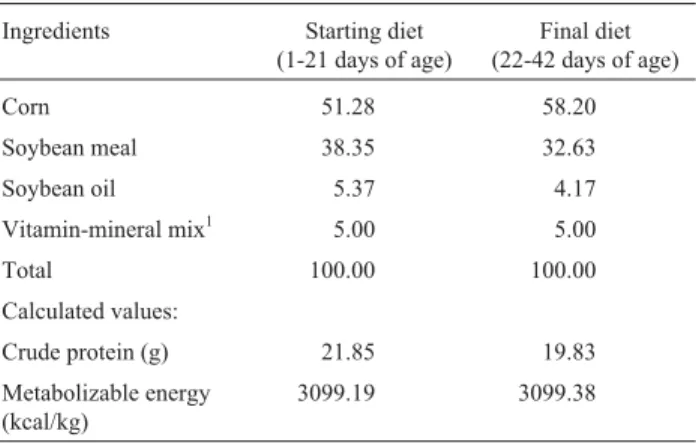
The birds were housed on the floor in separate boxes at a temperature close to thermoneutrality for each age in-terval. Thus, the initial temperature was 33 °C and de-creased at a rate of 2 °C per week to 23 °C at 35 days of age. The birds were fed ad libitum with diets containing 3,100 kcal of metabolizable energy (ME)/kg that consisted of corn and soybean meal with a vitamin-mineral supple-ment (Table 1). From 1-21 and 22-42 days of age, the birds were fed diets containing 21.8% and 19.8% of crude pro-tein (CP), respectively.
The growth curve for each strain was determined by weighing the birds at 1, 7, 21, 35 and 42 days of age. Food intake was also measured, and food conversion was calcu-lated for each strain for the initial (1-21 days), final (22-42 days) and total (1-42 days) periods.
Liver sampling
To assess IGF-I mRNA expression, three males of each strain were sacrificed by cervical dislocation at 1, 21 and 42 days of age and 1 gram of liver was quickly col-lected and frozen in liquid nitrogen. The samples were stored at -80 °C until total RNA isolation.
Blood sampling and IGF-I assay
Blood samples (5 mL) from male chickens (n = 12) were obtained by venipuncture (brachial vein) using a heparinized syringe. The blood was centrifuged at 3,000 rpm and 4 °C for 10 min. The plasma was collected and stored at -20 °C until assayed for IGF-I. Following the precipitation of plasma binding proteins (IGFBPs) with acidified ethanol, plasma IGF-I was quantified using a heterologous radioimmunoassay (RIA) previously vali-dated for chicken plasma (Huybrechtset al.1985).
For IGFBP precipitation, 400µL of an ethanol-HCl
solution (2 N HCl, 95% ethanol) were added to a tube con-taining 100µL of plasma. After vortex-mixing, the tubes
were incubated at room temperature for 30 min and then centrifuged at 3,000 x g for 30 min, at 4 °C. After centri-fugation, an aliquot (200 µL) of each supernatant was
collected without disturbing the precipitates and was thor-oughly mixed with 80µL of neutralizing solution (0.855 M Tris) followed by incubation for 60 min at room tempera-ture. After a further centrifugation (3,000 x g, 60 min, 4 °C), a 100µL aliquot was removed for IGF-I
quantifica-tion.
For RIA, 1µg of recombinant human IGF-I (hIGF-I)
in 0,1% acetic acid was iodinated with 1 mCi [125I] NaI (Amersham Biosciences) by adding chloramine T (0.1 mg/mL in 0.3 M sodium phosphate buffer, pH 7.6) in a stepwise manner over a period of 4.5 min. The iodination reaction was terminated by adding to the reaction mixture 150 µL of a solution containing 1.0 M NaI, 100 mM
KH2PO4, 0,1% BSA and 0.02% NaN3. Iodinated peptide
was separated from free 125I by chromatography on a Sephadex G-50 column pre-equilibrated and eluted with 30 mM NaH2PO4containing 0.25% BSA. The specific
ac-tivity of the purified [125I]-hIGF-I was ~ 320µCi/µg.
So-dium phosphate buffer (30 mM, pH 7.5), containing 10 mM EDTA, 0.02% protamine sulphate and 0.02% sodium azide was used to dilute the primary and secondary antibodies and the hormone standard for the assay. Standard hormone (hIGF-I) and tracer (125I-labelled hIGF-I) were initially dis-solved, diluted and stored in phosphate buffer containing 0,1% BSA. The RIA diluent was the phosphate buffer de-scribed above containing 0.05% (v/v) Tween 20.
The assay was done under nonequilibrium condi-tions. On day 1, RIA diluent (250µL) plus a 50µL sample of the acid-ethanol extract and 100µL of tracer containing
125
I-labelled hIGF-I (6,000 cpm) were added to RIA tubes containing 100µL of primary antibody (1:16,000 working
dilution), followed by mixing and incubation for 24 h at room temperature. On day 2, secondary antibody (100µL
of goat anti-rabbit IgG diluted 1:25 in phosphate buffer) plus 100µL of carrier solution (49 mL of RIA buffer, 1 mL
of normal rabbit serum, 1.5 g of polyethylene glycol) were added to each tube, followed by vortex-mixing and
Table 1- Composition (in %) of the diets used.
Ingredients Starting diet
(1-21 days of age)
Final diet (22-42 days of age)
Corn 51.28 58.20
Soybean meal 38.35 32.63
Soybean oil 5.37 4.17
Vitamin-mineral mix1 5.00 5.00
Total 100.00 100.00
Calculated values:
Crude protein (g) 21.85 19.83
Metabolizable energy (kcal/kg)
3099.19 3099.38
1Vitamin and mineral mix/kg: vitamin A 176,000IU, vitamin D3
centrifugation at 2,000 x g for 30 min at 4 °C. Subse-quently, 1 mL of 1 M NaCl and 6% polyethylene glycol were added and incubated at 4 °C for 10 min followed by centrifugation at 2,000 x g for 30 min. The resulting supernatant was aspirated and the pellet counted in a
γ-counter. The intra-assay coefficient of variation was
6.9%.
Dot blot analysis of IGF-I mRNA expression
Frozen hepatic tissue (1 g/bird) was homogenized, and total RNA was isolated by the guanidinium thiocyanate method of Chomczynski and Sacchi (1987). Total RNA was quantified by the absorbance at 260 nm and the relative IGF-I mRNA content was determined by dot blot hybrid-ization. Briefly, 20µg of total RNA were dried under
vac-uum and dissolved in 25 µL of 50% DMSO (dimethyl
sulphoxide), 10 mM sodium phosphate, pH 7.0 and 1.0 M glyoxal. After incubation at 50 °C for 1 h, the samples were placed on dry ice. Two dilutions of 5µg and 10µg of RNA
were prepared in a final volume of 400µL of TE (10 mM Tris-HCl, 1 mM EDTA, pH 8.0) and dotted (Bio-Dot Microfiltration Apparatus, Bio-Rad) onto nylon mem-branes (Hybond N, Amersham Pharmacia Biotech). The membranes were pre-hybridized for 2 h at 65 °C in a pre-hybridization solution (1% BSA fraction V, 7% sodium dodecyl sulphate, 1 mM EDTA, 0.5 M sodium phosphate, pH 7.2), with 20 mL per 100 cm2, and hybridized for 16 h at 65 °C with the same solution containing a randomly labeled (Feinberg and Vogelstein, 1983) cDNA probe for chicken IGF-I (cloned into the pGEM-3Z plasmid and kindly pro-vided by Dr. Peter S. Rotwein (School of Medicine, Wash-ington University)). After hybridization, the membranes were washed twice in wash A solution (0.5% BSA, 5% SDS, 1 mM EDTA, 40 mM sodium phosphate, pH 7.2) at 65 °C for 30 min. Autoradiography was done using Kodak X-OMAT X-ray film and Dupont Cronex Lightening Plus intensifying screens. For re-probing, the membranes were washed in 10 mM Tris-HCl at 90 °C for 20 min and then re-hybridized with a cDNA probe for rat 28S RNA under the same conditions as used for IGF-I cDNA. The signals obtained in the dots were quantified by densitometry (GS 300 densitometer, Hoefer Scientific Instruments) and the values were normalized according to the 28S RNA hybrid-ization signal, used as an RNA quantity and quality control for each sample. The densitometric values obtained were within the linear range of the method.
Statistical analysis
The experiments were done using a split-plot design with strains as parcels and age as sub-parcels. The data were analyzed using the general linear model procedure (GLM) and means were compared by the Tukey test using SAS software (SAS Institute, 2000).
Results
Table 2 shows the mean body weight from 1 to 42 days of age for the three strains studied. As expected, broiler chickens of the fast growing strain (HP) grew faster than the NN and C strains (NN also grew faster than C). The hatching body weight was higher (p < 0.05) in HP broilers than in the other strains (HP > NN = C). This difference could be attributed not only to genotype, but also to the nu-tritional status and age of the chickens. From seven days of age, the three strains differed in body weight (p < 0.05), with HP birds always being the heaviest, followed by NN and C birds.
The weight gain of the HP strain paralleled the better food conversion values (Table 3), but only during the initial phase (1-21 days), when HP had a significantly lower food conversion than NN birds (1.50vs.1.65, p < 0.05). During the final phase (22-42 days), food conversion was not dif-ferent (2.18vs. 2.24, p > 0.05) between the HP and NN strains, but both were different (p < 0.05) from C birds.
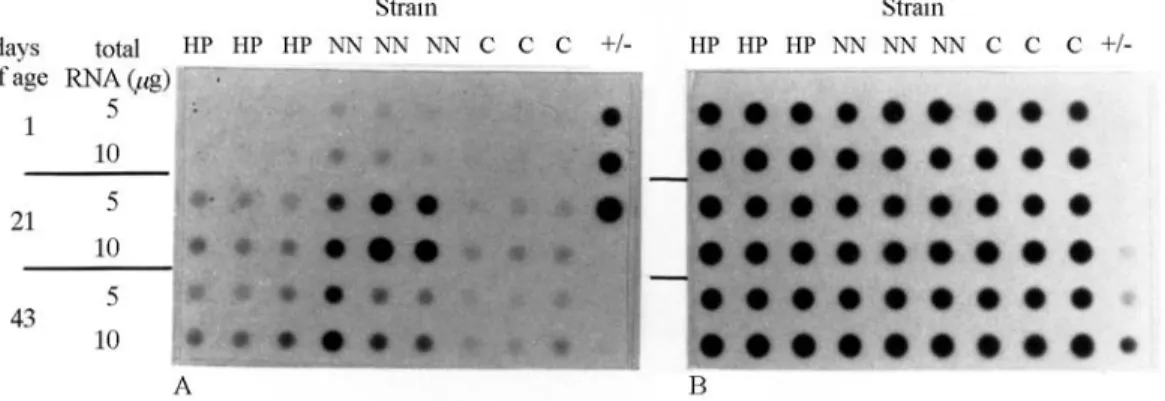
Figure 1 shows the autoradiographic signals of the dot blots for hepatic IGF-I mRNA and 28S cDNA, the latter used as an internal control. The dots correspond to ages of 1, 21 and 42 days. The relative densitometric values for the dots at the three different ages (expressed as arbitrary units) are shown in Table 4. Regardless of the broiler strain, hepatic IGF-I mRNA expression increased with age, from hatching to 21 days old. From 21 to 42 days, a decrease (p < 0.05) in IGF-I mRNA expression was seen in the NN strain. A comparative analysis among strains showed that NN had a much higher hepatic IGF-I mRNA expression than the other two strains at the age of 21 days (NN > HP > C).
The plasma IGF-I concentrations for the three strains at different ages are shown in Table 4. The broiler strain did not affect the levels of circulating IGF-I but, as observed for IGF-I mRNA expression, plasma IGF-I levels increased from 1 to 21 days of age with no significant change thereaf-ter (days 21 to 42).
Table 2- Mean body weight (g) of the three strains (Hubbard-Pettersen, Naked-neck and Caipira) during the 42 days of the experiment.
Strains
Age (days) HP1 NN C F values CV (%)
1 43.8a2 36.9b 35.2b 83.8 2.58
7 139.2a 81.3b 69.7c 306.8 4.40
21 740.9a 333.3b 201.7c 838.4 4.57
35 1,573.0a 656.0b 363.1c 1,917.7 3.34
42 2,070.5a 911.0b 527.0c 1,352.4 3.74
1
Discussion
As expected, the HP and NN birds had better growth performances than the C strain. At 42 days of age, body weight was significantly different among the three strains, thus confirming the growth potential of the genetically im-proved strains. Despite the increase in body weight, food conversion was not different for HP and NN strains after 21 days. Thus, the regulatory mechanisms involved in growth seem to be dependent on the genetic characteristics of the strains and also on the age of the birds.
Burnside and Cogburn (1992) reported that the hepatic expression of IGF-I mRNA in broiler chickens peaked at 28 days of age, and Beccavinet al.(2001) found that high growth rate birds had a five-fold increase in IGF-I expression from the first to sixth week of life. The plasma concentration of IGF-I was reported to increase
progres-Table 4- Relative values for hepatic IGF-I mRNA expression and plasma IGF-I concentrations in the three strains at 1, 21 and 42 days of age.
Age (days) Strains
HP1 NN C
Hepatic IGF-I mRNA expression (arbitrary units), n = 3
1 0.707Ba2 1.017Ba 0.707Ba
21 2.193Ab 4.553Aa 1.525Ab
42 2.226Ab 3.023Aa 1.600Ac
Plasma IGF-I concentration (ng/mL), n = 12
1 5.20Ba 7.47Ba 4.33Ba
21 30.31Aa 29.68Aa 29.38Aa
42 26.09Aa 30.34Aa 26.98Aa
1
HP: Hubbard-Pettersen; NN: Naked-neck, C: Caipira.2Means with simi-lar capital letters in the columns and lower case in the rows are not signifi-cantly different (p > 0.05).
Table 3- Mean weight gain (g), food intake (g) and food conversion during the initial (1-21 days), final (22-42 days) and total (1-42 days) experimental periods for the three broiler chicken strains used.
Strains
Variable Period (days)
HP1 NN C F
value
CV (%)
Body weight (g)
1-21 697.1a2 296.5b 167.4c 896.7 4.77
22-42 1,329.6a 577.7b 325.3c 1,547.0 3.57
1-42 2,020.7a 874.1b 491.8c 1,382.6 3.80
Food intake (g)
1-21 1,044.7a 490.1b 433.2c 688.5 3.93
22-42 2,893.6a 1,296.1b 964.0c 1,196.6 3.47
1-42 3,938.2a 1,786.2b 1,397.2c 1,144.6 3.41
Food conversion
1-21 1.50c 1.65b 2.61a 346.0 3.35
22-42 2.18b 2.24b 2.97a 78.1 4.07
1-42 1.94b 2.05b 2.85a 146.3 3.06
1HP: Hubbard-Pettersen; NN: Naked-neck, C: Caipira.2Means followed by the same letter in the rows are not significantly different (p > 0.05).
sively until the third week of age, and reached a plateau by the seventh week (McGuiness and Cogburn, 1990; Beccavin et al., 2001). As already observed by others (Kikuchi et al., 1991; Burnside and Cogburn, 1992; Radeckiet al., 1997; Beccavin et al., 2001), the hepatic IGF-I mRNA expression and IGF-I plasma levels in the present study also increased from hatching to day 21, with hepatic expression increasing at least three-fold and plasma levels showing a six- to seven-fold increase. Nevertheless, at 42 days of age, both the expression and plasma IGF-I lev-els showed no significant increase (p > 0.05) when com-pared to 21 days, although other reports have indicated that this increase persisted until six weeks of age (McGuiness and Cogburn, 1990; Burnside and Cogburn, 1992; Beccavinet al.2001).
The most interesting finding of this study was that the patterns of increase in IGF-I expression and production were the same, irrespective of the broiler chicken strain, ex-cept for the NN strain, which had higher values at all ages, but also showed reduced IGF-I mRNA expression from 21 to 42 days of age. Huybrechtset al.(1987) and Goddardet al.(1988) observed no positive correlation between growth rate and absolute plasma IGF-I levels in chickens. Our re-sults also showed that there was no clear correlation be-tween the growth of the birds and hepatic IGF-I mRNA expression and plasma IGF-I levels.
In mice, complete disruption of the liver IGF-I gene in the post-natal period decreased the circulating IGF-I lev-els by 75%, while the growth rate was normal (Yakaret al., 1999). According to Oudinet al.(1998), there were no dif-ferences in the number, affinity or tyrosine kinase activity of IGF-I receptors purified from the muscles of fast and slow growth chickens at one to seven weeks of age. Thus, the difference in body weight among strains may be related to the hypothalamic-pituitary feedback mechanism that in-terferes with GH synthesis and release. This aspect requires further investigation, as does the genetic variation in mus-cle IGF-I gene expression, especially since a paracrine ac-tion of IGF-I on chicken muscle has been reported (Duclos
et al., 1999).
The temporal regulation of IGF-I expression in broiler chickens of unrelated genotypes and different growth rates has been studied (Goddard et al., 1988; Ballardet al., 1990; Johnsonet al., 1990), but no influence of strain was reported. In contrast, in work with chickens of different genotypes and high or low growth rates, Scaneset al. (1989) found that plasma IGF-I levels were lower in the low compared to high weight strains. Becavinet al. (2001) also found that high growth rate birds had higher levels of hepatic IGF-I mRNA and plasma IGF-I. Thus, the in-creased hepatic IGF-I mRNA expression observed here, which was associated with age but not strain, could be re-lated to the complex regulatory mechanisms of growth in birds. Liver GHR (growth hormone receptor) expression is low after hatching, but increases with age (Burnside and
Cogburn, 1992; Scaneset al., 1996; Maoet al., 1998). In fast growing broilers, increased hepatic GHR expression was observed between the first and the fourth week of age and coincided with an increase in IGF-I mRNA expression and plasma IGF-I levels (Leunget al., 1987). The subse-quent decrease in plasma GH, also described by McCann-Levorseet al.(1993), does not appear to interfere with the hepatic GHR since the number and affinity of these receptors compensates for the low level of circulating GH, thereby maintaining the steady-state expression of IGF-I mRNA.
These results show that the ontogenetic pattern of hy-pothalamic-pituitary axis activity after hatching is appar-ently independent of broiler chicken strain, despite the magnitude of the difference in their growth response. To-gether with previous reports (Leiliet al.1997; Beccavinet al.1999, 2001), our findings indicate that additional tempo-ral regulatory mechanisms related to nutrition and age are involved in modulating the expression of hepatic IGF-I mRNA and the consequent increase in plasma IGF-I levels.
Acknowledgments
This work was supported by grants from FAPESP, PADCT and CNPq. E. C. Riedel was supported by a mas-ter’s fellowship from CNPq.
References
Ballard FJ, Johnson RJ, Owens PC, Francis GL, Upton FM, McMurtry JP and Wallace JC (1990) Chicken insulin-like growth factor-I: amino acid sequence, radioimmunoassay, and plasma levels between strains and during growth. Gen Comp Endocrinol 79:459-468.
Beccavin C, Chevalier B, Simon J and Duclos MJ (1999) Circu-lating insulin-like growth factors (IGF-I and II) and IGF binding proteins in divergently selected fat or lean chickens: effect of prolonged fasting. Growth Horm IGF Res 9:187-194.
Beccavin C, Chevalier B, Cogburn LA, Simon J and Duclos MJ (2001) Insulin-like growth factors and body growth in chickens divergently selected for high and low growth rate. J Endocrinol 168:297-306.
Burnside J and Cogburn LA (1992) Developmental expression of hepatic growth hormone receptor and insulin-like growth factor-I mRNA in the chicken. Mol Cell Endocrinol 89:91-96.
Chomczynski P and Sacchi N (1987) Single-step method of RNA isolation by acid guanidinium thiocyanate-phenol-chloroform extraction. Anal Biochem 162:156-159. Dawe SR, Francis GL, McNamara PJ, Wallace JC and Ballard FJ
(1988) Purification, partial sequences and properties of chicken insulin-like growth factors. J Endocrinol 117:173-181.
Feinberg AP and Vogelstein B (1983) A technique for radiolabeling DNA restriction endonuclease fragments to high specific activity. Anal Biochem 132:6-13.
Florini JR, Ewton DZ and Coolican SA (1996) Growth hormone and the insulin-like growth factor system in myogenesis. Endocr Rev 17:481-517.
Girbau M, Gomez JA, Lesniak MA and de Pablo F (1987) Insulin and insulin-like growth factor I both stimulate metabolism, growth, and differentiation in the postneurula chick embryo. Endocrinology 121:1477-1482.
Goddard C, Wilkie RS and Dunn IC (1988) The relationship be-tween insulin-like growth factor-1, growth hormone, thyroid hormones and insulin in chickens selected for growth. Domest Anim Endocrinol 5:165-176.
Huybrechts LM, King DB, Lauterio TJ, Marsh J and Scanes CG (1985) Plasma concentrations of somatomedin-C in hypo-physectomized, dwarf and intact growing domestic fowl as determined by heterologous radioimmunoassay. J Endocrinol 104:233-239.
Huybrechts LM, Kuhn ER, Decuypere E, Merat P and Scanes CG (1987) Plasma concentrations of growth hormone and somatomedin C in dwarf and normal chickens. Reprod Nutr Dev 27:547-553.
Johnson RJ, McMurtry JP and Ballard FJ (1990) Ontogeny and secretory patterns of plasma insulin-like growth factor-I concentrations in meat-type chickens. J Endocrinol 124:81-87.
Kikuchi K, Buonomo FC, Kajimoto Y and Rotwein P (1991) Ex-pression of insulin-like growth factor-I during chicken de-velopment. Endocrinology 128:1323-1328.
Leenstra FR, Decuypere E, Beuving G, Buyse J, Berghman L and Herremans M (1991) Concentrations of hormones, glucose, triglycerides and free fatty acids in the plasma of broiler chickens selected for weight gain or food conversion. Br Poult Sci 32:619-632.
Leili S, Buonomo FC and Scanes CG (1997) The effects of dietary restriction on insulin-like growth factor (IGF)-I and II, and IGF-binding proteins in chicken. Proc Soc Exp Biol Med 216:104-111.
Leung FC, Styles WJ, Rosenblum CI, Lilburn MS and Marsh JA (1987) Diminished hepatic growth hormone receptor bind-ing in sex-linked dwarf broiler and leghorn chickens. Proc Soc Exp Biol Med 184:234-238.
Mao JNC, Burnside J, Postel-Vinay MC, Pesek JD, Chambers JR and Cogburn, LA (1998) Ontogeny of growth hormone re-ceptor gene expression in tissue of growth-selected strains of broiler chickens. J Endocrinol 156:67-75.
McCann-Levorse LM, Radecki SV, Donoghue DJ, Malamed S, Foster DN and Scanes CG (1993) Ontogeny of pituitary growth hormone and growth hormone mRNA in the chicken. Proc Soc Exp Biol Med 202:109-113.
McGuinness MC and Cogburn LA (1990) Measurement of devel-opmental changes in plasma insulin-like growth factor-I lev-els of broiler chickens by radioreceptor assay and radioimmunoassay. Gen Comp Endocrinol 79:446-458. Oudin A, Chevalier B and Simon J (1998) Muscle insulin-like
growth factor-I (IGF-I) receptors in chickens with high and low body weight: effects of age and muscle fiber type. Growth Horm IGF Res 8:243-250.
Radecki SV, Capdevielle MC, Buonomo FC and Scanes CG (1997) Ontogeny of insulin-like growth factors (IGF-I and IGF-II) and IGF-binding proteins in the chicken following hatching. Gen Comp Endocrinol 107:109-117.
Rosebrough RW and McMurtry JP (1993) Protein and energy re-lationships in the broiler chicken. Effects of protein quantity and quality on metabolism. Br J Nutr 70:667-678.
Rosebrough RW, McMurtry JP and Vasilatos-Younken R (1992) In vitrolipid metabolism, growth and metabolic hormone concentrations in hyperthyroid chickens. Br J Nutr 68:667-676.
SAS Institute (2000). SAS (Statistical Analysis System): users’ Guide. SAS Institute, Cary, 496 pp.
Scanes CG, Dunnington EA, Buonomo FC, Donoghue DJ and Siegel PB (1989) Plasma concentrations of insulin like growth factors (IGF-I) and IGF-II in dwarf and normal chickens of high and low weight selected strains. Growth Dev Aging 53:151-157.
Scanes CG, Radecki, SV and Aramburo C (1996) Growth hor-mone and growth factors in avian development. Poult Avian Biol Rev 7:89-98.
Yakar S, Liu JL, Stannard B, Butler A, Accili D, Sauer B and LeRoith D (1999) Normal growth and development in the absence of hepatic insulin-like growth factor I. Proc Natl Acad Sci USA 96:7324-7329.