FOCUSING ON DISSOCIATED MOTOR
DEVELOPMENT IN BRAZILIAN CHILDREN
Maria Avanise Yumi Minami
1, Carolina A.R. Funayama
2, Julio Cesar Daneluzzi
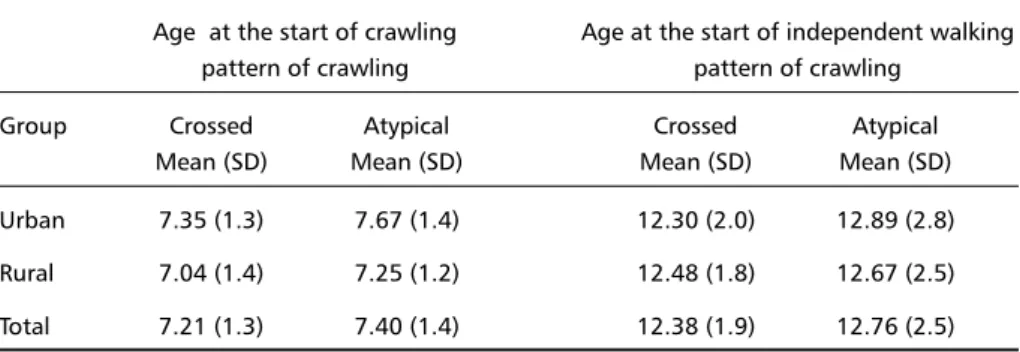
3ABSTRACT - Dissociated motor development (DMD) is considered when the baby starts independent walking late, with normality of the other fields of development. There is evidence that babies with DMD present an atypical crawling pattern and hypotonia. To investigate the frequency and characteristics of DMD, neurological examination was performed monthly in 177 healthy full-term babies from 6 months age, in urban and rural zone samples in Brazil. Among 20 children with atypical crawling, none presented hypotonia neither did they start independent walking late. The means of the ages at the begining of atypical crawling and independent walking acquisitions, 7.40mo (SD 1.4) and 12.76mo (SD 2.5) respectively, did not differ from the group with crossed crawling pattern. Thus, in this sample of Brazilian healthy children we did not find cases with DMD.
KEY WORDS: crawling, postural development, child development, motor skills, child.
Desenvolvimento motor dissociado: um enfoque em crianças brasileiras
RESUMO - Desenvolvimento motor dissociado (DMD) é considerado quando o bebê inicia tardiamente a marcha sem apoio, tendo apresentado normalidade em outros setores do desenvolvimento. Tem sido associado à hipotonia e ao engatinhar atípico. Para investigar a frequência e características do DMD, exame neurológico foi realizado mensalmente após os 6 meses em 177 bebês nascidos a termo, em duas amostras procedentes de zona rural e urbana no Brasil. Entre as 20 crianças com engatinhar atípico, nenhuma apresentou hipotonia e nem atraso para a marcha sem apoio. As médias das idades no início do engatinhar atípico e marcha independente foram 7,40 (dp 1,4) meses e 12,76 (dp 2,5) meses respectivamente, que não diferiram do grupo que engatinhou com padrão cruzado. Portanto, nesta amostra de crianças brasileiras não foram encontrados casos com DMD.
PALAVRAS-CHAVE: engatinhar, desenvolvimento postural, desenvolvimento infantil, habilidades motoras, criança.
Faculdade de Medicina de Ribeirão Preto da Universidade de São Paulo (FMRP-USP), Ribeirão Preto SP, Brazil: 1Neuropediatra,
Pós-graduanda; 2Docente do Departamento de Neurologia, Psiquiatria e Psicologia Médica; 3Docente do Departamento de Pediatria e
Puericultura, responsável pelo Centro Social Comunitário de Vila Lobato.
Received 21 February 2001, received in final form 24 May 2001. Accepted 30 May 2001.
Dra. Carolina Araújo Rodrigues Funayama - Departamento de Neurologia, Psiquiatria e Psicologia Médica HC Campus 4º andar 14048-900 Ribeirão Preto SP Brasil. E-mail: [email protected]
Illingworth (1958)
1was the first to use the term
dissociated development (DMD) when reporting
cases of children who presented delays in one of
the five areas of development described by Gesell in
relation to others. This author
1described children
with delayed postural development but without
de-lays in other fields, and attributed these deviations
to hypotonia, hypertonia or even cerebral palsy. In
the same study, Illingworth acknowledged that
iso-lated cases of delays can also occur in motor
devel-opment without an apparent reason, with perfectly
normal future development.
Hagberg and Lundberg, 1969 (Apud Robson
2)
stu-died 32 children diagnosed with DMD, and defined
DMD as a condition in which the fine, adaptive,
lin-guistic and personal/social development are normal
in accordance with the age, while postural
develop-ment is significantly retarded. Of this group, 15
chil-dren started crawling and walking late (12.5 and
20months on average respectively), and all presented
the atypical crawling pattern. This group contained
children diagnosed with hypotonia or cerebral palsy,
although their postural development became
nor-mal later on without requiring treatment. Robson
2for this pattern of crawling, proposing a genetic
he-ritage based on a dominant mode of transmission.
Lundberg
3studied the clinical characteristics of
the children with different crawling patterns and
dis-tinguished two groups of children who presented
the atypical pattern: those diagnosed with DMD with
pathological characteristics with detectable
hypoto-nia and those who were suffering from the
idio-pathic delayed walking syndrome without damage
to the nervous system and without detectable
hypo-tonia. Lundberg
3also mentions the difficulty
distin-guishing one group from the other, and cites an
im-portant factor: children with the idiopathic delayed
walking syndrome do not have any pre, peri or
post-natal history of nervous system injury, but do
pos-sess a comprehensive family history of the atypical
crawling pattern. Robson
4studied normal children
with various patterns of crawling and related these
factors with the age these children started to walk.
He distinguished two groups: the group that walked
earlier formed by children who did not crawl and
those with the crossed pattern besides those who
started walking later, formed by children with the
atypical pattern, and concluded that these different
crawling patterns are more closely related to a
varia-tion of normal patterns than with a pathological
con-dition, as Touwen
5and Illingworth
6had already
sug-gested.
The aim of this study was to investigate the
oc-currence, frequency and characteristics of DMD in
healthy full-term babies in two different samples,
one from Urban (Gr.U) and another from Rural (Gr.R)
origin.
METHOD
Inclusion criteria: 1. full-term babies with a known ges-tational age of 37 to 42 weeks, based on the date of the last menstrual period or compatible Somatic Capurro In-dex7. 2. male or female, 6 months age. 3. without
neurolo-gical and/or pediatric antecedents that could interfere in the neurological development. 4. babies without clinical signs of neurological lesions, excepting global hypotonia or hypotonia restricted to the axis, as expected1,2 for children
with dissociated motor development. 5. cephalic perim-eter, weight and stature in the adequate channel of the growth curve, according to the curves of Marcondes & Machado8.
Population studied: children who had been attended and accompanied at two Centers maintained by the De-partment of Pediatrics and Child Welfare of the School of Medicine of Ribeirão Preto, São Paulo University: The So-cial Community Center of Vila Lobato and The SoSo-cial Com-munity Medical Center Januário Theodoro de Souza.
The district of Vila Lobato is located in the northeastern
region of the city of Ribeirão Preto, covering an area of 5 thousand houses with an average population of 22 thou-sand inhabitants, predominantly from the lower middle class. This population presents typically urban character-istics. The group was designated as Urban Group (Gr.U).
The Social Community Medical Center Januário Theo-doro de Souza, is located in the city of Pradópolis, lo-cated 34 Km southeast of downtown Ribeirão Preto Cen-ter, which currently has 12 thousand inhabitants. Eight thousand of these inhabitants live in the urban zone and 4 thousand in the rural zone, and are also characterized as a lower middle class population. As to the type of work in the region, agricultural jobs in the sugar cane planta-tions predominate, with a small percent of jobs in the sugar-alcohol plant. This population has typically rural char-acteristics and usually bring up their babies without ap-paratus such as baby-comforts, prams or walkers, that are common in the urban zone. The group was designated Rural Group (Gr.R).
Data collection: the parents were initially informed about the objective of the work and of the subsequent accompaniment; the children were only included in the study after obtaining the consent of the parents.
The evaluations were conducted by the examiner in medical consulting-type rooms with the minimum amount of external interference possible after the child had been attended in Pediatrics. The evaluation took place in the presence of the parents and subsequent visits were scheduled.
The evaluations were only made when the child pre-sented good clinical conditions and proved cooperative during the exam.
This was a longitudinal study. One neurological evalu-ation was performed every month until the child started walking independently.
Those children who had began a pre-walking locomo-tor strategy at the age of 5 months were included in the work, based on detailed descriptions provided by the mother and on the short period of time that had passed. The protocol developed for this survey included a ques-tionnaire for the genitors and/or adult familiar with the daily lifestyle of the child, consisting of information re-lated to motor acquisition, information on maternal work and resources for the child, items from the classic neuro-logical exam and of neuroneuro-logical development, prepared with a basis on the evaluation proposals of Saint-Anne Dargassies9-11; Amiel-Tison12; Lefèvre13; Diament14;
Milani-Comparetti and Guidoni15,16; Zdanska-Brincken and
Wolanski17.
For the data analysis, we separated the children in 3 groups according to the pre-walking locomotor strategy and took the following definitions into consideration:
in the prone position (lying down on the stomach) on the four limbs, hands-knees or hands-feet flexed (knees ex-tended), according to the definition submitted by Lund-berg3. There can even be asymmetry of the lower limbs as
to the position of the knee (flexed or extended). We also included children who presented other forms of pre-walk-ing locomotion in this group, such as draggpre-walk-ing of but-tocks, abdomen or rolling, and, after a given period, these children passed on to the crossed pattern.
2. Atypical pattern: children with atypical crawling characteristics, i.e., those with pre-walking locomotion:
a. as described by Peiper, 1963 (Apud Robson2): a
sliding movement with the torso erect and the hips flexed. The child supports him/herself on both buttocks or one buttock with the lower limbs flexed, and can use feet or hands or both for propulsion.
b. in the prone position, characterized according to the definition presented by Green et al.18: child lying on
his/her stomach, using the abdomen as a point of sup-port, with free movement of the pelvic and scapular belt; the propulsion and point of support can be realized by the four limbs.
3. Children who did not crawl: are those in which no locomotor strategy was observed prior to independent walking. (Bottos et al. 19); Robson4 defined these as
chil-dren who, from the sitting position, stood up and walked. Others define them as children who passed from the roll-ing phase or from the sittroll-ing position to the upright posi-tion with support presenting reptilian movements. These children started walking with support first and then with-out (Largo et al.20).
For calculation purposes, the various forms of crossed pattern crawling were only considered with the crossed pattern while two forms were considered for the atypical pattern: shuffling, i.e., sliding on the buttocks (buttocks)
and dragging of the abdomen (abdomen), and the form rolling + abdomen was considered for calculations such as abdomen locomotion.
The beginning of the crawling and independent walk-ing period was considered in complete months (mo).
For the statistical analysis we used the non-parametric test developed by Mann-Whitney and Kruskal-Wallys.
RESULTS
A total of 177 children were included: 93
belon-ged to Gr.U (46 males and 47 females) and 84 (46
males and 38 females) to Gr.R. Twelve (12.6%) of
Gr.U and 21 (25%) of Gr.R were Black or Mulattoes;
one child of Gr.R from Japanese origin and the
oth-ers were white. 30% from GrU and 23% from GrR
remained in the home, under the direct care of the
mother.
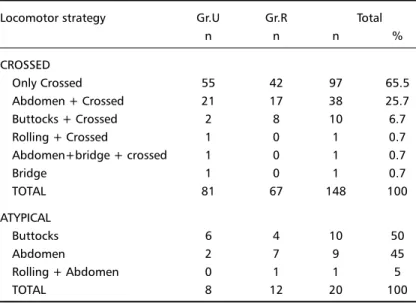
From 177 children, 168 (95%) have crawled.
Among 148 with crossed pattern of crawling, 50
(33,7%) presented an atypical pattern before
cross-ing (Table 1).
From 168 children who have crawled, 20 (12%)
presented only atypical pattern (buttocks sliding or
shuffling and abdominal dragging). In the Gr.R we
found a trend to predominance of female children
with dragging. (Table 2).
Among the total of 177 children: none of them
presented hypotonia in the limbs or body axis,
fur-ther to that expected for the age bracket. None of
them presented asymmetric responses in the
classi-cal nerologiclassi-cal exam. None of them started the
crawl-ing after the 10
thmonth. None of them started
in-dependent walking after 18 months age.
Concerning the start of crawling and
indepen-Table 1. Distribution of the pre-walking locomotor strategy in the Urban (Gr.U) and Rural (Gr.R) groups.
Locomotor strategy Gr.U Gr.R Total
n n n %
CROSSED
Only Crossed 55 42 97 65.5
Abdomen + Crossed 21 17 38 25.7
Buttocks + Crossed 2 8 10 6.7
Rolling + Crossed 1 0 1 0.7
Abdomen+bridge + crossed 1 0 1 0.7
Bridge 1 0 1 0.7
TOTAL 81 67 148 100
ATYPICAL
Buttocks 6 4 10 50
Abdomen 2 7 9 45
Rolling + Abdomen 0 1 1 5
dent walking periods according to the patterns of
crawling, no significant difference was found
com-paring Gr.U to Gr.R as the means of the ages at the
start of crawling and independent walking
accord-ing to the patterns of crawlaccord-ing (Table 3).
DISCUSSION
Considering the initial observation made by
Illin-gworth
1and the subsequent publications some
dou-bts about DMD remain. The aetiology and the
pecu-liarities of the postural development of DMD, such
as the pattern of crawling and the characteristics of
the muscle tonus have not been clarified at all.
Tak-ing into account the family studies of Robson
2,
al-though he did not provide information about
pre-natal or peripre-natal periods, he suggested that there
would be a group with different characteristics from
those with cerebral palsy: a benign variation of
nor-mality, with possible inherited basis, a delay in the
independent walking, with shuffling (sliding on the
buttoks) as a prewalking strategy and the presence
of hypotonia. In this series, Robson described with
details the evolution of the hypotonia in the axis and
limbs. On the other hand, Lundberg
3considered
DMD as a result of a pathological cerebral condition
and suggested another new group, different from
that with DMD, the idiopathic delayed walking
syn-drome with atypical crawling but without
hypoto-nia, that would be an inherited condition. We
con-sider that the major criterion for DMD diagnosis is
the late walking that comes beyond the range of
normality in otherwise healthy infants who presented
an atypical pattern of crawling. It is quite difficult
think of DMD diagnosis in children with cerebral
le-sion. These children do not present late walking as
unique sequel; the retard occurs since early phases
of postural development; the hypotonia did not
ham-per the crossed pattern of crawling, as we observe
in the clinical practice, and in agreement with Bobath
and Bobath
21. In addition, according to data from
Bottos et al.
19no enhance was seen in the number
of shufllers and creepers in the group with cerebral
lesion, comparing to the control group.
In the present casuistic of normal babies, around
34% of the crawlers had some type of atypical
pat-tern of crawling before starting the crossed
crawl-ing. We could consider that those babies who
pre-sented only atypical pattern lacked the crossed phase,
and persisted with the same pattern untill walking.
In the present, our concern was only about the
characteristics of the pattern of crawling and the
incidence of late walkers among healthy babies. We
found a group of children with atypical crawling
patterns, who did not start walking after the
nor-mal range, and who did not present signs of
hypo-tonia or asymmetric tonus. Therefore, we did not
find DMD nor idiopathic delayed walking
syndro-me in this sample of healthy children, even analysing
Table 3. Means of ages in months at the start of crawling and independent walking according to the patterns of crawling
Age at the start of crawling Age at the start of independent walking pattern of crawling pattern of crawling
Group Crossed Atypical Crossed Atypical
Mean (SD) Mean (SD) Mean (SD) Mean (SD)
Urban 7.35 (1.3) 7.67 (1.4) 12.30 (2.0) 12.89 (2.8)
Rural 7.04 (1.4) 7.25 (1.2) 12.48 (1.8) 12.67 (2.5)
Total 7.21 (1.3) 7.40 (1.4) 12.38 (1.9) 12.76 (2.5)
Table 2. Distribution of 20 cases with atypical crawling pattern according to sex.
Urban Rural Total
Buttocks Abdomen Buttocks Abdomen
Male 3 1 0 4 8
Female 3 1 2 6 12
their different characteristics such as rural or urban
origin.
We concluded that DMD seems to be a rare
condi-tion among Brazilian children, and late independent
walking, regardless the pattern of crawling, should
be faced carefuly, towards pathological condition.
REFERENCES
1. Illingworth RS. Dissociation as a guide to developmental assessment. Arch Dis Childhood 1958;33:118-122.
2. Robson P. Shuffling, hitching, scooting or sliding: some other observa-tions in 30 otherwise normal children. DMCN 1970;12:608-617. 3. Lundberg A. Dissociated motor development. Developmental patterns,
clinical characteristics, causal factors and outcome, with special refer-ence to late walking children. Neuropädiatrie 1979;10:161-182. 4. Robson P. Prewalking locomotor movements and their use in
predict-ing standpredict-ing and walkpredict-ing. Child Care, Health Dev 1984;10:317-330. 5. Touwen BCL. A Study on the development of some motor phenomena
in infancy. DMCN 1971;13:435-446.
6. Illingworth RS. Know the normal or else...? Arch Dis Childhood 1979;54:849-852.
7. Capurro H. Método clínico para diagnosticar la edad gestacional del recien nacido. Thesis, Faculdad de Medicina de la Universidad de la Republica de Uruguay, Montevideo, 1971.
8. Marcondes E, Machado DVM. Crescimento e desenvolvimento. In Alcântara P, Marcondes E (eds). Pediatria básica, São Paulo: Procienx. 1971:39-56.
9. Saint-Anne Dargassies S. Neurodevelopmental symptoms during the first year of life: Part I. Essential landmarks for each key-age. DMCN 1972;14:235-246.
10. Saint-Anne Dargassies S. Neurodevelopmental symptoms during the first year of life: Part II. Practical examples of the assessment method to the abnormal infant. DMCN 1972;14:247-264.
11. Saint-Anne Dargassies S. Desarrolo neurologico del recien nacido de termino y prematuro. Buenos Aires: Medica Panamericana, 1977. 12. Amiel-Tison C. A method for neurologic evaluation within the first
year of life. Curr Prob Ped 1976;7:1-50.
13. Lefèvre AB.Contribuição para a padronização do exame neurológico do recém-nascido normal. Tese, Faculdade de Medicina da Universi-dade de São Paulo. São Paulo, 1950.
14. Diament AJ. Evolução neurológica do lactente normal. São Paulo: EDART, 1976.
15. Milani-Comparetti A, Gidoni EA. Pattern analysis of motor develop-ment and its disorders. DMCN 1967;9:625-630.
16. Milani-Comparetti A, Gidoni EA. Routine Developmental examina-tion in normal and retarded children. DMCN1967;9:631-638. 17. Zdanska-Brincken M, Wolanski N. A graphic method for the
evalua-tion of motor development in infants. DMCN 1969;11:228-241. 18. Green EM, Mulcahy CM, Puntney TE. An investigation into the
devel-opment of early postural control. DMCN 1995;37:437-448.
19. Bottos M, Barba BD, Stefani D, Petena G, Tonin C, D’Este A. Locomotor strategies preceding independent walking: prospective study of neuro-logical and language development in 424 cases. DMCN 1989;31:31-34. 20. Largo RH, Molinari L, Weber M, Comenale-Pinto L, Duc G. Early de-velopment of locomotion: significance of prematurity, cerebral palsy and sex. DMCN 1985;27:183-191.