Arq Neuropsiquiatr 2001;59(2-A):255-258
Departamento de Neurologia, Faculdade de Ciências Médicas, Universidade Estadual de Campinas (UNICAMP), Campinas SP, Brazil. Supported by FAPESP.
Received 14 September 2000, received in final form 4 December 2000. Accepted 8 December 2000.
Dr. Fernando Cendes, MD, PhD - Departamento de Neurologia - FCM – UNICAMP - Caixa Postal 6111 - 13083-970 Campinas SP - Brasil. E-mail: [email protected]
LATE ONSET TEMPORAL LOBE EPILEPSY WITH
MRI EVIDENCE OF MESIAL TEMPORAL SCLEROSIS
FOLLOWING ACUTE NEUROCYSTICERCOSIS
Case report
Eliane Kobayashi, Carlos A.M. Guerreiro, Fernando Cendes
ABSTRACT - The objective of this case report is to describe magnetic resonance imaging (MRI) evidence of mesial temporal sclerosis (MTS) in a patient with new onset temporal lobe epilepsy (TLE) and acute neurocysticercosis with multiple cysts. A 56 years old man with new onset headache, Simple Partial Seizures and Complex Partial Seizures underwent CT scan and lumbar puncture as diagnose proceeding. Multiple cysts and meningitis were identified, with a positive immunology for cysticercosis. Seizures were recorded over the left temporal region in a routine EEG. Treatment with albendazole was performed for 21 days, with clinical improvement and seizure remission after 4 months. An MRI scan 11 months after treatment, showed complete resolution of those cystic lesions and a left hippocampal atrophy (HA) with hyperintense T2 signal. The presence of HA and hyperintense T2 signal in this patient has not, to date, been associated with a poor seizure control.
Conclusions: This patient presented with MRI evidence of left MTS after new onset partial seizures of left temporal lobe origin. Although we did not have a previous MRI scan, it is likely that this hippocampal abnormality was due to the acute inflammatory response to cysticercosis associated to repeated partial seizures. This suggests that acute neurocysticercosis associated with repeated seizures may cause MTS and late onset TLE.
KEY WORDS: temporal lobe epilepsy, hippocampal atrophy, mesial temporal sclerosis, acute neurocysticercosis.
Epilepsia de lobo temporal de início tardio com evidências de esclerose mesial temporal após quadro agudo de neurocisticercose: relato de caso
RESUMO - O objetivo deste relato édescrever a evidência de esclerose mesial temporal (EMT) por ressonância magnética (RM) em um paciente com epilepsia de lobo temporal (ELT) de início tardio e múltiplos cisticercos. Um paciente de 56 anos previamente hígido, iniciou quadro de cefaléia, crises parciais simples e complexas, sendo realizadas TC de crânio e punção lombar. Foram visualizados múltiplos cistos e meningite com imunologia positiva para cisticercose. Registramos crises com início em região temporal esquerda durante um eletroencefalograma de rotina. Iniciamos tratamento com albendazol, por 21 dias, e observamos melhora clínica e remissão de crises após 4 meses. RM feita 11 meses após o tratamento mostrou resolução completa das lesões císticas e uma atrofia hipocampal (AH) esquerda com hipersinal em T2. A presença de AH com hipersinal em T2 neste paciente não está até o momento associada com crises refratárias. Conclusões: Apesar de não dispormos de RM previamente ao início do quadro clínico, é provável que esta alteração hipocampal seja decorrente da resposta inflamatória aos cisticercos associadamente às crises parciais repetidas. Isto sugere que formas agudas de neurocisticercose associadas a crises repetidas possam causar EMT e ELT de início tardio.
PALAVRAS-CHAVE: epilepsia de lobo temporal, atrofia hipocampal, esclerose mesial temporal, neurocisticercose aguda.
The presence of a cystic parenchimatous lesion
of neurocysticercosisis associated to inflammatory
response, depending on the patient immunological
tolerance. It may remain active and present
progres-sive growth, sometimes not associated to clinical
manifestation for years
1-3.
256 Arq Neuropsiquiatr 2001;59(2-A)
symptoms, including seizures, headache or focal
neurological deficits. The CSF may be normal or show
only mild protein elevation, but pleocytosis with
pres-ence of eosinophilus and a positive ELISA or
immu-nofluorescence test is commonly observed
1-3.
The treatment with cysticids (albendazole or
praziquantel) in most patients accelerate the
de-generation of cysts and improve clinical symptoms
3,4,
but this remains controversial
1. Neurocysticercosis
and seizures are common and its relationship is more
clearly identified in patients with adult onset partial
seizures, frequently associated to headache or focal
neurological deficits. The correlation between cyst
localization and seizure semiology is variable, as well
as the correlation between number of cysts and
sei-zure frequency
2,4,5.
The recent advances on neuroimaging have
pro-vided means for better evaluating patients with
epi-lepsy, particularly those with refractory seizures or
suspected structural abnormalities. New MRI
tech-niques have allowed a more detailed evaluation of
cystic lesions, inflammatory response (observed as
the presence of edema or gadolinium enhancement)
and associated abnormalities
6.
The presence of hippocampal atrophy (HA)
asso-ciated with altered internal structure and increased
T2 signal is an “in vivo” MRI evidence of mesial
tem-poral sclerosis (MTS)
7. MTS is a particular
pathologi-cal finding, observed more than a century ago, with
a specific pattern of neuronal loss on subfields of
hippocampal formation and other medial temporal
structures
8. It has been associated to prolonged
febri-le seizures and recurrent seizures, but the
relation-ship of repeated seizures and HA remains uncertain
9.
The co-existence of HA and neurocysticercosis has
been demonstrated, mainly in patients with
calci-fied lesions and history of temporal lobe epilepsy
(TLE), with early seizure onset and refractory
epi-lepsy
10,11. As TLE is the most frequent form of partial
epilepsy and neurocysticercosis is highly prevalent
among our patients, these calcifications are thought
to have an innocent role in the clinical outcome of
these patients
11,12.
We describe in this report the early finding of
MRI evidence of MTS in a patient with new onset
complex partial seizures (CPS) after acute
neurocysti-cercosis, and we discuss the possible mechanisms in
the development of hippocampal pathology.
Arq Neuropsiquiatr 2001;59(2-A) 257
CASE
A 56 years old man came to our emergency room on 10/22/97, with history of pulsatile left headache for 4 days. The headache had an anterior predominance and was as-sociated with scotomas in the left hemifield, with no clini-cal improvement after analgesics. No significant mediclini-cal history was identified prior to this, except for tabacco and alcohol use. On neurological examination, no abnormali-ties were found and he was dispensed with NSAID and asked to return in 2 days for reevaluation.
On reevaluation he referred improvement of the head-ache, but started having short episodes of malaise, sudoresis, altered responsivity with speech abnormalities. During examination he presented a similar episode, with oromandibullary automatisms and aphasia, lasting for 2 minutes. We prescribed phenytoin infusion and ordered a CT scan.
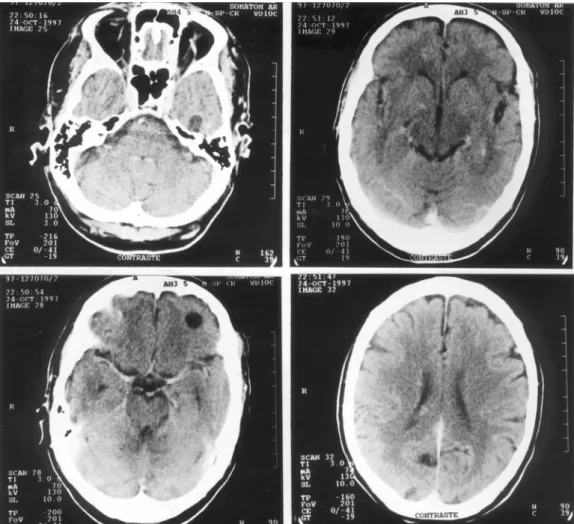
The CT showed multiple cystic lesions, with contrast enhancement, in the following regions: left frontal, left temporal, right parietal, and right Sylvian fissure (Fig 1).
A lumbar puncture was performed and CSF showed a mild pleocytosis (25 leucocytes: 90% limphocytes, 4% neutrophils, 6% eosinophils) with an increased protein (78 mg/dl) and glucose level (174 mg/dl). IgG level was 12
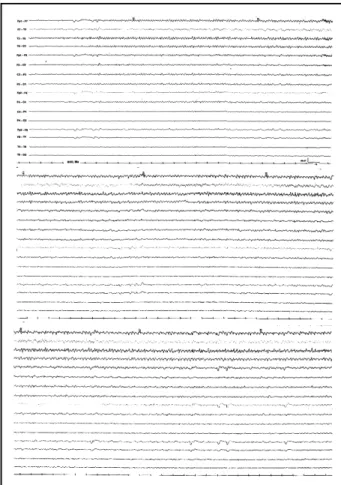
mg/dl. EEG showed 2 CPS with ictal onset in the left tem-poral region, and interictal EEG showed small sharp waves and continuous slow waves in the left temporal region (Fig 2).
We started treatment with prednisone 1mg/kg/day and after 5 days he received albendazole 20 mg/kg/day for 21 days. The patient continued having seizures once a week for the following 2 months. After this period, he had only sporadic episodes of CPS, the last one in 02/98. He is now on phenobarbital because he developed cutaneous rash related to phenytoin. He has had some episodes of mild headache but no further seizures. Another lumbar punc-ture was performed on 02/98 and CSF showed 21 leucocytes (100% limphocytes) and protein of 88 mg/dL. MRI was performed on 09/98 (11 months after sei-zure onset) and showed HA, altered internal structure and increased T2 signal (Fig 3). The previously identified cystic lesions on CT disappeared completely and only a small cyst over the right hippocampus, compatible with plexus choroyd cyst, was observed.
DISCUSSION
TLE is often associated with MTS, particularly in
patients with refractory seizures and history of
ear-lier prolonged febrile seizure
8. Nevertheless, the
eti-ology of MTS remains controversial. The surgical
re-section of the mesial temporal structures including
amygdala and hippocampus in these patients is
re-lated to a good outcome, with up to 95% of
pa-tients becoming seizure-free.
Fig 2. EEG performed during the acute infection, showing a left temporal onset seizure, clinically compatible with complex par-tial seizure.
258 Arq Neuropsiquiatr 2001;59(2-A)
More recently, MRI evaluation of patients with
mild TLE, including those with seizure remission or
only few episodes, has brought new insights about
the causative role of repeated seizures and other
environmental factors in the development of HA
13.
Moreover, the presence of subtle hippocampal
ab-normalities on asymptomatic individuals has pointed
the genetic influence on the epilepsy and the HA in
these patients
9,13.
The epileptogenic role of the cysticercus is
thought to be related to the inflammatory response
that it carries out
11. More frequently, the seizure
semi-ology is related to the localization of the cyst
14,15.
Our patient presented with new onset left
tem-poral lobe seizures during the acute infection of
neurocysticercosis and follow-up MRI evidence of
MTS. Although it is probable that the acute episode
of repeated CPSs induced some neuronal damage, it
is most likely that the presence of cysts in the
tempo-ral lobe associated with an acute inflammatory
respon-se nearby and within the hippocampus played a
ma-jor role in the development of MTS in this patient.
This suggests that an acute neurocysticercosis
in-fection, associated with repeated CPS may be one
etio-logic factor in the genesis of MTS and late onset TLE.
REFERENCES
1. Carpio A, Escobar A, Hauser WA. Cysticercosis and epilepsy: a critical review. Epilepsia 1998;39:1025-1040.
2. Monteiro L, Nunes B, Mendonça D, Lopes J. Spectrum of epilepsy in neurocysticercosis: a long term follow-up of 143 patients. Acta Neurol Scand 1995;92:33-40.
3. Vazquez V, Sotelo J. The course of seizures after treatment for cerebral cysticercosis. New Engl J Med 1992;327:696-701.
4. Santos IC, Kobayashi E, Cardoso TAM, Guerreiro CAM, Cendes F. Cysticidal therapy: impact on seizure control in epilepsy associated with neurocysticercosis. Arq Neuropsiquiatr 2000;58:1014-1020. 5. Kowacs PA, Rogacheski E, Werneck LC. The relevance of temporal
lobe as an irritative and symptomatogenic area in epilepsy associated to abnormal intracranial calcifications. Arq Neuropsiquiatr 1998;56 (Supl1): 314 (abstract).
6. Fried I, Kim JH, Spencer DD. Hippocampal pathology in patients with intractable seizures and temporal lobe masses. J Neurosurg 1992;76:735-740.
7. Watson C, Jack CR, Cendes F. Volumetric Magnetic Resonance Imag-ing. Clinical applications and contribuitions to the understanding of temporal lobe epilepsy. Arch Neurol 1997;54: 1521-1531.
8. Gloor P. Mesial temporal sclerosis: historical background and an over-view from a modern perspective. In Lüders H (ed). Epilepsy surgery. New York: Raven Press,1991:689-703.
9. Fernandez G, Effenberger O, Vinz B, et al. Hippocampal malformation as a cause of familial febrile convulsions and hippocampal sclerosis. Neurology 1998; 50: 909-916.
10. Manreza MLG. Epilepsia e neurocisticercose. In Guerreiro, et al. (eds). Epilepsia. 3.E. Lemos editorial, 2000; 255-264.
11. Jorge CL, Valerio RMF, Bueno JF, Guilhoto LMFF, Valente KDR, Yakubian EMT. Mesial temporal sclerosis: related or not to neurocysti-cercosis? Arq Neuropsiquiatr 1998;56 (Supl1):205.
12. Terra VC, Sakamoto AC, Santos AC, Garzon E, Mendes, MFSG. et al. Epilepsy and cerebral cysticercosis: correlation between CT, EEG and clinical findings. Epilepsia 1995;36(suppl 3):S266.
13. Kobayashi E, Cendes F, Guerreiro CAM, Lopes-Cendes I. MRI abnor-malities in familial temporal lobe epilepsy. Neurology 1999 (Suppl 2): A545.
14. Monteiro L, Nunes B, Mendonça D, Lopes J. Spectrum of epilepsy in neurocysticercosis: a long-term follow-up of 143 patients. Acta Neurol Scand 1995;92:33-40.