http://dx.doi.org/10.1590/0104-530X1357-16
Resumo: O presente estudo tem como propósito avaliar o efeito das ações e do sistema de apoio de duas incubadoras sobre o atual padrão de crescimento de empresas que passaram por processos de incubação e que se encontram graduadas há pelo menos 3 anos. Para tanto, realizou-se um estudo exploratório junto a 5 empresas de base tecnológica que pertenceram a 2 incubadoras ligadas à Universidade Estadual de Campinas. No período de pré-incubação analisaram-se características técnicas e gerenciais dos fundadores. No período de incubação buscou-se avaliar a atuação da incubadora na promoção das empresas. Por im, no período de pós-incubação, considerou-se o desempenho, o potencial, o impacto da incubadora e as principais barreiras que podem vir a diicultar o crescimento. Os principais resultados indicam que o processo de incubação e o sistema de apoio das incubadoras exerceram baixo impacto ou efeito sobre os diferentes padrões de crescimento identiicados.
Palavras-chave: Empresas de base tecnológica; Padrões de crescimento; Incubadora; Período pós-incubação. Abstract: This study aims to evaluate the effects of business incubators’ support on growth patterns of previously incubated irms that graduated at least three years prior the study. To this end, an exploratory study was carried out with ive technology-based irms belonging to two incubators linked to the Universidade Estadual Campinas. Concerning the pre-incubation period, this study focused on their founding partners’ technical and managerial attributes. As to the incubation period, the researchers sought to evaluate how successful the incubators had been in promoting the irms under investigation. Finally, the study investigates the incubators’ performance, potential, and impact and the major barriers to growth on the post-incubation period. The main results suggest that the incubation process as well as the incubators’ support system had little effect on the different growth patterns identiied.
Keywords: Technology-based irms; Growth patterns; Incubator; Post-incubation period.
Post-incubation of technology-based firms:
a case study on the effects of business incubators
on growth patterns
Pós-incubação de empresas de base tecnológica: um estudo de caso sobre o efeito da incubadora nos padrões de crescimento
Antonio Iacono1
Marcelo Seido Nagano2
1 Escola de Engenharia Industrial Metalúrgica de Volta Redonda, Universidade Federal Fluminense – UFF, Avenida dos Trabalhadores,
420, Vila Santa Cecília, CEP 27255-125, Volta Redonda, RJ, Brazil, e-mail: [email protected]
2 Escola de Engenharia de São Carlos, Universidade de São Paulo – USP, Avenida Trabalhador São-carlense, 400, Centro, CEP 13566-590,
São Carlos, SP, Brazil, e-mail: [email protected] Received Jan. 01, 2016 - Accepted June. 06, 2016 Financial support: None.
1 Introduction
Business incubators originated as a means to support the process of marketing new ideas and promote entrepreneurship and use of new opportunities in order to provide irms with a competitive edge in the product and service sectors of the market. Its main purpose is to not only support and encourage entrepreneurs to bring business ideas to fruition, but also contribute to the success of incubated irms.
Recent research has shown that mortality rates of previously incubated technology-based irms (TBFs) are very low, which points to the importance and effectiveness of this business-support mechanism.
notwithstanding, the post-incubation period is still a largely unmapped territory.
As regards the performance of incubators, graduation constitutes the best indicator of success. However, a high survival rate of graduated irms does not imply success per se. In reality, success should be deined as more than mere survival. In this sense, it is important to determine to what extent incubators’ speciic support components contribute to the survival and long-term growth of graduated irms.
Along these lines, this study aims to identify and investigate whether and how some incubation factors shape the growth pattern of graduated irms. To this end, this article is divided into sections presenting, in the following order, a brief theoretical framework about incubators of technology-based irms, the incubation period and process, and the post-incubation period. After discussing and employing the theoretical framework to construct the variables for this study, Section 4 presents its research methodology. In Section 5 are the results of the case study conducted with ive previously incubated irms that had graduated at least three years before the study began. The last section presents the authors’ inal remarks.
2 Incubation process
Incubators of technology-based irms (TBFs) house irms that make systematic use of scientiic/technological knowledge and advanced/pioneering techniques, i.e., their main input is technical-scientiic information and knowledge. Most TBFs originate from spinoffs of projects developed at universities and research centers. According to Fontes & Coombs (2001), these irms are known for their “technological dynamism,” i.e., their ability to identify and develop new technologies and grow rapidly after successfully introducing these new technologies to the market. This deinition incorporates the dimension of technological capacity building effort, a useful deinition in that these irms apply a signiicant portion of their resources to their activities despite not necessarily having the most solid and conventional R&D format (Côrtes et al., 2005).
The incubation process allocates a speciied period of time to business building and development of innovations proposed in previously selected projects. According to Mas-Verdú et al. (2015), the key function of incubators is to support entrepreneurs in their initial stage of business operation. Andino (2005) maintains that the incubation process is important in that incubated irms can thus adequately acquire competencies that will help them adapt to the market and prosper after graduating.
During the incubation period — typically three years long — incubated irms receive technical and managerial support in addition to logistics, which facilitates their access to funding mechanisms and promotes partnerships with innovation agents. According to Santos (2004), the incubation process aims to produce inancially viable and self-sustaining businesses upon leaving the incubator. Lundqvist (2014) and Xiao & North (2016) have emphasized the importance of incubator support services to the successful development and growth of new TBFs.
The incubation process can be divided into three stages, according to Abreu et al. (2006). The irst stage is called pre-incubation and lasts from three months to one year. The incubated irm uses this time to improve its business plan, conduct market research, and prepare technically for self-management. The next stage is the incubation proper. During this stage, the business plan — conceived in the previous stage — is developed. The irm can now take advantage of the facilities and other services supplied by the incubator. This stage is critical as regards value adding, and the incubator focuses on business orientation, monitoring, and evaluation. This stage usually lasts two years. Finally, the third stage — the post-incubation stage, which has no time limit — is when the irm is mature enough to operate on the market on its own. Then, the irm graduates from the incubator, but the latter’s services remain available to the former. The goal of this stage is to foster the irm’s autonomy and mitigate the impact of graduation from the incubator.
The incubation process pays special attention to the early phases. Aspelund et al. (2005) point out that the TBF entrepreneurs’ control of resources and strategic and market decisions — particularly in the early stages of the business life cycle — are predictive of their survival and growth in later stages. During the initial incubation stages, some components such as physical infrastructure and shared use of a variety of business support services can reduce important operational costs of the incubated irms and assist them in areas lacking in knowledge and expertise, e.g., marketing, accounting, and human resources. According to Schwartz (2009), the extent to which these support mechanisms work together is of fundamental importance to the survival and growth of incubated irms after graduation. However, it should be noted that there are usually discrepancies among key resources, which are crucial to the viability of the irm and its actual resource base, as pointed out by Schwartz (2013).
during every one of the incubation years (Iacono & Nagano, 2014). Neglecting these factors — as well as discrepancies among resources that are crucial to the viability of the business and its actual resource base, as highlighted in Schwartz (2013) — can jeopardize sustainable business growth and success after graduation.
According to Hackett & Dilts (2004), the business incubation process can be evaluated in terms of the irms’ economic performance and growth at the time of leaving the incubator. As regards business operation, there are ive different, mutually exclusive result states for incubated irms at the end of the incubation period, namely:
• Firm is surviving and growing proitably;
• Firm is surviving and growing, and is on its
path to becoming proitable;
• Firm is surviving but not growing, is not
proitable or is only marginally proitable;
• Firm’s operations have been suspended; it is still
incubated, but its losses have been minimized;
• Firm’s operations have been suspended; it is
still incubated, and its losses have been large. Historically, the literature has suggested that the irst three result states are indicative of incubation success and the last two indicative of failure (Hackett & Dilts, 2004).
Other important considerations worth mentioning are the length of time spent in the incubator and exit policies. Schwartz (2008) claims that there is no ideal incubation time, but a longer incubation period may make incubated irms too dependent on the support received, leading them to stop investing in speciic resource bases of their own.
As to exit policies, Grimaldi & Grandi (2005) argue that they must take into account the fact that incubated irms may take different times to reach a given development level, depending on their industry context (e.g., market access and size). In other words, company-speciic factors require that more lexible graduation policies be devised. In this sense, the literature suggests adjusting the incubation time (an average time) to each irm individually, since it depends on its adopted business model (which may include different strategies, life cycle, target market, etc.). Rothaermel & Thursby (2005) claim that graduation criteria should be determined on a case-by-case basis, i.e., a different maximum incubation time should be set for each irm depending on its features and environment.
3 Post-incubation
According to Schwartz (2008, 2009), little is known about the dynamics of survival or exit of irms after graduating from incubators and the speciic support factors that actually determine their failure, survival, and success after graduation. Despite the key function of incubation being to assist future entrepreneurs in establishing their businesses, post-incubation success is not a given (Mas-Verdú et al., 2015). Recent research has suggested that incubated irms may not beneit considerably from their relationship with their incubators and may even become more vulnerable to failure after graduation (Lasrado et al., 2016).
With regard to survival rates of irms that have undergone incubation, the literature has focused only on failure rates during the incubation period. Problems and dificulties associated to survival and failure rates of incubated irms, as indicative of incubators’ performance, are often neglected. It has been implicitly assumed that business support should not aim at the irm’s survival after leaving the incubator and that failure of graduated irms does not depend on their previous incubation process. Moreover, this view fails to acknowledge that successful graduation does not warrant long-term survival and success (Schwartz, 2009; Rothaermel & Thursby 2005).
Studdard (2006) contends that research on incubated irms should not be restricted to the incubation period; it should aim beyond their graduation. Rothaermel & Thursby (2005) argue in a similar vein, pointing to the fact that despite constituting an important milestone in the development of incubated irms, graduation per se does not guarantee their future success. According to Bruderl et al. (1992), the chances of survival of new irms can be associated to three groups of factors: (1) entrepreneurs/founding partners’ individual attributes; (2) features, structural characteristics, and strategies of irms; and (3) irms’ environmental conditions and challenges of irms.
lack of experience in the ield or poor management skills, are determinants of organizational failure.
The organizational ecology approach emphasizes factors relating to organizational structure and environmental conditions, as stated by Hannan & Freeman (1977, 1989) and Aldrich (1979), cited by Bruderl et al. (1992). Business mortality is one of the major factors addressed in this approach. New companies have a higher risk of failing than those that have been on the market longer.
Another aspect to be highlighted is that companies that are followers — i.e., companies entering a market with established players — stand a better chance of surviving than those supplying something entirely new. Bates (1990) claims that follower companies can beneit from an existing customer network and/or internal organizational processes/routines of proven eficiency.
Establishing support mechanisms during incubation and a post-graduation follow-up process can improve the success rate of an incubated irm, including not only business survival, but also growth and proitability, which are relatively low after graduation from the incubator.
The factors inluencing the success rate of new companies have been identiied by several studies. These studies, according to Marino & De Noble (1997), have sought to understand the founding partners’ experience and attributes, the product and market strategies, product originality, and structural speciicities of the sector in which they operate. Criterion variables, in turn, have included sales growth, employee growth, time-to-market of irst products, business survival, and inancial performance. These elements can be categorized under four perspectives. The irst perspective focuses on the conditions under which irms grow and survive. Gartner’s (1985) new business creation model and Sandberg’s (1986) new business performance model epitomize this perspective. Gartner’s model encompasses a set of variables addressing the entrepreneur’s attributes and the company’s environment, organization, and business process. Correspondingly, Sandberg’s model identiies entrepreneurial experience, strategy, and industrial structure as key determinants of performance.
Known as venture capitalist, the second perspective — based on Tyebjee & Bruno (1984), MacMillan et al. (1985, 1997) — puts emphasis on factors associated to managerial capacity, market attractiveness, competitive exposure, and resistance to external threats. The third perspective focuses on the business incubator proper, its management and support provided. Along these lines, Lumpkin & Ireland (1988) maintain that an incubator’s success is closely related to that of its members.
Critical success in this perspective revolves around the management team’s attributes, access to inancing, and market factors.
The fourth perspective emphasizes market structure and product strategies (Biggadike, 1979; Hobson & Morrison, 1983; Sandberg, 1986). Structural characteristics include customer concentration, product heterogeneity, and development stage of industry. Business strategies focus on product differentiation, quality, and services provided (Hobson & Morrison, 1983; Sandberg, 1986; Robinson, 1990). In this context, it is important to note that while posing a barrier to entry, industry concentration may also represent an opportunity for growth. Wagner (1994) argues that new companies operating in concentrated industries ind it more dificult to grow and, as a result, have higher failure rates. On the other hand, customers in a concentrated industry tend to welcome new suppliers as a means to regulate the industry leaders’ decision power. Besides, a new company may very well converge its resources on a single segment that has been neglected by the market leaders in a concentrated industry sector, i.e., a niche, thus boosting its initial growth.
4 Methodology
The case study method was employed in this research. An investigation — of an exploratory nature — was conducted in 2012 by means of questionnaires and interviews with founding partners of previously incubated irms. The analysis unit comprised ive previously incubated irms that had graduated at least three years before the study began.
The sample included irms that had graduated from two incubators in Campinas, Brazil: INCAMP (UNICAMP’s incubator of TBFs) and SOFTEX (also belonging to UNICAMP).
The questionnaires addressed mainly issues related to the pre-incubation, incubation, and post-incubation periods.
The goal of the questionnaire concerning the pre-incubation period was to analyze and evaluate the founding partners’ technical and managerial proile and knowledge before establishing the irms under investigation.
Questions about the incubation period sought to evaluate the incubation process, with emphasis on the knowledge acquired by the participating irms and the incubators’ support and other general contributions provided to them during this period. Finally, regarding the post-incubation period, the goal was to assess the performance, capacity, and potential of the irms and the main barriers to growth (or higher growth) encountered by them.
the extent to which opinions were homogeneous or heterogeneous. Chart 1 details the set of variables and indicators used in this study.
5 Results
Based on the questionnaire and interviews carried out at the irms under investigation, this section presents the results in the form of summary tables and discussion for every variable analyzed.
Chart 1. Description of research indicators and group of variables.
Variables Description Indicators
INDIVIDUAL/
PRE-INCUBA
TION
Attributes of founder/ entrepreneur and
characteristics of irm
Assess managerial attributes regarding previous work experience and technical knowledge of management team.
Education; professional history; experience in the sector; business experience; managerial competence; technical competence.
INCUBA
T
OR/INCUBA
TION PROCESS
Acquisition of knowledge via
incubator
Because irm is in incubator, how much has it contributed to obtaining knowledge needed for business development?
Necessary technical knowledge; necessary knowledge of business; necessary marketing knowledge; necessary knowledge in the inancial area; knowledge about innovation.
Support provided by incubator
Evaluation of assistance provided by incubator concerning several areas.
Technical monitoring; interaction between irm and incubator; actual business knowledge; management support; technological support; marketing support; market support.
Competencies of incubator
Capacity of incubator to provide services in several areas
Access to sources of capital; legal support; accounting support; consulting; marketing; contact with university; interaction with industry/industry sector; training in entrepreneurship.
Contribution of incubator in each
incubation year
Evaluate how incubator acted and contributed in speciic ways to solving main problems presented by irm every year throughout incubation.
Adequacy of incubation time; preparation for market; resources or infrastructure not offered and deemed important for promotion of irms; performance and contribution in each incubation year.
POST
-INCUBA
TION PERIOD
Performance of irm Assess current performance of irm.
Sales growth rate over post-incubation period; employment growth rate; proitability; time-to-market; amount of funds obtained from funding sources; inancial performance, technological performance.
Potential of irm Assess qualities and competencies of irm to add value to product/service.
Qualiication of management team; sophistication of irm’s product; investment in R&D; proit potential; potential to attract capital investments; short-term balance.
Present effect of incubator on
business
Assess beneits of incubator and its impact on business.
Growth rhythm; level of competitiveness; business knowledge; self-conidence; incubator image; inancial and infrastructure feasibility for business; personal and professional growth.
Present needs and dificulties
Assess needs and dificulties encountered by irm after being incubated for several years.
Market information; working capital; training of management team; commercialization; technology development; fund-raising; partnerships; inancing.
Source: Devised by authors.
5.1 Characterization of participating irms and proile of founding partners and management team
Three irms already had more than one patent and two were at the stage of development and analysis. As for personnel, three irms employed from ten to twenty professionals and two fewer than ive.
It is worth mentioning that all the irms under investigation had adopted product differentiation as a strategy for their main product. The low-cost strategy, when it occurred, was always for a second product. Another important aspect to be highlighted is the change in the business model that took place in three of the irms under investigation. One of the irms, in particular, merged with a foreign company after 3 years of incubation. This led the irm to offer its product and service on the foreign market. As for their market reach, two irms offered their products on both foreign and domestic markets, and the remaining ones only operated on the domestic market.
Regarding the entrepreneurs’ and management team’s proile, in all but one irm, the founding partners had not had any previous experience as entrepreneurs before establishing the irms. On the other hand, in all of the participating irms, the founding partners had a high academic level (graduate school). In relation to their familiarity with the industry sector, one irm had a good deal of experience and another did not have any. The remaining three had some experience, however little. As for the management teams, the members had had some previous business experience, however little as well, not exceeding ive years.
5.2 Incubation process
The incubation period was analyzed with the aim of evaluating, from a technical and managerial standpoint, the extent to which the incubator had contributed to business development, the amount and quality of support provided to the incubated irms, and its ability to promote business development through the services it provided.
Several factors were taken into consideration such as time devoted to the incubated irms, quality and use of resources, and the incubator management team’s
quality and training. Table 1 shows the indicators
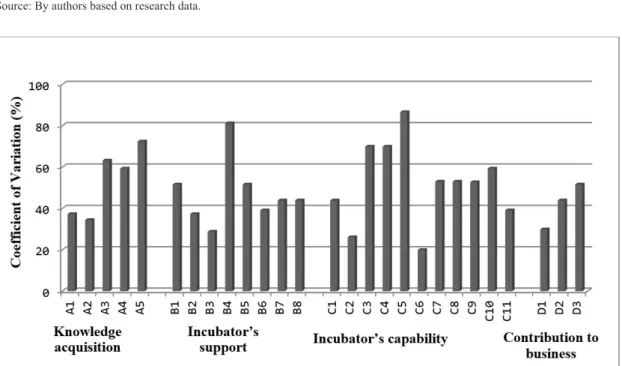
used for evaluation, e.g., average and coeficient of variation. The distribution of coeficients of variation per set of indicators is shown in Figure 1.
As regards the acquisition of knowledge via incubator, the incubators’ contribution to the incubated irms acquiring the knowledge needed for developing their business was assessed in management areas related to marketing, inance, and innovation. Table 1 shows that, on the whole, the participating irms consider the level of business development knowledge acquired via incubator as low.
Technical knowledge and that related to innovation rated the lowest. Marketing and business administration knowledge in general, in spite of obtaining the best rates, was considered low, too. In other words, the study results suggest that the knowledge acquired by the irms under investigation through their incubators contributed little to their development. Although it met the irms’ basic needs, this knowledge did not adequately address market and, specially, technological aspects. This can be observed in the indicators of support provided by the incubators. As regards this set of indicators, it is worth highlighting the heterogeneity of the answers given by the participants. The coeficient of variation in Table 1 and Figure 1 points to some homogeneity in the answers about technical and administration knowledge acquisition, i.e., the majority of the participants evaluated these factors in the same way. However, the coeficient of variation indicates strong heterogeneity in the responses when it comes to other factors such as marketing and innovation, implying that the level of importance in relation to knowledge acquisition differs considerably in these cases.
The support offered by the incubators was considered mostly insuficient, especially regarding advice and follow-up about technical factors. Most participants stated that more support and attention to technological, marketing and marketing factors was necessary. With regard to these factors, a total lack of support and monitoring was found in some cases. From the businesspersons’ viewpoint, more time should have been assigned to building the participating irms’ knowledge of actual problems and monitoring subsequent actions in order to promote business development. However, it should be observed that the technical support provided to the irms also shows dispersion in the responses, which indicates that different irms evaluate it differently.
The incubator’s ability to supply a variety of appropriate services to promote business was assessed in different ways. This heterogeneity is relected in the coeficients of variation. The management consulting services encompassing several areas of the irms were considered of great relevance to the cases in which the entrepreneurs did not have previous experience in business management. The incubators — through their available resources — provided, in this manner, vital professional training, especially concerning business management.
Table 1. Average and Coeficient of Variation (CV) of indicators during incubation.
Code Indicators Average CV (%)
A Knowledge acquisition via incubator Average CV (%)
A1 Technical (product design, manufacturing, etc.) 1.20 37.3
A2 Managerial (accounting, personnel, strategic planning, etc.) 2.60 34.4
A3 Marketing (sales, service provision, market conditions, etc.) 2.60 63.2
A4 Financial (risk capital, subsidies, angel investors, banks, etc.) 2.20 59.3 A5 Innovation (innovation process, project management, technology, etc.) 1.80 72.4
B Support provided by incubator Average CV (%)
B1 Time devoted to monitoring irm from a business point of view 2.60 51.6
B2 Time devoted to monitoring irm from a technological point of view 1.20 37.3
B3 Interaction time between irm and incubator managers 3.80 28.8
B4 Time devoted to getting to know the irm’s real problem 2.40 81.2
B5 Support and advice in management 3.20 51.6
B6 Support and advice in technology 1.80 39.1
B7 Support and advice in marketing 2.60 43.9
B8 Support and advice about the market 2.60 43.9
C Incubator’s competencies Average CV (%)
C1 Provision of administrative support services 2.60 43.9
C2 Provision of management knowledge 3.20 26.1
C3 Provision of access to sources of capital (banks, venture capitalists, and angels) 2.60 69.9
C4 Provision of legal support services 2.60 69.9
C5 Provision of accounting support services 2.00 86.6
C6 Provision of consulting services 4.20 19.9
C7 Provision of specialized marketing services 2.80 53.0
C8 Provision of contacts with universities 2.60 53.0
C9 Development of professional training 3.00 52.7
C10 Development of business as a whole 2.20 59.3
C11 Interaction with industry and/or industry sector 1.40 39.1
D Contribution of incubator to development of business Average CV (%)
D1 First incubation year 2.8 29.9
D2 Second incubation year 2.6 43.9
D3 Third incubation year 2.5 51.6
Source: By authors based on research data.
of capital, for others, these same items were not addressed adequately. Another important aspect is the lack of interaction between the incubator and the industry or industry sector. For the participants, a closer relationship with the industry is of paramount importance when their irms are still incubated, novices in their industry sector, since they often do not have business references or direct contact with the market. It is worth mentioning that the network support provided by the incubator should allow the creation of internal and external networks, as emphasized by Soetanto & Jack (2016) and Scillitoe & Chakrabarti (2010). In other words, it appears that the incubators contributed more to managerial training, albeit at a basic level, than to business development in general. Differences in the types of needs and levels of support provided by the incubators are also found throughout the three years of the incubation period.
In the irst year of incubation, most entrepreneurs considered the incubators’ contribution as of little
signiicance, as shown in Table 1. This is relected in
the coeficient of variation (29.9%), which is lower as compared to those relating to the following years.
Throughout the next stages of the incubation process, there is a decrease, however small, in the level of importance. According to the participants, the incubator’s importance is greater in the irst year because they get considerable support to develop their business idea and product. The irm owners stated that the incubators had not contributed consistently to solving the assortment of problems they faced in the second year, after the innovation stage of incubation. The incubators’ contribution is considered even lower in the third year. It is important to note that in this context the necessities of the irms throughout the incubation process can differ considerably. It is also worth noting that, insofar as the importance assigned by the irms under investigation to the incubators’ contribution decreases, the coeficient of variation increases, which indicates that the incubator’s contribution to business development is not so low for some irms under investigation.
In the irst year, it seems that the participating irms place more emphasis on business deinition and possible sources of funds. Whereas the irms’ major focus was on capacity building for product development and inancial resources for its implementation in the irst year, in the second year the innovation dynamics, marketing mechanisms, and partnerships appear to have been more relevant. In the third year, commercialization rose in importance, followed by inancing, the latter already present throughout the whole period.
As regards the incubation time, 80% of the irms under investigation claimed it to be adequate. For one irm, in particular, the incubation time was too short. In this case, the interviewee stated that because the development of his product was complex, it demanded a longer incubation period as well as greater investment. Yet, it is worth noting that when asked about their need for follow-up support after graduation, only one irm declared that they did not need it; the majority stated that support regarding marketing and inancial issues would be appreciated in order to accelerate growth.
In short, the results presented above clearly show that the participating irms’ assessment of their incubator’s performance as regards management is much more positive than that related to technology and innovation. As for indicators of dispersion of responses, the existing heterogeneity may be not only a result of mere diversity of opinion, but also due to the participating irms having different experiences.
5.3 Post-incubation
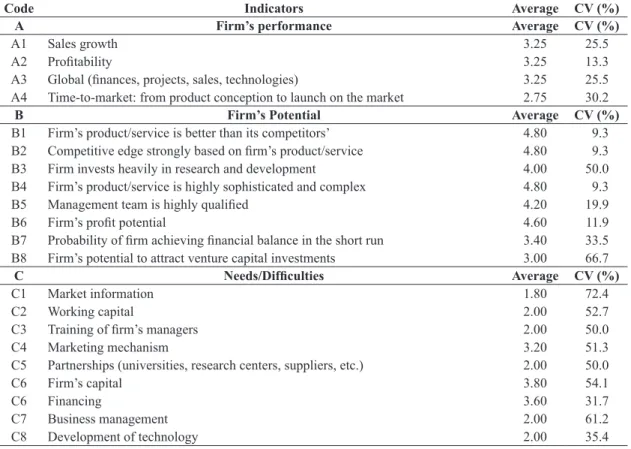
The post-incubation period was analyzed in order to evaluate the participating irms’ trajectories after graduation from their corresponding incubators. To this end, the performance of the irms was observed and so were their external environment (market and competitiveness), their current potential to compete, develop, and add value, their incubators’ current effect on them, and their needs and/or dificulties regarding business development. The irms’ performance was evaluated with reference to inancial results, personnel, management, and product. Table 2 presents the indicators used for evaluation.
Table 2 indicates that, in general, the participating irms had an average performance, which was corroborated by their own perceptions (Figure 2). It should be mentioned that just four of the participating irms responded to this question. One of them was still at the stage of product development and completion for commercialization due to lack of funding and resources for the inal project.
highest barriers. As regards the occupancy rate, with the exception of one irm, all presented an increase in personnel over the years.
In relation to their external environment, entry barriers were signiicant. Some of the participating irms’ markets are relatively new, and product promotion as well as marketing investments are constrained by scarce resources. Incubated irms that face price competition have many dificulties,
as they are still small-scale producers and their processes are not fully eficient. Competitive intensity was considered average-to-high by most participating irms. One of the strategies adopted by them to operate in competitive markets was to invest in niches.
Regarding the potential of the irms, i.e., their then capacity to be competitive and add value to their businesses, this study aimed to evaluate, Table 2. Average and Coeficient of Variation (CV) of post-incubation indicators.
Code Indicators Average CV (%)
A Firm’s performance Average CV (%)
A1 Sales growth 3.25 25.5
A2 Proitability 3.25 13.3
A3 Global (inances, projects, sales, technologies) 3.25 25.5
A4 Time-to-market: from product conception to launch on the market 2.75 30.2
B Firm’s Potential Average CV (%)
B1 Firm’s product/service is better than its competitors’ 4.80 9.3
B2 Competitive edge strongly based on irm’s product/service 4.80 9.3
B3 Firm invests heavily in research and development 4.00 50.0
B4 Firm’s product/service is highly sophisticated and complex 4.80 9.3
B5 Management team is highly qualiied 4.20 19.9
B6 Firm’s proit potential 4.60 11.9
B7 Probability of irm achieving inancial balance in the short run 3.40 33.5
B8 Firm’s potential to attract venture capital investments 3.00 66.7
C Needs/Dificulties Average CV (%)
C1 Market information 1.80 72.4
C2 Working capital 2.00 52.7
C3 Training of irm’s managers 2.00 50.0
C4 Marketing mechanism 3.20 51.3
C5 Partnerships (universities, research centers, suppliers, etc.) 2.00 50.0
C6 Firm’s capital 3.80 54.1
C6 Financing 3.60 31.7
C7 Business management 2.00 61.2
C8 Development of technology 2.00 35.4
Source: By authors based on research data.
among other aspects, their product performance as compared to that of their competitors’, investment in R&D, product sophistication, management team’s skills and qualiication, and proitability potential.
According to the respondents, all participating irms considered their products competitive. They also considered having the technical and management training needed to develop and grow proitably. At the same time, for 60% of the participants, their irms were not attractive enough to venture capital investments.
For one irm, its product — due to its radical innovation — represented a high risk to investment, which made the irm less attractive to venture capital. It is also worth highlighting and drawing attention to short-term inancial issues. Eighty percent of the irms found it dificult to reach inancial balance in the short term, which indicates the need for greater revenue and proitability. Financial oscillations can inhibit investment and future growth. However, the results regarding this group of factors indicates a degree of homogeneity in the responses given by the participants, as shown in the low coeficients of variation. That is, there is greater agreement among the participants, as expected, since the indicators depict the entrepreneurs’ opinions about their own irms’ potential.
Regarding current needs and/or dificulties, the objective was to evaluate the level of intensity of factors related to marketing, inancial, commercial,
and technological issues, as shown in Table 2.
At the stage of growth in which the participating irms were, the major dificulties were related to marketing mechanisms and fundraising, whether through inancing sources or via risk capital. It should be observed that the irms’ products, on the whole, were at a mature and technologically competitive stage, thus requiring viable and effective marketing mechanisms. Due to their size, small companies sometimes cannot obtain the inancial resources needed to leverage sales because in most cases they lack the required guarantees and inancial balance.
Nevertheless, it is important to observe that there is some dispersion in the responses about needs and dificulties, (Figure 2), which indicates that the intensity of these needs and dificulties was the same for all the irms under investigation.
6 Conclusion
This study aimed at evaluating the growth pattern of TBFs in the post-incubation period and the impact of incubation on this pattern. The incubated irms displayed some growth, however small with respect to proitability.
While graduating was relatively easy for the irms, post-incubation survival and growth were not.
The analysis of this process and the performance of the participating irms indicates that:
• Three irms display growth and are on the way
to proitability, however at a slow pace, which can compromise survival in the medium term, given that they their products have shorter life cycles and are sold in highly competitive markets;
• Two irms are at the survival stage despite
their potential.
In short, the results suggest that the incubation process and the incubator support system had little or no effect on the growth patterns identiied. Despite the potential presented by the participating irms, relected in the sophistication of their products and in their managers’ and technicians’ qualiications, these irms lack — in different measures throughout the incubation process — support in order to sort out marketing, inancial, and product promotion issues, which rise to paramount importance after graduation. In this sense, it is possible to afirm that the main objective of the incubator, i.e., to produce inancially viable and independent companies, is lacking since it is often limited to the evaluation of their “success” at graduation. In other words, the assessment of incubators’ contribution has focused more on the incubation process itself than on post-incubation challenges.
It is important to emphasize: irstly, that these are preliminary results within a broader research project; secondly, that other aspects of this research need to be further investigated and, inally, that the issues addressed in this study refer to the participants’ opinions and perceptions. Despite the importance of participants’ perceptions, further exploration of these issues is required, as reported opinions may differ somewhat from reality.
7 Final remarks
The incubation process was important to all irms under investigation, especially concerning provision of infrastructure and support in business management and training, important aspects to nascent irms and, especially, to those whose founding partners lack prior business experience.
Biggadike, R. E. (1979). The risky business of diversification. Harvard Business Review, 57, 103-111.
Bruderl, J., Preisendorfer, P., & Ziegler, R. (1992). Survival chances of newly founded business organizations. American Sociological Review, 57(2), 227-242. http:// dx.doi.org/10.2307/2096207.
Côrtes, M. R., Pinho, M., Fernandes, A. C., Smolka, R. B., & Barreto, A. L. C. M. (2005). Cooperação em empresas de base tecnológica: uma primeira avaliação baseada numa pesquisa abrangente. São Paulo em Perspectiva, 19(1), 85-94. http://dx.doi.org/10.1590/ S0102-88392005000100007.
Fontes, M., & Coombs, R. (2001). Contribution of new technology-based firms to the strengthening of technological capabilities in intermediate economies. Research Policy, 30(1), 79-97. http://dx.doi.org/10.1016/ S0048-7333(99)00095-5.
Gartner, W. B. (1985). A conceptual framework for describing the phenomenon of new venture creation. Academy of Management Review, 10(4), 696-706.
Grimaldi, R., & Grandi, A. (2005). Business incubators and new venture creation: an assessment of incubating models. Technovation, 25(2), 111-121. http://dx.doi. org/10.1016/S0166-4972(03)00076-2.
Hackett, S. M., & Dilts, D. M. (2004). A real options-driven theory of business incubation. The Journal of Technology Transfer, 29(1), 41-54. http://dx.doi. org/10.1023/B:JOTT.0000011180.19370.36. Hannan, M. T., & Freeman, J. (1977). The population ecology
of organizations. American Journal of Sociology, 82(5), 929-964. http://dx.doi.org/10.1086/226424.
Hannan, M. T., & Freeman, J. (1989). Organizational ecology. Cambridge: Harvard University Press.
Hobson, E. L., & Morrison, R. M. (1983). How do corporate start-up ventures fare? In J. Hornaday, J. Timmons & K. Vesper (Eds.), Frontiers of entrepreneurship research (pp. 390-420). Wellesley: Babson College.
Iacono, A., & Nagano, M. S. (2014). Gestão da inovação em empresas nascentes de base tecnológica: evidências em uma incubadora de empresas no Brasil. Interciencia, 39(5), 296.
Lasrado, V., Sivo, S., Ford, C., O’Neal, T., & Garibay, I. (2016). Do graduated university incubator firms benefit from their relationship with university incubators? The Journal of Technology Transfer, 41(2), 205-219. http:// dx.doi.org/10.1007/s10961-015-9412-0.
Lumpkin, J. R., & Ireland, R. D. (1988). Screening practices of new business incubators: the evaluation of critical success factors. American Journal of Small Business, 12, 59-81.
Lundqvist, M. A. (2014). The importance of surrogate entrepreneurship for incubated Swedish technology provided. Overall, the incubation process focused
more on internal issues of the participating irms (organizational management) than on their external environment (market).
In this sense, it is important that the incubation program strive for meeting, on a company-to-company basis, the diverse needs arising during this period. This fact can be veriied by the high degree of dispersion found in the entrepreneurs’ responses. The heterogeneity presented by the participants, through the coeficients of variation, should be considered as of great importance, since the incubation process includes the establishment of new company with novice entrepreneurs, whose attributes and potentialities differ greatly among themselves. It is also worth emphasizing that the introduction of new technologies or technological advances by companies requires efforts and support that differ from those required by traditional ones. Solutions to these problems, due to the size and condition of nascent companies, exceed their strengths and conditions.
Thus, the importance of qualiied management is clear; managers should be capable of interacting with all the actors involved, inside and outside the organization, so that the necessary support can be adequately provided to different incubated irms. It is also worth noting that the incubation process should mostly help irms acquire capacities effectively in order to accomplish the goal of adapting to the market and prospering. Since nascent companies are more vulnerable, the incubation program should aim to meet a wide assortment of needs arising over the three-year incubation period.
References
Abreu, F., Swirski, Y., & Gonçalo, C. (2006). Aprendizagem e criação do conhecimento em incubadoras. In Anais do XXX Encontro Nacional da Associação Nacional de Pós-graduação e Pesquisa em Administração (EnANPAD). Salvador: ANPAD.
Aldrich, H.E. (1979). Organizations and environments. Englewwood Cliffs: Prentice-Hall.
Andino, B. F. A. (2005). Impacto da incubação de empresas: capacidades de Empresas pós-incubadas e empresas não incubadas (Dissertação de mestrado). Universidade Federal do Rio Grande do Sul, Porto Alegre.
Aspelund, A., Berg-Utby, T., & Skjevdal, R. (2005). Initial resources’ influence on new venture survival: a longitudinal study of new technology-based firms. Technovation, 25(11), 1337-1347. http://dx.doi. org/10.1016/j.technovation.2004.06.004.
Schwartz, M. (2008). Incubator age and incubation time: determinants of irm survival after graduation? (IWH-Discussion Papers). Halle: RePEc-Econpapers, ECONIS. Schwartz, M. (2009). Beyond incubation: an analysis of
firm survival and exit dynamics in the post-graduation period. The Journal of Technology Transfer, 34(4), 403-421. http://dx.doi.org/10.1007/s10961-008-9095-x. Schwartz, M. (2013). A control group study of incubators’ impact to promote firm survival. The Journal of Technology Transfer, 38(3), 302-331. http://dx.doi. org/10.1007/s10961-012-9254-y.
Scillitoe, J. L., & Chakrabarti, A. K. (2010). The role of incubator interactions in assisting new ventures. Technovation, 30(3), 155-167. http://dx.doi.org/10.1016/j. technovation.2009.12.002.
Soetanto, D., & Jack, S. (2016). The impact of university-based incubation support on the innovation strategy of academic spin-offs. Technovation, 50, 25-40. http:// dx.doi.org/10.1016/j.technovation.2015.11.001. Studdard, N. L. (2006). The effectiveness of entrepreneurial
firm’s knowledge acquisition from a business incubator. The International Entrepreneurship and Management Journal, 2(2), 211-225. http://dx.doi.org/10.1007/ s11365-006-8685-z.
Tyebjee, T. T., & Bruno, A. V. (1984). A model of venture capitalist investment activity. Management Science, 30(9), 1051-1066. http://dx.doi.org/10.1287/mnsc.30.9.1051. Wagner, J. (1994). The post-entry performance of new small firms in German manufacturing industries. The Journal of Industrial Economics, 42(2), 141-154. http:// dx.doi.org/10.2307/2950486.
Xiao, L., & North, D. (2016). The graduation performance of technology business incubators in China’s three tier cities: the role of incubator funding, technical support, and entrepreneurial mentoring. The Journal of Technology Transfer. No prelo.
ventures. Technovation, 34(2), 93-100. http://dx.doi. org/10.1016/j.technovation.2013.08.005.
MacMillan, I., Siegal, R., & Narasimha, P. N. (1985). Criteria used by venture capitalists to evaluate new venture proposals. Journal of Business Venturing, 1(1), 119-128. http://dx.doi.org/10.1016/0883-9026(85)90011-4. MacMillan, I., Zemann, I., & Subba-Narasimha, P. N. (1997). Criteria distinguishing successful from unsuccessful ventures in the venture screening process. Journal of Business Venturing, 2(2), 123-137. http://dx.doi. org/10.1016/0883-9026(87)90003-6.
Marino, K. E., & De Noble, A. F. (1997). Growth and early returns in technology-based manufacturing ventures. The Journal of High Technology Management Research, 8(2), 225-242. http://dx.doi.org/10.1016/ S1047-8310(97)90004-3.
Mas-Verdú, F., Ribeiro-Soriano, D., & Roig-Tierno, N. (2015). Firm survival: The role of incubators and business characteristics. Journal of Business Research, 68(4), 793-796. http://dx.doi.org/10.1016/j. jbusres.2014.11.030.
Robinson, W. T. (1990). Product innovation and start-up business market share performance. Management Science, 10(10), 1279-1289. http://dx.doi.org/10.1287/ mnsc.36.10.1279.
Rothaermel, F. T., & Thursby, M. (2005). Incubator firm failure or graduation? The role of university linkages. Research Policy, 34(7), 1076-1090. http://dx.doi. org/10.1016/j.respol.2005.05.012.
Sandberg, W. R. (1986). New venture performance. Lexington: Lexington Books.