INTRODUCTION
Application of graphite is a recent development in the refractory-wall design of Platinum Group Metals’ (PGM) smelters. Consequently, not much data are available on the behaviour of graphite when it is exposed to liquid PGM-furnace matte. Graphite-blocks are currently used as a barrier between the coppercoolers and the furnace melt at the upper side-wall (feed and slag level) of the PGM smelter [1]. Graphite has improved the integrity of the furnace lining in the slagfeed tidal zone. It is envisaged that using graphite at the matte-zone might improve the overall service life of the refractory lining of the PGM smelter. This work aims to determine the wettability of RN-graphite by PGM-furnace matte. Wettability is the initial step in assessing the compatibility of graphite with liquid PGM-furnace matte, subsequent work will focus on determining the resistance of graphite to penetration and dissolution by matte. The experiments performed aim to address the following research question: Does a PGM-furnace matte (Cu-Fe-Ni-S) wet RN-graphite?
For in depth study of refractory wear, it is initially required to understand the mechanism of wetting when refractory material is in contact with the liquid [2]. Wetting
can be classiied into physical wetting and chemical wetting [3]. In physical wetting, reversible physical forces (van der Waals and dispersion) provide the attractive energy required to wet the surface. In chemical wetting, the reaction occurring at the solid-liquid interface is
Wettability of graphite by synthetic and industrial PGM-furnace matte
(Molhabilidade por PGM-forno matte sintético e industrial)
B. M. Thethwayo*, R. D. Cromarty
University of Pretoria, Centre for Pyrometallurgy, Department of Material Science and Metallurgy, Pretoria, South Africa
*[email protected], [email protected]
Abstract
Wettability of SGL’s RN-graphite by synthetic and industrial PGM (Platinum Group Metal)-furnace matte (CuFeNiS) was investigated using a sessile drop coniguration. This work was done to determine the compatibility of a graphite refractory with liquid PGM-furnace matte. Direct measurements of interfacial contact angles were used to determine wettability. In inert conditions, graphite was poorly wetted by synthetic and industrial PGMfurnace matte (CuFeNiS), the contact angles were > 90° for all tested matte types. No correlation was observed between the sulphur content of the matte and its wetting behaviour. The granulated matte expanded by up to 25 volume % during melting.
Keywords: PGM matte, graphite wettability.
Resumo
A molhabilidade do graite RN-SGL em forno-PGM de acabamento fosco (Cu Fe Ni S) sintético e industrial foi investigada usando uma coniguração de gota séssil. Este trabalho foi feito para determinar a compatibilidade de um refratário de graite com líquido PGM-forno de acabamento fosco. Medidas diretas de ângulos de contato interfacial foram usadas para determinar a molhabilidade. Em condições inertes, graite foi levemente molhado pelo PGM-forno de acabamento fosco (Cu Fe Ni S) sintético e industrial, os ângulos de contacto foram > 90 ° para todos os tipos de matte testados. Não houve correlação entre o teor de enxofre do acabamento fosco e seu comportamento molhamento. O acabamento fosco granulado foi expandido em até 25% em volume durante a fusão.
Palavras-chave: acabamento fosco, metais do grupo platina, molhabilidade do graite.
Figure 1: Schematic illustration of the sessile drop coniguration (a) contact angle <90° (wetting system), (b) contact angle > 90° (non-wetting system) [5].
responsible for wetting [3, 4].
A contrast between the wetting system and the nonwetting system is shown in Fig. 1 (sketches taken from [5]). By deinition, when the interfacial angle between a substrate and liquid droplet is <90°, the liquid wets the solid (Fig. 1a) and when the interfacial angle between the substrate and liquid is >90°, the solid is non-wetted by the liquid (Fig. 1b) [4, 5]. The contact angle θ is an accepted measure of wettability in relation to a liquid droplet on a solid surface [4].
MATERIALS AND METHODS
Scanning electron microscopy (SEM), X-ray luorescence (XRF), X-ray diffraction (XRD) and electronprobe micro analyser (EPMA) were used to analyse the materials.
RN-graphite
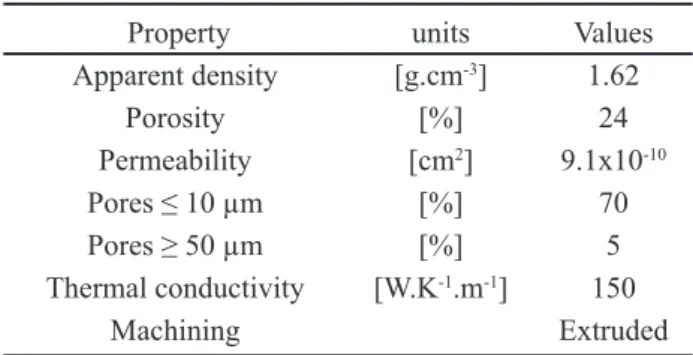
The RN-graphite used was an extruded synthetic graphite acquired from SGL, its properties are shown in Table I. This graphite is a typical graphite grade used at a hot-face of the upper side-wall of an industrial PGM-smelter refractorylining. Graphite samples were ground polished to a smooth and lat surface using a 600-grit SiC-paper. To prevent contact-angle hysteresis (errors or variations in contact angle), the substrate surface has to be lat, homogenous and smooth [2].
The matte types tested in this work are the following: Synthetic matte [Matte-S], Lonmin (industrial matte) [Matte-L] and Amplats Waterval-smelter (industrial matte) [Matte-A].
Synthetic matte (Matte-S)
Matte-S was prepared from sulide powders acquired from Sigma-Aldrich. The mixture used to form synthetic matte had 12 wt.-% Cu2S, 66 wt.-% FeS and 22 wt.-% Ni3S2. The sulphide-mixture was loaded into an alumina crucible and heated for one hour at 1100 °C in a vertical-tube furnace. The molten sulphide-mixture was slow
cooled and analysed to verify its composition. Matte-S had 62 wt.-% (FeNi)9S8, 36 wt.-%FeS and 2 wt.-% CuFeS2 according to the XRD analysis.
Industrial PGM-furnace matte [Matte-A and Matte-L]
Industrial PGM-furnace matte was acquired from two South African PGM producers, namely; Amplats (Waterval smelter) and Lonmin (no.1) smelter. Amplats-matte (Matte-A) was granulated during tapping whereas Lonmin-matte (Matte-L) was slow cooled after tapping. Matte-A and Matte-L had similar XRD patterns, the average XRD quantitative analysis for both mattes had 59 wt.-% (FeNi)9S8, 29 wt.-%FeS, 3 wt.-% CuFeS2 and 9 wt.-% amorphous material. The composition of the amorphous material was acquired by EPMA. Iron-chrome oxide and silicates of Al, Ca, Fe, Mg and Na were detected as major phases in the impurities in as-received matte-A. Matte-L had iron chrome oxide as a major impurity; silicates were not detected in Matte-L. The silicates and oxides report to the slag phase during industrial PGM matte smelting [6]. The oxide phases detected in industrial matte could result from slag entrainment in matte, poor separation between the slag and matte or high solubility of slag phases in matte which are typical phenomenon during the PGM matte smelting process [6]. The silicates are typically amorphous material, hence XRD could not accurately detect the phases in the impurities.
Matte was subjected to XRF to conirm its elemental composition, the XRF analysis is depicted in Table II. The proportions of metals (Co, Cr, Cu, Fe and Ni) in Matte-A, Matte-L and Matte-S are comparable. Sulfur content of Matte-A is relatively low (20.8 wt.-%) when compared to that of Matte-L and Matte-S. Matte-A also has appreciable amounts of impurities such as Al, Ca, Mg and Si as detected by EPMA. The presence of these elements in industrial matte conirmed the presence of slag-mpurities in as-received industrial matte. Matte was tested as-as-received; no puriication was done on the matte samples.
Apparatus
Wettability tests were done in a Coal Ash Fusion (CAF) furnace using a sessile drop method. A CAF furnace is a horizontal tube furnace which is heated using SiC heating elements. The furnace work-tube is made of sintered alumina, it has an inside diameter of 80 mm. The work-tube Fe S Ni Cu Si Mg Cr Al Co Ca Matte A 44.5 20.8 16.4 10.7 3.0 1.6 1.1 0.8 0.7 0.4 Matte L 44.7 27.3 15.7 9.3 0.1 0.0 1.7 0.5 0.6 0.2 Matte S 45.7 26.3 16.2 11.0 0.1 0.2 0.1 0.2 0.1 0.1 Table II - Elemental composition of Matte-A, Matte-L and Matte-S by XRF (wt.%).
[Tabela II - Composição elementar da Matte-A, Matte-L e Matte-S por FRX (peso%).]
Property units Values
Apparent density [g.cm-3] 1.62 Porosity [%] 24 Permeability [cm2] 9.1x10⁻¹⁰ Pores ≤ 10 µm [%] 70 Pores ≥ 50 µm [%] 5 Thermal conductivity [W.K-1.m-1] 150
Machining Extruded
Table I - Properties of RN-graphite. [Tabela I - Propriedades do graite-RN.]
is itted with stainless steel langes at both ends. The gas inlet and outlet ports are itted on the langes. The furnace temperature is controlled and measured using a B-type thermocouple placed inside the furnace tube at the hot zone. The CAF furnace is itted with a digital camera to enable image capturing; a camera is connected to a computer which stores the images with a corresponding time and temperature. A schematic diagram of the CAF experimental set-up is shown in Fig. 2. CAF furnace was used because it was readily available and is equipped to take images of the specimen during the experiment.
EXPERIMENTAL PROCEDURE
Sessile-drop method is commonly used for determination of wettability [5]. In a sessile-drop method the material is shaped and placed on the surface of the substrate [2, 5, 7]. The specimen is heated to the operating temperature and the interfacial contact angle between the molten droplet and the solid substrate is measured [5].
Matte samples were milled to below 150 µm before pelletizing. Average particle size-distribution of matte was as follows, D10 = 5.8 µm, D50 = 12.4 µm and D90 = 47.7 µm. Matte powder was formed into cylindrical pellets using a press and die. A typical pellet was 10 mm outside diameter and ± 5 mm in height. A typical specimen setup is depicted in Figure 3. A matte-pellet was placed on an RN-graphite block (20 mm x 20 mm x 5 mm) as shown in Fig. 3. The specimen was pushed into the hot zone of the furnace at the beginning of the test. The furnace temperature was raised
to 1350 °C at 7 °C/min, the highest operating temperature was limited to 1350 °C to prevent possible damage to the CAF furnace. The furnace was continuously purged with high-purity argon to maintain inert atmosphere inside the furnace. During the experiment, the furnace camera was set to capture an image of the specimen every 10 °C starting from 650 °C, the last image was taken at 1350 °C, when possible.
The softening and melting temperatures of the pellets were recorded manually using the captured images. The temperature at which the pellet shape started deforming was taken as softening temperature. The temperature at which the pellet became spherical was taken as the melting temperature. Graphite wettability was determined by direct measurement of interfacial contact angle between the molten matte and the graphite substrate. Contact angles were measured from the images captured by the camera during the experiments. The contact angle considered was the angle formed immediately after the droplet was fully molten to minimise errors associated with long contact time.
RESULTS AND DISCUSSION
The recorded wetting angle, softening temperature and melting temperature for all the experiments are shown in Table III. The melting temperature for Matte-A was not recorded because Matte-A pellet rolled off the substrate before it was fully molten. Images corresponding to the softening and melting temperatures are depicted in Figs. 4 to 6 for respectively Matte-S, Matte-L and Matte-A.
The interfacial contact-angles between graphite and Matte-S, Matte-L and Matte-A were respectively 113°, 126° and 147°. Graphite was poorly wetted by synthetic and industrial PGM-furnace matte because a contact angle of greater than 90° (between liquid droplet and solid substrate) indicates poor wettability [4, 5].
Matte-S started softening at 920 °C and was molten at 1070 °C, the images from softening to melting are depicted in Fig. 4. Matte-S initially spread on the graphite surface before the spherical droplet was formed. The volume of MatteS remained constant during and after melting. The molten droplet rolled off the substrate above 1200 °C.
Figure 3: Wettability tests specimen setup.
[Figura 3: Montagem das amostras para testes de molhabilidade.] Figure 2: Schematic diagram of the CAF furnace setup.
[Figura 2: Diagrama esquemático da coniguração do forno CAF.]
Material Contact angle θ (°) SofteningMelting temperature (°C)Melting
Matte-S 113 ± 3 920 1070
Matte-L 126 ± 7 950 1020
Matte-A 147 ± 7 850 . . .
Matte-A
residue 35 to 120 1260 1350
Table III - Contact angle, softening and melting temperatures of matte.
[Tabela III - Ângulo de contato, temperaturas de
Matte-L started softening at 950 °C and it appeared molten at 1020 °C. The images of Matte-L pellet from softening to melting are depicted in Fig. 5. The volume of the droplet remained constant during melting, after melting it started decreasing with increasing temperature. The decrease of the droplet of Matte-L could be attributed to the evaporation of gaseous species from the droplet owing to long exposure time and increase in temperature as explained by Luz et al. 2008 [2]. Adsorption of the species of the droplet on the surface of the substrate is another factor that can cause a decrease in the volume of the droplet as discussed by Bruce et al. 2005 [8]. The graphite substrate did not have any adsorbed matte species after exposure, therefore the evaporation of volatile species is a probable mechanism which lead to a decrease in the volume of Matte-L droplet. Matte-L droplet became unstable with temperature, it rolled off the graphite substrate at 1290 °C.
Matte-A softening and melting images are shown in Fig. 6. Matte-A started softening at 850 °C, it formed a very sharp contact-angle with graphite (Fig. 6 Matte-A 970 °C). Signiicant increase in the volume of the droplet was observed during softening. ImageJ software measured 25 % increase in the volume of the Matte-A droplet.
Increase in Matte-A volume can be attributed to the formation of gaseous species associated with melting. Siddiqi and co-workers [4] studied graphite-slag wetting, they observed that the inlation of the droplet during wetting tests is caused by the formation of gaseous products. In their
work they observed that when the gas is generated it inlates the volume of the droplet, the inlated volume is retained until the gas escapes the droplet [4]. Bhoi and coworkers [3] also observed the inlation of the droplet as a result of the gas trapped in the droplet during the wettability tests. The Matte-A pellet rolled off the graphite block at 1100 °C, before it was fully molten. The droplet falling was gradual and the material seemed very sticky. The increase of the volume of the pellet possibly enhanced the instability of the pellet which then caused the pellet to fall. The repulsion (lack of adhesion) between Matte-A and graphite is evinced by the sharpness of the interfacial contact-angle, this could also inluence the instability and falling of the pellet.
A small heap of material remained on top of the graphite after the bulk of the matte had fallen off (Fig. 6, Matte-A 1250 °C). The matte-residue had a contact angle of 30° to 50°. At 1230 °C the volume of the matteresidue started increasing. Matte-residue appeared molten at 1350 °C, it formed a contact-angle of 120° with graphite. The composition of the matte-residue was determined by EPMA. The major phases in the matte-residue were silicates of Fe-Ca, FeMg and the oxides of Cr and Fe, these phases were similar to the slag-impurities detected on as-received Matte-A. Minor amounts of sulide phases were detected in the Matte-A residue, this indicates that when the matte-droplet fell off the substrate, some matte was trapped in the slag-impurities. The liquidus temperature of a typical PGM-furnace matte is 850°C to 875 °C, whereas that of slag is 1350 °C [6]. This explains why the slag-impurities melted at 1350 °C whereas the matte started softening at 850 °C.
The difference in behavior [wetting angle, volume change, spreading and repulsion] of the tested matte types indicates that; melting and wetting behavior of sulides is speciic to the composition of the aliquot sample. The matte had comparable amounts of base metal sulides but the behavior of each matte is unique. As such, the behavior of matte cannot be generalized; impurities in matte seem to have major effect in its melting and wetting behavior.
Figure 6: Wettability of RN graphite by Matte-A (850 °C to 1350 °C).
[Figura 6: Molhabilidade do graite RN por Matte-A (850 °C a 1350 °C).]
Figure 4: Matte-S droplet on graphite-substrate (850 °C to 1100 °C). [Figura 4: Gota de Matte-S no substrato de graite (850 °C a 1100 °C).]
Adding surfactants such as sulfur to a metal or compound lower the surface tension of that metal or compound [9]. The metal to sulfur ratio of matte did not affect the wetting angle between the matte and graphite. Matte-S had a lower sulfur content than Matte-L but Matte-S had a lower wetting angle (113°), than that of Matte-L (126°). The effect of sulfur content on the wetting behavior of Matte-A cannot be conclusive because the slag-impurities in Matte-A possibly had signiicant effects on the melting and wetting behavior of Matte-A. Further work is needed to assess the effect of each element (Al, Ca, Mg, S, Si and O) on the melting and wetting behavior of matte.
The instability of the droplet with increase in temperature was observed in this work, all the droplets rolled off the graphite-substrate after melting. The instability of the droplet could be attributed to the change in its viscosity, which is envisaged with increase in temperature [2].
Graphite consumption by matte could not be quantiied because the matte-droplets and the process gas could not be analysed. However, no measurable change in the dimensions of the graphite-substrate was observed after exposure.
Penetration and dissolution of a refractory is enhanced by good wetting and chemical reactivity [10]. Since graphite is poorly wetted by matte, penetration of liquid matte through a graphite crucible is not envisaged. However, current work did not consider external factors such as change in system pressure or turbulence in the system.
CONCLUSIONS
RN-graphite is poorly wetted by synthetic and industrial PGM-furnace matte (Cu-Fe-Ni-S) based on the observed wetting angle. The penetration and dissolution of graphite by synthetic and industrial PGM-furnace matte is not envisaged where a graphite crucible is exposed to liquid matte. Diverse melting and wetting behavior amongst the tested matte type
was observed, the behavior of each matte type (synthetic or industrial) is unique to that speciic matte (composition and impurities).
ACKNOWLEDGMENTS
Authors would like to thank Anglo American Platinum and Lonmin for inancial and technical support, SGL for supplying graphite. “This work is based on the research supported in part by the National research Foundation of South Africa (Grant number TP1208219517)”.
REFERENCES
[1] P. K. van Manen, 3rd Int. Plat. Conf. ‘Platinum in Transformation’, Sun City, SA, SAIMM (2008) 191-196. [2] A. P. Luz, S. Ribeiro, V. C. Pandolfelli, Cerâmica 54 (2008) 174-183.
[3] B. Bhoi, H. S. Ray, V. Sahajwalla, J. Inst. Eng. (India), 89 (2008) 3-8.
[4] N. Siddiqi, B. Bhoi, R. K. Paramguru, V. Sahajwalla, O. Ostrovski, Ironmaking Steelmaking 27, 5 (2000) 367-372. [5] N. Eustathopoulos, M. G. Nicholas, B. Drevet, “Wettability at high temperatures”, Pergamon, Amsterdam, The Netherlands 349 (1999) 13-51.
[6] J. J. Eksteen, Miner. Eng. 24, 7 (2011) 676-687.
[7] W. E. Lee, S. Zhang, VII Int. Conf. Molten Slags Fluxes and Salts, SAIMM (2004) 309-319.
[8] D. Bruce, R. Mera, D. Leatherdale, M. Taylor, R. Musgrove, “Techniques for characterising the wetting, coating and spreading of adhesives on surfaces”, NPL Report DEPC MPR 020 (2005) 1-40.
[9] B. J. Keene, Contact angle and work of adhesion between
ferrous melts and non-metallic solid, Slag Atlas 2nd Ed., V.