CIGARETTE
SMOKING
IN LATIN
AMERICA-
A SURVEY OF EIGHT
CITIES’*’
Daniel J. Joly, M.D., M.P.H.,
Dr.P.H.3
Smoking is an important cause of disease and death in Latin America, but relatively little is known about Latin American smoking patterns. The present article reports the basic results of a major investigation desiped to shed Zight on this subject.
Introduction
Diseases related to smoking (cancer of the lung, cancer of the larynx, coronary heart disease, chronic bronchitis, emphysema, and others) are on the increase in Latin America. Indeed, the Inter-American Investigation of Mortality4 has shown that in the early 1960’s such diseases accounted for some 20 per cent of the fatalities in 10 Latin American cities. Since then, a variety of indicators have sug- gested that the prevalence of cigarette smok- ing was reaching unusually high levels in many countries.
In view of this, a major study of cigarette
smoking patterns in Latin America was
planned and carried out. This work had the following objectives: (1) to obtain a reliable estimate of the prevalence of cigarette smok- ing in urban communities of Latin America, (2) to correlate cigarette smoking patterns with some morbidity features, (3) to gain an
’ Published in Spanish in the Boletin de la Oficina
Sanitanh Panamericana, Volume LXXIX, No. 2, August 1975, pp. 93-111.
*This study was carried out with the collaboration of the following local co-investigators: Drs. Alfonso ArguelIes N. (Mexico), Favio Arias Rojas (Venezuela), Euclides Ayres de Castilho (Brazil), Ricardo Galin Morera (Colombia), Jose’ Gdlvez Brandon (Peru), Lionel Linares Garcia (Guatemala), Naum Marchevsky (Argentina), . and Aida de Pizzi (Chile).
s Adviser in Chronic Disease Epidemiology, Pan American Health Organization.
’ See reference (I).
insight into the attitudes and beliefs of the population regarding cigarette smoking and its relation to health, (4) to assist in formula- tion of well-defined policies on cigarette smoking by the participating countries, (5) to help in planning anti-smoking programs consonant with these policies, and (6) to provide baseline data for future evaluation of such programs.
The study was financed through the
regular budget of the Pan American Health Organization and through grants provided
by the United Nations Development Pro-
gram, the American Cancer Society, the Liga
Paul&a Contra el Chncer, the Peruvian
Cancer Foundation, and the Anti-Cancer Society of Venezuela. The investigation also received support from the health authorities of the countries involved.
The present summary report broadly de- scribes the methodology used, highlights the most important results, and presents the major conclusions of this study. A more detailed account, including city-by-city analysis of the data obtained, is provided in the full report of the investigation.
Methodology
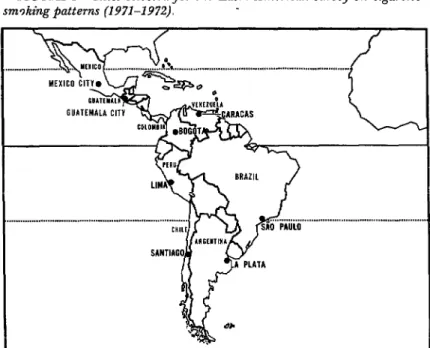
City and sample selection. The need to assure adequate diversity of geographic, ethnic, and demographic characteristics was the guiding criterion for selecting the eight
TABLE 1-Popuhtion.~ of the cities included in the
survey.
City and country
Population at about the time of
the survey BogotC, Colombia 2,500,OOO Caracas, Venezuela 2,180,OOO Guatemala City, Guatemala 980,000 La Plata, Argentina 380,000
Lima, Peru 3.300,000
Mexico City, Mexico 2,900,000
Santiago, Chile 2,600,OOO
SLo Paulo, Brazil 5,900,000
urban areas surveyed (see Table 1 and Figure 1). In each case, a probabilistic socio- economically stratified sample of about 1,600 persons was selected. This sample included members of both sexes 15-74 years of age. The size of the sample was based on an anticipated smoking prevalence of 50 per cent, with an acceptable standard error of 1.25 within 95 per cent confidence limits.
The questionnaire. To facilitate compari-
son, a survey form very like one used in similar studies carried out in the United
States in 1964, 1966, and 1970 was adopted (2). In addition, two other forms were used to collect information concerning cardio- respiratory symptoms, nonspecific morbidity, absenteeism, and decreased everyday activ- ities-one of the forms being recommended by the World Health Organization (3) and the other by the National Center for Health Statistics of the United States Public Health Service (4).
Field and headquarters procedures. The responsibility for field activities was en- trusted to local co-investigators supervised by the study’s principal investigator. Selection of the household sample was finished in the third quarter of 1971 and the: interviews were completed by mid-1972. Review, edit- ing, coding, and analysis of the information was carried out at the central office in Washington, D.C.
AnaZyticaE methods. Only one person
15-74 years old was interviewed in each of the households included in the study. This person was chosen from a list of everyone present in the house, on which all those
FIGURE 1 -Cities selected -for the Latin American suwey on cigarette
smsking patterns (1971-1972):
V-Q @Lr . . . ...” . . .
JOEY l CIGARETTE SMOKING IN LATIN AMERICA 331
who were identified as current or former smokers were, in effect, listed twice. This procedure made it twice as likely that current or former smokers, as opposed to those who had never smoked, would be selected.
To correct afterwards for this unequal probability of selection, a weighting factor was applied to each person interviewed, the size of the factor depending on the relation
of the number of smokers (current and
former) and never smokers interviewed to the number of smokers and never smokers in the household. This factor took house- hold size, sex, and the interviewed person’s particular smoking status into account.
In addition, smoking prevalence rates and various reported characteristics of the selected individuals were age-adjusted with reference to the total population of both sexes inter- viewed in all of the cities.
Interviews. Satisfactory interviews were ob- tained at 90 per cent of the addresses selected. Houses were found to be demolished, vacant, or not occupied by any identifiable family group at 5.8 per cent of the addresses: occupants refused to be interviewed at 2.1 per cent of the addresses; and adequate interviews could not be completed for a variety of other reasons at the remaining 2.1 per cent. The observed age and sex distributions of residents in the 15-74 age range at the selected addresses correlated very closely with distributions provided by the available census data in the eight cities.
The final weighted sample was equivalent to 5,608 men and 6,774 women. Of the men, 2,626 identified themselves as current cigarette smokers, 497 as former smokers, and 2,485 as never smokers.5 Among the women, the
s”Never” smokers were separated from former smokers by asking “Have you ever smoked cigarettes?” Those answering yes were asked “Have you smoked five packs (100 cigarettes) in your lifetime? Those giving a negative reply to either question were classed as never smokers.
The smokers remaining were then asked “Do you now smoke cigarettes?” Those who said yes were classed as current smokers and those who said no as former smokers.
respective numbers were 1,220 current
smokers, 201 former smokers, and 5,353
never smokers.
Results
Prevalence of Cigarette Smoking
As shown in Figure 2, the prevalence of current cigarette smoking among men was found to be highest in the cities of La Plata (58 per cent), Sio Paul0 (54 per cent), and Bogota (52 per cent). Intermediate pre- valences were observed in Caracas (49 per cent), Santiago (47 per cent), and Mexico City (45 per cent); and relatively low pre-
valences were found in Guatemala City
(36 per cent) and Lima (34 per cent). With regard to women, about one in four identified themselves as current cigarette smokers in Caracas (26 per cent), Santiago (26 per cent), and La Plata (24 per cent); this prevalence changed to about one in five in
FIGURE 2 - Age-adjwted percentages of CUT- rent smokers 15-74 years old in eight Latin American cities.
Bogota (21 per cent) and Slo Paulo (20 per cent), and was still smaller in Mexico City (17 per cent), Guatemala City (10 per cent), and Lima (7 per cent).
Overall, 45 per cent of the men inter- viewed were found to be current cigarette smokers, as opposed to 18 per cent of the women, This difference in male and female smoking patterns appears considerably greater than that in the United States, where the respective prevalences of cigarette smoking among men and women were found to be 42 and 30 per cent in 1970 (2).
In the 25-54 year age range, where the higher prevalences of current smokers were found, the average prevalences of smoking among men and women were, respectively, 50 and 20 per cent (see Figure 3). Also, the proportion of those who had given up smoking (former smokers) was found to rise with age, this rise being greater for men than for women. That is, 2.8 per cent of the men 15 to 25 years of age were former smokers, but for those 55 to 75 the figure was 20.5 per cent. Among women in these two age groups the respective percentages were 1.4 and 4.3 per cent.
FIGURE 3 -Percentages of current American cities, by age group and sex.
MEN
CURAENl SMOKERS i\p FORMER SMOKERS
Other Forms of Smoking
Cigars and pipes are seldom smoked in
Latin America: in fact, among the men
interviewed, only 1.6 per cent smoked cigars and only 1 per cent smoked pipes. This picture contrasts markedly with that seen in the United States, where the corresponding rates were 21 and 18 per cent in 1970 (2).
Occupations
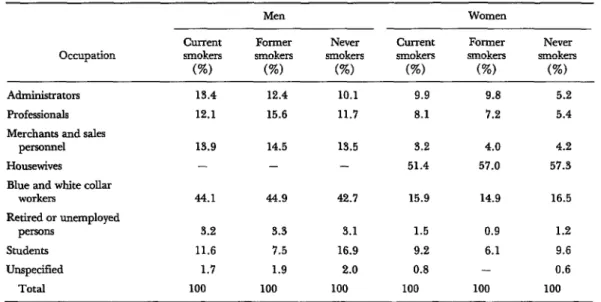
The subjects’ occupations were coded ac- cording to a classification scheme used by the International Labor Organization (i), and these occupations in turn were grouped into seven broad categories (see Table 2). Among men, the salient features observed were as follows: There were (a) a larger proportion of administrators among the cur- rent and former smokers than among the never smokers, (b) a larger proportion of
professionals among former smokers than
among current and never smokers, and (c) a markedly smaller proportion of students
among current and former smokers than
and former smokers in eight Latin
WOMEN
CURRENT SMOKERS i\\\y FORMER SMOKERS
JOEY l CIGARETTE SMOKING IN LATIN AMERICA 333
TABLE 2-Occupations of subjects inter&wed in eight Latin American cities; data adjusted for age and grouped according to the subjects’sex and smoking status.
Occupation
current smokers
(%)
Men
Former smokers
(%)
Never smokers
(%I
Current smokers (%)
Women Former smokers
(%)
Never smokers
(%) Administrators
Professionals Merchants and sales
personnel Housewives
Blue and white collar workers
Retired or unemployed persons
Students Unspecified
Total
13.4 12.4 10.1 9.9 9.8 5.2
12.1 15.6 11.7 8.1 7.2 5.4
13.9 14.5 13.5 3.2 4.0 4.2
- - - 51.4 57.0 57.3
44.1 44.9 42.7 15.9 14.9 16.5
3.2 3.3 3.1 1.5 0.9 1.2
11.6 7.5 16.9 9.2 6.1 9.6
1.7 1.9 2.0 0.8 - 0.6
100 100 100 100 100 100
among never smokers. With regard to
women, there were disproportionately large numbers of administrators and professionals among the current and former smokers, a relatively small proportion of students among
former smokers, and a relatively small
proportion of housewives among current
smokers.
Standardized ratios (age-adjusted for both
smoking status and occupational group)
indicate that workers (white and blue collar
workers combined) had about the same
likelihood of being current or former smokers
TABLE 3-Standardized Tatios comparzhg the per- centages of current and former smokers among workers, students, and housewives to the percentages among the whole survey population.
Men: Workers Students
Women:
Workers Students Housewives
Current Former smokers smokers
0.98 0.97 0.81 0.52
0.96 0.96 0.97 0.65 0.92 0.98
as did members of the population at large (see Table 3). But they also show that, ir- respective of age, both male and female students had relatively little tendency to be former smokers, and that relatively few male students were current smokers. In addition, they support the finding that housewives were in general less inclined to be current smokers than other women.
Education
In contrast to the foregoing findings among the students interviewed, disproportionately large numbers of current and former smokers
were found among subjects who had re-
ceived a relatively high degree of education. This tendency was even more striking in women than in men. Standardized smoking ratios for the various educational groups
TABLE 4-Education of the subjects; data adjusted for age and grouped according to the subjects’ sex and
smoking status. The standardized ratzos show the relative proportions of current and former smokers in the various educational group~.~
current smokers
MIXI Former smokers
Never smokers
Current smokers
Women Former smokers
Never smokers
yO current and former smokers with:
No schooling Grammar school High school University
Standardized ratios of current and former smokers z&h:
No schooling Grammar school High school University
3.9 3.6 3.3 8.1 8.9 9.9
41.0 41.6 43.1 40.9 42.9 51.3
35.4 35.3 36.5 36.2 32.4 30.5
19.4 19.4 16.5 14.7 15.3 8.0
1.10 0.70 - 0.81 0.93 -
0.97 1.02 - 0.83 0.84 -
1.00 0.88 - 1.15 1.14 -
1.06 1.17 - 1.57 1.58 -
V?he figures reflect the highest educational level reached (but not necessarily completed) by each subject.
Age When Smoking Started
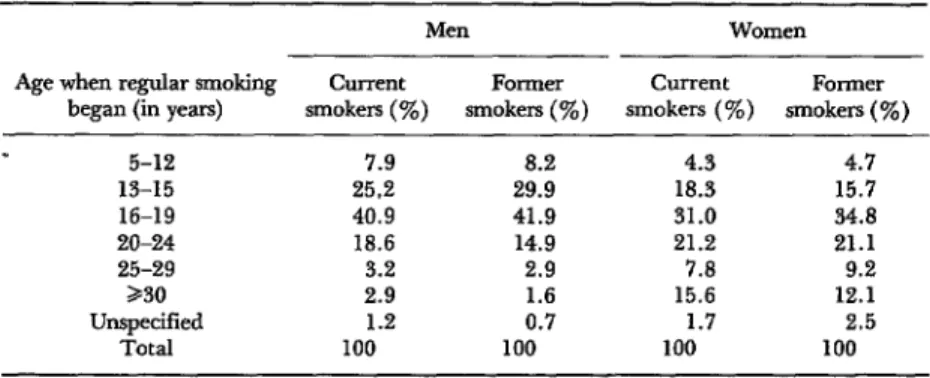
Data about the age of onset of cigarette smoking showed that in most cases the habit became established early (see Table 5). In effect, one-third of the current male smokers (33 per cent) began smoking regularly before age 16, almost three-fourths (74 per cent) started before age 20, and over nine-tenths (93 per cent) started before age 25. Male former smokers began even earlier, the re-
spective proportions being 38 per cent by age 16, 80 per cent by age 20, and 95 per cent by age 25. Female subjects tended to be
less precocious. Overall, 16 per cent of the current female smokers and 12 per cent of the former female smokers did not begin smoking before their thirtieth birthday.
Types of Tobacco Used
A significant fraction of the cigarettes consumed in Latin America are prepared with a dark, locally produced tobacco which is more alkaline than the lighter-colored tobaccoes produced locally or imported from abroad, and which has a higher concentra- tion of nicotine and phenols. However,. this
TABLE 5- Age-adjwted percentages showitg when regular smoking first began, by sex
and smoking status.
Men Women
Age when regular smoking Current Former Current Former began (in years) smokers (%) smokes (%) smokers ( !%) smokers (%)
5-12 13-15 16-19 20-24 25-29 230 Unspecified
Total 1
7.9 8.2 4.3 4.7
25.2 29.9 18.3 15.7
40.9 41.9 31.0 34.8
18.6 14.9 21.2 21.1
3.2 2.9 7.0 9.2
2.9 1.6 15.6 12.1
1.2 0.7 1.7 2.5
Job l CIGARETTE SMOKING IN LATIN AMERICA 335
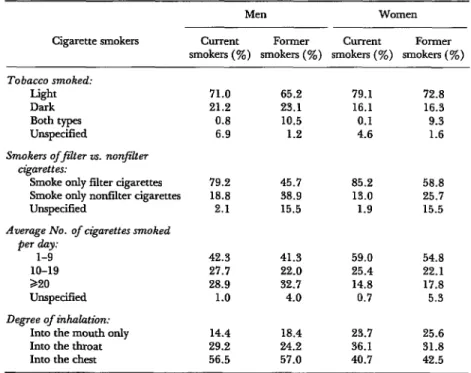
TABLE 6-Smoking pactices of current and former smokers interviewed, including average daily nkarette cottswnption, tendency to inhale, type of tobacco used, and pedilection forfilter or nonfilter czjgarettes.
Men Women
Cigarette smokers Current Former Current Former smokers (%) smokers (%) smokers (%) smokers (TO)
Tobacco smoked:
Light Dark Both types Unspecified
Smokers of)ltm IS. nonj%ter ngarettes:
Smoke only filter cigarettes Smoke only nonfilter cigarettes Unspecified
Average No. of cz&yarettes smoked
Pmltr
10-19 220 Unspecified
Degree of inhalation:
Into the mouth only Into the throat Into the chest
71.0 65.2 79.1 72.8
21.2 23.1 16.1 16.3
0.8 10.5 0.1 9.3
6.9 1.2 4.6 1.6
79.2 45.7 85.2 58.8
18.8 38.9 13.0 25.7
2.1 15.5 1.9 15.5
42.3 41.3 59.0 54.8
27.7 22.0 25.4 22.1
28.9 32.7 14.8 17.8
1.0 4.0 0.7 5.3
14.4 18.4 23.7 25.6
29.2 24.2 36.1 31.8
56.5 57.0 40.7 42.5
dark tobacco is actually the standard fare of relatively few current smokers (21 per cent of the men interviewed and 16 per cent of the women), and in fact most smokers use only the lighter tobacco (see Table 6). Among the men interviewed, former smokers were slightly more inclined to smoke dark tobacco than were current smokers.
Filter vs. NonfiZter Cigarettes
The vast majority of current smokers
showed a preference for filter-tip cigarettes; in fact, 79 per cent of the men and 85 per cent of the women said they smoked only this type of cigarette. The proportion of former smokers favoring filter-tip cigarettes was noticeably smaller, with 46 per cent of the men and 59 per cent of the women say- ing they had smoked only that kind.
Most brands of light-tobacco cigarettes
have filters and most dark tobbaco brands do not. Therefore, it is likely that a smoker’s preference for filter or nonfilter cigarettes will restrict his choice of tobacco somewhat, and vice versa.
Comparing 1970 U.S. figures with those from the present survey, it appears that fewer U.S. men (68 per cent of the current smokers and 35 per cent of the former smokers) were smoking only filter cigarettes, but that about the same proportions of women (83 per cent of the current smokers and 63 per cent of the former smokers) were doing so (2).
Number of Cigurettes Smoked Per Day
FIGURE 4-Age-adjusted percentages of heavy current smokers (20 cigarettes a day or more) in eight Latin American cities, by sex.
eURRrWT SMOllRS ,pu em,,
0 20 30 10 60
110 ll”LQ
reported proportions were somewhat larger among former smokers (33 per cent of the men and 18 per cent of the women).
Overall, the prevalence of heavy smoking appeared somewhat lower than in the United States, where the forementioned 1970 study showed that slightly higher percentages of current smokers (31 per cent of the men, 17 per cent of the women) and former smokers (38 per cent of the men, 19 per cent of the women) were consuming 25 or more cigarettes per day (2). However, these U.S. figures were notably exceeded by prevalences of heavy smoking among current male smokers in three Latin American cities-La Plata (38 per cent), Caracas (51 per cent), and So Paulo (52 per cent), as shown in Figure 4.
With regard to the eight cities covered, a positive correlation was found between the prevalence of smoking and the frequency of heavy smoking. The only significant exception was Bogot& which had the lowest percent-
age of heavy smokers even though it ranked third on the scale of smoking prevalence.
Cigarette Smoke Inhalation
Overall, the degree of inhaling appears less marked than in the United States. Among the current smokers interviewed, 57 per cent of the men and 41 per cent of the women said they inhaled smoke into the chest (see Table 6). Comparable 1970 figures for the United States are 68 and 46 per cent (2).
Medical Implications
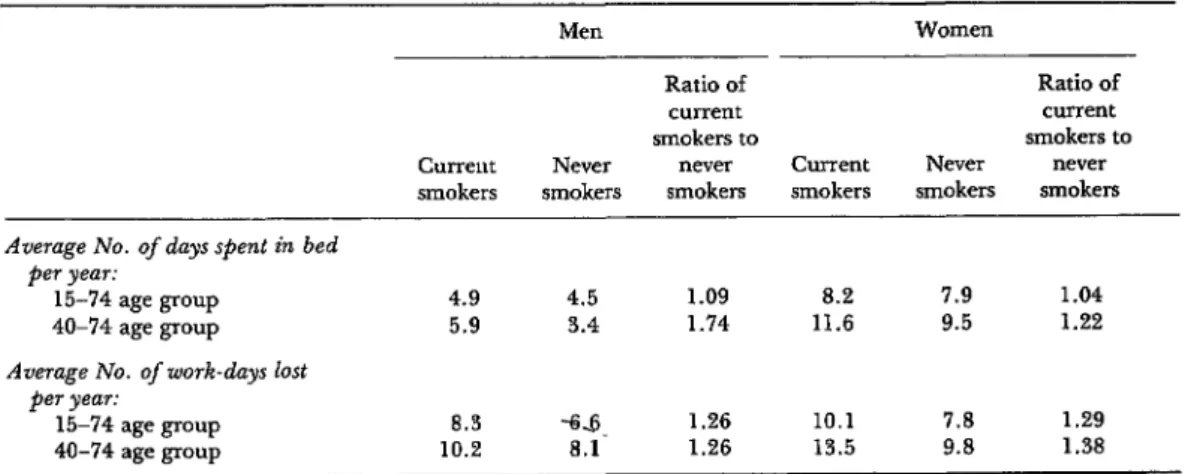
The survey was not designed to obtain data on the actual incidence of smoking- related diseases and deaths. Nevertheless, it was possible to gather data on several cardio- respiratory complaints (cough, phlegm, and dyspnea) often associated with smoking (see Table 7). It was also possible to find the number of days per year that subjects were absent from work or were confined to their beds (see Table 8). These data, by them- selves, do not provide a complete or compre- hensive assessment of the health implications of smoking in the areas surveyed. But it is hoped that, in combination with appropriate morbidity and mortality data, they will con- tribute to an improved understanding of these implications.
Cardiorespiratory symptoms. Both current
and former smokers complained of cough
and phlegm more often than never smokers (see Table 7). These symptoms were a good
deal more common among current smokers
than among former smokers, and were much
more common among men than among
women.
Moreover, compared to never smokers
complaining of cough and phlegm, a dis- proportionate share of the affected current smokers experienced severe symptoms. For example, early-morning cough was reported
2.4 times more often by current male
Job
*
CIGARETTE SMOKING IN LATIN AMERICA 337HEALTH EFFECTS OF THE SMOKING HABIT 1
A recent World Health Organization report2 &led attention to a number
of
points relating to the effects of smoking on health. Those cited included the
fol-
1owirLg:
l The worldwide rise in cancer mortal-
ity continues unabated in those countries where cigarette smoking has been wide- spread.
l In women, whose cigarette consump-
tion has been rising rapidly over the past 30 years, lung cancer mortality continues to rise at an increasing rate.
l It has been confirmed that smokers of
filter-tipped cigarettes with relatively low tar delivery experience a reduced risk of lung cancer, as compared with those who continue to smoke nonfilter cigarettes.
l Mortality among Japanese cigarette
smokers, both male and female, is some 22 per cent higher than among nonsmokers. The risk is increased by increasing ciga- rette consumption and by inhalation of cigarette smoke.
l A striking reduction of lung cancer
mortality among British doctors, the ma- jority of whom are nonsmokers or former smokers, has been documented.
l Research evidence published over the
past few years strengthens the view, pre- viously advanced with reservation, that cigarette smoking is a major risk factor in both fatal and nonfatal myocardial in- farction.
l Carbon monoxide plays an important
part in the mechanisms whereby smok- ing promotes ischaemic heart disease. The amount of carbon monoxide produced increases progressively as a cigarette is smoked down to the nub.
l In young people, ischaemic disease of
the legs (thromboangiitis obliterans) caus-
ing intermittent claudication appears to
be confined almost exclusively to those who smoke.
1Excerptedfrom In Point of Fact (No. 1, 1975). World Health Organization, Geneva, 1975.
2 World Health Organization, Smoking and Its Effects on Health: Report of a WHO Expert Committee, Geneva, 1975 (WHO Technical Report Series, No. 568).
l Several recent studies carried out in
various countries have confirmed that the incidence of gastroduodenal ulcer is roughly two times greater among smokers than among nonsmokers.
l The main effects of maternal smoking
are to retard fetal growth and increase the risk of perinatal death; but there is some evidence that as late as age seven the children of mothers who smoked during pregnancy may still be slightly smaller and show slightly lower levels of achieve- ment than other children.
l Several studies have shown that
children of parents who smoke are more liable to experience chest illnesses than children of parents who do not smoke.
l The nonsmoker exposed to the side-
stream and main-stream smoke of smok- ers in enclosed, ill-ventilated spaces, such as cars and small offices, may be exposed to harmful concentrations of smoke.
l In some communities, the traditional
way of smoking tobacco-by bubbling the
smoke through a pot of water-may be
less damaging than cigarette smoking. On the other hand, some other ways of using tobacco, e.g., chewing, may produce other harmful manifestations, such as cancer of the oral cavity.
l Pipe and cigar smokers, who do not
usually inhale, are exposed to lower health risks than cigarette smokers who usually inhale.
l In certain developed countries, the
publication of scientific findings on the ef- fects of smoking seems to have reduced cigarette use to some extent. On the other hand, the consumption in developing countries is rapidly increasing.
l Most countries have not yet adopted
TABLE i’- Cardiorespiratoy symptoms (cough, phlegm, and dyspnea) reported by the subjects interviewed; data adjusted for age and grouped according to the subjects’sex and smoking status.
current smokers
(%)
Men Former smokers
(%)
Never current smokers smokers
(%I (%)
Women
Former smokers
(%)
Never smokers
(%I
Cough usual in some season, as
f0110ws:=
Early in the morning 30.6 21.5 12.7 21.4 13.9 13.6 During the daytime or at night 20.6 14.6 7.4 16.8 12.1 8.6 For about 3 months per year 12.5 12.5 3.3 9.7 8.3 3.9
Phlegm usual in some season, as
follows:=
Early in the morning 25.4 25.4 10.9 15.0 12.7 9.1
During the daytime or at night 15.0 14.9 6.5 10.3 10.7 5.6 For about 3 months per year 14.9 14.8 4.8 8.6 9.1 3.7
An unusual period of cough and
phlegm lasting 3 or more weeks
experienced within the past 3 years 13.4 15.8 4.8 13.0 8.3 6.2 Shortness of breath (dyspnea)
experienced a.s follows:
While hurrying or walking up-hill While walking with people of own age
While walking at own pace on level ground
20.4 18.5 13.3 23.9 22.7 20.2
6.0 8.1 3.6 9.5 10.0 5.6
2.4 2.9 1.5 4.5 4.9 2.6
aThe subjects were asked “Do you usually cough early in the morning sometime during the year?” and “Do you usually cough during the daytime or at night sometime during the year?” Those answering yes to either question were asked “Do you cough like that for at least 3 months during the year?” The same series of questions was asked concerning phlegm.
TABLE S-Days current smokers and neve? smokers spent in bed or absent from work, per person-year, by sex.
Current smokers
Men Women
Ratio of Ratio of
current current
smokers to smokers to
Never never Current Never never smokers smokers smokers smokers smokers
Average No. of days spent in bed per year:
15-74 age group 40-74 age group
4.9 4.5 1.09 8.2 7.9 1.04
5.9 3.4 1.74 11.6 9.5 1.22
Average No. of work-days lost per year:
15-74 age group 40-74 age group
8.3 *s. 1.26 10.1 7.8 1.29
Job
l CIGARKITK SMOKING IN LATIN AMERICA 339cough symptoms lasting at least three months per year were reported 3.8 times more often. Similar trends were observed for complaints of phlegm in males and for complaints of both cough and phlegm in females. Current smokers reported experiencing dyspnea more often than nonsmokers, but the contrast was not as striking as in the case of the other two symptoms.
Overall, the frequency of almost every symptom was found to increase with the depth of inhalation, the length of time
smoking, the average daily number of
cigarettes smoked, the use of dark tobacco, and the consumption of nonfilter cigarettes.
Restn’ction of normal activities. Current
smokers reported staying in bed more often than never smokers as a result of sickness, accident, or injury (see Table 8). This trend
was especially pronounced among men in
the 40-74 age range, current smokers being found to spend 1.74 as much time confined to bed, on the average, as nonsmokers. In general, the findings for men shown in the table are very similar to 1965 figures for the United States (6), which indicated that cur- rent smokers over age 16 spent 1.08 times as many days in bed as nonsmokers, but that current smokers in the 45-64 age range were confined to bed 1.39 times as long as nonsmokers. (The average days in bed in the four respective U.S. cases were 5.7, 5.3, 6.4, and 4.6 days per annum).
Current smokers also spent more time
absent from work than nonsmokers, the
average annual absences being 1.26 times as great for male smokers and 1.29 times as great for female smokers (see Table 8). Comparable 1965 figures for the United States were 1.39 among men and 1.17 among women (6).
Not counting days confined to bed or absent from work or school, current smokers were found to restrict their usual activities more than never smokers. On the average, the days of restricted activity (for reasons of sickness, injury, or accident) reported for male current smokers exceeded the days re- ported for never smokers by nearly 60 per cent (the actual ratio was 1.57 days to 1). On the other hand, female current smokers did not report more days of restricted activity
than never smokers. Comparable United
States figures show roughly the same pattern for women, but for men the difference be- tween current smokers and never smokers is less (the ratio being 1.16 days to 1).
Motivating Factors
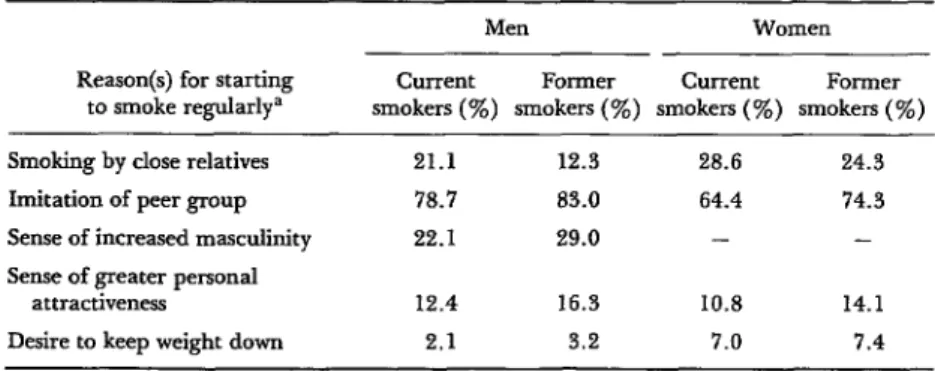
The questionnaire listed a series of possible reasons as to why the habit of smoking cigarettes was or was not acquired and why in some cases it was later given up (see Table 9). Imitation of peer group behavior seemed to be the predominant reason for starting
TABLE g--Reasons cited by current and former smokers for starting to smoke regularly (age-ad&.sted data).
Men Women
Reason(s) for starting Current Former Current Former to smoke regularly= smokers (%) smokers (so) smokers (ye) smokers (‘%)
Smoking by close relatives 21.1 12.3 28.6 24.3 Imitation of peer group 78.7 83.0 64.4 74.3
Sense of increased masculinity 22.1 29.0 - - Sense of greater personal
attractiveness 12.4 16.3 10.8 14.1
Desire to keep weight down 2.1 3.2 7.0 7.4
Three-fourths of those who had never smoked regularly asserted that they rejected cigarettes simply because they did not like smoking; health reasons and family influence were cited by relatively small percentages of nonsmokers (see Table 10). Nearly a third of the nonsmoking women interviewed said they did not take up smoking because they felt the practice was unfeminine.
to smoke, with 80 per cent of the men and 70 per cent of the women citing this reason. The example set by close relatives appeared
to play a much less significant role, especially among men. A feeling of heightened mascu- linity was cited by about a quarter of the men, while an appreciably smaller proportion of men and women stated that they began smoking because they felt their personal attractiveness was enhanced.
“Feeling sick” when smoking cigarettes
was the reason most often cited by former Some Theoretical Considerations smokers (62 per cent of the men and 49 per
cent of the women) for giving up the habit (see Table 10). Medical advice played a primary role in 27 per cent of the cases; in a similar vein, the belief that cigarette smok- ing decreased the subject’s capacity for usual activities was cited as a reason by 32 per cent of the men and 19 per cent of the women. Family pressures and the excessive cost of cigarettes appear to have played very secondary roles in most cases.
Cigarette smoking can be viewed as having a social history with its own dynamic processes of “diffusion” and “maintenance.” Diffusion, as defined here, means spread of the smok- ing habit within a particular group of people. When referring to age-phased progressive acquisition of the habit by members of a generation, we call it “generation” or “cohort” diffusion; and when referring to acquisition
TABLE lo- Reasons cited by nonsmokers for nevel-
smoking regularly, and reasons cited by former smokers
for giving up smoking.
by members of a community over time we term it “community” diffusion. Maintenance,
in this context, means continuance of
cigarette smoking. Again, we can either re- gard the habit as being maintained among the individuals of a generation (“generation”
or “cohort” maintenance) or among the
members of a community (“community”
maintenance) over time. Both the diffusion and maintenance processes begin with initia- tion of the smoking habit, but diffusion drops off as stabilization levels are reached, while a greater or lesser degree of maintenance continues indefinitely.
Men Women (%) (%)
Reasons for giving up smokinga
Family influence 12.0 15.1 Medical advice 27.3 27.0 Felt sick when smoking 62.5 49.4 Reduced capacity for
work, sports, or other
activities 32.2 19.1
Expense 11.2 10.4
Reasons for never having smokeda
Family influence 17.9 19.6
Health 20.9 15.6
Expense 8.4 7.6
Believed it unfeminine - 30.1
Feared loss of work No. starting to smoke in
capacity 12.0 8.5 age-range X sdiffusion
x 100 =
Feared loss of athletic Population in age- in age-
capacity 14.4 5.4 range X range X
Dislike of smoking 74.3 80.1 ‘Totals exceed 100% because each person was allowed
to choose more than one reason. one is forced to use the percentages of cur-
For purposes of measuring generation or cohort diffusion, the most precise indicator would be the changing incidence of smoking in successive specific age groups. That is,
Iolv l CIGARETTE SMOKING IN LATIN AMERICA 341
rent smokers who began smoking at different ages:
No. of current smokers % current smokers starting in age-range X x 100 = who
Total No. of current started in
smokers age-Tge
If these latter percentages are plotted cumulatively on a semi-log scale, the ap- proximate rate of propagation of the habit can be assessed (see Figure 5). This shows that there was a rapid rate of diffusion
among both the men and women inter-
viewed, but especially among the men, since 74 per cent of the male current smokers had already begun smoking at about age 19, and only 3 per cent began after age 29. The
FIGURE 5 -Age of male and female smokers 15-74 years of age when they began smoking; cumulative percentages based on age-adjusted data from eight Latin American cities.
i
WOMEN
.’ .’
MEN i
progression was somewhat less rapid among women: only 75 per cent of the female current smokers began smoking before age 25, and about 15 per cent started after age 29. The level of smoking maintenance is indi- cated by the age-specific prevalence of cur- rent smoking.6 Figure 6 shows that these prevalences reach a plateau in the middle age groups of the eight cities surveyed and decline in the older age groups. Examining each of the cities individually, several patterns may be observed. For one thing, in the cities with lower smoking prevalences (Gua- temala City, Lima, and Mexico City), a maximum level of maintenance was observed among men 40-54 years of age; while in cities with higher prevalences (La Plata, Santiago, and SLo Paulo), the maximum maintenance level was observed among men 25-39 years of age. In addition, the mainte- nance curve for women in each city tended to follow the bends of the curve for men in the same city much more than it followed the maintenance curves for women in other cities.
With regard to community diffusion and maintenance, the processes can be identified over the course of successive historic periods. However, lacking periodic surveys of levels of smokers in the population that go far enough back in time, we can use per capita consumption of cigarettes as an approximate indicator of community diffusion. Data on yearly adult consumption of cigarettes in six countries during 1940-1970, for example, yields the semi-log curves shown in Figure 7. It appears from these data that as of 1970 the diffusion process was not yet on the decline in Argentina, Portugal, or Sweden, where consumption levels were intermediate. On the other hand, diffusion seems to have largely abated in the three countries with the higher consumption levels (Canada, the
6 A more precise indicator would be: No. of current smokers in age group X No. of current smokers plus those who
x loo
FIGURE 6 -Age-specific prevalences of cigarette smoking in the cities surveyed.
FIGURE 7 - The average consumption of cig- arettes per capita (15 years of age and over) in six countries, 1940-1970.
moo
r
rwo -
_,__ C.-.-._ __.-.
SOURCE: Beese, D. H., Tobacco Consumption
in Various Countries: Research Paper 6, Tobacco Research Council (7).
United Kingdom, and the United States), the curves indicating that since about 1955 these countries had entered into a pre- dominantly maintenance phase.
Among the commonly cited factors which influence the processes of diffusion and maintenance, the most notable are: norms of behavior prevailing in different sectors of the community, demographic and socioeconomic characteristics of the individuals involved, commercial advertising, industrial pressures,
antismoking campaigns, and government
policies regarding both tobacco farming and cigarette manufacture and sale. In addition, psychological rewards and nicotine addiction play a substantial role in the persistence of cigarette smoking.
JOEY l CIGARETTE SMOKING IN LATIN AMERICA 343
relax, give them more self-confidence, afford
them pleasure, increase their personal
attractiveness, and pose only minor health
problems. On the other hand, current
smokers assert less often than former and never smokers that cigarette smoking is harmful to health, that there should be fewer places where smoking is publicly al- lowed, that advertising and sale of cigarettes
should be forbidden, and that teachers, physicians, and other health workers should refrain from smoking in public (see Table 10).
In general, data obtained from this and other surveys indicate that the decision to smoke depends heavily on a desire to conform to attitudes and norms of behavior in a subject’s peer, family, and various reference groups. On the other hand, we may presume that repeated attempts to stop smoking are
frustrated largely by a combination of nico-
tine addiction, social pressures (such as peer group behavior), and psychological rewards.
In the context of the concepts developed above, the following points are suggested: (1) unabated diffusion does not proceed in- definitely; interlocked with maintenance, it
reaches a maximum level beyond which it does not progress: (2) commercial advertis- ing and social norms of behavior have their
greatest influence on the rate and extent of the habit’s diffusion; and (3) once diffusion has reached its peak, the continuation of the habit depends mainly upon prevailing patterns of behavior which make cigarette smoking socially acceptable-a theory reinforced by the high prevalence of cigarette smoking noted in countries where commercial ad- vertising is either absent or at a minimum.
SUMMARY
During the period 1962-1964, diseases related
to cigarette smoking were responsible for 20 per
cent of all deaths in men between the ages of 35 and 64 in 10 large Latin American cities, and in the years that followed various indicators pointed to the fact that cigarette smoking was reaching very high levels in several countries of the Region. In the light of these trends, an investigation was undertaken in eight cities selected for their geographic, ethnic, and demographic diversity--Bogota, Caracas, Guatemala City, La Plata (Argentina), Lima, Mexico City, Santiago, and Sio Paulo.
The aims of the study were: to obtain a reliable estimate of the prevalence of cigarette smoking in urban communities in Latin America, to establish a correlation between the habit and certain symptoms of cardiorespiratory and other disability, and to obtain an accurate assessment of public beliefs and attitudes with respect to cigarette smoking and its relation to health. One of the questionnaires used was similar to one employed in comparable investigations made in the United States in 1964, 1966, and 1970. Addi-
tional information on cardiorespiratory symptoms, non-specific mortality, absenteeism, and other subjects was collected on two other forms, one recommended by WHO and the other by the
United States National Health Statistics Center.
A socioeconomically stratified probability sample of about 1,600 adolescents and adults of both sexes was selected for the investigation. In each of the households chosen, one person between the ages of 15 and 74 years was interviewed. Special analytical methods were then applied, on the basis of which the following conclusions were reached: the proportion of current smokers in the eight cities taken as a whole was two and one-half times greater in males than in females. The highest prevalence rates were observed in the intermediate age range. Other forms of tobacco smoking were uncommon in Latin America, in marked contrast to the situation in the United States. Standardized ratios of cigarette smoking by educational level showed that as the educational level rose there was an increased probability of females being smokers or former smokers and of men being former smokers. Most of the current smokers preferred filter cigarettes made with light tobacco, but a significant proportion cited a predilection for dark tobacco. The proportion smoking 20 or more cigarettes a day was close to the level recorded in the United States. The frequency of cardiorespiratory complaints such as
cough, phlegm, and shortness of breath was
the average, and were more often absent from work.
Imitation of the behavior of fellow workers, schoolmates, and other familiar acquaintances appears to be the predominant motive for starting the habit. But about a quarter of the smokers said they began to smoke because “it made them feel more manly,” while a substantially smaller proportion of both sexes felt that cigarette smoking made them personally more attractive.
It is possible to view evolution of the smoking habit within a cohort or a community over time
in terms of separate processes of “diffusion” (spread of the habit) and “main tenance” (con- tinuance of the habit). In general, such analysis suggests that unabated diffusion does not con- tinue indefinitely, that commercial advertising and social norms of behavior have their greatest influence on the extent and rate of diffusion, and that once diffusion has reached its peak, con- tinuation of the habit depends mainly upon pre- vailing patterns of behavior that make cigarette smoking socially acceptable.
REFERENCES
(I) Puffer, ti. R., and G. W. Griffith. Patterns of Urban Mortality: Report of the Inter-American Investigation of~Mor&ity Pan American Health Oraanization, Washington. D.C., 1967. (PAHO Sci&tific Publication, ho. 151).
(2) United States, Department of Health, Education, and Welfare. Adult Use of Tobacco, 1970. U.S. Public Health Service, Washington, D.C., 19’73. (3) Rose, G. A., and H. Blackburn. Cardiovascular Survey Methods. World Health Organization. Geneva, 1968. (WHO Monograph Series, No. 56). (4) Wilder, C. S. Chronic Conditions and Limitations
of Activity and Morbidity, United States: July
1965-June 1967. United States Public Health Service, Washington, D.C., 1971.
(5) International Labor Organization. Uniform Inter- national Classifications of Occupations (Revised
edition). Geneva, 1970.
(6) Wilson, R. W. Cigarette Smoking and Health Ckaractetitics, United States: July 1964-June 1965. United States Public Health Service, Wash- ington, D.C., 1967.