B
REEDING SITES OF
CULICOIDES PARAENSIS AND OPTIONS
FOR CONTROL BY ENVIRONMENTAL
MANAGEMENT1
A@ea? 15. Hoc& 2 DonaZd R. Roberts, 3 and Francisco D. I? Pinbeiro4
I
NTRODUCTION
Cz&coia’e.rpuraensis (Diptera: Ceratopogonidae) is the primary vector for many urban outbreaks of Oropouche virus disease in the Amazon Basin (l-4).
Outbreaks of this acute febrile illness commonly occur with high attack rates, up to 44% of the population being af- fected (I). Surveillance of man-biting ar- thropods during outbreaks of the disease have shown C. paraensis to be the most common diurnal anthropophilic insect in the affected urban areas (3). In addition, this biting midge is a major pest in urban areas because its bite produces frequent and significant physical discomfort and dermatologic reactions (5, 6). Documen- tation of the strong association of C. pa- raensis with domestic environments and its anthropophilic behavior has been pre- sented elsewhere (l-6). The purpose of
r This article will also be published in Spanish in the Bo- let62 de la Ojkina Sanitaria Panamericana, 1987. The work reported here was conducted under the auspices of the Ministry of Health of Brazil. The research was conducted at the Evandro Chagas Institute, BelEm, Pad, Brazil, under PAHO Project BRA 43 11, and was supported by Research Contract Number DAMD 17- 74-G-9378 from the U.S. Army Medical Research and Development Command, Offrce of the Surgeon Gen- eral, Washington, D.C. The opinions contained herein
this article is to present the results of studies that characterize C. paruensis breeding habitats in field locations hav- ing dense populations of these medically important midges.
M
ATERIALS
AND METHODS
The Study Site
An agricultural research sta- tion located on the grounds of IPEAN
(Instituto de Pesquisas e Experimenta@o Agropecuaria do Norte) in BeKm, Pad, Brazil served as our study site. Belem,
are those of the authors and should not be construed as official or reflecting the views of the U.S. Department of the Army. Requests for reprints should be addressed to the Reprints Section, Division of Academic Affairs, Walter Reed Army Institute of Research, Walter Reed Army Medical Center, Washington, D.C. 20307-5100, USA.
z United States Army Medical Research Unit, Brasilia, Brazil (APO Miami, Florida 34030-0008).
3 Department of Preventive Medicine/Biometrics, Uni- formed Services University of The Health Sciences, 4301 Jones Bridge Rd., Bethesda, MD 20814, USA. 4 Pan American ‘Health Organization, Washington,
the capital of the state of Par& is located at the mouth of the Amazon River and has been the site of several major Oro- pouche virus disease epidemics (1). The agricultural research station had been es- tablished, in part, to conduct research on the cacao tree, a fruit-bearing tree that produces the cocoa seed from which chocolate is derived. Our specific study site, encompassing an area of lo-15
hectares, was located in an area where cacao was being cultivated and that supported dense populations of C. paraensis.
Four general types of habitat were found in the study area, these being
(1) mixed plots of mature cacao and ba- nana trees, (2) marsh, (3) grassy areas, and (4) a monoculture of maturing de- ciduous trees. Banana plants are com- monly planted with or before cacao as a sun-screen for the maturing cacao plants. Marsh areas with dense, low-growing vegetation and mixed primary and sec- ondary forest stands bordered two por- tions of the study area.
The fruit pods of the cacao tree are normally picked by hand and taken to a centralized location where the pods are split in half to remove the cocoa seeds and meat. The hulls are then rou- tinely discarded in piles that gradually decay. While they are decaying, however, the discarded hulls serve as reservoirs of organic matter and water that offer ideal breeding sites for a wide variety of inver- tebrates.
Banana plants are pruned pe- riodically to keep them growing and bearing fruit. A common practice in Bra- zil is to leave the pruned parts on the ground to decay, and sometimes to cut them into smaller sections to facilitate the degradation process. Banana stumps, short basal portions of the plants that re-
main after the main stalks have been cut, will also decay. However, both the stalks and stumps require several weeks to de- cay; and during this time the vegetative matter is high in water content.
Breeding Site Surveillance
The potential breeding habi- tats available at the study site were moni- tored with the emergence traps described below. Habitats evaluated as breeding sites were cacao leaf litter, banana stumps, decomposing banana stalks, leaf ax& of banana plants, piles of discarded and decomposing cacao hulls, and stag- nant water within the marsh area. Breed- ing site surveillance was conducted from June 1977 to June 1978.
Trap locations were changed at two to three week intervals to avoid depleting the populations of immature C. paraensis. Each type of potential breeding habitat was monitored continu- ously with no less than two emergence traps. All collecting containers were ex- amined periodically, and the CzlGicoides within were identified, counted, and re- corded. Fresh containers were installed at the time of each collection. This sam- pling program was designed to quantify gross differences in breeding patterns at different sites over a one-year period.
Emergence Traps
Emergence traps used in this study, designed for sampling habitats as- sociated with banana cultivation, are shown in the accompanying photo- graphs. All were constructed with one or more removable transparent adult col- lecting containers affixed atop a larger, opaque emergence chamber covering the breeding site or sites. Although the structure of the emergence chambers var- ied with the type of breeding site being sampled, the collecting containers were
containers consisted of a funnel inverted so that the narrow end led into a 250 ml specimen cup. CzlZicoides midges were trapped when they emerged into the emergence chamber and subsequently entered the collecting container via the inverted funnel A 70% alcohol solution was added to each container to kill and preserve the specimens. The trap was de- signed to take advantage of the positive phototaxis of C. paraensis.
One type of trap (designated Trap A) was made by attaching a black 2-
3 mil plastic sheet to a pyramidal wooden frame. The trap (shown in Photo 1) was
1.2 m high, covered 1 m* of surface area, and could cover three to five sections of decaying banana stalks. Identical or simi- lar traps were used to sample piles of de- caying cacao hulls (Photo 2) and marsh- land habitats.
Trap B (shown in Photo 3) was designed to collect emerging adults from individual upright banana stumps. The emergence chamber of this trap consisted of a one-gallon paperboard “ice-cream carton” that was open at one end. The carton was made water-resistant by im- pregnating it with melted wax. A lo-12
inch surgical stockinette was attached to the open end, and this served as a sleeve that fit over the banana stump. A collect- ing container was attached over a small opening at the top of the chamber. The whole trap was covered by a small plastic cl trash sack to protect it from the weather.
5 Trap C was used to sample the
-
3 large leaf axils of banana plants. The trap 8 was made by encircling the upper two- .g thirds of the banana plant with heavy P) black plastic and placing two adult col- Q 8 letting containers near the top of the
: plastic cylinder. Wire spacers were placed s
between the tree and the plastic sheeting a,
286
to provide adequate space for fly move- ment into the adult collecting contain- ers.
Trap D (shown in Photo 4) was employed to sample the decompos- ing cacao leaf litter. This trap was con- structed of modified disposable plastic mouse cages 10.5 x 8 x 4.5 inches. A small circular hole about 5 cm in diame- ter was cut out of the top and fitted with a half-pint container for collecting the adult midges. The disposable cage was turned upside down over the leaf litter and covered with heavy black plastic to exclude light and promote movement of adults into the collecting chamber.
IL
SULTS .
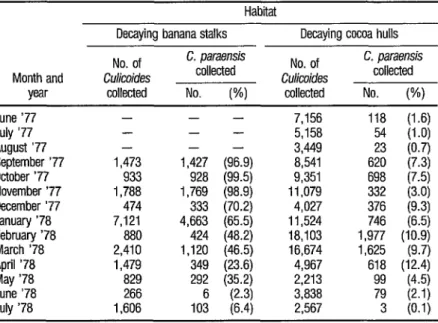
Specimens of C. paraensis were collected at three of the six habitats sampled (Table 1). The banana stalks yielded the largest number of specimens, followed by the cacao hulls and then the banana stumps. No C. paraensis were collected from banana leaf axils, or from the cacao leaf litter or marshland habi- tats. Consequently, sampling of the ca- cao leaf litter and marshland habitats was discontinued in February and March
1978, respectively. Leafaxil sampling was only conducted for three months.
Culicoides paraensis was the principal species of Cdicoides found breeding in decaying banana stalks, Dur- ing some months cacao hulls yielded smaller numbers of C. paraensis than did the banana stalks. Both habitats, as well as the marshland habitat, produced other species of Cdicoia’es biting midges (Table 2).
photo 3 (above): A type B emergence trap used to sample banana stumps. Photo 4 (MOW): A type D emergence trap used to sample decaying leaf liir.
TABLE 1. The numbers of Culicoides midges collected from different habitats with emergence traps at an agrfcuttural research station in Belkm, Par& Brazil, in 1977 and 1978.
Habitat
Month and year
Decaying banana stalks No. of C. paraensis No. of captured per trap-days trap-day
Decaying cacao hulls No. of C. paraensis No. of captured per trap-days trap-day
Decaying banana stumps No. of C. paraensis No. of captured per trap-days trap-day June ‘77 July ‘77 August ‘77 September ‘77 October ‘77 November ‘77 December ‘77 January ‘78 February ‘78 March ‘78 April ‘78 May ‘78 June ‘78 July ‘78 - - - - - -
89 16.03 110 8.44 114 11.66 96 4.47 168 27.75 186 2.28 168 6.66 112 3.12 128 2.28 112 .05 124 .83
ii
90 87 54 96 102 91 56 62 66 622.18 782 .Ol 0.87 850 .Ol 0.29 290 .Ol 7.38 300 .I0 7.75 280 .06 3.82 280 .04 6.96 280 .08 7.80 310 .44 19.40 280 .oo 17.80 350 ‘.I7 11.00 310 .oo 1.60 210 .07 1.20 320 .02 .05 280 .02
Fi
TABLE 2. Composition of the biting midge faunaa and the percentage represented by Culicoides
El
paraensis in emergence trap samples from principal breeding habiis at an agricultural research uo station in Betim, Pad, Brazil, 1977 and 1978. 5Month and year
Habiiat
5 Decaying banana stalks Decaying cocoa hulls
8 No. of C. paraensis No. of C. paraensis E Culiwides collected Culiwides collected
collected No. (%I collected No. W) June ‘77 July ‘77 August ‘77 September ‘77 October ‘77 November ‘77 December ‘77 January ‘78 February ‘78 March ‘78 April ‘78 May ‘78 June ‘78 July ‘78
- - - 7,156 - - - 5,158
1;; y; ig (0:7) +i - I.427 - 3,449 23
1,473 (96.9) 8,541 620 (7.3) 2
933 928 (99.5) 9,351 698 (7.5) 5 1,788 1,769 (98.9) 11,079 332 (3.0) Q
474 333 (70.2) 4,027 376 (9.3)
7,121 4,663 (65.5) 11,524 746 (6.5) 3 880 424 (48.2) 18,103 1,977 (10.9) . 2,410 1,120 (46.5) 16,674 1,625 (9.7)
1,479 349 (23.6) 4,967 618 (12.4) + z 829 292 (35.2) 2,213 99 (4.5) s 266 6 (2.3) 3,838 79 (2.1)
1,606 103 (6.4) 2,567 3 (0.1) gi
5 500 55 5 400
k j 300 iE 2 200
d I- 100 ?
5 3 25
t 8 s 20
g 15 .
g 10 ti
g 5
z
111111111111111
- BANANASTALKS
ed CACAO HULLS
I
MJJASONDJFMAMJJ
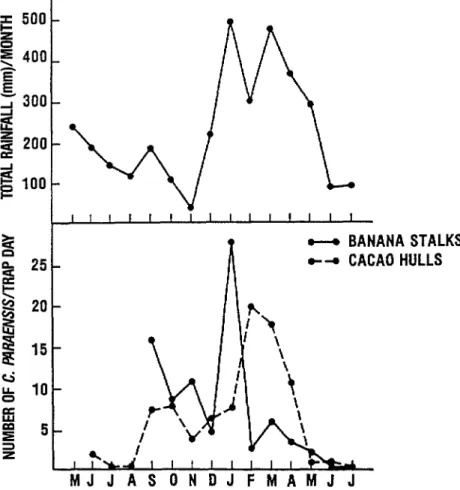
FIGURE 1. Rainfall patterns at the study site and the average numbers of C. paraensis captured per trap-day from decaying banana stalks and cacao hulls during each month of the study period in 1977 and 1978.
gence rates of C. paraensis from cacao hulls, but not from banana stalks, ap- b
3
peared to correlate with rainfall patterns.
.
3
z
.g
u
D
ISCUSSION
a
AND CONCLUSIONS
G
Decaying banana plant mate-5
rials and decomposing cacao hulls were
n, found to be the principal breeding sites of C. paraensis in the study area. This midge has been collected from tree holes 290 in other parts of its geographic range.
The scarcity of tree holes and negative results from the few that were sampled during our studies indicate, however, that tree holes were not an important fac- tor in the proliferation of C. paraensis at our study site.
ment, while the decomposing banana stalk creates a semiaquatic environment due to its more limited rainwater collect- ing capacity. Our emergence trap data (see Table 1) indicate that banana stumps yielded relatively few specimens of C. pa- raensis, and it seems that decaying ba- nana stalks are preferred over banana stumps as breeding sites.
Banana plants are frequently planted in close proximity to houses in both urban and rural areas of Amazonia to provide a source of fruit for supple- menting the family diet, to give shade, and to prevent soil erosion. The banana cluster is commonly harvested by cutting the entire trunk on which the fruit is borne, since this portion of the plant will not bear fruit again. Decayed banana stalks are thought to be useful as fertil- izer, and so the trunk is usually cut into several small stalks that are left at the base of the plant to decompose. The length of time required for decomposi- tion of the stalks depends on environ- mental conditions. Based on our obser- vations, however, the stalks will serve as a breeding site for two to four months. Since oviposition occurs mainly on the exposed ends of the banana stalks, sec- tioning the trunk probably increases the availability of breeding sites.
Like the banana stalks, cacao hulls located in shaded areas can provide favorable breeding sites for C. paraensis during periods of little rainfall. In addi- tion, we found the hulls to be an impor- tant breeding site for several other midge species. (Similar studies in Trinidad had indicated that C.paraensis was one of the predominant Cdicoides species reared on rotting cacao hulls- 7.)
Cacao is normally harvested once a year during the months of January through March. After the cacao pods are removed from the trees, they are taken to a central area, usually near the owner’s residence, and processed manually for
the seed. Since cacao hulls have no com- mercial value, they are generally piled in large mounds and left to decompose. A fresh cacao hull contains considerable or- ganic matter, and some decomposition must occur before it provides an accept- able habitat for C. paraensis (8). As it de- composes, however, it does provide a suitable breeding habitat for both C. pa- raensis and other midge species. De- pending upon the quantity of hulls present, several thousand biting midges may be produced.
Although cacao plantations are not common in large urban areas, plantations are sometimes associated with smaller, agriculturally oriented towns and villages. One such village that typifies this situation is Tome Acu, a set- tlement in northern Brazil that was the site of an outbreak of Oropouche virus disease in 1978 (9). This village is bor- dered by large cacao plantations and is burdened with dense populations of C. g paraensis. In this area, the breeding of C. t3 paraemis occurred almost exclusively s
among the large quantities of discarded
cacao hulls. 2
Such linkages as those de- scribed between the cultural practices of
5
human populations and dense popula- 8 tions of C. paraensis present various op- E tions for controlling this medically im- 5 portant biting midge. For example,
significant reduction in C. paraensis : population densities should result if ba- 5 nana refuse is eliminated from residen-
tial areas. 2 5
Destruction of the breeding 3 substrate by burning is not feasible due 3 to its high water content. A more effec- . tive direct approach would be to bury ba- < nana stalks and stumps or to dispose of 2 b the debris in a sanitary landfii. Either 3 method would eliminate the breeding 5
sites this material provides, so long as most of the residents participate. How- ever, it should be noted that while such measures would be useful in preventing pest problems and disease outbreaks, they would not be useful in stopping an Oropouche virus disease epidemic. To contain an epidemic, it would be neces- sary to treat the area with insecticides so as to control the adult C. paraensis popu- lations.
Large cacao plantations pre- sent similar, but perhaps simpler, control options involving removal or burial of both cacao refuse (discarded hulls) and banana refuse. Emphasis on these mea- sures by the plantation management would facilitate the control effort. A sim- ilar program for villages would be more difficult, since voluntary participation of the residents would be required.
In sum, the early elimination of banana plant refuse and discarded ca- cao hulls should greatly reduce C. pa- raensis abundance and the likelihood of * Oropouche virus disease epidemics oc- curring in urban areas within the Ama- zon Basin. The benefits of reducing the numbers of this pest species and disease vector through simple modifications in basic agricultural practices are sufficient to warrant a field trial of such a control effort.
S
UMMARY
-
3
The biting midge CzcGicoides$ paraensis (Diptera: Ceratopogonidae) is .g a major pest in urban parts of the Ama-
u
% 8 zon Basin, not only because its bite pro-
2
duces physical discomfort and skin reac-
3
tions, but also because it is the primary
a,
vector for many urban outbreaks of Oro- pouche virus disease.
Studies on the breeding sites of Cdicoides paraensis were conducted at an agricultural research station in Be- Km, Brazil, during 1977 and 1978. A va- riety of emergence traps were employed to quantify numbers of adult C. paraen-
sis produced in decaying banana-plant stalks, stumps, and leaf axils; discarded cacao hulls; leaf litter; and marsh habi- tats. Banana stalks were found to yield large numbers of C. paraensis, while ca- cao hulls turned out to be the second most productive habitat.
Decaying banana stalks and cacao hulls are common refuse materials resulting from the cultivation of cacao and banana plants in urban and semiur- ban areas and on cacao plantations in the Amazon Basin. This article includes sug- gestions for the control of C. paraensis through elimination of these materials.
Rx
FERENCES
Pinheiro, F. P., A. F! A. Ztavassos da Rosa, J. E S. Travassos da Rosa, R. Ishak, R. B. Freitas, M. L. C. Gomes, J. W. LeDuc, and 0. F. P. Oliva. Oropouche virus: I. A review of clinical, epide-
miological, and ecological findings. Am] Trap Med Hyg 30( 1): 149-160, 1981.
Dixon, K. E., A. I? A. Travassos da Rosa, J. E Travassos da Rosa, and C. H. Lewellvn. Oro- pouche virus: II. Epidemiological obiervations during an eDidemic in Santartm. Pars. Brazil in 1975.-Amj Trap Med Hyg jO(l):i61-164, 1981.
Roberts, D. R., A. L. Hoch, K. E. Dixon, and
C. H. Lewellyn. Oropouche virus: III. Entomo-
logical observations from three epidemics in Par%. Brazil, 1975. Am J Trap Med Hyg 30(1):165-171, 1981.
Pinheiro, E P, A. I? A. Travassos da Rosa, M. L. C. Gomes, J. W. LeDuc, and A. L. Hoch. Trans-
mission of Oro ouche virus from man to ham- ster by the ml ge Cuhcoidesparaensir. Science -8 . 215:1251-1253, 1982.
5 Sherlock, I. A. 0 problema do C.u~~coz’& em Salvador, Bahia. Rev Brazil Malarial Doerqas Fop 15:567-591, 1963.
6 Sherlock, I. A. Dermatotoonosis by Cz&oides bite (Diptera, Ceratopogonidae) in Salvador, State of Bahia, Brazil: VI. A clinical study. Mem hut Oswal’do Cmz 63127-37. 1965.
8 Soria, S. deJ., W. W. Wirth, and H. A. Bese- mer. Breeding places and sites of collections of adults of ForGipomyia spp. midges (Diptera, Ceratopogonidae) in cacao plantations in Bahia, Brazil: A progress report Rev&a Theobroma (Brazil 8:21-29, 1978.
9 LeDuc. 1. W.. H. L. Hoch, E A. Pinheiro, and 7 Williams. R. W. Observations on habitats of
Cucicoia’e.r larvae in Trinidad, W. I. (Diptera: Ceratopogonidae). Ann Entomol SOG Am 57~462-466, 1964.
A. P. ‘A. Travassos da R&a. Epidemic Oro- oouche virus disease in northern Brazil. B&l kan Am Health Organ 15(2):97-103, 1981.
Reports
of Denguel
and Dengue-2
Outbreak
As of May 1986 Brazil’s Ministry of Health had reported a large dengue-l epidemic estimated to have caused more that 300,000 cases. No cases of dengue hemorrhagic fever had been re- ported.
Also, dengue-2 activity was reported in several countries north of Brazil around this time. Spe- cifically, the laboratory of the Caribbean Epide- miology Center (CAREC) isolated dengue-2 vi- rus from one disease case in Trinidad and one in Suriname; the Pasteur Institute in Cayenne, French Guiana, reported increased dengue-2 activity in that country beginning in January 1986; and the institute isolated dengue-2 virus from two Cayenne residents in April. CAREC has advised health officials in its member countries to increase dengue surveillance activities and to step up efforts to control the Aedes aegypti vector.
Soum:Cadbbean Epidemiology Center, Notes, CSR CARECSurveillaance Report12(5):5, 1986.