R E V I E W
Open Access
Chronic obstructive pulmonary disease
guidelines in Europe: a look into the future
Marc Miravitlles
1*, Nicolas Roche
2, João Cardoso
3, David Halpin
4, Zaurbek Aisanov
5, Hannu Kankaanranta
6,7,
Vladimir Kobli
žek
8, Pawe
ł Śliwiński
9, Leif Bjermer
10, Michael Tamm
11, Francesco Blasi
12and Claus F. Vogelmeier
13Abstract
Clinical practice guidelines are ubiquitous and are developed to provide recommendations for the management of many diseases, including chronic obstructive pulmonary disease. The development of these guidelines is burdensome, demanding a significant investment of time and money. In Europe, the majority of countries develop their own national guidelines, despite the potential for overlap or duplication of effort. A concerted effort and consolidation of resources between countries may alleviate the resource-intensity of maintaining individual national guidelines. Despite significant resource investment into the development and maintenance of clinical practice guidelines, their implementation is suboptimal. Effective strategies of guideline dissemination must be given more consideration, to ensure adequate implementation and improved patient care management in the future.
Keywords: Chronic obstructive pulmonary disease, Clinical practice guidelines, Treatment recommendations
Background
The ultimate treatment goals in chronic obstructive pul-monary disease (COPD) management remain uniform across the majority of national and international COPD clinical practice guidelines (CPGs), and include reduced symptoms, reduced exacerbation risk and improved quality of life [1]. To achieve these goals, CPGs require regular updates with recent and relevant state-of-the-art medical and scientific developments. Guidelines strive to improve the quality of healthcare and to reduce varia-tions in the treatment and management of COPD [2].
Clinical practice guidelines provide recommendations on patient management based on available evidence and, in certain cases, educated opinion where there is no dir-ect evidence available [3]. The quality of the available evidence and the intended audience of CPGs remain core considerations for their development [4]. In recent years, CPGs have further evolved in response to an increasing recognition of the need for more stringent, systematic approaches when recommending specific therapeutic interventions or strategies [5]. The importance
of rigorous processes to ensure that only accurate and ap-propriate treatment recommendations are made is now well-accepted among professional scientific societies. In fact, standards to guide the preparation of CPGs are now available [6]. However, little attention is afforded to the challenges and pitfalls associated with the development of such documents.
A concerted effort between multiple stakeholders is needed to ensure precise, practical and up-to-date clinical recommendations for the diagnosis and optimal management of COPD. Guidelines must be locally relevant; therefore local expert stakeholders should offer local proposals, while referring to global evidence-based documents.
This review article highlights the challenges associated with the development and implementation of national CPGs for COPD in Europe and Russia.
Current challenges associated with the development of guidelines
Important advances in the methodologies used for the development of CPGs have been made in recent years. These include the Grading of Recommendations Assess-ment, Development and Evaluation (GRADE) guides [7]. GRADE provides a transparent, systematic approach to review available evidence and rate its quality, in order to * Correspondence:[email protected]
1
Pneumology Department, University Hospital Vall d’Hebron, Ciber de Enfermedades Respiratorias (CIBERES), Barcelona, Spain
Full list of author information is available at the end of the article
© The Author(s). 2018 Open Access This article is distributed under the terms of the Creative Commons Attribution 4.0 International License (http://creativecommons.org/licenses/by/4.0/), which permits unrestricted use, distribution, and reproduction in any medium, provided you give appropriate credit to the original author(s) and the source, provide a link to the Creative Commons license, and indicate if changes were made. The Creative Commons Public Domain Dedication waiver (http://creativecommons.org/publicdomain/zero/1.0/) applies to the data made available in this article, unless otherwise stated.
make recommendations of graded strength based on the degree of confidence in the benefit-risk-cost ratio and ap-plicability of the strategies of interest. GRADE is best used in response to defined key clinical (population/interven-tion/comparator/outcome [PICO]) questions [5, 8, 9].
Evidence-based CPGs should require minimal inter-pretation by end-users, to reduce the risk of bias. However, this type of CPG also carries inherent draw-backs and limitations, including a potential disconnec-tion between the focus on high-quality scientific evidence and real-world clinical practice [10]. Evidence-based guidelines may not address areas where there is an insufficient number of well-designed clinical trials (i.e. evidence), but yet clinicians still require guidance in these areas [11].
While rigorous methodologies such as the GRADE strategy offer robust and less biased treatment recom-mendations, solely relying on such strict methodologies can also compromise the conclusions and external valid-ity of CPGs. Using high-level, formal methodology to de-velop guidelines may exclude clinically relevant study results [12]. Evidence-based guidelines may reduce pro-fessional autonomy or clinical judgement [11]. Further-more, the evidence included in these grading processes is primarily collected from specific subsets of patients who meet strict inclusion criteria for participation in large clinical trials: specifically, registration randomised controlled trials (RCTs) recruit patients in whom there is the highest chance to demonstrate the efficacy of tested agents [10]. Consequently, often the results ob-tained do not allow determination of (i) the generalis-ability of results obtained in selected populations, or (ii) the most suitable target subgroups in terms of benefit-risk ratio. However, it is well-recognised that significant heterogeneity exists among patients with COPD. Older or very severe COPD patients, patients with a history of asthma and/or allergy, never smokers or patients with multiple comorbidities may not meet inclusion criteria and therefore may not be represented by the evidence used to support most recommendations within guide-lines [3, 11]. A recent study by Halpin et al. reported that only 27% of COPD patients are eligible for RCTs [13]. Under-representation of “challenging patients” (i.e. those who do not meet strict eligibility criteria, particu-larly the elderly, those with significant comorbidities and those requiring long-term oxygen therapy) in RCTs results in evidence-based CPGs that may not be fully adequate to ensure the optimal management of a signifi-cant number of patients.
Conversely however, guidelines which rely heavily on consensus opinion, rather than high-quality evidence, may be vulnerable to bias and individual interpretation [11]. To try to find the right balance, evidence from real-world effectiveness studies should be more heavily
considered in CPGs. These could include the results of observational studies or pragmatic trials where appropri-ate [10], provided that they satisfy appropriappropri-ate quality standards [14]. In light of this, CPGs should ideally combine both evidence- and opinion-based approaches in a complementary and transparent way. This can be achieved by clearly highlighting sections that are evidence-based, and addressing gaps in the knowledge by educated opinion or extrapolation from efficacy evidence in other disease areas. Furthermore, of significant consideration is the use of single-disease guidelines for patients with mul-tiple comorbidities. This may be particularly relevant in the case of COPD, because due to the advanced age of the majority of patients and the exposure to noxious particles or gases, especially tobacco smoking, the prevalence of co-morbidities is substantial [15]. In addition, COPD and its respiratory consequences can exert direct deleterious ef-fects on other systems; one example is the effect of lung hyperinflation on heart function [16]. Conversely, some comorbidities can increase the burden of COPD; e.g., anx-iety and depression can increase the perception of dyspnea through various mechanisms including hyperventilation and psychological distress [17]. The frequency and type of comorbidities presented may be different in patients in real life compared to those included in RCTs [18]; there-fore, guidance on multimorbidity will need to be consid-ered in the future [19–21].
Guidelines are time-consuming and expensive to pro-duce. Extensive literature reviews and detailed analyses require more time and resources than clinical and aca-demic experts can dedicate to the development and up-dates of national or international CPGs [12, 22–24]. This puts strain on local and national societies with lim-ited funding. Budget and available resources are import-ant factors for most countries when developing and updating their national guidelines [22]. Financial support from private (e.g. pharmaceutical) companies may raise issues around potential conflicts of interest [24]. New simplified strategies for CPG development are being tested; they combine consensus through a Delphi meth-odology with strict application of GRADE in areas where consensus is not reached or that are subject to a high risk of bias [25]. If adequately validated, these strategies could save significant time and resources. An overview of the developmental processes for national CPGs in Europe and Russia is presented in Table 1.
The key target audiences of national and international guidelines
Identifying the key target audience is a critical step in the development of CPGs. The audience is broad, and includes healthcare practitioners with varying levels of specialisation and expertise, as well as non-healthcare professionals [26]. Pulmonologists, general practitioners
Table 1 The development o f national guidelines in Europe and Russia: participants and intended audiences Count ry Evide nce system used O rganisat ion involved in the de velopm ent Participant s involved in the de velopm ent Inten ded audience Refere nce Czech Repu blic Con sensus The Czech Pneum ological an d Phth isiological Soc iety (CPPS) comm issione d an exp ert gro up to draft rec ommend ed guide lines for the managemen t o f stabl e COP D. Su bsequent revi sions we re further disc ussed at the National C o nsensus Con ference . Re viewe rs ’com ments cont ribut ed to the es tablishment of the final vers ion. Pu lmonolo gists and pharm acolo gists Pu lmonol ogists (full version), intern ists, GP s, and em ergency phy sician s (redu ced version ). The Cz ech nation al recom mendat ion was fully acce pted by the Stat e Instit ute for D rug Contr ol (SUKL) . [ 43 ] Eng land NICE technic al manu al metho dology (includes GRADE ) Nat ional Instit ute for Hea lth and Care Exce llenc e (NIC E) Pu lmonolo gists, GP s, respiratory nurs es, phy siothe rapist s patie nts, NICE technic al team (including heal th econ omist s), feedback from reg istered stak eholder s (pay ors, profes sional bodi es, hospi tals et c.) Pu lmonol ogists, GPs, other spec ialists, all othe r heal thcare prof essionals involved in caring for people with COP D, payo rs an d managers https ://www.nice.o rg.uk/process/ pmg2 0/chapter/int roduction -and-ove rview [ 44 ] Finland Evide nce-based medi cine and GR ADE metho dology The Current Care Gu idelines we re devel oped by the Fi nnish Medical Socie ty Duodecim in ass ociati on with various medi cal spe cialist soc ieties . The guide lines we re produ ced with pub lic fun ding and are ope n to all heal thcare pro fessionals and the gen eral public, and inc lude pat ient vers ions. A large revi ewing gro up including GPs was asked to com ment on the guideline. Pu lmonolo gists, GP s and interni sts Pu lmonol ogists, GPs, other spec ialists, all othe r heal thcare prof essionals (incl uding nurses, phy siothe rapist s, pharmac ists) an d citiz ens www.kay pahoito .fi/web/eng lish/ home [ 41 , 45 ] France (A) Position pap er/ statem ent on pharm acolo gical treat ment optimisation of st able CO PD A restricted expert group was com mission ed by the na tional socie ty (SPL F) to produc e an init ial propos ition. A larger reviewing group inc luding GPs was ask ed to com ment. Pu lmonolo gists and GPs Pu lmonol ogists and GPs [ 46 ] (B) GRAD E method for guide lines on exa cerba tions An exte nsiv e mult idisciplinary group o f exp erts an d end -users was com missio ned to produ ce the initial do cument , which was com mente d on by a pane l of exte rnal revi ewers . Pu lmonolo gists, GP s, intens ivists, emer gen cy phy sician s, phy siothe rapists and nurses Pu lmonol ogists, GPs, intens ivists, em ergency ph ysicians , phy siothe rapist s and nurses [ 47 ] Germ any Con sensus The German Re spirato ry Societ y (DGP ) and the Ge rman Airw ay League (A WL) com missio ned an exp ert group to de velop a gui deline for the dia gnosi s, assessment and managemen t o f COP D. Pu lmonolo gists Pu lmonol ogists, GPs, intens ivists, em ergency ph ysicians , phy siothe rapist s, nurses and pat ients Vogelm eier CF et al. Pneum ologi e 2017; in preparation Italy Con sensus The docum ent was prepared by a working gro up appointed by the three major nati onal res piratory soc ieties (AIM AR, AIP O and SI MeR) an d the Itali an Societ y of Gen eral Medicin e (SIM G). Represe ntatives of the Itali an Ministry of Healt h and AG E.NA.S . were involved as exte rnal indepen dent observe rs to ens ure et hical, social an d soli darity principles. Pu lmonolo gists and GPs Pu lmonol ogists and other spec ialists working either inside or out side the hos pital setting , GP s, oth er healthc are profes sionals, pat ient ass ociatio ns, and institutions at na tional, reg ional, or local level [ 48 ]
Table 1 The development o f national guidelines in Europe and Russia: participants and intended audiences (Continued) Count ry Evide nce system used O rganisat ion involved in the de velopm ent Participant s involved in the de velopm ent Inten ded audience Refere nce Pola nd Con sensus Poli sh Re spirato ry Societ y Pu lmonolo gists Pu lmonol ogists and a sho rt vers ion for GPs [ 49 ] Portug al Con sensus Nat ional Hea lth Autho rity (DGS ) com missio ned an exper t group, includ ing Nat ional Phy sicians Organi zation (OM ) an d Port uguese Re spirato ry Societ y (SPP) rep resent atives, to produc e a guidance do cument . Pu lmonolo gists All Phy sician s of the Nation al Hea lth Service (SNS) [ 50 ] Russia Evide nce-based medi cine and cons ensus Ru ssian Resp iratory Soc iety an d Ru ssian Mi nistry of Hea lth. Pu lmonolo gists Pu lmonol ogists, GPs, other heal thcare prof essionals, patien t ass ociatio ns, and institutions at na tional, reg ional, or local le vel [ 51 ] Spain GRADE and cons ensus 11 me dical scien tific soc ieties and the Nat ional Ass ociation of Patients . Pu lmonolo gists, GP s, internal medi cine, rehab ilitators , nurs es, phy siothe rapists, ge riatricians, emer gen cy spec ialists and patie nts Pu lmonol ogists, GPs, internal me dicine and emerge ncy spec ialists [ 52 ] Swed en (A) Evidence-base d medi cine and cons ensus Sw edish Medical Prod ucts Agen cy (MP A) Pu lmonolo gists, GP s, all ergologi sts an d phy siothe rapists Pu lmona ry special ists, GPs and intern al medi cine spe cialists https ://lakemedel sverket.s e/ upload/ halso-och-sjukvard/be handli ngsreko mmend ationer/ Kroniskt_ob struktiv_ lungsjukdom _KOL_be handli ngsreko mmen dation.pdf [ 53 ] (B) Evide nce-based medi cine and GR ADE The Swedish National Board of Hea lth an d We lfare Pu lmonolo gists, GP s, all ergologi sts an d phy siothe rapists Pu lmona ry special ists, GPs and intern al medi cine spe cialists [ 54 ] Swit zerland Con sensus The Swiss Societ y of Pne umo logy (SG P) com missio ned an exper t group inc luding pul monolog ists from all five Universi ty H ospitals in Sw itzerlan d, a rep resentat ive from a REHAB Clinic and at least one rep resent ative from each Langu age Regi on in Sw itzerlan d Sw iss me dical doc tors (me mbers of the Foederat io Medi corum Helve ticorum [FM H]) Pu lmonol ogists, GPs, internal me dicine and special ists [ 55 ] Abbreviations :GP general practitioner, GRADE grading of recommendations assessment, development and evaluation
(GPs), other healthcare professionals, patients, payors and policy-makers are the primary audiences of COPD guidelines.
Although not directly involved in the delivery of pa-tient care, healthcare payors, policy-makers and regu-latory agencies also comprise the readership of CPGs. Recommendations that relieve the burden of disease (e.g. reduce the frequency or severity of costly exacer-bations) or strategies to encourage early diagnosis in COPD patients can be of considerable benefit to payors. Payors rely on CPGs and robust efficacy evi-dence in order to make informed decisions on fund-ing and reimbursement policies of specific therapies [27, 28]. Policy-makers also need CPGs to develop ad-equate prevention strategies and to build pathways of care [29]. Guidelines are heavily regarded by regula-tory authorities, which may impact the design of clinical trials. This is of significant importance when regulatory authorities adopt the definition or diagnos-tic criteria used by a pardiagnos-ticular guideline when defin-ing the requirements for novel drugs, thereby (and
perhaps inadvertently) influencing the design of
clinical trials [30].
Who is involved in the development of CPGs?
Guidelines that are intended for widespread use in clin-ical practice should include relevant stakeholders at vari-ous and appropriate stages of the development process, which may encourage improved implementation and ad-herence of the recommendations through an increased sense of ownership [31, 32]. Although it may not be ap-propriate for all stakeholders to take an active role in the development process from the beginning, certain groups may participate in the drafting of recommendations or at the review stages.
Academic or clinical expert involvement in guideline preparation should include GPs, pulmonologists, nurses and physiotherapists where appropriate [31]. As the ma-jority of COPD care is administered by GPs, their in-volvement in guideline development may drive increased primary care physician-specialist communication and in-tegration, which is crucial in the management of COPD, particularly when patient referral is necessary. Input from nurses, cardiologists, physiotherapists and dieti-cians may also add value and clinical expertise to guide-lines in the pathways of care [26].
Importantly, guidelines should involve all “end-users”, including patients, non-expert practitioners and payors to ensure that the guidelines address the right questions from a family or society perspective. Critically, this may also help to incorporate patient preferences into the guidelines. Increased involvement may encourage pa-tients to play a more active role in their healthcare management [33].
A standardised pan-European guideline; is this realistic?
Duplicate efforts are made across Europe, with individ-ual countries investing significant resources into the de-velopment of CPGs [34]. Institutional collaboration and consolidation of efforts may significantly reduce the cumbersome nature of guideline development and frequent updates [35]. Furthermore, variations in individual sets of guidelines will inevitably continue unless collaboration is encouraged and optimised be-tween countries. These variations, however minor, have the potential to mislead or confuse practicing healthcare professionals [10].
Most national guidelines in Europe have been influ-enced to varying extents by GOLD. Moreover, GOLD 2017 [36] will likely impact future revisions of European national guidelines in a move towards more personalised treatment of COPD. The GOLD strategy also carries a major positive advantage in that the document is updated annually with the most recent and relevant lit-erature and studies; however, no formal evaluation of evidence (i.e. GRADE or similar) is performed. In addition, since by its definition, GOLD aims to provide a global strategy document, some recommendations may not be directly (i.e. without any adaptation) applicable in some areas or contexts. As most countries do not have the resources to facilitate an annual update to their na-tional guidelines, each country has the opportunity to adopt specific sections of GOLD that are locally relevant. Such processes could be facilitated by tighter collabor-ation between GOLD committees and regional, ncollabor-ational or local initiatives.
Owing to the importance of national guidelines, coupled with the international availability of the GOLD 2017 docu-ment, there may be potential for the development of an intermediary document between the two. This could com-prise a single detailed“umbrella” evidence base supporting common principles but with an adaptation of recommen-dations to reflect local practices. Individual sensitivities could therefore be facilitated within this common adapt-able template. National reimbursement policies, availabil-ity of resources and/or regulatory legislation may cause guideline recommendation and prescription deviations between countries. In brief, first-line treatment recom-mendations (at the class level) and secondary recommen-dations could be included within the common guideline, with local alternative suggestions added at a local level in line with local policy and scientific societies.
To support the introduction and implementation of a common, adaptable European guideline, a pan-European guideline development resource repository could be compiled as a support tool. Moreover, differ-ent sections of a guideline dedicated to a specific healthcare practitioner role may boost implementation across clinical practice.
There is potential for significant alleviation of time and budget constraints through a concerted, collabora-tive effort between European countries. Who should take the lead during such a collaboration remains to be discussed, but it is likely that the European Respiratory Society (ERS) is in the best position to lead such a pro-ject. The ERS is committed to the development of high quality CPGs [37], and either alone or in concert with sister societies such as the American Thoracic Society (ATS), has also delivered evidence-based CPGs for the management of COPD [38, 39]. Developing a European collaboration would be best achieved through the ERS and national societies, agreeing on a common method-ology. Tight links with the GOLD group could also be useful to share retrieved evidence and increase reactivity, allowing a continuous update and adaptation process.
Can COPD guidelines be simplified?
There is an apparent contradiction between the expo-nential increase in the scientific knowledge of COPD complexity (phenotypes, endotypes, comorbidities etc.) and the need for simplified treatment pathways. Com-plex raw data needs to be aggregated and translated into meaningful, useful information to support recommenda-tions of new treatments [29]. Algorithms may be helpful to guide COPD therapy in a simple, stepwise and coordi-nated manner [40]. Such algorithms need to be flexible and continuously evolving in order to remain up-to-date and clinically relevant. Importantly, the availability of al-gorithms does not negate the need for scientific princi-ples, and the role of clinical judgement should always be acknowledged.
Considerations for effective guideline dissemination
Once finalised, the CPGs should be shared in many ways to ensure optimal dissemination. Freely accessible online publishing of the guidelines is important. A way forward could be to amalgamate CPGs on all diseases into one single portal that is accessible by all physicians, other healthcare professionals and the general public free of charge. This has been done in Finland by the general Medical Society Duodecim Current Care Guideline system where guidelines on more than 100 diseases are collated on a single online portal and used by most healthcare professionals [41]. Also, presenting the guide-lines at local, national and international congresses may increase awareness amongst a myriad of healthcare prac-titioners. Furthermore, innovative methods to inform relevant end-users of CPGs could be considered e.g. e-mail blasts or social media communications. Plain language summaries may also prove helpful to guide pa-tients and their relatives on available treatments. A short pocket version should be made available to all physicians to facilitate quick and easy access during patient
consultations. Useful treatment algorithms should be available on an easily-navigable website. Using smart technology may also improve the implementation of guidelines. Such applications may also have a place within already-existing clinical integrated management systems such as GP practice computer software.
The final presentation of the recommendations should also be carefully considered. Succinct and concise rec-ommendations presented in an easily-digestible format such as tables or charts should be considered for busy healthcare practitioners [10].
Conclusions
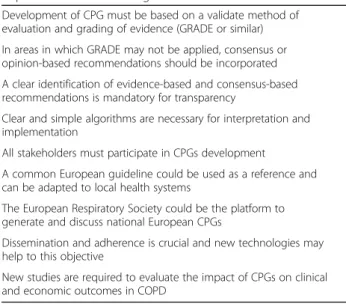
Evidence-based CPGs are rigorous by their very nature, but are difficult to implement in real-life clinical practice [11]. Some suggestions for improvement in the develop-ment and impledevelop-mentation of COPD CPGs are presented in Table 2. The authors suggest that an ideal COPD guideline document should comprise a fair balance be-tween evidence-based and expert opinion-based recom-mendations where definitive evidence is unavailable. For transparency, each recommendation should clearly state whether it is supported by evidence or based on expert opinion and clinical judgement.
The key target medical audience of COPD guidelines include pulmonologists and GPs, with patients, payors and policy-makers also comprising the intended audi-ence. All end-users should be involved in the develop-ment of guidelines. Formally assessing what they expect from the guidelines and which barriers may impede their implementation could help overcome current insuffi-ciencies in routine care for COPD patients.
Some guideline developers struggle to provide the ne-cessary resources to support the development and/or
Table 2 Suggestions for improvement in the development and implementation of COPD guidelines
Development of CPG must be based on a validate method of evaluation and grading of evidence (GRADE or similar) In areas in which GRADE may not be applied, consensus or opinion-based recommendations should be incorporated A clear identification of evidence-based and consensus-based recommendations is mandatory for transparency
Clear and simple algorithms are necessary for interpretation and implementation
All stakeholders must participate in CPGs development
A common European guideline could be used as a reference and can be adapted to local health systems
The European Respiratory Society could be the platform to generate and discuss national European CPGs
Dissemination and adherence is crucial and new technologies may help to this objective
New studies are required to evaluate the impact of CPGs on clinical and economic outcomes in COPD
regular update of their guidelines. Furthermore, it is pos-sible that not all aspects of international guidelines will be directly relevant to all local patients. In this regard, improved collaboration between European countries and the ERS may be beneficial, where a single intermediary strategy document for the management of COPD should be considered. This document could encompass some overarching high-level common principles, with the im-portant opportunity for local adaptation. This may sig-nificantly reduce the costs and resources associated with guideline development for many countries.
Although the majority of COPD management is con-ducted by GPs, familiarity of guidelines amongst general practitioners is suboptimal. Approximately 24% of gen-eral practitioners have reported that they are not familiar with the GOLD strategy for COPD [42].
Quick and easy access to guidelines on a website or smart phone is important to maximise guideline imple-mentation. A quickly- and easily-understandable treat-ment algorithm may help to simplify COPD guidelines. The algorithm must be flexible and continually evolving in accordance with new research and evidence.
There is still a paucity of knowledge on the effect of adequate COPD guideline implementation on disease management and patient outcomes. Further studies are warranted to address this gap in the literature.
Abbreviations
ATS:American Thoracic Society; COPD: Chronic obstructive pulmonary disease; CPG: Clinical practice guidelines; ERS: European Respiratory Society; GOLD: Global Initiative for Chronic Obstructive Lung Disease; GP: General practitioner; GRADE: Grading of Recommendations Assessment, Development and Evaluation; PICO: Population/intervention/comparator/ outcome question; RCT: Randomised controlled trial
Acknowledgments
The authors thank Gillian Lavelle, PhD, of Novartis Product Lifecycle Services (Dublin, Ireland), for providing medical writing support for this article, which was funded by Novartis Pharma AG, Basel, Switzerland in accordance with Good Publication Practice (GPP3) guidelines (http://www.ismpp.org/gpp3). The authors also thank Professor Bartolome Celli (Boston, US) for bringing the definition of a guideline by the US Department of Veterans Affairs to their attention.
Funding
None of the authors received payment or compensation for the development of this article. Medical writing support was funded by Novartis Pharma AG, Basel, Switzerland.
Availability of data and materials Not applicable
Authors’ contributions
All authors made substantial contributions to the drafting and critical review of all stages of this article. All authors have given final approval of the version to be published and agree to be accountable for all aspects of this work.
Ethics approval and consent to participate Not applicable
Consent for publication Not applicable
Competing interests
Marc Miravitlles has received speaker fees from Boehringer Ingelheim, Chiesi, Cipla, Menarini, Grifols and Novartis, and consulting fees from Boehringer Ingelheim, GlaxoSmithKline, Gebro Pharma, CLS Behring, Novartis and Grifols.
Nicolas Roche reports grants from Boehringer Ingelheim, Pfizer and Novartis, and personal fees from Boehringer Ingelheim, Novartis, Teva, GSK, AstraZeneca, Chiesi, Mundipharma, Cipla, Pfizer, Sanofi, Sandoz, 3 M, Zambon.
João Cardoso reports personal fees from Novartis, and has received honoraria for scientific advice and/or lecture fees from AstraZeneca, Boehringer Ingelheim, GSK, Mundipharma and Novartis.
David Halpin reports personal fees from Novartis.
Zaurbek Aisanov and Michael Tamm have no conflicts of interest to declare.
Hannu Kankaanranta reports personal fees from Almirall, AstraZeneca, Chiesi, GSK, Boehringer Ingelheim, Leiras-Takeda, MSD, Novartis, Mundipharma, Medith, ResMed Finland, Roche and Orion Pharma. He also reports non-financial support from Almirall, AstraZeneca and Intermune, and grants from AstraZeneca.
Vladimir Kobližek reports personal fees from AstraZeneca, Angelini, Boehringer Ingelheim, GSK, Novartis, Pulmonx, Sandoz and Mundipharma. He also reports grants from AstraZeneca, GSK and Novartis.
Paweł Śliwiński reports personal fees from Boehringer Ingelheim, Chiesi, Grifols, Novartis, Roche and Teva, and non-financial support from Boehringer Ingelheim and Chiesi.
Leif Bjermer reports that he has received honoraria for attending advisory boards or giving lectures from AstraZeneca, Boehringer Ingelheim, Chiesi, GSK, Novartis and Teva.
Francesco Blasi reports personal fees and grants from AstraZeneca, Bayer, Chiesi, Menarini, Grifols, Pfizer and Zambon, and personal fees from GSK, Guidotti and Novartis.
Claus F. Vogelmeier reports personal fees and grants from AstraZeneca, Boehringer Ingelheim, Chiesi, GlaxoSmithKline, Grifols, Mundipharma, Novartis and Takeda. He also reports personal fees from Almirall, Cipla, Berlin Chemie/Menarini, CSL Behring and Teva, and grants from the German Federal Ministry of Education and Research (BMBF) Competence Network Asthma and COPD (ASCONET), Bayer Schering Pharma AG, MSD and Pfizer.
Publisher’s Note
Springer Nature remains neutral with regard to jurisdictional claims in published maps and institutional affiliations.
Author details
1Pneumology Department, University Hospital Vall d’Hebron, Ciber de Enfermedades Respiratorias (CIBERES), Barcelona, Spain.2Service de Pneumologie et Soins Intensifs Respiratoires, Hôpital Cochin (AP-HP), University Paris Descartes (EA2511), Paris, France.3Hospital de Santa Marta, Centro Hospitalar de Lisboa Central, Universidade Nova de Lisboa, Lisbon, Portugal.4Royal Devon and Exeter Hospital, Exeter, UK.5Pulmonology Department, Pulmonology Research Institute, Russian National Medical University, Moscow, Russia.6Department of Respiratory Medicine, Seinäjoki Central Hospital, Seinäjoki, Finland.7Faculty of Medicine and Life Sciences, University of Tampere, Tampere, Finland.8Department of Pneumology, University Hospital Hradec Kralove, Faculty of Medicine in Hradec Kralove, Charles University in Prague, Hradec Kralove, Czech Republic.92nd Department of Respiratory Medicine, Institute of Tuberculosis and Lung Diseases, Warsaw, Poland.10Department of Respiratory Medicine & Allergology, Skåne University Hospital, Lund, Sweden.11Clinic of Pulmonary Medicine and Respiratory Cell Research, University Hospital, Basel, Switzerland.12Department of Pathophysiology and Transplantation, University of Milan, and Department of Internal Medicine, Respiratory Unit and Adult Cystic Fibrosis Center, Fondazione IRCCS Cà Granda Ospedale Maggiore Policlinico, Milan, Italy.13Department of Medicine, Pulmonary and Critical Care Medicine, University Medical Center Giessen and Marburg, Philipps-University Marburg, Member of the German Center for Lung Research (DZL), Marburg, Germany.
Received: 13 December 2017 Accepted: 5 January 2018
References
1. Overington JD, Huang YC, Abramson MJ, Brown JL, Goddard JR, Bowman RV, et al. Implementing clinical guidelines for chronic obstructive pulmonary disease: barriers and solutions. J Thorac Dis. 2014;6:1586–96.
2. Grimshaw JM, Thomas RE, MacLennan G, Fraser C, Ramsay CR, Vale L, et al. Effectiveness and efficiency of guideline dissemination and implementation strategies. Health Technol Assess. 2004;8:1–72.
3. Hughes LD, McMurdo ME, Guthrie B. Guidelines for people not for diseases: the challenges of applying UK clinical guidelines to people with multimorbidity. Age Ageing. 2013;42:62–9.
4. Wilt TJ, Guyatt G, Kunz R, Macnee W, Puhan MA, Viegi G, et al. Deciding what type of evidence and outcomes to include in guidelines: article 5 in integrating and coordinating efforts in COPD guideline development. An official ATS/ERS workshop report. Proc Am Thorac Soc. 2012;9:243–50. 5. Schunemann HJ, Oxman AD, Akl EA, Brozek JL, Montori VM, Heffner J, et al.
Moving from evidence to developing recommendations in guidelines: article 11 in integrating and coordinating efforts in COPD guideline development. An official ATS/ERS workshop report. Proc Am Thorac Soc. 2012;9:282–92.
6. Schunemann HJ, Woodhead M, Anzueto A, Buist AS, Macnee W, Rabe KF, et al. A guide to guidelines for professional societies and other developers of recommendations: introduction to integrating and coordinating efforts in COPD guideline development. An official ATS/ERS workshop report. Proc Am Thorac Soc. 2012;9:215–8.
7. Atkins D, Best D, Briss PA, Eccles M, Falck-Ytter Y, Flottorp S, et al. Grading quality of evidence and strength of recommendations. BMJ. 2004;328:1490. 8. Guyatt GH, Oxman AD, Kunz R, Jaeschke R, Helfand M, Liberati A, et al.
Incorporating considerations of resources use into grading recommendations. BMJ. 2008;336:1170–3.
9. Guyatt GH, Oxman AD, Vist GE, Kunz R, Falck-Ytter Y, Alonso-Coello P, et al. GRADE: an emerging consensus on rating quality of evidence and strength of recommendations. BMJ. 2008;336:924–6.
10. Wong GW, Miravitlles M, Chisholm A, Krishnan JA. Respiratory guidelines -which real world? Ann Am Thorac Soc. 2014;11(Suppl 2):S85–91. 11. Croft P, Malmivaara A, van Tulder M. The pros and cons of evidence-based
medicine. Spine. 2011;36:E1121–5.
12. Fabbri LM, Boschetto P, Mapp CE. COPD guidelines: the important thing is not to stop questioning. Am J Respir Crit Care Med. 2007;176:527–8. 13. Halpin DM, Kerkhof M, Soriano JB, Mikkelsen H, Price DB. Eligibility of
real-life patients with COPD for inclusion in trials of inhaled long-acting bronchodilator therapy. Respir Res. 2016;17:120.
14. Roche N, Reddel H, Martin R, Brusselle G, Papi A, Thomas M, et al. Quality standards for real-world research. Focus on observational database studies of comparative effectiveness. Ann Am Thorac Soc. 2014;11(Suppl 2):S99–104. 15. Laforest L, Roche N, Devouassoux G, Belhassen M, Chouaid C, Ginoux M, et
al. Frequency of comorbidities in chronic obstructive pulmonary disease, and impact on all-cause mortality: a population-based cohort study. Respir Med. 2016;117:33–9.
16. Stone IS, Barnes NC, James W-Y, Midwinter D, Boubertakh R, Follows R, et al. Lung deflation and cardiovascular structure and function in chronic obstructive pulmonary disease. A randomized controlled trial. Am J Respir Crit Care Med. 2016;193:717–26.
17. Livermore N, Butler JE, Sharpe L, McBain RA, Gandevia SC, McKenzie DK. Panic attacks and perception of inspiratory resistive loads in chronic obstructive pulmonary disease. Am J Respir Crit Care Med. 2008;178:7–12. 18. Miravitlles M, Price D, Rabe K, Schmidt H, Metzdorf N, Celli B. Comorbidities
of patients in tiotropium clinical trials: comparison with observational studies of patients with chronic obstructive pulmonary disease. Int J Chron Obst Pulm Dis. 2015;10:549–64.
19. Boyd CM, Darer J, Boult C, Fried LP, Boult L, Wu AW. Clinical practice guidelines and quality of care for older patients with multiple comorbid diseases. JAMA. 2005;294:716–24.
20. Tinetti ME, Bogardus ST Jr, Agostini JV. Potential pitfalls of disease-specific guidelines for patients with multiple conditions. N Engl J Med. 2004;351: 2870–4.
21. Vanfleteren LEGW, Spruit MA, Wouters EFM, Franssen FME. Management of chronic obstructive pulmonary disease beyond the lungs. Lancet Respir Med. 2016;4:911–24.
22. Hilbink MA, Ouwens MM, Burgers JS, Kool RB. A new impetus for guideline development and implementation: construction and evaluation of a toolbox. Implement Sci. 2014;9:34.
23. Woolf SH, Grol R, Hutchinson A, Eccles M, Grimshaw J. Clinical guidelines: potential benefits, limitations, and harms of clinical guidelines. BMJ. 1999; 318:527–30.
24. Boyd EA, Akl EA, Baumann M, Curtis JR, Field MJ, Jaeschke R, et al. Guideline funding and conflicts of interest: article 4 in integrating and coordinating efforts in COPD guideline development. An official ATS/ERS workshop report. Proc Am Thorac Soc. 2012;9:234–42.
25. Schoenberg NC, Barker AF, Bernardo J, Deterding RR, Ellner JJ, Hess DR, et al. A comparative analysis of pulmonary and critical care medicine guideline development methodologies. Am J Respir Crit Care Med. 2017;196:621–7. 26. Yawn BP, Akl EA, Qaseem A, Black P, Campos-Outcalt D. Identifying target audiences: who are the guidelines for? Integrating and coordinating efforts in COPD guideline development. An official ATS/ERS workshop report. Proc Am Thorac Soc. 2012;9:219–24.
27. Mapel D, Pearson M. Obtaining evidence for use by healthcare payers on the success of chronic obstructive pulmonary disease management. Respir Med. 2002;96(Suppl C):S23–30.
28. Eccles MP, Grimshaw JM, Shekelle P, Schunemann HJ, Woolf S. Developing clinical practice guidelines: target audiences, identifying topics for guidelines, guideline group composition and functioning and conflicts of interest. Implement Sci. 2012;7:60.
29. Bloomrosen M, Detmer DE. Informatics, evidence-based care, and research; implications for national policy: a report of an American medical informatics association health policy conference. J Am Med Inform Assoc. 2010;17:115–23. 30. Calverley PM, Rennard SI. Application of management guidelines to the
assessment of new medicines: driving us forward or holding us back? Eur Respir J. 2004;23:793–4.
31. Cluzeau F, Wedzicha JA, Kelson M, Corn J, Kunz R, Walsh J, et al. Stakeholder involvement: how to do it right: article 9 in integrating and coordinating efforts in COPD guideline development. An official ATS/ERS workshop report. Proc Am Thorac Soc. 2012;9:269–73.
32. Buist AS. Guidelines for the management of chronic obstructive pulmonary disease. Respir Med. 2002;96(Suppl C):S11–6.
33. Legare F, Boivin A, van der Weijden T, Pakenham C, Burgers J, Legare J, et al. Patient and public involvement in clinical practice guidelines: a knowledge synthesis of existing programs. Med Decis Mak. 2011;31:E45–74. 34. Miravitlles M, Vogelmeier C, Roche N, Halpin D, Cardoso J, Chuchalin AG, et al. A review of national guidelines for management of COPD in Europe. Eur Respir J. 2016;47:625–37.
35. Alonso-Coello P, Martinez Garcia L, Carrasco JM, Sola I, Qureshi S, Burgers JS. The updating of clinical practice guidelines: insights from an international survey. Implement Sci. 2011;6:107.
36. Vogelmeier CF, Criner GJ, Martinez FJ, Anzueto A, Barnes PJ, Bourbeau J, et al. Global strategy for the diagnosis, management, and prevention of chronic obstructive lung disease 2017 report: GOLD executive summary. Eur Respir J. 2017;195:557–82.
37. Brusselle GG, Gaga M. ERS guidelines, statements and technical standards published in the ERJ in 2014: a year in review. Eur Respir J. 2015;45:863–6. 38. Wedzicha JA, Calverley PM, Albert RK, Anzueto A, Criner GJ, Hurst JR, et al.
Prevention of COPD exacerbations: an European Respiratory Society/American Thoracic Society (ERS/ATS) guideline. Eur Respir J. 2017;50:1602265. 39. Wedzicha JA, Miravitlles M, Hurst JR, Calverley PM, Albert RK, Anzueto A, et
al. Management of COPD exacerbations: a European Respiratory Society/ American Thoracic Society guideline. Eur Respir J. 2017;49:1600791. 40. Miravitlles M, Anzueto AA. New two-step algorithm for the treatment of
COPD. Eur Respir J. 2017;49:1602200.
41. Kankaanranta H, Harju T, Kilpelainen M, Mazur W, Lehto JT, Katajisto M, et al. Diagnosis and pharmacotherapy of stable chronic obstructive pulmonary disease: the finnish guidelines. Basic Clin Pharmacol Toxicol. 2015;116:291–307. 42. Salinas GD, Williamson JC, Kalhan R, Thomashow B, Scheckermann JL, Walsh
J, et al. Barriers to adherence to chronic obstructive pulmonary disease guidelines by primary care physicians. Int J Chron Obstruct Pulmon Dis. 2011;6:171–9.
43. Koblizek V, Chlumsky J, Zindr V, Neumannova K, Zatloukal J, Zak J, et al. Chronic obstructive pulmonary disease: official diagnosis and treatment guidelines of the Czech Pneumological and Phthisiological society; a novel phenotypic approach to COPD with patient-oriented care. Biomed Pap Med Fac Univ Palacky Olomouc Czech Repub. 2013;157:189–201.
44. National Institute for Health and Care Excellence UK: Chronic obstructive pulmonary disease: Management of Chronic Obstructive Pulmonary Disease in adults in primary and secondary care (partial Update). 2010. www.nice. org.uk/guidance/cg101 Accessed 15 Sept 2017.
45. Harju T, Kankaanranta H, Katajisto M, Kilpelainen M, Lehtimaki L, Lehto J, et al. Update on current care guideline: chronic obstructive pulmonary disease (COPD). Duodecim. 2014;130:1774–6.
46. Zysman M, Chabot F, Devillier P, Housset B, Morelot-Panzini C, Roche N. Pharmacological treatment optimization for stable chronic obstructive pulmonary disease. Proposals from the Société de Pneumologie de langue Française. Rev Mal Respir. 2016;33:911–36.
47. Jouneau S, Chabot F, Roche N. New guidelines for acute COPD exacerbations. Rev Mal Respir. 2017;34:279–81.
48. Bettoncelli G, Blasi F, Brusasco V, Centanni S, Corrado A, De Benedetto F, et al. The clinical and integrated management of COPD. An official document of AIMAR (interdisciplinary Association for Research in lung disease), AIPO (Italian Association of Hospital Pulmonologists), SIMER (Italian Society of Respiratory Medicine), SIMG (Italian Society of General Medicine). Multidiscip Respir Med. 2014;9:25.
49. Sliwinski P, Gorecka D, Jassem E, Pierzchala W. Polish respiratory society guidelines for chronic obstructive pulmonary disease. Pneumonol Alergol Pol. 2014;82:227–63.
50. Health Ministry. Diagnóstico e Tratamento da Doença Pulmonar Obstrutiva Crónica. Diagnosis and Treatment of Chronic Obstructive Pulmonary Disease. Standard No. 028/2011. Portugal. 2013. www.dgs.pt/directrizes-da- dgs/normas-e-circulares-normativas/norma-n-0282011-de-30092011-atualizada-a-10092013.aspx Accessed 15 Sept 2017.
51. Aisanov Z, Avdeev S, Arkhipov V, Belevskiy A, Chuchalin A, Leshchenko I, et al. Russian guidelines for the management of COPD: algorithm of pharmacologic treatment. Int J Chron Obst Pulm Dis. 2018;13:183–187. 52. Miravitlles M, Soler-Cataluña JJ, Calle M, Molina J, Almagro P, Quintano JA,
et al. Spanish guidelines for Management of Chronic Obstructive Pulmonary Disease (GesEPOC) 2017. Pharmacological treatment of stable phase. Arch Bronconeumol. 2017;53:324–35.
53. Medical Products Agency, Kroniskt obstruktiv lungsjukdom (KOL)– behandlingsrekommendation, Lakemedelsverket, Sweden. 2015. https://lakemedelsverket.se/upload/halso-och-sjukvard/behandling srekommendationer/Kroniskt_obstruktiv_lungsjukdom_KOL_ behandlingsrekommendation.pdf Accessed 15 Sept 2017.
54. Holm LE: National Guidelines for Care in Asthma and COPD– Support for Governance and Management– Consultation Version, The National Board of Health and Welfare (Socialstyrelsen), Sweden. 2014. www.socialstyrelsen. se/sitecollectiondocuments/nr-astma-kol-vetenskapligt-underlag-2015.pdf Accessed 15 Sept 2017.
55. Russi EW, Karrer W, Brutsche M, Eich C, Fitting JW, Frey M, et al. Diagnosis and management of chronic obstructive pulmonary disease: the Swiss guidelines. Official guidelines of the Swiss respiratory society. Respiration. 2013;85:160–74.
• We accept pre-submission inquiries
• Our selector tool helps you to find the most relevant journal
• We provide round the clock customer support
• Convenient online submission
• Thorough peer review
• Inclusion in PubMed and all major indexing services
• Maximum visibility for your research Submit your manuscript at
www.biomedcentral.com/submit