F
ACULDADE DEE
NGENHARIA DAU
NIVERSIDADE DOP
ORTODeep Learning Approaches Assessment
for Underwater Scene Understanding
and Egomotion Estimation
Bernardo Teixeira
Mestrado Integrado em Engenharia Eletrotécnica e de Computadores Supervisor: Prof. Doutor Eduardo Silva
Co-Supervisor: Prof. Doutor Anibal Matos
c
Resumo
A progressiva utilização de soluções baseadas em visão computacional no âmbito do desenvolvi-mento de veículos autónomos submarinos (VAS) vem sendo impulsionada pelo baixo preço das câmaras visiveis em comparação com outros tipos de sensorização, tendo em conta a quantidade de informação que pode ser retirada apartir da análise da informação visual. No contexto de ambi-entes subaquáticos, em que soluções como o GPS não são viáveis e outros tipos de sensorização já mostraram vulnerabilidades no passado, a utilização de câmaras e novos algoritmos que utilizam a informação obtida por estas, tem sido alvo de imensa pesquisa e desenvolvimento.
No entanto, e não obstante a maturidade e os iterativos ganhos em performance dos algoritmos de aplicação de visão computacional, a sua dependência de formulações geométricas elaboradas, combinada com alguma incapacidade de manter elevados níveis de performance em cenários de aplicação mais complexos, comprometem a sua aplicação em soluções robóticas em meio opera-cional. O elevado volume de dados de sensorização produzido pelas soluções robóticas atuais, aliado ao maior poder de processamento, realça a possibilidade de implementação de métodos computacionais baseados em aprendizagem em soluções de estimação de movimento e navegação robótica.
Nos últimos anos, abordagens baseadas em arquitecturas Deep Learning tem aparecido como métodos capazes de solucionar problemas de visão computacional. A performance dessas aborda-gens rapidamente ultrapassaram os resultados obtidos pelos métodos clássicos em alguns tipos de tarefas no âmbito da visão computacional, nomeadamente na detecção e classificação de objectos. No entanto, o seu potencial de aplicação não se cinge a estas tarefas, existindo trabalho anterior também em aplicações de navegação robótica.
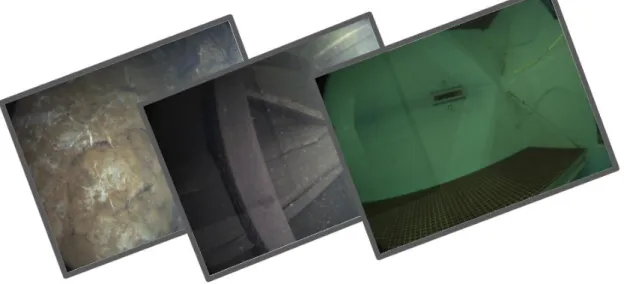
Nesta dissertação, o foco é colocado na avaliação da performance dos métodos de Deep Learning em tarefas de relocalização e estimação de movimento, em particular transportando os métodos do estado da arte da literatura para o contexto subaquático, testando e avaliando a sua performance num dataset visual subaquático desenvolvido no decorrer deste trabalho, que contém cenários de aplicação reais de uma solução robótica em missão operacional.
Baseado nos resultados obtidos, foram desenvolvidos duas novas arquitecturas de fusão sensorial para optimização do posicionamento global do robô com o propósito de corrigir o drift acumulado pelos métodos de estimação de movimento; uma rede de fusão de informação visual e inercial baseada num esquema de aprendizagem supervisionado e uma rede neuronal recorrente que realiza a fusão de estimativas do posicionamento provenientes de múltiplas cameras que não possuem overlapdos seus respectivos campos de visão.
Abstract
The widespread use of Computer Vision approaches on Autonomous Underwater Vehicles (AUV) applications, rises from the fact that vision sensors are low cost and can provide lots of information for a variety of tasks the AUV has to perform. In the underwater context a lot of research has been devoted to the development of algorithms that leverage visual camera information.
However, and despite the technical maturity and accurate performance of visual based algorithms, classical visual approaches rely on intricate geometric formulations that may struggle to capture more complex environments. In addition, robotic solutions of today provide huge amounts of sensor data, begging the question of whether more data-centric approaches could be beneficial for improving accuracy and performance of visual-based tasks.
Deep learning approaches for Computer Vision applications have been surfacing in the last couple years, posing as a viable alternative to classical methods for a wide range of computer vision tasks, even severely outperforming classical algorithms for some visual tasks. Despite of its prevalence in computer vision tasks such as object detection and scene classification, the realm of potential applications can still be further extended. End-to-end visual-based navigation applications, tai-lored for several different tasks ranging from scene localization to egomotion estimation, could result in interesting alternative approaches to the robot navigation problem.
State-of-the-art algorithms have shown the tremendous potential deep learning architectures can have for visual navigation implementations, though they are still mostly outperformed by classical feature-based techniques.
In this work, we apply the advancements in deep learning methods for visual-based robot naviga-tion to the more challenging underwater environment, providing both an underwater visual dataset acquired in real operational mission scenarios and an assessment of state-of-the-art algorithms on the underwater context.
Furthermore, we propose two novel pose optimization architectures for the purpose of correct-ing visual odometry estimate drift: a Visual-Inertial fusion network aimcorrect-ing to correct monocular estimates through an inertial supervision learning scheme and a camera sensor fusion within a Recurrent Neural network aimed at optimizing unsupervised monocular trajectory estimates in systems with the presence of multiple cameras with non-overlapping fields-of-view (FOV).
Agradecimentos
Em primeiro lugar, queria agradecer ao meu orientador, Prof. Eduardo Silva pela excelente opor-tunidade que me proporcionou e pelas palavras de motivação ao longo desta etapa. Espero ter correspondido e continuar a corresponder às expectativas que depositou em mim. Agradeço tam-bém ao Prof. Aníbal Matos, pela disponibilidade que sempre mostrou para me receber e responder às minhas dúvidas.
Não posso deixar de mencionar os meus colegas investigadores do CRAS, nomeadamente a Sara, o Eduardo, o Tiago, o Ricardo, o Denis, o Caio, o Pedrosa, o Amaral e o Miranda. Obrigado pelo forma como me receberam e pelo excelente ambiente que se vive aqui dentro.
As minhas próximas palavras são para quem me trouxe até aqui, os meus pais Jorge e Fátima. As palavras não chegam para descrever a gratidão que sinto pela educação que me deram, pelo carinho, pela força e pelas condições que me proporcionaram.
À minha madrinha Celeste, por tudo o que fizeste por mim. Ao Hugo, por seres um exemplo para mim, me mostrares o caminho e incentivares a cada passo do caminho.
Aos meus avós, tios, primos e todo o resto da minha família, cada um à sua maneira importante nesta caminhada. Uma palavra especial para quem já não cá está, mas nunca partiu do meu coração.
À rapaziada do DMESM, foi um prazer partilhar esta caminhada convosco. 5 anos de pura partilha nesta montanha russa de emoções, não podia pedir mehor companhia nesta etapa.
Aos meus amigos Salvador, Kiko, Hugo, Filipe, Diana e Isabel, já sabem que são a família que eu escolhi, e se largos dias tem 100 anos, largas noites tem histórias que ficam para a vida. Obrigado especialmente por terem sido o garante da minha sanidade ao longo deste percurso.
E por último, quero agradecer à pessoa única e especial que é a minha namorada Ana. Entrámos já juntos nesta caminhada, e sem ti nada teria sido igual. Obrigado por seres a minha rocha e por sempre me motivares para ser a melhor versão de mim.
A todos o meu muito obrigado,
Bernardo Teixeira
“Our intelligence is what makes us human, and AI is an extension of that quality”
Yann LeCun
Contents
1 Introduction 1 1.1 Context . . . 1 1.2 Motivation . . . 3 1.3 Objectives . . . 4 1.4 Contributions . . . 5 1.5 Document Structure . . . 6 2 Related Work 7 2.1 Introduction . . . 72.2 Retrieving Image Information . . . 8
2.2.1 Stereo Vision . . . 8
2.2.2 Monocular Cameras . . . 9
2.2.3 Feature-based Methods . . . 10
2.2.4 Direct/Dense Methods . . . 11
2.3 Egomotion estimation . . . 12
2.4 Deep Learning for Computer Vision . . . 14
2.4.1 Depth Estimation . . . 14
2.4.2 Global Pose Estimation . . . 15
2.4.3 Egomotion Estimation . . . 16
2.5 Benchmark Datasets . . . 17
2.6 Summary . . . 18
3 Fundamentals 19 3.1 Introduction . . . 19
3.2 Formulation of the VO problem . . . 19
3.3 Perspective Camera Model . . . 21
3.4 Epipolar Geometry . . . 22
3.5 Egomotion Estimation . . . 23
3.5.1 2D-to-2D: Motion from Image Feature Correspondence . . . 24
3.5.2 3D-to-3D: Motion from Structure Correspondence . . . 24
3.5.3 3D-to-2D: Motion from 3D Structure and Feature Correspondence . . . . 25
3.6 Pose Parametrizations . . . 26 3.6.1 Rotation Matrix . . . 26 3.6.2 Euler Angles . . . 27 3.6.3 Quaternions . . . 27 3.7 Deep Learning . . . 28 3.7.1 Motivation . . . 28
3.7.2 Supervised vs Unsupervised schemes . . . 29
x CONTENTS
3.7.3 Concepts and Techniques . . . 29
3.7.4 Convolutional Neural Networks (CNN) . . . 30
3.7.5 Recurrent Neural Networks (RNN) . . . 32
3.7.6 Long Short-Term Memory Units (LSTM) . . . 32
3.8 Evaluation Metrics . . . 33
4 Deep Learning Approaches for Visual-based Robot Navigation 37 4.1 Introduction . . . 37
4.2 Underwater Visual Dataset . . . 38
4.2.1 The Robotic Solution . . . 39
4.2.2 Scenarios . . . 43
4.2.3 Environment constraints . . . 44
4.3 Relocalization and Global Pose Estimation . . . 45
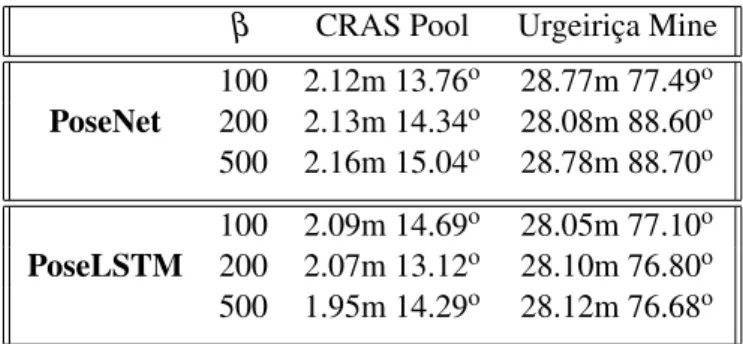
4.3.1 Results on Deep Visual Relocalization . . . 45
4.3.2 Generalization . . . 46 4.4 Egomotion Estimation . . . 48 4.4.1 SfMLearner . . . 48 4.4.2 GeoNet . . . 50 4.4.3 Results . . . 52 4.5 Summary . . . 58
5 Global Trajectory Optimization 61 5.1 Introduction . . . 61
5.2 Visual Inertial Fusion Network . . . 62
5.2.1 Training Procedure and Hyperparameter grid-search . . . 63
5.2.2 Results . . . 64
5.3 Monocular Camera Pose Estimate Fusion Network . . . 67
5.3.1 Results . . . 68
5.4 Summary . . . 69
6 Conclusions and Future Work 71 6.1 Conclusions . . . 71
6.2 Future Work . . . 73
List of Figures
1.1 Example CRAS robots . . . 4
2.1 Stereo vision . . . 9
2.2 Brightness shift of an 2D image pixel representation . . . 11
2.3 Typical Visual Odometry pipeline . . . 12
2.4 VO applications . . . 13
2.5 Proposed Deep Learning for Visual Odometry end-to-end methods pipeline . . . 16
3.1 Pinhole Camera Model . . . 21
3.2 Epipolar geometry . . . 23
3.3 R,t parameter extraction . . . 26
3.4 Euler Angles representation . . . 27
3.5 Quaternion Unit Sphere . . . 28
3.6 Neural network . . . 28
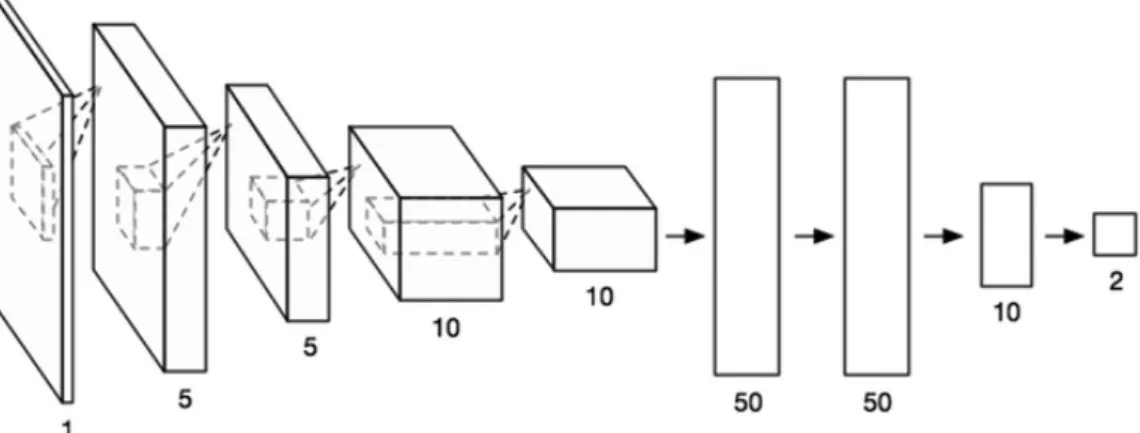
3.7 Convolutional Neural Network: Dimensionality reduction example for binary clas-sification problem . . . 31
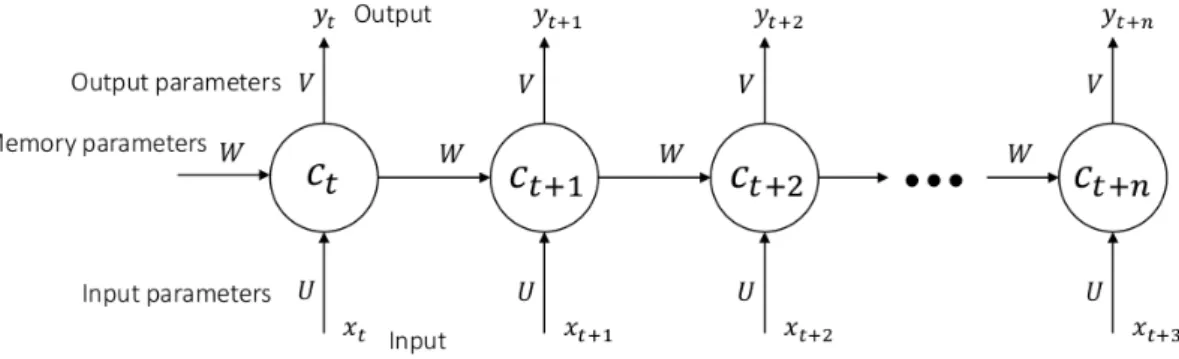
3.8 Recurrent Neural Network diagram . . . 32
3.9 LSTM unit . . . 33
3.10 The process of quantitative trajectory evaluation . . . 33
3.11 Illustration of absolute trajectory error and relative pose error . . . 34
4.1 Dataset image examples . . . 38
4.2 UNEXMIN UX-1 CAD design . . . 39
4.3 UNEXMIN UX-1 description . . . 39
4.4 UNEXMIN UX-1 photo . . . 40
4.5 Environmental constraints in underwater VO . . . 44
4.6 CRAS pool relocalization performance . . . 47
4.7 CRAS pool 5-sequence length snippet . . . 48
4.8 Representation of the SfMlearner PoseNet, the framework component responsible for regressing 6-DoF pose estimates . . . 49
4.9 Representation of the GeoNet pose estimation network, the framework component responsible for regressing 6-DoF pose estimates . . . 51
4.10 Results for KITTI sequence 09 . . . 53
4.11 Translation Error with respect to distance traveled from SfMlearner pose estimates in KITTI sequence 09 . . . 53
4.12 Translation Error with respect to distance traveled from GeoNet pose estimates in KITTI sequence 09 . . . 53
4.13 Results for KITTI sequence 10 . . . 54
xii LIST OF FIGURES
4.14 Translation Error with respect to distance traveled from SfMlearner pose estimates in KITTI sequence 10 . . . 54
4.15 Translation Error with respect to distance traveled from GeoNet pose estimates in KITTI sequence 10 . . . 54
4.16 Results for CRAS pool sequence . . . 55
4.17 Translation Error with respect to distance traveled from SfMlearner pose estimates in our CRAS pool sequence . . . 55
4.18 Translation Error with respect to distance traveled from GeoNet pose estimates in our CRAS pool sequence . . . 56
4.19 Results for Urgeiriça mine sequence . . . 57
4.20 Translation Error with respect to distance traveled from SfMlearner pose estimates in our Urgeiriça mine test sequence . . . 57
4.21 Translation Error with respect to distance traveled from GeoNet pose estimates in our Urgeiriça mine test sequence . . . 57
5.1 Results for the CRAS pool sequence . . . 64
5.2 Translation Error with respect to distance traveled from our network pose esti-mates in our CRAS pool test sequence . . . 64
5.3 Results for Urgeiriça mine sequence . . . 65
5.4 Translation Error with respect to distance traveled from our network pose esti-mates in our Urgeiriça mine test sequence . . . 65
5.5 Computed trajectory estimates against groundtruth data, in the Urgeiriça mine se-quence. . . 68
List of Tables
4.1 Average Error Results of Deep Visual Relocalization algorithms . . . 46
4.2 Average Error Assessment of generalization ability of Deep Visual Relocalization algorithms . . . 47
4.3 Absolute Trajectory Error (ATE) method evaluation . . . 52
4.4 Absolute Pose Error (APE) w.r.t translation: Compilation of best obtained results on full concatenated trajectory in the global reference frame, comprising both al-gorithms and all training procedures. . . 55
4.5 Relative Pose Error (RPE): Evaluation of relative pose error provides insight about the local accuracy, i.e. the visual odometry drift of pose estimates . . . 56
5.1 Hyperparameter grid-search setup . . . 63
5.2 Theoretical best fit for hyperparameter tuning . . . 63
5.3 Result compilation for absolute pose error with respect to translation, comprising both studied egomotion estimation algorithms and our visual-inertial fusion network 66
5.4 Results of our novel multi-camera fusion network for absolute position error. . . 68
Abbreviations and Symbols
AI Artificial Intelligence ANN Artificial Neural Network AUV Autonomous Underwater Vehicle
BA Bundle Adjustment
CNN Convolutional Neural Network CPU Central Processing Unit
CRAS Centre for Robotics and Autonomous Systems
DVL Doppler Velocity Log
GPU Graphical Processing Unit IMU Inertial Measurement Unit
INESC TEC Instituto de Engenharia de Sistemas e Computadores - Tecnologia e Ciência JPEG Joint Photographic Experts Group
LSTM Long Short-Term Memory
ML Machine Learning
PNG Portable Network Graphics ReLu Rectified Linear Unit RNN Recurrent Neural Network
ROS Robot Operating System
SBL Short Baseline Acoustic Positioning Systems
SfM Structure from Motion
SLAM Simultaneous Localization and Mapping USBL Ultra-Short Baseline Acoustic Systems
VO Visual Odometry
6-DoF Six Degrees of Freedom
Chapter 1
Introduction
“Aside from its importance to many branches of science, a knowledge of the oceans has a practical value for mankind. The intelligent development of our fishing indus-tries, the laying of oceanic cables, the proper construction of harbor-works, oceanic commerce and navigation, as well as long-range weather forecasting, are all depen-dent on an understanding of the ocean.”
In The Last Cruise of the Carnegie (1932) by J. H. Paul.
1.1
Context
The ongoing evolution of underwater robotic vehicles, whether autonomous or remotely operated, is closely tied to its reliable application in potential risk carrying tasks or challenging environ-ments for human operators. Such applications range from oceanographic monitoring or demining operations to bathymetric or topological mapping of ocean floors. Gathering and analyzing data from marine resource filled ocean floors has helped improve further research in marine biology, as well as fuel the recent growth in marine blue economy all over the world.
Autonomous Underwater Vehicle (AUV) technology development started in the 1970’s and pro-gressive improvements in computational efficiency, hardware size reduction and navigation accu-racy have contributed to its increasingly importance for marine exploration, deep sea applications and mapping of ocean floors. To perform this tasks, robot navigation in complex unstructured environments is a crucial aspect of robotic solutions development.
There has been a substantial increase in the use of underwater robotic solutions, that are typically equipped with a plethora of heterogeneous sensors such as: acoustic sensors, laser rangefind-ers, Doppler Velocity Loggers (DVL), Inertial Measurement Units (IMU) or Global Positioning System (GPS). The combination of these sensors aims to provide precise and reliable robot local-ization and navigation. However, its application is limited when it becomes necessary for the robot
2 Introduction
to remain submerse for long periods of time relying solely on perceiving sensorial information, since it acccumulates drift in navigation estimates.
Typical robotic application scenarios are prone to IMU/GPS failures, thus making it necessary to use alternative or complementary sensors. In the underwater context, since GPS is not available as a navigation solution due to electromagnetic waves being severely attenuated underwater, the use of Doppler Velocity Loggers (DVL) and Acoustic Localization methods (SBL/USBL) is com-monplace. Doppler Velocity Logs work by obtaining the frequency distortion between emitted and received signals, denoted as Doppler Effect, while Acoustic Localization functioning princi-ple is computing the propagation time of acoustic signals in water, and triangulating at least three emitters data to recover absolute localization. However, classical dead reckoning methods tend to drift substantially, thus making it necessary to fuse information from different sensors in order to achieve persistent autonomous navigation.
To tackle the issue of precision and reliability, scientists and researchers started exploring the possibility of including camera setups in underwater robotic solutions, so as to further expand upon robot autonomy capabilities.
One example of a task that can be performed through the use of visual camera setups is motion esti-mation based on visual inforesti-mation, denoted as Visual Odometry (VO). VO is an advantageous ap-proach for computing navigation data, often outperforming classical dead reckoning methods(e.g. wheel encoder sensors in case of slippery terrain). With increasing levels of performance and ac-curacy, visual-based robotic navigation is gaining wider acceptance in the Robotics community, posing as a viable alternative to classical solutions.
Egomotion estimation, or self-motion estimation, commonly denoted as Visual Odometry (VO) in the Robotics community, is defined as the measurement of environmental displacement of the observer, usually referring to a camera system. The goal is to extract the 2D/3D movement of said moving camera from a sequence of images. This task is almost a prerequisite for many computer vision applications in mobile robots such as obstacle detection, autonomous driving or Simultaneous Localization and Mapping (SLAM). All these applications require a measure of the relative motion of the current camera frame with respect to the previous camera frame, in order to estimate the camera pose (position and attitude).
Though Visual Odometry algorithms have already undergone several years of research and devel-opment, with increasing levels of performance and accuracy, there are still many open challenges for visual-based robotic navigation applications. With this in mind, novel data-centric approaches have been surfacing, posing as a viable alternative approach to VO based geometric solutions.
1.2 Motivation 3
1.2
Motivation
Given that robot navigation is a crucial aspect in the field of underwater robotics, an extensive research has been continuously devoted to solve the robot navigation problem and help achieve persistent autonomy for vision-based mobile robots, especially in unknown environments. Under-water mobile robotics application scenarios present uniquely challenging conditions for vision-based egomotion estimation due to several environmental factors, namely: the lack of appropriate lighting conditions, water turbidity, backscattering, lack of image texture and vignetting effect. In addition to this frequent problems, the amount of sensorial information provided by visual system applications usually leads to a situation of information overload, by which not all the gathered data is adequately processed. The above referenced issues, along with the development and proliferation of cheaper Graphical Processing Units (GPU) alternatives, have prompted the research into data-driven methods such as deep learning for egomotion estimation. The field of deep learning applications for computer vision problems has had a tremendous surge in the last decade, posing as a viable and robust alternative to classical approaches.
State-of-the-art approaches , heavily reliant on geometric models, have shown to perform robustly on robotic applications. Yet, the advent of deep learning methods brings forward the expectation of improving upon visual task performance through the use of data-centric approaches. Experiment-ing, testing and evaluating the performance of such approaches in real operational data is therefore key to understand the degree to which they can provide accurate and robust performance in com-plex mission scenarios, as well as pose as alternative solutions for possible future implementations in robotic applications.
INESC TEC Centre for Robotics and Autonomous Systems (CRAS) has been conducting several projects in the domain of underwater robotics, often coming across the very same problems. The motivation for the proposal of this Msc Thesis is to understand the extent to which end-to-end data-driven methods can help tackle robotic visual navigation issues, in particular its robustness when being deployed in large-scale harsh operational environments, or under extreme lighting conditions.
The application and development of novel deep learning approaches will contribute to further ad-vance the robotic solutions of ongoing projects like the UNEXMIN, TURTLE or VAMOS robots, currently being developed at CRAS [1] [2].
4 Introduction
(a) EVA hybrid ROV (b) Turtle Lander
(c) UNEXTMIN UX-1 AUV
Figure 1.1: Example CRAS robots
1.3
Objectives
This thesis main objective is to be able to robustly estimate robot 6-DoF pose and/or its egomotion in the underwater context using deep learning approaches. To do so, we can decompose this objective into the following secondary objectives:
• Acquisition of novel datasets for motion estimation using visual based methods of an AUV/ROV in underwater environment. This is to be achieved through extracting visual and inertial information from a CRAS robot, in particular the UX-1 robot. The goal is to build a com-prehensive dataset that encompasses different texture environments and adresses all typical problems in the underwater context. Two different scenarios are to be taken into account: fully known CRAS pool environment and real operational UX1 mission scenario.
• Performance assessment of state-of-the-art data-driven end-to-end methods based on deep-learning approaches for Visual Odometry estimates. Performance shall be evaluated against its respective ground truth for two different tasks: Absolute Relocatization and Egomotion Estimation.
• Develop and test the fusion of visual information data with inertial data. Assess performance gains with Deep Learning architecture for sensor fusion, when compared with solely visual-based visual approaches.
1.4 Contributions 5
• Evaluate all the implemented approaches via real robot data, taken in challenging underwa-ter conditions.
• Contribute to the long-term enhancement of CRAS robots perception capability, particularly with respect to visual-based robot navigation solutions.
1.4
Contributions
During the course of this work, a bottom-top approach was followed, in order to guide and support the development of the thesis scientific work. This approach lead to the following contributions, namely:
• Perform a comprehensive review of state-of-the-art Deep Learning approaches for Visual Odometry applications, to assess the main advantages and/or disadvantages of the proposed methods in order to identify the main method bottlenecks and degenerate failure condi-tions. It is important to mention that most of deep learning VO state-of-the-art approaches, were mainly tested in Urban operational scenarios (car datasets), which poses a completely different challenge to these algorithms when comparing to the underwater VO estimation scenario.
• Use and test different underwater robot visual data, using the UX-1 robot [2], for the devel-opment and creation of novel image datasets, that allow the test and develdevel-opment of SOA and novel deep learning based Visual Odometry solutions, and access their feasibility for application in real robot underwater navigation scenarios i.e. CRAS pool and Urgeiriça mines.
• Evaluation of the performance of the most renown state-of-art deep learning VO estima-tion, using supervised and non-supervised VO estimation approaches in the UX-1 dataset sequences.
• Perform context fine tuning of the state-of-the-art methods, in order to improve results for VO estimation in underwater environment. Compare VO estimation results against ground-truth information, obtained by fusing Inertial and DVL sensors information.
• Development of a novel supervised deep learning approach by fusing visual and inertial sen-sor information within an artificial neural network. Comparison against previous obtained results.
• Preliminary development of an exploratory approach, consisted of a multi-camera pose esti-mate fusion Recurrent Neural Network for non-overlapping field-of-view monocular setups.
6 Introduction
This work lead to the following scientific publication:
• Bernardo Teixeira, Hugo Silva, Anibal Matos and Eduardo Silva, "Deep Learning Ap-proaches Assessment for Underwater Scene Understanding and Egomotion Estimation", OCEANS 2019 Seattle (Accepted for publication and inclusion in the Student Poster Com-petition)
1.5
Document Structure
This section serves the purpose of detailing the structure of this document.
In chapter1we introduced the research topic, describing the context and scope of application of this Msc thesis. We explained the motivation behind novel data-driven approaches to egomotion estimation problems and further described the objectives we hoped to accomplish in this thesis. In chapter2 we review related work on Computer Vision, mainly focusing on Visual Odometry applications. We review both monocular and stereo approaches, further separating feature-based and dense methods. Finally, we turn our attention to Deep Learning and the novel data-driven visual-based robot navigation approaches that have been flourishing amongst the Robotics com-munity.
Chapter3introduces key fundamental concepts and governing principles aiming to contextualiz-ing the reader to the research topic. We start by formulatcontextualiz-ing the Visual Odometry problem, and proceed to cover different relevant topics ranging from the pinhole camera model to deep learning key concepts and techniques.
Chatpter 4 provides a review and assessment of existing algorithms that perform relocalization and egomotion estimation task using deep learning techniques. The novelty is the application of such methods to the underwater context, which to the best of our knowledge, has not yet been attempted.
In chapter5, we present two novel deep learning architectures for improving upon global trajec-tory estimates obtained through concatenation of deep learning framework generated egomotion estimates. We propose to leverage the sequential nature of the data to enforce global pose opti-mization and discuss the results of both networks.
Chapter6discusses the overall performance of deep learning methods for visual-based robot nav-igation tasks, offering insight about potential applications on board of real robotic solutions. Fur-ther, it ponders upon future work to be done in the deep learning domain for computer vision applications.
Chapter 2
Related Work
2.1
Introduction
This chapter focuses on the thesis related work. It underlines the areas where Deep Learning research has provided significant results or promising potential. A brief overview of state-of-the-art research conducted over the past 30 years on the topic of Visual Odometry is provided, as well as an explanation of the technological motivations prompting the surge of data-driven methods such as deep learning for performing the task of egomotion estimation.
To do so, it starts by addressing the problem of recovering relative camera pose and obtaining motion information from a set of camera images, exploring geometrical approaches to the problem. Secondly, it details the functioning principles of methods that perform egomotion estimation using computer vision applications in the context of robotic solutions, such as Structure from Motion or SLAM systems. Finally, it focuses on novel data-centric approaches using Deep Learning, that aim to help tackle robotic visual navigation issues in situation where classical methods tend to fail or flat out struggle to perform. Common benchmark datasets used in the context of evaluating algorithm performance are also discussed in the last part of this section.
8 Related Work
2.2
Retrieving Image Information
As a prerequisite for many robotic applications, it becomes necessary to accurately estimate self-motion of a robot’s camera system. Given that input data are visual images, the self-motion estimation task is performed by identifying and measuring the relative displacement between consecutive images in a temporal sequence.
Recovering motion information has presented itself as a somewhat challenging task. Both the Computer Vision and the Robotics Communities have been conducting extensive research and presenting novel approaches and methods almost on a yearly basis.
In recent decades, many different motion estimation algorithms and approaches have been devel-oped, matured and perfected. The taxonomy may be divided into two main categories based on camera setups: approaches using a monocular camera (e.g. Yamaguchi et al [3]) and approaches using a stereo camera (Nister et al [4]). These approaches can be further separated into meth-ods that either use feature-based methmeth-ods (e.g. Howard et al [5]) or dense (e.g., Engel et al [6]) methods. In this section, we review relevant prior work in all aforementioned categories.
2.2.1 Stereo Vision
The term stereo camera vision accounts for the fact that information is extracted from multiple cameras and the relative position of detected features can be directly measured by triangulation and used to derive motion. Given that information on the third dimension (i.e. depth) can be extracted from a single frame, the image scale can be immediately and instantaneously retrieved because the size of the stereo baseline (distance between the two camera lenses) is fixed and known, thereby resulting in an efficient and accurate triangulation process.
In order to facilitate correspondence in stereo camera setups, it is usual to employ a transformation process called stereo rectification [7]. The motivation behind this procedure is to determine a transformation of the left and right camera image planes so that epipolar lines become collinear and parallel to one of the image axes, hence simplifying the stereo correspondence problem through reducing it to a 1D horizontal search along the epipolar line in the new rectified image.
2.2 Retrieving Image Information 9
Figure 2.1: Stereo vision
The early work of Moravec [8] provided a description of the first motion estimation pipeline (whose main definitions remain basically intact today) as well of his renowned corner detector. This work formed a basis for further research in motion estimation using stereo vision systems, ex-tended by means of correcting absolute orientation [9] and careful selection of key points through analyzing the curvature of auto-correlation function around feature peaks. Coupled with a robust least-squares motion estimation step around an outlier rejection scheme denoted as RANSAC [10], Cheng et al [11] developed the definitive VO implementation on board the Mars Rover (fig2.4). The downside of stereo vision applications is the need for an adequate and precise camera calibra-tion, as it strongly impacts motion estimation accuracy. Also, stereo vision systems degrade to the monocular case when the stereo baseline is much smaller than the distances to the scene from the camera. Stereo vision becomes ineffective in this case, and monocular methods are recommended as per Scaramuzza and Fraundorfer findings [12] [13].
2.2.2 Monocular Cameras
The alternative to stereo vision is to use a single camera. In monocular VO systems, both the relative motion and 3D structure must be computed from two-dimensional data, hence the absolute scale is unknown. However, there are methods that allow for absolute scale recovery, though sometimes with limitations. Scale can be determined from direct measurements (e.g. the size of an element in the scene across images) or extracted from complementary sensors, such as IMU’s or wheel odometry. For every new image, the relative scale and camera pose are computed between current and previous frames.
There are two publications worth mentioning: the seminal publication of Nister et al [4], with his 5-point algorithm, proposed the first real-time large scale VO system using monocular cam-era, using RANSAC for outlier rejection and computing upcoming camera poses through 3D-2D camera pose estimation. Corke [14] provided a different, biologically inspired approach, using an omnidirectional camera and capturing optical flow (the pattern of apparent motion of objects in a scene caused by the relative motion between an observer and a scene).
10 Related Work
Independently of the camera setup, the ultimate goal is to extract and process information from visual image inputs. In the next sections, we will further discuss image information retrieval, expanding on the difference between feature-based and dense methods, as well as detailing the guiding principles of novel application for each group.
2.2.3 Feature-based Methods
Feature-based methods for visual motion estimation are based on salient and repeatable features that are tracked across multiple frames. The process starts with the detection and matching of such features and the camera pose is computed based on a set of feature observations.
A feature is defined as an image pattern that is significantly different from its immediate neighbor-ing pixels, either in term of intensity, color or texture. In Visual Odometry applications, the most common traits to search for are usually edges, corners or blobs. An edge is defined as a place of rapid change in the image intensity function and the intersection of two or more edges is denoted as a corner. Blob is the computer vision term that represents a group of connected pixels that have similar intensity values within the blob but have different values from the ones surrounding it. Features possess interesting characteristics that help explain why it is so appealing to design geo-metric models around them, namely:
• Quantity: There can be hundreds or thousands of features in a single image.
• Repeatability: features can be redetected in the next images, allowing for feature matching. • Locality : Features are local, and theoretically more robust to occlusions or visual clutter. • Distinctiveness : Through combination or correlation of features, it is possible to
differenti-ate between a large database of objects.
• Efficiency: Feature-based methods are proven to achieve real time performance. • Robustness: Features are robust to noise, blur or the presence of artifacts in the image. In addition to these properties, a good feature detector should focus on detecting features that are invariant to both photometric changes (i.e. changes in illumination, brightness, exposure, etc) and geometric changes like rotations, scale or distortions.
In egomotion estimation, consecutive images will show changes due to differences in rotation, scale and illumination and possibly image noises. Being based on salient key points, these methods are theoretically more robust to these effects. Novel scale invariant methods such as Scale Invariant Feature Transform (SIFT) [15], Speeded Up Robust Feature (SURF)[16] address this very same issues and create invariant descriptors, even in cases of abrupt rotational or scale changes or even under non-homogeneous lighting conditions. Real time computation of high resolution imagery prompted the use of faster computational descriptors like ORB [17] or BRIEF [18].
2.2 Retrieving Image Information 11
The feature transformation step greatly reduces the computational time needed to process infor-mation and allow for smoother real-time implementations. For this reason, feature-based methods dominate the realm of solutions to the pose estimation problem.
However, feature-based methods process only the information contained in the detected features, effectively discarding a great amount of visual clues about the scene that could otherwise be help-ful in some applications. Furthermore, typical approaches require huge amounts of computation concerning scale and rotational invariant descriptors and are thus prone to show weaknesses in operational environments.
2.2.4 Direct/Dense Methods
Algorithms for aligning images and estimating motion in video sequences are widely used in computer vision since the early days of digital cameras and primitive image stabilization features. Dense methods are methods by which the intensity information of all image pixels or subregions of it is computed in order to perceive motion in sequential images.
Figure 2.2: Brightness shift of an 2D image pixel representation. The image pattern at position (x, y,t) is the same of position (x + uσt, y + uσt,t + σt). Image courtesy of [19]
The most general approach, denoted as optical flow, involves minimizing the brightness or color difference between corresponding pixels over a time frame.
Optical flow methods are often divided in three main categories [20] [21]:
• Differential methods: The motion is computed from spatio-temporal derivatives or filtered versions of the image [22] [23]. [24]
• Frequency methods: These methods work by applying spatio-temporal filters in the fre-quency domain [25] [26].
• Correlation methods: Correlation based methods attempt to find matching image regions by maximizing some similarity measure between them, all under the assumption that the image has not been overly distorted over a local region for a short period of time [27] [28] [29].
12 Related Work
Dense methods are more suitable to tackle small scale motion displacement estimation problems but often pale in comparison to feature-based counterpart methods when analyzing large scale robotic applications self-motion.
2.3
Egomotion estimation
The problem of estimating a vehicle self-motion based on visual input alone first saw light in the early 1980’s. The goal was to develop a robust visual navigation system for the NASA Mars Rover, capable of providing the planetary rover the capability to measure 6-Degrees-of-Freedom (6-DoF) motion , essentially reducing the risks of classic odometry failure due to wheel slippage and uneven terrain.
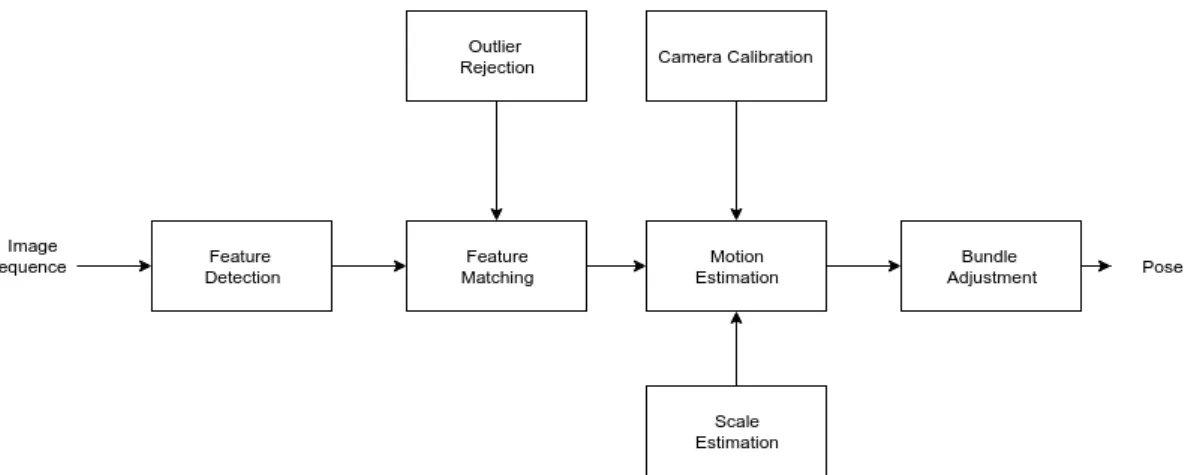
In the landmark paper by Nister et al [4], the term Visual Odometry (VO) was first introduced and a Visual Odometry pipeline was presented (Fig.2.3) .
Figure 2.3: Typical Visual Odometry pipeline: Usual blocks present in Visual Odometry applica-tions
Visual Odometry is defined by the process of estimating self-motion of a robotic application using only image measurements from a single or multiple cameras. The principle of operation of VO is estimating robot pose through examining changes in sequential images sets, induced by mo-tion. It has demonstrated to be more advantageous with respect to wheel odometry under some circumstances and is a useful supplement to other common navigation systems such as Inertial Measument Units (IMU) and Global Positioning Systems (GPS). Typical robotic application sce-narios are prone to IMU/GPS failures, thus VO has the utmost importance and extensive research has been conducted in the topic [30] [19].
Recent work on stereo VO has shifted away from planetary rover applications, broadening the spectrum of Visual Odometry applications to the development of novel autonomous vehicles and also more commercial applications in the automotive industry. This apparent proliferation of
2.3 Egomotion estimation 13
(a) Mars Rover (b) Car applications
Figure 2.4: VO applications: early research and first applications were closely tied to space explo-ration. In recent years, an ever-growing number of commercial applications have surfaced all over the world, especially in the automotive industry
vision-based systems in commercial applications is, in part, due to recent advances by Scara-muzza et al [31] that allow a much faster motion estimation by applying physical constraints to help reduce model complexity.
In the last couple years it has been suggested that vehicle motion could benefit from relying less on geometry-based approaches and carefully calibrated camera motions, instead adopting a learning scheme for capturing vehicle dynamics and camera motion. Machine learning techniques [32] have been gaining favor, in particular thanks to the advent of more precise and robust approaches such as Deep Learning, which have proven capable of being a reliable alternative to conventional methods. In the next section, we present novel approaches to the motion estimation problem which use Deep Learning architectures to perform such tasks.
14 Related Work
2.4
Deep Learning for Computer Vision
Both feature-based and dense methods for Visual Odometry estimation have made great success in the past decade, demonstrating ever-growing performance on both relocalization and motion estimation. However, they still face many challenging issues, in particular when being deployed in large scale robotic applications and facing complex environment application scenarios.
Usually, the previously discussed model based methods represent manually designed features and search for the best pose which matches the detected features between consecutive image frames. On the contrary, Deep Learning methods can effectively learn good representations of input im-ages from massive amounts of data, not requiring manual extraction of features nor extensive or complex geometric formulations for modeling the environment. In recent years, Deep learning methods have shown good capability for cognitive and perceptual tasks in Computer Vision appli-cations whether by analyzing unknown features, image depth or even egomotion between image frames. For more information on Deep Learning and a brief overview of key concepts we refer both to chapter 3 of this thesis and Ian Goodfellow et al book on Deep Learning [32].
In this section, we will review state-of the art Visual Odometry implementations running on top of Deep Learning architectures, analyzing key contributions for the research topic and nuances between emerging approaches to the problem.
2.4.1 Depth Estimation
Depth estimation methods take advantage of camera displacement or difference in the apparent position of an object viewed along two different lines of sight to estimate depth.
Early work by Eigen et al [33] proposed a supervised method for depth estimation with a ground-truth depth map and a scale-invariant error as a cost function for training. The work was further extended by further integrating convolutional neural networks improving accuracy and efficiency on both segmentation tasks and depth estimation. CNN-SLAM [34] is a proposed monocular SLAM system that relies on convolutional neural networks solely to estimate depth, recovering pose and graph optimization from conventional feature-based SLAM. This approach demonstrated that Deep Learning architectures can also work hand-in-hand with vision-based systems, improv-ing upon overall robustness and accuracy of said algorithms.
Unsupervised schemes have recently emerged, also posing as viable alternatives. Garg’s idea [35] was to use CNN’s to predict the depth map for the left input image, reconstructing the left image from the right image and using the photometric reconstruction error (2.1) between the original left image I and the new synthetized left image I’ in the training phase of the algorithm.
E=
∑
I− I0
2
2.4 Deep Learning for Computer Vision 15
SfMLearner [36] is a solution that established an influential framework for Deep Learning for Visual Odometry research. It uses a monocular image sequence in order to estimate depth and pose simultaneously in an end-to-end unsupervised manner, through enforcing geometric constraints between image pairs in the view synthesis process. Based on this framework, there were several novel architectures developed. SfMlearner++ [37] improved upon the results in both depth and pose estimation by using the Essential matrix, obtained using Nister’s Five Point Algorithm [38], to enforce epipolar constraints on the loss function, effectively discounting ambiguous pixels.
GeoNet [39] is a similar approach, a jointly unsupervised learning framework for monocular depth, optical flow and egomotion estimation that decouples rigid scene reconstruction and dynamic ob-ject motion, making use of this knowledge to further tailor the geometric constraints to the model Vijayanarasimhan et al.[40] presented SfM-Net, innovating through adding motion masks to pho-tometric losses to jointly estimate optimal flow, depth maps and egomotion.
2.4.2 Global Pose Estimation
Localization is a crucial component for autonomous systems development, that enables a robot to determine where it is on an environment, which serves as a precursor to any type of action execution or planning.
The main purpose of data-driven pose estimation is to estimate pose without explicitly model-ing the camera motion. PoseNet [41] was the first instance of CNN usage for pose estimation, starting from a supervised scheme with a 6-DoF pose ground-truth. Making use of geometry to design meaningful constraints to the loss function [42] proved to yield significant improvements to method performance and accuracy. This method showed very robust performances in relocal-ization tasks and was further extended to support both color and depth inputs, improving upon its accuracy in challenging environments, such as night-time.
RCNN architectures have been gaining favor in the past years, exploring either temporal dynamics or spatial analysis of image sequences, thereby reducing the uncertainty of pose estimation and generally improving upon method performance. The introduction of LSTM units to neural net-work design as showcased in [43] proved to improve results in localization tasks making use of structured correlation in feature space using LSTM units.
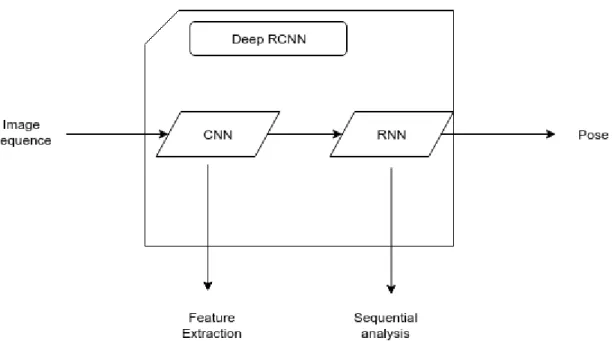
The application of deep RCNN’s to Visual Odometry bypass the need for almost all blocks in the conventional VO pipeline (see Fig.2.3), allowing for end-to-end pose inference as can be seen in Fig.2.5.
16 Related Work
Figure 2.5: Proposed Deep Learning for Visual Odometry end-to-end methods pipeline. Deep RCNN takes a sequence of RGB images as input, automatically learning features by CNN, cap-turing temporal dynamics in its RNN component and outputting pose estimations
2.4.3 Egomotion Estimation
Building upon the success of absolute pose estimation, the egomotion between consecutive image frames can also be estimated with the use of deep neural architectures inspired by geometric mod-els. The key principle is that for the egomotion estimation task we are interested in capturing the motion underwent by the camera system between consecutive images rather than just determining the position and attitude of the observer. FlowNet [44] and its successive iterations garnered im-mense attention as a reliable deep learning framework for learning optical flow and paved the way for early egomotion estimators. Wang et al. proposed a monocular visual odometry system called DeepVO [45], which trains a RCNN to estimate camera motion in an end-to-end fashion, infer-ring pose directly from a sequence of raw RGB images in a video clip while bypassing all usual modules in the conventional VO pipeline. The advantage of such approach is to simultaneously factor in both feature extraction and sequential modelling through combining CNN’s and RNN’s. As labeling data in large scale significantly hinders the application of supervised learning methods to robotic applications, Li et al proposed UnDeepVO [46], a monocular system that uses stereo image pairs in the training phase for scale recovery. After training with unlabeled stereo images, UnDeepVO can simultaneously perform visual odometry and depth estimation with monocular images.
Valada et al [47] proposed a novel architecture that encompasses both global pose localization and a relative pose estimation, jointly regressing global pose and odometry and learning inter-task correlations and shared features through parameter sharing. This method is denoted as Deep
2.5 Benchmark Datasets 17
Auxiliary Learning.
Visual Odometry methods are particularly sensitive to rotation errors, as small early drifts can have a large influence on final trajectory pose estimates. Peretroukhin [48] proposed HydraNet, a deep learning structure aimed at improving attitude estimates, able to be fused with classical visual methods. Through regressing unit quaternions, modeling rotation uncertainty and producing 3D covariances, HydraNet manages to improve visual algorithms at predicting 6-DoF pose estimates (position and attitude).
Another application where Deep learning architectures are currently being tested on is sensor fusion. VINet [49] is a proposed framework that fuses pose estimates from DeepVO [45] with inertial data, showing comparable performance to traditional fusion systems. The same method was also adopted to fuse other kinds of information such as magnetic sensors, GPS, INS or wheel odometry. [50] [51]. Sensor fusion can be easily incorporated in deep learning architectures and jointly trained end-to-end with pose regression, thus making a potentially interesting solution for Visual Odometry applications as it can be used for a wide variety of purposes (e.g. recovering absolute scale on monocular camera systems).
2.5
Benchmark Datasets
Deep learning methods usually require massive amounts of data in order to properly train its neural architectures. This is particularly true in robotic applications, since autonomous systems typically operate in completely unknown environments or under extreme lighting condition. As so, the availability of large scale datasets is crucial for further development of deep learning methods. In this part, we review existing datasets usually adopted for evaluating deep learning related visual tasks.
The KITTI dataset [52] is usually regarded as a complete and comprehensive dataset for visual applications. It consists of outdoor environment images of a driving car, with multiple sensor data, best suited for egomotion estimation tasks. Similarly, the EuRoc MAV [53] also presents the same characteristics and also outdoor imagery but gathered by a flying robot.
When it comes to indoor imagery, the TUM dataset [54] is highly regarded as a comprehensive benchmark for depth estimation. It was collected through the use of an hand-held RGB-D cam-era in an indoor environment. Together, these datasets form a comprehensive basis for method evaluation, whether for depth or egomotion estimation.
For relocalization tasks, 7-scenes [55] dataset or Cambridge Landmarks [41] are best suited for evaluating method performance.
However, the focus of the thesis is in the underwater context. In the scope of underwater robotics there are no universally recognized datasets that fulfill either depth or egomotion estimation task evaluation requirements. Furthermore, the objective of this thesis is to evaluate the viability of
18 Related Work
data-driven methods for motion estimation in the context of CRAS ongoing robotic applications. With this in mind, we developed a novel dataset comprised of underwater imagery acquired with the CRAS robot UNEXMIN UX1 robot, in both a fully known controlled environment and oper-ational mission scenarios. For more information on our novel dataset, see chapter4.
2.6
Summary
In this chapter, a study of visual-based navigation methods was performed, denoting the motivation behind the path from classical feature-based or direct/dense visual methods to learning-based data-centric approaches.
The scenarios where classical visual-based methods tend to fail, or at least do not provide the consistency and robustness required for persistent and accurate robot navigation prompted the development of data-centric approaches as an attempt to overcome such difficulties. For our use case, since we are focusing on the broader underwater context and particularly in this work on underwater flooded mines, deep learning method evaluation and assessment becomes especially relevant, as it could become a really interesting application for such scenarios
It is important to note that, at the moment, classical visual methods still dominate the realm of applications for robotic navigation solutions, especially due to its higher technological maturity, accuracy and robustness. However, novel deep learning powered architectures have show compa-rable performance in some situations, and it is reasonable to assume that deep learning methods will be able to compete with visual methods in the future, benefiting from more technological establishment and hardware enhancement allowing for better real-time performance on board the robot.
In order to bring some closure to this Related Work chapter, the main thought worth withholding is that deep learning based methods are becoming more and more reliable as years go by, posing as a viable alternative to classical Computer Vision methods for a wide range of different tasks. So, it becomes then necessary to evaluate whether specific robotic solutions can benefit from such approaches, possibly enhancing the perception capabilities of some robotic applications.
Chapter 3
Fundamentals
3.1
Introduction
This chapter begins by formulating the Visual Odometry problem and describing some of the key concepts and governing principles required to the thesis research topic. It aims to cover funda-mental aspects of both Computer Vision and Deep Learning, focusing on some essential building blocks upon which different Egomotion Estimation techniques and methods are based. For each topic covered in this chapter, further references are provided, and the understanding of the basic concepts presented in this chapter will be important to the explanation of this thesis implementa-tion and results.
3.2
Formulation of the VO problem
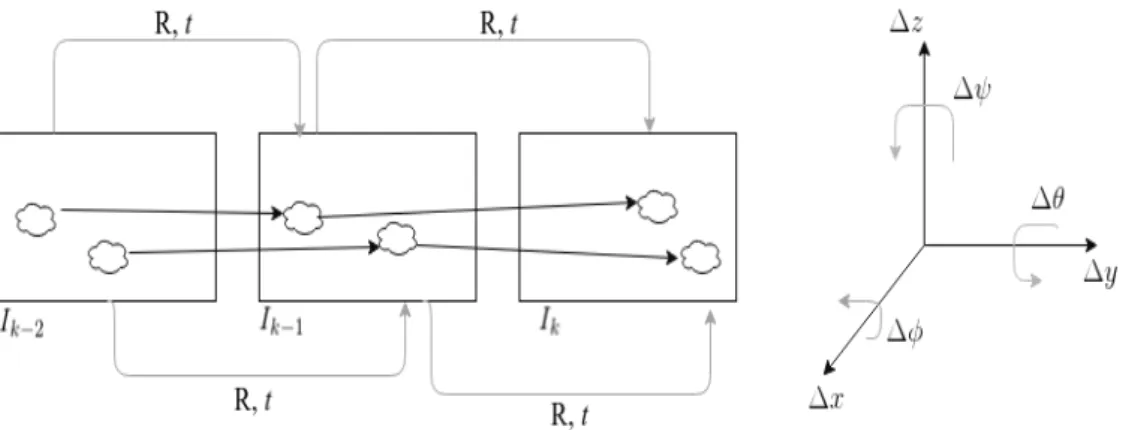
An agent is moving through an environment and taking images at discrete time intervals k. For monocular camera setups, the camera coordinate frame can be assumed as the agent’s coordinate frame and is usually denoted as I0:n = I0, ..., In. In stereo vision systems, there is a left and a
right image at every time instant, denoted as Il,0:n= Il, 0, ..., Il, n and Ir,0:n= Ir, 0, ..., Ir, n. The left
camera is usually used as the origin, without any loss of generality.
Two camera positions at consecutive time instants are related to one another by rigid transforma-tions Tk,k−1defined as followed:
Tk,k−1= " Rk,k−1 tk,k−1 0 1 # (3.1)
Rk,k−1represents the rotation from frame k-1 to frame k and tk,k−1is the translation vector.
Additionally, a set of camera poses C0:n can be computed to contain information about camera
transformations with respect to the initial frame k=0. Current pose Cn can be computed from the
20 Fundamentals
previous pose and the rigid transformation between camera frames:
Cn= Cn−1Tn (3.2)
The main task in Visual Odometry applications is to calculate image transformations Tk,k−1 and
then concatenating the transformations to recover the full trajectory C0:nof the camera. This means
VO systems recover the path incrementally, pose after pose.
As stated in chapter 2, there are two main approaches to compute the relative motion Tk,k−1: dense
methods, which use the intensity information of all the pixels in the two input images, and feature-based methods, which only use salient and repeatable features extracted (or tracked) across the images.
In the VO pipeline, previously mentioned in Fig. 2.3, for every new image or stereo image pair Ik, a set of features fk is extracted. The next step is to find correspondences between feature sets
on time instances k and k − 1. This can be accomplished either by finding features in one image and tracking them across the following images through prediction and correlation local search techniques or by independently detecting features in each image and find correspondence on the basis of similarity metrics (use of descriptors like SIFT, SURF or ORB) [15] [16] [17].
Motion estimates can be computed from transformations Tkbetween consecutive frames and
cor-responding feature sets fk−1and fk. Motion estimation correspondence models are further detailed
in section3.5.
The final step in VO systems is usually a local optimization block, consisting of iterative refine-ments over the last n poses. This step, commonly denoted as bundle adjustment [56] [57], aims to provide a more accurate motion estimation of local trajectories by minimizing re-projection errors between camera poses.
3.3 Perspective Camera Model 21
3.3
Perspective Camera Model
Camera models map 3D world point spaces into 2D image representations. The most common camera models for image interpretation and analysis are perspective camera models and are fo-cusing our attention on the pinhole projective model.
Figure 3.1: Pinhole Camera Model
In this model, a point in Cartesian space with coordinates X= (X,Y, Z)T is mapped on the point
on the image plane where a line joining the point X to the centre of projection meets the image plane (Fig.3.1).
Usually in computer vision notation, parameter f corresponds to the focal distance and parameters (cx,cy) represent the principal point (p) coordinates, which is the place where the principal axis intersects the image plane in pinhole camera model. The camera parameters like the focal distance f , principal point p, and skew s which is the angle between the x and y sensor axes, need to be known for the model to be applied. Together, these points form matrix K, which is the camera calibration matrix and defines the camera intrinsic parameters :
K= f s cx 0 f cy 0 0 1 (3.3)
In Visual Odometry applications, there is sometimes a necessity to apply transformations between camera frame and world frame. Euclidean transformations are represented by a rotation matrix R in the 3D space and a translation vector t. Thus, camera projection matrix becomes:
P= K[ R |t ] (3.4)
22 Fundamentals
3.4
Epipolar Geometry
Epipolar geometry is essentially the relation between images of a single point (P) captured from two different viewpoints (see Fig. 3.2). This concept can both be applied to the stereo case (two cameras simultaneously viewing the same scene) as well as to a single camera taking pictures standing from different viewpoints (monocular camera setups). There are a few concepts worth explaining:
• Epipole: The point of intersection of the line joining the camera centers (stereo baseline for the stereo case) with the image plane.
• Epipolar plane: The epipolar plane is formed by the world point P and the two camera centers, therefore containing the baseline.
• Epipolar lines: The intersection of an epipolar plane with the image plane. All epipolar lines intersect at the epipole.
Exploring these epipolar geometry concepts, we come across a very useful definition: the epipolar constraint is a key geometric concept that limits the correspondence of a given point in image Il
to lie along a line in the other image Ir [60]. This correspondence is key to establishing point
correspondence between images since it reduces potential correspondence points from the image plane to just the points in an epipolar line.
The Fundamental matrix (F) is a function of the camera intrinsic parameters (K), and also encodes the relative camera poses between the different viewpoints and can be given by:
F = K−1R[t]xK (3.5)
Another way of encompassing information of the epipolar constraint is the Essential matrix [61]. The Essential matrix (E) is a specific application of the fundamental matrix to the case of calibrated cameras (i.e. intrinsic parameters known). The Essential matrix has 5 degrees of freedom and is defined by three rotational and two translation parameters
In summary, the Fundamental matrix (F) and a point in one image define an epipolar line in the other image on which its correspondent point must lie. The Essential matrix (E) encodes the rela-tive pose between the two camera frames, and their pose can be extracted with some uncertainty only in translation displacement, which is scaled by an unknown factor. The geometric relations provide valuable information about scenes to the visual egomotion estimation problem, and are a basis for numerous Visual Odometry applications, both for stereo and monocular setups.
3.5 Egomotion Estimation 23
Figure 3.2: The world point P and the two cameras centers form the epipolar plane. The inter-section of the epipolar plane with the image plane forms the epipolar lines. Image courtesy of [19]
3.5
Egomotion Estimation
Motion estimation is one of the core blocks in Visual Odometry systems. In order to perceive camera self-motion, VO systems make use of aforementioned spatial transformations between images Ik and Ik−1.
Using features sets fk and fk−1 from consecutive images Ik and Ik−1, there are three methods for
computing the transformation Tk,k−1:
• 2D-to-2D: Feature sets fkand fk−1are specified in 2D image coordinates.
• 3D-to-3D: Feature sets fk and fk−1are specified in 3D. This technique is available in stereo
vision, and consists on determining the aligning of the two 3D feature sets in stereo image pairs.
• 3D-to-2D: In this case, fk−1is a 3D feature set and fkis the correspondent 2D re-projection
onto the Ikimage. In monocular VO systems, 3D structure need to be reconstructed from at
24 Fundamentals
3.5.1 2D-to-2D: Motion from Image Feature Correspondence
The Essential matrix E, which encompasses rotational and translational information , can robustly be computed from 2D-to-2D feature correspondences through the epipolar constraint, as per Nis-ter’s proposed five-point algorithm [38].
From the Essential matrix, we can extract the rotational and translational parts, through computing the Singular Value Decomposition (SVD):
E= USVT (3.6)
This equation returns four possible solutions for the R, t pair, but the correct representation can be easily identified by means of triangulation of a single point (i.e. only in one of the four possible solutions the point is front of both cameras).
As the absolute scale of the translational component cannot be computed in the essential matrix, relative scales must be computed from measured distances between point pairs in consecutive images in order to recover the trajectory of an image sequence.
The algorithm for egomotion estimation from 2D-to-2D correspondence works as follows: Algorithm 1 Motion estimation from from 2D-to-2D feature correspondence
• Acquire new image Ik
• Extract and match features between Ikand Ik−1
• Compute essential matrix (E)
• Extract R,t from the essential matrix and form Euclidean transformation Tk,k−1
• Compute relative scale
• Concatenate camera pose transformation by performing Ck= Ck−1Tk,k−1
3.5.2 3D-to-3D: Motion from Structure Correspondence
In the case of 3D-to-3D motion estimation, the task is to find the transformation Tk,k−1 that
min-imizes the L2 norm distance between features (i) with their respective 3D coordinates between consecutive frames ( ˆXkiandXk−1iˆ )
argminT k,k−1
∑
ˆ Xki− TkXˆk−1i (3.7)As in the previous case, there is more than one solution to this problem and the correct solution must be recovered through triangulation. In this case, we decouple translation from rotation, computing translation through SVD and rotation as the difference from centroids of 3D features. The algorithm for egomotion estimation from 3D-to-3D structure correspondence works as fol-lows:
3.5 Egomotion Estimation 25
Algorithm 2 Motion estimation from 3D-to-3D structure correspondence • Acquire new image stereo pair Il,kand Ir,k
• Extract and match features between Il,kand Il,k−1
• Triangulate the previous features for every stereo pair
• Concatenate camera pose transformation by performing Ck= Ck−1Tk,k−1
3.5.3 3D-to-2D: Motion from 3D Structure and Feature Correspondence
Nister [4] has shown 3D-to-2D to be more accurate than 3D-to-3D. This is because instead of minimizing the distance between features on consecutive images, we focus on minimizing the reprojection error.
Motion can be estimated both from stereo images and from the monocular case, by triangulating three view points. In a stereo system, the 2D point can be obtained by aligning the left and right images whereas in the monocular case, the algorithm processes the triangulation between feature matches in Ik−2and Ik−1and subsequently matches to the new captured frame Ik
P3P [62] is a commonly used robust method for 3D-to-2D motion estimation, even in the presence of outliers, that computes camera pose and orientation in the world reference frame from three 3D-2D point .
The algorithm for 3D-to-2D egomotion estimation can be synthesized as followed: Algorithm 3 Motion estimation from from 3D-to-2D feature correspondence Initialization:
• Capture two frames Ik−2and Ik−1
• Extract and match features
• Triangulate features between them For every iteration:
• Capture new frame Ik
• Extract features and match features with previous frame Ik−1
• Compute camera pose and orientation from 3D-to-2D matches • Triangulate feature matches between Ikand Ik−1
26 Fundamentals
3.6
Pose Parametrizations
The goal of every Visual Odometry system is to adequately process visual information in order to compute the camera transformation in relation to the previous image frame. As formulated in section 3.2, we are interested in obtaining a set of camera poses containing the information of relative transformations in camera position and attitude. These can then be concatenated to represent the full trajectory in an image sequence.
Figure 3.3: R,t parameter extraction
The literature presents different pose estimate parameterizations for 6-DoF pose (position and at-titude). While the position of an object is naturally represented by a 3-dimensional vector without much debate, such consensus does not exist regarding its orientation representation. In this section we review key attitude representations that serve as a starting point for the work of this thesis.
3.6.1 Rotation Matrix
The rotation matrix, also called the special orthogonal group SO(3), is the most generic form for representing a linear transformation on an Euclidean space used to rotate point coordinates from one reference frame to another.
Considering two frames A and B and p as position of an object relative to frame A. Then the position of the object with respect to frame B is given by:
pB= RABpA (3.8)
where RA
B represents the rotation undertaken by point p from one frame to another. This means
nine scalars are used to represent rotations in 3D space (i.e. 3x3 matrix).
Coupled with a translation vector in 3D space (∈ R3), we can represent the Special Euclidean group SE(3), an all encompassing space for rigid transformations.
3.6 Pose Parametrizations 27
3.6.2 Euler Angles
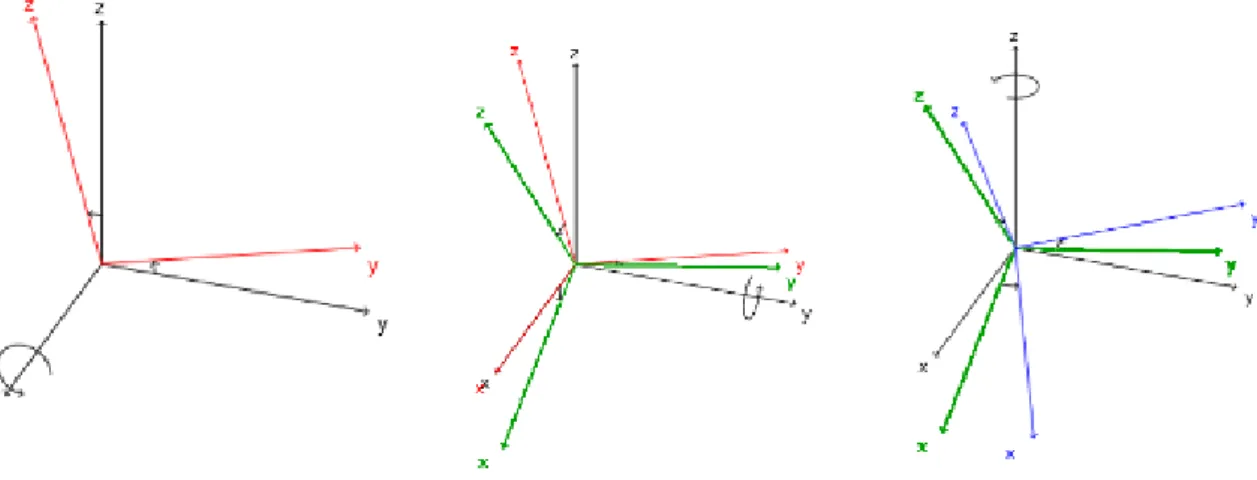
However, it is possible to parametrize the very same rotation using much less parameters. Euler Angles Representation is defined by the angles that each axis of frame B needs to rotate, in a sequential order, to coincide with a reference frame A.
Figure 3.4: Euler Angles representation
This representation can be more intuitive and easy to interpret physically. However, it suffer from singularities in mathematical formulations (e.g. such as gimbal-lock in Roll-Pitch-Yaw). Notation can also be problematic, as there exist twelve possible sequences of rotation axes, giving rise to potential confusion due to notation ambiguity that can be detrimental for cross-implementation integration.
3.6.3 Quaternions
Quaternions are R4unit vectors that can also be used to represent rotations very efficiently. It can also provide a more restricted parameterization of the output space when compared to the entirety of the transformation matrix set. A quaternion can be defined as:
q= (w + xi + yj + zk) (3.9)
Quaternions [63] are sometimes an advantageous representation in light of its computational ef-ficiency (simple number operations are computationally less costly than sines and cosines) and because unlike Euler Angles it does not have any discontinuity . Interpolating between rotations and especially chaining multiple transformations is therefore a way smoother process using quater-nions.
28 Fundamentals
Figure 3.5: Quaternion Unit Sphere
3.7
Deep Learning
3.7.1 Motivation
Machine learning is defined as the scientific study of algorithms and applied statistical models that allow computer systems to estimate otherwise complicated functions, progressively improving upon its performance on a specific task.
Figure 3.6: Neural network
Deep learning is a specific kind of machine learning. Its onset stems from the failure of tradi-tional machine learning algorithms to generalize well on some artificial intelligence tasks and deep learning methods are, by design, more fit to overcome these and other obstacles.
One of such tasks is Computer Vision. Computer vision has traditionally been one of the most active research areas for deep learning, due to it being intrinsically challenging to implement simultaneously robust and efficient computer algorithms. The ongoing rise in large scale dataset

![Figure 3.11: Illustration of absolute trajectory error and relative pose error, credits to [66]](https://thumb-eu.123doks.com/thumbv2/123dok_br/15589518.1050441/52.892.141.730.720.908/figure-illustration-absolute-trajectory-error-relative-error-credits.webp)