fre
tem
E
eshw
mpora
Ecolo
varia
water f
ary M
ogica
abilit
fishe
Medite
ORIENTADTe
para o
Carlos
al imp
ty in t
es fro
erran
DORES: Prof Prose apresen
obtenção d
s Manue
pact o
the b
om pe
nean r
ÉVORA fessor Doutor ofessora Doutntada à Un
do Grau de
el Engeit
of str
bio-ec
erma
river
A, DEZEMB r Pedro Rapos tora Maria Teniversidade
e Doutor e
tado Ale
ream
colog
anent
syst
RO DE 2014 so de Almeida eresa Ferreirae de Évora
m Biologia
exandre
mflow
gy of
t and
tems
4 a aa
a
e
ÉVORA, DEZEMBRO DE 2014
ORIENTADORES: Professor Doutor Pedro Raposo de Almeida
Professora Doutora Maria Teresa Ferreira
Tese apresentada à Universidade de Évora
para obtenção do Grau de Doutor em Biologia
Carlos Manuel Engeitado Alexandre
Ecological impact of streamflow
variability in the bio-ecology of
freshwater fishes from permanent and
temporary Mediterranean river systems
Aknowledgements
Agradecimentos
No final desta etapa gostaria de dedicar algumas palavras de agradecimento a várias pessoas e instituições que, de alguma forma, contribuíram para a realização desta tese de doutoramento.
Ao Professor Doutor Pedro Raposo de Almeida, o meu orientador, pela sua dedicação, entusiamo e apoio constantes e fundamentais para o bom desenvolvimento e conclusão deste trabalho. Agradeço em particular o apoio demonstrado ao longo dos últimos 10 anos em que temos trabalhado juntos e a aposta constante que sempre fez na minha formação e no meu trabalho. Obrigado por todas as oportunidades e pela autonomia e confiança depositadas. Desde as suas primeiras aulas de Ictiologia na Universidade de Évora que o rigor e a exigência que sempre demonstrou representam para mim o maior exemplo em termos profissionais.
À Professora Doutora Maria Teresa Ferreira, a minha orientadora, por todo o apoio dado ao longo do desenvolvimento desta tese. As suas constantes ideias, sugestões e conselhos ao longo dos vários trabalhos desenvolvidos contribuíram de sobremaneira para que esta tese e os vários capítulos que a compõem fossem levados a bom porto.
Ao Bernardo Quintella que sempre contribuiu com ideias e sugestões que, para além de aumentarem a qualidade dos trabalhos apresentados, ajudam no meu crescimento profissional e pessoal. Com ele, todos os dias aprendo qualquer coisa nova! Agradeço também a oportunidade que, como coordenador, me deu de integrar o projeto “ECOFLOW”, no âmbito do qual foram desenvolvidos os trabalhos apresentados no capítulo 2 da presente tese.
À Ana Filipa Ferreira, pela ajuda nas várias etapas do trabalho desenvolvido ao longo desta tese. A sua pronta disponibilidade para me ajudar nos trabalhos de campo e o companheirismo demonstrado durante o trabalho laboratorial foram fundamentais para que conseguisse terminar com sucesso esta tese. Todas as palavras de apoio que sempre tem, as discussões sobre os mais variados assuntos, as inúmeras e longas viagens para mais uma nova saída de campo, o seu “mau-feitio” e, sobretudo, o quanto contribuiu com os seus sonhos e o seu entusiasmo para que eu não perdesse o sentido principal da nossa profissão, nunca serão esquecidos mesmo que algum dia os nossos caminhos se afastem. Obrigado por tudo!
À Catarina Mateus, por todo um percurso académico, profissional e de amizade que temos em conjunto há mais de 10 anos. A sua dedicação profissional e rigor científico sempre foram um exemplo para mim. Obrigado por todas as discussões sobre trabalho, politica, religião, etc. que ajudaram a que as saídas de campo que fizemos juntos decorressem da melhor forma. Agradeço também as importantes palavras de apoio nos momentos mais complicados.
À Sabrina Sales, pela importante ajuda na parte referente à análise das amostras de recursos alimentares e conteúdos estomacais. A enorme perícia, dedicação e rigor com que desempenhou estas tarefas,
pela alegria constante que sempre demonstrou!
Ao Filipe Romão, pela sua contribuição ao longo dos vários trabalhos apresentados nesta tese e pelo companheirismo ao longo de incontáveis saídas de campo por esse Portugal fora!
Aos restantes elementos atuais e antigos da equipa das “lampreias”, nomeadamente Tadeu Pereira, Sílvia
Pedro, Nuno Andrade, João Ferreira, Sara Pinela, Inês Póvoa, Marta Lourenço, Marta Candeias, Gabriela Cardoso, Ricardo Branca, Esmeralda Pereira, Ana Filipa Belo e Ana Filipa Silva, pela ajuda e
companheirismo demonstrado ao longo de tantas e tantas saídas de campo, no âmbito da minha tese de doutoramento e de outros projetos em curso. Que a amizade e a entreajuda com que fui recebido, e que sempre me esforcei por manter e passar aos mais novos, continue nesta equipa. É essa a nossa força! Aos inúmeros alunos de Biologia da Universidade de Évora e Universidade de Lisboa com que me cruzei ao longo do desenvolvimento desta tese e que contribuíram de uma ou outra forma para que os respetivos trabalhos se concretizassem.
Ao Doutor José Lino Costa, pela ajuda e conselhos no tratamento estatístico da imensa quantidade de dados recolhidos no âmbito da tese pela forma cordial como me recebeu e integrou no centro.
Aos vários colegas do Grupo de Zoologia do IO, representados em particular pela Gilda Silva, João Paulo
Medeiros e Érica Sá, pela ajuda e bom ambiente que conseguem criar. Obrigado também pelas situações
e problemas logísticos desbloqueados, que permitiram a eficaz conclusão das tarefas desenvolvidas nesta tese.
À Maria João Feio e à Ana Raquel Calapez, do IMAR, Universidade de Coimbra, pela inestimável ajuda na identificação dos invertebrados e conteúdos estomacais caracterizados no capítulo 3 desta tese.
À Elsa Cabral e à Mafalda Mascarenhas do Centro de Oceanografia pela ajuda nas questões burocráticas que foram surgindo no decorrer desta tese.
Aos meus sogros, cunhada e avó “emprestada”, pelo apoio e interesse que sempre demonstraram pelo meu trabalho e pela preocupação durante as saídas de campo. Em especial ao meu sogro pela ajuda que também me deu durante o trabalho de campo. Equipa da retaguarda sempre a postos!
À minha irmã, cunhado e sobrinhas pelo apoio e interesse constantes no meu trabalho e pela alegria e boa disposição que trazem à minha vida.
Aos meus pais, por tudo! Ao meu pai, por todo o apoio e força que sempre me deu. Agradeço-lhe também a ajuda que deu nos trabalhos de campo e a prontidão com que muitas vezes resolveu os meus problemas logísticos. À minha mãe, por tudo o que sou e que ela me ajudou a conseguir. Todo o meu percurso pessoal e profissional não seriam possíveis sem o seu apoio. Obrigado por estarem sempre presentes, mesmo nas alturas mais complicadas!
À minha Avó, que já não teve oportunidade de assistir à conclusão do meu doutoramento, como ela tanto desejava. A sua ausência nestes últimos anos deixou um vazio que nunca mais será preenchido, mas o seu apoio e carinho foram sempre muito importantes e nunca serão esquecidos. Nunca conseguirei estar à altura do orgulho imenso que sei que ela sentia por mim. Prometo que vou continuar sempre a guardar os rios!
À Paula, por todo o amor, carinho, compreensão e apoio que sempre me deu, durante toda a minha carreira profissional e, em particular, durante o doutoramento. Só tu sabes o quanto este período foi moroso e complicado e só tu tens a paciência necessária para aturar o meu mau-feitio nos dias de maior stresse. Obrigado também por teres estado sempre presente para me ajudar no campo e nas longas tardes e noites a processar amostras de peixes e a ler escamas nas paredes da nossa casa. Obrigado pelos inúmeros fins de semana, feriados e férias que passaste sozinha ou em casa fechada para que eu pudesse trabalhar. Obrigado por seres quem és e por estares sempre ao meu lado!
Institutional aknowledgements
Agradecimentos institucionais
Ao Centro de Oceanografia e ao Centro de Estudos Florestais, enquanto instituições de acolhimento, e aos respetivos coordenadores, Professor Doutor Henrique Cabral e Professora Doutora Helena Pereira, por me terem integrado nas suas equipas como estudante de Doutoramento.
À Fundação para a Ciência e a Tecnologia pela atribuição da bolsa individual de Doutoramento, com a referência SFRH/BD/66081/2009.
À EDP – Eletricidade de Portugal pelo financiamento do projeto “ECOFLOW – Efeitos ecológicos dos caudais nas comunidades piscícolas dos rios portugueses”, através do “Fundo Biodiversidade EDP 2011”, que permitiu a realização de uma parte desta tese, nomeadamente parte dos trabalhos apresentados no Capítulo 2.
À Divisão de Hidrometria da Agência Portuguesa do Ambiente/Instituto Nacional da Água (APA/INAG), na pessoa da Engenheira Cláudia Brandão, pela ajuda na compilação dos dados hidrométricos utilizados nos vários capítulos desta tese.
Paper I:
Alexandre CM, Ferreira MT, Almeida PR. 2013. Fish assemblages in non-regulated and regulated rivers from permanent and temporary Iberian systems. River Research and Applications 29: 1042-1058.
(Published as Research Article).
Paper II:
Alexandre CM, Almeida PR, Neves T, Costa JL, Quintella BR. 2014. Effects of flow regulation on the movement patterns and habitat use of an Iberian potamodromous cyprinid species.
(Submitted for publication in Ecohydrology).
Paper III:
Alexandre CM, Quintella BR, Ferreira AF, Romão F, Almeida PR. 2014. Swimming performance and ecomorphology of the Iberian barbel Luciobarbus bocagei (Steindachner, 1864) on permanent and temporary rivers. Ecology of Freshwater Fish 23: 244-258.
(Published as Research Article).
Paper IV:
Alexandre CM, Sales S, Ferreira MT, Almeida PR. 2014. Food resources and cyprinid diet in permanent and temporary Mediterranean rivers with natural and regulated flow. Ecology of Freshwater Fish. DOI: 10.1111/eff.12176
(Published as Research Article)
Paper V:
Alexandre CM, Ferreira MT, Almeida PR. Life-history of a cyprinid species in non-regulated and regulated rivers from permanent and temporary Mediterranean basins.
Table of contents
ABSTRACT _________________________________________________________ vii
RESUMO ___________________________________________________________ viii
CHAPTER 1 | GENERAL INTRODUCTION _________________________________ 1
1.1. Natural flow regimes 2
1.1.1. Characterization of natural flow regimes 2
1.1.2. Dimensions and concepts of flow regimes 5
1.1.3. Natural streamflows and biodiversity 8
1.2. Dams and flow regulation 15
1.2.1. Historical background and global distribution 15
1.2.2. Types of dams 16
1.2.3. Impacts on freshwater ecosystems and biodiversity 18
1.3. Mediterranean rivers: a particular scenario 23
1.4. Thesis aims and structure 26
1.4.1. General and specific aims 26
1.4.2. Thesis structure 27
1.5. References 29
CHAPTER 2 | ECOLOGICAL IMPACTS OF STREAMFLOW VARIABILITY ______ 45
PAPER I | Alexandre CM, Ferreira MT, Almeida PR. 2013. Fish assemblages in non-regulated and regulated rivers from permanent and temporary Iberian systems. River Research and
Applications 29: 1042-1058. 45
PAPER II | Alexandre CM, Almeida PR, Neves T, Costa JL, Quintella BR. 2014. Effects of flow regulation on the movement patterns and habitat use of an Iberian potamodromous cyprinid
PAPER III | Alexandre CM, Quintella BR, Ferreira AF, Romão F, Almeida PR. 2014. Swimming performance and ecomorphology of the Iberian barbel Luciobarbus bocagei (Steindachner, 1864) on permanent and temporary rivers. Ecology of Freshwater Fish 23: 244-258. 107 PAPER IV | Alexandre CM, Sales S, Ferreira MT, Almeida PR. 2014. Food resources and cyprinid diet in permanent and temporary Mediterranean rivers with natural and regulated
flow. Ecology of Freshwater Fish. DOI: 10.1111/eff.12176. 135
PAPER V | Alexandre CM, Ferreira MT, Almeida PR. Life-history of a cyprinid species in non-regulated and non-regulated rivers from permanent and temporary Mediterranean basins.
Submitted for publication in Ecohydrology. 165
CHAPTER 4 | GENERAL DISCUSSION AND CONCLUSIONS ________________ 199
4.1. Regional variability between permanent and temporary rivers 199 4.2. Impacts of streamflow regulation on Mediterranean fish 202 4.3. Management applications: is ecoregulation possible? 208
4.4. Future research 212
Abstract
Natural streamflow variability is important for riverine ecosystems but river regulation modifies flow patterns, disturbing fish bio-ecology. This thesis includes a characterization of basal biological differences between non-regulated permanent and temporary Mediterranean rivers and analyzes the effects of three types of regulation on fish assemblage composition, movement, diet and life-history. Fish from non-regulated permanent rivers had higher swimming performance, a higher percentage of invertebrates in their diet, mature at an older age, later in the year and have higher growth rates. By homogenizing flow pattern, regulation for water derivation and agriculture affected fluvial specialists, benefiting generalist species, promoted the consumption of plants and detritus, and decreased fish growth rates, condition and reproductive activity. Regulation for hydroeletricty induced short-term flow and habitat changes that increased fish seasonal movement and home range. These findings allow understanding bio-ecological changes imposed by flow regulation and can be used as guidelines for flow requirements implementations.
Impacto de diferentes regimes hidrológicos na bio-ecologia dos peixes dulciaquícolas em rios Mediterrânicos permanentes e temporários
Esta tese inclui uma caracterização das diferenças biológicas entre rios Mediterrânicos não regularizados de regime permanente e temporário e analiza os efeitos de três tipos de regularização na composição, movimento, dieta e ciclos de vida dos agrupamentos piscícolas. Peixes de rios permanentes não regularizados apresentam uma maior capacidade natatória, um maior consumo de invertebrados, reproduzem-se mais tarde e possuem maior taxa de crescimento. Através da homogeneização do caudal, as barragens para derivação e agricultura afetam as espécies especializadas, beneficiando as generalistas, promovem o consumo de detritos e o decréscimo da taxa de crescimento, condição corporal e actividade reprodutora. A regularização para fins hidroelétricos induz uma acentuada variação do caudal e habitat, a uma escala temporal menor, contribuindo para o aumento do movimento e área utilizada pelos peixes. Estes resultados permitem compreender as alterações bio-ecologicas impostas pela regularização do caudal e podem ser usados em futuros programas de reabilitação fluvial.
CHAPTER 1
Rivers and their connected floodplains, groundwaters and wetlands face currently a severe threat. Historically, humans have extensively altered river systems through deforestation, water pollution, river corridor engineering, impoundments and water diversions, irrigation, extensive wetland drainage, groundwater depletion, habitat loss, and species introduction. Globally, these ecosystems are the world’s most damaged ones, losing species at a rate that far exceeds the decline of biodiversity in terrestrial and marine systems (Dudgeon et al., 2006). A synthesis of threats to the world’s rivers has found that nearly 83% of the land surface surrounding aquatic systems has been significantly influenced by human actions (Vörösmarty et al., 2010). Estimates from this work suggest that, at least, 10,000 to 20,000 freshwater species are extinct or at risk, largely from anthropogenic factors, and rates of riverine biodiversity loss can be compared to those described for the Pleistocene-Holocene transition (Arthington, 2012). Freshwater fish, due to their more intricate bio-ecological characteristics, life-history patterns and habitat requirements (e.g. Poff & Allan, 1995), are more affected by anthropogenic actions on riverine environments, at different spatial and temporal scales, than any other group of freshwater species (Simon, 2003). For example, just for the European Continent, almost 200 fish species (~38%) are endangered by several and synergistic threatens like pollution, damming, severe water abstraction or introduction of alien species (Kottelat & Freyhof, 2007). Perhaps for these reasons, freshwater fish assemblages are also considered as excellent indicators of aquatic ecosystem health (Karr, 1981), being widely used for the development of tools regarding the evaluation of the environmental quality of continental waters, in the scope of the Water Framework Directive (e.g. Karr, 1981; Pont et al., 2006). Impoundments and depletion of river flows are arguably the main source of fish biodiversity threat, especially because they directly degrade and reduce river and floodplain habitat and connectivity (Dynesius & Nilsson, 1994; Nilsson et al., 2005), affecting important bio-ecological processes of freshwater fish populations and/or assemblages, such as composition, functional diversity, growth, reproduction, feeding or migration (Bunn & Arthington, 2002). Changes in fish faunas facing human-impacted environments have been examined at different spatial scales across different continents and types of river systems (e.g. Rahel, 2000). However, to this date and despite decades of research, researchers have made little contribution towards a comprehensive synthesis based on a multi-regional scale perspective on the relationship between fish assemblages and natural or human-altered streamflow variability and/or connectivity (Poff & Zimmerman, 2010). The existing reviews are limited by geographical region or hydrological regime (e.g. river Don Basin, Russia; Volovik, 1994), specific taxa (i.e., salmonids, Hunter, 1992) or topical focus (e.g. ecological responses; Steele & Smokorowski, 2000). This dissertation aims to be a contribution to the conservation and management of freshwater fish populations, especially the ones affected by river discharge and connectivity degradation, by giving important insights on how this animal group respond, at different bio-ecological levels, to the natural regional variability of flow conditions and how some of these responses change in the presence of different types of flow regulation.
1.1. Natural flow regimes
1.1.1. Characterization of natural flow regimes
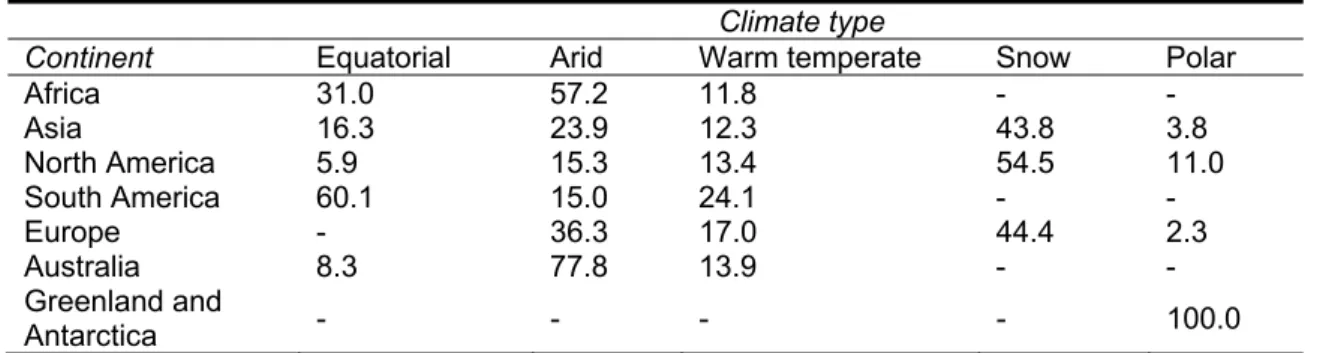
Freshwater availability varies dramatically worldwide, responding to climatic constraints that determine the amount and seasonal distribution of the precipitation phenomena. The world’s main climatic zones are grouped into five broad categories based on their average annual precipitation, average monthly precipitation, and average monthly temperature (Kotteck et al., 2006). The most known and frequently used climate classification is the Köppen-Geiger classification that includes five main regions, namely the equatorial zone, the arid zone, the warm temperature zone, the snow zone and the polar zone. Following these five climatic areas, this classification further considers precipitation and air temperature, producing a final count of 31 distinct climate types (for a world map of this climate classification and associated digital data, see Global Precipitation Climatology Centre, http://gpcc.dwd.de). The distribution of climate types across world regions varies significantly (Table 1) and sets the climatic context for the development of fluvial systems and freshwater ecosystems (Hynes, 1970). Regional climatic variation translates to a similar pattern of hydrologic variation that is then adapted to specific local abiotic characteristics, such as basin area, topography, geology and geomorphology (Brierley & Fryirs, 2005). This regional diversity on the interaction between habitual weather conditions and abiotic features typically influence the volume and timing of runoff and streamflow conditions (Snelder & Biggs, 2002; Poff et al., 1997).
Table 1. Distribution of climate types, by percentage (%) of land area, throughout world’s continents Climate type
Continent Equatorial Arid Warm temperate Snow Polar
Africa 31.0 57.2 11.8 - - Asia 16.3 23.9 12.3 43.8 3.8 North America 5.9 15.3 13.4 54.5 11.0 South America 60.1 15.0 24.1 - - Europe - 36.3 17.0 44.4 2.3 Australia 8.3 77.8 13.9 - - Greenland and Antarctica - - - - 100.0
Seasonality of river flow is amongst the most important attributes to characterize and define the existent types of natural flow regimes of riverine ecosystems, from the smallest headwater streams to the largest floodplain river systems, and across different world regions (Arthington, 2012). However, there are several other major components that, together, contribute to the differentiation of river types and regulate ecological processes in river ecosystems. In general, hydrologists and ecologists recognize five ecologically relevant facets of natural river flow regimes, namely: magnitude, frequency, duration, timing or predictability, and rate of change of hydrologic conditions (Poff & Ward, 1989, Richter et al., 1996, Poff et al., 1997). These components can be used to characterize the entire range of habitual flows and
specific hydrologic phenomena, such as floods or droughts that are critical to the integrity of river ecosystems (Poff et al., 1997). The five general facets of flow regimes can be describes as (Poff et al., 1997; Arthington, 2012):
i) Magnitude of discharge1, is the amount of water moving past a location by unit of time
(Fig. 1) and it can be associated to the quantity of flow relatively to some river property, such as, for example, the volume of water needed to provide an adequate depth and velocity in an habitat important for fish usage, or to inundate floodplains. Maximum and minimum flow magnitudes vary with climate and watershed size, within and among river systems;
ii) Frequency of occurrence, is associated to how often a given flow discharge occurs during a specific time period. Usually, the frequency of a particular amount of discharge is analyzed trough a flow duration curve (Fig. 1), representing the percentage of time that a specific flow magnitude is exceeded. For example, a 100-year flood event is defined as the size of flood that is equaled or exceeded one in 100 years, or has a 1% chance of occurring in any year. Flood frequency regulates, for example, the regime of floodplain inundation or how often flood dependent biota can execute their vital bio-ecological processes;
iii) Duration, is the period of time associated with a particular discharge event, such as floods or droughts (Fig. 1). For ecological and river management purposes, it is of extreme importance to know the number of days or months that a specific flow condition, such as a period of absolutely zero streamflow, persists, so that harsh conditions for river biota can be correctly assessed and successfully minimized (Richter et al., 1997). Flow duration curves can be used to analyze different types of flow regime and to quantify changes on their habitual patterns caused by anthropogenic actions, such as water extraction, dams regulation and weirs; iv) Timing/Predictability, can refer to two distinct flow characteristics. Timing, by itself, can be related with the season when a particular hydrologic event is likely to occur (Fig. 1). On the other hand, predictability is directly associated with the degree to which flood or drought events are temporally autocorrelated (Welcomme et al., 2006). The occurrence of flood phenomena is usually less predictable in arid-regions, where flood frequencies and timings are strongly dependent on regional climate and stochastic local rainfall‐runoff events (Puckridge et
al., 1998);
v) Rate of change, is related to the rate at which discharge events vary from one magnitude to another (Fig. 1). Considering the extreme cases, "flashy" streams have rapid rates of change, whereas "stable" streams have slow rates of variation. This flow aspect is also strongly dependent of climate phenomena, such as sudden rainstorms or snowmelt (Poff et al., 1997).
Combinations of these five main components of the flow regime determine many of the physical and biogeochemical processes of aquatic ecosystems to such an extent that flow is considered to be the main environmental variable controlling pattern and processes of river
1
ecolo critica unde Arthin dynam temp devel al., 20 Figur with s to un the in Allan mana ecosy (inclu class selec all inf produ from main ogy (Power e al role for rpinning pri ngton, 2002 mics and th oral patterns lop a classifi 011). re 1. Hydrogra the terms Portugues Hydrolog similar flow r derstand rive nfluence of , 1995; Ken agement (e.g ystems (e.g uding statist sifications, de cted, geograp fluence the o One of th uced 13 sea 66 countries climatic inf et al., 1995; the sustain nciples of r ; Naiman e he higher va s and magn cation of rive aph of River V s associated w se Environmen ic classificat regime chara erine flow va streamflow o nnard et al., g. Arthington . Snelder & tical measur epending on phic distribut outcomes of he first classif asonally disti s, while acco fluences of Walker et al nability of n river restora et al., 2008) ariability exis nitude of flow er flow regim Vouga, centra with the main ntal Agency (A tion is the pr acteristics an ariability (e.g on biologica 2007), aid n et al., 200 & Biggs, 20 res of the the objectiv tion of the ga a flow classif fications of fl nctive flow r unting for se each group l., 1995). Th native biodi ation and co ). Thus, con stent among w regimes, mes, at globa al west region n facets of st APA/INAG) (S rocess of sy nd plays an g. Haines et l communitie the inventor 06), and prio 002; Arthing five main ves of the an auging statio fication (Ken low regimes regime types easonal diffe . Years late e natural dy versity and onservation nsidering the g world’s str interest has al continental of the Iberian treamflow reg SNIRH, 2012). ystematically important ro al., 1988; Sn es and ecol ry of hydrolo oritize conse gton, 2012). facets) hav nalysis (Olde ons and the l nnard et al., 2 was propose s based on rences amon er, Puckridg namic of flow fluvial eco (Poff et al e importanc reams and r s arisen in t and regiona n Peninsula, P ime. Data wa separating le in ecohyd nelder & Bigg
ogical proce ogic types fo ervation effo . Many dist ve been us en & Poff, 20 ength of the 2010). ed by Haines almost 1000 ng regime ty e et al. (19 w regimes p osystem int l., 1997; Bu ce of natura rivers in ter the past yea al scales (Old Portugal, illus as provided b rivers into g drology as a gs, 2002), ex esses (e.g. P or water res orts for fresh tinct flow m sed in num 003). Flow m record serie s et al. (1988 0 gauging st ypes as well a 998) propose lays a egrity, unn & al flow ms of ars to den et trating by the groups mean xplore Poff & source hwater metrics merous metrics es can 8) and ations as the ed an
with high flow variability and tropical rainy climate rivers with low variability represented the extremes of a range of global river flow variability. More recently, Poff et al. (2006) performed an intercontinental comparison of hydrologic regimes based on daily flow data for 463 flow gauges that revealed similarities and differences between rivers from spatially distant areas of the globe such as Australia, New Zealand, South Africa, Europe and the United States. Within this classification, Australian rivers were characterized by large flow magnitudes and inter and intra-annual variation in flow rates of rise and fall. In contrast, New Zealand and European streams had high minimum flows, a high baseflow index and coefficient of variation and relatively high spring flows. South African streams were characterized by high autumn flows and a large variation in maximum flow values and rise/fall rates. Within their dataset Poff et al. (2006) identified United States streams as the ones showing the broader variation in flow regimes, including examples of the hydrological features of the other four continents. The classifications described are just representative of the great amount of work that has been developed within this subject in the past few years. Other continental flow classifications are also available for the United Kingdom, Europe, Scandinavia, Turkey, Russia, South Africa, Central Africa, Nepal, New Zealand, Australia and the United States (Arthington, 2012). Such flow classifications vary according to the types of flow data used, the flow aspects explored and the employed statistical approach (Olden et al., 2011).
1.1.2. Dimensions and concepts of flow regimes
The structure of physical systems and ecological linkages within a river system are generally divided into longitudinal, lateral and vertical vectors or dimensions (Poole, 2002). Besides these three components, river systems also include temporal relationships and processes, turning them onto four dimensional systems (Ward & Stanford, 1995), that are strongly dependent on the maintenance of hydrological connectivity within and between all of these four vectors (Heiler et al., 1995). These assumptions led to early schemes of biologically based riverine zonation that classified watercourses into three or four zones along the upland-floodplain transition, each characterized by distinctive invertebrate and/or fish faunas (e.g., Hawkes, 1975). Zonation schemes like these ones are still occasionally employed in Europe (e.g. Santoul et al., 2005) however in many river systems the evidence of a distinctive biological zonation pattern is poor, giving ways to different thoughts about riverine organization in longitudinal, lateral, vertical and temporal terms, from headwaters to estuaries.
The River Continuum Concept
River ecologists have long recognized moderate rather than abrupt changes in physical and biological processes along the downstream gradient of running water systems from small headwater streams to wide lowland reaches (Mills, 1969). These longitudinal patterns have
formalized and described by the River Continuum Concept (RCC, Vannote et al., 1980). In short, this concept (Fig. 2) describes a river system as starting in headwater areas, characterized by dense riparian vegetation that, periodically, shed leaves and other plant parts. These materials enter in the stream as coarse particulate organic matter (CPOM), which is processed by invertebrates and decomposed by aquatic microbes. Processed fragments are then repeatedly released downstream and consumed by different types of invertebrates until fine particulate organic matter (FPOM) is produced and utilized by a third group of invertebrate fauna. Although the multiple roles of the flow regime were not given particular attention in the RCC, downstream flows are integral to this model, since flow is the primary agent of material transportation along the longitudinal continuum (Poff et al., 1997).
The RCC has been considered by many ecologists as a central paradigm in riverine ecology, applicable to many rivers, even though local changes such as impoundment require special consideration (Ward, 1989). Several studies also emphasized that the RCC would need considerable modification before it can be applied to large rivers (Davies & Walker, 1986; Sedell et al., 1989). This concept was primarily associated with influences of geomorphology and physical conditions of flowing rivers on invertebrate communities and energy sources and was considerably less concerned with aquatic vertebrates and the ecological processes that influence these communities (Arthington, 2012). This work was later advanced by different studies that placed more emphasis on the lateral dimensions of rivers and adjacent areas (e.g. Junk et al., 1989).
The Flood Pulse Concept
Many studies of tropical fishes (e.g. Lowe-McConnell, 1963; Agostinho et al., 2008; 2009), and more recent work on floodplain rivers from temperate and arid zones (Walker et al., 1995; Tockner et al., 2008) have confirmed the importance of physical and ecological linkages between rivers and their floodplains, as well as the importance of floods in this processes, which were formalized by Junk et al. (1989) as the Flood Pulse Concept (FPC, Fig. 2) after several studies in tropical floodplain rivers with a predictable and persistent annual flood season.
In short, accordingly with the FPC, the ecology of non-altered rivers is governed by the pulsing of the predictable annual flood cycle that maintains the system in a state of equilibrium, in which organisms and processes respond to the rate of rise and fall and the magnitude, duration, frequency and regularity of floods. Moreover, during flood seasons, habitat diversity increases with the access to the newly inundated adjacent floodplain, coupled with the increase of habitat quantity and nutrient production. Reproductive and feeding cycles and associated migrations of many fish species are timed to take advantage of this maximum availability of food and shelter (Lowe-McConnell, 1963). Initially, the FPC was developed for tropical ecosystems, characterized by a predictable annual flood pulse, however the concept has been applied to several other scenarios and regions, including flood pulses that occur only within river channels and large floods that are more irregular and may not occur on a predictable annual cycle (e.g., Walker et al., 1995; Puckridge et al., 1998). For example, during occasional large floods that
occur between long periods (sometimes months to years) of low or no flow in arid and semi-arid regions, isolated drying water bodies may become reconnected, nutrients are replenished and fish productivity in newly inundated areas can reach very high proportions (Bunn & Arthington 2002; Balcombe et al., 2007), which may be of extreme importance to enhance the survival of fish assemblages affected by long periods of adverse conditions (Walker et al., 1995; Magalhães et al., 2007; Arthington & Balcombe, 2011).
Vertical dimensions
Vertical dimensions on river systems are primarily associated with the relationship between surface waters and groundwater, movement of dissolved material in water and the dynamic of hyporheic biological communities (Boulton et al., 1998). Upwelling of hyporheic waters can affect surface water quality, primary productivity, sediment microbial activity and decomposition of organic matter (Wood et al., 2007). The different degrees to which rivers and riparian corridors depend on groundwater are the ones controlling all these interactions, which also vary along the length of river corridors (Boulton & Hancock, 2006).
Temporal dimensions
Finally, the fourth dimension, or the temporal dimension of running waters, assumes that all the other three river dimensions described before are superimposed and regulated by a temporal hierarchy (Ward, 1989). According to this author, all the studies and conservation/management actions dedicated to free-flowing waters require an appreciation of past environmental conditions, the time scales involved in the ecological processes and the respective changes caused by human actions. Understanding historical and recent temporal patterns of flow, temperature and other environmental drivers is central to the development of river management and, in particular, environmental flow strategies (Petts & Amoros, 1996).
Figure descr (1997 natur physi geom distrib water struct facilit al., 1 riverin while and “ e 2. Represe Continuum 1989). Sm river syste 1 The glob ribed within 7), in which t ral dynamic c icochemical morphology a bution and a rs”. Thus, flo ture of aqu tating the ex 997; Strang ne species t e facing seem “re-create” ha entation of th m Concept (RC mall arrows re ms (Adapted 1.1.3. Natura bal importanc the concept the authors character” an features o and habitat abundance o ow regime is atic and rip xistence of a e et al., 199 to this enviro mingly harsh abitat mosai e main spati CC, Vannote e present longit from Arthingto al streamflo ce of natura t of the Natu state that “th nd that “stre of riverine diversity, ca of riverine sp s the backbo parian enviro variety of h 99; Bunn & A onmental dy h conditions, cs (Poff et a ial arrangeme et al., 1980) a tudinal (RCC) on, 2012).
ows and bio
al flow patte ural Flow Re he integrity o amflow, whic systems, an be cons pecies and re one of the ri onment, mo habitats and Arthington, 2 ynamism allo such as floo al., 1997). Alt
ents and eco nd the Flood P ) and lateral (
odiversity
erns for rive egime Parad of flowing wa ch is strongl such as w sidered a m egulates the iver ecosyste delling its e the dynamic 2002; Naima ows aquatic ods and dro though the ro ological proce Pulse Concep (FPC) biophys erine ecosys digm, propos ater systems y correlated water temp aster variab ecological i em, being re environmenta cs of their int an et al., 200 and floodpla ughts, that r ole of hydrolo esses of the pt (FPC, Junk ysical exchang stems is pe sed by Poff s depends on with many c perature, ch ble that limit integrity of fl esponsible f al conditions teractions (P 08). Adaptat ain taxa to p regularly “de ogy in biodiv River et al., ges in rfectly et al. n their critical hannel ts the owing or the s and Poff et tion of persist estroy” versity
programs. Fredrickson (1997) has presented several proposals for the management of wetland water resources, in coordination with the vegetation and the wildlife, bearing in mind aspects such as flow seasonality, magnitude and duration. Poff et al. (1997) mention innumerous examples where the restoration of one of the components of the natural flow regime has helped to improve both the physical and the biological processes of the ecosystem (e.g., Molles et al., 1995; Rood et al., 1995; Robertson, 1997). Earlier in this chapter it was discussed that natural flow regimes can be described in terms of five flow aspects, namely magnitude, frequency, duration, timing and rate of flows change. All these flow components can interact in many different ways and present a wide range of different signatures, within their habitual and extreme values (Santa-Maria & Yuste, 2010), that, together or isolated, are environmentally significant and can have several relevant ecological functions on natural river systems (Table 2):
Table 2. Summary of streamflow components and their ecological relevance for freshwater ecosystems (Adapted from Santa-Maria & Yuste, 2010)
Streamflow component Ecological significance Habitual flow values
Magnitude of annual and
monthly volumes Annual and monthly inputs are not associated with a specific geomorphologic or ecological function, although they are decisive for the overall availability of water in the ecosystem (Richter et al., 1996; Brizga et al., 2001), providing habitat for aquatic organisms; soil moisture content for plants, water availability for land-based animals; access to breeding areas and influence on temperature, oxygen and photosynthesis in the water column.
Variability of annual and
monthly flow values Variability is the guideline for geomorphologic and ecological dynamics. It influences the expansion and contraction processes in the stream and the behavioral patterns of the animal and plant biota (Brizga et al., 2001);
Reductions of flow variability can foster the invasion and expansion of exotic species (Ward & Stanford, 1989; Poff et al., 1997);
Similarity in average monthly values throughout the year can be interpreted as an indication of environmental constancy, while interannual variations in the value for a given month is an indication of environmental contingency (Richter et al., 1996). Both aspects guarantee the predictability of events for, for example, fish fauna (González del Tánago & García de Jalón, 1995);
Variability of flow regime influences the diversity of the hyporheic habitat and its quality, also affecting the magnitude of the matter that forms the river bed, its stability, the sedimentation of the hyporheic environment and its hydraulic characteristics (Magilligan & Nislow, 2005).
Table 2 (continues). Summary of streamflow components and their ecological relevance for freshwater ecosystems (Adapted from Santa-Maria & Yuste, 2010)
Streamflow component Ecological significance Habitual flow values
Seasonality and timing of annual and monthly volumes
Seasonality and timing of high and/or low flows provide environmental cues for the life cycle processes (e.g., spawning; egg hatching; rearing movement; feeding; etc.) of aquatic and riparian biota, intimately linked and synchronized with a set of environmental variables such as air and water temperature, moon phases, storms and other climatic factors, etc. (e.g., Junk et al., 1989; Poff et al., 1997);
Match of reproductive season and floodplain or wetland access explains some of the variation in stream fish communities composition (Brizga et al., 2001);
Many riparian plants have life cycles that are adapted to the seasonal timing components of natural flows through their emergence phenologies, which coupled with a temporally varying environment of floods and droughts helps the maintenance of high species diversity and productivity in floodplain forests (Fenner et al., 1985);
Natural seasonal flow variation in flow conditions can prevent the successful establishment of nonnative species with flow dependent spawning and egg incubation requirements (Ward & Stanford, 1989; Poff et al., 1997).
Duration of flows The duration of a specific flow condition often determines its ecological significance;
Differences in tolerance to prolonged flooding in riparian plants and to prolonged low flow in aquatic invertebrates and fish allow these species to persist in locations from which they might be dispersed by dominant, but less tolerant, species (Petts, 1984; Cushman, 1985);
Seasonal access to floodplain wetlands is essential for the recruitment of certain river fishes, the duration of floodplain inundation can influence the growth potential and recruitment of river biota that need to use floodplain habitats and food resources (Junk et al., 1989);
Duration of dry periods in arid and semi-arid regions can influence the survival of river biota, especially when isolated water bodies may lose their entire fish assemblage, unless flow replenishment comes on time (Bernardo et al., 2003; Magalhães et al., 2007).
Rate of flow change Rate of change in flow conditions due to heavy storms can influence species persistence and coexistence (Poff et al., 1997);
Rapid flow increases serve as spawning cues for native species and more gradual, seasonal rates of change in flow conditions regulate the persistence of many aquatic and riparian species (Poff et al., 1997); Rate of floodwater recession is critical for seedling germinations of some riverine vegetation, because seedling roots must remain connected to a receding water table as they grow (Rood et al., 1995); Nonnative fish generally lack the behavioral adaptations to avoid being displaced downstream by sudden flood. In locations where flash floods are regulated by upstream dams, these species can extirpate native ones but, the latter may persist in naturally flashy environments (Petts, 1984; Cushman, 1985).
Table 2 (continues). Summary of streamflow components and their ecological relevance for freshwater ecosystems (Adapted from Santa-Maria & Yuste, 2010)
Streamflow component Ecological significance Extreme maximum values – Floods
Magnitude, frequency, duration and seasonality of floods
GEOMORPHOLOGICAL DYNAMICS (EFFECTIVE2 AND FLUSHING3 DISCHARGES): Maintenance of the morphology, river geometry and granulometry of the substrate in a dynamic equilibrium (Brizga et al., 2001); maintenance of riffle and pool sequence (Bunn & Arthington, 2002); substrate scour (Poff et al., 1997); transport and input of large-sized plant remains to the river, providing hydraulic diversity and shaping micro-habitats of greater ecological value (Poff et al., 1997); TRANSVERSAL CONTINUITY (CONNECTIVITY4 DISCHARGE): Re-establishment of the river-plain connectivity, facilitating access to this zone (Brizga et al., 2001); overall rejuvenation of the riparian habitat (Richter & Richter, 2000); stimulated ecological succession of the riparian forest (Richter & Richter, 2000); creation of suitable conditions for the growth of plant and animal species, especially in their early stages (Poff et al., 1997);
VERTICAL CONTINUITY: Connection with the water table (Pinay et al., 2002); recharge of the alluvial water table (Naiman et al., 2008); maintenance of suitable environmental conditions in the hyporheic environment (Poff et al., 1997);
LONGITUDINAL CONTINUITY: maintenance of the river’s function as a corridor (Bunn & Arthington, 2002); sediment and nutrient input along the river (Brizga et al., 2001);
Stimulus for many species’ migratory movements (Naiman et al., 2008); Access to breeding and spawning zones (Strange et al., 1999);
Adaptation of many species’ breeding strategies to these flows (Poff & Allan, 1995);
Germination stimulus for many plant species (Strange et al., 1999); Favoring of adapted native species over alien ones (Strange et al., 1999).
Floods variability Higher interannual variability of floods promotes: (i) several geomorphological processes, such as erosion and sedimentation, reduction of meanders, loss of hydraulic variability in the channel and on the floodplain (Brizga et al., 2001); (ii) changes on numerous processes in the ecosystem such as the transport of organisms and nutrients, promoting physical and chemical diversity in both space and time (Thoms & Sheldon, 2002);
Low variability of floods promotes (i) exclusive competition by exotic species at the expense of native ones (Poff et al., 1997); (ii) effects on riparian species and their community dynamics, such as death from desiccation, reduced growth, competition and failed germination (Richter et al., 1997). 2 Effective discharge is the discharge value with power enough to cause geomorphological changes (Hickey & Salas, 1995). 3 Flushing floods (Q ) usually represent the 5% exceedance percentile on the flow duration curve (Brizga et al.,
Table 2 (continues). Summary of streamflow components and their ecological relevance for freshwater ecosystems (Adapted from Santa-Maria & Yuste, 2010)
Streamflow component Ecological significance Extreme minimum values – Droughts
Magnitude, frequency, duration and seasonality of droughts
AQUATIC AND RIPARIAN BIOTA: Influence on species size, tolerance and trophic behavior (Bunn & Arthington, 2002); disturbed hyporheic environment potentially due to decantation of fine matter in extreme droughts (Magilligan & Nislow, 2005); dispersal of juveniles and adults due to loss of connectivity (Strange et al., 1999); mortality of individuals trapped in drying floodplains (Arthington, 2002); control of ecosystem dynamics, regulation the intrusion of exotic non-adapted species (Strange et al., 1999); decisive on the maintenance of instream hydraulic conditions for invertebrates ad fish species (Arthington, 2002);
CONNECTIVITY OF RIVER CORRIDOR: maintenance of the waterbody during dry months facilitates survival of the riparian corridor during this period (Richter et al., 1997); desiccation of river stretches and habitat fragmentation (Strange et al., 1999); water table depth associated to low flows is fundamental to the maintenance of connectivity between pools and vitality in riffles (Thoms & Sheldon, 2002);
WATER QUALITY: river dilution capacity (Brizga et al., 2001); thermal regime in the water during the most extreme months (Growns & Marsh, 2000).
Droughts variability Minimum values must lie within compatible ranges for river biota requirements and their fluctuations can also be predicted by the affected organisms, given that the predictability of certain events, particularly those with extreme values, is precisely the safeguard that allows species life cycles to adapt to them (González de Tánago & García de Jalón, 1995);
Plays a major role in the dynamics of river ecosystems, controlling ecological processes such as the composition and diversity of biotic communities (Jowet, 2000) and the succession and competition of animal and plant species (Poff et al., 1997).
Within the scope of the Natural Flow Paradigm, Bunn and Arthington (2002) proposed guiding hydroecological principles that drive freshwater biodiversity in free-flowing rivers and adjacent floodplains and succinctly explain the various and complex facets of the relationship between natural flow regimes and freshwater biodiversity:
i) Flow is a major determinant of physical habitats in streams, which in turn is a major determinant of biotic composition. Shape and size of river channels, distribution of riffle, run and pool habitats and the stability of the substrate are determined by the interaction between the flow regime and local geology and geomorphology (Magilligan & Nislow, 2005). On the other hand, this complex interaction between flows and physical habitat is a major determinant of the distribution, abundance and diversity of stream and river organisms (e.g., Schlosser, 1982; Poff & Allan, 1995). Associations with physical habitat can be found in many stream organisms ranging from algae and aquatic plants to invertebrates and fish (Bunn & Arthington, 2002). A good understanding of how physical habitats are created and maintained and how habitat varies across the spatial and temporal dimensions of rivers is fundamental to environmental flow
management and river restoration (Bond & Lake, 2003). Riverine and floodplain biota have evolved and adapted to the complex and shifting mosaic of habitat in river systems (Lytle & Poff, 2004). Considering fish species in particular, many of them display a specific preference for a precise type of habitat. The richness of the fauna often increases as habitat complexity increases, with depth, velocity and cover being the most important variables for this relationship (Schlosser, 1982). Fish assemblage structure (i.e., composition and functional structure) is also related to habitat structure (Meffe & Sheldon, 1988). Also, streamflow variability influences the relationship between fish and their habitat at a wide range of spatial scales. For example, in their work, Poff and Allan (1995) revealed that hydrologically variable streams (i.e., high coefficient of variation of daily flows) were characterized by species with generalized feeding strategies and preference for low water velocity, silt and general substrata. In more stable and periodic streams, with high predictability of daily flows and stable baseflows, fish assemblages contained more silt-intolerant trophic specialists.
ii) Aquatic species have evolved life-history strategies primarily in response to their natural flow regime. Flow pattern has a major influence on shaping the life-history strategies of aquatic species. The influence of water level fluctuation and flow disturbance, frequency and intensity on riverine plants is well established and includes effects on seedling survival, as well on plant growth rates (e.g., Blanch et al., 1999). For other groups, although temperature regimes influence the life history patterns of many stream and river animals (Olden & Naiman, 2010), timing of particular flow events is also important (Resh et al., 1988). Seasonal timing and predictability of the natural flow regime is critical because the life-cycles of many aquatic species are timed to avoid or take advantage of particular flow conditions (Poff et al., 1997). For freshwater fishes in particular, flow plays an important role in the lives of fish with critical life events linked to flow regime (e.g., reproduction, spawning behavior, larval survival, growth patterns and recruitment) (Junk et al., 1989; Humphries et al., 1999). Many of these life events are synchronized with temperature and day-length such that changes in flow regime that are not in natural harmony with these seasonal cycles may have a negative impact on aquatic biota (Bunn & Arthington, 2002). Many species in streams with highly variable flow regimes have evolved life history strategies that ensure strong recruitment despite the disturbances caused by floods or droughts (Humphries & Lake, 2000). For example, Milton & Arthington (1985) suggested that small sub-tropical stream fishes recruit successfully by spawning in the months of low and relatively stable stream flows when their spawning habitats are least likely to be scoured out or stranded. In contrast to low flow spawning, other aquatic species respond to increases in flow or to the timing of large floods (Lowe-McConnell, 1963).
iii) Maintenance of natural patterns of longitudinal and lateral connectivity is essential to the viability of populations of many riverine species. The viability of populations of many species of fully aquatic organisms depends on their ability to move freely through the stream network (Bunn & Arthington, 2002). Migration of aquatic organisms has evolved as an adaptive response to natural environmental variation at different spatial and temporal scales, with the
them, being an essential feature of the migration patterns of invertebrates, fish and other vertebrates (Lucas & Baras, 2001; Fausch et al., 2002). Aquatic species movements may be mandatory components of life-cycle strategies, particularly when migrations are associated with breeding or feeding (Welcomme et al., 2006). Longitudinal migrations may occur at various spatial scales within river network, from rivers to lakes or sea and back, or in the inverse way (Dudgeon et al., 2006). Also, hydrological connectivity between the river channel and adjacent floodplains controls the spatial and temporal heterogeneity of floodplain habitats, contributing for the related increase in biodiversity (Tockner et al., 2008). Lateral connections and exchanges between a river channel and its inundated floodplain underpin vital bio-ecological processes of many animal groups that use these newly created and enriched habitats for spawning, nursing and foraging (Junk et al., 1989; King et al., 2003). In particular, for fish species, the importance of longitudinal and lateral connectivity, regulated by natural and regional streamflow patterns, is well noted in the literature. Salmonid migrations upstream for breeding purposes are among the most famous and well-studied ecological phenomena (e.g., Enders et al., 2009). The extent and duration of river flooding during the wet season can determine whether and for how long fish can gain access to nursery habitats and food (Heiler et al., 1995), and whether fishes will remain trapped in isolated floodplain water-bodies or will be released back into the river system (Lowe-McConnell, 1963). In rivers from arid or semi-arid regions, mortality of fish trapped in dry season refuges may be very high due to the harsh environmental conditions reflected by a deterioration of physicochemical conditions, reductions in food availability, and lack of refuge from predators (Magalhães et al., 2002; Bernardo et al., 2003). On the other hand, the duration and frequency of longitudinal and lateral connectivity during periods of high flow are important in determining the composition and persistence of fish assemblages (Hickley & Bailey 1986). iv) The invasion and success of exotic and translocated species in rivers is facilitated by the alteration of flood regimes. Although riverine species have been introduced into a wide variety of environments, the greatest success has been achieved in waters which have been dammed, diverted, and otherwise modified, creating permanent standing water (often called reservoirs) and more constant flow regimes than the ones that previously existed (e.g., Moyle & Light, 1996). Long-term success of an invading species is much more likely in an aquatic system permanently altered by human activity than in a lightly disturbed or nearly-natural system, and the most successful invaders will be those adapted to the modified environment (Bunn & Arthington, 2002).This fourth principle relates to changes in flow regimes and the propensity for flow altered environments that usually favors exotic species at the expense of native ones. These and other consequences of flow alteration and river impoundment for native aquatic biodiversity are the focus of the next section of this introductory chapter.
1.2. Dams and flow regulation
1.2.1. Historical background and global distribution
Human activities have modified the natural hydrologic and ecological processes of catchments and rivers, wetlands, floodplains and estuaries for thousands of years (Boon et al., 1992). Early societies used the natural resources of river and floodplains and the surrounding ecosystems for water, food and shelter but, apart from these activities, impacts on riverine ecosystems were relatively minor (Freitag et al., 2009). The earliest forms of human civilization emerged around 8,000 years ago along river valleys and on adjacent floodplains of some major world rivers, such as the Tigris, Euphrates and Nile (Arthington, 2012). Access to water and the skills to control and manipulate water resources for human benefit (i.e. irrigation systems; canals to transport water from the river to land crops; etc.) were essential for food cultivation for large groups of people (Jiang et al., 2010). Small communities living in arid regions of the Middle East developed systems for conveying water from underground reservoirs to their villages and romans constructed water delivery systems from underground storage systems to public baths and homes of some wealthy citizens (Cech, 2010). In China, successive periods of drought and severe flooding promoted the development of water-engineering technologies along the Yellow River that were used for water supply and flood control (Jiang et al., 2010). Early civilizations also constructed dikes and barriers made of earth or other materials to redirect water for flood control and provide water for irrigation (WCD, 2000). Larger and more complex dams eventually became a commonly applied water management technology to control, regulate and deliver water for a multitude of human uses, namely flood control, hydroelectricity, agriculture or for recreation (Dynesius & Nilsson, 1994).
Today, there are >45,000 dams above 15 m high, which are the ones considered as large dams as define by (Poff & Hart, 2002), capable of retaining >6500 km3 of water, or about
15% of the global total annual river runoff (Nilsson et al., 2005). Over 300 dams are defined as giant dams, meeting one of three criteria in height (>150 m), dam volume (> 15 million m3) or reservoir storage (>25 km3). Hoover Dam on the Colorado River, Nevada, was the first world mega dam (Cech, 2010) and the recently constructed Three Gorges Dam on the Yangtze River, China, is the largest with 181 m of height and a reservoir storage of over 39 km3 (Nilsson et al., 2005). In addition, many smaller impoundments dams are used for capturing and supplying water in grazing lands and irrigated areas (Dynesius & Nilsson, 1994). Water impoundment by dams in the Northern Hemisphere is now so great that it has caused measurable geodynamic changes in the earth’s rotation and gravitational field (Chao, 1995).
Considering the world’s larger river systems (annual mean discharge ≥ 350 m3 s-1; Dynesius & Nilsson, 1994), which drain almost 55% of global land area, Nilsson et al. (2005) performed an extensive revision of the level of impoundment to which these areas are subjected. From the total of 292 systems identified, nearly half (48%) remain unfragmented by
dams5 in the main channel, 119 systems have unfragmented tributaries and 102 (35%) are completely unfragmented (Dynesius & Nilsson, 1994). According to the same study, Europe contains the smallest number of completely unfragmented river systems. The continent with the greatest number of unfragmented rivers is North and Central America and the greatest proportion is in Australasia (74%). Postel et al. (1996) predicted that by 2025, more than 70% of the available runoff from rivers will be retained and made available for human use. Moreover, accounting for the predicted changes in the pattern of precipitation, evapotranspiration and runoff resulting from the widely discussed climate change effects, accompanied by an increase in the variability and stochasticity of extreme floods and droughts, more water-engineering responses will occur in order to ensure water security and availability (Vörösmarty et al., 2010).
1.2.2. Types of dams
The main and common function associated to a dam is the capability of capture, store and release water downstream in its own particular way, depending on its climatic and catchment settings, purpose, design and operation (Arthington & Pusey, 2003; Carlisle et al., 2009). According to a report from ICOLD (2003), from the 45,000 large dams that are being operated nowadays, up to 50% support irrigation systems and many others provide industrial and domestic water supply as well as flood protection, hydropower production and recreation. In many cases, a single dam provides many of these functions.
Differences on the effects of dams on river flow regimes reflect storage capacity relative to the mean annual water volume yield for the catchment, and therefore the degree of discharge control of each specific impoundment (Arthington, 2012). When the storage capacity is higher than the flow volume yield, the dam can theoretically store the incoming flow for more than one year and will have a far greater impact on downstream flows than a dam with the inverse storage-yield relationship, which causes much less control over the flow regime (Richter et al., 1997). Nonetheless, even though these smaller dams have less hydrologic impact, they can still alter substrate dynamics and influence downstream geomorphology, channel features and aquatic habitats (Graf, 2006).
Dams built for flood control or water derivation (e.g., reservoirs that store and provide water for larger and more productive hydroelectric dams) are designed to hold the probable maximum flood for a region (Cech, 2010). Some of them maintain a smaller and constant, often hypolimnetic, flow release set in order by authorities to fulfil minimum ecological flow requirements, usually called “Environmental Flow Regime (EFR)”, which has the main function of minimizing the ecological effects related with the altered flow regimes and “mimic” the local natural flow regime by maintaining the timing, quantity, duration and frequency of flow required to sustain downstream ecosystems (Rolls et al., 2011). These set of purposes and hydraulic
5
operations often truncate and homogenise flow extremes (Fig. 3a), causing both floods and droughts to become less frequent and lower in magnitude (Lytle & Poff, 2004).
Irrigation and agricultural dams are mainly used for water storage, being usually kept as full as possible, according to the climatic feature of the region where it is built on, until irrigation supplies are needed for the crops produced downstream (Arthington, 2012). The common outcome of these dams is the disruption and, in extreme cases the inversion, of the seasonal patterns of natural flow regime, since almost all high flows (with the exception of some unusual large floods) are captured during the winter and spring, the high flow seasons, and released downstream during the formerly typical low-flow season, usually summer and beginning of autumn (Fig. 3b), when there is little precipitation and crops need water (Maheshwari et al., 1995; McMahon & Finlayson, 2003). At first sight, this scenario may sound as a beneficial outcome in formerly harsh dry periods, but is has a range of adverse effects on aquatic biota and ecosystem functioning (Poff et al., 1997; Bond et al., 2010).
Dams built to generate hydropower bring a different set of alterations to the natural flow regimes of river. Renöfalt et al. (2010) review the main operational purposes of this type of dams as to provide hydraulic head and release water trough turbines on a schedule that matches energy demands. This type of flow alteration is often designated as a short-term regulation (often called hydropeaking). Within hydropeaking procedures, high amplitude changes in flow occur suddenly at completely unnatural rates and within only a few hours the discharge can become many-fold higher or lower (Poff et al., 1997; Bunn & Arthington, 2002). Flow pulses are usually irregular although presenting some periodicity (e.g. flow is usually lower at night when energy demand is lower) (Petts, 1984). For example, from the standpoint of ichthyofauna, this unpredictability is even more important than the alteration of flow magnitudes. The pulse power generation most often results in fast changes in river discharge, local hydraulics and associated habitat conditions over very short time scales, which strongly affects this highly habitat-specific and mobile group of animals (Scruton et al., 2003; Vehanen et al., 2005).
Figur river’s impac dams 1984 globa Upstr descr Bunn and p usual Marc impac rivers inevit of wa with s migra spaw re 3. Hydrogr volume (h storage fo line repre flowing riv provided (Energias 1 The cons s biota and a cts. General s are well e ), more rece al analysis (e ream effects ribed in the l n & Arthingto primary prod lly have dam hetti & Moyle ct of this typ s results in table loss of atercourses ( special relev ations are a wning and fee
rams represen hm3) caused b
or summer irr sents the reg ver, from the by the Portug de Portugal). 1.2.3. Impac struction of a aquatic ecos l concepts o established f ent reviews ( e.g., Dynesiu s of impoun iterature, ran n, 2002) and uction growt maging effe e, 2001). On pe of structur discontinuiti longitudinal, (Bunn & Arth vance to fish
mandatory eding (Lucas
nting the cha by three differe igation and c gulated waterc same region guese Environ cts on freshw a dam or we systems, nam of the physic from semina e.g., Boon e us & Nilsson, ndment are nging from ha d degradation h (Carol et a cts on the the other ha res in freshw es in the riv , and someti hington, 2002 h species, us component s & Baras, 2 anges in the ent types of da c) hydropower course while and with the nmental Agen water ecosy ir on a strea mely upstrea cal, chemica al compilatio et al., 1992; P 1994; Nilss generally abitat alterat n of water qu al., 2006), to ecosystem and, barrier e water ecosys ver continuu mes also wit 2). Some of se distinct ha of their life 2001). The p intra-annual ams operating r production, i
black line rep same origina ncy (APA/INA ystems and am involve th am effects, b al and biolog ons (e.g., W Poff et al., 1 on et al., 200 well-known tion from lotic uality due to
the introduc and its nati effect of dam stems. The c um (Ward & th the latera the animal g abitats at dif e-history pro resence of a variation of m g for a) water n the Portugu presents the c al characterist AG) (SNIRH, 2 d biodiversity hree major ty arrier effects gical change ard & Stanf 997; Naiman 05; Poff & Zi
and have c to lentic ch the high nutr tion of non-n ve fauna (e ms is perhaps construction & Stanford, l floodplain a groups inhab fferent stage cesses, part an impassible monthly strea derivation, b) uese territory. corresponden tics. Flow dat 2012) and by ty ypes of impa s and downs es associated ford, 1979; n et al., 2008 immerman, 2 been exten haracteristics rient accumu native specie e.g., Rahel, s the most st of barriers a 1995) and t areas, conne biting freshw es of their life rticularly bree e barrier, as amflow water . Grey t free-a wfree-as y EDP act on stream d with Petts, 8) and 2010). nsively s (e.g., ulation es that 2000; tudied across to the ectivity waters, e, and eding, s most