UNIVERSIDADE DE LISBOA FACULDADE DE CIÊNCIAS
DEPARTAMENTO DE BIOLOGIA VEGETAL
Role of CenH3/CENP-A in the regulation of
centromere function and chromosome segregation
Márcia Sofia Ribeiro Lamy
Mestrado em Biologia Molecular e Genética 2010
2
UNIVERSIDADE DE LISBOA FACULDADE DE CIÊNCIAS
DEPARTAMENTO DE BIOLOGIA VEGETAL
Role of CenH3/CENP-A in the regulation of
centromere function and chromosome segregation
Márcia Sofia Ribeiro Lamy
Dissertação de mestrado orientada por:
Doutor Ferran Azorin – Institute for Research in Biomedicine (IRB) and Institute of molecular Biology of Barcelona (CSIC), Barcelona
Doutor Júlio Duarte – Faculdade de Ciências da Universidade de Lisboa, Lisboa
Mestrado em Biologia Molecular e Genética 2010
3
Acknowledgments
I start this by thanking to all the persons that somehow contribute to my stay in Barcelona. It´s been without doubts the best period of my life not only by the persons that I meet but also by the things that i learn. It has been a great journey where I really know myself which enable me to grown.
I thanks in first place to Mr. Ferran Azorín that accept me to do part of this project in his laboratory of Development biology and by it´s always disponibility to take doubts and for always have some time to talk and discuss in an informal way with all of his students . Second but not least important a big thank you to the person that has been directly working with me and that teach me everything since the simple places of the things (that at the beginning I think that the poor one have to had a big patience ;) ) until the more complex parts of the work, thanks a lot Olga Moreno.
After I want to thanks of course to my ―company de poiata‖ Marta Orcheta not only a super funny person help me a lot to understand more and more the Català (because for the ones who know her knows that it´s a person that likes a lot of talking) and for the good talks that we had. Thanks to Sònia Medina my company of running and a person always with a smile on is face I always remember it´s joy in living. To Olivera for the kindness, help and teaching Salsa in the free time, to Gaylord company of work, football, beach for his cooking‘s and of course for his precious help in the confocal. I would like to thank of course to Sergi the capitan of our football team not only for it´s support but for the first day take me has one more of the team. To Salva the one who like´s karaoke has much as I am. To Martí although for few months but it´s a very nice person always with a smile in is face. To Joan and Esther for teach me to ―jirar‖ larvas very difficult in the beginning but with some help it become more easier. Also of course to Roman to share the same interest in running like me, to Tomás and Katrin that arrived when few months left me to stay but persons that I like to much not only by their great amiability to help in any time, for the important conversations and for being always honest (the verdito some times to honest ;) ). To all the Martas, Carles, Anne, Alicia and to Gemma (our ―mama‖ in the lab but with an enviable youth). Also to Jordi (our marker in the football team), Lluïsa, Mònica y Josep for always being nice and friendly persons!! And in general a BIG THANK for all the persons that I met in
4
the Parc Científic always helpful and available to make that every day could be more funny and interesting then the other.
A big thanks also to my family, Mom, Dad, Brother ;) for the support and to my cousin Denise for receiving me and take care of me in this year!
Thanks to Stephanie and Maria João for also sharing with me this experience of doing the last year of master in strange country!
Of course a big THANKS to all the wonderful persons that I met in this beautiful city and that always will remember as a magic year!
5
Resumo
Os centrómeros são estruturas especializadas do cromossoma, com uma composição de cromatina única,que desempenham um papel chave nos processos de segregação dos cromossomas durante a mitose e meiose para além de determinarem o local de formação do cinetócoro. A formação e propagação do centrómero é um exemplo claro de um processo epigenético, isto é, estruturas proteicas são formadas ou associadas ao DNA e depois estavelmente propagadas através de numerosas divisões celulares numa maneira que é independente da sequência de DNA. Mais especificamente o cinetócoro é uma estrutura fundamental formada no final da prófase na região centromérica que é responsável por mediar a ligação dos cromossomas as fibras do fuso, monitorizar a ligação bipolar e puxar os cromossomas para os pólos durante a anáfase. O centrómero apesar de já ter sido identificado há muito tempo como a primeira constrição dos cromossomas metafásicos, a sua caracterização molecular ainda permanece um pouco inconclusiva devido ao seu invulgar enriquecimento em sequencias DNA satélite (a excepção dos centrómeros das leveduras gemulação). Para além do seu valor biológico intrínseco, o estudo e a análise do centrómero é também importante sob uma perspectiva biomédica uma vez que alterações na função centromérica levam frequentemente às aneuploidias (perda ou ganho de cromossomas) que muitas vezes levam a letalidade.
Os centrómeros Eucarióticos podem ser classificados como monocêntricos ou holocêntricos. Os monocêntricos caracterizam-se por serem localizados, isto é, a sua formação é restrita a um específico loccus cromossomal, já nos holocêntricos,o centrómero forma-se difusamente ao longo de todo o cromossoma. Neste trabalho, pretendeu-se aprofundar o conhecimento acerca da estrutura e função da cromatina centromérica uma vez que tem um papel fundamental na segregação cromossomica, usando para este estudo como organismo modelo a mosca Drosophila melanogaster. Uma das características da cromatina centromérica é a presença de uma específica variante da histona H3, genericamente designada por CenH3, que substitui a histona canónica H3.1 nos nucleossomas quer in vivo quer in vitro. O que se verifica é que na ausência de CenH3, a função centromérica e a localização de outros componentes do cinetócoro é abolida e pelo contrário experiências em que se procedia a sobrexpressão da CenH3 humana (CENP-A) isso levava a sua mislocalization para os braços
6
cromossomicos onde recrutava componentes do cinetócoro levando muitas vezes a formação ectópica de cinetócoros, afectando a progressão no ciclo celular. Em Drosophila a CenH3 designa-se por Cid (centromere identifier) e é extremamente divergente da H3 canónica uma vez que apresenta um domínio N-terminal altamente variável, que pode ir desde os 20 aos 200 aminoácidos, não apresentando quase nenhuma homologia. O domínio C-terminal de Cid, mais especificamente o HFD, já apresenta uma significante homologia com a H3 mas apenas 48% de identidade dentro da filogenia. E portanto é fácil de perceber que estas diferenças tenham levado a uma rápida evolução das CenH3 o que reflecte a sua especialização funcional. Assim se identifica esta CenH3 como sendo a marca epigenética que nos permite identificar o centrómero, uma vez que existe uma falta de conservação no que diz respeito a sequência de DNA, isto é, não existe uma especifica sequência de DNA que seja necessária e suficiente para levar a formação do centrómero (excepção nas leveduras de gemulação). No entanto o exacto mecanismo molecular pelo qual a específica deposição de CenH3 ocorre nos centrómeros ainda não é bem conhecida, o que se sabe é que no caso da Drosophila melanogaster, e com base nestas observações enunciadas anteriormente, a CenH3 funciona ou é fundamental quer estrutural quer funcionalmente para o cinetócoro mais especificamente para a sua formação o que lhe confere a capacidade de ser a proteína identificadora da função centromérica e daí o interesse do estudo dos mecanismos que levam a sua deposição e regulação durante o ciclo celular.
A analise das fibras de cromatina de Drosophila revelaram que a região centromérica em realidade não esta composta exclusivamente por nucleossomas que contem a cenH3 senão que há uma distribuição em blocos de nucleossomas com a H3 intercalados com nucleossomas com cenH3 (Blower et al. 2002). Assim os nucleossomas que contem a CenH3 são a base para uma correcta organização do cinetócoro e a sua formação é independente da replicação (Henikoff et al. 2001). Pensa-se que este processo possa iniciar-Pensa-se com interacções entre o DNA e o Loop1 da região C-terminal da CenH3-H4 e quando a totalidade do nucleossoma ((H2A-H2B)2 (H3-H4)2) é formado, a região N-terminal da CenH3 interactuara com o DNA de ligação.
A nível do ciclo celular sabe-se que a expressão de CenH3CENP-A surge no início da fase S mas os seus níveis só atingem um máximo em G2 sendo que a sua deposição ocorre no final da mitose (final da telófase) inicio da G1. Sabe-se no entanto que
7
mecanismos adicionais tem de existir para evitar quer a deposição de nucleossomas contendo CENP-A em locais não centroméricos durante a replicação do DNA e/ou para remove-los após a replicação do DNA. No caso de Drosophila em embriões não são observadas as fases gap (G1/G2) mas a deposição de CenH3Cid também tem lugar durante a mitose mais concretamente em Anáfase.
Em suma CenH3 é essencial para a função centromérica uma vez que em todos os eucariotas analisados até a data, a depleção de CenH3 é letal quer a nível da célula quer a nível do organismo. Para aprofundar o conhecimento acerca desta proteína vamos verificar qual o mecanismo que regula os seus níveis na célula, através do uso de mutantes para os genes β2 e/ou β6 do proteossoma 26S (via de degradação mais comum dos eucariotas) investigou-se o seu papel na possível regulação de Cid via proteossoma. A caracterização fenotípica sugere que estes genes têm papéis importantes uma vez que mutantes nestes genes actuam de uma maneira dominante-negativa que interfere com as funções do proteossoma, assim usando linhas UAS-GAL4 com mutantes nestes genes e verificando qual a localização de Cid nas células de discos imaginais (pequeno grupo de células progenitoras tecido-específicas que se mantêm quiescentes durante a embriogénese e que proliferam durante o desenvolvimento larvar afim de originarem a maioria das futuras estruturas do individuo adulto) será um dos objectivos a que nos propomos.
Numa segunda parte do trabalho estamos interessados em perceber que complexos do ciclo celular estão envolvidos na regulação de Cid, pela adição de uma cauda de ubiquitina a esta proteína que depois pode então ser reconhecida pelo proteossoma. Iremos analisar em específico o complexo SCF (Skip, Cullin, F-box), um complexo multi-proteico E3 ubiquitina ligase que catalisa a ubiquitinação de proteínas destinadas a degradação proteossomal, visto que já foi testado que a F-box deste complexo interactua directamente com Cid in vitro. Pela utilização de linhas RNAi contra as subunidades Skp1 (16983R-III e CG16983) e Cul1 (1877-III e CG1877) deste complexo iremos analisar a localização de Cid nestes mutantes em neuroblastos (células progenitoras que dão origem ao sistema nervoso) de larvas de Drosophila.
Também foi realizado um pequeno ensaio experimental de expressão transitória em células Kc de Drosophila com o objectivo de provar se o CATD (CENP-A targeting
8
domain) de Cid é necessário e suficiente, como nos mamíferos, para determinar a sua localização centromérica. Com isto podemos aprofundar o conhecimento a cerca das vias reguladoras de deposição e eliminação desta proteína chave centromérica e perceber como isso afecta o recrutamento de outras proteínas importantes para a formação do cinetócoro, para a função do fuso mitótico entre outros.
Palavras – chave: Centrómero, Variante Centromérica da Histona 3 (CenH3), Cinetócoro, Nucleossomas, Proteossoma
9
Abstract
The centromere is a specialized structure of the chromosome that plays a key role in the process of chromosome segregation during mitosis and meiosis. Surprisingly, the centromere appears to represent the most stable form of epigenetic inheritance known to date since it is maintained not only through mitotic divisions but also through the germ line. Although the histones are one of the most conserved proteins, one of the characteristics of the centromeric chromatin is the presence of a specific histone H3 variant (CenH3), which replaces canonical H3.1 in all eukaryotic centromeres. CenH3 appears to dictate centromere identity, being required for the kinetochore formation and for a correct centromere function. However, the precise molecular mechanisms accounting for its specific deposition at centromeres are not well understood. In a previous work had been showed that transiently expressed Cid, the CenH3 of Drosophila melanogaster, is incorporated throughout chromatin and that this mislocalization affects cell cycle progression. Therefore, expression of CenH3 must be tightly regulated during cell cycle to prevent deposition at non centromeric sites and additional mechanisms must exist to either avoid deposition of CenH3 containing nucleosomes at non centromeric sites and/or to remove them afterwards. Previously had been showed how a process of proteasome degradation contributes to the centromeric localization of Cid by eliminating mislocalized Cid as well as by regulating available Cid levels. To be recognised by the proteasome Cid requires to be polyubiquitinated , a function that it´s performed by a sequential action of 3 enzimes : E1, E2 and E3. The activity of E3 it´s essential since it´s involved in substract recognition, where upon they become substrates for the proteolytic machine, the proteasome. One of the major E3 are the SCF (Skp1, Cul1, F-box) complex that will be analysed since one of the F-box protein of this complex Ppa (partener of paired) interacts directly in vitro with Cid and this interaction could contribute to the proteolytic degradation of CID.
Key words: Centromere, Centromeric histone H3 variant (CenH3), Kinetochore, Nucleosome, Proteasome
10
Abbreviations acronyms and symbols
BSA- Bovine Serum Albumin CaCl2- Calcium chloride
CAF- chromatin assembly factor CATD – CENP-A targeting domain CenH3- Centromeric histone H3 variant CID- Centromer Identifier
C-terminal- carboxyl terminal
DAPI - 4', 6-diamidino-2-phenylindole DMSO- Dimethyl Sulfoxide
DTS - dominant temperature-sensitive HFD- Histone Fold Domain
FBS- Fetal Bovine Serum LRR´s – Leucine Rich repeats LN2- Liquid nitrogen
H3 Lys4-diMe- dimetylacion of Lysin 4from Histone 3 N-terminal- Amino terminal
PBS- Phosphate buffered saline Ppa- Partner of Paired
o/n- over night
Rpm- rotations per minute
UAS- Upstream Activating Sequence YFP- Yellow Fluorescent Protein
11
APPENDIX OF THE FIGURES
Index
Figure I.1 - Types of Eukaryotic centromers Adptaded from Epigenetic Control 14
of Centromere Behavior Karl Ekwall (2007) Figure I.2 - Schematic view of centromeric DNA in Drosophila 15
Figure I.3 - Representation of the sequence of Cid 15
Figure I.4 - Structure of some of the centromeric variants of H3 (CenH3) 16
Figure I.5 - Schematic view of the 26S proteasome and it´s subunits 18
Figure I.6 - Representation of the SCF complex 18
Figure I.7 - Representation of the interaction saw in vitro between 19 our study protein,Cid, and the F-box protein Ppa. Fig M.1 - The GAL4 system in Drosophila 21
Figure M.2- UAS constructs driving expression of dominant temperature- sensitive 23 proteasome mutant genes Fig R.1- Images of immunostaining in neuroblasts from third instar larvae of the 30
effects that RNAi against sub-units of SCF complex induce in the Cid localization. Figure R.2 Graphics with the result of the qRT-PCR experiments 32
Figure R.3 - Analysis of the effect of mutations in the proteasome in Cid 33
localization in imaginal discs. Figure R.4 – Analysis of the effect of mutations in the proteasome in Cid 34
localization in imaginal Figure R.5 – Transitory transfection of Kc cell with four different plasmideos 35
by the method of Effectene: Figure R.6 - Adapted from Centromere identity maintained by nucleosomes 36
assembled with histone H3 containig the CENP-A Targeting Domain (Black et al 2007) Figure A.1- Images of immunostaining in neuroblasts from third instar 45 larvae of the effects that RNAi against sub-units of SCF complex induce in the Cid localization
12
Index
ACKNOWLEDGMENTS
4RESUMO
5ABSTRACT
9ABBREVIATIONS ACRONYMS AND SYMBOLS
10APPENDIX OF THE FIGURES
11I-
INTRODUCTIONI.1. The centromeric chromatin 13
I.2. The centromeric histone H3 variants 15
I.3. The proteasome pathway 17
II- OBJECTIVES/GOALS 20
III- MATERIALS AND METHODS III.1.1. Materials III.1.1.1. Genetic Tools 21
III.1.1.2. Drosophila Strains 22
III.1.1.2.1. RNAi Lines against sub-units of the SCF III.1.1.2.2. UAS mutant lines against sub-units of proteasome III.1.1.3 Gal4 drivers 23
III.1.2. Methods III.1.2.1 Work with Neuroblasts of Drosophila 24
III.1.2.1. Work with Imaginal Discs of Drosophila 25
III.1.2.2. Work with Kc cells of Drosophila 26
III.1.2.3. qRT-PCR 28
IV- RESULTS 29
V- DISCUSSION 37
VI- CONCLUDING REMARKS 40
VII- REFERENCES 41
13
I- INTRODUCTION
One of the subjects very important nowadays and that should be understood is the chromosome inheritance since it´s a process that affect the lives of all cell and organisms. If an incorrect chromosome segregation occurs not only functional germ cells will be damaged but also the somatic tissues and organs will face problems in terms of development and diferenciacion (Sullivan et al. 2001). Eukaryotic genomes are packaged into a nucleoprotein complex known as chromatin, a DNA-protein complex whose basic repeating unit is the nucleosome, which affects most processes that occur on DNA (Chang et al. 2009). The nucleosome is composed of 147 base pairs of DNA wrapped 1.7 times around an octamer of histone proteins (two histones of each H2A, H2B, H3, and H4) (Vermaak et al. 2002).
I.1. The centromeric chromatin
The centromers are chromosomal regions responsible for many functions in the cell like the poleward movement at meiosis and mitosis, are essential to the faithful segregation of the chromosomes and are the place of kinetochore assembly (Ekwall 2007, Howman et al. 2000, Henikoff 2002). Because multiple spindle attachment points (kinetochores) per chromatid result in chromosome missegregation in most organisms, this complex machinery needs to be assembled at a single site on each chromosome (Karpen et al. 2008). The centromers are characterized by a unique chromatin structure that contains a histone H3 variant (CenH3) which is considered the epigenetic mark of centromere function being this epigenetic nature of centromeres manifest in the fact that—although there are different requirements for centromere establishment—a functional centromere is transmitted epigenetically to daughter cells. The Centromeric (CEN) chromatin is embedded in heterochromatin and contains blocks of histone H3 nucleosomes interspersed with blocks of CenH3 nucleosome. Have been demonstrated also that some characteristics of this chromatin is present some specific post- translational modifications. The H3 subdomains present within CEN chromatin it´s enriched for H3 Lys4-diMe, a modification associated with open but not active euchromatin. These same H3 subdomains within CEN chromatin did not contain the H3 Lys9 di- or trimethylation associated with heterochromatin, and lacked acetylations at H3 Lys9. The knowledge about the specific pattern of post-translational modifications
14
that the CenH3 is subjected is low but it´s anticipated that could give un important contribution to understand better the regulation of chromatin functions in the chromatin assembly/disassembly processes (Torras-Llort et al. 2009).
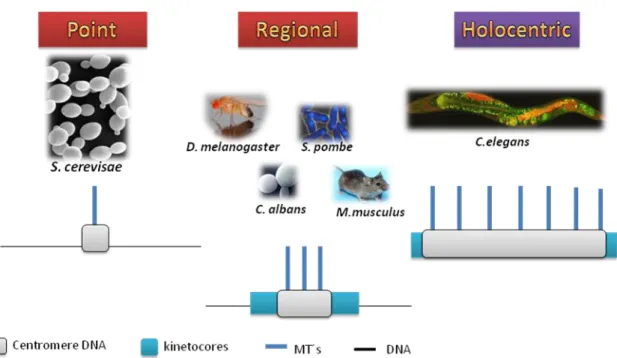
The size and composition of centromeric DNA vary significantly between different eukaryotes and we distinguish 3 types of centromers (Figure I.1): Point, Regional and Holocentric. The simplest point centromere could be found in the budding yeast Saccharomyces cerevisiae (Karpen et al. 2001). Larger chromosomes have regional centromeres, which bind 30 to 40 microtubules simultaneously. They are assembled upon megabase-sized arrays of simple satellite sequences. But although large, these regional centromers assemble upon a defined subdomain of the chromosome which not happens with the holocentric organisms (c.elegans), as we can see in the figure I.1, centromeres are at sites interspersed along the chromosome.
Figure I.1 – Types of Eukaryotic centromers. Adptaded from Epigenetic Control of Centromere
Behavior Karl Ekwall (2007).
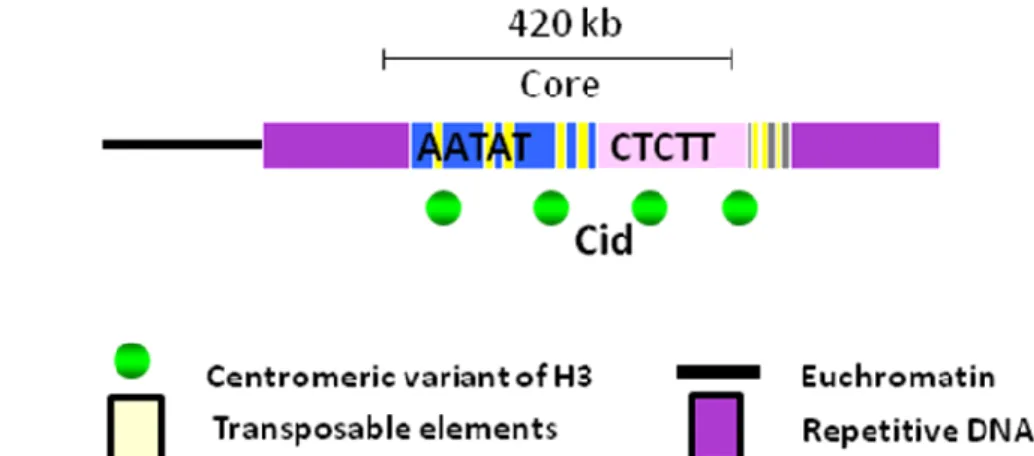
In Drosophila melanogaster the centromers are very well localizated in one region of repetitive DNA (Figure I.2). The only centromere that has been identify (molecular and functionally) was identified in the minicromosome DP1887 of 1,3Mb that derive from the X chromosome, were a region of 420 kb that contain repetitive DNA was
15
sufficient and able to perform a normal chromosomal segregation (Murphy and Karpen 1995).
Figure I.2 - Schematic view of centromeric DNA in Drosophila. This region present 2 blocks of DNA
satellite AATAT and CTCTT , and in the first block exist the insertion of 5 transposons. Also exist 2 domains in this centromers: one responsible for the assemble of the kinetochore were localize the centromeric variant of H3, Cid, and another domain implicated in the attachment of the sister chromatids. Adapted from Sullivan et al. 2001).
I.2. The centromeric histone H3 variants
The histones are the major structural components of chromatin and are expressed as a family of sequence variants encoded by multiple genes being the scaffold in which the eukaryotic genome is packaged and subject to a bewildering array of covalent modifications (Brown 2001).The canonical histones (H2A, H2B, H3 and H4), that are part of the nucleosome, are small and basic proteins composed of a globular domain (carboxil terminal domain) and a flexible domain (amino terminal domain). In addition to the canonical histones, histone variants such as
HAX, H2AZ and H3.3 are associated with distinct regions of the genome and substitute one of the canonical histones. Another issue is the fact that the histone pass to some modifications that are indicators of active or repressed chromatin, and the proposed 'histone code' hypothesis suggests that combinations of specific histone modifications
16
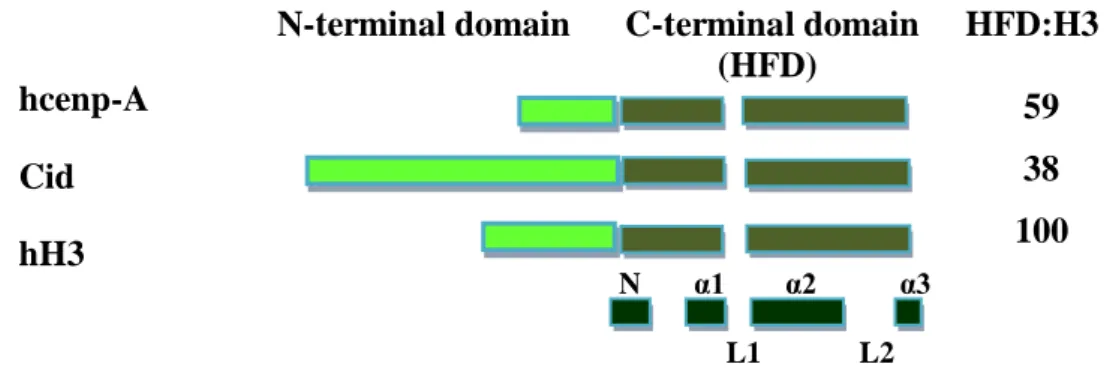
create a complex, functional hierarchy for chromatin regulation (Jenuwein et al. 2001). The CenH3 has been described in several organisms but in this work we are going to focus in Cid, the CenH3 of D.melanogaster (Henikoff et al. 2000). The CenH3 is characterized by having N-terminal with little conservation between the different organisms and almost without homology with the canonical H3 and a C-terminal domain composed by a HFD very conserved in relation to the canonical H3 and also between different variants (Figure I.4) (Henikoff et al. 2000).
N-terminal domain C-terminal domain HFD:H3 (HFD) 59 38 100
Figure I.4 - Structure of some of the centromeric variants of H3 (CenH3). In dark green we have the
organization of C-terminal more specifically is HFD. At right we have the percentage of homology of each domain in respect to the canonical H3.
Contrary to canonical histones, which nucleosome assembly occurs during DNA replication by the CAF-1 complex, the CenH3 it´s incorporated into the chromatin independently of DNA replication, like other histone variants (Torras-Llor et al. 2009) by the HIRA complex (conserved chromatin assembly factor that allows the replication-independent deposition of core histones on DNA) (Ray-Gallet et al. 2002). The deposition of newly synthesized CenH3 occurs during mitosis, in late telophase or early G1. In drosophila was saw that the deposition of CenH3CID takes place during anaphase (Scuch et al. 2007), a process that presumably initiates with interactions between DNA and CenH3 Loop1 of CenH3-H4 units and after the full core is assembled, the CenH3 N-terminal tail would interact with linker DNA (Vermaak et al. 2002). To be possible the deposition of newly synthesized CenH3CENP-A after the mitosis it´s also required some CenH3 specific factors as the HJURP chaperone in vertebrates directly binds to the CATD of CENP-A and together with it´s cofactor, nucleophosmin1, helps in the CENP-A loading (Przewloka et al. 2009) and seems to prevent proteolytic degradation of CenH3CENP-A (Dunleavy et al.2009). One intriguing question will be how the CenH3
hcenp-A Cid hH3
L1 L2 N α1 α2 α3
17
assembly it´s maintained at sites pre-existing CenH3 in the absence of DNA sequence determinants.
I.3. The proteasome pathway
Once the CenH3 can form a dimer with the H4 it´s reasonable to think that in principle CenH3 could be located everywhere on chromosome, but what happens is that normally CenH3 is restrict to a particular region. Therefore mechanisms must exist in the cells that lead to a selective localization of CenH3 in centromeric regions (Ekwall et al. 2007). So we could have two hypotheses or the CenH3 is deposited everywhere and actively removed from noncentromeric regions or CenH3 could be selectively deposited only at centromers. In some assays was prove that the proteolysis contribute to CenH3 (Cse4) restricted localization to centromers in budding yeast (Collins et al. 2004).
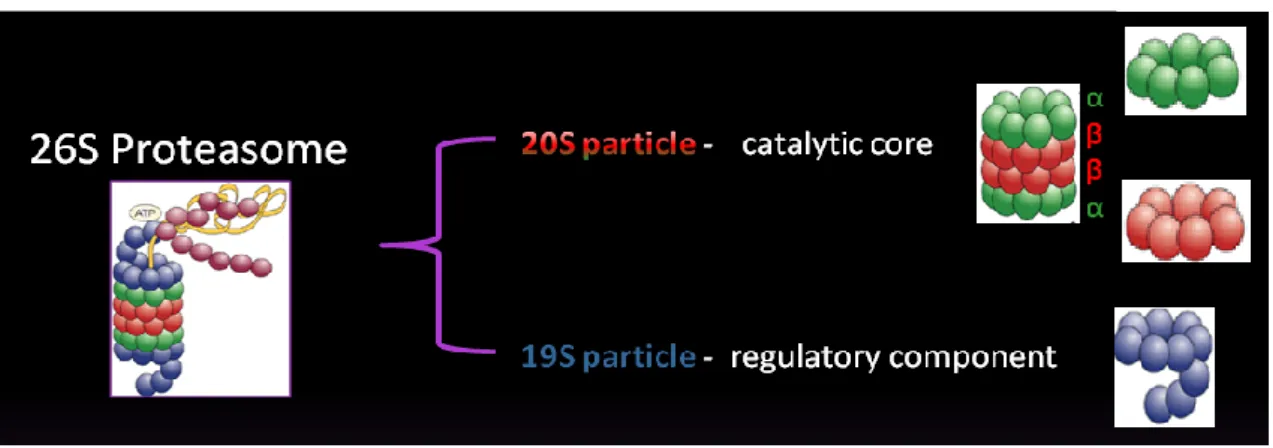
The proteasome represents the major nonlysosomal proteolytic system in eukaryotes (De Mot et al. 1999). In eukaryotic cells, degradation of many proteins involves their covalent modification by conjugation with ubiquitin and requires the sequential action of three enzymes: an ubiquitin activator enzyme (E1) an ubiquitin-conjugating enzyme (E2) and ubiquitin-protein ligase (E3). The specificity of this destruction system is mainly governed by the E3 and therefore play a pivotal role in this degradation pathway, enabling the quickly degradation of proteins by a large multisubunit complex called the 26S proteasome (Goldberg et al. 1996).The 26 proteasome is present in the nucleus and cytosol of all cells and consists of a 20S core particle capped by two 19S regulatory complexes (Figure I.5). The 20S particle is the catalytic core and is composed by four stacked heptameric ring structures that are themselves composed of two different types of subunits: α and β. The outer two rings in the stack consist of seven α subunits each, which serve as docking domains for the regulatory particles and the alpha subunits N-termini form a gate that blocks unregulated access of substrates to the interior cavity (Goldberg et al. 2007). The inner two rings consist of seven β subunits each and contain the protease active sites that perform the proteolysis reactions. Had been describe that three of the β-type subunits (β1, β2, and β5) are catalytic with the mechanism involving their amino-terminal threonines that face inward toward a large central cavity. Several of the β-type subunits, including all catalytic subunits, are synthesized as proproteins that undergo autocatalytic processing following their
18
Figure I.6 - Representation of the SCF complex assembly into the 20S complex (Schmidtke et al. 1996, Neuburger et al. 2006). The 19S particle, which is the regulatory component with ATPase activity, is responsible for stimulating the 20S to degrade proteins and it´s primary function is to open the gate in the 20S that blocks the entry of substrates into the degradation chamber.
The most known E3 enzymes are the APC and the SCF complexes. Many diverse cellular processes are regulated by the SCF family of ubiquitin ligases that have the function to target specific proteins for proteolysis (Deshaies, 1999). The SCF complex exists and is evolutionarily conserved among all the eukaryotes. It´s a multimeric complex that recognize
specific subtracts and promote the
transition G1-S. Typically it´s composed by 4 subunits (Figure I.6): an invariant core containing Skp1, Cul1, and Rbx1(RING finger protein) complexed with one member of a large family of F-box proteins (Murphy 2003).The Skp1 is the bridging protein essential in the recognition and binding to the F-box. The Cul1 is the major structural scaffold of the SCF complex, and the Rbx1 is the protein to which the E2-ubiquitin conjugate binds. The F-box proteins are a family of specificity factors, each of which direct a set of substrates for ubiquitin-mediated degradation (Patton et al. 1998) and could be split in two groups with base in it´s protein –protein interaction domain that recognizes the substrate: WD40 or LRR.
19
Figure I.7 - Representation of the interaction saw in vitro between our study protein, Cid, and the F-box
protein Ppa.
Previous experiments in Azorin's lab have shown that Cid interacts with Ppa (Moreno-Moreno O. et al, unpublished results). Ppa is an F-box protein that is involved in the degradation of the transcription factor Paired (Raj et al. 2000) and the first example of an F-box protein that is integrated into the Drosophila segmentation cascade (Das et al. 2001). Have a Sequence of 538 a.a and contain 3 types of domains: one Domain rich in Ala/ His/Pro, a Domain F-box and 11 domains LRR (leucine-rich repeats) (Figure I.7). Like other F-box proteins, it can have multiple substrates, what could explain the phenotype of its null mutant. Recently it´s also been prove that Ppa not only are evolved in the degradation of the transcription factor Paired but also in the degradation of proteins related with the regulation of the cellular cycle (Raj et al.2000)
20
II- Objectives/goals
As I have explained in the introduction, the precise molecular mechanisms accounting for the specific deposition of CenH3 at centromeres are still poorly understood so, our main objective has been try to improve our knowledge about this process. For this we have focus our work on:
1. - Analyze the role of the SCF complex in the centromeric localization of Cid
2. - Analyze if the mechanism of proteasome-mediated degradation also contributes to the centromeric localization of the Cid endogenous protein
21
III-
Materials and Methods
III. 1.1.1 Genetic ToolsIII.1.1.1.1 UAS-Gal4 System
The UAS-GAL4 system was developed by Brand and Perrimon and is a powerful biochemical method used to study gene expression and function (Brand and Perrimon, 1993). This is a systems that enable the geneticists to create a great variety of Gal4 lines, each one expressing the Gal4 in some subset of the fly's tissues and reporter lines UAS promoter sequences have been introduced in a number of eukaryotic expression vectors, allowing the production of transgenic constructs that are conditionally expressed upon the availability of GAL4, enabling the expression of lethal products (Duffy, 2002). Thus, in Drosophila, a parental stock expressing GAL4 can be crossed to another carrying a UAS-construct, therefore driving expression of the latter in the F1 progeny (Fig. M.1). Furthermore, to yield spatio-temporal specific drivers of gene expression, several well-characterized enhancer sequences have been trapped by the GAL4 coding gene (Brand and Perrimon, 1993).
Fig M.1 - The GAL4 system in Drosophila. One of the parental stocks carries the GAL4 gene in close
proximity to a known enhancer of gene expression. This stock can be crossed to another containing a UAS-transgene, and the resulting progeny will express this transgene in the pattern of expression of the GAL4 factor, which is specified by the associated enhancer region.
22
III. 1.1.2
Drosophila Strains
All fly stocks were raised at 25ºC or 29ºC (DTS), according to standard conditions (Dahmann, 2008). Crosses were cultured in small tubes, sealed with cotton, containing a yeast-glucose-agar medium. The mutant‘s lines will be described separately due the different conditions that they were cultured and maintained.
III.1.1.2.1 RNAi Lines against sub-units of the SCF
CG16983 and 16983R-III mutant lines against the Skp1 component and CG1877 and 1877R-I mutant lines against the Cul1 component. The lines CG16983 and CG1877
came from the Viena Drosophila RNAi Center (VDRC)
(http://stockcenter.vdrc.at/control/main) and the 16983R-III and 1877R-I from the
Drosophila Genetic Resource Center (DGRC) Kyoto, Japan
(http://www.shigen.nig.ac.jp/fly/nigfly/index.jsp). The four lines were raised at 25ºC.
III.1.1.2.2 DTS mutants of the proteasome sub-units
In this work were used dominant temperature-sensitive (DTS) lethal mutant of the proteasome subunit Pros β2 and Pros β6. The phenotypes of both mutants are similar, since they are not viable in homozygosis and neither in heterozygosis when they are raised at 29ºC (non permissive temperature) dye during the passage to the pupal stage due to a numerous defects including reduced abdominal and failure of head eversion (Neuberger et al. 2006). At 25ºC, the heterozygous flies develop normally and are fully viable and fertile. So genetic and biochemical evidence suggests that these mutants act in a dominant-negative manner to interfere with proteasome function (Saville et al. 1993; Covi et al.1999). The DTS nature of these mutants makes them useful for manipulating proteasome function in vivo. Since the proteasome pathway is critically involved in so many cellular events most proteasome null mutants are lethals. Thus, the most useful alleles for manipulating proteasome function are hypomorphic (leaky) or conditional mutants. The genetic and biochemical properties of the Prosβ2 and Pros26 mutants suggest that they encode abnormal β2 and β6 subunits that incorporate into proteasome particles and interfere with their function (Saville et al. 1993; Covi et al. 1999). This ‗‗poison subunit‘‘ hypothesis explains how these mutants act in a dominant negative fashion (Herskowitz 1987). However, the exact mechanism by which these
23
abnormal subunits are interfering with proteasome activity is not known. So the expression of these mutants forms under the control of the UAS-Gal4 system allow us to express them only in an specific tissue (not in all the fly) and then avoid the lethality effect. In Drosophila melanogaster, two mutants that enable us to test if the proteasome are involved in the degradation of our study protein are the Pros26 and UAS-Prosbβ2 (Neuburger et al. 2006).
A
Figure M.2- UAS constructs driving expression of dominant temperature- sensitive proteasome mutant genes. A- DTS7 (Pros β2) B-DTS5 (Pros26)
III. 1.1.3 Gal4 drivers
Table 1 Description of all gal4 drivers used in this work
Gal4 Drivers
Domain of activity
Patched –Gal4
(Ptcgal4)
Patched is express in imaginal discs ( in the posterior compartment) from early embryogenesis until end of larval stage
Engrailed-Gal4
(Engal4)
Express the gal4 in the engrailed domain (Antero-Posterior boundary) from end of embryogenesis until end of larval stage.
Aptereou-Gal4
(Apgal4)
dorsal selector gene required for patterning and growth of the wing
Scabrous-Gal4 (Scagal4) Scabrous gene expressed in the neurons
Elav-gal4 (Embryonic lethal abnormal vision) express in the neurons
24
The drivers used in this work are depicted in Table1 and the pictures that show is domain of expression were kindly provided by Gaylord Darras.
III.1.2. Methods of work with drosophila
III.1.2.2 Work with neuroblasts of Drosophila
III 1.2.2.1 RNA Extraction from third instar larvae brains
Previously, to isolate the brains is necessary dissect them in PBS 1X , transfer to an 1,5mL eppendorf with 50 µl of PBS 1X and maintained on ice. After that centrifuge at 100 rpm and eliminate the supernatant. To finish we freeze the brains in LN2 and store at -80ºC until they are going to be used. We for each cross collect between 80 and 150 brains and follow the protocol in annexes III.1.2.2.1.
III 1.2.2.2 Protocol of dissection of neuroblasts
To analyze if the E3-Ubiquitin ligase SCF complex has a role in the specific localization of Cid we have done some imunolocalizations in neuroblasts to see if this protein appear delocalized to all the chromatin. The neuroblasts were obtained from Drosophila lines expressing RNAi against one of the subunits of the SCF complex: Skp1 (16983R-III and CG16983) or Cul1 (1877R-I and CG1877). We cross males from this RNAi lines with females Scagal4 or Elavgal4 (the drivers that are expressed in the neuroblasts) at 25ºC and wait more or less 6 days until the first progeny arrives to third instard larvae. In this moment we can dissect the brains of the larvae to obtain the neuroblasts.
So we dissect the brains of L3 larvae in 50µL of saline medium 0.7% Nacl (0.07g Nacl in 10ml of H20) and left in this medium between 2 to 5minutes. After that and to be able to observe metaphases we treat for 1h30 minutes with 5 µg/µL colcemid (at the concentration 10 µg/µL) in one dark and humid box at room temperature. After we
25
perform un hypotonic shock with sodium citrate 0.5% medium at room temperature for 5-10minutes (0.05g citrate de sodium in 10mL of H20) and proceed to the fixation of the brains in formaldehyde 3,7% for 30minutes. Next we transfer the brains to a siliconized coverslip that already has 16 µL of acetic acid 60% (1200 µL acetic acid in 800 µL of H20) and do a squash. To finish this first part we submerge the slides in LN2 and stored the preparations in PBS-Triton X-100 (100 µL Triton X-100; 100mL PBS 10X).
III.1.2.2.3 Imunostaining of neuroblasts
After we prepare the neuroblasts like it´s explain in III 1.2.2.2 we start the imunolocalization by blocking with Triton-Milk for 1hour (100mL PBS-0,1%Triton X-100 + 1g powder milk) and after we incubate with 25 µL of first antibody in a humid box for 1hour at room temperature and let o/n at for 4ºC (we have used a 1:300 dilution of rabbit in PBS-0,1%Triton-1%Milk).
In the next day we wash twice for 10 minutes with PBS-0,1%Triton-1%Milk and incubate with 25 µL of secondary antibody (from Jackson ImunoReserch) in one dark and humid box for 45 minutes at room temperature (diluted 1: 400 in PBS-0,1%Triton-1%Milk). As we did before with the primary antibody we wash twice, for 10 minutes, with PBS-0,1%Triton-1%Milk. To finish we mounted in Mowiol+Dapi (50 µL DAPI 2ng/µL in 500 µL Mowiol), let it dry and storage at 4ºC until visualization at the inverted fluorescence microscopy NikonEclipse E-1000. The images were collected with a colour view 12 camera using a 40X objective lens. Acquisition parameters were controlled by Metamorph Software and images were analyzed with the program Adobe Photoshop.
III.1.2.3 Work with imaginal discs of Drosophila
III 1.2.3.1 Protocol of dissection and Imunostaining of imaginal discs of third instar larvae
To see if in vivo the levels of Cid are affected or regulated by the biggest mechanism of degradation in Eukaryotes, the proteasome, we will do some imunolocalizations in imaginal discs. We start by dissecting the brains and discs (all together) of third instar larvae in could PBS and fixed the tissues in PBS-4% formaldehyde for 15 to 20 minutes at room temperature. Next the larvae were washed and permeabilized in PBT
(PBS-26
0.3%Triton X-100) 3 times for 10 minutes each. Afterwards they were blocked in fresh PBS-0.3% Triton X-100-2% BSA 3 times also 10 minutes each and incubate at 4ºC o/n with the primary antibody rabbit anti-CidNt (diluted 1:300 in PBS-0,3% Triton X-100-2% BSA) on agitation.
In the next day we wash in agitation, first with fresh PBS-0.3% Triton X-100 and then four times with PBS-0.3% Triton X-100-2%BSA . After these washes we incubate for 2h at room temperature with the secondary antibody anti-rabbit cy3 (from Jackson ImunoReserch) diluted 1:400 in PBS-0,3% TritonX-100-2%BSA in agitation covered by aluminum paper. Next, they were washed 4 times, 10 minutes each, in PBT and then twice in PBS for 10 minutes. Finally they were incubated with Dapi (600 µL PBS+ 6 µL DAPI 2ng/ µL) for 5 minutes at room temperature and washed for 5 minutes in PBS-0,3%Triton X-100. To finish we dissect and mount the discs in Mowiol and visualized at the confocal microscopy. The images were analyzed with the program ImageJ.
III.1.2.4 Work with Kc cells of Drosophila
The Kc cell line (or Kc 167) is one of the firsts lines of D.melanogaster established for the in vitro culture (Echelier and Ohanessian 1969). Derived from 8 or 12h drosophila embryos, more specifically from embryonic hemocytes (blood cells that differentiate into macrophages). Have a spherical aspect, growth in suspension and form grumps. It´s cellular cycle is about 20h. One of it´s characteristic is since they are solved don´t attaches one to each others like other lines (S2 line).
III.1.2.4.1 Mantencien of the cells
a) Growth – The cells growth at 25ºC without CO2 in Schneider medium (Sigma) and 100µg/mL of Streptomycin (Gibco), 100U/mL of penincilin (Gibco) and 10% FBS (Gibco) that will be inactivate during 30minutes at 56ºC. We maintained this medium in flasks of 75cm2 at one density of 1-8x10⁶ cells/mL in a volume of 5-6 mL, doing dilutions of 1/6 or 1/8 every 3-4days. To have great amounts of cells to transfect we going to prepare flasks of 175 cm2 doing dilutions of 1/6 in a final volume of 30 mL.
27
b) Freezing – To freeze the cells we let them growth in 75 cm2 flasks until they reach a density of 5x10⁶ cell/mL. To recover the cells we going to transfect the medium to a falcon tube of 15 mL and centrifuge 2 minutes at 1300 rpm at room temperature. Afterwards, we eliminate the supernatant and resuspend the cellular sediment with 900 µL FBS. We going to pass to cryotubs and add drop by drop 100µL of DMSO. The process of freezing have to be slow so first we storage the cryotube during 2 houres at -20ºC after o/n at -80ºC and finally storage in LN2.
c) Defrost - We use one of the cryotubes of Kc cells storage in LN2 and defrost quickly in our hands. After we pass to a 15 mL falcon with 5 mL of medium and centrifuge 2 minutes at 1300 rpm at room temperature and resuspend the cellular sediment with 5mL of medium. Finally, we pass this medium with cells to 75 cm2 flask and let it growth during 3-4 days.
III.1.2.4.2 Transfection of the Kc cells by Effecten method
To transitory transfections of the DNA plasmids we used the Effectene method. To obtain a sufficient number of cells to transfect we let the cells growth until they reach a density of more or less 6x10⁶ cell/mL in a volume of 30 mL in 175cm2 flasks. Once quantificated the exact concentration of cells by counting with the Neubauer´s chamber we inoculate 2x10⁶ cells in harvest plats of 60mm2 in one final volume of 5mL and incubate 24h at 25ºC. For each plate we transfect 10 µg of DNA (obtained from maxipreps with Quiagen columns) in a final volume of 50 µL. For every transfection we going to made duplicates so we going to prepare for 2,5X transfections. In the next day after we plate the cells we prepare in eppendorfs the necessary quantity of DNA in one final volume 125µL.
III.1.2.4.3 Analyze of the transfection by fluorescence microscopy
To determine the transfection efficiency and the localization of the proteins of interested in fusion with YFP we use the fluorescence microscopy. 48 hours after the transfection, we impact 200 µL the cells in one porta slides by centrifugation at 500 rpm for 10 minutes. First we had to collect 300 µL the cells from the plate and to a tube that
28
already contain 1mL of MAC hypotonic medium (50 mM glycerol; 5mM KCl; 10 mM Nacl; 0,8 mM CaCl2; 10 mM Sucrose).Afterwards we incubate for 5 minutes to the cells incorporate water, but with the careful of not pass this time because they can end up blowing. Quickly we put 200 µL of this solution in the deposits of the centrifuge in the porta slides, and centrifuge for 10 minutes at 500 rpm in the ThermoShadon Cytospin4. To acoplate the embuts and the porta slides we use a clip and between them put a filter. In this way the cells will be impacted in one small circle in the slides that coincides with the exit of the embut. Afterwards we let dry the slides for 1hour at room temperature and fixe the cells with 50µL paraformaldehid 3,7% (diluted in PBS 1X) directly above the cells for 10 minutes at room temperature. Next step was wash the slides with PBS 1X for 15 minutes and after that let it dry and storage dry at 4ºC involved in aluminum paper until we observe in fluorescent microscopy.
III 1.2.3 qRT-PCR
The qRT-PCR was done using the RNA obtained by the protocol in annex of RNA extraction (III 1.2.2.1) using as a internal control actin gene and the primers used for the qRT-PCR are described in Annexes (table A.1). After the extraction of total RNA, it´s integrity was tested. The RNA with good integrity was subjected to a RT-PCR using the Qiagen Kit under the manufacter´s instructions and the termocycler LightCycler480. The PCR conditions used was: 1 minute to 94ºC; 1 minute to 55ºC, 1 minute to 72ºC all for 30 cycles and 1 minute to 72ºC.
29
IV-
RESULTSAs I have explained before the goal of this work has been to deep the understanding of the mechanism(s) that are involved in the centromeric localization of Cid. To achieve this we have focused our work in the study of how some proteasome mutants and RNAi lines against some proteins involved in the proteasome pathway affect Cid's localization. And moreover, we have tried to found if any specific domain of Cid is required to be degradated.
A- SCF Complex mutants :Skp1 and Cul1 mutants
With the goal to see if in fact the SCF complex regulates the levels of Cid in the cells we have used RNAi against subunits of this complex: two against Skp1 and two against Cul1 with one of two drivers, Scagal4 or Elavgal4 (Matherials and Methods III.1.1.2.1 and Table1). To analyze if Skp1 and Cul1 are involved in Cid localization we perform an immunofluorescence experiment in neuroblast prepared from third instard larvae growth at 25ºC and using as a primary antibody anti-CidNt (Matherials and Methods III.1.2.2.3).
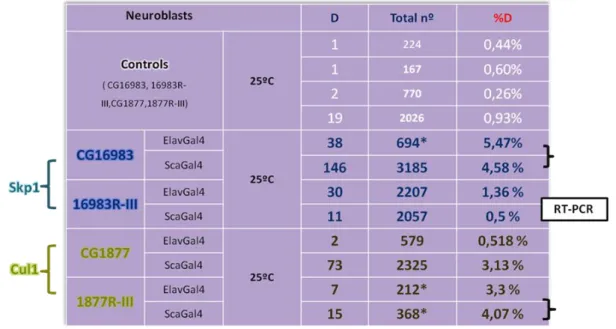
As can be observed in Table2 in the parental lines, which contain the RNAi but not express them, Cid is always localized exclusively at centromeres (excepcion to the RNAi line 1877R-I that appears to show a little more delocalization, almost 1% , but that it´s not significative) . When we crossed the RNAi lines CG1683 (against Skp1) and 1877R-I (against Cul1) with both gal4-drivers we observed a low but statistically significative percentage of cells showing Cid mislocalized (Figure R.1). However, when we do the same with the other two RNAi lines, the RNAi 16983R-III against Skp1 present results very low of delocalization when compared with the other lines and the same pass with the other RNAi CG1877 crossed with Elavgal4 driver.
30
Elavgal4x1887R-I
DAPI αNCid DAPI + αNCid
Fig R.1- Images of immunostaining in neuroblasts from third instar larvae of the effects that RNAi against sub-units of SCF complex induce in the Cid localization. A,B- Scagal4 x
16983R-III (Skp1) 25ºC where we see that some cells shows Cid delocalized (red circule) and C- Scagal4 x CG16983 (Skp1) 25ºC in which Cid appears localized. In blue we have the DNA stained with DAPI an in red the signal of the Anti-CidNt.. D- Elavgal4x CG1877(Cul1) 25ºC the DNA of the cells stained with DAPI, E- signal of the Anti-CidNt, F- Overlay were we see the cells with Cid localize,
G- Elavgal4x1877R-I (Cul1) 25ºC where we also see the cells with Cid localize(H) but a fews with
Cid desocalized (I).
D E F
G
H
31
Table.2- Percentage of neuroblasts from third instar larvae showing Cid delocalized in the Skp1 or Cul1
subunits. D-number of cells with Cid delocalized, Total nº-total number of cells count, %D-percentage of delocalization, * the total number of cells count in this crosses was less then in the others.
The differences in the percentage of cells with Cid mislocalized may could be explain with a difference in the RNAi efficiency. So, to analyze this we have performed a qRT-PCR analysis with the RNAs from 3 crosses: Elavgal4xCG16983, Scagal4x1877R-I (Figure R.2) and Elavgal4x 16983R-III (not show).
Figure R.2 Graphics with the result of the qRT-PCR experiments. Analysis of the efficiency of our RNAi
lines against the subunits of the SCF complex. A- dark green the mRNA levels of the RNAi lines against Skp1( CG16983) component and lighter green the mRNA from Actin our internal control of the samples that we used to normalized all the data ; Axis yy- relative levels of mRNA- B- dark blue green the mRNA levels of the RNAi lines against Cul1(1877R-I ) component and lighter blue the mRNA from our normalization control Actin.; Axis yy- relative levels of mRNA.
32
In theory the actin mRNA doesn't change between samples so we used actin as a internal control gene to correct the possible errors due to differences in the total RNA used in every well (errors in the determination of RNA concentrations, different efficiency of the RT, errors in loading). Once we normalized all data we compared our mRNA levels (Skp1 or Cul1) in the parental line (which contains but not express the RNAi) and our mRNA levels when we have crossed with the drivers (Scagal4 or Elavgal4). We observe that in both crosses CG16983x Elavgal4 and 1877R-Ix Scagal4 a significative decrease in these mRNA levels are achieved, a decrease of 40% and 60% respectively.
B- Proteasome mutants
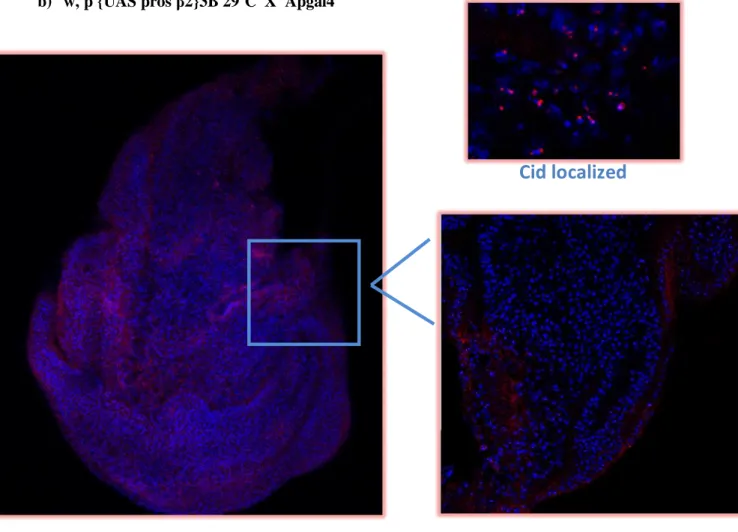
In the proteasome mutants, as I have explained in the introduction, it is reasonable to expect that mutations in genes encoding proteasome subunits would exhibit lethal phenotypes. The lethal effects of the mutations reported here indicate that in flies, as has been previously shown in yeast proteasome function is essential for viability (Saville et all 1993). So to study the function of this genes it´s better to use the UAS-Gal4 system since in previews experiments in Ferran´s lab, were they perform studies of imunostaining with this β2 and β6 proteasome mutants without the UAS-Gal4 system , were observed only an 8% of Cid mislocalized in the neuroblasts. Due to the fact that with this mutants appear the problem that the mutant effect begin at the third instar larvae leading to the dead in the final of this instar, we decided to do this experiments with the UAS-Gal4 system in an temptative to see higher levels of mislocalization. In our experiments we cross 10 males of one of the two UAS lines that we have (Table1) with 10 virgin females of the driver lines (Ptcgal4, Engal4 or Apgal4). The cross were put at 25ºC and 24h late change to 29ºC (restrictive temperature). We performed an immulocalization assay in wing imaginal disc using anti-CidNt (Materials and Methods III 1.2.2.4) and the images taken in the confocal microscopy (figure R.3 and R.4) shows an absence of the mislocalization of our study protein, Cid, in the domains of expression of our drivers in the imaginal discs. We always see the typical punctuated pattern in the cells. However one interesting phenotype that it´s also saw it´s an abnormal cellular proliferation (figure R.3).
33 a) w;p {UAS prosβ2} 3B 29ºC X Ptcgal4
a) b) c)
d) e)
Dapi
Overlay overlay 63X amplified
GFP 2nd Anti-CidNt
Figure R.3 - Analysis of the effect of mutations in the proteasome in Cid localization in
imaginal discs. w, p {UAS prosβ2}3B 29ºC X Engal4}. The images a) b) c) and d) were
34 b) w, p {UAS pros β2}3B 29ºC X Apgal4
Cid localized
Figure R.4 – Analysis of the effect mutations in the proteasome in Cid localization in imaginal discs.. a)
w, p{UAS prosβ2}3B 29ºC x ptcgal4}, b) w, p {UAS prosβ2}3B 29ºC x Apgal4}. The images a) b) were captured in 20X , 40X and 63X and ampliation in the Leica confocal microscopy.
35
C- Kc cells experiments
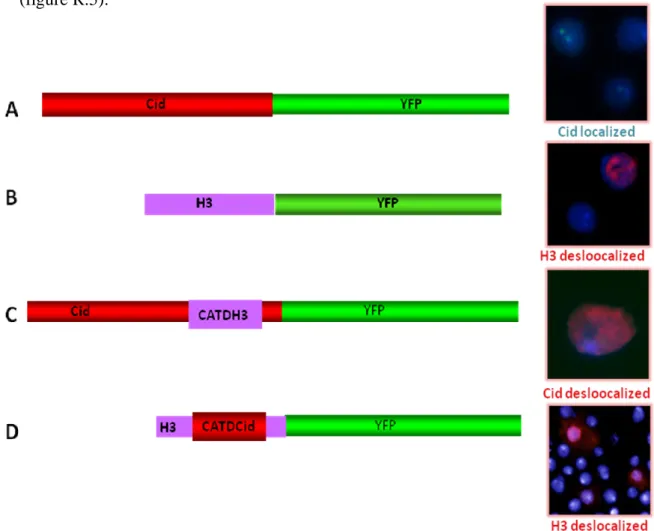
The experiment done with the goal to test the hypothesis if the CATD domain is sufficient to localize Cid in the centromere, we transfect by the Effectene method (as Quiagen manufacture recommends) this Kc cells with 4 different plasmid constructs (figure R.5).
What it´s observed was in the two first constructs A and B, our controls, we see that after the imunolocalization , the cells transfected with all the sequence of Cid in fusion with the quimeric protein YFP, shows a punctuated pattern witch mean that Cid it´s
Figure R.5 – Transitory transfection of Kc cell with four different plasmids by the method of Effectene: Estructural view A-pCid-YFP; B- pH3-YFP; C-pCidCATD H3-YFP and D- pH3CATD Cid – YFP. A it´s one of our control were we transfect the Kc cell with a plasmid that contain the entire sequence of
Cid in fusion with fluorescent protein YFP. We see a patron of localization at right. B- the second control were we transfect the Kc cell with a plasmid that contain the entire sequence of H3 in fusion with fluorescent protein YFP (green). We see a patron of delocalization were it´s saw signal spread to all the nucleus. C and D are our study experiment were we transfect, like in the controls, the Kc cells with plasmid that are altered. In C we transfect the plasmid that contains the N-terminal domain of Cid (red) and the part of the C-terminal domain, the CATD, of H3.1 (violet) and in D we transfect the cells with a plasmid that contains the N-terminal domain of H3(violet) and a part of the C-terminal domain, the CATD, of Cid (red).
36
only localize in the centromers. This was expected since the HFD don´t suffer any alteration in is sequence and so the CATD, the domain responsible for targeting the CenH3CENP-A to the centromers, was also functional and unchangeable. In B we also have the entire sequence but this time of the canonical H3 in fusion with YFP. In this case since the CATD domain it´s not the same then in the CenH3 don´t exist the determination necessary to localize this protein, canonical H3, only in the centromere and so what it´s saw it´s a typically patron of delocalization were the signal spread to all the nucleus. In the constructions C and D we want to prove if in fact the CATD of Cid it´s required and sufficient for it´s centromeric localization like happens with CENP-A in mammals. So, by fluorescent microscopy we can say that the C-terminal domain it´s required for the centromeric localization, which is in agree with some studies performed with quimeric proteins CENP-A and H3 (Sullivan et al 1994), specifically was described that a specific region of the C-terminal domain, the CATD domain L1/α2 was the responsible for the centromeric localization of Cid (Vermaak et al 2002). What is saw with our experiments is that in Drosophila this CATD domain it´s required but seems it´s not sufficient to target Cid in the centromers because in the last construct with the sequence of canonical H3 and CATD domain of Cid if in fact this CATD was sufficient we should see a pattern of localization and not the mislocalization through all the nucleus that it´s observed in D. This results are also in agreement with a experiment performed by Black et al 2007 (Figure R.6) in yeast. They saw that the CATD domain was necessary but never sufficient, seems like it always required some little sequence, like the α3 region, to target Cid only in the centromers.
Figure R.6 – Adptaded from Centromere identity manteined by nucleosomes assembled with histone H3
containing the CENP-A Targeting Domain (Black et al. 2007). The red arrow serve to evidence the fact that
37
V-
DISCUSSIONSince the discovery of centromeric variants in last century this area become a very interesting field to improve the knowledgment about the centromeric chromatin in a way that this CenH3 have a key role in the formation of the kinetochore and in chromosome segregation. As I have said before one common characteristic of all the centromers is the presence of CenH3, which it´s thought to be the epigenetic determinant of the centromere identity (Howman et al. 2000, Vermaak et al. 2002). The specific mechanism that determines that this variant only deposit in the centromere and the factors responsible for that it´s not completely known, so with this work we had the goal to try to understand a little better some of this doubts.
To the proteins being degradate by the proteasome they previews had to be poliubiquitinated. First we start to perform some imunolocalization experiments in neuroblasts of third instar larvae that are mutants in one of the invariable components of an E3 ubiquitin ligase, the SCF complex: Skp1 or Cu11. We observe a very low percentage of delocalization in all the RNAi lines (table2) but principal in the lines 16983R-III (Skp1) and CG1877 (Cul1). To have sure that our RNAlines are working well and the low delocalization is not due to problems with them we perform qRT-PCR using the RNA from the crosses: Elavgal4xCG16983 (figure R.2 A), Scagal4x1877R-I (figure R.2 B) and Elavgal4x 16983R-III (not shown) to be sure what are the level of the decrease that our RNAi pathway promote. We choose the ones that in the beginning present the higher percentage of delocalization for each component Skp1 or Cul1 with base in the table 2. With these results we could compare if our levels of delocalization are significative or no. Based on the graphics we could see that both RNAi line against the Skp1 and Cul1 component, promotes a significative decrease in the levels of these proteins in the cells, ~40% and 60% respectively. In the experiment done with the other RNAi line, CG16983, don´t show a significative decrease in the levels of this protein, Skp1, in the cells. So these lines are working reasonable well and the low percentage of mislocalization of Cid in the cells couldn´t be for that reason. All the crosses were raised at 25ºC and maybe these temperatures were not sufficient enough to induce the UAS-Gal4 system and few levels of the mRNA Skp1 or Cul1 are silence. The problem was when we put the crosses at 29ºC we don´t obtain any larvae, probably because at this temperature the UAS system are more active and we have a massive silence of the
38
mRNA of Skp1 or Cul1 and in this conditions the SCF complex could lose it´s function which could be unviable to the progression of celular cycle and so the larvae die before arrive the third instar or don´t pass the embrionary development. In future will be valuable use a two subunits mutant to see if the percentage of delocalization appears bigger, or inclusively if it´s viable.
Second in the experiments with mutants of the proteasome and since the function of the proteasome genes, β2 and β6, are very important to the correct function of this structure one of the ways of test there function in terms of the involvement in the localization of Cid, was express this mutants sub-units of the proteasome in one specific tissue by the using the UAS-Gal4 system (Belote et al 2002). In this way we be able to compare in the same individual the effects of the presence or absence of proteosomal activity in the levels of the endogenous Cid.
In imaginal discs we cross every mutant line (III.1.1.2.2) with drivers that express in that appendage (ptcgal4, Engal4, Apgal4 III.1.1.3) and after we try to optimize all the conditions in the imunolocalization assay (III.1.2.3.1) not only the type of first antibody used but also the dilution. The results indicate us a lack of Cid delocalized in the discs of this mutant larvae. One possibility for this was the fact that we could not achieve an optimization of the imunostaining conditions because in the majority of the cases we see a background noise from the second antibody which many times don´t let us understand if the punctuated pattern that we see it´s due to the centromeric localization of Cid or it´s due to this not specific stain of the secondary antibody. Further optimization work will be one of the goal to clearly understand if in imaginal discs , like was already saw in neuroblasts (Moreno-Moreno et al 2002), the proteasome is the mechanism of degradation responsible to maintained the Cid localization in the centromers.
Meanwhile an intriguing phenotype that we see in all the discs was an abnormal cellular proliferation in this UAS proteasome mutants crossed with the Engal4 driver (figure R.3) and Apgal4 (not shown). We know that since the proteasome it´s evolved in the degradation of so many and different protein this phenotype probably could have nothing to do with the localization of Cid. So in the future one of the goal´s will be study the phenotype of these proteasome mutants in the wings of the adults flies,
39
possible because we are using UAS-Gal4 lines, to see if this phenotype has something to do with Cid localization.
Third we also perform some studies in vitro to prove if the CATD, a particular region of the C-terminal domain, the helix α2 and the loop1 (figure I.2) that connect with the H4 and that conferring the thickness and compactation of the nucleosome (black et al.2004) is sufficient to localize Cid in the centromere. The results obtained by transient transfection of the different construct plasmid that express the YFP proteins (Figures R.5) we can say that a particular region of the C-terminal domain it´s required for the centromeric localization because when we transfect the cells with N-terminal sequence of Cid but with the CATD of canonical H3 we see a mislocalization of this protein which is in agree with some studies performed with quimeric proteins, CENP-A and H3 (Sullivan et al 1994), that shows that this domain it´s required and sufficient to target CENP-A in the cells. However in Drosophila this CidCATD it´s not sufficient to target Cid in the centromers, because when we transfect the cells with the N-terminal sequence of the canonical H3 with the CATD of Cid this is not sufficient to localize H3 only in the centromere. Appears that some other region outside the CATD, like the α3 region in the C-terminal region of the CenH3 of yeast (Black et al 2007), could be required to the targeting of Cid to the centromere. One further work that will be of value to do was do some constructions with the CATD and also different parts of this α3 region to identify all the regions required to targeting Cid only in the centromers.
40
VI-
CONCLUSIONS1- Appears that the SCF complex regulates the levels of Cid in the cells, but it´s not essential to it´s degradation. When we mutate Skp1 or Cul1 in the both cases we see very few delocalization of Cid which could mean that some other subunits are able to compensate the function of Skp1 or Cul1 or this SCF complex it´s not the only one that regulated the degradation of this protein.
2- The proteasome mutants don´t show a mislocalization of Cid in the imaginal discs in our assays. This lack of results could be due to we don´t achieve the correct optimization in the imunostaining assay. Other possibility it´s the fact that a single mutation in each one of the two subunits is not strong enough to disrupt the proteasome function and somehow the function of these subunits could be compensate by other ones. But it´s clear that the proteasome in somehow have to regulate the levels of this protein in the cells with base in some assays done before.
3- The function of the CATD seems to be conserved from fungi to mammals and appears that this domain it´s necessary but not sufficient to the centromeric localization of CenH3 in Drosophila, as have been previously show for budding yeast (Black et al 2007). It seems that it´s required some other region of the HFD, not only the CATD, to localize Cid in the centromers.