Comparison of two methods to assess the root architecture as
the potential factor influencing the diversity of a stand
DINIS,C.,SUROVÝ,P.,RIBEIRO,NA.
Universidade de Évora, Departamento de Fitotecnia, Largo dos Colegiais 2, 7000 Évora, Portugal
Abstract
In this article we describe two methods for acquisition and examination of the root architecture of trees in order to evaluate the possible influence on stand diversity and horizontal structure. The roots and belowground biomass in semi-arid areas of south Portugal can be understood as the main competition area for the trees so understanding of their growth and architecture is essential for understanding of growth, interaction among plants and finally the diversity of the stand.
Introduction
The rooting strategy is of major importance in understanding the dynamics of species over forest succession and maturation (CURT AND PRÉVOSTO, 2003). If a determined tree has the ability to, for some reason, acquiring a greater proportion of water and nutrients, they turn to be more competitive in producing biomass and allocating assimilates in ways that maximize its survival and growth. Researchers that try to explore knowledge in the area of root systems recognized the difficulties associated with the study of roots in the soil (BOX, 1996; ATKINSON, 2000; PÀGES, 2004; TOBIN ET AL., 2007; DUPUY ET AL., 2010). However the growing of technological innovations that already can be used actually, the study of plant root systems still continue to be a challenge often refused, because of the small relation between the obtained results and the invested effort (DUPUY ET AL., 2010; MULIA 2010; KALLIOKOSKY ET AL., 2010). Whatever the type of modeling applied, root systems must be exposed in a way of that it is possible to capture and analyze its volume and tridimensional structure. To have access to the belowground structure several researchers applied different methodologies, e.g., HRUSKA ET AL. (1999) used the “ground penetrating radar”. However, in a recent study,STOKES ET AL. (2002) showed that the resolution obtained is unsatisfactory plus the demanding requirements necessary to apply this method (homogeneous soil, dry soil, etc.), make this technique inappropriate in the majority of studies of root systems behavior.
DANJON AND REUBENS (2008) used another technique, laser digitizing, referring that it’s the best technique available to describe the surface and the shape of roots. Although the authors recognize the integration of lift perception, the development processes and carbon exchanges in modeling works integrating also de annual behavior of root system (WAGNER ET AL., 2010). This author also refers, that many of studies only analyze samples of individual roots but the necessity of construction on new modeling approaches of the entire root system is urgent. Acquisition of the exact spatial distribution of the roots in belowground, will allow the explanation and understanding of many actions and functions of these systems, so little studied, in terms of functional and structural dynamic of tree, allowing the ecosystem understanding also in terms of water and carbon cycles. Quoting the referred author “the exposition of root system is crucial to future researches”. According to DANJON ET REUBENS (2008), the collected information about the availability for coarse roots can be achieved through invasive and non-invasive techniques. In the application of non-invasive methods, the accessibility to root system does not implicate its exposure, being the measurements made through X-ray (PIERRE ET AL., 1999 in TOBIN ET AL. 2007) or MRI (ASSENG ET AL. 2000 in TOBIN ET AL., 2007). Although in these techniques the quantity of available parameters is low, comparing with value cost of equipment acquisition and, also the demand of specific soil conditions, as temperature, texture, water, presence of coarse soil material, etc. make this technique less viable for applications in tree root systems. In invasive techniques, it’s assumed that the exposition of tree root system should be made by pulling or lifting of roots with heavy machinery help, by profile excavation or excavation of total volume of soil occupied by the roots. After root system exposition the coarse root measurements can be achieve by the techniques: (1) manually using a frame and plumb (KHUDER ET AL. 1996 in TOBIN ET AL., 2007); (2) using computational programs to reconstruct the geometry analyzed manually by measurements recovered with the use of a ruler and compass (DUPUY ET AL., 2003) and (3) semi automated method using a digital compass or a 3D digitalizer (DANJON ET AL., 1999; OPPELT ET AL., 2000). Nowadays, the method more often used is the 3D digitizing, as the Polhemus Fastrak of low magnetic field and the analysis made through specific software’s (DANJON ET AL., 1999, 2005; TAMASI ET AL., 2005; NICOLL ET AL., 2006). By the research made until this moment, the measurements can be done in situ (OPPELT ET AL., 2001; KHUDER ET AL., 2006; DANJON E REUBENS, 2008) or in excavated root systems (DANJON ET AL., 1999; 2005; NICOLL ET AL., 2006). The in situ method is the better technique to apply resulting in a major quantity of information despite expensive and time consuming. In this paper we try to demonstrate the application of two different methodologies in excavation of tree root systems (Pinus pinea L. and Quercus suber L.) representing
a technical component of a project of tridimensional architecture modelation of tree root systems.
Methodology
When the main goal is to evaluate the morphology and root system architecture, it is necessary to have access to these systems in a complete and integral way in all the extension, horizontally and in depth. For this experimental work, two healthy trees were selected, a stone pine (Pinus pinea L.) and a cork oak (Quercus suber L.). Both of trees were located in Canha, in central Portugal (38º45’31.94”N 8º38’30.93”O and 8º45’38.38”N 8º 38’22.22”O, respectively). The predominant type of soil in the study area is a Vt with sandy-loam characteristics with clay congregations.
For both method application, a shortly biophysics analysis of the surrounding matrix was made, soil condition, slope of the surface, density stand conditions and stand type characteristics of the study area (trees, shrubs and herbs layers).
In this comparative experiment, we tested two methods for excavation of total volume soil occupied by the root system: (1) denominated by washing the root with water and, (2) cleaning the root by high pressure air spade. In both methods, initially dendrometric evaluation of tree samples and the collection of soil cores (two soil cores minimum per tree) for textural and chemical analysis of the different soil layers of the profile, were made.
The stone pine was located in a pure stand installed by seedlings in 1998, with 4x4m distance. Cork oak was located in a mixed stand with juvenile cork oaks, stone pines and essentially eucalyptus (Eucalyptus globulus Labill.), main competitor for subsoil resources. The surface layer was also occupied by some sage-leaved Cistus shrubs (Cistus salvifolius L.) and some annual herbs. These were removed in advance to facilitate the excavation process. The cork oak was young (around 20 years) and never had been debarked.
Tab. 1 Evaluation of study location characteristics.
Stone pine Cork oak
Stand Pure Mixed
Neighborhood Stone pines Cork oaks, stone pines, eucalyptus
Shrub layer No Sage-leaved cistus
1 - Root system excavation by profile washing with water
We use the following steps: (1) initially a hole was open with two meters of depth and in a distance of three meters from the tree trunk (this distance was estimated as the maximum horizontal root spread), to function as a deposit of water and flowed sediments, from the washed profile; (2) Proceeded to the opening of the main trench with water washing; being careful with the position and distance of the water jet, because it can cause the movement and displacement of mainly more fine structural roots (diameter between 0.2 – 0.5 cm) from the original position. In our case, the loss of structural fine roots was imminent, so we use a fine net in the top of the hole in the expectation of collecting these roots for further biomass evaluation.
Simultaneously, after the opening/washing of each 10 cm of vertical soil layer, in the demand of not losing the original position of the roots, we proceed with the digitalizing with 3D digitalizer (Polhemus Fastrak), collecting the 3D representation of roots, codifying each root, collecting and storing them to future laboratory analysis. Because of the complex “net” form by root system, we decide to label the roots for easier identification along the excavation process.
For the first layers (layers AP and beginning of A) this method of excavation with water works well, however for deeper layers, because of the embedded clay features we decide to use the manual excavation method which turned the process harder and time consuming.
In the final stage of excavation, when only the central part of root system wasn’t exposed, it was necessary to fix the root system with sticks and strings avoiding the movement and displacement of the rest of the system while the soil was being removed. The purpose of this step is trying to maintain the 3D spatial distribution the most close to reality as possible.
For fine roots samples (less than 2 mm of diameter) we used the method of wall profile where we collected soil cubes with 15x15x15 cm dimensions, in a soil wall at 0.75m deeper and with one meter of length. These soil cubes were codified and store in cold environment, for future laboratory treatment.
2 - Root system excavation by high pressure air jet
For the method of excavation by high pressure air jet after dendrometric evaluation of cork oak aerial component, similar to the technique adopted to wash profile excavation a deposit of sediments was open with two meters of depth and at a distance of four meters from the trunk of the tree. With the use of the jet air connected to a compressor we began the excavation of the first layer – topsoil – from the trunk in the direction of the crown edge’s horizontal projection. This technique
were reaching more depth, soil characteristics became more clayey, what made us change to the manual option (by hand with help of archaeological material used in excavations) with the aid of a pneumatic hammer when was necessary (characteristics of high bulk density).
With the excavation of one quarter of the horizontal projection of the root system we began the 3-dimensional digitizing of the roots, applying the same methodological proceeding used for the stone pine, to cut, label and store of the roots for further analysis always aiming the total exposure of each root for proper digitizing. In the final stage of cork oak root system excavation, the central part of the root was supported and fixed with wooden sticks, strings and also with the support of a tractor to avoid displacement of the remaining root system when the rest of soil was being removed. After total exposure of the rest of root system it was carried to laboratory where we finished the task of 3D digitizing, cutting and storing the root samples.
Results
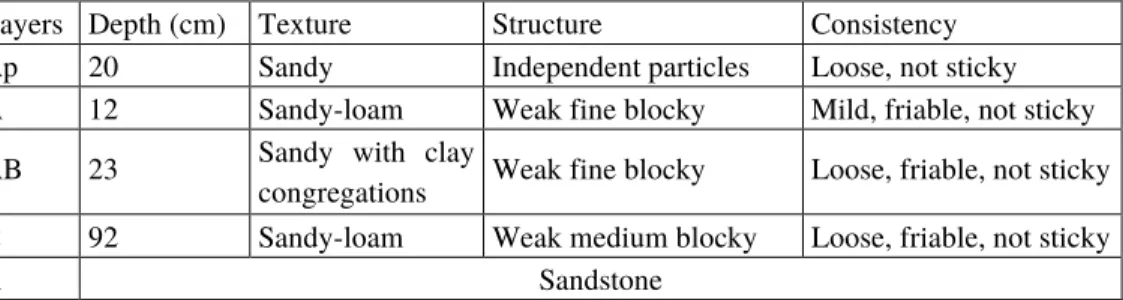
The results show that both methods are able to obtain the expected results, i.e., the ability to have full access to the entire root system. However according to the soil characteristics of the study area also supported by the results obtained by chemical and textural analysis (see table 2), both methods only worked well up to 20cm depth where the predominant texture was sandy. After this depth the only method possible to use in our profiles was the manual excavation method plus the pneumatic hammer, when necessary.
Tab. 2 Profile layers description of the soil in the study area.
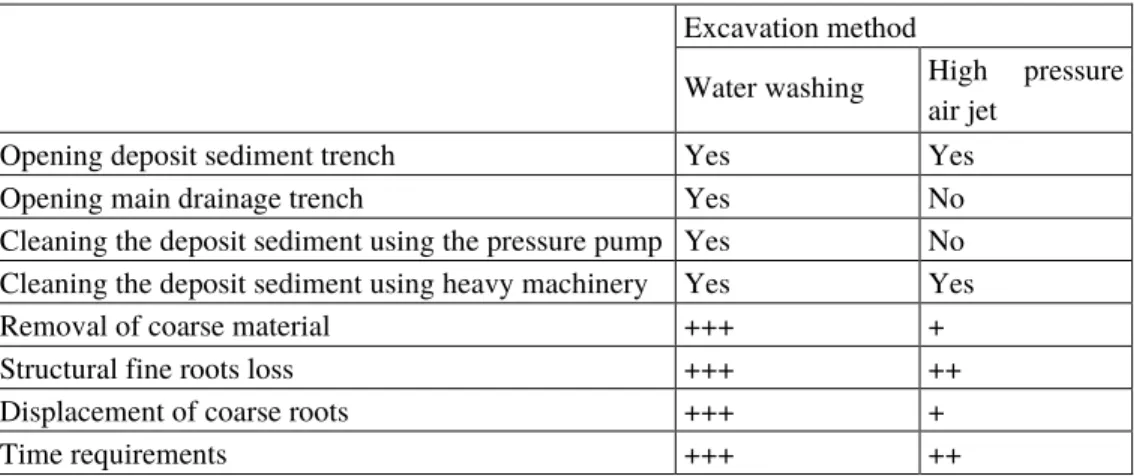
According to what was possible to evaluate with this work, the comparative results of the two methodologies are shown in Table 3.
For root system excavation by profile washing with water, the total money budget spend between days of work, men per day for the excavation process and digitizing (100 man/days for excavation), heavy machinery work (5 hours) for open the deposit sediment trench and for cleaning the deposit sediment during
Layers Depth (cm) Texture Structure Consistency
Ap 20 Sandy Independent particles Loose, not sticky A 12 Sandy-loam Weak fine blocky Mild, friable, not sticky
AB 23 Sandy with clay
congregations Weak fine blocky Loose, friable, not sticky C 92 Sandy-loam Weak medium blocky Loose, friable, not sticky
the process, acquisition of excavation equipment (1500€) and water spended (700€), was about 7000€.
In case of excavation method by high pressure air jet it was necessary 150 man/days, 5 hours of heavy machinery work. The comparison is shown in Table 4.
Tab. 3 Comparative results of application of both methods evaluated.
Tab. 4 Comparison of total costs for water washing and high pressure air jet methods.
The values presented in Table 4 indicates that the excavation types might have similar costs though to obtain the precise comparison we should divide the total amount of air excavation costs by two due to the fact that the total volume of excavation was twice as big as in the water case. So in such a way, when multiplying the man/day values by index price 35 we obtain for water excavation total 5105 (3500+105+1500+500) and for air excavation 3177.5 (5250+105+1000)/2. So we can conclude that the air excavation is approximately 40% cheaper than water.
Discussion and conclusions
In this article we describe two methods for excavation of structural root systems of trees. The first one is based on water washing of root system aiming to remove
Excavation method
Water washing High pressure air jet
Opening deposit sediment trench Yes Yes
Opening main drainage trench Yes No
Cleaning the deposit sediment using the pressure pump Yes No Cleaning the deposit sediment using heavy machinery Yes Yes
Removal of coarse material +++ +
Structural fine roots loss +++ ++
Displacement of coarse roots +++ +
Time requirements +++ ++
Excavation method Water washing High pressure
air jet
Excavation time man/days 100 150
Heavy machinery hours 5 5
Additional equipment costs (index) 1500 1000
the application of both methods it is advisable to make a brief analysis of biophysical environmental matrix, such as, soil conditions, the slope of the surface, conditions of stand density and characteristics of forestry layers of the stand (trees, shrubs, herbs). For both methods before beginning the excavation of volume soil occupied by the roots its necessary to remove the aerial part of the tree, which could cause displacement of roots during topsoil removal.
In the case of sandy texture soils the method of high pressure air jet, will probably have good results when the main goal is having complete access to the root systems. This method besides being logistically easier to install is faster and less costly. In cases of clayey textural soil characteristics both methods are likely to be inefficient to clean soil layers. The manual option is the best choice to achieve best results, although time-consuming and expensive.
Taking into account the criteria evaluated in this work of comparison of root excavation methodologies and making the balance of costs/time versus quality of results, we conclude that for sandy soil types with embedded clay features, the method of excavation by high pressure air jet together with manual excavation is the best technique to apply when the main goal is to achieve the complete root system of a tree.
The growing interest that has been observed in this research area – large trees root systems – justify an imminent and necessary research focus on excavation methods, testing and creating new alternatives. The relevance of the results obtained with this study also remains to the fact of possibility an easier understand of the behavior and competition that exists belowground which allow the diversity observed in the stands. The net formed by the root systems, and its functions and spatial distributions justify the survivor of the trees enabling the anchorage, the acquisition and transport of nutrients and water for aerial growth and survival.
References
ATKINSON,D. (2000) Root characteristics: why and what to measure. In Root Methods: A
handbook. Eds. Smit, A. L., Bengough, A. G., Engels, C., van Noordwijk, M., Pellerin, S. and van de Geijn,k. S. C. pp. 2–32. Springer-Verlag. Berlin. Heidelberg. Germany. BOX,J.E. (1996) Modern methods for root investigations. In Plant Roots: The Hidden Half.
Eds. Waisel, Y. et al. pp.193–237. Marcel Dekker. New York.
CURT,T.&PRÉVOSTO,B. (2003). Rooting strategy of naturally regenerated beech in silver Birch and Scots pine woodlands. Plant and Soil, 255, pp. 265-279.
DANJON,F.,SINOQUET,H.,&DREXHAGE,M. (1999). Characterisation of structural tree root architecture using 3d digitising and AMAPmod software. Plant and Soil , pp. 241-258. DANJON,F.,FOURCAUD,T.(2005). Root architecture and wind firmness of mature Pinus
DANJON,F.,&REUBENS,B. (2008). Assessing and analyzing 3D architecture of woody root
systems, a review of methods and applications in tree and soil stability, resource acquisition and allocation. Plant and Soil , pp. 1-34.
DUPUY, L., FOURCAUD, T., LAC, P., & STOKES, A. (2003). Modelling the influence of
morphological and mechanical properties on the anchorage of root systems. In B. Ruck, C. Kottmeier, C. Mattheck, C. Quine, & G. Wilhelm (Ed.), Wind Effects on Trees, Sepetember 16-18, (pp. 315-322). Universitat Karlsruhe, Germany.
DUPUY,L., GREGORY, P., &BENGOUGH,A. (2010). Root growth models: towards a new
generation of continuous approaches. Journal of Experimental Botany , 61, pp. 2131-2143.
HRUSKA, J., CERMAK, J., & SUSTEK, S. (1999). Mapping tree root systemswith
ground-penetrating radar. Tree Physiologist , 19, pp. 125-130.
KALLIOKOSKI,T.,SIEVANEN,R.,&NYGREN,P.(2010). Tree roots as self-similar branching structures:axis differentiation and segment tapering in coarse roots of three boreal forest tree species. Trees , 24, pp. 219-236.
KHUDER,H., DANJON,F.,STOKES,A., &FOURCAUD,T. (2006). Growth response and root architecture of black locust seedlings growing on slopes and subjected to mechanical perturbation. Proc. 5th Plant Biomechanics Conference (pp. 299-303). Stockolm: Salmen L.
MULIA, R., DUPRAZ, C., & VAN NOORDWIJK, M. (2010). Reconciling root plasticity and architectural ground rules in tree root growth models with voxel automata. Plant and Soil , 337, pp. 77-92.
NICOLL,B.,BERTHIER,S.,ACHIM,A., GOUSKOU,K.,DANJON,F.,& VAN BEEK,L. (2006). The architecture of Picea sitchensis structural root systems on horizontal and sloping terrain. Trees, 20, pp. 701-712.
OPPELT,A.,KURTH,W.,DZIERZON,H.,JENTSCHKE,G.,&GODBOLD,D. (2000). Structure and
fractal dimensions of root systems of four co-occurring fruit tree species from Botswana. Annals Forestry Science , 57, pp. 463-475.
OPPELT,A.,KURTH,W.,&GODBOLD,D.(2001). Topology, scaling relations and Leonardo’s
rule in root systems from African tree species. Tree Physiologist , 21, pp. 117-128. PÀGES,L.,VERCAMBRE,G.,DROUET,J.,LECOMPTE,F.,COLLET,C.,&LE BOLT,J. (2004).
Root type: a generic model to depict and analyse the root system architecture. Plant and Soil , 258 (1-2), pp. 103-119.
STOKES,A.,FOURCAUD,T.,HRUSKA,J.,CERMAK,J.,NADYEZDHINA,N.,NADYEZDHIN,V., ET AL.(2002). An evaluation of different methods to investigate root system architecture of
urban trees in situ: I. ground-penetrating radar. Journal of Arboriculture , 28, pp. 2-10. TAMASI, E.,STOKES, A., LASSERRE, B., DANJON, F.,BERTHIER, S.,FOURCAUD, T., ET AL.
(2005). Influence of wind loading on root system development and architecture in oak seedlings (Quercus robur L.). Trees , 19, pp. 374-384.
TOBIN,B.,CERMAK,J.,CHIATANTE,D.,DANJON,F.,DI ORIO,A.,DUPUY,L. (2007). Towards developmental modelling of tree root systems. Plant Byosystem , 141(3), pp. 481-501. WAGNER,B.,GARTNER,H.,INGENSAND,H.,&SANTINI,S. (2010). Incorporating 2D tree-ring
Sborník ze semináře Editor: Ing. Eliška Trnková
Vydavatel: Česká zemědělská univerzita v Praze, Fakulta lesnická a dřevařská, Kamýcká 129, 165 21 Praha, Česká republika, www.fld.czu.cz.
Tisk: Tribun EU s.r.o., Cejl 892/32, Brno 602 00, Česká republika. Počet výtisků: 40
Počet stran: 116
Doporučená cena: 150 Kč 1. vydání, prosinec 2011