By P. GARCIA I, L. OLIVEIRA 1& J. TAVARES I
With 2 figures and 2 tables
ABSTR..4CT. A survey for Chrysodeixis cita/cites Esper and Autographa gamma L. (Lep.:Noctuidae) eggs was carried oul on lomato fields during lhe summer season of 1993 and 1994, ill orderto sludyegg parasilism. Onlytwo species were found to parasite C. chalcites and A. gamma eggs: Teleno/l1l1s sp. (Hym.: Scelionidae) and Trichogramma cordubensis (Hym.: Trichogrammatidae). The natural egg parasitism rates were higher in the first year (62.30% for A. gamma and 48.39% for C. chalcites) than in the second (25. J 6% for A. gamma and 10.91% for C. cha/cites). Telenomus sp. was the parasitoid with higher parasitism rates on both host species. Furthermore, this parasitoid always appeared earlier in the fields than T. cordubcnsis.
lNTRODUCTION
The use of egg parasitoids for lhe control 01' pests has long been an essential part of pest management strategies in crop protection. NlImerolls egg parasitoids are effective natural enemies of important agricultural and forestry pests, and among these, the genus
Trichogramma WESTWOOD is worldwíde used in severa I pest management programs (Ll-YING,1994).
ln bíological control ir has been proved a valid practice to choose indigenous oophagous species to mass produce and release on lhe target crop, because local parasitoids are likely to be more adapted to the environment. According to this, the attributes of the different oophagous species occurring on distinct agroecosystems need to be assessed in order to improve lhe sllccess of pest management programs.
ln São Miguel islafid, parasiloids 01' the genus Trichogramma and Telenomus
HALlDAY are known since 1989 (PINTUREAU el ai.. 1991). Therefore, the study ofnative
I Universidade dos Açores. Departamento de Biologia Rua da Màe de Deus 58, 9500- Ponta Delgada, Açores. Portugal
178 Boletim do Museu Municipal do Funchal (História Natural) Sup.no.5
egg parasitoids regarding their occurrence on different local crops must be explored. This paper reports on Chrysodeixis chalcites Esper (Lep.: Noctuidae) and Autographa gamma L. (Lep.: Noctuidae) egg parasitism on tomato fields at São Miguel island.
MATERIAL AND MElliODS
During the summer season of 1993 (from 9 Jun. 1993 untíl 22 Sep. 1993) and 1994 (from 7 Jun. 1994 untilll Oct. 1994) a weekly survey for C. chalcites and A. gamma
eggs was carried out in order to study egg parasitism on tomato fields at Ribeira Grande -São Miguel, Açores. C. chalcites and A. gamma eggs were identified by their chorion
structure and micropylar area under a stereo microscope. The Lepidoptera eggs were surveyed on 200 tomato plants, with the observation of3 leafs per plant. The encountered eggs were individually isolated in glass tubes (7xlcm), kept at 22°C, 75±5% RH and L:D 16:8, for dai1y observation ofthe hatching larvae or parasitoids, as well as the number of parasitoids per host.
A comparative analysis based on Wilcoxon-Mann-Whitney Test was made between the two-year field data regarding the egg parasitism for each parasitoid species.
RESUL TS AND DISCUSSION
Only two species were found to parasitize C. chalcites and A. gamma eggs on the
tomato fields: Telenomus sp. (Hym.: Scelionidae) and Trichogramma cordubensis V ARGAS & CABELLO (Hym.: Trichogrammatidae). However, the proportion of different oophagous on the parasitism ofboth host species was always favourable to Telenomus sp. (Table 1): ln both years, the number of A. gamma eggs parasitized by Telenomus sp. was significantly higher (U=414.500, Z= -2.919, p=0.0035, Wicoxon-Mann-Whitney Test) than by T.
cordubensis; For C. chalcites, this difference was not significant (U=559.500, Z=-1.351,
p=O.l766, Wicoxon-Mann-Whitney Test), although the number ofhost eggs parasitized by
Telenomus sp. was also higher than by T. cordubensis .
TABLE 1 -Number of collected eggs and parasitism rates by T. cordubensís an Telenomus sp., for each host species during the summer seasons of 1993 and 1994.
N° of host eggs T cordubensis (",1;) Telenomus (%) 1993 A. gamma C. ehaleites 183 9.29 53.01 217 6.91 41.47 1994 A. gamma C. eh aleites 155 3.23 21.94 55 3.64 7.27
According to BAl et ai. (1992) and SCHMIDT (1994), the number ofprogeny in
Triehogramma depends, among other factors. on the host egg volume and availability.
The mean number of Triehogramma adults emerging from C. chalcites and A. gamma field collected eggs oscillated from one to two wasps per host, except for C. chaleites eggs collected in 1994, where mean values of three adults were observed. Probably this was due to the fact that in this year the egg populations of
t.
ehalcites was very low. For Telenomus sp. only one adult emerged per host egg. No cases of multiparasitism wereobserved, which seems to indicate that the females from both parasitoids species ha'Ve a high discriminative capacity towards previous parasitized eggs.
C. chaleites and A. gamma egg parasitism rates were higher in 1993 for both
Telenomus sp. and T. cordubensis, although the observed differences were not significant
(Table 1,2). The lower paràsitism rates observed in 1994 were probably due to the heavier use of insecticides in this year when compared to the previous one.
TABLE 2 - Statistical comparison between 1993 and 1994 parasítísm data for T cordubensis and Telenomus sp.
Wicoxon- Mallll- Whitney Test (p)' T cordubensis Telenomus • With a significance of 5% 1993 vs 1994 .--1., gUl1jHl{I C elia/cites 0.6476 0.4461 0.1096 0.0588
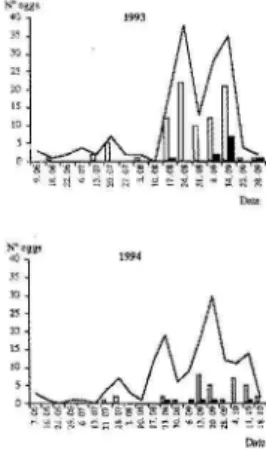
Figures 1 and 2 respectively represent the number of C Chaleites and A. gamma
eggs weekly found on 600 tornato leaves, and the egg parasitism by Telenomus sp. and T.
cordubensis. lt should be stressed that the tirst C Chalcites and A. gamma eggs were
parasitized by Telenomus. The earlier appearancc in the summer season of the genus
Telenomus in tomato fields as also been observed by MEIRROSE et ai. (1991) and in other
ecosystems by GARCIA et aI. (1995). Also during the host' s peak populations this species was an important biological control agent, achieving a parasitis111 rate of 55% for A. gamma and 46% for C chaleites eggs, during lhe period between 17 August and 22 September 1993.
CONCLUSIONS
The results of the present study show that T cordubensis and Telenomus sp. can be used on biological control progranls against A, gallllllo anel C. chalcites on azorean tomato
180 Boletim do Museu Municipal do Funchal (História Natural) Sup.no.5
fields. Telenomus sp. seems to be a very promising biocontrol agent against these pests, due to
the high rates ofnatural egg parasitism that were achieved during the summer season. However, further research on mass production and releasing techniques of this parasitoid need to be
performed, in order to fully assess the potential of Telenomus sp. as a biocontrol agent.
Fig. 1 - Number of C. chalcites eggs weekly collected (-) and their parasitism by Telenomus sp. ( O ) and T. cordubensis (.), during the summer seasons of 1993 and 1994.
1993
"I.~·
~o " w , c '8:B:BBbr::;'!!l'!lZ~'8$S8S "" ~ ~ ,f 'ti &i f< oi ;::j ,: i :; '" ;:t .: p,Fig. 2 - Number of A. gamma eggs weekly collected (-) and their parasitism by Telenomus sp. (O) and T. cordubensis (I), during the summer seaSOI1S of 1993 ànd 1994.
ACKNOWLEDGEMENTS
Financial support for this work was provided by the Universidade dos Açores, Fundação Luso-Americana para o Desenvolvimento and Secretaria Regional de Agricultura e Pescas.
REFERENCES
BAI, S., R.F. LUCK, L. FORSTER, S. STEPHENS & .I.A.M. JANSSEN:
1992. The effect of host size on quality attributes ofthe egg parasitoid, Trichogramma pretiosum. Entomologia Experimentalis et Applicata, 64: 37-48.
GARCIA, P., L. OLIVEIRA & J. TA VARES:
1995. Trichogramma cordubensis (Hym., Trichogr,unmatidae): a dynamics study of an azorean population. Les colloques de L 'lNRA, 73: 189-192.
LI-VING, L.:
1994. Worldwide use ofTrichogramma for biologícal control on different crops: A survey, 37-53pp. ln: WAJNSERG E. & S. A. HASSAN (Eds.), Biological control with egg parasiloids, 286pp. CAS International, Wallingford, UK.
MEIERROSE, C., I. SILVA & J. ARAUJO:
1991. Egg parasitoids from He/iothi.s armigera on tomato in Southem Portugal. I. Fields studies with naturally occurring Trichogramma sp. and Telenomus sp. Les colloques de L 'lNRA, 56: 221-226.
PINTUREAU, 6., L. OLIVEIRA & L. ANUNCIADA:
1991. Contribution to the study of the egg parasitíc hyl11enoptera of the Azores isIands. Les colloques de L 'INRA, 56: 115-118.
SCHMIDT, J.M.:
1994. Host recognition and acceptance by Trichogramma, 165-217pp. ln: W AJNSERG E. & S. A. HASSAN (Eds.), Biological conlrol wilh eggparasitoíds, 286pp. CAS International, Wallingford, UK.