Children Toy’s Brands:
The effect of nostalgia
appeals on purchase
likelihood and gift giving.
Francisca Pereira Martins
152117295
Dissertation written under the supervision of João Pedro Niza Braga
Acknowledgements
First, I would like to thank Professor João Pedro Niza Braga for doing an amazing job as my supervisor. His guidance, feedback and encouragement were essential to the accomplishment of this master thesis.
A huge and special thanks to my parents, Oscar Martins and Ana Cristina Martins, for giving me the best any son or daughter can ask for. Thank you for all the time, effort and resources you invested in me and in my education. Speaking about family, I would also like to thank my brother, Pedro Martins, for always encouraging me. I am truly grateful for all the unconditional love and support my parents and my brother gave me throughout my entire life.
To all the professors who, during my academic years, taught me so many different things from different perspectives and motivated me to pursue my goals.
To all my friends who always backed me up with a lot of fun and caring moments, making this last months less stressful.
Last but not the least, I would like to give a special thanks my boyfriend, Pedro Campos, whose hard work and motivation inspired me to be better. Thank you for being there for me in every moment, for always making me laugh, but also, for all the great feedback and help you gave me during this journey and for so many years.
Abstract
Title: Children Toy’s Brands: The effects of nostalgia appeals on purchase preference and gift
giving.
Author: Francisca Pereira Martins
Keywords: nostalgia; social distance; toys; children; preference; consumer behaviour.
Nostalgia is defined as an intense affective emotion based on a deep feeling of discontinuity regarding a specific period of one’s past. In marketing context, the evocation of such emotion was proven by several authors to increase purchase intensions, loyalty and shape brand preference when people are choosing a product for their own. The present dissertation aims to assess if the same favourable pattern of attitudes towards brands arise when the nostalgia appeals regard children toys’ brands. Considering that in this market there are, often, two decision making agents (as the buyers are not the actual users of the toys) we further propose that the nostalgia marketing research and its effects on consumers can be extended to gift-giving, mediated by a lower social distance regarding the toy’s receiver.
The findings made through this study’s results support the proposed theoretical framework. We can observe a reinforcement in the attitudes, loyalty, purchase likelihood and choice towards nostalgic toys, when the individuals are, both, stimulated by nostalgia appeals and assigned the mission to purchase a gift to their offspring. Contrarily, when participants are encouraged to focus their thoughts on the present and should offer a toy to their co-workers’ child our results indicate a slope of the previous variables to the most recent toy.
Sumário
Título: Marcas de brinquedos infantis: Os efeitos dos apelos à nostalgia na probabilidade de
compra e na oferta de presentes.
Autor: Francisca Pereira Martins
Palavras-Chave: nostalgia; distância social; brinquedos; crianças; preferência;
comportamento do consumidor
A nostalgia é definida como uma emoção intensa de caracter afetivo baseada num sentimento de descontinuidade relativamente a um período passado. No contexto do marketing, vários autores têm provado que a evocação de tal emoção modela preferências, aumenta as intenções de compra e a fidelidade quando os indivíduos tencionam escolher um produto para si mesmos. A presente dissertação propõe-se a verificar se o mesmo padrão favorável de atitudes acontece quando são feitos apelos à nostalgia em marcas de brinquedos infantis. Considerando que neste mercado existem, muitas vezes, dois agentes de tomada de decisão (pois os compradores não são os utilizadores finais do brinquedo) propomos, ainda, que os efeitos da nostalgia no marketing podem ser observados no caso da oferta de presentes, quando mediados por uma menor distância social em relação ao recetor do brinquedo.
As conclusões retiradas da análise dos resultados suportam a estrutura teórica proposta. Podemos observar um reforço nas atitudes, fidelidade, probabilidade de compra e escolha relativamente a brinquedos nostálgicos, quando os indivíduos são estimulados a sentirem-se nostálgicos e devem oferecer um presente aos seus filhos. Pelo contrário, quando os participantes são incentivados a focarem os seus pensamentos no presente e devem oferecer um brinquedo ao filho de um colega de trabalho, os resultados indicam uma inclinação das variáveis anteriores para o brinquedo recente.
Table of Contents
1.Introduction ... 8
2.Literature Review ... 11
2.1 Hedonic Consumption... 11
2.2 Nostalgia and Memory ... 13
2.2.1 Identity, Self-Continuity and Extension of the Self ... 15
2.3 Gift Giving and Social Distance ... 18
2.4 Brand Preference and Loyalty ... 19
2.5 Overview ... 20 3. Methodology ... 22 3.1 Study Purposes ... 22 3.2 Participants ... 23 3.3 Materials ... 24 3.3.1 Independent variables ... 24 3.3.2 Experimental stimuli... 25 3.3.3 Dependent Variables... 26 3.4 Procedure ... 28 3.5 Design ... 29 4. Results ... 30 4.1 Sample ... 30 4.2 Results ... 30
4.2.1 Nostalgia Manipulation Check ... 30
4.2.2 Social Distance Manipulation Check ... 31
4.2.3 Attitudes and Quality ... 31
4.2.4 Purchase Likelihood ... 35
4.2.5 Choice ... 39
4.2.6 Brand Loyalty ... 41
4.2.7 Social Distance and the awareness of preferences ... 43
4.2.8 Results Overview ... 43
5. Main Conclusions and Future Research ... 45
5.1 Main Findings and Conclusion ... 45
5.2 Managerial/Academic Implications ... 47
5.3 Limitations and Future Research ... 48
Table of Tables
Table 1: ANOVA Descriptives “Attitudes”: Product Type ... 32
Table 2: ANOVA Descriptives “Attitudes”: Offspring with Product Type ... 32
Table 3: ANOVA Descriptives “Attitudes”: Nostalgia with Product Type ... 32
Table 4: ANOVA Descriptives “Quality”: Product Type ... 34
Table 5: ANOVA Descriptives “Quality”: Nostalgia with Product Type ... 35
Table 6: ANOVA Descriptives “Purchase Likelihood”: Product Type ... 35
Table 7: ANOVA Descriptives “Purchase Likelihood”: Nostalgia Conditions ... 36
Table 8: ANOVA Descriptives “Purchase Likelihood”: Offspring Conditions ... 36
Table 9: ANOVA Descriptives “Quality”: Nostalgia and Offspring Conditions ... 36
Table 10: ANOVA Descriptives “Quality”: Nostalgia Conditions with Product Type ... 37
Table 11: ANOVA Descriptives “Quality”: Offspring Conditions with Product Type ... 37
Table 12: ANOVA Descriptives “Choice”: Nostalgia Conditions ... 39
Table 13: ANOVA Descriptives “Choice”: Offspring Conditions ... 40
Table 14: ANOVA Descriptives “Loyalty”: Product Type ... 42
Table 15: ANOVA Descriptives “Loyalty”: Offspring Conditions with Product Type ... 42
Table 16: Hypothesis and results overview ... 44
Table 17: Study Sample: Attributed condition ... 70
Table 18: Study Sample: Gender ... 70
Table 20: Study Sample: Parental Condition ... 71
Table 21: Study Sample: Nationality ... 71
Table 22: Study Sample: Native Language ... 71
Table 23: Study Sample: Choice between Pokémon and Yo-Kai Watch ... 71
Table 24: Study Sample: Choice between Polly Pocket and Frozen ... 72
Table 25: Study Sample: Choice between Where’s Waldo and Despicable Me ... 72
Table 26: Paired Samples t-test of attitudes towards playing time ... 72
Table 27: ANOVA: Attitudes towards brands ... 73
Table 28: ANOVA: Attitudes towards brands ... 73
Table 29: ANOVA Descriptives “Attitudes”: Nostalgia and Offspring conditions with Product Type ... 74
Table 30: T-tests of attitudes towards brands depending on nostalgia conditions ... 74
Table 31: ANOVA: Brand’s perceived quality ... 75
Table 32: ANOVA: Brand’s perceived quality ... 76
Table 33: T-tests of brands’ perceived quality depending on nostalgia conditions ... 76
Table 35: ANOVA: Brand’s purchase likelihood ... 78
Table 36: ANOVA Descriptives “Purchase Likelihood”: Nostalgia and Offspring conditions with Product Type ... 78
Table 37: Paired Samples t-test of offspring condition with present condition regarding purchase likelihood ... 79
Table 38: Paired Samples t-test of not offspring condition with nostalgia condition regarding purchase likelihood ... 79
Table 39: ANOVA: Attitudes towards brands ... 80
Table 40: ANOVA Descriptives “Choice”: Nostalgia and Offspring Conditions ... 80
Table 41: T-tests of choice depending on nostalgia conditions when in offspring condition .. 80
Table 42: T-tests of choice depending on nostalgia conditions when in not offspring condition ... 81
Table 43: Correlations between Purchase Likelihood of the nostalgic toy, Purchase Likelihood of the recent toy, Choice and averaged Social Distance Manipulation Check. ... 82
Table 45: ANOVA: Loyalty towards brands ... 83
Table 47: Paired Samples t-test of nostalgia condition regarding loyalty ... 83
Table 48: Oneway ANOVA Social Distance and Offspring conditions ... 84
Table 49: T-tests of nostalgia distance manipulation check ... 84
Table 50: T-tests of self-continuity ... 85
1.Introduction
Do you know that bittersweet feeling of nostalgia? Don’t you find yourself sometimes missing those special moments of your childhood and adolescence? Remembering the aroma of a loved one’s meal? Or even feeling the smell of that perfume which instantly makes you travel back to an era that has passed? The following dissertation addresses nostalgic stimulus to marketing appeals in a specific market.
Marketing has been progressively evolving over the past years to focus on the consumers and the satisfaction of their needs. If once it was only centred on the main activity of selling products – mass marketing – this prospect quickly became insufficient in an evolving world (Petruzzellis, 2010). Consequently, we have witnessed an evolution on the consumers’ behaviours and attitudes towards products and services, which aroused an urge to adapt markets to meet the customers’ demands and expectations. Moreover, researchers enlightened that consumers often feel the motivation to seek for brands that incite and fulfil them through their senses and emotions (Holbrook & Hirschman, 1982). However, consumers’ perceptions are not always straightforward. Why do we choose a specific brand? Why do we feel more attached to some products? There are many psychological effects and heuristics that influence customers’ judgement about brands and can modify (in the buyers’ minds) the actual preference for one product over another (Gigerenzer and Gaissmaier, 2011).
Nostalgia is a psychological condition defined as an intense affective emotion based on a deep yearning for the past (Holbrook and Schindler, 1991). In all respects, many researchers proved that it can shape enduring brand preferences, change purchasing behaviours and increase loyalty for the most diverse product categories- as sunscreen, fragrances, toothbrush, pop music and movies (Ju et al., 2016; Muehling et al., 2014; Holbrook and Schindler, 1989; 1996). Individuals consume in a way that is consistent with their perceived self-identity which is connected to their sense of self-continuity regarding the past through the present time (Sedikides et al., 2015). In fact, nostalgia has been used by several brands in their strategies to awaken the consumers’ desire to appease the crave for the past through the purchase of past themed products (Schultz, 2012). But does it work for all product categories? Will it work, for instance, in children toys’ brands? More specifically, is the nostalgia stimuli successful when we are not choosing a product for ourselves but for others?
The truth is that the market of children toys has the peculiarity of, in most of the times, the products’ buyer is not the actual user. Accordingly, it can be considered as extremely challenging and hard to thrive in two key aspects (Guber e Berry, 1993). First, products need to please both parents and children. A product that is extremely appealing to children but does not meet parents’ criteria will not succeed, as the adult is the one with the purchasing power. On the other hand, even if the product meets the desires of the two parties, for a child a product that today is a great success, tomorrow may no longer be and simply vanish (Ji, 2002). As an extremely volatile market, it is difficult to create the long-lasting loyalty that guarantees dedicated consumers. If some brands have done an outstanding job in this regard, others miserably failed (Guber e Berry, 1993). Therefore, we propose nostalgia marketing as a strategy to strengthen parents’ attitudes and loyalty behaviours towards toy brands.
The meanings people attribute to their fondest possessions have been considered by researchers as a consequence of the inclusion of the object into one’s identity, by a process of self-extension. The way individuals act regarding what they perceive to be theirs is very similar to how they act about their selves (Belk, 1988). However, the concept of possessions is not limited to physical objects but can regard, for instance, places or other people. In fact, our children are often seen as extensions of ourselves, with whom we often blend our identity and preferences (Aron, Mashek and Aron’s, 2004; Aron et al., 1991). In the present study it is proposed that under a nostalgic condition, adults buying a toy to their children will have a purchase behaviour (towards nostalgic toys) which is very similar to the one they have when buying for themselves. We support that the actual social distance to the children is fundamental to the nostalgic purchase of a toy as this notion has been proven to be a key component in gift giving (Goodman and Lim, 2018). When choosing a gift to someone, people tend to be afraid of the social consequence of poorly matching the receivers’ preferences (Hoyer, MacInnis, and Pieters 2012). As people do not feel confident in predicting the preferences of individuals who are more socially distant, they often prefer to purchase the most secure option (for instance, material gifts). Contrarily, when offering to close others (that is, lower social distant people), as individuals perceive to have a greater knowledge of their tastes (even though most of the times blending the receiver’s preferences with their personal preferences), they’ll purchase gifts that are felt as more unique (Goodman and Lim, 2018).
Therefore, it is hypothesized that these stimuli of nostalgia will increase the purchase preference of nostalgic brands (such as Pokémon, Polly Pocket and Where’s Waldo), when the toys’ receiver is a child with whom the adult has a smaller social distance, such as their offspring. On the other hand, when the child is more socially distant, the adult will prefer to purchase a safe option, as the most recent or popular toy.
2.Literature Review
In the literature review, it was conducted an analysis of the available up to date literature and academical articles that we considered relevant to address the topic we proposed to study. In order to present the theoretical framework in a structured way, we divided the analysis into four main sub topics: hedonic consumption; nostalgia and memory; gift giving and social distance; brand preference and loyalty.
2.1 Hedonic Consumption
Throughout the years, managers and researchers focused one-dimensionally in the attitudes towards products and brands by taking an information processing approach to the matter. This premise defined consumers as logical thinkers when making a purchase decision (Ross & Bettman, 1979; Voss, Spangenberg, & Grohmann, 2003). However, the predominance of such perspective led the marketing researchers to neglect some important consumption phenomena as human attitudes cannot be considered static but multidimensional and complex (Holbrook & Hirschman, 1982; Voss, Spangenberg, & Grohmann, 2003). Also, due to the similarities across products, resultant of the technological advances, consumers found it increasingly hard to discriminate between brands only by its functional attributes (Petruzzellis, 2010). Proportionally, consumers felt the motivation to rather seek for brands that either arouse and fulfil them emotionally or in a sensorial manner (Holbrook & Hirschman, 1982; Ebrahim et al., 2016)
This change in the paradigm of attitudes towards goods required the incorporation of an experiential view of consumption, which involves the most diverse intangible symbolic meanings and subjective aspects, into the traditional functional approach (Holbrook & Hirschman, 1982; Voss, Spangenberg, & Grohmann, 2003). As a result, two distinct dimensions regarding consumption emerged. The first one, a conventional utilitarian dimension, is mainly focused in the actual functionality of the product as an instrumental way to accomplish a practical task (Strahilevitz & Myers, 1998; Voss, Spangenberg, & Grohmann, 2003). The second one, characterized as hedonic, defines the product’s usage as a result of a sensory and affective experience, that involves feelings, fun and fantasies. (Holbrook & Hirschman, 1982)
In the panorama of hedonic consumption, consumers do not consider products as merely objects but rather as symbols that trigger an emotive response in behalf of the meaning that either can be rooted in product itself or deep inside customer’s consciousness (Osgood, 1952). Hedonic products are usually perceived as more enjoyable and pleasant, contrarily utilitarian products are perceived as functional and necessary. However, even though there is consensus in consumer research regarding the validity of this distinction, the actual application is not always that straightforward (Alba & Williams, 2013). While in some occasions this symbolic substance is outstandingly evident, for instance in experiences (such as entertainment and leisure activities) the most mundane product can carry meaningful important cues for oneself, and vice versa (Holbrook & Hirschman, 1982). A primarily utilitarian product can also be hedonic, for instance when a detergent is bought for its scent rather than its cleaning ability (Chaker, 2011), and a hedonic product, such as chocolate, can be utilitarian as well if it is used for cardio-vascular purposes (Linden, 2011).
The decision of purchasing hedonic products or experiences is considered to be profoundly associated to the multisensory and emotive facets of the consumers’ personal experience with a good, as well as their expectations regarding future enjoyment based on present feelings (Holbrook & Hirschman, 1982; Alba & Williams, 2013). The multisensory facet of consumption is related with the external stimulus experienced by the five senses that are encoded into internal multisensory images which afterwards form consumer responses. Those images can be either historic, when consumers recall episodes that occurred in the past (the scent of a perfume might evoke a past episode with someone wearing that perfume), or fantasy, when a past episode is used as a baseline to draw an imaginary scenario (Berlyne 1971; Holbrook & Hirschman, 1982). The emotional arousal is, also, often involved in consumer’s response when facing hedonic consumption. An emotive response will generate altered psychological and physiological conditions that will influence the motivation of consuming and the actual involvement with products and experiences (Holbrook & Hirschman, 1982).
However, there is a key element of the hedonic consumption that can manage to better define the barrier between hedonic and utilitarian consumption. Every hedonic experience has its ultimate goal on the pleasure (either expected or present) that derives from it, regardless of serving a utilitarian purpose or not. As a universal key to decode hedonic experiences, memorable pleasure can be divided into two separate categories: the products and services by themselves and one’s personal judgements and involvement with them (Alba & Williams,
2013). This conceptual distinction in pleasure is supported by the four types of pleasure regarding goods proposed by Jordan, 2000, whose definition might provide a deeper understanding of pleasures’ main sources. Physio-pleasures are related with the external stimulus from the senses; the psycho-pleasures are originated in the consumers’ psychological (either emotional or cognitive) perceptions that arise from the products’ usage; ideo-pleasures are linked to the personal meanings and values attributed to a product; and the socio-pleasures are related to the customers’ interpersonal relationships with groups and peers (Jordan, 2000). These determinants influence the way people pursue and perceive pleasure, while increasing the likelihood of certain conditions to be perceived as more pleasurable. For instance, past hedonic meaningful experiences often serve as psychological clues that shape consumer preferences. People take pleasure from their most affectionate memories and nostalgia in a way that those recollections tend to inform decisions in a more affective basis and less cognitive. This will positively reinforce the individuals' attitudes and product evaluation (Alba & Williams, 2013).
2.2 Nostalgia and Memory
As an intense personal experience, nostalgia has been proven to produce preferences for goods and experiences that generate nostalgic responses. As so, this concept has increasingly been receiving much attention of researchers (Holak and Havlena 1998; Baker and Kennedy, 1994).
Nostalgia has been consistently defined as an affective state or emotion, which is strongly infused by feelings such as joy, happiness and love, triggered by our own thoughts regarding a meaningful past (Muehling et al., 2014). In 1991, Holbrook and Schindler introduced nostalgia as time-dated preference which is deeply rooted in strong affective past experiences. This definition considers nostalgia as a favourable attitude towards situations, people, places or possessions that were common in a younger age but that nowadays are not widely accessible.
From a memory-based perspective, one’s unique personal associations to particular prior brand experiences are stored in our long-term memory (and available for late recalling) which facilitates a nostalgic response in the future (Braun, 1999; Holak and Havelena, 1998). The former fond involvement with a certain product will tend to be transformed into enduring preferences which retrieval will be manifested in the consumers’ minds as a positive nostalgic
longer available intense affective experience, especially during a critical period of preference formation, is considered among the nostalgia researchers to be essential to the development of nostalgic consumer preferences (Holbrook & Schindler, 2003; Braun-LaTour, 2007). In fact, inducing childhood memories has been proven to be contributory to the trigger of emotional states which influence favourably brand attitudes and purchase intensions. (Muehling et al., 2014; Moore and Homer, 2008). For instance, several authors have provided evidences that nostalgic appeals in advertising result in an increase of purchasing intensions and brand preference, as those appeals are found to be adequate in prompting nostalgic thoughts. (Muehling et al., 2014; Muehling and Pascal 2011; Pascal, Sprott, and Muehling 2002). Furthermore, some brands such as Coca-Cola, McDonald’s or Unilever have occasionally used nostalgic themed marketing strategies in order to intensify consumer-brand relationship and elicit purchase (Schultz, 2012; White, 2002). Other brands have pushed those nostalgic appeals further by introducing new products that directly evoke consumers’ fond past memories, such as the new Beetle, or by reintroducing, for instance, popular children’s toys as the G. I. Joe or the Teenage Mutant Ninja Turtles (Holbrook and Schindler, 2003; Gibney, 1999; Bhatia, 2001).
Recurrently researches adopt manipulations of nostalgia through several stimuli that evoke this feeling. In their studies, the participants are separated into two distinctive conditions: a nostalgic condition, in which the individuals are aroused to feel nostalgic; and a present focused condition, which appeals the participants to focus their thoughts in the present time of their lives. In fact, the effects of nostalgia in consumer attitudes and preferences towards brands has been consistently evident in numerous studies regarding many product categories - as sunscreen, fragrances, toothbrush, pop music and movies (Ju et al., 2016; Muehling et al., 2014; Holbrook and Schindler, 1989; 1996). Therefore, we anticipate that the same phenomenon of brand preference will occur when, under the same circumstances, the product type is children's toys. Given that playing with toys can be considered as a hedonic consumption experience, we propose that it can be extremely affective. Thus, the choice of this type of products can be based on the existence of strong affective consumptions experiences in a period of preference development.
H1: In a nostalgic condition, adult consumers will prefer brands that were popular during their
childhood.
Holbrook and Schindler in 2003 suggested some principles for the strength and time period of such affective consumption. The authors defined that age and gender of consumers and the product type in conjunction with both biological and environmental mechanisms, are determinants for those sources of affective consumption. The biological mechanisms will depend on the consumers’ age and gender as it will impact the emotional energy available. Furthermore, the perspectives regarding some product types will be influenced by the differences in one’s innate capacity to stimuli response, which in turn is deeply connect to specific phases of development. Also, the environment in which each one of us is involved and its respective forces of influence (such as culture, reference groups and peers) will drive individuals of specific ages and gender to be more exposed and keener on some particular product types or brands, rather than others. In fact, nostalgic experiences often include significant others as a key component (Wildschut et al. 2006). The choice of the toys presented in this study was made according to these criteria.
Even though most of the researches have been based on external evocation of nostalgia, one should not ignore the capacity of a brand to elicit a nostalgic response by itself. Thus, a nostalgic brand can arouse nostalgic feelings and enhance the effects of nostalgic stimulus such as advertising (Loveland, Smeesters, and Mandel 2010).
2.2.1 Identity, Self-Continuity and Extension of the Self
Nostalgia is profoundly connected with our sense of self being. Recalling meaningful moments of a past era often elicits uncomfortable feelings of discontinuity between our present and past (Braun-LaTour, 2007). Nostalgia operates as a mean to counteract these negative emotions by generating idealized reflections of past events which are translated into positive toned narratives fulfilled with great affectivity (Wildschut et al., 2006; Muehling et al., 2014). In fact, nostalgia has been proven to have several positive psychological effects. According to the research made by Sedikis et al., 2015, nostalgia as a self-conscious social emotion serves our brain with three main functions: a self-oriented function as it fosters positivity regarding one’s self and the future; an existential function since it increases the perception of a meaningful life; and a sociality function by rising social contractedness. Also, nostalgia showed positive effects in reducing loneliness and existential threats while increasing self-esteem (Wildschut et al., 2006). Hence, by putting together pieces of past experiences through the glasses of nostalgia,
In the marketing research context, self-continuity has been demonstrated to mediate nostalgia and attitudes towards brands plus purchase intension (Ju et al., 2016). People consume products and services as a mean to express their self in a way that is consistent with their perceived self-identity. The eagerness to revisit certain period of the past and recreate it in the present time, drives people to call upon symbolic representations of their former possessions. Thus, people purchase nostalgic goods in order to preserve their past through a facilitated sense of self-continuity with that past time. As so, consuming nostalgic products is more than an emotional experience, it promotes self-continuity and congruency regarding the past (Ju et al., 2016; Sedikides et al., 2015). By reliving and even reassembling a past experience, consumer nostalgia fulfils the individual needs of self-idealization, self-affirmation and self-actualization by extending the self. (Stern, 1992). Consequently, these nostalgic responses bolsters individuals to create, maintain and understand their identities (Wildschut et al., 2006; Brown and Humphreys, 2002).
Possessions have been considered instrumental in human and self-concept development. In an early stage the childhood, children learn to distinguish their self from their closest environment with the aid of objects – for example, the “security blanket” serves as an object that represents the mother (Furby and Wilke, 1982). Following, infants start to clearly distinguish their selves from others when their interactions with their peers starts to involve conflicts regarding sharing or giving objects that they consider theirs (Furby, 1980). Later, they start to develop a sense of personal identity, and throughout adolescence and adulthood, individuals use possessions as an anchor to manage their identities – supporting the importance of goods in self-definition as the perceptions of having, doing and being are all related (Snyder, 1972; Rochberg-Halton, 1984). Into an older age, objects help individuals to feel continuity through their whole lives while assuring that their selves will be extend beyond their deaths. Moreover, possessions often are seen as means of storing memories and feelings of the past by making tangible certain events that are intangible – for instance travel experience souvenirs (Belk, 1988).
In 1988, Berk pointed to several authors who have defined that the special meanings granted by individuals to their possessions are related with an extension of the self. The concept of extended self includes not merely what people see as “me” (the self by definition), but also what they perceive to be “mine”. As a matter of fact, the way individuals act and feel regarding certain things that are considered as their property (as the fondest objects, children or even work of hands) is very similar to how people act and feel about their selves. For instance, when we
are faced with an unintended loss of an object (especially when we connected it with our sense of identity), we experience anger and somehow vulnerability, just as if we have lessened ourselves. Moreover, both Rosenblatt, Walsh, and Jackson, 1976 and McLeod, 1984 suggested that the process of losing a good (whether stolen or as a result of natural catastrophes) follows a feeling of mourning similar to losing someone we love or that was a part of our lives. It means that by stating that something is “mine”, individuals automatically (aware or unaware of it) consider their possessions as a part of their selves.
Sartre, 1943 defined three ways in which possessions can be intentionally incorporated in individuals as extensions of the self. A first way is by appropriating or controlling an object for personal use, just as individuals control their own legs or arms. Hence, when people exercise power, are in control, conquer or master either a tangible or intangible possession, the more they will feel bounded with it. Another way of including a possession into the self is by creating it. The concept of creating an object is not only limited to the manufacture with our “bare hands”, but buying an object can, also, be considered a way of creating, considering that purchasing power also supports the perception of self. Finally, a third way of extending a self is by knowing our possessions. This approach is supported by the notion that the extended self is not limited to physical external and personal objects but can also regard places and other people.
The inclusion of the self into others’ is, indeed, a relationship-specific schema recurrent in several families. This phenomenon was approached in Aron, Mashek and Aron’s, 2004 self-expansion model. The model defined that people often feel an urge to expand their perceived self by constructing and maintaining close relationships with others. Thus, individuals include into their selves some of the relevant others’ shared worldview, resources (particularly knowledge, materials goods and mutually owned social assets) and identities (depending on the magnitude in which both persons consider themselves as one) (Ledbetter et al., 2010). Individuals encode and decode information regarding close others in the same way they do about their selves (Ledbetter & Beck, 2014). Thus, the actual social comparison processes between subjects becomes similar to self-comparison processes, as the comparison target is recognized as an important part of the individuals’ (who considers the other as an integral part of their selves) identity (Aron, Mashek and Aron’s, 2004). For instance, Hirt and his colleagues’
victories are perceived essentially as personal failures or victories. Collins (1996) pointed as well to the perceived ownership of a close target outcomes, when speaking about the rise or fall of ones’ feelings of self-relevancy with the wins or losses of a sibling playing in a tennis competition (McFarland et al., 2001). Agnew et al., 1998 showed that individuals who relationship with parents presents a higher inclusion of the other in the self are more probable to have the same religious and political believes as the parents do. Finally, Lifton in 1973 noticed that children and grandchildren are the closest to immortality that any individual can get, being a living offspring a strongly desired extension of the self (Belk, 1988).
2.3 Gift Giving and Social Distance
Sartre (1943) considered gift giving (to others) as a mean to extend the self since it is intrinsically a practice of control. A gift pretrains to be associated with the giver in order that their identity is extended into the receiver. The author also suggests that gifts are frequently regarded as favourite possessions because are generally received from loved ones which makes this extension of the self to be often accepted as positive. Gift giving reinforces the expression of the giver’s self-concept into the objectified form of a gift (Belk, 1979).
Choosing the right offering might seem to be complex, given the conflicting task of selecting a good that reflects the givers’ identity while being accurate regarding the recipients’ preferences and both subjects’ interpersonal relationship. However, the literature has proven that, most of the times, the giver’s identity plays a dominant force in gift purchase (Ward and Broniarczyk, 2011). Thus, when selecting an offering to a close other, people usually tend to blend their knowledge of the grantees with information regarding their selves, mixing up the others’ preferences with their own personal tastes (Aron et al., 1991). As long as the giver considers the receiver a part of their extended self, gift giving is a strongly self-gratifying activity but, when it is not, gift giving is just a matter of reciprocity (Belk, 1988)
As a social exchange between two parties, offering something is associated with the social risk of not matching the recipient’s preferences. Individuals feel that poorly matching the receiver’s preferences will have as a consequence a possible harm to one’s social standing and relationship (Hoyer, MacInnis, and Pieters 2012). This risk moderates the fact that people often prefer to give material gifts to others, which are felt to be a more secure option, rather than experiential gifts, as its uniqueness require a more specific knowledge of the receivers’ actual personal
preferences (Goodman and Lim, 2018). Several authors have suggested that the extent to which a person has a greater knowledge of others’ preferences is related with the social distance between both subjects (e.g. Chan and Mogilner 2017 and Ward and Broaniarczyk, 2011). According with previous literature regarding interpersonal relationships, social distance is defined as a degree of interpersonal closeness that concerns the interactions between two individuals (Goodman and Lim, 2018). These frequent, strong and diverse interactions will get people to better know and understand each other. In this context, Goodman and Lim, 2018 suggested that social distance acts as a key component in gift exchanging. In fact, the authors provided evidences through their research that the more socially close individuals are to the recipients, the more confident they feel regarding their accuracy in predicting the receivers’ preferences. Therefore, the more willing the individuals will be to offer experiences rather than material gifts.
Considering the selected literature regarding nostalgia, extended self and gift giving, we propose that the same effect of social distance approached by Goodman and Lim (2018) will occur when the individuals face a purchasing choice of a nostalgic gift vs a non-nostalgic gift. In the context of the present study, individuals will face the choice of purchasing a nostalgic toy or a currently popular toy for either their offspring (lower social distance) or a co-worker’s children (higher social distance). As so, we formulated the following hypothesis:
H3. Individuals will feel more confident in predicting their offspring’s preferences.
H4. In a nostalgic condition, consumers’ will prefer to purchase nostalgic gifts for lower
socially distant children (their offspring).
H5. Both in a nostalgic condition and a non-nostalgic condition, individuals will prefer to buy
the currently popular toy for higher socially distant children (their co-worker’s children).
2.4 Brand Preference and Loyalty
The experiential facet of marketing has been defined as an essential key component to enhance consumer preferences towards brands and the fomentation of future purchase decisions (Schmitt, 2009). Brand preference as a behavioural tendency regarding the customers’ attitudes towards a brand, can be linked to the concept of brand attachment (Ebrahim et al., 2016). When a consumer feels emotionally attached to a brand, their attitudes towards that brand will likely
strong attachments (Thomson, MacInnis, and Whan Park, 2005). In this context, experiences play an important role as a source of consumer preferences. As the memories of experiences often contain more vivid and concrete information, the consumers rely on these inputs as trusted sources of information to support their choices and judgments (Schwarz, 2004). Also, memorable and meaningful experiences usually have a hedonic nature. Certainly, when an item meets or surpasses the utilitarian criteria, the consumers encounter satisfaction, however when an item meets or surpasses the hedonic criteria, consumers feel excitement and delight, are more disposed to participate in positive word of mouth, keep the item for longer periods and turn out to be more loyal (Dhar and Wertenbroch, 2000; Chitturi, Raghunathan, & Mahajan, 2008).
Brand loyalty has been defined as a general propensity of a commitment to a brand. Chaudhuri and Holbrook in 2001 proposed that the concept of brand loyalty regards both purchase and attitudinal loyalty, which are influenced by brand trust and brand affect. The authors defined purchase loyalty as a willingness to repurchase a determined brand and attitudinal loyalty as an extended commitment towards a brand that results, for instance, in a higher willingness to pay. Therefore, we hypothesize that:
H6. In a nostalgic condition, consumers will be more loyal to the nostalgic brand
2.5 Overview
Nostalgia has been coherently proven to increase the preference, the perceived attributes, the consumers’ attitudes and promote loyalty behaviours towards nostalgic products (Ju et al., 2016; Muehling et al., 2014; Holbrook and Schindler, 1989; 1996). Therefore, we anticipate that the same phenomena should be, also, observed for toys (H1, H2 and H6). However, as toys are not usually bought for oneself but for others (children) it would be alsoimportant to explore whether nostalgia affects preferences for this kind of consumer decisions for others.
Nonetheless, as nostalgia is an emotion associated to the self and one’s identity (Ju et al., 2016; Sedikides et al., 2015; Wildschut et al., 2006; Brown and Humphreys, 2002), social distance is hypothesized to be an important moderator of the effects of nostalgia on consumer decisions for others. There are several ways in which individuals extend their self-identity through their possessions which can regard their fondest objects, but also, places and people (Belk, 1988; Satre, 1943). Therefore, the inclusion of the self into others’ is a relationship schema recurrent specially to close others. Often, individuals care the information regarding close others in the
same way they do about their selves. Consequently, people start to blend the other resources, preferences and identity with theirs (Aron, Mashek and Aron’s, 2004). In fact, it was found that individuals feel more confident in predicting close others’ preferences, even if those are mixed up with theirs (Chan and Mogilner 2017; Ward and Broaniarczyk, 2011) (H3), such that, reduced social distance towards the receiver of the gift should increase the preference for the nostalgic toy (H4). On the other hand, when choosing a gift to a higher social distant person, individuals will fear the social harm of poorly matching the receiver’s preference (Hoyer, MacInnis, and Pieters 2012). Thus, they will prefer to select the most secure gift option (Goodman and Lim, 2018) as for instance the most recent and popular toy (H5).
3. Methodology
3.1 Study Purposes
The main purpose of this data collection process was to assess if evoking nostalgic feelings influences the preference of adults when buying toys for children. Furthermore, this study aims to analyse if that influence is reinforced when there is a smaller social distance from the toy’s receiver, namely when the child is the adult’s offspring.
We have chosen three nostalgic brands which, by their popularity at the time, were recurrent to the generations of adults who are nowadays between 19 and 35 years old — Pokémon, Polly Pocket, Where’s Waldo. All the three brands have two particularities in common. First, all provide either toys or other means of merchandising which stimulated the senses. For instance, Pokémon appeared as an animated cartoon (sight and sound), Polly Pocket created little interactive scenarios for children to play with the dolls (touch, sight and sometimes smell) and Where’s Waldo primarily sold books with colourful full-page illustrations (sight and touch) and later animated cartoons. The individuals could have experienced the offerings of the chosen brands either alone, with friends, siblings or parents. Both Pokémon and Polly Pocket were, at the time, somehow gender specific. It means that most of the male sample will probably have less affection or nostalgic memories with Polly Pocket when comparing with women and vice versa in the case of Pokémon. Where’s Waldo was chosen in order to neutralize potential gender effects on nostalgia.
The participants were randomly exposed to one condition of nostalgia (nostalgia vs present focused) and one condition of social distance (offspring vs not offspring). Afterwards, we displayed three pairs of toys – an old toy and a new one (Pokémon and Yo-Kai Watch; Polly Pocket and Frozen; Where’s Waldo and Despicable Me) and asked the participants a set of questions regarding their willingness to purchase, attributes, attitudes, familiarity and attachment and loyalty for all the stated brands. It is expected the nostalgic brands’ ratings concerning the willingness to purchase, attributes, attitudes, loyalty and desired loyalty to be more favourable when the respondent is under a nostalgic condition. Also, we focused on the impacts that the social distance (to the toy’s receiver) can have in choice itself between the oldest and newest brand, but also in terms of the willingness to purchase and the desired brand loyalty.
When in the condition of buying for their own child, due the existence of a lower social distance, the participants will be more confident regarding their child's preferences rather their co-worker's son. In this way, we propose that the participants will take a more egocentric perspective of their child’s preference by taking it in consideration as their personal preference (based on their past experiences), especially when evoking a feeling as nostalgia, which is deeply connect to a perception of self-extent. We postulate that the participants will extrapolate how much fun their child will have with a toy from how much fun the respondents had in the past. It eventually will positively affect the buying choice of a brand from the past instead of a currently trendy brand among the children. However, such association shouldn’t be present when buying for co-worker’s son.
A survey was found to be the best way to test our hypothesis as this type of data collection makes it easier to collect a larger confidential sample in a short period of time, while being more convenient for the participants themselves. Also, the survey is an extremely versatile mean concerning the large amount of information that can be collect both within and between subjects. It can provide deeper insights regarding not only the participants’ attitudes and preferences, but also, the differences between individuals in particular conditions.
3.2 Participants
The survey was distributed online by e-mail and social networks, being all the participants volunteers. There were 140 respondents being 86 females and 54 males. Regarding age, 80.7% of the participants ranged from 19 to 35 years old which was the defined target sample of the present study. All the participants should be native Portuguese as the survey was constructed in Portuguese. The requirement of the nationality and participants’ native language matching language in which the survey was designed, was purposely made to meet Keysar and his colleagues’, 2012 findings regarding the foreign language effect on decision making. The authors proved that decisions made in a foreign language increase psychological distance to the matter and thus, reduce emotional reactions. As nostalgia is an intense personal emotional state, the actual evocation of emotions is necessary to test our hypothesis and therefore, the foreign-language psychological effect could damage the quality of our findings.
3.3 Materials
3.3.1 Independent variables Nostalgia
A manipulation of the independent variable nostalgia was conducted. Regarding this manipulation, two conditions (Nostalgia vs Present) were adapted from Lasaleta et al., 2014. In both conditions the participants were shown one of two advertisements, corresponding to the two experimental conditions. The advertisements looked alike, containing the same photography, the same Kodak branding element but with a different copy’s message (Appendix I – Survey Guide). In the condition of nostalgia, the copy’s message invited the respondents to reminisce about their past by saying “Remember special occasions with others from your past…Take a moment to cherish your childhood memories.”. While in the present condition, the copy intended to lead the participants to think about their present and future when stating “A special occasion with others… Think about making new memories starting today and well into your future.” In order to verify the effectiveness of the previous manipulation and to confirm if the nostalgic stimuli evokes more nostalgic feelings than the present condition, the Wildschut et al. 2006 manipulation check was used. Respecting this task, the participants answered, in a scale of 1 (strongly disagree) to 7 (strongly agree), to three items: “Right now, I am feeling quite nostalgic”; “Right now, I am having nostalgic feelings”; and “I feel nostalgic at the moment”. The same manipulation check was supported by the Lasaleta et al., 2014 study.
Self-Continuity.
To check the nostalgia manipulation, we measured self-continuity. Perceived self-continuity has been proven to be central in what regards nostalgia research as it has been demonstrated to increase when nostalgia is evoked. Hence, a measure of Self-Continuity was adopted from Sedikides et al., 2015 to assess if the increased sense of self-continuity influences the preference of a nostalgic product to the offspring. This measure consisted in a task of rating the following four items in a seven-point scale: “I feel connected with my past”; “I feel connected with who I was in the past”; “There is continuity in my life”; and “Important aspects of my personality remain”.
Social Distance
Two conditions were used (Offspring and Not Offspring) for the manipulation of the independent variable Social Distance. In the Offspring condition, regardless the participants
parenthood personal aspiration, they were initially asked to make an imagination exercise in which they were in the scenario of having an 8-year-old child. In the Not-Offspring condition the respondents were requested to imagine an 8-year-old child that is a son or daughter of a co-worker. In both conditions the participants were also indicated that they were looking to purchase a gift to either their son/daughter or to a co-worker’s son/daughter, respectively. The two items “How easy is it to imagine that child” and “How close to that child do you feel” were intended to test how efficient was the proposed imagination exercises and the actual perceived social distance to that imaginary child. The item “How well do you believe to know that child preferences, what he/she likes and dislikes” was adapted from the two-item manipulation check of social distance of Goodman & Lim, 2018 for the same purpose.
3.3.2 Experimental stimuli Toys
In this section, we presented the participants with three pairs of two identical products (an old nostalgic toy and a recent hyped toy that shares some characteristics with the old one, but from a different brand). Next, the respondents faced three groups of questions (each group corresponding to each pair of toys: Pokémon and Yo Kai Watch; Polly Pocket and Frozen; Where’s Wally and Minions) regarding their willingness to purchase, perceived attributes, attitudes, familiarity and attachment and loyalty towards both brands, followed by a choice task. Each pair was composed by an old nostalgic toy and a recent hyped toy that shares some characteristics with the old one. The literature defined a nostalgic product as a good that was outstandingly popular during a long past period of time but that nowadays is widely available or not even available at all. The old products were chosen according with these criteria, with special attention to ensure that the period in which the product thrived matched the childhood period of the main target of this survey (young-adults with ages ranging from 20 to 35 years old).
Figure 1 – Pairs of toys (nostalgic toy on the right and recent toy on the left)
3.3.3 Dependent Variables Purchase Likelihood
To measure the purchase likelihood of each brand, the participants rate the sentence “How likely are you to purchase (brand) for your (colleague’s) child?” in a scale from 1 (strongly unlikely) to 7 (strongly likely).
Attitudes towards brands
To assess the participants attitudes towards the brand it was adopted the Hensel and Bruner, 1992 rating scale of three items: “Bad/Good”; “Unsatisfactory/Satisfactory”; “Unfavourable/Favourable”.
Brands’ Perceived Attributes
To measure how much quality the participants perceived in each brand, it was asked the participants to rate their perception of quality in a seven-point scale.
Familiarity and Attachment
We requested participants to rate three items measuring familiarity from 1 (Strongly Disagree) to 7 (Strongly Agree): “I played with (brand) when I was a child”; “I played with products similar to the ones of (brand) when I was a child”; and “I recognize (brand)”. One item from Whan Park et al., 2010 brand attachment scale was chosen and adapted to measure brand attachment along with the familiarity measures: “I feel emotionally bonded to (brand)”.
Brand Loyalty
The brand loyalty scale proposed by Chaudhuri & Holbrook, 2001 was used to measure both purchase loyalty - “I intend to buy (brand) in the future” and “I will buy (brand) the next time I buy (product type)” - and attitudinal loyalty - “I am committed to (brand)” and “I would be willing to pay a higher price for (brand) over other brands”.
Adult-child gap
In the end of each brand’s set of questions we measure the adult-child gap by asking the respondents to rate the sentences: “How much fun do you believe that this child will have while playing with this toy” and “How much fun did you had while playing with this toy”. We obtain this variable by computing the difference between these two items. We expect a lower gap in the perceived fun between the adult and the child in the nostalgia condition, comparing with the present condition, and we also expect a lower gap in the offspring condition than in the not offspring condition.
Attitudes towards playing time
The attitudes towards playing time was determined on the basis of a seven-point agreement rating of four sentences. In this scale there are two items corresponded to a utilitarian perspective of playing time - “I feel that playing time is a mean for children to be challenged and develop cognitive, social and physical skills.” and “I feel that playing time is just a mean for children to develop capabilities for their future” and another two sentences that reflected it in a hedonic point of view: “I feel that playing time is a mean for children to experience fun, pleasure and enjoy themselves” and “I feel that playing time is a mean for children to feel positive emotions.
Demographics
Concerning the demographic questions, participants were asked their gender, age, native language, nationality and if they have children.
3.4 Procedure
The participants were provided an introduction informing them that they were participating in a study about children products and were presented with a consent form. This initial text was purposively vague regarding the study’s goal in order to guarantee that no previous biases affect the quality of the answers (Appendix I: Survey Guide).
Initially, the participants were randomly assigned to one condition of nostalgia (nostalgia vs. present) and one condition of offspring (offspring vs. not offspring). Participants were presented with an image for 30 seconds (nostalgia manipulation), after which were asked to fill the nostalgia manipulation check and self-continuity scales. Afterwards, participants were presented with the offspring manipulation, in which we asked participants to imagine they were buying toys for their children (offspring) or the children of co-worker (not offspring). Accordingly, they answered to the social distance manipulation check scales.
Afterwards, participants had the task to respond to the three groups of questions that match three pairs of brands (an old and a new one) - Pokémon and Yo-Kai Watch; Polly Pocket and Frozen; Where’s Waldo and Despicable Me. As the survey would take several minutes to be completed, in order to avoid that a loss of strength regarding the nostalgia manipulation could damage the sample, the groups were shown to all participants by the specific order previously stated.
In each group, the participants first visualized a picture of both toys, with a small description of each brand. Then, we immediately asked them to rate their willingness to buy one and the other. Subsequently, the participants answered to the questions concerning the quality (brand attribute) and attitudes towards the brand. At the end of this section, participants were requested to choose which brand they would actually buy (purchase likelihood) to their child or co-worker’s child. Following this set of questions, we measured the familiarity and attachment and loyalty.
After answering these three groups, the attitudes regarding playing time were measured. Lastly, we collected the demographic data and provided, at the very end, an explanation regarding the purpose of the study.
3.5 Design
The experiment had a 2 Nostalgia (Nostalgia, Present) x 2 Social Distance (Offspring, Not Offspring) between subjects’ design.
4. Results
4.1 Sample
In the present study, the participants were attributed to one of four combinations of conditions available which were categorized as: “Nostalgia and Offspring”, “Present and Offspring”, “Nostalgia and Not Offspring” and “Present and Not Offspring”. It was determined that each condition should have at least 20 responses. The study was completed by 140 participants as we were able to collect a final sample of 35 answers to our four stablished conditions.
The group of participants was composed by 61,4% of females and 38,6% of males. It can be reported an uneven distribution of the ages among the participants, with the largest group being 23 to 27 years old (52,9%). The second most impactful group affirmed being 19 to 22 years old, weighting 21,4%. Accordingly, 80,6% of the sample, ranging ages from 19 to 35 years old, fits perfectly the age groups that could have played with the nostalgic toys in a childhood period. All the respondents were from Portugal and their native language was Portuguese. Lastly, the majority of the participants do not have children, 82,9% (Appendix II: Survey’s Results: Sample Description).
4.2 Results
Regardless of the condition to which participants were attributed, Pokémon was picked up as a purchase choice by 73,6% of the participants, Polly Pocket by 45% and Where’s Waldo by 53,6%. Concerning the attitudes in playing time, a Paired Samples T-Test demonstrated that the respondents consider this activity to be more hedonic than utilitarian, being the differences in the means significant (t (139) =3.163, p=.002).
4.2.1 Nostalgia Manipulation Check
To confirm the effectiveness of the nostalgia’s manipulation, a nostalgia check set of three items was asked to be completed by the respondents. The difference in the means for the composite nostalgia check between the nostalgia (M=3.77, SD=1.61) and present condition (M=2.94, SD=1.58), was statistically significant t (138) =3.095, p =.002. Therefore, participants in a nostalgic condition report higher levels of nostalgic feelings and so it is possible to support that the manipulation of nostalgia was, indeed, effective. However, the self-continuity measures turned out to not be significant respecting the conditions of nostalgia (Appendix II: Survey’s Results: Manipulation Checks)
4.2.2 Social Distance Manipulation Check
Regarding the social distance manipulation check set of three questions, an Independent Samples T-Test was run and the difference between the offspring (M=4.92, SD=2.13) and not offspring (M=3.59, SD= 1.27) conditions for the composite measure of social distance manipulation check was significant t (138) = 5.21, p =.000. In fact, the participants who were attributed the task of choosing a gift for their own offspring, report a higher proximity (t (138) =7.61, p=.000) and higher knowledge about the preferences of the recipient child (t (138) =138, p=.000) than those participants choosing for a co-worker’s offspring. Thus, it is possible to assume that the manipulation of offspring was effective and reliable (Appendix II: Survey’s Results: Manipulation Checks).
4.2.3 Attitudes and Quality
In respect to the attitudes towards the nostalgic and recent brands, participants rate their convictions of the brand being “Bad/Good”, “Unfavourable/Favourable” and “Unsatisfactory/Satisfactory”, consisting of a composite measure of attitudes towards the brand. An ANOVA 2 nostalgia x 2 offspring x 2 product type, with repeated measures on the last factor was run for participant’s attitudes towards the toys’ brands.
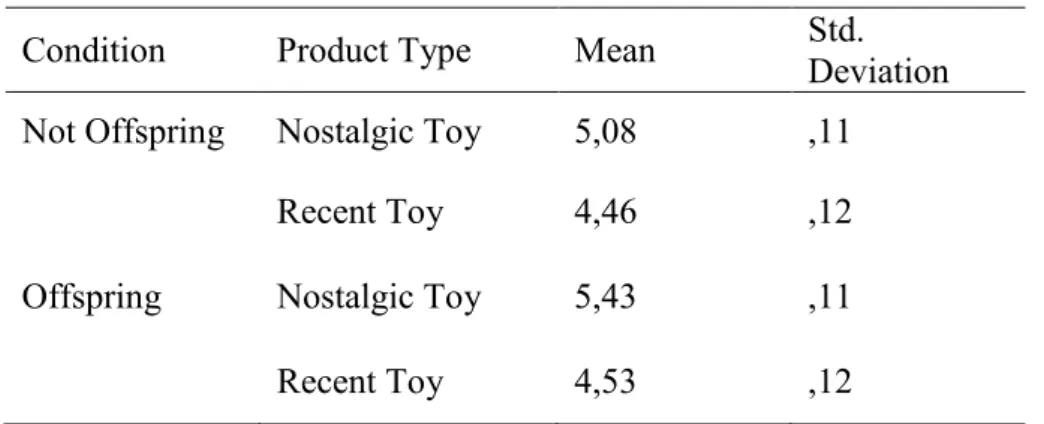
The ANOVA revealed that overall participants have more positive attitudes towards nostalgic brands (M=5.25, SD=0.81) than recent brands (M=4.49, SD= 0.88) indicated by a significant main effect of product type, F(1, 136) =94.79, p=.000.It was possible to observe a marginal significant interaction between the offspring conditions and the product type, F(1, 138)= 3.41, p=.067. In fact, even though the respondents have generally greater attitudes towards nostalgic brands, the differences in attitudes of nostalgic and recent brands are much more noticeable in the offspring condition (MNostalgic=5.43, SDNostalgic=.11, MRecent=4.53, SDRecent=.12) than in the non-offspring condition (MNostalgic=5.10, SDNostalgic=.11, MRecent=4.46, SDRecent=.12). The same pattern of interaction was found to be significant regarding the nostalgia conditions and product type, F(1, 138)= 25.42, p=.000. Individuals reveal a much less evident difference in their attitudes regarding nostalgic and recent brands in the present condition (MNostalgic=4.95,
SDNostalgic=.11, MRecent=4.57, SDRecent=.12) than they do in the nostalgic condition
(MNostalgic=5.56, SDNostalgic=.11, MRecent=4.41, SDRecent=.12). However, no main effects
conducted to assess the differences in attitudes towards nostalgic brands and recent brands in each condition of nostalgia. Concerning the nostalgic brands, individuals in a nostalgic condition have significant better attitudes (M=5.56, SD=.817) than the participants in the present condition (M=4.95, SD=1.11); t (138) =3.698, p=.000. However, regarding the recent brand no significant differences were found between nostalgia (M=4.41, SD=1.05) and present conditions (M=4.57, SD=1.00), although the individuals in the present condition report to have better attitudes towards the recent brands.
Product Type
Product Type Mean Std. Deviation
Nostalgic Toy 5,25 ,08
Recent Toy 4,49 ,09
Table 1: ANOVA Descriptives “Attitudes”: Product Type
Effect of Offspring Conditions in Product Type
Condition Product Type Mean Std. Deviation
Not Offspring Nostalgic Toy 5,08 ,11
Recent Toy 4,46 ,12
Offspring Nostalgic Toy 5,43 ,11
Recent Toy 4,53 ,12
Table 2: ANOVA Descriptives “Attitudes”: Offspring with Product Type
Effect of Nostalgia Conditions in Product Type
Condition Product Type Mean Std. Deviation
Present Nostalgic Toy 4,95 ,11
Recent Toy 4,57 ,12
Nostalgia Nostalgic Toy 5,56 ,11
Recent Toy 4,41 ,12
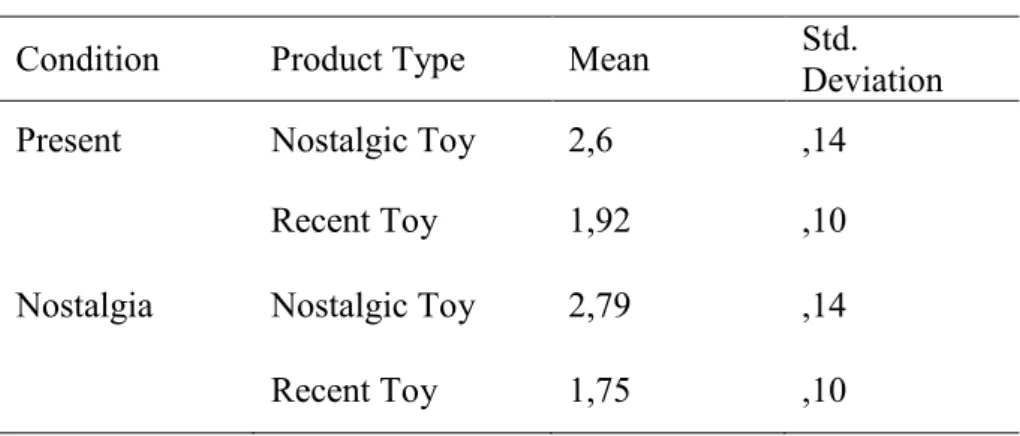
A third order interaction between nostalgia, offspring and product type was found to be significant, F(1, 136)=4.40, p=.038. The participants in the nostalgia and offspring condition demonstrate the better reported attitudes towards nostalgic toys, while the respondents in the present and not offspring condition reveal the weakest attitudes (Graphic 1 and Graphic 2).
Graphic 1- Third order interaction between nostalgia conditions, product type and offspring conditions regarding attitudes towards the brands.
Graphic 2- Third order interaction between nostalgia conditions, product type and offspring conditions regarding attitudes towards the brands.
0 1 2 3 4 5 6 Present Nostalgia Es timated Ma rgin al Me an s Nostalgia Conditions
Estimated Marginal Means of Attitudes
at Offspring = Offspring
Nostalgic Toy Recent Toy
0 1 2 3 4 5 6 Present Nostalgia Es timated Ma rgin al Me an s Nostalgia Conditions
Estimated Marginal Means of Attitudes
at Offspring = Not Offspring
We also asked the participants to rate their perceptions of quality in relation to every brand that was presented. An ANOVA 2 nostalgia x 2 offspring x 2 product type, with repeated measures on the last factor was computed for participant’s perceived quality. A main effect of product type was found to be significant (F(1, 136)= 96.06, p=.000) as, again, all participants attribute better quality to nostalgic brands (M=5.33, SD=0.09) and lower quality to recent brands (M=4.53, SD=0.1).
Product Type
Product Type Mean Std. Deviation
Nostalgic Toy 5,33 ,09
Recent Toy 4,53 ,10
Table 4: ANOVA Descriptives “Quality”: Product Type
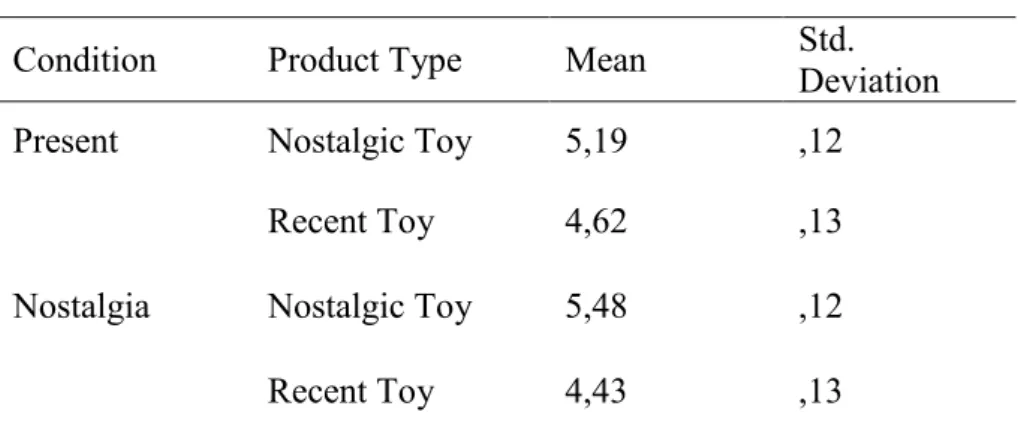
It was found a significant interaction of the nostalgia conditions and product type, (F(1, 136)=, p=.000). Repeatedly, the participants in a nostalgic condition show a higher difference in their perceived quality regarding the nostalgic-toy and recent toy (MNostalgic=5.48, SDNostalgic=.12,
MRecent=4.43, SDRecent=.13), which is diminished in the present condition (MNostalgic=5.20,
SDNostalgic=.12, MRecent=4.62, SDRecent=.13). Yet, no main effects of offspring, F(1, 136)<1, or
nostalgia, F(1, 136)<1, could be reported as those are not significant. Also, there is no interaction between the nostalgia and offspring conditions, F(1, 136)<1, neither between the offspring and product type, F(1, 136)<1, nor a third order interaction between nostalgia, offspring and product type, F(1, 136)<1.
Nonetheless, planned comparisons revealed that for nostalgic products participants in the nostalgic condition revealed marginally higher quality ratings than participants in the present condition (t (138) =1.724, p=.087) but no differences were found for the new product and no further effects were found.
Effect of Nostalgia Conditions in Product Type
Condition Product Type Mean Std. Deviation
Present Nostalgic Toy 5,19 ,12
Recent Toy 4,62 ,13
Nostalgia Nostalgic Toy 5,48 ,12
Recent Toy 4,43 ,13
Table 5: ANOVA Descriptives “Quality”: Nostalgia with Product Type
The attitudes towards brands and quality follow the same pattern of favourable results which supports us to accept the second hypothesis (H2).
4.2.4 Purchase Likelihood
An ANOVA 2 nostalgia x 2 offspring x 2 product type, with repeated measures on the last factor was conducted for participant’s purchase likelihood.
The ANOVA revealed a marginal main effect of product type F(1, 136) = 3.23, p = .075, suggesting higher purchase likelihood for the nostalgic-product (M = 4.41 , SE = .06) than for the recent-product (M = 4.22, SE = .09). A main effect of the Nostalgia manipulation was also found, F(1, 136) = 4.54, p = .035; indicating higher purchase likelihood for the nostalgic condition (M = 4.44, SE = .085) than for the present condition (M = 4.19, SE = .085). The Offspring manipulation also had a significant effect on purchase likelihood, F(1, 136) = 8.56,
p = .004, such that participants were more likely to purchase the products for their offspring (M
= 4.49, SE = .085) than for their co-worker’s offspring (M = 4.14, SE = .085).
Product Type
Product Type Mean Std. Deviation
Nostalgic Toy 4,41 ,06
Recent Toy 4,22 ,09
Nostalgia Conditions
Conditions Mean Std. Deviation
Present 4,19 ,09
Nostalgia 4,44 ,09
Table 7: ANOVA Descriptives “Purchase Likelihood”: Nostalgia Conditions
Offspring Conditions
Conditions Mean Std. Deviation
Not Offspring 4,14 ,09
Offspring 4,49 ,09
Table 8: ANOVA Descriptives “Purchase Likelihood”: Offspring Conditions
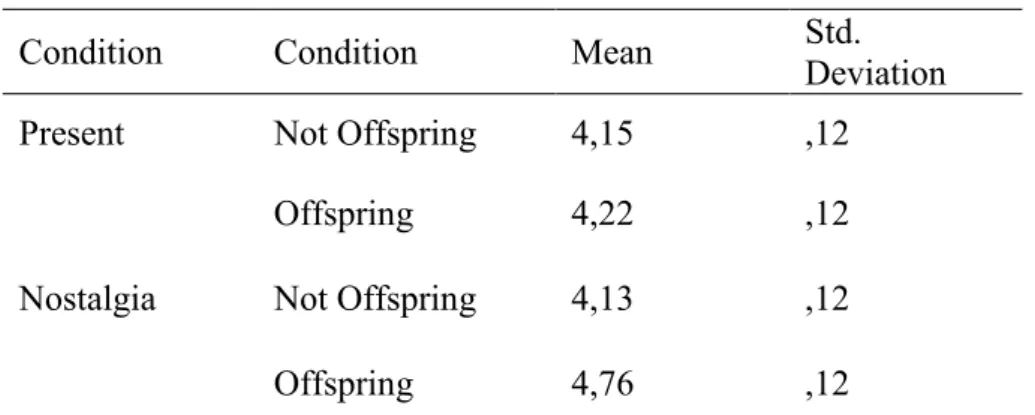
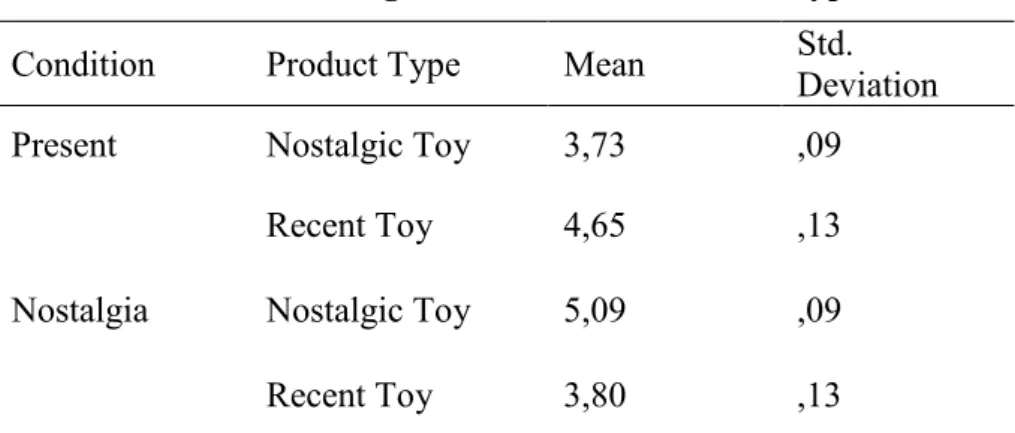
As expected, we also found an interaction between the Nostalgia manipulation and the offspring, F(1, 136) = 5.43, p = .021; suggesting that the effect of Nostalgia on purchase likelihood is stronger for the offspring condition (Mnostalgia = 4.75, SEnostalgia = .12; Mpresent = 4.22, SEpresent = .12) than for the No-offspring condition (Mnostalgia = 4.13, SEnostalgia = .12; Mpresent = 4.15, SEpresent = .12). It is possible to observe an addictive effect of the individual conditions of nostalgia and offspring together. When individuals are in a nostalgic condition and are attributed to purchase to their offspring, they report a superior preference for nostalgic toy and a much lower preference for the recent toy. Contrarily, when people are in a present (non-nostalgic) condition and attributed to purchase to their co-worker’s child, they reveal a preference to buy the most recent toy rather than the nostalgic toy.
Effect of Nostalgia and Offspring Conditions
Condition Condition Mean Std. Deviation
Present Not Offspring 4,15 ,12
Offspring 4,22 ,12
Nostalgia Not Offspring 4,13 ,12
Offspring 4,76 ,12