Curricular and pedagogic innovation in a Social Education
programme: findings from the implementation of PBL
Sandra Fernandes1,2,Marta Abelha1,3, Ana Sílvia Albuquerque1, Edgar Sousa1Portucalense Institute for Human Development INPP, Portucalense University, Portugal 2Research Centre on Child Studies CIEC, University of Minho, Portugal
3CEIS20 University of Coimbra, Portucalense University, Porto, Open University (UAb), Portugal
Email: [email protected], [email protected]; [email protected]; [email protected]
Abstract
This paper describes the results from the implementation of PBL experiences in the Social Education degree programme at Portucalense University, Portugal. It aims to discuss the curricular and pedagogical changes implemented in the past three years, in this programme. In total, five PBL experiences will be reported in this study: three editions were carried out with second year students and two editions with first year students, since the academic year of 2017/2018 to 2019/2020. The objective of this study is to report findings concerning the main curricular and pedagogic innovations implemented as a result of the shift to the PBL approach, such as the teaching strategies, assessment methods, learning outcomes, student competences, partnerships with community, amongst
end of each PBL edition, through questionnaires and individual narratives. Until the present, ten different curricular units have participated in the PBL projects, involving about forty students and five teachers in the five PBL editions mentioned. The results, in general, suggest a positive view of the PBL experiences and the role of the project to enhance student centred teaching and learning. Teachers showed interest in developing active learning strategies and openness to change / rethink their teaching practices. Creativity, oral and written communication, problem solving, project management, interpersonal and teamwork skills were key competencies highlighted by students as a result of the PBL project. This also resulted in greater student autonomy and the development of an active role by students, characteristics which are in accordance with the main guidelines of European Standards and Guidelines for Quality in Higher Education.
Key-words: Higher Education; Pedagogic innovation; Project-based Learning (PBL), Social Education.
1 Introduction
In accordance with the Standards and Guidelines for Quality Assurance in the European Higher Education Area (2015), Higher Education institutions must ensure that the process of teaching, learning and assessment is focused on students, where students should take an active role in their learning process. Along the same lines, Cerrillo, García-Peinado & López-Bueno (2013) and Rutti et al. (2016) argue that Higher Education should prepare students for their future profession, endowing and enabling them with the appropriate practical and necessary skills. Society calls for autonomous and proactive professionals able to make decisions, work in teams and lifelong learners (Behrens, 1999). These skills can be acquired and/or developed by Higher Education students through active teaching and learning methodologies. According to Berbel (2011), these must be based on real or simulated situations which challenge students to analyse and solve problems related to their future work practices. Santos, Spagnolo, Nascimento & Santos (2017) not only present a similar definition to the one presented by Berbel (2011) but also further highlight the essential need for these methodologies in Higher Education context, given that, as stated by Miter et al. (2008), these allow the interaction between Higher Education inst
The use of active methodologies in the classroom enables students to develop the capacity for critical reflection, search for new information, knowledge and solutions for a problem they ultimately must solve proves to be beneficial as it promotes greater motivation, interest and involvement of students, increased
Project-based Learning (PBL) is one of the most successful active learning methodologies in the context of Higher Education (Kokotsaki, Menzies, & Wiggins, 2016; Lima et al., 2017; Newman, 2003; Powell & Weenk, 2003). As pointed out in the theoretical perspective of Aldabbus (2018), this methodology was based on the constructivist theories of Gergen (1995), Piaget & Inhelder (1969) and Vygotsky (1978). The definitions that Imaz (2015) and Fernandes, Abelha, Fernandes & Albuquerque (2018) give about this methodology correlate with Berbel's (2011) active teaching and learning methodology, described above. Imaz (2015, p.682) portrays
project- -life
situations (Boss y Krauss, 2007; Bender, 2012; Patton, 2012; Garrigós y Valero-Fernandes, Abelha, Fernandes & Albuquerque (2018,
methodology, focused on the student and development of their skills (Fernandes, 2011; Lima
According to Thomas (2000, cited in Monteiro, Reis, Silva & Souza, 2017), projects of this nature must be mainly concerned with the curriculum of the students, focused on problems or situations which prompt students to identify and apply what they have learned on the course, involve the students in researching and should reflect the reality beyond academic life. In order to develop and implement a PBL project, the following steps are required (Vára y Valero, 2010, cited in Imaz, 2015): define the context; define the theme of the project and what it aims to achieve; design a first draft of the project; outline moments of delivery and briefing of aspects related to the project; outline the evaluation process and the final classification criteria; plan the activities to be implemented; identify how the five factors that facilitate cooperative learning will incorporate the project (positive interdependence, level of demand, face-to-face interaction, ability to work as a team and to reflect back on the work accomplished); devise a schedule; identify the material resources necessary for the project and develop a help script to guide the students on the project.
The major advantage of implementing this methodology relies on the fact that it does not require far more time or resources compared to the current system of traditional education (Kokotsaki, Menzies & Wiggins, 2016). Imaz (2015) also reckons that this methodology allows students to develop cognitive skills, such as analysing information, decision-making and judgement, since the student projects are based on real or tangible problems and the role of the teacher is solely to promote the teaching and learning process. Within this methodology, learning is carried out by the students themselves, from the beginning to the end of the process, in which they play an active role in problem-solving, articulation between theory and practice, cooperative work, etc., some of the main features of the said methodology (Fernandes, Abelha, Fernandes, Albuquerque, 2018). Regarding the negative side of project-based learning, Rodríguez-Sandoval, Vargas-Solnado & Luna-Cortés (2010), based on the work of Van den Bergh et al. (2006), claim that the two main disadvantages of applying this methodology might be the work overload and the overly broad range of the resulting projects, therefore, straining the teacher that has to carefully considerate each one of them (Mesquita et al., 2009; Alves et al., 2016).
2 Context of Study
In the academic year of 2017/2018, an opportunity arose for the development of a pilot project in the Social Education Degree course (Fernandes, Abelha, Fernandes, & Albuquerque, 2018), due to the participation of teachers in pedagogical training sessions promoted by the Rectory of the Portucalense University, through its Center for Excellence in Teaching (CET@UPT). Recognizing the importance of teacher training and professional development for the quality of teaching, CET@UPT is a structure that aims to promote reflection and discussion on student-centred pedagogical practices, develop training for UPT teachers and also seeks to distinguish and disseminate examples of best practices at UPT.
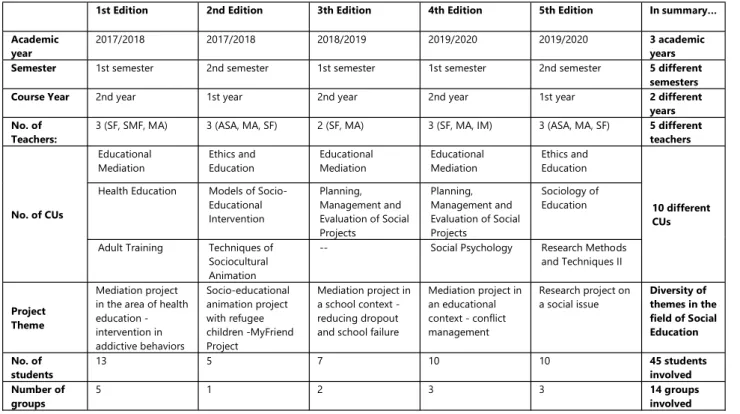
Since this pilot experience, which was the first edition of the PBL in this program, four other editions of PBL have already been carried out afterwards. Table 1 presents a summary of the five editions of PBL held from the academic year 2017/2018 to the academic year 2019/2020. These experiences took place in the 1st and 2nd year of the Social Education program, involving 2 to 3 curricular units (CUs) in the each semester. The total number of students who participated in each edition varied according to the number of students enrolled each year. This difference varied between a total of 5 students, in the 1st year of 2017/2018, and a total of 13 students, in the 2nd year of 2017/2018.
Table 1. Summary of the PBL editions developed in the Social Education program at UPT
1st Edition 2nd Edition 3th Edition 4th Edition 5th Edition Academic
year 2017/2018 2017/2018 2018/2019 2019/2020 2019/2020 3 academic years Semester 1st semester 2nd semester 1st semester 1st semester 2nd semester 5 different
semesters Course Year 2nd year 1st year 2nd year 2nd year 1st year 2 different
years No. of
Teachers: 3 (SF, SMF, MA) 3 (ASA, MA, SF) 2 (SF, MA) 3 (SF, MA, IM) 3 (ASA, MA, SF) 5 different teachers
No. of CUs
Educational
Mediation Ethics and Education Educational Mediation Educational Mediation Ethics and Education
10 different CUs Health Education Models of
Socio-Educational Intervention Planning, Management and Evaluation of Social Projects Planning, Management and Evaluation of Social Projects Sociology of Education Adult Training Techniques of
Sociocultural Animation
-- Social Psychology Research Methods and Techniques II
Project Theme
Mediation project in the area of health education - intervention in addictive behaviors Socio-educational animation project with refugee children -MyFriend Project Mediation project in a school context - reducing dropout and school failure
Mediation project in an educational context - conflict management
Research project on
a social issue Diversity of themes in the field of Social Education No. of
students 13 5 7 10 10 45 students involved Number of
groups 5 1 2 3 3 14 groups involved
The number of CUs that integrated the project, per semester, varied from 2 to 3 CUs. However, in total, up to now, ten different curricular units have been part of the Social Education course syllabus, with the CU of Educational Mediation the 2nd year, having the most frequent participation in the PBL projects (involvement in a total three edit
he 1st year, with the participation in two editions of PBL each. It should also be noted that the academic staff responsible for lecturing the 3 CUs mentioned above has remained the same over the past three years, which has facilitated the active collaboration of these teachers in the PBL projects over the past academic years.
Figure 1. Articulation between the CUs and the PBL Project of the 1st year, 2nd semester, in 2019/2020
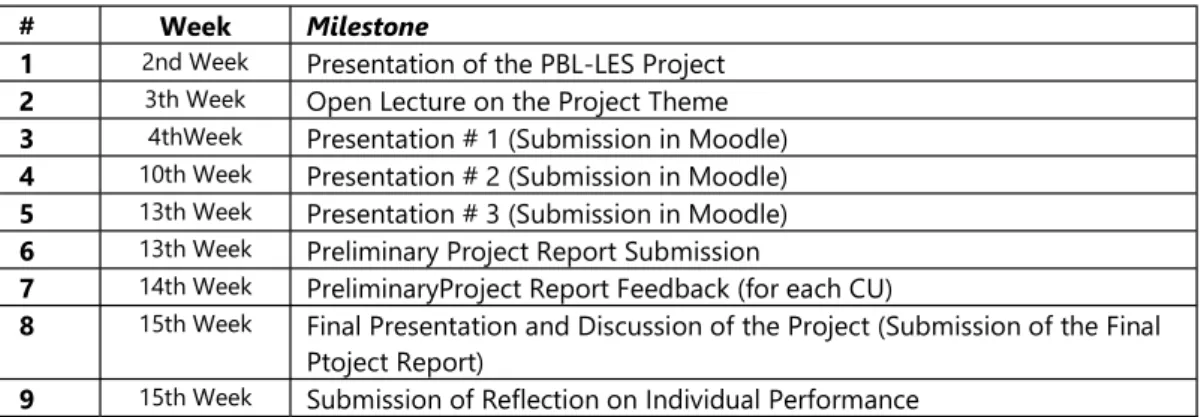
The curricular and pedagogical organization of the semesters that integrate PBL methodology requires articulation between the learning outcomes, contents and assessment strategies of each curricular unit. The moments for student assessment are also defined in a common way, since PBL entails the existence of several milestones where the student groups present their projects development state. These milestones aim to provide students with moments of feedback on project development and an opportunity to clarify doubts
PBL Project 2019/2020 Research Methods and Techniques II Sociology of Education Ethics and Education
regarding the integration of the curricular units in the project. Table 2 presents the milestones of the project, according to the last five editions of PBL projects in the Social Education degree at UPT.
Table 2. PBL-LES Project Miletones Schedule
# Week Milestone
1 2nd Week Presentation of the PBL-LES Project 2 3th Week Open Lecture on the Project Theme 3 4thWeek Presentation # 1 (Submission in Moodle) 4 10th Week Presentation # 2 (Submission in Moodle) 5 13th Week Presentation # 3 (Submission in Moodle) 6 13th Week Preliminary Project Report Submission
7 14th Week PreliminaryProject Report Feedback (for each CU)
8 15th Week Final Presentation and Discussion of the Project (Submission of the Final Ptoject Report)
9 15th Week Submission of Reflection on Individual Performance
Concerning the project's evaluation elements, these are distributed at different times, throughout the semester. The final grade of the group results from several factors, with a different weight in the final classification of the group. These values have undergone slight changes over the years. The following elements and weights are usually used: Presentation # 1 (5%) + Presentation # 2 (5%) + Presentation # 3 (5%), Preliminary Project Report (20%), Final Project Report (30%), Final Presentation and Project Discussion (15 %), Reflection on Individual Performance in the Group self and peer assessment (20%)
3 Results
As stated, this paper aims to describe the results from the implementation of PBL experiences in the Social Education degree programme at UPT, with particular emphasis on the curricular and pedagogical changes implemented within this programme. For this, the authors will focus on the results of the last edition (5th) of PBL, carried out in 2019/2020.
3.1 Feedback from Students
This topic provides the results from the survey applied to first-year students, at the end of the second semester. This survey was adapted from the original version of the survey developed Lima et al. (2017), a group of researchers from the University of Minho who have deep and extensive experience in PBL. The survey explored the following sections: I) project theme; II) student learning and skills developed; III) teamwork; IV) the role of the teacher; V) student assessment and VI) PBL as a teaching-learning methodology.
3.1.1 Results from the Survey
The scale used to answer each question covers a set of choices between 1 = strongly disagree; 2 = disagree; 3 = neither agree nor disagree; 4 = agree and 5 = strongly agree. In that sense, students were asked to specify their level of agreement or disagreement according to each statement presented.
I. Project theme
Regarding the project theme, which addressed social issues selected by each one of the working groups and, subsequently, approved by the staff coordination team, it is possible to see in Figure 2, that the aspects which scored higher show that students managed to understand the articulation established between curricular units. The fact that the students selected these social problems by themselves may have served as a motivating factor itself.
Figure 2. Results from section I - Project Theme II. Student learning and skills developed
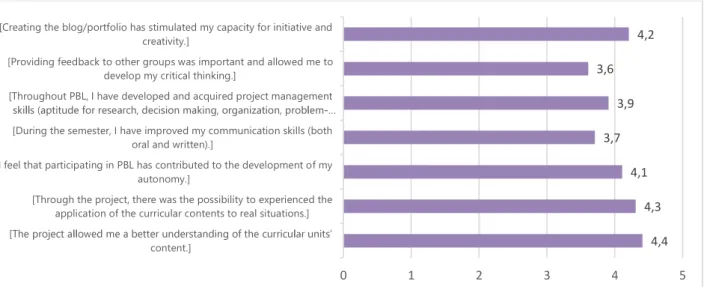
The items curricular content
were the topics better rated by students (see Figure 3). Thus, PBL seems to promote an opportunity for students to understand and integrate different contents of curricular units in real-life situations ing feedback to other grou
is understandable taking into account that these are first-year students. Nonetheless, the teaching staff considers that being able to give feedback is a capacity that must be trained with greater depth in the coming
thinking and reflection skills.
Figure 3. Results from section II Student learning and skills developed through PBL III. Teamwork
As shown in Figure 4, the majority of students
have pla
related to poor management of conflict situations that may have emerged within the student groups, motivated, for example, by different opinions or weak communication between members. On this subject, Lima et al. (2011) note that overcoming these problems implies understanding them first so that later these can be effectively overcome using the appropriate strat
4 4,9 4,3 4,9 4,4 4,4 0 1 2 3 4 5
[The theme of the project is relevant to understand and inform my future practice.]
[I consider the theme of this year's project interesting and stimulating.] [The open nature of the project (allowing for several possible research
paths) challenged me.]
[I consider that the proposed project was adequate to deliver the curricular units of this semester.]
[Curricular articulation between curricular units of the semester was effectively accomplished with the project.]
[I am pleased with the project that my group developed.]
4,4 4,3 4,1 3,7 3,9 3,6 4,2 0 1 2 3 4 5 content.]
[Through the project, there was the possibility to experienced the application of the curricular contents to real situations.] [I feel that participating in PBL has contributed to the development of my
autonomy.]
[During the semester, I have improved my communication skills (both oral and written).]
[Throughout PBL, I have developed and acquired project management [Providing feedback to other groups was important and allowed me to
develop my critical thinking.]
[Creating the blog/portfolio has stimulated my capacity for initiative and creativity.]
particularly important compone (Lima et al., 2011, p.97).
Figure 4. Results from section III - Teamwork in PBL IV. The role of the teacher
Data presented in Figure 5 shows that students, in general, seem to
the stu perience of
teachers, acquired through previous editions, may have significantly and successfully contributed to the implementation and development of the PBL methodology.
Figure 5. Results from section IV - The role of the teacher in PBL V. Student Assessment
the surveyed students also agrees with the number of presentations during the project, which further stresses the importance given to feedback since every presentation was followed with oral feedback and every report followed by written feedback from the teaching team, stimulating improvements on the project.
4,1 2,6 4,7 3,3 4,3 4,6 4,9 4,6 0 1 2 3 4 5
[Teamwork has contributed to increase my motivation to learn.] [I have a preference for group work over individual work.] [During the semester, I have played an active role in the group.] [Roles must exist within a group (leader, etc ...).] [During the project, my group held regular meetings.] [I consider I have developed interpersonal skills which are important for
my professional education.]
[All tasks and knowledge were shared within the group.] [I was able to positively address and resolve conflicts within the group.]
5 5 4,9 4,1 4,4 4,3 0 1 2 3 4 5
[Teachers were available to support the students.] [The teaching team gave the technical support necessary to carry out the
project.]
[The performance of the teaching team has lived up to my expectations.] [I sought the teaching team whenever I had questions or difficulties.] [I have been in regular contact with the teachers, via email or Skype.] [I feel that PBL has strengthened the proximity in the teacher-student
Figure 6. Results from section V - Student assessment in PBL VI. PBL as teaching-learning methodology
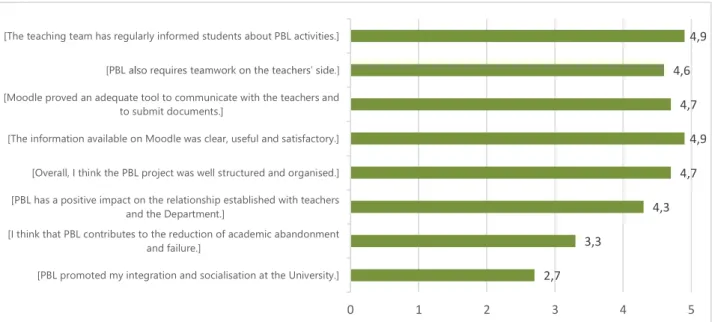
Most students are satisfied with the role played by PBL as a teaching-learning approach. However, students as the least positive (2.7). This may be related to the effect that the COVID-19 pandemic phase had worldwide, forcing academic institutions to shift to online learning, thus avoiding he opportunity for a greater integration and socialisation of students across the University.
Figure 7. Results from section VI - PBL as teaching-learning methodology 3.1.2 Results from the open-ended questions of the Survey
Students were asked to point out which aspects of the PBL experience they considered to be the most positive. Teamwork, the development of autonomy and the ability to communicate were the most indicated competences, which follow and corroborate the theory of Behrens (1999). The author asserts that society demands that professionals show skills such as autonomy, initiative, decision-making, and teamwork spirit. Similarly to Ramos et al.
capable of, promoting individual and cooperative work in order to develop fundamental and transversal skills 1,9 4,6 3 4,3 3,2 4 3,6 4,4 0 1 2 3 4 5
[There should be fewer presentations during the project.] [The feedback given by the teachers about presentations and reports was
clear.]
[In the context of PBL, peer review (student-student) is pertinent to assess the engagement of each member of the group.] [I read and understood the evaluation criteria present in the Moodle.]
[The final reflection of the project helped me prepare the final presentation.]
[Every member of the group should obtain the same classification.] [I think the project should weigh more in the final evaluation of the
student (currently 40%).]
[Overall, I am satisfied with the results obtained in the project.]
2,7 3,3 4,3 4,7 4,9 4,7 4,6 4,9 0 1 2 3 4 5
[PBL promoted my integration and socialisation at the University.] [I think that PBL contributes to the reduction of academic abandonment
and failure.]
[PBL has a positive impact on the relationship established with teachers and the Department.]
[Overall, I think the PBL project was well structured and organised.] [The information available on Moodle was clear, useful and satisfactory.] [Moodle proved an adequate tool to communicate with the teachers and
to submit documents.]
(soft skills), for instan Difficulties in managing time, as well as adversities in managing conflicts that sometimes arise inside groups, were the main issues students identified as the least positive aspects of the PBL experience. The authors presume that the reasons why most students struggled with time management may be due to the fact that they are still first-year students and that this teaching-learning methodology is entirely new for them. Suggestions for improvement were limited to the stu own performance, who mention that, if they were to start PBL "now", they would manage time more efficiently and, therefore, more effectively. Regarding suggestions for further improvement, some students suggested another interim report, as a new milestone, which could support students in doing a better time management.
3.2 Curricular and pedagogical innovation with PBL
The Project-Based Learning methodology is an approach that focuses, mostly, on the student, where it is sought that the student learns for himself and that the teacher assumes the role of advisor/facilitator of that same learning. PBL was considered, in the five editions, as an integrating methodology for content from
different CU to solve questions/problems related
to their future profession, in this case, Social Educators. This integration and curricular articulation of the different contents, connected to each of the CUs involved, enabled students to have a more holistic and integrative view of theory and practice.
Throughout the different editions, each of the CUs involved in the PBL project had classes centered on instanced content inherent to the CUs themselves and classes to support the PBL project throughout the semester. It should be noted that in the 3rd and 4th editions one of the UCs - Planning, Management and Evaluation of Social Projects - was explicitly oriented towards the project, which proved to be an important issue not only for students (who had contemplated in their three teaching hours weekly hours of dedication to the project), as well as for teachers (who had the opportunity to share the CU, seeing that time counted and optimized with regard, for example, to scheduling milestones). Thus, it is considered of utmost importance a CU dedicated to project development, which can be extended to the 1st and 3rd year of the Social Education course, similar to what happens in the 2nd year´s. Another aspect, which is considered necessary, is to guarantee the continuity of the academic staff team throughout the academic years, to ensure a more significant and successful contribution of PBL implementation and development. In this case, it is considered that more significant experience in the PBL methodology results into higher levels of confidence to implement more innovative curricular and pedagogical strategies. During the semester, each team of students had to make three oral presentations. These presentations were aimed at improving proficiency in oral communication to audiences, with each student having to individually take the lead in the presentation at some point during the performance. There were moments experienced at an early stage with some nervousness that dissipated with the course of the semester given the level of confidence of students making oral presentations. The level of autonomy some students revealed in their project final discussion with the rest of the class shows that PBL methodology is impactful in terms of the development of transversal skills, so valued by the job market. On the other hand, one of the curricular and pedagogical aspects that we consider that needs greater investment in the future PBL editions is related to students' feedback capacity, as this has proved to be a weakness that students need to be overcome, especially those of the 1st year. In this sense, to increase students' feedback capacity and, consequently, their critical analysis, it is suggested that in a next edition, students have to give written feedback to another team's intermediate report.
Concerning the assessment methods of the CU, these were considered by students as innovative, standing out from the usual assessment methods (test and group work). The assessment
students regulate their learning process. For this purpose, several milestones were created (previously explained) in which oral feedback was provided in the case of presentations and written feedback in the case of reports. Each milestone was part of the assessment elements of the project. Monitoring student learning and the development of individual skills was also evaluated during the semester, through the delivery of project tasks/milestones. The weight attributed to the PBL project varied according to each CU, being determined by each teacher responsible. Some programmatic contents of each CU were evaluated by the contents included in the PBL project itself, while other specific contents were not assessed in the project. With teachers experience
and the feedback given by students about intra-group evaluation, as of the 3rd edition, a milestone has been included that consists of an individual reflection aimed to evaluate student involvement, autonomy and responsibility. This task gives students the opportunity to express their feelings about the experience, identifying possible problems that arose within the group work and how they were (or not) overcome.
4 Final Remarks
The implementation of PBL in higher education context has consistently shown a remarkable interest by students and teachers, due to the results obtained in terms of learning the syllabus of the curricular units that make up the project, but also in terms of the development of skills, namely soft skills. It is a challenge for teachers, in the sense of coherently combining the contents of each CU to encourage and guide students to successfully achieve the defined goals. This objective has been accomplished in the several editions of PBL, encompassing idiosyncrasies as diverse as the individuals involved. So we can consider that it is an innovative methodology that justifies its existence, contributing to enhancing student's autonomy, communication, fulfilling the mission of higher education, leading towards full integration into life in society. In years to come, we will try to achieve some goals students expressed themselves, such as the possibility of inter-year projects in social education. Also, older students mentoring/tutoring projects, physical and virtual spaces suitable for collaborative work by students and teachers.
5 Referências Bibliográficas
Alves, A., Sousa, R., Moreira, F., Carvalho, M. A., Cardoso, E., Pimenta, P., Malheiro, T., Brito, I., Fernandes, S., Mesquita, D. (2016). Managing PBL difficulties in an industrial engineering and management program. Journal of Industrial Engineering and Management, 9(3). https://doi.org/10.3926/jiem.1816
Aldabbus, S. (2018). Project-based learning: implementation & challenges. International Journal of Education, Learning and Development, 6(3), pp. 71-79.
Behrens. (1999). A prática pedagógica e o desafio do paradigma emergente. Revista Brasileira de Estudos Pedagógicos, pp. 383-403. Berbel, N. A. (2011). As metodologias ativas e a promoção da autonomia de estudantes. Semina: Ciências Sociais e Humanas, 32(1), pp.
25-40.
Cerrillo, R., García-Peinado, R., & López-Bueno, H. (2013). El aprendizaje servicio como innovación docente en la universidad para la enseñanza de la organización escolar.
ENQA, ESU, EUA & EURASHE (2015). Standards and guidelines for quality assurance in the European higher education area (ESG). Brussels, Belgium
Fernandes, S., Abelha, M., Fernandes, S. M., & Albuquerque, A. S. (2018). Implementação de PBL no curso de educação social: resultados de um estudo piloto na universidade portucalense. International Symposium on Project Approaches in Engineering Education, pp. 446-455.
Fernandes, S., Morais, P., Mesquita, D., Abelha, M., Fernandes, S., & Albuquerque, A. (2018). The centre for excellence in teaching (CET) at portucalense university: Goals, strategies and expected outcomes. pp. 1585-1592. https://doi.org/10.4995/head18.2018.8257 Revista Complutense de Educación, 26(3), pp. 679-696.
Kokotsaki, D., Menzies, V., & Wiggins, A. (2016). Project-based learning: a review of the literature. Improving Schools, pp. 1-11.
Lima, R. M., Carvalho, D., Sousa, R. M., Alves, A., Moreira, F., Mesquita, D., & Fernandes, S. (2011). Estrutura de gestão para planejamento e execução de projetos interdisciplinares de aprendizagem em engenharia. In L.C. de Campos, E.A.T. Dirani e A.L. Manrique (Eds.). Educação em Engenharia: Novas Abordagens (pp. 87-121). EDUC - Editora da PUC-SP, São Paulo, Brasil.
Lima, R. M., Dinis-Carvalho, J., Sousa, R. M., Alves, A. C., Moreira, F., Fernandes, S., Mesquita, D. (2017). Ten years of project-based learning (PBL) in industrial engineering and management at the university of minho. In PBL in Engineering Education: International Perspectives on Curriculum Change. https://doi.org/10.1007/978-94-6300-905-8
Macedo, K. D. S., Acosta, B. S., Silva, E. B., Souza, N. S., Beck, C. L. C., Silva, K. K. D. (2018). Metodologias ativas de aprendizagem: caminhos possíveis para inovação no ensino em saúde. Escola Anna Nery Revista de Enfermagem, 22(3), pp. 1-9.
Mesquita, D., Alves, A., Fernandes, S., Moreira, F. & Lima, R. M. (2009). A first year and first semester project-led engineering education approach 2 organization model. In D. Carvalho, N. van Hattum, & R. M. Lima (Eds.), Proceedings of the 1st Ibero- American symposium on project approaches in engineering education (pp. 181-189). Braga, Portugal: Centro de Investigação em Educação, Universidade do Minho.
Mitre, S. M., Siqueira-Batista, R., Girardi-de-Mendonça, J. M., Morais-Pinto, N. M., Meirelles, C. A. B., Pinto-Porto, C., Moreira, T., Hoffmann, L. M. A. (2008). Metodologias ativas de ensino-aprendizagem na formação profissional em saúde: debates atuais. Revista Ciência & Saúde Coletiva, 13, pp. 2133-2144.
Monteiro, S. B., Reis, A. C., Silva, J. M., & Souza, J. C. (2015). Project-based learning curricular approach in production engineering program. Production, 27, pp. 1-12.
Newman, M. (2003). A pilot systematic review and meta-analysis on the effectiveness of problem-based learning. Ltsn. Powell, P., & Weenk, W. (2003). Project-Led engineering education (Vol. 53). https://doi.org/10.1017/CBO9781107415324.004
Ramos, A., Delgado, F., Afonso, P., Cruchinho, A., Pereira, P., Sapeta, P. & Ramos, G. (2013). Implementação de novas práticas pedagógicas no ensino superior. Revista Portuguesa de Educação, 26(1), pp. 115-141.
Rodríguez-Sandoval, E., Vargas-Solnado, E. M., & Luna-Cortés, J. (2010). Evaluación de la estrategia "aprendizaje basado en proyectos". Educación y Educadores, 13(1), pp. 13-25.
Rutti, R. M., LaBonte, J., Helms, M. M., Hervani, A. A., Sarkarat, S. (2016). The service-learning projects: stakeholder benefits and potential class topics. Education+Training, 58(4), pp. 422-438.
Santos, P. K., Spagnolo, C., Nascimento, L. M., & Santos, B. S. (2017). Metodologias ativas para aprendizagem na educação superior: reflexões teóricas para a permanência. Séptima Conferencia Latinoamerica Sobre el Abandono en la Educación Superior. Argentina.