Procedia Computer Science 64 ( 2015 ) 170 – 179
1877-0509 © 2015 The Authors. Published by Elsevier B.V. This is an open access article under the CC BY-NC-ND license (http://creativecommons.org/licenses/by-nc-nd/4.0/).
Peer-review under responsibility of SciKA - Association for Promotion and Dissemination of Scientific Knowledge doi: 10.1016/j.procs.2015.08.478
ScienceDirect
Conference on ENTERprise Information Systems / International Conference on Project
MANagement / Conference on Health and Social Care Information Systems and Technologies,
CENTERIS / ProjMAN / HCist 2015 October 7-9, 2015
FCASM
2T: The Tools and functionalities / features identification
process
Fernando Moreira
a*, Isabel Seruca
a,b, Maria João Ferreira
a,b aUniversidade Portucalense, Rua Dr. António Bernardino de Almeida, 541, 4200 Porto, PortugalbISTTOS, Centro Algoritmi, Minho University, Portugal
Abstract
The huge popularity and evolution of the Web in the last decade, and the rapid advances in ICT allowed an exponential growth of the volume and diversity of data produced by social media. The widespread use of social media has encouraged citizens to give their opinions more freely and actively participate in several aspects of modern life. The data provided in this context can have a great impact on business, where often opinions of customers may contribute to the success of a product or service, or destroy the reputation of a brand or a company. The effective and full use of social media by organizations require that they are able to monitor and analyse the high volumes of heterogeneous data that are produced by these media, so as to obtain relevant information and valuable insights for decision making and for conducting their business. Due to the diversity of social media monitoring tools available and wide range of features offered, the FCASM2T (Framework for classification and adoption of
social media monitoring tools) was proposed to classify and guide the process of adoption of such a tool (or set of tools) by an organization. This paper addresses the first stage of the framework, the Tools and functionalities/features identification process, describing its rationale and way-of-working.
© 2015 The Authors. Published by Elsevier B.V.
Peer-review under responsibility of SciKA - Association for Promotion and Dissemination of Scientific Knowledge.
Keywords: Social media, Social media monitoring tools, Framework, Thresholds
* Corresponding author. Tel.: +351225572000
E-mail address: [email protected]
© 2015 The Authors. Published by Elsevier B.V. This is an open access article under the CC BY-NC-ND license (http://creativecommons.org/licenses/by-nc-nd/4.0/).
1. Introduction
The huge popularity and evolution of the Web in the last decade and the rapid advances of IT and communication channels allowed an exponential data growth from social media tools, that are different from traditional data, produced by all types of users from around the world1. Social media tools have raised new challenges for research: content analysis, discovery and monitoring, and context-based services2. Basically, the existence of social media tools, encouraged citizens to give their opinions more freely, and participate more in many aspects of life, such as in politics; their impact was very clear in what was called the "Arab Spring"3. Furthermore, they also have a huge impact on business, were opinions of online users often contribute to the success of a product, or may destroy the reputation of a brand or a company4.
Today's organizations tend to use modern strategic marketing plans to promote their products and services; this can include the placement of tutorials, demonstrations, advertisements, etc., in social media tools, such as the most used social networks. In this context, organizations can measure their customer responses or potential customers regarding the interactions carried out with social tools. This evaluation can only be carried out efficiently and in due time, if it is performed through the use of monitoring tools of the target social media. The results obtained can be used in defining new marketing strategies, address issues and problems identified by customers, target new types of customers, etc.
In this context, an analysis of social media monitoring tools is needed as well as the definition of a framework for their adoption, so that organizations can use the most appropriate tool in order to obtain the necessary knowledge and valuable insights for decision-making. In this paper, we address the first stage of the FCASM2T (Framework for classification and adoption of social media monitoring tools)26 to drive the adoption of a social media monitoring tool.
The rest of the paper is structured as follows. In Section 2 we present an overview of social media and discuss the motivation for the use of social media monitoring tools. In Section 3 we present related work within the area of
social media monitoring tools adoption. In Section 4 we provide an outline of the FCASM2T framework and we
address the first stage of the framework, the tools and functionalities identification process, describing its rationale and way-of-working. Section 5 concludes with considerations on the achievements produced so far and directions for future work.
2. Background
2.1. Social Media
Social media is defined by Ahlqvist5 as a concept based on three key elements – content, communities and Web 2.0 – “social media refers to the interaction of people and also to creating, sharing, exchanging and commenting
contents in virtual communities and networks”. Following the some underlying idea, Kaplan and Haenlein6 defined social media as “a group of Internet-based applications that build on the ideological and technological foundations
of Web 2.0, and that allow the creation and exchange of User Generated Content” and Kietzmann7 state that “social
media employ mobile and web-based technologies to create highly interactive platforms via which individuals and communities share, co-create, discuss, and modify user-generated content”. Finally, Hafez and Xu1 defined a social media site as: “a web site that provides an interactive platform, which facilitates communication between people or
creating and sharing User Generated Contents (UGC), including collaborative works, social networks, blogs, contents sharing, social bookmarking, virtual worlds and rating websites”.
From the definitions provided above it may be concluded that social media tools are changing the way of life of current populations, as people can, not only connect with one another, but also create and share content. Hence, social tools have generated a huge amount of data, containing potential valuable information that can be extremely useful, if appropriate monitoring tools are used to extract relevant knowledge for organizational decision support.
Organizations may benefit from the use social media tools if these are harnessed to create value for them8. Martin and van Bavel9 present a set of potential benefits, i.e., tangible and intangible gains, for organizations using social media tools, which they classified in terms of a) employees’ use of the technologies, b) customer engagement activities, and c) external partner activities.
Within the business context, companies currently understand the value of social media tools, the benefits that they may get, and the role they play in the development of business in the future. The problem that arises is how to achieve these goals effectively, especially with the diversity of the social media tools available. Hanna, Rohm, and Crittenden10 suggest treating them as an ecosystem of elements, associated with the development of a social media strategy, rather than treat them as autonomous systems.
2.2. Social Media Monitoring tools
Janssen11 defined social media monitoring as “a process of using social media channels to track, gather and mine
the information and data of certain individuals or groups, usually companies or organizations, to assess their reputation and discern how they are perceived online. Social media monitoring is also known as social media listening and social media measurement”. Rouse12 puts forward the following definition of the concept: “Social
media listening, also known as social media monitoring, is the process of identifying and assessing what is being said about a company, individual, product or brand.”
Social media monitoring tools are useful in the discovery of what is happening in online environments, in which the company operates. Furthermore, these tools can also be used to measure the usefulness of the efforts made on interaction with customers and potential customers. Indeed, it can be quite difficult to fully understand the effectiveness of these efforts, only by analyzing subscriptions of customers and answers.
There are a large number of social media monitoring tools. Hence, depending on the goal to be achieved, the right tool may be a series of free Google Alerts or an expensive software suite, including ad hoc analysis and full integration with legacy customer relationship management applications. These tools transfer the desired words and phrases from unstructured to structured database data, for analysis with traditional data mining techniques.
In the private and/or public sector, social media monitoring tools can mine text for specific keywords on social networking websites, blogs, discussion forums and other social media. For example, in the private sector, these tools are useful as companies aim to hear and analyze the complaints about their own products or services, or those of competitors, to help to attract customers; in the public sector, “observing” online conversations may be a way of collecting opinions from people who may not want to fill in a formal survey form.
By using social media monitoring tools the organizations can make better informed decisions about where it can make improvements, spot opportunities and strengthen any weaknesses that it might have in their social media output.
3. Related work
Related work in this subject mostly include proposals for the adoption of a social media monitoring tool based on a qualitative approach by organizing tools into categories and sub-categories of features whereas only one approach is based on the cost criterion.
The work undertaken by several authors13,14,15,16,17,18,19 have in common the identification of a set of aspects and features that should be considered in social media monitoring tools. These aspects are subdivided into five categories and each category by a set of functionalities/features.
Stavrakantonakis20 present an approach for evaluation of social media monitoring tools based in eleven criteria and a matching table where the authors use a check mark in the case a criterion is fulfilled and a cross in case it is not supported.
Neiger21 discuss three issues that should be considered in the process of adoption of social media monitoring tools: 1) Why are you using social media? 2) What will be your key performance indicators? and 3) How will you match your evaluation metrics to your performance indicators? However, the authors point out the importance of combining quantitative and qualitative approaches. The authors also examine the use of indicators in measuring social media. These metrics comprise five areas: brand awareness, critical information dissemination, reach, public engagement and market insights.
Giustini22 proposes a method named POST, an acronym for People, Objectives, Strategy and Technologies. The author argues that by using POST it is possible to define the goals and objectives before evaluating the use of social media. However, a method or framework to select social media monitoring tools is not targeted by the approach.
Chaffey23 does not present a specific selection method for social media monitoring tools, but only a set of features organized in four levels, whereas Ntalianis24 use as the single criterion for adoption of such tools the criterion of “more known in the market”.
Finally, Aquino25 discusses a number of issues regarding the alignment of what organizations need and the kind of tools that should be used. Regarding the issue of tools selection, the author puts forward the guiding principle of cost, showing that it may be interesting to consider a combination of free and paid tools.
4. Tools and functionalities/features identification process
4.1. FCASM2T
The literature review presented in the previous section has shown that none of the proposed solutions include a quantitative approach to help decision-makers in the adoption of social media monitoring tools, as well as on the analysis of the functionalities and features of these tools. Acknowledging this gap, we proposed a framework for classification and adoption of social media monitoring tools, called FCASM2T, which is described in26.
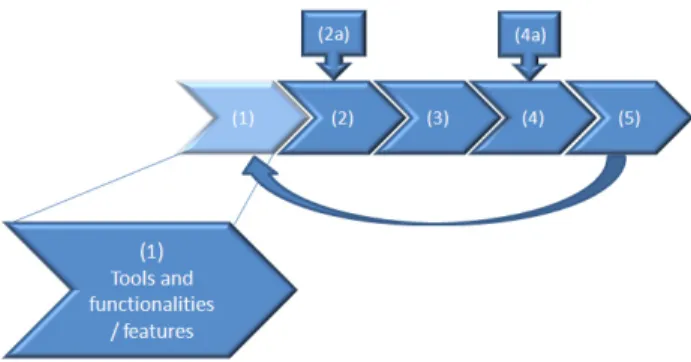
The proposed framework26 is illustrated in Fig. 1 and is composed of five stages: (1) Tools and
functionalities/features; (2) Profile calculation; (3) Ordering of the index; (4) Definition of ranges for adoption and (5) Suggestion for adoption.
Fig. 1: FCASM2T: tools and functionalities / features identification process
In the first stage (1) tools are collected from the repository of available tools, and their functionalities and features are identified. After building the matrix (tools – functionalities/features), in step (2), weights (2a) are assigned to each of the functionalities, according to the degree of importance that the feature is perceived to have. Subsequently, the profile of each tool is calculated. In step (3) the ordering of the sorting index is performed. This ordering is made based on the profiles calculated for each tool in step (2). In step (4) thresholds are set (4a) so that intervals of choice may be defined. By using step (5) and based on the defined thresholds, it is possible to have as an outcome the suggested tool or tools most suitable for an adoption. At this stage, the following three types of adoption are allowed: (i) full adoption; (ii) conditional adoption, and (iii) should not to be adopted. The process is iterative, as new tools and functionalities may be considered, and need to be evaluated in the process.
This paper is focused on the first stage of the FCASM2T, which is described in sections 4.2 and 4.3.
4.2. Tools identification process
The creation of the tools repository needed for the first stage of the frameworkl26 was based on the evaluation of a set of 66 social media monitoring tools described in 21 references13, 14, 16, 18, 19, 27-42. The tools analyzed were the following: 10Alike; AddictoMatic; Alerti; Argyle Social; Autre Planete; BackTweets; Beevolve; Brand24; Brandwatch; Buffer; Carma; Collective Intellect; Crimson Hexagon; Curalate; DataSift; Digimind Social; Everypost; Facebook Insights; Followerwonk; Geofeedia; Google Analytics; Gorkana; Hootsuite; HowSociable;
IceRocket; Klout; MarketMeSuite; Mass Planner; MediaMiser; MediaVantage; Meltwater; Mention; Moz; NetBase; Netvibes; NUVI; OktoPost; Oracle Social Cloud; Personapp; Pinpuff; Pinterest Web Analytics; Plugg.io; Postling; Radarly; Radian6; Raven; Reputology; Sendible; Shoutlet; Social Marketing Cloud; Social Mention; Sprout Social; Sumall; Synthesio; Sysomos; Talkwalker; Topsy; Trackur; Twazzup; Tweet Reach; TweetBeep; Twitter Analytics; Typeform; uberVU; Viralheat; Visible Technologies.
Subsequently to the selection of these tools, a set of criteria were defined in order to obtain the more relevant tools to be used in the remaining stages of FCASM2T. The first criterion resulted from the creation of a matrix where tools and references were crossed in order to indicate the description of tool i in the reference j. Additionally, it is checked whether the i tool is freeware or commercially available and whether it is suitable for Small and Medium Sized Enterprises (SMEs) or Large Enterprises. The values assigned to the corresponding attributes of tools are (1, 0) to indicate that the tool is or is not referenced, “f” for a freeware tool, “$” for a commercial tool, and “s” and “l” for a tool targeted for SMEs and a large enterprise respectively. However, in the analyzed references it was not always possible to find the tool classification associated with the type of the enterprise where it is best applied, or whether it was a commercial or free tool. Hence, additional searches were needed in some tools’ web sites to gather this information.
As a result of the analysis, a table is obtained with the total number of occurrences (citations) of the tool i in the set of 21 references. The next step of the process deals with the setting of sorting criteria to be applied to the output list of tools and needed to choose those tools which obtained a value greater than or equal to a number of instances, to be called thresholdON, with ON representing the number of occurrences.
The established criteria were:
1. Sort the applications in descending order of the number of occurrences 2. Filter by: 2.1. Cost 2.1.1. Free 2.1.2. Commercial 2.2. Type 2.2.1. SME 2.2.2. Large enterprise
3. Select the first n tools according to the combination of criteria used
Due to space reasons, the full table is not presented, while partial tables are shown according to the criteria defined.
The application of the described methodology will be illustrated with the presentation of results obtained for the tools with an initial classification of thresholdONt9 and that were classified according to the criteria described above.
Table 1. Most common social media monitoring tools.
Tools Number of occurrences Mention 14 Hootsuite 13 Topsy 12 Crimson Hexagon 10 Sysomos 10 Social Mention 9 Trackur 9
The analysis of table 1 shows that seven applications met criteria 1 and 3. In the results presented, there was no concern of isolating applications by cost neither by targeted organization type.
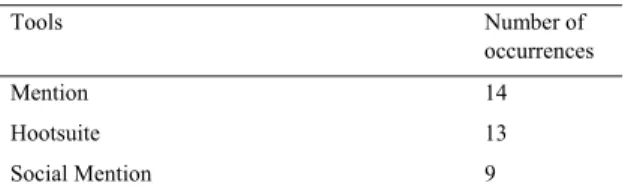
To understand whether these tools remained in the output list, criteria 1, 2.1.1, and 3 were applied; the result obtained is shown in table 2.
Table 2. Free tools.
Tools Number of
occurrences
Mention 14 Hootsuite 13
Social Mention 9
From the analysis of table 2, two interesting situations may be depicted: first, the top 2 tools shown in table 1 remain in the output list (criterion 1); second, the failure to consider more than three applications that satisfy criterion 2.1.1, that is, tools without costs.
Table 3. Tools for SME.
Tools Number of occurrences Mention 14 Hootsuite 13 Topsy 12 Social Mention 9 Trackur 9
When the criterion applied is whether the tool is targeted for SMEs (criterion 2.2.1), independently of the cost criterion (criterion 2.1.1), the number of applications shown in table 3 increases; furthermore the applications that are listed in the first and second places are the same that were listed when the former criteria were applied (cf. tables 1 and 2).
Table 4. Free tools for SME.
Tools Number of
occurrences
Mention 14 Hootsuite 13
Social Mention 9
Finally, table 4 shoes the combined application of criteria 1, 2.1.1, 2.2.1 and 3. There is a reduction in the number of applications listed; nevertheless, the two applications that occupy the first two places of the output list remain the same.
The exercise illustrated in the tables above was used only to show how tools can be considered and included in the creation of the tools repository, which is an intermediate outcome of the first stage of the framework. The setting of a higher or lower minimum number of occurrences will allow to increase or decrease the granularity of the selection of tools.
4.3. Functionalities/features identification process
Further to the intermediate outcome described in Section 4.2, the final outcome of this phase of the framework is needed, that is, the list of functionalities/features to be considered in the creation of the final repository that will be used as input to the second stage of FCASM2T.
The construction of this taxonomy of functionalities/features was based on a comprehensive search of existing taxonomies in the literature in order to determine, firstly, the structure used in the taxonomy and, secondly, the number of functionalities/features used to categorize the several tools.
In the research conducted six contributions20, 27, 43, 44, 45, 46 were found, where three proposals presented a two-level classification of functionalities20, 27, 43, whereas the other three proposed a one-level classification. Among classifications based on two levels, contribution27 includes five categories, whereas contribution43 considers four categories and contribution20 three categories. The number of functionalities/features considered in the six proposals ranges from 12 to 36. Furthermore, the analysis performed aimed to determine whether there were a set of functionalities/features that were common to the six proposals; to this extent, the only functionality/feature found was "Sentimental Analysis". It is also worth noticing the lack of a standard classification among the contributions surveyed.
The two-level structure of taxonomy presented in27will be used as a the basis for the taxonomy proposed in this work with the following extensions. A new first level category will be considered, called “Price policy & Software vendor” which will include relevant functionalities/features associated with the administrative decision-making procedure of adopting a tool over another. The other categories will also include a set functionalities/features that, in our view, are missing from the base proposal.
Therefore, our taxonomy of functionalities/features will enable a first level analysis of social media monitoring tools according to the following six perspectives: Degree of Monitoring; Data analysis & Visualization; Social follow up; Price policy & Software vendor; Integration options; Support & Documentation. The second level of the taxonomy will allow a more detailed analysis according to a set of features. The two-level classification is described in more detail in the following text, where the title of each topic corresponds to a first level item of the classification, and the description of the topic refers the features included.
Degree of Monitoring
When studying the behavior of Internet users, it is important to notice that this behavior may vary according to the used platform. For example, Facebook attracts a different kind of posts from Youtube, or any other social network. Thus, it is important to monitor the users through the use of social media monitoring tools, in order to be able to handle large volumes of information and in several languages. In addition, it is necessary to monitor issues related to competitors, trending topics, filtering of spam messages, etc. In this category, the following functionalities/features are considered: “Languages Monitored”; “Social Media Networks Monitored” ; “Spam Filtering” ; “Unlimited mentions” ; “Unlimited Users”.
Data analysis &Visualization
Social media monitoring tools should monitor and evaluate the sentiment that users show towards an organization, a brand or an individual. For example, a post targeting a particular organization maybe considered positive, negative or neutral.
Historical data can be obtained from older posts so that these data can be used to compare trends and feelings of days, weeks or even years. E-mail alerts allow the tool to notify if a subject or a topic of interest shows a sudden increase in activity or even if another key indicator appears. Google Analytics is a useful resource for tracking the users of the site, and many tools are integrated with it. In this category, the following functionalities/features are considered: “Sentiment Analysis”; “Translate Posts”; “Historical Data”; “Email Alerts”; “Integration with Google Analytics”; “Influence Profiling and Analysis”; “Viral Content Tracking and Analysis”; “Topic and Theme Analysis”; “Campaign Monitoring and Measurements”; “Dashboard”.
Social follow up
To know the opinion of customers, suppliers and competitors of an organization is important, but not sufficient, as these new audiences want quick answers. For example, a customer who makes a complaint through social media expects to have a quick answer from the organization. Thus, social media monitoring tools should include social engagement functionalities/features.
Furthermore, the massive use of mobile devices requires appropriate tool features for dealing with this type of equipment. Hence, in this category, the following functionalities/features are considered: “Manage Workflow”; “Schedule Posts”; “Respond to Posts”; “Mobile app/support”.
Price policy & Software vendor
It is also important to consider some functionalities/features that are not technical, but that have a great influence on the decision of adopting a tool over another. Each tool has its own form of charging the organization for its use. For example, some tools apply charges according to how many entries the organization receives, others according to the number of platforms monitored, the number of users allowed, etc. There are solutions that are free to a limited extent of use of a set of functionalities/features. Further information may also be included such as key customers that are mentioned, the size of the software vendor organization, the duration of contracts, etc.
In this category, the following functionalities/features are considered: “Pricing”; “Contract Length”; “Clients”; “Year of Product Release”; “Product Applications”; “Industry Focus”; “Company Size”.
Integration options
Social media monitoring tools can help the business as a whole, and not just traditional departments, such as the marketing department. These tools should allow the integration of APIs (Application Programming Interface) capable of providing data to other platforms that are integrated and are essential for running the business of an organization. Thus, in this category, the following functionalities/features are considered: “API"; "CRM Integration"; "Export results”.
Support & Documentation
One of the most critical processes for organizations with exposure to the internet is to increase their reputation in social media, since it is not enough to be present in the network through the creation of accounts or pages in social media; that is the means, but not the purpose of doing it. Indeed, the greatest difficulty is to make proper use of tools, and also proper use of social media monitoring tools. Thus, if a social media monitoring tool provides an account manager, it can be a valuable help for the use of the tool; the account manager can also provide coaching in campaigns, or provide advice about the most appropriate way to use the information obtained with the use of the tool. In this category, the following functionalities/features are considered: “Dedicated Account Manager”; “Email/ Online Form Support”; “Video Tutorials”; “Blog”; “Live Chat Support”; “Forums”; “Specialized Training”.
The classification of features here described will be used in this stage of the framework to create the matrix (tools – functionalities/features). Subsequently, in step (2) of the framework, we will set the accurate weights (2a) to assign to each of the functionalities, according to the degree of importance that the feature is perceived to have. The profile of each tool will be then calculated.
5. Conclusions and Future Work
The effective and full use of social media by organizations require that they are able to monitor and analyse the high volumes of heterogeneous data that are produced by these media, so as to obtain relevant information and valuable insights for decision making and for conducting their business.
Due to the diversity of social media monitoring tools available and the wide range of features offered, we
proposed the FCASM2T framework to guide the process of adoption of such a tool (or set of tools) by an
organization. In this paper, we addressed the first stage of the framework, the tools and functionalities / features identification process, and described its rationale as well as its way of working.
The framework design is currently at an early stage and there are several issues that need to be fully explored. Nevertheless, we believe that it represents a valuable contribution to acknowledge the potential of social media monitoring tools and to envisage a classification scheme of these tools. When fully developed and tested, it will provide the necessary guidance for the adoption of these tools.
Further work should target the definition of the right or more appropriate weights and thresholds, and for this purpose, a multiple case study approach should be adopted, including domain experts to validate weights and thresholds of the proposed FCASM2T. To that end, a comprehensive study of the more representative social media
monitoring tools needs to be conducted so as to define exactly the top functionalities that these tools cover; these results may be used to indicate more accurate weights to be assigned to each functionality. Additionally, it is necessary to define the thresholds in order to calculate the ranges of variation, to be used in the process of tool adoption. Finally, to determine the weights and thresholds, other issues may be considered besides the functionalities of the tools. For example, the impact of the tool cost on adoption, the business area of the organization, or even the size of the organization (large enterprise or SME), among others.
References
1. Hafez, A. A., Xu, Y. A Survey of User Modelling in Social Media Websites. Computer and Information Science; Published by Canadian Center of Science and Education. 2013. 6(4). doi:10.5539/cis.v6n4p59
2. Shen, H. T., X. S. Hua, et al. Guest editorial: content, concept and context mining in social media. World Wide Web-Internet and Web Information Systems, 2012; 15(2): 115-116.
3. Saleh, I. Egypt’s digital activism and the Dictator’s Dilemma: An evaluation. Telecommunications Policy. 2012. http://dx.doi.org/10.1016/j.telpol.2012.04.001
4. Ferreira, M. J., Moreira, F. Seruca, I. A traditional organization towards a new dimension of labour – social business, Information systems and Technology for Organizational Agility, Intelligence, and Resilience. Hershey: Information Science Reference. 2014. pp. 180-204, DOI: 10.4018/978-1-4666-5970-4.ch009
5. Ahlqvist, T., Bäck, A., Halonen, M., Heinonen, S. Social Media Roadmaps. Helsinki: Edita Prima Oy. 2008.
6. Kaplan, A. M., Haenlein, M. Users of the world, unite! The challenges and opportunities of Social Media. Business horizons, 2010;. 53(1): 59-68. http://dx.doi.org/10.1016/j.bushor.2009.09.003
7. Kietzmann, J. H., Hermkens, K., Mccarthy, I. P., Silvestre, B. S. Social media? Get serious! Understanding the functional building blocks of
social media. Business horizons, 2011. 54(3): 241-251. http://dx.doi.org/10.1016/j.bushor.2011.01.005
8. Majchrzack, A., Cherbakov, L., Ives, B. Harnessing the Power of the Crowds with Corporate Social Networking “How IBM does it”. MIS Quarterly Executive, 2009. 8(2):103-198.
9. Martin, A., van Bavel, R. Assessing the Benefits of Social Networks for Organizations. 2103. http://ftp.jrc.es/EURdoc/JRC78641.pdf 10. Hanna, R., Rohm, A., Crittenden, V. L. We’re all connected: The power of the social media ecosystem. Business horizons. 2011. 54(3):
265-273. http://dx.doi.org/10.1016/j.bushor.2011.01.007
11. Janssen, C. Social Media Monitoring, 2014. http://www.techopedia.com/definition/29592/social-media-monitoring 12. Rouse, M. Social media listening. 2013. http://searchcrm.techtarget.com/definition/Social-media-monitoring
13. Mindruta, R. Top 10 Free Social Media Monitoring Tools. 2013. http://www.brandwatch.com/2013/08/top-10-free-social-media-monitoring-tools/
14. Dyer, P. 50 Top Tools for Social Media Monitoring, Analytics, and Management. 2013. http://www.socialmediatoday.com/content/50-top-tools-social-media-monitoring-analytics-and-management
15. O'Hare, M. New social media monitoring rankings: Brandwatch, Synthesio earn high marks. 2014. http://about.g2crowd.com/blog/new-social-media-monitoring-rankings/
16. Crowd. Compare Best Social Media Monitoring Software. 2014. https://www.g2crowd.com/categories/social-media-monitoring.
17. Barakat, C. 30 Social Media Monitoring Tools for Business. 2014. http://socialtimes.com/30-social-media-monitoring-tools-business_b199940
18. Davids, S. 30 Best Social Media Monitoring Tools for Business. 2014. http://stuartjdavidson.com/social-media-monitoring-tools/
19. Keshav. Top 9 Free Social Media Monitoring Tools That You Cannot Miss Out On. 2014. http://digitalescalator.com/2014/03/top-9-free-social-media-monitoring-tools-that-you-cannot-miss-out-on/
20. Stavrakantonakis, I., Gagiu, A.-E., Kasper, H., Toma, I., Thalhammer A. An approach for evaluation of social media monitoring tools. Common Value Management. 2012. Pp. 52–64
21. Neiger BL, Thackeray R, Van Wagenen SA. Use of social media in health promotion: purposes, key performance indicators & evaluation
metrics. Health Promot Pract. 2012. 13(2):159–64. doi: 10.1177/1524839911433467.
22. Giustini, D. Social media evaluation. 2015. http://hlwiki.slais.ubc.ca/index.php/Social_media_evaluation
23. Chaffey, D. Social media listening tool comparison. 2014. http://www.smartinsights.com/social-media-marketing/social-media-analytics/social-media-listening-tool-comparison/
24. Ntalianis, K., Papadakis, N., Tomaras, P. Reputation Monitoring over Rule-Stringent Social Media based on Advanced Wrapper
Technologies. 2nd International Conference on Strategic Innovative Marketing. Procedia – Social and Behavioral Sciences. 2014. 148.
559-566
25. Aquino, J. Find the right Social Media Monitoring Tool. Customer Relationship Management. 2012. 33-37
26. Moreira, F., Seruca, I. & Ferreira, M.J. Towards a framework for classification and adoption of social media monitoring tools. 2nd European Conference on Social Media ECSM 2015. Porto, Portugal, Submited
27. Purch, Social Media Monitoring Review, 2015, http://social-media-monitoring-review.toptenreviews.com/
28. Purch, Social Media Monitoring for Small Business, 2015, http://social-media-monitoring-review.toptenreviews.com/small-business/
29. BusinessToCommunity. 115 Social Media Marketing Tools for 2015. 2014. https://smallbusiness.yahoo.com/advisor/post/113313680637/whats-new-this-year-in-the-social-media-software
30. Mueller, K. 9 Tools for Small Business Reputation Management and Brand Monitoring. 2015. http://www.socialmediatoday.com/social-business/2015-03-24/9-tools-small-business-reputation-management-and-brand-monitoring
31. Ivanovs, A. 10 Social Media Tools for Small Businesses and Freelancers. 2015. http://www.huffingtonpost.com/alex-ivanovs/10-social-media-tools-for_b_6619490.html
32. Newswire. G2 Crowd publishes Spring 2015 rankings of the best social media monitoring platforms, based on user reviews. 2015. http://www.prnewswire.com/news-releases/g2-crowd-publishes-spring-2015-rankings-of-the-best-social-media-monitoring-platforms-based-on-user-reviews-300054772.html
33. Rule, A. The Best Social Media Monitoring Tool. 2015. http://www.elegantthemes.com/blog/resource/the-best-social-media-monitoring-tools 34. Newswire. Social media monitoring categories. 2015. http://www.g2.crowd.com/categories/social-media-monitoring
35. Cox, J. 5 Essential Social Media Monitoring Tools for Beginners. 2015. http://socialmarketingwriting.com/5-essential-social-media-monitoring-tools-beginners/
36. Almaz. 100 Media Monitoring Tools for PR in 2015. 2015. http://everything-pr.com/top-pr-tools-2015/218947/
37. Ahmad, I. 20+ #SocialMedia Monitoring Tools For Business. 2015. http://www.digitalinformationworld.com/2015/03/the-20-best-social-media-monitoring-tools-infographic.html
38. Weinberg, T. 6 Social Media Monitoring Tools to Track Your Brand. 2015. http://www.socialmediaexaminer.com/6-social-media-monitoring-tools/
39. Windels, J. The Top Free Listening Tools Available Online. 2015. http://www.brandwatch.com/2015/03/top-free-listening-tools-available-online/
40. Paarlberg, B. RazorSocial: 26 Social Media Monitoring Tools Infographic. 2015. http://www.themeasurementstandard.com/2015/03/razorsocial-26-social-media-monitoring-tools-infographic/
41. Neathery, B. Top 8 Social Listening Tools That Do Way More Than Listen. 2014. http://www.socialmediatoday.com/content/top-8-social-listening-tools-do-way-more-listen
42. Cleary, I. 26 Social Media Monitoring Tools. 2015. http://www.razorsocial.com/social-media-monitoring/
43. Chaffey, D. Social media listening tool comparison. 2014. http://www.smartinsights.com/social-media-marketing/social-media-analytics/social-media-listening-tool-comparison/
44. PR. Social Media Monitoring Tools Comparison Guide. 2012. http://cdn2.hubspot.net/hub/883/file-1318984189-pdf/Downloads/PR_2012_-_SM-Monitoring-Comparison-1_Sheet1.pdf?t=1428949134789
45. Drewes, D. A Comparison of Social Media Monitoring Tools: The Search for the Holy Grail. 2015. http://www.dragonsearchmarketing.com/social-media-marketing-tools-research/
46. Domelen, K. Social Media Monitoring Tools – How to Pick The Right One. 2015. http://www.convinceandconvert.com/guest-posts/social-media-monitoring-tools-how-to-pick-the-right-one/