i |
A SCALABLE RECOMMENDER SYSTEM
Using Latent Topics and Alternating Least Squares
Techniques
András Péter Kolbert
Dissertation presented as partial requirement for obtaining
the Master’s degree in Advanced Analytics
i |
A SCALABLE RECOMMENDER SYSTEM
Using Latent Topics and Alternating Least Squares Techniques
2017
András Péter Kolbert
MAA
MAA
NOVA Information Management School
Instituto Superior de Estatística e Gestão de Informação
Universidade Nova de Lisboa
A Scalable Recommender System Using Latent Topics and Alternating
Least Squares Techniques
by
András Péter Kolbert
Dissertation presented as partial requirement for obtaining the Master’s degree in Advanced Analytics
Advisor: Mauro Castelli
i |
Abstract
A recommender system is one of the major techniques that handles information overload problem of Information Retrieval. Improves access and proactively recommends relevant information to each user, based on preferences and objectives. During the implementation and planning phases, designers have to cope with several issues and challenges that need proper attention. This thesis aims to show the issues and challenges in developing high-quality recommender systems.
A paper solves a current research problem in the field of job recommendations using a distributed algorithmic framework built on top of Spark for parallel computation which allows the algorithm to scale linearly with the growing number of users.
The final solution consists of two different recommenders which could be utilised for different purposes. The first method is mainly driven by latent topics among users, meanwhile the second technique utilises a latent factor algorithm that directly addresses the preference-confidence paradigm.
Keywords: job recommendation, matrix factorisation, alternating least squares, latent dirichlet allocation,
ii |
Acknowledgements
First, I would like to thank my thesis instructor, Mauro Castelli, for the guidance and support he has provided me throughout the whole process, from the very beginning to the end. I have been extremely lucky to have a supervisor who cared so much about my work and who responded to my questions and queries promptly.
Secondly, I must express my gratitude to Ildikó Kolbert, my sister, for her continued support and suggestions. I was amazed by her willingness to proof read countless pages.
Furthermore, I would like to thank to Steve Austen, for the suggestions he made in reference to this work.
Completing this work would have been all more difficult without a flatmate and friend like Matt Parkin, who experienced all of the ups and downs of my research and helped me out whenever I needed.
Finally, I would like to acknowledge university colleagues and friends who supported me during my time in Lisbon. I feel honoured to have had the chance to work together with Beáta Babiaková, Carolina Duarte and Illya Olegovich Bakurov on various data science projects and continuously learn from them. Also, I would like to thank Andrea Vergati, Federico Sisci and Giuseppe Parisi for the happy time we spent together during my time in Lisbon.
iii |
Table of Contents
1 Chapter 1 ... 1 1.1 Introduction ... 1 1.1.1 Context ... 1 1.2 Motivations ... 21.2.1 Benefits for the providers ... 2
1.2.2 Benefits for the users ... 2
1.3 Document Structure ... 3
2 Chapter 2 ... 4
2.1 Recommender Systems overview ... 4
2.2 Formal definition ... 5
2.3 User preferences ... 6
2.3.1 Implicit and explicit feedback ... 6
2.4 Bias in user preferences ... 7
2.5 Related works ... 7 3 Chapter 3 ... 9 3.1 Basic algorithms ... 9 3.2 Heuristic recommenders ... 10 3.2.1 Similarity measures... 10 3.3 Content-based recommenders ... 12 3.3.1 Pre-processing ... 13 3.4 Collaborative filtering ... 15 4 Chapter 4 ... 17 4.1 Matrix Factorisation ... 17
4.2 Principal Component Analysis ... 19
4.3 Singular Value Decomposition ... 20
4.4 Limitations of most optimization algorithms ... 23
4.5 Additional challenges and solutions ... 24
4.5.1 Biases ... 24 4.5.2 Temporal dynamics... 24 4.5.3 Synonymity ... 25 5 Chapter 5 ... 27 5.1 Hybrid recommenders ... 27 5.1.1 Parallelized hybridization ... 27
iv |
5.1.2 Pipelined approach ... 30
5.1.3 Monolithic design ... 32
5.1.4 Hybrid System Experiments ... 33
6 Chapter 6 ... 35
6.1 Challenges ... 35
6.1.1 Cold start ... 35
6.1.2 Sparsity ... 35
6.1.3 Diversity and serendipity ... 37
6.1.4 Scalability ... 38
7 Chapter 7 ... 39
7.1 Evaluating recommender systems ... 39
7.1.1 Measures ... 40 7.1.2 Methodology ... 41 8 Chapter 8 ... 42 8.1 Problem formulation ... 42 8.2 Used technology ... 43 8.3 Description of data ... 44
8.4 Data preparation and exploration ... 45
8.5 Challenges ... 50
8.5.1 Cold-start problem ... 50
8.5.2 Scalability ... 51
8.5.3 Sparsity ... 51
8.6 Model training ... 51
8.6.1 Latent user profile segments ... 52
8.6.2 Alternating least squares ... 53
8.6.3 Recommending to existing and online updating for new users ... 54
8.7 Evaluation methods ... 55
8.8 Optimisation and training ... 56
8.8.1 Latent topic approach ... 56
8.8.2 Alternating least squares ... 57
8.8.3 Overall optimisation results ... 62
9 Chapter 9 ... 63
9.1 Conclusions ... 63
9.2 Future work ... 64
10 Chapter 10 ... 65
v |
Table of Figures
Figure 1 - A traditional utility matrix example representing movie ratings on a 1–5 scale ... 5
Figure 2 - Collaborative Filtering at Spotify (Bernhardsson, 2013) ... 18
Figure 3 – Parallelized hybridization (Brusilovsky et al, 2007) ... 27
Figure 4 – Weighted scheme (Brusilovsky et al, 2007) ... 28
Figure 5 – Switching technique (Brusilovsky et al, 2007)... 29
Figure 6 – Mixed strategies (Brusilovsky et al, 2007) ... 29
Figure 7 – Pipelined approach (Brusilovsky et al, 2007) ... 30
Figure 8 – Cascade hybrids (Brusilovsky et al, 2007) ... 30
Figure 9 – Meta-level hybrids (Brusilovsky et al, 2007) ... 31
Figure 10 – Monolithic hybrids (Brusilovsky et al, 2007) ... 32
Figure 11 – Feature combination hybrids (Brusilovsky et al, 2007) ... 32
Figure 12 – Feature augmentation hybrids (Brusilovsky et al, 2007) ... 33
Figure 13 – Users registered location ... 47
Figure 14 – Job postings registered position ... 48
Figure 15 – Number of interactions since jobs were posted ... 48
Figure 16 – Average number of interactions ... 49
Figure 17 – Account’s event interactions ... 50
Figure 18 – LDA technique to derive recommendations ... 53
Figure 19 – ALS pseudo code ... 54
Figure 20 – Rank Score by latent topics ... 57
Figure 21 – Rank score by regularisation parameter ... 58
Figure 22 – Rank score by iterations ... 59
Figure 23 – Computational costs by iterations ... 59
Figure 24 – Rank score by alpha values ... 60
Figure 25 – Computational costs by latent features ... 61
Table of Tables
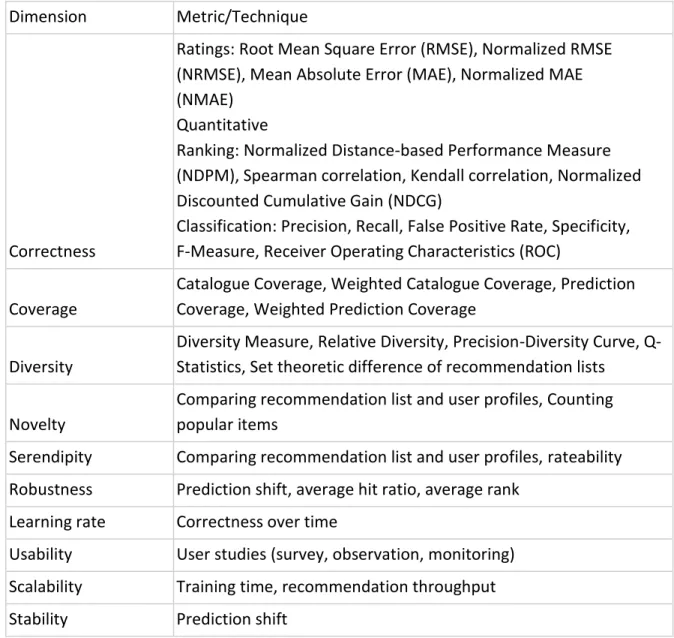
Table 1 – Evaluation metrics (Avazpour et al, 2014) ... 40Table 2 – Descriptive Statistics... 45
1 |
1 Chapter 1
1.1 Introduction
1.1.1 Context
The volume of structured and unstructured data has grown at an exponential scale in recent years. As a result of this rapid data growth, we are deluged with information and a plethora of choices in any product or service. It is natural to get lost in the range of options. Information overload has reached a point where the available information cannot be processed simply by the human mind, it needs special guidance.
Recommender systems (hereinafter RS) are one of the major techniques to handle this information overload problem from the field of Information Retrieval. These systems have emerged to help users navigate through this increased content, often leveraging user-specific data that is collected from users. It improves access and proactively recommends relevant information to each user based on preferences and objectives.
During the implementation and planning phases, designers have to cope with several issues and challenges that need proper attention. This thesis aims to show the issues and challenges in developing high-quality recommender systems. This paper also aims to solve a current research problem in the field of job recommendations. More specifically, with a given large dataset that consists of anonymized user profiles, job postings, and interactions, the aim is to predict the job postings that a user will positively interact with by clicking on, or bookmarking it. This prediction is will be evaluated on various approaches while using a scalable computation solution.
The project makes use of Apache Spark, a distributed big data processing framework. The study will introduce an algorithmic framework built on top of Spark for parallel computation which allows the algorithm to scale linearly with the growing number of users. The use of Spark also provides the advantage of interactive computation and minimal processing time as compared to traditional MapReduce paradigm. This implementation enable us to process more than 230 million interactions from 1.5 million users in 5 months timeframe.
2 |
1.2 Motivations
The following section assess the possible benefits and motivations for both users and providers for developing recommender systems.
1.2.1 Benefits for the providers
One out of the many opportunities for the providers, is to get a better understanding of users’ needs. Describing and knowing users’ preferences can boost sales figures, marketing activity, product performance or even their supply chain management by improving production or logistic efficiency. For instance the logistic efficiency increase can be achieved by investigating various item associations, based on geographical area which allows the businesses to monitor and balance stock levels in an optimal manner. Having known the item associations and having optimised stock level, the users are targeted with relevant recommendations, at the right time and place. This relevancy leads to an enhanced user experience which implies higher retention rate to the business owners. Furthermore, it also enables the providers to efficiently solve the so called long-tail problem. The long-tail refers to items that are rare and obscure. Online vendors, unlike retailers can have these items on “stock”, using a broad meaning for stock because frequently there’s no physical entity to store at all. A recommender system can ensure that having a more diverse online platform, we can still communicate to the right people and target relevant segments with matching products. One positive side of optimising customer journeys is to generate more sales, but also to satisfy users’ needs to a greater extent.
1.2.2 Benefits for the users
Recommender systems (RS) are not only beneficial for the service providers but also to the users (PU et al, 2011). RS can help providers identify latent needs, desires or preferences which a consumer might not be able to realise by himself/herself, due to the lack of information about the product's availability.
For instance, finding an interesting and informative article that one may not look for specifically, but may take pleasure in reading after being recommended. Users may also find their most desired job posting due to a recommendation which might have a long term impact on their life.
3 | To conclude, one may see that this level of personalisation can be used in varying circumstances for various benefits but it is worth emphasizing that in most cases it is a win-win scenario for both parties.
1.3 Document Structure
This paper is structured in nine chapters.
Chapter 2 presents an overview about recommender systems. It includes a general introduction, a formal definition and the relevance of such systems. It also shows in more details the two different methods of rating data and describes the major difference in modelling them. The chapter closes with detailing the most relevant related works and research platforms.
Chapter 3 describes basic and heuristic based recommenders, highlighting their strengths and weaknesses.
Chapter 4 presents additional advanced and model based techniques that the current state of the art generally favours for specific problem formulations.
Chapter 5 gives a detailed overview about hybridization and presents the different strategies in depth.
Chapter 6 presents the main challenges that need special attention during the practical implementation phase.
Chapter 7 describes the main metrics and methodologies used for evaluating solutions in the field.
Chapter 8 presents a job recommendation problem and propose a scalable solution. Here it is further explained how the algorithmic approach works and also the used technology for implementation phase, experimental setup and result analysis to understand the current benefits and drawbacks of this solution. Finally, a short summary and discussion is presented about the results.
Chapter 9 presents some conclusions about the presented work and a discussion about future research lines.
4 |
2 Chapter 2
This chapter presents an overview about recommender systems, which is followed by a formal definition. It is followed by a description of the different user feedbacks, related works and the chapter end with categorising the currently active research hubs.
2.1 Recommender Systems overview
The concept of Recommender Systems (RS) initiates from the idea of information reuse, and persistent preferences. RS can be defined as the set of software tools and techniques, that provide suggestions for items that are of interest for a given user profile. (Ricci et al, 2011) RS has the ability to guide users in a personalized way towards interesting objects in a large search space (Burke, 2002). A naive user may not even recognise that most of their online activities are supported and influenced by various recommendations in order to provide them relevant content which can help in their decision making process. This guidance is the system’s ability to predict whether an individual would prefer an item based on their profile. The overall aim of such systems is to deal with the information overload problem by retrieving vital information out of a large search space.
The structure of such systems depends on the particular domain and on the characteristics of the available data. The most popular domains include social tags, search queries, social connections, books, news, movies, music, services and products in general. There are also recommender systems for experts, collaborators, jokes(Eigentaste, 2001), restaurants (Ricci and Nguyen, 2017), garments (Iwata et al, 2017), financial services, life insurance, online dating, Twitter pages (Gupta et al, 2013), and many others.
The large number of domains using RS is a testimony to the several usefulness of this technique in enhancing provider-user interactions.
5 |
2.2 Formal definition
A traditional recommender system problem consists of a set of users, items and ratings. Let’s introduce the following notation:
● Users: u = {u1, u2, . . . , un} U ∈ U1×n
● Items: I = {i1, i2, . . . , im} I ∈ I1×m
● Ratings: R = {r11, r12, . . . , rnm} R ∈ Rn×m
rui element is devoted to the rating, interaction or any sort of feature which represents a user
u ∈ U interest on a particular item i ∈ I. Generally, recommender problems have to tackle a very sparse rating matrix, suggesting that there are many unknown relations between an item and a user u.
Figure 1 - A traditional utility matrix example representing movie ratings on a 1–5 scale
One may note that most of the user-movie pairs are blanks, which means that the user has not rated the movie yet. In this example the users have rated 36% of the items (9/25) has higher density than most real word scenarios. This means that a typical user may rate or interact with only a tiny fraction of all available items. According to the literature, the density of the rating matrix in commercial recommender systems is often less than 1% (Tang et al, 2013, p.4).
The usual aim of any recommender systems is to be able predict the missing ratings for the user ui on a non-rated item ij; or to recommend particular item sets or neighbourhoods which
6 |
2.3 User preferences
2.3.1 Implicit and explicit feedback
Fundamentally, the utility matrix shown previously can contain two types of rating data, which need to be distinguished and modelled differently. Most convenient is the high quality explicit feedback, which includes explicit input from users regarding their interest in products, typically using a concrete rating scale. This type of feedback can be directly interpreted as the user’s preferences, making it easier to make extrapolations from the data to predict future ratings. For instance, Netflix collects star ratings for movies or YouTube users indicate their preferences for videos by hitting thumbs-up and down buttons. Although explicit feedback tends to have higher quality, and is in general easier to model, this kind of pure information is not always available.
Thus, one may use behavioural data to infer user preferences from the more abundant implicit feedback, which indirectly reflect opinion through observing user behaviour: such as purchase history, browsing history, search patterns or mouse movements. The aim is to transform user behaviour into user preferences which can be a difficult task to solve. Modelling implicit feedback is a difficult but an important problem.
Essentially, there are two main challenges in modelling preferences using implicit feedback data. By observing users behaviour, we can infer which items they probably like and thus chose to consume. However, this does not necessarily indicate a positive view of the product. For instance observing a purchase for an individual, may have just happened for gifting purposes on behalf of someone else, or took place but the user was not satisfied with the item and eventually it leads to a negative experience. Implicit feedback is not capable of accounting for these factors on its own.
Meanwhile, explicit recommenders tend to focus on the gathered information – those user-item pairs that we know their ratings – which provide a balanced picture on the user preference. Thus, the remaining user-item relationships, which typically constitute the vast majority of the data, are treated as “missing data” and are omitted from the analysis. This is impossible with implicit feedback, as concentrating only on the gathered feedback will leave us with the positive feedback, greatly misrepresenting the full user profile. Hence, it is crucial to address also the missing data, which is where most negative feedback is expected to be
7 | found. In implicit feedback datasets, non-interaction of a user with an item does not necessarily indicate that an item is irrelevant for the user, it can also mean that the user is unaware of the item’s existence. The significance of positive feedbacks are much larger than the missing negative feedbacks, therefore the feedback types should be weighted (normalized) differently in the model.
2.4 Bias in user preferences
Another important aspect of user feedback is the user bias. Raw ratings also encapsulate the user’s viewpoint, the way they rate items. There are always some users who tend to give higher (or lower) ratings than others (explicit), or on average be more active in general than the others (implicit), or some items may be higher (or lower) rated than others, because they are widely perceived as better (or worse) than the others. For instance, two users liking and disliking similar movies, but one being a bit more critical and rates average movies 1.5-2 out of 5 meanwhile the other user is a movie enthusiast who rates the average films 4 out of 5. According to previously conducted experiments, most recommender systems perform better if user and item biases are taken into account (Adomavicius et al, 2014). Therefore a proposed solution is explained in a later section.
2.5 Related works
Recommender Systems is a burgeoning research area. There are multiple mediums that foster the advancement of this field:
● Research articles, conferences and workshops
○ ACM Conference on Recommender Systems - The most significant annual conference where all the papers focus on recommender technology and applications.
○ ACM Transactions on Information Systems
○ ACM UMAP (User Modeling, Adaptation and Personalization) User Modeling. ○ ACM HT (Hypertext and Social Media) - Hypertext and Social Media (HT)
WWW, ACM SIGIR - many relevant discussions related to RSs. ○ ACM IUI FLAIRS, Web Intelligence
8 | ● Recommender System handbook (Ricci et al, 2011), and several academic journals related to RSs were published. A few examples AI Communications (2008), IEEE intelligent Systems ACM Transactions on Computer-Human Interaction (2005) and many others.
● Netflix prize competition - One of the key events that significantly boosted research in RSs.
9 |
3 Chapter 3
The following chapter presents various algorithms; starting from basic type of algorithms to more complex forms.
3.1 Basic algorithms
The simplest type of recommendations are given by non-personalised (NP) systems. As one may suspect, these methods do not take into account an individual’s preferences thus the recommendations are identical for all the users. These can be seen as an item suggestion or an item set that the user might like although it is independent of the specific consumer behaviour (Poriya et al, 2014; Khatwani and Chandak, 2016). NP systems use data about what consumers have said about an item and derive a global expectation of how an average user would rate them. NP can be mainly categorized into two types: aggregated opinion recommender and basic product association recommender. Various examples exist for the NP approach, as it is often combined with personalised recommenders in the initial phase when there is no available information about the given user.
For instance, restaurant guides like TripAdvisor or Yelp tend to use aggregated opinion techniques to display ratings of items. News websites also make use of this type of algorithm by showing the most popular articles or trending news to the users. Many commercial websites also show the products with the highest demand on their page as a form of recommendation. Aggregated opinion techniques can be useful to obtain a view of what the vast majority of people prefer, however, a major disadvantage is they lack context around the suggestion.
An example can be given using the previously mentioned most popular articles. In general, the value of information tends to decrease over time (Moody and Walsh, 1999). Using the top average ratings from users (explicit) or most visited (implicit) pages, may suggest articles that many users were interested in an article from 10 years back, following a live feed about an ongoing election. Most probably this article became less and less relevant over time, even if it is classified as the most popular page. This example illustrates one of the drawbacks of using only top rated items for recommendation as it misses the time as contextual information but that is easy to avoid with recency based trending. In addition to the lack of context, these
10 | measures are able to describe a group of observations but fail to recognise an individual’s taste and adjust suggestions accordingly.
The NP systems can be a good approach when the system lacks any sort of interactions (cookies, registered users, location etc.) so cannot associate behaviour data to a specific user. In these anonym cases, blindly showing items which tend to be the most favoured on average can be a solution. However, these assumptions may not be relevant for many users.
3.2 Heuristic recommenders
After reviewing the most basic aggregated approaches, the following section is intended to describe heuristic based approaches.
Heuristic (also called memory-based) RS employ specific heuristic formulae - such as vector-based similarity or correlation measures - to calculate recommendations. For memory vector-based recommenders, the prediction process needs similarity evaluation in order to generate nearest neighbourhoods which can be utilised for score prediction. Memory-based techniques continuously analyse user and item data to calculate recommendations and can be classified in the following main groups: Collaborative Filtering, Content-Based (CB) techniques and Hybrid approaches.
3.2.1 Similarity measures
Modelling distance and similarity between various features is an important step in recommender systems. Chiefly, the aim is to find similar items and users in order to find a relevant neighbourhoods. This section shows some of the popular similarity measures that are widely used in collaborative filtering.
Probably the simplest distance measures out of the many is Euclidean distance (Gower, 1982) and its generalised counterpart, the Minkowski distance (Schafer, 2007). Euclidean distance:
● N number of dimensions
● and are the attributes of data objects x and y Minkowski distance (generalization of Euclidean distance):
11 | Another common approach is cosine similarity (Sidorov, 2014). As the name suggests, this measures the similarity based on the cosine of the angle between vector x and y in an n-dimensional space.
Similarity can also be assessed based on correlation which means the linear relationship between objects. The most commonly used correlation in recommender systems (Ricci et al, 2011) is Pearson correlation, which can be formulated as follows:
● are the standard deviation of the corresponding vectors
Pearson’s correlation coefficient ranges from negative one to positive one. Positive relationship indicates that the variables increase or decrease together, whereas negative value implies that the variables move in the opposite direction to each other. Traditionally, most of the recommender systems have used either the cosine similarity or the Pearson correlation - or one of their many variations.
For instance Adjusted Cosine (AC) whereas centred ratings are compared. This mean-centred property eliminates one of the important drawbacks of similarity computation using cosine measure: the difference in rating scale between different users are not taken into account. The adjusted cosine similarity offsets this drawback by subtracting the corresponding user average from each co-rated pair. (Wei et al, 2012)
12 | Formally, the similarity between items i and j using this scheme is given by:
● average rating of user u ● adjusted rating scale
Broadly speaking, the described similarity scores allow the model to select trusted neighbours whose ratings are used in the predictions and they also provide the means to give more, or less importance to these neighbours in the prediction. Therefore, the computation of the similarity weights is a crucial part of building neighbourhoods based recommender systems, as it can have a significant impact on both its accuracy and performance.
The previously mentioned neighbourhood can be defined by items (content based recommenders) or users (collaborative filtering). Collaborative and content-based recommender algorithms are the most applied and most popular approaches among RS (Lü et al, 2012; Ricci et al, 2011). The following two sections provide an overview of these methods.
3.3 Content-based recommenders
Content-based recommenders (CB) make use of content characteristics of items that the user has previously rated or favoured. The basis of these systems is to analyse a set of documents, descriptions or any other attributes of items and build a profile of user interests based on these features. This profile is a structured representation of user interest for the purpose of
recommending new relevant items.
One may note that, the users are independent in CB approach, as these techniques exploits solely ratings provided by the user to build his/her own profile. It means that these systems can tackle the so-called new-items problem, which is one specific type of cold-start problem. They are capable of making recommendations on items, which are not yet rated by any users. Although CB methods resolve the new item problem, they still suffer when a new user appears in the system (Ricci et al, 2011). In case a new user registers, these systems
13 | fail to make recommendations, hence the user profile is missing. This topic can be tackled in various ways which are presented in chapter six.
It is worth pointing out that CB can provide explanation to the users; the descriptions that caused an item to be recommended. Explanation on CB systems can be provided by explicitly listing content features that can promote users’ trust in the system. Transparency is an important aspect of an RS.
Conversely, CB recommenders are prone to become over specialised and lack the capability to find the unexpected. The system recommends items whose score are high when matched against the user profile, therefore the user gets similar items as recommendations. This leads to another well-known issue in RS which is the serendipity problem. Serendipity can be described as a surprise, delight in a sense that something unexpected resulted, this problem is explained in more depth in chapter six.
3.3.1 Pre-processing
In order to perform CB recommendations, various pre-processing steps are required to structure and extract features from the available information about the items. Most of the techniques which are applied through the content analysis stage are taken from Information Retrieval Systems.
In some cases features can be immediately available for use in modelling similarity based on the content. The most obvious example is user ratings (as it was shown before). In addition, item features can also be used for positioning and linking items together. An example is the product category for an item in an e-commerce website.
In some cases these features are not that obvious. Feature engineering is needed to transform and discover the information from the given dataset. The data can be in various format document collection or corpus like news articles, blog posts, web pages, research papers, item descriptions or visual content like images or videos. For the textual data, the overall aim is to be able to identify a set of words or characteristics which can separate the dissimilar items and cohere the similar ones.
Term Frequency (TF) and Inverse Document Frequency (IDF) is used to model these additional features. These concepts are mainly used in information retrieval systems but can also be
14 | applied in content based filtering mechanisms. They are used to determine the relative importance of a document, article, news item, movie, book or any sort of textual corpus. (Jurafsky and Martin, 2000)
The frequency of a word in a document can be formulated as follows:
, Where
● is the number of times word i appears in document j
● is the number of most frequent term in the document j
TF measures how relative frequency of a specific term in document j. It is not simply the actual frequency, since documents can have varying length, thus it is need to be normalised. For this purpose, the frequency is often divided either by the length of the documents, or by the frequency number of the most occurring term in the document (as in the above formula) to prevent a bias towards longer documents.
IDF is the inverse of the document frequency among the whole corpus of documents.
Where
● N is the Total number of documents
● Ni is the number of documents with term t in it
IDF measures how much information the word provides and it negates the effect of high frequency words in determining the importance of an item. The sum product of TF and IDF gives the TF-IDF score which values describe a vector space. This value space can be used to find similar items by a distance measure which can help quantify the interrelationship between items and eventually create new useful features.
15 |
3.4 Collaborative filtering
Whereas content based systems try to recommend similar items to those items that a given user has previously liked, collaborative RS tries to identify a group of users who share similar characteristics or tastes. CF relies on pattern of users’ behaviour or ratings without the need for exogenous information about either items or users. It tries to capture the interactions between users and items by computing a similarity index between users and recommend items.
Commonly used CF methods are correlation based (Manolis and Konstantinos, 2004, also see Mahapatra et al, 2011), Bayesian network (Miyahara and Pazzani, 2000) and association rules techniques (Lin et al, 2002).
Generally, users are clustered based on their preferences with the aim of representing group of individuals who tend to share common taste and like similar items. The cluster that has the highest correlation with the specific target user can be used in collaborative recommender systems to represent affinities among user’s preferences.
The neighbourhood based approach uses the ratings to find the most correlated features in order to predict ratings for new items. These algorithms require computation that grows with both the number of customers and the number of products. With millions of customers and products, a typical web based recommender system running existing algorithms will suffer serious scalability problems. The majority of implementations are not scalable therefore can be questionable for most real-world scenarios (Sarwar et al, 2002).
Contrastingly, model based approaches use ratings to create a predictive model. These models are based on an offline pre-processing or "model-learning" phase at run-time. In this phase, user and item features are captured by a set of model parameters which are learned
from the training set and used to predict ratings.
Therefore, the recommendations are produced using the learned model which makes it possible to apply to real-world problems. However, these models are usually updated or re-trained periodically.
Several different model based techniques have been applied in terms of RSs, including Bayesian belief nets CF (Miyahara and Pazzani, 2000), Artificial neural network (ANN) (Oord
et al, 2013; Kim et al, 2005), Markov Decision processes based Collaborative Filtering
16 | (Agarwal and Chen, 2010), Boltzmann Machines (Abdollahi, 2016), Support Vector Machines (SVM) (Min and Han, 2005) and Singular Value Decomposition (SVD) (Koren et al, 2009). The following chapter provide details about model based recommenders.
17 |
4 Chapter 4
In machine learning, the goal is to find solutions to problems which are generalizable and can be applied on unseen data with certain confidence. In order to obtain a statistically sound and reliable result, the amount of underlying data needs to support this result while considering that the computation complexity often grows exponentially with the dimensionality.
In the context of RS, the number of items available in a dataset is usually much higher than the number of items rated by a user. This sparsity is a widely-known problem in the recommender systems literature (Amatriain, 2011). The dataset defines a sparse high-dimensional space which means that the number of observations by features is not significantly numerous. This phenomenon is usually referred as the curse of dimensionality. The following sections will describe the main data pre-processing dimensionality reduction techniques - Principal Component Analysis, Singular Value Decomposition and a few enhancements - which can tackle this serious problem. In addition to providing information about different matrix factorisation techniques, this chapter also shows how to efficiently transform these approaches into a supervised model based dimensionality reduction technique and a powerful recommender system.
4.1 Matrix Factorisation
On top of reducing the dimensionality, matrix factorisation methods can also help uncover latent features that explain observed ratings. Furthermore, the identified factors might be used to explain interrelationships among the variables too. The latent factors are capable of solving the synonym problem, which refers to the tendency of a number of the same or very similar items to have different names or entries. The prevalence of synonyms increase the competitive advantage of the model based matrix factorisation approaches over the memory based CF systems. The synonyms problem is detailed in more depth after introducing the different matrix factorisation techniques.
The latent factor approach tries to explain ratings by characterising both items and users set. For instance a song recommender system’s item factors might measure obvious dimensions, such as rock versus pop, amount of bass or acousticness factors.
18 | These factors could be easily digested for humans though this is not the case for most of the real world applications.
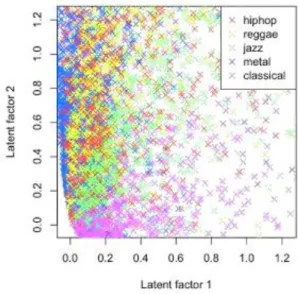
Figure 2 - Collaborative Filtering at Spotify (Bernhardsson, 2013)
The example above illustrates that latent factors might correspond with human assumptions like music genre. As the graph shows, the two latent factors separate classical music well from the others, however the other genres are not clearly separated.
In addition to describing items, these factors can also be applied for users. In this case, each factor measures how much the user like the item that score high on the corresponding factor. It captures the user’s overall interest in the item’s characteristics. Matrix factorisation models map both users and items to a joint fact space, whereas user-item interactions are modelled as inner products in that space. The resulting dot product is
captures the previously mentioned interrelationships between users and items. This approximates the rating matrix leading to the following estimates:
Where
● pu indicates how much user likes f latent factors
● qi measures how much one particular item obtains from f latent factors
The dot product of the two gives the approximation on the u user’s taste on i item. Matrix factorisation is known as one of the most successful realizations of latent factor models and can produce better accuracy than classic nearest neighbour methods when dealing with
19 | product recommendations because of the incorporation of additional information such as implicit feedback and temporal effects (Guan et al, 2016).
4.2 Principal Component Analysis
Principal Component Analysis (PCA) is a factorisation method which can be applied in terms of a collaborative filtering approach.
PCA is a statistical technique for dimensionality reduction which identifies the correlated variables and the linearly uncorrelated Principal Components in a given dataset. The components are orthogonal and each of them is linear combinations of the input variables, which account for as much of the remaining variation as possible. The PCs are ordered based on how much variance they can explain from the total variance.
Although PCA is a powerful technique, it does have important limitations. First of all, PCA relies on the empirical data set to be a linear combination of a certain basis (Amatriain et al, 2011; Nagarnaik and Thomas, 2015). However, most real world data requires nonlinear methods in order to perform tasks that involve the analysis and discovery of patterns
successfully. For non-linear data, generalizations of PCA have been proposed, such as Kernel
PCA (Mika et al, 1999). Kernel PCA extends conventional PCA to a high dimensional feature space using the “kernel trick” which makes it possible to extract nonlinear principal components without expensive computation (Leeuw, 2006).
The second assumption of PCA is that, the data has been drawn from a Gaussian distribution (unimodal) (Rummel, 1970). In case this assumption does not hold and the data is drawn from a multi-modal Gaussian or a non-Gaussian distribution, there is no warranty that the principal components are the best estimator anymore (consistent, unbiased, efficient...). (Pearlmuttery and Parraz, 1996; Tellinghuisen, 2008) Moreover, the strongly predictive information may lie in directions of small variance, which gets removed by PCA.
Even though PCA has some limitations, there are systems which rely on this technique. Goldberg et al, 2001 proposed an approach to use PCA in the context of an online joke recommendation system. Wang et al also employs PCA data reduction technique to dense the movie population space using a hybrid approach with k-means clustering and genetic algorithms (Wang et al, 2014).
20 | Recent trend shows greater interest in supervised dimensionality reduction techniques (e.g. distance metric learning algorithms) which retain keeping features useful for the specific task. PCA can produce interesting insights of the data but may not be as powerful as Singular Value Decomposition, Alternating Least Squares or Non-Negative Matrix Factorisation techniques.
4.3 Singular Value Decomposition
PCA is not the only matrix factorisation method used for collaborative filtering. A particular realization of the Matrix Factorisation approach is the Singular Value Decomposition (SVD), which is related to PCA. The aim of SVD is to find a lower dimensional feature space where the new features and the weight of each features can represent the original data points. Recently, SVD models have gained popularity, thanks to their attractive accuracy and scalability, for example see (Zhou et al, 2015; Ricci et al 2011; Guan et al, 2016; Mori et al, 2016)
SVD factorises a matrix into three matrices: U, Σ, and V such that
Where
● A is a M x N matrix
● U is an M x M orthonormal matrix, whose columns are called left singular
vectors.
● Σ is a diagonal matrix with nonnegative diagonals in descending order, whose
diagonals are called singular values,
● V is an N x N orthonormal matrix, whose columns are called right singular
vectors.
The aim of SVD is to derive an estimation of data matrix A by low-rank matrix . The matrix provides the best lower rank approximation of the original matrix A, in terms of Frobenius norm. This can be obtained by reducing the diagonal n x n matrix and keep only the first k largest values to obtain a smaller Σ nxn matrix, and also reduce the U and V matrices accordingly. After that, the reconstructed matrix
21 |
, is the closest rank-k matrix to A.
In addition to the derived estimation, SVD also provides both signal enhancement and noise suppression. Various studies have pointed out (Porsani et al, 2010; Shiau et al, 2007) that the low-rank approximation of the original space is better than the original space itself due to filtering out of the small singular values that introduce “noise” in the data.
Apart from noise, another important challenge is the sparsity of the ratings matrices For example, the density of the famous Netflix and Movielens data sets are 1.18% and 4.61%, respectively, which means that only a few elements are rated while most of them are unknown (Guan et al, 2016).
In terms of recommender systems, the matrix A may represent the rating matrix, the previously mentioned set where users are rows, movies are columns, and the individual entries are specific ratings. Once the SVD is performed, it is possible to predict a rating by looking up the entry for the appropriate user/movie pair in the matrix .
Applying SVD in the collaborative filtering domain requires factoring the rating matrix. The conventional SVD is undefined in case the matrix is incomplete. Earlier systems relied on various imputation techniques to fill in the missing ratings and make the matrix dense. However, the imputation significantly increase the size of the matrix. Hence the computation of a general SVD grows with the number of users and products it can be challenging to compute on non-sparse imputed matrices.
As a result, recent works suggested modelling the observed ratings only, without the need of imputation. The initial version of this approach in the context of the Netflix Prize was presented by Simon Funk in his Try This at Home blogpost (Funk, 2006).
“SVD of ginormous matrices is... well, no fun“ (Simon Funk)
The decomposition of the sparse matrix is done by using an iterative approach to minimize the loss function.
To learn the factor vectors (pu and qi), the system minimizes the regularized squared error on the set of known ratings:
22 |
The above cost function is the Mean Square Error (MSE) distance measure between the original rating matrix and the approximated matrix. This minimization problem is usually solved with Stochastic Gradient Descent (SGD), Bias Stochastic Gradient Descent (B-SGD) (Aberger, 2014), Alternating Least Square (ALS), or Weighted Alternating Least Square
(W-ALS) technique (Zhou et al, 2008). All these algorithms are scalable and can be run on
distributed Hadoop system (Gemulla et al, 2011)
Stochastic Gradient Descent (SGD) computes a parameter update for each training example
and .
It modifies the parameters by a magnitude proportional to in the opposite direction of the
gradient, yielding :
The importance that SGD computes a parameter for each training example is a crucial property of this method. Instead of looping over every single training case like gradient descent, SGD provides a more computationally cost efficient method. It takes out such complexity as it depends only on one instance selected randomly.
However, one of the issues with this method is that it can lead to some serious over-fitting of our data and in order to solve this problem, we can try and regularize our SVD stochastic gradient descent method. To prevent overfitting during the optimization process of minimising the squared error of the real rating and the estimated rating matrix, a common technique is to use Tikhonov regularization to transform the low rank approximation problem into the following:
23 |
The lambda term is used for regularizing the model such that it will not overfit the training data. Exact value of the parameter λ is data-dependent and determined by cross validation. The resulting model will not be a true SVD of the rating matrix, as the component matrices are no longer orthogonal, but tends to be more accurate at predicting unseen preferences than the unregularised SVD.
4.4 Limitations of most optimization algorithms
The previous regularised cost function contains m users and n items. For a typical application, m * n can easily reach a few billion. This huge number of terms is limiting for most direct optimization techniques such as stochastic gradient descent. This lead us to the Hu et al (2008) suggested alternative efficient optimization process the Alternative Least Squares optimization problem, which works in the same way as the SVD stochastic gradient descent
algorithm excluding the fact that it keeps rotating between fixing the and the . ALS
holds either the item vectors fixed or the user vectors fixed, therefore the cost function
becomes quadratic so its global minimum can be readily computed. Pseudo steps for minimising the cost function:
1. Initialize matrix
2. Hold the user vectors fixed and solve the quadratic equation for the item
vectors.
3. Hold the item vectors fixed and solve the quadratic equation for the user
vectors.
4. Repeat Steps 2 and 3 until a stopping criterion is satisfied.
One important difference is that at each step the algorithm finds the exact minimum; without taking small steps in a downward direction. A single iteration generally moves much further than an iteration of a gradient descent algorithm, therefore it needs fewer iterations for convergence.
Since the system computes each qi independently of the other item factors and computes each p j independently of the other users and other user factors, this gives rise to the possibility of massive parallelization of the algorithm.
24 |
4.5 Additional challenges and solutions
4.5.1 Biases
The previously introduced user rating bias problem can be also taken into account in matrix factorisation. The idea behind modelling bias is that the rating itself contains two elements, the user bias and the normalised rating.
Where:
- rating - user bias of user u
- normalised rating
It applies to the matrix factorisation similarly:
Where
- item bias of item i
User and item biases can be directly applied to the ALS algorithm minimisation problem, modifying the formula as follows:
4.5.2 Temporal dynamics
Ratings may be affected by temporal effects. Customer preferences for products are drifting over time. An example has already been detailed earlier about the most visited news article, and how the information value is decreasing over time. User preferences for items can constantly change as new items arises and old items fades out. In addition to the changing
25 |
item set, customer taste is also evolving, leading them to ever redefine their taste. Therefore, modelling temporal effects can improve accuracy significantly. One may think about seasonal effects: different items are interesting for users before Christmas or during the summer holiday season. The rating predictions are manifested by the fact that item bias or user preferences will not be a constant but a function that changes over time. Hence the bias and user preferences become time-dependent.
4.5.3 Synonymity
Synonymy is the tendency of having similar items with different entities or names. Most recommender systems may find it challenging to make distinction between closely related items or even the same item just with another entity. Synonymy would make items that are highly related to seem dissimilar if they use a different set of synonyms. This set can be name itself, item description, item tags or any documents related to the description of the item. As Singular Value Decomposition maps related items into topics, it is also able to deal with the problem of synonymy (words with the same or similar meanings) and polysemy (words with multiple meanings). Using SVD, documents can be indexed with a smaller set of dimensions instead of all the words in the dictionary.
Collaborative Filtering systems usually find no match between the two terms to be able to compute their similarity. Different methods, such as automatic term expansion, the construction of a thesaurus, and SVD, especially Latent Semantic Indexing (LSI) are capable of solving the synonymy problem.
LSI, also named as latent semantic analysis (LSA), is an extension to the traditional vector based document representation. One form of vector representation has already been shown earlier, the TF-IDF technique. LSI using this term-document matrix (m x n values, whereas m represents the unique terms and n is the different documents) to perform SVD.
As it was shown before, the SVD maps this term-document matrix (A) into a USVT, where U is
called as the term-concept matrix, S the singular values and V is the computed document-concept matrix. The further steps are the same as shown before, reducing the rank of the matrices S and U by a chosen k.
26 | Where is an n × k matrix including the original n documents in their LSI representation as k dimensional vectors.
LSI tries to overcome the existing problems of the vector space model by identifying semantic association between words, which can improve synonym handling. The performance of LSI in addressing the synonymy problem is impressive at higher recall levels where precision is ordinarily quite low, thus representing large proportional improvements. However, the performance of the LSI method at the lowest levels of recall is poor (Deerwester et al, 1990). The shortcoming of these methods is that some added terms may have different meanings from what is intended, which sometimes leads to rapid degradation of recommendation performance. Alternative to LSI is based upon a different type of probability model of document generation which is called Latent Dirichlet Allocation (LDA), introduced by Blei et al, (2003). LDA is a probabilistic topic model, where each item of a collection is modeled as a finite mixture over an underlying set of topics. In the context of text modeling, the topic
probabilities provide an explicit representation of a document. LDA can also be interpreted
as matrix factorization where document over keyword probability distribution can be split into two different distributions: the topic over keyword distribution, and the document over topic distribution.
Both LDA and LSA techniques allow us to find a low dimensional representation for a set of documents with regard to the simple term by document matrix and capable of dealing with
27 |
5 Chapter 5
The following chapter describes the taxonomy of Hybrid recommender systems meanwhile presenting and evaluating the differences in the various design approaches. The chapter concludes with experimental results.
5.1 Hybrid recommenders
Hybrid recommender systems combine two or more recommendation techniques to gain better performance with fewer of the drawbacks of the individual components.
The most common is to combine collaborative filtering with some other techniques, in an attempt to avoid specific issues, like cold start problem. For instance, we have seen that both content-based filtering and collaborative filtering have their own strengths and weaknesses. A system that combines these two techniques can take advantage from both the presentation of the content and the similarity among users.
Although, this hybridization process can follow different approaches. According to Burke’s (2012) taxonomy about recommendation paradigms and hybridization designs, three notable hybridization design strategies can be distinguished; parallelized hybridization, pipelined approach and monolithic designs. The following sections gives a comprehensive overview about the main elements of various designs, based on Burke’s work.
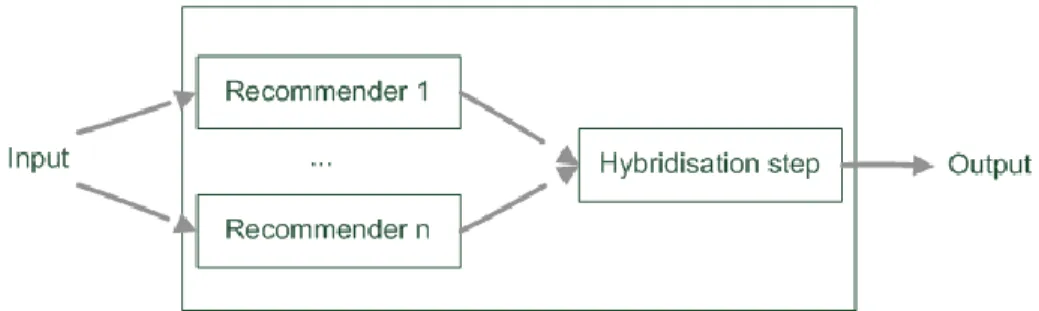
5.1.1 Parallelized hybridization
The parallelized hybridization design employ several recommenders side by side and employ a specific hybridization mechanism to aggregate their outputs.
28 | This aggregation is a post-processing step, thus one may say that parallelized design is the least invasive hybridization technique. Three strategies can be further specified within the parallelization: weighted scheme, switching technique or mixed strategies. The difference between these parallel approaches is the way hybridisation unites the output of the isolated recommenders.
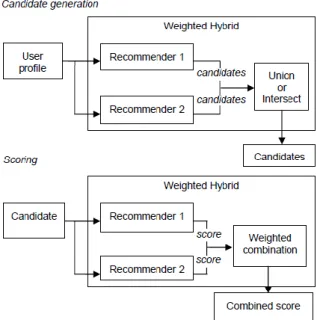
5.1.1.1 Weighted scheme
A weighted scheme combines the predictions of two or more recommender systems by computing weighted sums of their respective scores.
Figure 4 – Weighted scheme (Brusilovsky et al, 2007)
In order to estimate weights, one may use an ensemble learning techniques like bagging or any other empirical bootstrapping methods to gain the optimal combination of the recommenders.
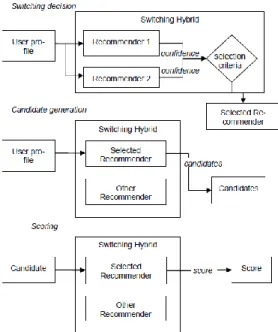
5.1.1.2 Switching technique
The second strategy - the switching technique - requires an oracle that decides which recommender’s output should be favoured in specific scenarios, depending on the user profile and or quality of recommendation results.
29 | Figure 5 – Switching technique (Brusilovsky et al, 2007)
For instance to overcome the cold/start problem a knowledge based and collaborative switching hybrid could initially make knowledge based recommendations until enough rating data are available.
5.1.1.3 Mixed strategies
The third strategy within the parallelization is the mixed hybrid approach, whereas the results of various recommender systems are combined at the level of the user interface, in which the results from different techniques are presented along each other.
30 | Thus the recommendation result for user u and item i is a set of tuples, representing the score of each constituting recommenders.
5.1.2 Pipelined approach
The second type of hybridization is the pipeline approach. In this strategy, the different recommender systems are placed into a pipeline. This implementation follows stages whereas the techniques are sequentially combined and the last module generates the final recommendations.
Figure 7 – Pipelined approach (Brusilovsky et al, 2007)
As with the parallelized approach, the pipelined approach also has further variants similarly to the parallelized approach, namely the cascade and the meta-level strategies.
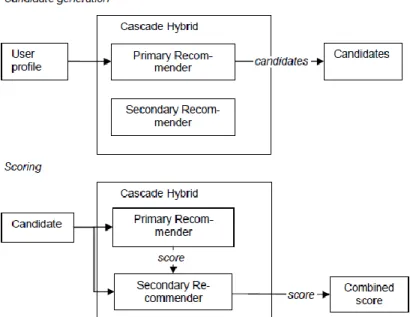
5.1.2.1 Cascade hybrids
Following the cascade logic, the recommender component n, is limited to items that were also recommended by the preceding recommenders.
31 | For this reason, the following component cannot add new items to the list, but can exclude items. In case the sequential order is changed and the components remained unchanged, it will not have any effect on the final recommended list of items. However, it can introduce some changes in the ordering of the list of recommended items as it solely depends on the last technique. This is a crucial attribute as the system can help in reducing the overall variance since the possibly overfitted items would fall out from the chain. Although this is a trade-off between variance and bias, as a bad performing component which contains erroneous assumptions in the learning algorithm will introduce a significant bias in the overall system’s recommendation capability.
Meta-level hybrids
In a meta-level hybridization design, one recommender builds a model that is exploited by the principal recommender to make recommendations. A typical use for meta-level hybrids can be a CB recommender that builds user models based on weighted term vectors, and a CF identifies similar peers based on the previous results from the CB results but makes recommendations based on ratings.
32 |
5.1.3 Monolithic design
Whereas the parallelization and pipeline approach consist of two or more components whose result are combined in a certain way, the monolithic hybridization implements only one recommendation system.
Figure 10 – Monolithic hybrids (Brusilovsky et al, 2007)
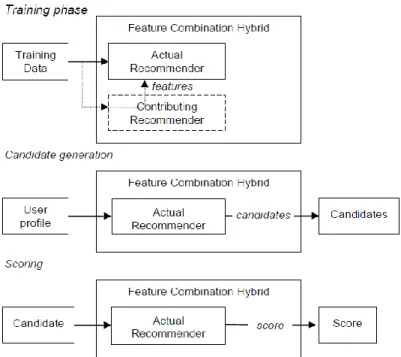
The monolithic approach integrates aspects of different recommenders’ strategies into a single algorithm. The hybridization is "virtual" in a sense that features/knowledge sources of different paradigms are combined. Monolithic design use only a single recommender system that integrates multiple approaches by pre-processing and combining various knowledge source like ratings and user demographics or explicit requirements into one learning algorithm. The hybridization is achieved by a built-in modification of the algorithm to exploit different types of inputs.
5.1.3.1 Feature combination hybrids
33 | Feature combination techniques combine various features like users’ rating data with content features of catalogue items, enabling the system to identify new hybrid features.
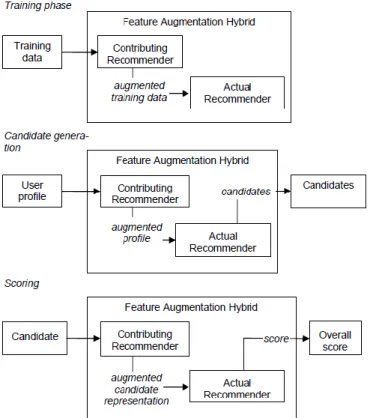
5.1.3.2 Feature augmentation hybrids
Figure 12 – Feature augmentation hybrids (Brusilovsky et al, 2007)
Feature augmentation is another approach for integrating several recommendation
algorithms. This design technique does not simply combine and pre-process several types of input but also applies more complex transformations during processing. The output of a contributing system augments the feature space of the actual recommender by pre-processing its knowledge sources. This technique is more flexible and adds fewer dimensions than the feature combination method.
5.1.4
Hybrid System Experiments
The hybrid recommendation approach can provide synergistic improvement compared to simple basic recommendation algorithms.
According to the experimental results; hybrid systems showed dominance over basic recommendation systems. This synergy was found under situations like with smaller session
34 | size, sparse recommendation density. This result means that hybridization can conquer cold start problem which was innate for some basic recommendation systems.
The study of Burke (2002) showed this synergy. Aslanian et al (2016) also proved that their proposed hybrid solution could better deal with the cold-start problem than the state-of-art algorithms. Wei et al (2017) empirically tested that tight coupling of CF approach and deep learning neural network is feasible and very effective for cold start item recommendation. Zhitomirsky-Geffet, et al (2017) also developed a hybrid approach by combining two or more traditional similarity metrics such as Pearson correlation, log-likelihood and Tanimoto coefficient to tackle several well-known problems including cold start item recommendation. Several other studies have also been conducted hybrid recommendation experiments and proved the effectiveness improvement of hybrid systems.
35 |
6 Chapter 6
6.1 Challenges
Today, several recommender systems have been developed for different domains however, they are not precise enough to fulfil the information needs of users. Therefore, it is necessary to build higher quality recommender systems. In designing such recommenders, designers face several issues and challenges that need proper attention. The following section highlights the main issues and challenges and presents new research papers and solutions towards fine-tuned and high-quality recommender systems.
6.1.1 Cold start
The cold-start problem was already mentioned in the section of CB recommenders and CF methods. This challenge can be divided into two categories; cold-start items and cold-start users. The problem arises when a new user or a new item has been added to the system. In case that happens a traditional collaborative algorithm cannot recommend a new item to the users until some users rate it and also, new users are unlikely to be given good recommendations, due to the lack of their rating or purchase history.
Various approaches have been developed to mitigate this problem. Most of the solutions focus on, or are related to the sparsity issue, hence they are presented together in the next section.
6.1.2 Sparsity
The sparsity problem is closely related to the cold start problem and most of the proposed solutions address both challenges.
Sparsity arises from the fact that most of the online systems contain thousands or millions of items and even the most active users will only rate a few of the total number of available items. The rating data then contains only minimal number of pairs between item (I) and user (U), making the utility matrix sparse. High sparsity creates enormous challenge to achieving high quality recommendations, as well as to the number of predictions that the systems is able to compute.
36 | The possible number of item predictions can be measured with the coverage metric, which is defined as the percentage of items that has been rated and the percentage of items that each algorithm could provide recommendations for. As nearest neighbour algorithms rely on exact matches, the result is poor coverage and accuracy.
Several methods have been introduced to address the cold start and the data sparsity problems. Most of the proposed methods to address item cold-start adopt content-based approach; they utilize the content of new items in order to identify similar user profiles and subsequently recommend these new items to them.
Content supported hybrid CF algorithms can address the sparsity problem as they do not rely solely on user ratings. These approaches often use external content information which can be used to produce predictions for new users and items.
Yuan et al (2016) propose a deep learning based matching algorithm to solve cold-start and sparsity problems in CF based recommendation systems without major changes in the existing system. Jian Wei et al developed a similar approach, using a hybrid recommendation model to address the cold start problem, which explores the item content features learned from a deep learning neural network and applies them to the time SVD++ CF model. Kim et al (2012) published a paper about hybrid recommenders based on user similarity and content boosted recommenders used in conjunction with interaction-based collaborative filtering to address the cold start and sparsity problems in this domain.
External information can also be related to the user, external social information. Shaghayegh
et al (2011) presented a solution which use social networks’ information in order to fill the
gap and detect similarities between users. In this community based solution, features were extracted from different dimensions of social networks to help recommendation systems in solving cold-start problem based on the found latent similarities. Li and Tang (2016) investigated how to provide a recommendation to a new user, based on a previous group of user opinions, by utilizing techniques from social choice theory. Social choice theory has developed models for aggregating individual preferences and judgments, so as to reach a collective decision. In socially aware systems, user benefit from their trust and connections with others as they can find other peers, those who they trust. Pitsilis and Knapskog (2012) demonstrated an approach which used trust to exploit the latent relationships between users.
37 | In this way, the opinions of distant participants can be discovered and used by users who do not need to be known to each other.
6.1.3 Diversity and serendipity
Accuracy is a crucial part of recommender systems but chasing the accuracy curve may not always be the right call. In the recent years, the focus of RS research has shifted to such objectives as ensuring the suggested items are novel and the recommended population is diverse. In a real life system people tend to like divers recommendations which help them to discover something relevant but not expected. Therefore it is crucial to make sure set of recommended items are as interesting and engaging as possible.
Increasing serendipity can be the key to increase novelty and positive discovery from the users. The meaning of serendipity can be described as “happy and unexpected discovery by accident” (Kaminskas and Bridge, 2014, p.1), originated from the 18th century. Serendipity can be described as a surprise, delight in a sense that something unexpected resulted. It is commonly agreed that serendipity consists of two components – surprise and relevance. Meanwhile relevance is fairly easy to measure user ratings or any other feedback from the users, surprise of recommendations is difficult to capture, as the notion of an item being unexpected is difficult to measure without explicitly asking the users for their opinion. There are several formulae which try to capture and quantify serendipity itself. The key concept is the need of prior primitive estimate of obviousness, one such metric that represents overall popularity of an item. Intuitively, by downgrading items that are highly popular, one can increase serendipity. Therefore our intuition would say that an increase in serendipity will lead to higher diversity. On the other hand, correctness dictates more constraint which leads to a decrease in serendipity.
The results of Kaminskas and Bridge (2014) validate the former intuition that a MF approach which tends to provide more accurate suggestions leads to less surprising ones, meanwhile a user-based neighbourhood approach performs better in terms of surprise. (Murakami et al, 2008)