The relationship between
subordinated debt,
contingent capital and
risk-taking behaviour
Evidence from U.S. commercial banks
Master’s Final Assignment presented to Católica Porto Business School to obtain a master’s degree in Finance
By
José Maria de Siqueira de Almeida Soares Franco
under the guidance of Prof. Dr. Ricardo Miguel Martins da Costa Ribeiro
Católica Porto Business School April, 2018
Acknowledgments
I would like to thank my parents, José Maria Soares Franco and Margarida Maria Soares Franco for their kindness, affection and all the support they provided me while performing this work. Their testimony of justice, faith and hard-work have been proved crucial not only in my professional career but also in personal life.
Then, to my supervisor, Mr. Ricardo Ribeiro, who guided me in this work through almost one year, having shown outstanding availability and willingness even in the hardest of times.
Finally, I am grateful to my family, my girlfriend and friends who have always supported me during my entire life.
Abstract
The recent financial crisis and its consequent distortions have raised a lot of issues regarding the safety of the financial system. One of its triggers was the excessive risk-taking behaviour that commercial banks have been taking since the 80’s which boomed from 2000 on. Regulatory proposals including subordinated debt have been increasing since the last quarter of 20th century for it provided more direct market discipline. Contingent capital became the focus after capital requirements took place, especially with the Basel III Accord.
This thesis proposes to examine whether subordinated debt and contingent capital, are able to refrain the risk-taking behaviour of both too-big-to-fail and non-too-big-to-fail banks. I test the hypothesis that subordinated debt has a negative impact on risk-taking behaviour of non-too-big-to-fail banks and no impact on too-big-to-fail banks. In addition, I test the hypothesis that contingent capital has a negative impact in both non-to-big-to-fail and too-big-to-fail banks. I estimate the impact of subordinated debt and contingent capital on risk taking-behaviour using a sample of US commercial banks from 1996 to 2013. I also include some observed features as controls. Finally, I use instrumental variables techniques.
Findings suggest that subordinated debt has a negative impact on risk-taking behaviour of non-to-fail banks. The impact is also negative for too-big-to-fail banks. No statistically significant evidence was found about the impact of contingent capital on either non-too-big-to-fail or too-big-to-fail banks. However, these results must be seen carefully for they might be biased due to instruments correlation with the explained variable. They were corroborated by the robustness check.
Resumo
A recente crise financeira e suas consequentes distorções levantaram muitas questões relativas à segurança do sistema financeiro. Uma das causas foi o excessivo comportamento de risco que os bancos comerciais têm vindo a tomar desde os anos 80, que explodiu a partir de 2000. Propostas regulatórias, incluindo dívida subordinada, têm vindo aumentando desde o último quarto do século 20, pois proporcionam uma disciplina mais direta do mercado. O capital contingente tornou-se o foco após a introdução dos rácios mínios de capital, especialmente com o Acordo de Basileia III.
Esta tese propõe examinar se dívida subordinada e capital contingente, são capazes de conter o comportamento de risco de bancos não big-to-fail e too-big-to-fail. Testarei a hipótese de que a dívida subordinada tem um impacto negativo no comportamento de risco dos bancos não too-big-to-fail e nenhum impacto nos bancos too-big-to-fail. Testarei também a hipótese do capital contingente ter um impacto negativo nos bancos não too-big-to-fail e too-big-to-fail.
A estimação do impacto da dívida subordinada e do capital contingente no comportamento de risco será feita usando uma amostra de bancos comerciais dos Estados Unidos de 1996 a 2013. Incluirei também outras características observadas como controlos. Usarei ainda a técnica de instrumentos variáveis.
Os resultados sugerem que a dívida subordinada tem um impacto negativo no comportamento de risco de bancos não too-big-to-fail. O impacto também é negativo para too-big-to-fail. Nenhuma evidência estatística foi encontrada sobre o impacto do capital contingente em bancos não too-big-to-fail e too-big-to-fail. No entanto, os resultados devem ser vistos com cuidado, pois podem estar enviesados devido à correlação dos instrumentos com a variável explicada. Esses resultados foram corroborados por um teste à robustez.
Palavras-chave: Dívida Subordinada, Capital Contingente, Comportamento de Risco
Table of Contents
Acknowledgments ... iii Abstract ... v Resumo ... vii Table of Contents ... ix List of Figures ... xiList of Tables ... xiii
1. Introduction ... 16
2. Literature Review ... 20
2.1. Subordinated debt and contingent capital as regulation instruments ... 20
2.2. The Basel Accords ... 20
2.3. Subordinated debt ... 21
2.4. Contingent capital ... 28
3. Concepts and theoretical framework. ... 36
3.1. Concepts ... 36
3.2. Economic theory predictions ... 37
4. Methodology. ... 40
4.1. Model specifications ... 40
4.2. Data and variables ... 41
4.3. Econometric issues ... 45 5. Empirical application. ... 49 5.1. Data decription ... 49 5.2. Preliminary analysis ... 50 5.3. Estimation results ... 53 6. Robustness check. ... 59 6.1. Data decription ... 60 6.2. Preliminary analysis ... 61 6.3. Estimation results ... 63
7. Conclusion. ... 68
8. References. ... 71
List of Figures
Figure 1: Preliminary analysis of the impact of SND/RWA on EV ... 51
Figure 2: Preliminary analysis of the impact of CD/RWA on EV ... 52
Figure 3: Preliminary analysis of the impact of SND/RWA * TBTF on EV ... 52
Figure 4: Preliminary analysis of the impact of CD/RWA * TBTF on EV ... 52
Figure 5: Preliminary analysis of the impact of SND/RWA on LPD90D/TA ... 61
Figure 6: Preliminary analysis of the impact of CD/RWA on LPD90D/TA ... 62
Figure 7: Preliminary analysis of the impact of SND/RWA * TBTF on LPD90D/TA ... 62
Figure 8: Preliminary analysis of the impact of CD/RWA * TBTF on LPD90D/TA ... 63
List of Tables
Table 1: Summary statistics of the main model ... 49
Table 2: Estimation results of the main model. ... 54
Table 3: Summary statistics of the robustness check model ... 60
Chapter 1
Introduction
The financial system has perhaps faced no greater challenges than those it faces today. In fact, the number of financial institutions collapses had been increasing through the 20th century until it exceeded the thousand per year in the 90s which harmed many economic players and sometimes tax payers who had to absorb losses in case it was a too-big-to-fail bank that needed state intervention. Therefore, observers and regulators began to seek ways of making the financial system self-regulated in order to prevent future undesired events.
Following this argument, subordinated debt arose as the main driver capable of refraining risk incentives and excessive risk taking, for providing both direct and indirect discipline and for its intrinsic features (high sensitivity to changes in banks assets’ risk, monitoring incentives and long maturity) and easy implementation. If investor worsen their perception of the bank’s risk, the price of subordinated debt increases in the market. Economic theory, thus, predicts that subordinated debt has a negative impact on bank risk taking.
However, in the case of too-big-to-fail banks, investors are much less worried about failure scenario, since they know that the bank would be rescued by the government if it approaches insolvency. This would have an impact on subordinated debt pricing and thus prevent market discipline. Subordinated debt, then, is not expected to have any impact on bank risk taking. I test the hypothesis that subordinated debt has a negative impact on risk-taking behaviour of non-too-big-to-fail banks and no impact of too-big-to-fail banks.
Contingent capital discussion emerged from recent developments on proposals and regulations regarding the capital adequacy. Since Basel I in 1988,
17
regulators impose minimum capital ratios to financial institutions. The aim of this policy is to keep banks away from a failure zone. Contingent capital is any type of security that assumes the shape and behaviour of a debt instrument that converts into capital under pre-determined conditions. This way, it is clear that it would perfectly fit the purpose of capital adequacy given that whenever capital ratios are at stake, debt converts into capital (and debt holders convert into equity holders). The prediction regarding the impact of contingent capital on risk taking depends on the features of the security itself, especially the conversion ratio (that indirectly defines the price of shares in case of conversion). Nevertheless, for either non-too-big-to-fail or too-big-to-fail banks, contingent capital is expected to lower the riskiness of their assets. Therefore, I test the hypothesis that contingent capital has a negative impact in both non-to-big-to-fail and too-big-to-fail banks.
This thesis proposes to examine the impact of subordinated debt and contingent capital on the risk-taking behaviour in too-big-to-fail and non-too-big-to-fail banks. To do so, I estimate the impact of subordinated debt and contingent capital on risk taking-behaviour using a sample of US commercial banks from 1996 to 2013. The estimation equation uses a measure of bank risk taking (earnings volatility) as explained variable, a measure of subordinated debt and contingent capital (ratio of Subordinated Notes and Debentures to Risk-weighted assets and the ratio of Convertible debt to Risk-weighted assets respectively) and a set of controls (logarithm of total assets, demand deposits ratio, debt-to-equity ratio and loan loss provision ratio).
To do so, I will use instrumental variables techniques while controlling for bank and period fixed effects. I will use two measures for risk-taking behaviour: the earnings volatility and the ratio of loans past due 90 days to total assets.
According to the estimation results, subordinated debt has a negative (and statistically significant) impact on bank risk-taking behaviour of
non-too-big-to-fail banks. The results also point out a negative relationship between subordinated debt and risk-taking behaviour of too-big-to-fail banks. Thus, the results match the theory only by half (it stated that no impact should occur only on risk-taking behaviour of too-big-to-fail banks). Regarding contingent capital, findings suggest no impact on risk-taking behaviour of both non-too-big-to-fail and too-big-to-fail banks.
The thesis is organized as follows: chapter 2 provides a literature review, in which I resume all relevant contributions from preceding authors and regulatory developments; chapter 3 provides the main concepts I use in this work and a deeper analysis over theory predictions; chapter 4 includes the model specifications, data and variables and eventual econometric issues; chapter 5 presents the estimation results with earning’s volatility as explained variable while chapter 6 presents a robustness check with the ratio of loans past due 90 days as explained variable. Chapter 7 concludes.
Chapter 2
Literature Review
2.1. Subordinated debt and contingent capital as regulation
instruments
Subordinated debt and contingent capital are the focus of recent empirical and theoretical studies regarding risk-taking behaviour in financial institutions. In fact, the riskiness and eventual collapse of banks (especially too-big-to-fail banks – hereafter TBTF) have been concerning regulators who seem reluctant to let them fail (Flannery 2016). These two instruments provide different regulation tools: while subordinated debt has been discussed to be a source of market discipline (Flannery & Sorescu 1996), contingent capital, in its turn, could help financial institutions remain well capitalized (Flannery 2016; Flannery 2014) or avoid government rescues (Hilscher & Raviv 2014).
2.2. The Basel Accords
The Basel Accords were a set of three bank regulations proposed by the Basel Committee of Bank Supervision whose main goal was providing financial institutions and regulators with recommendations regarding the capital, market and operating risk. These accords were ratified by more than 100 countries.
The first agreement (hereafter Basel I) was issued in 1988 and focused mainly on capital adequacy and minimum capital requirements. According to the riskiness of their assets, banks were ranked into categories and legislation prevented those with 8% (or less) risk weight from operating internationally. The Basel I was enforced law by G10 in 1992. The second agreement (hereafter Basel II) was published in 2004 and it is perhaps the document that matters the most
21 for my article. It is based on three pillars: capital adequacy requirements (already discussed in 1988), supervisory review and market discipline, although the articulation of these pillars is not clear (Decamps et al, 2004). Nevertheless, these authors have shown that, under some circumstances, it is possible to combine efforts so that capital adequacy (which literature assumes as the goal of contingent capital) could be achieved in the presence of market discipline (which the literature assumes as a result of subordinated debt in banks’ capital structure). The Basel II triggered the need for contingent capital as it included a more strict legislation regarding minimum capital requirements. Following the failure of Lehman Brothers, the third agreement (hereafter Basel III) was signed in 2009 and published one year later and relied mainly on credit risk. Basel III also proposes measures to deal with distressed banks.
Together with other regulation acts (such as FDIC, mentioned earlier in this section) the Basel Accords were the recognition of the financial system complexity and, more importantly, the danger it represents to the world economy when regulation does not do a proper work. Regarding commercial banks, such legislation developments were as either the great exponent of or the trigger to authors who focused on subordinated debt and contingent capital role.
2.3. Subordinated debt
Regarding subordinated debt, Blum (2012) was concerned about the high costs taxpayers absorb whenever a bank needs state intervention (Blum, 2002), not only because the government channels tax revenues to something that does not benefit them directly but also due to the lack of trust in the financial system that arises in the event of rescue. Thus, a self-regulating tool that prevents banks from failure has been discussed by several authors. According to Blum (2012), the most consensual way is to increase market discipline and thus reduce the costs of
safety nets) through requiring a minimal amount of subordinated debt issuance by banks. Blum (2012) defines subordinated debt holders as the first to bear the losses of risky investments while they do not benefit from eventual gains (on opposite to shareholders). The only way to attract such investors is to remunerate them by assigning a premium as compensation for the high risk they run.
Blum’s (2012) worries about banks’ failures and its consequences are shared by many other authors. The US history was free of any kind of bank regulation until 1933, when the Banking Act took place, in part to mitigate the damage of 1929’s crisis and in part to regulate the financial system. The Banking Act created FDIC (Federal Deposits Insurance Corporation) which is an US government corporation in charge of supervisory and whose main activity is to provide deposits insurance to depositors. Later, in the 80´s, the regulation’s argument changed a little bit: instead of a system which is regulated by a neutral institution, economists and observers proposed the use of subordinated debt to increase market discipline. These new regulatory issues (regarding market discipline) became effective with the FDICIA (FDIC Improvement Act) in 1991.
Kwast et al. (1999) formed an extensive analysis to the proposals of the 80’s. They subdivided them into 3 categories (according to content and time). The first set of proposals saw subordinated debt as a tool to increase bank’s costs with the increase of its risk. The second category arose when subordinated debt started to be seen as a signal to the market of the bank’s solvency – the easier the bank can issue risky debt, the more solvent it is. The third set was provided by Calomoris (1999) – he predicted a way in which banks that fail to issue subordinated debt under a certain rate cap, would be somehow penalized, by shrinking 1/24 per month (to see more details, consult his work). Kwast et al. (1999) also presented a detailed table of several proposals according to the category they are included in.
23 Subordinated debt is usually mentioned when market discipline is the subject. There is some consensus about its advantages overcoming its disadvantages. Firstly, it provides two sources of market discipline - Blum (2002); Goyal (2005); Nguyen (2013) - both direct and indirect. Direct market discipline occurs through subordinated debt holders’ monitoring the bank’s business - whenever the bank increases the riskiness of its assets (and thus investors’ perceived risk), they respond by increasing the costs of a new subordinated debt issuance – which makes banks’ financing harder and costlier. Indirect discipline occurs through regulators supervisory of secondary market yields. Yields of such risky debt instrument provides information about the riskiness of the whole bank itself. Information regarding the riskiness of bank’s assets is harder to obtain from banks’ financial statements or any other accounting information since they are not available on a regular basis (or at least as available as market data). Moreover, earnings manipulation can hide the true riskiness of the business. Market data, instead, reflects investors feelings and instincts which are more reliable given that they have direct interest in how the banks’ activity is run. However, there are other liabilities capable of providing both direct and indirect market discipline (for instance, uninsured certificates of deposits). Kwast et al. (1999) highlights three reasons that explain the preference for subordinated debt. Firstly, it is the debt instrument that allows investors to better perceive the risk of the bank’s business, given its price on the market - the sensitivity of subordinated debt price to the bank’s risk is by far greater than any other instrument. This risk perception takes us to the second reason: once the investor holds the instrument it has the incentive to monitor the bank’s activity, given that they bear the losses in the event of default, but they do not share the benefits of a potential upward movement of value. Finally, the long maturity of subordinated debt instruments does not require bigger banks to constantly issue debt instruments, which makes this instrument attractive to big banks who
benefit from avoiding burden issuances. Kwast et al. (1999) also points out some disadvantages, such as instability on subordinated debt secondary market in crisis periods, eventual inability of the bank to increase its capital through retained earnings (due to excessive interests) or the moral hazard incentive to increase risk after a debt issuance. Nevertheless, the subordinated debt’s pros are believed to overcome its cons after all.
Another important feature which deserves attention is the distinction between market monitoring and market influence, two different ways of market discipline, according to Bliss & Flannery (2002). Market monitoring refers to the way investors truly understand the firm’s condition and reflect it on the debt price. If a firm’s condition deteriorates, they penalize it by increasing the required yield at which the firm can issue new debt. In contrast, if they perceive an improvement in a firm’s environment, they become more willing to lend money cheaper than before. Market influence, on the other hand, refers to the ability of external stakeholders (supervisors, regulators, investors) to influence the management after an adverse event occurred. Bliss & Flannery (2002) point out that market monitoring has empirical support, meaning that firms are penalized by the market if it feels the business’ riskiness has increased. However, there is no evidence regarding the ability of market players to influence management, specially either due to asymmetric information (people from within the organization are in a better position to make better decisions) or principal-agent/conflicts of interest (shareholders and debtholders do not converge their interests in case the firm’s situation worsens – while shareholders might prefer to raise the firm’s risk, for they have little to lose and a lot to gain, debtholders fear for their position).
The most prominent studies about the market discipline of subordinated debt present diverging results, which might have happened because they relied on different data (Sironi, 2003). Earlier work was based on US banks from 1980s,
25 when market discipline did not take place (Nguyen (2013) suggests that the US Congress was keener on regulatory discretion and thus political proposals regarding market discipline did not find the necessary support) and thus the authors did not find a significant relationship between a subordinated debt measure and bank risk - Avery, Belton & Goldberg (1988) and Gorton & Santomero (1990). The measure used was the Subordinated Notes and Debentures spread which was found not to be influenced by the bank’s risk. However, more recent work, using the same approach but a broader sample (including later periods of time), was able to find a statistically relevant relationship: Subordinated Notes and Debentures spread reacted to changes in a set of bank risk measures (Flannery & Sorescu, 1996; and DeYoung et al., 2001).
The main reason for these diverging results was the regulation system in the US which substantially changed in the late 80s. Until then, government guarantees, a bailout in 1984 and a TBTF policy assured that banks remained under the regulator’s direct control. Avery, Belton & Goldlderg (1988) and Gorton & Santomero (1990) based their work on this period, when market discipline was needless. However, FDIC’s foundation in 1991 as well as a set of huge debenture holders’ losses in the end of 80 decade contributed to a new paradigm in which market discipline played a major role, while the policies of the previous period were also reverted by FDIC. Thus, it was no surprise that the relationship between subordinated debentures and risk intensified in the already mentioned studies of Flannery & Sorescu (1996) and DeYoung et al (2001).
Nguyen (2013) also described another strand of literature that suggests an indirect impact of subordinated debt on banks’ risk. As mentioned earlier in this section, this indirect impact occurs through supervisory of secondary market yields and later use of that information to effectively exercise monitoring over the riskiest banks. Thus, for these source of market discipline to work, a liquid secondary market is required as well as a good risk perception from investors.
Following this approach, Ashcraft (2006) has come to the conclusion that the ratio of subordinated debt could help distressed financial institutions recover from their desperate situation. Although he studied the impact of subordinated debt on troubled banks solely, Ashcraft (2006) pointed out an interesting issue: if a bank is in such a critical condition, its subordinated debt issuance must be strong enough to offset the negative impact of having more leverage than before the issuance (which, ceteris paribus, deteriorates its already bad risk profile). This offsetting is achieved by reducing the moral hazard between the parts, since the existence of a moral hazard problem would prevent investors from trusting distressed banks. In this case, Ashcraft (2006) expects both parts to overcome the moral hazard issue: the bank because it has incentives to reduce it (given the complicated position) and the potential investors because they protect themselves by including restrictive covenants in the issuance contract. He also tested whether there is empirical evidence supporting this theory or not and concluded positively. Another relevant study that fits the implications of an indirect market discipline did not find evidence of an effective relationship (Krishnan et al., 2005) contrasting with the work of Ashcraft (2006). Moreover, they also tested whether the issuance of subordinated debt provided preventive risk reducing (i.e. banks which know they will issue subordinated debt in a near future – one quarter - reduce the riskiness of their assets before the issuance) but again found no evidence and thus failed to find any kind of indirect market discipline.
Nguyen (2013) resumes four hypotheses in order for subordinated debt to have an effective market discipline, based on earlier work. Firstly, debtholders must have access to all the information they need to assess the bank’s risk. Otherwise they are not able to penalize a bank whose risk has increased or reward another in case it has reduced the riskiness of its investments. Therefore, the regulator has a decisive role in guaranteeing that banks report its true
27 condition. Secondly, it is essential that regulators have the authority to impose the necessary corrections upon receiving of information from secondary market, or even be given the necessary tools to prevent harmful events from occurring. Thus regulators must be provided with sufficient power to proceed with these duties. In addition, market discipline could be seriously called into question if the relationship between subordinated debt holders and the bank is not held at arm’s length or if there is any mechanism to strengthen the bank’s risk profile other than the bank itself in the case it falters. These could lead to a lack of trust in one of the parts. Moreover, more sophisticated investors work better in an environment that ensures a true and fair relationship with financial institutions. Finally, the absence of regulatory and state intervention to save distressed banks is also crucial. If investors know ex-ante that a bail out will take place in the event of default, for instance, market discipline could be seriously compromised. For these reason, subordinated debt is expected to have a little disciplinary effect on TBTF banks, whose failure entails negative consequences to the whole economy. Nguyen (2013), in his turn, assumed a different approach from the previous studies. Instead of examining whether a bank risk measure changes with changes in subordinated debt contracts yields, he chose to examine the impact of a measure of subordinated debt on a measure of bank risk – he concluded that subordinated debt exercises influence on bank risk under some circumstances and furthermore, he tested (with positive results) whether the intervention of the regulator and the existence of a legal system accordingly to the requirements of subordinated debt to discipline banks is relevant or not. In fact, the set of conditions provided above proved to be of such importance in order to allow the self-discipline system to work out.
2.4. Contingent capital
Contrasting with subordinated debt, contingent capital has not received much attention at least until very recently (the Third Basel Accord, in 2010, introduced some proposals regarding the financial system and financial institutions’ capitalization which triggered observers attention to new instruments capable of keeping banks well-capitalized). In fact, keeping banks well-capitalized could prevent them from spreading potential losses to investors (Flannery, 2016). Bank capital in the form of equity is by far the most trustful mean of absorbing losses and protect creditors from bearing the costs of a recent downfall. One might think that the issuance of new equity would solve the banks’ capitalization problem, although regulators find it difficult to force banks to issue new equity, for several reasons. Firstly because issuing equity is more expensive than issuing debt (in the US, firm’s creditors are paid before shareholders which makes the latter require a higher rate of return). Thus, based on the Pecking Order Theory (Eldomiaty et al. 2017), firms are reluctant to new equity issuances. Secondly, and following the general idea of the Pecking Order Theory, issuing equity sends a negative message to the market – investors, in the absence of any further information, realize that the new equity issuance is always the second choice and only occurs after the failing of the first one, meaning the bank is in trouble. In addition, in the case the bank is in a bad condition, shareholders are reluctant to invest more money in it by buying more equity, following the Risk-Shifting theory: Li et al. (2017). Shareholders would prefer to get into a situation where others run the risk and they benefit from an eventual upward movement. In fact, the closer the bank is to fail (and leveraging is still available), the more attractive risk investments seem to shareholders, once they have little to lose and everything to gain from them (in the unlikely scenario of success, they can
29 improve their condition and benefit from it while if things go as expected, they lose the very few they already had). Calorimis (2013) also refers the dilution costs that would arose to existing shareholders if new underpriced equity was issued. In the case the management believes that shareholders are overvalued, investors would recognize the real motivations behind the issuance and would penalize the shares price immediately after the issuance. Finally, the issuance of equity would burden the bank and shareholders with tax-inefficiency. Therefore, an instrument that prevents the bank from (or corrects) an eventual fall of equity value has been discussed since the last great financial crisis, triggered in 2008. Flannery (2016) demonstrates a type of debt that assumes the shape of contingent capital, which he defines as “debt obligations (that) would convert into common stock if the issuer's capital ratio fell below some pre-specified value”, meaning, in other words, a type of debt that converts into capital whenever the bank approaches failure. This would require debt-holders to become owners of the bank itself after the conversion is made, which in theoretical terms, is a directly and automatic replacement of debt for equity, thus bringing equity back to normal levels. What regulators seek is the safety of depositors and tax payers (i.e. they want unsecured debt holders and equity holders to absorb potential losses). By relying on contingent capital securities, they assure not only this goal but also that contingent capital holders do not get penalized by tax inefficiency.
Another main advantage of this security is that it would reduce the probability of default and does not require regulatory actions since it is a re-capitalization self-mechanism. Hilscher & Raviv (2014) also predicted a reduction of default probability if the bank issued contingent capital when compared to a subordinated debt issuance. They presented 3 scenarios of three different banks with the same amount of equity or equity equivalent, one of which consisted of a bank with equity and contingent capital, another one with equity and subordinated debt and the third one that was an all-equity bank. They
demonstrated that the all equity bank and the bank with a contingent capital issuance were those with lowest default probability. This is explained by the stabilizing effect contingent capital provides: whenever things worsens, i.e. whenever assets suffer a loss, a capital provision had been already made and thus an absorbing mean of losses is triggered. In the case of an all equity bank, absorbing mean of losses is already available. Note that subordinated debt is the least desirable of the three instruments if the bank pursues a low default probability (which indirectly depends on its risk, although it was not the goal of their study).
Nevertheless, this resolution does not benefit old shareholders who share the cost of an eventual downfall with contingent capital bondholders. Flannery (2016) describes the situation as a reduction of call option maturity over the bank’s assets. In fact, shareholders’ decision can be seen as a call option that as value, at maturity, if assets exceed liabilities. Ceteris paribus, the longer the maturity of a call option the more value it has to its holder (higher time premium). Prompt re-capitalization would shorten the maturity of this call option because the conversion is triggered before the maturity of debt.
Even though I will not focus on contingent capital features, I will resume the most important ones: trigger and conversion ratio. As we will see later, conversion ratio might assume a key role regarding the risk incentive that comes from contingent capital securities.
The trigger is what sets the conversion out. According to Calorimis (2013), the trigger should be sufficiently clear in order for investors and agencies to evaluate them and thus assess the bank’s real risk. Therefore, an alternative in which contingent capital securities have a trigger that depends on the will of the management is not appropriate. So, should the conversion trigger rely on book values? Basel agreements (which will be presented later in this section) base the capital requirements on book values. Although it provides a more accurate
31 resolution, book values are still object of management manipulation and thus they are not the best alternative. Calorimis (2013) identifies two market-base measures that are a potential conversion trigger: CDS (credit default swaps, a type of insurance against a bond payment fail) spreads and stock price movements. They discarded CDS once they are also not completely free of manipulation and due to the fact that its price is a little bit inert in response to risk change. Therefore, an equity value indicator (based on stock price) is Calorimis (2013) chosen trigger because it is the one that fits all recommendations. Market-based triggers are also proposed by Albul, Boris et al. 2015), who also pointed out that stock prices are much less susceptible to manipulation, since market players who have incentives to delay the conversion are not able to artificial change stock prices.
Glasserman & Nouri (2012), however, propose a trigger based on the value capital ratios, recognizing there are also good arguments in favour of book-value triggers. Their contribution to the literature was the use of a partial conversion instead of a full conversion, which enables the bank to convert the exact amount of debt to capital to meet the minimum capital requirement and leave space for further conversions. Hischer & Raviv (2014) use on their model a trigger based on the value of assets, which they assume to be exogenous in the sense that it is a pre-determined variable (the initial assumption is assuming that assets value is given by V). Given that capital ratios are the practical solution for the problem (and the one most used in real life), they mention that their model could also be adapted to a capital-ratio trigger.
The other important feature of a Contingent Convertible security and perhaps what investors are more interested in is the conversion ratio, the number of shares received at the time of conversion for each convertible security, or, as Hilscher & Raviv (2014) denominate them, “the percentage of the ownership in the post-conversion financial institution that contingent capital holders receive”.
This is of high importance in the sense that it directly determines the new equity structure of the bank. Hilscher & Raviv (2014) studied the influence of the conversion ratio on risk incentives. In their model, they have shown not only that the presence of a contingent convertible security has a negative impact on risk-taking behaviour but also that shareholders behave differently depending on how many shares do those convertible bond securities give place in case of conversion: they have incentives to increase the riskiness of the business when the conversion ratio is low – the equity value they gain for reducing debt at conversion overcomes the equity value they lose due to dilution costs (the entry of new shareholders reduces the bank share of old shareholders and thus their power to control it). In contrast, a high conversion ratio causes high dilution costs (so high that the equity value gain due to debt decrease is not sufficient to overcome the first effect). For intermediate levels, i.e. for a moderate conversion ratio, incentives are inconclusive. Note that the conversion ratio is the par value of the bond divided by the conversion price which makes Conversion ratio and conversion price vary on opposite directions.
The literature does not provide much work regarding the empirical impact of contingent capital on risk-taking behaviour. In fact, I found only two articles that attempted to assess whether a measure of contingent impacts banks’ risk-taking behaviour, but neither of them used U.S. as data source. Berg and Caserer (2011) tried to test the relationship between contingent capital securities’ returns and changes in the implied volatility of put options on Lloyds’ shares. They found that, in contrast with straight bonds, contingent bonds have a negative impact on the implied volatility with an even higher magnitude. According to them, this is explained not because of the instrument details, but because it is designed to transfer the wealth from contingent capital holders to shareholders at the time of conversion and thus have an incentive to increase the assets’ risk. This occurs mainly because the market sets high conversion prices (or low conversion ratios)
33 which enables the shareholders to impose the losses to the contingent capital holders at conversion. This effect is much less significant with low conversion prices (or high conversion ratios).
The other article is assigned to Grossman & Imai (2013) who tried to assess the empirical relationship between the amount of contingent capital and risk-taking behaviour on British banks in the pre-World War I period. Despite the fact that economic, financial, political and even geographic conditions were much different at that time, this article’s approach is similar to the one I will present later. At the end of the ninetieth century, the most popular way of keeping banks’ capital above the minimum requirements was through adding to common shares an extended liability, meaning that a common shareholder also carries a part of the bank’s liability (and, as a consequence a share of an eventual downfall in the earnings). The rationale behind is making shareholders bear part of the losses and thus avoid scenarios such as risk-shifting. Grossman & Imai (2013)’ contribution was a mechanism in which equity subscribers that did not pay for the shares at issuance carry a contingent liability for the unpaid portion, the uncalled capital which can be called by the bank at management’s discretion. These should be enough for shareholders to restrain their risk propensity since even if the management never exercises the call option, the threat of such an event would make the shares less liquid which should increase shareholders’ incentives to monitor the bank’s risk more actively. Their results corroborated the theory.
In contrast, many authors studied the relationship between shareholders’ risk incentives and contingent capital, but only from a theoretical point of view. Here, I highlight one article, from Martynova & Perotti (2015), who found mathematical evidence of risk restrain in the presence of contingent capital. Despite that it provides sufficient risk prevention (meaning that in terms of loss absorption, they are both efficient), they state that only pure equity ensures fully
recapitalization under all scenarios - contingent capital converts into debt only in case of failure and are subject to trigger limitations which could cause a distressed bank no to recapitalize.
Chapter 3
Concepts and theoretical framework
3.1. Concepts
In this chapter I will address the main concepts I will use in my analysis. Starting with bank risk, I define it as the riskiness of its assets, which is, in turn, the long-run result of the bank’s investments today. This definition is broadly taken in the literature (used by Goyal (2005) for instance). The riskier the bank’s investments, generally the riskier its assets and thus the less realizable they are (meaning that the likelihood of its recovering - totally or partially – is smaller). Therefore, the less realizable the assets of an institution, the more risky it is.
Regarding subordinated debt, there is also consensus in the literature – observers use the financial definition and so will I. Subordinated debt is the type of debt that ranks below all other debt funding sources. In other words, in case of borrower’s liquidation, subordinated debtholders are the last to be paid – if a bank declares bankruptcy, it will use its assets to pay taxes, senior and normal debt holders and only after, subordinated debt holders. Thus, it is not difficult to verify that such a security carries more risk than all others and so, subordinated debt holders are paid with a higher premium. However, subordinated debt is issued by contract, meaning that some banks might not have issued this type pf security (they finance their business with secure debt and secure debt only).
Finally, following Hilscher & Raviv (2014), I will define contingent capital as a deb security that converts into capital if assets fall below a predetermined threshold. Also, if we could “build” an instrument that completely fulfils this definition, whenever the assets of a bank decrease under a certain level, the
37 trigger is pulled and part of its debt is converted into capital, bringing the bank to a “well-capitalized” status.
3.2. Economic theory predictions
As all we know economic theories do not always have empirical support, although they have much explanatory power. This happens because some economic theories rely on the relationship between a variable and another, isolating all the other factors capable of influencing them (ceteris paribus). Thus, depending on the data, variables and estimation processes used, empirical studies might either corroborate or deny the authors predictions.
Concerning subordinated debt, theory suggests it has a restraining power on bank risk taking, given the market discipline it exercises (through market monitoring and market influence). In fact, as the above mentioned literature shows, and despite the scepticism of some authors, market discipline has been discussed to replace direct monitoring with benefits for everyone (again, I refer above its main advantages with evidence from other authors). The empirical tests, then, should examine the validity of the following hypothesis:
H1 Subordinated debt has a negative impact on risk-taking behaviour of non-too-big-to-fail banks.
However, in the case of a TBTF bank, the market influence is not expected to be exercised. In fact, if investors do not expect to be penalized in case of bankruptcy, they no longer demand the premium they would if failure was a real scenario. Therefore, there would be no distinction between senior debt yield and subordinated debt yield, making the discipline impossible. Furthermore, regulators would not be able to use the information provided by the secondary market. The theory then, suggests no impact of subordinated debt on a risk-taking behaviour. Then, the empirical teste should examine the following hypothesis:
H2: Subordinated debt has no impact on risk-taking behaviour of too-big-to-fail banks.
As for contingent capital, no prediction can be made unless we know the exact features of the contract and how it is implemented. Take for instance the example of a Contingent Convertible Bond: its impact on risk-taking behaviour depends on the maturity, the conversion ratio and the threshold in the first place. As Berg & Caserer (2011) pointed out, a low conversion ratio puts contingent capital security holders at stake because shareholders know that they now have someone to share the losses in case of distress. They also show in a single example that shareholders are better off when assets are slightly below the trigger, meaning they have incentives to increase risk until they reach that point. On opposite, if the conversion ratio is set high, then shareholders would come up to a point where they lose the bank’s control after conversion. However, this analysis is made by comparing one bank that has contingent capital to another that does not have. Generally, for two banks that have already issued contingent capital, it is expected that the one with higher risk-taking behaviour is penalized by investors. Thus, the test should examine the following hypothesis:
H3: Contingent capital has a negative impact on risk-taking behaviour of non-too-big-to-fail banks.
In contrast with subordinated debt, contingent capital holders do not get harmed if the bank increases its risk (or even gets close to insolvency), as it happens with subordinated debt. They know that if the bank approaches failure, the trigger is pulled and it recovers to normal debt and equity levels. This is true for both non-too-big-to-fail and too-big-to-fail banks. Thus, I expect no difference in the relationship between contingent capital and risk-taking behaviour in both cases. The hypothesis to be tested is the following:
H4: Contingent capital has a negative impact on risk-taking behaviour of too-big-to-fail banks.
Chapter 4
Methodology
4.1. Model specifications
In this sub-chapter, I will present the model and the estimation procedure I will use to assess the impact of subordinated debt and contingent capital on risk-taking behaviour. Market discipline has been discussed mainly by regressing the spread of subordinated debt yields of the market on bank risk measures. This does not fit my purpose though – I intend to examine if there is any market discipline by assessing the impact of the subordinated debt amount on measures of bank risk. In order to do so I will follow the approach of Nguyen (2013) who used a regression where the explained variable was a bank risk measure, the main explanatory variable was a ratio whose numerator was the amount of subordinated, controlling for a number of other explanatory variables. I will also introduce, as main explanatory variable, a variable that measures contingent capital in the model, which constitutes my contribution to the literature. As discussed above, Grossman & Imai (2013) also took a similar procedure regarding contingent capital. I will teste the impact of these
The model will consist of an estimation equation that regresses bank risk-taking on measures of subordinated debt and contingent capital in normal and TBTF banks.
41
4.2. Data and Variables
I will contemplate an explained variable that mathematically measures bank risk-taking (it is in accordance with the financial definition of risk), which deals with the uncertainty of a potential outcome – the variation that could occur around the expected value of return, or, in other words, the volatility of the bank’s earnings. Following Nguyen (2013)’s approach, I consider as bank’s return the earnings before taxes and loan loss provision. Therefore, in order to measure the variation that could occur to the bank’s earnings I use the ratio of standard deviation of the earnings (computed over a moving window of 4 periods) to the average total assets (also computed over a moving window of 4 periods). This variable will be mentioned hereafter as Earnings Volatility EV). As Nguyen (2013) also mentions, this is the measure less subject to manipulation as it is very close to the standard deviation of the return of assets given that it does not include the loan loss provision (which highly depends on lawyers and experts reports) and taxes.
In addition to the main model I will also present a robustness check in which I build a model whose explained variable is defined as the ratio of accruing loans past due 90 days to total assets (LPD90/TA). This approach was set by Flannery & Sorescu (1996) and is based on a broader risk concept. In fact, having accrued loans whose reimbursement is past due might indicate potential problems (more specifically, short-run liquidity problems). The use of 90 days refers to a signal of impairment considered by audit firms. In fact, the net realizable value of an asset is subject to a decrease when it is past due 90 days (depending on professional judgement). Therefore, it is expected that, in absence of any other factors, the more the loans past due 90 days, the more problematic is the bank’s condition and thus the riskier it is.
Concerning subordinated debt, and again following Nguyen (2013)’s approach, I will use the amount of Subordinated Notes and Debentures (SND),
since they truly replicate the features of subordinated debt as defined above. In order to make this measure comparable among banks, I update the measure by using the ratio of Subordinated Notes and Debentures to risk-weighted assets (RWA). Not only does it allow us to compare different banks regarding basic features (such as size, core business or geographical dispersion), but also banks who are similar in basic features but have different assets risk.
The measure of contingent capital is much less clear. In fact, it is not possible to measure it by analysing the banks’ financial statements unless the bank specifies a note with that purpose. Therefore, I had to address this issue by finding bank securities that have similar market behaviour. One way of solving the problem would be artificially computing the amount of these securities by subtracting a version of common equity tier 1 capital from total tier 1 capital, thus isolating all securities that are part of tier 1 capital but are not included in common equity tier 1, which should be what I mean by contingent capital. However, as we will see later in the following section, information regarding tier 1 capital and its subdivisions might or might not be disclosed (it is up to the bank). Moreover, the composition of common equity tier 1 differ from bank to bank which makes it inefficient to reach each bank’s contingent capital security amount this way. The help of an expert who works as Financial Economist for the Federal Reserve Bank of New York led me to a variable (Convertible Debt – CD) that includes a debt security that will convert into common or perpetual preferred stock in lieu of cash payments. The great disadvantage of this measure is that it might also include simply delayed equity issuances (triggered by date, with other covenants like changes in control, for instance). The frontier between debt and capital is not so well defined here. I leave the definition of a better measure for later and further discussion.
As the objective of this thesis is to evaluate whether there is any market discipline through subordinated debt and contingent capital on both TBTF and
43 non-TBTF banks, I must distinguish them. Thus I will use a dummy variable that assumes the value 1 whenever the observation refers to a TBTF bank and zero otherwise. Therefore, by multiplying this variable for both regressors, I will be able to assess the impact of subordinated debt and contingent capital on risk-taking behaviour of TBTF banks. Following the US legislation I use $ 50 billion as the TBTF threshold.
Regarding the bank-level control variables, I follow Goyal (2005) who stated that the bank charter value is capable of influencing the risk incentives of banks (through economic benefits that they obtain from charging rents in competition protected markets). Therefore, I use the ratio of demand deposits to total deposits (DD/TD) as a proxy for bank charter value. Almost all the literature emphasizes the use of two other controls: size (measured as the logarithm of total assets – ln(TA)), since it is highly believed that bank’s risk depends on its size, and loan-loss provision ratio (measured as the ratio of loan-loan-loss provision to net interest income – LLP/NII, following Nugyen (2013). Finally and in accordance with Hilscher & Raviv (2014), I will use another variable that controls for the indebtedness of the bank – the debt-to-equity ratio. As referred above, not only excessive debt might cause risk-shifting, but also does it make the bank closer to a potential conversion trigger (in case it has contingent capital).
The estimation equation can be resumed as follows:
= 0 + 1 + 2 + 3 + 4
+ 5 + 6 ln( ) + 7 + ( ) + + + ,
where denotes the ratio of Subordinated Notes and Debentures to
Risk-weighted assets of bank i in quarter t, denotes the ratio of Convertible debt to Risk-weighted assets of bank i in quarter t, TBTF denotes a dummy variable that assumes the value 1 whenever the observation refers to a
too-big-to-fail and 0 otherwise, denotes the demand deposits ratio of bank i in quarter t , ln( ) denotes the logarithm of total assets of bank i in quarter t,
denotes the loan loss provision ratio of bank i in quarter t, ( ) denotes the debt-to-equity ratio of bank i in quarter t. v and uare variables that control for bank fixed effects and quarter fixed effects, respectively. We will see further details about these variables in the following chapter. E it denotes the error term associated with the bank i in quarter t.
Financial information on the above variables was collected from Wharton Research Data Services. The raw data refers to 12,360 US commercial banks from 1985:1 to 2016:4 (32 years) on a quarterly basis. Each observation is defined as bank-quarter in the estimation exercise.
Regarding the raw data, I made two assumptions/changes. Firstly, I deleted banks that were systematically below the 300 million assets limit. I did this to exclude from the analysis the micro banks in US economy given that they assume less financial literacy and thus are less likely to transact securities such as contingent convertible bonds or subordinated notes and debentures. I did this for practical reasons since the above number of banks within the 32 years range made estimation difficult. Then I assumed that whenever a bank does not report values for a variable in a given period it is because its book-value is zero or near. I leave for further discussion the reasonability of these assumptions. After introducing these changes, the final number of banks was 4,025 within a time range from 1996:1 to 2013:4 (18 years).
45
4.3. Econometrics issues
Many econometrics issues arise when we plan to explain the risk of a financial institution or at least intend to examine whether there is any market discipline through subordinated debt or contingent capital. One of them is the potential regressors’ endogeneity. In fact, regarding subordinated debt, Nguyen suggests there might be some endogeneity, due to the fact that subordinated debt issuances are much more likely to occur in safe banks, given that it is not mandatory yet. Ignoring this would result in biased results (the coefficients would be biased due to the potential causality problem). To address this issue, I will use instrumental variables techniques. The choice of the instruments also relies on Nguyen (2013)’s work. They must be correlated with subordinated debt and not correlated with risk-taking behaviour. The author stated that equity-to-assets ratio (E/A) could be one of the instruments, once it is expected that higher equity-to-assets ratio banks are further from failing than lower equity-to-assets banks, thus making this ratio a good candidate for the first instrument, for it indirectly assumes a correlation between subordinated debt and this ratio. I don’t expect this ratio to be correlated with the risk-taking behaviour. While, on the one hand it seems true that higher debt deteriorates this ratio (thus indicating a potential relationship), banks could still improve its assets independently from its debt and the same applies for equity. Potential tax benefits could also influence the choice for subordinated debt through interest cost deduction. Ceteris paribus, the higher the tax rate, the higher the tax benefits. There are safe and risky banks independently from the location (where tax rate is applied). Thus I don´t see why tax rate should be correlated with risk-taking behaviour. Effective tax rate is, then, the second instrument. The third instrument’s purpose is to control for other factors within the industry that could interfere with a bank’s choice for subordinated debt. I will use the ratio of Subordinated Notes and Debentures of other banks to risk-weighted assets in the data (once they all
operate in the same industry – U.S. commercial banks market). The subordinated debt of other banks could influence the bank to decide to increase its own subordinated debt issues. I don’t find any relationship between other bank’s subordinated debt amount with the bank’s risk-taking behaviour.
In order to reduce the requirements for the instruments, I will also include two sources of fixed effects. On the one hand, I will use quarter fixed effects. This allows me to control for every variable that varies across time (t) and remains constant across banks (i), for instance, GDP, tax rate, interest rate and any other macro variables. On the other hand, I will also use bank fixed effects which allows me, in its turn, to control for every changes across banks (i) that do not change across time (t), for instance, headquarters, branches’ location and so on.
Given that the objective of the thesis is to examine whether subordinated debt and contingent capital impact the risk taking-behaviour of a financial institution, and given that they are similar in their nature, I expect an endogeneity problem also in contingent capital. Thus, I will use another instrument - contingent capital instruments of other banks in the same industry (the US banking industry).
Another issue present on Nguyen (2013)’s work is the potential influence of the choice of reporting Tier 1 capital on banks’ quarter reports. Some observers pointed out that risk-taking incentives could shift after banks report their true capital ratio. Nguyen (2013) addressed this issue and concluded that there is no correlation between the choice of reporting Tier 1 capital and risk incentives after the report is disclosed which makes me comfortable about using data with banks that do report Tier 1 capital (otherwise, an alternative could be taken - using a different denominator other than risk-weighted assets given that it is computed based on Tier 1 capital ratio). See Nguyen (2013) for further details.
Niu (2008) did some theoretical work on whether banks prepare themselves for debt issuances (specially subordinated debt issuance), thus constraining their risk taking after the issuance, or not. A positive answer would obviously bias our
47 results since an external factor, present in the error term, would be influencing the answer the model seeks. Therefore, it is important to assess if banks take some decisions that allow them to reduce the riskiness of their assets before they issue subordinated debt. His work showed no positive trend regarding risk incentives but due to the complexity of the problem (and having in mind that was not his main focus) he left the issue for further research, which takes us back to Nguyen (2013) who addressed it, having found no evidence about assets risk reduction before subordinated debt issuance.
Goyal (2005) and Flannery & Sorescu (1996) pointed out a heteroscedasticity problem in regressions that included risk-taking behaviour variables. They did not specify the origin or source of this problem even though it is a standard practice in the literature. Therefore I will also compute heteroscedasticity-adjusted standard errors, instead of default/normal standard errors.
49
Chapter 5
Empirical application
5.1. Data description
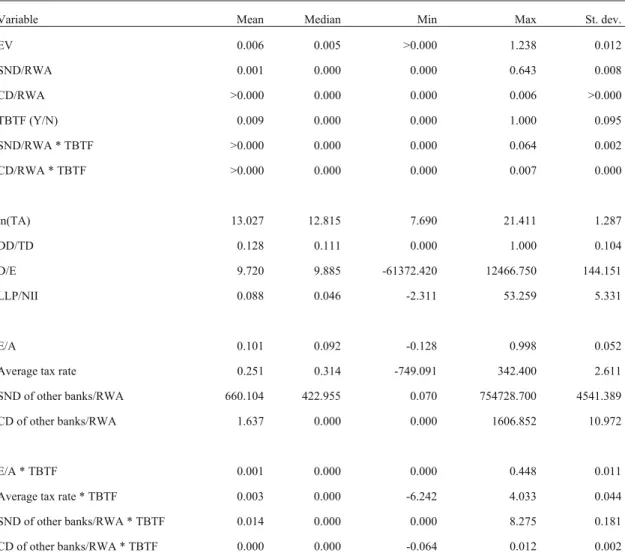
This section presents the summary statistics of the variables used in the model. They are shown in Table 1:
Variable Mean Median Min Max St. dev. EV 0.006 0.005 >0.000 1.238 0.012 SND/RWA 0.001 0.000 0.000 0.643 0.008 CD/RWA >0.000 0.000 0.000 0.006 >0.000 TBTF (Y/N) 0.009 0.000 0.000 1.000 0.095 SND/RWA * TBTF >0.000 0.000 0.000 0.064 0.002 CD/RWA * TBTF >0.000 0.000 0.000 0.007 0.000 ln(TA) 13.027 12.815 7.690 21.411 1.287 DD/TD 0.128 0.111 0.000 1.000 0.104 D/E 9.720 9.885 -61372.420 12466.750 144.151 LLP/NII 0.088 0.046 -2.311 53.259 5.331 E/A 0.101 0.092 -0.128 0.998 0.052 Average tax rate 0.251 0.314 -749.091 342.400 2.611 SND of other banks/RWA 660.104 422.955 0.070 754728.700 4541.389 CD of other banks/RWA 1.637 0.000 0.000 1606.852 10.972 E/A * TBTF 0.001 0.000 0.000 0.448 0.011 Average tax rate * TBTF 0.003 0.000 -6.242 4.033 0.044 SND of other banks/RWA * TBTF 0.014 0.000 0.000 8.275 0.181 CD of other banks/RWA * TBTF 0.000 0.000 -0.064 0.012 0.002
Table 1: Summary statistics of the main model
We can state that the average bank has an earnings volatility of 0.006, a Subordinated Notes and Debentures to Risk-weighted assets ratio of 0.001 and a Convertible debt to Risk-weighted assets ratio between 0.000 and 0.001. 0.9% of the observations refer to a too-big-to-fail bank. Regarding the book values, the average bank has USD 367.692 million of total assets, a demands deposits ratio of 0.128, a debt-to-equity ratio of 9.720 and a loan loss provisions ratio of 0.088.
Table 1 also provides information regarding the instruments I will use to address endogeneity. The average bank has an equity-to-assets ratio of 0.101480 and faces an average tax rate of 0.251. The ratio of Subordinated Notes and Debentures to Risk-weighted assets of all banks other than the average bank is 660.104 and the ratio of Convertible debt to Risk-weighted assets all banks other than the average bank is 1.637.
One thing that might seem odd, is the extreme range that the average tax rate assumes. In fact, it has a minimum of -749.091 and a maximum of 342.400 (the values are not percentages). However, this dispersion occurs because the taxable income does not match the net income (since taxable income settlement does not follow the same rules as the accounting). It might happen that a bank has deferred tax assets (that are a consequence of an accounting costs that was not recognized as cost by the tax authority in previous quarters) or liabilities (following the same rationale).
5.2. Preliminary analysis
I will use a graphical approach to provide a preliminary answer to my research question. This preliminary analysis examines the relationship between subordinated Notes and Debentures and earnings volatility and Convertible Debt and earnings volatility of both too-big-to-fail and non-too-big-to-fail banks.
51 Thus, analysing the relationship of these two variables and earnings volatility, we have that:
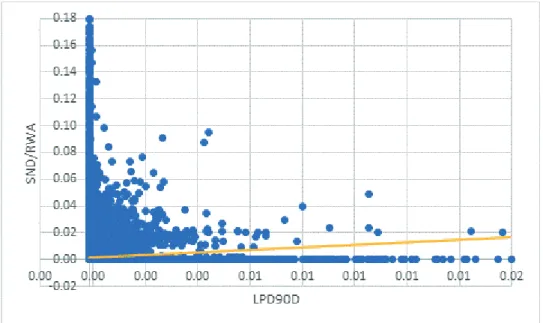
Figure 1: Preliminary analysis of the impact of SND/RWA on EV
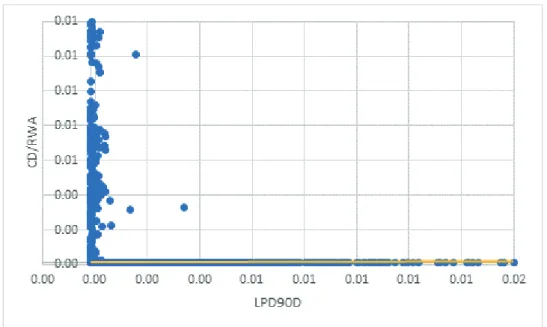
Figure 2: Preliminary analysis of the impact of CD/RWA on EV
-0.02 0.00 0.02 0.04 0.06 0.08 0.10 0.12 0.14 0.16 0.18 -0.03 0.07 0.17 0.27 0.37 0.47 0.57 0.67 SND/RWA EV
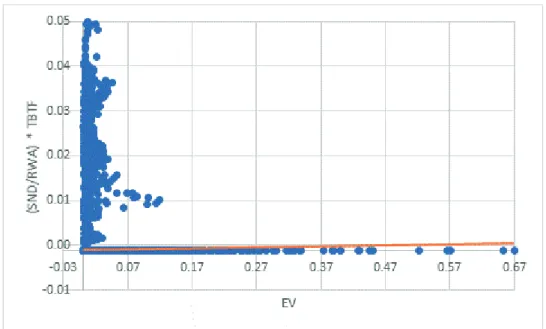
Figure 3: Preliminary analysis of the impact of SND/RWA * TBTF on EV
Figure 4: Preliminary analysis of the impact of CD/RWA * TBTF on EV
In order to have a better idea of the trend line and the scatter results themselves, I decided to expurgate outliers from the graphs. To do so, I defined as axis maximum the percentile 99.99%. Outliers falling outside this range do not show up in the above figures. The line reflects the linear trend line.
Preliminary analysis suggests interesting results. Figure 1 shows a positive relationship between Subordinated Notes and Debentures and earnings
53 volatility, which means that, apparently (and apparently only), there is no market discipline. This result might be caused by the absence of other variables that could interfere with this relationship (for instance size). Figure 3 does not change this trend. In fact, too-big-to-fail banks seem to have risk incentives in the presence of this kind of instruments, which after knowing the relation specified in Figure 1 is not quite a surprise – if normal banks assume riskier investments under subordinated debt financing, why would not a too-big-to-fail bank do so? Concerning contingent capital, Convertible Debt does not seem to have a defined relationship. We cannot highlight any positive or negative trend. Again, other variables that are missing in this analysis could interfere with this relationship (for instance debt-to-equity ratio).
5.3. Estimation results
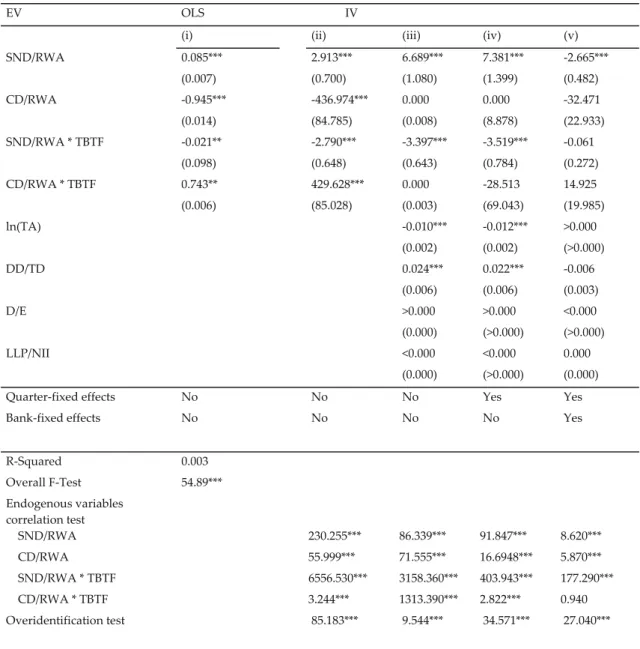
Model estimation results are presented in Table 2. Specification (i) follows an OLS estimation which uses as explanatory variables the ratio of Subordinated Notes and Debentures to Risk-weighted assets (alone, assuming that the marginal and separate impact on earnings volatility is constant, and together with TBTF dummy, assuming that the marginal and separate impact on earnings volatility depends on whether the bank is too-big-to-fail or not) and the ratio of Convertible debt to Risk-weighted assets (again, alone and together with TBTF dummy).
Specifications
EV OLS IV
(i) (ii) (iii) (iv) (v)
SND/RWA 0.085*** 2.913*** 6.689*** 7.381*** -2.665*** (0.007) (0.700) (1.080) (1.399) (0.482) CD/RWA -0.945*** -436.974*** 0.000 0.000 -32.471 (0.014) (84.785) (0.008) (8.878) (22.933) SND/RWA * TBTF -0.021** -2.790*** -3.397*** -3.519*** -0.061 (0.098) (0.648) (0.643) (0.784) (0.272) CD/RWA * TBTF 0.743** 429.628*** 0.000 -28.513 14.925 (0.006) (85.028) (0.003) (69.043) (19.985) ln(TA) -0.010*** -0.012*** >0.000 (0.002) (0.002) (>0.000) DD/TD 0.024*** 0.022*** -0.006 (0.006) (0.006) (0.003) D/E >0.000 >0.000 <0.000 (0.000) (>0.000) (>0.000) LLP/NII <0.000 <0.000 0.000 (0.000) (>0.000) (0.000)
Quarter-fixed effects No No No Yes Yes Bank-fixed effects No No No No Yes R-Squared 0.003 Overall F-Test 54.89*** Endogenous variables correlation test SND/RWA 230.255*** 86.339*** 91.847*** 8.620*** CD/RWA 55.999*** 71.555*** 16.6948*** 5.870*** SND/RWA * TBTF 6556.530*** 3158.360*** 403.943*** 177.290*** CD/RWA * TBTF 3.244*** 1313.390*** 2.822*** 0.940 Overidentification test 85.183*** 9.544*** 34.571*** 27.040***
Table 2: Estimation results of the main model. All specifications are based on 192,675
observations. Heteroscedasticity-robust standard errors in parenthesis. *** denote significant at 1%, ** denote significant at 5* and * denote significant at 10%. Endogenous variables correlation test examines if the instruments are correlated with each of the four endogenous variables. The overidentification test examines if the instruments are correlated with the error term. For specifications (ii), (iii) and (iv), the test is score chi squared and for specification (v), the test is the Hansen J test.
The results from specification (i) suggest a statistically significant positive relationship between subordinated debt and risk-taking behaviour in
55 big-to-fail banks. H1 is, then, rejected. That relationship is estimated to also be positive in too-big-to-fail banks (0.085-0.021>0 and it is statistically different from zero), which seems contradictory to the theory, H2 is rejected. The relationship between contingent capital and risk-taking behaviour is estimated to be negative for non-too-big-to-fail banks, which confirms H3 (-0.945<0). The relationship is estimated to be negative also in too-big-to-fail banks (-0.945+0.743<0 and it is statistically different from zero). H4 is accepted.
The very controversial and not applicable to real word assumptions that OLS requires made it compulsory to change to an IV regression. As discussed above, the explanatory variables are believed to be endogenous. A proper way of addressing the issue is by using instrumental variables techniques, which leads us to specification (ii). It follows an instrumental variables approach, using the same variables than in specification (i) and the already mentioned instruments (see bottom of Table 1) to address the endogeneity of the Subordinated Notes and Debentures to Risk-weighted assets ratio and Convertible debt to Risk-weighted assets ratio. Specification (ii) suggests again that subordinated has a statistically positive impact on risk-taking behaviour of non-too-big-to-fail banks. H1 is still rejected. The impact is also positive in too-big-to-fail banks (2.913-2.790<0 and is statistically different from zero). H2 is still rejected. Concerning contingent capital, its impact on risk-taking behaviour of non-too-big-to-fail banks is negative which validates H3. The impact is also negative for non-too-big-to-fail banks (-436.974+429.628<0 and is statistically different from zero. H4 is accepted. One important analysis is the one that tests the validity of the instruments. As we can see in Table 2, the instruments are correlated with the endogenous variables, which is a good indicator. However, the Overidentification test shows that they are also correlated with the explained variable (risk-taking behaviour). Thus, we must analyse this results with caution.