EUROPEAN ORGANIZATION FOR NUCLEAR RESEARCH (CERN)
CERN-EP-2018-183 2018/07/19
CMS-EXO-16-049
Search for dark matter particles produced in association
with a top quark pair at
√
s
=
13 TeV
The CMS Collaboration
∗Abstract
A search is performed for dark matter particles produced in association with a top
quark pair in proton-proton collisions at √s = 13 TeV. The data correspond to an
integrated luminosity of 35.9 fb−1recorded by the CMS detector at the LHC. No
sig-nificant excess over the standard model expectation is observed. The results are inter-preted using simplified models of dark matter production via spin-0 mediators that couple to dark matter particles and to standard model quarks, providing constraints on the coupling strength between the mediator and the quarks. These are the most stringent collider limits to date for scalar mediators, and the most stringent for pseu-doscalar mediators at low masses.
Submitted to Physical Review Letters
c
2018 CERN for the benefit of the CMS Collaboration. CC-BY-4.0 license
∗See Appendix A for the list of collaboration members
1
Astrophysical observations strongly motivate the existence of dark matter [1–4], which may originate from physics beyond the standard model. In a large class of models, dark matter consists of stable, weakly interacting massive particles (χ) [4], which may be pair produced at the CERN LHC via mediators that couple both to dark matter particles and to standard model quarks. The dark matter particles would escape detection, thereby creating a transverse
momentum imbalance (~pTmiss) in the event. Searches at collider experiments can offer insights
on the nature of the mediator and provide constraints on dark matter masses of O(10 GeV) and below, a region that is difficult to explore both in direct and indirect searches for dark matter. A favored class of models propose a spin-0 mediator with standard model Higgs-like Yukawa coupling to quarks, which therefore couples preferentially to the top quark [5–9]. Consequently, dark matter production in association with a top quark pair (tt) can offer better search sensitivity compared to other modes such as production in association with a jet [10–
14]. At the LHC, the tt+χχ process is probed through the signature of tt accompanied by
~pmiss
T [15, 16].
The top quark almost always decays to a W boson and a b quark. The W boson can decay leptonically (to a charged lepton and a neutrino) or hadronically (to a quark pair). The signal
regions (SRs) of the search cover three tt decay modes: the all-hadronic, lepton+jets (`+jets
where` =e, µ), and dileptonic (ee, eµ, µµ) final states where neither, either, or both of the W
bosons decay to leptons, respectively. This Letter presents a search for tt+χχ in ppcollisions
at√s = 13 TeV with data recorded by the CMS experiment in 2016, corresponding to an
inte-grated luminosity of 35.9 fb−1. The analysis strategy is similar to Ref. [17], but includes
addi-tional SRs for the dileptonic mode.
The central feature of the CMS detector is a superconducting solenoid providing a magnetic field of 3.8 T. Within the solenoid volume are the silicon pixel and strip trackers, a lead tungstate crystal electromagnetic calorimeter, and a brass and scintillator hadron calorimeter. A steel and quartz-fiber Cherenkov forward hadron calorimeter extends the pseudorapidity (η) coverage. The muon system consists of gas-ionization detectors embedded in the steel flux-return yoke outside the solenoid. A two-tiered trigger system [18] selects events at a rate of about 1 kHz for storage. A detailed description of the CMS detector is provided in Ref. [19].
The event reconstruction is based on the CMS particle-flow algorithm [20], which reconstructs and identifies individual particles using an optimized combination of the detector information.
The~pTmissvector is computed as the negative vector sum of the transverse momenta (~pT) of all
the particles in an event. Jets are formed from particles using the anti-kTalgorithm [21, 22] with
a distance parameter of 0.4. Corrections are applied to calibrate the jet momentum [23] and to remove energy from additional collisions in the same or adjacent bunch crossings (pileup) [24].
Jets in the analysis are required to have pT >30 GeV and|η| <2.4, and to satisfy identification
criteria [25] that minimize spurious detector effects. A combined secondary vertex b tagging algorithm [26] is used to identify jets originating from b quarks (b-tagged jets). A multivari-ate discriminant, the “resolved top tagger” (RTT) [17], based on jet properties and kinematic information, is used to identify top quarks that decay into three jets. Electrons and muons are selected using “tight” and “loose” requirements where the former applies more stringent identification criteria than the latter [27]. The “tight” leptons are used in the selection of spe-cific final states, while “loose” leptons are used to veto events with extra leptons. The primary
ppinteraction vertex is taken to be the reconstructed vertex with the highest summed p2
T of
its associated physics objects. Here, the physics objects are the jets, clustered with the tracks
assigned to the vertex as inputs, plus the associated~pmiss
T .
The background is dominated by tt and V+jets (V = W, Z/γ∗) production. The tt and sin-gle top quark backgrounds are simulated at next-to-leading order (NLO) accuracy in quantum
chromodynamics (QCD) using POWHEG v2 and POWHEG v1 [28–31], respectively. Samples
of V+jets and QCD multijet events are simulated at leading order (LO) in QCD using MAD
-GRAPH5 aMC@NLO v2.2.2 [32] (MADGRAPH), with up to four additional partons in the
ma-trix element (ME) calculations. The V+jets samples are corrected with boson pT-dependent
electroweak corrections [33–38] and QCD NLO/LO K factors computed using MADGRAPH.
Samples of tt+V and diboson processes (WW, WZ, and ZZ) are generated at NLO using
either MADGRAPH or POWHEG v2. The initial-state partons are modeled with the NNPDF
3.0 [39] parton distribution function (PDF) sets at LO or NLO in QCD to match the ME
cal-culation. Generated events are interfaced withPYTHIA8.205 [40] for parton showering using
the CUETP8M1 tune [41], except for the tt simulation which uses the CUETP8M2 tune
cus-tomized by CMS with an updated strong coupling αSfor initial-state radiation. The simulation
of the CMS detector is performed with GEANT4 [42]. Corrections derived from data are applied
to account for any mismodeling of selection efficiencies in simulation.
The signal is simulated using simplified models of dark matter production [43]. The domi-nant mechanism is s-channel production of the mediator via gluon fusion, with the mediator then decaying to a pair of dark matter particles. The dark matter particles are assumed to be Dirac fermions, and the mediators are sp0 particles with scalar (φ) or pseudoscalar (a)
in-teractions. The couplings between the mediator and standard model quarks are gqq = gqyq,
where yq =
√
2mq/v are the standard model Yukawa couplings, mq is the quark mass, and
v =246 GeV is the Higgs boson field vacuum expectation value. The gqparameter is assumed
to be unity for all quarks. The direct coupling strength of the mediators to dark matter is
de-noted by gχ. The model does not take into account possible mixing between φ and the standard
model Higgs boson [44]. The tt+χχsignal is generated at LO using MADGRAPH with up to
one additional parton, and the mediator is forced to decay to a pair of dark matter fermions. The mediator width is computed according to partial-width formulas in Ref. [45] and assum-ing no additional interactions beyond those described here. The relative width of the scalar (pseudoscalar) mediator varies between 4–6% (4–8%) for masses in the range of 10–500 GeV. The signal is normalized to the cross section computed at NLO in QCD.
Data are collected by triggering on events containing large pmissT (the magnitude of~pTmiss) or
high-pT leptons. The triggers for the all-hadronic final state are based on the amount of pmissT
and HmissT measured with the trigger-level reconstruction. The HTmissvariable is defined as the
magnitude of the vector sum of~pT over trigger-level jets with pT > 20 GeV and |η| < 5.0
that pass identification requirements. During the period of data collection, the pmissT and HmissT
trigger thresholds were increased as the instantaneous luminosity increased, in steps from 90
to 120 GeV. Events in the`+jets final state are obtained using single-lepton triggers that require
an electron (muon) with pT >27 (24) GeV. Events in the dilepton final state are obtained using
single-lepton and dilepton (ee, eµ, µµ) triggers. The trigger thresholds on the higher- and
lower-pTelectrons (muons) are 23 (17) GeV and 12 (8) GeV, respectively.
Using additional selection requirements, two all-hadronic, one`+jets, and four dilepton SRs
are defined. Several control regions (CRs) enriched in standard model processes are used to
im-prove the simulation-based background estimates for the all-hadronic and`+jets SRs. There
are no event overlaps among the regions. Together, the SRs and CRs associated with the
indi-vidual tt+χχfinal states are referred to as “channels”. All three tt+χχchannels are used in a
simultaneous maximum-likelihood fit of pmissT distributions to extract a potential dark matter
signal. In the fit, the CRs constrain the contributions of tt, W+jets, and Z+jets processes within
3
The all-hadronic SRs require pmissT >200 GeV, and four or more jets, of which at least one must
be b tagged. Any event with a “loose” lepton of pT > 10 GeV is vetoed. The dominant
back-ground consists of tt decays to`+jets, referred to as tt(1`), where the lepton is not identified as
“loose” and therefore not vetoed, and the neutrino is the source of~pmiss
T . The RTT is employed
to define a category of events with two tagged hadronic top quark decays (2RTT), which
sup-presses the tt(1`)background, and a category with less than two top quark tags (0,1RTT) and
at least two b-tagged jets. Spurious pmissT can arise in multijet events as a result of jet energy
mismeasurement. In such cases, the reconstructed~pTmiss tends to align with a jet. The
multi-jet background is suppressed by requiring the smallest azimuthal angle between the~pTmiss and
each jet in the event, ∆j ≡ min∆φ(~pTj,~pTmiss), to be greater than 0.4 (1.0) radians in the 2RTT
(0,1RTT) category. The∆jrequirement also reduces the tt(1`)background, for which~pTmisscan
align with a bottom jet.
The CRs targeting the tt(1`)background, one for each category, are defined by selecting events
with exactly one “tight” lepton with pT > 30 GeV, and by requiring the transverse mass, mT,
given in terms of~pTmissand the lepton momentum (~p`T) by the following expression:
mT =
p
2p`TpmissT [1−cos∆φ(~p`T,~pTmiss)], (1)
to be less than 160 GeV, in order to avoid overlaps with the SR of the `+jets channel. For
ideal measurements, the mTquantity is bounded above by the W boson mass for tt(1`)and for
W(`ν)+jets where the W boson is produced on-shell.
There are also significant background contributions from Z(νν)+jets, and from W(`ν)+jets
where the lepton is not identified. The CRs enriched in both W+jets and Z+jets are formed by
modifying the SR selections to require no b-tagged jets. Additionally, dedicated W+jets CRs
are defined by requiring a “tight” lepton with pT >30 GeV and mT <160 GeV. A CR enriched
in Z+jets is defined by selecting two “tight”, oppositely charged, and same-flavor leptons, with
the dilepton invariant mass between 60 and 120 GeV. This CR is not subdivided into categories based on the number of top quark tags because the event yield with two tags is negligible. The pmiss
T calculation does not consider the two leptons in order to emulate the Z(νν)+jets process.
Events in the`+jets SR are selected by requiring pmissT > 160 GeV, exactly one “tight” lepton
with pT > 30 GeV, and three or more jets, of which at least one is b tagged. Events must
not contain additional “loose” leptons with pT > 10 GeV. A selection of mT > 160 GeV is
imposed to reduce the tt(1`)and W+jets backgrounds. Following these selections, the
remain-ing background events primarily consist of dileptonic tt decays, referred to as tt(2`) events,
where one of the leptons is not identified. This background is suppressed by requiring that
the mWT2 quantity [46] be larger than 200 GeV, and for the two highest pT jets in the event that
∆j1,2 ≡ min∆φ(~p
j1,2
T ,~pTmiss) > 1.2. The mWT2 variable corresponds to the minimum mass of a
particle consistent with being pair-produced and decaying to a bottom quark and a W boson, where both W bosons decay leptonically but one of the two leptons is not detected. The key
characteristic of mWT2is that for ideal measurements the distribution for tt(2`)events is bounded
above by the top quark mass.
The CR targeting the tt(2`) background is defined by requiring an additional “tight” lepton
of pT > 30 GeV with respect to the SR selection and removing the selections on mT, mWT2, and
∆j1,2. To reduce the signal contamination and avoid overlap with the dileptonic SRs, the m
``
T2
variable [47–49] is required to be less than 110 GeV. The m``T2variable is essentially the minimum
mTof a pair-produced particle that decays to a lepton and a neutrino. The m``T2 distribution for
for the`+jets channel is defined by requiring no b-tagged jets and removing the selections on mWT2and∆j1,2.
Events in the dilepton SRs are selected by requiring exactly two oppositely charged “tight”
leptons with higher (lower) pT > 25 (15) GeV, two or more jets with at least one b-tagged
jet, and pmissT > 50 GeV. The dilepton mass is required to be greater than 20 GeV, and for the
dielectron and dimuon events, to be at least 15 GeV away from the Z boson pole mass (mZ) [50].
Separate categories are considered for events with same- and different-flavor lepton pairs, and
for events with m``T2 greater or less than 110 GeV. The SRs with large m``T2 have significantly
higher signal purity.
The estimates for the backgrounds from Drell–Yan production and from jets misidentified
as leptons are performed using dedicated sideband regions not included in the fit. A pmissT
-dependent correction to the Drell–Yan simulation in the same-flavor SRs is obtained by
com-paring data and simulation yields within 15 GeV of mZ. The misidentified leptons background
is estimated using data events with pairs consisting of one “tight” lepton plus a non-“tight” lepton-like object passing a less stringent selection. The number of such combinations is scaled by misidentification rates, which are measured in a jet-enriched sample.
The dark matter signal, which would be observed as an excess of events compared to the
pre-dicted background at high pmissT , is extracted via a simultaneous maximum-likelihood fit to
the binned pmissT distributions of the signal and backgrounds, based on simulation with the
exception of the misidentified leptons background, in the SRs and associated CRs. The fit is
performed using the ROOSTATSstatistical package [51]. The template shapes and
normaliza-tion are allowed to vary in the fit, constrained by the priors of the systematic uncertainties, parameterized as nuisance parameters.
The common sources of uncertainty are correlated across SRs and CRs and across channels. The sources of normalization uncertainty include the integrated luminosity (2.5%) [52], b tag-ging efficiency (1–5%) [26], lepton efficiency (1.5–2.2%) [27], and pileup simulation (0.8–1.9%), where the range of values indicates variations across different physics processes. The common
sources of shape uncertainty include pmissT trigger efficiency, jet energy scale and resolution [25],
PDF [39], uncertainty on the K factors for V+jets, uncertainty from missing higher order QCD
corrections for each simulated physics process, and the uncertainty in the modeling of top
quark pT in tt simulation [53]. The jet energy scale uncertainties have the largest impact on the
`+jets and dilepton channels, while in the all-hadronic channel the top quark pTmodeling and
pmiss
T trigger uncertainties are more important.
Within the all-hadronic and`+jets search channels, additional nuisance parameters scale the
yields of the tt, W+jets, and Z+jets backgrounds independently in each pmissT bin across the SRs
and CRs of a given channel. For example, in each bin of pmissT a single parameter is associated
with the contribution of the W+jets process in the all-hadronic SRs and CRs, while another
set of parameters distinct from those of the all-hadronic channel, is associated with the W+jets
background in the`+jets SRs and CRs. These nuisance parameters allow the data in the CRs
to constrain the estimates of the dominant background processes in the corresponding SRs. Signal yields in all the SRs and CRs are scaled simultaneously by the signal strength parameter (µ), defined as the ratio of the measured signal cross section to the theoretical cross section,
µ=σ/σth.
The fit is performed across all search channels and no significant excess is observed. Figure 1
shows the pmiss
T distributions for three of the seven SRs, obtained after the background-only fit
5
using a modified frequentist approach (CLs) with a test statistic based on the profile likelihood
in the asymptotic approximation [54–56]. For each signal hypothesis, 95% confidence level (CL) upper limits on µ are determined. The all-hadronic channel provides the best sensitivity. The dileptonic channel is competitive with the all-hadronic channel for scalar mediator masses less
than about 50 GeV, where the signal has a soft pmissT spectrum, but is typically the least sensitive
channel in other regions of the parameter space.
[GeV] miss T p 200 300 400 Events / bin 10 2 10 3 10 4 10 5 10 Data t t +V t t W+jets *+jets γ Z/ Single top Diboson QCD Multijet Bkg. unc. Prefit =1 GeV χ =100 GeV, m a m (13 TeV) -1 35.9 fb CMS miss T +p t 2RTT all-hadronic t [GeV] miss T p 200 250 300 350 400 450 Obs / Fitted 0.5 1.0 1.5 [GeV] miss T p 200 300 400 Events / bin 10 2 10 3 10 4 10 Data t t +V t t W+jets *+jets γ Z/ Single top Diboson Bkg. unc. Prefit =1 GeV χ =100 GeV, m a m miss T +p t l+jets t (13 TeV) -1 35.9 fb CMS [GeV] miss T p 200 250 300 350 400 450 Obs / Fitted 0.5 1.0 1.5 [GeV] miss T p 100 200 300 400 500 Events / bin 1 10 2 10 3 10 4 10 Data (2l) t t +V t t *+jets γ Z/ Single top (2l) Diboson (1l) / tW(1l) t W+jets / t Bkg. unc. Prefit =1 GeV χ =100 GeV, m a m (13 TeV) -1 35.9 fb CMS > 110 GeV ll T2 M channel µ e [GeV] miss T p 50 100 150 200 250 300 350 400 450 500 Obs / Fitted 0.5 1.0 1.5
Figure 1: Selected pmiss
T distributions in SRs: 2RTT SR for the all-hadronic (upper left), the`+jets
(upper right), and the different-flavor, m``
T2 >110 GeV SR in the dileptonic channel (lower). The
solid red line shows the expectation for a signal with ma = 100 GeV and mχ =1 GeV. The last
bin contains the overflow events. The lower panel shows the ratio of the observed to the fitted distribution (points), and the ratio of the background expectation before the fit to the fitted distribution (dashed magenta line). The vertical bars indicate the statistical uncertainty on the data. The horizontal bars on the rightmost plot indicate the bin width. The uncertainty bands in both panels include the statistical and systematic uncertainties on the total background.
The limits are shown as a function of ma/φ and mχ in Fig. 2. The contours enclose the
re-gion where the upper limit on µ is less than 1. Because of the narrow width of the mediator,
the signal cross section drops rapidly across the ma/φ = 2mχ line, marking the boundary
be-tween the on-shell to the off-shell region. Therefore, the exclusion contour runs close to the
scalar and pseudoscalar masses of 160 (240) and 220 (320) GeV, respectively, at 95% CL. The observed exclusion is weaker than the expected because of tension in the fit between CRs and SRs of the all-hadronic channel, although the difference is not significant as the observed result lies only just outside the 68% probability interval. This arises because the a priori estimation of the background in the CRs exceeds the number of events observed by a larger amount than in the SRs. Consequently, the signal+background fit, in contrast to the background-only fit, re-duces this tension between CRs and SRs by accommodating for some signal, which contributes primarily to the SRs. [GeV] φ m 50 100 150 200 250 300 350 [GeV]χ m 20 40 60 80 100 120 140 160 th σ / 95% CL σ Observed 0.5 1 1.5 2 2.5 3 (13 TeV) -1 35.9 fb CMS =1 χ =1, g q Scalar, Dirac, g (13 TeV) -1 35.9 fb CMS =1 χ =1, g q Scalar, Dirac, g 1 1 χ = 2m φ m Observed 95% CL Median expected 95% CL 68% expected [GeV] a m 50 100 150 200 250 300 350 [GeV]χ m 20 40 60 80 100 120 140 160 th σ / 95% CL σ Observed 0.5 1 1.5 2 2.5 3 (13 TeV) -1 35.9 fb CMS =1 χ =1, g q Pseudoscalar, Dirac, g (13 TeV) -1 35.9 fb CMS =1 χ =1, g q Pseudoscalar, Dirac, g 1 1 χ = 2m a m Observed 95% CL Median expected 95% CL 68% expected
Figure 2: The exclusion limits at 95% CL on the signal strength µ = σ/σth computed as a
function of the mediator and dark matter mass, assuming a scalar (left) and pseudoscalar (right)
mediator. The mediator couplings are assumed to be gq = gχ = 1. The dashed magenta lines
represent the 68% probability interval around the expected limit. The observed limit contour is almost coincident with the boundary of the 68% probability interval.
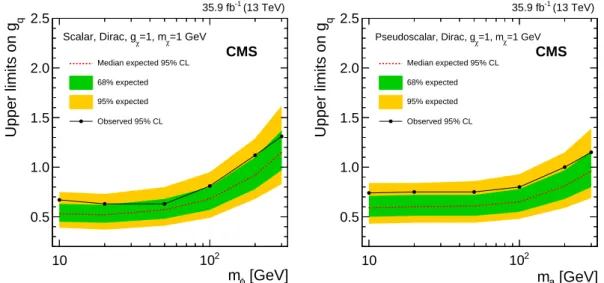
The limits on µ are also expressed in terms of the mediator coupling strength to quarks in Fig. 3.
These results are obtained by fixing mχ = 1 GeV and gχ = 1, and then finding the value of gq
that corresponds to the upper limit on the cross section. This procedure is valid because the
kinematic properties of the signal do not vary appreciably with gq. The width-to-mass ratio is
around 4% for the gqand ma/φvalues considered.
In summary, a comprehensive search for dark matter particles produced in association with a top quark pair yields no significant excess over the predicted background. The results pre-sented in this Letter provide 30–60% better cross section limits compared to earlier searches targeting the same signature [57–59]. The analysis offers stronger constraints than direct and indirect experiments for dark matter masses of O(10 GeV) and below. Over much of the
pa-rameter space, the tt+χχsignature has better sensitivity for spin-0 mediators than dark matter
production in association with a jet [14] – previously considered to be the most sensitive
signa-ture. For the pseudoscalar model, the tt+χχsignature provides the most stringent cross section
constraints for mediator masses of around 200 GeV and below. The observed (expected) limits
exclude a pseudoscalar mediator with mass below 220 (320) GeV under the gq =gχ =1
bench-mark scenario. The tt+χχsignature provides the best sensitivity for the scalar mediator model
and is currently the only collider signature that is sufficiently sensitive to exclude regions of parameter space with these values of the couplings. The observed exclusion of a mediator with mass below 160 GeV (240 GeV expected) provides the most stringent constraint to date on this model.
References 7 [GeV] φ m 10 102 q Upper limits on g 0.5 1.0 1.5 2.0 2.5 Median expected 95% CL 68% expected 95% expected Observed 95% CL (13 TeV) -1 35.9 fb =1 GeV χ =1, m χ Scalar, Dirac, g CMS [GeV] a m 10 102 q Upper limits on g 0.5 1.0 1.5 2.0 2.5 Median expected 95% CL 68% expected 95% expected Observed 95% CL (13 TeV) -1 35.9 fb =1 GeV χ =1, m χ Pseudoscalar, Dirac, g CMS
Figure 3: The 95% observed and median expected CL upper limits on the coupling strength of
the mediator to the standard model quarks under the assumption that gχ = 1. A dark matter
particle with a mass of 1 GeV is assumed. The green and yellow bands indicate respectively the 68% and 95% probability intervals around the expected limit. The interpretations for a scalar (left) and a pseudoscalar (right) mediator are shown.
Acknowledgments
We congratulate our colleagues in the CERN accelerator departments for the excellent perfor-mance of the LHC and thank the technical and administrative staffs at CERN and at other CMS institutes for their contributions to the success of the CMS effort. In addition, we grate-fully acknowledge the computing centers and personnel of the Worldwide LHC Computing Grid for delivering so effectively the computing infrastructure essential to our analyses. Fi-nally, we acknowledge the enduring support for the construction and operation of the LHC and the CMS detector provided by the following funding agencies: BMWFW and FWF (Aus-tria); FNRS and FWO (Belgium); CNPq, CAPES, FAPERJ, and FAPESP (Brazil); MES (Bulgaria); CERN; CAS, MoST, and NSFC (China); COLCIENCIAS (Colombia); MSES and CSF (Croatia); RPF (Cyprus); SENESCYT (Ecuador); MoER, ERC IUT, and ERDF (Estonia); Academy of Fin-land, MEC, and HIP (Finland); CEA and CNRS/IN2P3 (France); BMBF, DFG, and HGF (Ger-many); GSRT (Greece); OTKA and NIH (Hungary); DAE and DST (India); IPM (Iran); SFI (Ireland); INFN (Italy); MSIP and NRF (Republic of Korea); LAS (Lithuania); MOE and UM (Malaysia); BUAP, CINVESTAV, CONACYT, LNS, SEP, and UASLP-FAI (Mexico); MBIE (New Zealand); PAEC (Pakistan); MSHE and NSC (Poland); FCT (Portugal); JINR (Dubna); MON, RosAtom, RAS, RFBR and RAEP (Russia); MESTD (Serbia); SEIDI and CPAN (Spain); Swiss Funding Agencies (Switzerland); MST (Taipei); ThEPCenter, IPST, STAR, and NSTDA (Thai-land); TUBITAK and TAEK (Turkey); NASU and SFFR (Ukraine); STFC (United Kingdom); DOE and NSF (USA).
References
[1] G. Bertone, D. Hooper, and J. Silk, “Particle dark matter: evidence, candidates and constraints”, Phys. Rept. 405 (2005) 279, doi:10.1016/j.physrep.2004.08.031, arXiv:hep-ph/0404175.
Ann. Rev. Astron. Astrophys. 48 (2010) 495,
doi:10.1146/annurev-astro-082708-101659, arXiv:1003.0904.
[3] T. A. Porter, R. P. Johnson, and P. W. Graham, “Dark matter searches with astroparticle data”, Ann. Rev. Astron. Astrophys. 49 (2011) 155,
doi:10.1146/annurev-astro-081710-102528, arXiv:1104.2836.
[4] G. Bertone et al., “Identifying WIMP dark matter from particle and astroparticle data”, JCAP 03 (2018) 026, doi:10.1088/1475-7516/2018/03/026, arXiv:1712.04793. [5] U. Haisch, F. Kahlhoefer, and J. Unwin, “The impact of heavy-quark loops on LHC dark
matter searches”, JHEP 07 (2013) 125, doi:10.1007/JHEP07(2013)125,
arXiv:1208.4605.
[6] T. Lin, E. W. Kolb, and L.-T. Wang, “Probing dark matter couplings to top and bottom quarks at the LHC”, Phys. Rev. D 88 (2013) 063510,
doi:10.1103/PhysRevD.88.063510, arXiv:1303.6638.
[7] M. R. Buckley, D. Feld, and D. Gonc¸alves, “Scalar simplified models for dark matter”, Phys. Rev. D 91 (2015) 015017, doi:10.1103/PhysRevD.91.015017,
arXiv:1410.6497.
[8] U. Haisch and E. Re, “Simplified dark matter top-quark interactions at the LHC”, JHEP
06(2015) 078, doi:10.1007/JHEP06(2015)078, arXiv:1503.00691.
[9] C. Arina et al., “A comprehensive approach to dark matter studies: exploration of
simplified top-philic models”, JHEP 11 (2016) 111, doi:10.1007/JHEP11(2016)111, arXiv:1605.09242.
[10] ATLAS Collaboration, “Search for new phenomena in final states with an energetic jet
and large missing transverse momentum in pp collisions at√s=8 TeV with the ATLAS
detector”, Eur. Phys. J. C 75 (2015) 299, doi:10.1140/epjc/s10052-015-3517-3, arXiv:1502.01518. [Erratum: Eur. Phys. J. C 75 (2015) 408].
[11] CMS Collaboration, “Search for dark matter in proton-proton collisions at 8 TeV with missing transverse momentum and vector boson tagged jets”, JHEP 12 (2016) 083,
doi:10.1007/JHEP12(2016)083, arXiv:1607.05764.
[12] ATLAS Collaboration, “Search for new phenomena in final states with an energetic jet
and large missing transverse momentum in pp collisions at√s=13 TeV using the
ATLAS detector”, Phys. Rev. D 94 (2016) 032005,
doi:10.1103/PhysRevD.94.032005, arXiv:1604.07773.
[13] CMS Collaboration, “Search for dark matter produced with an energetic jet or a
hadronically decaying W or Z boson at√s =13 TeV”, JHEP 07 (2017) 14,
doi:10.1007/JHEP07(2017)014, arXiv:1703.01651.
[14] CMS Collaboration, “Search for new physics in final states with an energetic jet or a
hadronically decaying W or Z boson and transverse momentum imbalance at√s=13
TeV”, Phys. Rev. D 97 (2018) 092005, doi:10.1103/PhysRevD.97.092005, arXiv:1712.02345.
[15] CMS Collaboration, “Search for the production of dark matter in association with
top-quark pairs in the single-lepton final state in proton-proton collisions at√s =8 TeV”,
References 9
[16] ATLAS Collaboration, “Search for dark matter in events with heavy quarks and missing transverse momentum in pp collisions with the ATLAS detector”, Eur. Phys. J. C 75 (2015) 92, doi:10.1140/epjc/s10052-015-3306-z, arXiv:1410.4031.
[17] CMS Collaboration, “Search for dark matter produced in association with heavy-flavor
quark pairs in proton-proton collisions at√s=13 TeV”, Eur. Phys. J. C 77 (2017) 845,
doi:10.1140/epjc/s10052-017-5317-4, arXiv:1706.02581. [18] CMS Collaboration, “The CMS trigger system”, JINST 12 (2017) P01020,
doi:10.1088/1748-0221/12/01/P01020, arXiv:1609.02366.
[19] CMS Collaboration, “The CMS experiment at the CERN LHC”, JINST 3 (2008) S08004, doi:10.1088/1748-0221/3/08/S08004.
[20] CMS Collaboration, “Particle-flow reconstruction and global event description with the CMS detector”, JINST 12 (2017) P10003, doi:10.1088/1748-0221/12/10/P10003, arXiv:1706.04965.
[21] M. Cacciari, G. P. Salam, and G. Soyez, “The anti-kTjet clustering algorithm”, JHEP 04
(2008) 063, doi:10.1088/1126-6708/2008/04/063, arXiv:0802.1189.
[22] M. Cacciari, G. P. Salam, and G. Soyez, “FastJet user manual”, Eur. Phys. J. C 72 (2012) 1896, doi:10.1140/epjc/s10052-012-1896-2, arXiv:1111.6097.
[23] CMS Collaboration, “Determination of jet energy calibration and transverse momentum resolution in CMS”, JINST 6 (2011) 11002, doi:10.1088/1748-0221/6/11/P11002, arXiv:1107.4277.
[24] M. Cacciari, G. P. Salam, and G. Soyez, “The catchment area of jets”, JHEP 04 (2008) 005, doi:10.1088/1126-6708/2008/04/005, arXiv:0802.1188.
[25] CMS Collaboration, “Jet algorithms performance in 13 TeV data”, CMS Physics Analysis Summary CMS-PAS-JME-16-003, 2017.
[26] CMS Collaboration, “Identification of heavy-flavour jets with the CMS detector in pp collisions at 13 TeV”, JINST 13 (2018) P05011,
doi:10.1088/1748-0221/13/05/P05011, arXiv:1712.07158.
[27] CMS Collaboration, “Performance of electron reconstruction and selection with the CMS
Detector in proton-proton Collisions at√s=8 TeV”, JINST 10 (2015) P06005,
doi:10.1088/1748-0221/10/06/P06005, arXiv:1502.02701.
[28] P. Nason, “A new method for combining NLO QCD with shower Monte Carlo algorithms”, JHEP 11 (2004) 040, doi:10.1088/1126-6708/2004/11/040, arXiv:hep-ph/0409146.
[29] S. Frixione, P. Nason, and C. Oleari, “Matching NLO QCD computations with parton shower simulations: the POWHEG method”, JHEP 11 (2007) 070,
doi:10.1088/1126-6708/2007/11/070, arXiv:0709.2092.
[30] S. Alioli, P. Nason, C. Oleari, and E. Re, “A general framework for implementing NLO calculations in shower Monte Carlo programs: the POWHEG BOX”, JHEP 06 (2010) 043,
[31] C. Oleari, “The POWHEG-BOX”, Nucl. Phys. Proc. Suppl. 205-206 (2010) 36, doi:10.1016/j.nuclphysbps.2010.08.016, arXiv:1007.3893.
[32] J. Alwall et al., “The automated computation of tree-level and next-to-leading order differential cross sections, and their matching to parton shower simulations”, JHEP 07 (2014) 079, doi:10.1007/JHEP07(2014)079, arXiv:1405.0301.
[33] A. Denner, S. Dittmaier, T. Kasprzik, and A. Muck, “Electroweak corrections to W+jet hadroproduction including leptonic W-boson decays”, JHEP 08 (2009) 075,
doi:10.1088/1126-6708/2009/08/075, arXiv:0906.1656.
[34] A. Denner, S. Dittmaier, T. Kasprzik, and A. Muck, “Electroweak corrections to dilepton+jet production at hadron colliders”, JHEP 06 (2011) 069,
doi:10.1007/JHEP06(2011)069, arXiv:1103.0914.
[35] A. Denner, S. Dittmaier, T. Kasprzik, and A. Maeck, “Electroweak corrections to monojet production at the LHC”, Eur. Phys. J. C 73 (2013) 2297,
doi:10.1140/epjc/s10052-013-2297-x, arXiv:1211.5078.
[36] J. H. Kuhn, A. Kulesza, S. Pozzorini, and M. Schulze, “Electroweak corrections to hadronic photon production at large transverse momenta”, JHEP 03 (2006) 059, doi:10.1088/1126-6708/2006/03/059, arXiv:hep-ph/0508253.
[37] S. Kallweit et al., “NLO electroweak automation and precise predictions for W+multijet production at the LHC”, JHEP 04 (2015) 012, doi:10.1007/JHEP04(2015)012,
arXiv:1412.5157.
[38] S. Kallweit et al., “NLO QCD+EW predictions for V+jets including off-shell vector-boson decays and multijet merging”, JHEP 04 (2016) 021, doi:10.1007/JHEP04(2016)021,
arXiv:1511.08692.
[39] NNPDF Collaboration, “Parton distributions for the LHC Run II”, JHEP 04 (2015) 040,
doi:10.1007/JHEP04(2015)040, arXiv:1410.8849.
[40] T. Sj ¨ostrand, S. Mrenna, and P. Z. Skands, “A brief introduction to PYTHIA 8.1”, Comput. Phys. Commun. 178 (2008) 852, doi:10.1016/j.cpc.2008.01.036,
arXiv:0710.3820.
[41] CMS Collaboration, “Event generator tunes obtained from underlying event and multiparton scattering measurements”, Eur. Phys. J. C 76 (2016) 155,
doi:10.1140/epjc/s10052-016-3988-x, arXiv:1512.00815.
[42] GEANT4 Collaboration, “GEANT4—a simulation toolkit”, Nucl. Instrum. Meth. A 506
(2003) 250, doi:10.1016/S0168-9002(03)01368-8.
[43] D. Abercrombie et al., “Dark matter benchmark models for early LHC Run-2 searches: report of the ATLAS/CMS Dark Matter Forum”, (2015). arXiv:1507.00966.
[44] A. Albert et al., “Towards the next generation of simplified dark matter models”, Phys. Dark Univ. 16 (2017) 49, doi:10.1016/j.dark.2017.02.002, arXiv:1607.06680. [45] P. Harris, V. V. Khoze, M. Spannowsky, and C. Williams, “Constraining dark sectors at
colliders: Beyond the effective theory approach”, Phys. Rev. D 91 (2015) 055009, doi:10.1103/PhysRevD.91.055009, arXiv:1411.0535.
References 11
[46] Y. Bai, H.-C. Cheng, J. Gallicchio, and J. Gu, “Stop the top background of the stop search”, JHEP 07 (2012) 110, doi:10.1007/JHEP07(2012)110, arXiv:1203.4813.
[47] C. G. Lester and D. J. Summers, “Measuring masses of semi-invisibly decaying particles pair produced at hadron colliders”, Phys. Lett. B 463 (1999) 99,
doi:10.1016/S0370-2693(99)00945-4, arXiv:hep-ph/9906349.
[48] M. Burns, K. Kong, K. T. Matchev, and M. Park, “Using subsystem MT2for complete
mass determinations in decay chains with missing energy at hadron colliders”, JHEP 03 (2009) 143, doi:10.1088/1126-6708/2009/03/143, arXiv:0810.5576.
[49] H.-C. Cheng and Z. Han, “Minimal kinematic constraints and mT2”, JHEP 12 (2008) 063,
doi:10.1088/1126-6708/2008/12/063, arXiv:0810.5178.
[50] Particle Data Group, “Review of particle physics”, Chin. Phys. C 40 (2016) 100001 and 2017 update, doi:10.1088/1674-1137/40/10/100001.
[51] L. Moneta et al., “The RooStats Project”, in Proceedings, 13th International Workshop on Advanced computing and analysis techniques in physics research (ACAT2010), p. 057. Jaipur, India, February, 2010. arXiv:1009.1003. [PoS(ACAT2010)057].
doi:10.22323/1.093.0057.
[52] CMS Collaboration, “CMS luminosity measurements for the 2016 data taking period”, CMS Physics Analysis Summary CMS-PAS-LUM-17-001, 2017.
[53] CMS Collaboration, “Measurement of differential cross sections for top quark pair production using the lepton+jets final state in proton-proton collisions at 13 TeV”, Phys. Rev. D 95 (2017) 092001, doi:10.1103/PhysRevD.95.092001, arXiv:1610.04191. [54] T. Junk, “Confidence level computation for combining searches with small statistics”,
Nucl. Instrum. Methods A 434 (1999) 435, doi:10.1016/S0168-9002(99)00498-2, arXiv:hep-ex/9902006.
[55] A. L. Read, “Presentation of search results: the CLstechnique”, J. Phys. G 28 2693,
doi:10.1088/0954-3899/28/10/313.
[56] G. Cowan, K. Cranmer, E. Gross, and O. Vitells, “Asymptotic formulae for likelihood-based tests of new physics”, Eur. Phys. J. C 71 (2011) 1554,
doi:10.1140/epjc/s10052-011-1554-0, arXiv:1007.1727. [Erratum:
doi:10.1140/epjc/s10052-013-2501-z].
[57] CMS Collaboration, “Search for top squarks and dark matter particles in opposite-charge
dilepton final states at√s=13 TeV”, Phys. Rev. D 97 (2018) 032009,
doi:10.1103/PhysRevD.97.032009, arXiv:1711.00752.
[58] ATLAS Collaboration, “Search for top-squark pair production in final states with one
lepton, jets, and missing transverse momentum using 36.1 fb−1of√s=13 TeV pp
collision data with the ATLAS detector”, (2017). arXiv:1711.11520. Submitted to JHEP.
[59] ATLAS Collaboration, “Search for dark matter produced in association with bottom or
top quarks in√s=13 TeV pp collisions with the ATLAS detector”, Eur. Phys. J. C 78
13
A
The CMS Collaboration
Yerevan Physics Institute, Yerevan, Armenia
A.M. Sirunyan, A. Tumasyan
Institut f ¨ur Hochenergiephysik, Wien, Austria
W. Adam, F. Ambrogi, E. Asilar, T. Bergauer, J. Brandstetter, M. Dragicevic, J. Er ¨o, A. Escalante
Del Valle, M. Flechl, R. Fr ¨uhwirth1, V.M. Ghete, J. Hrubec, M. Jeitler1, N. Krammer,
I. Kr¨atschmer, D. Liko, T. Madlener, I. Mikulec, N. Rad, H. Rohringer, J. Schieck1, R. Sch ¨ofbeck,
M. Spanring, D. Spitzbart, A. Taurok, W. Waltenberger, J. Wittmann, C.-E. Wulz1, M. Zarucki
Institute for Nuclear Problems, Minsk, Belarus
V. Chekhovsky, V. Mossolov, J. Suarez Gonzalez
Universiteit Antwerpen, Antwerpen, Belgium
E.A. De Wolf, D. Di Croce, X. Janssen, J. Lauwers, M. Pieters, M. Van De Klundert, H. Van Haevermaet, P. Van Mechelen, N. Van Remortel
Vrije Universiteit Brussel, Brussel, Belgium
S. Abu Zeid, F. Blekman, J. D’Hondt, I. De Bruyn, J. De Clercq, K. Deroover, G. Flouris, D. Lontkovskyi, S. Lowette, I. Marchesini, S. Moortgat, L. Moreels, Q. Python, K. Skovpen, S. Tavernier, W. Van Doninck, P. Van Mulders, I. Van Parijs
Universit´e Libre de Bruxelles, Bruxelles, Belgium
D. Beghin, B. Bilin, H. Brun, B. Clerbaux, G. De Lentdecker, H. Delannoy, B. Dorney, G. Fasanella, L. Favart, R. Goldouzian, A. Grebenyuk, A.K. Kalsi, T. Lenzi, J. Luetic, N. Postiau, E. Starling, L. Thomas, C. Vander Velde, P. Vanlaer, D. Vannerom, Q. Wang
Ghent University, Ghent, Belgium
T. Cornelis, D. Dobur, A. Fagot, M. Gul, I. Khvastunov2, D. Poyraz, C. Roskas, D. Trocino,
M. Tytgat, W. Verbeke, B. Vermassen, M. Vit, N. Zaganidis
Universit´e Catholique de Louvain, Louvain-la-Neuve, Belgium
H. Bakhshiansohi, O. Bondu, S. Brochet, G. Bruno, C. Caputo, P. David, C. Delaere, M. Delcourt, B. Francois, A. Giammanco, G. Krintiras, V. Lemaitre, A. Magitteri, A. Mertens, M. Musich, K. Piotrzkowski, A. Saggio, M. Vidal Marono, S. Wertz, J. Zobec
Centro Brasileiro de Pesquisas Fisicas, Rio de Janeiro, Brazil
F.L. Alves, G.A. Alves, M. Correa Martins Junior, G. Correia Silva, C. Hensel, A. Moraes, M.E. Pol, P. Rebello Teles
Universidade do Estado do Rio de Janeiro, Rio de Janeiro, Brazil
E. Belchior Batista Das Chagas, W. Carvalho, J. Chinellato3, E. Coelho, E.M. Da Costa, G.G. Da
Silveira4, D. De Jesus Damiao, C. De Oliveira Martins, S. Fonseca De Souza, H. Malbouisson,
D. Matos Figueiredo, M. Melo De Almeida, C. Mora Herrera, L. Mundim, H. Nogima, W.L. Prado Da Silva, L.J. Sanchez Rosas, A. Santoro, A. Sznajder, M. Thiel, E.J. Tonelli
Manganote3, F. Torres Da Silva De Araujo, A. Vilela Pereira
Universidade Estadual Paulistaa, Universidade Federal do ABCb, S˜ao Paulo, Brazil
S. Ahujaa, C.A. Bernardesa, L. Calligarisa, T.R. Fernandez Perez Tomeia, E.M. Gregoresb,
P.G. Mercadanteb, S.F. Novaesa, SandraS. Padulaa, D. Romero Abadb
Bulgaria
A. Aleksandrov, R. Hadjiiska, P. Iaydjiev, A. Marinov, M. Misheva, M. Rodozov, M. Shopova, G. Sultanov
University of Sofia, Sofia, Bulgaria
A. Dimitrov, L. Litov, B. Pavlov, P. Petkov
Beihang University, Beijing, China
W. Fang5, X. Gao5, L. Yuan
Institute of High Energy Physics, Beijing, China
M. Ahmad, J.G. Bian, G.M. Chen, H.S. Chen, M. Chen, Y. Chen, C.H. Jiang, D. Leggat, H. Liao,
Z. Liu, F. Romeo, S.M. Shaheen6, A. Spiezia, J. Tao, C. Wang, Z. Wang, E. Yazgan, H. Zhang,
J. Zhao
State Key Laboratory of Nuclear Physics and Technology, Peking University, Beijing, China
Y. Ban, G. Chen, A. Levin, J. Li, L. Li, Q. Li, Y. Mao, S.J. Qian, D. Wang, Z. Xu
Tsinghua University, Beijing, China
Y. Wang
Universidad de Los Andes, Bogota, Colombia
C. Avila, A. Cabrera, C.A. Carrillo Montoya, L.F. Chaparro Sierra, C. Florez, C.F. Gonz´alez Hern´andez, M.A. Segura Delgado
University of Split, Faculty of Electrical Engineering, Mechanical Engineering and Naval Architecture, Split, Croatia
B. Courbon, N. Godinovic, D. Lelas, I. Puljak, T. Sculac
University of Split, Faculty of Science, Split, Croatia
Z. Antunovic, M. Kovac
Institute Rudjer Boskovic, Zagreb, Croatia
V. Brigljevic, D. Ferencek, K. Kadija, B. Mesic, A. Starodumov7, T. Susa
University of Cyprus, Nicosia, Cyprus
M.W. Ather, A. Attikis, M. Kolosova, G. Mavromanolakis, J. Mousa, C. Nicolaou, F. Ptochos, P.A. Razis, H. Rykaczewski
Charles University, Prague, Czech Republic
M. Finger8, M. Finger Jr.8
Escuela Politecnica Nacional, Quito, Ecuador
E. Ayala
Universidad San Francisco de Quito, Quito, Ecuador
E. Carrera Jarrin
Academy of Scientific Research and Technology of the Arab Republic of Egypt, Egyptian Network of High Energy Physics, Cairo, Egypt
Y. Assran9,10, S. Elgammal10, Y. Mohammed11
National Institute of Chemical Physics and Biophysics, Tallinn, Estonia
S. Bhowmik, A. Carvalho Antunes De Oliveira, R.K. Dewanjee, K. Ehataht, M. Kadastik, M. Raidal, C. Veelken
15
Department of Physics, University of Helsinki, Helsinki, Finland
P. Eerola, H. Kirschenmann, J. Pekkanen, M. Voutilainen
Helsinki Institute of Physics, Helsinki, Finland
J. Havukainen, J.K. Heikkil¨a, T. J¨arvinen, V. Karim¨aki, R. Kinnunen, T. Lamp´en, K. Lassila-Perini, S. Laurila, S. Lehti, T. Lind´en, P. Luukka, T. M¨aenp¨a¨a, H. Siikonen, E. Tuominen, J. Tuominiemi
Lappeenranta University of Technology, Lappeenranta, Finland
T. Tuuva
IRFU, CEA, Universit´e Paris-Saclay, Gif-sur-Yvette, France
M. Besancon, F. Couderc, M. Dejardin, D. Denegri, J.L. Faure, F. Ferri, S. Ganjour, A. Givernaud, P. Gras, G. Hamel de Monchenault, P. Jarry, C. Leloup, E. Locci, J. Malcles, G. Negro, J. Rander,
A. Rosowsky, M. ¨O. Sahin, M. Titov
Laboratoire Leprince-Ringuet, Ecole polytechnique, CNRS/IN2P3, Universit´e Paris-Saclay, Palaiseau, France
A. Abdulsalam12, C. Amendola, I. Antropov, F. Beaudette, P. Busson, C. Charlot, R. Granier
de Cassagnac, I. Kucher, A. Lobanov, J. Martin Blanco, M. Nguyen, C. Ochando, G. Ortona, P. Paganini, P. Pigard, R. Salerno, J.B. Sauvan, Y. Sirois, A.G. Stahl Leiton, A. Zabi, A. Zghiche
Universit´e de Strasbourg, CNRS, IPHC UMR 7178, Strasbourg, France
J.-L. Agram13, J. Andrea, D. Bloch, J.-M. Brom, E.C. Chabert, V. Cherepanov, C. Collard,
E. Conte13, J.-C. Fontaine13, D. Gel´e, U. Goerlach, M. Jansov´a, A.-C. Le Bihan, N. Tonon, P. Van
Hove
Centre de Calcul de l’Institut National de Physique Nucleaire et de Physique des Particules, CNRS/IN2P3, Villeurbanne, France
S. Gadrat
Universit´e de Lyon, Universit´e Claude Bernard Lyon 1, CNRS-IN2P3, Institut de Physique Nucl´eaire de Lyon, Villeurbanne, France
S. Beauceron, C. Bernet, G. Boudoul, N. Chanon, R. Chierici, D. Contardo, P. Depasse, H. El Mamouni, J. Fay, L. Finco, S. Gascon, M. Gouzevitch, G. Grenier, B. Ille, F. Lagarde,
I.B. Laktineh, H. Lattaud, M. Lethuillier, L. Mirabito, A.L. Pequegnot, S. Perries, A. Popov14,
V. Sordini, M. Vander Donckt, S. Viret, S. Zhang
Georgian Technical University, Tbilisi, Georgia
A. Khvedelidze8
Tbilisi State University, Tbilisi, Georgia
Z. Tsamalaidze8
RWTH Aachen University, I. Physikalisches Institut, Aachen, Germany
C. Autermann, L. Feld, M.K. Kiesel, K. Klein, M. Lipinski, M. Preuten, M.P. Rauch,
C. Schomakers, J. Schulz, M. Teroerde, B. Wittmer, V. Zhukov14
RWTH Aachen University, III. Physikalisches Institut A, Aachen, Germany
A. Albert, D. Duchardt, M. Endres, M. Erdmann, T. Esch, R. Fischer, S. Ghosh, A. G ¨uth, T. Hebbeker, C. Heidemann, K. Hoepfner, H. Keller, S. Knutzen, L. Mastrolorenzo, M. Merschmeyer, A. Meyer, P. Millet, S. Mukherjee, T. Pook, M. Radziej, H. Reithler, M. Rieger, F. Scheuch, A. Schmidt, D. Teyssier
RWTH Aachen University, III. Physikalisches Institut B, Aachen, Germany
G. Fl ¨ugge, O. Hlushchenko, T. Kress, A. K ¨unsken, T. M ¨uller, A. Nehrkorn, A. Nowack,
C. Pistone, O. Pooth, D. Roy, H. Sert, A. Stahl15
Deutsches Elektronen-Synchrotron, Hamburg, Germany
M. Aldaya Martin, T. Arndt, C. Asawatangtrakuldee, I. Babounikau, K. Beernaert, O. Behnke,
U. Behrens, A. Berm ´udez Mart´ınez, D. Bertsche, A.A. Bin Anuar, K. Borras16, V. Botta,
A. Campbell, P. Connor, C. Contreras-Campana, F. Costanza, V. Danilov, A. De Wit, M.M. Defranchis, C. Diez Pardos, D. Dom´ınguez Damiani, G. Eckerlin, T. Eichhorn, A. Elwood,
E. Eren, E. Gallo17, A. Geiser, J.M. Grados Luyando, A. Grohsjean, P. Gunnellini, M. Guthoff,
M. Haranko, A. Harb, J. Hauk, H. Jung, M. Kasemann, J. Keaveney, C. Kleinwort, J. Knolle,
D. Kr ¨ucker, W. Lange, A. Lelek, T. Lenz, K. Lipka, W. Lohmann18, R. Mankel, I.-A.
Melzer-Pellmann, A.B. Meyer, M. Meyer, M. Missiroli, G. Mittag, J. Mnich, V. Myronenko, S.K. Pflitsch, D. Pitzl, A. Raspereza, M. Savitskyi, P. Saxena, P. Sch ¨utze, C. Schwanenberger, R. Shevchenko, A. Singh, H. Tholen, O. Turkot, A. Vagnerini, G.P. Van Onsem, R. Walsh, Y. Wen, K. Wichmann, C. Wissing, O. Zenaiev
University of Hamburg, Hamburg, Germany
R. Aggleton, S. Bein, L. Benato, A. Benecke, V. Blobel, M. Centis Vignali, T. Dreyer, E. Garutti, D. Gonzalez, J. Haller, A. Hinzmann, A. Karavdina, G. Kasieczka, R. Klanner, R. Kogler, N. Kovalchuk, S. Kurz, V. Kutzner, J. Lange, D. Marconi, J. Multhaup, M. Niedziela, D. Nowatschin, A. Perieanu, A. Reimers, O. Rieger, C. Scharf, P. Schleper, S. Schumann, J. Schwandt, J. Sonneveld, H. Stadie, G. Steinbr ¨uck, F.M. Stober, M. St ¨over, D. Troendle, A. Vanhoefer, B. Vormwald
Karlsruher Institut fuer Technology
M. Akbiyik, C. Barth, M. Baselga, S. Baur, E. Butz, R. Caspart, T. Chwalek, F. Colombo, W. De Boer, A. Dierlamm, K. El Morabit, N. Faltermann, B. Freund, M. Giffels, M.A. Harrendorf,
F. Hartmann15, S.M. Heindl, U. Husemann, F. Kassel15, I. Katkov14, S. Kudella, H. Mildner,
S. Mitra, M.U. Mozer, Th. M ¨uller, M. Plagge, G. Quast, K. Rabbertz, M. Schr ¨oder, I. Shvetsov, G. Sieber, H.J. Simonis, R. Ulrich, S. Wayand, M. Weber, T. Weiler, S. Williamson, C. W ¨ohrmann, R. Wolf
Institute of Nuclear and Particle Physics (INPP), NCSR Demokritos, Aghia Paraskevi, Greece
G. Anagnostou, G. Daskalakis, T. Geralis, A. Kyriakis, D. Loukas, G. Paspalaki, I. Topsis-Giotis
National and Kapodistrian University of Athens, Athens, Greece
G. Karathanasis, S. Kesisoglou, P. Kontaxakis, A. Panagiotou, I. Papavergou, N. Saoulidou, E. Tziaferi, K. Vellidis
National Technical University of Athens, Athens, Greece
K. Kousouris, I. Papakrivopoulos, G. Tsipolitis
University of Io´annina, Io´annina, Greece
I. Evangelou, C. Foudas, P. Gianneios, P. Katsoulis, P. Kokkas, S. Mallios, N. Manthos, I. Papadopoulos, E. Paradas, J. Strologas, F.A. Triantis, D. Tsitsonis
MTA-ELTE Lend ¨ulet CMS Particle and Nuclear Physics Group, E ¨otv ¨os Lor´and University, Budapest, Hungary
M. Bart ´ok19, M. Csanad, N. Filipovic, P. Major, M.I. Nagy, G. Pasztor, O. Sur´anyi, G.I. Veres
17
G. Bencze, C. Hajdu, D. Horvath20, ´A. Hunyadi, F. Sikler, T. ´A. V´ami, V. Veszpremi,
G. Vesztergombi†
Institute of Nuclear Research ATOMKI, Debrecen, Hungary
N. Beni, S. Czellar, J. Karancsi21, A. Makovec, J. Molnar, Z. Szillasi
Institute of Physics, University of Debrecen, Debrecen, Hungary
P. Raics, Z.L. Trocsanyi, B. Ujvari
Indian Institute of Science (IISc), Bangalore, India
S. Choudhury, J.R. Komaragiri, P.C. Tiwari
National Institute of Science Education and Research, HBNI, Bhubaneswar, India
S. Bahinipati22, C. Kar, P. Mal, K. Mandal, A. Nayak23, D.K. Sahoo22, S.K. Swain
Panjab University, Chandigarh, India
S. Bansal, S.B. Beri, V. Bhatnagar, S. Chauhan, R. Chawla, N. Dhingra, R. Gupta, A. Kaur, A. Kaur, M. Kaur, S. Kaur, R. Kumar, P. Kumari, M. Lohan, A. Mehta, K. Sandeep, S. Sharma, J.B. Singh, G. Walia
University of Delhi, Delhi, India
A. Bhardwaj, B.C. Choudhary, R.B. Garg, M. Gola, S. Keshri, Ashok Kumar, S. Malhotra, M. Naimuddin, P. Priyanka, K. Ranjan, Aashaq Shah, R. Sharma
Saha Institute of Nuclear Physics, HBNI, Kolkata, India
R. Bhardwaj24, M. Bharti, R. Bhattacharya, S. Bhattacharya, U. Bhawandeep24, D. Bhowmik,
S. Dey, S. Dutt24, S. Dutta, S. Ghosh, K. Mondal, S. Nandan, A. Purohit, P.K. Rout, A. Roy,
S. Roy Chowdhury, G. Saha, S. Sarkar, M. Sharan, B. Singh, S. Thakur24
Indian Institute of Technology Madras, Madras, India
P.K. Behera
Bhabha Atomic Research Centre, Mumbai, India
R. Chudasama, D. Dutta, V. Jha, V. Kumar, P.K. Netrakanti, L.M. Pant, P. Shukla
Tata Institute of Fundamental Research-A, Mumbai, India
T. Aziz, M.A. Bhat, S. Dugad, G.B. Mohanty, N. Sur, B. Sutar, RavindraKumar Verma
Tata Institute of Fundamental Research-B, Mumbai, India
S. Banerjee, S. Bhattacharya, S. Chatterjee, P. Das, M. Guchait, Sa. Jain, S. Karmakar, S. Kumar,
M. Maity25, G. Majumder, K. Mazumdar, N. Sahoo, T. Sarkar25
Indian Institute of Science Education and Research (IISER), Pune, India
S. Chauhan, S. Dube, V. Hegde, A. Kapoor, K. Kothekar, S. Pandey, A. Rane, S. Sharma
Institute for Research in Fundamental Sciences (IPM), Tehran, Iran
S. Chenarani26, E. Eskandari Tadavani, S.M. Etesami26, M. Khakzad, M. Mohammadi
Najafabadi, M. Naseri, F. Rezaei Hosseinabadi, B. Safarzadeh27, M. Zeinali
University College Dublin, Dublin, Ireland
M. Felcini, M. Grunewald
INFN Sezione di Baria, Universit`a di Barib, Politecnico di Baric, Bari, Italy
M. Abbresciaa,b, C. Calabriaa,b, A. Colaleoa, D. Creanzaa,c, L. Cristellaa,b, N. De Filippisa,c,
M. De Palmaa,b, A. Di Florioa,b, F. Erricoa,b, L. Fiorea, A. Gelmia,b, G. Iasellia,c, M. Incea,b,
G. Pugliesea,c, R. Radognaa, A. Ranieria, G. Selvaggia,b, A. Sharmaa, L. Silvestrisa, R. Vendittia,
P. Verwilligena, G. Zitoa
INFN Sezione di Bolognaa, Universit`a di Bolognab, Bologna, Italy
G. Abbiendia, C. Battilanaa,b, D. Bonacorsia,b, L. Borgonovia,b, S. Braibant-Giacomellia,b,
R. Campaninia,b, P. Capiluppia,b, A. Castroa,b, F.R. Cavalloa, S.S. Chhibraa,b, C. Cioccaa,
G. Codispotia,b, M. Cuffiania,b, G.M. Dallavallea, F. Fabbria, A. Fanfania,b, P. Giacomellia,
C. Grandia, L. Guiduccia,b, F. Iemmia,b, S. Marcellinia, G. Masettia, A. Montanaria,
F.L. Navarriaa,b, A. Perrottaa, F. Primaveraa,b,15, A.M. Rossia,b, T. Rovellia,b, G.P. Sirolia,b,
N. Tosia
INFN Sezione di Cataniaa, Universit`a di Cataniab, Catania, Italy
S. Albergoa,b, A. Di Mattiaa, R. Potenzaa,b, A. Tricomia,b, C. Tuvea,b
INFN Sezione di Firenzea, Universit`a di Firenzeb, Firenze, Italy
G. Barbaglia, K. Chatterjeea,b, V. Ciullia,b, C. Civininia, R. D’Alessandroa,b, E. Focardia,b,
G. Latino, P. Lenzia,b, M. Meschinia, S. Paolettia, L. Russoa,28, G. Sguazzonia, D. Stroma,
L. Viliania
INFN Laboratori Nazionali di Frascati, Frascati, Italy
L. Benussi, S. Bianco, F. Fabbri, D. Piccolo
INFN Sezione di Genovaa, Universit`a di Genovab, Genova, Italy
F. Ferroa, F. Raveraa,b, E. Robuttia, S. Tosia,b
INFN Sezione di Milano-Bicoccaa, Universit`a di Milano-Bicoccab, Milano, Italy
A. Benagliaa, A. Beschib, L. Brianzaa,b, F. Brivioa,b, V. Cirioloa,b,15, S. Di Guidaa,d,15,
M.E. Dinardoa,b, S. Fiorendia,b, S. Gennaia, A. Ghezzia,b, P. Govonia,b, M. Malbertia,b,
S. Malvezzia, A. Massironia,b, D. Menascea, L. Moronia, M. Paganonia,b, D. Pedrinia,
S. Ragazzia,b, T. Tabarelli de Fatisa,b, D. Zuolo
INFN Sezione di Napolia, Universit`a di Napoli ’Federico II’b, Napoli, Italy, Universit`a della Basilicatac, Potenza, Italy, Universit`a G. Marconid, Roma, Italy
S. Buontempoa, N. Cavalloa,c, A. Di Crescenzoa,b, F. Fabozzia,c, F. Fiengaa, G. Galatia,
A.O.M. Iorioa,b, W.A. Khana, L. Listaa, S. Meolaa,d,15, P. Paoluccia,15, C. Sciaccaa,b,
E. Voevodinaa,b
INFN Sezione di Padova a, Universit`a di Padova b, Padova, Italy, Universit`a di Trento c, Trento, Italy
P. Azzia, N. Bacchettaa, A. Bolettia,b, A. Bragagnolo, R. Carlina,b, P. Checchiaa, P. De Castro
Manzanoa, T. Dorigoa, U. Dossellia, F. Gasparinia,b, U. Gasparinia,b, A. Gozzelinoa, S.Y. Hoh,
S. Lacapraraa, P. Lujan, M. Margonia,b, A.T. Meneguzzoa,b, J. Pazzinia,b, N. Pozzobona,b,
P. Ronchesea,b, R. Rossina,b, F. Simonettoa,b, A. Tiko, E. Torassaa, S. Venturaa, M. Zanettia,b,
P. Zottoa,b, G. Zumerlea,b
INFN Sezione di Paviaa, Universit`a di Paviab, Pavia, Italy
A. Braghieria, A. Magnania, P. Montagnaa,b, S.P. Rattia,b, V. Rea, M. Ressegottia,b, C. Riccardia,b,
P. Salvinia, I. Vaia,b, P. Vituloa,b
INFN Sezione di Perugiaa, Universit`a di Perugiab, Perugia, Italy
L. Alunni Solestizia,b, M. Biasinia,b, G.M. Bileia, C. Cecchia,b, D. Ciangottinia,b, L. Fan `oa,b,
P. Laricciaa,b, R. Leonardia,b, E. Manonia, G. Mantovania,b, V. Mariania,b, M. Menichellia,
19
INFN Sezione di Pisaa, Universit`a di Pisab, Scuola Normale Superiore di Pisac, Pisa, Italy
K. Androsova, P. Azzurria, G. Bagliesia, L. Bianchinia, T. Boccalia, L. Borrello, R. Castaldia,
M.A. Cioccia,b, R. Dell’Orsoa, G. Fedia, F. Fioria,c, L. Gianninia,c, A. Giassia, M.T. Grippoa,
F. Ligabuea,c, E. Mancaa,c, G. Mandorlia,c, A. Messineoa,b, F. Pallaa, A. Rizzia,b, P. Spagnoloa,
R. Tenchinia, G. Tonellia,b, A. Venturia, P.G. Verdinia
INFN Sezione di Romaa, Sapienza Universit`a di Romab, Rome, Italy
L. Baronea,b, F. Cavallaria, M. Cipriania,b, N. Dacia, D. Del Rea,b, E. Di Marcoa,b, M. Diemoza,
S. Gellia,b, E. Longoa,b, B. Marzocchia,b, P. Meridiania, G. Organtinia,b, F. Pandolfia,
R. Paramattia,b, F. Preiatoa,b, S. Rahatloua,b, C. Rovellia, F. Santanastasioa,b
INFN Sezione di Torino a, Universit`a di Torino b, Torino, Italy, Universit`a del Piemonte Orientalec, Novara, Italy
N. Amapanea,b, R. Arcidiaconoa,c, S. Argiroa,b, M. Arneodoa,c, N. Bartosika, R. Bellana,b,
C. Biinoa, N. Cartigliaa, F. Cennaa,b, S. Comettia, M. Costaa,b, R. Covarellia,b, N. Demariaa,
B. Kiania,b, C. Mariottia, S. Masellia, E. Migliorea,b, V. Monacoa,b, E. Monteila,b, M. Montenoa,
M.M. Obertinoa,b, L. Pachera,b, N. Pastronea, M. Pelliccionia, G.L. Pinna Angionia,b,
A. Romeroa,b, M. Ruspaa,c, R. Sacchia,b, K. Shchelinaa,b, V. Solaa, A. Solanoa,b, D. Soldia,b,
A. Staianoa
INFN Sezione di Triestea, Universit`a di Triesteb, Trieste, Italy
S. Belfortea, V. Candelisea,b, M. Casarsaa, F. Cossuttia, G. Della Riccaa,b, F. Vazzolera,b,
A. Zanettia
Kyungpook National University
D.H. Kim, G.N. Kim, M.S. Kim, J. Lee, S. Lee, S.W. Lee, C.S. Moon, Y.D. Oh, S. Sekmen, D.C. Son, Y.C. Yang
Chonnam National University, Institute for Universe and Elementary Particles, Kwangju, Korea
H. Kim, D.H. Moon, G. Oh
Hanyang University, Seoul, Korea
J. Goh29, T.J. Kim
Korea University, Seoul, Korea
S. Cho, S. Choi, Y. Go, D. Gyun, S. Ha, B. Hong, Y. Jo, K. Lee, K.S. Lee, S. Lee, J. Lim, S.K. Park, Y. Roh
Sejong University, Seoul, Korea
H.S. Kim
Seoul National University, Seoul, Korea
J. Almond, J. Kim, J.S. Kim, H. Lee, K. Lee, K. Nam, S.B. Oh, B.C. Radburn-Smith, S.h. Seo, U.K. Yang, H.D. Yoo, G.B. Yu
University of Seoul, Seoul, Korea
D. Jeon, H. Kim, J.H. Kim, J.S.H. Lee, I.C. Park
Sungkyunkwan University, Suwon, Korea
Y. Choi, C. Hwang, J. Lee, I. Yu
Vilnius University, Vilnius, Lithuania
National Centre for Particle Physics, Universiti Malaya, Kuala Lumpur, Malaysia
I. Ahmed, Z.A. Ibrahim, M.A.B. Md Ali30, F. Mohamad Idris31, W.A.T. Wan Abdullah,
M.N. Yusli, Z. Zolkapli
Universidad de Sonora (UNISON), Hermosillo, Mexico
A. Castaneda Hernandez, J.A. Murillo Quijada
Centro de Investigacion y de Estudios Avanzados del IPN, Mexico City, Mexico
H. Castilla-Valdez, E. De La Cruz-Burelo, M.C. Duran-Osuna, I. Heredia-De La Cruz32,
R. Lopez-Fernandez, J. Mejia Guisao, R.I. Rabadan-Trejo, M. Garcia, G. Ramirez-Sanchez, R Reyes-Almanza, A. Sanchez-Hernandez
Universidad Iberoamericana, Mexico City, Mexico
S. Carrillo Moreno, C. Oropeza Barrera, F. Vazquez Valencia
Benemerita Universidad Autonoma de Puebla, Puebla, Mexico
J. Eysermans, I. Pedraza, H.A. Salazar Ibarguen, C. Uribe Estrada
Universidad Aut ´onoma de San Luis Potos´ı, San Luis Potos´ı, Mexico
A. Morelos Pineda
University of Auckland, Auckland, New Zealand
D. Krofcheck
University of Canterbury, Christchurch, New Zealand
S. Bheesette, P.H. Butler
National Centre for Physics, Quaid-I-Azam University, Islamabad, Pakistan
A. Ahmad, M. Ahmad, M.I. Asghar, Q. Hassan, H.R. Hoorani, S. Qazi, M.A. Shah, M. Shoaib, M. Waqas
National Centre for Nuclear Research, Swierk, Poland
H. Bialkowska, M. Bluj, B. Boimska, T. Frueboes, M. G ´orski, M. Kazana, K. Nawrocki, M. Szleper, P. Traczyk, P. Zalewski
Institute of Experimental Physics, Faculty of Physics, University of Warsaw, Warsaw, Poland
K. Bunkowski, A. Byszuk33, K. Doroba, A. Kalinowski, M. Konecki, J. Krolikowski, M. Misiura,
M. Olszewski, A. Pyskir, M. Walczak
Laborat ´orio de Instrumenta¸c˜ao e F´ısica Experimental de Part´ıculas, Lisboa, Portugal
M. Araujo, P. Bargassa, C. Beir˜ao Da Cruz E Silva, A. Di Francesco, P. Faccioli, B. Galinhas, M. Gallinaro, J. Hollar, N. Leonardo, M.V. Nemallapudi, J. Seixas, G. Strong, O. Toldaiev, D. Vadruccio, J. Varela
Joint Institute for Nuclear Research, Dubna, Russia
S. Afanasiev, V. Alexakhin, P. Bunin, M. Gavrilenko, A. Golunov, I. Golutvin, N. Gorbounov,
V. Karjavin, A. Lanev, A. Malakhov, V. Matveev34,35, P. Moisenz, V. Palichik, V. Perelygin,
M. Savina, S. Shmatov, V. Smirnov, N. Voytishin, A. Zarubin
Petersburg Nuclear Physics Institute, Gatchina (St. Petersburg), Russia
V. Golovtsov, Y. Ivanov, V. Kim36, E. Kuznetsova37, P. Levchenko, V. Murzin, V. Oreshkin,
I. Smirnov, D. Sosnov, V. Sulimov, L. Uvarov, S. Vavilov, A. Vorobyev
Institute for Nuclear Research, Moscow, Russia
Yu. Andreev, A. Dermenev, S. Gninenko, N. Golubev, A. Karneyeu, M. Kirsanov, N. Krasnikov, A. Pashenkov, D. Tlisov, A. Toropin
21
Institute for Theoretical and Experimental Physics, Moscow, Russia
V. Epshteyn, V. Gavrilov, N. Lychkovskaya, V. Popov, I. Pozdnyakov, G. Safronov, A. Spiridonov, A. Stepennov, V. Stolin, M. Toms, E. Vlasov, A. Zhokin
Moscow Institute of Physics and Technology, Moscow, Russia
T. Aushev
National Research Nuclear University ’Moscow Engineering Physics Institute’ (MEPhI), Moscow, Russia
R. Chistov38, M. Danilov38, P. Parygin, D. Philippov, S. Polikarpov38, E. Tarkovskii
P.N. Lebedev Physical Institute, Moscow, Russia
V. Andreev, M. Azarkin35, I. Dremin35, M. Kirakosyan35, S.V. Rusakov, A. Terkulov
Skobeltsyn Institute of Nuclear Physics, Lomonosov Moscow State University, Moscow, Russia
A. Baskakov, A. Belyaev, E. Boos, M. Dubinin39, L. Dudko, A. Ershov, A. Gribushin,
V. Klyukhin, O. Kodolova, I. Lokhtin, I. Miagkov, S. Obraztsov, S. Petrushanko, V. Savrin, A. Snigirev
Novosibirsk State University (NSU), Novosibirsk, Russia
V. Blinov40, T. Dimova40, L. Kardapoltsev40, D. Shtol40, Y. Skovpen40
State Research Center of Russian Federation, Institute for High Energy Physics of NRC “Kurchatov Institute”, Protvino, Russia
I. Azhgirey, I. Bayshev, S. Bitioukov, D. Elumakhov, A. Godizov, V. Kachanov, A. Kalinin, D. Konstantinov, P. Mandrik, V. Petrov, R. Ryutin, S. Slabospitskii, A. Sobol, S. Troshin, N. Tyurin, A. Uzunian, A. Volkov
National Research Tomsk Polytechnic University, Tomsk, Russia
A. Babaev, S. Baidali, V. Okhotnikov
University of Belgrade, Faculty of Physics and Vinca Institute of Nuclear Sciences, Belgrade, Serbia
P. Adzic41, P. Cirkovic, D. Devetak, M. Dordevic, J. Milosevic
Centro de Investigaciones Energ´eticas Medioambientales y Tecnol ´ogicas (CIEMAT), Madrid, Spain
J. Alcaraz Maestre, A. ´Alvarez Fern´andez, I. Bachiller, M. Barrio Luna, J.A. Brochero Cifuentes,
M. Cerrada, N. Colino, B. De La Cruz, A. Delgado Peris, C. Fernandez Bedoya, J.P. Fern´andez Ramos, J. Flix, M.C. Fouz, O. Gonzalez Lopez, S. Goy Lopez, J.M. Hernandez, M.I. Josa, D. Moran, A. P´erez-Calero Yzquierdo, J. Puerta Pelayo, I. Redondo, L. Romero, M.S. Soares, A. Triossi
Universidad Aut ´onoma de Madrid, Madrid, Spain
C. Albajar, J.F. de Troc ´oniz
Universidad de Oviedo, Oviedo, Spain
J. Cuevas, C. Erice, J. Fernandez Menendez, S. Folgueras, I. Gonzalez Caballero, J.R. Gonz´alez Fern´andez, E. Palencia Cortezon, V. Rodr´ıguez Bouza, S. Sanchez Cruz, P. Vischia, J.M. Vizan Garcia
Instituto de F´ısica de Cantabria (IFCA), CSIC-Universidad de Cantabria, Santander, Spain
I.J. Cabrillo, A. Calderon, B. Chazin Quero, J. Duarte Campderros, M. Fernandez, P.J. Fern´andez Manteca, A. Garc´ıa Alonso, J. Garcia-Ferrero, G. Gomez, A. Lopez Virto, J. Marco, C. Martinez
Rivero, P. Martinez Ruiz del Arbol, F. Matorras, J. Piedra Gomez, C. Prieels, T. Rodrigo, A. Ruiz-Jimeno, L. Scodellaro, N. Trevisani, I. Vila, R. Vilar Cortabitarte
CERN, European Organization for Nuclear Research, Geneva, Switzerland
D. Abbaneo, B. Akgun, E. Auffray, P. Baillon, A.H. Ball, D. Barney, J. Bendavid, M. Bianco, A. Bocci, C. Botta, E. Brondolin, T. Camporesi, M. Cepeda, G. Cerminara, E. Chapon, Y. Chen, G. Cucciati, D. d’Enterria, A. Dabrowski, V. Daponte, A. David, A. De Roeck, N. Deelen,
M. Dobson, M. D ¨unser, N. Dupont, A. Elliott-Peisert, P. Everaerts, F. Fallavollita42, D. Fasanella,
G. Franzoni, J. Fulcher, W. Funk, D. Gigi, A. Gilbert, K. Gill, F. Glege, M. Guilbaud, D. Gulhan,
J. Hegeman, V. Innocente, A. Jafari, P. Janot, O. Karacheban18, J. Kieseler, A. Kornmayer,
M. Krammer1, C. Lange, P. Lecoq, C. Lourenc¸o, L. Malgeri, M. Mannelli, F. Meijers, J.A. Merlin,
S. Mersi, E. Meschi, P. Milenovic43, F. Moortgat, M. Mulders, J. Ngadiuba, S. Nourbakhsh,
S. Orfanelli, L. Orsini, F. Pantaleo15, L. Pape, E. Perez, M. Peruzzi, A. Petrilli, G. Petrucciani,
A. Pfeiffer, M. Pierini, F.M. Pitters, D. Rabady, A. Racz, T. Reis, G. Rolandi44, M. Rovere,
H. Sakulin, C. Sch¨afer, C. Schwick, M. Seidel, M. Selvaggi, A. Sharma, P. Silva, P. Sphicas45,
A. Stakia, J. Steggemann, M. Tosi, D. Treille, A. Tsirou, V. Veckalns46, W.D. Zeuner
Paul Scherrer Institut, Villigen, Switzerland
L. Caminada47, K. Deiters, W. Erdmann, R. Horisberger, Q. Ingram, H.C. Kaestli, D. Kotlinski,
U. Langenegger, T. Rohe, S.A. Wiederkehr
ETH Zurich - Institute for Particle Physics and Astrophysics (IPA), Zurich, Switzerland
M. Backhaus, L. B¨ani, P. Berger, N. Chernyavskaya, G. Dissertori, M. Dittmar, M. Doneg`a, C. Dorfer, C. Grab, C. Heidegger, D. Hits, J. Hoss, T. Klijnsma, W. Lustermann, R.A. Manzoni, M. Marionneau, M.T. Meinhard, F. Micheli, P. Musella, F. Nessi-Tedaldi, J. Pata, F. Pauss, G. Perrin, L. Perrozzi, S. Pigazzini, M. Quittnat, D. Ruini, D.A. Sanz Becerra, M. Sch ¨onenberger, L. Shchutska, V.R. Tavolaro, K. Theofilatos, M.L. Vesterbacka Olsson, R. Wallny, D.H. Zhu
Universit¨at Z ¨urich, Zurich, Switzerland
T.K. Aarrestad, C. Amsler48, D. Brzhechko, M.F. Canelli, A. De Cosa, R. Del Burgo, S. Donato,
C. Galloni, T. Hreus, B. Kilminster, I. Neutelings, D. Pinna, G. Rauco, P. Robmann, D. Salerno, K. Schweiger, C. Seitz, Y. Takahashi, A. Zucchetta
National Central University, Chung-Li, Taiwan
Y.H. Chang, K.y. Cheng, T.H. Doan, Sh. Jain, R. Khurana, C.M. Kuo, W. Lin, A. Pozdnyakov, S.S. Yu
National Taiwan University (NTU), Taipei, Taiwan
P. Chang, Y. Chao, K.F. Chen, P.H. Chen, W.-S. Hou, Arun Kumar, Y.y. Li, Y.F. Liu, R.-S. Lu, E. Paganis, A. Psallidas, A. Steen
Chulalongkorn University, Faculty of Science, Department of Physics, Bangkok, Thailand
B. Asavapibhop, N. Srimanobhas, N. Suwonjandee
C¸ ukurova University, Physics Department, Science and Art Faculty, Adana, Turkey
A. Bat, F. Boran, S. Cerci49, S. Damarseckin, Z.S. Demiroglu, F. Dolek, C. Dozen, I. Dumanoglu,
S. Girgis, G. Gokbulut, Y. Guler, E. Gurpinar, I. Hos50, C. Isik, E.E. Kangal51, O. Kara, A. Kayis
Topaksu, U. Kiminsu, M. Oglakci, G. Onengut, K. Ozdemir52, S. Ozturk53, A. Polatoz, B. Tali49,
U.G. Tok, S. Turkcapar, I.S. Zorbakir, C. Zorbilmez
Middle East Technical University, Physics Department, Ankara, Turkey
23
Bogazici University, Istanbul, Turkey
I.O. Atakisi, E. G ¨ulmez, M. Kaya56, O. Kaya57, S. Ozkorucuklu58, S. Tekten, E.A. Yetkin59
Istanbul Technical University, Istanbul, Turkey
M.N. Agaras, S. Atay, A. Cakir, K. Cankocak, Y. Komurcu, S. Sen60
Institute for Scintillation Materials of National Academy of Science of Ukraine, Kharkov, Ukraine
B. Grynyov
National Scientific Center, Kharkov Institute of Physics and Technology, Kharkov, Ukraine
L. Levchuk
University of Bristol, Bristol, United Kingdom
F. Ball, L. Beck, J.J. Brooke, D. Burns, E. Clement, D. Cussans, O. Davignon, H. Flacher,
J. Goldstein, G.P. Heath, H.F. Heath, L. Kreczko, D.M. Newbold61, S. Paramesvaran, B. Penning,
T. Sakuma, D. Smith, V.J. Smith, J. Taylor, A. Titterton
Rutherford Appleton Laboratory, Didcot, United Kingdom
K.W. Bell, A. Belyaev62, C. Brew, R.M. Brown, D. Cieri, D.J.A. Cockerill, J.A. Coughlan,
K. Harder, S. Harper, J. Linacre, E. Olaiya, D. Petyt, C.H. Shepherd-Themistocleous, A. Thea, I.R. Tomalin, T. Williams, W.J. Womersley
Imperial College, London, United Kingdom
G. Auzinger, R. Bainbridge, P. Bloch, J. Borg, S. Breeze, O. Buchmuller, A. Bundock, S. Casasso, D. Colling, L. Corpe, P. Dauncey, G. Davies, M. Della Negra, R. Di Maria, Y. Haddad, G. Hall,
G. Iles, T. James, M. Komm, C. Laner, L. Lyons, A.-M. Magnan, S. Malik, A. Martelli, J. Nash63,
A. Nikitenko7, V. Palladino, M. Pesaresi, A. Richards, A. Rose, E. Scott, C. Seez, A. Shtipliyski,
G. Singh, M. Stoye, T. Strebler, S. Summers, A. Tapper, K. Uchida, T. Virdee15, N. Wardle,
D. Winterbottom, J. Wright, S.C. Zenz
Brunel University, Uxbridge, United Kingdom
J.E. Cole, P.R. Hobson, A. Khan, P. Kyberd, C.K. Mackay, A. Morton, I.D. Reid, L. Teodorescu, S. Zahid
Baylor University, Waco, USA
K. Call, J. Dittmann, K. Hatakeyama, H. Liu, C. Madrid, B. Mcmaster, N. Pastika, C. Smith
Catholic University of America, Washington DC, USA
R. Bartek, A. Dominguez
The University of Alabama, Tuscaloosa, USA
A. Buccilli, S.I. Cooper, C. Henderson, P. Rumerio, C. West
Boston University, Boston, USA
D. Arcaro, T. Bose, D. Gastler, D. Rankin, C. Richardson, J. Rohlf, L. Sulak, D. Zou
Brown University, Providence, USA
G. Benelli, X. Coubez, D. Cutts, M. Hadley, J. Hakala, U. Heintz, J.M. Hogan64, K.H.M. Kwok,
E. Laird, G. Landsberg, J. Lee, Z. Mao, M. Narain, S. Piperov, S. Sagir65, R. Syarif, E. Usai, D. Yu
University of California, Davis, Davis, USA
R. Band, C. Brainerd, R. Breedon, D. Burns, M. Calderon De La Barca Sanchez, M. Chertok, J. Conway, R. Conway, P.T. Cox, R. Erbacher, C. Flores, G. Funk, W. Ko, O. Kukral, R. Lander, M. Mulhearn, D. Pellett, J. Pilot, S. Shalhout, M. Shi, D. Stolp, D. Taylor, K. Tos, M. Tripathi, Z. Wang, F. Zhang