FINANCING INFRASTRUCTURE PROJECTS USING PPPs: THE CASE OF THE 4th GENERATION OF HIGHWAYS IN COLOMBIA
By Esteban Arango Botero (152113379)
Supervisors: Ricardo Reis and Joaquim Sarmento.
Dissertation submitted in partial fulfillment of requirements for the degree of MSc in Business Administration, at the Universidade Católica Portuguesa, May 2015.
FINANCING INFRASTRUCTURE PROJECTS USING PPPs: THE CASE OF THE 4th GENERATION OF HIGHWAYS IN COLOMBIA
Abstract
Public-private partnerships (PPPs) have become in a well-know model that is use around the globe for infrastructure development, especially for highways construction and operation. As the private sector becomes responsible for the availability and quality of the infrastructure, there are efficiencies and innovations expected that make the PPP model more suitable than traditional public procurement. Besides, PPPs are expected to evoke performance-based contracting, more solid regulation and are a financing alternative when there are budgetary fiscal constrains. The 4th Generation of highways is an ambitious PPP program developed by the Colombian government to build more than 30 highways in the country in the next 5 years, which contemplates investment of more than EUR 20 billion. This paper aims to analyze in detail the 4G program experience, to assess strengths and weaknesses of the Colombian model that could become on learning points for future PPP projects on emerging markets. Several findings on the lack of financing capacity by private partners, barriers on lending and immaturity of the institutional market, summed up to particular risks and lack of a more accurate planning, have made evident the dependency on public resources. Then, the question arise about the convenience of the PPP model and consideration of other alternatives for the development of the roads that are heavily required to boost the competitiveness of this emerging country.
Keywords: public-private partnerships, infrastructure, highways, Colombia, project finance.
Resumo
As Parcerias Público Privadas tornaram-se num modelo conhecido e utilizado globalmente para o desenvolvimento de infraestruturas, especialmente para a construção e operação de auto estradas. Uma vez que o sector privado é o responsável pela disponibilidade e qualidade das infraestruturas, são esperadas eficiências e inovações que tornam o modelo de PPP mais adequado que os contratos públicos tradicionais. Para além disso, as PPP são esperadas a evocar contratação baseada no desempenho, regulamentação mais sólida e são também uma alternativa de financiamento quando existem restrições fiscais orçamentais. A Quarta Geração de Concessões Rodoviárias (4G) é um programa ambicioso das PPP desenvolvido pelo governo Colombiano, que visa construir mais de 30 estradas no país nos próximos cinco anos, contemplando um investimento de mais de 20 milhões de euros. Esta tese tem como objectivo analisar em pormenor a experiência do programa 4G, de forma a avaliar os pontos fortes e fracos do modelo Colombiano que poderão vir a desencadear pontos de aprendizagem para futuros projetos de PPP em mercados emergentes. Várias conclusões sobre a falta de capacidade de financiamento por parceiros privados, barreiras à concessão de empréstimos e imaturidade do mercado institucional, juntamente com os riscos específicos e falta de um planeamento mais preciso, tornaram evidente a dependência de recursos públicos. Assim, coloca-se a questão sobre a conveniência do modelo de PPP bem como a consideração de outras alternativas para o desenvolvimento de estradas que constituem requisitos fundamentais para reforçar a competitividade deste país emergente.
Keywords: parcerias público privadas, infraestrutura, auto estradas, Colombia, project finance.
To Carlos for his kindliness and love; To Jorge for his mentoring and sincere friendship; To Jorge for his mentoring and sincere friendship; To my family for their unconditional support and affection.
TABLE OF CONTENTS
Abstract 2 TABLE OF CONTENTS 4 LIST OF EXHIBITS 5 ACRONYMS 6 CHAPTER 1: INTRODUCTION 7
CHAPTER 2: LITERATURE REVIEW 8
2.1 Infrastructure Development 8
2.2 Public-Private Partnerships 9
2.3 Public Provision vs. PPPs and the PPP Premium 11
2.4 Project Finance and Financing Sources for PPPs 13
2.5 Risk Assessment and Allocation on PPPs 16
2.6 Contracts and Renegotiations on PPPs 18
2.7 Institutional Investment on PPPs 20
CHAPTER 3: CASE PRESENTATION 21
3.1 Past experiences with PPPs in Colombia 21
3.2 Institutional Framework 22
3.3 The 4G Highways Projects 24
3.4 Financial Sources 25
3.5 Current State and Issues 26
CHAPTER 4: ANALYSIS 28
4.1 Institutional Readiness 28
4.2 Risk Distribution 30
4.3 Financing Sources and Financing Model 33
I. Equity and Bank Loans. 34
II. Public Contributions 36
III. User-Fee Based Income 38
IV. Institutional Investment 39
CHAPTER 5: CONCLUSIONS 41
REFERENCES 42
APPENDIXES 49
Appendix A. Attractiveness of PPPs 49
Appendix B. Framework for building successful PPPs 49
Appendix C. PPP financing and structure 50
Appendix D. Financial instruments used in PPP road projects 51
Appendix E. Colombian National Roads Network 52
Appendix F. Financial details of the projects 53
Appendix H. Future Obligations of the Central Government, Colombia. 56
Appendix I. Infrastructure Index 56
Appendix J. Evolution of the Infrascope Index 57
Appendix K. Public and private initiatives under the PPP law 58 Appendix L. Problems and solutions on the Colombian PPPs in the past 59 Appendix M. Financial ratios of different applicant companies for 4G projects. 61
Appendix N. Costs and retribution for the 4G program. 62
Appendix O. Return over infrastructure investment 63
LIST OF EXHIBITS
Figure 1. Financial life cycle of PPPs 14 Figure 2. Basic Web of contracts on a PPP 18 Figure 3. Institutional Framework for PPPs in Transport Infrastructure in Colombia 24 Figure 4. Distribution of Financing Sources for the 4G of highways 25 Figure 5. Performance of Colombia on the Infrascope Index 28 Figure 6. Anatomy of the financing and web of contracts of the 4G highways program 34
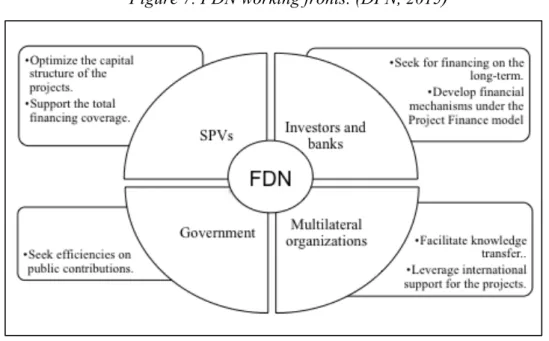
Figure 7. FDN working fronts 36
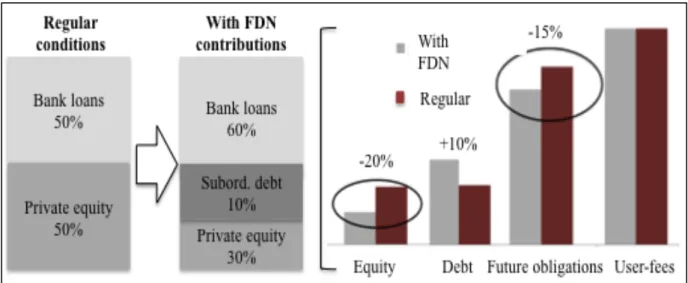
Figure 8. Effect of the FDN contributions on the financing structure of the 4G program 37 Figure 9. Allocation of future obligations for PPP projects as a GDP percentage 38
Table 1. Before and after the PPP law 29 Table 2. Allocation of Risks on the 4G Highways Program 31
ACRONYMS
ANI National Agency for Infrastructure
ANIF National Association of Financial Institutions CCI Colombian Chamber of Infrastructure
CONPES Colombian National Committee of Social and Economic Policies DNP National Planning Department
EIU Economist Intelligence Unit FDN National Development Financial GDP Gross Domestic Product
IDB Ibero-American Development Bank INCO National institution for Concessions LPVR Less Present Value of Revenues MTFP Medium Term Fiscal Plan NMF National ministry of Finance NMT National Ministry of Transport
OECD Organization for Economic Co-operation and Development O&M Operation and Maintenance
PPP Public-Private Partnerships PSC Public Sector Comparator SPV Special Project Vehicle VfM Value for Money
CHAPTER 1: INTRODUCTION
Worldwide, the existence of an infrastructure gap is undeniable (Deloitte, 2009). As worrying as the lack of infrastructure is in both developed and emerging economies, is the lack of public and private investment to close that gap. Intervention of governments is needed to ensure that the infrastructure projects developed are in line with the economic and social objectives of the country, but a series of market and government failures demand the involvement of the private sector, which can contribute with expertise, efficiency and innovation. Around the world, PPPs have become a well-known model to deal with the time inconsistency problem and other difficulties, always that exists a sufficient transfer of risk to the private partners (OECD, 2008).
Colombia, as many other countries in the region, suffers from a high infrastructure gap and has an urgent need to consolidate an optimal national road network that connect the production and consumption centers of the country, with the main ports and frontiers (CONPES, 2013). Despite the fact that total public investment on transportation infrastructure has doubled during the last years, Colombia still needs to invest every year for a decade, 3,1% of the GDP to close the infrastructure gap (Fedesarrollo, 2012).
The 4th Generation of highways is an ambitious program developed by the Colombian government to build more than 30 highways in the country in the next 5 years, which contemplates investment of more than EUR 20 billion and is designed under a PPP model. The Colombian government is having problems ensuring the financing of the projects that have been already approved and is considering different alternatives to construct the highways. Some options imply a higher fiscal risk or the possibility of suffering of the same problems presented in the previous concessions of highways.
Developing a suitable PPP model is the key to ensure the implementation of the projects under the PPP model that the government has been working on during the last 3 years. The objective of this paper is to analyze in detail this PPP model, addressing dimensions like the institutional framework, the risk assignation and the financial instruments. Then, it is intended to assess strengths and weaknesses of the Colombian model that could become on learning points for future PPP projects on emerging markets.
The paper starts with a review of the relevant literature on PPPs for the purpose of this dissertation in Chapter 2. Then, Chapter 3 presents the case of the 4th generation of highways. This section covers details about the previous experiences on PPPs in Colombia, the size of the projects, the institutional framework, financial model and current state of the program. In Chapter 4, the analysis of the 4th generation of highways program is addressed in several dimensions like risk management and financial structure, making a special emphasis on each of the main financing sources. Finally, in Chapter 5, conclusions and considerations for future experiences are provided.
CHAPTER 2: LITERATURE REVIEW 2.1 Infrastructure Development
Around the globe, the existence of an infrastructure “gap” (Deloitte, 2009) is a reality for both emerging and developed economies (Haran, 2013). That infrastructure “gap” has gone hand by hand with a lack of investment on this field (Meaney & Hope, 2012). Globally, total government investment on infrastructure, measured as a proportion over countries’ GDP has fell by half, going from 5% to less than 2.5% over the last four decades. On the other side, private investment on infrastructure has increased during the same period but the contribution of the private sector is not enough to leverage the current state of infrastructure investment (Meaney & Hope, 2012). Particularly, during the last years, and due in part to the economic downturn, private investment has fallen dramatically, and instead public funding has slightly increased. Even so, the medium-term outlook for public infrastructurre finance is bleak. (Uppenberg, Strauss & Wagenvoort, 2011).
In the case of infrastructure, leaving the market to act on its own may not end on a socially optimal level of investment because there are market failures that make intervention of the public sector necessary. On the other side, the government acting on its own drives to other failures. Both market and government failures are due, firstly, to the heavy front-loaded sunk costs and the long-term nature of infrastructure projects. Besides, the monopolistic characteristic of massive infrastructure causes possible incumbents to fear about the return of their investment under competition, and entrants to find it too risky to compete due to a possible lack of demand or regulation. On the other hand, there are external factors that could be positive and will not be captured by the investor, or negative, as pollution and noise, which
are socially undesirable1. The difficulty of capturing these externalities impact may lead to a suboptimal price on infrastructure investment. (Meaney & Hope, 2012)
In terms of the relations between public and private entities on infrastructure development, the monopolistic nature and cost structure of the projects lead to the time-inconsistency problem that argues that, from a financial perspective, the investor would need an ex-ante guarantee of the recovery of its investments on the long term, considering the incentive for the government and regulatory bodies to drive prices down because the assets have partly become a public good and operations will run until the operator recovers its marginal cost (Helm, 2009). Without a credible commitment, private parties will demand a compensation for the political risk, leading to a higher financial cost. (Meaney & Hope, 2012)
In order to close the infrastructure “gap”, the need for infrastructure financing by private parties is greater than ever, but it will only works if governments understand and address the specific incentives, information problems and risks that arise for investors in infrastructure (Uppenberg, Strauss, & Wagenvoort, 2011). In that sense, partnership-based procurement is projected to continue raising over the course of the next decade (Haran, 2013).
2.2 Public-Private Partnerships
Governments need to choose and implement policies that facilitate infrastructure development, at the same time allowing access to financing, reducing waste and corruption, and developing a sustainable operation framework for the infrastructure assets (Delmon, 2010). As seen before, PPPs are one of the possible tools to address these challenges. PPPs, as defined by the OECD, are agreements between the government and one or more private partners in which the latter delivers a service, and in which the alignment of both parties’ objectives depends on the sufficient transfer of risk to the private partners (OECD, 2008). It is a contract on a long-term base where normally the investment is financed through time by deferred payments by the government, user-fees or a combination of both.
Risk-transfer mechanisms appear with the establishment of an integral regulation over the quality of the infrastructure service and accomplishment on the delivery levels (Hinojosa, 2010). The long-term nature of the PPPs means that they represent a solution to the time- time- time- time- time- time- time- time- time- time- time- time- time- time- time- time- time- time- time- time- time- time- time- time- time- time- time- time- time- time- time- time- time- time- time- time- time- time- time- time- time- time- time- time- time- time- time- time- time- time- time- time- time- time- time- time-
inconsistency problem described before, by targeting private sector efficiencies and benefits derived from an efficient risk allocation. (Meaney & Hope, 2012).
There are even more tangible expectations about the PPP model: time performance. According to Hampton (2012), PPPs are considered the most favorable form of procurement in this sense. As several international experiences, mostly in the United Kingdom, have shown, PPPs have a higher accomplishment on time and budget than other models, and they even evidenced cost savings of up to 10% due to the risk transfer from the public to the private firms (Haran, 2013).
One of the main expectations around PPPs is that the private sector will be able to provide services more efficiently and more effectively than the public sector, by achieving reductions on operating costs and maximizing the use of capital expenditure (Dunnigan and Pollock, 2003; Shaw, 2004; Meaney & Hope, 2012). Normally, the private sector becomes responsible for the initial design and construction, operation and maintenance, thereby aligning incentives for low-cost construction and at the same time minimizing lifetime costs of operation (Meaney & Hope, 2012).
Additionally, the PPP model is expected to evoke a more entrepreneurial government, capturing private sector manners such as market-driven competition, performance-based contracting (Bloomfield, 2006) and more solid regulation institutions reducing corruption by the increase in accountability and transparency. PPPs would allow accelerated infrastructure provision transforming public capital expenditure into a flow of ongoing service payments (Liu, Love, Smith, Regan, & Sutrisna, 2014). These expectations follow from the fact that shareholders, who are the residual claimants of any additional profits, are expected to put pressure on management to accomplish lower costs and major efficiencies (Meaney & Hope, 2012).
The problem arise when governments choose PPPs as the model for a project based on reasons such as having neither revenues nor the credit to finance investments in public goods and services such as roads, hospitals or schools. PPPs should not arise on the demand for financial miraculous solutions. On the contrary, PPPs should be a feasible solution2 among
other alternatives, and should only be applied when its advantages for the public sector are proven by a cost-benefit analysis (Trincão, 2014).
The first step on the decision to adopt PPPs is the political discussion. Governments should consider if there is sufficient political and social will to implement PPPs and their implications. Another requirement is a deep analysis of the institutional, regulatory and legal context to determine if government institutions have the needed skills and resources, if financial markets have the capacity and disposition for investment, and if law and regulation encourage the development of PPPs. The third step refers to the design elements of the PPP structure that include cost/benefit analysis, consideration of different sources of financing, commercial agreements needed, suitable participants, and more (Delmon, 2010)3. Figure 1 presents a framework for building a successful PPP.
Despite the existence of a broad theoretical support for the use of PPPs, it continues to exist a lack of comprehensive, reliable data on their performance over the lifetime of the contract. It has even been suggested that the absence of clear financial information and accountability allows the government to hide mistakes on the development and procurement of the PPP projects or to justify decisions already taken (Shaoul, 2010).
2.3 Public Provision vs. PPPs and the PPP Premium
According to some authors, the increase on the development of PPP projects is due mainly to the government’s intention of evading the possible constrains on the public budget to implement ambitious infrastructure plans (Yescombe, 2011). In addition, some countries face a more specific constrain, which are fiscal rules. In that kind of situations, to leverage the public budget needed, governments are forced to raise taxes, levy user fees, cut spending in other areas, etc. As PPPs do not encumber budgets on the short-term, they become an attractive alternative, or maybe the only one, for infrastructure development (OECD, 2008).
Governments find PPPs so attractive because expenditures are only registered after the construction is complete and are spread over the years of the contract. On PPPs, governments are not obliged to report an increase on expenditures, and undertaking a new project will not
affect public debt during the investment stage. In that sense, PPPs can create the false impression that they are a more affordable model (OECD, 2008). The reality is that, in the short run, PPPs will always tend to reduce the government capital expenditure, but on the long run, this may not be the cheapest option. Depending on the social cost of government transfer and considering the discount rate used to evaluate the projects, PPPs could be a better alternative or not that if the public sector finances the project wholly. After all, it is normally more expensive to raise debt on a project finance basis (Engel, Fischer & Galetovic, 2010). When there are not efficiency gains, PPPs and publicly financed projects will have a similar long-run effect on public finances. If there is not a change on the net present value of the project, investment is not more affordable under PPPs and then, if the government can afford the project under a PPP, it should be able to afford it under public provision. (Funke, Irwin & Rial, 2013).
Actually, PPPs use to show higher transaction costs caused by a more careful project planning, which, together with the complexity of the contracts, is expected to lower the probability of costly renegotiations in the future and to promote that infrastructure will be delivered on time and on budget (Engel, Fischer & Galetovic, 2010). But due to this complexity, PPPs can become more expensive. They require legal, technical and financial advisory and regulation as well as a tight risk management. These costs can reach up to 10% of the total cost of the project (Yescombe, 2007). Due to these transaction costs and risk assignation, several authors talk about the existence of a PPP premium.
It is said that investors would require a premium on the return rate of the project with the intention of recovering costs sooner. That means that the discount rate would be higher. Contracts on PPPs try to mitigate this by providing assurance to investors that they will be able to recover their initial cost (Meaney & Hope, 2012). According to Yescombe (2007), the cost of capital on a PPP is usually 200-300 points higher than the cost of public funds, but the view that PPPs cost more on this sense could be naïve because the cost of capital calculations for the government and for private firms are different. For the government, taxpayers assume the costs of the risk in the end. This idea rests on capital market imperfections that give the government a tax system advantage. On the other hand, private firms have to explicitly recognize the risk and its price. At the end, a possible advantage for the government is not reflecting the funding risk of the project per se (Engel, Fischer & Galetovic, 2010). Eduardo Engel (2010) argues that a part of the observed PPP premium may be a reflection of faulty contract design, and therefore it is not an inherent disadvantage of PPPs.
In the end, the evaluation of the best alternative should not depend on the accounting methodology or the government’s short-term interests (Trincão, 2014), but on a financial evaluation on the affordability of the project. Methodologies like the “Value for Money” and the “Public-Private Comparator” (PSC) help on that task but they should be used alongside a range of other information (Hinojosa, 2010). The government should take into account that, if it does not have the required skills to construct and operate the project, it should develop the skilled staff to monitor the private partner and manage the risks that were assigned to it (OECD, 2008).
2.4 Project Finance and Financing Sources for PPPs4
The growth and spread experienced by PPPs in different countries is closely linked to the development of project finance, a methodology in which investors lend money against the cash flow of a structured project. Project finance takes the form of a specially created project vehicle (SPV) that carries the construction and operation of the infrastructure (Delmon, 2010). In that sense, the assets are specific and illiquid, and so they do not have value in case the project does not work (Wilhelm, 2009). The main guarantee investors can have is the right to be paid from the cash flow of the project. In that case, three main conditions should be accomplished: first, cash flow should be able to offer an attractive profitability for risk capital; second, there should be enough cash-flow guarantees, collaterals and insurances that give confidence to lenders; and third, the financial planning should be able to separate risks and allocate them properly (Hinojosa, 2010).
Project financing typically has two components: equity and debt capital. Payments to creditors are contractually defined to be done during the lifetime of the projects, but the cost and the revenue for each partner can be different, depending on each contract. The private partner could have two sources of revenue to overcome the cost of the investment on the infrastructure: payments/subsidies from the public sector that could be direct or contingent liabilities, and/or fees paid by the users, like tolls in the road sector (OECD, 2008). As was mentioned before, one of the main advantages of PPPs is that with the creation of the SPV, expenses are off-balance sheets that will shift the illiquidity risk to the lenders. In that sense,
lenders would require a detailed assessment of risks and a higher margin than they will ask in regular corporate lending. The risk associated to the different obligations will be attached to the availability of funding, the cost of funding and the capacity of the project to fulfill the debt service obligations (Delmon, 2010, Meaney & Hope, 2012) .
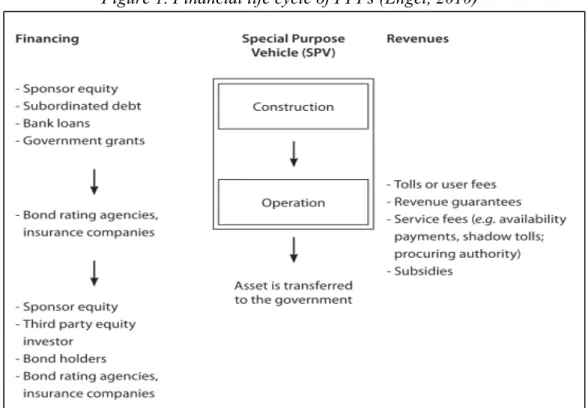
Sources of financing on PPPs change over the time of the project (figure 1). The different sources are pretended to match the evolution on risk patterns over the life cycle of the infrastructure investment (Yescombe, 2007).
Figure 1. Financial life cycle of PPPs (Engel, 2010)
On the first stage, construction, uncertainty is a substantial cause for major design changes and costs will depend on the ability of the private partner to build the infrastructure according to the studies and plans (Yescombe 2007). The private partner supplies the initial equity of the project and normally it should keep this contribution until the end of the project to create a long-term incentive (Delmon, 2010). This becomes costly for the private partner because its cost of capital is high as it is the last creditor and it is freezing resources that could be invested for other purposes (Engel, Fischer & Galetovic, 2010). Probably, the government would require the SPV to include some local investors to accomplish transfer of technology to the country or to generate jobs and training for local communities. The SPV may be possibly
subjected to public control, for example, through a joint stock company that is common in developing countries (Delmon, 2010).
On this stage, private equity is combined with debt that can come from many sources like bank loans, export credit agencies, bilateral or multilateral organizations and the government. The most common instruments on this stage are bank loans and sometimes government grants in money or in kind. In the case of projects that derive their revenues from user fees, the initial contribution to investment is sometimes supplemented with subsidies from the government (Delmon, 2010).
Over this period, banks will exercise a considerable control over the contracts and private partner behaviors (Yescombe, 2007). They perform a strict monitoring that can mitigate the moral hazard problem. To exercise control, banks only disburse funds gradually as the project stages are completed (Engel, Fischer & Galetovic, 2010). In the midway between equity and debt, there exists the possibility of having mezzanine contributions that have a lower priority than senior debt but higher priority than equity contributions. Subordinated loans and preference shares are examples of mezzanine contributions. On the other hand, one actor that has become important mainly in developing countries is multilateral organizations. These agencies will normally demand strict planning and arrangements, and will also help to mitigate political risks (Delmon, 2010).5
After completing construction and starting operation, long-term debt appears to substitute bank lending, and private partner equity is subjected to a possible acquisition by a facilities operator or third-party investors like pension or mutual funds (Wilhelm, 2009). As risk falls when works are completed and the events that can affect cash flows are limited, bond financing becomes more suitable (Engel, Fischer & Galetovic, 2010), and is associated with the appearance of rating agencies and insurance companies (Wilhelm, 2009). Bondholders only have control over situations that may affect significantly cash flows but they are not able to examine the behavior of the private partner or operator (Yescombe, 2007). This type of lenders will not want to bear risks that are more appropriately borne by other parties, but they will be involved in the financial structuring and will exercise their review powers with the support of independent technical and financial auditors (Delmon, 2010). Including debt
holders will demand an attractive project bankability, which is ensured if there is a financial instrument and a legal bound that give them enough confidence, without requiring direct guarantees (Hinojosa, 2010). For example, It has become common for governments to grant revenue guarantees to concessionaires, especially when concessions have a fixed term (Engel, Fischer & Galetovic, 2010).
Another source of finance at the long run are user-fees. For this, the private operator would charge tariffs to the user of the roads. The level at which tariffs are set can be an extremely political issue. They can be subsidized, charged at very low rates or not collected (Delmon, 2010). A critical issue with tariffs is that dependence on user fees becomes unviable when large portions of the users lack the ability to pay (Uppenberg, Strauss, & Wagenvoort, 2011).
Anyway, there are different techniques related with tariffs and use of the infrastructure: on one side, there are the traditional SPVs where toll collection is the main source of revenue for the private partner; and on the other side, there are concessions based on availability where the government pays a periodical fee for the availability of the road and maintenance of service. It is a fixed payment that is independent of demand; payments are attached to the quality of infrastructure, and so there is an incentive for the private partner to promote it. In this case, there is a switch of demand risk from the private partner to the government, that at the end is covered by tax-payers (Trincão, 2014).
A new mechanism has started to be used in the last decade in countries like Colombia and Chile that receives the name of “Less Present Value of Revenues” (LPVR) (Engel, 2008). In this technique, there is a periodical monitoring of the income of the SPV and it is upgraded at the discount rate defined on the contract. The PPP is over in the moment in which the SPV income is equal to the value defined on the contract. In that sense, the partnership does not have a fixed term (Hinojosa, 2010).
2.5 Risk Assessment and Allocation on PPPs
Risk refers to an uncertain event that in case of occurring will have a positive or negative effect over the objectives, time, costs or quality of the project. Among the most important risks on a PPP are technology obsolescence, failures on design, changes on demand, political,
regulatory and macro-economic risks (Hinojosa, 2010). Allocation of these risks should be made in the most cost effective way, transferring each risk to the party that has better capacity, knowledge and experience to deal with it. That way, long-term cost of the project can be reduced and incentives are created to deliver the project on time and achieve more efficient operations (European Commission, 2003). Adding to that, allocation of risk is the main factor that would determine the existence of costly renegotiations in the future (Trincão, 2014).
Under PPPs, the private sector will be better prepared to take care of endogenous risks, most of all commercial risks, leading to technical efficiency. However, the substantial difference that makes PPPs more attractive than traditional public provision is the ability to transfer demand risk to the private sector (Meaney & Hope, 2012). The assignation of demand risk is closely related with the definition of user fees.
It is important to tone that several studies have found that on the project planning, demand is normally overestimated. Bain (2009), for example, found that traffic volumes were 23% below the forecast. Li and Hensher (2010) found that the real demand was 45% below the estimates. Baeza and Vasallo (2008) found that the traffic levels on the long run for Spanish roads tend to be 27% below the forecast. Similarly, it has been found that there is a systematical tendency to underestimate costs. Mixed with overestimation of demand, this results in a high risk around the expected profitability (Meaney & Hope, 2012, Delmon, 2010).
The transfer of risk from the government to the private sector does not involve reductions in the aggregated risk. The difference arises on the financing costs because the private partner prices risks explicitly, and not the government. In that sense, PPPs can bring to light the true riskiness of the project, which may have been disguised under public provision (Meaney & Hope, 2012).
Despite the fact that the private sector may be better at evaluating risks than the public sector, in practice not all the projects have enjoyed a better investment appraisal (Meaney & Hope, 2012). Therefore, a meticulous and structured process of contract design and enforced regulation are crucial to ensure a proper risk assessment and assignation.
2.6 Contracts and Renegotiations on PPPs
The existence of uncertainty makes contracts incomplete by definition, opening the possibility for conflicts. To solve this, contractual theory incorporates two concepts that are extremely important on PPPs: contractual commitment and renegotiations. Under uncertainty there is an asymmetry of information as well, that lead to two relevant agency problems: moral hazard and adverse selection. The private partner has incentives to show higher costs, avoid ex-ante cost savings on financial planning, or even hide information about demand forecast. Contracts should be designed in a way that they motivate the private partner to take actions that are optimal for him but are optimal on a social perspective at the same time (Hinojosa, 2010).
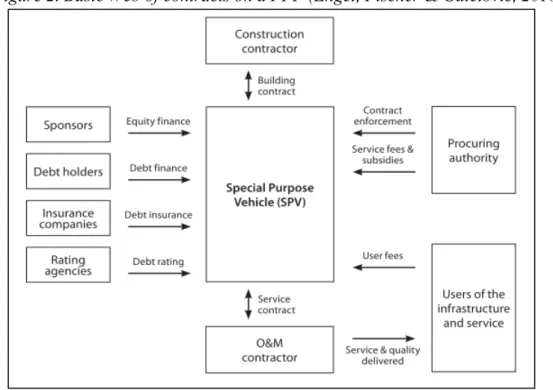
Figure 2 presents all the contractual relations that emerge on a PPP. Each of these contracts is a potential source of conflict. The success of the SPV in dealing with these conflicts, according to Engel (2010), depends on two factors. One is the quality of the legal institutions and laws on which the web of contracts rests. The governance structure of the procuring authority, its degree of independence and the financial condition of the government affect the level of risk perceived by creditors. The second factor is how the participants of each relationship and contract affect risk perceptions by debt holders. On the side of the private partner, for example, its experience, reputation and financial strength are relevant because they determine the ability to credibly bear cost overruns without having to renegotiate the contract (Engel, Fischer & Galetovic, 2010).
One way of overcoming the problems created by uncertainty around future outcomes is to build outcome-dependent terms and risk-sharing mechanisms into the contracts. However, this can make the contract increasingly complex and lead to transaction costs. There are three main transaction costs: first, those costs associated with finding a private sector company capable of supplying or operating the infrastructure as required by the public sector, which will also include bidding costs for the private sector companies; second, those costs related to agreeing the terms and conditions of a contract, including the structure of payments, the transfer of risk, and other detailed project specifications; and third, monitoring and enforcement costs (Meaney & Hope, 2012).
The incompleteness of contracts can create a high degree of uncertainty and greater risk in PPPs, which can in turn push up the cost of capital. It can create an incentive for the private partner to take opportunistic actions like engaging in an excessive level of debt and increase the risk of financial distress, and then look for renegotiations to ensure the delivery of service on the builded infrastrucutre (Meaney & Hope, 2012). Faulty design of the contracts has been a huge concern in regions like Latin America and the Caribbean, where renegotiations ocurred in more than 55% of the projects on the first three years after signing the contract (Guasch, 2004).The majority of the requests were made by the private partners and are tipically related to increases in tarrifs, delays on investment obligations and reduction of the obligations of the private partner with the government (Hinojosa, 2010).
Theoretically, a renegotiation brings advantages for this type of contracts. They are long-term contracts, so it is difficult to design complete contracts with all details. Therefore, renegotiations in PPP contracts may become occasionally inevitable (OECD, 2007; Posner, Ryu & Tkachenko; 2009). In fact, “no contract is flexible enough to cover every eventuality” (OECD, 2007). And, on the opposite, an excessively detailed contract may encourage partners to look for opportunistic exits instead of making the contractual relation work. The lack of flexibility may be a problem if terms under initial contracts are misspecified, which is likely in the case where future demand is highly uncertain. For example, the inflexibility of PPPs might not allow the parties to take into account exogenous, unexpected cost shocks (Trincão, 2014). Therefore, there should be a balance between flexibility and strictness (Meaney & Hope, 2012).
2.7 Institutional Investment on PPPs
Institutional investors have tended to include on their portfolio infrastructure assets, which are believed to posses a mix of characteristics in terms of risk return, inflation protection and time horizon. These in turn give place to the development of specialized investment products like infrastructure funds (Haran, 2013), which can give returns up to 14%, almost double the return expected for bonds and stocks in the financial markets (Peng & Newell, 2007). This contradicts the common belief that infrastructure investment has a low level of risk, and then only provides moderate returns (Bitsch, Buchner & Kaserer; 2010). It has been found too that infrastructure investment is not strongly linked to inflation and is not at exponential risk by management inexperience (Uppenberg et al., 2011).
Despite the fact that the involvement of institutional investors on infrastructure vehicles has grown, it remains below 5% globally and remains underrepresented in the PPP market. This, in part, can be attributed to the comparatively small size of PPP projects in institutional investment terms. An example of innovation to deal with this is the “unitization” of “securitizes” PPP investments in the UK6 that should provide more effective risk-sharing, enables a more diverse range of investors to enter the PPP market and enhances the liquidity of the market. Some investors feel that this type of financial packages are similar to the ones that generated the World Financial Crisis of 2008 and therefore may carry a similar systemic risk (Haran, 2013).
Currently, the composition of international portfolios of PPP projects is confined to a small number of specialist investors. This is expected to change over the next few years as the global PPP market matures and transparency improves. The global economic crisis has shown the overdependence of PPP projects on debt finance. In light of the illiquidity and financial malaise within capital, innovative products and models are urgently required to address and attract big volumes of private sector capital into infrastructure provision (Haran, 2013).
Additionally, the investment community is willing to be involved in the construction phase of projects that deliver higher rates of return in compensation for the greater risk incurred to it. There is as well a growing interest of funds to invest in local infrastructure; however, greater transparency within infrastructure investment markets is required to enable investors to
6 Grouping a large number of PPP bonds together into a fund and selling stakes in this fund as “units” (Haran, 2013).
benchmark performance relative to other asset classes and to assess (mitigate) investment risk (Haran, 2013). The big question is how to develop a model that capitalizes on private sector innovations at the lower cost for taxpayers, while accomplishing the best value of investment for the public wealth. In determining the best model, key areas should be taken into consideration: flexibility, transaction costs, cost of financing, risk allocation and pricing, and incentives for distortion (Meaney & Hope, 2012).
CHAPTER 3: CASE PRESENTATION 3.1 Past experiences with PPPs in Colombia
Private participation on infrastructure development has been present in Colombia since the 90s, with the launch of the first generation of highways. Since then, private involvement on roads infrastructure has been constant. The first generation of highways, in 1994, included 11 concession projects for a total of 1.649 km of roads, focusing on specific high traffic roads but without any consideration for network effects (CONPES, 2013). In this case, the government assumed the demand risk by establishing some guarantees for the private partner (Hinojosa, 2010). The second generation in 1995, for the intervention of 470 km, incorporated risk and responsibility schemes. This time, a liquidity guarantee was included, and the private partner did the acquisition of lands and obtained the environmental permissions at the beginning of the construction stage (CONPES, 2013). In that way, public investment concentrated on construction, avoiding long-term commitments for the public budget (Hinojosa, 2010). The third generation in 2006 was much more ambitious, going for the intervention of 3.557 km. In this case there were legislative improvements on the rules of renegotiations and additions, as on the selection process and risk assignation, with a specific policy framework for the contractual risk management on PPPs (CONPES, 2013). On this generation, the present value of revenues was introduced, changing the partnership term from fixed to variable. INCO (National Institution for Concessions) was founded to structure and manage the projects (Hinojosa, 2010).
On all the previous generations of highways, there were several over costs on construction, problems on land and environmental management, and important delays on the projects’ calendars. All of these problems led to multiple renegotiations and eventually to the financial imbalance of the projects. The selection process was too long, with lots of conflicts and lawsuits
on the assignment process, and absence of homogeneous criteria for the private partner selection. Several cases were taken to the court where flaws on the bidding process where discovered, including under-budgeted proposals and disequilibrium on contracts on benefit of the private company (CONPES, 2013).
The OCDE (2013) analyzed 25 concession contracts in Colombia and found that there were around 20 renegotiations by contract, even just one year after being signed, representing increases of more than 280% of the initial value of the project. The main reasons were improper technical and financial studies, deficient design of contracts and opportunistic behavior by the different actors involved on the web of PPP contracts. A deficient contract design makes it difficult to solve conflicts on the future and define the contributions to be made by all parties, because there is no clear understanding of the economic foundations of the partnership. Besides, it was found that the participation of the private partner in relation to the total investment was low, implicating an excessive leverage of the project on public financing. Moreover, there was a low involvement of institutional investors (CONPES, 2013).
3.2 Institutional Framework
To tackle the problems from previous experiences and new challenges such as the social-environmental impact of the projects, the Colombian government has developed several initiatives7. The first one was the creation of a complete PPP law. Its most remarkable contributions were: first, it demanded more maturity on the technical, environmental, social, legal and financial studies, delegating the responsibility of the definitive design to the private company. Second, it allowed disbursements done by the government only with the fulfillment of the specific agreed levels of availability and quality of the infrastructure and service. Projects are divided in functional units (sections) to facilitate financing for each unit independently. Third, it specified better criteria to identify and allocate risks to the party that is better prepared to deal with them. Finally, It introduced new legal instruments for conflict resolution, such as arbitration.
7 For example, the anti-corruption law to deal with the patronage on the bidding and contracting processes, and the infrastructure law to improve the efficiency on lands acquisition, environmental licenses and conflict resolution on public services transfer to the SPV (DNP, 2013).
An important innovation of the PPP law was the introduction of two different types of PPP models. On the first one, PPP under public initiative, the responsible for the initial planning and design of the project is the government. Then, a public bidding process is open to find a private partner. In this case there is a limit to the possible additions by the public sector of a maximum of 20% over the value of the contract. On the second model, PPP under private initiative, the private party proposes a project to the government that can or not be accepted, and that can or not ends on the proposer being the winning company for the execution. In this case, the private partner will finance the project with a maximum contribution by the public sector of 20% of the total value of the project8 (CONPES, 2013).
Besides the legislative initiative, the national planning department (DNP) developed The Cities System Mission (2012), a plan that defines the specific actions to make cities the growth engine of the country, pursuing the regional competitiveness and the citizens’ quality of life, taking advantage of urbanization and agglomeration. The National Minister of Transports (NMT) introduced The Master Transport Plan 2010-2032, which presented a prioritization of the road projects, based on a flow assignation model that identifies bottlenecks on infrastructure and traffic and the cost/benefit analysis of the projects to be developed. It included projections of demand and capacity analysis. This document concludes that it is necessary to improve 4.800 km of current roads, to pave 3.500 km and to enlarge 3.200 km from single to dual carriageway.
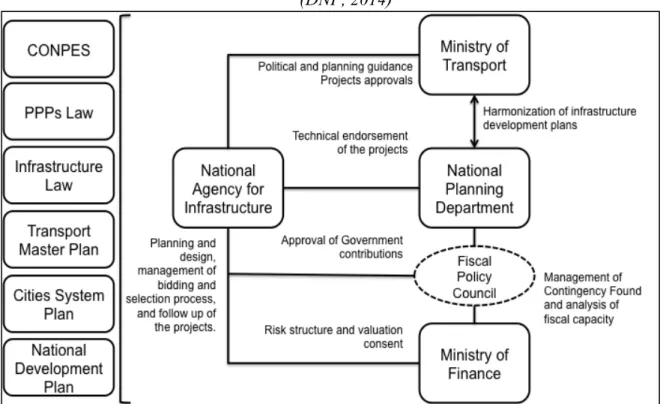
Finally, organizational changes were introduced in the government structure (figure 3). The National Vice-Ministry of Infrastructure was introduced and the old concessions institution was replaced by the National Agency for Infrastructure (ANI), a technical body responsible of ensuring the planning, design and execution of the projects (ANIF, 2014).
Figure 3. Institutional Framework for PPPs in Transport Infrastructure in Colombia (DNP, 2014)
3.3 The 4G Highways Projects
In 2013, only 7,20% of the Colombian road network corresponded to dual carriageway and around 30% of the roads were under a concession model. They are mainly concentrated on the border area of the biggest cities, but the road capacity between the main production and consumption centers is small, transportation costs are too high and production centers are not specialized (CONPES, 2013). According to the cross-border trade index, developed by the magazine Doing Business Global (2013), Colombia decreased 46 positions among 185 economies, to position #91, in relation to transportation costs and times. According to the World Economic Forum (2014), Colombia occupies position #126 among 144 countries on quality of road infrastructure, which is lower than the average position of the countries of the Latin American region.
Based on the Master Transports Plan and The Cities System Plan, the design and structuration of the projects was started, taking into account the financing capacity of the government, the fiscal rule and the potential to involve the private sector. Depending on demand and technical studies, and considering items like travel time savings, transportation cost savings, the
multiplier effect on the economy the new infrastructure may have, and cost/benefit analysis overall, the suitability of each project was defined under the PPP model. The complete program includes more than 40 highways, when private initiatives are considered, for a total investment of more than COP 50 billion and the construction of more than 6.000 km of roads. Appendix E presents the outlook of the National Highways Network when the program is completed. For detailed information on the projects, refer to appendix F and G. These 19 projects account for the development of 3.000 km of roads and a total investment of COP 39 billion, with a CAPEX investment of COP 24 billion to be done over the next 5 years, and an OPEX investment of COP 15 billion to be executed over a period of 25 years, as it is the planned term of the contracts for most of the projects.
3.4 Financial Sources
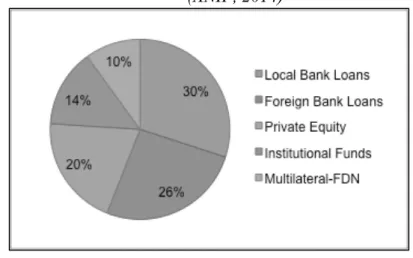
The financing structure varies for each of the two stages of the project. On the construction stage, the main sources of financing are: local banks (loans), international banks, equity from the private partners, institutional investors like private capital funds attracted to invest on this stage, and, finally, the multilateral organizations and the National Development Fund (FDN) through subordinated debt. (ANIF, 2014)
Figure 4. Distribution of Financing Sources for the 4G of highways (ANIF, 2014)
On the operation and maintenance stage (O&M), three financing sources are contemplated: income based on user-fees, public contributions made by the government, and the resources expected from the involvement of pension funds through the acquisition of infrastructure bonds. (ANIF, 2014)
In the case of Colombia, the approved resources to be disbursed by the government during the O&M stage are future obligations and are accounted on the Medium Term Fiscal Plan (MTFP)9. They are a pre-assignation of public resources to fulfill strategic plans for the economic and social development of the country, which will require to be executed during several fiscal periods, like a public transportation system or a long-term education program (CCI, 2014). For the period 2015-2044, the amount approved by the government on this category is COP 62 billion, with 85% intended to finance transport infrastructure projects, which includes airports, trains, roads, ports and public urban transportation systems (ANIF, 2014). These contributions are intended to cover 60% of the total retributions required to pay all the creditors. Besides, according to the PPPs law, the additions by the government cannot be higher than the 20% of the estimated cost of the project stipulated on the contract signed at the beginning of the partnership. The 40% left of the total retributions are planned to be covered by the revenues from user-fees related to the use of the infrastructure over the period of the PPP (CNPSE, 2013).
To facilitate the procurement of resources, the projects are divided into functional units, where one unit corresponds to a section of the project with lengths varying from 40 to 70 km, which corresponds to an investment need per unit of around COP 100.000 million. That way, remuneration is attached to each functional unit according to its availability and fulfillment of quality standards, which are subjected to an ongoing evaluation by independent engineer firms hired by the ANI. Retributions from the public budget are subjected to possible discounts, up to 10% of the agreed value, if the infrastructure does not fulfill all the quality standards (DNP, 2014).
3.5 Current State and Issues
The 4G highways program has experienced difficulties to create the synergies and develop the expertise in the different public and regulation institutions involved, but the financial dimension has become the most matted issue. There is a great concern around long-term financing and the possibility to mobilize resources away from institutional investors and risky capital funds. There is a general concern about the size of the program, which could be overloading a young market
9 The Ministry of Finance emits the MTFP. It includes estimations of incomes and expenses of the central government over the next 10 years and accounts for all the future obligations that have been approved by the government (CCI, 2014). For more information, refer to appendix E.
like Colombia’s (IDB, 2014).
The projects of the first wave have experienced difficulties to capture all the resources needed and the scenario has been even more difficult for the second wave. The main problems experienced are: i) banks are refusing to accept payment periods higher than 8-10 years, when the intended period is of 20-30 years; ii) investors perceive high risks associated to land acquisition, environmental licenses and the acceptance of the projects in local communities; iii) cost increases could result from poor technical studies (CCI, 2014).
The Colombian government is considering alternatives to ensure the resources for the projects. One of them is to execute some of the highways by traditional public provision. Some of the projects are not attractive enough for investors due, in one hand, to the demand risks resulting from uncertainty about the future traffic flows and low levels of traffic in the present; and, on the other hand, due to the technical complexity and costs of construction, taking into account the geological and engineering challenges. This situation is exacerbated by the low investment on the pre-bidding stage (0,2% vs. 3% of the value of the project according to international standards) (ANIF, 2014).
ANIF (2014) has developed an infrastructure index to determine which projects are more suitable for PPPs, which for public provision and which could be executed by any of both alternatives. This index is not based on a financial evaluation as the one suggested by the Public-Private Comparator, but on five prioritized criteria: current and potential traffic, construction risk, investment amount required, relevance of the road, and percentage of the work that corresponds to the construction of new assets10 (ANIF, 2014).
Following the ANIF’s recommendation, 13 of 25 evaluated projects would be suitable for public provision. This would require additional resources of 0,3% of the GDP per year for the next 8 years. With that level of public expense, the deficit goal defined by the fiscal rule would not be accomplished. Then, a tributary reform would be needed to collect more taxes that can cover the need for public resources. The ANIF suggests to exclude capital expenses from the fiscal rule and limit it to debt related with investments, as other countries like Brazil, Ecuador, Honk Kong and Japan have done. In that way, there would be a higher contribution for
10 Refer to appendix I.
infrastructure projects at the same time that more taxes are collected. According to the ANIF, infrastructure development requires as much attention on the tributary regulation as the PPPs themselves (ANIF, 2014).
CHAPTER 4: ANALYSIS 4.1 Institutional Readiness
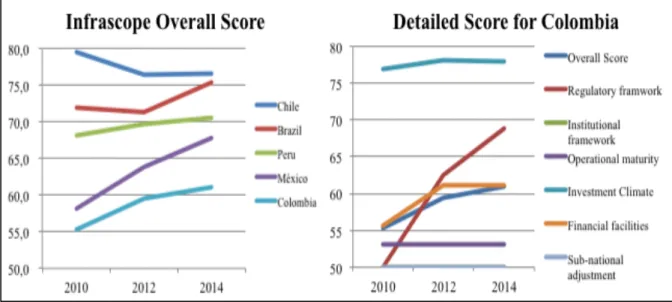
Colombia is highlighted as one of the most mature countries for the development of infrastructure projects, among Chile, Peru, Brazil and Mexico (EIU, 2015). Despite that and according to the Infrascope, an infrastructure readiness index developed by the IDB and the EIU, the real improvement on the support framework to infrastructure development in the country has not been as notable as one would think. There are several areas in which the country has not made notable improvements, especially in terms of risk allocation and technical expertise on the design and approval of PPP projects.
Figure 5. Colombia on the Infrascope Index. (EIU, 2015)
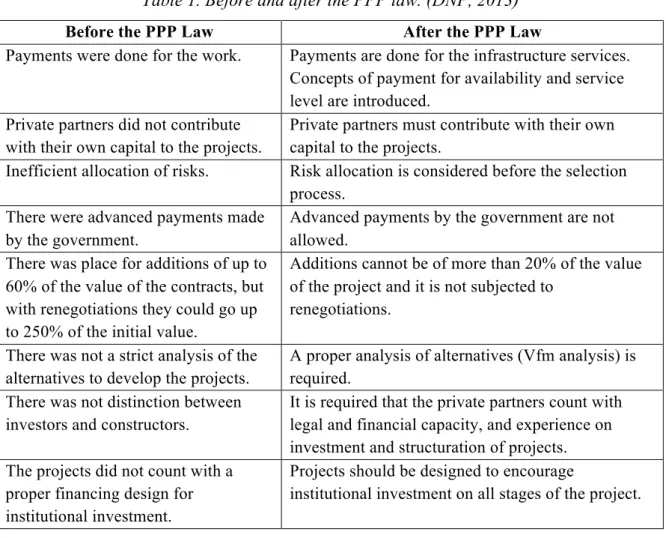
The PPP law, approved in 2012, brought several changes that have been implemented over the last 3 years. Table 1 summarizes the most relevant ones.
One of the main innovations on the PPP law was the introduction of public and private initiatives. To avoid this mechanism becoming an easy way to skip the public tendering process, if there are public resources compromised, the public tendering should be open, giving the possibility to other parties to gain the right to build the infrastructure if they have a better offer than the proponent.
Another important mechanism to deal with corruption was the timeline created for additions and prorogations. With the PPP law, they can only be made on the first three years after signing the contract and before 75% of the PPP period has passed. PPP contracts cannot be signed at the end of a local government period to avoid the possibility of PPPs being used as a political instrument for the next elections. To avoid money laundering, the real benefactor information of the private companies should be disclosed, even for the pre-qualification process.
Table 1. Before and after the PPP law. (DNP, 2013)
Before the PPP Law After the PPP Law
Payments were done for the work. Payments are done for the infrastructure services. Concepts of payment for availability and service level are introduced.
Private partners did not contribute with their own capital to the projects.
Private partners must contribute with their own capital to the projects.
Inefficient allocation of risks. Risk allocation is considered before the selection process.
There were advanced payments made by the government.
Advanced payments by the government are not allowed.
There was place for additions of up to 60% of the value of the contracts, but with renegotiations they could go up to 250% of the initial value.
Additions cannot be of more than 20% of the value of the project and it is not subjected to
renegotiations. There was not a strict analysis of the
alternatives to develop the projects.
A proper analysis of alternatives (Vfm analysis) is required.
There was not distinction between investors and constructors.
It is required that the private partners count with legal and financial capacity, and experience on investment and structuration of projects. The projects did not count with a
proper financing design for institutional investment.
Projects should be designed to encourage
Despite this improvement, in reality there are lots of challenges to be addressed. Most of the personnel of the ANI lack project-planning experience. For example, the law mandates a cost-benefit analysis for the selection of PPP projects, including public-private comparison indicators, but in practice the system has a poor record of renegotiating projects, and commercial risks are often passed to the government, irrespective of what has been explicitly laid down in contract agreements. In this sense, creating project preparation and oversight capabilities within the government remains the critical factor (Infrascope, 2015).
In addition, several difficulties appear in the implementation of the PPP law, like the design of the pre-qualification process, which could become a mechanism that favors some private companies. Worrying as well is the definition of the level of service and quality standards that will allow the disbursement of public funds. It is not an easy task to define that criteria ex-ante and they can become a manipulated argument to ensure public funding. Another important difficulty arises when extensions and additions are truly needed, for example, caused by a weather phenomenon. According to the law, the private partner has to pay to the government 10% of the required addition in order for the latter to evaluate its authorization. In the end, this could cause an increase on the cost of the project, due to the fact that private companies are going to add that cost to the initial value; or can imply a decrease on the quality of the infrastructure if needed additions are not easy to get.
Other concerns appear specifically around public contributions to the project. Additions and extensions are limited to 20% of the initial value, but it is not clear exactly what is counted as public contribution, and if, for example, land rights11 or tolls gave up by the state to the SPV are included. In addition, local governments are allowed to make in-kind contributions out of the 20%, but there is no clarity about which kind are these. Appendix I exposes other problems in past experiences and the proposed solutions. Some of them were implemented but others experienced difficulties persist until now.
4.2 Risk Distribution
According to the PPP law, risks should be allocated in the contract to whom has better capacity to manage and mitigate them (CONPES, 2013). In that sense, there are some risks
11 Under the PPP law, the government transfers environmental licenses and land acquisition responsibilities to the contractors.
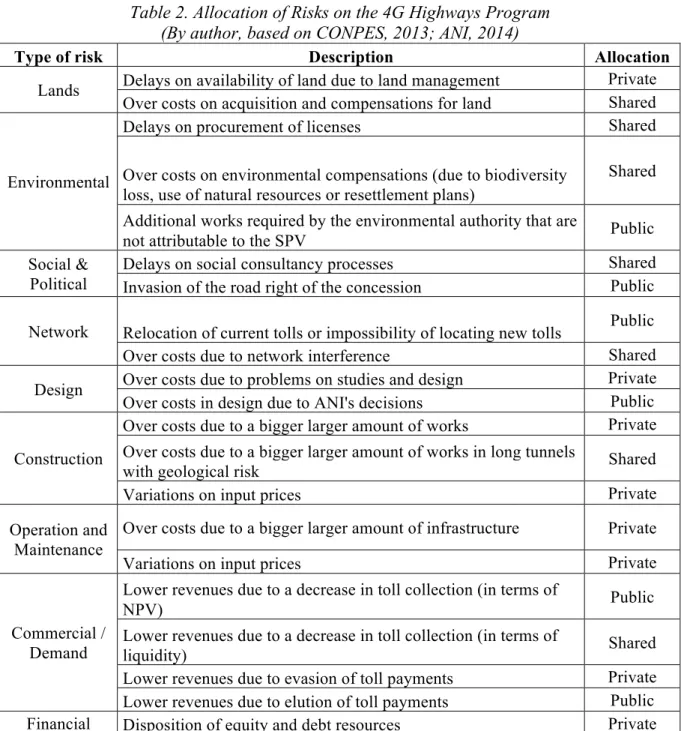
that are more suitable for the public sector, like political risk, in which legislation or regulation of several items can change in the near future and affect the projects, and cannot be controlled by the private partner. By contrast, other types of risk related to construction, operation and maintenance are better borne by the private partner (Sarmento & Renneboog, 2014). Finally, there are some risks in which it is not that clear which party is better prepared and, as in the Colombian case, an efficient allocation should consider a mix of variables. The Colombian government has designed mechanisms in which public contributions for shared risks are subjected to some conditions. Table 5 summarizes the mayor risks that have been considered and allocation in the 4G highways program.
Table 2. Allocation of Risks on the 4G Highways Program (By author, based on CONPES, 2013; ANI, 2014)
Type of risk Description Allocation
Lands Delays on availability of land due to land management Private
Over costs on acquisition and compensations for land Shared
Environmental
Delays on procurement of licenses Shared
Over costs on environmental compensations (due to biodiversity loss, use of natural resources or resettlement plans)
Shared Additional works required by the environmental authority that are
not attributable to the SPV Public
Social & Political
Delays on social consultancy processes Shared
Invasion of the road right of the concession Public
Network Relocation of current tolls or impossibility of locating new tolls Public
Over costs due to network interference Shared
Design Over costs due to problems on studies and design Private
Over costs in design due to ANI's decisions Public
Construction
Over costs due to a bigger larger amount of works Private
Over costs due to a bigger larger amount of works in long tunnels
with geological risk Shared
Variations on input prices Private
Operation and Maintenance
Over costs due to a bigger larger amount of infrastructure Private
Variations on input prices Private
Commercial / Demand
Lower revenues due to a decrease in toll collection (in terms of
NPV) Public
Lower revenues due to a decrease in toll collection (in terms of
liquidity) Shared
Lower revenues due to evasion of toll payments Private
Lower revenues due to elution of toll payments Public