How to address tensions between growing
demand and decreasing resources as a NGO
The case of ATLAS
Matilde Carvalho
Dissertation written under the supervision of Laure Leglise
Dissertation submitted in partial fulfilment of requirements for the MSc in Master of Science in Business Administration, Major in Strategy and Consulting, at the Universidade Católica Portuguesa, June 2017.
Abstract
“How to address tensions between growing demand and decreasing resources as a NGO: the case of ATLAS” written by Matilde Cura Mariano de Carvalho.
The goal of this thesis is to provide insight into how a local NGO can address the tensions between the growing demand for its services and the decreasing number of resources available to meet that demand. This question is crucial for Portuguese NGOs, since Portugal is slowly recovering from a crisis.
To investigate the research question, a qualitative, single case study methodology was employed. Interviews were the key technique to collect primary data, and internal and external documentation provided secondary data. The data collected was treated through the coding system, yielding an exploitable and organized structure for analysis. The company studied is “ATLAS People like us”, a small NGO that is currently only operating in the Portuguese market.
The study identifies some distinctive strategies that are being used in order to address these tensions. Firstly, the organization is focused on its volunteers, treating them the right way and giving them autonomy; secondly, it is exploiting networks; and thirdly, it is focusing its resources in one main project, in order to get more resources and visibility.
Resumo
“Como as ONGs podem responder ás tensões geradas pela crescente procura dos seus serviços, apesar da diminuição de recursos disponíveis para dar essa resposta: o caso da ATLAS” escrito por Matilde Cura Mariano de Carvalho.
Esta tese tem como objetivo apresentar estratégias para que as ONGs locais consigam responder ás tensões geradas pela crescente procura dos seus serviços, apesar da diminuição de recursos disponíveis para dar essa resposta. Estando Portugal a recuperar de uma crise, esta é uma questão essencial para a sobrevivência das ONGs portuguesas.
Para estudar e dar resposta à nossa questão, foi feito um estudo qualitativo de um caso especifico. As entrevistas foram a principal fonte de informação primária e os documentos internos e externos forneceram os dados secundários. Os dados recolhidos foram tratados pelo sistema “coding”, dando origem a uma estrutura exploratória, organizada para análise. A organização estudada foi a “ATLAS People like us”, uma pequena ONG que atualmente opera somente no mercado português.
O estudo identifica algumas estratégias que estão a ser usadas de forma a responder a estas tensões. Em primeiro lugar, a organização apoia-se nos seus voluntários, tratando-os bem e dando-lhes autonomia; em segundo, está a explorar e aproveitar redes de contactos; e em terceiro, está a concentrar os seus recursos num projeto principal, de forma a ganhar mais visibilidade e mais recursos.
Table of contents
1 Introduction ... 8
2 Literature review ... 10
2.1 What is a NGO ... 10
2.1.1 NGO’s definition ... 10
2.1.2 Different Types of NGOs ... 11
2.1.3 NGO’s importance ... 12
2.2 NGO’s resources ... 13
2.2.1 Resource dependence theory ... 13
2.2.2 Human resources ... 14
2.2.3 Dependence on volunteers ... 14
2.2.4 NGO’s funding possibilities ... 15
2.3 Strategies to face tensions ... 17
3 Methodology ... 20
3.1 Methodological choices ... 20
3.2 Data collection & Data analysis ... 21
4 Case Study ... 25
4.1 History ... 25
4.2 Organization’s overview ... 25
4.3 Vision mission and values ... 26
4.4 Structure ... 26 4.5 Projects ... 26 4.5.1 “Escolas solidárias” ... 27 4.5.2 “Mexe-te” ... 27 4.5.3 “Velhos amigos” ... 28 5 Findings ... 29 5.1 Results ... 29
5.1.1 Introduce loose criteria to attract more volunteers ... 29
5.1.2 Treating volunteers well in order to retain them ... 30
5.1.3 Empowering volunteers ... 30
5.1.5 Applying for grants to have financial sustainability ... 32
5.1.6 Fund raising ... 33
5.1.7 Establishing partnerships ... 33
5.1.8 Increasing notoriety to attract more resources ... 34
5.2 Discussion ... 35 6 Conclusion ... 36 6.1 Main Contributions ... 36 6.2 Limitations ... 36 6.3 Future research ... 37 7 Appendixes ... 38 8 References ... 44
List of tables
Table 1- Different types of NGOs ... 11
Table 2- Strategic responses to resource dependence ... 18
Table 3- Examples of citations being coded ... 22
List of appendixes
Appendix 1- Interviewee list ... 38
Appendix- 2 Helena Vasconcelos’ profile ... 38
Appendix- 3 Sources for the case study ... 39
Appendix 4- Examples of 2014 newspaper articles on ATLAS ... 40
Appendix 5- Examples of 2015 newspaper articles on ATLAS ... 41
Appendix 6- Screenshot of Inês Leal email's signature ... 41
Appendix 7- Treated available financial information on each year ... 42
1 Introduction
In 2015, the weight of volunteerism represented less than 1% in the Portuguese GDP, contrary to other more developed European countries, where the percentage of volunteerism is more significant, as for the case of Austria that was represented by almost 5% (Franco and others 2015). In order to understand and make efforts to change this scenario, a study was conducted, a study that was the foundation of our thesis.
With the support of Fundação Calouste Gulbenkian Cidadania Ativa, Universidade Católica Portuguesa conducted the first study, with statistical data, on the diagnosis of nongovernmental organizations in Portugal. In this study, the context where these organizations are operating is mentioned as well as its present and possible future consequences.
The contextual environment is referred, by the studied NGOs, to be increasingly difficult, dynamic and complex, mostly because the country is still slowly recovering from an economic crisis. At the same time, the complexity of problems to be solved is increasing, together with the competition from other organizations in the sector, both in terms of service provision and access to funds.
Related with the difficult access to funds, the NGOs under study noted a significant decrease in public funding and they declared that to be one of the greatest challenges for their sustainability. But that is not the only consequence of the economic crisis, the decrease of corporate funding was also noticed, because the crisis came to slow down or stop some of the achievements and weight that the concept of corporate social responsibility was gaining in the business sector. Lastly, several organizations also outlined the difficulty in attracting enough volunteers, but above all, to achieve the desired quality in the recruits.
To sum up, this study shows that the slow recovery from the economic crisis, which Portugal is facing at the moment, can not only lead to a decrease in public and private support, but also, hinder the attraction of volunteers who cannot take risks in the job market.
In the past, there were studies that showed how the nations should respond in order to account for the non-profit growing troubles that arised from the crisis (Bridgeland et al. 2009), but little research has been made about the strategic responses that the non-profit organizations
should take to overcame the consequences of the economic crisis. Only last year, a paper explored the impact of numerous strategies on non-profit organizational performance during this time, but in the United Stated (Arik, Clark, and Raffo 2016). So, this study comes to study these strategies in Portugal, examining how can a local NGO address the tensions between the growing demand for its services and the decreasing number of resources available to meet that demand. It is of managerial relevance because this thesis intends to present, through a successful case study, solutions in the form of strategies that NGOs’ managers have available, in order to overcome this challenge that most of them are facing. The present thesis adopts a qualitative (Bettis et al. 2015) and, as stated before, a single case study approach (Yin 2009), where the NGO elected was “ATLAS People like us”. ATLAS is a local NGO that is currently only operating in the Portuguese market, and it was of particular interest on this research because despite the current economic situation of the country, this organization is growing and getting more visibility every year.
The structure that this thesis follows is the following. In the first chapter the literature review is presented, where past literature on NGOs is our focus, including three main sub themes: NGO’s concept; NGO’s resources; and strategies that NGOs use to face tensions.
The second chapter is dedicated to the methodology used when developing this study, where it is specified why the qualitative research approach was selected, as well as the use of a case study and how it was built, how the data was collected and how it was analysed.
Subsequent to the methodology, the case study is exposed. Which has, as the main goal, the presentation of the organization, its structure and processes, and the main projects they are involved in.
The following chapter is dedicated to the findings of the present research, where an extensive analysis of the outcomes obtained through the interviews as well as organizational documents is processed.
Finally, the last chapter includes the main conclusions, as well as limitations and further research.
2 Literature review
This chapter will focus on past literature that has been written in order to help us answer our research question. For that, the chapter is divided in three main sections, starting to focus on the concept of NGO, its definition, different types and its importance; the second one focuses on the resource dependence theory and its appliance to NGOs, here we are going to emphasize the human and financial resources; finally, we will focus on the studied strategies that NGOs use to overcome dependency on others or on the environment.
2.1 What is a NGO
Although the importance of institutions, that offer goods and services when in need, has long been recognized (Morris 2000), the lack of consensus on how to define and classify the term NGO has led to make it harder to comprehend the functioning of the third sector, consequently constraining possible progresses in the theoretical and experimental perspective of the same (Vakil 1997).
2.1.1 NGO’s definition
The term “nongovernmental organization” (NGO) was created in 1945, post World War II, by the United Nations (UN) to mention the role of consultants working for UN activities that were not those of national governments (Martens 2002). At this time, the UN left open the term’s content, and today a big variety of organizations fit in the concept (Srinivas 2009). After that, with no interest on profits or politics, frequently were NGOs characterized as organizations focused on “doing good” (Werker and Ahmed 2008). But, with the fast international development, NGOs not only started to be seen as more efficient suppliers of services and goods (Edwards and Hulme 1995), but also, as instruments in changing mind-sets and attitudes (Keck and Sikkink 1999).
In 2002, Willetts described an NGO as an association which is independent and voluntary, constituted by a group of people that act together for the same purpose and on a regular basis without having in mind achieving government office, earning money or any type of illegal activities. In the same year, Martens (2002) described it as an independent and professionalized social organization that has the main objective to promote common goals at the national or international level. In neither the cases, the type of goals are defined or clarified, nor the way to achieve them.
A more complete, and recent, definition is given later by Teegen, Doh, and Vachani, who state that “NGOs are private, non-for-profit organizations that aim to serve particular societal interests by focusing advocacy and/or operational efforts on social, political, and economic goals, including equity, education, health, environmental protection and human rights” (Teegen, Doh, and Vachani 2004, p.466).
2.1.2 Different Types of NGOs
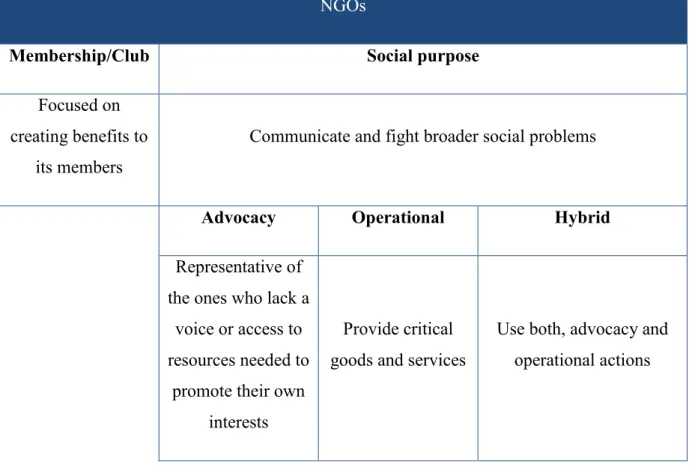
According to the same authors, depending on the benefits they produce, non-governmental organizations can have two different categorizations, as membership or club NGOs that are focused on creating benefits to its members, and social purpose NGOs that communicate and fight broader social problems. Inside this last characterization there are three types of NGOs, important to differ, and that are distinguished according to their activities: advocacy NGOs; operational NGOs; and Hybrid NGOs (see Table 1).
Table 1- Different types of NGOs, adapted from: “Teegen, Doh, and Vachani 2004” NGOs
Membership/Club Social purpose
Focused on creating benefits to
its members
Communicate and fight broader social problems
Advocacy Operational Hybrid
Representative of the ones who lack a
voice or access to resources needed to
promote their own interests
Provide critical goods and services
Use both, advocacy and operational actions
2.1.2.1 Advocacy NGOs
NGOs are some of the organizations with better placement to give a voice to specific needs, since they are the ones that comprehend them better (Stromquist 1998). This type of organizations work as representatives of the ones who lack a voice or access to resources needed to promote their own interests (Teegen, Doh, and Vachani 2004).
In case the NGOs’ strategies have the objective to influence decision-makers directly, then they are referred to as ‘insider’ strategies, if, on the other side, they intend to create awareness on the public on a specific topic, they are ‘outside’ strategies (Peterson 1992).
2.1.2.2 Operational NGOs
Despite the importance that is given to advocacy NGOs, most of the value that NGOs create comes from their operational activities, Teegen, Doh, and Vachani (2004) classify these organizations as the ones who “provide critical goods and services to clients with unmet needs” (Teegen, Doh, and Vachani 2004, p.467). As some examples of this type of activities, they mention the relief of efforts provided by the Red Cross, the natural resources monitoring by the World Wide Fund for Nature, and finally the distribution of medical drugs by Doctors Without Borders.
2.1.2.3 Hybrid NGOs
Hybrid NGOs are the ones that use both, advocacy and operational actions to succeed on the social benefits they are committed to. Some of the activities associated with this type of NGO are activities that intend to strengthen social capability as for: creation and establishment of codes of conduct; provision of education and training; facilitating access to certain resources; sharing knowledge about goods and service’s delivery; sharing best practices; and helping on the creation, promotion and maintenance of institutional setting that stimulate social welfare (Brown and Kalegaonkar 2002, Offenheiser and Holcombe 2003).
2.1.3 NGO’s importance
The role of non-profit organizations in our society is “sometimes thought to be one of fulfilling social welfare functions in spheres where state intervention is considered to be inefficient and/or undesirable” (Lagerspepetz, Rikmann, and Ruutsoo 2002, p.75). And in the cases where critical services, representation, and organization are missing, for social ends, NGOs play important roles in governance and value creation (Teegen, Doh, and Vachani 2004).
NGOs are considered to be organizations able to offer high quality services at relatively low costs, to their clients with unmet needs, because not only do they have experience but they also possess the reputation of being reliable institutions (Leonard 2002).
The impact on the beneficiaries and on their respective communities is how the success of the organization can be measured (Woller and Parsons 2002), but in order for this impact to be positive, the resources needed have to be secure, and that is what we are studying in the following section.
2.2 NGO’s resources
Motivated by both normative and instrumental concerns, NGOs act similarly to firms, operating in a competitive arena for resources, seeking to maintain organizational survival and growth (Prakash and Gugerty 2010). And their vulnerability to external impacts is measured by the extent to which they depend on a resource (Khieng and Dahles 2015).
2.2.1 Resource dependence theory
Resource dependence theory cannot be ignored and Pfeffer and Salancik resume it as “The key to organizational survival is the ability to acquire and maintain resources” (Pfeffer and Salancik 2003, p.2). According to Froelich (1999) this is not easy, due to the unsuitability, instability and impossibility to ensure the resources. The author also stated that the organizations are restricted by the environment, as an effect of their resource needs.
To comprehend what resource dependence means, we have to rely on an open-system perspective (Katz and Kahn 1966), understanding that an open system does not only mean that the system interacts with the environment but that the interchange is fundamental for the systems viability. Meaning that, in order to have access, acquire and maintain the desirable resources, the organizations have to build relationships with individuals and groups that control those adequate resources (Froelich 1999). The organizations get more dependent when the resources are more important and more concentrated (Froelich 1999). Later, in the “2.3 Strategies to face tensions” section, an analysis on the possible strategies that NGOs have and adopt in order to avoid or reduce this dependence will be made.
NGOs’ needs can be expressed in the form of material, legislative, and moral support (Lagerspepetz, Rikmann, and Ruutsoo 2002). In this following section, we will focus our attention on the human and different possible financial resources of NGOs.
2.2.2 Human resources
A 2003 World Bank report notes that ‘‘The altruistic motives of people working in NGOs can overcome the incompleteness of contracts.’’ (World Bank 2003, p. 104). But the topic of human resource management in non-profit organizations has created some challenges in the human resource management field, being one of the most problematic organizational capacity issue mentioned (Light 2011, Hall et al. 2003). So far, the literature has mainly focused attention on tracking the development of human resource practices and its consequences on the non-profit organizations (Cunningham 2001, Akingbola 2004), missing the study of what are the best practices and strategies to apply in each type of organization.
With the key assumption that human resource management is influenced by employees’ various needs and motivations or their beliefs, missions and goals, Ridder and McCandless (2010) suggested an analytical framework that differentiates HRM in non-profit organizations in four types: motivational, administrative, values-driven and strategic. Other authors focus their attention on the differences and consequences of having paid workers and unpaid ones, or both at the same time.
Pearce’s main finding was that employees attitudes were more similar within characterization of employee (belonging to the paid group or the unpaid one), rather than within job roles (performing the same tasks)(Pearce 1993). Although, more recently, Liao-Troth (2001) demonstrated that “volunteers and paid employees in the same location, performing similar work, and subject to similar work rules, procedures, contracts, expectations, discipline, and evaluations have job attitudes similar to one another for psychological contracts (except regarding benefits), affective commitment, and organizational justice”. Focusing on what is the best strategy for the organization, Matusik and Hill (1998) found that there are several advantages on combining both types of employees, specially because of the diversity of skills that can result from it.
2.2.3 Dependence on volunteers
A volunteer is an individual who is not paid and offers freely his or her time to the organization (Brudney and Kellough 2000, Wilson and Pimm 1996). It is studied that its participation increases the quality and diversity of the human resources, generating cost advantage in the market (Hartenian 2007; Liao-Troth 2001).
It is undeniable that non-profit organizations depend on volunteers, and that they can be central to the organizations core activities, since they represent some of the most essential resources, as for time, skills, and information on the beneficiaries. And that is why the relationship between the volunteers and the NGO represents a challenge for attracting, retaining and motivating them (Hartenian 2007).
According to Hartenian (2007), we can separate volunteers in two types, depending on their roles. There are the “direct volunteers”, that have more contact with the beneficiaries, can manage their case files but also perform activities such as delivering meals in person, and the “indirect volunteers”, which have less contact with the beneficiaries, perform support activities such as answering phones and emails, raising funds, or even serving on board of directors. One of the insights of this paper, on agency dependence on volunteers, is that dependence on direct volunteers may be strongly related with the type of project, whereas indirect volunteers are not so influenced by the projects in hand, since they are more involved in general activities.
The different types of funding available for volunteers to raise, and their respective characteristics, will be thematized hereinafter.
2.2.4 NGO’s funding possibilities
In 1999, Froelich studied the development of resource dependence on non-profit organizations and NGOs, demonstrating it by the variable reliance on each one of the sources for funds. The author starts by dividing the sources in three: private contributions, governmental funding, and commercial activities. Being the first one mentioned as the traditional way of attracting charitable donations for social value projects, from individuals and corporations; the second one as another usual practice that includes the chase of grants and contracts, both, from the government or foundations; and finally, the most questionable one, that can consist on selling goods to clients or pricing fees for services.
2.2.4.1 Private contributions
Private contributions include funds from individual donors, corporate donors, and foundations (Froelich 1999).
2.2.4.1.1 Individual contributions
Not only concerns about excessive fund-raising costs have a negative impact on NGOs (Young, Bania, and Bailey 1996), but according to Gronbjerg’s case studies, revenue
volatility and global displacement are two of the major risks associated with dependence on individual contributions (Grønbjerg 1993). The case studies show how unpredictable and volatile the individual contributions usually are, which leads to impossibility of reliable planning of the future strategy as well as assurance of stable operations. They also show how this fund-raising activity can be effort consuming for staff, board and volunteers, distracting attention from other essential activities. Finally, the goal displacement arises when objectives and projects are adapted to satisfy the contributors’ desires.
2.2.4.1.2 Corporate contributions
According to Froelich (1999), the use of facilities and employee time are two of the most common types of in-kind gifts of property and services that corporations use as a contribute, although the monetary contributions are the most prominent ones. As in the case of individual contributions, corporate contributions are also accompanied by the revenue volatility possibility as well as goal displacement effect, this time, additional impacts on the organization structure and processes are also mentioned.
2.2.4.1.3 Foundation grants
Similar to corporate foundations, independent foundations use professional employees and formalized procedures to direct grand funds, which contributes to fortify the professionalization of the organizations (DiMaggio 1987). In these cases, the impacts and risks are mostly related with the changes in the processes and structure of the organization, as well as goal displacement and income volatility, being greater than in the previous cases (Froelich 1999).
2.2.4.2 Government funding
Government funding is one of the strategies mostly associated with the highest income stability, despite also contributing to goal displacement and institutional isomorphism (Froelich 1999). The literature is very focused on its potential negative effects such as jeopardizing the organization‘s autonomy and flexibility (Cooley and Ron 2002) and on the increase vulnerability to economic crisis (Feiock and Jang 2009). In 1979, Nielson concluded that “as a direct consequence of their financial dependence, third sector institutions have become entangled in an increasingly dense web of government rules and regulations, and have lost a large degree of control over their own policies, procedures, and programs” (Nielson 1979, p.18).
On the other hand, recent studies defend the idea that accepting the government funding support does not inevitably weakens the NGO position (Rose 2011), and although strategies are not frequently clear, NGOs actions indicate tacit strategies that preserve their identity and influence (Batley and Rose 2011). Delfin Jr and Tang (2008), give the example of multiple year grants and contracts as ways of decreasing the probability of cooptation; which would intensify transparency and develop coordination (Cooley and Ron 2002).
2.2.4.3 Commercial activity
Earned-income or commercial activities may involve ‘‘any form of revenue-financed, cost-recovery, or fee-for-service programming within an NGO” (Mitchell 2014, p.78); as well as structural forms commonly linked to for-profit firms, as application of business franchise approaches; mergers and consolidations; strategic alliances; vertical integration; formation of subsidiaries; joint ventures and, ultimately, the conversion on non-profit to for-profit organizations (Froelich 1999).
Such self-financing activities appear to not only minimize the likelihood of goal displacement, but also promote greater flexibility and autonomy for the organizations, compared to traditional forms of support (Froelich 1999; Mitchell 2014). But since our environment is constantly changing, strategies to be able to survive to it should be taken in consideration, and those will be addressed in what follows.
2.3 Strategies to face tensions
Pfeffer and Salancik (2003) focus on the importance that the external environment has on organizations, mentioning that if the resource is unstable, then the environment is not dependable and problems will arise. But also, the fact that the environment is changing can result in a big challenge for the survival of the NGO, imposing them to adapt their activities, such as seeking alternative sources of income.
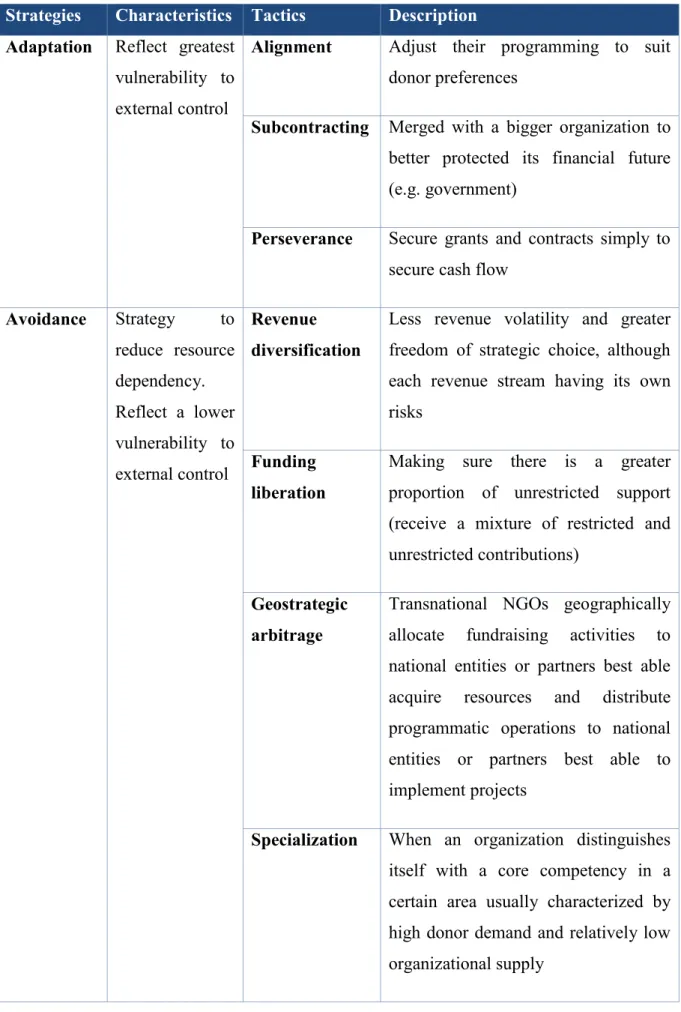
Tactics as alignment, subcontracting and perseverance allow NGOs to adapt and survive to the actual circumstances, but it is also possible for them to avoid being controlled and actually influence the environment they are in, through tactics as “revenue diversification, commercialization, funding liberation, geostrategic arbitrage, specialization, and selectivity, while shaping tactics include donor education and compromise” (Mitchell 2014, p.74). In table 2 we summarized the strategies and the possible tactics to perform those strategies, along with a description of each of them.
Table 2- Strategic responses to resource dependence, adapted from: “Mitchell 2014”
Strategies Characteristics Tactics Description
Adaptation Reflect greatest vulnerability to external control
Alignment Adjust their programming to suit donor preferences
Subcontracting Merged with a bigger organization to better protected its financial future (e.g. government)
Perseverance Secure grants and contracts simply to secure cash flow
Avoidance Strategy to reduce resource dependency. Reflect a lower vulnerability to external control Revenue diversification
Less revenue volatility and greater freedom of strategic choice, although each revenue stream having its own risks
Funding liberation
Making sure there is a greater proportion of unrestricted support (receive a mixture of restricted and unrestricted contributions)
Geostrategic arbitrage
Transnational NGOs geographically allocate fundraising activities to national entities or partners best able acquire resources and distribute programmatic operations to national entities or partners best able to implement projects
Specialization When an organization distinguishes itself with a core competency in a certain area usually characterized by high donor demand and relatively low organizational supply
Selectivity Ability to reject restricted funding when the conditions are not aligned with the organization’s pre-existing objectives Shaping Reflect an organization’s ability to resist and even reverse the direction of influence Donor Education
Leveraging its distinctive capabilities to direct the preferences of its funders Compromise When an NGO and a donor
reciprocally influence each other to reach a domain consensus
Diversity of funding is one of the tactics highligted in Lagerspepetz, Rikmann, and Ruutsoo (2002) article, that suggests that it is positively correlated with self-regulation practices. This practice is defined as “a set of institutions or informal arrangements for affecting organizational behaviour with a key feature of self-regulation being that standards and rules of conduct are set by an industry-level organization rather than a governmental or firm-level apparatus” (Bies 2010, p.1062 and 1603). NGO’s self-regulation is a popular practice, as it can deliver an alternative to severe government directives and helps alleviate government control (Sinclair 1997). In addition, it is a learning exercise for NGOs, helping shape the NGO sector’s values and norms and facilitating the flow of information. Potential outcomes include shared identity, better collaboration, and enhanced efficiency and performance (Sidel 2003), it also contributes to improve NGO’s accountability to different stakeholders (Argandoña 2007). The combination of these factors have a positive impact in the organization’s reputation which can lead to stronger power and access to resources (Thomas 2007). Therefore, self-regulation develops the sector’s ability to access, diversify, and attract external funding (AbouAssi 2015).
A recent study, conducted by Arik, Clark, and Raffo (2016) comes to question the diversity of funding strategy, saying that it may not always be the right way and arguing that it may be more valuable to focus on a few sources of revenue and diversifying within the stream of funding. The same study, outlines that NGOs need to develop, maintain and use their online
presence strategically, starting to see it as a valuable resource to get other resources. Finally, the paper draws attention to the importance of sharing information about the board of directors on their website, in a way that they should not be afraid to be bothered and should act as an extension of the organization.
3 Methodology
The next chapter is divided in two sections. The first one will include the methodological choices of this thesis such as the use of a qualitative approach. After, the second section will describe the methods for data collection and data analysis.
3.1 Methodological choices
To address our research question, a qualitative and explorative approach was applied, with the intention of contributing to theory building and possibly involving the identification of patterns as a foundation for future research (Bettis et al. 2015). According to Doz, “Many of the most telling published contributions of qualitative research combine a richly textured description of a specific situation, or of several, and a robust and insightful theoretical contribution that springs from a conceptual interpretation of the qualitative data” (Doz 2011, p. 584). We conducted an explorative research, since the focus is on inductive theory building and hypotheses generation (Birkinshaw, Brannen, and Tung 2011)
The case study method was selected as it is considered “an empirical enquiry that investigates a contemporary phenomenon in depth and within its real-life context, especially when the boundaries between phenomenon and context are not clearly evident” (Yin 2009, p. 18). This method is the ideally used to answer a “how” question; the investigator should have little or absolute no control over the behavioural events studied, so he cannot influence them; and, as mentioned, it should be a contemporary phenomenon in a real-life context (Yin 2009). All the requirements mentioned fit both, our research question, and the environment where our study will take place.
ATLAS is the name of the organization selected for this study, which is qualified as an operational NGO, according to the definition stated earlier on this thesis. This institution was considered to be ideal for the study because it is a Portuguese NGO, today operating only in the Portuguese market and that is influenced and driven by the needs of the people of this
country, when, at the same time, is dependent on the resources that this country has to offer. Besides that, ATLAS is a name that is getting more relevance in the cities where they are operating, getting more known by the community, not only for the events they create and their online presence but mostly because of their continuing appearances on the local newspaper. These are some of the facts that make us believe this is a successful case of an organization that has been doing a good job in dealing with the tensions between higher demand and fewer resources.
3.2 Data collection & Data analysis
Since we adopted a qualitative approach, we are presenting a narrative, where qualitative data was used, such as semi-structured interview data and qualitative case studies (Doz 2011). The principal source of data used in this study was primary data, although secondary data was also part of it. The first one refers to data collected by the investigator himself/herself for a specific purpose, as it was the case of semi structured interviews and internal company documents, and the second one refers to data collected by someone else for some other purpose, but that can still be useful for the investigator, as it is the case of the newspaper articles.
Firstly, we started our research by studying the online content that the organization has available on their official website, on their facebook page, and youtube channel. It mainly consisted on activity reports of previous years, content about activities created exclusively for their facebook page, and some promotional videos on the youtube channel. These not only helped understand which projects the organization was involved but also how the organization is structured, essential information to write the case study section (Appendix 03). Based on this information some other websites were also studied, as for the BPI website, bank that conceived the NGO a grant, to understand their relation and contact with the organization. Secondly, a semi-structured interview with one of the two interns was conducted, to confirm that all the data gathered so far was updated, to understand how the projects are planned and executed and who is in charge, as well as her role on the NGO. But because the intern did not have full access to some essential information, as the finances, an interview was scheduled with one of the board members, where it was possible to get a good understanding of the internal structure and processes. To finalize the interviews with the management team, an interview with the president was conducted.
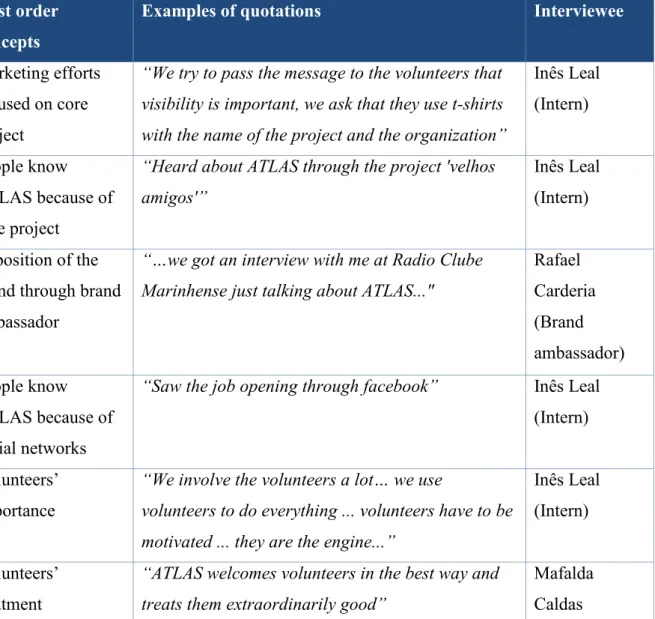
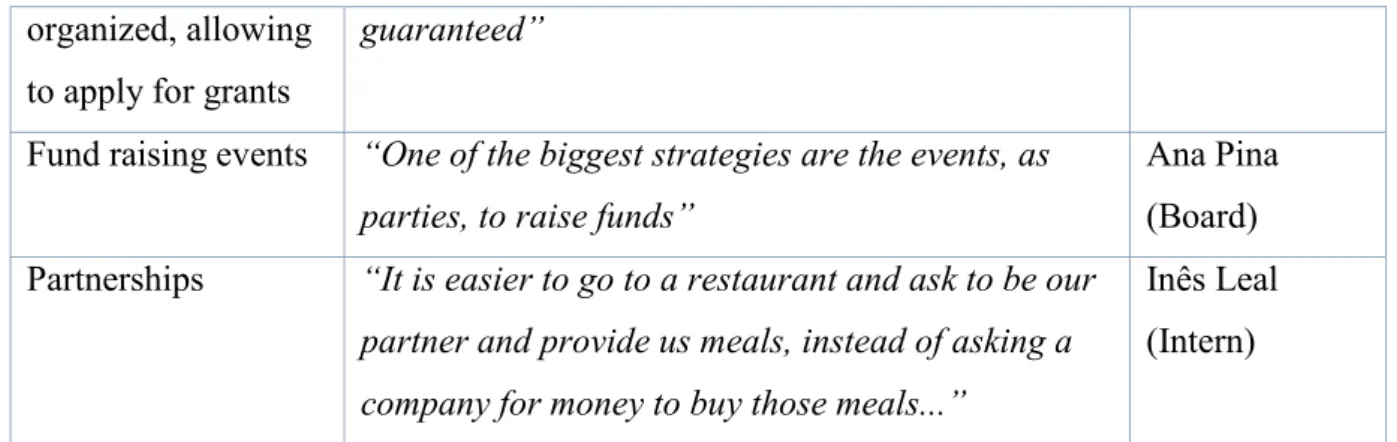
Thirdly, some of the volunteers were also interviewed, as well as the brand ambassador; a local rally driver that represents the NGO in some events; and one of the partners. These were done in order to understand their relationship with the organization and how did they got there, since they are some of the most important actors (see interviewee list in Appendix 01). The process of data analysis involved three different stages. The first one consisted on the writing of the case study, with the intention to transcribe the context of our study and identify any interconnections of events and/or persons in time (Pettigrew 1990). In order to identify the success factors that led the organization to overcome the tensions between higher demand and lack of resources, coding was performed in all the data available. Table 3 shows some examples or quotation being coded and table 4 shows the different codes used.
Table 3- Examples of citations being coded
First order concepts
Examples of quotations Interviewee
Marketing efforts focused on core project
“We try to pass the message to the volunteers that visibility is important, we ask that they use t-shirts with the name of the project and the organization”
Inês Leal (Intern)
People know ATLAS because of core project
“Heard about ATLAS through the project 'velhos amigos'”
Inês Leal (Intern)
Exposition of the brand through brand ambassador
“…we got an interview with me at Radio Clube Marinhense just talking about ATLAS..."
Rafael Carderia (Brand ambassador) People know ATLAS because of social networks
“Saw the job opening through facebook” Inês Leal (Intern)
Volunteers’ importance
“We involve the volunteers a lot… we use
volunteers to do everything ... volunteers have to be motivated ... they are the engine...”
Inês Leal (Intern)
Volunteers’ treatment
“ATLAS welcomes volunteers in the best way and treats them extraordinarily good”
Mafalda Caldas
(Volunteer) Volunteers are given
autonomy and responsibility
"When there is a problem, as a missing volunteer in a group, I sometimes call them to encourage to bring a family member or friend to fill in and solve the problem"
Inês Leal (Intern)
Use of volunteers’ contacts
"One day two friends of mine came to my restaurant to ask me if I could participate in the “velhos amigos” project, donating food every saturday, and one of them I knew very well from a long time ago, they are volunteers there"
Maria Natalina Santos (Partner) Volunteers create a network between them
“When volunteers know each other it gets easier for them to collaborate, organize and be a more
autonomous group “ Inês Leal (Intern) Close relationship between volunteers and beneficiaries
"... they (the volunteers) get close to beneficiaries... create relationships” Inês Leal (Intern) President's professional relations
“The nurses, it was Dr. Helena who arranged because she works in the hospital”
Inês Leal (Intern)
President's personal relations
“My knowledge of ATLAS was through Dr. Helena Vasconcelos, the mother of a great friend of
mine…” Rafael Carderia (Brand ambassador) Easy to be a volunteer
"Many organizations have many bureaucracies to get us in, I did not feel this on the part of the atlas"
Inês Lagoa (Volunteer) Spontaneity
depending on situations
"Then I also gave some used things that had no more use in the restaurant for then to sell in their next raise funds' event, and they are coming here again to see if I can help more"
Maria Natalina Santos
(Partner)
Receipt of donation “it is easier to make a change of goods and with a receipt of donation...”
Inês Leal (Intern) Core project is the
biggest and most
“we are relying on applications with BPI's, with "velhos amigos" project to have another year
Inês Leal (Intern)
organized, allowing to apply for grants
guaranteed”
Fund raising events “One of the biggest strategies are the events, as parties, to raise funds”
Ana Pina (Board) Partnerships “It is easier to go to a restaurant and ask to be our
partner and provide us meals, instead of asking a company for money to buy those meals...”
Inês Leal (Intern)
Table 4- Data structure
1st order concept 2nd order themes Aggregate dimensions
Easy to be a volunteer Introduce loose criteria Attract volunteers Volunteers’ importance
Treating volunteers well
Retain volunteers Volunteers’ treatment
Volunteers are given autonomy and
responsibility Empowering volunteers
Spontaneity depending on situations Use of volunteers’ contacts
Using networks to attract/retain volunteers
and to get resources
Attract/retain volunteers and get
resources Volunteers create a network between
them
Close relationship between volunteers and beneficiaries
President’s relations
Core project is the biggest and most organized, allowing to apply for
grants
Applying for grants to have financial sustainability
Get resources
Fund raising events Fund raising
Partnerships
Establishing partnerships Receipt of donation
People know ATLAS because of core project and marketing efforts
Increasing notoriety to attract more resources
are focused on core project Exposition of the brand through
brand ambassador
People know ATLAS because of social networks
4 Case Study1
This chapter will present the case studied within the present thesis. Firstly, an overview of the organization analysed will be done, including its stated vision, mission and values. Then, its structure will be illustrated and finally the active projects will be outlined.
4.1 History
The Association was born from the initiative of a group of friends who wanted to found an NGO in an attempt to do different, but genuine. Founding president Rosario Almeida e Sousa had already been involved in the work of another NGO, based in Lisbon.
At the time, the group of friends were in Coimbra and decided to capitalize on that and build a strong partnership with Coimbra University. Started with the local project “velhos amigos”, which at the time was called “alta de Coimbra”, when the faculty of psychology, nursing and economics were already strongly involved.
“The two first years were harder, since the NGO status was difficult to get and we could not give receipts of donation, finally we survived at the expense and help of friends and other people we knew” (Helena Vasconcelos).
4.2 Organization’s overview
“ATLAS People like us” is a Portuguese nongovernmental organization which aims for the cooperation and community development. Created in 29th March 2008 this institution has two physical offices, one in Coimbra and one in Leiria, the two cities where it focus most of its resources and efforts.
4.3 Vision mission and values
ATLAS states it has “an integrated vision of the development in which people are in the center of motivations, policies and actions” (ATLAS website).
The organization stated mission is to intervene in key society sectors, in order to build, with the local communities, levers of integrated and sustainable human development, with a continuous multiplying effect, in which the communities are the protagonists of the change. The organization states they have seven main values that they nurture, which start by giving importance to the culture of excellence, where the truth, quality and rigor are essential; moving to the human rights’ defense and their promotion; as well as the environment; then law; justice and equity are mentioned as being a priority in their culture and their processes; they are used to take their projects with commitment and responsibility; and finally they value transparency and accountability.
Atlas states they want to find the solution to the problems by motivating, sensitizing and including everyone in the search of the “better human being” that each one of us can be (ATLAS website).
4.4 Structure
The composition of the governing bodies is organized in 4 main divisions. Firstly the direction, which includes the president, vice president and the secretary; then the audit committee, again with one president, vice president and secretary; the general assembly, with the same 3 different titles; and finally the governing council that besides the president, vice president and secretary, also has six vocals. From now on, they will be referred as being part of the “board of directors”, and when naming the “president”, we are referring to the president of the direction, Helena Vasconcelos.
In the NGO, there are only two employees with salary, which are two interns permanently on the job, one in Coimbra and the other in Leiria, that do not only have the responsibility to coordinate the teams of volunteers but also to recruit them as well as organize and coordinate the events and activities they are in. We will use the concept “management team” when referring to both, the board of directors and these two volunteers, since they are the ones that are coordinating all the projects, activities and volunteers.
4.5.1 “Escolas solidárias”
The name of this project means “solidary schools” which includes two main projects, being developed in two different schools, one happening in Leiria and the other in Marinha Grande (city that is part of Leiria district).
4.5.1.1 Project I
This project started in 2013 and it is on since then, with the goal of supporting children with disabilities of one of the high schools in Leiria. ATLAS volunteers participating on this project are mainly students form the mentioned school, which makes it easier to provide a daily and efficient support to the students with special needs. Two ATLAS’ volunteers work together with human resources provided by the school, as teachers and assistant teachers, with a fixed schedule and on a daily basis. In total, there are 25 volunteers assigned to this project. Besides this daily support, the volunteers are also participating in some events, as the final annual school party and events specifically designed to raise funds to continue helping these children.
4.5.1.2 Project II
Since 2011 that ATLAS is helping children with basic needs, as for food and access to health care, in a high school located in Marinha Grande. With the professors’ help, the children with the most significant needs are signalized and introduced to ATLAS. Every month ATLAS’ volunteers prepare food baskets, including some hygiene products, according to the children’s specific needs and the number of people living at each house. When necessary, the NGO provides help on other segments, as for arranging medical and dental appointments, providing necessary medication or even books for the children’s education.
At the moment, there are 40 beneficiaries on this project, and the organization is counting with the help of Continent, one of the SONAE hypermarket.
4.5.2 “Mexe-te”
This project is focused in educating the younger generation for the development and for the global citizenship. With this type of initiative, ATLAS aims to raise awareness among this target, about the current society problems, as for sustainable and integrated human development.
The first stated goal of this project is to support schools and higher education institutes in the implementation of actions that raise awareness for global problems and the search for
solutions, always bearing in mind that every citizen is, or can be, part of the solution. The second one is to use schools as a way to reach all citizens.
Usually the project involves activities as lectures, cinema forums, games, reflections after testimonies, exhibitions, and meetings with parents and educators. Both, the time and the topics are adjusted to the needs that each school expresses.
4.5.3 “Velhos amigos”
When mentioning “core project” later on, “velhos amigos” is the project we are referring to. “Old friends” is the translation of the name given to the biggest project the NGO has and that has been giving a lot of recognition to. It started in 2009 and it consists on supporting the elderly people in situations of need and/or isolation. This action is taking place in Coimbra, Leiria and Marinha Grande.
The group of volunteer does not only promise to offer strong and affective ties but they are organized to gather and distribute hot meals from partners’ restaurants, during the weekend, when the other sources of social support are not available, as for private social solidarity institutions. Through a team of professional nurses, the volunteers monitor the health status of the elderly and when necessary they arrange appointments with specialists in different areas, most commonly being ophthalmology and dental care. Depending on each beneficiary needs, it can happen that the volunteers help with legal support, or psychological support, through a team specialized in psychopathology. Counting with hairdressers’ help, it gets easier to boost their self-esteem and improve their image. Sometimes one of the most vital and urgent issues are the conditions that they live in and ATLAS has partnerships to also take care about reparations and conservation of their houses.
During 2015, there were 245 volunteers involved on this project, and 30 restaurants working as partners. This was the year when the relationship with the volunteers got more professionalized; in a way that they started having contracts as well as evaluations as part of the NGO’s strategy.
5 Findings2
5.1 Results
In this chapter we will present our findings, during which we are keeping a critical view, meaning that, not only the positive strategies will be described but also, the possible negative consequences that those actions can bring, or, that are already visibly influencing the organization. Here, it is possible to get a better understanding on how the NGO operates and what are the strategies they are using, consciously or not, to keep on growing every day, within the local community.
According to one of the board members, ATLAS “biggest challenge is the lack of sustainable financing” (Ana Pina), and one of the major implications it brings to any organization is the impossibility of paying salaries. This is when the dependence on volunteers is firstly visible, turning the challenge of attracting and retain volunteers into one of their priorities.
This section starts presenting the strategies used to attract and retain volunteers, followed by the strategies used to face missing funds, while some have both objectives at the same time. 5.1.1 Introduce loose criteria to attract more volunteers
Easy to be a volunteer
The volunteers we interviewed suggested the easiness to become a volunteer as one of the reasons why they chose this organization among others, and that makes it different from the rest.
"Many organizations have many bureaucracies to get us in, I did not feel this on the part of ATLAS" (Inês Lagoa).
Mafalda Caldas referred to the NGO as being “uncomplicated”, because there are no difficult procedures to check before someone can start helping and participating on the projects. There is also no mandatory training in the early stages, but in order to reduce risks, senior volunteers accompany the inexperienced ones.
2 Information that is not on quotation marks was taken from the 2015 activity report
5.1.2 Treating volunteers well in order to retain them Volunteers’ importance
In this organization, the direct volunteers are given a lot of importance and they are treated accordingly. At this stage, it is imperative to remember that besides the board and the two paid interns, solely volunteers constitute the organization.
“We involve the volunteers a lot… we use volunteers to do everything... they are the engine” (Inês Leal).
Here, Inês Leal is making a reference to the direct volunteers, the ones that have direct contact with the beneficiaries and that have their hands on each project. Ana Pina, one of the board members, identifies the “proximity of the volunteers with the management team” as one of ATLAS’ differentiating factors.
Volunteers’ treatment
The organization is well aware of their importance, but also on the challenge that they have in hands that consists on, not only attracting but also retaining volunteers, and for that “volunteers have to be motivated” (Inês Leal). Plus, according to the volunteers, this motivation starts right from the first contact, when “ATLAS welcomes volunteers in the best way and treats them extraordinarily good” (Mafalda Caldas). Besides feeling welcomed to the organization, the volunteers understand how important they are, and this treatment will be noted next, on the empowerment strategy.
ATLAS also offers the volunteers training, so that they are prepared for the projects and do the best possible work, but the reality is that these workshops are sporadic, depending on the active projects, and are also open for the community, for anyone who wants to join.
5.1.3 Empowering volunteers
Volunteers are given autonomy and responsibility
According to the president “This association has, in its culture, the habit to share the concerns and responsibilities with its volunteers, who are called to find solutions to the financing problem, among others that arise” (Helena Vasconcelos).
Other very common procedure is "When there is a problem, as a missing volunteer in a group, I sometimes call them (the volunteers) to encourage to bring a family member or
friend to fill in and solve the problem" (Inês Leal), and most of the times, the volunteers are the ones getting more partnerships to the project, as it happened with the addition of restaurant Linita to the “velhos amigos” project.
Spontaneity depending on situations
The people involved in the organization show a big availability to multitask and help whenever is necessary, a good example is Inês Leal “I’m a social worker, I do a little of everything”.
Besides being polyvalent, they are also encouraged to take initiative and be spontaneous when opportunities arise, which is something that often happens in small communities and when you are working with family and friends.
"Then I also gave some used things that had no more use in the restaurant for then to sell in their next raise funds’ event, and they are coming here again to see if I can help more" (Maria Natalina Santos).
5.1.4 Using networks to attract/retain volunteers and to get resources Use of volunteers’ contacts
Since the first day that the volunteers are encouraged to use their private contacts to participate in the NGO.
“One day two friends of mine came to my restaurant to ask me if I could participate in the “velhos amigos” project, donating food every saturday, and one of them I knew very well from a long time ago, they are volunteers there (ATLAS)" (Maria Natalina Santos).
The management team incites that “volunteers bring other people they know” (Inês Leal), and they also rely on them to “spread the word and convince more people” (Inês Leal) as it was the case of Mafalda’s mother “I got to know ATLAS through my mother, who has been a volunteer for some years in this NGO” (Mafalda Caldas).
Volunteers create a network between them
Besides that, the organization also believes that “When volunteers know each other it gets easier for them to collaborate, organize and be a more autonomous group” (Inês Leal), in most of the groups there is a network created that runs without the intervention of the management team.
Close relationship between volunteers and beneficiaries
But the close relationships do not end between the volunteers, in fact “they (the volunteers) get close to beneficiaries… create relationships” (Inês Leal) because the organization believes to be essential that the beneficiaries have the opportunity to really “know the volunteers and built a relationship based on trust” (“Relatório de actividades 2015”). Although, this fact combined with the autonomy volunteers are encouraged to have, sometimes leads to situations where the volunteer acts on his behalf and the name of the organization is no longer involved. Reported cases of “volunteers fixing doors, windows and buying microwaves” are some of the examples present in the annual activity report, as stories that the beneficiaries tell (“Relatório de actividades 2015”).
President’s relations
One of the most impactful findings was the influence and importance that the president’s role in the local community has in the organization. Helena Vasconcelos is a doctor (see Appendix 2), which does not only make her be aware of the society’s major problems, but mostly, gives her direct access to nurses, doctors and more professionals that are crucial in projects like “velhos amigos”.
“The nurses, it was Dr. Helena who arranged because she works in the hospital” (Inês Leal). Besides, she is also writing a column on the local newspaper, which gave her the opportunity to have some of the organization’s main events documented, with distinction (see appendix 4 and appendix 5). Naturally, working this big network and in so many different places also has some disadvantages, as limiting the time to focus on the organization.
Nevertheless, her personal connections also seem to play a big role, as it was the case of the brand ambassador that his “knowledge of ATLAS was through Dr.Helena Vasconcelos, the mother of a great friend of mine… in conversation with Dr.Helena, I said that I was available to support ATLAS through loaning my image…” (Rafael Cardeira), and that was how a new partnership started.
5.1.5 Applying for grants to have financial sustainability
Core project is the biggest and most organized, allowing to apply for grants
most organized one. This tactic has allowed them to apply and actually get grants provided by big institutions, as it was the case of Fundação Calouste Gulbenkian, with the project “Cidadania Ativa” from EEA Grants (European Economic Area) in 2015, and “Prémio BPI Séniores” from 2016 edition, and according to Inês Leal they are “relying on applications with BPI, with "velhos amigos" project, to have another year (financial) guaranteed” (Inês Leal).
5.1.6 Fund raising Fund raising events
“One of the biggest strategies are the events, as parties to raise funds” (Ana Pina).
Here, the beneficiaries, volunteers and possible future contributors are present, the group mainly consists on friends and family of the organization’s members.
5.1.7 Establishing partnerships Partnerships
Also, the partnerships are a big part of the resource seeking activity, although it gives the organization specific resources for specific projects instead of money.
“It is easier to go to a restaurant and ask to be our partner and provide us meals, instead of asking a company for money to buy those meals” (Inês Leal).
Besides the restaurants that on saturday supply food to the beneficiaries, Lusoforma SA is the company responsible for providing the disposable containers to carry the food. In the health department, ATLAS has partnerships with PLURAL, the company that provides the health material, such as compresses and bandages; with Clinicas Leite, which provide ophthalmology appointments; and Sorriso de Mel, which is a dental care clinic that provides 15% discount to every beneficiary, just to mention a few. Finally, a partnership important to mention is with the company CAIADO, that not only provides de physical office in Leiria, for ATLAS to operate, but also recruits some of its employees every fifth weekend on each month to participate as a volunteer. These are examples of some relevant partnerships that allow the organization to stay active even in times when there is lack of financial resources.
Receipt of donation
In order to facilitate these partnerships, the NGO is able to give, in exchange for the goods, a receipt of donations that the partners use in their accounts as a cost for the company. This is a possibility that is opening the opportunity for many new partnerships, since “it is easier to make a change of goods… with a receipt of donation” (Inês Leal).
5.1.8 Increasing notoriety to attract more resources
The last strategy will be increasing the notoriety of the NGO, in order to facilitate the attraction of resources, not only physical ones but human as well.
People know ATLAS because of core project and marketing efforts are focused on core project
Along with Inês Leal that “heard about ATLAS through the project ‘velhos amigos’”, a lot of people hear the name of the project before the name of the institution. And that happens because the NGO is focusing its marketing efforts around the core project, attracting the public’s attention with one well-designed and functioning project so that later they can introduce the organization behind that project. They do it in small actions as, for example, associating the logo of the project along with the logo of the organization in signature emails (see Appendix 6), and in t-shirts “We try to pass the message to the volunteers that visibility is important, we ask that they use t-shirts with the name of the project and the organization” (Inês Leal); and finally, focusing the media attention on the project as well (see appendix 4 and appendix 5).
Exposition of the brand through brand ambassador
As mentioned before, from the president’s personal connections, and from an informal conversation, the opportunity of having an ambassador arose. The rally driver, Rafael Cardeira, is now giving visibility to the organization by being present “in events and initiatives throughout the year” (Rafael Cardeira).
“The ATLAS logo is present in all my rallies, last year I announced the beginning of the partnership together with the written press and we managed to make it news and we got an interview with me at Radio Clube Marinhense (radio station) just talking about ATLAS” (Rafael Cardeira).
We strongly believe that initiatives of this kind are making the organization reach new targets, along with the strong presence on social networks.
People know ATLAS because of social networks
One of the interns told us that she “Saw the job opening through facebook” (Inês Leal), and we noticed that the NGO focus a lot of its resources on this social network, showing a big disparity in the content produced for the facebook page compared with the content produced for the official website. This tactic makes the content more informal and humanized, since the network permits to have interaction with the followers, with “likes” and comments, and also makes it easier for the organization to share content with family, friends and possible future volunteers, and update them on the news in real time.
In conclusion, continuing operating this way, the NGO expects to be able to achieve some of its future goals, “Grow in a harmonious and sustainable way; expand the “velhos amigos" project to other cities and increase support in the 3 cities where it operates; implement a project in Angola; increase a network of fixed business support; and apply for Portugal 20/20” (Helena Vasconcelos).
5.2 Discussion
The results presented on this thesis go beyond the ones reported by previous studies, on our literature review. The importance of the human capital and the different ways to get financial resources were mentioned in the literature review, but when discussing the strategies to face tensions, networks were not mentioned, although we strongly believe that the use of networks (president’s personal and professional connections as well as the volunteers’ contacts) are one of the major strategies that make this organization work and grow.
This can be because it is a finding very specific of this case study, or because it is related with the characteristics of the studied country, since it is the first time Portugal is studied in this context.
6 Conclusion
This last chapter will finalize the present thesis that aimed to understand how can a small NGO, in a moment that its country is still recovering from a crisis, deal with the tensions between the growing demand for its services and the decreasing number of resources available to meet that demand. Based on the previously presented findings, it will first build the conclusions and its implications, not only on the literature review but also on current management practices. Followed by recognizing the limitations of this specific case study, and finally, based on those limitations, it will identify possible future research on this topic. 6.1 Main Contributions
From our research on the environmental context, we stated that Portugal is facing a slow recovery from the economic crisis, which reflects on a decrease in public and private support for NGOs and an increase challenge in attracting volunteers (Franco and others 2015), which coincides with the president’s statement “The biggest challenges we face are always funding and maintaining the minimal structure of professionals.” (Helena Vasconcelos). After a close look and study of ATLAS, one NGO that seemed to get known for more and more people every day, in the local community, we will outline the major strategies that the organization is using to overcome these tensions.
Firstly, ATLAS recognizes the importance and dependence on volunteers, and they act accordingly, by simplifying the admission process and making sure the volunteers feel welcomed. They also encourage them to be autonomous and take initiative. Secondly, the organization exploits networks, not only the president’s one, including her professional and personal contacts, but also the volunteers’ networks, always asking them to involve their families and friends. Finally, since we are studying a small NGO with not so much resources (e.g. time and money), they focus their energy and efforts on one project, which is actually responsible for most of their notoriety. With this project, they are able to capture some relevant grants that enable them to secure one entire year, as it happened in past editions. 6.2 Limitations
Nevertheless, this study should be interpreted in the light of a few limitations. One limitation was that the results of this case study intensely rely on data that was collected during the interviews, but because of constrains of resource and time, we could only perform a limited