Effect of different levels of CO
2
on the
antioxidant content and the polyphenol
oxidase activity of ‘Rocha’ pears during
cold storage
Andrea C Galvis-S ´anchez,
1Susana C Fonseca,
1´Angel Gil-Izquierdo,
2Mar´ıa I Gil
2and F Xavier Malcata
1∗1Escola Superior de Biotecnologia, Universidade Cat ´olica Portuguesa, Rua Dr Ant ´onio Bernardino de Almeida, P-4200-072 Porto, Portugal 2Department of Food Science and Technology, CEBAS (CSIC), PO Box 4195, E-30080 Murcia, Spain
Abstract: Pears (Pyrus communis L. cv. ‘Rocha’) were exposed to air or controlled atmosphere (CA)
containing various concentrations of CO2: 0, 0.5 and 5 kPa, all with 2 kPa O2. After 4 months of storage
at 2◦C, the fruits were transferred to air at room temperature, and assessed in terms of soluble solids,
titratable acidity, pH, incidence of brown heart and flesh browning, phenolic content, vitamin C content and polyphenol oxidase activity. By 4 months of storage, soluble solids and pH increased, and acidity decreased relative to harvest, but no differences were detected between pears stored under air or any of the CA tested. Higher contents of hydroxycinnamic derivatives and flavan-3-ols in the peel than in the flesh were recorded. However, the content of arbutin was higher in the flesh than in the peel, whereas flavonols were only detected in the peel. In general, hydroxycinnamic derivatives and flavonols were stable throughout storage, but flavan-3-ols decreased in concentration under air or CA. Arbutin was the only phenolic compound that increased in concentration as time elapsed. No clear relation was found between the storage conditions tested and the phenolic concentration in pears. Regarding ascorbic acid (AA) and dehydroascorbic acid (DHA), their concentrations were higher in the peel than in the flesh. Furthermore, AA and DHA were strongly affected by storage: the former decreased, whereas the latter increased in content. A decrease in PPO activity was apparent after harvest and during storage, particularly under
higher levels of CO2. The combination 2 kPa O2+ 5 kPa CO2increased the incidence of internal disorders
(viz. brown heart and flesh browning) after storage. 2005 Society of Chemical Industry
Keywords: controlled atmosphere; phenolics; vitamin C; disorders; quality
INTRODUCTION
Assurance of safety of a food product, maintenance of its quality and concern about its ‘health-protecting capacities’ are major goals pursued by the various elements of the food chain, including producers and consumers.1,2 In recent years, several studies pertaining to the correlation between consumption of food products with a high content of antioxidant compounds, and prevention of coronary heart diseases and incidence of cancer, have been published.3,4
The antioxidant capacity of plant tissues, based on such compounds as phenolics, carotenoids, tocopherol and ascorbic acid, as affected by exposure to stress conditions, has also been tackled as a subject of research.5,6 The outcome of the
application of controlled atmosphere (CA) technology towards extension of pear shelf-life, as well as its implication regarding the development of storage disorders, has also been made available.7 CA
injuries refer to the internal breakdown of the cortex and/or core tissue, probably developed in response to adverse pre-harvest and/or post-harvest environments, which may produce distinct metabolic rates, resistance to gas diffusion and change in energy metabolism.8 – 11
‘Rocha’ pear is the most widespread variety of pear grown in Portugal; it has a good commercial potential owing to its unique characteristics.12It is of
extreme importance for distribution chain managers to assure a final product bearing good quality
∗Correspondence to: F Xavier Malcata, Escola Superior de Biotecnologia, Universidade Cat ´olica Portuguesa, Rua Dr Ant ´onio Bernardino
de Almeida, P-4200-072 Porto, Portugal E-mail: [email protected]
Contract/grant sponsor: FCT (Portugal); contract/grant numbers: BD/18392/98; BPD/1601/2000 Contract/grant sponsor: Fundaci ´on Cajamurcia
even after several months of storage; it is indeed known that the ‘Rocha’ pear variety can develop CA-related disorders when stored under high CO2
concentrations.13
The aim of this work was therefore to evaluate the effect of storage under different levels of CO2
on the quality of ‘Rocha’ pear in terms of its antioxidant content, specifically phenolic and vitamin C levels. Incidence of brown heart and flesh browning, content of soluble solids, titratable acidity, pH and polyphenoloxidase activity were also assessed. Hence, this work attempted to extend related work on other varieties of pears and to address the issue of validity of the only published work on ‘Rocha’ pears, while specifically adding to overall pear storage optimisation.
EXPERIMENTAL Plant material
Studies were conducted using fruits harvested in August 2002. ‘Rocha’ pears were grown at Esta¸c˜ao Nacional de Fruticultura Vieira Natividade in Alcoba¸ca, Portugal. Immediately after harvest, fruits were transported to the Post-harvest Technology Lab-oratory at Escola Superior de Biotecnologia in Porto, Portugal. Pears free from defects and without evi-dence of mechanical injury were selected for storage, under conditions set forth according to the experimen-tal design chosen. Before storage, pears were cleaned, cooled overnight to 4◦C and subjected to 90 – 95% rel-ative humidity (RH); on the next day, they were duly calibrated and weighed. Forty pears were selected at random and allowed to ripen in air at room tempera-ture (18 – 20◦C) for 14 days. After 1, 6, 9 and 14 days following harvest, ten pears were assessed in terms of quality indices to follow their evolution under normal conditions.
Controlled atmosphere storage
Pears were stored under CA conditions for 4 months at 2± 0.5◦C and 90 – 95% RH. Combinations of 2 kPa O2 with 0, 0.5 and 5 kPa CO2 were applied, as well
as plain air used as a control. Gas mixtures were humidified and continuously flushed at a flow rate of 13 mL min−1 into each experimental container (with an individual capacity of 7 L, and containing ca 2.0 kg pears).
After 4 months, pears were removed from storage and allowed to ripen in air at room temperature (18 – 20◦C) in order to simulate the marketing period. After 1, 6 and 8 days of exposure to air at room temperature, ten pears were taken at random from each storage condition and evaluated in terms of incidence of storage disorders and quality indices. For determination of phenolic compound content, vitamin C content and polyphenol oxidase (PPO) activity, the flesh and peel of pears from each condition were separately frozen in liquid nitrogen, and stored at−20◦C until analysis. Weight
loss was less than 1% throughout the period of storage.
Storage disorders
The incidence of brown heart (BH) and flesh browning (FB) was evaluated in seven pears and scored using the following scale: 1= absent, 2 = very slight, 3 = slight, 4= moderate and 5 = severe.
Quality indices
Soluble solids (SS), titratable acidity (TA) and pH were evaluated in triplicate in three pears randomly selected. The SS content was measured with a hand refractometer (Atago model N1, Tokyo, Japan) and was expressed in ◦Brix. The TA was determined by titrating 10 mL of juice samples with 0.1 mol L−1 NaOH, and was expressed as grams of malic acid per 100 mL. The pH values were measured with a pH meter (Crison model 501, Barcelona, Spain).
Analysis of phenolic compounds
Phenolic compounds were determined as described by Galvis-S´anchez et al.14 Pear flesh or peel (10 g) was homogenised with 10 mL of a methanol/formic acid (98:2 v/v) mixture, using an Ultra-Turrax (IKA Labortechnik model T 25, Staufen, Germany) for 3 min in an ice bath (4◦C). The homogenate was filtered through a filter cloth, centrifuged at 10 500× g for 3 min and passed through a 0.45µm membrane filter. 95µL of extract was injected in an HPLC system (Merck-Hitachi, Darmstadt, Germany) equipped with a pump (model L-7100), a diode array detector (model L-7455) and an autosampler (model L-7200). A reverse-phase C18LiChroCART column (25× 0.4 cm
filled with 5µm particles, from Merck) was utilised. The mobile phase was constituted of water/formic acid (95:5, v/v) (solvent A) and HPLC-grade methanol (solvent B). The linear gradient started from 10% B to reach 15% B by 30 min, and 50% B by 62 min. The flow rate was 1 mL min−1 and chromatograms were recorded at 280, 330 and 350 nm.
Retention times and UV-Vis spectra were com-pared with suitable standards. The flavan-3-ol deriva-tives were quantified as catechin (Sigma-Aldrich, St Louis, MO, USA). Hydroxycinnamic acid deriva-tives were quantified as chlorogenic acid (Sigma-Aldrich). Flavonols were quantified using quercetin 3-O-glucoside isolated from onion. Arbutin (p-hydroxyphenyl-β-D-glucoside) was quantified using a commercial standard (Sigma-Aldrich). For each stor-age condition and time of exposure to air, phenolic compounds were assayed in triplicate. The concen-tration in the flesh and the peel was expressed as mg 100 g−1fresh weight (fw).
Analysis of vitamin C
Vitamin C content was calculated as the sum of ascorbic acid (AA) and dehydroascorbic acid (DHA) contents. They were determined as described by Zapata and Dufour,15with some modifications.16The
flesh or peel of the pears (30 g) was homogenised with 30 mL of methanol/water (5:95 v/v) plus 10 g L−1HCl, using an Ultra-Turrax for 3 min. The homogenate was centrifuged at 8000× g for 5 min and the supernatant was filtered through a filter cloth. The pH of the filtrate was adjusted to between 2.2 and 2.4 with 1 mol L−1 HCl. Extraction procedures were carried out at 4◦C in the absence of light. Pear sample extracts of 1200µL were incubated with 400µL of a solution of 1,2-phenylenediamine dihydrochloride (OPDA, from Sigma-Aldrich), for 30 – 40 min. The samples were analysed with an HPLC system equipped with a UV-Vis detector (UV-1575), an autosampler (AS-1555) and a pump (PU-1580), all controlled by appropriate software (Borwin v. 1.5, from Jasco Corporation, Tokyo, Japan). Separation of AA and DHA was achieved in a reverse-phase C18 column
(250× 4.6 mm with 5µm particles, from Waters, MA, USA). The mobile phase was methanol/water (5:95, v/v) containing 5 mmol L−1 cetrimide and 50 mmol L−1 potassium dihydrogen phosphate at pH 4.5. The flow rate was 0.8 mL min−1 and the injection volume was 20µL. The detector was set at 348 nm for DHA and 261 nm for AA detection. Three replicates of each storage condition and time of exposure to air were performed, for both flesh and peel; AA and DHA contents were expressed in mg 100 g−1fw.
Analysis of PPO activity
A pear crude extract was prepared by homogeni-sing 30 g of frozen pear pulp with 30 mL of 0.2 mol L−1 sodium phosphate buffer (pH 6.5), containing 20 g L−1 polyvinylpolypyrrolidone (PVPP) and 2.5 g L−1 Triton X-100, using an Ultra-Turrax for 3 min (at 1 min intervals) in an ice bath. The homogenate was centrifuged at 4◦C and 16 000× g for 30 min at 4◦C, using an adequate centrifuge (Sorvall RC-5C, from Instruments Dupont, Newtown, CT, USA). The supernatant was then filtered through cheesecloth, and its volume was duly recorded. For the assay reaction, 300µL of supernatant was mixed with 2.7 mL of catechol (used as substrate). The reference cuvette contained only the substrate solution. The increase in absorbance was recorded at 420 nm for 1 min at 25◦C, using a UV-Vis spectrophotometer (model UV-260, from Shimadzu, Japan). The linear part of the absorbance vs time plot was used to estimate the activity of the enzyme (U g−1 min−1). One unit of enzymatic activity (U) was defined as the change of 0.001 units in absorbance under the aforementioned assay conditions. Three measures of each replicate were taken.
Statistical analysis
All data were subject to analysis of variance (ANOVA), at a significance level of 5%, in an effort to assess the influence of storage conditions and time of exposure to air on quality parameters, phenolic composition, vitamin C content and PPO activity. Duncan’s
multiple range test was employed to detect significant differences between storage conditions.
RESULTS AND DISCUSSION
Influence of storage conditions on quality parameters
One day after harvest, the SS content was 11.3± 1.2
◦Brix, and increased up to 15.0± 1.0◦Brix by 14 days
of exposure to air at room temperature. After 4 months of storage and 1 day of exposure to air, an increase in the SS content relative to its initial harvest value was observed in pears under all conditions. This behaviour was not followed by pears stored in 2 kPa O2+ 0.5 kPa CO2(Table 1). After 6 days of exposure
to air, an increase in the SS content was recorded for pears under all storage conditions, which remained for up to 8 days; this increase was associated with synthesis of sugars.17In general, storage conditions did not affect the SS content in ‘Rocha’ pears; our results were thus in agreement with those reported by L ´opez
et al.,18 pertaining to ‘Doyenne du Comice’ pears
stored under similar concentrations of O2and CO2.
Immediately after harvest, the acidity of pears was 1.8± 0.2 g of malic acid 100 mL−1; during the additional 14 days of exposure to air, no variations were observed in this quality parameter. Acidity decreased after 4 months of storage, as well as during the additional time of exposure to air at room temperature (Table 1). In general, no differences were detected among pears from the various storage conditions considered. The acidity decrease in ‘Rocha’ pears during storage was consistent with previous findings pertaining to ‘Bartlett’ pears after CA and air storage,19 although a greater decrease for those
pears stored under air was noticed than for those stored under CA conditions.
Upon harvest, the pH of the pears was 4.13± 0.05. As time of exposure to air at room temperature elapsed, the pH increased lightly, reaching a final value of 4.56± 0.07. By 4 months of storage, an increase in pH was observed for all storage conditions; however, during the additional time of exposure to air, no clear tendency of this parameter could be pinpointed (Table 1). Coseteng and Lee20reported an increase in
pH for different varieties of apples during maturation and cold storage; such behaviour was attributed to the decrease in acid concentration, which was brought about by changes of the metabolism in the fruit.20
Influence of storage conditions on phenolic content
Upon harvest, great differences were found in the con-tent of hydroxycinnamic derivatives and flavan-3-ols between the flesh and the peel of ‘Rocha’ pears; sim-ilar findings have been reported for other varieties of pear.14 Chlorogenic acid was the major
hydroxycin-namic compound; in this variety, the hydroxycinhydroxycin-namic derivative and flavan-3-ol contents were three- and ten-fold higher in the peel than in the flesh, respectively
Table 1 . Quality indices o f ‘R o c ha’ p ear after 4 mo nt hs of storage, followed b y a n e xtra 1, 6 a nd 8 d ays in a ir at room temperature (18 – 2 0 ◦C) a Soluble s olids ( ◦Brix) a Titratable acidity (g of malic acid 100 mL − 1)p H Storage c onditions 1 day 6 days 8 d ays 1 day 6 days 8 d ays 1 day 6 days 8 d ays Air 13.5 (0.2)a b 14.1 (0.2) NS 14.6 (0.8) NS 0.75 (0.04)ab 0.60 (0.01)b 0 .66 (0.00) NS 5.19 (0.04)b 5 .33 (0.02)b 5 .11 (0.01)b 2k P a O2 + 0k P a C O2 12.6 (0.3)a 14.6 (0.3) NS 14.1 (0.2) NS 0.76 (0.21)ab 0.60 (0 .00)b 0 .60 (0.09) NS 5.60 (0.09)a 5 .51 (0.01)a 5 .15 (0.01)b 2k P a O2 + 0 .5k P a C O2 9.8 (0.3)b 14.3 (0.6) NS 14.4 (0.4) NS 0.51 (0.13)b 0 .71 (0. 02)a 0 .60 (0.00) NS 5.57 (0.07)a 5 .20 (0.07)c 5 .24 (0.04)a 2k P a O2 + 5k P a C O2 13.4 (0.8)a 13.7 (0.6) NS 14.0 (0.0) NS 0.91 (0.00)a 0 .57 (0. 04)b 0 .61 (0.01) NS 5.37 (0.12)b 5 .50 (0.00)a 5 .26 (0.03)a aData are m eans of three replicates; s ta ndar d d eviatio n is in par e ntheses. bM ean separ a tio n w ithin ro w s by Duncan’s multiple ra ng e test (P = 0 .05); s ignificantly d if ferent means a re followed b y d if ferent letters (a, b , c ); NS, n ot significant.
(Table 2). However, the content of arbutin was higher in the flesh than in the peel, whereas flavonols were only detected in the peel (Table 2). Several authors have encountered similar phenolic contents in other varieties of pear.21,22 During the additional 14 days
of exposure to air at room temperature, a decrease in the concentrations of hydroxycinnamic deriva-tives and arbutin was detected in the flesh, while those of flavan-3-ols remained essentially unchanged (Table 2); the content of hydroxycinnamic derivatives and flavan-3-ols in the peel decreased, but the con-tent of arbutin increased in this period (Table 2). Such an increase could trigger pear browning, since arbutin has been described as a polyphenol oxidase substrate.23 In the flesh and peel of apples, the con-centration of phenolic compounds (flavan-3-ols and chlorogenic acid) decreased during development at early stages of ripening,24,25 in agreement with our results, which encompassed a decreasing trend of these compounds after harvest and throughout the whole ripening period.
After 4 months of storage, the difference between flesh and peel in terms of hydroxycinnamic derivatives and flavan-3-ols persisted, whereas the arbutin concentration was higher in the peel than in the flesh (Tables 3 and 4). The hydroxycinnamic derivatives of the flesh were stable after storage, during the additional time at room temperature, except for pears stored under 2 kPa O2+ 0.5 kPa CO2for which their content
decreased (Table 3). During the same period, the flavan-3-ols decreased in concentration in the pears stored under CA (Table 3). Higher concentration of flavan-3-ols in pears was observed in air than under CA conditions, as described elsewhere.26 Regarding arbutin, the concentration by 4 months of storage was lower in pears stored under CA than in those stored in air (Table 3), these results are in agreement with those reported by Amiot et al.26Arbutin increased in
content in the pears stored under CA (Table 3). The concentration of hydroxycinnamic derivatives in the peel decreased after storage under air and CA conditions, but was stable throughout the additional time of exposure to air (Tables 2 and 4). The flavan-3-ols decreased in concentration after storage and after the additional period at room temperature, and reached a similar value under all storage conditions (Tables 2 and 4). After storage, the concentration of arbutin increased in the peel of pears stored under all conditions (Tables 2 and 4). During the additional time at room temperature, the concentration of arbutin decreased for air and 2 kPa O2+ 0.5 kPa CO2, was
unchanged for 2 kPa+ 0 kPa CO2 and increased for
2 kPa O2+ 5 kPa CO2(Table 4). The flavonols were
stable after storage, so no significant differences could be detected (Tables 2 and 4).
Influence of storage conditions on AA/DHA content
Upon harvest, concentrations of AA and DHA were two-fold higher in the peel than in the flesh
Table 2. Contents of hydroxycinnamic derivatives, flavan-3-ols, arbutin and flavonols (mg 100 g−1fw) in the flesh and in the peel of ‘Rocha’ pear after harvest, followed by an extra 1, 6, 9 and 14 days in air at room temperature (18–20◦C)a
Time (days)
Tissue Phenolic 1 6 9 14
Flesh Hydroxycinnamics 12.5 (0.4)ab 12.3 (0.1)a 11.1 (0.4)b 9.4 (0.1)c
Flavan-3-ols 6.4 (0.6)a 5.9 (0.7)ab 4.2 (0.4)b 5.9 (1.2)ab
Arbutin 3.9 (0.2)a 0.8 (0.1)b 0.7 (0.0)b 0.2 (0.0)c
Peel Hydroxycinnamics 41.0 (0.2)a 42.5 (2.3)a 34.4 (0.1)b 26.2 (0.3)c
Flavan-3-ols 60.2 (4.2)a 64.3 (6.6)ab 52.6 (4.7)b 31.4 (2.7)c
Arbutin 0.7 (0.0)b 0.9 (0.3)b 1.3 (0.3)b 4.9 (0.1)a
Flavonols 8.2 (0.4)b 10.3 (1.3)a 8.4 (1.1)b 7.2 (0.1)b
aData are means of three replicates; standard deviation is included in parentheses.
bMean separation within columns by Duncan’s multiple range test (P= 0.05); significantly different means are followed by different letters (a, b, c)
Table 3. Contents of hydroxycinnamic derivatives, flavan-3-ols and arbutin (mg 100 g−1fw) in the flesh of ‘Rocha’ pear after 4 months of storage, followed by an extra 1, 6 and 8 days in air at room temperature (18–20◦C)a
Hydroxycinnamics Flavan-3-ols Arbutin
Storage conditions 1 day 6 days 8 days 1 day 6 days 8 days 1 day 6 days 8 days
Air 10.9 (0.7) NS 10.4 (0.3)abb 11.0 (0.2)a 8.2 (0.1)a 7.7 (0.3)a 7.8 (0.4)a 4.2 (0.2)a 3.6 (0.1)a 4.3 (0.2)a
2 kPa O2+ 0 kPa CO2 10.7 (0.1) NS 10.9 (0.7)a 9.8 (0.5)bc 6.8 (0.4)b 4.4 (0.6)b 5.3 (0.2)b 2.0 (0.3)c 2.5 (0.2)b 3.7 (0.3)ab 2 kPa O2+ 0.5 kPa CO2 11.2 (0.3) NS 10.3 (0.2)ab 9.7 (0.6)c 5.4 (0.9)c 4.2 (0.9)b 4.3 (0.2)c 2.4 (0.0)b 2.3 (0.1)b 2.8 (0.1)c
2 kPa O2+ 5 kPa CO2 10.1 (0.8) NS 9.9 (0.2)b 10.6 (0.1)ab 5.6 (0.5)c 4.9 (0.1)b 4.0 (0.2)c 2.3 (0.1)bc 1.5 (0.3)c 3.4 (0.5)bc aData are means of three replicates; standard deviation is included in parentheses.
bMean separation within rows by Duncan’s multiple range test (P= 0.05); significantly different means are followed by different letters (a, b, c); NS,
not significant.
(Table 5). After exposure to air at room temperature, concentrations of AA and DHA decreased both in the flesh and in the peel (Table 5). With regard to our results, Veltman et al.27 detected higher (62%) AA
content in the flesh of ‘Rocha’ pears.
AA and DHA concentrations in pears were significantly affected by the storage conditions and by the time of exposure to air at room temperature. After 4 months of storage, the concentration of AA in the flesh decreased 80 – 85% under all storage conditions, whereas that of DHA increased 82 – 93% relative to the value measured at harvest (Tables 5 and 6). After 1 day of exposure to air, no differences in concentration of AA in the flesh were detected under the various storage conditions, whereas it decreased with time of exposure to air. After the remaining time at room temperature, the concentration of DHA in the pear flesh stored in air was the highest. In general, the lowest DHA was exhibited by pears under 2 kPa O2+ 5 kPa CO2(Table 6).
By 4 months of storage, the concentration of AA in the peel decreased by 87 – 95% and that of DHA increased by 74 – 82% as compared to the value prevailing at harvest (Tables 5 and 6). The lowest decrease was for pears under atmospheres containing extra CO2, whereas pears kept under 2 kPa
O2+ 0.5 kPa CO2 showed the highest increase in
DHA concentration (Table 6). During the following storage period in air at room temperature, the pears under atmospheres containing extra CO2 showed
lower AA content and higher DHA content. No changes in either were detected for storage under 2 kPa O2(Table 6).
The losses of AA content in ‘Rocha’ pears were greater during storage than those found when the fruits were transferred to air at room temperature, which is in agreement with Veltman et al.27 A high CO
2
concentration during storage was claimed to promote AA degradation;28 however, AA losses were higher
in our case, irrespective of the storage conditions. The decrease in the concentration of vitamin C could be due to autoxidation and enzymatic degradation (mediated by ascorbate oxidase, polyphenol oxidase, cytochrome oxidase and/or peroxidase). The pH plays an important role on ascorbate oxidase activity; this enzyme exhibits its maximum activity in the pH range 4.5 – 5.5. In our case, the increase in pear pH under all storage conditions could favour degradation of AA during storage.29
Influence of storage conditions on PPO activity
Upon harvest, PPO activity in the flesh of pears was 3712.1± 901.9 U g−1 min−1, and it decreased down to 241.1± 55.1 U g−1min−1 within 14 days of exposure to air at room temperature. In the following 4 months of storage, a decrease in that enzymatic activity was detected in pears exposed to all conditions when compared to their harvest value (Table 7). After 1 day exposed to air, pears stored under 2 kPa O2+ 0.5 kPa CO2 showed the highest PPO activity;
Table 4 . Contents of hydrox ycinnamic d erivatives, fl avan-3-ols, a rbutin and fl avonols (mg 100 g − 1fw) in the p e el of ‘R ocha’ p ear a fter 4 m onths o f s torage, fol lo wed b y a n e x tra 1, 6 a nd 8 d ays in a ir at room temperature (18 – 2 0 ◦C) a Hydroxycinnamics Flavan-3-ols Arbutin F lavonols Storage conditions 1 d ay 6 d ays 8 days 1 d ay 6 d ays 8 days 1 d ay 6 d ays 8 days 1 d ay 6 d ays 8 days Air 30.6 (0.3)c b 32.2 (1.4)ab 31.5 (0.5) NS 35.0 (0.9)a 28.1 (2.2)a 19.0 (2.3) NS 8.8 (0.0)a 7 .5 (0.6)b 6.9 (0.2)b 5 .9 (1.0) N S 5 .8 (0.7) N S 6 .1 (0.4) N S 2k P a O2 + 0k P a C O2 33.7 (0.6)a 33.7 (0.9)a 33.2 (1.9) NS 30.2 (1.1)b 20.0 (1.9)b 18.5 (0.6) NS 8.3 (0.8)a 8 .5 (0.1)a 8.5 (0.0)a 6 .4 (0.3) N S 7 .2 (3.0) N S 5 .8 (2.5) N S 2k P a O2 + 0 .5k P a C O2 31.6 (0.2)b 29.5 (0.6)c 30.4 (2.1) NS 36.3 (0.8)a 25.5 (1.9)ab 19.3 (1.1) NS 5.2 (0.2)b 6 .9 (0.0)b 4.4 (0.0)c 6 .5 (0.6) N S 6 .4 (1.9) N S 6 .1 (1.6) N S 2k P a O2 + 5k P a C O2 31.9 (0.4)b 30.5 (0.3)bc 32.4 (0.3) NS 27.1 (0.1)c 19.5 (3.8)b 20.2 (0.7) NS 6.0 (0.3)b 6 .3 (0.0)b 6.9 (0.0)b 5 .6 (0.8) N S 7 .8 (1.0) N S 5 .7 (0.4) N S aData are m eans of three replicates; s tandar d d eviatio n is included in par e ntheses. bM ean separ a tio n w ithin ro w s by Duncan’s multiple ra ng e test (P = 0 .05); s ignificantly d if ferent means a re followed b y d if ferent letters (a, b , c ); NS, n ot significant.
Table 5. Contents of ascorbic acid (AA) and dehydroascorbic acid
(DHA) (mg 100 g−1fw) in the flesh and in the peel of ‘Rocha’ pear after harvest, followed by an extra 1, 6, 9 and 14 days in air at room temperature (18–20◦C)a
Time (days)
Tissue Content 1 6 9 14
Flesh AA 4.4 (0.8)ab 0.7 (0.4)c 2.0 (0.5)b 0.7 (0.2)c
DHA 1.2 (0.5)a 0.9 (0.6)ab 0.6 (0.1)b 0.6 (0.4)b Peel AA 8.4 (0.5)a 6.2 (1.2)b 3.4 (0.3)c 2.7 (0.5)c DHA 2.9 (0.5)ab 3.7 (0.8)ab 4.2 (1.5)a 2.6 (0.7)b aData are means of three replicates; standard deviation is included in
parentheses.
bMean separation within columns by Duncan’s multiple range test
(P= 0.05); significantly different means are followed by different letters (a, b, c).
after 6 and 8 days exposed to air, the highest PPO activity changed relative to pears stored under 2 kPa O2. The lowest PPO activity was for pears subjected to
2 kPa O2+ 5 kPa CO2. Previous studies30,31indicated
that a high CO2 concentration inhibits PPO activity.
On the other hand, the decrease in PPO activity in pears during storage might indicate decrease in cell viability, enzyme decay and fruit senescence.32 The
decrease in such a parameter was also observed in apples stored under various levels of CO2; in this case,
the reduction was attributed to breakdown of the cell membrane and wall, which allowed changes in the subcellular location of PPO, followed by reaction of phenolic substrates.33
Influence of storage conditions on storage disorders
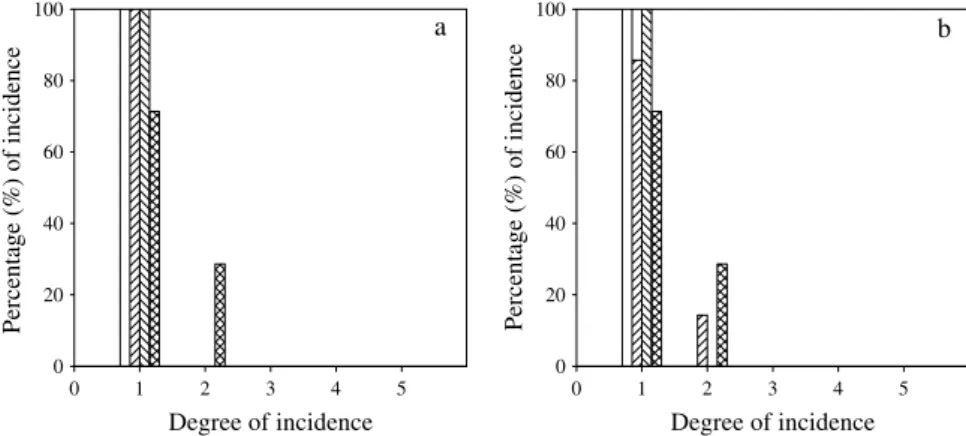
By 4 months of storage and after 1 day of exposure to air at room temperature, only pears that had been stored under 2 kPa O2+ 5 kPa CO2showed BH
(Fig. 1(a)); BH increased by 6 days of exposure to air at room temperature in pears from all conditions (Fig. 1(b)). A further increase in the incidence of BH was detected in pears after an additional 8 days at room temperature (data not shown). On the other hand, FB was detected by 1 day of exposure to air in pears stored under 2 kPa O2+ 5 kPa CO2; by an extra
6 days, it was also observed in fruits stored under 2 kPa O2 (Fig. 2(a, b)). After another 8 days, FB
was detected in pears from all conditions, and the degree of incidence increased in fruits that already presented FB symptoms. The causes of the incidence of core breakdown (BH and FB) in pears stored under CA conditions have been extensively studied;27,34,35
one of the factors that promote development of such disorders during storage is high CO2 and low O2
concentrations. In our case, the ripening conditions tested could also have a strong influence on the development of such disorders.
As mentioned above, the phenolic and vitamin C (AA and DHA) contents of ‘Rocha’ pears suffered great changes during storage. Note that AA content plays an important role in the protective system
Table 6. Contents of ascorbic acid (AA) and dehydroascorbic acid (DHA) (mg 100 g−1fw) in the flesh and in the peel of ‘Rocha’ pear after 4 months of storage, followed by an extra 1, 6 and 8 days in air at room temperature (18–20◦C)a
AA DHA
Tissue Storage condition 1 day 6 days 8 days 1 day 6 days 8 days
Flesh Air 0.8 (0.1) NS 0.7 (0.0)ab 0.6 (0.0) 14.7 (0.2)a 16.0 (3.9)a 17.0 (0.1)a
2 kPa O2+ 0 kPa CO2 1.0 (0.1) NS 0.6 (0.1)a 0.5 (0.0) 9.5 (0.6)c 8.6 (0.5)b 6.2 (0.3)c
2 kPa O2+ 0.5 kPa CO2 0.9 (0.2) NS 0.5 (0.1)b NM 11.6 (0.7)b 7.1 (1.2)b 6.9 (0.4)b
2 kPa O2+ 5 kPa CO2 0.8 (0.1) NS 0.5 (0.0)b NM 6.0 (0.3)d 7.2 (0.5)b 6.0 (0.4)c
Peelc 2 kPa O2+ 0 kPa CO2 0.4 (0.0)c 0.4 (0.1)b 0.4 (0.0) NS 11.4 (0.1)b 11.3 (0.0)b 11.4 (0.0)b
2 kPa O2+ 0.5 kPa CO2 0.9 (0.1)b 0.8 (0.2)a 0.4 (0.0) NS 16.6 (1.0)a 13.8 (0.4)a 14.8 (1.4)a
2 kPa O2+ 5 kPa CO2 1.1 (0.0)a 1.1 (0.1)a 0.4 (0.0) NS 11.5 (1.1)b 10.6 (0.7)b 11.6 (0.5)b aData are means of three replicates; standard deviation is included in parentheses.
bMean separation within rows by Duncan’s multiple range test (P= 0.05); significantly different means are followed by different letters (a, b, c); NS,
not significant; NM, not measured.
cAir data were not shown because sample was lost.
Table 7. Activity of polyphenol oxidase (U g−1min−1) in the flesh of ‘Rocha’ pear after 4 months of storage, followed by an extra 1, 6 and 8 days in air at room temperature (18–20◦C)a
Time (days)
Storage conditions 1 6 8
Air 1896.6 (43.6)bb 1272.6 (126.7)b 2028.1 (74.5)c
2 kPa O2+ 0 kPa CO2 2245.8 (298.7)b 2342.4 (161.7)a 2606.6 (123.7)a
2 kPa O2+ 0.5 kPa CO2 2705.8 (269.8)a 1167.5 (87.1)b 2264.1 (170.2)b
2 kPa O2+ 5 kPa CO2 1300.1 (155.9)c 970.3 (34.6)c 1370.1 (66.8)d
aData are mean of three replicates; standard deviation is included in parentheses.
bMean separation within rows by Duncan’s multiple range test (P= 0.05); significantly different means are followed by different letters (a, b, c).
a Degree of incidence 0 1 2 3 4 5 Percentage (%) of incidence 0 20 40 60 80 100 b Degree of incidence 0 1 2 3 4 5 Percentage (%) of incidence 0 20 40 60 80 100
Figure 1. Incidence of BH in ‘Rocha’ pears after 4 months of storage in air: ( ); 2 kPa O2: ( ); 2 kPa O2+ 0.5 kPa CO2: ( ); and 2 kPa
O2+ 5 kPa CO2: ( ), after 1 (a) and 6 days (b) of exposure to the open air at room temperature (18–20◦C). Degree of incidence: 1= absent;
2= very slight; 3 = slight; 4 = moderate; 5 = severe. Columns represent the mean of 7 observations.
against oxidative damage of fruits. The modulation of the antioxidant system has been associated with accumulation of DHA, which can accelerate catabolic processes.36 On the other hand, a decrease in the AA content might lead to accumulation of oxidative substances, which promote membrane oxidation.37
In addition, the low PPO activity observed in pears stored under 5 kPa CO2 might indicate that such
a concentration causes disruption of the normal metabolic balance of plant cells. As a consequence of this fact, membrane breakdown may take place, thus allowing leakage of phenolic compounds and occurrence of enzymatic reactions during storage;33
development of internal problems in pears might be related to these reactions.
CONCLUSIONS
The antioxidant system of ‘Rocha’ pears was altered during storage time. This fact was reflected in the changes observed in the phenolic content and in the conversion of AA to DHA, both in the flesh and in the peel of pears stored under all conditions. A decrease in PPO activity was apparent after harvest and during storage, particularly under higher levels of CO2. The
a Degree of incidence 0 1 2 3 4 5 Percentage (%) of incidence 0 20 40 60 80 100 b Degree of incidence 0 1 2 3 4 5 Percentage (%) of incidence 0 20 40 60 80 100
Figure 2. Incidence of FB in ‘Rocha’ pears after 4 months of storage in air: ( ); 2 kPa O2: ( ); 2 kPa O2+ 0.5 kPa CO2: ( ); and 2 kPa
O2+ 5 kPa CO2: ( ), after 1 (a) and 6 days (b) of exposure to the open air at room temperature (18–20◦C). Degree of incidence: 1= absent;
2= very slight; 3 = slight; 4 = moderate; 5 = severe. Columns represent the mean of 7 observations.
higher for those stored under 5 kPa CO2 combined
with 2 kPa O2. This pear variety is very sensitive to
CA composition and temperature/RH, so the storage conditions should be properly selected in order to preserve quality following harvest.
ACKNOWLEDGEMENTS
AC Galvis-S´anchez and SC Fonseca acknowledge financial support from FCT (Portugal), via fellowships BD/18392/98 and BPD/1601/2000, respectively. A Gil-Izquierdo holds a research grant from Fundaci ´on Cajamurcia.
REFERENCES
1 Cao G, Rusell RM, Lischner N and Prior RL, Responses in serum antioxidant capacity is increased by the consumption of strawberries, spinach, red wine or vitamin C in elderly women. J Nutr 128:2383–2390 (1998).
2 Tom´as-Barber´an FA, Ferreres F and Gil MI, Antioxidant phenolic metabolism from fruits and vegetables and changes during postharvest storage and processing, in Studies in natural
products chemistry, Vol 23, ed by Atta-ur-Rahman , Elsevier,
Amsterdam pp 793–795 (2000).
3 Gaziano JM, Antioxidant vitamins and cardiovascular disease.
Proc Assoc Am Physic 111:2–9 (1999).
4 Morton LW, Abu-Amsha CR, Caccetta R, Puddey IB and Croft KD, Chemistry and biological effects of dietary phenolic compounds: relevance to cardiovascular disease. Clin Exp
Pharmacol Physiol 27:152–159 (2000).
5 Leja M, Mareczek A and Ben J, Antioxidant properties of two apple cultivars during long-term storage. Food Chem
80:303–307 (2003).
6 S´anchez-Mata MC, C´amara M and D´ıez-Marqu´es C, Extend-ing shelf-life and nutritive value of green beans (Phaseolus
vulgaris L.), by controlled atmosphere storage:
micronutri-ents. Food Chem 80:317–322 (2003).
7 Kupferman E, Controlled atmosphere storage of apples and pears. Acta Hort 600:729–735 (2003).
8 Lentheric I, Pint ´o E, Vendrell M and Larrigaudiere C, Harvest date affects the antioxidant systems of pear fruits. J Hort Sci
Biotechnol 74:791–795 (1999).
9 Saquet AA, Streif J and Bangerth F, Changes in ATP, ADP and pyridine nucleotide levels related to the incidence of physiological disorders in ‘Conference’ pears and ‘Jonagold’ apples during controlled atmosphere storage. J Hort Sci
Biotechnol 75:243–249 (2000).
10 Larrigaudiere C, Pint ´o E, Lentheric I and Vendrell M, Involve-ment of oxidative processes in the developInvolve-ment of core browning in controlled atmosphere stored pears. J Hort Sci
Biotechnol 76:157–162 (2001).
11 Verlinden BE, de Jager A, Lammertyn J, Schotsmans W and Nicola¨ı BM, Effect of harvest and delaying controlled atmo-sphere storage on core breakdown incidence in ‘Conference’ pears. Biosyst Engineer 83:339–347 (2002).
12 Ventura-da-Silva AJ, Pera Rocha, una variedad nacida en Portugal. Fruticultura Profesional 78:8–29 (1996).
13 Avelar ML and Rodrigues AC, Vantagens da atmosfera contro-lada na qualidade da pˆera Rocha. Frutas, Legumes e Flores
45:33–36 (1999).
14 Galvis-S´anchez AC, Gil-Izquierdo A and Gil MI, Comparative study of six pear cultivars in terms of their phenolic and vitamin C contents and antioxidant capacity. J Sci Food Agric
83:995–1003 (2003).
15 Zapata S and Dufour JP, Ascorbic, dehydroascorbic and isoascorbic acid simultaneous determinations. J Food Sci
57:506–511 (1992).
16 Gil MI, Ferreres F and Tom´as-Barber´an FA, Effect of posthar-vest storage and processing on the antioxidant constituents (flavonoids and vitamin C) of fresh-cut spinach. J Agric Food
Chem 47:2213–2217 (1999).
17 Lavilla T, Puy J, L ´opez ML, Recasens I and Vendrell M, Relationship between volatile production, fruit quality, and sensory evaluation in Granny Smith apples stored in different controlled-atmosphere treatments by means of multivariate analysis. J Agric Food Chem 47:3791–3803 (1999).
18 L ´opez ML, Mir ´o R and Graell J, Quality and aroma production of ‘Doyenne du Comice’ pears in relation to harvest date and storage atmosphere. Food Sci Technol Int 7:493–500 (2001). 19 Li PH and Hansen E, Effect of modified atmosphere on organic
acid and protein metabolism of pears. Proc Am Soc Hort Sci
85:100–111 (1964).
20 Coseteng MY and Lee CY, Changes in apple polyphenol oxidase and polyphenol concentrations in relation to degree of browning. J Food Sci 52:985–989 (1987).
21 Ranadive AS and Haard NF, Changes in polyphenolics on ripening of selected pear varieties. J Sci Food Agric 22:86–89 (1971).
22 Escarpa A and Gonz´alez MC, Total extractable phenolic chromatographic index: an overview of the phenolic class contents from different sources of foods. Eur Food Res Technol
212:439–444 (2001).
23 Durkee AB, Johnston FB, Thivierge PA and Poapst PA, Arbutin and related glucoside in immature pear fruit. J Food
Sci 33:461–463 (1968).
24 P´erez-Ilzarbe J and Hern´andez TZ, Cold storage of apples (cv. Granny Smith) and changes in phenolic compounds. Lebensm
25 Burda S, Oleszek W and Lee CY, Phenolic compounds and their changes in apples during maturation and cold storage. J
Agric Food Chem 38:945–948 (1990).
26 Amiot MJ, Tacchini M, Aubert SY and Oleszek W, Influence of cultivar, maturity stage, and storage conditions on phenolic composition and enzymatic browning of pear fruits. J Agric
Food Chem 43:1132–1137 (1995).
27 Veltman RH, Kho RM, van Schaik ACR, Sanders MG and Oosterhaven J, Ascorbic acid and tissue browning in pears (Pyrus communis L. cvs. Rocha and Conference). Postharvest
Biol Technol 19:129–137 (2000).
28 Veltman RH, Sanders MG, Persijn ST, Peppelenbos HW and Oosterhaven J, Decrease of ascorbic acid levels and brown core development in pears (Pyrus communis L. cv. Confer-ence). Physiol Plant 107:39–45 (1999).
29 Davey MW, van Montagu M, Inz´e D, Sanmartin M, Kanel-lis A, Smirnoff N, Benzie IJJ, Strain JJ, Favell D and Fletcher J, Review — Plant L-ascorbic acid: chemistry, func-tion, metabolism, bioavailability and effects of processing. J
Sci Food Agric 80:825–860 (2000).
30 Murr DP and Morris LL, Influence of O2 and CO2 on o-diphenol oxidase activity in mushrooms. J Am Soc Hort Sci 99:155–158 (1974).
31 Siriphanich J and Kader AA, Effects of CO2on total phenolics,
phenylalanine ammonia lyase, and polyphenol oxidase in lettuce tissue. J Am Soc Hort Sci 110:249–253 (1985).
32 Veltman RH, Larrigaudiere C, Wichers HJ, van Schaik ACR, van der Plas LHW and Oosterhaven J, PPO activity and polyphenol content are not limiting factors during brown core development in pears (Pyrus
com-munis L. cv. Conference). J Plant Physiol 154:697–702
(1999).
33 Barrett DM, Lee CY and Liu FW, Changes in the activity and subcellular distribution of PPO in delicious apples during controlled atmosphere storage. J Food Biochem 15:185–199 (1991).
34 Larrigaudiere C, Lentheric I and Vendrell M, Relationship between enzymatic browning and internal disorders in controlled-atmosphere stored pears. J Sci Food Agric
78:232–236 (1998).
35 Frank C, Baetens M, Lammertyn J and Davey MW, Vitamin C mapping as a new method to investigate the origin of core breakdown in ‘Conference’ pears. Acta Hort 599:559–565 (2003).
36 Larrigaudiere C, Pint ´o E and Lentheric I, Oxidative behaviour of ‘Conference’ pears stored in air and controlled atmosphere storage. Acta Hort 600:355–360 (2003).
37 Pint ´o E, Lentheric I, Vendrell M and Larrigaudiere C, Role of fermentative and antioxidant metabolisms in the induction of core browning in controlled-atmosphere stored pears. J Sci