(will be inserted by the editor)
Hopeful monsters: A note on multiple conclusions
Bogdan Dicher
April 2018
Abstract Arguments, the story goes, have one or more premises and only one con-clusion. A contentious generalisation allows arguments with several disjunctively connected conclusions. Contentious as this generalisation may be, I will argue nev-ertheless that it is justified. My main claim is that multiple conclusions are epiphe-nomena of the logical connectives: some connectives determine, in a certain sense, multiple-conclusion derivations. Therefore, such derivations are completely natural and can safely be used in proof-theoretic semantics.
Keywords multiple conclusions · defining rules · structure of derivations · logical inferentialism
Delta: [. . . ] He seems engrossed in the production of monstrosities. But monstrosities never foster growth, either in world of nature or in the world of thought.
Gamma: Geneticists can easily refute that. Have you not heard that mutations producing monstrosities play a considerable role in macro-evolution? They call such monstrous mutants ‘hopeful monsters’.
Lakatos, Proofs and refutations, pp. 21–22
1 Preamble
An argument has one or more premises and one conclusion. Thus goes the orthodox stance. In this paper, I will defend the heretical claim that an argument may have Lancog Group, Centre of Philosophy, University of Lisbon, E-mail: [email protected]
more than one conclusion. Or rather, I will defend the claim that derivations, which are formal representations of arguments, may have more than one conclusion. This defence is not merely about legitimising a convenient technical artifice. Traditionally, multiple conclusions have been connected with the (im)possibility of providing an inferentialist, broadly anti-realist, justification of classical logic. Such a justification is illusory, it has been argued, because it relies on multiple-conclusion derivations which are illicit. The complaint can be voiced with respect to other logics—linear logic, distributionless R, etc.—that similarly rely on arguments being represented via multiple-conclusion derivations. My aim is not to defend some such logic. The spirit of this paper is pluralist and I do not assume that there is a unique correct logic accounting for the vernacular practice. Nor am I directly concerned with defending the family of logics that may depend on multiple conclusions. My only aim is to ensure that these logics get a fair chance and are not placed beyond the scope of proof-theoretic justification because of the unfounded belief that there is something wrong with multiple conclusions.
Multiple conclusions are not friendless. Some of their friends have argued that there are multiple-conclusion patterns of inference in the vernacular [35,29]. Others have defended them by providing a non-standard reading of deductions [29] or by proceeding, as it were, from generality, claiming that single-conclusion arguments are a limit case of more general, multiple-conclusion, arguments [2,3]. Likewise, conclusion arguments have been justified as enthymematic, while multiple-conclusion sequent proofs have been defended on the ground that they represent fam-ilies of arguments in the vernacular [5].
This paper mounts a different argument. I grant—for the sake of the argument for, in fact, I believe this to be a moot point—that the vernacular ratiocinative prac-tice does not contain multiple-conclusion arguments. Yet I argue that despite this, using multiple conclusions in accounting for the practice and, in general, in theo-rising about logics is legitimate. This is why I’d rather speak of ‘derivations’ in-stead of ‘arguments’.1While I am sceptical about the cogency of the received dogma that arguments are single-conclusion, I do not see much point in challenging it— though see below, section 4. Even if it were true, it does not immediately follow that derivations—which are formal entities, useful for regimenting the pre-formal practice—must be single-conclusion too. On the contrary, I shall argue that multiple-conclusion derivations are legitimate tools irrespective of whether they fit or not with the ‘nature’ of the vernacular arguments.
On the view I defend, multiple-conclusion derivations are epiphenomena of the logical connectives. Spelled out in more detail, this amounts to the following two claims:
(1) The structure of the derivations is partly determined by the logical connectives. (2) Some logical connectives determine multiple-conclusion derivations.
I will defend (1) and (2) in section 3. In section 4, I examine in some detail two candidates for instantiating the existential quantifier in (2), viz., multiplicative
1 The exact terminology is irrelevant; ‘formalised argument’ would have been a good alternative to
‘derivation’, which I nonetheless prefer as it frees ‘argument’ to be used as a shortcut for ‘vernacular argument’.
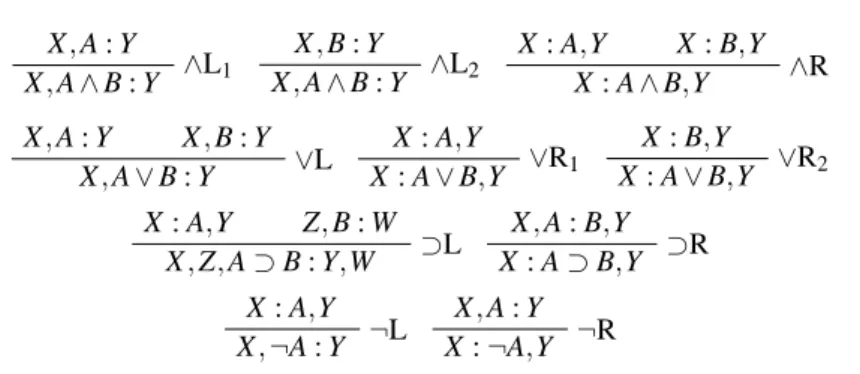
X, A : Y ∧L1 X, A ∧ B : Y X, B : Y ∧L2 X, A ∧ B : Y X: A,Y X: B,Y ∧R X: A ∧ B,Y X, A : Y X, B : Y ∨L X, A ∨ B : Y X: A,Y ∨R1 X: A ∨ B,Y X: B,Y ∨R2 X: A ∨ B,Y X: A,Y Z, B : W ⊃L X, Z, A ⊃ B : Y,W X, A : B,Y ⊃R X: A ⊃ B,Y X: A,Y ¬L X, ¬A : Y X, A : Y ¬R X: ¬A,Y Fig. 1 The operational rules of LKm
disjunction and involutive negation. Sections5 and6are largely polemical, aiming to debunk the chief complaints against multiple conclusions: that they are unnatural and, respectively, circular in inferentialist accounts of meaning. A final argument against the epiphenomenality thesis—roughly, that structure takes preeminence over the connectives—is discussed in section7. However, it is best to begin with a quick overview of the technical and philosophical background of the debate on multiple conclusions.
2 Background
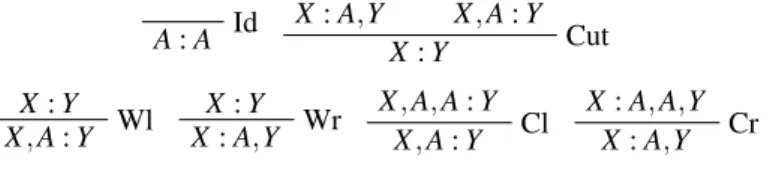
The best known multiple-conclusion formalisation of a logic is Gentzen’s sequent calculus for classical logic, LK [14]. A sequent is a pair of finite, possibly empty, collections of formulae, written X : Y . In Gentzen’s original formulation these col-lections were sequences. Here, they are multisets: lists without order or sets with repetitions. The left-hand side member of the pair is the precedent; the right-hand side one is the succedent.2Rules take zero or more sequents and deliver another se-quent. Operational rules introduce logical constants in the precedent or in the succe-dent. Structural rules output sequents from sequents independently of the logical con-stants. Figure1presents Gentzen’s operational rules for propositional classical logic and Figure2presents its structural rules. Roman capitals from the beginning of the alphabet stand for active and principal formula occurrences. The principal formula occurrence is the one introduced by the (application of the) rule, except in applica-tions of Cut, where the principal formula is the Cut-formula itself, i.e., the formula re-moved by the application. The active formula occurrences are those premise-sequent formula occurrences that are used constituents of the principal formula. The letters from the end of the alphabet stand for multisets of parametric formulae or contexts, i.e., formula occurrences that are neither active nor principal. Together, these rules give us LKm: multiset-based sequent calculus for (propositional) classical logic.3
2 In the literature, the first member is usually called antecedent, but precedent fits better with succedent. 3 There will be no need to go past the propositional level. Therefore, I shall sometimes use ‘logical
Id A: A X: A,Y X, A : Y Cut X: Y X: Y Wl X, A : Y X: Y Wr X: A,Y X, A, A : Y Cl X, A : Y X: A, A,Y Cr X: A,Y Fig. 2 The structural rules of LKm
LKm is a multiple-conclusion formalisation of classical logic in the following sense. Sequents are read as claims of consequence so that e.g. X : B means ‘B follows from (the conjunction of) all the formulae in X ’. Then X : Y says that the disjunction of the formulae in Y follows from the conjunction of all the formulae in X . Under this interpretation, the sequent X : Y is a claim of multiple-conclusion consequence. Importantly, a multiple-conclusion is a disjunctive structure.
Multiple-conclusion formalisms being bona fide inhabitants of the logical world is probably the simplest way to ensure that several logics—including the case study of choice here, classical logic—have a vocation to proof-theoretic justifiability. Se-quent calculi provide a handy environment to develop in a precise manner the logical inferentialists’ idea that the meaning of the logical constants is given by the rules of proof which govern their behaviour. In a proof, a sentence dominated by a constant \ can serve either as a premise or as a conclusion. Its premise role is codified by the rules specifying how to introduce it in the precedent (L-rules) while its conclusion role is codified by the rules specifying how to introduce it in the succedent (R-rules). Not every meaning determination by means of rules is successful, as shown by Prior’s infamous tonk [25]. Tonk, governed by the rules
X, A : Y tonkL X, A tonk B : Y X: B,Y tonkR X: A tonk B,Y
trivialises logics that have Cut. The need to rule out such pathological connectives was one of the reasons that prompted the development of proof-theoretic tests for the coherence of the L/R-rules, although tests of this kind were already indicated by Gentzen, albeit prior to and independently of tonk. His ideas were subsequently de-veloped by Prawitz [24] and Dummett [11] among others, with the latter coining the term harmony to denote the balance between the L/R rules for a logical constant that is indicative of its meaning-coherence.4However, the results of these procedures,
in-cluding their many ulterior refinements, are highly sensitive to whether the underlying formal systems allow or not multiple conclusions [26,27,13,20,12,37].5Classical
4 Dummett’s preferred formalism is natural deduction, although he seems not to be having any qualms
with sequent calculi beyond their (unspecific and potential) appeal to multiple conclusions. Furthermore, following Gentzen, he takes the R-introductions (i.e., the natural deduction introductions) to be meaning conferring. Harmony then boils down to the L-rules (the eliminations) being faithful to this meaning de-termination. The reverse direction, going from L- to R-rules is usually called stability. But Dummett’s terminology is unclear; ditto for that used in the subsequent literature. Here I shall use harmony in such a way as to include stability. Hence the term builds-in no assumption of priority of one type of rules over the other.
5 For a succinct discussion of the basic ideas of proof-theoretic semantics see [34]; my own views on
logic fares well and its constants appear to be harmonious in multiple-conclusion systems. The restriction to single conclusions brings about troubles: in particular, it renders classical negation disharmonious [11,26]. This is (one important reason) why multiple conclusions count: they are useful for an inferentialist justification of classi-cal logic.6So much by way of motivation—although the reader shouldn’t forget the remark from the previous section: Multiple conclusions are not just about classical logic; other logics rely on them as well. One unmoved by the desire to do (proof-theoretic) justice to classical logic may still find that their favourite logic needs them. So what is (purportedly) wrong with multiple-conclusion derivations? The two main allegations against multiple-conclusion derivations are that they are unnatural and, respectively, induce a kind of circularity in the proof-theoretic project. The worry about unnaturalness has to do with multiple conclusions being theoretical artefacts and, eo ipso, deviations from the practice. When one’s interest is to justify or criticise the practice, such deviations vitiate the theoretical outcome. Thus multiple conclu-sions are seen as the analogue of a lab procedure that does not guarantee spotlessly clean Petri dishes. The accusation of circularity concerns their usual reading as dis-junctive structures. One appeals to a certain formalism in order to gain an insight into the meaning of the logical connectives. But grasping the formalism requires a prior understanding of disjunction, which seems to render the entire project dangerously circular.
For the time being, this is enough to give the reader a sense of why one may be wary of using multiple-conclusion derivations (see [36] for an impressive case against them). I will address these worries in more detail in sections5and6. Right now, it’s time to turn to the thesis that the structure of the derivations is an epiphenomenon of the connectives.
3 Multiple conclusions as epiphenomena of the connectives
This thesis, which I call the Epiphenomenality Thesis, is a corollary of a more general claim, namely that the structural and operational levels of a logic stand in a relation of co-determination [9]. Let me briefly explain this with reference to LKm, which I have described previously along three different coordinates:
– the specification of the (multi)set-theoretic properties of the sequents, including the cardinality constraints that operate on them;
– the specification of the available structural rules;
– the specification of the behaviour of the connectives, as stipulated by the opera-tional rules.
This last item pertains to the operational aspect of a logic. The structural aspect consists of the specification of the set-theoretic properties of the sequents and the
6 There are other ways of making room for classical logic in the inferentialist world, such as going
bilateral and setting denial on a par with assertion [29,32], or rejecting the proof-theoretic desideratum of purity (or separability) [21]. (Recall that a logical constant is said to be governed by pure (L/R) rules if and only if, when schematically formulated, these rules mention no other constant than the one they purportedly define.)
structural rules available, i.e. the first two items in the list above. As already indicated, the commas on the left/right of the sequent sign are informally read as conjunctions and, respectively, disjunctions. I refer to them as structural operators; naturally, they pertain to a logic’s structural aspect.
The co-determination thesis holds that there is an interplay between these two aspects of a logic: features that pertain to one determine features belonging to the other. It is, for instance, well known that the presence or absence of structural rules can modify the behaviour of the connectives. Ditto as far as the set-theoretic prop-erties of the sequents are concerned. It is the other direction, viz., the effect of the connectives over the structure of the derivations, which is of particular interest here. The mechanics behind it are rather familiar, yet despite this the phenomenon itself is less widely acknowledged. Still, it can be argued that the structure of the derivations is in part an effect of the connectives.
The thought is this. The rules which stipulate how a connective can be introduced in the precedent or the succedent do not convey only information about that con-nective. They also say a lot about the structure of the derivations within which the connective can be used. Some of the structural information conveyed via operational rules is essential for the connective: given an adequate test of definitional success, there is a threshold of structural informativeness of the defining rules below which the connective is not viable. Suppose now that we take the connectives as the ba-sic building blocks of a logic. Then we can go on to determine what properties the derivability relation must have in order to accommodate those connectives. Thus the structure of that logic’s derivations is partly determined by its connectives. It is, as it were, an epiphenomenon of the connectives. All this is, I dare say, prima facie plausi-ble enough—the sceptical reader will get a heftier target shortly when I will say more in defence of the thesis. Right now, it is best move on and see how this helps the case for multiple conclusions.
The epiphenomenality thesis allows us to make sense of the structural operators in a principled, non-ad-hoc way. It allows us to see, as it were, where they come from and why they may be needed. Quite simply, the structural operators are side-effects of some connectives and we may think of them as structural ‘images’ or metalinguis-tic counterparts of the (object-language) connectives, in accordance with their usual interpretation. So the commas on the left correspond to the object language conjunc-tion, while those on the right correspond to object language disjunction. This would be the easiest way to grasp them intuitively.
Granted, this picture is still too sketchy; I will flesh it out subsequently, after a brief recapitulation of what we have so far. I have claimed (1) that there exists a co-determination relation between the operational and structural aspects of a logic and (2) that while the structure-to-connective direction is familiar, the converse direction is rather less widely acknowledged.
The ‘familiar direction’ is straightforward to illustrate. Famously, Gentzen ob-tained a calculus for intuitionist logic from LK by requiring succedents to contain at most one formula occurrence. Thus, by tinkering with the structure of the deriva-tions and in particular with the (multi)set-theoretic framework underlying them, one modifies the output of the operational rules. Structural transformations too can af-fect the behaviour of the connectives. In Figure1, there is a difference between the
two-premise rules for conjunction and disjunction on the one hand, and implication on the other. In the first case, the parametric variables are identical in both premise sequents and the conclusion sequents of ∨L and ∧R contain a single occurrence of each parametric variable. In ⊃L the premise sequents do not share the same para-metric variables and the parameters in the conclusion sequent are the multiset union of the (left/right respectively) parameters of the premises. The rules ∨L and ∧R are additive; ⊃L is multiplicative.7In systems which have all the structural rules of Fig-ure2one could formulate any two premise rule either additively or multiplicatively without affecting the consequence relation. There would be no difference at the level of provability, because any sequent derivable by means of additive rules could be de-rived by means of multiplicative rules and vice versa, give or take a few applications of the structural rules. I leave it as an exercise to the reader to prove this in full gen-erality, but an example will help drive the point home. The multiplicative R-rule for ∧ is:8
X: A,Y Z: B,W ∧Rm X, Z : A ∧ B,Y,W
with which the sequent A, B : A ∧ B is derivable as follows: Id
A: A B: B ∧RId m A, B : A ∧ B
With the additive rules, this sequent is derivable from the same premises only if Weakening is allowed: Id A: A Wl A, B : A Id B: B Wl A, B : B ∧R A, B : A ∧ B
This also illustrates how, in the absence of the structural rules, additive and multi-plicative connectives behave differently. So much then for the effect of the structural side on the operational one.
The connectives too have an effect on the structure of the derivations. For one thing, certain combinations of operational rules determine structural transformations which may not be independently available in the calculus. For instance, a disjunctive connective governed by the multiplicative L-introduction
X, A : Y Z, B : W ∨Lm X, Z, A ∨ B : Y,W
together with the previously given R-rules for ∨, allows one to derive Weakening, if Cut is available: X: A,Y ∨R X: A ∨ B,Y Id A: A B: B ∨LmId A∨ B : A, B Cut X: A, B,Y
7 This is the terminology consecrated in the linear logic tradition. Sometimes the additives are called
extensional or context-sharing, while the multiplicatives are also called intensional or context-independent.
8 I add the subscript m to record the fact that this rule is multiplicative. Sometimes, I shall append the
subscript to the connectives themselves, writing, e.g., ∨mto denote disjunction as given by multiplicative
Normally, the multiplicative L-introduction is paired with X: A, B,Y
∨Rm X: A ∨ B,Y
acting as a single R-introduction. The dual hybridisation of the rules, which pairs the additive L-introduction with ∨Rm, allows us to derive Cl. Similar effects can be observed, mutatis mutandis, in the case of conjunction and the conditional (cf. [17,18,22,23]).
This is a rough illustration of the fact that the logical connectives and the structure of the derivations are not isolated dimensions of a calculus and that choices made in one part have effects in the other. What really concerns us here is another, somewhat simpler, effect of the connectives over the structure of the derivations. The previous illustrations showed that one can get structural transformations from the rules for the connectives. Now we shall see that the static structure of the derivations too can be (regarded as) determined by the connectives.
The point is rather simple. Instead of taking the structure of the derivations to be pre-determined, we start with the connectives themselves. Then, we can use an ade-quate test of success for definitional stipulations by means of L/R rules to determine the structural conditions which are essential for defining the connectives. This will tell us what are the minimal structural requirements that a given connective imposes on a derivability relation.
A suitable criterion of definitional success—occasionally emerging, albeit in dif-ferent forms, in the literature, particularly when logics are presented by means of sequent calculi—is invertibility [1,10,30]. I shall not go into a detailed account of why invertibility is a formal property the obtaining of which is indicative of harmony; an explicit endorsement and analysis of invertibility as a criterion of harmony can be found in [15,16]. In the present context it is enough to notice that it suffices to rule out pathological connectives like tonk.
Intuitively, a rule is invertible if and only if it can be used both top-to-bottom and bottom-to-top. In a technically precise sense and relative to a sequent calculus, a rule
S1, . . . , Sn
S , where S1, . . . , Sndenote sequents, is invertible if and only if, for all i ≤ n, the converse rule(s) S
Si
is (are) derivable.
I take the meaning of a logical constant to be ultimately given by a double-line rule that in the case of, say, additive disjunction has the following form:
X, A : Y X, B : Y ∨ l X, A ∨ B : Y
The double-line signifies precisely that the rule can be used both top-to-bottom and bottom-to-top. Technical smallprint: If one direction of a double-line rule generates downward branching (as is the case with the bottom-to-top direction of ∨ l) this is to be read conjunctively, meaning that the sequents on each branch follow from the premise sequent. Readers queasy about this can think of the branching as a notational shortcut, compressing several rules.
Our official doctrine will be that double-line rules are stipulations, working in both directions by fiat and that they are both distinct from and conceptually prior to
sequent calculus rules. Unofficially, it pays to notice that there is a simple general recipe for determining the double-line rule corresponding to a logical constant. The l-rule is always based on the template provided by that L/R rule for the constant that is invertible in the sequent calculus technical sense. In practice, a quick examination of the rules suffices to weed out unsuitable candidates. For instance, the R-rules for additive disjunction can’t serve as a template for a suitable double-line rule because, given the endsequent X : A ∨ B,Y , there is no way to ascertain which were its premise sequents. The principal formula of the rule, A ∨ B, could have been derived using either A or B as the active formula.
A set of L/R rules for a logical constant successfully define it if and only if they can be derived from the l-rule for that constant using only Id, Cut and the double-line rule itself. Although the defining rule itself is not, properly speaking, part of the calculus considered—and to that extent its own structural requirements may be thought to be irrelevant to the issue of how the L/R rules determine the meaning of the connectives—its minimal structural requirements are inherited by the sequent calculus rules.
Before seeing which connectives determine multiple-conclusion derivations, it pays to look at a connective that can happily inhabit tighter structural contexts. Ad-ditive disjunction is a good example. From ∨ l, ∨L follows trivially, since it is the top-to-bottom direction of it. The following derivation delivers ∨R1:
X: A,Y Id A∨ B : A ∨ B ∨ ↑ A: A ∨ B Cut X: A ∨ B,Y
A similar derivation using X , B : Y as the free-standing premise generates the other R-introduction.9The result is preserved if we impose the intuitionistic restriction that succedents contain at most one formula occurrence. Likewise, it is not affected by the more stringent restriction that both precedents and succedents should consist of exactly one formula, occurring at most once. In this case, we obtain the behaviour of disjunction in lattice logic [31]. The upshot is that additive disjunction is definable even if sequents consist of singleton multisets. This is the most parsimonious context of derivability compatible with defining a disjunction. More stringent conditions like demanding either empty precedents or succedents would render it undefinable.
Other connectives require more generous structural allowances. Such is the case with multiplicative disjunction, whose sequent calculus rules are:
X, A : Y Z, B : W ∨Lm X, Z, A ∨ B : Y,W X: A, B,Y ∨Rm X: A ∨ B,Y
9 Conversely, given the R-introductions, ∨ ↑ is derivable which, in fact, would work as a formal proof
that ∨L, a.k.a ∨ ↑, is invertible). One of the required derivations is: Id A: A ∨R A: A ∨ B X, A ∨ B : Y Cut X, A : Y
Its L-introduction cannot serve as a template for the double-line rule, because there is no way to trace the premise sequent from which the members of X , Z and, respec-tively, Y,W came. But ∨Rmfits the bill so we can rewrite it as a l-rule:
X: A, B,Y ∨ml X: A ∨ B,Y
This l-rule can only be internalised in a multiple-conclusion calculus. This is trivial with respect to R-introduction—which is just ∨m↓—and cannot even be formulated if the succedents were to contain at most one formula occurrence. It is almost equally straightforward that the derivation of ∨L too depends crucially on multiple conclu-sions. Without them, there simply isn’t enough room for an application of ∨m↑ to the identity sequent A ∨mB: A ∨mBto yield A ∨mB: A, B. It follows that multiplicative disjunction is not definable in derivability contexts where the cardinality of the succe-dent cannot be greater than one. Conversely, if multiplicative disjunction is definable, then the structure of the derivations must be multiple-conclusion.
The same is true of classical (better and more general: involutive) negation and of the additive conditional. The standard sequent calculus derivation of double negation elimination (DNE) makes the involvement of multiple conclusions intuitively plain:
Id A: A ¬R : ¬A, A ¬L ¬¬A : A
and the formal confirmation of this intuition is not difficult to find. Take negation to be defined by the double-line rule:
X: A,Y ¬Ll X, ¬A : Y
(So we take it as defined by, as it were, its left-side.) This corresponds to the se-quent rule ¬L, which, setting Y = ∅, can be obtained in a single conclusion calculus. However, getting ¬R from ¬Ll requires the use of multiple-conclusion derivations:
Id ¬A : ¬A ¬L↑
: A, ¬A X, A : Y Cut X: ¬A,Y
Moving now to the conditional, notice first that the multiplicative rules for the con-ditional given in Figure1work as successful inferential definitions even in single-conclusion contexts, as the reader can easily check. Nonetheless, an additive condi-tional governed by the rules:
X: A,Y X, B : Y ⊃La X, A ⊃ B : Y X, A : Y ⊃Ra1 X: A ⊃ B,Y X: B,Y ⊃Ra2 X: A ⊃ B,Y
can be defined only in multiple-conclusion frameworks. Invertibility is an attribute of ⊃La, which thus can serve as the pattern for the l-rule. From this the ⊃R rules can
be easily obtained. For instance, we get ⊃Ra1 as follows: Id A⊃ B : A ⊃ B ⊃↑ : A, A ⊃ B X, A : Y Cut X: A ⊃ B,Y
This takes us through the multiple-conclusion step : A, A ⊃ B. I conclude that the additive conditional too determines—and thus encodes—multiple conclusions.
The upshot is that the ‘traditional’ search for multiple conclusions in the vernacu-lar practice was conducted the wrong way. The focus has been on identifying aspects of the practice that can reasonably be said to ‘look like’ multiple-conclusion deriva-tions as a result of a simple, naked-eye, examination. This distinction usually goes to proofs by cases; nevertheless, the results obtained are, to say the least, inconclusive. Proof-by-cases inference patterns are similar to the usual disjunction elimination rule in natural deduction: A∨ B [A]i .. . C [B]j .. . C ∨E, i, j C
However, the ‘several’ conclusions active in a proof by cases are, in fact, instances of one and the same formula. Thus it is not entirely surprising that this suggestion, ini-tially put forward by Shoesmith and Smiley [35], has been greeted with a rather dis-tinct lack of enthusiasm. Rumfitt [33], for instance, remarks that the example above fails to exhibit multiple conclusions at all, because real multiple conclusions should be different sentences all of which follow from a set of premises. (Though see [29] for an example which avoids this problem.) I shall try my own hand at a search of the same kind in section4, if only to reinforce a sceptical stance towards it. That, I hope, will help the case for the following claims:
This manner of searching for multiple conclusions is too narrow. The mistake lies in limiting the search to discernible multiple-conclusion-like features of the prac-tice. This makes sense if one assumes that the structure of the derivations is given and segregated from the behaviour of the connectives. But, in virtue of the epiphe-nomenality thesis, this assumption is wrong. A great deal of structuring is the ef-fect of the connectives. Of course, this need not be smoothly represented in the pre-theoretical practice, for a multitude of reasons, chiefly amongst which is that said practice is not concerned with reflecting critically upon itself. Instead of search-ing for ‘visible’ multiple-conclusion derivations, one should look for features of the vernacular practice that are suitably connected with multiple-conclusion derivations. The epiphenomenality thesis indicates what the ‘suitable connection’ might be: We need to look for aspects of the behaviour of the logical connectives that determine multiple-conclusion derivations.
4 Choosing among candidates
Each of the previously mentioned connectives (multiplicative disjunction, involutive negation and the additive conditional) can instantiate the existential quantifier in the
epiphenomenality thesis. It may pay to see what benefits and disadvantages are con-nected with each choice, particularly within the setup of the traditional debate on multiple-conclusions. Recall that in this scenario, the McGuffin is the justification of classical logic and the setting is the vernacular ratiocinative practice. From the outset, we can disregard the additive conditional: much of what follows will revolve around the topic of naturalness and it is plain that the ⊃R rules are a far cry from being natural. So we are left with multiplicative disjunction and involutive negation.
The existence of a vernacular multiplicative disjunction is hotly debated, particu-larly in relation to relevant logics. This would be a connective for which disjunctive syllogism
A∨ B ¬A
DS B
is valid—which, in a sequent calculus, boils down to the derivability of the sequent A∨ B, ¬A : B—while the additive ∨R rules fail. But part of the motivation for the present undertaking was to ensure that classical logic can be brought into the fold of proof-theoretically justifiable logics. Thus it seems fair to rely only on the resources that classical logic itself recognises. However, the additive/multiplicative distinction is spurious in classical logic: any logical law obeyed by the additive disjunction is obeyed by the multiplicative one. It is thus unlikely that this debate, as it stands, will be of much help here.10
The aforementioned spuriousness should be taken with a cardiacally calamitous pinch of salt. As long as logics are identified with consequence relations and, more importantly, analysed strictly as such, there are no imperative reasons for paying at-tention to the additive/multiplicative divide. Nonetheless, for sundry purposes, we may need more fine-grained distinctions, even if we take logics to be consequence relations. An analogy (explicatory rather than justificatory) may help make sense of this. Classical logic is usually presented over a language that does not explicitly con-tain Sheffer’s stroke. Even the banal ‘if and only if’ rarely makes it into the primitive language. It simply isn’t technically convenient. But if one wishes one can add them (as either primitive or defined connectives), safe in the knowledge that they will not modify the consequence relation while nevertheless leaving their mark at the level of proofs. Consequence-wise, the biconditional’s behaviour can be mimicked with the help of the conditional and of the conjunction; yet its rules are not a composition of the rules for ‘if . . . then’ and ‘and’, in any sense of ‘composition’. Rule-wise, ‘if and only if’ is a proper citizen of the classical consequence relation. Its vote may not make a difference, but the taxes it pays are there to be missued by the government! Dittofor multiplicative disjunction and for every other connectives which are addi-tive/multiplicative relations of each other. One of each pair is (classically) enough; more make for better representativity—to stick to political metaphors.
This suggests another possible starting point for the case that there is a vernacular multiplicative disjunction: ∨Rmitself. Could it be that sometimes we infer a disjunc-tion because we are in the situadisjunc-tion when both its disjuncts follow (disjunctively) by one argument? The existence of such a scenario would be, ipso facto, an argument that there are multiple-conclusions in the pre-formal practice. Given the consensus
that this cannot be, the suggestion appears to be a dead end. Still, I can think of at least one natural language scenario that appears to be (formalisable as) an application of ∨Rm. Take the following dialogue:
Primus(mansplaining tenderly): . . . ; therefore A!
Secunda(not rolling her eyes): Yes, well, unless B: your argument could just as well have ended in the conclusion that B so it supports either of the two conclusions (though there may be independent reasons to believe that only one of them can be true).
Primus(perplexed by her insolence): Indeed, maybe A, maybe B; so A or B. But ¬B, because . . . , hence A.
Here, it doesn’t look as though Secunda is acquiescing to the assertion that A nor, for that matter, to that of B. She also doesn’t appear to be asserting the disjunction of A or B. Her own gloss says that much: she feels that Primus’ argument supports Aand B in like manner—not in the sense that asserting their conjunction would have been acceptable, but in the sense that it precludes discrimination between them. Or perhaps in the sense that it couldn’t be that both A and B are false, though which one isn’t is yet a matter of debate. Accepting Secunda’s point, Primus goes on to assert A∨mB—obviously, by applying ∨mR.
Had Primus and Secunda had an argument that A, they could have inferred A ∨ B by means of ∨R. So there is nothing peculiar consequence-relation wise to a disjunc-tion so introduced. But Secunda’s point is that there is as yet no conclusive argument that A. B is just as plausible. So their entitlement to assert ‘A or B’ is that maybe A, maybe B. Primus and Secunda may even agree that, by dint of it being the case that A or B, there must be an argument that A or else there must an argument that B and that their use of ∨mR is ultimately justified by this latter fact. Indeed, their dialogue could have proceeded in that direction, say, with Secunda refusing to acknowledge that A was proved and demanding that Primus improves their case that A. Could have, but crucially, didn’t and in fact they have inferred ‘A or B’ by ostensibly applying ∨Rm. So this may be a prima facie case for the claim that rules like ∨Rmare actually applied in vernacular reasoning. Granted, this would be a very weak case. But the punchline is that moving past it requires the exercise of theoretical prowess. Let us see why this matter.
It is difficult to fathom, if only for sociological reasons, that this could be a correct analysis of the dialogue between Primus and Secunda. Could it be that the consensus that vernacular reasoning is single-conclusion has been achieved at the cost of so blatantly disregarding straightforward indications to the contrary? To be sure, worse cases of theoretically induced blindness have been seen. Be that as it may, a kind of strategic withdrawal, albeit one that leaves nothing but scorched land in its wake, is better suited for my overall argument. To get the argument going, the mere prima facie plausibility of our dialogists acting within a multiple-conclusion framework suffices. If we want to reject it, we need to explain it away: to say why things aren’t as they seem to be. This entails that recognising any kind of structure in the dialogue above and, by extension, in the vernacular practice as a whole, is very much a matter of exercising one’s theoretical commitments, however inchoate these may be. For most practical purposes, this means that, ultimately, structure, no less than beauty, is
in the eye of the beholder. If there is anything that has a claim to being taken face value, then it is the connectives and their behaviour.11
If this is so, then it would be a waste of time to debate any further the merits of the case for a vernacular multiplicative disjunction. The defence of the thesis that multi-ple conclusions are epiphenomena of the connectives is more straightforward relative to involutive negation. There can be no doubt that there are vernacular patterns of inference matching those usually ascribed to this connective. The pattern of interest here is, of course, double negation elimination (hereafter sometimes abbreviated as DNE), which is so well entrenched in the vernacular practice that, alas, it even made its way into pop-culture, although generally suffering from grievous mutilations.
Negation brings with it specific worries, though these are somehow more theo-retical and also easier to dispatch.12 It is precisely DNE, in its capacity as the ¬-elimination rule in natural deduction, that is at stake in the revisionary arguments put forward by, e.g., Dummett. Hence it may appear that using it to argue for multiple conclusions is question-begging. Now the case against classical negation, via DNE, goes roughly like this:
P1 Genuine logical constants must be harmonious; P2 The natural derivability relation is single-conclusion;
P3 Classical negation is disharmonious in single-conclusion settings; C Classical negation is disharmonious.
I grant, at least for the sake of the argument, P1 and P3. I do not grant the conclusion C because classical negation is harmonious in multiple-conclusion settings. Which is to say: I reject P2. So the appeal to classical negation is prima facie fair. There is no disagreement between one proposing an argument along these lines and myself as far as facts about negation are concerned. What is at stake is P2. The argument I am proposing runs, roughly, as follows:
P4 The structure of the derivations is (epiphenomenally) determined by the connec-tives;
P5 Vernacular negation is involutive;
Anti-C Involutive negation determines multiple conclusions.
P5 is not challenged by the foes of multiple conclusions, who grant it as a matter of, as it were, sociological observation. Their qualms are with its correctness. The contentious premise will be P4 which in a sense is contrary to P2.
5 Naturalness
The proper, direct defence of P4 comes out from the discussion in section3. Never-theless, the case for it can be boosted indirectly, by exposing some of the weaknesses of the competing view expressed by P2. So let us focus on ‘naturalness’.
11 And here one may wish to further argue that there can be no doubt that classical logic allows for a
behaviour like that described by the multiplicative rules for ‘or’. If we further assume that the vernacular roughly obeys classical logical laws, then we have a good motivation for accepting multiple conclusions.
The requirement of naturalness is predicated upon the premise that the inferential-ist justification of logic(s) must keep as close as possible to the discernible features of the vernacular practice. Multiple conclusions, it is believed, are not a part of it [11]. Steinberger [36] condenses the theoretical upshot of these arguments in the following Principle of Answerability:
Only such deductive systems are permissible as can be seen to be suitably connected to our ordinary deductive inferential practices. [36, 335]
He also delivers the knock-out blow without hesitation:
it seems intuitively clear, however, that multiple-conclusion systems represent so marked a departure from our actual practice that they can hardly be said to track that practice even in an idealised sense. [36, 336]
Although, in the end, it matters little which formalism is used as long as it is single-conclusion, the conventional wisdom has it that, when naturalness is concerned, natu-ral deduction is choicer. Therefore, I go with the flow and focus on natunatu-ral deduction in the subsequent analysis of the Principle of Answerability. Anti-climactically as it is, I state from the very beginning that I believe Answerability to be the sort of herring that decidedly drifts towards the reddish side of the chromatic spectrum.
To say that the Principle of Answerability is too loose would be quite an under-statement. That this is so is seen not so much in what the Principle rules out, but rather on what it must allow if natural deduction is to win its laurel wreath.
Take, as a case study, the natural deduction systematization of the rules for nega-tion. In the classical case, one usually uses the following rules:
[A]i .. . B [A]i .. . ¬B RAA, i ¬A A ¬A ECQ B ¬¬A DNE A
Reductio as absurdum(RAA) and DNE are certainly inferential patterns adapted, if not adopted, from the pre-formal practice. However, it is a bit of stretch to make the same claim about ex contradictione quodlibet (ECQ). In the vernacular, contradic-tions may entail everything, but one usually doesn’t draw any conclusion whatsoever from a contraction. Instead, one revisits one’s reasoning up to that point, trying to identify the trouble-making premise(s) and to remove it (them).
Ex falso quodlibet— ⊥ EFQ
A —fares even worse: there is no falsity constant in the vernacular. There are many natural language sentences that can, in this or that circumstance, play the role of ⊥, but this is quite different from there being a logi-cal constant ⊥. As it turns out, it is this way of dealing with negation, via a falsity constant, that is required in order to get a proof-theoretically pleasing behaviour of (intuitionistic) negation (cf. [24,11]). Perhaps accepting ⊥ as a legitimate idealisation of some aspects of the practice is in keeping with Answerability. After all, negation is
sometimes expressed as an implication with a false consequent.13But surely letting it do the job of negation in all circumstances is a rather radical ‘idealisation’!
Take now the conditional; in natural deduction it is governed by the following rules: [A]i .. . B ⊃I, i A⊃ B A⊃ B A ⊃E B
which are readily seen to be related to the vernacular practice. These rules do not tell the whole story of the (minimal, intuitionist and classical) conditional. In order to know how to use them, we need to know how to discharge assumptions. Can we discharge assumptions that we have never made? Can we discharge multiple assump-tions with one rule application?14
Defenders of classical or intuitionist logic have not choice but to allow both of these types of discharges. Presumably, one can find something similar to multiple discharges in the ordinary practice. Once an assumption is made, we regard ourselves as entitled to use it as many times as required in the course of a deduction. However, one would be hard-pressed to find ordinary practice instances of vacuous discharges. It may be thought that these come to the fore precisely in the informal justification of logical laws like A ⊃ (B ⊃ A), which one may explain by saying that if A holds no matter what, then it also follows from whatever assumptions. This, however, is rather far-fetched qua argument for the presence of vacuous discharges ‘in nature’. All that it shows it that (something that we interpret as) vacuous discharges are part of our narrative about what goes on ‘in nature’. This hardly makes them ‘natural’.
The point of all this is quite simple. In order to make even single-conclusion natural deduction work, one needs to go beyond the realm of what can plausibly be claimed to correspond to the pre-formal practice. There is nothing wrong with that. Nevertheless, one who rejects multiple-conclusion derivations on account of the Prin-ciple of Answerabilitymust explain what distinguishes the type of idealisation per-formed, say, by allowing vacuous discharges or made-up logical constants, from that performed by allowing multiple conclusions. Why is it that only the latter counts as an unjustifiable generalisation of and departure from the practice? Certainly, the dis-tinguishing element cannot be belonging to the pre-formal practice and even less the harmless character of the idealisation. And saying that one is intuitively fine whereas the other is intuitively rotten to the core just isn’t enough.
6 Circularity
The dialectical setup of the case against multiple conclusions is somehow puzzling. One usually starts by deploying the accusation of non-naturalness and then (snarky
13 This observation is made by way of doing justice to Tennant’s view that falsum is not a logical
con-stant, but rather a punctuation mark, signalling a deduction gone pear-shaped [38]. Again, I am indebted to an anonymous referee for bringing this to my attention.
14 In the sequent calculus, vacuous discharges correspond to weakening while multiple discharges are
aside: when that turns stale) moves on to circularity, which appears to be the more serious accusation.15As far as I can see, this accusation usually comes in two (and a half) flavours.
We may call the first flavour generic. It boils down to the worry that disjunction must be at hand—at least in its structural guise—prior to verifying that it is harmo-nious. This is relatively straightforward to deal with. As already seen in section3, a kind of disjunction, which turns out to be that of lattice logic, can be defined even if sequents consist of (multiset-)singleton precedents and succedents. Therefore, it is available before the structure of derivations is enriched so as to allow multiple con-clusions. I have argued elsewhere that these structurally minimal, single-conclusion rules determine the meaning of additive disjunction [9]. In classical or intuitionist logic its rules are enriched and carry more structural information than required for definability. However, these richer formulations do not alter the meaning of disjunc-tion. If this is true, then there is no reason to worry about the appeal to disjunction in the inferentialist explanation of the meaning of the logical constants. By the time we get to using multiple-conclusion derivations we can already avail ourselves of dis-junction. While structural disjunction is still required to make sense of connectives such as negation and the additive conditional, there is nothing circular about this, since a perfectly coherent meaning of disjunction is already available. The threat of circularity is, at least in this case, mitigated.16
Somewhere in the same ballpark lies the worry that multiple-conclusion deriva-tions go against the proof-theoretic desideratum of separability [36]. Technically, this is the requirement that the (schematic formulation of the) defining rules for the con-nectives do not mention any logical concon-nectives but the one they define. Its point is really to ensure that there is no interconnection of meanings. Whereas separabil-ity is not technically affected by the use of structural disjunctions, it does seem that allowing multiple conclusions goes against its spirit. Nevertheless, the epiphenom-enality thesis shows that requiring separability in this extended sense is misguided. There may be theoretical reasons to retain separability in the restricted sense; how-ever, these have no bearing on the present issue.17
That second flavour of the accusation of circularity, to my knowledge previously not discussed in the literature, is more specific and it has to do with multiplicative disjunction. If this is a genuine (vernacular) connective and one takes it to determine multiple-conclusion derivations, then it is apparent that grasping it is fundamentally tied to grasp of a structural disjunction. Now if this last would be somehow identifi-able, behaviour-wise, to additive disjunction, then the scenario would not differ from the one discussed above. But what reasons do we have to think that this is the case? I haven’t provided any. Besides, we would presumably not wish to make it so that the
15 Incidentally, this suggests that the efforts to show that multiple conclusions are not part of the
vernac-ular practice are pointless. If appealing to them in proof-theoretic arguments is somehow circvernac-ular, then the circularity would not be fixed by there being multiple-conclusion derivations in ‘nature’.
16 For a brief discussion of this kind of inter-conectedness of the connectives see [7].
17 Besides, the usual tu quoque, that multiple premises, being conjunctive structures, are just as sinful
as multiple conclusions, is pretty difficult to dismiss in this setup. (I thank an anonymous reviewer for noticing this.)
definability of multiplicative disjunction would be indelibly connected with that of its additive kin.
The worrisome aspects of this scenario are easily debunked after a modicum more meditation on the epiphenomenality thesis. One lesson to be drawn from it is that the structure of the derivations should not be taken as given. Instead, we should think of it as dynamically generated by the connectives. The worse that could be said about multiplicative disjunction and the structural disjunction that it determines is that they are given simultaneously. That is, grasp of the former brings along grasp of the latter. If one insists on establishing some sort of conceptual priority between the two con-nectives, then this distinction goes to the object-language connective. Even if this is circularity, it is of a most benign nature.
The final worry I wish to address here has to do with the relation between the many disjunctions we have encountered. In the grand scheme of things, it is impor-tant to determine whether the structural disjunction determined by negation is the same as that determined by multiplicative disjunction. However, I shall not tackle this issue here. My purposes fall short of explaining in full the connection and the in-terplay between connectives and the structure of the derivations, y compris structural operators. For what I want to achieve, it is enough to show that object-language dis-junction can be inferentially characterised without recourse to a structural disdis-junction and, in those case where this is not possible, that there is no plausible accusation of circularity to be brought against the appeal to structural disjunction. A full theory of structural connectives would be desirable, but it is not required at this point.
7 Concluding remarks
By way of concluding, I should like to spell out explicitly a few details regarding the ‘biography’ of the epiphenomenality thesis. Undoubtedly, the reader already recog-nised that it, together with the co-determination view, are related to Doˇsen’s analysis of the logical constants as punctuation marks [10]—in a certain sense, they invert it.
To begin with, it is best to recast the story above as a kind of dilemma. In vernac-ular deductive reasoning, there is a tension between operational inferences and the structure of derivations. Informal arguments are prima facie single-conclusion—or at least this is the consensus. At the same time, the informal practice does not shy away from using inferential moves like DNE, of which we cannot make proof-theoretic sense within a single-conclusion framework. This may plausibly be taken as a de-fect of the practice, but it is not immediately obvious that it is a flaw of negation. Reforming the behaviour of negation is one way of resolving this tension. Reform-ing the structure of the derivations representReform-ing vernacular arguments, viz. adopt-ing a multiple-conclusion framework, is another. Ultimately, we are presented with a choice between general traits of a structural nature on the one hand, and well-entrenched, indisputably (or even uncritically) accepted patterns of inference on the other.18
18 In passing, let us note that the theoretical question of which kind of features should be preferred is
Now Doˇsen stated—rather than argued—that ‘formal deductions are structural inferences’ [10, 364] and that the logical constants mirror in the object language the structural properties of a calculus. It appears thus that the epiphenomenality thesis goes against this view, since it claims that (some of) the properties of the constants appearing in the object language are ‘mirrored’ in the structure the derivations. On the face of it, it would be an unconvincing move to complain that the epiphenom-enality thesis is abusively inverting a relation that naturally goes from structure to connectives. For one thing, on its own, this would amount to little more than a ad verecundiam. However, it isn’t even that; the view I am defending is a lot more in the spirit of Doˇsen’s proposal that it appears at first blush. (Not that this could be used in its favour without perpetrating another ad verecundiam!) The fact is, Doˇsen does not make any assumption whatsoever about which structural properties are in place to be mirrored in the object language. What he says is that, e.g., a relevant con-ditional will mirror into the object language the properties of a deducibility relation that disavows weakening in the precedent [10, 367]. Whether Wl itself is or isn’t a legitimate ‘structural deduction’ is a moot point as far as his analysis is concerned. The epiphenomenality thesis shows that (roughly) the same type of analysis can be adapted to serve another purpose, that of determining which derivations fit best to a certain behaviour of the logical constants.
Much the same is the situation with another famous pronouncement that, one may think, could be brought against the direction of assessment introduced by the epiphenomenality thesis. Belnap’s solution to Prior’s tonk [4], lifts of the ground on the basis of the observation that:
we are not defining our connectives ab initio, but rather in terms of an an-tecedently given context of deducibility, concerning which we have some def-inite notions. [. . . ] [B]efore arriving at the problem of characterizing connec-tives, we have already made some assumptions about the nature of deducibil-ity. [4, 131]
There are two things to observe here. First, although Belnap talks of the ‘deducibility context’ as such, the only properties of this that are actually relevant to the point are reflexivity and transitivity as codified by Id and Cut, respectively. Not only the arguments above do not question Id and Cut, but, in fact, they rely on them. The second observation is that, irrespective of Belnap’s position, it is at least possible to revise the ‘context of deducibility’ in order to accommodate a particular connective— be it the dreaded tonk. As Cook [6] reminds us, we cannot but assess the structure of the derivations concurrently with the viability of the connectives. Belnap presumably judges that we are better of retaining Cut and Id than by making room for tonk.
To sum up: If the impact of the connectives over the structure of the derivations is duly recognised, then the use of multiple-conclusion derivations is justified. They are epiphenomenal consequences of certain connectives. In this sense, there is noth-ing unnatural about them. Moreover, if the dynamic relation between connectives and structural properties is taken into account, then there is no need to worry about cir-cularity. Furthermore, at least one kind of disjunction needs not multiple-conclusion derivations in order to be defined. All in all, there is nothing wrong with multiple-conclusion derivations.
Acknowledgements
I am grateful to the audience at the Lancog Seminar Series in Analytic Philosophy (Centre of Philosophy, University of Lisbon) and in particular to Ricardo Santos and Elia Zardini for a very interesting discussion of these issues. Special thanks are due to Francesco Paoli, who read an early version of this paper and suggested many invalu-able improvements. I owe a debt of gratitude to Greg Restall for many discussions about multiple conclusions. Last but not least, I thank the two anonymous referees for this journal for their very detailed and tremendously helpful comments.
This paper was financed by the Fundac¸˜ao para a Ciˆencia e a Tecnologia, via grant no. SFRH/BPD/116125/2016.
References
1. Avron, Arnon (1991). Simple consequence relations. Information and Compu-tation, 92: 105–139. 8
2. Beall, JC (2011). Multiple-conclusion LP and default classicality. Review of Symbolic Logic, 4: 326–336.2
3. Beall, JC (2014). Strict-choice validities: A note on a familiar pluralism. Erken-ntnis, 79: 301–307. 2
4. Belnap, Nuel D. (1962). Tonk, plonk and plink. Analysis, 22: 130–134. 19
5. Cintula, Petr and Paoli, Francesco (2016). Is multiset consequence trivial? Syn-these, OnlineFirst: 1-25.2
6. Cook, Roy T. (2005). What’s wrong with tonk(?). Journal of Philosophical Logic, 34(2): 217–226.19
7. Dicher, Bogdan (2017). On a generality condition in proof-theoretic semantics. Theoria, 83(4): 394–418. 17
8. Dicher, Bogdan (2016a). Weak disharmony: some lessons for proof-theoretic se-mantics. Review of Symbolic Logic, 9(3): 583–602. 4
9. Dicher, Bogdan (2016b). A proof-theoretic defence of meaning-invariant logical pluralism. Mind, 125(499): 727–757.5,17
10. Doˇsen, Kosta (1989). Logical constants as punctuation marks. Notre Dame Journal of Formal Logic, 30(3): 362–381.8,18,19
11. Dummett, Michael (1991). The Logical Basis of Metaphysics. Duckworth, Lon-don. 4,5,15
12. Francez, Nissim (2015). Proof-theoretic semantics. College Publications, Lon-don. 4
13. Francez, Nissim and Dyckhoff, Roy (2011). A note on harmony. Journal of Philosophical Logic, 40: 1–16.4
14. Gentzen, Gerhard (1935). Untersuchungen ¨uber das logische schließen. I,II. Mathematische Zeitschrift, 39(1): 176–210; 405–431. 3
15. Gratzl, Norbert and Orlandelli, Eugenio (2017). Double-line Harmony in a Se-quent Setting. In P. Arazim and T. L´aviˇcka (Eds), The Logica Yearbook 2016. London: College Publications, London, pp. 157–171. 8
16. Gratzl, Norbert and Orlandelli, Eugenio (2018). Logicality, Double-Line Rules, and Modalities. Studia Logica. Online first. DOI: https://doi.org/10.1007/s11225-017-9778-0.8
17. Hjortland, Ole T. (2013). Harmony and the context of deducibility. In Cata-rina Dutilh Novaes and Ole T. Hjortland, (eds.), Insolubles and Consequences: Essays in Honour of Stephen Read. College Publications, London, pp. 105–117.
8
18. Humberstone, Lloyd (2007). Investigations into a left-structural right-substructural sequent calculus. Journal of Logic, Language and Information, 16(2): 141–171. 8
19. Humberstone, Lloyd (2011). The Connectives, MIT Press.12
20. Kurbis, Nils (2015). Proof-theoretic semantics, a problem with negation and prospects for modality. Journal of Philosophical Logic, 44(6): 713–727. 4
21. Milne, Peter (2013). Harmony, Purity, Simplicity and a “Seemingly Magical Fact”. The Monist, 85: 498–534. 5
22. Paoli, Francesco (2002). Substructural Logics: A Primer. Springer, Berlin, Hei-delberg. 8
23. Paoli, Francesco (2007). Implicational paradoxes and the meaning of logical constants. Australasian Journal of Philosophy, 85(4): 553–579.8
24. Prawitz, Dag (1965). Natural Deduction: A Proof Theoretical Study. Almqvist and Wiksell, Stockholm. 4,15
25. Prior, Arthur N. (1960). The runabout inference-ticket. Analysis, 21(2): 38–39.
4
26. Read, Stephen (2000). Harmony and autonomy in classical logic. Journal of Philosophical Logic, 29(2): 123–154.4,5
27. Read, Stephen (2010). General-elimination harmony and the meaning of the logical constants. Journal of Philosophical Logic, 39: 557–576. 4
28. Read, Stephen (2015). Proof-theoretic validity. In Colin R. Caret and Ole T. Hjortland, editors, The Foundations of Logical Consequence, pp. 136–159. Ox-ford University Press, OxOx-ford.
29. Restall, Greg (2005). Multiple conclusions. In Petr H´ajek, Luis Vald´es-Villanueva, and Dag Westerstahl, editors, Logic, Methodology and Philosophy of Science: Proceedings of the Twelfth International Congress, pp. 189–205. KCL Publications.2,5,11
30. Restall, Greg (2015). Generality and existence (I): quantification and free logic. Available online at http://consequently.org/writing/ generality-and-existence-1/.
8
31. Restall, Greg and Paoli, Francesco (2005). The geometry of non-distributive logics. Journal of Symbolic Logic, 70(4): 1108–1126. 9
32. Rumfitt, Ian (2000). “Yes” and “No”. Mind, 109: 61–84. 5
33. Rumfitt, Ian (2008). Knowledge by deduction. Grazer Philosophische Studien, 77: 61–84.11
34. Schroeder-Heister, Peter (2014). Proof-theoretic semantics. In Edward N. Zalta, editor, The Stanford Encyclopedia of Philosophy. Summer 2014 edi-tion. URL : http://plato.stanford.edu/archives/sum2014/entries/proof-theoretic-semantics/. First published 2012.4
35. Shoesmith, D. J. and Smiley, T. J. (1978). Multiple-Conclusion Logic. Cam-bridge University Press, CamCam-bridge. 2,11
36. Steinberger, Florian (2010). Why conclusions should remain single. Journal of Philosophical Logic, 39: 333–355. 5,15,17
37. Tennant, Neil (forthcoming). Inferentialism, logicism, harmony, and a counter-point. In A. Miller, editor, Essays for Crispin Wright: Logic, Language and Mathematics, pp. n/a. Oxford University Press, Oxford.4
38. Tennant, Neil (1999). Negation, absurdity and contrariety. In D.M Gabbay and H. Wansing (eds), What is Negation?, pp. 199–222. Springer, Dordrecht. 16