Practices and obstetric interventions in women from a state in the
Northeast of Brazil
DANIELA SIQUEIRA PRADO1*, ROSEMAR BARBOSA MENDES2, ROSANA QUEIROZ GURGEL3, IKARO DANIELDE CARVALHO BARRETO4,
FELIPA DAIANA BEZERRA5, ROSANA CIPOLOTTI1, RICARDO QUEIROZ GURGEL1
1MD, Professor, Department of Medicine, Universidade Federal de Sergipe (UFS), São Cristóvão, SE, Brazil 2Professor, Nursing Department, UFS, São Cristóvão, SE, Brazil
3Professor, Nursing Department, Universidade Tiradentes, Itabaiana, SE, Brazil
4PhD Student, Biometry and Applied Statistics Graduate Program, Universidade Federal Rural de Pernambuco, Recife, PE, Brazil 5Nurse, Maternidade Nossa Senhora de Lourdes, Aracaju, SE, Brazil
S
UMMARYStudy conducted at Universidade Federal de Sergipe, Aracaju, SE, Brazil
Article received: 5/9/2017
Accepted for publication: 5/20/2017
*Correspondence:
Address: Rua Cláudio Batista, s/n Aracaju, SE – Brazil Postal code: 49060-108 [email protected]
Funding: Programa de Apoio à Extensão Universitária MEC/SESu (PROEXT)
http://dx.doi.org/10.1590/1806-9282.63.12.1039
Objective: To describe practices and interventions used during labor and childbirth
and factors associated with such practices in puerperae in the state of Sergipe.
Method: A cross-sectional study with 768 postpartum women from 11 maternity
hospitals interviewed 6 hours after delivery, and hospital records review. The associations between best practices and interventions used during labor and delivery with exposure variables were described using simple frequencies, percentages, crude and adjusted odds ratio (ORa) with the confidence interval.
Results: Of the women in the study, 10.6% received food and 27.8% moved during labor; non-pharmacological methods for pain relief were performed in 26.1%; a partogram was filled in 39.4% of the charts; and an accompanying person was present in 40.6% of deliveries. Oxytocin, amniotomy and labor analgesia were used in 59.1%, 49.3% and 4.2% of women, respectively. Lithotomy position during childbirth was used in 95.2% of the cases, episiotomy in 43.9% and Kristeller maneuver in 31.7%. The variables most associated with cesarean section were private financing (ORa=4.27, 95CI 2.44-7.47), higher levels of education (ORa=4.54, 95CI 2.56-8.3) and high obstetric risk (ORa=1.9, 95CI 1.31-2.74). Women whose delivery was funded privately were more likely to have an accompanying person present (ORa=2.12, 95CI 1.18-3.79) and to undergo labor analgesia (ORa=4.96, 95CI 1.7-14.5).
Conclusion: Best practices are poorly performed and unnecessary interventions
are frequent. The factors most associated with c-section were private funding, greater length of education and high obstetric risk.
Keywords: maternal and child health, labor, obstetric, delivery, parturition,
episiotomy, cesarean section.
I
NTRODUCTIONThe model for parturition care in Brazil until the mid-twentieth century was one that relied mostly on home care, which was provided mainly by female accoucheuses and midwives. Since then, there has been a process of hospitalization and medicalization of delivery with a large increase in the rates of interventions such as episiotomy, use of oxytocin and cesarean section.1,2 The trend towards an increase in the number of cesarean sections is observed worldwide – except for the Netherlands and other Euro-pean countries, where it is minor – with Brazil as a leader.3
amni-otomy, since this does not reduce the duration of labor or the cesarean section rate.7 The presence of a support person (doula) during labor is associated with reduction in the use of analgesia, lower rate of operative delivery and greater maternal satisfaction.8 If their presence is not possible, women should be encouraged to choose an ac-companying person (relative or friend).9 Performing selec-tive episiotomy is associated with less posterior perineal trauma, less need for suturing and fewer complications, with no difference in pain intensity and severe vaginal or perineal trauma when compared to routine episiotomy.10 The Kristeller maneuver, albeit safe for the fetus,
increas-es the risk of vaginal and cervical laceration and should thus be avoided.11
In order to improve prenatal care and delivery and adapt obstetric practices to current recommendations, the Brazilian Ministry of Health has been adopting sev-eral public policies: the National Prenatal and Birth Pro-gram (PHPN) by means of the Ordinance GM No. 569, of June 1, 2000;12 the guarantee of right to an accompanying person during labor, childbirth and immediate puerpe-rium (Law 11,108, of April 7, 2005)13 and the so-called Stork Network (Rede Cegonha, Ordinance No. 1459, of June 24, 2011), which reinforces and expands on the PHPN proposal,14 as well as the definition of the Nation-al Directive for NormNation-al Labor Care issued by the Na-tional Technology Incorporation Commission (CONITEC) of the Unified Health System (SUS, in the Portuguese ac-ronym) (CONITEC- SUS, 2016).2
Data from the “Birth in Brazil” (Nascer no Brasil) study showed that the prevalence of good practices in conducting labor was lower in the North and Northeast regions.15 The state of Sergipe is the smallest in Brazil, located in the Northeast region. In 2014, 34,369 live births and a mater-nal mortality rate of 61/100,000 live births (DATASUS, the SUS Department of Informatics)16 were recorded, well above that which is considered acceptable by the WHO, namely up to 20/100,000. There is no study with a repre-sentative sample at the state level evaluating the use of “good practices” and interventions in childbirth. The pur-pose of this study was to describe adequate practices used during labor/delivery (feeding, movement, use of non-pharmacological methods for pain relief, monitoring of labor using partogram and the presence of an accompa-nying person during labor) and interventions aimed at women (use of oxytocin, amniotomy, analgesia, episiot-omy, Kristeller maneuver, lithotomy delivery, and cesar-ean section). It also aimed at investigating factors associated with such practices in puerperae at 11 maternity hospitals in the state of Sergipe.
M
ETHODThis is a cross-sectional study extracted from the “Birth in Sergipe” (Nascer em Sergipe), a cohort study conduct-ed between June 2015 and April 2016. The local team was trained by investigators from Fundação Osvaldo Cruz (Fiocruz), who participated in the national study, to evaluate a sample representative of the state of Sergipe. The method used in the “Birth in Brazil”17 study was re-produced. Public, private and mixed maternities that had more than 500 births per year were included.
Sample size was calculated considering a cesarean section rate of 38% (DATASUS, 2011),16 totaling 358 women to be interviewed. This figure was calculated as an estimate of cesarean section prevalence considering all institutions with 500 or more births in the state of Sergipe, with a 95% confidence interval. To increase the power of the study and evaluate associations with other variables, we doubled the sample to 768 puerperae and their conceptuses. An allocation proportional to the size of the institution was adopted for distributing the calcu-lated sample size.
The interviewers stayed at least 7 days at each institu-tion. If the number of puerperae was reached before the end of that period, a random number limiting the maxi-mum daily number of interviewees would be drawn up so as to ensure that all 7 scheduled days were reached. We included all randomly selected women who had been ad-mitted to chosen maternities at the time of delivery and their conceptuses, alive or dead, with birth weight greater than or equal to 500 g and/or gestational age greater than or equal to 22 weeks, provided they accepted to participate in the study and sign a Voluntary and Informed Consent Form (VICF). We excluded the women who could not speak and/or understand Portuguese or who could not be reached by telephone between 45-60 days and 6 to 8 months post-partum. No puerpera that was considered eligible refused to participate. There were two eligible patients who were lost due to complications in the immediate puerperium and progressed to death.
The (independent) exposure variables studied were the source of financing: public (SUS system) or private (private or granted by health insurance companies); local-ity: capital or countryside; age (10 to 19; 20 to 34; > 35); number of years of formal education (7 or less; 8-10; 11 or more); self-reported skin color (white or non-white); number of previous deliveries (0; 1-2; 3 or more); and usual or high obstetric risk (gestational diabetes, gesta-tional or pre-gestagesta-tional high blood pressure, obesity, AIDS, gestational age lesser than 37 weeks or greater than 41 weeks at the time of birth, multiple pregnancy, non-cephalic presentations, birth weight less than 2,500 g or greater than 4,499 g and below the fifth-percentile or above the ninety-fifth percentile of weight for gestational age). It was used the same risk classification as the one adopted in the “Birth in Brazil” study.18
The outcomes evaluated (dependent variables) were “good practices” and obstetric interventions during labor/ delivery. The good practices during labor/delivery inves-tigated were: feeding, movement during labor, use of non-pharmacological procedures for pain relief, use of parto-gram and presence of an accompanying person, whereas interventions during labor/delivery were: use of oxytocin, amniotomy, epidural analgesia, elective or intrapartum cesarean section (i.e. in patients who went into labor), episiotomy, use of the Kristeller maneuver, and delivery in the lithotomy position.
For statistical analysis, the associations between good practices and interventions used during labor and delivery with exposure variables were described by simple frequencies, percentages, crude odds ratios, as well as their confidence interval. In the multivariate analysis, odds ratios were adjusted by using a generalized linear model with Bernoulli distribution (logistic regression) with robust standard errors. Occasionally, odds ratios could not be calculated due to the presence of null cross-ings between variables (separation problems).19
The project was approved by the Ethics Committee for Research involving human beings at the Universidade Federal de Sergipe, CAAE: 22488213.4.0000.5546. The participants’ identity and rights have been preserved. This research project follows the recommendations of Norma-tive 196/96 pursuant to Resolution No. 466/2012,which has replacedResolution No. 196, of October 10, 1996, of the National Health Council of the Ministry of Health (Conselho Nacional de Saúde do Ministério de Saúde), Brasília, DF, Brazil. The puerperae signed a VICF, having a guaranteed right to terminate participation at any mo-ment, without suffering any damage.
R
ESULTSThe participants’ mean age was 25 years: 21.4% were ado-lescents and 7.3% were aged 35 years or more. Brown skin was the most frequently self-reported skin color (75.1%), with yellow and indigenous skin colors corresponding to 3% and 0.4%, respectively. With regard to education, 48.7% had 7 or less years of formal education and 33.2% had 8-10 years. Most participants performed no paid work (55.5%) and lived with their partner (84.3%). Regarding parity, 43.2% were primiparous and 17.1% had three or more previous pregnancies. Delivery was normal in 59.4% and cesarean section was performed in 40.46% of cases. According to the type of financing involved, the cesarean section rate was 35% at public health care services and 75% at private ones. Feeding and movement during labor, use of non-phar-macological measures for pain relief, use of partogram for labor monitoring, use of oxytocin, epidural analgesia and intrapartum cesarean section were evaluated in the 566 (73.6%) patients who went into labor. As far as interventions at delivery, episiotomy, Kristeller maneuver and delivery in the lithotomy position were evaluated in the 456 (59.4%) patients who had normal delivery. The presence of an ac-companying person during delivery and elective cesarean section were evaluated among all patients in the study. Amniotomy was evaluated in 389 patients who went into labor, and those who had premature rupture of membranes before admission were excluded.
In 10.6% of cases, women were given food and 27.8% moved during labor; non-pharmacological measures for pain relief were taken in 26.1%; the partogram was filled out in 39.4% of medical records; and the accompanying person was present in 40.6% of deliveries. With respect to interventions, oxytocin was used in 59.1% and amniotomy in 49.3% of cases. Labor analgesia was provided to 4.2% of women. Delivery occurred in the traditional lithotomy position in 95.2% of cases; episiotomy was performed in 43.9% and Kristeller maneuver, in 31.7%. Among the pa-tients who went into labor, 14.3% required resolution by cesarean section, whereas 26.3% of women participating in the study had elective cesarean section. Most deliveries (75%) were performed by a medical obstetrician and 17% by a nurse obstetrician.
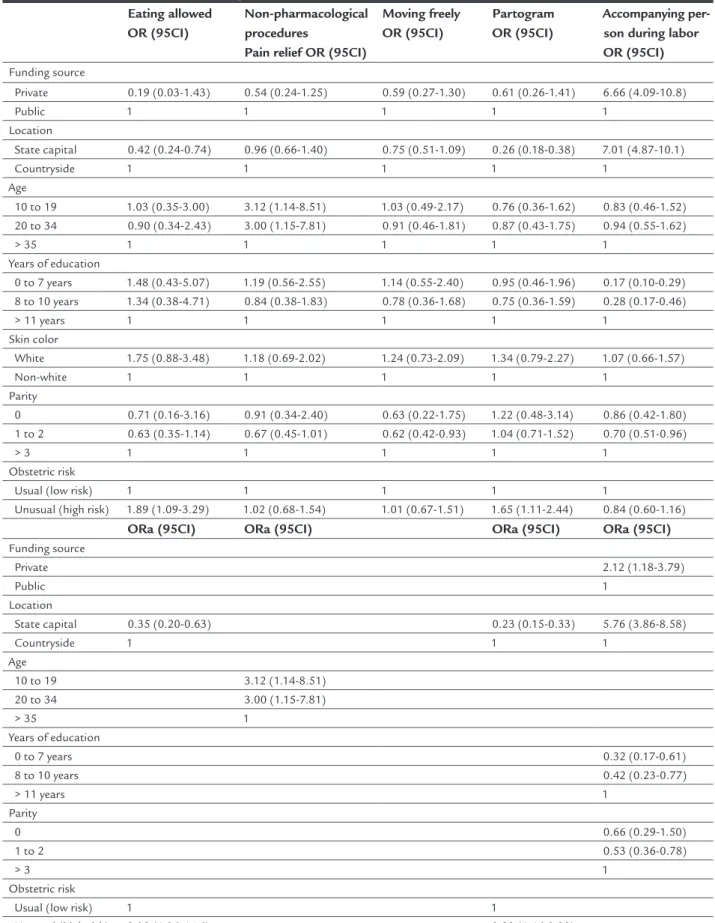
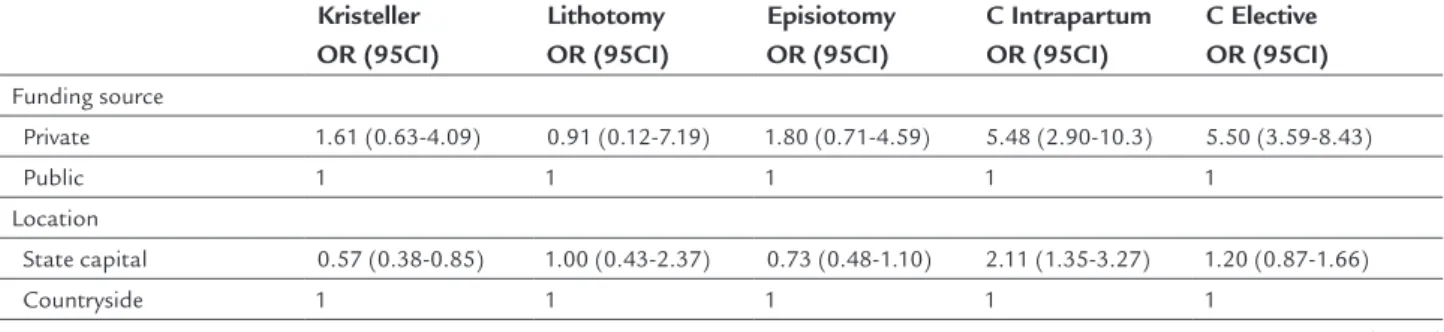
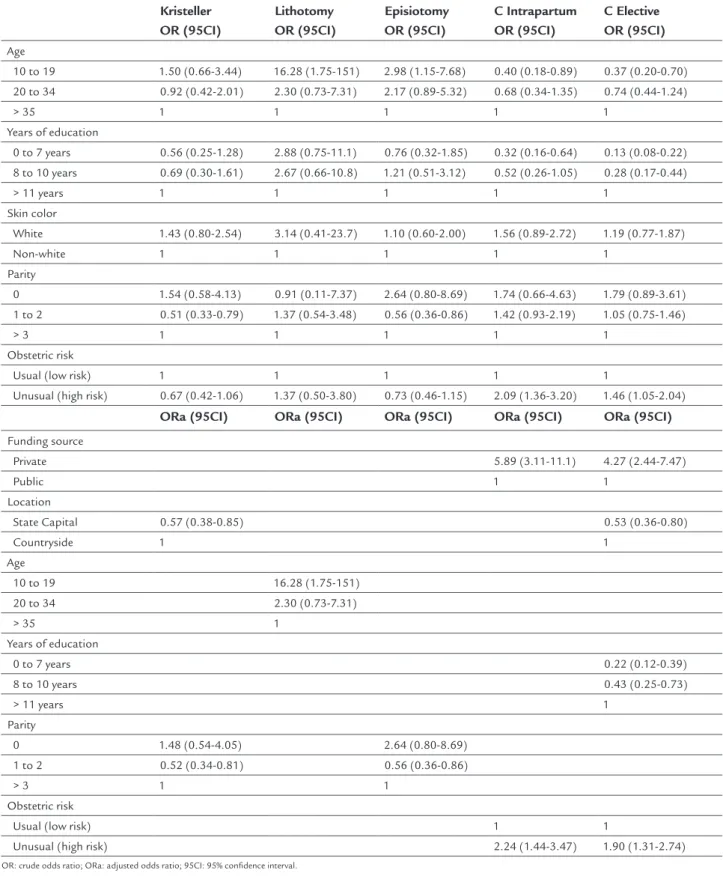
95CI 1.18-3.79) (Table 1), use of analgesia (ORa=4.96; 95CI 1.7-14.5) (Table 2), indication of intrapartum cesarean sec-tion (ORa=5.89; 95CI 3.11-11.1); or elective cesarean secsec-tion (ORa=4.27; 95CI 2.44-7.47) (Table 3) and less chance of using oxytocin (ORa=0.23; 95CI 0.1-0.52) (Table 2). Patients in the countryside are more likely to eat (ORa=2.85; 95CI 1.5-5) and to have their labor monitored by a partogram (ORa=4.34; 95CI 3-6.6) (Table 1), but were also the ones who underwent Kristeller maneuver more often (ORa=1.7; 95CI 1.1-2.6) (Table 3), whereas those in the capital were the most likely to have the presence of an accompanying person during labor (ORa=5.76; 95CI 3.86-8.58) (Table 1), be given oxytocin (ORa=4.17; 95CI 2.8-6.21) and labor analgesia (ORa=7.38; 95CI 1.65-33.1) (Table 2). Regarding age, women between 10 and 34 years of age underwent a greater number of non-pharmacological procedures for pain relief (ORa=3.12; 95CI 1.14-8.51) (Table 1) whereas in those aged between 10 and 19 years a larger number of lithotomy deliveries (ORa=16.28; 95CI 1.75-151) was per-formed compared with those aged 35 years or older (Table 3). As for schooling, those who had 11 or more years of formal education reported the presence of an accompany-ing person duraccompany-ing delivery more frequently than those who had up to seven years of education (ORa=3.12; 95CI 1.6-5.88) (Table 1), as well as more elective c-sections (ORa=4.54; 95CI 2.56-16.6) (Table 3). Women with one or two previous deliveries reported more frequently having an accompany-ing person duraccompany-ing labor than those with three or more previous deliveries (ORa=1.88; 95CI 1.2-2.7) (Table 1). They also underwent Kristeller maneuvers less often than those with three or more previous deliveries (ORa=0.52; 95CI 0.34-0.81), whereas these, in turn, were at a higher risk of episiotomy than those with one to two previous deliveries (ORa=1.7; 95CI 1.16-2.77) (Table 3). Finally, pregnant women classified as being at a high risk stood a higher chance of eating during labor (ORa=2.38; 95CI 1.36-4.16); recorded more deliveries monitored by a partogram (ORa=2.22; 95CI 1.46-3.39) (Table 1) and had a higher number of intrapartum (ORa=2.24; 95CI 1.44-3.47) and elective (ORa=1.9; 95CI: 1.31-2.74) c-sections than did pregnant women at low-risk (Table 3).
D
ISCUSSIONPeriodic reviews of practices used in obstetric care should be conducted to verify whether the recommendations of reviews and international9 and national2 guidelines are being followed.
The so-called “good practices” recommended for con-ducting labor were used in less than 30% of women in the state of Sergipe, whereas interventions that should not
be used due to lacking evidence that supported the need thereof and/or due to proven damage such as the use of oxytocin, amniotomy, episiotomy, Kristeller maneuver (which is strongly discouraged) and lithotomy delivery2 were very frequently performed. This result is similar to that found by the “Birth in Brazil” study, which detected that good practices are used in less than 50% of deliveries and interventions such as Kristeller maneuver (37%) and episiotomy (56%) are still widely practiced.15
In the state of Sergipe, as much as in Brazil, there is great diversity in the care of patients in the public health care system when compared to the private system. Wom-en receiving care in the private health care system had more comfortable deliveries, with a more frequent use of analgesia and a less frequent use of oxytocin. In addition, they had the presence of accompanying persons more frequently, unlike those receiving care in the public health care system, who received oxytocin more often as well as less analgesia, characterizing the practice of medicalized and painful deliveries. However, the indications of cesar-ean section, either electively or during labor, were more frequent in women receiving care at the private health care system, from the capital city of Sergipe, with greater lengths of formal education and at a high obstetric risk. A Spanish study has shown that patients from the private health care system and private hospitals with fewer births are more likely to undergo cesarean section and invasive procedures such as episiotomy or instrumental vaginal delivery.20 Another study evaluated the role played by the source of payment in increasing cesarean section rates in Brazil between 1998 and 2008 and showed that private payment was associated with higher cesarean rates, as well as an older age, greater length of formal education and residing outside the Northeast region.21
A national survey carried out in Brazil in 2010 also showed a higher frequency of cesarean delivery among older women and those with greater lengths of formal education, primiparous, whose prenatal care was pro-vided by the private health care system and residing in the South, Southeast and Midwest22 regions. A study published in 2014 shows a change in this geographical pattern, with the frequency of cesarean sections being higher in the North and lower in the Southeast regions, despite the fact that the latter has the highest coverage by health insurance companies in Brazil. This may indicate the beginning of a change due to the movements in favor of humanized delivery and greater access to evidence-based information on good obstetric practices.15
pri-TABLE 1 Crude (OR) and adjusted odds ratios (ORa) for sociodemographic determinants of good practices during labor and delivery in women in the state of Sergipe, 2015.
Eating allowed OR (95CI)
Non-pharmacological procedures
Pain relief OR (95CI)
Moving freely OR (95CI)
Partogram OR (95CI)
Accompanying per-son during labor OR (95CI) Funding source
Private 0.19 (0.03-1.43) 0.54 (0.24-1.25) 0.59 (0.27-1.30) 0.61 (0.26-1.41) 6.66 (4.09-10.8)
Public 1 1 1 1 1
Location
State capital 0.42 (0.24-0.74) 0.96 (0.66-1.40) 0.75 (0.51-1.09) 0.26 (0.18-0.38) 7.01 (4.87-10.1)
Countryside 1 1 1 1 1
Age
10 to 19 1.03 (0.35-3.00) 3.12 (1.14-8.51) 1.03 (0.49-2.17) 0.76 (0.36-1.62) 0.83 (0.46-1.52) 20 to 34 0.90 (0.34-2.43) 3.00 (1.15-7.81) 0.91 (0.46-1.81) 0.87 (0.43-1.75) 0.94 (0.55-1.62)
> 35 1 1 1 1 1
Years of education
0 to 7 years 1.48 (0.43-5.07) 1.19 (0.56-2.55) 1.14 (0.55-2.40) 0.95 (0.46-1.96) 0.17 (0.10-0.29) 8 to 10 years 1.34 (0.38-4.71) 0.84 (0.38-1.83) 0.78 (0.36-1.68) 0.75 (0.36-1.59) 0.28 (0.17-0.46)
> 11 years 1 1 1 1 1
Skin color
White 1.75 (0.88-3.48) 1.18 (0.69-2.02) 1.24 (0.73-2.09) 1.34 (0.79-2.27) 1.07 (0.66-1.57)
Non-white 1 1 1 1 1
Parity
0 0.71 (0.16-3.16) 0.91 (0.34-2.40) 0.63 (0.22-1.75) 1.22 (0.48-3.14) 0.86 (0.42-1.80) 1 to 2 0.63 (0.35-1.14) 0.67 (0.45-1.01) 0.62 (0.42-0.93) 1.04 (0.71-1.52) 0.70 (0.51-0.96)
> 3 1 1 1 1 1
Obstetric risk
Usual (low risk) 1 1 1 1 1
Unusual (high risk) 1.89 (1.09-3.29) 1.02 (0.68-1.54) 1.01 (0.67-1.51) 1.65 (1.11-2.44) 0.84 (0.60-1.16)
ORa (95CI) ORa (95CI) ORa (95CI) ORa (95CI)
Funding source
Private 2.12 (1.18-3.79)
Public 1
Location
State capital 0.35 (0.20-0.63) 0.23 (0.15-0.33) 5.76 (3.86-8.58)
Countryside 1 1 1
Age
10 to 19 3.12 (1.14-8.51)
20 to 34 3.00 (1.15-7.81)
> 35 1
Years of education
0 to 7 years 0.32 (0.17-0.61)
8 to 10 years 0.42 (0.23-0.77)
> 11 years 1
Parity
0 0.66 (0.29-1.50)
1 to 2 0.53 (0.36-0.78)
> 3 1
Obstetric risk
Usual (low risk) 1 1
Unusual (high risk) 2.38 (1.36-4.16) 2.22 (1.46-3.39)
TABLE 2 Crude (OR) and adjusted odds ratios (ORa) for sociodemographic determinants of interventions during labor and delivery in women in the state of Sergipe, 2015.
Oxytocin OR (95CI)
Analgesia OR (95CI)
Amniotomy OR (95CI) Funding source
Private 0.53 (0.24-1.18) 14.3 (4.69-43.8) 1.45 (0.49-4.28)
Public 1 1 1
Location
State capital 3.79 (2.55-5.62) 14.9 (1.95-113) 0.86 (0.55-1.34)
Countryside 1 1 1
Age
10 to 19 1.48 (0.68-3.22) * 1.35 (0.52-3.48)
20 to 34 1.16 (0.57-2.37) * 1.39 (0.57-3.39)
> 35 1 1 1
Years of education
0 to 7 years 1.99 (0.93-4.29) 0.08 (0.02-0.36) 1.20 (0.46-3.13)
8 to 10 years 2.36 (1.08-5.19) 0.35 (0.10-1.12) 1.45 (0.54-3.85)
> 11 years 1 1 1
Skin color
White 0.70 (0.41-1.18) 1.52 (0.42-5.45) 1.20 (0.64-2.27)
Non-white 1 1 1
Parity
0 0.66 (0.25-1.76) 2.56 (0.30-22.2) 1.14 (0.37-3.52)
1 to 2 0.80 (0.54-1.18) 1.87 (0.67-5.26) 0.77 (0.49-1.22)
> 3 1 1 1
Obstetric risk
Usual (low risk) 1 1 1
Unusual (high risk) 1.04 (0.69-1.57) 1.45 (0.52-4.08) 0.77 (0.47-1.24)
ORa (95CI) ORa (95CI)
Funding source
Private 0.23 (0.10-0.52) 4.96 (1.70-14.5)
Public 1 1
Location
State capital 4.17 (2.80-6.21) 7.38 (1.65-33.1)
Countryside 1 1
OR: crude odds ratio; ORa: adjusted odds ratio; 95CI: 95% confidence interval. *OR could not be calculated due to numerical problems.19
TABLE 3 Crude (OR) and adjusted odds ratios (ORa) for sociodemographic determinants of interventions during delivery in women in the state of Sergipe, 2015.
Kristeller OR (95CI)
Lithotomy OR (95CI)
Episiotomy OR (95CI)
C Intrapartum OR (95CI)
C Elective OR (95CI) Funding source
Private 1.61 (0.63-4.09) 0.91 (0.12-7.19) 1.80 (0.71-4.59) 5.48 (2.90-10.3) 5.50 (3.59-8.43)
Public 1 1 1 1 1
Location
State capital 0.57 (0.38-0.85) 1.00 (0.43-2.37) 0.73 (0.48-1.10) 2.11 (1.35-3.27) 1.20 (0.87-1.66)
Countryside 1 1 1 1 1
TABLE 3 Crude (OR) and adjusted odds ratios (ORa) for sociodemographic determinants of interventions during delivery in women in the state of Sergipe, 2015.
Kristeller OR (95CI)
Lithotomy OR (95CI)
Episiotomy OR (95CI)
C Intrapartum OR (95CI)
C Elective OR (95CI) Age
10 to 19 1.50 (0.66-3.44) 16.28 (1.75-151) 2.98 (1.15-7.68) 0.40 (0.18-0.89) 0.37 (0.20-0.70)
20 to 34 0.92 (0.42-2.01) 2.30 (0.73-7.31) 2.17 (0.89-5.32) 0.68 (0.34-1.35) 0.74 (0.44-1.24)
> 35 1 1 1 1 1
Years of education
0 to 7 years 0.56 (0.25-1.28) 2.88 (0.75-11.1) 0.76 (0.32-1.85) 0.32 (0.16-0.64) 0.13 (0.08-0.22) 8 to 10 years 0.69 (0.30-1.61) 2.67 (0.66-10.8) 1.21 (0.51-3.12) 0.52 (0.26-1.05) 0.28 (0.17-0.44)
> 11 years 1 1 1 1 1
Skin color
White 1.43 (0.80-2.54) 3.14 (0.41-23.7) 1.10 (0.60-2.00) 1.56 (0.89-2.72) 1.19 (0.77-1.87)
Non-white 1 1 1 1 1
Parity
0 1.54 (0.58-4.13) 0.91 (0.11-7.37) 2.64 (0.80-8.69) 1.74 (0.66-4.63) 1.79 (0.89-3.61)
1 to 2 0.51 (0.33-0.79) 1.37 (0.54-3.48) 0.56 (0.36-0.86) 1.42 (0.93-2.19) 1.05 (0.75-1.46)
> 3 1 1 1 1 1
Obstetric risk
Usual (low risk) 1 1 1 1 1
Unusual (high risk) 0.67 (0.42-1.06) 1.37 (0.50-3.80) 0.73 (0.46-1.15) 2.09 (1.36-3.20) 1.46 (1.05-2.04)
ORa (95CI) ORa (95CI) ORa (95CI) ORa (95CI) ORa (95CI)
Funding source
Private 5.89 (3.11-11.1) 4.27 (2.44-7.47)
Public 1 1
Location
State Capital 0.57 (0.38-0.85) 0.53 (0.36-0.80)
Countryside 1 1
Age
10 to 19 16.28 (1.75-151)
20 to 34 2.30 (0.73-7.31)
> 35 1
Years of education
0 to 7 years 0.22 (0.12-0.39)
8 to 10 years 0.43 (0.25-0.73)
> 11 years 1
Parity
0 1.48 (0.54-4.05) 2.64 (0.80-8.69)
1 to 2 0.52 (0.34-0.81) 0.56 (0.36-0.86)
> 3 1 1
Obstetric risk
Usual (low risk) 1 1
Unusual (high risk) 2.24 (1.44-3.47) 1.90 (1.31-2.74)
vate system and with greater lengths of formal education to maternal choice, since many times the procedure is performed without a medical indication.23 However, a study conducted in Brazil with 1,136 women showed that 70 to 80% of preg-nant women in both health systems (public and private) reported their preference at the beginning of prenatal care for vaginal delivery, which implies that high rates of cesar-ean sections do not seem to reflect a maternal option.24
Labor analgesia is a resource that can minimize the fear of pain that some women have and reduce the indica-tion for cesarean secindica-tion at the request of the pregnant woman. The National Directive for Normal Labor Care recommends that the patient receive guidance during her prenatal care about the potential risks related to analgesia, namely a longer duration of the second period of delivery and a greater chance of instrumental vaginal delivery. The maternal request would be sufficient and an indication for it to be performed, irrespective of the stage of labor and the degree of dilation.2 A randomized study with patients receiving regional analgesia versus non-pharma-cological measures for pain relief showed a greater reduc-tion in pain scores and satisfacreduc-tion with the analgesic technique and delivery in the group that was given re-gional analgesia.25 The percentage of patients receiving analgesia in our study was higher in parturients in the private health care system, despite it being a universal right. The large numbers of births, small number of anes-thetists and procedure rooms in public institutions can justify such inequality.
The current legislation in Brazil determines that health care services allow the presence of an accompanying per-son, someone to be indicated by the parturient, during labor, delivery and immediate postpartum.13 The presence of an accompanying person is correlated to the minimiza-tion of feelings of loneliness and pain, which allows for a positive parturition experience.26 However, despite its benefits and legal support, we observe that it does not occur on a regular and systematic basis. In our study, the accompanying person was present only in 40.6% of deliv-eries, more frequently with women receiving care in the private health care system, in the capital, with a higher education level and lower parity. Data from the “Birth in Brazil” study allowed for finding similar results as inde-pendent predictors of having no accompanying person: lower income and education, brown skin color, being a user of the public health care system, multiparity and vaginal delivery.26 This demonstrates the need to raise awareness about this right and its importance by profes-sionals providing prenatal care in the public health care system, in order for all parturients to benefit from it.
Although there is evidence that the routine use of epi-siotomy does not present short- or long-term benefits for parturients when compared to its restrictive use,2,10 the frequency of this intervention was 40.6%, well above the 10% recommended by the WHO4, and more frequent among younger women. The frequency of episiotomy in primipa-rous women was 71.4%, but, given their small number, there was no significance following variable adjustment. A cross--sectional study carried out in Spain with 12,093 women also showed an episiotomy rate as high as 50%. The variables that presented a significant association were primiparity (RR=2.98), gestational age greater than 41 weeks (RR=1.2), induced labor (RR=1.33), analgesia (RR=1.95), use of oxy-tocin (RR=1.58), delivery in the lithotomy position (RR=6.4) and instrumental delivery (RR=1.84).27
In a teaching-maternity hospital in Recife, in Brazil’s northeast, where the adoption of good practices is sys-tematic, there was a reduction in episiotomy rates from 29% in 201028 to 10% in 2014.29 A case-control study un-dertaken at this institution showed that the factors most frequently associated with this procedure were physician-assisted births, primiparity, and instrumental births.29 We may thus conclude that continued medical education,
inclusion of the nursing staff in childbirth care, adoption of good practices, and reduction of interventions during labor and delivery result in a reduced number of episi-otomies being performed.
There is insufficient evidence to support the routine use of a partogram to manage labor.9,30 However, consid-ering that some studies have shown benefits from using them, particularly at institutions with fewer resources,30 the National Directive for Normal Labor Care recommends using the model with a 4h-action line routine.2 In our study, the more frequent use of a partogram and eating being allowed during labor among women with high-risk pregnancies can be explained by the fact that there is only a single high-risk maternity hospital in the state of Sergipe, which also serves as a center for medical residency and obstetric nursing services, where good care practices are more frequent.
A qualitative, exploratory and descriptive study carried out at a maternity hospital in southern Brazil showed that some practices that are detrimental to the patients’ health are still used by professionals who perpetuate pre-viously learned, inadequate models. Such models are expected to make the moment of delivery easier, but with-out evidence-based justifications for adopting them.31
entire state, this is an adequate overview of what happens in Sergipe. Studies that can prospectively evaluate preg-nant women during pregnancy until delivery could be more elucidative. Those who can assess the motivations of the agents involved can also identify the reasons for the disparities in care.
In conclusion, in the state of Sergipe, the factors most frequently associated with cesarean section were receiv-ing care in the private health care system, havreceiv-ing a great-er length of education and having a high-risk pregnancy. Patients in the public health care system and with a lower education level have less access to labor analgesia and to the presence of an accompanying person. It is observed that obstetrical good practices are not univer-sally used and unnecessary interventions, which are still frequent, should be discouraged.
Changes in paradigms, in general, occur gradually. Obstetric care in Brazil remains, in several places, based on “tradition”. The importance of encouraging the adoption of scientific, evidence-based protocols in all maternity hos-pitals, continuing medical education and conducting audit of health care services becomes clear. Accordingly, we sug-gest that studies evaluating the satisfaction degree of pu-erperal women with the care received be conducted, com-paring different practices that may serve as a stimulus for implementing the necessary changes in behavior.
A
CKNOWLEDGMENTSTo Dr. Maria do Carmo Leal, coordinator of the Projeto Nascer in Brazil, for her consent to carry out this study with a methodology that was already tested in a national field study. To teachers Barbara Vasques da Silva Ayres and Silvana Granado Nogueira da Gama, who trained the local study team; to the managers of the institutions involved in the study; to the academics who worked as interviewers; and to the participating mothers, who made this study possible.
C
ONFLICT OF INTERESTThe authors declare no conflict of interest.
R
ESUMOPráticas e intervenções obstétricas em mulheres de um estado do Nordeste brasileiro
Objetivo: Descrever as práticas e intervenções utilizadas durante o trabalho de parto e o parto e fatores associados em puérperas do estado de Sergipe.
Método: Estudo transversal com 768 puérperas das 11 maternidades do estado com entrevista após 6h do parto e dados do prontuário da puérpera e dos recém-nascidos. As associações entre as boas práticas e intervenções utili-zadas durante o trabalho de parto e o parto com as variá-veis de exposição foram descritas em frequências simples, percentuais, razões de chances brutas e ajustadas (ORa) com o intervalo de confiança.
Resultados: Das mulheres estudadas, 10,6% receberam alimentos e 27,8% movimentaram-se durante o trabalho de parto; medidas não farmacológicas para alívio da dor foram realizadas em 26,1%; o partograma estava preenchi-do em 39,4% preenchi-dos prontuários; o acompanhante esteve presente em 40,6% dos partos. O uso de ocitocina, amnio-tomia e analgesia ocorreram em 59,1%, 49,3% e 4,2% das mulheres, respectivamente. O parto ocorreu na posição de litotomia em 95,2% dos casos, houve episiotomia em 43,9% e manobra de Kristeller em 31,7%. Os fatores mais associados à cesariana foram ser usuárias do setor privado de saúde (ORa=4,27; 95CI 2,44-7,47), ter maior escolari-dade (ORa=4,54; 95CI 2,56-8,3) e alto risco obstétrico (ORa=1,9; 95CI 1,31-2,74). Usuárias do setor privado ti-veram maior presença do acompanhante (ORa=2,12; 95CI 1,18-3,79) e analgesia (ORa=4,96; 95CI 1,7-14,5).
Conclusão: Boas práticas obstétricas são pouco utiliza-das e intervenções desnecessárias são frequentes, e os fatores mais associados à cesariana foram ser usuária do setor privado de saúde, ter maior escolaridade e alto risco obstétrico.
Palavras-chave: saúde materno-infantil, trabalho de parto, parto obstétrico, episiotomia, cesárea.
R
EFERENCES1. Brasil. Ministério da Saúde. Secretaria de Vigilância em Saúde. Departamento de Análise de Situação de Saúde. Saúde Brasil 2011: uma análise da situação de saúde e a vigilância da saúde da mulher. Brasília: Ministério da Saúde, Secretaria de Vigilância em Saúde; 2011.
2. CONITEC. Diretriz Nacional de assistência ao parto normal [Internet]. Brasília: Ministério de Saúde; 2016. p. 1-381. Available from: http://conitec. gov.br.
3. He Z, Cheng Z, Wu T, Zhou Y, Chen J, Fu Q, et al. The costs and their determinant of cesarean section and vaginal delivery: an exploratory study in Chongqing municipality, China. Biomed Res Int. 2016; 2016:5685261. 4. Care in normal birth: a practical guide. Technical Working Group, World
Health Organization. Birth. 1996; 24(2):121-3.
5. Lawrence A, Lewis L, Hofmeyr GJ, Styles C. Maternal positions and mobility during first stage labour. Cochrane Database Syst Rev. 2013; (8):CD003934. 6. Singata M, Tranmer J, Gyte GM. Restricting oral fluid and food intake
during labour. Cochrane Database Syst Rev. 2010; (1):CD003930. 7. Smyth R, Alldred SK, Markham C. Amniotomy for shortening spontaneous
labour. Cochrane Database Syst Rev. 2007; (4):CD006167.
9. Berghella V, Baxter JK, Chauhan SP. Evidence-based labor and delivery management. Am J Obstet Gynecol. 2008; 199(5):445-54.
10. Carroli G, Mignini L. Episiotomy for vaginal birth. Cochrane Database Syst Rev. 2009; (1):CD000081.
11. Acmaz G, Albayrak E, Oner G, Baser M, Aykut G, Tekin GT, et al. The effect of Kristeller maneuver on maternal and neonatal outcome. Arch Clin Exp Surg. 2015; 4(1):29-35.
12. Brasil. Ministério da Saúde. Portaria no 569/GM, de 1o de junho de 2000. Institui o Programa de Humanização no Pré-Natal e Nascimento, no âmbito do Sistema Único de Saúde. Diário Oficial da União, seção 1, p. 4. Brasília, Distrito Federal; 2000.
13. Brasil. Lei no 11.108 de 07, de abril de 2005. Altera a Lei 8.080 de 19 de setembro de 1990, para garantia às parturientes o direito à presença de acompanhante durante o trabalho de parto, parto e pós-parto imediato, no âmbito do Sistema Único de Saúde. Diário Oficial da União, número 67, seção 1:1. Brasília, Distrito Federal; 2005.
14. Brasil. Ministério da Saúde. Portaria 1.459, de 24 de junho de 2011. Institui no âmbito do Sistema Único de Saúde (SUS) a Rede Cegonha. Diário Oficial da União. Brasília: Ministério da Saúde; 2011.
15. Leal MC, Pereira APE, Domingues RMSM, Theme Filha MM, Dias MAB, Nakamura-Pereira M, et al. Obstetric interventions during labor and childbirth in Brazilian low-risk women. Cad Saúde Pública. 2014; 30(Suppl. 1):S17-47. 16. Ministério da Saúde [internet]. Secretaria executiva. Datasus. Informações de saúde (TABNET). Estatísticas vitais [cited 2016 Dec]. Available from: http://datasus.saude.gov.br.
17. Vasconcellos MTL, Silva PLN, Pereira APE, Schilithz AOC, Souza Junior PRB, Szwarcwald CL. Sampling design for the Birth in Brazil: National Survey into Labor and Birth. Cad Saúde Pública. 2014; 30(Suppl. 1):S49-58. 18. Dahlen HG, Tracy S, Tracy M, Bisits A, Brown C, Thornton C. Rates of obstetric intervention and associated perinatal mortality and morbidity among low-risk women giving birth in private and public hospitals in NSW (2000-2008): a linked data population-based cohort study. BMJ Open. 2014; 4(5):e004551. 19. Barreto IDC, Russo SL, Brasil GH, Simon VH. Separation phenomena logistic
regression. GEINTEC. 2014; 4(1):716-28.
20. Escuriet R, Pueyo M, Biescas H, Colls C, Espiga I, White J, et al. Obstetric interventions in two groups of hospitals in Catalonia: a cross-sectional study. BMC Pregnancy Childbirth. 2014; 14:143.
21. Hopkins K, Lima Amaral EF, Mourão AN. The impact of payment source and hospital type on rising cesarean section rates in Brazil, 1998 to 2008. Birth. 2014; 41(2):169-77.
22. Rebelo F, Rocha CM, Cortes TR, Dutra CL, Kac G. High cesarean prevalence in a national population-based study in Brazil: the role of private practice. Acta Obstet Gynecol Scand. 2010; 89(7):903-8.
23. Dias MAB, Domingues RMSM, Pereira APE, Fonseca SC, Gama SGN, Theme Filha MM, et al. Trajetória das mulheres na definição pelo parto cesáreo: estudo de caso em duas unidades do sistema de saúde suplementar do estado do Rio de Janeiro. Cien Saude Colet. 2008; 13(5):1521-34.
24. Potter JE, Berquó E, Perpétuo IH, Leal OF, Hopkins K, Souza MR, et al. Unwanted caesarean sections among public and private patients in Brazil: prospective study. BMJ. 2001; 323(7322):1155-8.
25. Orange FA, Passini-Jr R, Melo AS, Katz L, Coutinho IC, Amorim MM. Combined spinal-epidural anesthesia and non-pharmacological methods of pain relief during normal childbirth and maternal satisfaction: a randomized clinical trial. Rev Assoc Med Bras (1992). 2012; 58(1):112-7. 26. Diniz CSG, D’Orsi E, Domingues RMSM, Torres JA, Dias MAB, Schneck
CA, et al. Implementation of the presence of companions during hospital admission for childbirth: data from the Birth in Brazil national survey. Cad Saúde Pública. 2014; 30(Suppl. 1):S140-53.
27. Ballesteros-Meseguer C, Carrillo-García C, Meseguer-de-Pedro M, Canteras-Jordana M, Martínez-Roche ME. Episiotomy and its relationship to various clinical variables that influence its performance. Rev Lat Am Enfermagem. 2016; 24:e2793.
28. Carvalho CCM, Souza ASR, Moraes Filho OB. Prevalence and factors associated with practice of episiotomy at a maternity school in Recife, Pernambuco, Brazil. Rev Assoc Med Bras. 2010; 56(3):333-9.
29. Braga GC, Clementino STP, Luz PFN, Scavuzzi A, Noronha Neto C, Amorim MMR. Risk factors for episiotomy: a case-control study. Rev Assoc Med Bras. 2014; 60(5):465-72.
30. Bedwell C, Levin K, Pett C, Lavender DT. A realist review of the partograph: when and how does it work for labour monitoring? BMC Pregnancy Childbirth. 2017; 17(1):31.