Volatile organic compounds (VOC) variation in
Croton fl oribundus
(L.)
Spreng. related to environmental conditions and ozone concentration in
an urban forest of the city of São Paulo, São Paulo State, Brazil
Vanessa Palermo Bolsoni1, Débora Pinheiro de Oliveira1 and Giselle da Silva Pedrosa2, and Silvia Ribeiro de Souza1,3
Received: 12.09.2017; accepted: 8.03.2018
ABSTRACT - (Volatile organic compounds (VOC) variation in Croton fl oribundus (L.) Spreng. related to environmental conditions and ozone concentration in an urban forest of the city of São Paulo, São Paulo State, Brazil). Volatile organic compounds (VOC) are emitted by vegetation in response to different kinds of stress, such as herbivory, environmental conditions and air pollutants. The aim of this study was to identify the VOC emitted by seedlings of Croton fl oribundus (L.)
Spreng. exposed to a polluted environment and analyze the relationship among classes of compounds emitted, ozone levels and changes in climate conditions. Two exposures were carried out, one in winter (June to August 2012) and another in summer (January to April 2013), in the Parque Estadual das Fontes do Ipiranga, city of São Paulo, São Paulo State, Brazil. We identifi ed 26 compounds that are grouped into oxygenates, aromatics, monoterpenes and sesquiterpenes. The emission of sesquiterpenes was inhibited in summer, while those of the oxygenated and aromatic compounds were induced. The emission of volatiles was correlated to ozone levels (AOT 40). Our results suggest that the levels of atmospheric ozone detected in the summer can increase the induction of oxygenates and reduce the emission of monoterpenes in C. fl oribundus plants. Keywords:abiotic factors, air pollutants, oxidative stress
RESUMO-(Variação dos compostos orgânicos voláteis (COV) de Croton fl oribundus (L.) Spreng. àscondições ambientais
e concentração de ozônio em fl oresta urbana de São Paulo, SP, Brasil). Os compostos orgânicos voláteis (COV) são emitidos pela vegetação em resposta ao estresse, incluindo fatores como herbivoria, condições ambientais e poluentes aéreos. Os objetivos deste trabalho foram identifi car compostos orgânicos voláteis emitidos por plantas jovens de Croton fl oribundus (L.)
Spreng. expostas em ambiente poluído e relacionar as classes dos compostos emitidos com os níveis de ozônio atmosférico e variações climáticas. Foram realizadas duas exposições em diferentes estações climáticas (inverno de 2012: junho a agosto e verão de 2013: janeiro a abril), no Parque Estadual das Fontes do Ipiranga, São Paulo, SP, Brasil. Foram identifi cados 26 compostos, agrupados em oxigenados, aromáticos, monoterpenos e sesquiterpenos. As emissões dos sesquiterpenos foram inibidas no verão, enquanto as dos oxigenados e aromáticos foram induzidas. Os voláteis foram relacionados com os níveis de ozônio (AOT 40). Os resultados sugerem que os níveis de ozônio atmosférico detectados no verão podem contribuir para aumentar a emissão dos compostos oxigenados e reduzir a emissão dos monoterpenos em plantas de C. fl oribundus. Palavras-chave:estresse oxidativo, fatores abióticos, poluentes atmosféricos
1. Instituto de Botânica, Núcleo de Pesquisa em Ecologia, Av. Miguel Stéfano, nº 3.687, 04301-902 São Paulo, SP, Brasil 2. Universidade Federal do ABC, Biotecnociência, Av. dos Estados, nº 5.001 - Bangú, Santo André - SP, 09210-58SP, Brasil 3. Corresponding author: [email protected]
Introduction
Volatile organic compounds (VOC) emitted by biogenic sources have a key role in the atmospheric chemistry and exceed those of anthropogenic origin in order of magnitude (Guenther 1997). Biogenic emissions comprise 90% of the organic compounds
emitted annually and are considered as the major
terrestrial source of carbon for the atmosphere
(Niinemets et al. 2010).
Biogenic VOC are directly associated with climate change, because to some extent, they modify the global balance of atmospheric carbon (Fehsenfeld
et al.1992). These VOCs induce photochemical
altering the equilibrium of methane and carbon
monoxide (CO) in the atmosphere, which leads to
yet unmeasured environmental damages (Fehsenfeld
et al. 1992, Guenther et al. 1995).
In urban regions where the ozone concentration can reach up to 200 ppb and that have green fragmented areas in their surroundings, such as the city
of São Paulo (Orlando et al. 2010), the contribution
of biogenic VOC and other tropospheric oxidants to ozone formation can be significant.
It should be considered that VOC, in the presence of nitrogen oxides and solar radiation, form photochemical smog, which through a complex chain
of reactions produces ozone (O3), peroxyacetyl nitrate
(PAN), hydrogen peroxide (H2O2), aldehydes, and
ketones, among others compounds (Krupa & Manning 1988). Furthermore, VOCs can undergo photolysis
and react with the ozone itself (O3) and the radicals
OH and NO3, reducing the concentrations of both
compounds in the atmosphere (Sienfeld & Pandis
1998). Therefore, the atmospheric concentrations of ozone and other air pollutants are sensitive to
superficial VOC fluxes, which can lead to their either
accumulation or reduction (Ciccioli 1993, Schirmer et al. 2010).
Ozone is one of the most aggressive pollutants for vegetation, attaining the cell via stomata and, once
inside the stomatal complex, reaches the subestomatic
cavity where it is soluble, and spreads through the
intercellular spaces of the mesophyll by molecular diffusion (Cardoso-Gustavson et al. 2014). The plant
responds to oxidative stress caused by ozone through physiological and biochemical changes that lead to the increase in VOC emission (Loreto & Schnitzler 2010). This VOC increase prevents the entrance of
more ozone into the leaf cell, since volatiles may
react with ozone and degrade it even before reaching the leaf (Loreto & Schnitzler 2010, Niinemets et al.
2010).
The mechanisms of VOC release by plants are
still not well understood due to the lack of knowledge
on factors that alter the metabolism of production
of those compounds and their emission. It is well known that plants emit organic volatiles to defend themselves against biotic and abiotic factors, such as herbivores and air pollutants, respectively (Tingey
et al. 1991, Arimura et al. 2009, Niinemets et al.
2010). In addition, several factors may alter the pattern of VOC emissions, such as water deficit, temperature,
photoperiod, CO2 increase and air pollutants (Peñuelas
et al. 1999, Loreto & Velikova 2001, Baier et al. 2005). Thus, studies that analyze the rate of VOC emission from plants exposed to air pollution, especially to
ozone, are important for determining which biogenic
volatiles are predominant in urban areas impacted by
air pollution, as well as for identifying which plant species are emitters of highly reactive volatiles to the
atmosphere.
Although emissions by vegetation in the tropical regions are not well known, they might have an
important role in the behavior of the atmosphere,
since in these regions there is a wide diversity of plant species and a great vegetation complexity. Several plant species that emit significant amounts of monoterpenes and oxygenated compounds have
been studied in some countries worldwide (Arey et al. 1991, Owen et al. 1998, Kesselmeier & Staudt
1999) and some genera of these plants are present in the Ombrophilous Dense Florest of São Paulo, Brazil (Aragaki & Mantovani 1998). However, studies assessing the VOC emission rate in Brazilian native
species are rare, particularly in the case of species that
are present in urban regions impacted by air pollution
(Souza et al. 2002, Carvalho et al. 2005). Croton floribundus (L.) Spreng is a pioneer plant that belongs to the Family Euphorbiaceae, commonly known as “capixingui”. This family has a wide distribution throughout Brazil (Ziroldo 2007) and can be found either as a tree, shrub, herb or climbing plant (LEME, 1994). Due to its high phenotypic plasticity, this family has been recommended for cultivation in parks and
sub-forests in urban areas and for the restoration of
degraded areas (Meira Júnior et al. 2015).
VOC are generally species-specific and may
or may not contribute the increase in atmospheric
ozone. Thus, to know the VOCs of plant species that
are widely used in restoration can aid the selection of these species for cultivation in areas impacted by
air pollutants. In this context, we aim at evaluating the emission of volatile organic compounds (VOCs)
from leaves of C. floribundus seedlings exposed to
the atmosphere of “Parque Estadual das Fontes do Ipiranga” (PEFI), in order to relate climatic conditions
and ozone levels to the classes of VOC emitted.
Materials and methods
Seedlings of Croton floribundus purchased in the
were cultivated in a greenhouse with filtered air, free
of gaseous and particulate pollutants at the “Instituto de Botânica”, which is placed inside the “Parque Estadual das Fontes do Ipiranga” (PEFI), located in the southeast region of the Metropolitan Region of São
Paulo.
Irrigation was maintained by capillarity with nylon strings immersed in water. After two weeks
of acclimation, two treatments were carried out
with a plot of plants containing 12 individuals: a) exposure to the PEFI environment and b) maintenance in a greenhouse with air free of pollutants. Two
exposures of three months each were performed. The
first exposure was during the winter of 2013 (June-August), while the second one occurred during the summer of 2013/2014 (January-April).
The atmospheric ozone was measured throughout the exposure period with an ECOSOFT continuous monitor (model 60B). The medium concentration of ozone was 74 ppb and 46 ppb in winter and summer,
respectively. The climatic conditions (temperature,
radiation and relative humidity) during both exposures were monitored using a meteorological station located in the PEFI. In winter, mean values of temperature, radiation, and relative humidity were 17ºC, 408 MJ/ m² and 79%, while in summer, 22ºC, 513 MJ/m² and 82 %, respectively (table 1).
Three individuals from each treatment were
collected at 0, 38, 57 and 72 days of exposure. Leaves from each individual were maintained in Teflon bags with lateral openings to ensure gas exchange.
The volatiles were collected through cartridges, containing 100mg of Tenax TA adsorbent (Supelco, 60/80 mesh), with one end fixed to the bagʼs opening
and the other connected to a suction pump, in order
to ensure the air flow through the cartridge. The flow of sampled air was maintained at 180 ml/min and the air was introduced into the bags at 1.2 L/min. The sampling period of volatiles was of 1h 3 min. The sampled volatiles were thermally deabsorved by a
thermal deabsortion system (ATD650, Perkin Elmer)
and analyzed by gas chromatography (Agilent 7890B) coupled to a mass spectrometer (Agilent 5977A). The Kovatsʼ index (KI cal) was calculated from the time of
retention of each sample to be posteriorly compared
with reference values (KI) found in the literature. Data were analyzed using one-way analysis of variance (ANOVA) and the means were compared between treatments with Tukeyʼs test (statistical significance set at p < 0.05)using the program IBM SPSS statistics v. 20. A principal component analysis was performed using the multivariate statistical software package PC-ORD v. 6.0 to explore if treatments are grouped according to the chemical
compounds emitted.
Results
We identified 26 volatile compounds emitted by
the leaves of Croton floribundus during winter and
summer, which belong to four different chemical classes: 12 oxygenated (OX), seven aromatic (AR), three monoterpenes (MT) and four sesqueterpenes (ST), as shown in table 2 and figure 1. Among them, the most abundant were the aldehyde E-Z 2-4 nonadienal, the ester methyl salicylate, the monoterpene geranyl acetone and the oxygenated sesquiterpene nerolidol, which belong to the classes OX, AR, MT and ST,
respectively.
The percentage of emission of compounds was higher in the individuals exposed to the PEFI
environment compared to the control. The number
of OX and AR compounds detected was higher in winter, although the sum of the emission percentage of these compounds was higher in the summer. The most emitted OXs were methyl decanoate in winter and E-Z-nonadienol in summer. In the case of AR
compounds, the main were methyl benzaldehyde in winter and methyl salicylate in summer. Among the terpenoids, the most abundant compounds in summer
Table 1. Mean temperature, radiation, relative humidity and hourly concentration of ozone during the exposure of Croton floribundus seedlings to the polluted atmosphere of the city of São Paulo, São Paulo State, Brazil, during the winter and
summer.
Winter Summer
Climatic conditions June (2013) July (2013) August (2013) December (2013) January (2014) February (2014)
Temperature (ºC) 17 16.4 17 23 21 22
Radiation (MJ/m²) 280 395 550 600 440 500
Relative humidity (%) 86 77 74 81 84 81
Table 2.Mean of percent area of volatile organic compounds emitted by Croton floribundus during winter and summer.
Calculated (cal KI) and reference (KI) values of Kovats retention index.
Winter Summer
Class Compound IK IK cal PEFI Control IK cal PEFI Control
Oxygenated
Nonan-2-one 1091 1091.28 0.53 0.67 - -
-Decanal 1211 1211.76 0.32 0.51 1211.54 0.23 0.46
(Z)-5-Hexadecenal 1799 1799.55 0.32 0.26 - -
-(Z)-2-Decenal 1250 - - - 1250.65 2.31 2.32
Methyl decanoate 1326 1326.86 0.64 0.59 - -
-Pentadecanal 1687 1687.75 0.51 0.19 - -
-Pentadecanoic acid 1829 1820.43 0.5 0.33 - -
-Nonadecanal 2105 2105.01 0.37 0.33 - -
-Octadecanoic acid 2200 2200.18 0.47 0.385 - -
-(E)-3-Octen-2-one 1034 - - - 1034.70 4.07 3.21
(E,Z)-2,4-Nonadienal 1196 - - - 1196.75 11.67 11.27
Nonanal 1098 1098.6 0.55 0.65 1098.9 0.085 0.17
Aromatic
(Z) -3-Hexenyl benzoate 1252 1252.18 2.79 0.57 - -
-(Z) -3-Hexenyl benzoate 1570 1570.27 0.48 0.63 - -
-Ethyl benzoate 1170 1170.68 0.72 0.42 - -
-Methyl salicylate 1191 1191.13 0.63 0.30 1191.94 4.45 2.22
Methyl benzyl formate 1335 1335.56 0.57 0.57 - - -Methyl 3,4-dimethyl benzoate 1353 1353.73 0.34 0.52 - - -2-Phenyl ethyl (E)
-2-methyl-2-butenoate 1584 1584.64 0.58 0.53 - -
-Monoterpenes
(Z) -3,7-Dimethyl-2,6-octadienal 1235 1235.28 0.68 0.39 - - -2,6-Dimethyl-2,7-octadien-6-ol 1098 1098.67 0.55 0.65 1098.89 0.08 0.17
(E) -6,10-Dimethyl-5,9-undecadien-2-one (geranyl
acetone)
1453 1453.41 0.54 0.32 1453.66 1.08 2.16
Sesquiterpenes
Alpha-cubebeno 1351 1351.38 0.56 0.42 1351.73 0.46 0.93
Beta-Gurjunene 1423 1423.10 0.38 0.54 - -
-Nerolidol 1564 1564.02 0.54 0.44 1564.5 2.73 1.77
Caryophyllene oxide 1581 1581.91 0.70 0.49 - - -and winter were geranyl acetone -and nerolidol, -and
(Z) -3,7-dimethyl-2,6-octadiene and caryophyllene
oxide, respectively (table 2).
The relationship between the sum of the ozone
accumulation above 40 ppb (AOT40) and the percentage of compounds emitted during summer at 38, 57 and 72 days (figure 2), indicates a correlation between the AOT40 and the percentage of emission of OX and MT, which was positive for OX and negative for MT.
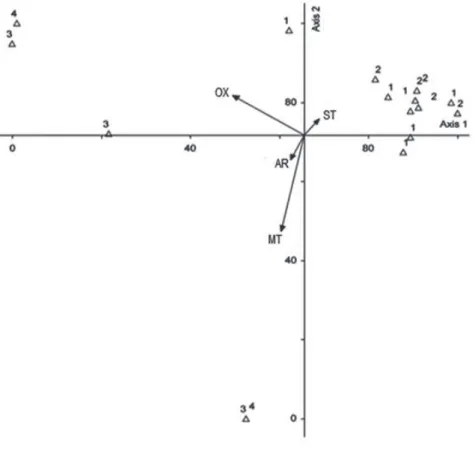
Principal component analysis (PCA) of the
biological variables showed four groups (figure 3).
Groups 1 and 2 corresponded to plants maintained
in the PEFI environment and to the winter control,
respectively, and were associated to the axes
influenced by ST. Groups 3 and 4 corresponded to the plants kept in the environment and to the summer control, respectively, and were influenced by other
Figure 1.Sum of the percentages of the area of each class of volatile organic compounds emitted by Croton floribundus in winter and summer. PEFI: Parque Estadual das Fontes do Ipiranga. Control: Greenhouse. References: Oxygenates (OX), Aromatics (AR), Sesquiterpenes (ST) and monoterpenes (MT).
Figure 2. Relationship between the sum of the percentage of the area of oxygenates (a), aromatic (b), monoterpenes (c) and sesquiterpenes (d) emitted by Croton floribundus, and the sum of hourly values of ozone concentration above 40 ppb (AOT40) in summer.
Discussion
The sum of the percentages of the area of each class of compounds showed that isoprenoids (MT and
ST) were emitted more in summer than in winter and that there was a predominance of ST emission than of
MT (figure 1). This variation in VOC emissions can be due to the increase in temperature during summer. According to Monson et al. (1992), the temperature
influences the enzymatic activity responsible for the synthesis of many VOCs. Although little studied, the optimum temperature range for isoprenoid emission is generally between 30 and 40 ºC. The highest temperature reached in summer was 35 ºC while in winter was 28 ºC, indicating that the terpenoids
emitted by C. floribundus might have been influenced
by the local temperature. Our results are in agreement
with Bartram et al. (2006), who found that some abiotic factors such as temperature and radiation
positively influenced the ST production.
According to Loreto et al. (2006), MT emissions
can be negatively influenced in environments with a temperature higher or equal to 40 oC. In summer, control
plants kept under greenhouse conditions with filtered air had a decrease in MT. Although greenhouses had good
control conditions for air pollutants, they did not always
provide appropriate refrigeration since often we registered higher temperatures than at the PEFI. They also have shown
that ozone and temperature may act jointly to accelerate
Figure 3.Principal components analysis (PCA) of the biological variables assessed in Croton floribundus during winter (1-environment of PEFI; 2-control) and summer (3-environment, 4 control). References: Oxygenates (OX), Aromatics (AR), Sesquiterpenes (ST) and Monoterpenes (MT).
a higher temperature in summer than in winter. The lower
ozone levels found in summer can be partially due to the
activity of a South Atlantic Convergence Zone, which increased rainfall throughout the State of São Paulo during this season, favoring cloudiness. This resulted in a less
incidence of solar radiation and fewer exceedances of the
air quality standard for ozone (CETESB 2012, 2013). On the contrary, in winter, drought and other meteorological
conditions favored the formation of ozone, and thus caused
the excess of the air quality standard for this pollutant during several days.
The emission of methyl salicylate (MeSA), which
is produced under stress conditions, increased in the presence of ozone and high temperatures (Loreto &
Schnitzler 2010, Cardoso-Gustavson et al. 2014). Our
results showed that in summer the percentage of MeSA was significantly different between control plants and those exposed to the polluted environment; in contrast, no significant differences were found in winter. This discrepancy between winter and summer MeSA
emissions indicated that this aromatic compound,
besides of being emitted in larger amounts during
the summer when temperatures are higher, had its
emission rate increased due to the conditions to which plants were exposed. The volatiles emitted by the
plants in summer, such as geranil acetone and nerodiol, presented a high reactive capacity in the atmosphere
and can contribute to the increase in ozone itself. The aldehydes, aromatic compounds and
isoprenoids identified in the present study have a high
reactive potential with radicals and can contribute to the increase in the reactive capacity of the atmosphere, which can also result in ozone accumulation (Carvalho et al. 2005).
The sum of hourly values of ozone concentration
in the environment above 40 ppb, defined as AOT40,
was herein considered because it is the only ozone index for the protection of plant species that is
regulated. Although this index is more appropriate for European species, it can be considered as the limit of exposition for tropical species (Boutsoukidis et al.
emission of these compounds. However, the emission
of ST during winter was the variable that contributed most to differentiate winter from summer along the two axis, indicating that the emission of this class of
compounds is closely related to climatic conditions.
Conclusion
Volatile oxygenated compounds and monoterpenes
varied linearly with the increase in atmospheric ozone,
indicating that urban pollution can be a factor of induction of biogenic compounds of high reactivity to the atmosphere. The sesquiterpene emission was more
related to seasonal variation than to the concentration
of atmospheric ozone. Experiments under controlled
conditions need to be performed to corroborate the role of environmental conditions on volatile emission rates, and therefore establish the response limits of this species to ozone and temperature.
Acknowledgments
The authors would like to thank “Fundação de Amparo à Pesquisa do Estado de São Paulo” (FAPESP 12/11663-8, FAPESP 2016/25109-3) for the financial support. Vanessa Bolsoni and Débora Pinheiro de Oliveira thank CNPq program for the masters scholarships granted. Silvia Ribeiro de Souza also thanks CNPq for the fellowship of research
productivity provided (307281/2013-2).
Literature cited
Arakaki, S., Mantovani, W. 1998. Caracterização do
clima e da vegetação do remanescente florestal no
Planalto Paulistano (SP). In: Anais do IV Simpósio de
ecossistemas brasileiros, São Paulo,pp. 25-36.
Arey, J., Winer, A., Atkison, R., Aschmann, S.M., Long, W.D., Morrison, C.L. 1991. The emission of
(z)-3-hexen-1-ol, (z)-3-hexenylacetate and other oxygenated hydrocarbons from agricultural plant species. Atmospheric Environment, v. 25, pp. 1063-1075. Arimura, G. I, Matsui, K, Takabayashi, J. 2009.
Chemical and molecular ecology of herbivore-induced
plant volatiles: proximate factors and their ultimate
functions. Plant and Cell Physiology, v. 5, p. 911-923. Baier, M., Kandlbinder, A., Golldack, D., Dietz, K.
J. 2005. Oxidative stress and ozone: perception, signaling and response. Plant, Cell & Environment, v. 8, pp. 1012-1020.
Bartram, S., Jux, A., Gleixner, G., Boland, W. 2006.
Dynamic pathway allocation in early terpenoid biosynthesis of stress-induced lima bean leaves.
Phytochemistry, v. 67, pp. 1661-1672.
Bourtsoukidis, E., Bonn, B., Dittmann, A., Hakola, H., Hellén, H., Jacobi, S. 2012. Ozone stress as a driving force of sesquiterpene emissions: a suggested parameterisation. Biogeosciences, v. 11, pp. 4337-4352. Cardoso-Gustavson, P., Bolsoni, P.V., Oliveira, D.P.,
Guaratini, M.T.G., Aidar, M.P.M., Marabesi, M.A., Alves, S., Souza, S.R. 2014. Ozone-Induced Responses in Croton floribundus Spreng. (Euphorbiaceae): Metabolic Cross-Talk between Volatile Organic Compounds and Calcium Oxalate Crystal Formation. PLoS ONE, v. 9, pp. 1-10.
Carvalho, L.R., Vasconcellos, P.C., Mantovani, W., Pool, C.S., Pisani, S.O. 2005. Measurements of biogenic
hydrocarbon and carbonyl compounds emitted by trees
from temperate warm Atlantic rainforest, Brazil. Journal of Environmental Monitoring, v. 7, pp. 493-499. CETESB (Companhia Ambiental do Estado de São
Paulo). 2012.Relatório de qualidade do ar 2012, http:// cetesb.sp.gov.br/ar/publicacoes-relatorios/ (acesso em 02-II-2011).
CETESB (Companhia Ambiental do Estado de São Paulo). 2013 Relatório de qualidade do ar 2013. Available in http://cetesb.sp.gov.br/ar/publicacoes-relatorios/ (acesso em 02-II-2011).
Ciccioli, P. 1993. Chemistry and analysis of volatile organic compounds in the environment. Blackie Academic &
Professional, London, pp. 92.
Fehsenfeld, F., Calvert, J., Fall, R., Goldan, P., Guenther, A., Hewitt, T.N., Lamb, B., Lui, S., Trainer, M., Westberg, H., Zimmermam, P. 1992. Emissions of volatile organic compounds from vegetation and
the implications for atmospheric chemistry. Global
Biogeochemical Cycles, v. 6, pp. 389-430.
Guenther, A. 1997. Seasonal and special variation in natural volatile organic compounds emission Ecological
Application, v. 11, pp. 221-235.
Guenther, A., Hewitt, C.N., Erickson, D., Fall, R., Geron, C., Graedel, T., Harley, P., Klingr, L., Lerdau, M., Mackay, W.A., Pierce, T., Scholes, B., Steinbrecher, R., Tallaraju, R.,Taylor, J., Zimmerman, P. 1995. A global model of nature volatile organic compound emissions. Journal of Geophysical Research,v. 100, pp. 8873-889. Kesselmeier, J., Staudt, M. 1999. Biogenic volatile
compounds (VOC): an overview on emission,
physiology and ecologic. Journal of Atmospheric
Chemistry, v. 33, pp. 23-88.
Krupa, S.V., Manning, W.J. 1998. Atmospheric ozone:
formation and effects on vegetation. Environmental Pollution, v. 50, pp. 101-137.
Leme, C.L.D. 1994. Anatomia Comparada do lenho do caule,
raiz e ramo de algumas espécies de Euphorbiaceae da Mata Atlântica. Dissertação de Mestrado, Universidade
de São Paulo, São Paulo.
Loreto, F., Barta, G., Brilli, F., Nogues, I. 2006. On the induction of volatile organic compound emissions by plants as consequence of wounding or fluctuations of light and temperature. Plant Cell Environment, v. 29, pp. 1820-1828.
Loreto, F., Schnitzler, J.P. 2010. Abiotic stresses and
induced BVOCs. Trends in Plant Science, v. 3,
pp. 154-166.
Meira Junior, M.S., Pereira, I.M., Machado, E.L.M., Mota, S.L.L., Oton, T.J.O. 2015. Espécies potenciais para recuperação de áreas de floresta estacional
semidecidual com exploração de minério de ferro na
serra do espinhaço. Bioscience Journal, v. 31, n. 1,
pp. 283-295.
Monson, R.K. 1992. Relationship among isoprene emission
rate, photosynthesis, and isoprene synthase activity as
influenced by temperature. Plant Physiology, v. 98, pp. 1175-1180.
Niinemets, U., Arneth, A. Kuhn, U., Monson, R.K., Peñuelas, J., Staudt, S. 2010. The emission factor
of volatile isoprenoids: stress, acclimation, and
developmental responses. Biogeosciences, v. 7, pp. 2203-222.
Orlando, J.P., Alvim, D.S., Yamazaki, A., Corrêa, S.M., Gatti, L.V. 2010. Ozone precursors for the São Paulo Metropolitan Area. Science of the Total Environment, v. 7, pp. 1612-1620.
Owen, S.M., Boissard, C., Hagenlocher, B., Hewitt, N.C. 1998. Field studies of isoprene emissions from vegetation in the Northwest Mediterranean region. Journal of Geophysical Research, v. 25, pp. 499-511. Peñuelas, J., Llusia, J., Gimeno, B.S. 1999. Effects of
ozone concentrations on biogenic volatile organic compounds emission in the Mediterranean region. Environmental Pollution, v. 105, pp. 15-18.
Schirmer, W.N., Quadros, M.E. 2010. Compostos orgânicos voláteis biogênicos emitidos a partir de vegetação e seu papel no ozônio troposférico urbano. REVSBAU, v. 5, pp. 25-42.
Sienfeld, J. H., Pandis, S. N. 1998. Atmospheric Chemistry
and physics: from air pollution to climate change. John Willy & Sons, New York. pp. 235.
Souza, S. R., Vasconcellos, P.C., Mantovani, W., Carvalho, L. 2002. Emissão por folhas de Ficusbenjamina L. (Moraceae) de compostos orgânicos voláteis oxigenados. Revista Brasileira de Botânica, v. 25,
pp. 413-418.
Tingey, D.T., Turner, D.P., Weber, J.A. 1991. In: E. Sharkey, H. Holland, H. Mooney (ed.). Factor controlling the emissions of monoterpenes organic compounds. In trace gas emissions by plants. Academic Press, San Diego, pp. 93-13.
Ziroldo, B.D. 2007. Estrutura genética em diferentes
populações de 324 Croton floribundus Spreng. de