R E V I E W
Open Access
Scorpions and life-history strategies: from
evolutionary dynamics toward the
scorpionism problem
Wilson R. Lourenço
Abstract
This work aims to contribute to the general information on scorpion reproductive patterns in general including species that can be noxious to humans. Scorpions are unusual among terrestrial arthropods in several of their life-history traits since in many aspects their reproductive strategies are more similar to those of superior vertebrates than to those of arthropods in general. This communication focuses mainly on the aspects concerning embryonic and post-embryonic developments since these are quite peculiar in scorpions and can be directly connected to the scorpionism problem. As in previous similar contributions, the content of this communication is addressed mainly to non-specialists whose research embraces scorpions in several fields such as venom toxins and public health. A precise knowledge of reproductive strategies presented by several scorpion groups and, in particular, those of dangerous species may prove to be a useful tool in the interpretation of results dealing with scorpionism, and also lead to a better treatment of the problems caused by infamous scorpions.
Keywords:Scorpion, Reproductive strategies, Embryonic, Postembryonic development
Background
In a series of previous publications addressed to the
readers of theJournal of Venomous Animals and Toxins
including Tropical Diseases, I attempted to provide some general information about scorpions and scorpionism, broadly addressed to non-specialists whose research em-braces scorpions in several fields such as venom toxins and public health [1–6]. Most of the information previ-ously supplied concerned historical aspects of scorpion studies but also several questions on their taxonomy, evolution and geographic distribution [1–6].
It is obvious, however that the scorpionism problem is not only associated with the evolution of toxins in some groups (families and genera) of scorpions, but also has close connections with their life-history strategies. For example, the ecology of a given population can directly influence its presence in nearby human habitations [2]. Similarly, reproductive strategies are globally associated with the dynamics of each scorpion population. General
aspects of scorpion ecology and ecophysiology remain incompletely studied but will not be the subject of the present communication. Contrarily, many reproductive aspects of scorpions are presently known and attest to the strong particularities in their mode of reproduction [7]. In many aspects, scorpion reproductive strategies are more similar to those of superior vertebrates than to those of arthropods in general. In this communication, I will focus on the aspects concerning embryonic and post-embryonic developments since these aspects are peculiar to scorpions and have direct connection with scorpionism problems. Furthermore, I will avoid discuss-ing behavioral aspects that are of less interest in relation to the problem of scorpionism. Much information has been published for more than a century on the develop-ment of the scorpions, but it is usually available in spe-cialized literature, and is so scattered that it becomes unavailable for non-experts on the subject. Previous syn-theses are already old [7, 8]; consequently a new presen-tation should be welcome to a broad audience.
The synthesis presented in this communication is mainly based on my personal research on scorpion re-productive biology performed during more than 40 years.
Correspondence:[email protected]
Muséum national d’Histoire naturelle, Sorbonne Universités, Institut de Systématique, Evolution, Biodiversité (ISYEB), UMR7205-CNRS, MNHN, UPMC, EPHE, CP 53, 57 rue Cuvier, 75005 Paris, France
spermatophore (Fig. 1), undergo, without any exception, viviparous embryonic developments, which can last from a few months to more than two years, and show some remarkable maternal care [9–11] followed in several
spe-cies by an important degree of social behavior [12].
Their post-embryonic developments can be extraordin-arily long, lasting from 7 to 130 months [7,8].
On account of the unusual traits of their life history, many aspects of the reproductive biology of scorpions were poorly understood by pioneering authors, such as
the classical “promenade à deux” described by Maccary
[13] and Fabre [14]. Only by the middle of the 1950s,
several researchers discovered, independently, that
sperm transfer was accomplished by means of a sperm-atophore. The first reports were those by Angermann [15] and Alexander [16].
Nevertheless, long before the middle of the twentieth Century, detailed studies of scorpion embryology were de-veloped by authors such as Laurie [17–20], which were followed by those of Pavlovsky [21,22] and Pflugfelder [23]. Naturally, all these authors worked mainly through the techniques of comparative morphology based only on pre-served specimens. Observations on living specimens started to take place by the 1950–1960s [24–26]. After these pio-neering original contributions, much less attention was paid
Several of these works dealt with groups never before ob-served. Naturally, these citations are certainly not exhaust-ive; a more complete list of references can be found in Polis and Sissom [8] and Lourenço [7].
The mid-1970s saw a renewal of interest in the repro-ductive biology of scorpions and particularly in their post-embryonic development. Research on this subject was multiplied during the 1980s and continued through-out the 1990s and 2000s. Interestingly, most of the au-thors of this work were taxonomists who, in addition to obtaining biological information, were investigating the ontogenetic variability of the characters used in tax-onomy (see Lourenço [7] for references). The
contribu-tions by Polis and Farley [54, 55] represented an
interesting exception since these authors attempted for the first time to explain reproductive traits in the con-text of evolutionary ecology. However, in more recent years disengagement toward biological studies has been observed since almost all the attention is given to phylo-genetic and molecular studies.
A great disparity is evident from the known biological data in relation to the used methodology and the quality of the observations made. In many cases, the informa-tion reported may be speculative or even fallacious. I will not, however, discuss these aspects here.
Why may biological data be important in the understanding of the scorpionism problem? Interpretation of the ecology and geographical distribution patterns of scorpions cannot be achieved without a precise knowledge of the reproductive biology of these animals. Their capacity for a passive dispersion (normally transport by human agency) and possible re-adaptation to different and/or largely modified environments is totally dependent on their reproductive strategies. For this reason, scorpion species are generally divided into two categories: (i) equilibrium species, and (ii) opportunistic species. The reproduction models observed in these two categories are generally in accordance with their ecological require-ments. Equilibrium species are totally dependent on stable and predictable environments, whereas opportunistic spe-cies have weak ecological requirements and are able to
colonize highly modified and unpredictable environments. I will emphasize in the following sections two aspects of scorpion reproduction that are factors related to their def-inition as equilibrium or opportunistic species, and to their embryonic and post-embryonic developments. For more details on other aspects of scorpion reproduction, the reader can refer to Polis and Sissom [8] and Lourenço [7], where these aspects are presented in full detail.
Embryonic development
It is now accepted by the majority of authors that vivip-arity is the only model of embryonic reproduction in all scorpion species [32–35], although until recently some authors still suggested that certain species could be ovo-viviparous. At the end of the nineteenth Century, two classical models of embryonic development were
pro-posed by Laurie [19] and defined as apoikogenic and
katoikogenic. These models are still retained by most au-thors (see Polis and Sissom [8] and Lourenço [7] for
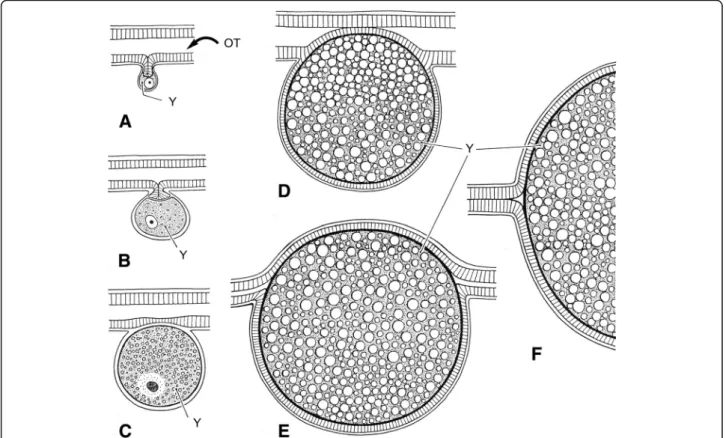
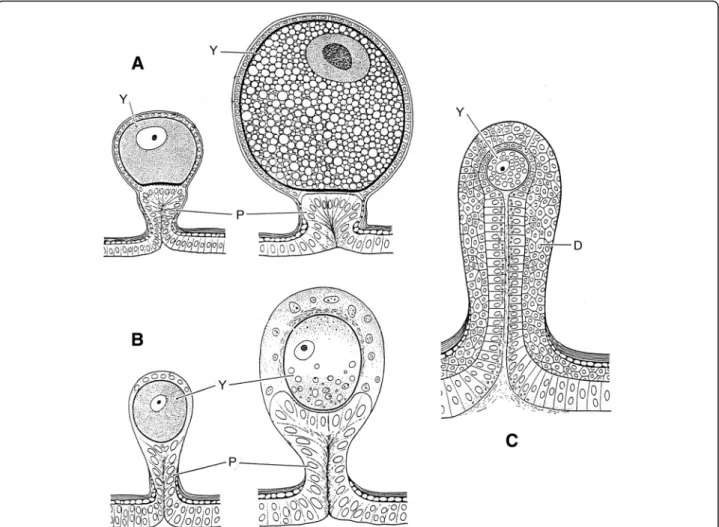
references). Laurie’s [19] model suggests a dichotomy in the embryonic development of scorpions; the first type is development without the presence of diverticula,
called apoikogenic–which in Greek meansfrom outside
of the home –and the second one, a development with
the presence of diverticula called katoikogenic –
mean-ingat homein Greek (Figs.2,3,4,5and6).
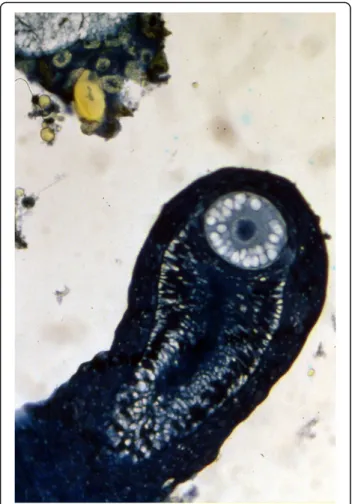
Ninety years after Laurie [19], Lourenço et al. [33,34] proposed a new concept of the embryological develop-ment of scorpions which partially modified the classical apoikogenic and katoikogenic models. According to this model, viviparity occurs in all scorpions studied, as pre-viously suggested by Francke [32]. The approach is based on tissue modification of the ovaries and differentiation associated with the formation of the ovarian follicles. Fol-lowing this amended model, a number of familial lineages can be arranged along a gradient of increasing complexity of viviparous development. Trophic exchanges that occur between the mother and the embryos range from the
simplest at the apoikogenic base to the most complex type at the katoikogenic apex (Figs.7,8and9).
The most complex gradients of embryonic development with well-developed diverticula are exhibited by the best known scorpion families including the Scorpionidae, Diplocentridae, Hormuridae, Hadogenidae, Urodacidae, and most certainly the Hemiscorpiidae and Heteroscor-pionidae (Fig.9). In other families–such as the Buthidae,
Bothriuridae, Chactidae, Euscorpiidae, Scorpiopidae,
Superstitioniidae, Vaejovidae, Iuridae and Chaerilidae – the gradients range from simple to moderately complex (Figs. 7 and 8). No data are available for poorly known families, such as the Microcharmidae, Troglotayosicidae and Pseudochactidae.
According to the model of embryonic development and also in association with the species’lineage, the dur-ation times of this development can show some huge variations ranging from 2.5 months for some buthid spe-cies to 24 months for some spespe-cies of the family Hor-muridae. Nearly complete tables are available in Polis and Sissom [8] and Lourenço [7].
Another important aspect of the embryonic process, presented by some scorpion species, is the capacity of fe-males to produce multiple broods after a single insemin-ation. Notably, this aspect is distinct from iteroparity, which is defined as repeated reproduction during the
lifetime of a female. In fact, iteroparity seems to be present in all studied scorpions. The precise mechanism associ-ated with this production of multiple broods remained un-solved for many decades but was finally clarified during the studies conducted by Kovoor et al. [35]. These authors demonstrated the existence of a unique process of storage of spermatozoa that are embedded in glandular tissue in the genital tract of the female (Fig.10). This process was confirmed for several species belonging to the family
Buthidae and in particular to some genera such as
Cen-truroidesandTityus. Naturally, the process was also estab-lished in species belonging to other genera such as
Isometrus, following a common process of evolution
within the buthid lineage.
After a single insemination, females of species be-longing to these genera are able to give birth to as many as five broods when isolated in laboratory
condi-tions. Isometrus maculatusrepresents a particular case
since the number of broods can reach seven in this spe-cies [56]. These observations have a bearing on the in-terpretation of the reproductive strategies of scorpions. Storage of spermatozoa can greatly increase the repro-ductive potential of some species and is most signifi-cant given that two of the buthid genera concerned (Centruroides and Tityus) contain species of medical importance that are responsible for thousands of
incidents in which human beings are stung and not in-frequently killed.
Histological studies of an important number of non-buthid scorpions confirmed the absence of any effective sperm storage mechanism. In a few diplocentrid and hor-murid species, only a much simpler modality of temporary conservation of spermatozoa in the genital atrium and the proximal region of the ovarian tube has been observed (Figs.11).
Brood size
When the embryonic development is achieved, the birth process takes place. For details on the birth process refer to Polis and Sissom [8] and Lourenço [7]. After partur-ition all the young ascend and settle on the female’s back (Fig. 12). Litter size is variable, ranging from 3 to 4 to
105–110 young per brood; some Hormuridae such as
Chiromachus ochropus from the Seychelles Islands may have broods surpassing 100 pro-juveniles [53] while sev-eral micro-buthoids present very small broods composed
of sometimes only 2–3 pro-juveniles (Figs 13 and 14)
[57]. Most other species show intermediate values ran-ging in general from 15 to 50 pro-juveniles, the range that also includes the brood sizes of most noxious spe-cies [7]. Brood size received little attention in previous
publications and was first discussed by Francke [58].
This author attempted to explain the factors involved in the litter size of scorpions of the family Diplocentridae and concluded that litter size would be directly tional to the size of the female and inversely propor-tional to the size of the young. Thus, the size of the mother and the size of the young were found to account for 81% of the variation in litter size between the species of this family. Polis and Sissom [8] briefly revisited this matter, but referred to Francke’s [58] results as being in-tuitive. The syntheses proposed by Polis and Sissom [8]
and Lourenço [7, 59] only summarize the known data
about litter size in scorpions, without further discussion of the factors that might be responsible for its variability. Subsequent to the publications by Polis and Sissom [8] and Lourenço [7], new data on litter size of several spe-cies of buthoid scorpions have become available and
were summarized in a table by Lourenço [57] who gave
special attention to micro-buthoid species [60], includ-ing members the families Buthidae Koch and Microchar-midae Lourenço.
Many, if not most, of these small species of buthids and microcharmids show a strongly reduced litter size, in most cases with numbers less than 10 and in others less than 7 juveniles. It is important to note that reduced broods have also been observed in large species of buthids, in which normal values range from 15 to 50. These weak numbers have frequently been reported as standard by several au-thors [8]; however, this interpretation is incorrect since
this situation can be observed among females of any spe-cies arriving at the end of their reproductive life, when the number of follicles starts to decline [9]. These numbers should not be retained as standard average values.
In fact the number of juveniles in a litter is directly re-lated not only to the scorpion lineage but also to the du-rations of embryonic and post-embryonic development, i.e. the number of molts necessary to reach adulthood. This leads to a number of conclusions: the size of litter size in a given species is independent of ecological fac-tors, since species with similar brood sizes can be humi-colous or live in rain forests while others inhabit arid environments and even deserts. In all cases, as already proposed by Francke [58], litter size is directly tional to the size of the female and inversely propor-tional to the size of the young. The large body size of pro-juveniles at birth seems to be associated with a more
‘complete’embryonic development. This factor may per-mit a strategy of post-embryonic development with a smaller number of instars. Morphometric growth values presented by pro-juveniles that belong to very small
broods are higher than those observed generally in other buthoids. Finally, the sex ratio of most species within a given population is often close to 1:1, but some species have ratios of 3:1 or 4:1 in favor of females.
The young remain with their mother until their first molt and generally disperse afterwards. This period of contact between mother and juveniles may therefore last from 5 to 30 days, depending on the species. During this period, a rather sophisticated maternal behavior can be observed among all studied species [7,59]. Some species can also present divers degrees of social behavior (Fig.15). In these cases the young remain with the mother and other adults during all their lifetime. This type of behavior was notably presented by species of the families Hormuri-dae, Scorpionidae and Diplocentridae [12]. Remarkably, none of the species belonging to these lineages has an in-famous reputation in relation to human incidents.
Post-embryonic development
Post-embryonic development comprises the period after birth until the adult stage has been reached. It can be
divided into two phases: pro-juvenile and juvenile. The pro-juvenile phase consists of a single instar that lasts from the moment of birth until the first molt. During this instar the young remain on their mother’s back (Figs.12,13 and 14). The first instar young cannot feed or sting. Their tarsi possess suckers instead of the ungues that appear only after the first molt. The duration of the pro-juvenile instar is vari-able, ranging in general from 5 to 25 days. The first molt takes place simultaneously among all the pro-juveniles in the litter. On average, it takes from 6 to 8 h. The juvenile phase begins after the first molt and comprises a variable
number of instars that differ according to the species; a vari-ation in the number of instars can also be observed within the same species [7–9, 59, 61]. The duration of a given instar is variable among juveniles of the same litter. How-ever, in social species such as Opisthacanthus cayaporum (Fig.15) most if not all the juveniles of the litter will molt within a short period of time, normally during the same night [62]. This behavior suggests a group effect.
Before molting, scorpions become reclusive and in-active until the cuticle has been shed, possibly by blood pressure (Figs. 16, 17). The cuticle ruptures at the sides
Fig. 6Schemas showing well developed embryos of the hormuridChiromachus ochropus(katoikogenic species) from the Seychelles Islands.
aDiverticulum with one embryo.bSeveral diverticula. OT: ovariuterine tubule; APP: appendix; CH: chelicerae; ST: spiral tubule; PR: prosoma; PD: pedipalps; AB: abdomen; MET: metasoma
Fig. 7Histological section showing the development of the apoikogenic buthidCentruroides barbudensis
and front margin of the carapace, while the chelicerae, pedipalps and legs are withdrawn from the exuviae. The body emerges slowly during short periods of vigorous movement that alternate with long periods of relaxation. The process usually takes place in well-hidden places or during the night. It lasts from 10 to 14 h. Immediately after molting the scorpion cuticle is not fluorescent under UV light, and does not become so until the new
cuticle hardens. The exuviae are, however, fluorescent. The duration of the different instars is variable and de-pends on the ambient temperature, humidity and food. The total number of instars observed may vary strongly, from 4 in some micro-buthoids [57] to 12 in the Chiro-machus ochropus (Fig. 18), a hormurid endemic to the Seychelles Islands [53].
In several species, males and females can be distin-guished only after the last molt when sexual dimorphism becomes visible. This is the case in several species from the buthid or chactid genera, such asTityus,Centruroides, Babycurus, Brotheas and Broteochactas, etc. In other buthid or ischnurid species, such as those belonging to
the genera Grosphus and Opisthacanthus, sexual
di-morphism is apparent from birth and the sexes can easily be recognized after the first juvenile instar (instar 2).
Lifespan
The lifespan of scorpions is variable and may be extraor-dinarily long, ranging from 4 to 25 years [7,8]. We still know nothing about the life histories of most small
Fig. 9Histological section showing the development of the katoikogenic hormuridOpisthacanthus asper
Fig. 10Storage of spermatozoa in glandular tissue of the buthidCentruroides barbudensis. (a) Part of the proximal glandular region of the ovarian tube containing piles of spermatozoa. (b) Details of sperm masses surrounded by glandular cells
scorpion species, so new data may reveal more short-lived species.
Parthenogenesis
Parthenogenesis (from the Greek παρθενος parthenos
=‘virgin’+γενεσις genesis=‘birth’) is a form of reproduction in which the ovum develops without fertilization. This phenomenon in scorpions was previ-ously outlined in previous papers [5,63]; however, since this last synthesis some more data became available and are herein summarized.
Thelytokous parthenogenesis (with all-female broods) is the general trend observed among scorpions [63]. The most classical example being the noxious Brazilian spe-cies Tityus serrulatus. However, two known exceptions
are the speciesTityus metuendusPocock from the
west-ern Amazon and Tityus neblina Lourenço from the
Tepui ‘Pico da Neblina’, located between Brazil and
Venezuela. As to the first, a unique case of arrhenoto-kous (all-male broods) was confirmed [64, 65], while in the second a first case of deutherotokous (male and fe-male brood) was observed (Fig.19) [11,48].
Historically, this very peculiar phenomenon was first described in the Brazilian buthid Tityus serrulatus [25]. Most new findings about this reproduction process in scorpions were confirmed after the 1990s and 2000s, in contrast with the suggestion of Polis and Sissom [8] to whom this phenomenon would be rare.
Among more than 2200 species of scorpions distributed throughout the world, about 15 are known or at least have been suggested to be parthenogenetic [5,63,64,66]. After the original report by Matthiesen [25] on Tityus serrula-tus, several other species proved to be parthenogenetic. The majority of the reports concern species of the family Buthidae that belong to the genera Tityus, Hottentota,
Fig. 12Female specimen ofTityus ythierifrom Ecuador with an average litter size of first instar pro-juveniles (copyright by Eric Ythier, reproduced with permission)
Fig. 13Female ofChiromachus ochropusfrom the Seychelles Islands with a huge litter size of first instar pro-juveniles
Fig. 14Female ofOrthochirus scrobiculosusfrom Saudi Arabia with a reduced litter size of first instar pro-juveniles (copyright by Eric Ythier, reproduced with permission)
Ananteris, Lychas and Pseudolychas. Other reports are also known for non-buthid species that belong to the gen-eraLiochelis(Hormuridae) andSerradigitus(Vaejovidae).
The parthenogenetic pattern observed in scorpions cor-responds in all cases to the model defined by Vandel [67] as‘geographic parthenogenesis’, and can be tentatively ex-plained in terms of the life-history strategies of the popu-lations. However, very few studies are available on the comparative dynamics of parthenogenetic vs. sexual popu-lations. The single exception is the comparative study
car-ried out by Lourenço et al. [68] on the Colombian
populations ofTityus columbianus. The authors reported that most ecological parameters have been compared be-tween parthenogenetic and sexual aspects, and demon-strated that the sexual females were significantly larger
Fig. 16Molting process in the buthid scorpionHottentotta franzwernerifrom North Africa
Fig. 17The exuviation process concluded for the buthid scorpion Tityus fasciolatusfrom Brazil
Fig. 18Graph showing the growth parameters in the scorpion Chiromachus ochropus.Values are calculated from carapace length (Car. L.), metasomal segment V length (MSVL) and movable finger length (Mov. FL). The number of instars reaches 12 in this species
and had significantly greater relative litter mass than the parthenogenetic ones [68].
Conclusions
Reproductive strategies are intrinsically associated with the population dynamics of each scorpion species. Con-sequently, species presenting short life cycles, capacity to store spermatozoa and the potential to reproduce asexu-ally (parthenogenesis) will be preferentiasexu-ally selected in newly created environments generally disturbed by hu-man action. The longer life cycles seem to predominate in older lineages with narrow-ranged species, but vari-ability is also observed in these groups, and may have been the key for the adaptation of so many scorpions in a diversity of habitats on all continents.
When these reproductive parameters are associated with strongly opportunistic species capable of colonizing disturbed and unpredictable environments, one can ob-serve populations‘explosions’, since in these cases regu-lations are not of the density-dependent type, but rather of the catastrophic type [59,69]. This basic model seems to be perfectly applicable to several infamous species of Tityusin South America,Centruroidesin North America andAndroctonusin North Africa [2–4].
Acknowledgements
I am most grateful to the staff of JVATiTD for their new invitation to contribute a communication to the journal. To Elise-Anne Leguin (Muséum, Paris) for her assistance in the preparation of several plates. To Eric Ythier, Syntech Research, France, for permission to use some of his scorpion photos and in particular to Lucienne Wilmé of the Missouri Botanical Garden for very useful comments on the initial versions of the text.
Author’s contributions
The author read and approved the final manuscript.
Ethics approval and consent to participate
Not applicable.
Consent for publication
Not applicable.
Competing interests
The author declares that he has no competing interests.
Publisher’s Note
Springer Nature remains neutral with regard to jurisdictional claims in published maps and institutional affiliations.
Received: 12 July 2018 Accepted: 3 August 2018
References
1. Lourenço WR. A historical approach to scorpion studies with special reference to the 20thand 21st centuries. J Venom Anim Toxins incl Trop
Dis. 2014;20:8.https://doi.org/10.1186/1678-9199-20-8.
2. Lourenço WR. What do we know about some of the most conspicuous scorpion species of the genusTityus? A historical approach J Venom Anim Toxins incl Trop Dis. 2015;21:20.https://doi.org/10.1186/s40409-015-0016-9. 3. Lourenço WR. Scorpion incidents, misidentification cases and possible
implications on the interpretation of results. J Venom Anim Toxins incl Trop Dis. 2016;22:21.https://doi.org/10.1186/s40409-016-0075-6.
4. Lourenço WR. The evolution and distribution of noxious species of scorpions (Arachnida: Scorpiones). J Venom Anim Toxins incl Trop Dis. 2018; 24:1.https://doi.org/10.1186/s40409-017-0138-3.
5. Lourenço WR, Cuellar O. Scorpions, scorpionism, life history strategies and parthenogenesis. J Venom Anim Toxins. 1995;1(2)http://www.scielo.br/ scielo.php?script=sci_arttext&pid=S0104-79301995000200002.
6. Lourenço WR, Cloudsley-Thompson JL, Cuellar O, Eickstedt VRD, Barraviera B, Knox MB. The evolution of scorpionism in Brazil in recent years. J Venom Anim Toxins. 1996;2(2)http://www.scielo.br/scielo.php?script=sci_ arttext&pid=S0104-79301996000200005.
7. Lourenço WR. Reproduction in scorpions, with special reference to parthenogenesis. In: Toft S, Scharff N, editors. European arachnology 2000. Aarhus: Aarhus University Press; 2002. p. 71–85.
8. Polis GA, Sissom WD. Life History. In: Polis GA, editor. The Biology of scorpions. Stanford: Stanford Univ. Press; 1990. p. 161–223.
9. Lourenço WR. La biologie sexuelle et développement postembryonnaire du Scorpion Buthidae:Tityus trivittatus fasciolatusPessoa, 1935. Rev Nordestina Biol. 1979;2(1):49–96.
10. Lourenço WR, Ythier E, Cloudsley-Thompson JL. Observations on the life history ofChaerilus philippinusLourenço & Ythier, 2008 (Scorpiones, Chaerilidae) from the Philippines. C R Biol. 2008;331(11):896–900. 11. Lourenço WR, Cloudsley-Thompson JL. Aspects of maternal care and social
behaviour in scorpions;Tityus(Atreus)neblinaLourenço (Scorpiones, Buthidae). Bol SEA. 2011;49:291–3.
12. Polis GA, Lourenço WR. Sociality among scorpions. Actas X Congr Inter Aracnol, Jaca/España. 1986;1:111–5.
13. Maccary MA. Mémoire sur le scorpion qui se trouve sur la montagne de Cette, département de l’Hérault. Paris: Gabon Ed; 1810. 44p.
14. Fabre JH. Souvenirs entomologiques. Paris: Delagrave Ed; 1907. 374p. 15. Angermann H. Indirekte spermatophorenübertragung beiEuscorpius italicus
(Herbst) (Scorpiones, Chactidae). Naturwiss. 1955;42(10):303–6. 16. Alexander AJ. Mating in scorpions. Nature. 1956;178:867–8.
17. Laurie M. The embryology of a scorpion (Euscorpius italicus). Q J Microsc Sci. 1890;31:105–41.
18. Laurie M. Some points in the development ofScorpio fulvipes. Q J Microsc Sci. 1891;32:587–97.
19. Laurie M. Notes on the anatomy of some scorpions, and its bearing on the classification of the order. Ann Mag Nat Hist. 1896;17(S-6):185–94. 20. Laurie M. Further notes on the anatomy and development of scorpions,
and their bearing on the classification of the order. Ann Mag Nat Hist. 1896; 18(S-6):121–33.
21. Pavlovsky EN. On the morphology of the male genital apparatus in scorpions. Trav Soc Nat Leningrad. 1924;53:76–86.
22. Pavlovsky EN. Zur Morphologie des weiblichen Genitalapparats und zur Embryologie der Skorpione. Ann Mus Zool l’Acad Sci l’URSS Leningrad. 1925;26:137–205.
23. Pflugfelder O. Zur Embryologie des Skorpions,Hormurus australasiae(F.). Z Wiss Zool. 1930;137:1–23.
24. Matthiesen FA. Notas sobre escorpiões. Rev Agric. 1961;36(3):139–47. 25. Matthiesen FA. Parthenogenesis in scorpions. Evolution. 1962;16(2):255–6. 26. Matthiesen FA. Le développement postembryonnaire du Scorpion Buthidae:
Tityus bahiensis(Perty, 1834). Bull Mus Natl Hist Nat. 1969;41:1367–70. 27. Mathew AP. Embryology ofHeterometrus scaber. Bull Centr Res Inst. 1956;1:1–96. 28. Mathew AP. Embryonic nutrition inLychas tricarinatus. J Zool Soc India.
1960;12:220–8.
29. Matthiesen FA. Reproductive system and embryos of Brazilian scorpions. An Acad Bras Cienc. 1970;42(3):627–32.
30. Anderson DT. Embryology and phylogeny in annelids and arthropods. Oxford: PergamonPress; 1973.
31. Yoshikura M. Comparative embryology and phylogeny of Arachnida. Kuma J Sci Biol. 1975;12(2):71–142.
32. Francke OF. Parturition in scorpions (Arachnida, Scorpiones). Rev Arachnol. 1982;4:27–37.
33. Lourenço WR, Kovoor J, Muñoz-Cuevas A. Modèle de la viviparité chez les Scorpions. Actas X Congr, vol. 1. Jaca/España: Int. Aracnol; 1986. p. 62. 34. Lourenço WR, Kovoor J, Muñoz-Cuevas A. Morphogenèse des premiers
stades embryonnaires chez des Scorpions. 51th Convegno dell’U.Z.I. In: Boll di Zool. Roma; 1986. p. 105.
29(78):131–9.
43. Shulov A, Amitai P. On mating habits of three scorpions:Leiurus quinquestriatusH & E.,Buthotus judaicusE.S. AndNebo hierochonticusE.S. Archs Inst Pasteur Algérie. 1958;36(3):351–69.
44. Shulov A, Rosin R, Amitai P. Parturition in scorpions. Bull Res Council Israel. 1960;9(1):65–9.
45. Varela JC. Gestacion, nacimiento y eclosion deBothriurus bonariensisvar. bonariensis(Koch, 1842) (Bothriuridae, Scorpiones). Montevideo: Publ. Dept. Biol. Gen. exp. Univ. Rep; 1961. 24p
46. Williams SC. Birth activities of some north American scorpions. Proc Calif Acad Sci. 1969;37(1):1–24.
47. Lourenço WR, Andrzejewski V, Cloudsley-Thompson JL. The life history of Chactas reticulatusKraepelin, 1912 (Scorpiones, Chactidae), with a comparative analysis of the reproductive traits of three scorpion lineages in relation to habitat. Zool Anz. 2003;242:63–74.
48. Lourenço WR, Cloudsley-Thompson JL. The life cycle ofTityus(Atreus) neblinaLourenço, 2008 (Scorpiones, Buthidae) in‘Cerro de la Neblina’. Brazil/Venezuela Bol SEA. 2010;47:293–8.
49. Lourenço WR, Goodman SM. Notes on the postembryonic development and ecology ofGrosphus hirtusKraepelin, 1901 (Scorpiones, Buthidae) from the Parc national d’Ankarafantsika, Northwest Madagascar. Zool Anz. 2006; 244:181–5.
50. Lourenço WR, Ythier E. Embryonic and post-embryonic developments of the Malagasy scorpionPalaeocheloctonus septentrionalisLourenço & Wilmé, 2015 (Scorpiones: Hormuridae). Onychium. 2017;13:17–24.
51. Lourenço WR, Cloudsley-Thompson JL. Notes on the postembryonic development ofHeteroscorpion opisthacanthoides(Kraepelin, 1896) (Scorpiones, Heteroscorpionidae) from the island of nosy be in the north of Madagascar. Entomol Mitt Zool Mus Hamburg. 2003;14(168):129–36. 52. Lourenço WR, Ythier E, Cloudsley-Thompson JL. Notes on the
postembryonic development ofTityus melanostictusPocock, 1893 (Scorpiones, Buthidae) from Trinidad. Entomol Mitt Zool Mus Hamburg. 2008;15(178):7–13.
53. Lourenço WR, Leguin EA, Cloudsley-Thompson JL. The embryonic and postembryonic developments ofChiromachus ochropus(C. L. Koch, 1837) (Scorpiones, Liochelidae) from Fregate Island Seychelles. Entomol Mitt Zool Mus Hamburg. 2011;15(184):213–22.
54. Polis GA, Farley RD. Characteristics and environmental determinants of natality, growth and maturity in a natural population of the desert scorpion Paruroctonus mesaensis(Scorpionida, Vaejovidae). J Zool. 1979;187:517–42. 55. Polis GA, Farley RD. Population biology of a desert scorpion:
survivorship, microhabitat, and the evolution of life history strategy. Ecology. 1980;61(3):620–9.
56. Huber DV, Andrzejewsky V, Albenga L, Lourenço WR. Notes on the postembryonic development of two species ofIsometrusEhrenberg (Scorpiones, Buthidae) from Sri Lanka. Ent Mitt Zool Mus Hamburg. 2002; 14(166):53–61.
57. Lourenço WR. Litter size in micro-buthoid scorpions (Chelicerata, Scorpiones). Bol Soc Entomol Aragonesa. 2007;40:473–7.
58. Francke OF. Birth behavior and life history ofDiplocentrus spitzeriStahnke (Scorpiones: Diplocentridae). Southwest Nat. 1981;25(4):517–23. 59. Lourenço WR. Biogéographie évolutive, écologie et les stratégies
biodémographiques chez les scorpions néotropicaux. C R Seances Soc Biogeogr. 1991;67(4):171–90.
60. Lourenço WR. Panbiogéographie, les familles des scorpions et leur répartition géographique. Biogeographica. 2000;76(1):21–39.
66. Lourenço WR, Cuellar O. Notes on the geography of parthenogenetic scorpions. Biogeographica. 1994;70(1):19–23.
67. Vandel A. La parthénogenèse géographique: Contribution à l’étude biologique et cytologique de la parthénogenèse naturelle. Bull Biol France Belg. 1928;62:164–281.
68. Lourenço WR, Cuellar O, Mendez-de-la-Cruz FR. Variation of reproductive effort between parthenogenetic and sexual populations of the scorpion Tityus columbianus. J Biogeogr. 1996;23(5):681–6.
69. Polis GA. Ecology. In: Polis GA, editor. The Biology of scorpions. Stanford: Stanford Univ. Press; 1990. p. 247–93.