DOI: http://dx.doi.org/10.5455/EJMS/292963/2019 3 The European Journal of Management
Studies is a publication of ISEG, Universidade de Lisboa. The mission of EJMS is to significantly influence the domain of management studies by publishing innovative research articles. EJMS aspires to provide a platform for thought leadership and outreach. Editors-in-Chief:
Tiago Cardão-Pito, PhD
ISEG - Lisbon School of Economics and Management, Universidade de Lisboa, Portugal
Gurpreet Dhillon, PhD
The University of North Carolina, Greensboro, USA
Managing Editor: Mark Crathorne, MA
ISEG - Lisbon School of Economics and Management, Universidade de Lisboa, Portugal
ISSN: 2183-4172 DOI: 10.5455/EJMS Volume 24, Issue 1 www.european-jms.com
Copyright © 2019 - ISEG, Universidade de Lisboa
CONTRACTUAL INCOMPLETENESS
AND RENEGOTIATIONS OF PUBLIC
PRIVATE PARTNERSHIPS: A
MIXED-METHODS ANALYSIS
Joaquim Sarmento
Advance/CSG & ISEG – Lisbon School of Economics and Management, Universidade de Lisboa, Portugal
Orcid: 0000-0002-1235-5779
Abstract
Public-private partnerships (PPPs) are frequently renegotiated. The reason is that these long-term contracts (of over 30 years) require major investments and therefore are necessarily incomplete. Thus, research perceives the renegotiation of PPPs as their biggest pitfall. The abnormal occurrence of renegotiations leads to low efficiency and potential problems in this type of organizational choice. This study addresses the contractual incompleteness and the effect of renegotiations by using Portuguese PPPs. The use of mixed methods (a qualitative approach using fsQCA and a quantitative one) provides a deeper knowledge of the conditions that can cause renegotiations. The results show that investment, debt, type of shareholder, and type of payment have a strong effect on the occurrence or absence of renegotiations. Regulatory agencies responsible for both the creation and the renegotiation of PPPs must consider these findings in the design of PPP contracts, particularly regarding the payment conditions of each project, as this is a critical condition for posterior renegotiation of contracts.1
Key words: Mixed methods; fsQCA; public private
partnerships; renegotiations; contract incompleteness.
1 The author is grateful for the support provided by FCT (Fundação para a Ciência e Tecnologia -
4
Introduction
Over the last few decades, a new form of collaboration between public and private organizations has emerged. Public-private partnerships (PPPs) have become extremely popular and relevant. These partnerships are long-term contracts (typically covering 30–40 years) with governments in which the private sector assures the construction of infrastructure and maintains a service for which the public sector pays.
Public-private interaction and cross-sector partnerships (Boyer, Van Slyke, & Rogers, 2015) have increased, as have the strategic aspects of providing the delivery of public services through PPPs (Rainey & Bozeman, 2000; Quelin, Cabral, Lazzarini, & Kivleniece, 2014). This recent concept brings new forms of organizational arrangements that lead to critical questions about organizational design, governance mechanisms, and institutional frameworks (Argyres & Liebeskind, 1999; Argyres, Bercovitz, & Mayer, 2007; Arino, Reuer, Mayer, & Jané, 2014).
One of the most relevant topics in the strategic, organizational, and management of PPPs relates to renegotiations. These contracts are often subject to renegotiations when specific events change the financial conditions of the concession (Sarmento & Renneboog, 2016a). According to Guasch (2004), a renegotiation of PPP contracts involves a change in the original contractual terms and conditions, as opposed to an adjustment that takes place under a mechanism defined in the contract. The literature on renegotiations has focused on studying the critical factors in renegotiations and the critical renegotiation triggers.
The reason for renegotiations is that these long-term contracts require major investments and are necessarily incomplete. Renegotiations touch on several relevant topics in management theory: uncertainty embedded in long-term and incomplete contracts (contract theory), opportunistic behavior both from governments and private sector (theories from political economics), and the effect of regulation and corruption (legal and institutional theory).
This study focuses on the contract theory. This literature shows that the degree of contract incompleteness induces more renegotiations; strong evidence exists of opportunistic behavior by both the public and private actors. However, fewer renegotiations occur in times of lower corruption and a stronger rule of law.
Based on contract theory, we formulate the following hypothesis: Are more complex and long PPPs contracts a causal combination of conditions that lead to a higher number of renegotiations? But a lack of research exists in addressing the strategic aspects in the renegotiations of PPPs. And, no study uses mixed methods to examine PPP renegotiations, such as a fuzzy set qualitative comparative analysis (fsQCA) with a quantitative approach. The literature focuses on regression analyses that explain the probabilities, the net effects, or the marginal effects. The fsQCA has the advantage of identifying the causes of outcomes and the exploration of complex casual relations (Denscombe, 2008; Vis, 2012; Kan, Adegbite, El Omari, & Abdellatif, 2016).
5 This study analyzes the contractual incompleteness of PPPs and the effect of contractual clauses on the occurrence of renegotiations. This work uses mixed methods as a way of developing the analysis and building on the initial findings. Several studies provide evidence that the fsQCA brings a more advance approach to providing explanations for specific outcomes (Ragin, 2000; Woodside, 2013) and for a phenomenon that has complex explanations (Wang, Yu, & Chiang, 2016). This approach is also useful when dealing with a small number of observations (but also large samples), unlike regressions that require large samples (Schneider & Wagemann, 2010; Fiss, Sharapov, & Cronqvist, 2013).
This study uses renegotiations of Portuguese PPPs. Portugal has set up many PPPs since 1993 and is the European leader (in terms of the large number of PPPs as a percentage of GDP, Sarmento & Reis, 2012). The analysis applies the mixed methods (fsQCA and regressions) to 35 PPP projects of which the partners renegotiated 26.
Several causal combinations of conditions exist that lead to a higher number of renegotiations. The results show that longer contracts and domestic shareholders are necessary conditions for renegotiations. Also, higher investments, more leverage, and more bidders in the tendering process can be sufficient conditions for renegotiations.
As PPPs become more frequent and as renegotiations increase, this study should be relevant to academics and practitioners for establishing better solutions for PPPs and public to private collaboration. The findings of this study contribute to the management literature on long-term contracts that involve both public and private actors. This study’s novelty comes from applying the fsQCA and a quantitative approach to the renegotiations in the PPP field.
This paper is organized as follows: section 2 presents the management literature on PPPs renegotiations. Section 3 presents the Portuguese experience with PPPs and renegotiations; Section 4 details the data and variables. Section 5 presents the results, and section 6 concludes.
Renegotiations
Public-private partnerships
The interest in the strategic aspects of PPPs and the organizational choices public and private actors make has increased (Rainey & Bozeman, 2000; Boyer et al., 2015). One of the main problematic issues with PPPs are their frequent renegotiations, which can arise at any stage in the lifecycle of a PPP (see Sarmento & Renneboog, 2016a, for details on how firms manage a PPP). The renegotiations occur when specific events change the financial conditions of the concession, which mainly occurs when the public authority proposes to compensate a firm for a loss of revenue or unanticipated costs during a project (Gausch, Laffont & Straub, 2003). Alternatively, the private sector can initiate renegotiations; this is mainly the case when the concession’s
6
financial conditions deteriorate in such a way that the private company might slip into financial distress.
One of the criticisms of PPPs is that the high rate of renegotiations undermines the credibility of the initial bids by the private sector. Bidding parties may anticipate renegotiations, which affects the bidding competition and thus the efficiency of PPPs. The PPP contracts are by nature more prone to renegotiations, because they are long-term, complex, and incomplete. In addition, they occur in heavily regulated sectors that are sensitive to political and circumstantial changes. These factors, combined with high levels of investment, result in greater uncertainty (Carson, Madhok and Wu, 2006,). Understanding the renegotiation process is a key aspect of PPP contracting, the more so as only few and geographically disperse studies have touched on this subject.
Renegotiations of public-private partnerships
In management theory, the focus has moved to efficiency and the performance of contractual relations (Kern, Willcocks, & van Heck, 2002) and less on how the actors design the contracts and how the contracts have evolved (Argyres, Bercovitz, & Mayer, 2007; Bercovitz & Tyler, 2014). Weber and Mayer (2011) state that the research still disputes how a contract determines the ongoing relationship between parties. Successful alliance projects are highly evolutionary and have a sequence of interactive cycles of learning, re-evaluation, and readjustment (in contrast, failing projects lack learning and adjustment) (Doz, 1996; Kumar & Nti, 1998; Anand & Khanna, 2000). Ideally, contractual arrangements for a PPP project should be dynamic and correspond to the evolution of risks as the future unfolds and new information dissipates uncertainty (Harrison, 2004). Contracts must provide the right incentives to fulfil obligations and lay the basis for dispute resolution in case one party reneges on its obligations (Argyres et al., 2007; Lumineau & Oxley., 2012). Regarding contract design, Mayer and Argyres (2004) argue that although renegotiations can be regarded as undesirable due to high transaction costs, a successful renegotiation can reduce the probability of future renegotiations in the decades to follow. They argue that this first renegotiation realigns the contract terms with the actors’ long-term expectations about the viability of the project.
Unlike contract renegotiation theory (e.g., Grossman, & Hart, 1986; Williamson, 1989; Tirole, 1999; Hart, 1990; Hart, 2003), the literature on PPPs and their renegotiations is not abundant because private firms rarely share information on their agreements and are even more unlikely to share information about their renegotiation decisions and outcomes. The empirical studies on renegotiations consider Guasch et al. (2003) as the seminal study on PPP renegotiations. The authors have subsequently expanded the study in several papers (Guasch, 2004; Guasch, Laffont, & Straub, 2007, 2008; Guasch & Straub, 2006; 2009). In the 2003 study, they analyzed 1,000 South-American concessions over a period of nearly 20 years. The partners renegotiated approximately 75% of the PPPs in transportation and 90% of the water and sanitation PPPs. Estache, Guasch, and Trujillo (2003, 2009) also study South America. De Brux, (2010) and De
7 Brux, Beuve, and Saussier (2011) have studied France. Cruz and Marques (2013) and Sarmento and Renneboog (2016b) analyze Portugal. Domingues & Sarmento (2016) study the transport sector in Europe.
Antecedents of renegotiations
All of these studies have looked at the contractual variables and their effect on the probability of renegotiations. Regarding the contractual variables, Guasch et al. (2003) report that higher investment and the presence of private sector financing reduces the occurrence of renegotiations. Also, the existence of a bidding process has a relation to more renegotiations. Renegotiations may also stem from the opportunistic behavior of private bidders who assume that renegotiations are likely to occur and therefore bid more aggressively (Williamson, 1989; Das & Teng, 1996, 1998). Longer contracts are also more prone to renegotiation. The other studies on the South-American experience show evidence of the effect of higher investment and long-term contracts in increasing renegotiations.
Regarding the Portuguese experience, the studies have concluded that a higher investment, longer contracts, and more leverage increase the occurrence of renegotiations. Also, organizations tend to renegotiate PPPs more at the operational stage. Domingues and Sarmento (2016) make the same finding for the transport sector in Europe.
The literature also presents evidence that the existence of a regulator and better institutional quality reduce the probability of renegotiation but that GDP growth, additional investments, upcoming elections, and a reduction in the corruption level increase it. A regulatory body reduces the effect of contract incompleteness by leaving less room for mistakes and uncertainties.
Guasch and Straub (2006) and Guasch et al. (2007) differentiate the probability of firm-led and government-led renegotiations and confirm the importance of the above variables. They also show that additional investment requirements and corruption positively affect the probability of public sector renegotiation (with a negative effect on the private sector). They further show that exclusive private financing has a positive effect on the probability of private sector renegotiation (and a negative effect on the public sector). Engel, Fischer, and Galetovic (2009) study PPPs in Chile and find evidence that in a competitive market, firms lowball their offers with the expectation of breaking even through renegotiation, while governments use renegotiation to increase spending and shift the burden of payments to future administrations.
The key issue is how to design better concession contracts through inducing both parties to comply with the agreed initial conditions. That way, this better design will reduce the probability of renegotiation, along with the opportunistic behavior of both parties.
8
Literature gap and hypothesis
The literature on PPPs renegotiation is mainly driven by country factors, such as the quality of the institutional, political and economic environment (Guasch et al., 2003; Estache et al., 2009; Cruz and Marques, 2013; Domingues and Sarmento, 2016; Athias and Saussier, 2018). These studies focus on how variables such as corruption, government, regulation, economic growth or elections impact on the probability of renegotiations. However, there is less literature on how contracts design impact on renegotiations. The complexity of contracts is a key issue on the occurrence of renegotiations, as it increases uncertainty in the long run. PPPs have particular characteristics that make them more prone to renegotiations, as they are long-term, complex, and incomplete contracts. Incomplete contract theory argues that renegotiations are the result of the need to adapt contracts to a changing environment or new conditions unforeseen in the initial agreement and that is requiring compensation for investments that were not foreseen in the contract and only became verifiable ex-post (Grossman & Hart, 1986).
To address this issue, our research focuses only on contractual characteristics of PPPs. The duration of the contract and the inherent complexity. Therefore, based on contract theory, we formulate the following hypothesis: Are more complex and long PPPs contracts a causal combination of conditions that lead to a higher number of renegotiations?
The Portuguese experience in PPPs
Portugal has been a leading country concerning using PPPs, allowing for a substantial reduction in the “infrastructure gap” the country faced two decades ago, particularly in the road sector. Portugal has intensively used PPPs to build an extensive highway network. This network has increased by 700% between 1990 and 2007, similar to Ireland (+900%) and Greece (+500%) (Cruz and Marques, 2011). According to Sarmento and Reis (2012), two large waves of PPPs in the highway sector were launched: one between 1997 and 2001 and the other between 2007 and 2010. The PPP model was chosen because these highways did not present sufficient traffic for being fully privatised (as the first wave of highways in the 80´s – see Sarmento and Renneboog, 2015) and as Portugal entered the Eurozone fiscal constraints increased.
In the health sector, four hospitals were built, with an innovator scheme were each hospital have two PPPs: one for the infrastructure (with a 30-year contract) and other for the medical services (with a 10-year contract).
Portugal has the highest value of PPP investment as a percentage of GDP. Since 1993, Portugal has used PPPs in four sectors: health, security, railways, and highways. Of a total of 35 projects, 22 are in the road sector, 10 in the health sector, 2 in railways, and 1 in security. A total of 20 billion € has been invested in these projects, and the road sector accounts for 18 billion of these investments (Sarmento and Renneboog 2015). The intensive use of PPPs led to some concerns regarding affordability. The future payments represent an annual effort above 0.5% of GDP until
9 almost 2030, while between 2014 and 2020 these payments will go up to 1% of GDP (Reis and Sarmento, 2017). There is a definite concern that PPPs were used for a “budget temptation” and not to create Value for Money (Sarmento, 2010).
The intensive use of PPPs (and the purpose of it) lead to a large (and probably abnormal) number of renegotiations. This deserves further attention from PPPs research.
All this makes the Portuguese experience relevant. We are using a unique dataset, covering a large number of renegotiations events for an extended period (more than 20 years). Portugal used PPPs in a very intensive way in different sectors, providing a rich experience and lessons for less developed PPPs markets.
Methods
Mixed methods
In order to analyze the renegotiation process, this study uses a mixed-methods approach (Creswell & Clark, 2007; Creswell, 2013). The qualitative analysis is performed with an fsQCA to test several contractual conditions regarding the renegotiation of PPPs. This technique uses a theoretical approach to explore how casual conditions jointly link to an outcome of interest (Fiss, 2011; Ferreira, Jalali, & Ferreira, 2016). The study measures the presence and absence of the outcome.
In order to use the fsQCA, calibration must occur so that the levels can represent meaningful groups (Ragin, 2008; Crilly et al., 2012). According to Ragin (2008), this calibration requires a theoretical and empirical knowledge of the variables. The fsQCA requires the calibration of all variables into scales according to three breakpoints: 5%, 50%, and 95% of the data values (Ragin, 2008). Following Ragin and Fiss (2008), the analysis of the outputs of the fuzzy truth table algorithm builds on the parsimonious and intermediate solutions.
The study develops a quantitative approach to PPP renegotiations. Thus, the study performs an OLS that uses the number of renegotiations of each PPP as the dependent variable and the fsQCA conditions as predictors in a cross-section analysis. This analysis intends to observe how each condition affects the number of renegotiations by each firm. The data do not show multicollinearity. In order to avoid heteroskedasticity, robust standard errors are used (see Hoechle, 2007; Wooldridge, 2010).
Sample and variables
The sample covers a total of 35 PPPs (of which 26 were renegotiated at least once) from 1995 to 2012. The analysis hinges on a unique panel data set of 254 renegotiation events over the sample period. The data are hand-collected from the Ministry of Finance for each of the 35 reports.
10
Although they are not publicly available, the previous Portuguese government granted access for the purpose of studying renegotiations (with a confidentiality agreement for individual cases). The study also collects information from the initial and renegotiated PPP contracts and their annexes, which are also not publicly available.
The study uses Reneg to identify the outcome as the number of renegotiations from each of the 26 PPPs. The ~Reneg represents the alternative outcome of no renegotiations in the 9 PPPs. In order to assess several casual combinations that can lead to renegotiations, this study uses the following contractual variables:
payaval represents the type of payment that the PPP receives, with zero if the payment is based
on service (demand) and one if a payment to the PPP is based on availability. The availability of a PPP payment consists of a fixed annual rent, as long as the asset is in a condition to be used according to the contractual requirements. This type of payment is expected to decrease the occurrence of renegotiations because the demand risk has been allocated to the public sector.
shardomest is a variable equal to zero if the majority of the equity capital is owned by foreign
companies and one if the majority is owned by domestic companies. A majority stake of foreign shares may decrease the occurrence of renegotiations because these shareholders have less political connections. Political connections can indeed affect investment decisions. Fisman (2001) and Hong and Kostovetsky (2012) show connections as “red” and “blue” US firms, that is, firms with Republican or Democratic ties, respectively.
capex stands for the total investment required for each PPP. The higher it is, the higher the risk is
for the owners of and lenders to PPPs. Large infrastructural projects are subject to more uncertainty regarding possible overruns in costs, especially during the construction period (Bruzelius, Flyvbjerg, & Rothengatter, 2002; Flyvbjerg, Holm, & Buhl, 2002). In this regard, the levels of investment also increase the probability of renegotiations.
debt is the percentage of the investment financed by debt (the project’s leverage). A high debt
percentage represents the risk for the banking sector, which could increase the probability of renegotiations. Additionally, a high level of debt, despite being common in project finance can expose the project to shocks and crises in the financial markets, with consequences for the cost of debt and the financial sustainability of the project (Sarmento & Renneboog, 2016a; Kim, Song, & Wang, 2017).
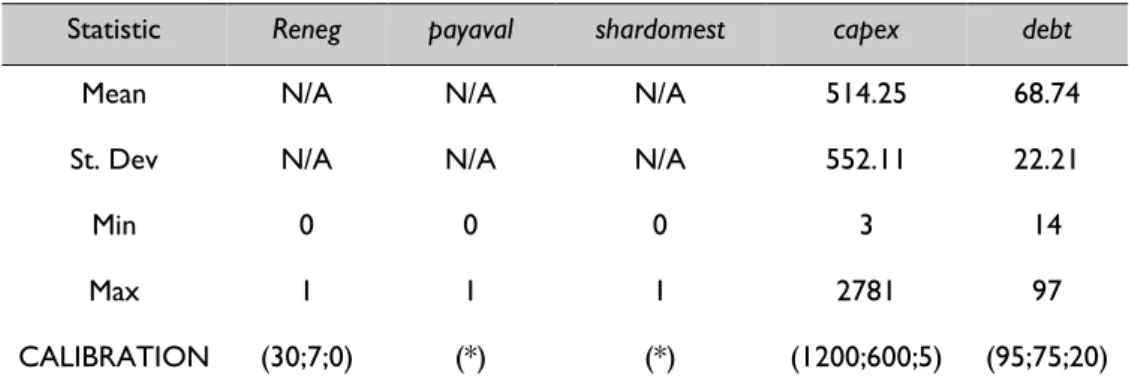
The contractual variables are used in both analysis; they are considered causal conditions in the fsQCA, and they are used as predictors in the regression’s estimation. Table 1 presents the statistics of the variables, along with the calibration values used for the fsQCA.
11
Statistic Reneg payaval shardomest capex debt
Mean N/A N/A N/A 514.25 68.74
St. Dev N/A N/A N/A 552.11 22.21
Min 0 0 0 3 14
Max 1 1 1 2781 97
CALIBRATION (30;7;0) (*) (*) (1200;600;5) (95;75;20)
N/A – non applicable
* - 1 = full membership; 0 = full non-membership
Table 1: Descriptive statistics and calibration values Qualitative analysis and results
First, the study addresses the necessary conditions for Reneg and its absence. According to Ragin (2000; 2008), a condition, or a combination of conditions, is necessary for the consistency score to exceed the threshold of 0.8.
Using such a threshold shows that no necessary conditions exist for Reneg. However, two conditions exist for ~Reneg: the variables ~shar and ~capex. This is in line with the literature (Guasch et al., 2003, 2007; Guasch & Straub, 2006; De Brux et al., 2011; Domingues & Sarmento, 2016) that finds that fewer renegotiations occur when foreign shareholders exist. Also, projects that use less investment are less uncertain, and therefore the results confirm such conditions are necessary conditions for the absence of renegotiations.
The outcome Reneg and the conditions payaval and shardomest assume the values one for presence and zero for absence – they are crispy variables. The conditions capex and debt assume various values over a range, thus they need to be calibrated into a fuzzy set. Following Ragin and Fiss (2008), the casual combinations of conditions that exceed 0.8 are categorized as sufficient, with the outcome being assigned the value of one in the truth table. The casual combinations with a value below 0.8 are assigned the value of zero, as they are not considered sufficient. Such sorting generates the three solutions (complex, parsimonious, and intermediate). In order to check the solutions’ quality the consistency score should exceed the threshold of 0.8. (Ragin, 2008). According to Wang et al. (2016), consistency means significance because of the existence of multiple configurations of antecedent conditions that are useful in predicting scores of an outcome condition. Coverage means strength that indicates the empirical relevance of a set-theoretic connection. Woodside (2013) stresses the importance of achieving high consistency over achieving high coverage.
12
Regarding the sufficient conditions sets, the study considers results for the intermediate and parsimonious solutions (Fiss, 2011; Ragin, 2008) that are reported in a single table. Conditions present in both solutions are core conditions and are represented by large circles, whereas conditions only present in the intermediate solution are peripheral and are represented by small circles. Sufficient conditions for Reneg are presented in Table 2 and the ones leading to ~Reneg are presented in Table 3. The results in both tables respect the consistency cut-off of 0.8. The results show that two sufficient conditions sets lead to Reneg and three lead to ~Reneg, which offers alternative ways to keep PPPs from renegotiation.
Coverage Consistency
Configurations payaval shardomest capex debt Raw Unique
1 ◦ ◦ 0.24 0.24 0.91
2 • 0.15 0.15 0.87 Overall Solution coverage: 0.38
Overall Solution consistency: 0.90
Reneg = ; debt = ; capex = ; shareholders = ; payment = ; full black circles (•) indicate the presence
of a condition, and center white circles (◦) indicate its absence. Large circles indicate core conditions; small ones, peripheral conditions.
Table 2: Sufficient conditions sets (Reneg)
Model: fsreneg = f(fsdebt, fscapex, shardomest, cripayaval)
Coverage Consistency
Configurations payaval shardomest capex debt Raw Unique
1 0.71 0.59 0.88
2 0.19 0.07 0.82
3 0.07 0.07 0.86
Overall Solution coverage: 0.85 Overall Solution consistency: 0.86
Reneg = ; debt = ; capex = ; shareholders = ; payment = ; full black circles (•) indicate the presence
of a condition, and center white circles (◦) indicate its absence. Large circles indicate core conditions; small ones, peripheral conditions. Blank spaces indicate “don’t care.”
Table 3: Sufficient conditions sets (~Reneg)
13 Quantitative analysis and results
Regarding the quantitative analysis, Table 4 presents the results of the regression analysis. The results confirm the previous results. The foreign shareholders reduce the number of renegotiations. Also, projects with higher investment tend to request renegotiations more frequently. The regression analysis also shows that PPPs with the availability payment have less uncertainty regarding future revenues that reduce the frequency of renegotiations. In contrast, longer contracts increase uncertainty and are more frequently renegotiated.
OLS VARIABLES reneg payaval -7.68** (3.03) shardomest -6.11** (4.60) Capex 0.23** (0.00) debt 0.03 (0.06) Constant -6.78 (5.86) Wald test 0.00 Observations 35 R-squared 0.37
Robust standard errors in parentheses *** p<0.01, ** p<0.05, * p<0.1
Table 4: Regression estimation Discussion
The findings of this study reveal the conditions sets that lead to renegotiation (Table 2) and finds two conditions for Reneg: ~payaval *~shar*capex*~debt, and payaval*shar*~capex*debt.
14
The study finds three conditions sets that lead to the absence of renegotiations: ~capex*~shar, debt*~shar*~ payaval, and debt*capex*shar* payaval. These three sets are core conditions for no renegotiation.
These results show that despite the high number of renegotiations in Portugal, solutions exist that can mitigate the occurrence of renegotiations. The PPPs that tend not to be renegotiated are: a) those with low investment and foreign shareholders; b) those with larger debt, foreign shareholders, and demand payments; and c) more investment with larger debt that is associated with domestic shareholders and the availability payment. These results are in line with the literature (Guasch et al., 2007; Guasch & Straub, 2006; Sarmento & Renneboog, 2016b; Domingues & Sarmento, 2016).
In contrast, the pitfalls of renegotiations are: a) PPPs with a demand payment with foreign shareholders, larger investment, and lower leverage; and b) PPPs with the availability payment, domestic shareholders, less investment, and more leverage. The solution leading to Reneg presents just two configurations, each involving core and peripheral conditions. Such results contrast with the ~Reneg solution with only core conditions, and thus are more pertinent. For managerial purposes, these are encouraging results, as they present more solutions to avoid the main pitfall in PPPs: renegotiations.
Conclusions
As the use of public-private partnerships (PPPs) has increased, the issue of the renegotiations of these long and incomplete contracts have become extremely relevant. In order to analyze the contractual variables and causal combinations of conditions that lead to a higher number of renegotiations, this paper applies a fsQCA model to Portugal’s PPPs. This is the first study to use a fsQCA in the PPP context.
This study shows that contractual determinants are relevant for the occurrence of renegotiations. This study provides strong evidence that the degree of contract incompleteness influences renegotiations, which confirms the literature on this topic. Further, evidence exists that the private sector responds to more risk with a higher incidence of renegotiations. Also, the type of shareholders in the private firm is relevant. The PPPs with domestic shareholders have more ties to political agents, and hence frequently renegotiate the majority of the capital. Contract theory shows that uncertainty plays a relevant role in renegotiations. The results provide evidence that longer contracts are more subject to renegotiations. Further, some evidence exists that firms more frequently renegotiate more complex projects (measured by the level of investment).
15 This paper contributes to the management literature on long-term contracts that involve both public and private parties. As PPPs are becoming more frequent, and renegotiations are increasing, this paper should be relevant for both academics and practitioners. This paper also brings novelty to the current literature on the renegotiations in the PPP field. No previous literature has addressed renegotiations by means of a mixed methods analysis. The literature on PPP renegotiations has mainly addressed the determinants of the probability for renegotiation. This study goes a step further and analyzes what conditions are necessary and what conditions are sufficient for a PPP renegotiation. The use of a fsQCA enables the identification of combinations of attributes associated with more renegotiations.
References
Anand, B., & Khanna, T. (2000). Do firms learn to create value? The case of alliances. Strategic
Management Journal, 21(3), 295–315.
Argyres, N. S., & Liebeskind, J. P. (1999). Contractual commitments, bargaining power, and governance inseparability: Incorporating history into transaction cost theory. Academy of
Management Review, 24(1), 49–63.
Argyres, N. S., Bercovitz, J., & Mayer, K. J. (2007). Complementarity and evolution of contractual provisions: An empirical study of IT services contracts. Organization Science, 18(1), 3–19.
Athias, L., & Saussier, S. (2018). Are public private partnerships that rigid? And why? Evidence from price provisions in French toll road concession contracts. Transportation Research Part A: Policy and Practice, 111, 174-186.
Bercovitz, J. E., & Tyler, B. B. (2014). Who I am and how I contract: The effect of contractors’ roles on the evolution of contract structure in university–industry research agreements.
Organization Science, 25(6), 1840-1859.
Boyer, E. J., Van Slyke, D. M., & Rogers, J. D. (2015). An empirical examination of public involvement in Public-Private Partnerships: Qualifying the benefits of public involvement in PPPs.
Journal of Public Administration Research and Theory, 26 (1): 45-61.
Bruzelius, N., Flyvbjerg, B., & Rothengatter, W. (2002). Big decisions, big risks. Improving accountability in mega projects. Transport Policy, 9(2), 143–154.
Carson, S., Madhok, A., & Wu, T. (2006). Uncertainty, opportunism, and governance: The effects of volatility and ambiguity on formal and relational contracting. Academy of Management Journal,
49(5), 1058–1077.
Creswell, J. W. (2013). Research design: Qualitative, quantitative, and mixed methods approaches. London: Sage publications.
16
Creswell, J. W., & Clark, V. L. (2007). Designing and conducting mixed methods research, University of Nebraska-Lincoln.
Crilly, D. (2011). Predicting stakeholder orientation in the multinational enterprise: A mid-range theory. Journal of International Business Studies, 42(5), 694–717.
Crilly, D., Zollo, M., & Hansen, M. T. (2012). Faking it or muddling through? Understanding decoupling in response to stakeholder pressures. Academy of Management Journal, 55(6), 1429-1448.
Cruz, C. O., & Marques, R. C. (2011). Revisiting the Portuguese experience with public-private partnerships. African Journal of Business Management, 5(11), 4023-4032.
Cruz, C. & Marques, R. (2013). Exogenous Determinants for Renegotiating Public Infrastructure Concessions: Evidence from Portugal. Journal of Construction Engineering and Management, 139(9), 1082–1090.
Das, T., & Teng, B. (1996). Risk types and inter‐firm alliance structures. Journal of Management
Studies, 33(6), 827–843.
Das, T., & Teng, B. (1998). Between trust and control: Developing confidence in partner cooperation in alliances. Academy of Management Review, 23(3), 491–512.
De Brux, J. (2010). The dark and bright sides of renegotiation: An application to transport concession contracts. Utilities Policy, 18 (2), 77–85.
De Brux, J., Beuve, J., & Saussier, S. (2011, May). Renegotiations and Contract Renewals in PPPs. In 17th Annual Conference of the International Society for New Institutional Economics, Florence, Italy.
Denscombe, M. (2008). Communities of practice a research paradigm for the mixed methods approach. Journal of Mixed Methods Research, 2(3), 270–283.
Domingues, S., & Sarmento, J. (2016). Critical renegotiation triggers of European transport concessions. Transport Policy, 48, 82–91.
Doz, Y. (1996). The evolution of cooperation in strategic alliances: Initial conditions or learning processes? Strategic Management Journal, 17(S1), 55–83.
Estache, A., Guasch, J., & Trujillo, L. (2003). Price caps, efficiency payoffs and infrastructure contract renegotiation in Latin America. World Bank Policy Research Working Paper nº 3129. Estache, A., Guasch, J. L., Iimi, A., & Trujillo, L. (2009). Multidimensionality and renegotiation: Evidence from transport-sector public-private-partnership transactions in Latin America. Review
17 Ferreira, F. A., Jalali, M. S., & Ferreira, J. J. (2016). Integrating qualitative comparative analysis (QCA) and fuzzy cognitive maps (FCM) to enhance the selection of independent variables. Journal
of Business Research, 69(4), 1471–1478.
Fisman, R. 2001. Estimating the value of political connections. American Economic Review, 91(4), 1095–1102.
Fiss, P. C. (2011). Building better causal theories: A fuzzy set approach to typologies in organization research. Academy of Management Journal, 54(2), 393–420.
Fiss, P. C., Sharapov, D., & Cronqvist, L. (2013). Opposites attract? Opportunities and challenges for integrating large-N QCA and econometric analysis. Political Research Quarterly, 191–198. Flyvbjerg, B., Holm, M. S., & Buhl, S. (2002). Underestimating costs in public works projects: Error or lie? Journal of the American Planning Association, 68(3), 279–295.
Guasch, J. (2004). Granting and renegotiating infrastructure concessions: doing it right. World
Bank Publications.
Guasch, J., Laffont, J., & Straub, S. (2003). Renegotiation of concession contracts in Latin America (Vol. 3011). World Bank Publications, Washington D.C..
Guasch, J., Laffont, J., & Straub, S. (2007). Concessions of infrastructure in Latin America: Government‐led renegotiation. Journal of Applied Econometrics, 22(7), 1267–1294.
Guasch, J., Laffont, J., & Straub, S. (2008). Renegotiation of concession contracts in Latin America: Evidence from the water and transport sectors. International Journal of Industrial Organization,
26(2), 421–442.
Guasch, J., & Straub, S. (2006). Renegotiation of infrastructure concessions: an overview. Annals of
Public and Cooperative Economics, 77(4), 479–493.
Guasch, J., & Straub, S. (2009). Corruption and concession renegotiations: Evidence from the water and transport sectors in Latin America. Utilities Policy, 17(2), 185–190.
Grossman, S., & Hart, O. (1986). The cost and benefits of ownership: A theory of vertical and lateral intégration. Journal of Political Economy, 94(4):691–719.
Harrison, D. (2004). Is a long‐term business relationship an implied contract? Two views of relationship disengagement. Journal of Management Studies, 41(1), 107–125.
Hart, O. (1990). Property rights and the theory of the firm. Journal of Political Economy, 98, 1119– 1158
Hart, O. (2003). Incomplete contracts and public ownership: Remarks, and an application to public-private partnerships. The Economic Journal, 113(486), C69–C76.
Hoechle, D. (2007). Robust standard errors for panel regressions with cross-sectional dependence. Stata Journal, 7(3), 281.
18
Hong, H. & Kostovetsky, L. (2012). Red and blue investing: Values and finance. Journal of Financial
Economics, 103(1), 1–19.
Kan, A., Adegbite, E., El Omari, S., & Abdellatif, M. (2016). On the use of qualitative comparative analysis in management. Journal of Business Research, 69(4), 1458–1463.
Kern, T., Willcocks, L., & van Heck, E. (2002). The winner’s curse in IT outsourcing: Strategies for avoiding relational trauma. California Management Review. 44(2), 47–63.
Kim, J. B., Song, B. Y., & Wang, Z. (2017). Special purpose entities and bank loan contracting.
Journal of Banking & Finance, 74, 133–152.
Kumar, R., & Nti, K. (1998). Differential learning and interaction in alliance dynamics: A process and outcome discrepancy model. Organization Science, 9(3), 356–367
Lumineau, F., & Oxley, J. (2012). Let's work it out (or we'll see you in court): Litigation and private dispute resolution in vertical exchange relationships. Organization Science, 23(3), 820–834. Mayer, K., & Argyres, N. (2004). Learning to contract: Evidence from the personal computer industry. Organization Science, 15: 394–410.
Quelin, B. Cabral, S., Lazzarini, S., & Kivleniece, I. (2014). The private scope in public-private partnerships: An international cross-sector study. Academy of Management Proceedings (Vol. 2014, No. 1, p. 15727). Academy of Management.
Rainey, H. G., & Bozeman, B. (2000). Comparing public and private organizations: Empirical research and the power of the a priori. Journal of Public Administration Research and Theory, 10(2), 447–470.
Ragin, C. C. (2000). Fuzzy-set social science. Chicago: University of Chicago Press.
Ragin, C. C. (2008). Redesigning social inquiry: Fuzzy sets and beyond (Vol. 240). Chicago: University of Chicago Press.
Ragin, C. C., & Fiss, P. C. (2008). Net effects analysis versus configurational analysis: An empirical demonstration. Redesigning social inquiry: Fuzzy sets and beyond, 190–212, University of Chicago Press Chicago.
Reis, R. F., & Sarmento, J. M. (2017). “Cutting costs to the bone”: the Portuguese experience in renegotiating public private partnerships highways during the financial crisis. Transportation, 1-18. Sarmento, J., & Reis, R. (2012). Buy back PPPs: An arbitrage opportunity. OECD Journal on
Budgeting, 12(3), A1.
Sarmento, J. M., & Renneboog, L. (2015). 16 Portugal’s experience with Public Private Partnerships. Public Private Partnerships: A Global Review, 266.
Sarmento, J. M., & Renneboog, L. (2016a). Anatomy of public-private partnerships: their creation, financing and renegotiations. International Journal of Managing Projects in Business, 9(1), 94–122.
19 Sarmento, J. M., & Renneboog, L. (2016b). Renegotiating public-private partnerships. European Corporate Governance Institute (ECGI)-Finance Working Paper, No416.
Schneider, C. Q., & Wagemann, C. (2010). Standards of good practice in qualitative comparative analysis (QCA) and fuzzy-sets. Comparative Sociology, 9(3), 397–418.
Tirole, J. (1999). Incomplete contracts: Where do we stand? Econometrica, 67(4), 741–781. Vis, B. (2012). The comparative advantages of fsQCA and regression analysis for moderately large-N analyses. Sociological Methods & Research, 41(1), 168–198.
Wang, D., Yu, T., & Chiang, C. (2016). Exploring the value relevance of corporate reputation: A fuzzy-set qualitative comparative analysis. Journal of Business Research, 69(4), 1329–1332.
Weber, L., & Mayer, K. 2011. Designing effective contracts: Exploring the influence of framing and expectations. Academy of Management Review, 36(1), 53–75.
Williamson, O. (1989). Transaction cost economics. In S. Richard & W. Robert (Eds.), Handbook
of Industrial Organization (Vol. 1, pp. 135–182 Vol I ed. R. Schmalensee e R. D. Willig. Elsevier
Science Publ.
Woodside, A. G. (2013). Moving beyond multiple regression analysis to algorithms: Calling for adoption of a paradigm shift from symmetric to asymmetric thinking in data analysis and crafting theory, Journal of Business Research, 66(4) 463–472.
Wooldridge, J. M. (2010). Econometric analysis of cross section and panel data. Cambridge, MA: MIT press.