Adoption of E-Hailing Apps in Brazil: The
Passengers’ Standpoint
Full Paper
Luiz Antonio Joia
Getulio Vargas Foundation
[email protected]
Diego Altieri
Getulio Vargas Foundation
[email protected]
Abstract
E-Hailing Apps (EHA) have become very popular in Brazil due to the swift proliferation of smartphones in the country. Thus, the scope of this article is to ascertain the antecedents of use of EHA in Brazil from the passengers’ standpoint. To do that, a meta-model was developed via a theoretical background based on theories of information system adoption, diffusion of innovation, trust in virtual environments and user satisfaction, as well as research hypotheses. By applying structural equation modelling in data collected via a web survey, the theoretical meta-model and research hypotheses were tested. It was established that perceived utility, compatibility, relative advantage and trust are antecedents of user satisfaction with EHA, this factor being an antecedent of the intention to use the system. Lastly, it was found that subjective norms have a direct and statistically significant impact on the intention of use of EHA.
Keywords
E-Hailing Apps; Smartphones; Adoption of technology; Apps; Mobile commerce.
Introduction
E-Hailing Appsi are advanced mobile service applications that enable requests for transportation services
via Internet and geo-location by using mobile applications and tracking the service provided and the payments due. In other words, e-hailing is the process of ordering a car, taxi, limousine, or any other form of transportation pick up via a computer or mobile device. The E stands for electronic and hail refers to the traditional process of signaling an approaching taxicab to stop.
The adoption and use of E-Hailing Apps (EHA), both by drivers and users, has increased exponentially in the country, with the number of EHA users doubling monthly in 2014 (Marôcco, Porto, Oliveira, & Zanetti, 2014; Vasconcelos, 2014). By the end of 2015, 18.2% of all Internet users in Brazil with smartphones requested transportation at least once in the preceding six weeks via an EHA.
The importance of this subject is related to the nature of EHA in Brazil, which links the provision of a service with increasing demand and insufficient supply (Marôcco et al., 2014; Vasconcelos, 2014) with a steep increase in the adoption of smartphones and the consequent use of mobile applications (apps). Smartphones, in particular, are highly attuned to EHA due to their portability, which enables the use of such apps by drivers and passengers. Thus, this phenomenon needs to be studied in order to broaden the knowledge about the apps industry in Brazil due to its fast growth and government incentives.
Besides, according to Harris, Brookshire and Chin (2016), Joia, Altieri and Medeiros (2016) and Kim, Kankanhalli and Lee (2016), there are as yet few studies on the antecedents of use of EHA. Thus, this article aims to answer the following research question: what are the antecedents of the intention to use EHA on smartphones by people in Brazil?
Theoretical Background
approaches have been used to assess information systems in order to predict how users will respond to them, so as to improve their use. Among these approaches, one can highlight the Theory of Reasoned Action (TRA), the Theory of Planned Behavior (TPB) and the Technology Acceptance Model (TAM) with its various variants, as explained below.
Theory of Reasoned Action (TRA)
The Theory of Reasoned Action (TRA), with its roots in the Social Psychology field, seeks to identify antecedents of intentional and conscious behavior (Fishbein & Ajzen, 1975). The TRA assumes that people behave rationally, evaluating what they can gain or lose through their attitudes. Therefore, their ideas, personal goals, values, beliefs and attitudes influence their behavior.
According to Davis et al. (1989), since TRA is so easy to generalize and integrates diverse theoretical perspectives of Psychology, its use is appropriate in studies about the critical success factors associated with the use of computers and information systems (IS) as well. When applied in this context, the TRA points out that a person’s attitude in relation to the use of an information system, besides peer pressure, might influence their intentions to use the IS, as well as IT in general.
Theory of Planned Behavior (TPB)
While the TRA has been largely used to study user acceptance to computers and information systems, other theoretical perspectives were also proposed and applied in this realm. Ajzen (1991) proposed the Theory of Planned Behavior (TPB), which complements the TRA adding one more antecedent to the intention of using IS, namely perceived behavioral control. Due to this, the TPB has been applied in empirical research on the acceptance of sundry computational systems (Taylor & Todd, 1995; Venkatesh, Thong, & Xin, 2012).
The perceived behavioral control construct was added to the model in order to reduce potential flaws in the TRA in cases where individuals are not fully aware of their behavior. This construct is defined as the personal perception about the resources, available opportunities and information that might hamper or enable the behavior under analysis (Taylor & Todd, 1995; Cho & Cheung, 2003).
Technology Acceptance Model (TAM) and its Variants
In essence, the TAM points out that IT acceptance is affected by two constructs associated with users, namely perceived usefulness (PU) and perceived ease of use (PEOU). Perceived usefulness is defined by Davis et al. (1989) as the extent to which users believe that the use of a system will improve their performance. As to perceived ease of use, Davis et al. (1989) define it as the extent to which an individual believes that the use of a system is effortless. Davis et al. (1989) argue that these two perceptions ensure a favorable disposition or positive intention to use an Information System. Thus, the TAM infers that individuals will use an IS if they believe its use will bring them positive results in the form of perceived ease of use and usefulness (Igbaria, Guimarães, & Davis, 1995).
However, from the original model, several other constructs have been added to the TAM, leading to the development of TAM 2 (Venkatesh & Davis, 2000; Venkatesh, 2000), UTAUT (Venkatesh et al., 2003), TAM 3 (Venkatesh & Bala, 2008), UTAUT2 (Venkatesh, Thong, & Xing, 2012) and several other variants, in what has been called “TAM ++ research” by Benbasat and Barki (2007, p. 212). Notwithstanding the complexity of the current technology acceptance models derived from the original TAM, they are open to criticism (e.g. Lee et al., 2003; Benbasat & Barki, 2007), mainly for not considering other theoretical approaches to better explain technology adoption – such as the Innovation Diffusion Theory (IDT) developed by Rogers (2003) – as well as not taking into account the peculiarities of each technology, assuming that all of them are equal and thus capable of their adoption being explained by the same theoretical approach (Orlikowski & Iacono, 2001). According to the critics (Lee et al., 2003; Legris et al., 2003; Benbasat & Barki, 2007), these shortcomings have led the TAM and its variants to explain at most 40% of the variation in the attitude and intention of use of IS (Legris et al., 2003), thereby suggesting that important factors have been overlooked in the analyses conducted. In order to tackle these issues, other approaches will be presented below, aiming at increasing the explanation power of the TAM and its variants.
Innovation Diffusion Theory (IDT)
The Innovation Diffusion Theory (IDT) aims to explain the process by which technological innovations are adopted and disseminated by users.
According to Rogers (2003), the IDT considers the following factors to be antecedents of diffusion of large-scale innovation: relative advantage, compatibility, complexity, trialability, and observability. However, according to Chen, Gillenson and Sherrell (2004), of these attributes only relative advantage, compatibility and complexity appear to be consistently associated with the adoption of technological innovation.
For Benbasat and Barki (2007), Carter and Belanger (2005) and Chen, Gillenson and Sherrell (2004), as the IDT can add more explanatory power to the original TAM, it should be taken into consideration in research into IT adoption. Furthermore, Al-Jabri & Sohail (2012) argue that several studies have applied the IDT successfully to ascertain the antecedents to the adoption of Internet and mobile systems.
Trust
There are several definitions for trust, which reveal the complex nature of this construct. In a literature review encompassing several knowledge fields, Rousseau et al. (1998) point out that one’s personal expectations and propensity to feel vulnerable are critical components in all definitions concerning trust. The most cited definition in the scientific literature of trust is the one proposed by Mayer, Davis and Shoorman (1995), which is adopted in this work. In this definition, trust involves two agents – the one who trusts in someone and the one who is trusted by someone – being understood as “the willingness of a party to be vulnerable to the actions of another party based on the expectation that the other will perform a particular action important to the trustor, irrespective of the ability to monitor or control that other party” (Mayer et al., 1995, p. 712). This definition is based on the concept that the individual who trusts becomes vulnerable, which implies that something important can potentially be lost due to this trust relationship (Schlosser, White and Lloyd, 2006).
In general, in the Internet arena, remote users from anywhere in the world can access files on computers. Thus, information travelling through EHA involves an inherent risk due to safety and privacy reasons. In this context, it would appear to be mandatory that EHA users need to rely on the performance of the system, so as to enable them to use it when necessary (Hong & Cha, 2013; Hong, 2015).
User Satisfaction
Wixom and Todd (2005) argue that there are two distinct theoretical strands adopted in research into the adoption of Information Technology. The first, previously presented, involves the models of acceptance of technology, with emphasis on the TAM and its variants. Conversely, the second, initiated by Bailey and Pearson (1983) and Ives et al. (1983) among others, applies user satisfaction with the IS to explain the adoption of same. Both theoretical strands have greatly contributed to an increase in understanding the success/failure of IS use, although remaining distinct from each other (Wixom & Todd, 2005).
According to Wixom and Todd (2005), these two approaches if used jointly might better explain the Information Technology adoption phenomenon. In particular, Wixom and Todd (2005) highlight the fact that unlike the TAM model and its variants, the literature on user satisfaction is markedly focused on the intrinsic characteristics of the system in use, overcoming what is considered a recurrent problem in IS research, as supported by Orlikowsli and Iacono (2001).
On the other hand, Mather et al. (2002) argue that taking the intention of use as the dependent variable, as is done in TAM and its variants, can produce skewed results, as the respondents can present a cognitive bias in their answers about their actual intention to use the system, trying to report merely positive outcomes or say only what they believe they should say. Furthermore, the original dependent variable of TAM is useless in environments where use of the system is mandatory (Rawstorne et al., 2000). Lastly, the dependent variable used in TAM continues to be challenged, as some authors perceive it as being intention of use of the system (Agarwal & Prasad, 1998), whereas others see it as actual use of the system (Igbaria et al., 1995).
related to use of the system, as supported by Gatian (1994) and Mather et al. (2002). Therefore, it was decided to adopt user satisfaction with EHA in this work as a proxy for user attitude in relation to the use of same.
Proposed Model and Research Hypotheses
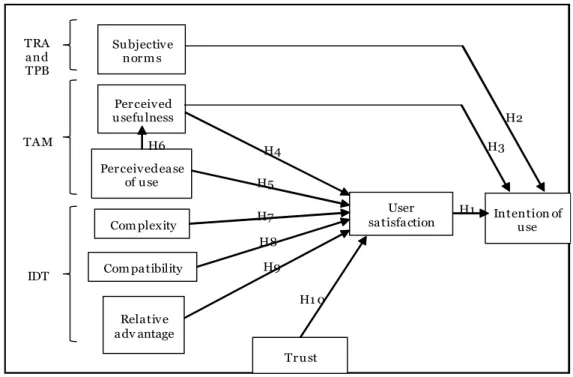
EHA are specific mobile Internet-based systems. Therefore, a research meta-model is developed from the abovementioned theoretical references as depicted in Figure 1. Subsequently, the research hypotheses accrued from this meta-model are listed and discussed.
Research Hypotheses
From the meta-model developed (Figure 1), the following hypotheses can be proposed to be further tested. H1: User satisfaction has a positive effect on the intention of use of EHA.
H2: Subjective norms have a positive effect on the intention of use of EHA. H3: Perceived usefulness has a positive effect on the intention of use of EHA H4: Perceived usefulness has a positive effect on user satisfaction with EHA. H5: Perceived ease of use has a positive effect on user satisfaction with EHA. H6: Perceived ease of use has a positive effect on perceived usefulness of EHA. H7: Complexity has a negative effect on user satisfaction with EHA.
H8: Compatibility has a positive effect on user satisfaction with EHA. H9: Relative advantage has a positive effect on user satisfaction with EHA. H10: Trust has a positive effect on user satisfaction with EHA.
Perceived u sefu lness Perceived ease of u se User satisfaction Intention of u se Su bjective norm s Com plexity Com patibility Relative adv antage Tru st TAM IDT TRA and TPB H4 H5 H2 H3 H1 H6 H7 H8 H9 H1 0
Figure 1. Research Meta-Model
Source: Authors based on the theoretical references
Methodological Procedures
Operationalization of Constructs
The constructs of the structural model (Figure 1) were measured via scales previously tested and available in the extant literature. The constructs that compound the TAM and IDT, as well as subjective norms and
trust, have been broadly studied and evaluated for a long time. There is therefore significant consensus on how they must be measured.
Unlike what occurs with the constructs quoted above, there is still some disagreement on how to measure user satisfaction with an information system. According to Ajzen and Fishbein (1980), Wixom and Todd (2005), Kim et al. (2009) and Al-Jabri and Sohail (2012), user satisfaction can be understood as an attitude towards an object – in this case, an information system. Doll and Torkzadeh (1991) have thus developed a specific scale to measure user satisfaction with IS. However, Chin and Lee (2000) have later challenged it, as they support the fact that satisfaction accrues from the difference between the system’s actual performance and expected performance. As there is to date no consensus on how to measure user satisfaction, it was decided to assess user satisfaction with the EHA in this research via a Likert-type scale of seven points, where seven means the user is totally satisfied with the system and one signifies total dissatisfaction of the user with the system (Joia et al., 2016).
Sample and Data Collection
Data were collected via an electronic survey developed according to the aforementioned scales. The questionnaire had two parts. In the first part, demographic data of the respondents were collected, namely age, income, gender, educational level, marital status, and occupation. In addition to this, the participants were asked whether they were already users of EHA. The second part comprised the scales of the structural model proposed. All constructs were measured using a seven-point Likert-type scale varying from 1 (totally disagree) to 7 (totally agree).
Before the questionnaire was made available, a pre-test was undertaken with thirty users of EHA. These participants were encouraged to criticize the questionnaire format, as well as to single out questions they consider to be vague or hard to understand. Their comments were used to refine the data collection instrument, there being no need to implement major modifications in the original questionnaire.
The population of this work comprises all Brazilians who have used EHA. The sample of respondents in this research was obtained from Internet and mobile devices groups, discussion lists, social media and other sources, totaling 538 participants.
The participants were then invited via e-mails sent to them to take part in the survey. In the message sent, the objectives of the survey were presented, stating clearly that participation was voluntary and the answers would be kept confidential. The e-mail also included a link to access the electronic survey. The questionnaire was made available on the Web from May to September 2016. From the 538 respondents, 448 had already used EHA. The 90 respondents who said they had never used EHA were excluded from the database. At the end of data collection, 330 totally filled-out questionnaires were obtained, which were considered valid for the purpose of the research.
Of the 330 respondents who comprised the valid sample, 53% were male. More than half of the respondents were married (51%) and just under one third of them was single (31%). Furthermore, more than half of the respondents (52%) reported an income of more than US$ 3,000.00 per month. Moreover, 71% of the respondents’ age ranged from 25 to 44 and 54% of them from 25 to 34 years old. Besides this, 87% of the respondents had a university degree, with 63% of them having a post-graduate degree. Lastly, 63% of the respondents worked full time whereas 40% of them worked and studied as well.
Data Analysis
Data collected were analyzed by means of Structural Equation Modelling (SEM) – a multivariate second-generation method that comprises two basic procedures: evaluation of a measurement model, namely how the variables or indicators are comprised in a Confirmatory Factor Analysis (CFA) model; and assessment of a path model – path analysis (PA) – via evaluation of the causal relationships among the constructs. In order to achieve this, Stata 14.0 software was used.
SEM makes it possible to analyze the residues among variables measured and the relationships developed from the modelling, by means of a set of fitness tests that can verify, with an adequate confidence level,
Since some studies have indicated that demographical factors might influence the intention to adopt information systems (Venkatesh & Bala, 2008) and mobile applications in particular (Van Biljon & Kotzé, 2007), the following control variables were included in the proposed model: age, income, gender, educational level, marital status, and occupation. These six control variables were linked to the most endogenous latent variable of the model, namely the intention of use of EHA.
The following measurement tools were used to verify the fitness of the meta-model proposed: Chi-Square (χ2), Standardized Root Mean Squared Residual (SRMR), Root Mean Square Error of Approximation
(RMSEA), Tucker-Lewis Index (TLI), and Comparative Fit Index (CFI). In order to assess the significance level of the estimated coefficients, the p-values of the results obtained were analyzed.
Results
The measurement model was assessed by means of Confirmatory Factor Analysis (CFA), by following the procedures defined by Johnson, Rosen and Chang (2011). From the results obtained, it was verified whether the conditions specified by Johnson et al. (2012) and Fornell and Larcker (1981) to evaluate the internal consistency and the convergent and discriminant validities of the scales had been attained, namely: (1) the loads of the manifest variables must be high and significant; (2) the variation range of these loads for one variable must be small; (3) any cross load for a latent variable must be smaller than the specific load extracted for same; (4) any average variance extracted (AVE) must be equal to or higher than 0.50; (5) any composite reliability (CR) and Cronbach’s alpha (
α)
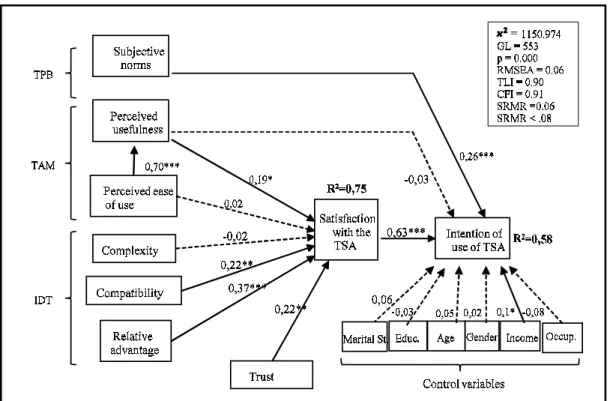
must be equal to or higher than 0.70; and (6) the AVE square root for a latent variable must be higher than its correlations with the other latent variables.After having ascertained the validity of the measurement model, the structural model was assessed. In Figure 2 the results obtained are set forth. It can be seen that the explained variance proportion for the satisfaction (R2 = 0.75) and intention of use (R2 = 0.58) variables are acceptable, making it possible to
support that the proposed meta-model has strong predictive power. In Figure 3, the hypotheses tests undertaken are consolidated and the results are then discussed in the following section.
* p < 0,05; ** p < 0,01; *** p < 0,001; n = 330
Discussion
The results obtained suggest that, as predicted by the TAM, EHA usefulness as perceived by the users has a positive influence on their satisfaction with the system. The perceived usefulness construct is very well known and used in the academic literature and is often found in studies supported by TAM as an antecedent of the attitude and intention of use of an information system.
Hypothesis H9, which relates the relative advantage with user satisfaction was also supported through the meta-model. The relative advantage construct is defined as the extent to which an innovation is perceived as being better than the preceding idea (Rogers, 2003). Therefore, as most of the respondents, due to their educational level and purchasing power, are users of the Internet and the Web, they might consider the digital media compatible with their lifestyles and consequently the use of the EHA as a new benefit for them.
User trust in the EHA was also considered as a statistically significant antecedent to EHA adoption. Wu and Chen (2005) argued that the introduction of the trust factor in the traditional TAM and TPB models can increase the explanation power of adoption of web-based systems. Moreover, Harris et al. (2016) point out that users trust that their private data as well as geo-location are not shared is a relevant antecedent for the installation and use of apps.
Hypotheses Results
H1: User satisfaction has a positive effect on the intention of use of EHA.
Supported H2: Subjective norms have a positive effect
on the intention of use of EHA.
Supported H3: Perceived usefulness has a positive effect
on the intention of use of EHA
Not supported H4: Perceived usefulness has a positive effect
on user satisfaction with EHA.
Supported H5: Perceived ease of use has a positive effect
on user satisfaction with EHA.
Not supported H6: Perceived ease of use has a positive
effect on perceived usefulness of EHA.
Supported H7: Complexity has a negative effect on user
satisfaction with EHA.
Not supported H8: Compatibility has a positive effect on
user satisfaction with EHA.
Supported H9: Relative advantage has a positive effect
on user satisfaction with EHA.
Supported H10: Trust has a positive effect on user
satisfaction with EHA.
Supported
Figure 3. Research Hypotheses Test
The influence of the subjective norm (H3) in the intention of use, as found in this work, is also supported by other studies (Venkatesh & Davis, 2000; Park, 2009; Yao & Ho, 2015). As the use of EHA in Brazil is already at a consolidated stage of dissemination, there is social pressure from EHA users on potential users, such as relatives, friends and colleagues (Wu & Chen, 2005).
The analysis conducted also supported hypothesis H8, namely that compatibility influences user satisfaction with the EHA in a positive way. This finding is corroborated by Carter and Belanger (2005), who found compatibility to be the most important factor in favor of the adoption of e-government systems, as well as Koenig-Lewis et al. (2010) and Lin (2011) in their research on online investing and mobile banking systems, respectively. According to Rogers (2003), compatibility is how an innovation is perceived as being consistent with users’ past experiences and potential users’ needs. Thus, in a virtual environment, the process of calling and using a car via an EHA seems to be compatible with the process
However, there are factors that are not yet statistically significant in the meta-model analyzed, a fact that is duly discussed below.
The perceived usefulness had no direct significant effect on the intention of use of an EHA, as supported by the original TAM model (Davis et al., 1989). According to Park (2009), when the use of a system becomes very easy and its usefulness is indisputable, a positive cognitive attitude is developed in users in relation to the system, leading the intention of use of the system by users to be mediated by their satisfaction or positive attitude in relation to same. Likewise, the perceived ease of use factor was not relevant to explain user satisfaction with the EHA either which, in this work, as already explained, is used as a proxy for user attitude in relation to the system. Legris et al. (2003, p. 195) listed a series of works that did not find perceived ease of use to be a significant antecedent to attitude and intention of use of an IS (see, for example, Hu, Chau, Sheng, & Tam, 1999). Davis et al. (1989) also support that the influence of perceived ease of use on user attitude, replaced here by user satisfaction, is achieved mainly via perceived usefulness, as the learning curve of the system lessens the importance of this construct over time. Likewise, Venkatesh et al. (2003) argue that the perceived ease of use tends to be more relevant during the first stages of learning how to use an information system, becoming less important throughout the period of use (Venkatesh et al, 2003). As in the sample collected all respondents had already used EHA, they indisputably have reasonable experience with this system, thereby reducing the importance of perceived ease of use as an antecedent to the intention of use of the EHA. Moreover, Carter and Belanger (2005) argue that the complexity scale captures the same effects of the perceived ease of use scale, having eliminated the former factor from their work on e-government systems adoption. Thus, as the perceived ease of use factor was not supported in this work as a significant antecedent to user attitude, it is understandable that the complexity factor was also perceived as not being a relevant factor to user attitude related to the EHA.
Conclusions
Taking user satisfaction with the EHA as a proxy of attitude in relation to this system and as an antecedent to the intention of use of same can be considered a valid academic contribution of this work, since these two approaches are rarely combined (Mather et al., 2002; Wixom & Todd, 2005, Al-Jabri & Sohail, 2012). Indeed, the results accrued from this article – set forth through the fitness indexes of the structural meta-model developed, as well as by the higher values of R2 – support that the joint use of those
two theoretical strands can be more adequate than the use of either of them separately.
This paper addresses an as yet insufficiently researched area in Brazil. Thus, further research needs to be conducted in the near future to corroborate or challenge the results set forth here.
REFERENCES
Agarwal, R., & Prasad J. A. (1998). Conceptual and Operational Definition of Personal Innovativeness in the Domain of Information Technology. Information Systems Research, v. 9, n. 2, p. 204-215.
Ajzen, I. (1991). The theory of planned behavior. Organizational Behavior and Human Decision Processes, v. 50, n.2, p. 179-211.
Al-Jabri. M., & Sohail M.S. (2012). Mobile banking adoption: Application of diffusion of innovation theory. Journal of Electronic Commerce, v.13, n.4, p. 379-391.
Bailey, J.E., & Pearson, W. (1983). Development of a Tool for Measuring and Analyzing Computer User Satisfaction. Management Science, v. 29, n. 5, p. 530-545.
Benbasat, I., & Barki, H. (2007). Quo Vadis TAM? Journal of the Association of Information Systems, v. 8, n. 4, Article 3, p. 211-218.
Carter, L., & Belanger, F. (2005). The Utilization of e-government services: citizen trust, innovation and acceptance factors. Information Systems Journal, v.15, n.1, p. 5-25.
Chen, L.-D., Gillenson, M. L., & Sherrell, D. L. (2004). Consumer acceptance of virtual stores: a theoretical model and critical success factors for virtual stores. SIGMIS Database, v. 35, n. 2, p. 8-31, 2004.
Chin, W.W., & Lee, M.K. (2010). A Proposed Model and Measurement Instrument for the Formation of IS Satisfaction: The Case of End User Computer Satisfaction. Proceedings of the Twenty First International Conference of Information Systems, p. 553-563.
Cho, V., & Cheung, I. (2003). A study of on-line legal service adoption in Hong Kong. Department of
Management, The Hong Kong Polytechnic University. Disponível em
http://www.sba.muohio.edu/abas/2003/vancouver/cho_on_line_legal_service_adoption.pdf. Acesso em 20 de janeiro de 2015.
Costa-Filho, B. A. and Pires, P. J. Avaliação dos Fatores Relacionados na Formação do Índice de Prontidão à Tecnologia - TRI (Technology Readiness Index) como Antecedentes do Modelo TAM (Technology Acceptance Model). In: Encontro Anual da Associação Nacional de Programas de Pós-Graduação em Administração (EnANPAD), Brasília, 2005.
Davis, F. D., Bagozzi, R. P., & Warshaw, P. R. (1989). User acceptance of computer technology: a comparison of two theoretical models. Management Science, v.35, n.8, p. 982-1003.
Dillon, A., & Morris, M. (1996). User acceptance of new information technology: theories and models. Annual Review of Information Science and Technology, v.31, p.3-32.
Doll, W. J., & Torkzadeh, G. (1998). Developing a Multidimensional Measure of System-Use in an Organisational Context. Information and Management, v. 33, n. 4, p. 171-185.
Fishbein, M., & Ajzen, I. (1975). Belief, attitude, intention, and behavior: an introduction to theory and research. Boston, MA: Addison-Wesley.
Fornell C, Larcker DF. (1981). Evaluating structural equation models with unobservable variables and measurement error. Journal of Marketing Research, 18(1): 39–50.
Gatian, A.W. (1994). Is User Satisfaction a Valid Measure of System Effectiveness? Information and Management, v. 26, n.3, p. 119-131.
Gefen, D., Karahanna, E., & Straub, D. W. (2003). Trust and TAM in Online Shopping: An Integrated Model. MIS Quarterly, v.27, n.1, p. 51-90.
Harris, M.A., Brookshire, R., & Chin, A.G. (2016). Identifying factors influencing consumers’ intent to install mobile applications. International Journal of Information Management, v. 36, n.3, p. 441-450. Hong, I. (2015). Understanding the consumer’s online merchant selection process: the roles of product involvement, perceived risk, and trust expectation. International Journal of Information Management, v.35, n.3, p. 322–336.
Hong, I., & Cha, H. (2013). The mediating role of consumer trust in an online merchant in predicting purchase intention. International Journal of Information Management, v. 33, n. 6, p. 927–939.
Hu, P.J.. Chau, P.Y.K., Sheng, O.R.L., & Tam, K.Y. (1999). Examining the Technology Acceptance Model Using Physician Acceptance of Telemedicine Technology. Journal of Management Information Systems, v.16, n.2, p. 91-112.
Igbaria, M., Guimarães, T., & Davis, G.B. (1995). Testing the Determinants of Microcomputer Usage via a Structural Equation Model. Journal of Management Information Systems, v.1, n.4, p. 87-114.
Ives, B., Olson, M.H., & Baroudi, J.J. (1983). The Measurement of User Information Satisfaction, Communications of the ACM, v. 26, n. 10, p. 785-793.
Johnson, R. E., Rosen, C. C., & Djurdjevic, E. (2011). Assessing the impact of common method variance on higher order multidimensional constructs. Journal of Applied Psychology, 96: 744-761.
Johnson, R. E., Rosen, C. C., Chang, C.-H., Djurdjevic, E., & Taing, M. U. (2012). Recommendations for improving the construct clarity of higher-order multidimensional constructs. Human Resource
Management Review, 22: 62-72.
Joia, L. A.; Altieri, D. ; Medeiros, A. C. (2016). Antecedentes da intenção de uso de aplicativos móveis de táxi. In: 40o. EnANPAD, 2016, Costa do Sauípe. Proceedings of the 40th. Encontro Nacional da Associação Nacional de Pós-Graduação em Administração.
Kim, Y.J., Chun, J.U., & Song, J. (2009). Investigating the role of attitude in technology acceptance from an attitude strength perspective. International Journal of Information Management, v.29, n.1, p. 67-77. Kim, H.-W., Kankanhalli, A., & Lee, H.-R (2016). Investigating Decision Factors in Mobile Application Purchase: A Mixed Methods Approach. Information & Management (forthcoming).
Koenig-Lewis, N., Palmer, A., & Moll, A. (2010). Predicting young consumers’ take up of mobile banking services. International Journal of Bank Marketing, v. 28, n. 5, p. 410-432.
Konana P., & Balasubramanian S. (2005). The Social-Economic-Psychological Model of Technology Adoption and Usage: An Application to Online Investion. Decision Support Systems, v. 39, n. 3, p. 505-524.
Lee, Y., Kozar, K.A., & Larsen K.R.T. (2003). The Technology Acceptance Model: Past, Present, and the Future. Communications of the AIS, v. 12, n. 50, p. 752-780.
Lee, M.C. (2009). Factors influencing the adoption of Internet banking: an integration of TAM and TPB with perceived risk and benefit. Electronic Commerce Research and Applications, v.8, n.3, p.130-141. Lin., H. (2011). An empirical investigation of mobile banking adoption: The effect of innovation attributes and knowledge-based trust. International Journal of Information Management, v. 31, n. 3, p. 252-260.
Marôcco, A. P., Porto, C.B., Oliveira, J. G. W, Zanetti, M.C.V. (2014). A Tecnologia disruptiva presente em aplicativos móveis para chamadas e serviços de táxi. Revista Cereus, v. 6, n. 1, p. 125-142.
Mather D., Caputi, P., & Jayasurya, R. (2002). Is the Technology Acceptance Model a Valid Model of User Satisfaction of Information Technology in Environments where Usage is Mandatory? In: A. Wenn, M. Mayer, R., Davis, J., & Shoorman, F. (1995). An integrative model of organizational trust. Academy of Management Review, v. 20, n.3, p. 709-734.
Orlikowski, W., & Iacono, C.S. (2001). Research Commentary: Desperately Seeking the ‘IT’ in IT Artifact. Information Systems Research, v. 12, n. 2, p.121-134.
Park, S. Y. (2009). An Analysis of the Technology Acceptance Model in Understanding University Students' Behavioral Intention to Use e-Learning. Educational Technology & Society, v. 12, n.3, p.150– 162.
Rawstorne, P., Jayasuriya, R., & Caputi, P. (2000). Issues in Predicting and Explaining Usage Behaviours with the Technology Acceptance Models and Theory of Planned Behaviour when Usage is Mandatory. In: Orlikowski, W., Weill, P., Ang, S., Kromar, H.C., & DeGross, J.I. (eds.) Twenty First International Conference of Information Systems, Brisbane, p. 37-46.
Roca, J.C., Garcia, J.J.; & De La Vega, J.J. (2009). The Importance of Perceived Trust, Security and Privacy in Online Trading Systems. Information Management & Computer Security, v.17, n.2, p.96-113. Rogers E. (2003). Diffusion of innovations. Free Press, New York, 5th. edition.
Rousseau, D.M, Sitkin, S.B., Burt, R.S., & Camerer, C. (1998). Not so different after all: A cross-discipline view of trust. Academy of Management Review, v.23, n.3, p. 393-404.
Schlosser, A.E., White, T.B., & Lloyd, S.M. (2006). Converting Web Site Visitors into Buyers: How Web Site Investment Increases Consumer Trusting Beliefs and Online Purchase Intentions. Journal of Marketing, v.70, n. 2, p. 133-148.
Taylor, S., & Todd, P.A. (1995). Understanding information technology usage: a test of competing models. Information Systems Research, v.6, n.2, p. 144-176.
Van Biljon, J., & Kotzé, P. (2007). Modelling the factors that influence mobile phone adoption. In: Proceedings of the 2007 annual research conference of the South African institute of computer scientists and information technologists on IT research in developing countries. ACM, p. 152-161.
Vasconcelos, P. (2014). Fatores-chave de sucesso na adoção de aplicativos móveis de táxi. Dissertação de mestrado. Escola Brasileira de Administração Pública e de Empresas, Fundação Getulio Vargas. Rio de Janeiro, RJ, Brasil.
Venkatesh, V. (2000). Determinants of Perceived Ease of Use: Integrating Control, Intrinsic Motivation, and Emotion into the Technology Acceptance Model. Information Systems Research, v.11, n.4, p. 342-365.
Venkatesh, V., & Bala, H. (2008). Technology Acceptance Model 3 and a Research Agenda on Interventions, Decision Sciences, v. 39, n. 2, 273-315.
Venkatesh, V., & Davis, F.D. (2000). A Theoretical Extension of the Technology Acceptance Model: Four Longitudinal Field Studies. Management Science, v.46, n.2, p. 186-204.
Venkatesh, V., Morris, M., Davis, G., & Davis, F. D. (2003). User acceptance of information technology: toward a unified view. MIS Quarterly, v.27, n.3.
Venkatesh, V., Thong, J.Y.L., & Xin, X. (2012). Consumer Acceptance and Use of Information Technology: Extending the Unified Theory of Acceptance and Use of Technology. MIS Quarterly, v. 36, n. 1, p. 157-178. Wixom B.H., & Todd P.A. (2005). A Theoretical Integration of User Satisfaction and Technology Acceptance. Information Systems Research, v. 16, n. 1, p. 85-102.
Wu, I.L., & Chen J.L. (2005). An Extension of Trust and TAM Model with TPB in the Initial Adoption of On-Line Tax: An Empirical Study. International Journal of Human-Computer Studies, v. 62, n. 6, p. 784-808.
Yao, H.K., & Ho, C. (2015). The Influence of Subjective Norm on Behavioral Intention in Using E-Learning: An Empirical Study in Hong Kong Higher Education. Proceedings of the International Multi-Conference of Engineers and Computer Scientists, Vol II, IMECS 2015, March 18-20, 2015, Hong Kong.