Repositório ISCTE-IUL
Deposited in Repositório ISCTE-IUL: 2018-06-08
Deposited version: Publisher Version
Peer-review status of attached file: Peer-reviewed
Citation for published item:
Osório, F. C., Paio, A. & Oliveira, S. (2017). Origami tesselations: folding algorithms from local to global. In Vera Viana (Ed.), Geometrias'17 Proceedings. Coimbra: APROGED.
Further information on publisher's website:
http://www.aproged.pt/geometrias17comunicacoespt.html#agenda
Publisher's copyright statement:
This is the peer reviewed version of the following article: Osório, F. C., Paio, A. & Oliveira, S. (2017). Origami tesselations: folding algorithms from local to global. In Vera Viana (Ed.), Geometrias'17 Proceedings. Coimbra: APROGED.. This article may be used for non-commercial purposes in accordance with the Publisher's Terms and Conditions for self-archiving.
Use policy
Creative Commons CC BY 4.0
The full-text may be used and/or reproduced, and given to third parties in any format or medium, without prior permission or charge, for personal research or study, educational, or not-for-profit purposes provided that:
• a full bibliographic reference is made to the original source • a link is made to the metadata record in the Repository • the full-text is not changed in any way
The full-text must not be sold in any format or medium without the formal permission of the copyright holders.
Serviços de Informação e Documentação, Instituto Universitário de Lisboa (ISCTE-IUL) Av. das Forças Armadas, Edifício II, 1649-026 Lisboa Portugal
ORIGAMI TESSELATIONS:
FOLDING ALGORITHMS, FROM LOCAL TO GLOBAL
Filipa Crespo Osório, ISCTE-IUL, Portugal, [email protected]
Alexandra Paio, ISCTE-IUL, Portugal, [email protected]
Sancho Oliveira, ISCTE-IUL, Portugal, [email protected]
KEYWORDS: Origami geometry; grasshopper definition; architectural simulation; folding surfaces.
INTRODUCTION
Rigid Origami folding surfaces have very interesting qualities for Architecture and Engi-neering for their geometric, structural and elastic qualities. The ability to turn a flat element, isotropic, without any structural capacity, into a self-supporting element through folds in the material opens the door to a multitude of uses. Besides that the intrinsic geometry of the crease pattern may allow the surface to assume doubly curved forms while the flat ele-ment, before the folding, could never do it without the deformation of the material. (Schenk, 2011) (Demaine, 2011)
The main objective of this PhD research is to reach a workflow from the definition of the geometry of the flat foldable surfaces to their implementation on a construction site. This paper will address mainly the steps taken to the parameterization of the Rigid Origami ge-ometries. We intend to establish a method to simulate the folding of regular crease pat-terns (tessellations) by understanding the geometric operations on the smallest set of faces (local) that can be reproduced to simulate the whole group (global).
RESEARCH
The use of digital parametric tools allows us to try and test all the solutions we want in or-der to choose the most appropriate for a particular building site or function and to optimize the chosen solution before its construction.
In this sense we are developing a system in Rhinoceros and Grasshopper, for the folding simulation of any regular Rigid Origami pattern.
P a g e | 2
+ info @
In this system our goal is that from the crease pattern design and the definition of the mountain and valley folds the system could simulate the entire range of forms that a given pattern can produce from the plan state to the completely folded state.
There is already a very extensive work on this matter, especially from authors like Robert Lang, that uses spherical trigonometry for the simulation, Tomohiro Tachi that uses the angles between edges and between faces as variables, Ron Resch and Christiansen who use a combination of analysis and elastic constraints between the connections and truss elements and also Casale and Valenti that use Rhinoceros and Grasshopper to simulate the folding of different crease patterns each one with a different approach.
Our method is more similar to the one used by Casale and Valenti, but they create their definitions to fold the entire crease pattern at once and we define the local rules for the folding of the minimal possible module of the regular tessellation and then reproduce that module with vectorial copies allowing to extend the crease pattern as far as we want. Our method comprises 3 steps:
1 – Analysis of the regular tessellation in order to define the base faces
2- Simulate the folding of the base faces from the unfolded state to the completely folded state
3 – Generate the complete tessellation through vectorial copies of the base faces
On our definitions we always assume we have one point or crease that does not change during the folding. This element behaves has the attachment to the XYZ referential, is the centre of all the transformations.
In this paper we will explain two examples of our folding simulations. These examples are the Miura pattern that folds on the plane and Yoshimura pattern that starts from a planar form and folds into a cylinder.
MIURA PATTERN
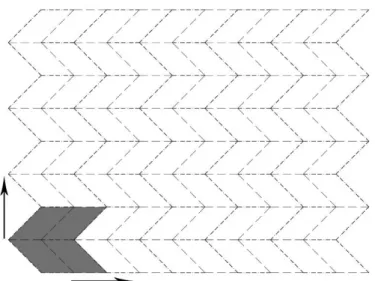
In this pattern we can observe that all the pattern can be described by two simple transla-tions in the horizontal and vertical direction of the base faces. The base faces are com-posed by four quadrilaterals also with a symmetry relation between them.
Figure 1. Miura-Ori Pattern, base faces and vectors of translation
Figure 2. Base faces of Miura Pattern and vertices
First we define the points A, B and D on Grasshopper, all are on the first quadrant so we can simplify the XYZ coordinates. The point E is defined by the translation of the line AD to the point B. The vertices of the line AD and the translated line define the face ADEB. The face ADEB rotates from 0º to 90º around the axis AD, this will be our fixed geometry, the reference to the movement of the whole surface.
Using the rotated face ADEB we define the face BEFC by moving again the AD line to the point J on the XY plane. This point is defined by the intersection of a circle that has is
cen-P a g e | 4
+ info @
This way we define the CF line, and consequently the face BEFC.
To define the faces DGHE and EHIF we simply use the mirror operation with the plane defined by the 3 points D, E and F.
To define the complete surface we use a rectangular array were the array cell is a quadri-lateral defined by the points A, C, F and D. By defining the cell with these points we can guarantee that the cell adapts constantly to their movement, therefore creates a closed geometry with any number of columns and lines
Figure 3. Miura surface, 3 folding states
YOSHIMURA PATTERN
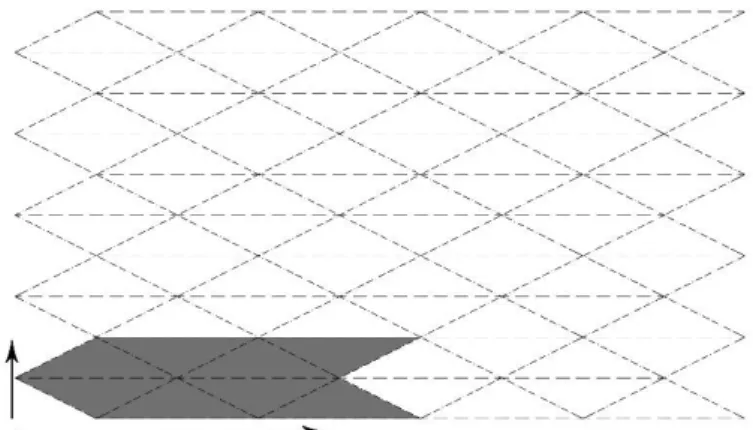
In this pattern we chose a group of eight faces to be the base faces. These are not really the base of the pattern when we think of it in 2D, but we decided to choose these because this is a pattern that folds into a cylinder, so by choosing these triangle faces we can set the initial curvature when parameterizing the folding. This way it is easier to define the translation vectors and the assembly of the different units.
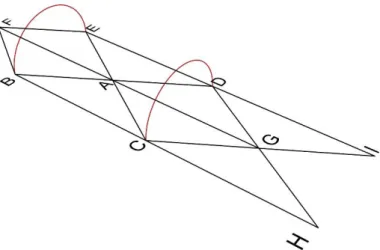
Figure 5. Base faces of Yoshimura Pattern and vertices
The folding starts when the creases AG and AF rotate in the vertical plane defined by them with centre on the point A. At the same time the arcs (red in Figure 5) follow the folding of lines AG and AF. The arc on the left defines the path where the points B and E can exist, the arc on the right defines the path for the points C and D.
The total possible movement of each point during the folding is remapped from 0 to 1 no matter what is the length of the curve where they can exist. This way all the points go from the unfolded to the completely folded state in the same amount of time.
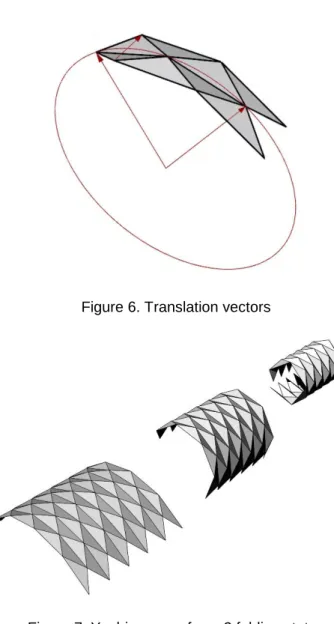
After all the faces are set the copies are made first in a linear way according to the vector BE. Secondly we take this set and copy it according to a vector that starts in the centre of the circle defined by F, A and G and tip the point F and that transforms itself into a vector with the same start point but with endpoint G.
P a g e | 6
+ info @ Figure 6. Translation vectors
Figure 7. Yoshimura surface, 3 folding states
CONCLUSIONS
This paper aims to add some structured knowledge to digital design in a specific type of form, folded surfaces. Although there are several works about Grasshopper definitions on folded surfaces these are mainly disseminated through open source channels and plained roughly or not at all. Instead of being a tutorial for specific patterns this paper ex-plains a method to think about Origami Geometry, to understand the transformations that happen to the faces while folding and to replicate them in order to generate a surface.
We thank FCT for the scholarship (ref.: SFRH/BD/100818/2014) that funds this investiga-tion.
REFERENCES
CASALE, A.; Valenti, G. M.; Architettura delle Superfici Piegate, le Geometrie che Muovono gli Origami, Nuovi quaderni di Applicazioni della Geometria Descrittiva, vol.6, Edizioni Kappa, 2012 DEMAINE, E.; O’Rourke, J. ; Geometric Folding Algorithms: Linkages, Origami, Polyhedra; Cam-bridge University Press, 2007
DEMAINE, E.; Demaine, M.; Hart, V.; Price, G.; Tachi, T.; (Non)existence of Pleated Folds: How Paper Folds Between Creases, in Graphs and Combinatorics, Volume 27, Issue 3 , pp 341-351, Springer Japan, 2011
JACKSON, P.; Folding Techniques for Designers: From Sheet to Form, Laurence, King Publishing, London, 2011
LANG, R.; Origami and Geometric Constructions; 2010
SCHENK, M.; GUEST, S.; Origami Folding: A Structural Engineering Approach, in Origami5 - Fifth International Meeting of Origami Science, Mathematics, and Education; CRC Press by Taylor and Francis Group, 2011
TACHI, T.; Rigid-Foldable Thick Origami, Origami5 - Fifth International Meeting of Origami Sci-ence, Mathematics, and Education, CRC Press by Taylor and Francis Group, 2011