1 ALVES R, FARIA P, BRÁS A (2019), Brita Lavada – An eco-efficient decorative mortar from Madeira Island. Journal:
Journal of Building Engineering 24, 100756 (March 2019). https://doi.org/10.1016/j.jobe.2019.100756
Brita Lavada – an eco-efficient decorative mortar from Madeira Island
Raul Alves1, Paulina Faria2*, Ana Brás3
1 Department of Civil Engineering, NOVA University of Lisbon, Portugal, [email protected]
2 Civil Engineering Research and Innovation for Sustainability (CERIS) and Department of Civil Engineering, NOVA University of Lisbon, Portugal, [email protected] (corresponding author)
3 Built Environment and Sustainable Technologies (BEST) Research Institute, Department of Built Environment, Liverpool John Moores University, UK, [email protected]
Abstract:
Brita Lavada (washed gravel, in direct translation) is a decorative coating technology with a mortar based on cement, local
Madeira basalt gravel and black pigment, currently used for masonry rendering on 20th-21st century Madeiran built heritage simulating stone masonry or cladding. Comparison of Brita Lavada and other cement based coating mortars was made regarding physical behaviour. The Brita Lavada shows high mechanical strength, acceptable water absorption and good water vapour permeability, what can justify its good durability on site and continuous application. The previous justify the interest on preserving the technology and is an example of optimized used of a local material, in the case a very hard basalt, with no possibility to be used for stonework, as a specific resource for a traditional, durable, eco-efficient decorative coating.
Keywords: Decorative coating; local raw material; basalt gravel; cement; physical behavior 1. Introduction
The Portuguese mainland marmorite is an especial decorative mortar made with chosen aggregates: a rough cast wall finishing simulating stone made with a specific technique based in washing the fresh mortar surface to make the selected aggregates visible [1]. Marmorite was very common in the Portuguese mainland during the Estado Novo regime (mainly during the 40s-70s of the 20th century). This technique was most probably based on similar techniques common in Europe in previous decades [2, 3].
2 Since the Portuguese Madeira Archipelago discovery, the Madeiran builders have developed several types of mortars and mortar application technologies. In Madeira the marmorite has undergone some changes especially with regard to its composition. The price of marmorite mortar was expensive because the gravel had to come from mainland. Therefore, Madeiran builders discard using marble gravel mainly because it had to be imported to the island, and they began using an aggregate from the region: a very hard basalt gravel that could be found in many local quarries, that was very difficult to work with for other applications like current stonework, mainly because it was cheaper. Over time, in the 20th century, habitants of the Madeira Island started making the separation of the so-called Brita Lavada (washed gravel, by direct translation) and the common marmorite.
The Brita Lavada is the application of a coating mortar with high proportion of binder (Portland cement) formulated with crushed basalt gravel (particle sizes 0-6mm, locally designated by “sarrisca”) and black pigment (iron oxide). The mortar is applied as a base and finishing coat of a render on the surface of external walls, with a single layer between 1 and 2 centimetres thickness. Previously, a crisp layer of cement and stone powder is applied on the surface of the masonry. The surface of the layer is washed after 3 to 5 hours, depending on the existing relative humidity (RH) and temperature - that in Madeira ranges from 22ºC / 65% RH (summer) and 16°C / 75% RH (winter) -, after mortar application, leaving the gravel integrated in the black-pigmented cement paste more visible, simulating basalt stone and trachybasalt used as stonework in buildings in the island. The mortar is uncoated; the decorative effect is given by the aggregate (colour, shape and size) and the black pigmented cement paste. Mortars of Brita Lavada are applied as decorative and protective coatings mainly on walls, enabling the creation of various patterns and designs: on wall copings, as wall decorative renders simulating stone masonry (Fig. 1 a) or stone claddings, in mouldings of spans (Fig. 1 b) and nowadays also to build sinks, tanks, tubs, among many other objects. In walls, for simulating stone masonry, sometimes joints are created by a wood formwork placed when applying the fresh mortar. After removing the formwork, the joints are pointed with a common mortar.
3 Figure 1 – Applications of Brita Lavada: (a) decorative render simulating stone masonry, (b) side by side with a common rendering mortar in mouldings of spans, (c) surface in detail.
The analysis to several city council documents in Madeira show that Brita Lavada could represent 20% of existing rendering in Madeira buildings, enhancing the importance of this technique. Furthermore, based on oral survey inquiring several construction companies that apply this especial mortar, the most common formulation used in Madeira to make Brita Lavada is “3 buckets of 15 litres of Portland cement, 3 buckets of 25 litres of basalt gravel and 1 bucket of 1 litre of black pigment”, which corresponds to a volumetric proportion of 1:1.73:0.023 (Portland cement: basalt gravel: black pigment). It was found that throughout the 20th century and until nowadays the use of Brita Lavada mortar has been constantly used in different Madeiran buildings. However, in the Archipelago the production is carried out in the construction site, demoted of any kind of regulation or even regional specification. Nevertheless, the durability of this especial decorative mortar is quite good. The number of references focusing on these types of rough cast coating mortars simulating stone is reduced [4, 5]. Nevertheless, there are some studies related to the properties of coloured concrete and cement-based mortars, examining for instance the influence of various inorganic pigments, in terms of consistence in fresh state [6] and the mechanical and physical properties [7], such as compressive and flexural strength [8]. There are also some studies related to cement-based mortars and concrete that uses the same “type” of aggregates evaluating: the capillary coefficient of mortars containing siliceous sand [9] and chemical interaction between siliceous aggregates [10], the chemical interactions between basalt and cement [11] and the influence of basalt as mineral admixture on hydration and microstructure formation mechanism of cement [12; 13], the effects of limestone aggregate geochemistry on aggregate-cement paste bond strength [14] and the influence of limestone aggregate physical properties on aggregate-cement paste interface [15].
A building technique similar to the Brita Lavada was applied for reinforced concrete in the island of S. Miguel, Azores [16]. A building complex (a former alcohol factory) has been converted into an exhibition centre in 2009 (Fig. 2 a). The 21th century existing buildings feature rugged masonry walls were built from volcanic stone (basalt). The concrete of the new building was produced with basalt aggregates from Azores (gravel, grit and sand) together with a black pigment and was left uncoated, with different types of surface, in order to reveal the basalt aggregate concrete (Fig. 2 b).
4 Figure 2 – Building technique similar to the Brita Lavada, applied for reinforced concrete (a); two different types of surface in detail, smooth and rough (b).
Protection of historic fabric through maintenance must be undertaken not only to cover the protection of the fabric of buildings and economic costs of existing built environment but also to address the perspective of environmental impact. This protection undertaken from a cultural perspective is reflected in the fact that 50% of Europe’s national wealth is encapsulated within its existing built environment [17]. Premature deterioration associated with lack of regular maintenance can extensively devalue these existing assets.
Therefore, this research work intends to characterize Brita Lavada and to assess what can justify their good durability on site and longevity of maintenance intervention.
An experimental campaign was defined to characterize the Brita Lavada especial mortar. It was decided to formulate and test five different mortars, some used as reference for comparison: the Brita Lavada common formulation, a similar cement-gravel formulation but without the pigment, two similar to the previous formulations, with and without pigment, but with a limestone crushed gravel from mainland Portugal instead of the basalt gravel, and a common siliceous sand mortar. High moisture content inside the rendering can contribute to worsen capillary rise and cyclic salt crystallization and dissolution. Subsequent weakness of the rendering resistance will occur due to the development of tensions, loose of cohesive properties and leaching phenomena of the original materials - as the case of mortars. For that reason, the repair, maintenance and sustainable use of mortars is very important when it comes to built heritage preservation. Therefore, the maximisation of the longevity of the rendering and the embodied carbon expenditure of each solution is crucial. The justification for the interest on this study, that may find similar cases in different regions of the world, is to contribute to the register and follow up of traditional building techniques using local materials that, until now, are only transmitted orally by master masons to their apprentices, and with which scientific knowledge can also be obtained.
5 2. Materials and testing
2.1 Materials
The Portland cement (PC) used in the production of the mortars is a common grey colour CEM II/B-L 32,5N produced by SECIL, Portugal, according to EN 197-1 [18].
The black pigment (bP) employed in the formulation is an inorganic pigment Preto 318 Bayer manufactured by Benzina
Química Internacional.
In the formulation of the mortars three types of aggregates were used: crushed Madeira basalt gravel (Mbg), characterised elsewhere [19], with particle sizes 0-6 mm from a quarry in Câmara de Lobos, Madeira Island, provided from JAP Company; crushed limestone gravel (Cg), with similar particle size, from a quarry in Sesimbra area, mainland Portugal; for the common mortar a fine siliceous sand (Ss), with particle size 0-2 mm from a quarry also in Sesimbra area.
The aggregates were oven dried to a constant weight at 60ºC prior to use. They were characterized in what concerns to particle size distribution, determined according to standard EN 933-1 [19]. The void volume (VV) and the voids content (e) were obtained through pycnometer method following standard EN 1097-7 [20]. Since there is a significant fraction of large particles in both the gravel aggregates, the maximum size of Faury, DF, can better represent the material [21]. According to Faury the maximum dimension is given by equation 2:
𝐷𝐹= 𝑑1+ (𝑑1− 𝑑2) × 𝑟1 𝑟2
(1)
where d1 is the sieve on which the first quantity of material is retained, d2 is the sieve that follows the sieve d1, r1 is the percentage of material retained at the sieve d1, r2 is the percentage of material retained at the sieve d2.
The loose bulk density (ρb) of all materials was determined according to EN 1097-3 [22].
The water absorption of the basalt stone at atmospheric pressure was tested using the method described in EN 13755 [23].
2.2 Mortar production and samples
As mentioned, the experimental campaign was designed to characterize the especial Brita Lavada mortar. This mortar was formulated with the volumetric proportion obtained by the oral survey of 1:1.73:0.023 (cement: gravel: pigment). The other four formulations were produced with the two distinct gravels, the sand and the black pigment, containing always the same Portland cement as binder. To evaluate the influence of the mineralogy of the gravel in the Brita Lavada mortar, a similar mortar was produced with the limestone gravel. To evaluate the influence of the pigment, the mortars with gravels (basalt
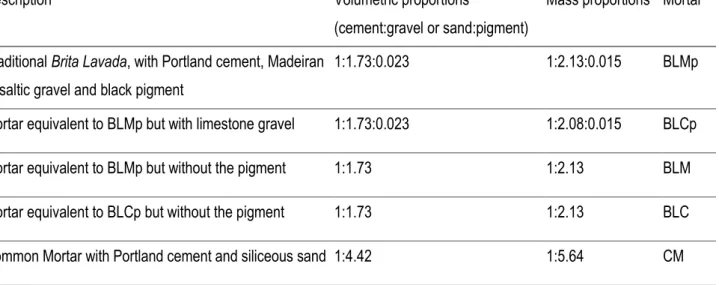
6 and limestone) were formulated with and without that pigment. As the Brita Lavada is often applied on walls, side by side with rendering and pointing mortars, a common mortar (with sand and not gravel) was also formulated. The proportion of this common rendering mortar was also obtained based on oral survey inquiring several Madeiran construction companies. Table 1 presents the five mortars formulations, identifying in each one the materials used, and also their proportion by volume and mass.
Table 1 – Description, volumetric and mass proportions and identification of each mortar
Description Volumetric proportions
(cement:gravel or sand:pigment)
Mass proportions Mortar
Traditional Brita Lavada, with Portland cement, Madeiran basaltic gravel and black pigment
1:1.73:0.023 1:2.13:0.015 BLMp
Mortar equivalent to BLMp but with limestone gravel 1:1.73:0.023 1:2.08:0.015 BLCp
Mortar equivalent to BLMp but without the pigment 1:1.73 1:2.13 BLM
Mortar equivalent to BLCp but without the pigment 1:1.73 1:2.13 BLC
Common Mortar with Portland cement and siliceous sand 1:4.42 1:5.64 CM
The amounts of water added to the mixtures were defined in the laboratory in order to obtain a consistency similar to what is found in the construction site. For that reason, all the mortars were produced manually and they all showed, except the mortar CM, low workability (consistent with the Brita Lavada mortars produced in the construction site).
Prismatic samples were produced, with dimensions 40x40x160 [mm], as well as cylindrical samples with dimensions 90 mm in diameter and 20 mm thick. After four hours, due to specific requirements of the technology, the cylindrical samples top surface was washed with a brush and water, leaving a rough surface, resembling the finishing of traditional Brita Lavada produced in situ.
Twenty-four hours following production the samples were de-moulded and kept, until the age of testing (45 days), at 20±5ºC temperature and 65±5% RH.
7 The consistency of the fresh mortars was determined by flow table method (fv) based on EN 1015-3 [24]. The bulk density of the fresh mortar was determined based on EN 1015-6 [25].
Drying shrinkage was visually assessed when de-moulding the prismatic and cylindrical samples. Some samples were cut to obtain smaller samples for certain tests. The surfaces of the washed cylindrical samples and the cutting surface of samples from the prismatic samples were observed by a magnifying glass.
The apparent density and the open porosity of the hardened mortars were evaluated based on EN 1936 [26] by vacuum saturation method and hydrostatic weighting with six samples with 40x20x20 [mm].
The determination of the flexural and compressive strengths was obtained with the prismatic samples (six tests for each mortar) according to EN 1015-11 [276] using a Zwick Rowell Z050 equipment. The flexural strength was determined by three points test with a load cell with 2 kN. The compressive strength, on a surface of 40x40 [mm], was assessed with one of each sample resulting from flexural test, with a load cell with 50 kN.
The water absorption under low pressure of the hardened mortars was determined according to the methodology described in EN 16302 [28] using the V1 pipe type – Karsten tube. The cylindrical samples were used (three tests for each mortar). The selected pipe is suited for measuring the absorption of the water through a horizontal surface; it consists on a graduated tube welded to its lower part on a cylinder cell. The graduated tube was positioned and fixed to the surface of the test samples with waterproof mastic. Then 4 ml of water was inserted into the pipe and the time required to absorb the amount of water was measured. The water column has a height of 9.8 cm, measured from the start of the gradations to the centre of the cylindrical body, exerting a pressure on the mortar surface of 961.38 Pa - this pressure corresponds to rain drops hitting the wall with a static wind velocity of 140 km/h, perpendicular to the surface [29]. The total duration of the experiment was 60 minutes. It was possible to determine the amount of water absorbed per unit of surface area, at the time ti [ml/cm2]. The water absorption by capillary rise was determined according to recommendations described in standards EN 15801 [30], EN 1925 [31] and EN 1015-18 [32]. Six test samples, with a sectional area of 40x40 [mm] and 65 mm high, cut from the prismatic samples, were sealed, waterproofing the four lateral surfaces with a resin, so that the water absorption throw the base of the sample has an ascending and unidirectional flow. Results are expressed in terms of capillary coefficient (CC), being the slope of the initial capillary absorption segment of the capillary curve.
The drying behaviour of the hardened mortars were determined using the methodology described in EN 16322 [33], after saturation by water absorption due to capillary action of the six previously mentioned samples.
8 The drying curve with time in abscissae is determined and results are expressed by the drying rate of the first drying phase (D1), that is the negative slope of the initial linear part of the curve, and drying index (ID), that reflects the difficulty of total drying and is calculated by equation 3 [33]:
𝐼𝐷 = ∫ 𝑀𝑖𝑑𝑡 𝑡𝑓 𝑡𝑖 𝑀𝑚á𝑥× 𝑡𝑓
(2)
where tf is the final time of the test (and the same for all the analysed mortars), ti is the time elapsed from the beginning of the test, Mi is the mass of the sample at time ti and Mmáx is the mass of the saturated sealed samples.
The drying curve with square root of time in abscissa is determined and the drying rate of the second drying phase (D2) is calculated by the negative slope of the linear part of that curve. Both drying rates were calculated by liner regression, and eight successive aligned points were used.
The water vapour permeability was determined based on EN 15803 [34] and EN 1015-19 [35], by the wet cup method. Three cylindrical samples were placed in a metallic cup containing water (creating a saturated ambient with 100% of RH) and sealed with mastic. The sets samples-cups were placed in a climatic chamber maintained at 23ºC and 50% RH, weighed every 24 hours until reaching a steady state vapour transmission.
For each mortar the mean and standard deviation of test results on individual samples were obtained.
3 Results
3.1 Materials characterization
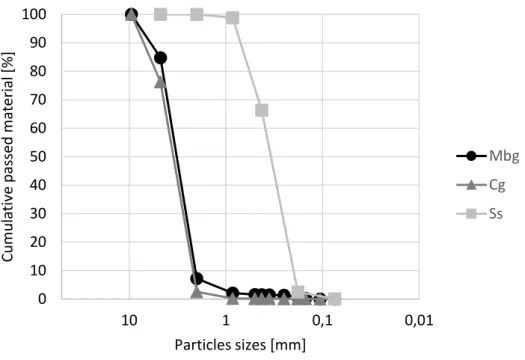
The particle size distribution is represented through the particle size distribution curve (Figure 4). Analysing the Figure 4 it is possible to confirm that the crushed basalt gravel and the crushed limestone gravel have similar particle size distributions, having the Mbg a slightly bigger percentage of smaller particles.
9 Figure 4 – Madeira basalt gravel (Mbg), limestone gravel (Cg) and siliceous sand (Ss) particle size distributions.
Following the attainment of the particle size distribution curves it was also possible to quantify some interesting data [36], presented in
Table 2, for the characterization of the materials, namely the percentile diameters d95 and d10, quartile diameters d75 and d25, median diameter (d50), span (d90-d10), relative span (span/d50) and quartile ratio (d75/d25).
Table 2 – Percentile diameters d95 and d10, quartile diameters d75 and d25, median diameter, span, relative span and quartile ratio values of the aggregates.
Materials d90 [mm] d10 [mm] d75 [mm] d25 [mm] d50 [mm] Span [mm] Relative Span Quartile Ratio Mbg 6.1 2.1 4.5 2.5 3.2 4.0 1.3 1.8 Cg 7.1 2.3 4.6 2.8 3.5 4.8 1.4 1.6 Ss 0.7 0.2 0.5 0.3 0.4 0.5 1.3 1.7
In the case of the Mbg, 50% of the particles are at or below 3.2 mm and 90% are at or below 6 mm. It is possible to see that values of the quartile ratio and relative span are quite similar between all aggregates. All the other data of Mbg and Cg have similarities but, as expected, are quite different from the ones of the sand.
0 10 20 30 40 50 60 70 80 90 100 0,01 0,1 1 10 Cu m u lative p assed m ate ria l [%] Particles sizes [mm] Mbg Cg Ss
10 The maximum dimension of the aggregate (using Faury method) and the minimum dimension of the aggregate are quantified (Table 3).
Table 3 – Faury maximum dimension and minimum dimension for the aggregates
Materials Mbg Cg Ss
DF(mm) 5.20 5.42 0.86
d (mm) 0.85 2 0.18
Analysing Table 3 it is possible to see that the difference on DF of gravels is not significant but, nevertheless, the difference on d is high. As expected, the sand presents the lower values.
Table 4 presents the loose bulk density, the voids volume and the voids content of the basalt gravel, limestone gravel, siliceous sand, black pigment and Portland cement.
Table 4 – Loose bulk density (ρb), void volume (Vv) and voids content (e) of the materials
Materials Mbg Cg Ss bP PC
ρb [kg/m3] 1419 1388 1471 766 1149
VV [%] 30 29 32
e [-] 0.51 0.48 0.44
In terms of loose bulk density of the materials, when visualizing the Table 4 it is confirmed that the two gravels used in these experiments show similar values, a little lower than the one of the sand. As expected the black pigment has the lowest loose bulk density.
The voids volume is very similar for all aggregates, with an increase for the sand. According to some guidelines [37], the voids content obtained during the experiment for a gravel should be in the range of 0.30 - 0.60 and for a silty sand should be in the range of 0.33 - 0.98. The values determined in the experiment (Table 4) are within the previously defined ranges. Mbg has the highest voids content while Ss has the lowest. It is also possible to conclude that, for the aggregates, the bulk density and the voids volume seems to be directly related: for a lower bulk density, lower voids volume (Cg) and, for a higher bulk density, higher voids volume (sand).
11 The water absorption at atmospheric pressure of the basaltic stone was low (0.32%) and consistent with the values obtain from other authors [38].
3.2 Mortar characterization in fresh state
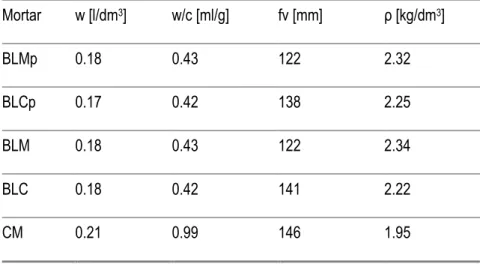
The water content, the water/cement ratio, the flow table consistency and the fresh mortar density are presented in Table 5.
Table 5 – Fresh mortar water content (w), water/cement ratio (w/c), flow table consistency (fv) and density (ρ)
Mortar w [l/dm3] w/c [ml/g] fv [mm] ρ [kg/dm3] BLMp 0.18 0.43 122 2.32 BLCp 0.17 0.42 138 2.25 BLM 0.18 0.43 122 2.34 BLC 0.18 0.42 141 2.22 CM 0.21 0.99 146 1.95
Analysing the Table 5 it can be stated that the amount of water and the water/cement ratio are very similar among the mortars with the same aggregate (the water used in the mortars formulations was maintained constant) and that the pigment had no significant influence in the fv value.
The workability of Brita Lavada will be influenced mainly by the flow properties (fv) and it was noted that this mortar, with low content on fine particles and water, replicating on site production, showed low workability during the mixing; in fact, it was hard to work the mortar with the trowel. The common mortar, with more water/cement ratio, presents a higher flow table consistency and much better workability, also consistent with the on-site production.
The density is higher for the basalt gravel mortars in comparison with the limestone ones and particularly with the common mortar.
3.3 Mortar characterization in harden state 3.3.1 Observation of mortars
12 The hardened mortars were visually analysed with a binocular magnifying glass. In Figure 5 it is possible to observe the aspect of the “washed” surface of the BLM (a) and BLCp (b) and the surface of the CM (c) mortar, with dimensions of the sand in comparison with the gravels. Figure 6 shows a cut surface of samples of gravel mortars BLM (a) and BLCp (b). It is possible to identify, in both gravel mortars, the colour of the cement pastes and the type of gravels (basalt or limestone). Figure 6 also shows the good bond between the paste and the gravels.
Figure 5 – Exterior surface of samples: (a) BLM washed surface (30x), (b) BLCp washed surface (30x), (c) CM surface (50x)
Figure 6 - Cut surface of samples (30x): (a) BLM, (b) BLCp
3.3.2 Flexural and compressive strength
13 Table 6 –Flexural (FStr) and compressive (CStr) strength, apparent density (ρb) and open porosity (Po) of mortars
Mortar FStr [MPa] CStr [MPa] ρb [kg/m3] Po [%]
BLMp 5.27±0.21 32.04±4.51 2202.9±7.1 20.1±0.3
BLCp 4.01±0.50 22.81±5.18 2133.2±13.6 18.1±0.4
BLM 4.35±0.50 26.76±2.73 2180.4±3.6 20.6±0.3
BLC 4.06±0.41 26.46±2.81 2105.8±14.1 18.1±0.3
CM 1.37±0.19 5.24±0.30 1809.3±4.5 21.0±0.2
It is clear that the flexural and the compressive strengths are higher for the mortars with the Madeiran gravel Mbg while the common mortar CM showed the lowest strength. These last results for CM are in accordance with other studies using the same test procedure for cement mortars [39]. The introduction of 0.5% of black pigment on the Brita Lavada mortar contributed to the increase of mechanical resistance through the increase of bulk density.
3.3.3 Apparent density and open porosity
Results of apparent density and open porosity are presented in Table 6. They show that the traditional Brita Lavada BLMp, with Madeiran gravel Mbg in its composition, has a minor increase of open porosity and a minor increase in apparent density compared to mortars with limestone gravel Cg. The higher density of BLMp may justify the higher strengths. The pigment in the mixture did not produce any significant variation in the values reported. The common mortar CM displays the lower apparent density and the higher open porosity.
The porosity and the porosimetry of the mortars may affect not only the mechanical properties but also their water absorption and drying.
3.3.4 Water absorption under low pressure and by capillary rise
In Figure 7 it is possible to observe the curve of water absorption under low pressure – volume of water absorbed (Qi) as a function of time (ti).
14 Figure 7 – Curves of water absorption under low pressure by Karsten tubes
Table 7 presents the average and standard deviation of: W5 – amount of water absorbed per unit of surface area in 5 minutes [ml/cm2] and W60 – similar to previous but in 60 minutes [ml/cm2].
Table 7 – Water absorbed by Karsten tubes per unit of surface area, in 5 and 60 minutes, and the capillary rise coefficient
Mortar W5 [ml/cm2] W60 [ml/cm2] CC [kg/(m2.min0,5)] BLMp 0.38±0.04 2.12±0.21 0.49±0.01 BLCp 0.29±0.11 1.48±0.39 0.33±0.01 BLM 0.42±0.06 2.41±0.21 0.58±0.01 BLC 0.15±0.01 0.92±0.04 0.44±0.01 CM 0.67±0.05 4.02±0.40 1.13±0.01
Observing Figure 7 and Table 7 it is possible to perceive that the mortar CM shows the highest W5 and W60 while the mortars with limestone gravel present the best behaviour with the slowest water intake. Being the basalt gravel mortars the ones with intermediate behaviour facing the contact with water under low pressure, the difference by comparison with the common mortar is significant: after 60 minutes, the water absorbed by BLMg is only 52.7%. However, the common mortar when applied in rendering systems is generally coated by a paint system. Without jeopardizing the protective contribution of the paint system to the render, it can be expected that it also contributes to decrease its water absorption.
0 2 4 6 8 10 12 14 16 18 20 0 10 20 30 40 50 60 Qi (m l) t (min) BLMp BLCp CM BLM BLC
15 The presence of the pigment in the traditional Brita Lavada (BLMp) seems to have a slightly positive effect. Nevertheless, the presence of pigment in the limestone gravel mortars has a contrary effect. Basalt is characterized by iron oxides and iron titanium oxides [19]. In comparison with the limestone gravel, the slight positive effect of the pigment on water absorption in BL renders with basalt gravel, unlike their effects in limestone gravel mortars, may be due to the petrology of the basalt aggregate that connects better with the iron oxide of the pigment.
The water absorption due to capillary rise stabilized after 10 days, corresponding to 120 min1/2 (Figure 8). Table 7 shows the capillary water absorption coefficient determined during the experiment for each one of the mortars (average and standard deviation of 6 samples of each mortar).
Figure 8 – Capillary rise curves of mortars
Analysing the Figure 8 and Table 7 one can state that the mortar CM favours the initial water absorption by capillary (higher slope) and that the pigment present in the gravel mortars decreases the initial water ingress but not the total amount of capillary water. Similarly, to water absorption under low pressure, the traditional Brita Lavada presents an intermediate behaviour in terms of capillary coefficient. Nevertheless, although the capillary coefficient of BLMg is 43.4% of the one of the common mortar, the total amount of water absorbed is similar and higher in comparison with the limestone gravel mortars.
The capillary coefficient is less pronounced in the gravel mortars, probably because of the bond between those aggregates and the Portland cement paste and the dimensions and geometry of the gravel. Nevertheless, it is also notable that the
0 2 4 6 8 10 12 14 0 50 100 Qi [kg /m 2] Time [min0.5] BLMp BLCp CM BLM BLC
16 mortars containing gravel and pigment tends to decrease the capillary coefficient. Results of bulk density may justify the influence of the pigment and the behaviour of the common mortar.
3.3.5 Drying behaviour
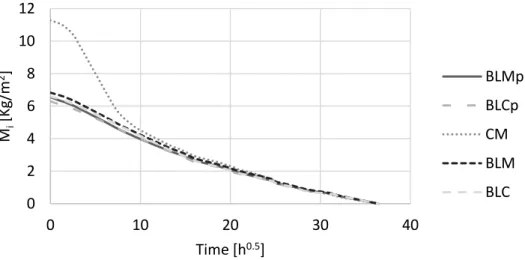
Figure 9 presents the drying curve of mortars with time in abscissae; it is possible to visualize the 1st drying phase of mortars (initial linear segment of the curves). Figure 10 presents the drying curve with the square root of time in abscissae; the linear segment of the curves (in the intermediate part) shows the 2nd drying phase. Comparing Figure 8 with Figure 10 the common mortar CM continues to absorb water by capillarity until saturation, while the gravel mortar stabilized completely saturated with lower amounts of capillary water. Results of D1, D2 and ID are presented in Table 8.
Figure 9 – Drying curve by time showing drying phase 1 of mortars
Figure 10 – Drying curve by square root of time showing drying phase 2 of mortars 0 2 4 6 8 10 12 0 500 1000 1500 M i [Kg /m 2] Time [h] BLMp BLCp CM BLM BLC 0 2 4 6 8 10 12 0 10 20 30 40 Mi [Kg /m 2] Time [h0.5] BLMp BLCp CM BLM BLC
17 By the drying curves (Figure 9 and Figure 10) and Table 8 it can be observed that the drying rates D1 and D2 and the drying index are quite similar for gravel mortars but the common mortar CM presents much higher drying rates, both D1 and D2, and a lower ID. It is safe to say that the mortar CM (which had previously absorbed much more capillary water) dries faster than the rest of the mortars during phases 1 and 2 of drying and presents a higher ability for total drying. Nevertheless, one should bear in mind that the gravel mortars are designed to be uncoated because of aesthetic reasons while the common mortar is currently coated by a paint system (Figure 1). As mentioned before it is expected that the paint systems, even those defined not to strongly influence drying, will indeed decrease that capacity [41].
Table 8 – Drying rates D1 and D2 and drying index ID
Mortar D1 [kg/(m2.h)] D2 [kg/(m2.h1/2)] ID [-] BLMp 0.093±0.02 0.253±0.01 0.241±0.02 BLCp 0.086±0.01 0.254±0.02 0.245±0.01 BLM 0.084±0.01 0.244±0.01 0.245±0.01 BLC 0.084±0.01 0.263±0.02 0.240±0.01 CM 0.143±0.01 0.939±0.02 0.158±0.01
3.3.6 Water vapour permeability
Table 9 shows the results of the water vapour permeance, in terms of water vapour diffused through the mortars (Wp), water vapour resistance factor (µ), water vapour permeability (δp) and water vapour diffusion-equivalent air layer thickness (Sd), that indicates the thickness of a motionless air layer that has the same water vapour resistance as the circular samples with thickness 2 mm – all different ways to express water vapour permeability, to facilitate comparison with other studies. It is possible to affirm that the water vapour permeability decreases when pigments are added to the mortars and that the mortars containing basalt gravel are more permeable in comparison with limestone gravel mortars. The traditional Brita Lavada presents the highest permeability among the gravel mortars. Although the CM mortar presents the highest water vapour permeability, it will most probably strongly decrease when a paint coating system is applied to protect the rendering mortar [41], as mentioned previously.
18 Table 9 – Water vapour permeance (Wp), water vapour resistance factor (µ), water vapour permeability (δp) and water vapour diffusion equivalent air layer thickness (Sd)
Mortar Wp [kg/(m2.s.Pa)10+10] µ [-] δp [kg/(m.s.Pa)10+12] Sd [m]
BLMp 11.16±1.16 31.03±3.77 22.98±2.38 6.39±0.63 BLCp 8.54±0.52 39.49±3.02 17.94±1.09 8.29±0.52 BLM 10.17±0.12 31.88±0.48 22.14 ±0.27 6.94±0.09 BLC 7.84±0.54 44.93±3.98 15.79±1.09 9.05±0.66 CM 20.65±0.57 16.92±0.57 41.75±1.14 3.42±0.09 4 Discussion
4.1 Fresh state behaviour
Basalt particles are characterized by sharp-edge and split-like grains, originating from relatively hard and brittle-breaking natural stone, absorbing more water due to increased surface area [11]. Therefore, the angular and elongated geometry of the gravels, combined with a rough surface, had a negative influence on the mortars workability.
The fresh density was very similar for all the mortars, although the mortars containing basalt had densities slightly higher. This is mainly because the basalt gravel has a high density and may also be related with the stability of the basalt phases counter to the silica sand and limestone gravel, which can react with hydration products [42, 43].
When 0.5% of black pigment is added to the cementitious mortars, it was notable a slight decrease in the workability, decreasing the fv in 3% for the limestone mortars while for the basalt mortars the fv value was constant. The probable spheroid shape and small size particles of the black pigment did not increase the fluidity and workability of the cementitious mortar [43].
4.2 Mechanical properties
There are studies remarking that basalt mortars have better physic-mechanical properties when compared with limestone mortars [12]. By analysing the data of mechanical strength (CStr and FStr) and open porosity it is notable that, as expected, the mechanical strength increases with the decrease of open porosity (for a mortar with the same aggregate type). The
19 lower porosity is probably due to chemical interaction between these aggregates and the cementitious matrix [11] and directly influences strength (denser mortar).
A drop in concrete resistance when pigment is added may be due to the increase of water because of specific surface demands. But adding pigment can also densify the matrix, increasing the mechanical resistance. Studies show that when the resistance is lowered by adding pigment it is possible to maintain its original consistency by adjusting the water/cement ratio [7]. Also, the incorporation of pigment, on the right proportions, do not cause any sort of changes [8].
In the present study, it is possible to remark that the introduction of 0.5% of black pigment contributed, in the case of the traditional Brita Lavada, BLMp, for the increase of the mechanical resistance – 17% and 16% for the flexural and compressive strength, respectively. For the mortar BLCp the opposite happened: the addition of the pigment caused a reduction in the mechanical resistance – 1% and 14% for the flexural and compressive strength, respectively.
4.3 Physical properties
It is known that the porous transition zones formed at the aggregate-paste interfaces affect the pore size distribution and the mortars´ permeability [45]. This tendency may be observed by the relation between the open porosity, the water absorption under low pressure and the water vapour permeability. The higher amount of liquid and gaseous water absorbed corresponds to mortar with higher open porosity (Table 9). However, this type of observation is not valid for all the mortars. The mortars BLMp and BLM present a decrease in the open porosity and an increase in the water vapour permeability, contradicting what is normally presented by various mortars. It is considered that this may be related to the quantity of pores, the pore size and how they are connected [22].
From the results obtained it is fair to say that a higher porosity may translate in to a larger quantity of pores, which is associated with a greater number of connections between pores. Thereby, the route of the water vapour molecules is characterized by a greater number of transition situations. On the other hand, a lower porosity could represent pores of smaller dimensions, and that the volume occupied by the water vapour molecules absorbed on the surface of the pores contributes to a reduction of flow, since there is less space available for the free flow of the remaining vapour molecules [22].
Comparing the results of capillary water absorption coefficient (CC) with the ones of open porosity and also with the water absorption by the Karsten tubes at 60 minutes (W60), it is safe to say that some sort of relation exists between the values, because, for higher Po, higher is the CC. It is also visible that for higher CC, higher W60, and both water absorption tests
20 complement each other. However, this type of observation is not valid for all the tested mortars. The mortars BLCp and BLC have higher W60 and lower CC, contradicting the forecasted.
Also, the cement paste is responsible for the existence of micro-pores in mortar microstructure, which enable the increasing of capillary water absorption coefficient [46].
Observing the Table 9 it can be observed that the results of capillary water absorption coefficient (CC) and water vapour permeability (δp) have the same tendency, being possible to conclude that the mortars with lower δp present lower CC. Can still be stated that the mortars with pigment and gravel in its composition have lower CC and δp – adding black pigment will decrease the water absorption by capillary rise [42].
Depending on the dominant mechanism during water movement, the moisture transport can be expressed in two forms in cementitious materials: (1) pore relative humidity or (2) pore evaporable water [47]. Vapour and liquid flow usually occur in the same direction and are rarely separated in studies. However, it is more practical to consider one mechanism of moisture movement, preferably water transfer, in both states of water absorption and moisture loss [48].
The gravel mortars have a higher compactness which translates in to a minor access of water by capillarity and greater difficulty in drying. It is also possible to conclude that, for higher Po, higher it will be the CC and also δp. Therefore, it is possible to view the important role of the pore structure in terms of water absorption.
Lastly in Table 9 the relation between the results obtained in the drying test, water absorption by capillarity and the open porosity of the Brita Lavada are shown. Theoretically, for a higher value of Po, greater is the drying capacity of the material; so, smallest ID it will present. In a cement paste, it is suggested that capillary pores larger than 10 nm influence mostly the strength and permeability, while gel pores, smaller than 10 nm, influence the drying shrinkage and creep [49]. Porosimetry studies, that were not possible to perform, would complement the mortars characterization, allowing to justify some behaviours.
Capillary water absorption is related to the initial capillary forces, which depend on the pore structure and temperature based on studies by McCarter [50] and Grant and Bachmann [51]. Moreover, there will always be condensation or evaporation at the water menisci; therefore, a phase transformation exists between the vapour and liquid phases during a water transport process [52].
After analysing the five mortars with regards to its absorption and evaporation of water and mechanical resistance, a global analysis should be performed. The Brita Lavada (BLMp) presented the higher mechanical strength, being the use of basalt gravel and the addition of pigment positive for strength. That agrees with the hardened density. In terms of water absorption
21 and evaporation the limestone based mortar with pigment (BLCp) displayed better behaviour. The pigment of Brita Lavada is also positive in terms of behaviour facing liquid water. Nevertheless, in this regard the limestone gravel performs a little better in comparison with the basalt gravel. Although the drying does not show significant differences among the gravel mortars, the water vapour permeability seems advantageous for the traditional Brita Lavada. Significant differences are presented by Brita Lavada in comparison to a common mortar.
5 Conclusions
This research work intends to demonstrate the characteristics that make Brita Lavada being choose as an optimised solution for masonry rendering in Madeira 20th–21st century heritage.
An experimental campaign was defined to characterize from a physical and mechanical perspective the Brita Lavada mortar. It was decided to formulate and test five different mortars, some used as reference for comparison. High moisture content inside the rendering can contribute to worsen capillary rise and cyclic salt crystallization and dissolution. Subsequent weakness of the rendering resistance will occur due to the development of tensions, loose of cohesive properties and leaching phenomena of the original materials - as the case of mortars. For that reason, the repair, maintenance and sustainable use of mortars is very important also when it comes to 20th and 21st century built heritage preservation. From the results, it can be concluded that the traditional Madeiran Brita Lavada with basalt gravel and black iron oxide pigment features:
• A very high mechanical strength compared to all the other tested mortars; this may be due to the characteristics of the gravel, namely specific surface area of the aggregates and, eventually, reactivity between the pigment and the aggregates.
• An acceptable water absorption under low pressure and water absorption due to capillary rise, although higher than the limestone gravel mortars but much lower than the common mortar; nevertheless, it is foreseen that a paint system applied on renders made with the common mortar would decrease their capillary absorption.
• An acceptable value of drying capability and a good value of water vapour permeability compared to the other gravel mortars; although lower than the common mortar, the Brita Lavada permeability will not decrease because it will be un-coated and will not be painted, as the common render.
22 These properties of high mechanical strengths, together with limited water absorption, associated to adequate drying capacity and good water vapour permeability may justify the good durability that this traditional decorative mortar presents on site.
Therefore, this regional decorative coating technique deserves to be defined, in order to be preserved and the knowledge not lost. Simultaneously shows how local materials, in the case a very hard basalt, with no possibility to be used for stonework, can be availed and used as a specific resource for a traditional, durable, eco-efficient decorative coating. Acknowledgments
This work was supported by Fundação para a Ciência e a Tecnologia by project PTDC/EPH-PAT/4684/2014 - DB-HERITAGE and grant support to the third author (SFRH/BPD/111183/2015). Authors want to thank the helpful support of Eng. Vitor Silva in the experimental campaign and Arch. José Lima for photos on Figure 2.
References
[1] Tavares M., Veiga R., Fragata A., Aguiar J. Consolidation of renderings simulating stone in the façade of LNEC’s building. Stone Consolidation in Cultural Heritage, International Symposium, Lisbon, LNEC, 2008.
[2] Dekeyser L., Verdonck A., De Clercq H. Belgian craftsmanship in the interwar period: formulas and application techniques of decorative cement-based wall finishes. International Journal of Architectural Heritage, 2015. DOI: 10.1080/15583058.2015.1017780
[3] Govaerts Y., Verdonck A., de Bouw M., Meulebroeck W. The introduction of ready-mix rendering mortars for stone imitation in Belgium [1920-1940]. Construction History Society: First National Conference, Cambridge, 2014.
[4] Faria P., Tavares M., Menezes M., Veiga R., Margalha G. Traditional Portuguese techniques for application and maintenance of historic renders. RILEM Proceedings Pro 078: HMC2010 - 2nd Historic Mortars Conference and RILEM TC 203-RHM Final Workshop (J. Walek, C. Groot, J. Hughes, Ed.), p. 609-617, 2010.
[5] Veiga R., Tavares M., Magalhães A. Facade restoration in lime-based marmorite of the National Civil Engineering Laboratory, in Lisbon. Materials, methods and results. Seminário Brasileiro de Tecnologia de Argamassas, Recife, Pe. Brazil, 2007 (in Portuguese).
[6] Lee H., Lee J., Yu M. Influence of the inorganic pigments on the fluidity of cement mortars. Cement and Concrete Research, Vol. 35, p. 703-710, 2005. DOI:10.1016/j.cemconres.2004.06.010.
23 [7] Mowat C., Symons M. Physical properties of concrete containing pigments. Symposium on Concrete - Towards Better Concrete Structures, Adelaide, Vol. 24, p. 16-24, 1981.
[8] Buchner G. Pigments in concrete production. Betonwerk und Fertigteil-Technik, Vol. 57 (8), p. 54-61, 1991.
[9] Stefanidou M. Cement-based renders with insulating properties. Construction and Building Materials, Vol. 65, p. 427-431, 2014. DOI:10.1016/j.conbuildmat.2014.04.062.
[10] Lee W., Van Deventer J. Chemical interactions between siliceous aggregates and low-Ca alkali-activated cements. Cement and Concrete Research, Vol. 37, p. 844-855, 2007. DOI:10.1016/J.cemconres.2007.03.012.
[11] Tasong W., Cripps J., Lynsdale C. Aggregate-cement chemical interactions. Cement and Concrete Research, Vol. 28, p. 1037-1048, 1998. DOI: 10.1016/S0008-8846(98)00067-2.
[12] Saraya M. Study physico-chemical properties of blended cements containing fixed amount of silica fume, blast furnace slag, basalt and limestone, a comparative study. Construction and Building Materials, Vol. 72, p. 104-112, 2014. DOI: 10.1016/j.conbuildmat.2014.08.071.
[13] Laibao L., Yunsheng Z., Wenhua Z., Zhiyong L., Lihua Z. Investigating the influence of basalt as mineral admixture on hydration and microstructure formation mechanism of cement. Construction and Building Materials, Vol. 48, p. 434-440, 2013. DOI: 10.1016/j.conbuildmat.2013.07.021.
[14] Tasong W., Lynsdale C. Cripps J. Aggregate-cement paste interface. Part I: Influence of aggregate geochemistry. Cement and Concrete Research, Vol. 29, p.1019-1025, 1999. DOI: 10.1016/S0008-8846(99)00086-1.
[15] Tasong W., Lynsdale C. Cripps J. Aggregate-cement paste interface. Part II: Influence of aggregate physical properties. Cement and Concrete Research, Vol. 28, p. 1453-1465, 1998. DOI: 10.1016/S0008-8846(98)00126-4.
[16] Público Newspaper of 10th April. The concrete found the basalt rock and that gave a darker gray, 2015 [in Portuguese]. [17] Kaylan, B., Forster, A., Ban fill, P. Green maintenance for historic masonry buildings: An option appraisal approach. Smart and Sustainable Built Environment, Vol. 5, p. 143-164, 2016.
[18] EN 197-1:2000. Cement. Part 1: Composition, specifications and conformity criteria for common cements. CEN, Brussels.
[19] Alves R., Faria P., Simões J. Experimental characterization of a basalt from Madeira Island traditionally applied in a regional decorative mortar. J. Building Engineering, Vol. 13, p. 326-335, 2017. DOI: 10.1016/j.jobe.2017.09.004
[20] EN 933-1:2012. Tests for geometrical properties of aggregates. Part 1: Determination of particle size distribution. Sieving method. CEN, Brussels.
24 [21] EN 1097-7:2008. Tests for mechanical and physical properties of aggregates. Part 7: Determination of the particle density of filler. Pyknometer method. CEN, Brussels.
[22] Rato V. Influence of morphologic microstructure in the performance of mortars. PhD thesis. Universidade Nova de Lisboa, 2006 [in Portuguese].
[23] EN 1097-3:1998. Tests for mechanical and physical properties of aggregates. Part 3: Determination of loose bulk density and voids. CEN, Brussels.
[24] EN 13755:2008. Natural stone test methods. Determination of water absorption at atmospheric pressure. CEN, Brussels.
[25] EN 1015-3:2004. Methods of test for mortar for masonry. Part 3: Determination of consistence of fresh mortar (by flow table). CEN, Brussels.
[26] EN 1015-6:1998. Methods of test for mortar for masonry. Part 6: Determination of bulk density of fresh mortar. CEN, Brussels.
[27] EN 1936:2008. Natural stone test methods. Determination of real density and apparent density, and of total and open porosity. CEN, Brussels.
[28] EN 1015-11:1999. Methods of test for mortar for masonry. Determination of flexural and compressive strength of hardened mortar. CEN, Brussels.
[29] EN 16302:2013. Conservation of cultural heritage. test methods. Measurement of water absorption by pipe method. CEN, Brussels.
[30] Van Hees, R., Koek J., De Clercq H., De Witte E., Binda L. Evaluation of the performance of surface treatments for the conservation of brick masonry. 8th Int. Congress on Deterioration and Conservation of Stone, Berlin, Vol. 3, pp. 1695-1715, 1996.
[31] EN 15801:2009. Conservation of cultural property. test methods. Determination of water absorption by capillarity. CEN, Brussels.
[32] EN 1925:2000. Natural stone test methods. Determination of water absorption coefficient by capillary. CEN, Brussels. [33] EN 1015-18:2002. Methods of test for mortar for masonry. Part 18: Determination of water absorption coefficient due to capillary action of hardened mortar. CEN, Brussels.
25 [35] EN 15803:2009. Conservation of cultural property. test methods. Determination of water vapour permeability. CEN, Brussels.
[36] EN 1015-19:2004. Methods of test for mortar for masonry. Part 19: Determination of water vapour permeability of hardened rendering and plastering mortars. CEN, Brussels.
[37] Weiner B. What is a continuous particle size distribution. Brookhaven Instruments Corporation White Paper, New York, 2011.
[38] Braja M. Advanced soil mechanics. Taylor & Francis, London & New York, 2008.
[39] Reis A. Organization and management of constructions. Edições Técnicas ETL, Lisbon, 2010 (in Portuguese). [40] Faria P., Henriques F. Current mortars in conservation: an overview. Restoration of Buildings and Monuments, Vol.10 (6), p.609-622, 2004. DOI: 10.1515/rbm-2004-5901.
[41] Brito V., Gonçalves T., Faria P. Coatings applied on damp substrates: performance and influence on moisture transport. J. Coating Technology and Research, Vol.8 (4), p. 513-525, 2011. DOI: 10.1007/s11998-010-9319-5.
[42] Song H., Pack S., Nam S., Jang J., Saraswathy V. Estimation of the permeability of silica fume cement concrete. Construction and Building Materials, Vol. 24, p. 315-21, 2010. DOI: 10.1016/j.conbuildmat.2009.08.033.
[43] Gunter B. Industrial Inorganic Pigment. VCH Publishers, Inc., New York, 1993. [44] Peter L. Pigment handbook. John Wiley & Son, New York, 1988.
[45] Halamickova P., Detwiler R. Water permeability and chloride ion diffusion in Portland cement mortars: relationship to sand content and critical pore diameter. Cement and Concrete Research, Vol. 25, p. 790–802, 1995. DOI: 10.1016/0008-8846(95)00069-O
[46] Brás A., Leal M., Faria P. Cement-cork mortars for thermal bridges correction. Comparison with cement-EPS mortars performance. Construction and Building Materials, Vol. 49, p. 315-327, 2013. DOI: 10.1016/j.conbuildmat.2013.08.006 [47] Bazant Z., Najjar L. Nonlinear water diffusion in nonsaturated concrete. Materials and Structures, Vol. 5, p. 3-20, 1972. [48] Martin-Perez B., Pantazopoulou S., Thomas M. Numerical solution of mass transport equations in concrete structures, Computational and Structural, Vol. 79, p. 1251–1264, 2001. DOI: 10.1016/S0045-7949(01)00018-9.
[49] Mehta P. Concrete: structure, properties, and materials. Englewood Cliffs, NJ: Prentice-Hall; 1986.
[50] McCarter W. Influence of surface finish on sorptivity on concrete. J. Materials in Civil Engineering, Vol. 5, p. 130-136, 1993. DOI: 10.1061/(ASCE)0899-1561(1993)5:1(130).
26 [51] Grant S., Bachmann J. Effect of temperature on capillary pressure. US Army Cold Regions Research & Engineering Laboratory, Hanover, New Hampshire, 2000. DOI: 10.1029/129GM18.
[52] Chari M., Shekarchi M., Sobhani J., Chari M. The effect of temperature on the moisture transfer coefficient of cement-based mortars: An experimental investigation. Construction and Building Materials, Vol. 102, p. 306-317, 2016. DOI: 10.1016/j.conbuildmat.2015.10.065.


![Table 7 presents the average and standard deviation of: W 5 – amount of water absorbed per unit of surface area in 5 minutes [ml/cm 2 ] and W 60 – similar to previous but in 60 minutes [ml/cm 2 ]](https://thumb-eu.123doks.com/thumbv2/123dok_br/19187459.948339/14.892.104.694.116.404/presents-average-standard-deviation-absorbed-surface-minutes-previous.webp)