Mathematical Problem Solving with Technology:
the Techno-Mathematical Fluency of a Student-with-GeoGebra
*Hélia Jacinto
UIDEF, Instituto de Educação, Universidade de Lisboa [email protected]
Susana Carreira
Departamento de Matemática, Faculdade de Ciências e Tecnologia, Universidade do Algarve and UIDEF, Instituto de Educação, Universidade de Lisboa
Abstract This study offers a view on students’ technology-based problem solving activity through the lens of a theoretical model which accounts for the relationship between mathematical and technological knowledge in successful problem solving. This study takes a qualitative approach building on the work of a 13-year-old girl as an exemplary case of the nature of young students’ spontaneous mathematical problem solving with technology. The empirical data comprise digital records of her approaches to two problems from a web-based mathematical competition where she resorted to GeoGebra and an interview where she explains and describes her usual problem solving activity with this tool. Based on a proposed model for describing the processes of mathematical problem solving with technologies (MPST), the main results show that this student’s solving and expressing the solution are held from the early and continuing interplay between mathematical skills and the perception of the affordances of the tool. The analytical model offers a clear picture of the type of actions that lead to the solution of each problem, revealing the student’s ability to deal with mathematics and technology in problem solving. By acknowledging this as a case of a human-with-media in solving mathematical problems, the students’ efficient way of merging technological and mathematical knowledge is portrayed in terms of her techno-mathematical fluency. Keywords Affordances. Digital problem-solving. Humans-with-media. Mathematical problem solving. Techno-mathematical fluency.
Researching Problem Solving in a Beyond-School Environment
* Jacinto, H., & Carreira, S. (2016). Mathematical Problem Solving with Technology: the Techno-Mathematical Fluency of a Student-with-GeoGebra. International Journal of Science and Mathematics
Education. International Journal of Science and Mathematics Education, 15(6), 1115-1136.
The bulk of the existing research on the use of digital tools for the learning of mathematics mainly concerns the classroom, the mathematics curriculum and inside school contexts. Yet out-of-school and beyond-school mathematized contexts are encouraging the reflection on the sort of skills that may become especially important in the technological, global and interconnected society of the twenty-first century (Barbeau & Taylor, 2009; Hoyles, Noss, Kent & Bakker, 2010; Lesh, 2000; Zevenbergen & Zevenbergen, 2009).
This is why investigating students’ mathematical problem solving with technological tools in a beyond-school context is expected to illuminate the generally unknown ways in which students use and combine their mathematical and technological knowledge outside the classroom, particularly when they are allowed to pick any digital tool of their choice and use it to achieve mathematical purposes. This study brings new knowledge about the spontaneous use of technology in solving non-routine mathematical problems by young people who autonomously engage in an online problem solving competition. The aim of the research is to develop a perspective on the ways students put their mathematical skills and technological know-how into action whilst solving and expressing problems. By redesigning and expanding well-known earlier theoretical models, we suggest a more refined way to describe the processes of solving mathematical problems with technology. We further propose the notion of techno-mathematical-fluency as a way of understanding the effectiveness of combining mathematical knowledge and the affordances of digital tools in a problem solving context.
Research Questions and Context
This study widens the research on students’ mathematical problem solving by building upon a beyond-school technologically rich environment and by revealing, under a purposely adopted perspective, how participants use their mathematical and technological abilities when they resort to a digital tool for solving problems. The research starts from a well-established theoretical background on mathematical problem solving, particularly when it comes to conceptualizing the steps undertaken along the route to achieve a solution. The need to rethink and extend such theoretical model by incorporating a view on using technology to solve problems has motivated the introduction of other theoretical constructs, particularly on digital problem solving. The theoretical framework is thus in tune with and driven by the research aim of knowing how the technological and mathematical knowledge of students is used in problem solving. Hence, the following research questions lead this study: (i) how do youngsters tackle mathematical problems by spontaneously resorting to digital technologies and (ii) how can the effectiveness of solving and expressing a mathematical problem with technology be understood?
The research context is a beyond-school problem solving competition, named SUB14®, within which we decided to study the case of a participant’s processes of solving and expressing geometry problems with GeoGebra. The SUB14 is a web-based mathematical problem solving competition targeting students from seventh and eighth grades (12 – 14 years old) and covering about 140 middle schools in the south of Portugal. The qualifying phase consists of answering ten problems, either through email or the online form
available on the competition website, each one published every 2 weeks. Participants may solve the problems using their preferred methods and tools but are explicitly required to report on their solving process and must offer a complete and detailed explanation of their reasoning. The rules of the competition permit and encourage help seeking from relevant others during the online stage of the contest.
The following sections offer the theoretical framework that supports the proposal of a model for describing mathematical problem solving with digital tools; the research methods provide a description of the methodological issues regarding the data collection and analysis; the results are presented in light of the case of Jessica solving problems with GeoGebra, where her typical approach to the problems is portrayed and her processes of solving and expressing with GeoGebra are described and analysed; then a summary of the findings is presented whilst highlighting the notion of techno-mathematical fluency as a concept that emerges from problem solving activity with digital tools. The paper concludes with implications of the findings.
Theoretical Background Overall Structure
A keystone of the theoretical background is the inseparability between the subject and the technological tool in solving problems and expressing the solutions. In addressing the students’ ways of tackling the mathematical problems by means of digital tools, we adopt humans-with-media as a core conceptual unit, thus inducing a view of mathematical thinking and expressing as entangled with the representational power of leading-edge digital technologies. Another fundamental element of the theoretical framework lies in people’s interaction with the digital media. This is seen from the point of view of placing affordances in the tools, in the sense that they are both relative to the object and to the subject who realises its advantages. In accounting for the processes of solving a mathematical problem with technologies, we combine two analytical tools: a mathematical problem solving framework and a digital technology problem solving framework. In understanding the effectiveness of solving and expressing problems with technology, we argue that techno-mathematical fluency holds up the entanglement between mathematical and technological knowledge and skills necessary for an efficient activity of problem solving with technologies.
Solving-and-Expressing with Digital Media
Theoretically and also from the point of view of the data under consideration, problem solving is conceived as a synchronous process of mathematization and expression of mathematical thinking (Carreira, Jones, Amado, Jacinto, & Nobre, 2016). This means that getting an answer to a problem gives way to creating an explanation for the answer, that is, to solve a problem encapsulates both the required answer and the process to find it. Rather than separating the solution phase from the reporting stage, the two are closely linked aspects of problem solving and that link is clearly stronger when the use of digital
tools is available to support the expression of mathematical thinking (Carreira et al.,
2016). Therefore, all the material incorporated in the final product is actually part of the solution process as timely argued by Lesh and Doerr (2003):
…descriptions, explanations, and constructions are not simply processes students use on the way to Bproducing the answer^, and, they are not simply postscripts that students give after the Banswer^ has been produced. They ARE the most important components of the responses that are needed (p. 3).
Today, the idea of expressing thinking as part of mathematical problem solving gets a new impetus because expressing mathematical thinking requires considering the media to convey it. Therefore, it is essential to look at the user and the tool as a single unit and understand how this unit operates in solving-and-expressing problems.
Humans and Digital Tools as Collectives
Different theoretical perspectives seek to interpret and outline the relationship between individuals and technologies during activities that involve mathematical thinking:
It is clear that no single theoretical framework can explain all phenomena in the complex setting of learning mathematics in a technology-rich environment. Different theoretical frameworks offer different windows on it, and each view on the landscape can be sound and valuable. (Drijvers, Kieran, Mariotti, Ainley, Andresen, Chan, Dana-Picard et al., 2010, pp. 121 – 122).
Aiming at studying the engagement of young students with the technological world in a beyond-school problem solving competition, we elect the theoretical contribution of Borba and Villarreal (2005), laying emphasis on the idea that processes mediated by technologies lead to a reorganization of the human mind and proposing that knowledge itself is an outcome of this symbiosis between students and the technology with which they act.
This symbiotic relation originates a new entity that Borba and Villarreal (2005) name ‘humans-with-media’—a metaphor that explains the ways in which the use of a technological tool transforms and reorganizes the thinking processes. The digital tools that are used to communicate, to produce or represent mathematical ideas influence the kind of mathematics as well as of mathematical thinking developed. Hence, the introduction of a specific tool in the system of humans-with-media impels concrete changes in the activity, according to the type of media that it encloses, thereby resulting that different collectives originate different ways of thinking and knowing (Villarreal & Borba, 2010). Previous research results also suggest that different individuals solving the same problem, even when using the same digital tool and recognizing a similar set of affordances, produce different digital solutions and qualitatively different conceptual models (Jacinto & Carreira, 2013). The contrasting mathematical thinking underlying different conceptual models reflects the symbiotic relationship between the aptitudes of the solvers and their perception of the affordances of the tool.
Whilst different types of knowledge arise from the activity mediated by a specific digital tool, their efficient use rests in a proper recognition of its affordances—the set of features arrogated to a certain tool or object that invite the subject to undertake an action (Gibson,
1979). If “perceiving affordances is placing features, seeing that the situation allows a certain activity” (Chemero, 2003, p. 187), then affordances emerge from the interaction between the agent and the object (Day & Lloyd, 2007), an idea already conveyed by Greeno (1994) in terms of ‘agent-situation interactions’. The conditions that impel those
interactions necessarily include some characteristics of the perceiver and some features of the object. Thus, whilst affordances refer to whatever features there are in the system that drive an action, one must define whatever is in the agent that contributes to that interaction – and for that matter Greeno (1994) offered the labels ‘ability’ or ‘aptitude’. Despite the diversity of theoretical views and even divergent arguments in this respect, there seems to be a consent upon the impossibility of separating the affordance of the tool from the ability of the agent, insofar as the perception of the possibility for action and the aptitude of the person are not “specifiable in the absence of specifying the other” (Greeno,
1994, p. 338).
The case presented below includes the analysis of perceiving affordances of a digital tool (as something relative to the object and the subject) by a student-with-GeoGebra (as a unit) in the context of solving-and-expressing given problems.
Processes Involved in Solving Mathematical Problems with Technology Within the scope of the online competition SUB14, solving a mathematical problem is a task that can become both a mathematical and a technological task. Thus, studying the participants’ mathematical problem solving with technology requires an appropriate descriptive model. Concurrent views on the meaning of being mathematically competent stress the ability to use mathematics but also to use tools for thinking mathematically, which is condensed in the idea that “becoming mathematically competent has to do with how students appropriate and gain expertise in using tools for thinking and acting” (Llinares & Roig, 2008, p. 506, our emphasis). However, whilst the existent digital literacy frameworks do not address mathematical activity, most of the mathematical problem solving models have emerged from paper-and-pencil tasks, so it remains the query if and to what extent they still account for this activity (Santos-Trigo & Camacho-Machín, 2013). This hiatus is now prompting a combination of models in order to provide the necessary level of detail for describing mathematical-problem-solving-with-technology.
The DigEuLit research project (Martin, 2006) aimed to develop a theoretical framework to guide the European teachers and students into sharing a common understanding on digital literacy. Within this project, it is assumed that digital literacy comprises the
awareness, attitude and ability of individuals to appropriately use digital tools and facilities . . . in the context of specific life situations, in order to enable constructive social action; and to reflect upon this process (Martin, 2006, p. 155).
The framework states a set of processes that are performed in the context of solving a task or problem that requires the use of a digital resource (Martin & Grudziecki, 2006). The
list of relatively sequential processes comprises: statement—clearly state the problem to be solved and the actions likely to be required; identification—identify the digital resources required to achieve the completion of the task; accession—locate and obtain those digital resources; evaluation—assess the accuracy and reliability of the digital resources and their relevance for solving the problem; interpretation— understand the meaning they convey; organisation—organise digital resources in ways that may enable the solution of the task; integration—bring these resources together in relevant combinations; analysis—examine the digital resources using concepts and models that will enable the solution; synthesis—recombine them in new ways to achieve the solution; creation—create new knowledge objects, new units of information, new digital outputs that contribute to achieve the solution; communication— interact with others whilst solving the problem; dissemination—present the solution to others; reflection—consider the success of the task performed (Martin & Grudziecki, 2006, p. 257).
Those processes that intend to describe the activity of a subject dealing with a digital task or problem (Digital Problem Solving) resemble the kind of processes involved in mathematics problem solving according to well-known models in mathematics education (Mathematical Problem Solving) (e.g. Pólya, 1945; Schoenfeld, 1985).
In describing students’ mathematical problem solving performance, Schoenfeld (1985, pp. 297 – 298) proposed a model that comprises five stages: read—time spent ‘ingesting the problem conditions’; analysis—attempt to fully understand the problem ‘sticking rather closely to the conditions or goals’ that may include a selection of ways of approaching the solution; exploration—a ‘search for relevant information’ that moves away from the context of the problem; planning and implementation—defining a sequence of actions and carrying them out orderly; verification—the solver reviews and assesses the solution.
Thus, by combining the particular aspects of the stages proposed by Schoenfeld (in describing mathematical problem solving) with the processes envisioned by Martin and Grudziecki (in portraying the solution of a digital task or problem), we intend to get a more accurate description of the process involved in solving and expressing a mathematical problem with technology (Table 1). With the combined model, we expect to achieve the necessary level of detail to characterize the mathematical problem solving with digital technology (MPST) that occurs within the frame of the competition SUB14. In pursuing this combined model, two steps were taken: firstly, we pondered an association between the phases suggested by Schoenfeld (1985) and the processes proposed by Martin and Grudzieck (2006) based on the commonalities in the descriptions of each model; secondly, the combination was made possible by identifying the most prominent actions in the two models, merging some of the processes of digital problem solving and dividing some of the stages of mathematical problem solving. We obtained a list of ten processes, in which the communication permeates all the others. The description of each process results from a synthesis of the correspondent characterizations offered by the two original frameworks, thus, the labelling of the processes aims to capture their fundamental attributes.
Table 1
Processes underlying mathematical problem solving with technology (MPST)
Mathematical Problem Solving with Technology (MPST)
Co mm un ic a te In ter ac t w ith r elev an t o th er s w h ils t d ea lin g with th e p ro b lem o r task
. Grasp Appropriation of the situation and the conditions in the problem, and early ideas on what it involves. (Reada; Statementb)
Notice
Initial attempt to comprehend what is at stake, namely the mathematics that may be relevant and the digital tools that may be necessary. (Analysisa;
Identificationb, Accessionb)
Interpret Placing affordances in the technological resources in pondering mathematical ways of approaching the solution. (Analysisa; Evaluationb, Interpretationb)
Integrate Combining technological and mathematical resources within an exploratory approach. (Explorationa; Organisationb, Integrationb)
Explore Using technological and mathematical resources to explore conceptual models that may enable the solution. (Explorationa; Analysisb)
Plan Outlining an approach to achieve the solution based on the analysis of the conjectures explored. (Planning and Implementationa; Synthesisb)
Create
Carrying out the outlined approach, recombining resources in new ways which will enable the solution and create new knowledge objects, units of information or other outputs which will contribute to solve-and-express the problem. (Planning and Implementationa; Creationb)
Verify Engaging in activities to explain or justify the solution achieved based on the mathematical and technological resources. (Verificationa)
Disseminate Present the solutions or outputs to relevant others and consider the success of the problem-solving process. (Verificationa; Reflectionb, Disseminationb) a phase of mathematical problem solving as proposed by Schoenfeld (1985)
b process of digital technology problem solving as proposed by Martin & Grudziecki (2006)
Techno-Mathematical Fluency in Problem Solving-and-Expressing
Handling digital technologies in mathematical environments outside school, either in curricular enrichment activities or the workplace, has attracted researchers over the last few years (Barbeau & Taylor, 2009; Hoyles et al., 2010; Stahl, 2009). When researching about the mathematics needed in several workplaces, Celia Hoyles and colleagues have reported an entanglement between technological and mathematical skills (Hoyles et al.,
2010; Hoyles, Wolf, Molyneux-Hodgson & Kent, 2002), having proposed the term ‘Techno-mathematical Literacies’ as the functional mathematical knowledge mediated by technological tools, grounded in a specific work context. The choice of the term ‘literacies’ was meant to emphasise the ‘breath of knowledge’ demanded within contemporary workplaces and the “importance of engagement that goes beyond symbol manipulation to an appreciation of how the same symbols are constitutive of different meanings across different contexts” (Kent, Noss, Guile, Hoyles & Bakker, 2007, p. 66).
This is in line with the conceptualization of digital literacy as referring to “the successful usage of digital competence within life situations” (Martin & Grudziecki, 2006, p. 256). However, the term fluency as proposed by Papert and Resnick (1995), when discussing technological fluency in parallel to being fluent with a particular language, is more adequate to capture the specificities of the mathematical and technological activity that takes place within the competition SUB14. Barron, Martin and Roberts (2007) argue that “fluency is an appropriate notion to describe the ability to reformulate knowledge, express oneself creatively and appropriately, and to produce and generate information (rather than simply comprehend it)” (p. 83). As it happens with language and linguistic fluency, technological tools are an extension of the individual who is technologically fluent, so this kind of fluency is about being able to think and express oneself by means of a dialect, meaning that
concepts flow from our brain and out of our mouth. The process is transparent to us. Our focus is on our thinking on what we want to say and not on the translation or the pronunciation. As a result, we are much more effective at expressing our true intention (Crockett, Jukes & Churches, 2012, pp. 13 – 14).
Hence, the term techno-mathematical fluency captures the interplay mentioned by Hoyles et al. (2010) but also encloses the idea of being able to produce mathematical thinking by means of digital tools, to reformulate or generate new knowledge, and to express such thinking technologically. Accordingly, techno-mathematical fluency emphasizes the need to be fluent in a ‘language’ that entails both mathematical and technological knowledge, the skilful use of digital tools and the efficient interpretation and communication of the solution to a problem.
Drawing on empirical data, the MPST model will be used as an analytical tool to develop a case that illustrates a student-with-GeoGebra solving-and-expressing geometrical problems within SUB14. The case of Jessica further provides evidence of the combination of thinking mathematically and perceiving technological affordances for a successful problem solving activity, discussed in terms of her techno-mathematical fluency.
Research Methods
By assuming a naturalistic standpoint on youngsters’ mathematical-problem-solving-with-technology, within the competition SUB14, we resorted to qualitative techniques for gathering, organizing and analysing empirical data (Quivy & Campenhoudt, 2008). Based on data collected in previous research (Jacinto & Carreira, 2013), we selected a participant, under the pseudonym of Jessica, whose involvement in the competition seemed prominent as far as the use of digital technologies is concerned, particularly GeoGebra. Furthermore, the quality of the descriptions and justifications in her answers led us to consider Jessica as a good informant, thereby electing the case of Jessica solving and expressing with GeoGebra.
Acknowledging the distinction between writing a case and the more general methodology of case study research (Dooley, 2002), our goal is to offer Jessica’s case—the case of a
young participant in an online competition engaging in mathematical problem solving using the digital tools she has at her disposal in her home environment.
As for the data required for the assemblage of the case, we began by gathering the digital productions of the participant along two yearly editions of the competition. Complementary information was obtained through an interview, audio and video taped, which took place at the participant’s home with the permission of her parents. The first part of the interview aimed to collect information regarding Jessica’s mathematical problem solving activity and technology usage both in the mathematics classroom and in the competition, whilst the second part was focused on asking her to recall, retrace and describe the solutions she submitted to specific geometry problems, as precisely and fully as possible (as in the case of the problem ‘United and Cropped’). The data stemming from the interview were used for building a generic portrait of Jessica’s ways of tackling the problems by means of digital tools.
We also examined two of Jessica’s solutions produced with GeoGebra (as shown in Figs.
7 and 9c) for a deeper analysis of the role of the software in her solving and expressing processes. In doing so, we resorted to the GeoGebra files and the electronic messages with the answers to the problems containing her detailed explanations of her solutions. From the GeoGebra files, we used the Construction Protocol that allows looking back and redoing every step of whatever was built. Being aware that such GeoGebra files are the final versions of the construction activity performed with the software, we assume that such final versions account for the interplay between the participant’s technological and mathematical skills to solve-and-express the problems. This assumption is reinforced by the rules of the competition that explicitly require documenting the solving processes by making clear the ways in which the solution was obtained. Since it is not possible to display thoroughly every step of the continuous activity of Jessica solving-and-expressing with the use of GeoGebra, we document the key moments of her construction by means of images of the screen whilst running the construction protocol. So that those images would reveal the objects that she created throughout the process, we had to disclose some labels and hidden elements.
The analysis followed an interpretative perspective, considering that providing an holistic description of the case would encompass a conjunction of the participant’s perception of her problem solving activity (data from the interview), the analysis of her productions (data from the GeoGebra files) and the researchers’ perspective informed by the above theoretical model.
The Case of Jessica Solving Problems with GeoGebra
Jessica’s Typical Approach to the ProblemsJessica is a 13-year-old girl that engaged in SUB14 for two yearly editions, during her seventh and eighth grades. She has always put a strong commitment in the competition as well as in all her school activities and she appears to be a responsible and independent
girl. At the competition, her answers are always on time; they are presented using a clear language, describing processes in a complete manner, and with proper justifications. Whenever she finds difficulties with a problem, Jessica resorts to her mathematics teacher that usually helps her by giving hints or posing ‘questions to think about’, but never providing the answers directly. Sometimes, she ‘googles’ on mathematical topics depending on the problem at hand.
She has developed a particular enjoyment for solving challenging problems and for the use of some digital tools, such as GeoGebra. Her personal interest on GeoGebra stemmed out from her experience at her mathematics classes, since her teacher uses this software quite often as a way to illustrate geometrical contents during the lessons.
Jessica: As I said, we use technology a lot…We used GeoGebra very often when we were studying geometry and geometric transformations.
Researcher: When you say Bwe used^, you mean the teacher? Jessica: Precisely. And we watched it.
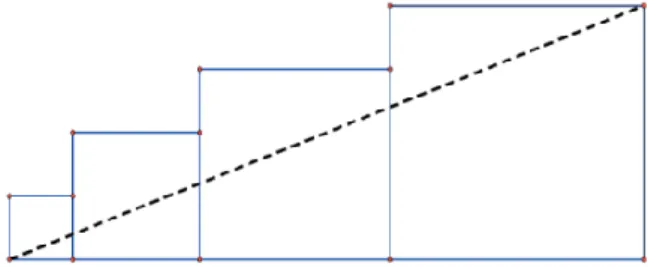
The frequent use of GeoGebra in the class has motivated Jessica to download, install and explore it at home. Jessica especially likes solving geometry problems because GeoGebra can improve the graphical display of her solutions, as she claims. When asked to recall some of her previous solutions, she explained the processes carried out in the problem ‘United and Cropped’. This problem presented a sequence of squares of sides 1, 2, 3, 4 cm, adjacent to each other, and asked for the area above a cut line, in a similar sequence of eight squares (Fig. 1). Whilst recalling her solution process for this problem, Jessica stated:
J: I think I went straight to GeoGebra. I knew it had something to do with geometry. (…) I realised it was a triangle, that this was a triangle here, and that by rearranging it in a simpler manner all I had to do was calculate the whole area and then subtracting the area of this triangle, which is easy: base times height divided by two. And then I thought…Oh, great! Geometry! I’m getting it neat!
Her usual working tools are the computer (she seldom prints the problem), lots of coloured pens, a notepad and a calculator. She describes her process of tackling a problem as follows:
Figure 1. Illustration used in the problem ‘United and Cropped’
Her usual working tools are the computer (she seldom prints the problem), lots of coloured pens, a notepad, and a calculator. She describes her process of tackling a problem as follows:
J: Hum… usually I look for the notepad and a pen, then [go to] Word and then I always… well I always use GeoGebra or some other software to add something to the text, for presenting a more complete work.
R: So… do you use it [GeoGebra] only after you solved the problem?
J: Yes, but… it depends. If GeoGebra or some other tools would help me understand the problem, then I’d use it firstly and afterwards I’d move to Word.
R: Ok, so you also use them while you’re still looking for the solution…
J: Yes, for instance, in this case [the problem United and Cropped] I started by going to GeoGebra to understand it properly, and then I discovered ‘Oh, that’s a triangle right there, so I have to subtract the area of that triangle’. In that case, I started with GeoGebra for a better understanding.
Jessica’s solving activity usually starts outside the computer but she admits that digital tools afford powerful approaches to the problems. Her perception is that GeoGebra assumes two roles in this activity: it allows the introduction of an illustration in the written explanation, which is related to the expression of the solution, and it also widens and empowers the understanding of the geometrical objects, which is related to the solving process itself.
It is now timely to make a brief summary of Jessica’s usual approach to the problems posed by SUB14, highlighting the initial intertwining of her technological and her mathematical knowledge. Jessica skims the statement of the problem looking for information regarding the mathematical topic enclosed, and when it refers to geometrical notions, she immediately identifies GeoGebra as the appropriate digital resource to tackle the problem (grasp). Jessica then engages in a first attempt to understand what the problem involves by identifying a mathematical repertoire and a technological repertoire – splitting the area and noticing a triangle and realizing that GeoGebra allows her to construct figures (notice). Moreover, her choice seems grounded on the recognition that GeoGebra offers the necessary accuracy for making use of her knowledge of geometry, that is, she feels able to perform and understand certain actions within the context – finding areas and subtracting the area of a triangle (interpret). She then explores the possibilities for action in combining different material resources (e.g., notepad, coloured pens, calculator, GeoGebra, text and image editor, e-mail) and also mathematical resources (e.g., areas, formulas, properties of figures) within an exploratory approach (integrate). As she explains, she sometimes asks for the help of her teacher, or uses Google to conduct a search on a topic (communicate).
After this brief sketch of Jessica’s initial procedures, and aiming to offer a complete perspective on the processes she develops, the following section describes all of her steps while using GeoGebra in solving and expressing geometry problems.
Jessica Solving Geometry Problems
Jessica’s work on two geometrical problems with GeoGebra may be retrieved through the Construction Protocols (CP) that allow ‘rewinding’ the processes back from the final products and observe, step-by-step, the sequence of actions. Although the GeoGebra files
were the final version of the solutions, the CP unveil several aspects of ‘messy sketches’. They are our major source of evidence on the intertwining of her technological and mathematical knowledge while solving-and-expressing these problems.
Jessica solving the problem ‘A divided square’.
This problem required to determine the area of the larger square in a configuration composed of different squares (Figure 2).
A plausible way to solve the problem is to relate the lengths of each type of coloured squares in a system of linear equations, and solving a quadratic equation to find the requested area.
Figure 2. Statement of the problem ‘A divided square’
The file sent by Jessica contains a geometrical construction of the given figure and a description of the processes undertaken, including the determination of the area (Figure 7).
The fact that Jessica decided to make a construction reveals that she approached the problem by taking a first look at its conditions, realizing she would have to determine the areas of the three types of yellow squares to obtain the solution (grasp). This is the genesis of an idea underlying a conceptual model of the solution. Additionally, she knows how to use GeoGebra for mathematical purposes because she has used it before in the competition and has seen her teacher using it for teaching geometrical notions. So, she has both material and conceptual access to GeoGebra since she knows that it affords the rigorous construction of geometrical figures that will contribute to finding the solution (notice). This means that Jessica is able to construct a geometrical composition similar to the given one, by resorting to her knowledge on Euclidean geometry and working with the mathematical knowledge embedded in GeoGebra. She seems to use GeoGebra as an emulator of Euclidean tools: she uses tools to create parallel or perpendicular lines and the circumference tool is used as a compass to set a length. She knows how to construct a square using a compass and a straightedge or how to divide a segment in half, which are extremely important affordances of GeoGebra for enabling this construction (interpret). In the following sections we present the critical aspects of Jessica’s solution, which is subdivided into three micro-problems: building the squares on the right, then on the bottom and finally the left ones.
The initial square and the sequence of constructions to follow. As there is only one relation visible in the statement – the side of the larger coloured square is ¼ of the side of the initial square – this seems to determine the sequence of constructions to perform.
The image shows a large square divided into 14 smaller squares, coloured in shades of yellow, of different but integer dimensions, and 1 white rectangle, also of integer dimensions. The white rectangle has an area of 30 464 cm2.
Which is the area of the larger square?
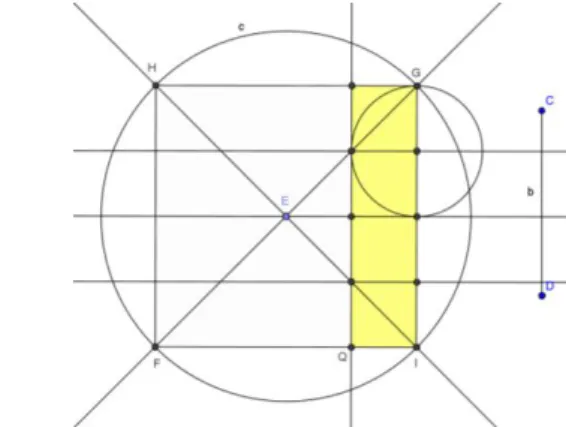
Jessica starts by creating the initial square that supports the construction (Figure 3) inscribing it in a circle (using two perpendicular diameters) with a changeable radius (allowing to manipulate the whole figure). She finds the vertices of the initial square and uses the polygon tool to construct the enveloping square. Using GeoGebra tools, she divides the right side of the square in four equal parts by finding midpoints recursively. Using the compass, and perpendicular and parallel line tools she identifies the vertices of the four larger coloured squares and creates these polygons, colouring them in yellow (integrate). This means that Jessica is not only aware of the geometrical properties of a square (sides of equal length and right angles), as she also knows the implicit language of this tool: GeoGebra recognizes a geometrical figure as a polygon (determining its area, for instance) if its interior is included.
Figure 3. Constructing the initial square Figure 4. Constructing larger coloured squares
At this point, not only she has a visual display of the four larger coloured squares (Figure 4), but she can also use them to pursue the construction of the subsequent squares drawing on the rigorous construction afforded by GeoGebra (explore).
Constructing the smaller coloured squares. This micro-problem requires to divide a segment in six equal parts, which is not a trivial mathematical procedure. Jessica uses the geometrical transformations tool to construct a reflection of the right lower vertex of a larger coloured square through the left lower vertex (Figure 5a), thus obtaining a way of dividing in thirds the segment that will contain the smaller squares (integrate). This reveals her understanding of the construction and the relations embedded: while four larger coloured squares occupy one side of the initial square and there is already one represented in its lower side, the remaining segment may support three more of those larger squares (explore).
Figure 5. Three stages of the construction of the smaller coloured squares
(a) Reflection of the vertex of the larger coloured square
(b) Dividing the segment in sixths (c) Constructing the smaller squares
By using midpoints and circumferences (Figure 5b), Jessica obtains the division of the segment in the lower side in sixths. She continues by using parallel and perpendicular lines and the polygon tools to construct the smaller squares (Figure 5c).
Constructing the medium coloured squares. She now needs to divide the remaining segment on the left in four equal parts (Figure 6a), which she does by finding midpoints recursively. Again she uses the circumference tool as a compass to determine a specific length and, by tracing perpendiculars and parallels and their intersection points (integrate), she is able to construct the medium coloured squares (Figure 6b). The construction protocol then shows Jessica colouring the interior rectangle, in red, and reconstructing some segments. The latter means that she decided to hide the geometrical objects that are clouding the construction, like straight lines or circumferences, but were useful for constructing others.
While analysing the statement does not make it obvious how to obtain a similar geometrical figure with GeoGebra, to devise a path for the construction is a fundamental part of the exploration process which results in a techno-mathematical understanding, crucial for solving the problem: as the figure is being created, the relations between the sides are disclosed.
Hence, GeoGebra is not only affording the construction but, most importantly, it is uncovering the proportions between these geometrical objects, it is transforming what is invisible and concealed inside the proposed figure, into visible and usable ideas for the development of a way of solving-and-expressing this problem (explore).
(a) Dividing the side in fourths (b) Constructing the green left squares
Figure 6. Constructing the medium coloured squares
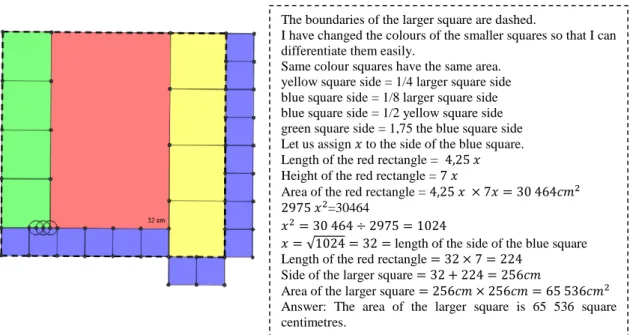
Portraying the relative proportions. Jessica then highlights some aspects of her work adding smaller squares along the exterior of the initial square and some circumferences whose centres divide the side of a smaller square in four parts (Figure 7). These items emphasise a visual perception of the existing relations between the lengths of the geometrical figures that is not possible just by examining the image in the statement. The analysis of the conjecture that she has been growing will allow moving away from the geometrical construction and reaching an algebra approach afterwards (plan).
Figure 7. Jessica’s solution of the problem ‘A divided square’ (authors’ translation of the text) Algebraization based on the proportions. On the right side of Figure 7, Jessica adds a caption that guides in interpreting her processes and portrays how she developed such plan. She defines the unknown as the length of the side of the smaller square and, using the previous relations, she formulates an equation that yields the unknown value, which she uses to find the side of the larger square as well as its area, thus providing an answer to the problem. She has developed and implemented an approach, by providing a mathematical look to her conceptual model of the situation (create).
Explaining and expressing the solution. The caption not only presents a justification of the solution, as it exposes the process of solving-and-expressing by means of combining, again, technological and mathematical resources (verify). The textual description on the right (Figure 7) is an evidence of the expressing process in the sense that, besides documenting all the procedures, it helps to understand why there are other constructions outside the larger square and how they were useful during the solving process. Nevertheless, these formatting aspects, such as changing colours to highlight specific sets of squares or using different types of borders, which could be associated with the ‘expressing’ of the solution, actually have a mathematical meaning because they are highly relevant to the construction of the solution. Their purpose and meaning are related to the understanding of the situation and the devising of a plan to obtain the solution and not merely to the reporting of what has been done. The dissemination takes place as she submitted the GeoGebra file as the answer to the problem posed by SUB14. Another example of a problem where Jessica resorted to GeoGebra is described and analysed in the following subsection.
Jessica solving the problem ‘Building a flowerbed’
This problem refers to the changing of the triangular shape of a flowerbed and to how it affects its area (Figure 8). A possible path to the solution is unveiled as soon as the stick
The boundaries of the larger square are dashed.
I have changed the colours of the smaller squares so that I can differentiate them easily.
Same colour squares have the same area. yellow square side = 1/4 larger square side blue square side = 1/8 larger square side blue square side = 1/2 yellow square side green square side = 1,75 the blue square side Let us assign 𝑥 to the side of the blue square. Length of the red rectangle = 4,25 𝑥 Height of the red rectangle = 7 𝑥
Area of the red rectangle = 4,25 𝑥 × 7𝑥 = 30 464𝑐𝑚2
2975 𝑥2=30464
𝑥2= 30 464 ÷ 2975 = 1024
𝑥 = √1024 = 32 = length of the side of the blue square Length of the red rectangle = 32 × 7 = 224
Side of the larger square = 32 + 224 = 256𝑐𝑚
Area of the larger square = 256𝑐𝑚 × 256𝑐𝑚 = 65 536𝑐𝑚2
Answer: The area of the larger square is 65 536 square centimetres.
𝐸𝐹 is perceived as the segment that divides the triangle 𝐸𝐺𝐻 into two smaller triangles, and also as the base of both triangles.
Rose explained to her gardener that she wanted a triangular area of flowers in her rectangular garden grass. The gardener took a 2‐meter stick and held it perpendicularly to one side of the garden, at a random point (E). Using a rope, he then drew a line through the end of the stick (F) and joining the two opposite sides of the rectangle, thus getting the inner triangle EGH.
The next day, Rose looked at the triangle and did not like it. She moved the same stick to another random point of the garden edge and she got a different triangle EGH.
When the gardener arrived, he complained that the area for the new flowerbed was smaller than before. But Rose assured him that it didn’t change. Who is right and why?
Do not forget to explain your problem solving process!
Figure 8. Statement of the problem ‘Building a flowerbed’
Jessica developed a solution for this geometrical problem using GeoGebra, by simulating the construction of the rectangular lawn and the triangular flowerbed (Figure 9). The following subsection portrays the critical aspects of Jessica’s solution based on the analysis of the construction protocol and the written text submitted to the competition. Realizing the dynamic nature of the situation. The construction and the explanation presented by Jessica reveal an approach that is rooted in acknowledging the dynamic nature of the situation. The statement offers a clue on the influence of the stick’s position in the shape of the flowerbed. Jessica also seems to have realized that she may reach a conclusion about the behaviour of the area by incorporating such dynamism in the construction (grasp). She decides to construct these geometrical figures with GeoGebra, which means that Jessica perceives the usefulness of imprinting this dynamic nature to the construction, by experimenting with a ‘virtual stick’ placed on a ‘virtual flowerbed’ (notice). In fact, she knows that GeoGebra affords a rigorous and accurate construction of the rectangular lawn and the triangular flowerbed. Most importantly, GeoGebra enhances a clearer understanding of the mathematics embedded in the problem: it simulates the change in the position of the stick by dragging, which results in the change of the shape of the triangular flowerbed, and it will immediately display the areas of the polygons in the algebraic window. So GeoGebra has what it takes to simulate the situation dynamically and the manipulation of the figures will generate conjectures about the solution and its proof (interpret).
Constructing the triangular flowerbed. Jessica uses perpendicular lines and their intersections to build the rectangular garden, maintaining two visible free points for changing its size: the upper right vertex and a point on the right side of the rectangle (Figure 9a). She then constructs a segment outside the figure, simulating a slider, whose length is transported into the geometrical construction, using a circumference, to establish the length of the stick. The exterior segment is a new geometrical object, not mentioned
H F D A B C E G H F D A B C E G
in the statement. Now, Jessica not only can change the position of the stick as she can control its size, while an exploratory approach of the situation is emerging (integrate). Afterwards, she completes the construction of the triangular flowerbed using the tools to create points, straight lines, segments, and a polygon – the triangular flowerbed (Figure 9b). By now, Jessica decides to construct two smaller triangles and colours them differently (Figure 9c), which indicates that she has realized that the area of the flowerbed is not changing under dragging, possibly by analysing the algebraic window containing the automatic display of the area of the triangle.
(a) Constructing the rectangular garden
(b) Constructing the triangular flowerbed
(c) Final construction
Figure 9. Three stages of the construction
Although the construction protocol does not record such manipulation, the intentionally imprinted dynamism, the inclusion of the smaller triangles, together with her written explanation suggest that the analysis of the effect of dragging some objects was crucial for recognizing that the stick is a common side of the two triangles, therefore helping to devise a more clear conceptual model of the invariance of the area of the flowerbed (explore).
Mathematization of the situation. The next step is to come up with an idea for explaining in a mathematical way why the area is invariant. In realizing that the stick is the base of each small triangle, Jessica then needs to analyse their areas as a way of understanding the behaviour of the flowerbed’s area (plan). She resorted to the dynamic construction as a new mathematical object in order to develop a conceptual model of the invariance of the area, that is, she abandons the geometrical construction activity to engage in an analytical perspective of the situation, where she uses the formula of the area of a triangle.
In fact, she observes that the sum of the heights of the two smaller triangles equal the length of the rectangle – a new mathematical understanding, afforded by GeoGebra. Hence, Jessica creates a new way to look at and understand the invariance of the area (create).
Explaining and expressing the solution. The construction is as fundamental to the solution as the written explanation and the symbolic work: they are created as Jessica
explores the figure and uses symbolic manipulation to mathematically demonstrate the invariance of the area (Figure 10). Her solution comprises the techno-mathematical construction and the mathematics results, that is, by means of the algebraic manipulation of the areas she offers a proof of the conjecture (verify), within her solving-and-expressing activity. Jessica submits both the geometrical constructions and the written explanations, which indicates that she is replying to the call of the competition’s rules for presenting a clear justification of the reasoning as well as a detailed description of the processes followed (disseminate). Furthermore, not all objects that were constructed are effectively visible in the files that she sent. At a certain point, Jessica ‘cleans’ the constructions using the option ‘setting properties’ to hide the geometric elements that were used as support to others; for example, the straight lines on which segments were constructed, or the circumferences that were only used to set the length of a segment. She knows that those auxiliary constructions are essential and they cannot be eliminated despite having already served their function. Thus, she perceives a double purpose in this affordance: on one side, hiding an object to reduce the number of visible entities and to focus the attention on those that are really necessary; on the other side, cleaning the construction makes it more elegant, simpler and more attainable to those who are going to analyse it. Thus, the ‘setting properties’ tool is a resource used for solving, but it is also a very important resource for expressing the solution.
Figure 10. Excerpt from the explanation sent by Jessica (authors’ translation of the text)
Results and Discussion
Bearing in mind the characteristics of the beyond-school environment addressed, where students are asked to solve mathematical problems and may use their everyday digital technologies, the need for an analytical lens to account for the processes involved in this particular ‘mathematical-problem-solving-with-technology’ emerged. Taking as levers the processes listed in the ‘mathematical problem solving’ framework developed by Schoenfeld (1985) and those in the ‘digital problem solving’ framework by Martin and Grudziecki (2006), a model of the processes involved in mathematical problem solving with technology was proposed. This model was then applied to elucidate the ways in which a youngster deals with technology whilst tackling a mathematical problem and expressing its solution.
Answer:
The yellow triangle is divided by the 2m stick in two triangles. The base of each triangle measures 2m – the length of the stick. To determine the area of a triangle, we have to calculate: height × base/2. In order to measure the area of those two triangles, we have: height × 2/2. But it is clear that 2/2=1, so the area of these triangles equals their height.
We can state that the sum of the heights of the two triangles equals the length of the rectangle (garden grass). Hence, the area of the flowerbed equals the length of the rectangular garden grass. If the length of the rectangle does not change, then the area of the triangle is maintained. In other words, Rosa is right.
Solving and Expressing Mathematical Problems with Technology
Jessica’s first approach aims at grasping the mathematical topic enclosed in the problem such as geometry contents, rules and procedures. That initial attempt to apprehend what is at stake leads her into noticing, at first, an association between geometry and GeoGebra and, further on, between her mathematical repertoire and her technological repertoire. Moreover, Jessica’s choice relies on her ability to perceive the affordances of the digital tool to devise a mathematical approach to the situation, that is, to interpret the techno-mathematical meaning that such approach conveys. Both Jessica’s statements while recalling her solving processes on a former problem and the analysis of the GeoGebra protocols suggest that fully understanding the problem and deciding on the actions to solve it starts in, but is not limited to, the initial processes. Whilst working on the problems she may communicate with relevant others, like her teacher, or search for information as she reported in the interview. Although this process was accounted for, it was not visible on the data regarding the two solutions.
Next, Jessica brings about different technological resources (GeoGebra Euclidean tools, setting properties, dependant objects and dragging mode) and mathematical resources (knowledge of plane geometry, which allows to construct figures, to manipulate dynamic constructions, and to operate on them) that she integrates within an exploratory approach to the situation. She then explores each situation by performing the constructions, which trigger the analysis of conjectures and the outlining of a path that can lead to the solution. From this exploratory process she synthesizes the key ideas that become part of the plan leading to the solution. By recombining the techno-mathematical resources, Jessica creates new knowledge objects, such as strategies, representations, conceptual models, and she engages in explaining and justifying the solution, consisting of a verification process. Finally, she reports the processes undertaken, that is, the problem solving activity by means of technologies, to the SUB14 committee. This dissemination includes the submission of the GeoGebra files and a detailed explanation of her problem-solving-and-expressing processes.
This model intertwines the processes of solving a mathematical problem with the ones of solving a digital task, drawing on the combination of mathematical and technological knowledge. The effectiveness of such combination for successfully solving the mathematical problems lies in the perception of the affordances of the selected tools and on the ability of solving-and-expressing.
The Evidence of Techno-Mathematical Fluency
The analysis of Jessica’s work with GeoGebra in solving geometrical problems provides evidence of how the use of a digital tool enables a techno-mathematical approach to achieve a solution and express it. In many ways this case illustrates the complexity of the symbiosis that Borba and Villarreal (2005) refer to in their theoretical positioning, since it unveils the nature of the unity student-with-GeoGebra in solving-and-expressing
geometry problems.
Jessica’s techno-mathematical fluency emerges as we unfold the various processes undertaken in the solving-and-expressing, from the grasping to the dissemination processes, supporting the claim that this kind of sophistication in the use of digital tools permeates several steps of the problem solving process and not solely the reporting of the solution.
This participant recognizes and responds to a wide array of affordances, which lead her into identifying GeoGebra as a usable and useful tool to create a techno-mathematical solution. The perception of what she is capable of, when empowered by GeoGebra (e.g., immediate or referential constructions, setting properties, constructions with parameters), shows: 1) how fluent she proves to be in using this tool, 2) how her mathematical thinking flows through and is shaped by GeoGebra, and 3) how she expresses herself by means of a techno-mathematical dialect (Crockett, Jukes, & Churches, 2012; Papert & Resnick, 1995).
Additionally, she acknowledges the relevant role that the geometric construction plays in generating a possible route for getting the solution. This case illustrates the way in which GeoGebra is given the role of a tool-to-create-with: 1) in the first solution, it is the construction activity that enables apprehending the relationships between the lengths of the several squares; 2) in the second one, the robust construction, enhanced by the dynamic variation of the objects, leads to a wider perspective of the problem posed, extending several of its conditions and allowing a generalization. The digital constructions become part of the process and of the solution itself, in that they trigger powerful mathematical ideas that she uses to reformulate or create new ways of knowing (Barron, Martin, & Roberts, 2007). Jessica’s effective uses of GeoGebra are linked to the way in which the constructions bring forth the conceptual structures underlying the process of obtaining and presenting the solution.
Lastly, Jessica establishes a dialectical connection between her knowledge about geometrical notions and the mathematical knowledge embedded in GeoGebra. It is through this symbiotic relationship (Borba & Villarreal, 2005) between the use of mathematical concepts and the digital representations produced with the computer, mostly visual, that she achieves deeper levels of understanding of the problems and devises procedures for obtaining the solutions.
In view of the theory discussed, the recognition of the affordances of a tool is the main generator of her techno-mathematical fluency. The evidence of techno-mathematical fluency arises from the processes of solving-and-expressing problems with technology and can be characterized by the ability to combine two types of background knowledge and skills – mathematical and technological – constantly being intertwined to develop techno-mathematical thinking, i.e. new ways of knowing and understanding, and its effective communication using a techno-mathematical discourse.
Final Remarks and Implications
In our study we developed and utilized a framework for examining the processes of mathematical problem solving with technology (MPST), by combining Schoenfeld’s (1985) mathematical problem solving model and Martin and Grudziecki’s (2006) digital problem solving framework. The case of Jessica provides evidence of techno-mathematical fluency as a combination of thinking techno-mathematically and perceiving technological affordances in a beyond-school mathematics problem solving activity. It unveils the nature of the processes that occur in the system of humans-with-media, which integrates the digital tools that the youngsters choose to use in their home environment, embedding and extending their school knowledge. Inasmuch as the interaction between solver and digital tool, this study places a strong emphasis on the twofold nature of the fluency that seems to foster successful mathematical problem solving and expressing with digital technologies. The concept of techno-mathematical fluency encompasses knowing about mathematics (facts, rules, procedures), knowing about technology (how a certain tool works, what it affords), and realizing how they relate to each other, how they can be combined in productive ways for thinking about a situation, developing a strategy, achieving the solution and communicating it effectively. Since it plays a decisive role in the problem solving activity, students’ techno-mathematical fluency needs to find its way into the mathematics classroom.
We have today strong evidences from a comprehensible body of research that the use of digital technologies in mathematics learning reframes and reorients mathematical thinking: it favours experimental and exploratory approaches, promotes critical and inquiry skills, allows a variety of strategies, triggers conjecture generation and supports mathematical proof. On the other hand, developing a techno-mathematical fluency encompasses exploring the affordances of several digital mathematical tools, and this can benefit from connecting technology and non-routine mathematical problems. With this in mind, the results highlighted by the case of Jessica suggest that learning mathematics through problem solving within the school and the curriculum needs to be thought of in terms of developing the techno-mathematical fluency that is expected for tackling problems in which mathematics is essential and technology, rather than a complement, is just as indispensable.
Acknowledgments. This work was supported by the project Problem@Web (PTDC/CPE-CED/101635/2008) and the PhD grant SFRH/BD/73363/2010, both funded by Fundação para a Ciência e Tecnologia.
References
Barbeau, E. J. & Taylor, P. (Eds.). (2009). Challenging Mathematics In and Beyond the Classroom: The 16th ICMI Study. New York, NY: Springer.
design experiment to build technological fluency and bridge divides. International Journal of Technology and Design Education, 17(1), 75-105.
Borba, M. & Villarreal, M. (2005). Humans-with-Media and the Reorganization of Mathematical Thinking. New York, NY: Springer.
Carreira, S., Jones, K., Amado, N., Jacinto, H., & Nobre, S. (2016). Youngsters solving mathematical problems with technology: The results and implications of the Problem@Web Project. New York, NY: Springer.
Chemero, A. (2003). An outline of a theory of affordances. Ecological Psychology, 15(2), 181– 195.
Crockett, L., Jukes, I., & Churches, A. (2012). Literacy Is NOT Enough: 21st Century Fluencies for the Digital Age. New York, NY: Corwin Press.
Day, D. & Lloyd, M. (2007). Affordances of online technologies: More than the properties of the technology. Australian Educational Computing, 22(2). 17–21.
Dooley, L. (2002). Case Study Research and Theory Building. Advances in Developing Human Resources, 4(3), 335–354.
Drijvers, P., Kieran, C., Mariotti, M-A., Ainley, J., Andresen, M., Chan, Y., Dana-Picard, T., Gueudet, G., Kidron, I., Leung, A., & Meagher, M. (2010). Integrating technology into mathematics education: Theoretical perspectives. In C. Hoyles & J-B. Lagrange (Eds.), Mathematics Education and Technology-Rethinking the Terrain, (pp 89–132). New York, NY: Springer.
English, L., & Sriraman, B. (2010). Problem solving for the 21st century. In B. Sriraman,
& L. English (Eds), Theories of Mathematics Education, (pp. 263–286). New York, NY: Springer.
Gibson, J. (1979). The Theory of Affordances. In R. Shaw & J. Bransford (Eds.), Perceiving, Acting, and Knowing: Toward an ecological psychology (pp. 67–82). Hillsdale, NJ: Erlbaum.
Greeno, J. (1994). Gibson's Affordances. Psychological Review, 101(2), 336–342.
Hoyles, C., Noss, R., Kent, P., & Bakker. A. (2010). Improving mathematics at work: The need for techno-mathematical literacies. London, UK: Routledge.
Hoyles, C., Wolf, A., Molyneux-Hodgson, S., & Kent, P. (2002). Mathematical skills in the workplace: final report to the Science Technology and Mathematics Council. Institute of Education, University of London; Science, Technology and Mathematics Council, London.
Jacinto, H., & Carreira, S. (2013). Beyond-school mathematical problem solving: a case of students-with-media. In A. M. Lindmeier & A. Heinze (Eds.), Proceedings of the 37th Conference of the International Group for the Psychology of Mathematics Education, (Vol. 3, pp. 105–112). Kiel, Germany: PME.
Mathematical Knowledge in Boundary-Crossing Situations at Work. Mind, Culture, and Activity, 14(1-2), 64-82.
Lesh, R. (2000). Beyond Constructivism: Identifying Mathematical Abilities that are Most Needed for Success Beyond School in an Age of Information. Mathematics Education Research Journal, 12(3), p. 177–195.
Lesh, R. & Doerr, H. (2003). Foundations of a models and modeling perspective on mathematics teaching, learning, and problem solving. In R. Lesh & H. Doerr (Eds.), Beyond Constructivism – Models and Modeling Perspectives on Mathematics Problem Solving, Learning, and Teaching, (pp. 3-33). Mahwah, NJ: Erlbaum Associates.
Llinares, S. & Roig, A. (2008). Secondary school students’ construction and use of mathematical models in solving word problems. International Journal of Science and Mathematics Education, 6, 505–532.
Martin, A. (2006). A European framework for digital literacy. Digital Kompetanse, 2, 151– 161.
Martin, A., & Grudziecki, J. (2006). DigEuLit: Concepts and Tools for Digital Literacy Development. Innovation in Teaching and Learning in Information and Computer Sciences, 5(4), 249–267.
Papert, S., & Resnick, M. (1995). Technological Fluency and the Representation of Knowledge. Proposal to the National Science Foundation. Cambridge, MA: MIT Media Laboratory.
Pólya, G. (1945). How to solve it: A new aspect of mathematical method. London: Penguin Books.
Quivy, R., & Campenhoudt, L. (2008). Manual de Investigação em Ciências Sociais. Lisboa: Gradiva.
Santos-Trigo. M. & Camacho-Machín, M. (2013). Framing the use of computational technology in problem solving approaches. The Mathematics Enthusiast, 1-2, 279-302. Schoenfeld, A. (1985). Mathematical problem solving. New York: Academic Press. Stahl, G. (2009) (Ed.). Studying Virtual Math Teams. New York, NY: Springer.
Villarreal, M., & Borba, M. (2010). Collectives of humans-with-media in mathematics education: notebooks, blackboards, calculators, computers and… notebooks throughout 100 years of ICMI. ZDM, 42(1), 49–62.
Zevenbergen, R. & Zevenbergen, K. (2009). The numeracies of boatbuilding: new numeracies shaped by workplace technologies. International Journal of Science and Mathematics Education, 7, 183–206.