Faculdade de Ciˆencias
Departamento de Inform´atica
LINEAR AND SHARED OBJECTS
IN CONCURRENT PROGRAMMING
Joana Correia Campos
MESTRADO EM ENGENHARIA INFORM ´
ATICA
Especializac¸˜ao em Engenharia de Software
Faculdade de Ciˆencias
Departamento de Inform´atica
LINEAR AND SHARED OBJECTS
IN CONCURRENT PROGRAMMING
Joana Correia Campos
DISSERTAC
¸ ˜
AO
Projecto orientado pelo Prof. Doutor Vasco Manuel Thudichum de Serpa Vasconcelos
MESTRADO EM ENGENHARIA INFORM ´
ATICA
Especializac¸˜ao em Engenharia de Software
Although mainstream object-oriented languages, like Java, are currently able to detect and prevent many programming errors by static type-checking, common usage-related errors are not captured and signalled to programmers. In general, no (formal) support is available in these languages for ensuring that an object is used according to the protocol which the programmer had in mind when describing the behaviour of a class. The file reader protocol is a simple but clarifying example: first a file must be opened, then it can be read multiple times (though not beyond the end-of-file), and finally it must be closed. As client code is not checked for protocol conformance, trying to read the file without first opening it, or when it is closed, are simple disregards caught only by runtime exceptions, assuming the language is equipped with built-in support to handle errors and exceptional events.
The MOOL programming language presented in this work is an attempt to formalise object usage and access. It consists in a simple class-based object-oriented language that includes standard primitives found in most object-oriented language formalisms. Addi-tionally, the language offers constructs that can be attached at class definitions for spec-ifying (1) the available methods based on an object state, and (2) how methods may be called in that state – by a single client, in which case we say that the object has a linear status, or without restrictions, in which case we say it has a shared one. We refer to this abstract view that defines an object state and status the class usage type. We formalise the language syntax, the operational semantics, and a type system that enforces by static typing that methods are called only when available, and by a single client if so specified in the class usage type. We illustrate the language capabilities by encoding in MOOLthe protocols of two well-known examples: the file reader and the auction system. We have built a prototype compiler to implement our ideas, and its architecture is also described. Finally, we anticipate some of the related topics which we are interested in pursuing in future work.
Keywords: Object-oriented programming, concurrency, type systems, linear objects, session types
As linguagens de programac¸˜ao centradas em objectos, como o Java, conseguem de-tectar antecipadamente em tempo de compilac¸˜ao, e assim prevenir, muitos dos erros de tipificac¸˜ao e de inicializac¸˜ao de atributos e vari´aveis que os programadores inadvertida-mente introduzem nos seus c´odigos. Contudo, estas linguagens s˜ao actualinadvertida-mente incapazes de capturar e assinalar erros relacionados com a utilizac¸˜ao incorrecta de objectos. Em geral, as linguagens comerciais n˜ao disp˜oem de suporte formal e verific´avel que garanta que uma instˆancia de uma classe ´e usada de acordo com a intenc¸˜ao do programador que es-creveu essa classe. O protocolo que descreve a leitura de um ficheiro serve de motivac¸˜ao: primeiro o ficheiro deve ser aberto, depois as suas linhas podem ser lidas uma por uma, e, antes de o programa terminar, o ficheiro deve ser fechado. N˜ao havendo qualquer verificac¸˜ao do c´odigo cliente a este n´ıvel, ´e inevit´avel que o protocolo seja quebrado, e que uma tentativa (indevida) de leitura seja efectuada antes de invocada a operac¸˜ao que abre o ficheiro, ou que uma outra esbarre com um ficheiro fechado. Em linguagens como o Java, este tipo de erros s´o ´e tarde detectado, quando uma excepc¸˜ao ´e lanc¸ada em tempo de execuc¸˜ao.
A linguagem de programac¸˜ao MOOL proposta nesta tese representa uma tentativa de
formalizar a utilizac¸˜ao e o acesso a objectos. Trata-se de uma linguagem baseada em classes, que inclui primitivas dispon´ıveis na maioria dos formalismos de linguagens cen-tradas em objectos. Adicionalmente, a linguagem disp˜oe de construc¸˜oes sint´acticas que permitem ao programador especificar como ´e que um objecto de uma classe deve ser us-ado. Atrav´es desta especificac¸˜ao, o programador pode (1) definir os m´etodos dispon´ıveis em func¸˜ao do estado do objecto, e (2) indicar como o objecto pode ser referenciado quando se encontra nesse estado – por uma ´unica referˆencia, tratando-se assim de um objecto linear, ou sem restric¸˜oes no caso de um objecto que pode ser partilhado por v´arios clientes. Neste trabalho, a vis˜ao abstracta que os clientes tˆem do estado dos objectos ´e designada de tipo de utilizac¸˜ao da classe (ou class usage type). Ao contr´ario dos tipos comuns, na linguagem proposta os tipos dos objectos s˜ao dinˆamicos, variando com o seu estado. Gay et al. [38] designam de interface dinˆamica a especificac¸˜ao global de m´etodos dispon´ıveis numa classe com base no estado do objecto, distinguindo-a da in-terface est´atica do Java. Objectos que mudam dinamicamente o conjunto de m´etodos dispon´ıveis em func¸˜ao do seu estado s˜ao tamb´em conhecidos na literatura como objectos
um mecanismo de concorrˆencia que permite a criac¸˜ao de threads, al´em da primitiva sync que permite a sincronizac¸˜ao de m´etodos quando, em objectos partilhados, a comunicac¸˜ao deve ser efectuada em exclus˜ao m´utua.
A linguagem formal que ´e apresentada nesta tese ´e baseada na linguagem proposta por Gay et al. [15], que formaliza uma abordagem designada de tipos de sess˜ao modulares. A teoria dos tipos de sess˜ao foi proposta para a verificac¸˜ao em tempo de compilac¸˜ao de gramas cuja comunicac¸˜ao se processa por canais tipificados. Os tipos de sess˜ao s˜ao pro-postos como forma de impor que as implementac¸˜oes dos canais obedecem `as sequˆencias e tipos das mensagens especificados nos protocolos de comunicac¸˜ao. Em geral, os pro-tocolos podem ser expressos por tipos de sess˜ao, independentemente da linguagem de programac¸˜ao em que s˜ao integrados. Os tipos de sess˜ao tˆem sido integrados em v´arios paradigmas de linguagens de programac¸˜ao: c´alculo pi, linguagens funcionais, linguagens centradas em objectos, CORBA, etc. O trabalho sobre tipos de sess˜ao modulares com-bina, numa linguagem centrada em objectos distribu´ıda, os tipos de sess˜ao e a ideia de disponibilidade dos m´etodos de uma classe em func¸˜ao do estado do objecto. A modular-idade da abordagem resulta de a implementac¸˜ao do tipo de sess˜ao poder ser decomposta pelos v´arios m´etodos da classe, contrastando com trabalhos anteriores, no contexto de linguagens centradas em objectos, em que o tipo de sess˜ao ´e implementado no corpo de um ´unico m´etodo.
O conceito de tipos de utilizac¸˜ao desenvolvido nesta tese foi inspirado nos tipos de sess˜ao modulares, e adaptado a um modelo de comunicac¸˜ao mais simples – a troca de mensagens atrav´es de chamadas de m´etodos. O estilo de programac¸˜ao proposto pretende ser simples e intuitivo, n˜ao tendo o programador de lidar com distribuic¸˜ao (a concorrˆencia ´e efectuada por mem´oria partilhada), mas tirando proveito das propriedades de seguranc¸a associadas aos tipos de sess˜ao.
As contribuic¸˜oes desta tese materializam-se na formalizac¸˜ao da sintaxe, da semˆantica operacional e do sistema de tipos, que verifica as especificac¸˜oes em tempo de compilac¸˜ao, e na implementac¸˜ao de um compilador de MOOL, cuja arquitectura tamb´em se descreve.
No contexto dos tipos de sess˜ao, as contribuic¸˜oes desta tese podem resumir-se nos seguintes pontos:
• Ao contr´ario de abordagens anteriores, o modelo de comunicac¸˜ao baseia-se exclu-sivamente na chamada de m´etodos;
• As classes s˜ao anotadas com uma especificac¸˜ao de utilizac¸˜ao que estrutura a sequˆencia de m´etodos que os clientes podem invocar em func¸˜ao do estado do objecto, a qual ´e enriquecida com qualificadores lin/un que permitem controlar se um objecto ´e lin-ear, e uma ´unica referˆencia o pode usar, ou se ´e partilhado, n˜ao existindo restric¸˜oes quanto ao n´umero de clientes;
jecto sejam acedidas sem interferˆencia de outras threads.
A tese encontra-se organizada em seis cap´ıtulos. Na introduc¸˜ao, o exemplo do leitor de ficheiros ´e apresentado como motivac¸˜ao dos principais aspectos da linguagem e, em particular, da especificac¸˜ao de tipos de utilizac¸˜ao. Segue-se um cap´ıtulo onde se apre-senta um exemplo mais extenso – o sistema de leil˜oes – que ilustra a introduc¸˜ao de tipos de utilizac¸˜ao em protocolos mais complexos. No cap´ıtulo da linguagem formal, ´e descrita a sintaxe, a semˆantica operacional e o sistema de tipos. Alguns exemplos de derivac¸˜ao de tipos ilustram o funcionamento das regras e as mudanc¸as operadas no tipo dos atributos `a medida que a derivac¸˜ao avanc¸a. A prova formal da linguagem MOOL n˜ao ´e apresentada
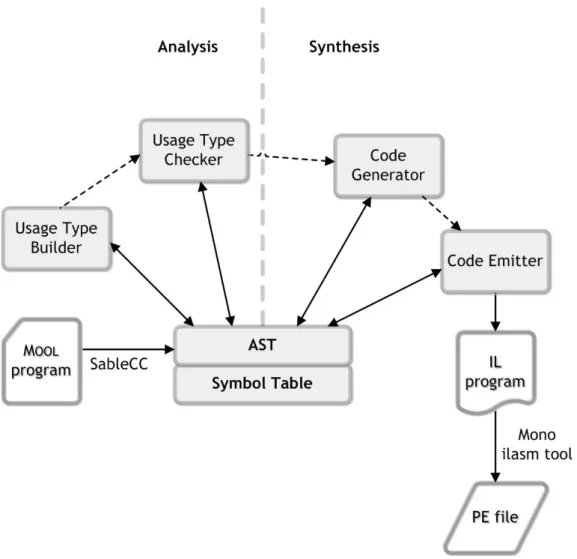
nesta tese, ficando adiada para um trabalho futuro. No entanto, sendo este sistema baseado num sistema de tipos [15] para o qual ´e apresentada a prova formal por induc¸˜ao, tudo aponta para que n˜ao seja dif´ıcil provar os resultados tamb´em para a linguagem MOOL. No cap´ıtulo da implementac¸˜ao, s˜ao descritas as tecnologias utilizadas e a arquitectura do compilador. Desenvolvido na linguagem Java, o compilador assenta na framework do SableCC, que gera automaticamente analisadores l´exicos e classes que implementam o padr˜ao visitante, o que permitiu reduzir o esforc¸o de implementac¸˜ao ao desenvolvimento da componente semˆantica, atrav´es da extens˜ao destas classes. A arquitectura do compi-lador distingue duas fases: a fase de an´alise, onde, com base na ´arvore abstracta do pro-grama, ´e constru´ıda a tabela de s´ımbolos e efectuada a verificac¸˜ao de tipos com base num algoritmo de tipificac¸˜ao guiado pelos tipos de utilizac¸˜ao, e a fase de s´ıntese, onde o c´odigo de um programa MOOL v´alido ´e traduzido para uma linguagem interm´edia. O resultado
desta traduc¸ao ´e convertido em bytecode pela plataforma open source Mono, tendo como alvo a Common Language Runtime (CLR). No cap´ıtulo do trabalho relacionado, discute-se o estado da arte em tipos de discute-sess˜ao, focando o contexto das linguagens centradas em objectos, em typestates, uma abordagem com a qual as ideias desta tese apresentam pon-tos de contacto, e em objecpon-tos lineares. Finalmente, na conclus˜ao antecipa-se o trabalho futuro, nomeadamente a apresentac¸˜ao dos resultados da linguagem MOOL e o estudo de
t´ecnicas que introduzam alguma flexibilidade na utilizac¸˜ao de objectos lineares.
Palavras-chave: Programac¸˜ao centrada em objectos, concorrˆencia, sistemas de tipos, objectos lineares, tipos de sess˜ao
Abstract iii Resumo v Contents ix List of Figures xi Listings xiii 1 Introduction 1 1.1 Motivation . . . 3 1.2 Contributions . . . 7 1.3 Thesis Outline . . . 8
2 Example: The Auction System 9 2.1 The Auction Usage Protocol . . . 9
2.2 Programming with Usage Types . . . 12
2.2.1 Usage syntactic details . . . 12
2.2.2 The Auctioneer . . . 14
2.2.3 The Seller . . . 14
2.2.4 The Bidder . . . 17
2.2.5 Putting all together . . . 17
3 The Core Language 19 3.1 Syntax . . . 19
3.1.1 User syntax . . . 20
3.1.2 Runtime syntax . . . 23
3.1.3 Programs . . . 24
3.2 Operational Semantics . . . 24
3.2.1 Reduction rules for states . . . 25
3.2.2 Reduction rules for expressions . . . 26
3.3 Subtyping . . . 29 ix
3.4.2 Type checking classes . . . 32
3.4.3 Type checking expressions . . . 35
3.5 Additional Details . . . 41
4 Implementation 43 4.1 Technologies . . . 43
4.1.1 The SableCC framework . . . 43
4.1.2 The Mono IL assembler . . . 44
4.2 Formalisation vs. Implementation . . . 45 4.3 Architecture . . . 45 4.3.1 Analysis Phase . . . 46 4.3.2 Synthesis Phase . . . 50 5 Related Work 53 5.1 Session types . . . 53 5.2 Typestates . . . 55
5.3 Unique Ownership of Objects . . . 56
6 Conclusion 59 6.1 Achievements . . . 59
6.2 Future Work . . . 60
Bibliography 63
2.1 The scenario for a seller . . . 11
2.2 The scenario for a bidder . . . 11
3.1 User syntax . . . 21
3.2 Runtime syntax . . . 23
3.3 Auxiliary functions for class and heap components . . . 25
3.4 Reduction rules for states . . . 26
3.5 Auxiliary functions for values and types . . . 27
3.6 Reduction rules for expressions . . . 28
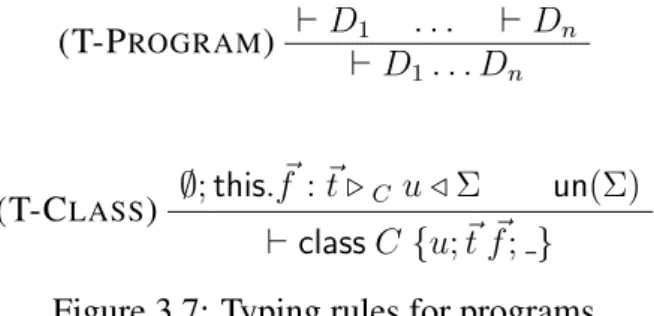
3.7 Typing rules for programs . . . 31
3.8 Typing rules for classes . . . 33
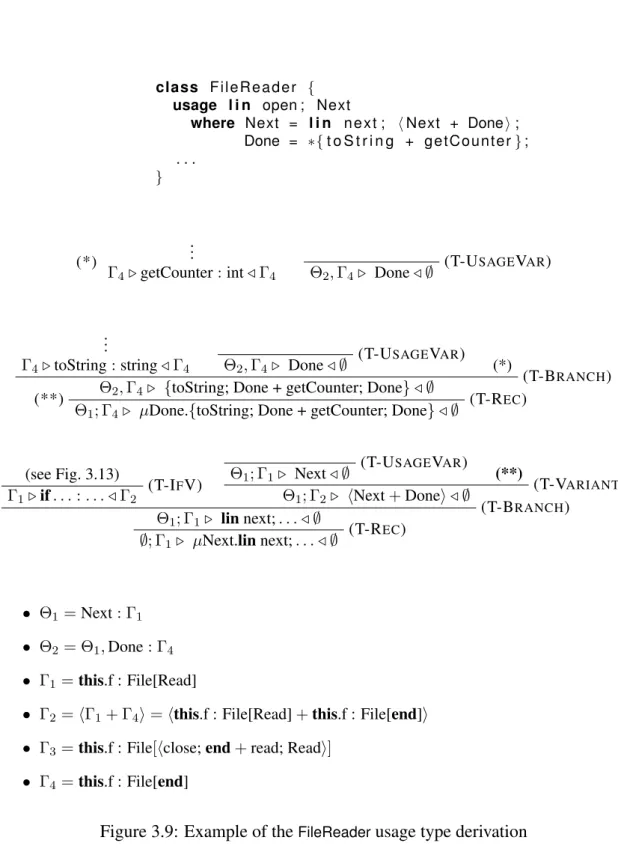
3.9 Example of theFileReaderusage type derivation . . . 34
3.10 Typing rules for values . . . 35
3.11 Typing rules for simple expressions . . . 36
3.12 Typing rules for calls and control flow expressions . . . 37
3.13 Example of aFileReadermethod derivation . . . 40
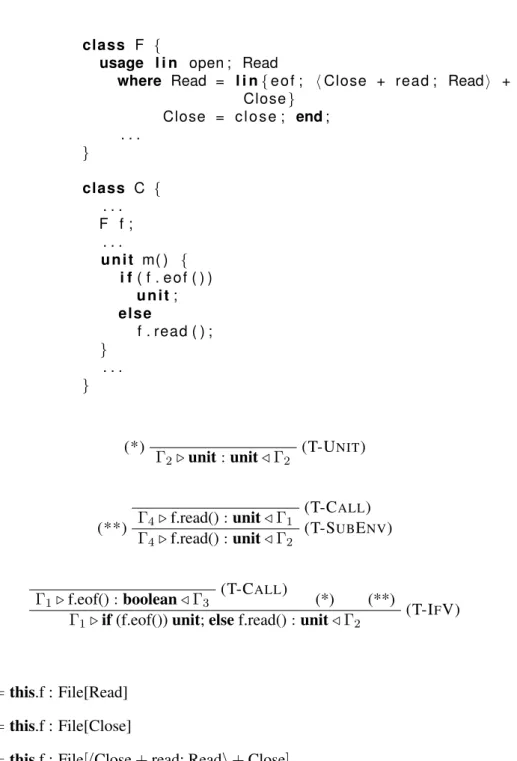
3.14 Example of a derivation with subtyping . . . 42
4.1 The MOOL compiler architecture . . . 46
4.2 A program and its symbol table . . . 47
4.3 The external and internal representation of two usage types . . . 48
1.1 A file usage type . . . 5 1.2 A file reader . . . 5 2.1 An auctioneer . . . 13 2.2 An auction . . . 13 2.3 A seller . . . 15 2.4 A selling protocol . . . 15 2.5 A bidder . . . 16 2.6 A bidding protocol . . . 16
2.7 The main class . . . 18
Introduction
As software complexity and size increase, more effective techniques for building reliable systems are needed. In particular, large applications require both modular development strategies and formal behavioural specifications that assist programmers in validating the correctness of their code.
Concurrent programming usually introduces further complexity into the already com-plex world of traditional sequential programming. Reasoning about concurrent programs can be difficult, since thread interference should be considered at several program points. Race conditions and deadlocks are some common concurrency-related problems in main-stream programming languages.
Mainstream object-oriented languages, like Java, can automatically detect and pre-vent (standard) type and initialisation errors through compile-time checks. However, they cannot detect and prevent errors related to usage protocols (usually only described in informal documentation), which end up revealing themselves as runtime exceptions in languages equipped with built-in support to handle errors and exceptional events. For example, reading from a file should follow the rules of a well-known usage protocol: first a file must be opened, then it can be read multiple times (without reading beyond the end-of-file), and finally it must be closed. Nevertheless, in mainstream object-oriented languages, any disregard of this specification is only detected when it eventually causes a runtime exception. As a result, one of the major topics of computer science today is the study of strategies that can verify sequential and concurrent programs against precise interface specifications.
The design of languages conceived especially for reasoning about program correct-ness via specification and verification has received great attention since the Floyd–Hoare logic [13, 21] in the late 1960’s. Since then, several programming languages were devel-oped with mechanisms to prove program correctness and, in particular, with support for statically enforcing specifications which programmers can write to express their intentions about how a program should work. This support for recording and enforcing assumptions about programs creates a new programming methodology in which developers are also
called to reason about their code. However, the complexity of some specification models is still a deterrent to the diffusion of these techniques to mainstream languages. Often, readability and ease of understanding are design considerations that are not regarded as important as correctness and safety ones, and software development practices continue to be subjected to numerous errors that could easily be avoided by the use of these safer languages.
Program development in the industry could greatly benefit from having specification and verification techniques fully integrated in mainstream programming languages. Ben-efits would not just be long-term, with the reduction in costs of software maintenance and the extension of software lifespan. Immediate benefits would also come of having pro-grammers use a methodology that allows them to automatically detect any usage errors as early as compile-time.
In this context, we propose MOOL, a mini object-oriented language in a Java-like style. Our programming language offers constructs that programmers can attach at class definitions to capture usage protocols, describing how an object should be used and ac-cessed. In particular, programmers can use these constructs to specify (1) the available methods and (2) the existence of aliasing restrictions, both of which depend on an object state. When only one client can reference an object, we say that the object has a linear status. When multiple clients can reference the same object (i.e no aliasing restrictions are imposed), we say that the object has an unrestricted, or shared, status. This combination of properties (state and status) provides an abstract view of an object as seen by clients, which we call the class usage type. As opposed to standard types, usage types are dy-namic, varying over time with the object state. Based on an object usage type, the MOOL
type system can statically enforce that (1) methods are called in the specified order and that (2) aliasing is compliant with the object specified status. MOOLalso includes a sim-ple concurrency mechanism for thread spawning, and a standard mutual exclusion facility to be used when access to certain operations on shared objects needs to be performed without thread interference.
Our formal language is based on a recent work by Gay et al. [15], which provides a new approach to session types within the distributed object-oriented paradigm, referred to as modular session types. Session types have been proposed to enhance the verifica-tion of programs at compile-time by addressing the issue of typed communicaverifica-tion over channels. Typically, all communication takes place within the context of sessions. In practice, sessions are just blocks of code in which a channel is made available for the communication between two or more participants. Session types provide a means to en-force that channel implementations obey the sequences and types of messages specified in communication protocols, and are thus of great assistance to programmers who want to verify the correctness of their programs. This theory has proved effective when applied to static type-checking concurrent and distributed object-oriented languages, revealing both
the expressiveness and complexity needed for modelling several common computing sce-narios, such as client-server and peer-to-peer protocols.
In the recent approach described in the work on modular session types [15], the mod-ularity comes from partitioning the session implementation into several methods, as op-posed to previous approaches in the context of object-oriented languages in which the session is implemented in a single method body. Moreover, there is a successful attempt at treating session-typed communication channels as objects by hiding channel primitive operations in an API from where clients can call methods. In this thesis, we take the overall concept on which session types are founded, namely that communication should proceed according to specified protocols, which are statically enforced, and use it to ad-dress the issue of typed object usage in a programming language that relies on a simpler communication model – message passing in the form of method calls. We follow the pro-gramming style of Java, and propose a language where the programmer does not have to deal with distribution (we use shared memory concurrency) nor channels, while still tak-ing advantage of the type-safety properties that are usually associated with session types. The design of our language was guided by the attempt to make it not only type-safe at compile-time, and for that we introduce statically enforced specification constructs, but also simple for object-oriented practitioners, which we accomplish by introducing an in-tuitive specification in a simple class-based object-oriented programming language.
1.1
Motivation
There are several reasons why a type system should enforce that an object, and its meth-ods, should only be available under specific conditions. For example, an attempt to pop an element from an empty stack, or to advance an iterator beyond the end of a list, or a file that is freely manipulated by several clients, are simple uses of objects that can lead to unexpected behaviour, and even loss of data.
Other approaches that check that an object is correctly used based on method availabil-ity, namely systems of typestates for object-oriented languages [7, 10], rely on pre- and post-condition annotations on method definitions, describing what an object state should be before and after each one of its methods is called. In our language, we do not use method annotations; instead, we attach a usage specification at the class level to define how an instance of the class should be used.
Gay et al. [38] call the global specification of available methods the object dynamic interfaceto distinguish from the interface offered by Java. In the literature, objects that dynamically change the set of available methods are also known as non-uniform objects. Nierstrasz [30] was the first to study the behaviour of non-uniform, or active, objects in concurrent systems.
state. Additionally, we make aliasing depend on its status. To introduce the concepts that support our ideas, we present a simple example. Consider aFileReaderthat uses an object of classFile, whose behaviour has already been informally described, and supports multi-threaded access once the contents of the file has been obtained. AFileReaderhides the File protocol from clients, revealing its own: it starts by reading an entire file into a string; once the reading is concluded, the object can be shared, and several threads can have references to the object in order to obtain the file contents. A counter tracks the number of accesses made to the object. During the reading process, there is a choice of obtaining the file contents read up to that point.
Listing 1.1 formalises the File protocol, which the FileReader class (the client side) in Listing 1.2 implements. Each class usage type formally describes the informal de-scriptions provided above. The FileReader uses an object of class File, conforming to its protocol. Similarly, aFileReader client should use an object of this class taking into consideration its formalised protocol. The usage specifications attached to the class defi-nitions indicate the order in which methods are to be called and the aliasing restrictions, if any, imposed on clients. An object of class File is linear from beginning to end, while an object of classFileReaderbegins by imposing restrictions on aliasing, but then evolves into stateDonewhere the specified methods may be called by multiple threads. Although a detailed explanation of the usage specification is provided later in Section 2.2.1 and Chapter 3 of this thesis, below we comment briefly on some specific features.
Notice first that the lin qualifier (used to indicate linearity) tracks the object status which is controlled by its current type. For example, after opening the file in line 10 of classFileReader, the field f changes its type to File [Read] (see the File usage), where the next available method iseof, annotated with the lin descriptor. Readis a symbolic name representing the object state or current type. TheFileReader type accompanies the changes in the File type. After calling open on a FileReader object, its type changes to
FileReader[Next].
The entireFileprotocol from stateReadto stateend, where there are no more available methods, takes place in the methodnextbody of classFileReader(lines 17-22). The form
h. . . + . . .i, which we call a variant type, in the File usage specification, indicates that methodeofreturns a result of typebooleanon which depends the object subsequent state. So, in theFileReaderimplementation, a test is performed in order to find out whether the end-of-file has been reached, and the file has to be closed by invoking methodclose, or the next string can be read by invoking methodread. Syntactically the (;) binds stronger than the (+), which separates the two possible results (the true result is described on the left hand-side, while the false one is described on the right hand-side). Because a variant is implicitly linear, thelin is omitted in the type that starts each variant.
1 class F i l e {
2 usage l i n open ; Read
3 where Read = l i n e o f ; h c l o s e ; end + read ; Read i ;
4 . . .
5 }
Listing 1.1: A file usage type
1 class F i l e R e a d e r {
2 usage l i n open ; Next
3 where Next = l i n { n e x t ; h Next + Done i +
4 t o S t r i n g ; Next } ; 5 Done = ∗{ t o S t r i n g + g e t C o u n t e r } ; 6 7 F i l e f ; s t r i n g s ; i n t c o u n t e r ; 8 9 u n i t open ( s t r i n g name ) { 10 F i l e f = new F i l e ( name ) ; 11 f . open ( ” r ” ) ; 12 s = ” ” ; 13 c o u n t e r = 0 ; 14 } 15 16 boolean n e x t ( ) { 17 i f ( f . e o f ( ) ) { 18 f . c l o s e ( ) ; 19 f a l s e ; / / r e t u r n f a l s e 20 } else { 21 s += f . read ( ) ; 22 t r u e ; / / r e t u r n t r u e 23 } 24 } 25 26 s t r i n g t o S t r i n g ( ) { 27 co unt ( ) ; 28 s ; / / r e t u r n s 29 } 30 31 i n t g e t C o u n t e r ( ) { 32 c o u n t e r ; / / r e t u r n c o u n t e r 33 } 34 35 sync u n i t count ( ) { 36 c o u n t e r ++; 37 } 38 }
stateNext, defines a recursive type, showing a similar behaviour to the one of the recursive type Read in the false variant of the File class usage type. While this recursive type eventually ends (methodnextreturnsfalseonce the File protocols ends), the anonymous recursive type denoted by (*) in line 5 of class FileReader reveals a different behaviour of a type that never ends. The state Donemarks the change in the object status, which evolves from linear to shared. It is not imposed by the MOOL type system, but rather
it emerges as a property that the only form of unrestricted useful types, apart fromend
(that isun{}), are of this form. In a branch type, the (+) assumes a different meaning, indicating a choice: when in state Doneany of the methods toString and getCountercan be called an infinite number of times, in no particular order. Formally, this type defines a recursive branch type of the formµX.un{toString.X + getCounter.X}, where theun stands for unrestricted (or shared), and, to lighten the syntax, can be omitted as we consider it to be an object default status. Because of the particular form of this recursive type, calling any of these methods on an instance of classFileReaderdoes not change the object state nor the set of available methods.
Finally, notice that the methodcount, defined in line 35, is not referred in theFileReader
usage type. This means that we can regard it as a private method, because in MOOLclients can only view (and call) methods defined in the class usage specification. This method issync-annotated, but when called in stateNext, the method annotation has no effect, as the lin qualifier in the class usage type, by forbidding aliasing, already enforces mutual exclusion.
There are several remarks to be made regarding this motivating example:
• The class usage type in the File andFileReaderexamples prevents common pitfalls in the usage of a file object by enforcing a sequence of legal method calls. For example, clients can no longer read from a file without first opening it, or read beyond the end-of-file. Moreover, the class usage type documents and formalises the specification which our compiler ensures at compile-time that clients correctly implement.
• This simple example also illustrates a problem of shared accesses which may arise in both sequential and concurrent object-oriented programming. In mainstream languages, there is no way to avoid the potential interference of two clients with a reference bound to the same file object. For example, one reference could be used to make the file unreadable (by invoking methodcloseon it) between the test on eofand the reading operation made by another reference. This might result in inconsistencies in the clients’ views of the file, and it illustrates a situation that can happen both in single- and multi-threaded settings. Our solution to this problem is to introduce a status (linear or unrestricted) attached to an object type. In the example, the field fdeclared in classFileReaderis the only reference allowed to the
linear while the File type has not been consumed to the end. Once the file has been closed, we can allow that several threads hold references to the same FileReader
instance.
Foregoing work on session types for objects deals with linear types only. The intro-duction of shared objects is dealt with in the implementation mentioned in modular session types [15], while defining two distinct categories to treat linear and un-restricted objects. In our approach to object aliasing control, we define a single category for objects, as opposed to distinct categories for linear and for shared ob-jects. We let the current status of an object to be governed by its type, allowing linear objects to evolve into shared ones (cf. [35, 37]). The opposite is not possible, as we do not keep track of the number of references to a given object.
• Finally, not all programming problems can be solved by the introduction of linear-ity. However, forbidding aliasing would be a too restrictive approach. Because we do not track the number of references existing to a shared object, we never let an object with an unrestricted type to go back to being linear. As a result, some addi-tional mechanism has to used to allow for concurrent access in mutual exclusion. Since our main focus are linear objects, to enforce serialised access to certain meth-ods that manipulate shared data, we adopt a standard and straightforward solution similar to the synchronized mechanism used in Java to prevent thread interference. The need for this mechanism should become clear from regarding methodcountin the example, where the synckeyword modifies the method in order to ensure that no updates to the counter are lost when the method is accessed by multiple threads.
1.2
Contributions
Building on previous work by Gay et al. [15, 38], we propose a core concurrent object oriented-language that includes specification constructs based on the idea of an object usage protocol. We formalise the operational semantics and type system. Finally, we implement these ideas in a prototype compiler.
Regarding session types, the contributions of our language are as follows:
• In contrast to other works on session types, we elect method invocation as the only communication model, both in concurrent and sequential programming;
• We annotate classes with a usage descriptor to structure how clients can call meth-ods, and we enhance it with lin/un qualifiers for aliasing control, thus defining a sin-gle category for objects that may evolve from a linear status into an unrestricted one; • In contrast to other works on session types, we replace the well-known shared chan-nel primitive by a conventional synchronization primitive for mutual exclusion
ac-cess in concurrent settings. We introduce a sync method modifier to describe those operations in shared objects that must be accessed without thread interference.
1.3
Thesis Outline
The current chapter introduces our work and its main motivations. The remaining chapters are organised as follows:
Chapter 2 describes the programming language via an extended example, which illus-trates the main features of the specification language;
Chapter 3 formally presents the core language, describing its syntax, operational seman-tics and type system. Its safeness is not proved in this thesis; we leave it for future work. Because our type system relies on many of the premises upon which the work on modular session types [15] is built, which provides a full formal treatment for its language, we are confident that MOOL inherits similar type-safety properties, and that we will be able to formally demonstrate them in future work;
Chapter 4 describes the prototype compiler implementation, introducing the main tech-nologies upon which the compiler was built, as well as a view of its architecture. As far as technologies are concerned, the compiler is written in Java, and the SableCC framework provides a parser generator and tree-walkers, which are extended in or-der to implement the analysis on the input MOOLprograms. The compiler targets Mono, the open-source clone of the Common Language Runtime (CLR);
Chapter 5 discusses the state of the art on session types, in particular in the context of object-oriented languages, typestates, and unique ownership of objects;
Example: The Auction System
In this chapter, we introduce an example of a full system written in the MOOL program-ming language in order to illustrate its syntax and main capabilities. Our main focus are the usage specification details, apart from which the language is a standard class-based object-oriented language. All the key technical ideas should already become clear in this chapter (see Chapter 3 for a more technical introduction).
The example models an auction system. We begin by explaining the system overall requirements and describing the usage protocols using an informal representation (Sec-tion 2.1). Then, we provide our solu(Sec-tion encoded in MOOL (Section 2.2) in which we formalise the described protocols in usage types, and discuss the decisions taken. Be-sides demonstrating a practical use of MOOL, we reveal in this extended example the potentialities of our approach, which can be summarised in the following features:
• Expressiveness: the usage specification can be used for modelling relatively com-plex scenarios;
• Small learning curve: it is very easy to understand the usage specification and start writing types using it;
• Safer code: the programmer specifies in the class usage type how objects should be used and accessed (namely, the available methods, and the aliasing restrictions), and our type-checker verifies that client implementations comply with the usage type.
2.1
The Auction Usage Protocol
Our auction system, adapted from [34, 35], features three kinds of participants: the auc-tioneer, the sellers and the bidders. Sellers sell items for a minimum price. Bidders place bids in order to buy some item for the best possible price. The auctioneer controls these interactions.
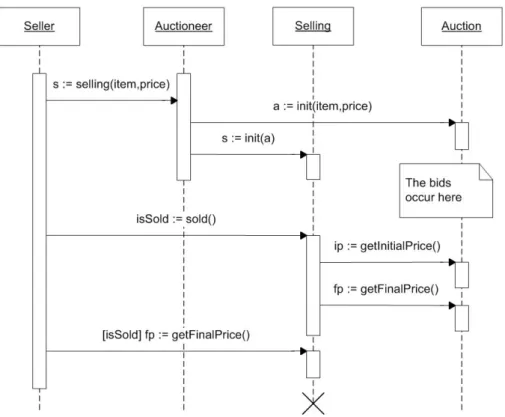
The system is best described by the UML sequence diagrams in Figures 2.1 and 2.2, modelling the two main scenarios through a sequence of messages exchanged between objects. The first diagram describes the scenario for a seller, while the second one de-scribes the scenario for a bidder. We are mainly interested in visualising the interac-tion between the different players; we do not represent concurrent communicainterac-tion, even though it should not be hard to imagine several seller and bidder threads concurrently making requests to the same auctioneer object.
The sequence diagrams show, as parallel vertical dotted lines (called lifelines), the different objects that participate in the protocol, and as horizontal arrows, the messages exchanged between them, in the order in which they occur. Activation boxes, or method-call boxes, are the rectangles drawn on top of lifelines to represent the execution of an operation in response to a message. To lighten the representation, we omit the usual dashed open-arrowed line at the end of an activation box indicating the return from a message and its result. Instead, we simply annotate sent messages with the returned value, if any. A conditional message is shown by preceding the message by a conditional clause in square brackets. The message is only sent if the clause evaluates to true.
The first diagram (Figure 2.1) depicts how a Seller initiates the interaction with the
Auctioneerindicating the item to auction and its price. The Auctioneer, after creating an
Auctionobject, where the bids for the item being sold are going to be placed, delegates the service to a new Sellingobject. Once the auction is set, the auctioneer can start receiving bids for that item. We signal with a note the moment when the two scenarios interweave. In the interaction initiated by a Bidder (Figure 2.2), the Auctioneerreceives a request for the item searched and, if the item is being auctioned, it delegates the service to the
Biddingobject. Still in the bidder scenario, we can see that aBidderholds its own Bidding
object from which it can obtain the item initial price as defined by the Seller. Based on the returned value, the Bidder decides whether to make a bid by calling the appropriate method on the Bidding object, or else do nothing. Returning to the seller scenario, if the sale is successful, the Selling object allows a Seller to obtain the sale final price by invoking methodgetFinalPrice.
Both scenarios depict a similar pattern, and it is not difficult to conclude from the di-agrams that the usage protocols should be specified in theSellingandBiddingclasses, and that these protocols should describe linear types. This is the only way we can guarantee that clients (sellers and bidders) fully obey the specification, by enforcing that their types are consumed to the end. Notice in the diagrams that a fresh Selling (and Bidding) ob-ject is created at the beginning of each selling (and bidding) interaction, and is implicitly destroyed at the end. We signal object destruction in the diagram to increase the ex-pressiveness of the representation; the type system provides crucial information to object deallocation.
Figure 2.1: The scenario for a seller
2.2
Programming with Usage Types
Given the above informal description of the system usage protocols, it is straightforward to write the code for each object identified in the two UML sequence diagrams. A possible implementation is sketched in Listings 2.1-2.7. Each class begins by specifying in a class usage descriptor the sequence of available methods and the aliasing restrictions, if any, with which clients should comply. No additional specification is needed since, as conventionally established, method signatures convey all the information clients need (the number and type of parameters, and the return types).
2.2.1
Usage syntactic details
Before analysing each class and its usage in detail, we introduce some less obvious syn-tactic details, in order to complete the brief description provided in Section 1.1. The usage formalises how clients should use an object of a given class, and no other usage is possi-ble. Although our language does not support access level modifiers, all methods that are not referred in the usage specification are not visible to clients. For the same reason, class fields are also private, and cannot be used directly.
If a program defines a conventional class namedCwith methodsm1,m2andm3, and no usage declaration, our compiler will insertusage ∗{m1 + m2 + m3}as the class default usage type, where each method (m1,m2andm3) is always available. Formally, this usage defines a recursive branch type of the formµX.un{m1.X + m2.X + m3.X}. Theunqualifiers are omitted in the examples. A choice between calling one of the three available methods is indicated by (+). Because of the particular form of the recursive type, calling any of these methods on an instance of class C will not change the object state nor the set of available methods.
A typical usage declaration for a linear object is a sequential composition of available methods. If classCis linear,usage lin m1; lin m2; lin m3; end;is a possible usage decla-ration. Calling methods in the prescribed order on an instance of this class changes the object state and the set of available methods. Stateendis an abbreviation forun {}. When an object is in this state, it means that the sequence of available methods is empty (the usage protocol is finished).
A variant type, denoted by h. . . + . . .i, is indexed by the two values of the boolean
type returned by the method to which the variant is bound. A client should test the result of the call: iftrue is returned, the new object state, and the available methods, are to be found in the left-hand side of the variant; iffalse is returned, it is the right-hand side to dictate the object state and available methods.
1 class A u c t i o n e e r { 2 usage l i n i n i t ; ∗{ s e l l i n g + b i d d i n g } ; 3 4 AuctionMap map ; 5 6 u n i t i n i t ( ) {
7 map = new AuctionMap ( ) ;
8 } 9 10 S e l l i n g [ Sold ] s e l l i n g (s t r i n g item , i n t p r i c e ) { 11 A u c t i o n a = new A u c t i o n ( ) ; 12 a . i n i t ( item , p r i c e ) ; 13 map . p u t ( item , a ) ; 14 S e l l i n g s = new S e l l i n g ( ) ; 15 s . i n i t ( a ) ; 16 s ; / / r e t u r n s 17 } 18 19 B i d d i n g [ R e g i s t e r ] b i d d i n g (s t r i n g i t e m ) { 20 B i d d i n g b = new B i d d i n g ( ) ; 21 b . i n i t ( map . g e t ( i t e m ) ) ; 22 b ; / / r e t u r n b 23 } 24 } Listing 2.1: An auctioneer 1 class A u c t i o n { 2 usage l i n i n i t ; 3 ∗{ b i d + g e t I n i t i a l P r i c e + 4 getMaxBid + g e t B i d d e r } ; 5 6 s t r i n g i t e m ; i n t i n i t P r i c e ; 7 i n t b i d d e r ; i n t maxBid ; 8 9 u n i t i n i t ( s t r i n g item , i n t i n i t P r i c e ) { 10 . . . / / i n i t i a l i z e f i e l d s 11 } 12 13 sync u n i t b i d ( i n t pid , i n t b i d ) { 14 i f ( maxBid <= b i d ) { 15 b i d d e r = p i d ; 16 maxBid = b i d ; 17 } 18 } 19 . . . / / t h e g e t t e r s 20 } Listing 2.2: An auction
2.2.2
The Auctioneer
Consider now the usage specification in Listing 2.1, which provides an implementation of classAuctioneer. When an object of this class is created using the explicit constructor
init, only one client can reference it, but then the object evolves into an unrestricted type, allowing several sellers and bidders to hold references to the same Auctioneer instance. Notice that we have defined a recursive (shared) type.
Each client can do one of two things:
• it can call method selling to obtain an object that provides an implementation of the selling activity on theAuctioneer; or
• it can call methodbiddingand obtain an object that implements the buying activity on theAuctioneer.
Then, it can repeat the interaction all over again: a seller can lower the price of an item with no bids, and start a new sale; a bidder can bid a higher price. The type never ends, and this illustrates why, in any program, we cannot keep track of the number of references to a shared object. The return types of these two methods areSelling [Sold]andBidding[Register]
respectively, because they need to be consistent with the state of the Selling and Bidding
objects after the method bodies are executed and advance the types. In the example, the stateSoldis short for lin sold; hgetPrice; end + done; endi;(lines 3 and 4 in Listing 2.4), and is used for convenience to replace the full type above by a name that represents the abstract state.
Notice, still in Listing 2.1, that when a new selling request is made, a new Auction
object is created (line 11). The code of classAuctionis shown in Listing 2.2. This instance is then added to theAuctionMapobject (whose class we omit), where theAuctioneerkeeps all the auctions (line 13), and is passed to the constructors of both theSelling andBidding
objects. In method selling, the reference to theAuctionis created locally within the method body and assigned to a variable (line 11), while in methodbidding, it must be fetched from theAuctionMap object (line 21). It is through reading and writing to this shared Auction
object that the protocol takes place.
Thesyncmodifier of methodbid(line 13 in Listing 2.2) is used to control concurrent bids made by separate Bidder threads via their Bidding objects (see Listing 2.6). This annotation also qualifies theputandgetoperations on classAuctionMap.
2.2.3
The Seller
Listings 2.3 and 2.4 implement two linear types. The usage declaration in class Seller is an abbreviation for the nested composition of branch typeslin{ init ; lin{run; un{}}}. Also
1 class S e l l e r {
2 usage l i n i n i t ; l i n run ; end ;
3 4 s t r i n g i t e m ; i n t p r i c e ; 5 A u c t i o n e e r a ; 6 7 u n i t i n i t ( A u c t i o n e e r a , s t r i n g item , i n t p r i c e ) { 8 . . . / / i n i t i a l i z e f i e l d s 9 } 10 11 u n i t run ( ) { 12 S e l l i n g s = a . s e l l i n g ( item , p r i c e ) ; 13 . . . / / w a i t f o r t h e a u c t i o n t o end 14 i f ( s . s o l d ( ) ) 15 p r i n t ( ” made ” + 16 s . g e t P r i c e ( ) + ” euros ! ” ) ; 17 else { 18 s . done ( ) ; 19 i f ( l o w e r P r i c e ( ) ) 20 run ( ) ; 21 } 22 } 23 24 boolean l o w e r P r i c e ( ) { 25 . . . / / i m p l e m e n t a t i o n o m i t t e d 26 } 27 } Listing 2.3: A seller 1 class S e l l i n g { 2 usage l i n i n i t ; Sold 3 where Sold = l i n s o l d ;
4 h g e t P r i c e ; end + done ; end i ;
5 6 A u c t i o n a ; i n t f i n a l P r i c e ; 7 8 u n i t i n i t ( A u c t i o n a ) { 9 . . . / / i n i t i a l i z e f i e l d s 10 } 11 12 boolean s o l d ( ) { 13 f i n a l P r i c e = a . g e t F i n a l P r i c e ( ) ; 14 f i n a l P r i c e >= a . g e t I n i t i a l P r i c e ( ) ; 15 } 16 17 i n t g e t P r i c e ( ) { 18 f i n a l P r i c e ; 19 } 20 21 u n i t done ( ) { 22 / / dummy method 23 } 24 }
1 class B i d d e r {
2 usage l i n i n i t ; l i n run ; end ;
3 4 i n t p i d ; i n t myPrice ; A u c t i o n e e r a ; 5 6 u n i t i n i t ( A u c t i o n e e r a , i n t pid , i n t myPrice ) { 7 t h i s . a = a ; 8 t h i s . p i d = p i d ; 9 t h i s . myPrice = myPrice ; 10 } 11 12 u n i t run ( ) { 13 B i d d i n g b = a . b i d d i n g ( ) ; 14 b . r e g i s t e r ( p i d ) ; 15 i f ( b . g e t I n i t i a l P r i c e ( ) <= myPrice ) 16 b . b i d ( myPrice ) ; 17 else 18 b . done ( ) ; 19 } 20 } Listing 2.5: A bidder 1 class B i d d i n g { 2 usage l i n i n i t ; R e g i s t e r 3 where R e g i s t e r = l i n r e g i s t e r ;
4 l i n g e t P r i c e ; l i n { b i d ; end + done ; end } ;
5 6 A u c t i o n a ; i n t myBidder ; i n t p r i c e ; 7 8 u n i t i n i t ( A u c t i o n a ) { 9 t h i s . a = a ; 10 p r i c e = 0 ; 11 } 12 13 u n i t r e g i s t e r ( i n t myBidder ) { 14 t h i s . myBidder = myBidder ; 15 } 16 17 i n t g e t P r i c e ( ) { 18 i f ( p r i c e == 0 ) 19 p r i c e = a . g e t I n i t i a l P r i c e ( ) ; 20 p r i c e ; 21 } 22 23 u n i t b i d ( i n t p r i c e ) { 24 a . b i d ( myBidder , p r i c e ) ; 25 } 26 27 u n i t done ( ) { 28 / / dummy method 29 } 30 }
notice an example of a variant type in classSelling(line 4 of Listing 2.4). The initial type of each variant must be linear, so the redundant lin qualifier can be omitted. This variant type requires that the client tests thebooleanresult of methodsold in order to determine the next available method: if the value evaluates totrue, then the caller can obtain the price (because the item was sold) via methodgetPrice, otherwise the protocol ends.
TheSellerimplementation completely complies with theSellingprotocol (lines 14-16) on what concerns referencesdeclared in line 12: the result of methodsoldis tested on the condition of the if expression, and the price of the sale is printed if it evaluates to true, otherwise the protocols ends, and the Selling object is deallocated through the dummy methoddone. This method only purpose is marking the end of the protocol (and of the object). However, if methodlowerPricereturnstrue, the protocol can restart, a newSelling
object is created, and memory is allocated to it.
The methodlowerPricein classSeller(line 24 in Listing 2.3) is an example of a method not referred in the usage specification (and consequently omitted from the object type). Our type system ensures that only methods in the usage type are visible to clients (cf. [15, 38]). All methods not specified in the usage type can be accessed in their own classes, but never alter the type (otherwise client views of the object could become inconsistent).
2.2.4
The Bidder
TheBidderandBidding classes in Listings 2.5-2.6 are similar in terms of structure to the classes described above for the seller protocol. Again, the usage type specified in class
Bidder shows an explicit constructor init and a run method (not recursive in this imple-mentation). In the methodrunbody, theBiddingobject is used according to its usage type, starting at stateRegister.
In order to bid, a bidder must register its process number; then, it must get the item price; and finally, it can either make a bid or do nothing, and the protocol ends. Notice the slight variation of the usage configuration in line 4 of Listing 2.6 in which the type offers a choice of two different calls (bidordone) based on the result of a method with a non-boolean return type. In line 15 of Listing 2.5, aBidderobject makes its choice based on the price it is willing to pay.
2.2.5
Putting all together
TheMain class in Listing 2.7 is the glue: it creates anAuctioneerobject that controls the auction, and spawns a separate thread for aSellerand twoBidderobjects, using a Java-like technique for thread creation.
1 class Main {
2 usage l i n main ; end ;
3 4 u n i t main ( ) { 5 A u c t i o n e e r a = new A u c t i o n e e r ( ) ; 6 a . i n i t ( ) ; 7 S e l l e r s e l l e r = new S e l l e r ( ) ; 8 s e l l e r . i n i t ( a , ” psp ” , 1 0 0 ) ; 9 spawn s e l l e r . run ( ) ; 10 B i d d e r b i d d e r 1 = new B i d d e r ( ) ; 11 b i d d e r 1 . i n i t ( a , 1 , 1 0 0 ) ; 12 spawn b i d d e r 1 . run ( ) ; 13 B i d d e r b i d d e r 2 = new B i d d e r ( ) ; 14 b i d d e r 2 . i n i t ( a , 2 , 1 0 0 ) ; 15 spawn b i d d e r 2 . run ( ) ; 16 } 17 }
The Core Language
In this chapter, we present the technical details of the MOOL core language, an essential
subset of the language used in the example (see Chapter 2) and implemented in a proto-type compiler (see Chapter 4). The subset consists of those features that define MOOL,
distinguishing it from similar languages, as well as a handful of other features that sup-port it as a practical language. We start with the formal syntax in Section 3.1, then we define the operational semantics in Section 3.2 and subtyping in Section 3.3, and finally we formalise the type system in Section 3.4. The main simplification in our language, as opposed to previous approaches that work with session type concepts within the object-oriented paradigm, is that it does not include channels; instead, only message passing in the form of method calls is used. In particular, the set of expressions defined in our language syntax are constructed based exclusively on standard primitives found in most object-oriented language formalisms. The only unusual element is the usage type, speci-fied in each class, which provides an abstract view of the protocol that clients must follow. Most of the technicalities that we present are based on the core language from mod-ular session types by Gay et al. [15], and on the linear type system presented by Vas-concelos [37]. Inspired by these approaches on sessions types, our main challenge was the attempt to formalise the convergence of channels and objects in a simple concurrent object-oriented language.
3.1
Syntax
In MOOL, we distinguish between the user syntax and the runtime syntax. The former is
the programmer’s language, and is defined in Figure 3.1; the latter is only required by the type system and operational semantics, and appears in Figure 3.2.
The metavariables C, f , and m range over class, field, and method names, respec-tively. We write ~F as short for F1; . . . ; Fn; (a sequence of field declarations), ~M as short
for M1. . . Mn(a sequence of method declarations), where n ≥ 0 in all cases. We
abbre-viate all sort of sequences using a similar pattern. 19
We assume that class identifiers in a sequence of declarations ~D are all distinct, and that the set of method and field names declared in each class contains only distinct names as well. Object references o include the keyword this, which references the current in-stance. In the examples, field accesses omit the prefix this; the compiler can insert it when needed.
In order to simplify the static and dynamic semantics, as well as the type system, in which we focus our analysis later in this chapter, we introduce the following restrictions on the syntax of specific constructs:
(i) only assignment to fields is defined;
(ii) a method call is only defined on a field of an object reference (not on an arbitrary expression);
(iii) it follows from the above that calling a method on a parameter requires assigning it first to a field;
(iv) a method accepts only one parameter.
The rules in the type system and operational semantics can easily be extended to methods accepting multiple parameters by recursively considering each of the parameters, instead of just one. The remaining restrictions are mainly related to the limited use of parameters in the core language. Passing a parameter to a method call, and assigning it to a field are the only two ways to use this kind of reference in the core language. While being a restriction, it supports good programming practices, since calling a method on a parameter changes the object type, and hence its assignment to a field, instead of its direct use in a call, should be preferred.
In the implementation, the syntax has been extended to include local variables. The rules for fields are easily adapted to variables, the main difference being that a variable has a method-level scope, whereas a field is defined at the class level. The resulting implications on linearity are taken into consideration. Self-calls (made on this) are defined in the syntax and the operational semantics, and have also been implemented. However, since self-calls do not modify the object type, we omit from the type system the typing rule for this construct.
3.1.1
User syntax
Classes, Fields and Methods The syntax of a class declaration D defines a class named C that encloses a usage descriptor u, and a set of fields and methods within its scope. A field declaration F simply defines a field named f with a type t. In the case of a field of an object reference, type t is dynamic, which means that it may vary at runtime. The
(class declarations) D ::= class C {u; ~F ; ~M } (field declarations) F ::= t f
(method declarations) M ::= s t m(t x) {e} (method qualifiers) s ::= ε | sync
(types) t ::= unit | boolean | C[u] (values) v ::= unit | true | false | o (expressions) e ::= v | x | o.f
| e; e | o.f = e
| new C() | o.m(e) | o.f .m(e) | if (e) e else e | while (e) e | spawn e
(class usage types) u ::= q {mi; ui}i∈I | hu + ui |
| X | µX.u (type qualifiers) q ::= lin | un
Figure 3.1: User syntax
general syntax for defining a method declaration M is also standard, denoting a method named m that returns a value of type t, taking a parameter x with type t. The body of the method is represented by the expression e.
Method modifiers are optional, which we indicate in the syntax by the empty string ε. A method declaration can be annotated with the sync qualifier to prevent race conditions from arising when separate threads attempt concurrent calls on the same method. This means that a sync method is evaluated in a similar way to Java’s synchronized methods: the object for which the method is invoked has an associated monitor lock, that is acquired by the synchronized method before its body is executed [19].
Types and Values The MOOL syntax defines non-object and object types. Non-object types include the primitive unit and boolean types. The unit type has the single value unit, while the boolean type can have one of two values: true and false.
The type of an object is C[u] in the style of modular session types [15], ranging over a class named C with usage type u. From a client class perspective, it prescribes the structure of method invocation: in which order/how methods should be called. Notice that only methods (not fields) are visible from outside, since methods are in the object type (and fields are not), as discussed in the examples from the previous chapters. It follows that methods not referred in the type of an object can be regarded as private (cf. [15, 38]), even though our language does not support access level modifiers.
Expressions The MOOL expressions are standard in object-oriented languages. We have defined (in order of appearance) values, parameters, fields, the sequential expression composition, assignment to fields, object creation, the self-call, the method call on fields, control flow expressions, and thread creation.
Values and references have been introduced above. Assignments, object creation and method calls have a syntax similar to the one found in most object-oriented languages, except for the aforementioned restrictions. Conditional and loop expressions are standard. Thread creation uses the spawn primitive. The form of the spawn expression means that the inner expression e will be evaluated in a newly created thread.
Class usage types In the core language, only the abstract syntax of usage types is de-fined, omitting theusage andwhereclauses, and the branch choice (+) and recursive (*) operators that have been introduced in the examples. However, it is not difficult to trans-late from the syntax of the examples into the core language syntax. The recursive type of theAuctioneerwith the formusage lin init ; ∗{ selling + bidding}; (see Section 2.2.2) takes the following configuration in the core language:
lin {init; µX.un {selling.X, bidding.X}}
The usage type defined in class Selling(see Section 2.2.3) provides an example of a vari-ant type. The formusage lin init ; Sold where Sold = lin sold; hgetPrice; end + done; endi;
is equivalent in the core language syntax to:
lin {init; lin {sold; hlin {getP rice; un {}} + lin {done; un {}}i}}
Branch types are denoted by {mi; ui}i∈I, defining available methods miand their
contin-uations ui. Variant types are denoted by hu + ui, and are indexed by the set of the two
boolean values returned by the preceding method in the specified usage type. In order to resolve the type, the caller must perform a test on its result before calling further methods. For simplicity, we use binary-only variants as in typestates [32], but more generous vari-ants using enumerations can be found in the literature [15]. Recursive types are indicated in the syntax by µX.u, and need to be contractive, which means that no subexpression of the form µX1.· · · µXn.X1 is allowed [15]. These types are treated in an equi-recursive
discipline, which means that we regard µX.u and its unrolling u{µX.u/
X} as equal types.
A usage branch type is annotated with a qualifier q for aliasing control. The lin qual-ifier describes the status of objects that can be referenced by a single client. The un qualifier stands for unrestricted, or shared, and governs the status of objects that can be referenced in multiple threads. Recall that we define a single category for objects, as op-posed to distinct categories for linear and for unrestricted objects, allowing linear objects to evolve into a status where they can be shared by multiple clients (cf. [35, 37]). The opposite is not possible, as we do not keep track of the number of references to a given object.
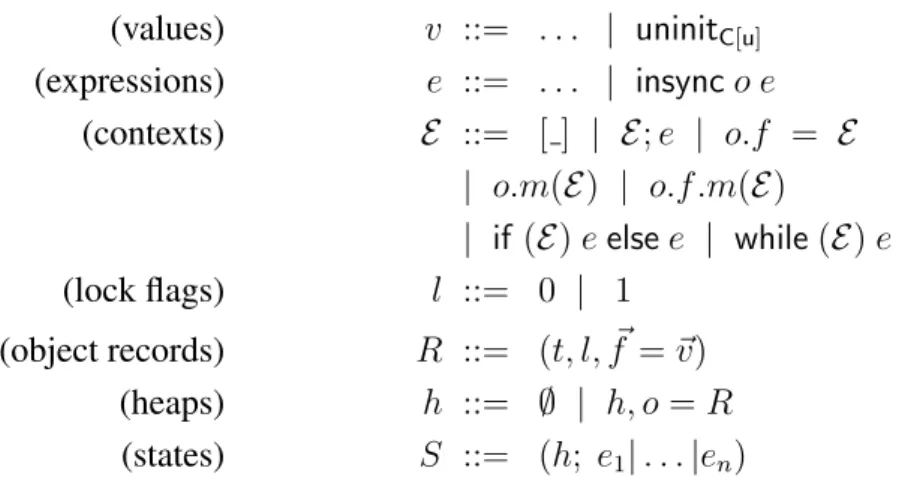
(values) v ::= . . . | uninitC[u]
(expressions) e ::= . . . | insync o e (contexts) E ::= [ ] | E; e | o.f = E
| o.m(E) | o.f .m(E)
| if (E) e else e | while (E) e (lock flags) l ::= 0 | 1
(object records) R ::= (t, l, ~f = ~v) (heaps) h ::= ∅ | h, o = R (states) S ::= (h; e1| . . . |en)
Figure 3.2: Runtime syntax
Notice that the type system, which we introduce later in this chapter, imposes some further restrictions on usage types, namely that:
(i) the initial class usage type can only be a branch, because a variant type is bound to the result of a method call;
(ii) in a variant type configuration hu + ui, each u corresponds to a lin-qualified branch (and that is why the qualifier is always omitted); and
(iii) an object final status is always unrestricted, whether because it evolves into an end state (with an empty set of alternatives), or because, being recursive, it never ends, as illustrated in the examples.
3.1.2
Runtime syntax
Figure 3.2 introduces additional elements required by the type system and operational semantics, but not available in the user syntax.
In the runtime syntax, values include uninitC[u], not in the programmer syntax, which
is used by our compiler to initialise fields of type C[u] when an object is created. Expres-sions are extended with the insync expression in the style of Flanagan and Abadi [12], that denotes that the subexpression e is currently being evaluated while the lock is held on object o.
Contexts, lock flags, object records, heaps and states presented next are required by the operational semantics. Evaluation contexts are denoted by E , and are expressions with one hole. Contexts specify the order in which expressions are evaluated, defining where reduction rules can be applied. The contexts which we define ensure that all field accesses and method calls occur after the receiver has been resolved, and that sequences
of expressions are evaluated in a specific order, namely from left to right. In the case of control flow expressions, the contexts guarantee that a branch in a conditional construct can only be executed after the condition has reduced to a value of a boolean type, and the same is guaranteed in the execution of the body of a while loop.
A heap is viewed as a map (a partial function of finite domain) from object identifiers o into records R. The operation h, o = R adds an entry to the heap h, if o does not yet exist, and is considered to be associative and commutative, which means that a heap is an unordered set of bindings [15]. Object records are instances of usage-typed classes and are represented by the triple (t, l, ~f = ~v), where t is the object current type, l represents the class lock flag, and ~f 7→ ~v is a mapping from field identifiers to their values. The lockcan be either in a locked or unlocked state, denoted by the 1 and 0 flag, respectively. The record ( , 1, ) means that some thread currently holds the lock associated with the current instance. Initially, an object is created with the flag set to 0. States consist of two components: a heap and a parallel composition of expressions sharing the same heap.
3.1.3
Programs
A MOOL program is composed of a collection of class declarations, which include the program entry point – a starting class named Main with a special method called main. A program starts with an initial state of the form (o : Main[u], 0, ~f = init(~t)), o.main(). Intuitively, though not syntactically correct, we could simplify and just say that a program starts with the expression new Main().main().
In the rest of this chapter, we present the reduction and typing rules of the MOOLcore language. We use the notation in Figure 3.3 to access the components defined in class declarations.
3.2
Operational Semantics
An operational semantics for MOOL is described in this section, modelling program exe-cution. The rules are defined in terms of state transitions. The evaluation of configurations starts with an empty heap and a set of expressions, and proceeds according to the various rules that specify the behaviour of each expression.
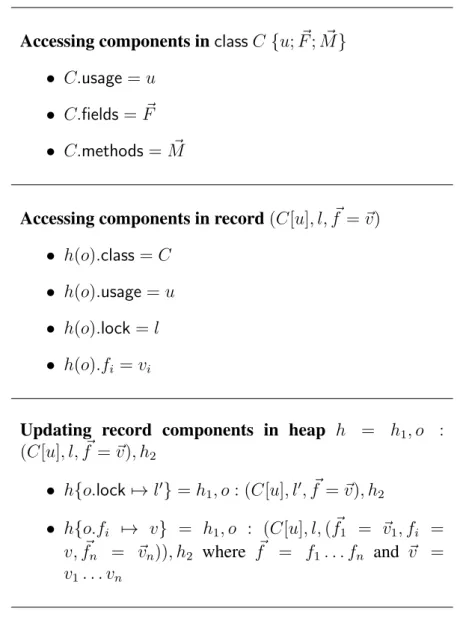
To simplify the reduction rules, we define a set of operations on the heap. If o is in the domain of h, then h(o) returns the record R associated with o in h. If R = (C[u], l, ~f = ~v), the auxiliary functions in Figure 3.3 are used to access and update object record compo-nents.
The functions used to access elements of object records are straightforward. Functions for record update are used to modify an object component. We show how lock and field values are updated. In both cases, the operation changes the initial heap h1 into the final
Accessing components in class C {u; ~F ; ~M } • C.usage = u
• C.fields = ~F • C.methods = ~M
Accessing components in record (C[u], l, ~f = ~v) • h(o).class = C
• h(o).usage = u • h(o).lock = l • h(o).fi = vi
Updating record components in heap h = h1, o :
(C[u], l, ~f = ~v), h2 • h{o.lock 7→ l0} = h 1, o : (C[u], l0, ~f = ~v), h2 • h{o.fi 7→ v} = h1, o : (C[u], l, ( ~f1 = ~v1, fi = v, ~fn = ~vn)), h2 where ~f = f1. . . fn and ~v = v1. . . vn
Figure 3.3: Auxiliary functions for class and heap components
one h2. We also use the notation e{o/this}{v/x} to denote the substitution in expression e
of this for o and of x for v.
The rest of the section is devoted to presenting the reduction rules for MOOL and
explaining each one of them in detail. The only unusual rules are the ones that have to deal with linear control of objects; the remaining ones are typical of most object-oriented languages.
3.2.1
Reduction rules for states
In Figure 3.4 we define the reduction rules for states, and below we comment on each one of them. These rules take the general form:
(h; e1| . . . |e| . . . |en) −→ (h0; e1| . . . |e0| . . . |en)
(R-CONTEXT)
(h; e1| . . . |E[e]| . . . |en) −→ (h0; e1| . . . |E[e0]| . . . |en)
(R-SPAWN) (h; e1| . . . |E[spawn e]| . . . |en) −→ (h; e1| . . . |E[unit]|e| . . . |en)
Figure 3.4: Reduction rules for states
R-CONTEXT This rule is standard, defining which expression can be evaluated next
in the program execution. It is the rule that invokes all the other reduction rules for expressions (see Figure 3.6).
R-SPAWN When spawn e is evaluated in an arbitrary context, the original thread does not evaluate the expression, but instead detaches it to a new thread running in parallel. After spawn, the original thread proceeds to evaluate its next instruction. The value of the spawn expression is unit, as the result of evaluating e is not transferred back to the original thread.
3.2.2
Reduction rules for expressions
The rules for expressions in Figure 3.6 have a similar form, with the difference that the state contains only one expression (as opposed to a parallel composition of expressions):
(h; e) −→ (h; e)
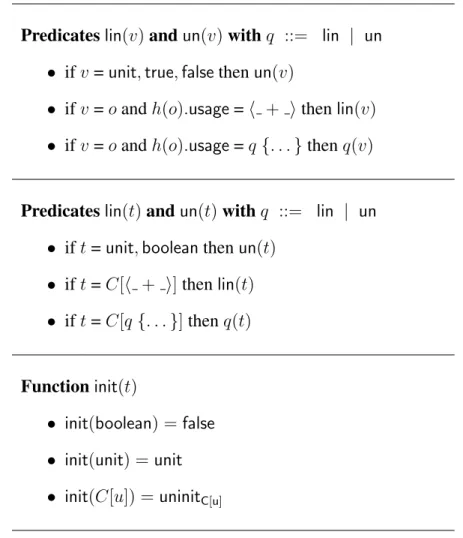
The rules use in their definitions the predicates defined in Figure 3.5. Predicate q(v) determines the type status (linear or unrestricted) given a value v. If v is a value of a primitive type, then its status is always unrestricted. If v is an object, then its status depends on its current type, which can be fetch from the usage component of the record associated with o in heap h. A variant type is always linear, and the status of a branch type is defined by the programmer. Predicate q(t) follows a similar pattern, with the difference that it takes a type as its argument. Finally, function init(t) takes a type as its argument and returns the type default value.
R-SEQ This rule reduces the result to the second part of the sequence of expressions, discarding the first part only after it has become a value.
R-LINFIELD, R-UNFIELD Access to a field involves extracting the value of the field from an object in the heap and determining whether the value belongs to an unrestricted
Predicates lin(v) and un(v) with q ::= lin | un • if v = unit, true, false then un(v)
• if v = o and h(o).usage = h + i then lin(v) • if v = o and h(o).usage = q {. . . } then q(v)
Predicates lin(t) and un(t) with q ::= lin | un • if t = unit, boolean then un(t)
• if t = C[h + i] then lin(t) • if t = C[q {. . . }] then q(t)
Function init(t)
• init(boolean) = false • init(unit) = unit • init(C[u]) = uninitC[u]
Figure 3.5: Auxiliary functions for values and types
or a linear type, using functions un(v) and lin(v), respectively (defined in Figure 3.5). After access, the value of an unrestricted field is v as in Java, but the value of a linear field must be unit to ensure that only one reference to an object with a linear type exists at any given moment.
R-ASSIGN Assignment to a field updates the value of the field with value v. The value of the entire expression needs to be unit (as opposed to v), and this is again a linearity constraint to enforce that a reference to an object with a linear type goes out of scope after appearing on the right-hand side of an assignment.
R-NEW The creation of a new object requires generating a fresh object identifier and obtaining the field names and types from the set of the class fields. Notice that a new object record, indexed by object identifier o, is added to the heap. Also notice that the object starts in an unlocked state 0, and that fields are initialised to default values based on their declared types (see Figure 3.5).
(R-SEQ) (h; v; e) −→ (h; e)
h(o).f = v lin(v) (R-LINFIELD)
(h; o.f ) −→ (h{o.f 7→ unit}; v)
h(o).f = v un(v) (R-UNFIELD)
(h; o.f ) −→ (h; v)
(R-ASSIGN) (h; o.f = v) −→ (h{o.f 7→ v}; unit)
o fresh C.fields = ~t ~f (R-NEW)
(h; new C()) −→ (h, o = (C, C.usage, 0) ~f = init(~t); o)
m( x) {e} ∈ (h(o).class).methods (R-SELFCALL)
(h; o.m(v)) −→ (h; e{o/
this}{v/x})
m ∈ h(o).f.usage m( x) {e} ∈ (h(o).f.class).methods (R-CALL)
(h; o.f .m(v)) −→ (h; e{o.f/this}{v/x})
h(o).f.lock = 0 m ∈ h(o).f.usage sync m( x) {e} ∈ (h(o).f.class).methods (R-SCALL)
(h; o.f .m(v)) −→ (h{(o).f.lock 7→ 1}; insync o0 e{o.f/
this}{v/x})
(R-INSYNC) (h; insync o v) −→ (h{(o).lock 7→ 0}; v) (R-IFTRUE) (h; if (true) e0 else e00) −→ (h; e0) (R-IFFALSE) (h; if (false) e0 else e00) −→ (h; e00)
(R-WHILE) (h; while (e) e0) −→ (h; if (e) {e0; while (e) e0} else unit) Figure 3.6: Reduction rules for expressions