Declaração
Nome: Roberto Manuel Dias Machado
Endereço Electrónico: [email protected] Telefone: 916748994
Bilhete de Identidade: 13441167
Título da Dissertação: Validating Common Criteria Documentation using Alloy Orientador: Doutor Manuel Bernardo Barbosa
Ano de conclusão: 2011
Designação do Mestrado: Mestrado em Engenharia Informática
Este trabalho for realizado no âmbito de uma bolsa de investigação financiada através do projecto de prestação de serviços de consultoria STORK, estabelecido entre a empresa Multicert - Serviços de Certificação Electrónica, S. A. e a Universidade do Minho.
É AUTORIZADA A REPRODUÇÃO INTEGRAL DESTA DISSERTAÇÃO APENAS PARA EFEITOS DE INVESTIGAÇÃO, MEDIANTE DECLARAÇÃO ESCRITA DO INTERESSADO, QUE A TAL SE COMPROMETE.
Universidade do Minho, 31 de Outubro de 2011 Roberto Manuel Dias Machado
Acknowledgements
First of all I want to thank my supervisor Professor Manuel Bernardo Barbosa for the research guidance and also for all the suggestions that improved this dissertation. I am grateful to Professor Alcino Cunha for the advice with Alloy.
Many thanks to the Multicert company for allowing me to participate in the CESeCore Project and to the CESeCore Technical Committee for the always interesting meetings. A special thank you to Nuno Santos who was always available to help. Also thanks to European Union Seventh Framework Programme, for granting me with a scholarship which made most of this work possible.
I take this opportunity to thank my colleagues at CeSIUM, that have helped me direct this student association for the last two years. I must also thank my colleagues at AAUM for their understanding when I was less available. A special thank you as well to my mates at Group Buddies.
I want to give a special thank you to all my friends that always support me as well, and at the same time I want to apologize for not being so present in the last year. A special acknowledgement to João that helped me with my doubts regarding the english language. Thank you to my friend and partner of long work nights André. A special thank you to Marta for all the kind support.
Family, I don’t have words to describe how much I’m thankful to all of you, especially my parents and my brother. Thank you for all the support since day zero of my life.
Last but certainly not least, I would like to thank to my aunt and uncle André and Angelina, and my cousins Ricardo and Luís, for their support in this five years that I have spent in Braga. You not only gave me a roof, you also gave me a second family.
“Rejoice with your family in the beautiful land of life!” - Albert Einstein Dedico este trabalho aos meus tios André e Angelina.
Resumo
O software criptográfico é frequentemente associado a componentes críticos de sistemas que requerem esforços adicionais para melhorar o seu nível de segurança. A certificação de software criptográfico é necessária para garantir que este vai de encontro às garantias de segurança desejadas. Esta certificação tem que seguir standards tais como Common Criteria (CC) para assegurar que a avaliação foi feita de uma forma rigorosa.
CC é um standard internacionalmente reconhecido que permite a certificação de software de segurança com relevo para a produção de provas do correcto desenvolvimento do software. Estas provas geralmente tomam a forma de uma série de documentos que podem custar tempo e dinheiro às organizações que pretendem conseguir certificações de software. Esta tese de mestrado trata da análise de todo o processo de certificação CC. Em específico, trata da documentação produzida como prova para uma avaliação. Pesquisa foi efectuada para compreender o processo de certificação, a documentação produzida, o Protection Profile e o Security Target, que mereceram especial atenção e, por último, técnicas que possam melhorar o desenvolvimento de documentação e a sua validação.
Geralmente os métodos formais são utilizados em procedimentos de certificação para obter fortes garantias de correcção para os níveis de segurança mais elevados. No trabalho aqui apresentado mostramos que os métodos formais também podem ser usados para aumentar o rigor do processo de certificação ao nível da análise documental. Usamos a linguagem de especificação Alloy para modelar os conceitos fundamentais de uma certificação de segurança de acordo com CC, e subsequentemente para mostrar como estes modelos podem ser usados para validar a consistência da documentação do Protection Profile e do Security Target.
Durante este trabalho estivemos envolvidos no projecto de certificação de um core crip-tográfico num pacote de software para certificação digital, o projecto CESeCore1. Olhamos para a documentação do CESeCore para desenvolver os nossos modelos e para validar a dita documentação. Para este projecto escrevemos ainda um documento que descreve todo o processo de certificação do CESeCore.
Finalmente, desenvolvemos um protótipo daquilo que pode vir a ser uma ferramenta para ajudar na criação de documentos para a certificação CC. Este protótipo usa os modelos Alloy como bases e permite-nos carregar documentos produzidos pela certificação CC, modificá-los, analisá-los e validá-los. Esta pode vir a ser uma ferramenta interessante para a indústria envolvida em certificação CC.
Abstract
Cryptographic software is typically associated with critical components of systems that require additional efforts in order to improve their level of assurance. Therefore, the certification of cryptographic software is necessary to ensure that it meets the desired guarantees. This certification must follow standards such as Common Criteria (CC) to ensure that the evaluation was conducted in a rigorous way.
CC is an internationally recognized standard that allows for security software certification with the focus on producing evidence of the software development. This evidence usually takes the form of a series of documents that can cost the organizations that intend to achieve software certifications time and money.
This master thesis focuses on the analysis of the whole CC process of certification. Specifi-cally, all the documentation produced as evidence for the evaluation. Research is conducted to understand the process of certification, the documentation produced, the Protection Pro-file and the Security Target, both of which deserved special attention, and lastly techniques that could improve the development of documentation and its validation.
Typically, formal methods are enforced in certification procedures in order to obtain strong correctness guarantees for the highest levels of assurance. In the presented work we show that formal methods can also be used to increase the rigor of the certification process at the documentation analysis level. We use the Alloy specification language to model the fundamental concepts of a security certification according to the CC, and then show how these models can be used to validate the consistency of Protection Profile and Security Target documentation.
During this work we have been involved in a cryptographic certification process in a soft-ware package for digital certification, project CESeCore2. We look at the documentation for CESeCore to develop our models and to validate said documentation. For this project we have also written a document that describes all the process of the CESeCore certifica-tion.
Finally, we have developed a prototype of what could be a tool to aid in the creation of an ion document for the CC certification. This prototype uses the Alloy models as bases and allows us to load documents produced for CESeCore certification, modify these documents, analyze them and validate the models. This could be an interesting tool for the industry involved in CC certifications.
Contents
1 Introduction 1 1.1 Motivation . . . 2 1.2 Objectives . . . 4 1.3 Contributions . . . 4 1.4 Dissertation Outline . . . 52 The Common Criteria Standard 7 2.1 Brief History . . . 8
2.2 Common Criteria Goals . . . 9
2.3 The Common Criteria Framework . . . 9
2.3.1 CC Part 1: Introduction and General Model . . . 10
2.3.2 CC Part 2: Security Functional Components . . . 11
2.3.3 CC Part 3: Security Assurance Components . . . 12
2.3.4 Common Evaluation Methodology . . . 14
2.4 Evaluation Assurance Levels . . . 15
2.5 Common Criteria Process . . . 18
2.6 General Model . . . 19
2.6.1 Sufficiency of the Countermeasures . . . 21
2.6.2 Correctness of the TOE . . . 21
2.6.3 Correctness of the Operational Environment . . . 22
2.6.4 Common Criteria Evaluation . . . 22
2.7 Formal Methods in Common Criteria . . . 24
2.8 Other applications of Formal Methods in CC Certifications . . . 26
3 Common Criteria Documentation 29 3.1 CC Documentation Structure . . . 30
3.2 Restrictions Imposed in the General Model . . . 32
3.3 Protection Profile . . . 33
3.3.1 Contents of a Protection Profile . . . 35
3.3.2 Choice of Protection Profile . . . 36
3.3.3 Consistency Concerns for the Protection Profile . . . 38
3.4 Security Target . . . 38
3.4.1 Contents of a Security Target . . . 39
3.4.2 Using a Security Target . . . 42
3.4.3 Sensitive Information . . . 42
3.4.4 Consistency Concerns for the Security Target . . . 43
3.4.5 SFR Dependencies . . . 43
3.4.6 Generation of Information from the Security Target . . . 45
3.5 Functional Specification . . . 45
3.5.1 Contents of a Functional Specification for EAL4 . . . 46
3.5.2 Generate Information for Functional Specification . . . 47
4 CC Documentation Modeling and Validation in Alloy 49 4.1 Modeling with Alloy . . . 50
4.1.1 Relational Logic . . . 51
4.1.2 Alloy Models . . . 52
4.2 Abstract Model . . . 54
4.3 Full Model . . . 56
4.4 Checking Consistency and Validation of Documents . . . 59
4.4.1 Checking Consistency . . . 59
4.4.2 SFR Dependencies . . . 61
4.4.3 SFR Tracing . . . 62
5 Case Studies 65 5.1 RSA Keon CA System . . . 65
5.1.1 Description of Keon CA . . . 66
5.1.2 Target of Evaluation . . . 66
5.1.3 Security Environment . . . 67
5.1.4 Security Objectives . . . 67
CONTENTS
5.1.6 Evaluation Process . . . 67
5.2 The CESeCore Project . . . 68
5.2.1 Protection Profile and Security Target for CESeCore . . . 68
5.2.2 Description of CESeCore . . . 69
5.2.3 Target Of Evaluation . . . 70
5.2.4 Security Environment . . . 72
5.2.5 Security Requirements . . . 73
5.3 Validation of the CESeCore Documentation . . . 74
5.3.1 Abstract Model Application . . . 74
5.3.2 Sensitive Information in the Full Model . . . 75
5.3.3 Consistency Checking for the Sensitive Information . . . 76
5.3.4 SFR Dependencies . . . 78
5.3.5 SFR Tracing . . . 79
5.4 CC Documentation in XML . . . 80
5.5 ToolBox for CC Documentation Development . . . 81
5.5.1 Functional Requirements Specification . . . 81
5.5.2 Non-Functional Requirements . . . 84
5.5.3 Design . . . 85
5.5.4 State of Implementation . . . 86
6 Conclusions and Future Work 87 6.1 Conclusion . . . 87
6.2 Future Work . . . 88
List of Figures
1.1 CC Evaluation process . . . 2
1.2 Documentation for Common Criteria Evaluation . . . 3
2.1 CC evaluation process overview . . . 7
2.2 CC evaluation process overview . . . 18
2.3 Evidence Evaluation Process . . . 19
2.4 The General Model of the CC evaluation process . . . 20
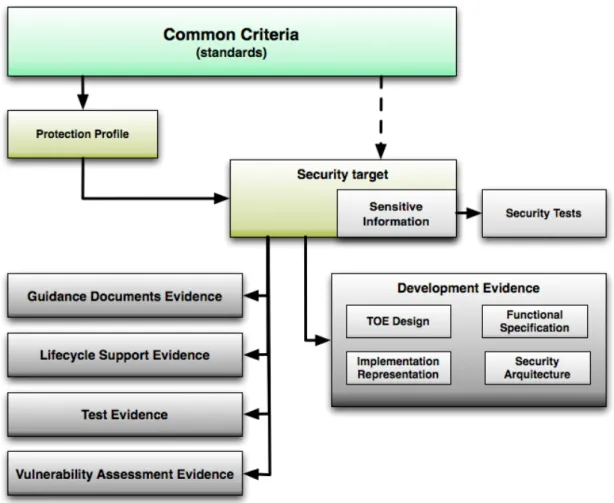
3.1 Common Criteria Documentation Structure . . . 30
3.2 Documentation for analyzes . . . 31
3.3 Security Objectives and Security Police Definition . . . 32
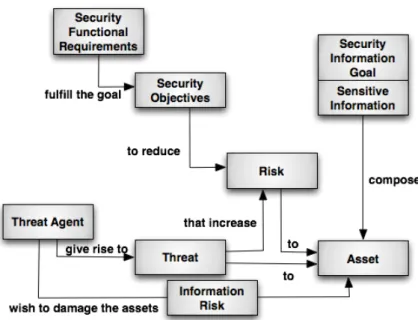
3.4 Detailed General Model . . . 33
3.5 Contents of a Protection Profile . . . 35
3.6 Protection Profile Decision Tree . . . 37
3.7 Contents of a Security Target . . . 39
3.8 Dependency table for Class FAU: Security audit . . . 44
3.9 Contents of a Functional Specification . . . 47
4.1 Structure of the Alloy Models . . . 50
4.2 Alloy analyzer instance for a farm problem . . . 51
4.3 Evaluator of the Alloy Analyzer . . . 61
5.1 The TOE Boundary of Keon CA system . . . 67
5.2 Integration of CESeCore with other applications . . . 69
5.3 TheTOE Boundary of CESeCore . . . 70
5.4 Deliverables for the CESeCore Project . . . 74
5.6 Sensitive Information included in the Full Model . . . 75
5.7 Validation of the Full Model - inconsistent . . . 76
5.8 Example of a correct assertion in the model . . . 77
5.9 Example of a assertion that creates a counterexample . . . 77
5.10 Counterexample visualized in the Tree option . . . 78
5.11 Exemples of SFR Dependencies in Alloy . . . 79
5.12 Components declaration and assertion for Dependencies . . . 79
5.13 SFR Tracing for the Functional Specification . . . 80
5.14 CC Documentation in XML . . . 81
5.15 Use Case for the Main Features . . . 82
Listings
4.1 Declaration Part . . . 53
4.2 Example of a fact in Alloy . . . 53
4.3 Running the model to find a valid instance . . . 54
4.4 Exemple of a assertion in Alloy . . . 54
4.5 Threat in Alloy . . . 55
4.6 Threat Agent in Alloy . . . 55
4.7 Asset in Alloy . . . 55
4.8 Information Risk in Alloy . . . 55
4.9 Risk in Alloy . . . 56
4.10 Security Objective in Alloy . . . 56
4.11 Security Functional Requirement in Alloy . . . 56
4.12 Threat Agents for the TOE . . . 57
4.13 Security Information Goals present in CESeCore . . . 57
4.14 Example of Sensitive Information . . . 57
4.15 Threat in Alloy . . . 58
4.16 Information Risk example for a set of Threat Agents . . . 58
4.17 Example of a Security Objective . . . 58
4.18 Example of a Risk . . . 58
4.19 Example of a Security Functional Requirement in Alloy . . . 58
4.20 Example of a Asset . . . 59
4.21 Security Objective countering the Threat in the Asset . . . 59
4.22 Security Objective countering the Threat in the Asset . . . 60
4.23 Threat Agent in Alloy . . . 60
4.24 New declaration of a SFRs . . . 61
4.25 List of Dependencies in the SFRs . . . 61
4.27 Declaration of the dependencies . . . 62
4.28 Checking the SFR Dependencies . . . 62
4.29 Interface in the Abstract Model . . . 63
4.30 Interface Roles in the Full Model . . . 63
List of Tables
2.1 Security Functional Classes . . . 12
2.2 Security Assurance Classes . . . 13
2.3 EAL Description . . . 15
2.4 EAL4 Components . . . 17
3.1 Functional Specification Component Requirement . . . 45
4.1 Set and logical operators used in Alloy Modeling Language (Alloy) . . . 52
Acronyms
AA Alloy Analyzer
Alloy Alloy Modeling Language CA Certification Authority CC Common Criteria
CCRA Common Criteria Mutual Recognition Agreement CEM Common Evaluation Methodology
CESeCore CESeCore Project
CIMC Certificate Issuing and Management Components Family of Protection Profiles
CRL Certificate Revocation List
CTCPEC Canadian Trusted Computer Product Evaluation Criteria DOD Department of Defense
EAL Evaluation Assurance Level ED Embedded Device
FC Federal Criteria
IDE Integrated Development Environment IT Information Technology
ITSEC Information Technology Security Evaluation Criteria JVM Java Virtual Machine
GUI Graphical User Interface Keon CA RSA Keon CA System
Keon ST RSA Keon CA System version 6.7 Security Target MIT Massachusetts Institute of Technology
NIAP National Information Assurance Partnership
NIST U.S. National Institute of Standards and Technology NSA National Security Agency
OSP Organizational Security Policie
PCA Polymorphous Computing Architecture PDF Portable Document Format
SAR Security Assurance Requirement SFR Security Functional Requirement SPD Security Policies Definition SPM Security Policy Modeling
TCSEC Trusted Computer System Evaluation Criteria TLS Top Level Specification
TOE Target of Evaluation TSF TOE Security Function
TSFI TOE Security Function Interfaces UML Unified Modeling Language XML Extensible Markup Language
Chapter 1
Introduction
Software plays a major role in critical systems such as cars, airplanes, health care de-vices, telecommunication and several other mainstream appliances. However, much of the software present in modern society does not give us correctness or security guarantees. Historically, this has led to incidents of disastrous proportions [11].
Over the years, great efforts have been made in order to find the best practices for achieving security, safety and dependability certificates to be delivered to users along with software systems. This work is related to this effort of establishing a consistent regulation to ensure that critical software is built in agreement with safety, security and reliability standards [31].
Common Criteria (CC) [22] is a standard developed for Information Technology (IT) prod-ucts evaluation, ensuring a consistent way to build confidence in the security of software products. There are other standards oriented to software security certification, but CC are widely recognized and a requisite for several governmental institutions. CC standards contains a security vocabulary and a set of security methodologies so that customers, ven-dors and evaluators can all use the same terms and proceed in conformity with all the evaluation processes. It is important for the vendors that the customers have the software products validated by independent third-parties, confirming his claims about the product. Security testing and evaluation standards provide a way to standardize product compar-isons. This also introduces development and documentation methodologies that will im-prove the development of the products and the customers’ level of assurance. CC is an internationally recognized standard that allows security software certification with focus on producing evidence on the software development.
The evaluation process in a CC certification can be divided into three phases: the prepara-tion phase and project launch; the phase in which evidence for the evaluaprepara-tion is produced and the validation and certificate emission phase. Figure 1.1 transposes this process divi-sion. The second phase is a series of cycles of evidence production, evaluation, commentary, modification, resubmission and re-evaluation iterated until the evaluator is satisfied that the requirements for evaluation are complete.
This evidence usually takes the form of a series of documents, depending on the cycles presented before, that could cost the organizations that want to achieve software certifi-cations time and money [42]. The number of iterations that one requirement could take depends on the quality of the documents and whether they are correctly formulated so as
to be presented to the evaluators.
Figure 1.1: CC Evaluation process
The amount of evidence that CC requires depends on the level of assurance desired with the evaluation. There are seven levels of assurance called Evaluation Assurance Level (EAL). In the highest levels of assurance, CC uses formal methods in some of its requirements to obtain rigorous correctness guarantees [38].
Formal methods are typically applied in software production to achieve a higher level in terms of correctness or security guarantees [9]. However, in this thesis, and following other works [5], we apply formal methods to the analysis of CC documentation.
The Alloy Modeling Language (Alloy)1 is a language for describing structural properties [26]. The models written in Alloy are usually much smaller than the systems they model and yet they can be used to verify important properties of their underlying systems [44]. Alloy models can be analyzed through the Alloy Analyzer (AA) [25], a fully automatic tool built on top of a SAT solver to simulate models and check their properties. Alloy can be seen as a formal methods technique. In the end of this chapter we introduce Alloy in more detail.
1.1 Motivation
In software certification a great number of documents have to be produced as evidence of the evaluation process. In the CC’s case, where the evaluation focuses mainly on the pro-duction of evidence in the form of documents, this work is always tedious and can become expensive with a great number of human resources occupation, even though the production of these documents is mostly a systematic process. The documentation produced for the CC evaluation process is also complicated to understand and vague on how its concepts relate [39].
CC concepts, sometimes abstract in their definitions, are an ample catalogue of threats, security objectives, security requirements, etc. When we are producing evidence for CC, in the form of a set of interrelated documents, it is necessary to clarify how all the concepts are transposed from each document to the others. To do this work manually can result in uncertainty regarding the correctness and sufficiency of the security objectives that are being certified [36].
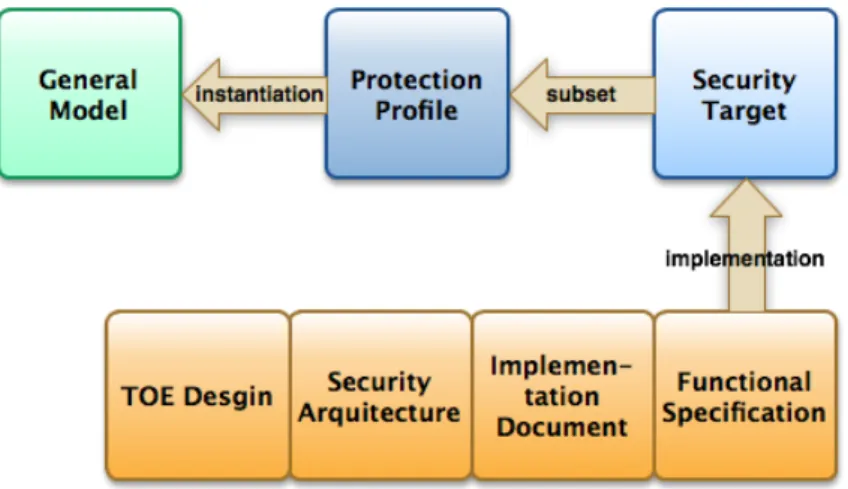
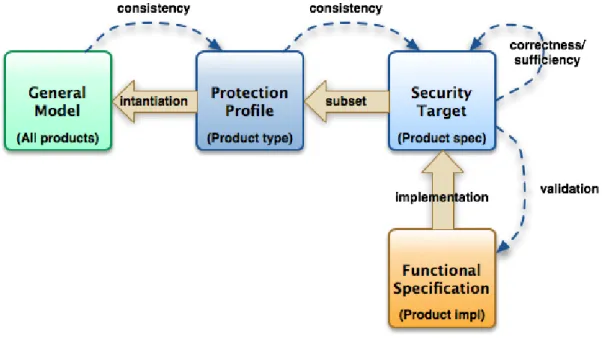
The most important documents in the CC certification are the Protection Profiles and the Security Target. These two documents are interrelated since the Security Target is a subset of the Protection Profiles. This is an instantiation of the General Model concepts present on the CC, as we can see in Figure 1.2.
The use of Protection Profiles in the process of certification was pioneered by the CC as 1http://alloy.mit.edu/
1.1. Motivation
Figure 1.2: Documentation for Common Criteria Evaluation
it is a document produced for a family of products with the same characteristics. In it, all the elements used in a CC certification for that family of products are specified as an instantiation of CC concepts present in the General Model. Protection Profiles are implementation independent.
The Security Target is a subset of the Protection Profiles oriented towards software prod-uct implementation. In it all the concepts used in the CC certification are specified. All the others documents relative to the software product development are based on the infor-mation stated in the Security Target. We use Alloy to model this documentation structure and minimize the problems presented in this section.
A little More About Alloy
Specification languages are a type of formal language used in system analysis, require-ments analysis and systems design [43]. As opposed to normal programming languages which are directly executable, formal languages are used along the whole system develop-ment process. With a specification language we can describe the system at a high level of abstraction, allowing representations of system properties in a way that is more under-standable to humans. If the level of abstraction at which we use the specification language isn’t high enough we cannot take advantage of these techniques. Some specification lan-guage examples are Alloy, Z, VDM, CASL, etc [29]. We present the Alloy lanlan-guage, which is used in this work to model and validate CC documentation.
Alloy was developed in the Massachusetts Institute of Technology (MIT) by Daniel Jackson in the late 90s for the purpose of abstract software design. It is a lightweight modeling language based on Z. Alloy supports the description of basic structure (graphically, or as textual declarations), as well as more intricate constraints and operations describing how structures change dynamically (both expressed as logical formulas) [26].
An Alloy model consists of a type declaration part, a number of formulas (facts), and an assertion. The AA checks the validity of the assertion taking into account a user-provided scope and an upper bound on the number of elements considered for each type [4]. In case the assertion is not valid, the analyzer produces a counterexample with symbolic values for each type and relation [12].
In Alloy types represent sets of atoms and are introduced using the signature construct. Atoms are something abstract and their type means nothing to the AA. These atoms establish relations between them and that is the key point in Alloy: every Alloy expression is a relation. Alloy is equipped with a set of operators similar to set theory operators and a set of quantifiers. Alloy also has a set of commands, non-parameterized constraints (assumptions) of the system, which are expressed as facts. These constraints are considered to be true at all times. Parameterized or reusable formulas expected to be used in different contexts are expressed as predicates and reusable expressions are expressed as functions. The properties to be checked are expressed as assertions. More details can be found elsewhere [27]. We explain in Section 4.1 how to build models in Alloy.
We use Alloy to model the various levels of abstraction present in the CC documentation and validate the main documents used as evidence in software certifications with CC. We chose Alloy for our work because it is a simple specification language that, when complemented with the AA, allows us to quickly build and analyze models.
1.2 Objectives
The main objectives for this work are several. Firstly, to study the CC standard in a way that would allow us to explain the whole certification process and how to elaborate a CC certification. Also a main objective is to understand how all the evidence is produced. With the objective of understanding how the evidence is produced comes the objective of understanding the problems associated with the elaboration of all the documents that need to be presented for validation during a CC certification. During this analysis we also intend to study ways to minimize this problem.
Another objective for this work is the use of Alloy in the software product certification process that could help its development in a correct way and that could help reduce the costs in the always expensive certifications. We want to use these techniques to analyze the CC certifications model and documentation. We also intend to use these same techniques to validate these documents.
This work’s last assignment is to specify a prototype for a tool that could aid the process of document development for the CC. We also want to develop a proof of concept for this tool, since the development of the complete application is out of the scope of this masters dissertation.
1.3 Contributions
In this work we present an overview of the CC security certification standard and how we can use Alloy to help in the evidence development process. This work is included in the project developed by Multicert2 in the CESeCore Project (CESeCore)3. In this project, Multicert, in a consortium with three more european companies, are conducting a software security certification, more specifically, a CC certification. As an example, along with the work for this dissertation, we look at the documentation of the RSA Keon CA System (Keon CA) digital certification and the CESeCore with CC.
2www.multicert.com 3www.cesecore.eu
1.4. Dissertation Outline In this work we analyze the Protection Profiles [35] used in the Keon CA and in the CESeC-ore, the Security Target of both certification, [30] and [37]. To analyze these documents we have built models of the concepts in CC and used them to represent the documentation used in CC certification. We have used Alloy to build these models.
We use Alloy to model the fundamental concepts of a security certification according to the CC. We model the information that we consider sensitive and validate it in the CC certification main documents. We want to be able to assertively answer several questions that have come up when analyzing the CC documents and validate the consistency of the main documents of CC: the Protection Profile and the Security Target. Other documents can be partially analyzed with these models and we can also infer information to include in the documents created from the Security Target. With this we are using formal methods techniques in a non-conventional way so as to analyze the rigor of the certification process at the documentation analysis level.
AA allows us to use the models and change them, quickly making changes and analyzing the documentation again. This, however, requires some knowledge of the Alloy language that not everyone has. With this in mind we believe that there was space for a tool to aid in the use of the alloy models. Another aspect that makes the need for a tool evident has to do with the difficulty felt in the elaboration of the evidence for the evaluation.
We have developed a prototype of what could be a tool to aid in the creation of documen-tation for the CC certification. This prototype uses the Alloy models as basis and allows us to load documents produced for CC certification, modify these documents, analyze them and validate these models. This could be an interesting tool for the industry involved in CC certifications.
1.4 Dissertation Outline
This work is divided into 6 Chapters. In the first chapter, the current one, we present an introduction to all the work undertaken for this dissertation.
Chapter 2:
presents an overview of the CC standard. We begin by presenting a brief history of the standard and its main goals. Afterwards, we present CC’s framework and, in more detail, the EALs and the General Model. This chapter finishes with the CC’s standard vision on formal methods and some works with this techniques on CC’s certifications.
Chapter 3:
presents the CC documentation that is used as evidence in the certification processes. Firstly, we present the documentation structure of all the documents used in the CC certification. Afterwards, we present the documents considered for this work and what is interesting to analyze in the context of our modulation in Alloy in detail. The documents presented in detail in this chapter are the Protection Profile, the Security Target and the Functional Specification.
Chapter 4:
presents the modulation and validation of the CC documents presented in the pre-vious chapter. Firstly, a brief tutorial on Alloy and the main characteristics of this
specification language is presented. To continue, a set of Alloy models that are used in the validation of the points specified in the chapter before for the main CC documents is presented.
Chapter 5:
presents the case studies that were used in this work. Initially, we present the case study for the RSA Keon CA System followed by the CESeCore Project. We also present the application of the Alloy models presented in the previous chapter in the CESeCore Project. This chapter ends with the presentation of an application to support our work with Alloy. We also present XMLs templates for the CC documents and parsers to work with this templates in this chapter.
In the last chapter we present this work’s conclusion and what we expect to be future work, especially that which concerns with the development of the tool to aid in the production of theCC documentation.
Related Publications
A portion of the work presented in this dissertation has been previously published in the form of conference papers:
• Roberto Machado. Cryptographic Software Certification with Common Criteria Evaluation Assurance Level 4+. In MI-STAR 2011. 2011.
• Roberto Machado. Modeling and Validating Cryptographic Software Documentation for Common Criteria Certification. In INForum. 2011.
Chapter 2
The Common Criteria Standard
In this chapter we present a detailed overview of the CC standard, its process, all the con-cepts related with CC certification and an overview of the use of formal method techniques in the context of software certifications. CC is an internationally recognized standard for security certification and this very fact is one of its strengths.
So as to begin, we introduce a very brief history of the CC standard in Section 2.1. There are others standards for security certification. In Section 2.2 we present some advantages and disadvantages of using the CC.
The CC standard is a framework divided into three parts. We explain these three parts in Section 2.3. All the components needed for a CC certification are in them. The first part of the standard introduces all the concepts and terminology used during a CC certification. The second part introduces the security functional components that are available to specify the security requirements of a certification. The third part introduces the security assurance components that define what kind of guarantees a certification has to assure in terms of evidence to be delivered for evaluation. We also present the document used by the evaluators to understand how to make a proper evaluation.
CC evaluations are ranked in levels of assurance. In CCs, they are called Evaluation Assurance Levels (EALs). This is useful to comprehend how deep of an evaluation was made in terms of certification requirements. In Section 2.4 we present those levels.
Figure 2.1: CC evaluation process overview
We also introduce an overview of the CC evaluation process. The process is based on the evaluation of evidence that serves as input and results in a certificate, which ensures that a certification was completed successfully. Figure 2.1 shows the flow of this evaluation [34]. In the second part of this chapter we present a brief overview of formal methods and how these techniques are included in the CC standard. We also present some work related with
the use of formal methods in the certification of software. In Section 2.7 we present an example of how formal methods are used in a CC certification successfully.
2.1 Brief History
For many years, people related to software security development tried to elaborate a stan-dard to certify the security of software. The U.S. Defense Department, the main driver since the early days, launched the Trusted Computer System Evaluation Criteria (TCSEC) in the late 70’s, also known as the Orange Book, the first standard for evaluating IT secu-rity. Since the release of the Orange Book, several attempts have been made to standardize such descriptions, especially for operating systems platforms. The trend has been toward increasing power and complexity [21]. A major result of this standardization activity is the Common Criteria, that was developed out of these previous approaches:
• Trusted Computer System Evaluation Criteria (TCSEC) - United States Department of Defense (DOD) 5200.28 Standard also know as the Orange Book;
• Federal Criteria (FC) a draft approach by the U.S. National Institute of Standards and Technology (NIST) and the National Security Agency (NSA) to replace TCSEC in 1992;
• Information Technology Security Evaluation Criteria (ITSEC) - developed in the early 1990s by France, Germany, the Netherlands and the U.K.;
• Canadian Trusted Computer Product Evaluation Criteria (CTCPEC) - the Canadian standard first developed in 1993 from the U.S. DOD standard.
The Common Criteria for Information Technology Security Evaluation (abbreviated as Common Criteria or CC) is an international standard for computer security certification. It is currently in version 3.1, which was released in 2009. The rationale behind CC is to formalize the language used by customers, developers and security evaluators to have the same understanding when security requirements are specified and evaluated.
At this moment, 26 countries are participating in the CC program, Portugal isn’t one of these countries. Participating countries sign the Common Criteria Mutual Recognition Agreement (CCRA) which basically states the conditions for participation including the requirement that each member country recognize certificates issued from the other member countries. This is probably the greatest advantage of CC for vendors, since they certify their products only once and all CCRA members will recognize that certification. This was not possible with previous standards. Each CCRA member nation has a CC governing entity or Scheme responsible for managing the implementation and use of the CC in their country.
There are two types of CCRA member nations, the certificate-authorizing countries and the certificate-consuming countries. The first ones are countries that have been approved to issue the CC certificates, the second ones are countries that recognize the certificates but can not issue them.
The CC standards documents are downloadable from the Common Criteria Portal1website free of charge.
2.3. The Common Criteria Framework
2.2 Common Criteria Goals
CC standards have several characteristics that define them as the leaders on the certifi-cation of security products. However, some critics define CC as nothing more than a pile of documentation, even though it can be proved to be valuable for vendors that want to make their products’ security claims certified and profit from that certification.
As we present in the previous section, CC was developed from a set of other existing security evaluation standards, including the two more popular, the TCSEC from the USA and the standard European/Australian ITSEC. Its other main characteristic is its international recognition. Right from the beginning fourteen countries have signed an agreement to recognize this standard for high-quality IT security evaluations. As stated in Section 2.1, today there are 26 countries participating in the CC program.
The CC specify methods for the evaluation criteria as well as to conduct evaluations. The stringent standards that CC sets and maintains imply that all people involved in a certification follow that standard in a rigorous way. Any laboratory that wishes to conduct CC evaluations must be certified through a rigorous process, and must maintain that certification through periodic reinspection.
Another important aspect is that CC is an independent evaluation of security assurance. Evaluation testing results are submitted to the CC Scheme in the lab’s host country for validation so as to insure that the evaluation process has been followed correctly, to enforce consistency across labs, and to prevent any financial motives from influencing the evaluation outcomes.
This set of characteristics already allows us to realize the value of CC, even though it also has some disadvantages. The most relevant is the cost of CC evaluations. An evaluation with CC can sometimes take years to complete and can also fail. A vendor, when deciding to evaluate his software product, must analyze it’s viability and what EAL (see Section 2.4) to follow. Otherwise, the certification can be commercially non-compensatory.
2.3 The Common Criteria Framework
CC standard provides a framework to describe and evaluate security attributes of a prod-uct. In this standard, we find a language that provides us with a vocabulary to express customer security requirements and vendor product claims. Allied to this, CC standard also has guidelines for evaluators to perform consistent security evaluations. CC standards documents capture these descriptions in four parts:
• CC Part 1: Introduction and General Model • CC Part 2: Security Functional Components • CC Part 3: Security Assurance Components • Common Evaluation Methodology
Reading the CC standard is a bit like reading a dictionary. It is important to have some guidance on how to look to at the documents and on what is contained in them. In the following section we provide an overview of each of the parts presented above.
2.3.1 CC Part 1: Introduction and General Model
CC Part 1 explains how the CC works. It is a document that aims to introduce people to the standard and should be read by everyone involved in CC certification. This document explains the objectives of the CC, the basic philosophy of the evaluation process, and definitions for components related to CC. An introduction to the basic security concepts necessary for evaluation of IT products is also given.
The introduction to Part 1 explains that CC provides a standard set of IT security char-acteristics for functionality and assurance. These security charchar-acteristics are used during security evaluations allowing comparisons of the independent evaluations results. CC eval-uations provide a specified level of confidence that the claimed security functionality will meet customer needs. With this, customers have more information so as to make an informed purchasing decision.
Part 1 contains a chapter dedicated to define the terms which are used in a specialized way throughout the CC. We can visit this chapter when we want to understand any concept that we find in the CC standard. This is an extensive dictionary of CC terms, 15 pages of terms, acronyms and abbreviations used in the standards. Some concepts aren’t explained here, leaving its definition to appear in the specific context.
The CC is flexible in what to evaluate and is therefore not tied to the boundaries of IT products as they are commonly understood. Therefore, in the context of evaluation, the CC uses the term Target of Evaluation (TOE). TOE is defined as a set of software, firmware and/or hardware possibly accompanied by guidance. After defining the TOE, CC Part 1 also presents the evaluation context and describes the audience to which the evaluation criteria are addressed.
In the last chapters, it defines the various operations by which the functional and assurance components given in CC Part 2 and CC Part 3 may be tailored through the use of permitted operations, and introduces the General Model of CC, the Protection Profile and Security Targets. These are explained in detail bellow.
Security Functional and Assurance Requirements
The Security Functional Requirements describe the desired behavior expected of a TOE and are intended to meet the security objectives stated in a Protection Profile or Secu-rity Target. The SecuSecu-rity Assurance Requirement (SAR) are requirements to establish a standard way of expressing the assurance requirements for the TOEs. The scale for rating assurance for TOEs is called Evaluation Assurance Levels and is presented bellow.
General Model
The general model descriptions in CC Part 1 allows us to understand the philosophy behind the CC evaluation process. CC is based on providing customers assurance by evaluating products and evidence rather than through theoretical modelling and simulation. In the CC process, products are evaluated after it has been developed, since CC uses "after-the-fact" evaluation.
2.3. The Common Criteria Framework the documentation of the CC evaluation is based on them. In Section 2.6 we explain the General Model and the concepts involved in detail.
Protection Profile
The Protection Profile’s main goal is to state a security problem rigorously for a given collection of systems or products, known as the TOE and to specify security requirements to address the problem without dictating how these requirements will be implemented. A Protection Profile is a combination of threats, security objectives, assumptions, Security Functional Requirement (SFR), SAR and rationales. It also specifies generic security evaluation criteria to substantiate a given family of information system products vendor’s claims. In order to get a product evaluated and certified according to the CC, the product vendor has to define a Security Target which may comply with one or more Protection Profile.
Vendors can evaluate their products against the requirements present in one of these appli-cable Protection Profile or they can make their own claims and have those claims evaluated in the CC evaluation process. Nevertheless, some governmental agencies have established policies requiring some products to only be evaluated against an applicable Protection Profile.
In Section 3.3 Protection Profiles are presented in more detail. Security Target
The Security Target is a security specification for a software product. This is the central document, typically provided by the developer of the product, that specifies security eval-uation criteria to substantiate the vendor’s claims for the product’s security properties. A Security Target defines information assurance security requirements for the given infor-mation system product, which is called the TOE. A Security Target is a complete and rigorous description of a security problem in terms of TOE description, threats, assump-tions, security objectives, SFRs, SARs, and rationales [23].
In Section 3.4 we present the Security Target in more detail.
2.3.2 CC Part 2: Security Functional Components
As already mentioned, the CC standards have a standard vocabulary. This allows cus-tomers to express their security needs and vendors to manage the security characteristics of their products in a consistent manner. In this CC Part 2, Security functional components are defined as the basis for the security functional requirements expressed in a Protection Profile or a Security Target.The SFR are standard identifiers and descriptions of security features about the product itself. These requirements describe the desired security behav-ior expected of a TOE and are intended to meet the Security Objectives as stated in a Protection Profile or an Security Target. These security features are the countermeasures to the threats.
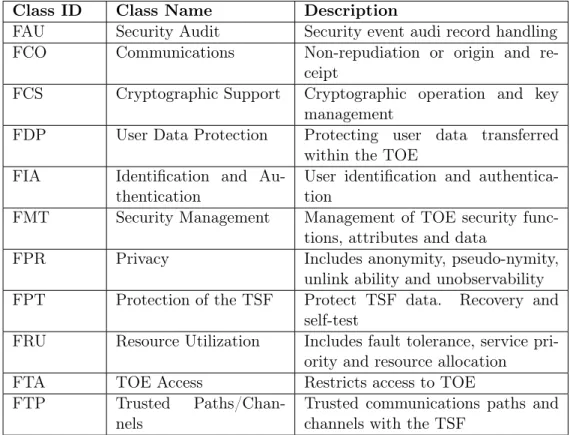
SFRs are organized into eleven major groups called Security Functional Classes. We can easily understand that these classes define all of the potential security functions a product
Table 2.1: Security Functional Classes
Class ID Class Name Description
FAU Security Audit Security event audi record handling FCO Communications Non-repudiation or origin and
re-ceipt
FCS Cryptographic Support Cryptographic operation and key management
FDP User Data Protection Protecting user data transferred within the TOE
FIA Identification and
Au-thentication User identification and authentica-tion FMT Security Management Management of TOE security
func-tions, attributes and data
FPR Privacy Includes anonymity, pseudo-nymity, unlink ability and unobservability FPT Protection of the TSF Protect TSF data. Recovery and
self-test
FRU Resource Utilization Includes fault tolerance, service pri-ority and resource allocation
FTA TOE Access Restricts access to TOE FTP Trusted
Paths/Chan-nels Trusted communications paths andchannels with the TSF
could provide. The Security Functional Classes from CC Part 2 are listed in Table 2.1: The SFR classes contain several families, components and elements. All of this information is contained in CC Part 2, and are the result of decades of effort to identify, describe and categorize effective countermeasures to a wide variety of IT threats. Using the "dictionary" of security functions we can remove the ambiguity of using different terms for the same requirement. To accommodate a wide variety of product types and security features, SFRs may include operations that further refine the definitions.
The SFRs may have dependencies. If an SFR has any dependence on another SFR and you include this SFR, you must also include those dependencies.
2.3.3 CC Part 3: Security Assurance Components
The CC standard’s main objective is to improve customer confidence (assurance) in the security of the IT products they purchase and use. Security features are one way to provide that confidence, but providing security in the product development process improves it even more. This CC Part 3 defines the assurance requirements of the CC, with this we can gain assurance through the evaluation of development process.
CC uses a set of independent evaluation techniques to provide assurance. We apply these techniques through the production of evidence for the evaluation. These evaluation tech-niques include:
2.3. The Common Criteria Framework Table 2.2: Security Assurance Classes
Class ID Class Name Description
ADV Development Product architecture, functional specifications, internals, implemen-tation and design
AGD Guidance Documents Operation and installation guides ALC Lifecycle Support Configuration management,
deliv-ery, development, flaw remediation security
ATE Test Test coverage, depth. Functional
and independent testing AVA Vulnerability
Assess-ment Vulnerability analysis
ACO Composition Composition evidence, testing, vul-nerability analysis and rationale
processes
• Verification of the application and adherence to those processes • Analysis and comparison of the various TOE design evidence • Comparison of the evidence against security requirements • Validation of claims
• Analysis of user guidance • Analysis of product tests
• Performance of independent functional tests • Vulnerability analysis
• Penetration testing
As in CC Part 2, where SFR are used to describe security features about the product itself, CC Part 3 and the security assurance components relate to the product development process. SAR cover areas regarding the secure development, delivery and deployment of the product. As in the CC Part 2 with the SFRs, the Security Assurance Classes are organized in eight classes. The Security Assurance Classes are listed in table 2.2.
As the SFRf, the SAR classes are segmented into families, components and elements. For example, the ADV, Development class is broken down into the following families:
• Security Architecture (ADV_ARC) • Functional Specification (ADV_FSP)
• Implementation Representation (ADV_IMP) • TOE Security Function Internals (ADV_INT)
• Security Policy Modeling (ADV_SPM) • TOE Security Design (ADV_TDS)
Each family is further decomposed into components and elements that provide the details of the specific requirements. The notation for SAR also has D, C and E element identifiers, that respectively denote requirements for Developers, Content and Evaluators. Develop-ers are the vendors or actual product developDevelop-ers, Content is the evidence documentation produced for evaluation and finally Evaluators are the actual, independent, third-party evaluators.
For example, ADV_ARC1.1, Security Architecture description, requires that the developer design and implement the TOE so that the security features of the TSF cannot be bypassed. A TSF can be something like a user authentication mechanism to detect or prevent unau-thorized access to the system. Developers that use structured design methodologies will be able to claim that they support this requirement. The content and presentation el-ements are the evidence (documentation) presented to the evaluators to prove that the requirements have been met. With this the evaluators shall confirm the claims made by developers. In Section 2.3.4 we will present the Common Evaluation Methodology (CEM) document that goes into this in much more detail, from the evaluator’s perspective. It’s important to understand this SAR requirements. When defining with assurance re-quirements what you want to achieve in your certification, you must keep in mind that the evaluator will analyze every component of that requirement. So you may save yourself some time and expense if you read the evaluator’s requirements in not only CC Part 3 but in CEM as well to find out precisely what the evaluator is going to be looking for to satisfy each requirement. With this you will be prepared to correspond with all the evidence necessary.
EAL is a set of collections of SARs with seven different levels of evaluation assurance. In Section 2.4 we explain the EALs in more detail.
2.3.4 Common Evaluation Methodology
The Common Methodology for Information Technology Security Evaluation (CEM) is a companion document to the Common Criteria for Information Technology Security Eval-uation (CC). CEM is the standardized set of instructions to the evalEval-uation labs on how to evaluate the different assurance requirements. The CEM defines the minimum actions to be performed by an evaluator in order to conduct a CC evaluation using the criteria and evaluation evidence defined in it. The CEM guides the evaluator on what to look for and to what depth should he evaluate the evidence. According to the EAL, the evaluator will examine the evidence with different depths. The CEM does not define evaluator actions for certain high assurance CC components, where there is as of yet no generally agreed on guidance.
Evaluators are instructed to check, examine, record and report. These terms are defined by the CEM as:
check - generate a verdict by simple comparison;
2.4. Evaluation Assurance Levels Table 2.3: EAL Description
EAL Description
EAL1 Functionally Tested EAL2 Structurally Tested
EAL3 Methodical Tested and Checked
EAL4 Methodically Designed, Tested and Reviewed EAL5 Semi-formally Designed and Tested
EAL6 Semi-formally Verified, Designed and Tested EAL7 Formally Verified and Tested
record - retain a written description of procedures, events, observations, insights and results in sufficient detail to enable the work performed during the evaluation to be reconstructed at a later time;
report - include evaluation results and supporting material in the Evaluation Technical Report or in an Observation Report.
These definitions may be subjected to interpretations and variatons based on the evalua-tors’ perspective and experience. They could be based on the background of the evaluator. Even though the CC Part 3 describes evaluator actions for each SAR, the CEM provides much more detailed instructions on what they have to do to satisfy the evaluation require-ment. This level of detail helps ensure greater consistency across evaluators and across inter nation Schemes.
2.4 Evaluation Assurance Levels
The assurance requirements define the level of the evaluation effort applied to the secure development, delivery and deployment processes by the product developer. This can refer both to the amount of evidence produced and reviewed to prove the security claims and to the scope of aspects of the product development processes..
Each EAL embodies a recommended set of assurance requirements: the higher the EAL, the more assurance the product has. The intent of higher levels is to provide higher confidence that the system’s main security features are reliably implemented. We can use EALs to choose which assurance requirements we want to satisfy. Table 2.3 has a description of the seven levels. A customer can look at the EAL of a certain product and see what kind of effort was put into the assessment of the security claims made by the vendor. The range of EAL usually used to certify products goes from EAL2 to EAL4. EAL4 is the highest level that is commercially advantageous and that is mutually recognized internationally. The belief is that evaluations higher than EAL4 require unique and proprietary evaluation techniques that cannot be duplicated or standardized internationally. It is also complicated to find laboratories that will evaluate these levels.
In some cases, the evaluation may be augmented to include assurance requirements beyond the minimum required for a particular EAL. Officially this is indicated by following the EAL number with the word augmented and usually with a list of codes to indicate the additional requirements. To simplify, vendors will often simply add a "plus" sign (as in
EAL4+) to indicate the augmented requirements. For example, in the project CESeCore, that is evaluated with EAL 4+, the SAR ALC_FLR.2, Flaw reporting procedures were added. As such, the EAL 4 would be denoted EAL4 augmented with ALC_FLR.2 or more informally EAL4+. Table 2.4 shows the requirements presented in standard EAL4. EAL4 certification
In this section we present an overview of an EAL4 certification of a software product with CC. This is the assurance level which processes an interesting set of requirements that assure us that the whole process of product improvement was developed with proper security concerns. The choice of EAL4 is due to its balance between price level and security certification guarantee [24]. Here we present this EAL because it was the one that we studied in more detail along the work for the dissertation.
With EAL4 certification a software product was methodologically designed, tested and reviewed, which means that good practices of development where followed, the software was tested against the identified threats and the whole process was reviewed.
EAL4 provides assurance by a full Security Target and an analysis of the SFRs in that Security Target, using a functional and complete interface specification, guidance docu-mentation, a description of the basic modular design of the TOE, and a subset of the implementation, to understand the security behavior. In what SARs are concerned, as we can see in Table 2.4, EAL4 covers six class of assurance.
The analysis is supported by independent testing of the TOE Security Function (TSF), ev-idence of developer testing based on the functional specification and TOE design, selective independent confirmation of the developer test results, and a vulnerability analysis. EAL4 also provides assurance through the use of development environment controls and additional TOE configuration management including automation, and evidence of secure delivery procedures. This EAL represents a meaningful increase in assurance from EAL3 by requiring more design description, the implementation representation for the entire TSF and improved mechanisms and/or procedures that provide confidence that the TOE will not be tampered with during development.
In Chapter 5 two examples of real-case CC certifications with EAL4+ are presented. More than EALs
It is important to note that not all families and components from CC Part 3 are included in the EALs. This is not to say that these do not provide meaningful and desirable assurances. Instead, it is expected that these families and components will be considered for augmentation of an EAL in those Protection Profiles and Security Targets to which they prove to be useful.
This notion of EALs represents the belief that assurance in terms of customer confidence is driven by evaluation and that more in-depth evaluation will give customers greater confidence. This means that, in theory, the higher the EAL, the greater the confidence the customer should have that the claims made by the vendor are true. The evaluations with higher EALs require more detailed evidence and are subjected to careful evaluation. These activities should represent greater proof of the vendor’s claims.
2.4. Evaluation Assurance Levels
Table 2.4: EAL4 Components Assurance Class Assurance Components ADV: Development
ADV_ARC.1 Security architecture de-scription
ADV_FSP.4 Complete functional specifi-cation
ADV_IMP.1 Implementation representa-tion of the TSF
ADV_TDS.3 Basic modular design AGD: Guidance documents AGD_OPE.1 Operational user guidanceAGD_PRE.1 Preparative procedures
ALC: Life-cycle support
ALC_CMC.4 Production support, accep-tance procedures and automation
ALC_CMS.4 Problem tracking CM cov-erage
ALC_DEL.1 Delivery procedures
ALC_DVS.1 Identification of security measures
ALC_LCD.1 Developer defined life-cycle model
ALC_TAT.1 Well-defined development tools
ASE: Security Target evaluation
ASE_CCL.1 Conformance claims
ASE_ECD.1 Extended components defi-nition
ASE_INT.1 Security Target introduction ASE_OBJ.2 Security objectives
ASE_REQ.2 Derived security require-ments
ASE_SPD.1 Security problem definition ASE_TSS.1 TOE summary specification ATE: Tests
ATE_COV.2 Analysis of coverage ATE_DPT.1 Testing: basic design ATE_FUN.1 Functional testing
ATE_IND.2 Independent testing - sample AVA: Vulnerability assessment AVA_VAN.3 Focused vulnerability
The security of a product is not measured by the EAL with which it was evaluated. A product evaluated with EAL3 isn’t necessarily more secure than another evaluated with EAL4. This only means that the product evaluated with EAL4 will have more evidence collected during its evaluation process. There does seem to be a need for customers to more easily grade the security of products, but EALs are not the way to achieve this.
2.5 Common Criteria Process
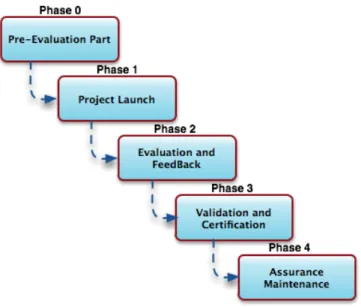
We can see the the CC certification process in five phases, as is presented in Figure 2.2. The first phase that could be called Phase 0, has to do with the Pre-Evaluation Preparation. It is a key element for a successful evaluation. The activities for that phase include: researching customer requirements, understanding the CC standards, developing a compelling business case, managing the project’s scope, allocating resources and selecting partners.
Figure 2.2: CC evaluation process overview
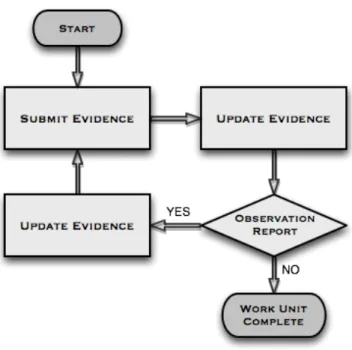
The second phase, Phase 1, the Project Launch has to do with the kickoff of the evalu-ation, here the meetings with the evaluation entities and the terms of the evaluation are defined. In this phase the Protection Profile to be used is defined and the Security Target is elaborated. The third phase, Phase 2, the Evaluation and Feedback phase is a series of cycles of interaction with the evaluators that include activities such as evidence production, evaluation, modification, resubmission and re-evaluation. Figure 2.3 shows the workflow of these cycles, as something deliverable starts, is produced and submitted as evidence. This evidence is evaluated and an observation report is produced by the evaluators. That report announces if the evidence is accepted or rejected. If it is rejected, then it must be updated and submitted again. Otherwise, in case of acceptance, the work unit is complete. This phase is the longest of the whole and the more critical.
The fourth phase, Phase 3, Validation and Certification, is the last phase directly related with the evaluation. This is when the whole certification is reviewed by the validators and if everything is evaluated successfully the product is certified. The last phase mentioned here, Phase 4, Assurance Maintenance, has to do with the problem that arises from each certification only being valid for one version of the software product. As such, the vendor,
2.6. General Model
Figure 2.3: Evidence Evaluation Process
when revising his product, also has to revalidate it’s certification, providing new evidence along with the new claims for the product. In the context of this dissertation we focus on Phases 1 and 2.
2.6 General Model
This is the model that explains how the concepts in CC are related. CC discusses security using a set of security concepts and terminology. To work with CC, submitting evalu-ations or evaluating them, an understanding of these concepts and the terminology is a prerequisite.
These concepts are quite general and not intended to restrict the class of IT security problems to which the CC is applicable. The General Model is a fundamental component for our work, since it is based on it that we build the models to analyze the CC evaluation documentation.
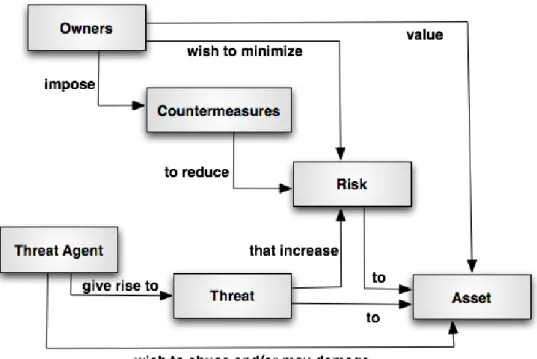
In order to understand the CC language, it is important to realize that IT organizations have assets they want to protect; those assets are subjected to threats; those threats can be opposed by countermeasures. We present the security concepts below and the relations between them are presented in Figure 2.4.
Assets Entities that someone places value upon. This could mean the contents of a file or a server, the authenticity of votes cast in an election, the availability of an electronic commerce process, etc.
Owners Place value on those assets. It is their responsibility to safeguard assets of interest.
Figure 2.4: The General Model of the CC evaluation process
Threat Agents May also place value on the assets and seek to abuse assets in a manner contrary to the interests of the owner.
Threats Potential for impairment of assets such that the value of the assets to the owners would be reduced.
Risk Comes from the threats inflicted by Threat Agents on the Assets, based on the likelihood of a threat being realized and the impact on the assets when that threat is realized.
Countermeasures Subsequently, countermeasures are imposed to reduce the risks to assets. These countermeasures may consist of IT countermeasures (such as firewalls and smart cards) and non-IT countermeasures (such as guards and procedures). In our work, only IT countermeasures are considered.
Two important elements about countermeasures:
• the countermeasures are sufficient: if the countermeasures do what they claim to do, the threats to the assets are countered;
• the countermeasures are correct: the countermeasures do what they claim to do.
Evaluation of these countermeasures is important to see if they are being used in a sufficient and correct way.
2.6. General Model
2.6.1 Sufficiency of the Countermeasures
The sufficiency of the countermeasures is one of the main points in an evaluation. Coun-termeasures are exposed in the Security Target. In Section 3.4 this document is explained in more detail. Here we present a brief description of the parts related to the sufficiency of the countermeasures.
The Security Target as of now contains a description of the assets and the threats to those assets. Subsequently, it describes the countermeasures and demonstrates that these countermeasures are sufficient to counter these threats: if the countermeasures do what they claim to do, the threats are countered. Countermeasures are shown in the Security Target as the Security Objectives. The countermeasures are divided into two groups in the Security Target: the security objectives for the TOE, which describe the countermeasure(s) for which correctness will be determined in the evaluation and the security objectives for the Operational Environment, that describe the countermeasures for which correctness will not be determined in the evaluation.
The reason for this division is that in the CC only the IT countermeasures’ correctness is suitable to be assessed. As such, the non-IT countermeasures (e.g. human security guards, procedures) are always in the Operational Environment. Assessing correctness of countermeasures costs time and money. This could possibly make it infeasible to assess the correctness of all IT countermeasures. The correctness of some IT countermeasures may already have been assessed in another evaluation. It is therefore not cost-effective to assess this correctness again.
The IT countermeasures whose correctness will be assessed during the evaluation are the ones that come from the Security Objectives for the TOE. A detailing of this Security Objectives for the TOE is necessary and is accomplished with the introduction of the Security Functional Requirements (SFRs). These SFRs are formulated in a standardized language (described in CC Part 2) to ensure exactness and facilitate comparability. With this stated we can say that a correct TOE, with all the SFRs covered, in combination with a correct operational environment, with all the security objectives for the operational environment, will counter all the threats. In the next two sections correctness of the TOE and correctness of the operational environment are discussed separately.
2.6.2 Correctness of the TOE
An attacker can exploit vulnerabilities, damaging and/or abusing the assets. This becomes possible because a TOE can be incorrectly designed and implemented and can therefore contain errors that lead to the vulnerabilities used by attackers. Accidental errors made during the development, poor design, intentional addtion of malicious code, poor testing, among others, cause these vulnerabilities to arise.
Some of the tasks that can be performed to reduce risks are: • testing the TOE;
• examining various design representations of the TOE;
These activities are presented in the context of the CC in the form of Security Assurance Requirements (SARs) and are defined in the Security Target. These SARs are formulated in a standardized language (described in CC Part 3) to ensure exactness and facilitate comparability. If the SARs are met, there is assurance in the correctness of the TOE and the TOE is therefore less likely to contain vulnerabilities that can be exploited by attackers. The level of assurance that exists in the correctness of the TOE is determined by the EALs, which are explained in Section 2.4.
2.6.3 Correctness of the Operational Environment
As in the TOE, the operation environment can also be incorrectly designed and imple-mented, and may therefore contain errors that lead to vulnerabilities. By exploiting these vulnerabilities, attackers may still damage and/or abuse the assets. However, in the CC, no assurance is obtained regarding the correctness of the operational environment. Or, in other words, the operational environment is not evaluated. As far as the evaluation is concerned, the operational environment is assumed to be a 100% correct instantiation of the security objectives for the operational environment.
2.6.4 Common Criteria Evaluation
The CC has two types of evaluation: a Security Target/TOE evaluation and an evaluation of the Protection Profiles. In general the CC uses the term evaluation to refer to a Security Target/TOE evaluation.
The Security Target/TOE evaluation has the following steps defined in the CC:
a) a Security Target evaluation, where the sufficiency of the TOE and the operational environment are determined;
b) a TOE evaluation, where the correctness of the TOE is determined. As stated earlier, the TOE evaluation does not assess correctness of the operational environment. In the case of the Security Target evaluation, the criteria applied are defined in CC Part 3, where the ASE assurance requirement is explained. The precise method to apply the ASE criteria is determined by the evaluation methodology that is used. The TOE evaluation is more complex. The main inputs to a TOE evaluation are: the evaluation evidence, which includes the TOE and Security Target, but will usually also include input from the development environment, such as design documents or developer test results. The TOE evaluation consists of applying the SARs (from the Security Target) to the evaluation evidence. The precise method to apply a specific SAR is determined by the evaluation methodology that is used.
The evaluation scheme under which the evaluation is carried out and the evaluation methodology followed states how the results must be presented. The results of the TOE evaluation process are either:
• all SARs have been met and therefore we have the specified level of assurance that the TOE meets the SFRs as stated in the Security Target;