doi: 10.3389/fmicb.2016.01844
Edited by: Joshua D. Nosanchuk, Albert Einstein College of Medicine, USA Reviewed by: Rossana Cordeiro, Universidade Federal do Ceará, Brazil Priscila Costa Albuquerque, FIOCRUZ Oswaldo Cruz Foundation, Brazil *Correspondence: Ildinete Silva-Pereira [email protected]; [email protected] †These authors share first authorship. ‡These authors share senior authorship.
Specialty section: This article was submitted to Antimicrobials, Resistance and Chemotherapy, a section of the journal Frontiers in Microbiology Received: 27 June 2016 Accepted: 02 November 2016 Published: 18 November 2016 Citation: Guilhelmelli F, Vilela N, Smidt KS, de Oliveira MA, Álvares ACM, Rigonatto MCL, da Silva Costa PH, Tavares AH, Freitas SM, Nicola AM, Franco OL, Derengowski LS, Schwartz EF, Mortari MR, Bocca AL, Albuquerque P and Silva-Pereira I (2016) Activity of Scorpion Venom-Derived Antifungal Peptides against Planktonic Cells of Candida spp. and Cryptococcus neoformans and Candida albicans Biofilms. Front. Microbiol. 7:1844. doi: 10.3389/fmicb.2016.01844
Activity of Scorpion Venom-Derived
Antifungal Peptides against
Planktonic Cells of Candida spp. and
Cryptococcus neoformans and
Candida albicans Biofilms
Fernanda Guilhelmelli1†, Nathália Vilela1†, Karina S. Smidt2, Marco A. de Oliveira1,
Alice da Cunha Morales Álvares3, Maria C. L. Rigonatto2, Pedro H. da Silva Costa2,
Aldo H. Tavares2, Sônia M. de Freitas3, André M. Nicola4, Octávio L. Franco5,
Lorena da Silveira Derengowski1, Elisabeth F. Schwartz6, Márcia R. Mortari6,
Anamélia L. Bocca2, Patrícia Albuquerque1,7‡and Ildinete Silva-Pereira1*‡
1Laboratory of Molecular Biology, Department of Cellular Biology, Institute of Biological Sciences, University of Brasília,
Brasília, Brazil,2Laboratory of Applied Immunology, Department of Cellular Biology, Institute of Biological Sciences,
University of Brasília, Brasília, Brazil,3Laboratory of Molecular Biophysics, Department of Cellular Biology, Institute of
Biological Sciences, University of Brasília, Brasília, Brazil,4Faculty of Medicine, University of Brasília, Brasília, Brazil,5Center
of Proteomic and Biochemistry Analysis, Post Graduation in Biotechnology and Genomic Sciences, Catholic University of Brasília, Brasília, Brazil,6Laboratory of Neuropharmacology, Department of Physiological Sciences, Institute of Biological
Sciences, University of Brasília, Brasília, Brazil,7Faculty of Ceilândia, University of Brasília, Brasília, Brazil
The incidence of fungal infections has been increasing in the last decades, while the number of available antifungal classes remains the same. The natural and acquired resistance of some fungal species to available therapies, associated with the high toxicity of these drugs on the present scenario and makes an imperative of the search for new, more efficient and less toxic therapeutic choices. Antimicrobial peptides (AMPs) are a potential class of antimicrobial drugs consisting of evolutionarily conserved multifunctional molecules with both microbicidal and immunomodulatory properties being part of the innate immune response of diverse organisms. In this study, we evaluated 11 scorpion-venom derived non-disulfide-bridged peptides against Cryptococcus neoformans and Candida spp., which are important human pathogens. Seven of them, including two novel molecules, showed activity against both genera with minimum inhibitory concentration values ranging from 3.12 to 200µM and an analogous activity against Candida albicans biofilms. Most of the peptides presented low hemolytic and cytotoxic activity against mammalian cells. Modifications in the primary peptide sequence, as revealed by in silico and circular dichroism analyses of the most promising peptides, underscored the importance of cationicity for their antimicrobial activity as well as the amphipathicity of these molecules and their tendency to form alpha helices. This is the first report of scorpion-derived AMPs against C. neoformans and our results underline the potential of scorpion venom as a source of antimicrobials. Further characterization of their mechanism of action, followed by molecular optimization to decrease their cytotoxicity and increase antimicrobial activity, is needed to fully clarify their real potential as antifungals.
Keywords: antifungal drugs, antimicrobial peptides, Candida spp., Candida albicans, Cryptococcus neoformans, scorpions venom
INTRODUCTION
An increase of systemic mycoses incidence due to the rising number of immunocompromised individuals, particularly cancer, HIV/AIDS and solid-organ transplant patients has been
noticed in recent years.Candida spp. and Cryptococcus spp. are
among the main causative agents (Romani, 2011;
Armstrong-James et al., 2014).
Candida spp. remain the most important cause of opportunistic mycoses worldwide and are associated to
high mortality and morbidity rates, Candida albicans being
the major agent of candidemia (Pfaller and Diekema, 2007;
Mikulska et al., 2012). Furthermore, an increase in infections
caused by non-albicans species has been noticed, like Candida
parapsilosis, Candida tropicalis, and Candida glabrata, the latter
being more resistant to antifungal drugs than other Candida
species (Sobel, 2006; Pfaller and Diekema, 2007; Diekema
et al., 2012;Rodrigues et al., 2014).Cryptococcus neoformans is another opportunistic pathogen of clinical relevance, especially among HIV/AIDS patients. Cryptococcal meningitis is the most important cause of death from HIV-related fungal infection
worldwide (Park et al., 2009). The estimated yearly incidence
of cryptococcal meningitis is almost one million cases, causing 625,000 deaths (Park et al., 2009). In addition,Candida species
and C. neoformans can form biofilms on abiotic and biotic
surfaces (Mayer et al., 2013;Martinez and Casadevall, 2015). Of
particular interest is the formation of biofilms by C. albicans,
which confers specialized properties to the microorganism that complicate treatment, such as the increased resistance to antimicrobial drugs and the ability to evade the host immune
system, among others (Finkel and Mitchell, 2011; Fanning and
Mitchell, 2012). Another problem regarding fungal infections is the rising of resistance to currently available antifungal
drugs (Pan et al., 2012; Pfaller, 2012; Arendrup, 2013). This
is compounded by the intrinsic resistance of some fungi to
antifungals, such as C. neoformans to echinocandins and
C. glabrata to azoles (Sable et al., 2008; Pfaller, 2012; Paul and Moye-Rowley, 2014).
In this scenario, there is a concrete need for new antifungals, and antimicrobial peptides (AMPs) have been promoted as
promising in that regard (Hancock and Sahl, 2006), considering
their low molecular masses and lower potential to induce resistance (Mookherjee and Hancock, 2007;Huang et al., 2010).
A great number of peptides are present in scorpion venom. They can be classified as disulfide-bridged peptides or non-disulfide-bridged peptides (NDBPs), the latter being the major
component of their venom (Almaaytah and Albalas, 2014;
Harrison et al., 2014; Ortiz et al., 2015). Most have similar physicochemical characteristics, such as a cationic character and structural flexibility. NDBPs present diverse biological activities,
including antimicrobial, cytolytic, immunomodulatory,
antitumor, and bradykinin-like potentiation effects (Zeng
et al., 2005; Almaaytah and Albalas, 2014; Ortiz et al., 2015). In the present work, we evaluated the antifungal activity of peptides previously obtained by transcriptomic approaches from
venom glands of three scorpion species (Silva et al., 2009). We
classified them according to the rules proposed by Zeng et al.
(2005), who group scorpion NDBPs in six subfamilies based on their pharmacological action, length and structural similarity. The peptides presented here belong to subfamilies 3, 4, and 5 and their activity will be discussed following this classification. Some AMPs are presented here for the first time, among them
five peptides from the venom of the scorpion Tityus obscurus
corresponding to the first AMPs characterized in this species.
MATERIALS AND METHODS
cDNAs Encoding Putative Antimicrobial
Peptides
Different cDNAs encoding putative AMPs from the venom gland
of scorpions T. obscurus, Tityus costatus, Hadrurus gertschi,
andOpisthacanthus cayaporum were characterized by expressed
sequence tag (EST). The amino acid sequences deduced from
ESTs as described in literature (Diego-Garcia et al., 2005;
Schwartz et al., 2007;Silva et al., 2009; Guerrero-Vargas et al.,
2012) were considered to obtain the synthetic peptides as
specified bellow (Table 1).
Comparative analyses of amino acids sequences were performed employing the Basic Local Alignment Search Tool
(BLAST1) and Collection of Anti-Microbial Peptides (CAMP2)
databases to identify peptides with at least 40% of identity to our queries sequence and to which antimicrobial activity was previously determined. The multiple sequence alignments were
done using the M-Coffee tool3on the sequences identified in the
previous step, and the consensus sequences were represented as a sequence logo, generated at Weblogo web server4.
Chemical Peptide Synthesis
Peptides were chemically synthesized using FMOC-Butila (AminoTech Pesquisa e Desenvolvimento LTDA, Brazil), and further purified by reverse-phase high performance liquid chromatography (HPLC). Peptides ToAP1, ToAP2S1, ToAP3, NDBP-4.23, ToAP4, and NDBP-5.7 were synthesized with C-terminal amidation. To assess the purity and sequence correctness, peptides were submitted to matrix-assisted laser desorption/ionization time of flight mass spectrometry (MALDI-TOF/TOF MS; UltraFlex III, Bruker Daltonics, Germany),
under reflector (MS) and LIFTTM (MS/MS) positive modes.
Matrix solution was prepared using 5.0 mg of
α-cyano-4-hydroxycinnamic acid (Sigma, USA) and solubilized with
250 µL of acetonitrile, 200 µL of deionized water, and with
50 µL of an aqueous trifluoroacetic acid solution (at 3% by
volume). The aqueous solution of the peptide was mixed with a saturated matrix solution (1:3 peptide/matrix) and air-dried. The monoisotopic molecular mass of the ion corresponding to the peptide of interest was determined by the ratio between m/z peaks in the spread profile (m/z ratio from 600 to 3,000). Additionally, interpretation of the MS/MS mass spectra 1http://blast.ncbi.nlm.nih.gov/Blast.cgi
2http://www.camp.bicnirrh.res.in/
3http://tcoffee.crg.cat/apps/tcoffee/do:mcoffee 4http://weblogo.berkeley.edu/logo.cgi
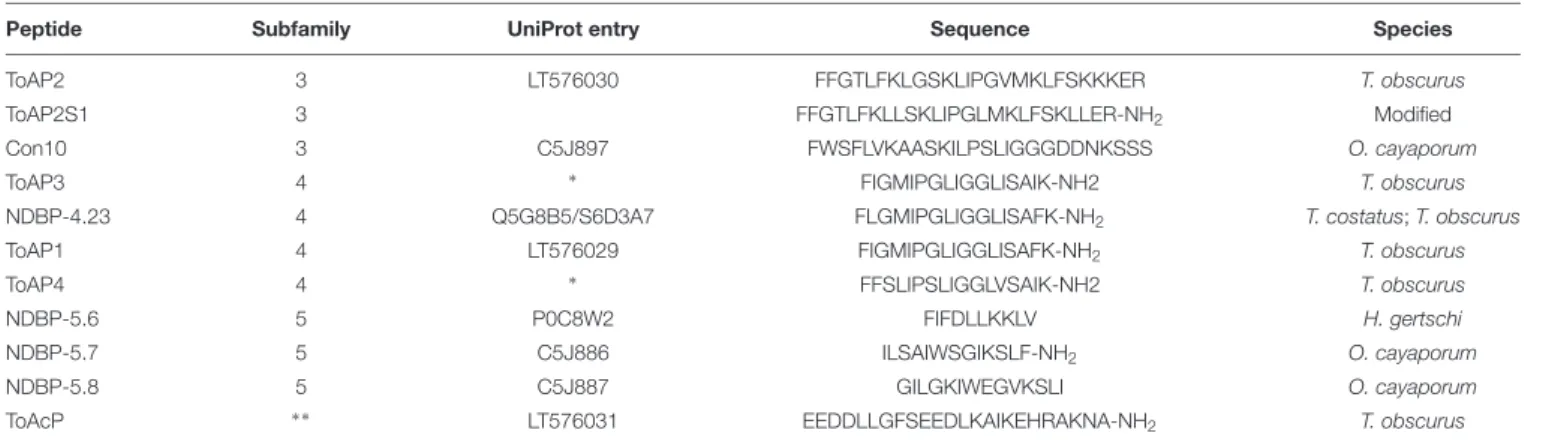
TABLE 1 | Sequence of chemically synthesized peptides obtained from scorpion venom cDNA library sequencing.
Peptide Subfamily UniProt entry Sequence Species
ToAP2 3 LT576030 FFGTLFKLGSKLIPGVMKLFSKKKER T. obscurus
ToAP2S1 3 FFGTLFKLLSKLIPGLMKLFSKLLER-NH2 Modified
Con10 3 C5J897 FWSFLVKAASKILPSLIGGGDDNKSSS O. cayaporum
ToAP3 4 ∗ FIGMIPGLIGGLISAIK-NH2 T. obscurus
NDBP-4.23 4 Q5G8B5/S6D3A7 FLGMIPGLIGGLISAFK-NH2 T. costatus; T. obscurus
ToAP1 4 LT576029 FIGMIPGLIGGLISAFK-NH2 T. obscurus
ToAP4 4 ∗ FFSLIPSLIGGLVSAIK-NH2 T. obscurus
NDBP-5.6 5 P0C8W2 FIFDLLKKLV H. gertschi
NDBP-5.7 5 C5J886 ILSAIWSGIKSLF-NH2 O. cayaporum
NDBP-5.8 5 C5J887 GILGKIWEGVKSLI O. cayaporum
ToAcP ∗ ∗ LT576031 EEDDLLGFSEEDLKAIKEHRAKNA-NH2 T. obscurus
∗
Accession number recently requested;∗∗
subfamily not designated. NDBP, non-disulfide-bridged peptide.
and de novo sequencing of peptides was performed using
the FlexAnalysis 3.0 software (Bruker Daltonics, Germany). Throughout the experiment, the stability of each peptide was reevaluated using the same mass spectrometry parameters detailed above. Only samples containing more than 95% of the peptide (high purity) were used for biological experiments.
Peptides were stored at −20◦
C and dissolved in Milli-Q water before each experiment.
In silico Analysis of Putative Secondary
Structure and Peptides Physicochemical
Properties
The putative secondary structures and the α-helix content
(%) were predicted using the software PHD as described previously (Guo et al., 2013)5. The hydrophobicity and the helical hydrophobic moment of the peptides were determined in the
HeliQuest web server6. Other physicochemical properties were
determined by ProtParam tool7 (Wilkins et al., 1999). Helical
wheel projections were generated at the respective web server8.
Fungal Strains and Growth Conditions
Candida albicans strain SC 5314 (ATCC MYA-2876) was provided by Dr. Joshua Nosanchuk (New York, NY, USA). C. glabrata ATCC 90030, C. parapsilosis ATCC 22019,
and C. tropicalis ATCC 750 were provided by Dr. Érika
Kioshima (Universidade Estadual de Maringá, Paraná, Brazil). C. neoformans var. grubii strain H99 (serotype A, ATCC 208821) was provided by Dr. John Perfect (Durham, NC, USA). C. neoformans var. neoformans B3501 (serotype D, ATCC 34873) was obtained from ATCC (Manassas, VA, USA). All strains were
stored as frozen stocks in 35% glycerol at −80◦
C. Before each
experiment, allCandida spp. strains were grown in Sabouraud’s
dextrose broth overnight at 30◦
C with agitation.C. neoformans
strains were grown in the same conditions for 24 h. Fungal cells were collected by centrifugation, washed three times in
5https://npsa-prabi.ibcp.fr/cgi-bin/npsa_automat.pl?page=/NPSA/npsa_phd.html
6http://heliquest.ipmc.cnrs.fr/cgi-bin/ComputParamsV2.py
7http://web.expasy.org/protparam
8http://rzlab.ucr.edu/scripts/wheel/wheel.cgi
phosphate buffered saline (PBS) (137 mM NaCl, 2.7 mM KCl,
10 mM Na2HPO4, 2 mM KH2PO4) and inoculated in Roswell
Park Memorial Institute (RPMI) 1640 medium supplemented
with L-glutamine and buffered to pH 7.0 with 165 mM
3-(N-morpholino)propanesulfonic acid for experiments described below.
Antifungal Assay
In vitro antifungal assays were performed according to broth microdilution susceptibility test from Clinical and Laboratory Standards Institute (CLSI) M27-A3 guidelines with some modifications. Briefly, twofold serial dilutions of each peptide were prepared in 96-well polystyrene microplates to a final
volume of 50 µL. Amphotericin B (Amp B; A2942,
Sigma-Aldrich), a known antifungal drug, was used as a positive control. Final concentrations of each peptide and Amp B ranged from
100 to 0.78µM and 16 to 0.03 µg/mL, respectively, except in
tests withC. glabrata and C. parapsilosis, where the final peptide
concentration ranged from 400 to 0.78µM. In each plate, wells
were included without peptide as a growth control. Then, 50µL
of the adjusted inoculum in RPMI-1640 medium were added to each well to a final concentration of 2 × 10³cells/mL forCandida
spp. and 104cells/mL forC. neoformans strains. The plates were
incubated at 37◦
C for 24 and 48 h, respectively. The strains
of C. neoformans were also incubated with shaking (200 rpm).
The minimum inhibitory concentration (MIC) was defined as the lowest AMP concentration that completely inhibited visible fungal growth at the end of the incubation period. The experiments were performed at least three times on separate dates.
Hemolytic Assay
Considering the potential use of the AMPs as treatment against pathogens, even if in a more distant future, some of their properties against host cells should be addressed. To achieve this goal, we have performed hemolytic assay to evaluate if these molecules are toxic or harmless to red blood cells. Further, we have also tested the possible cytotoxicity of those peptides against other mammalian cell types by following the cell viability score after treatment. The solution of human red blood cells was treated
with the peptide at levels ranging from 100 to 0.78µM. Whole human blood was collected from healthy donors in vials with ethylenediaminetetraacetic acid (EDTA). The red blood cells were separated by centrifugation and resuspended in PBS. After the
centrifugation (800 g, 5 min at 4 ± 1◦
C) the supernatant was removed and the red blood cells pellet was resuspended to a 3% hematocrit in sterile water (considered as 100% hemolysis) and PBS (taken as blank for spectrophotometric measurement). Fifty microliters of the 3% cell suspension in PBS were added to different final concentrations of the peptide (v/v) in a 96-well
polystyrene microplate and then incubated for 1 h (Nahar et al.,
2008;Zhao et al., 2009; Qi et al., 2010). The microplates were centrifuged and the supernatant was collected and analyzed at 540 nm using a microplate spectrophotometer. The percentage of hemolysis was calculated relative to the positive control as
performed byNahar et al. (2008). The procedures were approved
by the Ethics Committee on Human Research of Faculty of Medicine/University of Brasília (UnB) and conform to FDA standards (UnBDoc no. 66704/2016).
Cytotoxic Test Using Peritoneal
Macrophages
BALB/c mice were injected with thioglycolate 72 h before peritoneal macrophages were harvested. They were diluted to
a concentration of 106 cell/mL in RPMI-1640 supplemented
with penicillin/streptomycin (100 U/mL, 100 g/mL), 2 mM
L-glutamine, 2 mM non-essential amino acids, 1 mM sodium
pyruvate (all reagents from Sigma-Aldrich, St Louis, MO, USA) and 10% fetal bovine serum (FBS), and incubated in 96-well polystyrene microplates at 37◦
C, 5% CO2for 24 h. The peptides
were added then and cells were further incubated for 24 h
as described previously (Cruz et al., 2005). Three independent
experiments were performed. Cytotoxic activity was evaluated by the release of cytoplasmic enzyme lactate dehydrogenase due to cell lysis using the Cytotox kit (Promega). Briefly, at the end of the incubation period, supernatants were collected, the adhered cells were washed and the toxicity was determined according to the manufacturer’s protocol. The procedures were approved by the Ethics Committee on Animal Research of Institute of Biology (UnBDOC 52657/2011)/University of Brasília (UnB).
Effects of Peptides on Candida albicans
Biofilms
The effects of the peptides NDBP-4.23, ToAP1, ToAP2, and
NDBP-5.7 on C. albicans biofilms were analyzed according to
the protocol described byPierce et al. (2008). Briefly,C. albicans
SC 5314 (106 cells/mL) was grown on 96-well polystyrene
microplates and 4 h after seeding the peptides or Amp B were added to assess their effects on the first step of biofilm formation, the initial cell adherence. After 24 h of treatment, biofilm formation was measured by the metabolic assay based on the reduction of 2,3-bis-(2-methoxy-4-nitro-5-sulfophenyl)-2H-tetrazolium-5-carboxanilide (XTT). For the purpose of
investigating effects of peptides on mature biofilms, theCandida
cells were allowed to grow for 24 h prior to addition of the peptides or Amp B and the XTT assay was performed in the same
way. All results were analyzed for statistical significance using analysis of variance (ANOVA) followed by Tukey post-test using GraphPad Prism 6 and expressed in terms of biofilm viability as XTT-readings percentage normalized by the control groups. Each compound was tested in triplicate and the experiments were performed at least twice on separate dates.
Circular Dichroism
Circular dichroism (CD) assays were carried out using Jasco J-815 spectropolarimeter equipped with a Peltier-type temperature
controller. Peptides (0.2 mg/mL) were analyzed in water at 37◦
C in absence or the presence of trifluoroethanol (TFE) (10, 30, and 50%). The mean spectrum of three consecutive experiments was corrected for the baseline buffer contribution. The observed ellipticities were converted into molar ellipticity ([θ]) based on molecular mass per residue of 115 Da (Adler et al., 1973). Theα
helix secondary structure content (fθ) was estimated considering
the values of [θ]208 nmas a function of TFE concentration using
the following equation (Greenfield and Fasman, 1969):
fH = ([θ]208
− 4000)
(−33000 − 4000)
RESULTS
In silico Prediction of Major
Physicochemical Properties and
Secondary Structure of Peptides
The primary structures of ToAP2, ToAP1, ToAP3, ToAP4, and
ToAcP peptides from T. obscurus were used as queries on
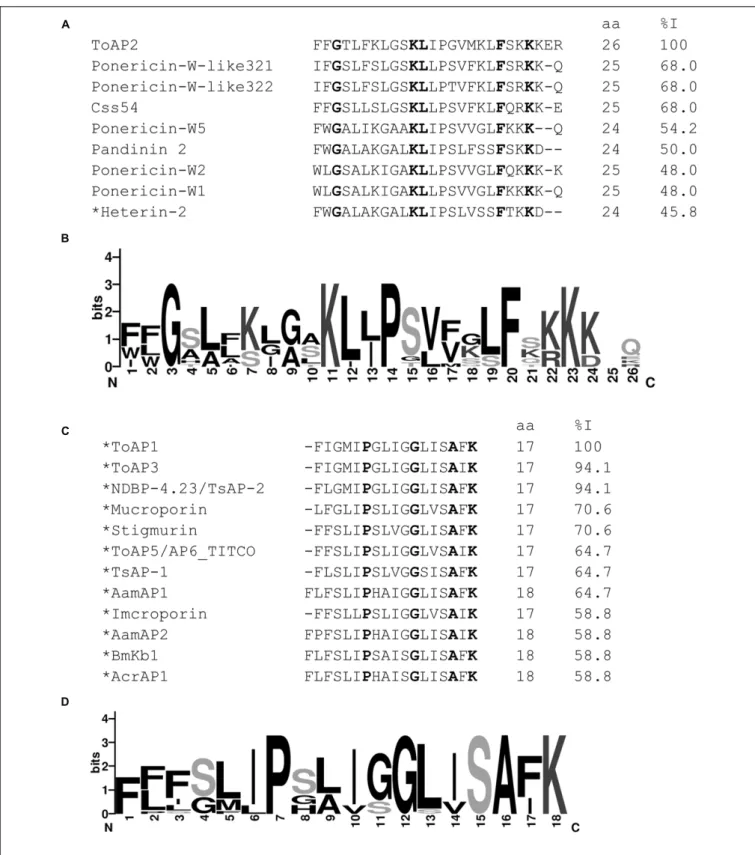
BLAST. Data analysis revealed that ToAP2 is similar to peptides previously described as belonging to NDBP subfamily 3 and to AMPs from ant venom (Figures 1A,B). ToAP1, ToAP3, and ToAP4 showed similarity to AMPs belonging to NDBP subfamily 4 (Figures 1C,D). ToAP4 also has 100% identity to putative
AMP clone 6 fromT. costatus [UniProt: Q5G8B3]. ToAcP did
not show similarity to any AMPs described before and shares 90% identity to Toxin Tp3 [UniProt: P0DL22], a peptide from Tityus pachyurus with no toxicity to mammalian cells and without
known biological activity (Barona et al., 2006). The result of
these analyses indicates that peptide ToAP2 belong to NDBP subfamily 3 and ToAP1, ToAP3, ToAP4 belongs to NDBP subfamily 4.
The results of in silico secondary structure and
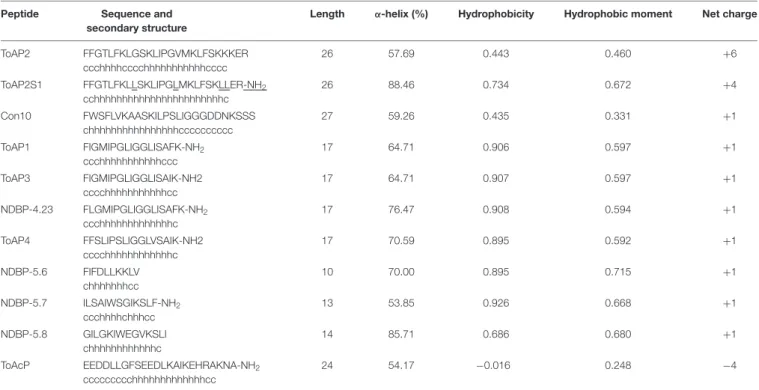
physicochemical property prediction for the peptides are summarized in Table 2. Except for ToAP2 and ToAcP, which have net charges at pH 7.0 of +6 and −4, respectively, all others showed a net charge of +1. All peptides have a predicted helical content of at least 53.85% and, except for ToAcP, had positive hydrophobicity values, which means that in theory they are slightly hydrophobic. ToAP2S1, an analog from ToAP2, had different physicochemical parameters. Its net charge was reduced from +6 to +4 as a result of the substitution of two lysines for leucines; and both its hydrophobicity and hydrophobic moment were increased. ToAP2S1 also had its predicted helical content increased from 57.69 to 88.46% relative to its prototype ToAP2.
FIGURE 1 | Comparative analysis of ToAP2, ToAP1, ToAP3, ToAP4 against previously described AMPs. Conserved amino acid residues are marked bold. Asterisks indicate peptides with amidated C-termini. (A,B) Multiple sequence alignment of ToAP2 mature peptide with known AMPs from scorpion and ant venoms such as Ponericin-W-like 32.1 [UniProt: P0CI91], Ponericin-W-like 32.2 [UniProt: P0CI92], Css54 [UniProt: P0DL41], Pandinin 2 [UniProt: P83240], Heterin-2 [UniProt: A0A0C4G5K0], Ponericin-W1 [UniProt: P82423], Ponericin-W2 [UniProt: P82424], and Ponericin-W5 [UniProt: P82427] and their consensus sequence logo. (C,D) Multiple sequence alignment of ToAP1 mature peptide with known antimicrobial peptides from scorpion venom such as NDBP-4.23 [UniProt: Q5G8B5/S6D3A7], Mucroporin [UniProt: B9UIY3], Imcroporin [UniProt: C7B247], Stigmurin [GenBank: JK483709], AP6_TITCO [UniProt: Q5G8B3], TsAP-1 [UniProt: S6CWV8], AamAP1 [UniProt: G8YYA5], AamAP2 [UniProt: G8YYA6], BmKb1 [UniProt: Q718F4], and AcrAP1 [UniProt: A0A0A1I6E7] and their consensus sequence logo.
TABLE 2 | Peptide sequences, putative secondary structure, and physicochemical properties.
Peptide Sequence and
secondary structure
Length α-helix (%) Hydrophobicity Hydrophobic moment Net charge
ToAP2 FFGTLFKLGSKLIPGVMKLFSKKKER ccchhhhcccchhhhhhhhhhhcccc 26 57.69 0.443 0.460 +6 ToAP2S1 FFGTLFKLLSKLIPGLMKLFSKLLER-NH2 cchhhhhhhhhhhhhhhhhhhhhhhc 26 88.46 0.734 0.672 +4 Con10 FWSFLVKAASKILPSLIGGGDDNKSSS chhhhhhhhhhhhhhhhcccccccccc 27 59.26 0.435 0.331 +1 ToAP1 FIGMIPGLIGGLISAFK-NH2 ccchhhhhhhhhhhccc 17 64.71 0.906 0.597 +1 ToAP3 FIGMIPGLIGGLISAIK-NH2 cccchhhhhhhhhhhcc 17 64.71 0.907 0.597 +1 NDBP-4.23 FLGMIPGLIGGLISAFK-NH2 ccchhhhhhhhhhhhhc 17 76.47 0.908 0.594 +1 ToAP4 FFSLIPSLIGGLVSAIK-NH2 cccchhhhhhhhhhhhc 17 70.59 0.895 0.592 +1 NDBP-5.6 FIFDLLKKLV chhhhhhhcc 10 70.00 0.895 0.715 +1 NDBP-5.7 ILSAIWSGIKSLF-NH2 ccchhhhchhhcc 13 53.85 0.926 0.668 +1 NDBP-5.8 GILGKIWEGVKSLI chhhhhhhhhhhhc 14 85.71 0.686 0.680 +1 ToAcP EEDDLLGFSEEDLKAIKEHRAKNA-NH2 ccccccccchhhhhhhhhhhhhcc 24 54.17 −0.016 0.248 −4
NDBP, non-disulfide-bridged peptide; the letter “c” represents random coil and “h” representsα-helix; the putative secondary structures and the α-helix content (%) were predicted using the software PHD (Guo et al., 2013); the hydrophobicity and the helical hydrophobic moment of the peptides were determined in the HeliQuest web server; length and net charge properties were determined by ProtParam tool.
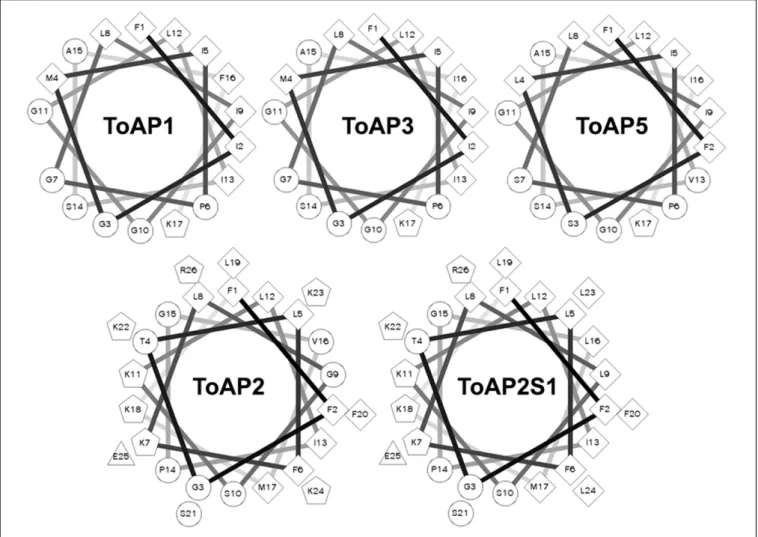
Helical wheel projections predict that ToAP2, ToAP2S1, ToAP1, ToAP3, and ToAP4, once adopting a helical conformation, are amphipathic peptides, thus presenting distinct hydrophobic and hydrophilic faces (Figure 2). ToAcP, however, presents only a hydrophilic face. The lack of a distinct hydrophobic face compromises its amphipathicity.
Antimicrobial Assay
Antifungal assays were performed against different species of Candida and C. neoformans (Table 3).
Seven peptides were active against Candida spp. and
C. neoformans. ToAP2 and Con10, both from NDBP subfamily 3, had antifungal activity against all strains tested with MICs values
ranging from 3.12 to 200µM and 12.5 to 200 µM, respectively.
Among peptides from NDBP subfamily 4, only ToAP4 has not shown antifungal activity in the tested concentrations (data not shown). The other peptides from this subfamily presented
antimicrobial activity against allCandida spp. and C. neoformans
in the same MIC range (6.25–200µM), except for C. glabrata,
which is insensitive to them. C. glabrata is also resistant to
all peptides from NDBP subfamily 5. Among those subfamily peptides, NDBP 5.7 presented antifungal activity with MIC values
ranging from 12.5 to 25µM and NDBP 5.8 inhibited the growth
of pathogens tested at concentrations ranging from 50 to 200µM.
NDBP-5.6 and ToAcP did not present antifungal activity in this assay (data not shown).
Since ToAP2 showed the lower MIC against all pathogens tested in this work, derivatives of its structure were produced
in order to increase theα-helical content. The modified peptide,
ToAP2S1 (Table 1) was synthesized and tested against two Candida species (C. albicans and C. glabrata) and C. neoformans H99. ToAP2S1 did not show antifungal activity in the tested concentrations (data not shown), demonstrating that the changes in peptide sequence abolished antifungal activity relative to the reference peptide.
Based on results from antimicrobial assay, we decided to proceed only with those peptides (at least one per family) that showed best antimicrobial activity.
Hemolysis and Cytotoxicity Assays
The hemolytic activities of peptides ToAP2, NDBP-4.23, ToAP1, and NDBP-5.7 were evaluated against human erythrocytes (Figure 3). ToAP2S1 was also tested to evaluate if it also has lost its hemolytic activity. NDBP-4.23 and ToAP1 might be considered of interest to future studies, because in all the tested concentrations their hemolysis curves were significantly lower
than 50% of hemolysis (Conlon et al., 2007; Thaker et al.,
2011; Figures 3B,C). However, NDBP-5.7 presents a hemolysis
percent higher than 50% in concentrations up to 50 µM
(Figure 3D). Comparing the original peptide ToAP2 and the modified ToAP2S1, the last one shows a higher hemolysis curve
with concentrations up to 25µM while the ToAP2 maintained its
curve above 50% of hemolysis (Figure 3A).
Toxicity to mammalian cells was further evaluated by assessing the viability of murine peritoneal macrophages in the presence of the peptides (Figure 4). The threshold of acceptable cytotoxicity was set at 50% viability as postulated elsewhere (Thaker et al., 2011; Zhao et al., 2012). In conformity with the
FIGURE 2 | Helical wheel projections of theα-helical structured peptides. The projections were generated at the web server for this tool
(http://rzlab.ucr.edu/scripts/wheel/wheel.cgi). Diamonds, hydrophobic residues; circles, hydrophilic residues, non-charged; pentagons, positively charged residues; triangles, negatively charged residues.
TABLE 3 | Inhibitory concentrations of different peptides against Candida spp. and two Cryptococcus neoformans strains.
Peptide Minimum inhibitory concentration (µM)
C. albicans (SC5314) C. tropicalis (ATCC 750) C. parapsilosis (ATCC 22019) C. glabrata (ATCC 90030) C. neoformans (H99 serotype A) C. neoformans (B3501 serotype D) ToAP2 12.5 3.12 50 200 12.5 6.25 Con10 100 12.5 200 200 50 25 ToAP3 25 12.5 100 >400 100 25 NDBP-4.23 50 6.25 100 >400 25 12.5 ToAP1 50 12.5 200 >400 25 12.5 NDBP-5.7 25 25 >400 >400 25 12.5 NDBP-5.8 100 25 200 >400 100 50 Amp B 1.08 2.16 2.16 1.08 0.27 0.135
NDBP, non-disulfide-bridged peptide; Amp B, amphotericin B. The values of 0.135, 0.27, 1.08 and 2,16µM of Amp B are equivalent to 0.125, 0,25, 1 and 2 µg/mL of Amp B respectively.
hemolytic test, ToAP2 and NDBP-4.23 in concentrations below
6.25 and 25 µM, respectively, have shown low cytotoxicity
(Figures 4A–C). For ToAP1 and NDBP-5.7, peritoneal macrophages displayed higher viability in the whole range
of peptide concentrations (Figures 4B–D). The difference in the hemolytic curves between ToAP2 and its analog (ToAP2S1) could be explained by the higher hydrophobicity of ToAP2S1
FIGURE 3 | Hemolytic activity of peptides against human erythrocytes. (A) ToAP2 and ToAP2S1, (B) ToAP1, (C) NDBP-4.23, and (D) NDBP-5.7.
(2007) demonstrated that there is an optimal hydrophobicity window for AMPs, below which antimicrobial activity can be lost and above which self-association becomes highly likely. Peptide aggregation prevents penetration through the capsule
and cell wall of microorganisms (Jiang et al., 2008). However,
the higher hydrophobicity does not affect their activity on the
eukaryotic membrane (Chen et al., 2007), which explains the
lower antifungal activity and the higher hemolytic activity of the modified ToAP2S1, respectively.
Effects of the Peptides on Candida
albicans Biofilms
We visualizedC. albicans biofilms at 4 and 24 h by fluorescence
microscopy using uvitex 2B, which binds chitin in the fungal cell wall, and they exhibited typical features of mature biofilms, including a basal layer of yeast cells and a thicker layer of yeast and hyphae cells (Supplementary Material). This structure was
very similar to the morphology ofC. albicans biofilms presented
in other works in the literature (Pierce et al., 2014, 2015).
Additionally, the inhibition values of biofilms by Amp B were similar to those found byRamage et al. (2001, 2002).
The effects of ToAP2, NDBP-4.23, ToAP1, and NDBP-5.7
onC. albicans biofilms were evaluated on the initial adherence
step (Figure 5A) and on the mature biofilm (Figure 5C). As a control, the effect of Amp B was also shown at both time points (Figures 5B,D), with a reduction of at least 80%
in biofilm viability at 0.25 µg/mL for the initial adherence
and 2 µg/mL for the three-dimensional architecture. All the
peptides were active against biofilm formation, albeit at a higher concentration compared to what was observed against planktonic
cells (100 µM for the initial adherence and 400 µM for the
three-dimensional architecture). ToAP2 was the most active peptide at the two different stages of biofilm formation, with
a lower effective concentration than the others (25 µM for
the initial adherence and 200 µM for the three-dimensional
architecture).
Circular Dichroism
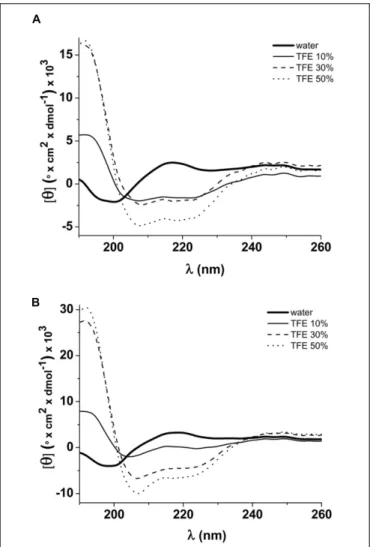
The secondary structures of native (ToAP2) and modified (ToAP2S1) peptides were assessed by CD spectroscopy. FAR-UV
CD spectra of ToAP2 in water at 37◦
C revealed a typical disordered structural pattern (Figure 6A). At increasing concentrations of 10, 30, and 50% TFE (v/v), a red shift from 200 to 208 and 222 nm and increased negative dichroic signals were observed (Figure 6A). These results show that ToAP2 lacks secondary structure in aqueous environments
FIGURE 4 | Cytotoxicity of peptides against peritoneal macrophages of BALB/c mice. (A) ToAP2, (B) ToAP1, (C) NDBP-4.23, and (D) NDBP-5.7.
and has a tendency to adopt an α-helical pattern at aqueous
environments in the present of the co-solvent TFE (Table 4).
In contrast, an α-helical conformation was observed for the
modified peptide ToAP2S1 in water at 37◦
C even in the absence of TFE. In the presence of 10, 30, and 50% TFE, intense negative dichroic bands at 208 and 222 nm were observed
(Figure 6B), which are compatible with higherα-helix content
(Table 4). Fractional helicity of peptides in water and TFE environments was calculated considering the molar ellipticity at
208 nm (Table 4). There was an increased α-helix content for
both peptides as a function of TFE, with ToAP2S1 presenting
approximately 17% of α-helix in water in the absence of the
co-solvent.
DISCUSSION
We have witnessed a steady increase in the incidence of systemic fungal diseases in the last decades, partially due to medical advances and the rise of immunosuppressive diseases. Although antifungal therapy is somewhat efficient, there are only four classes of agents, many of which have significant side effects.
In addition, there is an increasing number of fungal species with natural or acquired resistance to these drugs. For instance, the most recent class of antifungals, the echinocandins, was discovered in the seventies and only became available for clinical therapy in 2002. Since then, the search for new antifungal targets and potential drugs for more efficient and less toxic treatments has been an ongoing work. AMPs are attractive alternatives as antifungal drugs and here we describe seven scorpion venom-derived peptides with promising antimicrobial activity against Candida spp. and/or C. neoformans strains, all of which are major fungal pathogens.
Regardless of the strain, ToAP2, the most cationic peptide, showed the lowest inhibitory concentrations in our tests. ToAP2 and Con10 exhibited sequence similarity to Pandinin 2, for which anti-C. albicans activity has been described with a MIC of 19.1µM (Corzo et al., 2001). In contrast, while ToAP2 presented MIC values around this range, Con10 showed much higher values
for C. albicans and most of the other tested strains. Despite
the similarity, Con10 has lower net positive charge (+1) than Pandinin 2 (+3). Conversely, ToAP2 physicochemical properties are more similar to those of Pandinin 2: its net positive charge is +6. Several studies have shown that analog of AMPs with
FIGURE 5 | Effects of the peptides ToAP2, NDBP-4.23, ToAP1, NDBP-5.7, and amphotericin B on C. albicans biofilm formation. Effects of the peptides (A) and Amp B (B) on the initial adherence and effects of the peptides (C) and Amp B (D) on the mature stage. Results are expressed in terms of biofilm viability as XTT-reduction assay readings percentage, normalized by the control groups. The experiments were performed at least twice on different days. Statistical analyses: ANOVA and Turkey post-test (∗ ∗ ∗ ∗P ≤ 0.0001;∗ ∗ ∗P ≤ 0.001;∗ ∗P ≤ 0.01;∗P ≤ 0.05). Mean ± SEM.
amino acids substitutions to increase positive net charge had better antifungal activity (Nikawa et al., 2004), which may explain the poor antifungal activity of Con10 relative to ToAP2 and Pandinin 2.
We also analyzed the secondary structures of the peptides in water and in a mimetic membrane environment (aqueous co-solvent TFE) by CD spectroscopy. The FAR-UV CD spectra showed that ToAP2 and its modified version ToAP2S1 have
typical disordered and α-helical structures in water at 37◦
C,
respectively. There was an increase in α-helix content for
both peptides as a function of TFE concentration (Table 4), indicating the potential of these molecules to interact with the cellular membrane, a classical feature ofα-helical AMPs. Stability assays also showed that the non-modified peptide presented
lower α-helix content and lower stability than the modified
peptide. These observations may indicate that net charge is an important parameter for antifungal activity as well as to the conformation changes induced by the interaction with the fungal membrane.
ToAP1 and ToAP3 share similarity with AamAP1, AamAP2, and AcrAP1 (Figure 1), peptides that have already been documented as having anti-C. albicans activity (Almaaytah et al., 2012; Du et al., 2014). Interestingly, ToAP1 and ToAP3 only differ at one residue at position 16, respectively a Phe and an Ile. While ToAP3 has better anti-Candida spp. activity, ToAP1
showed better activity against C. neoformans (Table 3). This
result suggests that Phe16 in ToAP1 could be essential for anti-C. neoformans activity. The lack of activity of ToAP4 against the fungal strains tested in our assay condition is worth noting, in spite of its 82.3% identity with Stigmurin (Figure 1), a peptide fromTityus stigmurus that inhibits the growth of C. albicans and
C. glabrata with MIC values of 34.8µM and 69.5 µM, respectively
(de Melo et al., 2015). This difference could be due to different methods used to evaluate antifungal activity or the difference in sequence itself. More studies are needed to evaluate this.
NDBP-5.7 and NDBP-5.8 showed high similarity to IsCT, IsCT2, and Patinin3, peptides with antifungal activity against
FIGURE 6 | FAR-UV CD spectra of peptides in water and 10, 30, 50% TFE. (A) Spectra of ToAP2 presenting a red shift from 200 nm to 208 and 222 nm in the presence of TFE; (B) Spectra of ToAP2S1 showing an increase of the dichroic signals at 208 and 222 nm from water to TFE.
TABLE 4 |α-Helix content (%) of peptides in water, and TFE at 10, 30, and 50%.
Solvent α-Helix content (%) of peptides
ToAP2 ToAP2S1
Water 9.8 16.5
TFE 10% 12.9 22.9
TFE 30% 20.8 24.3
TFE 50% 25.8 24.7
2013). Considering that the C-terminal amidation modifies the
net positive charge and stabilizes peptide structure, improving
antimicrobial activity (Huang et al., 2010), the lack of this
chemical group may explain the lower activity of NDBP-5.8 against the tested microorganisms (Tables 2 and 3). By its turn, the lack of antifungal activity of ToAcP probably could be explained by its net negative charge, which causes
electrostatic repulsion from the microbial plasma membrane (van
der Weerden et al., 2013).
Among the testedCandida species, C. glabrata was the most
resistant, with inhibitory concentrations higher than 400 µM
for all peptides. This result is in accordance with the literature describing the high intrinsic resistance shown by this species to most antifungal drugs, as well as to Histatin 5, one of the
best candidacidal peptides already described (Sobel, 2006; Tati
et al., 2013; Rodrigues et al., 2014). Conversely, C. tropicalis
was the most susceptible organism amongCandida species. As
shown in Table 3, the AMPs exhibited their lowest inhibitory concentrations againstC. tropicalis, in contrast with its described high virulence, associated infection mortality rates, and resistance
to amphotericin B (CLSI M27-A3 protocol (Colombo et al.,
2007). Consequently, the peptides tested in this work are
promising candidates for the development of treatments for C. tropicalis infection.
With regard to the effects of AMPs against C. neoformans,
the B3501 strain (serotype D) was more sensitive to the scorpion peptides than the H99 strain (serotype A). This is in accordance with the previously described higher susceptibility
of this serotype to amphotericin B (Thompson et al., 2009).
C. neoformans has a negatively charged polysaccharide capsule that is one of the most important virulence factors of this yeast (McFadden et al., 2006). Its thickness varies according to strain, with strain B3501 presenting a thicker capsule than H99 under non-inducing conditions. Therefore, it is possible that the capsule exerts an electrostatic attraction effect on cationic AMPs, which may explain the higher susceptibility of strain B3501. Similarly,
susceptibility of C. neoformans to polymyxin B was previously
reported to be dependent on fungal capsule thickness (Zhai and
Lin, 2013).
In addition to the effects on planktonic cells described above, we also analyzed their action againstC. albicans biofilms. Biofilms represent a great health concern due to their intrinsic resistance to antimicrobial treatment and to the patient immune response. The resistance involves different factors like overexpression of drug resistance genes and impairment of drug penetration due the thickness of the extracellular matrix. All peptides tested (ToAP2, NDBP-4.23, ToAP1, and NDBP-5.7) reduced biofilm on both the initial cell adherence stage and the mature phase, albeit at higher concentration ranges relative to planktonic cells, which holds true for all antimicrobials. Again, ToAP2 was the most active peptide at the two different stages of biofilm formation, presenting a lower effective concentration
than the other peptides (25 µM for the initial adherence and
200 µM for the three-dimensional architecture). These results
are encouraging, since the peptides showed an antifungal effect in different phases of the biofilm process with lower concentrations than expected for prospective antifungals (100–1,000 times
higher than concentrations used against planktonic cells (Pierce
et al., 2008). Furthermore, hemolysis and cytotoxicity assays showed promising results regarding the selective toxicity of the tested peptides. Most of the tested peptides can be considered of interest for future studies, as they caused hemolysis of less than 50% of erythrocytes and more than 50% of murine peritoneal macrophages remained viable in their presence.
In summary, we described seven scorpion venom-derived
C. neoformans and against C. albicans biofilms, including two novel molecules. This is the first report of scorpion-derived AMPs
against C. neoformans and our results underscore the potential
of scorpion-venom as a source of antimicrobials. The observed
effects of the described peptides during and after C. albicans
biofilm formation highlight the antimicrobial potential of these molecules in the face of the huge impact of biofilm-derived infections in hospitalized patients. Further characterization of their mechanisms of action and interaction with available antifungals, followed by molecular optimization to reduce their toxicity to host cells and increase antimicrobial activity are need to fully clarify their real potential as antifungals.
AUTHOR CONTRIBUTIONS
FG and NV designed and carried out all AMP screening experiments and characterization of their antifungal properties. KS, MR, PC, AT, and AB designed and carried out the hemolysis and cytotoxicity assays. AA and SF contributed to CD experiments. OF contributed to MS experiments. MO, NV, FG, PA, IS-P, and LD contributed in the biofilm assays. AN supervised the biofilm microscopy analysis. ES selected the AMPs to be used in this work, contributed to chemical peptide synthesis and design of modified peptides. MM carried out peptide sequence, purity, and stability assessments (MS assays), contributed to antimicrobial assays and oversaw statistical analysis. PA and IS-P supervised all work. FG, NV, KS, AB, SF, PA, and IS-P contributed in the writing and revision of the manuscript. LD, OF, ES, and MM also contributed to the final revision of the manuscript. All authors read and approved the final version of the manuscript.
FUNDING
This study was supported by research funding by the National Council of Technological and Scientific Development (CNPq) and the Research Support Foundation of the Federal District (FAP-DF; grant numbers: PRONEX 193.000.571/2009; Rede Centro-Oeste 561212/2010-4 and 193.000.477/2011).
ACKNOWLEDGMENTS
We are grateful to the graduate programs in Molecular Biology (CEL/IB/UnB) and Molecular Pathology (FM/UnB) for all support and CNPq and CAPES for fellowships awarded to the graduate students FG, NV, KS, and AA. LD was supported by a postdoctoral fellowship from CNPq. We extend our gratitude to all colleagues of the INOVATOXIN network (“Innovation with venoms from animals from the Brazilian Midwest: therapeutic applications, toxicology and bioprospection”), for all valuable information. We thank Ana Marisa Fusco-Almeida (UNESP-Araraquara) for the kind donation of Concanavalin A conjugated to Alexa Fluor 488 (CAAF; Molecular Probes, USA). We thank Dr. Cynthia Kyaw for helpful suggestions. We are grateful to Dr. Hugo Costa Paes for revising the manuscript.
SUPPLEMENTARY MATERIAL
The Supplementary Material for this article can be found online at: http://journal.frontiersin.org/article/10.3389/fmicb. 2016.01844/full#supplementary-material
REFERENCES
Adler, A. J., Greenfield, N. J., and Fasman, G. D. (1973). Circular dichroism and optical rotatory dispersion of proteins and polypeptides.Methods Enzymol. 27, 675–735. doi: 10.1016/S0076-6879(73)27030-1
Almaaytah, A., and Albalas, Q. (2014). Scorpion venom peptides with no disulfide bridges: a review.Peptides 51, 35–45. doi: 10.1016/j.peptides.2013.10.021 Almaaytah, A., Zhou, M., Wang, L., Chen, T., Walker, B., and Shaw, C.
(2012). Antimicrobial/cytolytic peptides from the venom of the North African
scorpion,Androctonus amoreuxi: biochemical and functional characterization
of natural peptides and a single site-substituted analog.Peptides 35, 291–299. doi: 10.1016/j.peptides.2012.03.016
Arendrup, M. C. (2013). Candida and candidaemia. Susceptibility and
epidemiology.Dan. Med. J. 60:B4698.
Armstrong-James, D., Meintjes, G., and Brown, G. D. (2014). A neglected
epidemic: fungal infections in HIV/AIDS.Trends Microbiol. 22, 120–127. doi:
10.1016/j.tim.2014.01.001
Barona, J., Batista, C. V., Zamudio, F. Z., Gomez-Lagunas, F., Wanke, E., Otero, R., et al. (2006). Proteomic analysis of the venom and characterization of toxins specific for Na+ - and K+ -channels from the Colombian
scorpion Tityus pachyurus. Biochim. Biophys. Acta 1764, 76–84. doi:
10.1016/j.bbapap.2005.08.010
Chen, Y., Guarnieri, M. T., Vasil, A. I., Vasil, M. L., Mant, C. T., and Hodges, R. S. (2007). Role of peptide hydrophobicity in the mechanism of action of
alpha-helical antimicrobial peptides.Antimicrob. Agents Chemother. 51, 1398–1406.
doi: 10.1128/AAC.00925-06
Colombo, A. L., Guimaraes, T., Silva, L. R., de Almeida Monfardini, L. P., Cunha, A. K., Rady, P., et al. (2007). Prospective observational study of candidemia
in Sao Paulo, Brazil: incidence rate, epidemiology, and predictors of mortality. Infect. Control Hosp. Epidemiol. 28, 570–576. doi: 10.1086/513615
Conlon, J. M., Al-Dhaheri, A., Al-Mutawa, E., Al-Kharrge, R., Ahmed, E.,
Kolodziejek, J., et al. (2007). Peptide defenses of the Cascades frog Rana
cascadae: implications for the evolutionary history of frogs of the Amerana species group.Peptides 28, 1268–1274. doi: 10.1016/j.peptides.2007.03.010 Corzo, G., Escoubas, P., Villegas, E., Barnham, K. J., He, W., Norton, R. S., et al.
(2001). Characterization of unique amphipathic antimicrobial peptides from
venom of the scorpionPandinus imperator. Biochem. J. 359(Pt 1), 35–45. doi:
10.1042/bj3590035
Cruz, A. H., Mendonca, R. Z., and Petricevich, V. L. (2005). Crotalus durissus terrificus venom interferes with morphological, functional, and biochemical
changes in murine macrophage. Mediators Inflamm. 2005, 349–359. doi:
10.1155/MI.2005.349
Dai, L., Corzo, G., Naoki, H., Andriantsiferana, M., and Nakajima, T. (2002). Purification, structure-function analysis, and molecular characterization of novel linear peptides from scorpionOpisthacanthus madagascariensis. Biochem. Biophys. Res. Commun. 293, 1514–1522. doi: 10.1016/S0006-291X(02)00423-0 de Melo, E. T., Estrela, A. B., Santos, E. C., Machado, P. R., Farias, K. J.,
Torres, T. M., et al. (2015). Structural characterization of a novel peptide with antimicrobial activity from the venom gland of the scorpionTityus stigmurus: Stigmurin.Peptides 68, 3–10. doi: 10.1016/j.peptides.2015.03.003
Diego-Garcia, E., Batista, C. V., Garcia-Gomez, B. I., Lucas, S., Candido,
D. M., Gomez-Lagunas, F., et al. (2005). The Brazilian scorpion Tityus
costatus Karsch: genes, peptides and function. Toxicon 45, 273–283. doi: 10.1016/j.toxicon.2004.10.014
Diekema, D., Arbefeville, S., Boyken, L., Kroeger, J., and Pfaller, M. (2012). The changing epidemiology of healthcare-associated candidemia
over three decades. Diagn. Microbiol. Infect. Dis. 73, 45–48. doi: 10.1016/j.diagmicrobio.2012.02.001
Du, Q., Hou, X., Ge, L., Li, R., Zhou, M., Wang, H., et al. (2014). Cationicity-enhanced analogues of the antimicrobial peptides, AcrAP1 and AcrAP2, from
the venom of the scorpion,Androctonus crassicauda, display potent growth
modulation effects on human cancer cell lines.Int. J. Biol. Sci. 10, 1097–1107. doi: 10.7150/ijbs.9859
Fanning, S., and Mitchell, A. P. (2012). Fungal biofilms.PLoS Pathog. 8:e1002585. doi: 10.1371/journal.ppat.1002585
Finkel, J. S., and Mitchell, A. P. (2011). Genetic control ofCandida albicans biofilm
development.Nat. Rev. Microbiol. 9, 109–118. doi: 10.1038/nrmicro2475
Greenfield, N., and Fasman, G. D. (1969). Computed circular dichroism spectra
for the evaluation of protein conformation.Biochemistry 8, 4108–4116. doi:
10.1021/bi00838a031
Guerrero-Vargas, J. A., Mourao, C. B., Quintero-Hernandez, V., Possani, L. D., and Schwartz, E. F. (2012). Identification and phylogenetic
analysis of Tityus pachyurus and Tityus obscurus novel putative
Na+-channel scorpion toxins. PLoS ONE 7:e30478. doi: 10.1371/journal.pone.
0030478
Guo, X., Ma, C., Du, Q., Wei, R., Wang, L., Zhou, M., et al. (2013). Two peptides,
TsAP-1 and TsAP-2, from the venom of the Brazilian yellow scorpion,Tityus
serrulatus: evaluation of their antimicrobial and anticancer activities. Biochimie 95, 1784–1794. doi: 10.1016/j.biochi.2013.06.003
Hancock, R. E., and Sahl, H. G. (2006). Antimicrobial and host-defense peptides as new anti-infective therapeutic strategies.Nat. Biotechnol. 24, 1551–1557. doi: 10.1038/nbt1267
Harrison, P. L., Abdel-Rahman, M. A., Miller, K., and Strong, P. N. (2014).
Antimicrobial peptides from scorpion venoms. Toxicon 88, 115–137. doi:
10.1016/j.toxicon.2014.06.006
Huang, Y., Huang, J., and Chen, Y. (2010). Alpha-helical cationic antimicrobial peptides: relationships of structure and function.Protein Cell 1, 143–152. doi: 10.1007/s13238-010-0004-3
Jiang, Z., Vasil, A. I., Hale, J. D., Hancock, R. E., Vasil, M. L., and Hodges, R. S. (2008). Effects of net charge and the number of positively charged residues on the biological activity of amphipathic alpha-helical cationic antimicrobial peptides.Biopolymers 90, 369–383. doi: 10.1002/bip.20911
Martinez, L. R., and Casadevall, A. (2015). Biofilm formation by
Cryptococcus neoformans. Microbiol. Spectr. 3, MB-0006-2014. doi:
10.1128/microbiolspec.MB-0006-2014
Mayer, F. L., Wilson, D., and Hube, B. (2013).Candida albicans pathogenicity
mechanisms.Virulence 4, 119–128. doi: 10.4161/viru.22913
McFadden, D. C., De Jesus, M., and Casadevall, A. (2006). The physical
properties of the capsular polysaccharides from Cryptococcus neoformans
suggest features for capsule construction.J. Biol. Chem. 281, 1868–1875. doi: 10.1074/jbc.M509465200
Mikulska, M., Del Bono, V., Ratto, S., and Viscoli, C. (2012). Occurrence,
presentation and treatment of candidemia. Expert Rev. Clin. Immunol. 8,
755–765. doi: 10.1586/eci.12.52
Mookherjee, N., and Hancock, R. E. (2007). Cationic host defence peptides: innate
immune regulatory peptides as a novel approach for treating infections.Cell
Mol. Life Sci. 64, 922–933. doi: 10.1007/s00018-007-6475-6
Nahar, M., Mishra, D., Dubey, V., and Jain, N. K. (2008). Development,
characterization, and toxicity evaluation of amphotericin B-loaded
gelatin nanoparticles. Nanomedicine 4, 252–261. doi: 10.1016/j.nano.2008.
03.007
Nikawa, H., Fukushima, H., Makihira, S., Hamada, T., and Samaranayake, L. P. (2004). Fungicidal effect of three new synthetic cationic peptides againstCandida albicans. Oral Dis. 10, 221–228. doi: 10.1111/j.1601-0825.2004. 01010.x
Ortiz, E., Gurrola, G. B., Schwartz, E. F., and Possani, L. D. (2015). Scorpion
venom components as potential candidates for drug development.Toxicon 93,
125–135. doi: 10.1016/j.toxicon.2014.11.233
Pan, W., Khayhan, K., Hagen, F., Wahyuningsih, R., Chakrabarti, A.,
Chowdhary, A., et al. (2012). Resistance of AsianCryptococcus neoformans
serotype A is confined to few microsatellite genotypes.PLoS ONE 7:e32868.
doi: 10.1371/journal.pone.0032868
Park, B. J., Wannemuehler, K. A., Marston, B. J., Govender, N., Pappas, P. G., and Chiller, T. M. (2009). Estimation of the current global burden of cryptococcal
meningitis among persons living with HIV/AIDS.AIDS 23, 525–530. doi:
10.1097/QAD.0b013e328322ffac
Paul, S., and Moye-Rowley, W. S. (2014). Multidrug resistance in fungi: regulation of transporter-encoding gene expression.Front. Physiol. 5:143. doi: 10.3389/fphys.2014.00143
Pfaller, M. A. (2012). Antifungal drug resistance: mechanisms, epidemiology,
and consequences for treatment. Am. J. Med. 125(Suppl.), S3–S13. doi:
10.1016/j.amjmed.2011.11.001
Pfaller, M. A., and Diekema, D. J. (2007). Epidemiology of invasive candidiasis:
a persistent public health problem.Clin. Microbiol. Rev. 20, 133–163. doi:
10.1128/CMR.00029-06
Pierce, C. G., Chaturvedi, A. K., Lazzell, A. L., Powell, A. T., Saville, S. P.,
McHardy, S. F., et al. (2015). A novel small molecule inhibitor ofCandida
albicans biofilm formation, filamentation and virulence with low potential
for the development of resistance. NPJ Biofilms Microbiomes 1:15012. doi:
10.1038/npjbiofilms.2015.12
Pierce, C. G., Saville, S. P., and Lopez-Ribot, J. L. (2014). High-content
phenotypic screenings to identify inhibitors of Candida albicans biofilm
formation and filamentation.Pathog. Dis. 70, 423–431. doi:
10.1111/2049-632X.12161
Pierce, C. G., Uppuluri, P., Tristan, A. R., Wormley, FL Jr, Mowat, E., Ramage, G., et al. (2008). A simple and reproducible 96-well plate-based method for the formation of fungal biofilms and its application to antifungal susceptibility testing.Nat. Protoc. 3, 1494–1500. doi: 10.1038/nport.2008.141
Qi, X., Zhou, C., Li, P., Xu, W., Cao, Y., Ling, H., et al. (2010). Novel short antibacterial and antifungal peptides with low cytotoxicity: efficacy
and action mechanisms.Biochem. Biophys. Res. Commun. 398, 594–600. doi:
10.1016/j.bbrc.2010.06.131
Ramage, G., Vande Walle, K., Wickes, B. L., and Lopez-Ribot, J. L. (2001). Standardized method for in vitro antifungal susceptibility testing ofCandida albicans biofilms. Antimicrob. Agents Chemother. 45, 2475–2479. doi: 10.1128/AAC.45.9.2475-2479.2001
Ramage, G., VandeWalle, K., Lopez-Ribot, J. L., and Wickes, B. L. (2002). The filamentation pathway controlled by the Efg1 regulator protein is
required for normal biofilm formation and development in Candida
albicans. FEMS Microbiol. Lett. 214, 95–100. doi: 10.1111/j.1574-6968.2002. tb11330.x
Rodrigues, C. F., Silva, S., and Henriques, M. (2014).Candida glabrata: a review of its features and resistance.Eur. J. Clin. Microbiol. Infect. Dis. 33, 673–688. doi: 10.1007/s10096-013-2009-3
Romani, L. (2011). Immunity to fungal infections.Nat. Rev. Immunol. 11, 275–288. doi: 10.1038/nri2939
Sable, C. A., Strohmaier, K. M., and Chodakewitz, J. A. (2008).
Advances in antifungal therapy. Annu. Rev. Med. 59, 361–379. doi:
10.1146/annurev.med.59.062906.071602
Schwartz, E. F., Diego-Garcia, E., Rodriguez de la Vega, R. C., and Possani, L. D. (2007). Transcriptome analysis of the venom gland of the Mexican
scorpionHadrurus gertschi (Arachnida: Scorpiones). BMC Genomics 8:119. doi:
10.1186/1471-2164-8-119
Silva, E. C., Camargos, T. S., Maranhao, A. Q., Silva-Pereira, I., Silva, L. P., Possani, L. D., et al. (2009). Cloning and characterization of cDNA sequences encoding for new venom peptides of the Brazilian scorpion Opisthacanthus cayaporum. Toxicon 54, 252–261. doi: 10.1016/j.toxicon. 2009.04.010
Sobel, J. D. (2006). The emergence of non-albicansCandida species as causes of
invasive candidiasis and candidemia.Curr. Infect. Dis. Rep. 8, 427–433. doi: 10.1007/s11908-006-0016-6
Tati, S., Jang, W. S., Li, R., Kumar, R., Puri, S., and Edgerton, M. (2013). Histatin 5 resistance ofCandida glabrata can be reversed by insertion of Candida albicans
polyamine transporter-encoding genes DUR3 and DUR31.PLoS ONE 8:e61480.
doi: 10.1371/journal.pone.0061480
Thaker, H. D., Sgolastra, F., Clements, D., Scott, R. W., and Tew, G. N. (2011). Synthetic mimics of antimicrobial peptides from triaryl scaffolds.J. Med. Chem. 54, 2241–2254. doi: 10.1021/jm101410t
Thompson, G. R. III, Wiederhold, N. P., Fothergill, A. W., Vallor, A. C., Wickes, B. L., and Patterson, T. F. (2009). Antifungal susceptibilities among different
serotypes of Cryptococcus gattii andCryptococcus neoformans. Antimicrob.
van der Weerden, N. L., Bleackley, M. R., and Anderson, M. A. (2013). Properties and mechanisms of action of naturally occurring antifungal peptides.Cell Mol. Life Sci. 70, 3545–3570. doi: 10.1007/s00018-013-1260-1
Wilkins, M. R., Gasteiger, E., Bairoch, A., Sanchez, J. C., Williams, K. L., Appel, R. D., et al. (1999). Protein identification and analysis tools in the ExPASy server.Methods Mol. Biol. 112, 531–552.
Zeng, X. C., Corzo, G., and Hahin, R. (2005). Scorpion venom peptides without
disulfide bridges.IUBMB Life 57, 13–21. doi: 10.1080/15216540500058899
Zeng, X. C., Zhou, L., Shi, W., Luo, X., Zhang, L., Nie, Y., et al. (2013). Three new antimicrobial peptides from the scorpionPandinus imperator. Peptides 45, 28–34. doi: 10.1016/j.peptides.2013.03.026
Zhai, B., and Lin, X. (2013). Evaluation of the anticryptococcal activity of the
antibiotic polymyxin B in vitro and in vivo.Int. J. Antimicrob. Agents 41,
250–254. doi: 10.1016/j.ijantimicag.2012.11.006
Zhao, Z., Hong, W., Zeng, Z., Wu, Y., Hu, K., Tian, X., et al. (2012). Mucroporin-M1 inhibits hepatitis B virus replication by activating the mitogen-activated protein kinase (MAPK) pathway and down-regulating HNF4alpha in vitro and in vivo.J. Biol. Chem. 287, 30181–30190. doi: 10.1074/jbc.M112.370312
Zhao, Z., Ma, Y., Dai, C., Zhao, R., Li, S., Wu, Y., et al. (2009). Imcroporin, a new cationic antimicrobial peptide from the venom of the scorpion Isometrus maculates. Antimicrob. Agents Chemother. 53, 3472–3477. doi: 10.1128/AAC.01436-08
Conflict of Interest Statement: The authors declare that the research was conducted in the absence of any commercial or financial relationships that could be construed as a potential conflict of interest.
Copyright © 2016 Guilhelmelli, Vilela, Smidt, de Oliveira, Álvares, Rigonatto, da Silva Costa, Tavares, Freitas, Nicola, Franco, Derengowski, Schwartz, Mortari, Bocca, Albuquerque and Silva-Pereira. This is an open-access article distributed under the terms of the Creative Commons Attribution License (CC BY). The use, distribution or reproduction in other forums is permitted, provided the original author(s) or licensor are credited and that the original publication in this journal is cited, in accordance with accepted academic practice. No use, distribution or reproduction is permitted which does not comply with these terms.