Electronic journal Brazilian Journal of Natural Sciences www.bjns.com.br
¹Department of Food Science and Postharvest Technology, Institute of Technology, Haramaya University, Ethiopia, P. O. Box 138, Dire Dawa. ²School of Plant Sciences, College of Agriculture and Environmental Sciences, Haramaya University, Ethiopia, P. O. Box 138, Dire Dawa. ³Department of Chemistry, College of Natural and Computational Sciences, Haramaya University, Ethiopia, P. O. Box 138, Dire Dawa.
Authors: Tesfahun Lamboro¹, Melese Mengistu² and Teshome Gonfa Hordofa³
PHYTOCHEMICAL SCREENING, CHARACTERIZATION OF ESSENTIAL
OIL AND ANTIMICROBIAL ACTIVITY OF SCHINUS MOLLE
(ANACARDIACEAE) COLLECTED FROM EASTERN HARARGHE,
ETHIOPIA
Original article
*Corresponding author:
Tesfahun Lamboro – e-mail: [email protected] – ORCID: https://orcid.org/0000-0002-6379-3007
DOI: https://doi.org/10.31415/bjns.v3i2.93 - Article received on March 21, 2020; Accepted on May 6, 2020; published on 23 July 2020 in the Brazilian Journal of Natural Sciences, Vol. 3, N.2, online, ISSN 2595–0584. www.bjns.com.br. All authors contributed equally to the article. The authors declare that there is no conflict of interest. This is an open access article under the CC - BY license: http://creativecommons.org/licenses/by/4.0
Abstract
In the present study, antibacterial activity of leaf, stem bark and root bark extracts of Schinus molle (Anacardiaceae) was evaluated against two bacterial (Xanthomonas and Ranstonia) and two fungal (Aspergillusniger and Fusariumvert) species using agar diffusion method. The stem and root ethanol extracts of Schinusmolle exhibited relatively higher zone of inhibition (11.3mm) against Xanthomonas campestris, pv. Campestris. Higher zone of inhibition (10mm) was also observed by the ethanolic extracts of the root of Schinus molle against Fusarium verticillioides followed by the chloroform extracts of the root (8mm) against Aspergillus niger. Phytochemical analysis of leaf, stem bark and root bark extracts of Schinus molle revealed the presence of flavonoids, alkaloids, saponins, steroids, terpenoids, phenols, quinines, carbohydrates and proteins. The occurrence of these biologically active chemicals in the plants parts may justify their wide usage in traditional medicine. From GC-MS analysis, three terpenoids namely monoterpene (66.02%) as a major components, sesquiterpene hydrocarbons (13.63%) and oxygenated sesquterpenes (11.07%) were identified from the roots. The essential oils obtained from leaf have been also rich in oxygenated sesquterpenes (68.28%), followed by sesquiterpene hydrocarbons (18.33%), and alcohols (5.17%). The finding indicated that essential oils from different parts of Schinus molle have a promising potential on inhibiting activity of pathogenic microbes. Keywords: Schinus molle, phytochemical, essential oil, GC-MS, antimicrobial activity Article ID
Introduction
For thousands of years, human beings used plants to treat various ailments and still many peoples from developing countries rely on traditional doctors and the collections of medicinal plants to treat health problems (Mehani and Segni, 2013). The medicinal plants are the plants whose parts (leaf, seed, fruits, stems, roots, barks), extracts, infusions, decoctions, powders are used in the treatment of different diseases of humans, plants and animals (Samy, 2005). The medicinal value of plants lies in some chemical substances that produce a definite physiological action on the human or animal body part of the plant. Extracts of many plants are highly efficient against parasitic as well as microbial infections (Bharti et al., 2013; Jameela et al, 2016; Parekh and Chanda, 2006). Unlike synthetic pesticides and fungicides, antimicrobials of plant origin are not associated with many side effects and are environmental friendly.
The essential oils are volatile aromatic substance extracted from the plant. They are produced in aromatic and medicinal plants as secondary metabolites and are obtained from various plant parts (flower, seed, leaves, bark, herbs, wood, fruits and roots) and stored in secretory cells, cavities, vessels, or epidermal cells called glandular trichomes (Pedro,
2012). They have many therapeutic properties. In
herbal medicine, they are used for their antiseptic properties against infectious diseases of fungal and bacterial origin (Mehani and Segni, 2013). The inherent activity of an oil extract may be related to its chemical composition, the proportions of the components and the interactions between them. The chemical composition of the essential oil consists mainly of monoterpene hydrocarbons (e.g., α-pinene, β-pinene, sabinene, terpinen-4-o), and some sesquiterpenes such as (+) spathulenol and germacrene-D (Lisin et al., 1999). Essential oils act against microorganisms often causing instability in the plasma membrane leading to cell lysis. Although the antimicrobial activity can be triggered by a single chemical compound, it usually appears to result from a synergy between several chemicals in the oil (Bhavanani and Balow, 1992; Elhayouni et al., 2008).
Schinus molle L. (Anacardiaceae) is one of very important medicinal plant native to Argentina, Bolivia and Peru but has since been introduced to Ethiopia and known with local name as “Kundo
Berbere” (Amharic) (Basil and Zakaria, 2014). This plant plays an important role in pharmacology and pharmaceutical chemistry because of its high essential oil content in its different parts (Belhamel et al, 2008). In Ethiopia, especially in Eastern part of Ethiopia, the fresh leave was traditionally used to repel insects. The insecticide effect of this plant might be combination of bio active intergradients produce a physiologic action on the insects.
Some studies have concluded that the Essential oils as a whole have much greater antibacterial activity than a mixture of the major components, which suggests that minor components are critical for this activity and may have a synergistic effect or potentiating influence (Burt, 2004; Ljalem and Unnithan, 2014; Marongiu et al, 2004). However, in Ethiopia, there is no sufficient work on antimicrobial effect of leaf, stem bark, fruit and root bark extract of S. molle on growth and activity of different fungal and bacterial strains. Therefore, this study was aimed to screen phytochemicals, investigated the chemical constituent of essential oils and evaluates antimicrobial activities of leaf; stem and root bark extracts of S. molle against selected plant pathogens (Fusariumverticillioides, Aspergillusniger, Xanthomonascampestris, pv. Campestris and Ralstoniasolanacearum).
Material and Methods Plant Material Collection
The aerial parts (stem bark and leaf) and root bark of Schinus molle plant were collected from Eastern Hararghe, Ethiopia. Fresh plant materials were thoroughly washed under tap water, dried with blotting paper and made ready for extraction. The plant species deposited at the National Herbarium of the Addis Ababa University, Ethiopia and a voucher specimen (No. TT-12) has been given.
Preparation of Plant Extracts
Fresh plant parts (stem and root barks and leaf of Schinus molle) were collected and thoroughly washed under tap water and shade-dried at room temperature or three weeks. The dried plant parts were crushed to fine powder using an electric grinder. Exposure to direct sunlight was avoided to prevent the loss of active components. The powder of collected plant
materials (50 grams of each plant parts) were extracted successively with 600 mL of n-hexane, chloroform and ethanol for 6hours using Soxhlet extraction. Each solvent was removed by rotary flash evaporator at lower temperature under reduced pressure and the crude extracts were stored in dark vials at 4°C for future uses.
Hydro-distillation and purification of essential oil
The fresh leaf and stem bark of Schinusmolle (600mg) was soaked in water at a ratio of 1:2 (w/v) and subjected to hydro-distillationfor 6hours using a modified Clevenger type glass apparatus. The essential oil was separated from the aqueous layer by separatory funnel, using the non-polar chloroform as a solvent. The residual oil was dried over anhydrous Na2SO4 and kept in a refrigerator (5°C) for subsequent experiments. Analysis of essential oil was carried out by Clarus 600/600 P Gas Chromatograph/Mass Spectrometer (Perkin Elmer, USA) system.
Microbial Culture preparation
Bacterial species (Xanthomonascampestris, pv. Campestris and Ralstoniasolanacearum.) were used for the antibacterial screening in this study. These organisms were maintained on agar slope at 4oC and sub-cultured for 24hr before use. Similarly, the fungal plant pathogens Fusarium verticillioides and Aspergillus niger were used for the antimicrobial test of the extract.
Microbial Susceptibility Testing
Standardized inoculums with 0.5 McFarland standards were introduced onto the surface of sterile agar plates, and a sterile glass spreader was used for even distribution of inoculums. McFarland is a barium sulphate standard against which the turbidity of the test and controlled inoculum was compared. McFarland was prepared by mixing two, solution “A” is 1 % v/v solution of sulphuric acid (H2SO4) and solution “B” is 1 % w/v solution of barium chloride (BaCl2). To get 0.5 McFarland standard, concentration equivalents to cell density of about 107- 108 CFUg-1, the
amount of 0.5 ml BaCl2 of 1 % solution “A” was mixed with 99.5 ml H2SO4 of 1 % solution “B” (Bauer et al., 1966). A sterile paper disc previously soaked in known
concentration of extracts will be carefully placed at the centre of the seeded labeled agar. The plates were incubated aerobically at 37oC and examined for zone of inhibition after 24 hrs. Each zone of inhibition was measured with a ruler and compared with the control (Bauer et al., 1966).
Determination of Total Tannin and Phenol Content
Tannin
Condensed tannin was analyzed by vanillin-HCl method of (Price et al., 1980) using the modified Vanillin-HCl methanol method. The Vanillin-HCl reagent was prepared by mixing equal volume of 8% concentrated HCl in methanol and 1% Vanillin in methanol. The solutions of the reagent were mixed just prior to use. About 0.2 g of the ground sample was placed in small conical flask. Then 10 mL of 1% concentrated HCl in methanol was added. The conical flask was capped and continuously shaken for 20 min and the content then is centrifuged at 2500 rpm for 5 minutes. About 1mL of the supernatant was pipette into a test tube containing 5 mL of Vanillin-HCl reagent. Absorbance at 450 nm was read on spectrophotometer after 20 minutes incubation at 300C. A blank sample was also analyzed and its
absorbance was subtracted from sample absorbance. A standard curve also prepared from catechin (1 mg/mL). Tannins content was expressed as catechin equivalent as follows:
Where: C is concentration corresponding to the optical density, 10 is volume of the extract (mL), 200 is sample weight (mg).
Phenolic
Total phenolic content was determined according to Folin-Ciocalteu method (Sharma and Gupta, 2010). Sample 200 mg was extracted with 4mL of acidified methanol (HCL/Methanol/water, 1:80:10 v/v/v) at room temperature (25OC) for 2 hrs. Aliquot
of extract (200 µL) was added to 1.5 mL freshly diluted (10 fold) Folin-Ciocalteu reagent. The mixture was allowed to equilibrate for 5 min and then mixed
with 1.5 mL of sodium carbonate solution (60 g/l). After incubation at room temperature (25OC) for 90
min, the absorbance of mixture was read at 725 nm (6505 uv/vis spectrophotometer, Model 6505, U.K, GENWAY). Acidified methanol was used as a blank. Form the stock solution of standard gallic acid, a series of six standard solutions (0, 5, 10, 15, 20, 25, 30 and 35 ppm) was prepared. The amount of total phenolic was estimated from the calibrated curve as gallic acid equivalent (GAE) in milligram per kilogram of sample. Total phenolic content was calculated by the following formula:
Where: µg/mL is the absorbance reading concentration, Df is dilution factor.
Procedure of Phytochemical Tests
The different qualitative chemical tests were performed for establishing the profile of given extracts to detect various phyto-constituents present in them. The phytochemical were analyzed according to standard screening tests using conventional procedures.
Test for Flavonoids
Lead acetate Test: -Extracts were treated with few drops of lead acetate solution. Formation of yellow colour precipitate indicates the presence of flavonoids.
Test for Alkaloids:
Wagner’s Test: -Filtrates were treated with Wagner’s reagent (Iodine in Potassium Iodide). Formation of brown/reddish precipitate indicated the presence of alkaloids.
Hager’s Test: -Filtrates were treated with Hager’s reagent (saturated picric acid solution). Presence of alkaloids was confirmed by the formation of yellow coloured precipitate.
Detection of Saponins
Foam Test: 0.5 gm of extract was shaken with 2 mL of water. If foam produced persists for ten minutes it indicates the presence of saponins.
Test for Steroid
5 drops of concentrated H2SO4 was added to 1cm3
of the extract. A reddish brown colour indicates the presence of steroids.
Test for Terpenoids
Salkowski test; - 5 mL of various solvent extract was mixed in 2 mL of chloroform followed by the careful addition of 3 mL concentrated (H2SO4). A layer of the reddish brown coloration was formed at the interface thus indicating a positive result for the presence of terpenoids.
Detection of Phenols
Ferric Chloride Test: Extracts were treated with 3-4 drops of ferric chloride solution. Formation of bluish black colour indicates the presence of phenols.
Test for Quinones
One ml of each of the various extracts was treated separately with ferric chloride solution. Quinines give coloration ranging from red to blue.
Test for Carbohydrates
Molisch test: Treat extract with few drops of alcoholic alpha-naphthol. Add 0.2mL concentrated sulphuric acid slowly along the sides of test tube, purple to violet colour ring appears at junction was showed the presence of carbohydrates.
Detection of proteins and amino acids
Xanthoproteic Test: -The extracts were treated with few drops of conc. nitric acid. Formation of yellow colour indicates the presence of proteins.
Ninhydrin Test: -To the extract, 0.25% w/v ninhydrin reagent was added and boiled for few minutes. Formation of blue colour indicates the presence of amino acid.
Data Analysis
The data was analyzed by using simple statistical methods. Experimental results were expressed as
means ± SD. All measurements were replicated three times.
Results and Discussion
Phytochemical screening of the crude extracts
The different qualitative chemical tests were performed for screening the profile of given extracts
No. Phytochemical Components Leaf Stem Bark Root Bark
P ether CF Eth P ether CF Eth P ether CF Eth
1 Flavonoids - + + - + + - + + 2 Alkaloids - + + - + + - + -3 Saponins - - - + 4 Steroids + + - + + - - - -5 Terpenoids + - - + - - ++ ++ -6 Phenols - + + - + + - - + 7 Quinones - - + - + ++ - + ++ 8 Carbohydrates + + - ++ + - ++ + -9. Proteins - - + - + + - - +
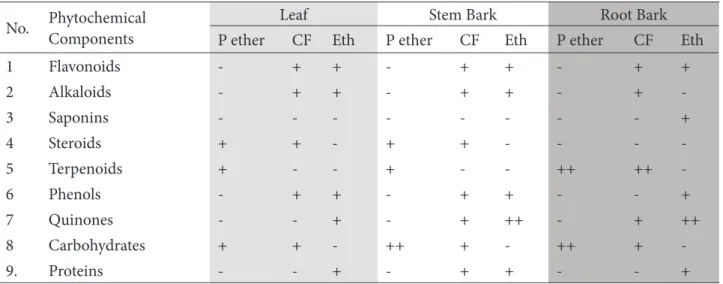
to detect various phyto-constituents present in the plant. The phytochemicals were analyzed according to standard screening tests using conventional procedures. The results of constituents of the crude extract of parts of Schinus molle were presented in table 1.
Table 1: -Phytochemical screenings results of crude
extracts of leaf, stem and root bark Schinusmolle.
Note: ++ = strong presence, + = moderate presence, - = absence: P eth= Petroleum ether, CF= Chloroform and Eth= Ethanol.
Phytochemical screenings results (Table 1) of crude extracts of leaf of Schinus molle revealed moderate presence of flavonoids, alkaloids, steroids, phenols and carbohydrates. The crude extracts of steam bark showed strong presence of quinones and carbohydrates and moderate presence of flavonoids, alkaloids, steroid and phenols. Phytochemical screenings of crude extracts of root of schinus molle also showed strong presence of terpenoides, quinones and carbohydrates and moderate presence of flavonoids. Flavonoids were present in both ethanolic and chloroform extracts of leaf, stem and root barks of Schinus molle. Similarly, alkaloids were found in both chloroform and ethanol extracts of leaf and stem barks of Schinus molle. They were also found in chloroform extracts of root barks while absent in ethanol extracts. Terpenoids were found in petroleum ether extracts of all plants parts while steroids were found in both petroleum and chloroform extracts of leaf and stem barks. Quinones were also present strongly in ethanolic extract of the above-mentioned plant parts. On the other hand, carbohydrates were found all petroleum and chloroform extracts of only
all plant parts.
Tannin and Phenolic content of the different parts of Schinus molle
The result of experiment for total tannin and phenol contents from the leaf, stem and root bark was indicated in table 2.
Table 2: Total tannin and phenolic content.
No Plant part Tanninmg/g Total phenol mg/g
1
Stem bark
13.48
177.27
3
Root bark
13.71
167.27
5
Leaf
5.92
58.86
This result showed that, the methanolic extracts of the leaf, root and stem bark of Schinus molle showed high amount of total phenolic content when compared to the total tannin in the three parts of the plant.
Similar finding was reported by Kasmi et al, (2016) there by higher phenolic content was observed on the fruit of Schinus molle with aqueous solution extracts.
Our findings showed that Schinus molle is rich in phenolic compounds which were mainly responsible for several antimicrobial activities due to the trapping potential of free radicals and activation of antioxidants of the cells. Phenols activate the natural defensive mechanism on the microbes.
Antimicrobial activity of leaf, stem and root bark extract of Schinus molle
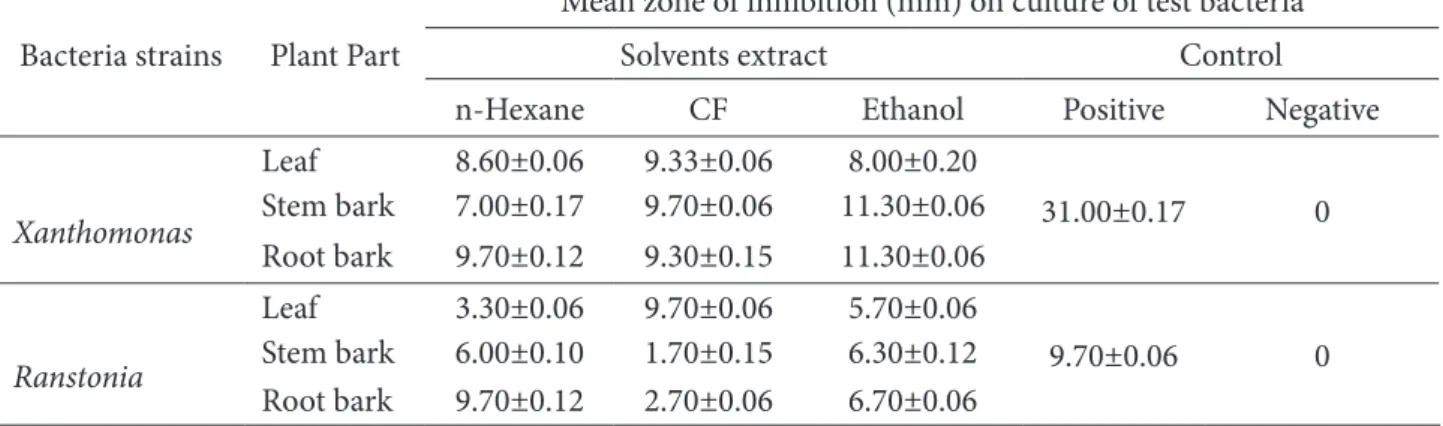
The result for antimicrobial effects of extracts from leaf, stem and root bark of Schinus molle against bacterial and fungal plant pathogens were summarized below (Table 3 and 4).
Table 3: Antibacterial activities of leaf, stem and root barks extracts of Schinus molle.
Bacteria strains Plant Part
Mean zone of inhibition (mm) on culture of test bacteria
Solvents extract Control
n-Hexane CF Ethanol Positive Negative
Xanthomonas Leaf 8.60±0.06 9.33±0.06 8.00±0.20 31.00±0.17 0 Stem bark 7.00±0.17 9.70±0.06 11.30±0.06 Root bark 9.70±0.12 9.30±0.15 11.30±0.06 Ranstonia Leaf 3.30±0.06 9.70±0.06 5.70±0.06 9.70±0.06 0 Stem bark 6.00±0.10 1.70±0.15 6.30±0.12 Root bark 9.70±0.12 2.70±0.06 6.70±0.06 The result revealed that stem and root bark
ethanol extracts exhibited relatively higher (11.3mm) inhibition zone against Xanthomonas campestris, pv. Campestris. The n- hexane extraction of leaf and stem showed relatively less inhibition against Xanthomonas as compared to others. Ralstonia showed relatively less
inhibition zone (1.7 and 2.7mm) against CF extracts of stem and root. The CF leaf extracts and the n- hexane root extracts showed relatively higher inhibition against Ralstonia. As compared to Xanthomonas, less inhibition of the plant extracts against Ralstonia were observed (Table 3).
Table 4: Antifungal activities of leaf, stem and root barks extracts of Schinus molle.
Fungi strain Plant Part
Mean zone of inhibition(mm) on cultures of test fungi
Solvent extracts Control
n-Hexane
CF
Ethanol
Positive
Negative
Aspergillusniger Leaf 6.30±0.06 5.30±0.056 5.70±0.10
33.70±0.06
0±0.00
Stem bark
6.30±0.06
5.30±0.21
6.30±0.23
Root bark 6.70±0.06 8.00±0.20 6.70±0.12 Fusariumvert Leaf 5.70±0.06 1.30±0.06 2.30±0.1524.30±0.06
0±0.00
Stem bark
5.30±0.31
1.30±0.06
7.00±0.10
Root bark
2±0.100
1.00±0.00 10.00±0.00
Relatively higher zone of inhibition (10mm) was observed by the ethanolic extracts of the root of Schinus molle against Fusarium verticillioides followed by the chloroform extracts of the root (8mm) against Aspergillus niger. The least zone of inhibition was detected in the chloroform extracts of the root, stem
and leaf extracts against Fusarium verticillioides. The n-hexane and chloroform extracts of the plant showed relatively higher zone of inhibition against Aspergillus niger than Fusarium verticillioides (Table 4).
When the overall zone of inhibition was examined, the crude extracts showed relatively higher zone of
inhibition against the tested bacterial species than fungal species. The ethanol extracts of stem and root showed relatively higher zone of inhibition against the tested bacteria than the other solvent extracts. Overall, the maximum inhibition zone of crude extract in the experiment was (12mm).
A report from Rhouma, et al, (2009) in the antimicrobial activity of leaf extracts of Schinus molle against Pseudomonas savastanoi pv. Savastanoi showed similar results and the zone of inhibition were between 9-12mm. Another report from (Mehani and Segni, 2013) on the antimicrobial activity of plant extract of Schinus molle on four bacterial pathogens (E. coli, Pseudomonas aeruginosa, Staphyloccus and Klebsiella pneumonia) with a zone of inhibition 13, 12.33, 11.67 and 10.5mm, respectively which is in agreement with the current finding.
This result could be due to the polarity of the compounds which were extracted by each solvent
and the ability of extracts to diffuse and dissolve in different culture media used in the study. Absence of antimicrobial activity does not mean that the bioactive compounds are not present in the plant or the plant has no activity against microorganisms. Presence of inadequate quantities of active constituent or constituents in the extract to exhibit the antimicrobial activity can be the reason for the negative results.
Chemical composition of essential oil from leave of Schinus molle
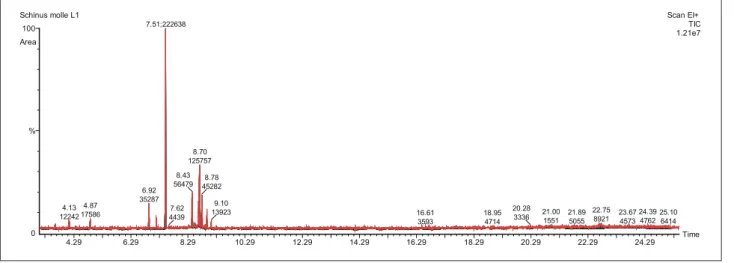
The major volatile components of essential oils recovered by hydro distillation and their retention time analyzed by GC/MS of Schinus molle were summarized in the Table 5 and Fig 1 below. Analysis of essential oil was carried out by Clarus 600/600 P Gas Chromatograph/Mass Spectrometer (GC/MS).
4.29 6.29 8.29 10.29 12.29 14.29 16.29 18.29 20.29 22.29 24.29 Time 0
100
%
Schinus molle L1 Scan EI+
TIC 1.21e7 Area 7.51;222638 6.92 35287 4.87 17586 4.13 12242 8.70 125757 8.43 56479 7.62 4439 8.78 45282 9.10 13923 22.75 8921 21.00 1551 20.28 3336 16.61 3593 18.954714 21.895055 23.67457324.39476225.106414
Fig 1: Chromatograms of essential oil from leaf of Schinus moll
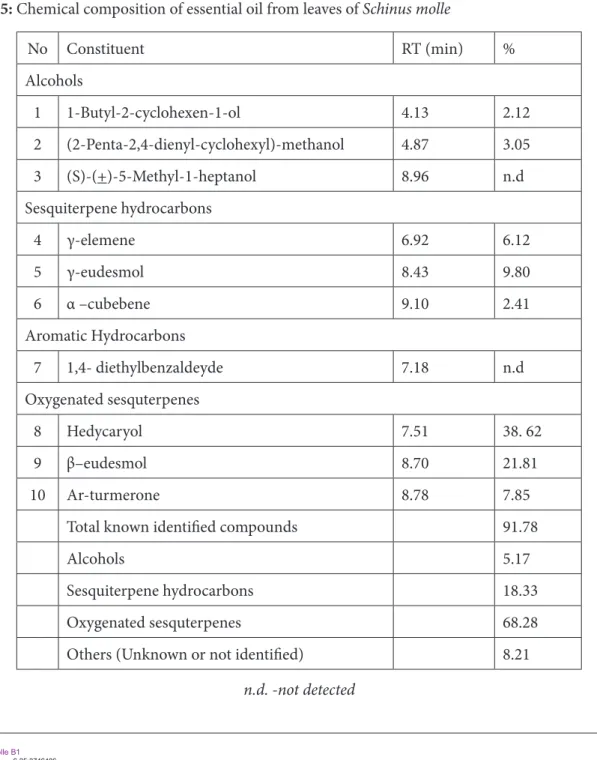
The result showed three alcohols, three sesquiterpene hydrocarbons, one aromatic hydrocarbon, three oxygenated sesquterpenes (91.78%) and other compounds (8.21%) totally 99.99% of the essential oils were identified from Ethiopian leaf of Schinus molle by GC-MS (Table 5). As shown by their proportion given in the Table 5, the essential oils obtained from leaf have been found to be rich in oxygenated sesquterpenes (68.28%), followed by sesquiterpene hydrocarbons (18.33%), and alcohols (5.17%). The published literature on the chemical composition of essential oils of Schinus molle growing in Egypt revealed that β- eudesmol
(10.34%), elemol (10.27%), β- bisabolenol (5.06%) and epi- α-muurolol (3.29%) as the major oxygenated sesquiterpenes (50%) and ρ-cymene (9.42%) as the most abundant monoterpene hydrocarbons (19.4%) in leaf oil (Dalia et al.,2016 ). However, the present study result on the chemical composition of essential oils of Schinus molle growing in Eastern Hararge (Ethiopia) was different. These were hedycaryol (38.62%), β– eudesmol (21.81%) and Ar-turmeroneas (7.85%) the major oxygenated sesquiterpenes (68.28%) followed by γ-Eudesmol (9.80%), γ-elemene (6.12%) and α– cubebene (2.41%) as sesquiterpene hydrocarbons (18.33%).
No Constituent RT (min) % Alcohols 1 1-Butyl-2-cyclohexen-1-ol 4.13 2.12 2 (2-Penta-2,4-dienyl-cyclohexyl)-methanol 4.87 3.05 3 (S)-(+)-5-Methyl-1-heptanol 8.96 n.d Sesquiterpene hydrocarbons 4 γ-elemene 6.92 6.12 5 γ-eudesmol 8.43 9.80 6 α –cubebene 9.10 2.41 Aromatic Hydrocarbons 7 1,4- diethylbenzaldeyde 7.18 n.d Oxygenated sesquterpenes 8 Hedycaryol 7.51 38. 62 9 β–eudesmol 8.70 21.81 10 Ar-turmerone 8.78 7.85
Total known identified compounds 91.78
Alcohols 5.17
Sesquiterpene hydrocarbons 18.33
Oxygenated sesquterpenes 68.28
Others (Unknown or not identified) 8.21
Table 5: Chemical composition of essential oil from leaves of Schinus molle
Fig 2: Chromatograms of essential oil from steam of Schinus molle
3.56 5.56 7.56 9.56 11.56 13.56 15.56 17.56 19.56 21.56 23.56 25.56 27.56 29.56 31.56 33.56 35.56 37.56 39.56Time 0
100
%
Schinus molle B1 Scan EI+
TIC 7.84e7 Area 6.25;3746486 4.93 72778 6.55 1380606 20.52 1290752 7.12 953845 20.36 209756 14.65 55110 12.91 9376 11.56 14940 9.90 4873 18.62 23424 16.42 22238 22.72 838283 22.65 591029 21.24 21780 23.45 56591 1744025.213011426.44 1336328.57 39.548122 38.54 9193 n.d. -not detected
Table 6: Chemical composition of essential oil from stem bark of Schinusmolle
n.d. -not detected According to the GC-MS investigation of the
essential oils, it was found that the stem bark of Schinusmolle contained, three terpenes (also known as terpenoids or isoprenoids) namely monoterpene (66.02%) as a major component, sesquiterpene hydrocarbons (13.63%) and oxygenated sesquterpenes (11.07%) were identified from the stem bark. Accordingly (Table 5 and Figure 4), β-pinene (39.57%), α-phellandrene, (14.58%), Germacrene A (13.63%), d-limonene (10.07%) and agarospirol (8.85%) were analyzed as major constituents in stem of these species. According to the published literatures, essential oils collected form Schinus molle in Tunisia, the species contained elemol (20.7%), 6-epi-shyobunol (20.36%), d-limonene (16.19%) and α-eudesmol (7.01%) (Kasmi et al., 2016). The stem oil 31% of monoterpene hydrocarbons and 43.82% of oxygenated sesquiterpenes with myrcene (15.28%), β-eudesmol (11.79%), elemol (9.79%), limonene (6.43%) and ρ-cymene (5.91%) were obtained as the major volatile components from the plant leaves in Egypt (Dalia et al., 2016). The differences of chemical
composition in the same plant species might be due to different environmental and geographical factors.
Conclusion
Phytochemical screening results of crude extracts of stem and root bark of Schinus molle revealed strong presence of quinones and carbohydrates and moderate presence of flavonoids, alkaloids, steroids and phenols. As compared to chloroform and n-hexane, stem and root bark ethanol extracts exhibited relatively higher (11.3mm) inhibition zone against Xanthomonas campestris, pv. Campestris. Relatively higher zone of inhibition (10mm) was observed by the ethanolic extracts of the root of Schinus molle against Fusarium verticillioides followed by the chloroform extracts of the root (8mm) against Aspergillus niger. Furthermore, the leaf extract of the plant were characterized and showed three alcohols, three sesquiterpene hydrocarbons, one aromatic hydrocarbon and three oxygenated sesquterpenes, totally 91.78%) % of the essential oil were identified
No Constituent RT (min) % Monoterpene hydrocarbons 1 α-pinene 4.93 0.77 2 β-pinene 6.25 39.57 3 α-Phellandrene 6.55 14.58 4 p-Cymene 6.98 1.03 5 d-limonene 7.12 10.07 Sesquiterpene hydrocarbons 6 α-amorphene 19.64 n.d 7 Germacrene A 20.52 13.63 Oxygenated sesquterpenes 8 Elemol 20.36 2.22 9 γ-eudesmol 22.17 n.d 10 Agarospirol 22.72 8.85
Total known identified compounds 90.72
Monoterpene hydrocarbons 66.02
Sesquiterpene hydrocarbons 13.63
Oxygenated sesquterpenes 11.07
by GC-MS. The GC-MS analysis showed, three terpenoids namely monoterpene (66.02%) as a major components, sesquiterpene hydrocarbons (13.63%) and oxygenated sesquterpenes (11.07%) were identified from the stem bark. The finding indicated that essential oils from different parts of Schinus molle have a promising potential on inhibiting activity of pathogenic microbes.
Acknowledgement
This work was supported by a grant from Haramaya University. Therefore, the authors would like to acknowledge Office of Vice President for Research Affairs of Haramaya University, for the providing necessary fund for this study. The authors sincerely thank to the Haramaya University, Department of Chemistry for providing laboratory facilities. We would also like to thanks Mrs. Haymanot Bezabeh, Plant Pathology Laboratory assistant and for her cooperation during the laboratory work on antimicrobial activities. Furthermore, we would like to acknowledge Ambo University, Department of Chemistry for their unreserved cooperation to characterize the essential oil by GC/MS.
References
BASIL, IBRAHIM and ZAKARIA ALNASER. (2014). Analysis of fruits Schinus molle extractions
and the efficacy in inhibition of growth the fungi in laboratory. International Journal of Chem.Tech.
Research; Vol.6, No.5, pp 2799-2806
BAUER, A. W.; KIRBY, W. M. M.; SHERRIS, J. C.; TURCK, M. (1996). Antibiotic Susceptibility Testing
by a Standardized Single Disk Method. American
Journal of Clinical Pathology, Volume 45: 493–496 BELHAMEL, K.; ABDERRAHIM, A.; LUDWIG R. (2008). Chemical composition and antibacterial
activity of the essential oil of Schinusmolle L. grown in Algeria. 4T Inter J Essential Oil Therapeut., 2:
175-177.
BHARTI, D.; GUPTA, S.; ARORA, C. C.; (2013).
Antimicrobial activity of medicinal plants against some pathogenic microbial strains. International
journal of phytomedicine: 5(2); 154-158
BHAVANANI, S.M.; BALOW, C.H.; (1992). New
agents for Gram-positive bacteria. Curr. Opin.
Microbiol, 13, 528–534.
BURT, S. (2004). Essential oils: Their antibacterial
properties and potential applications in foods - A
review. Int. J. Food Microbiol, 94, 223–253.
DALIA, I.H; AMAL, A.; ASSEM, M.; EL-SHAZL (2016). Chemical composition and cytotoxic activity
of the essential oils of Schinus molle growing in Egypt J. Pharm. Sci& Res. Vol. 8(8), 779 – 793.
EL HAYOUNI, E.A, CHRAIEF I, ABEDRABBA M.; BOUIX M.; LEVEAU JY.; HAMMAMI M.; HAMDI, M.; (2008). Tunisian Salvia officinalis L.
and Schinus molle L. essential oils: their chemical compositions and their preservative effects against Salmonella inoculated in minced beef meat:
International Journal of Food Microbiology; 125:242– 51.
GUPTA, V.K. and SHARMA, S.K. (2010). In vitro
Antioxidant Activities of Aqueous Extract of Ficus
Bangalensis Linn. Root. International Journal of
Biological Chemistry, 4: 134-140.
JAMEELA, M; MOHIDEEN, A.; SUNITHA, K.; and NARAYANAN, M.; (2011). Antibacterial
Activities of Three Medicinal Plants Extract against Fish Pathogens. International Journal of Biological
Technology; Vol.2(2):57-60.
KASMI, A.; HAMMAMI, M.; ABDERRABBA, M.; AYADI, S.; (2016). Schinusmolle: Chemical
analysis, phenolic compounds and evaluation of its antioxidant activity. Journal of Chemical and
Pharmaceutical Research, 8(5):93-10.
LISIN, G.; SAFIYEV, S.; CRAKER, L.E. (1999).
Antimicrobial activity of some essential oils. Acta
Hortic. (ISHS), 501, 283–288.
LJALEM HADUSH ABRHA and UNNITHAN C.R.; (2014). Chemical Composition and
Antibacterial Activity of Essential Oil of Schinus
molle. Unique Journal of Pharmaceutical and
Biological Sciences, 02(01); Page 9-12
MARONGIU, B; PORCEDDA, A.P.S.; CASU; R; PIERUCCI, P. (2004). Chemical composition of the
oil and supercritical CO2 extract of Schinusmolle L: Flavour and Fragrance Journal; 19:554–558.
MEHANI, M.; SEGNI, L. (2013). Antimicrobial
Effect of Essential Oil of Plant Schinus molle on Some Bacteria Pathogens. International Journal
of Chemical, Molecular, Nuclear, Materials and Metallurgical Engineering Vol: 7, No: 12
PAREKH, J. and CHANDA, S. (2006).
Antibacterial and phytochemical studies on twelve species of Indian medicinal plants. African Journal
of Biomedical Research, Vol. 10: 175 – 181
PAULO STEIDER DOLESKIMUHD; CAMILA HELENA FERREIRA CUELHO; JULIANA CALIL BRONDANI; MELÂNIA PALERMO MANFRON. (2015). Chemical composition of the Schinusmolle
L. essential oil and their biological activities.
RevistaCubana de Farmacia;49(1):132-143
PEDRO M DE MENDONÇA ROCHA; JESUS M. RODILLA; DAVID DÍEZ; HERIBERTO ELDER; MARIA SILVIA GUALA; LÚCIA A. SILVA and EUNICE BALTAZAR POMBO. ( 2012). Synergistic
Antibacterial Activity of the Essential Oil of Aguaribay (Schinusmolle L.) Molecules.
RHOUMA A.; BEN DAOUD H.; GHANMI S.; BEN SALAH H.; ROMDHANE M.; DEMAK M. (2009). Antimicrobial Activities of Leaf Extracts of
Pistacia and Schinus Species Against Some Plant Pathogenic Fungi and Bacteria. Journal of Plant
Pathology. 91:339-345
SAMY, R.P. (2005). Antimicrobial activity of
some medicinal plants from India. Fitoterapia; 76: