FUNDAÇÃO GETULIO VARGAS
ESCOLA BRASILEIRA DE ADMINISTRAÇÃO PÚBLICA E DE EMPRESAS DOUTORADO EM ADMINISTRAÇÃO
Putting Things in Context:
The effect of corporate venture capital investments on the market for ideas
TESE APRESENTADA À ESCOLA BRASILEIRA DE ADMINISTRAÇÃO PÚBLICA E DE EMPRESAS PARA OBTENÇÃO DO TÍTULO DE DOUTOR
CHARLOTTE JACOBS
Rio de Janeiro – 2019
Dados Internacionais de Catalogação na Publicação (CIP) Ficha catalográfica elaborada pelo Sistema de Bibliotecas/FGV
Jacobs, Charlotte
Putting things in context : the effect of corporate venture capital investments on the market for ideas / Charlotte Jacobs. – 2019.
75 f.
Tese (doutorado) - Escola Brasileira de Administração Pública e de Empresas, Centro de Formação Acadêmica e Pesquisa.
Orientador: Ronaldo Parente. Inclui bibliografia.
1. Capital de risco. 2. Investimentos de capital. 3. Inovações tecnológicas. I. Parente, Ronaldo Couto. II. Escola Brasileira de Administração Pública e de Empresas. Centro de Formação Acadêmica e Pesquisa. III. Título. CDD – 332.04154
Putting Things in Context:
The effect of corporate venture capital investments on the market for ideas
ABSTRACT
This PhD dissertation (Tese de Doutorado) critically reviews extant research on CVC investments and suggests future paths for studies on this phenomenon. The empirical study included in this dissertation, already puts one of these suggestions in practice. Whereas former research has mainly focused on the consequences of CVC investments on either the corporate investor or the CVC-backed entrepreneur, we empirically analyze the effect of CVC investments on the market of ideas (innovative activity) of the technological fields where they occur. We hypothesize that initial investments in an emerging technology will positively affect the attractiveness and size of the market for ideas in this technological area. Continued CVC investments, however, will stall the influx of new inventors and reduce the size of the market for ideas. We test our hypotheses using data on the CVC investments of a sample of 73 corporate investors from the pharmaceutical, hardware, and software industry. We find that CVC investments positively affect the attractiveness of the market for ideas in the technological fields where they occur in the hardware and software industry, but not in the pharmaceutical industry. The size of the market is positively affected over the whole sample. Probing further on this relation we also analyze the moderating effect of the presence of multiple investors. This research progresses the field of research on CVC in the first place through its critical overview of the literature on this phenomenon, pointing to interesting paths to explore in the future. Secondly, our empirical research may be the start of a new avenue in this research field that up to now has restricted itself to analyzing the consequences of CVC investments for either the funder or the receiver. Moving beyond the parties directly involved, our understanding of these investments and their impact on their technological environment will be further progressed.
SUMMARY
Chapter 1 – Introduction ………...1 Chapter 2 – Corporate Venture Capital: Theoretical Perspectives and Empirical State of the Art
………..………7 Chapter 3 – The Effect of Corporate Venture Capital Investments on the Market for Ideas…. 32 Chapter 4 – Discussion & Conclusion ………57
1
CHAPTER 1 INTRODUCTION
The resurgence of corporate venture capital (CVC) investments –defined as equity investments of established firms in venture entrepreneurs engaged in the development of new technologies whereof the commercial value not yet is established- last decade attracted interest of academic researchers. After the downfall of investments due to the dot-com bubble, corporate capital dedicated to venture investments went down, but did not fall as dramatically as at the end of former CVC waves (1960’s & 1980’s; Dushnitsky, 2006). Nowadays, 1 out of 5 companies of the Fortune 500 has a CVC program and those represent 10 % of total capital invested on the U.S. venture capital market and 17.1% of the total deals (Yang, Narayanan & De Carolis, 2014). Corporate investors are active players in the venture capital market, just as highly recognized financial venture capital firms (Keil et al., 2010).
The increasing number of academic publications on CVC progressed our understanding of this phenomenon, but the fragmented and non-consolidated character of the research on CVC uncovers a need for clear theoretical and empirical directions. Topics studied range from CVC program structure (Souitaris et al., 2012), interaction of CVC with company strategy (Birkinshaw, van Basten Batenburg & Murray, 2002), the effect of experience or renumeration policy on CVC managers practices (Dokko & Gaba, 2012; Dushnitsky & Shapira, 2010) to the impact of CVC on innovation performance (Dushnitsky & Lenox, 2005a; Wadhwa & Kotha, 2006), acquisition performance (Benson & Ziedonis, 2009), and attention to technological discontinuities (Keil et al., 2008; Maula et al., 2013). Although cross-citations are present, a coherent comprehension of the phenomenon of CVC investments is absent.
This lack of coherence may be a consequence of the rush to test hypotheses, ignoring flaws in the theoretical foundation of the research design. Wadhwa & Kotha (2006: 15), testing the impact of CVC investments on the established firm’s innovation performance, for example, state: “We assumed, on the basis of anecdotal data and academic surveys, that the primary motives for corporate investors are strategic. We were unable to get finer-grained data on corporate investors’ objectives when making CVC investments, but it is possible that some investors may
2 have exploratory versus exploitative motives.” The data and survey Wadhwa & Kotha refer to, however, require considerable caution when generalized. We note, unfortunately, that despite the flaws in research design of the pioneering studies1, those still serve as basis for the assumptions made in actual empirical research on corporate venture capital.
To avoid rushing in to conceptualizing an empirical study of factors that might influence the occurrence of CVC investments or the consequences of these, we start our research project with an extensive and critical review of extant literature on the phenomenon of CVC investments. We conduct this review from a strategic management perspective, what implies that our focus mainly lays on research from the perspective of the corporate investor. Studies on the impact of CVC investments on the venture entrepreneur are not discarded, however. This review reveals that researchers in this field have adopted two theoretical approaches to study this phenomenon: organizational learning theory and real options theory.
Based on Siegel et al. (1988) and Sykes’ (1990) findings, many authors consider CVC as a tool to acquire external knowledge, just as acquisitions, licensing or joint-ventures. Consequently, CVC has mainly been approached through the lenses of organizational learning theory. It is a mean to transfer knowledge from the innovation frontier, embedded in the venture entrepreneur, to the corporate investor. Based on this assumption outcomes as innovation performance, acquisition performance, and attention for technological discontinuities have been examined. Although organizational learning theory dominates the research on CVC, empirical research has not provided consolidated outcomes in this regard.
Real options theorists conceptualize CVC investments as the creation of an option, which will be executed once the technology invested in proofs its technological and commercial value (Tong & Li, 2011). Corporate investors will only commit more comprehensively to a technology when uncertainty has faded substantially, in order to avoid risk that comes with commitment.
1 Very small data samples, cross-sectional analysis ignoring heterogeneity and temporal precedence, and the absence
of control variables as firm size or industry are just someexamples of the limitations researchers should be cognizant of when interpreting and extrapolating the results (Dushnitsky, 2006).
3
Both theoretical perspectives focus strongly, if not solely, on the internal consequences of CVC investments for the corporate investor. Organizational learning theory focuses on the appropriation of knowledge accessed through these investments, whereas real options theory highlights the risk avoiding behavior of firms when facing technological uncertainty.
Inspired by what Maula (2007) stated 12 years ago, we argue that the research on CVC investments has yet to explore other drivers and consequences of these investments. We argue that corporate investors may be interested in consequences outside of their borders. The effects of CVC investments beyond the parties involved have not yet been examined in extant research. Therefore, we propose and empirically test hypotheses on how CVC investments influence the market for ideas in targeted technological fields. The “market for ideas” is defined as the set of creations or technological inventions available for commercialization2 (Gans & Stern, 2003; Chatterji & Fabrizio, 2016). Thus, the market for ideas can be understood as the set of inventions developed in a specific technological field as it usually is the inventor’s intention to commercialize these.
To understand how the market for ideas of a technological field reacts when a CVC investment occurs, we need to understand how other actors interpret the signal send by the corporate investor when investing in an emerging technology. Former research has demonstrated that inventors -either corporate or entrepreneurial- will dedicate their efforts, resources, and time to the development of technologies that will create economic returns for them. Hence, when interpreting the effect of CVC investments on the actions of other players in the technological field, we need to understand how CVC investments affect these players’ forecasts of economic returns when engaging in this field. Here, extant research on CVC investment provides us with seemingly contradictory explanations.
CVC investments, when perceived as a risk mitigating instrument, may foster the attractiveness and elevate R&D in the technological field the CVC-backed entrepreneur operates, because these
2 The “market for ideas”, “market for technology” and “market for inventions” are different terms, developed in
separate but very similar streams of literature (Chatterji & Fabrizio, 2016). Conti et al. (2013) unify these terms under the umbrella of “market for inventions”. In this paper, we use the term “market for ideas” because this stream of research has a stronger focus on the creation and dynamics of these “markets” (Conti et al. 2013; Chatterji & Fabrizio, 2016) which incorporate inventions developed by corporate and venture entrepreneurs.
4
investments are a positive signal towards the viability and potential of the technology underlying the CVC-backed entrepreneur’s activities (Pontikes & Barnett, 2017; Stuart et al., 1999). CVC investments may also have the opposite impact, however. Seen as external knowledge sourcing tool, CVC investments by a corporate investor in a technological field suggests that it is very likely that this firm becomes an active player in this field (Dushnitsky & Lenox, 2005; Wadhwa & Kotha, 2006). The forecast of direct competition with an established firm reduces the attractiveness of this technology field for venture entrepreneurs (Santos & Eisenhardt, 2009). Corporate entrepreneurship in these areas may be deflected when advanced technological knowledge of the investing established firm is presumed (Polidoro, 2013).
In the empirical part of this study (Chapter 3), we argue and demonstrate that initial CVC investments indeed enhance the attractiveness of the market for ideas in the technological fields where they occur. This is in line with the real options theory vision on corporate investments in emerging technologies. Continued CVC investments, however, are argued to indicate learning intentions by the corporate investor. An accumulated number of investments, we hypothesize, will stabilize the increase of new inventors. Thus, we argue that the relationship between CVC investments and the market for ideas is graphically represented by an S-curve.
To test our hypotheses, we collected data on the CVC investments made by leading firms in the pharmaceutical, hardware and software industry. A total of 73 firms closed 5883 deals with 3492 different venture entrepreneurs during the period of 1990-2016. From those ventures, 2372 applied for patents. We used these patent applications to define the technological fields the CVC-backed venture entrepreneurs operate in. Using the number of new inventing firms and innovative activity in these fields as dependent variables in our regression models, we define the effect CVC investments have on the attractiveness and size of the market for ideas.
Besides its extensive overview of extant research which points to some shortcomings and persistent gaps in our knowledge on the phenomenon, this study contributes to the research on corporate venture capital in two ways. First, by expounding the effect of CVC on the market for ideas, this research shows that corporate venture capital activities not only affect the innovative activity of the parties directly involved, but also orient innovative activity to the technological
5
fields where they occur. Initial CVC investments have a positive impact on the attractiveness and size of the market for ideas in the technological fields where they occur. After an accumulated number of investments is made however, additional CVC investments are associated with decreased attractiveness and size. These effects are not homogenous for the three industries in our sample, however. Noting the ‘nurturing’ effect of these investments on the market for ideas, we join Maula et al. (2013) in their suggestion that corporate investors may have other strategic intentions than learning. Second, the different effects of initial and follow-on CVC investments in new technologies remain underexplored in extant literature on this phenomenon. Former studies focused on the effects of first investments (e.g. Wadhwa & Kotha, 2006) or assumes homogenous effects for initial and follow-on investments (e.g. Schildt et al., 2005). This study also makes a modest contribution to evolutionary economy literature by demonstrating how CVC investments influence the patterns of technological evolution. Finally, our study contributes to the entrepreneurship literature by exploring how CVC investments may influence the choice of market of entrepreneurial inventors.
The rest of this paper is divided in 3 chapters. The next chapter –Chapter 2- discusses extant research on CVC investments and the main theoretical approaches used in this field of research: organizational learning theory and real options theory. In addition, we briefly discuss the presence of network theory in the study of this phenomenon. In that same chapter, we also briefly introduce the idea of CVC investments as tool in the pro-active strategy of the corporate investor facing a turbulent technological landscape. In this view, CVC investments are used to stimulate innovations in technological fields of interest for the corporate investor. Still in this chapter we continue with a critical overview on the empirical research on corporate venture capital, including the drivers, outcomes, and the tensions that exist between corporate investors and venture entrepreneurs. Where possible, we link the empirical findings to the presented theoretical perspectives.
In Chapter 3 we present our arguments, hypotheses and empirical study on the effect of CVC investments on the market for ideas in the technological fields they occurred. We also elaborate on the differences in outcomes between the different industries included in our sample. The results for the pharmaceutical industry deviate from what we find for the hardware and software industry. Where in the latter two industries initial CVC investments positively affect the influx of new
6
inventors in the technological field, this effect is absent for the pharmaceutical industry. The difficult generalizability of knowledge in the pharmaceutical industry is one of the explanations for the absence of this effect in that industry.
In the last chapter –Chapter 4- we discuss the findings of our empirical study and its managerial and theoretical contributions. We also provide suggestions for future research. Future research on CVC in general, but we also propose further nuances to the here presented empirical research.
7
CHAPTER 2
CORPORATE VENTURE CAPITAL: THEORETICAL PERSPECTIVES AND EMPIRICAL STATE OF THE ART
2.1. DEFINING CVC
Researchers have developed various definitions of CVC and failed to agree on a single one. The myriad of definitions of CVC investments show one commonality: there must be an equity investment from an established firm in a venture entrepreneur (Maula, 2007; Narayanan et al., 2009). Dushnitsky and Lenox define CVC as “investments that consist of minority equity stakes in relatively new, not publicly traded companies that are seeking capital to continue operation” (2005: 948). Wadhwa and Kotha limit their definition to “externally equity investments made by established firms in privately held start-ups” (2006: 1). Gaba and Meyer (2008) see venture capital as tool for making investment decisions in the face of risk and uncertainty. Narayanan et al. (2009) go further and include the company’s possible objectives in their definition (2009: 59): “CVC refers to equity investments made by incumbents in start-ups to gain access to their innovations, technologies, and other discoveries”. Because there does not exist a universally accepted definition of corporate venture capital, for the purpose of this research, we define CVC as equity investments of established firms (the corporate investors) in venture entrepreneurs engaged in the development of new technologies whereof the commercial value not yet is established. A company is an established firm when it already operates in at least one market and possesses a certain market share in that market. The main activity of the venture entrepreneur involves the development of a not yet commercialized technology of which the commercial value not has been established. CVC is normally used for investments in new technologies in an early stage of development (Gaba & Meyer, 2008; Basu, Phelps & Kotha, 2011; van de Vrande, 2013). Therefore, the investment itself involves uncertainty and risk.
2.2. THEORETICAL FRAMES
A theory of corporate venture capital must explain why a firm adopts this tool and predict its outcomes. This section provides a review of the theoretical frameworks present in the research on CVC. Organizational learning theory has found to be the dominant framework (Baldi et al., 2015; Yang, Narayanan & Zahra, 2009). Studies on CVC through the real options theory deviate from
8
organizational learning theory by focusing on the risk mitigating character of these investments in times of technological uncertainty. Network theory has only sporadically been used and shall briefly be discussed. The review of these theories and their shortcomings in explaining CVC investments makes that we propose an alternative perspective to the phenomenon: CVC as tool in the pro-active strategy towards technology change of the corporate investor.
2.2.1. ORGANIZATIONAL LEARNING THEORY
The knowledge-based view (KBV) of the firm as described by Grant (1996) provides an explanation of why firms exist. Simplified, following the KBV the transfer of knowledge withheld in persons is more efficiently and more effectively transferred within the context of a firm, compared to the market. The accumulation of knowledge within a firm is more than the sum of all separated knowledge in the market. Because a CVC investment does not lead to a unification of the venture and corporate investor but creates an ‘alliance’ (Van de Vrande & Vanhaverbeke, 2009), the KBV does not apply to explain the presence nor the choice of partner for CVC deals. The focus on knowledge transfer and acquisition dominates CVC research, however. Despite the other objectives for these investments that have been revealed (Maula, 2007), authors continue to interpret the strategic objectives of CVC investments as the intention to access and learn about the knowledge possessed by their portfolio companies (Wadhwa & Basu, 2013). From these authors perspective, a CVC investment is successful when the venture’s tacit knowledge gets integrated in the corporate investor’s knowledge base and practices (Baldi et al., 2015). Therefore, as we discuss in the section on ‘outcomes’ (section 2.3.3), many researchers try to present enhanced innovation performance to demonstrate the positive learning outcomes of CVC for the investor (e.g. Dushnitsky & Lenox, 2005; Wadhwa & Kotha, 2006; Wadhwa, Phelps & Zahra, 2015). Because of many researcher’s assumption that learning is intrinsic to CVC investments, organizational theory has been the dominant theoretical framework in this field of research. CVC is explained as a mean by which an established firm seeks and acquires knowledge developed outside its company borders.
Organizational learning theory proclaims that firms consist of a knowledge base that is not easily diffused across the boundaries of the firm (Kogut, 1988). Firms –especially firms in dynamic
9
markets- need access to externally developed knowledge to keep up with the pace of innovation (Dushnitsky & Lenox, 2005; Keil et al., 2008; Wadhwa, Phelps & Zahra, 2015) or detect gaps in their capability portfolio (Keil et al., 2008). Following organizational learning theory, corporate venture capital is a tool by which knowledge on the venture’s technology or business model is transferred to the corporate investor. Venture technologies are often located at the innovation frontier of an industry. Therefore, they are not always easy to understand by other market players nor the investors. The difficulty to transfer tacit knowledge through licenses or contracts impedes an efficient and effective learning process for the established firm (Kogut, 1988). Venture entrepreneurs are often too small and unstructured to close a joint-venture with a big firm. Tong & Li (2011) demonstrated that the irreversible character of an acquisition is a major obstacle to acquire technologies whereof the potential is not very well understood. Through CVC, the firm has the possibility to access the experimental knowledge under development in the venture, and to replicate this knowledge that is not well understood and difficult to understand for ‘outsiders’. Whenever this technology becomes the next ‘technology paradigm’ (Dosi, 1982), the established firm will be ready to follow this market change and respond with its own products or innovations based on the new technology. Through the interpretation and integration of the knowledge developed by the venture entrepreneur the established firm has optimized its innovation performance (Dushnitsky & Lenox, 2005; Wadhwa & Kotha, 2006; Wadhwa, Phelps & Zahra, 2015) and/or reoriented its innovation management to overcome capability gaps (Keil et al., 2008; Maula et al., 2013).
In sum, organizational learning theory approaches CVC as a tool for the established firm to acquire external knowledge, allowing the firm to improve its innovation performance by integrating new knowledge. Even though this theory dominates the research on CVC for some time now, the empirical confirmation of improved innovation performance or innovation reorientation is still absent. As will be discussed more in detail in the ‘outcomes’ section, results on the relation between CVC investments and its effect on innovation performance have been inconsistent and sometimes contradictory. The introduction of moderators in the equations has not completely resolved this problem (Wadhwa, Phelps & Zahra, 2015).
Organizational learning theory contributes in explaining why and when a company will engage in CVC, it does not help, however, to predict the selection process of technologies. The blurriness
10
and uncertainty surrounding new technologies in an early stage of development inhibit companies to make a clear analysis of the learning potential embedded in the venture. The absence of understanding what type of technologies receive investments, eventually influenced by contextual variables, makes that authors use assumptions on this issue. In general, it is assumed that established firms use CVC to explore the innovation frontier of the market (Keil et al., 2008; Maula et al., 2013).
Concurring with Dushnitsky (2006) we propose that researcher undertake more case-studies to better understand the reason and functioning of CVC activities. The process of selection of technologies, the process of interaction, and the final outcomes of the investment for the corporate investor should be better explored. The development of well-founded theoretical frameworks will allow researchers in the field to create coherent and contributing research projects, aligned with business practice.
2.2.2. REAL OPTIONS THEORY
Authors adopting the real options theory in their study on corporate venture capital describe this type of investments as a two-staged activity: option creation, eventually followed by option exercise. A firm makes an initial small investment in a technology it considers promising. The concept of venture capital investments allows the firm to use small incremental investments, achieve flexibility, and coop with technological uncertainty in stages (Tong & Li, 2011; Wadhwa & Basu, 2013; Yang, Narayanan & De Carolis, 2014). The flexibility that characterizes a CVC investment makes it a much more attractive instrument for investors than e.g. an irreversible acquisition (Tong & Li, 2011). Each investment round, the option holder (in case, the corporate investor) can reassess the value of the technology, based on the new information it acquired. As such, the firm can decide to keep the option or to abandon it. Real options theory sees CVC as a mean for managers to confront and mitigate market and technology uncertainties (Tong & Li, 2011; Wadhwa & Basu, 2013). As there are continuously numerous technologies under development, whereof the outcome is unsure, CVC allows parallel investments in multiple ventures. Only in a few cases the real option will be exercised, it is: the strategic benefit will be realized. This approach assumes an increased commitment over time between the corporate investor and its portfolio firms (Van de Vrande & Vanhaverbeke, 2012). We note that initially the
11
investor ‘keeps the option open’ and along with decreased uncertainty it increases its commitment towards the new technology.
Question is of course ‘on what does the corporate investor keep an option’? What is the potential strategic benefit they are after? With exception of Benson & Ziedonis (2009), we see the influence of the organizational learning theory emerging again. Applying the real options theory on CVC investments, Benson & Ziedonis (2009) found that firms who first invested through CVC programs in an acquired venture demonstrate better acquisition performance. Thus, by creating an option on a technology, the firm gained time to evaluate the value of the venture and make a more informed decision on acquisition.
This study being a lone wolf, in general, prior investments (option creations) are considered a way to overcome information asymmetry between the firm and the venture, necessary to learn about the technological and commercial opportunities of the technology (Vandevrande & Vanhaverbeke, 2012; Wadhwa & Basu, 2013). Baldi et al. (2015: 222) state that “CVC investments are dominated by strategic goals entailing beneficial learning processes and the development of managerial capabilities in new technological domains, which in turn nurture corporate growth opportunities”. The combination of real option theory and organizational learning theory creates a tension between the need to manage uncertainty with caution and the need to invest in the learning process of new technologies (Baldi et al., 2015; Vandevrande & Vanhaverbeke, 2012; Wadhwa & Basu, 2013). On the one hand, companies will be inclined to small investments and minor commitment of resources towards the venture due to the high risk of failure. Although strategic (long-term) benefits prevail for corporate investors, CVC activities cannot become a point of accumulated losses. Financial credibility of the CVC unit is required (Wadhwa & Basu, 2013). On the other hand, for the learning process to be successful, commitments and efforts must be made. Therefore, Wadhwa & Basu (2013) argue that exploration brings two forms of uncertainty for the investor, what makes the relation between exploration and resource commitment represented by a U-curve. First, exploration creates uncertainty about the technology’s potential. Second, there exists uncertainty about the investor’s capability to learn and realize the strategic benefits. Depending on the level of exploration and uncertainty faced, lower or higher resource commitment will occur. Through an inductive study Baldi et al. (2015) also confirmed the existence of an interplay between risk taking and learning propensity. A more diversified portfolio of ventures concentrated
12
on incremental innovations will create less learning benefits than a diversified portfolio of breakthrough innovations but will also incorporate little risk. A concentrated portfolio of breakthrough innovations incorporates the highest risk for the investor, but also the highest learning propensities. A concentrated portfolio focused on incremental innovations shall create less risk but also less learning benefits for the investor. The potential of the firm to overcome this risk vs. learning balance affects the firm’s Tobin’s Q (Yang, Narayanan & De Carolis, 2014). Firms investing in a diversified portfolio lower the financial risk of the investments. The option value, however, is derived from the growth expectations or the realization of the strategic benefits. The management of a diversified portfolio is less efficient and makes selection of ventures more complex, therefore diversification negatively affects the option value. A curvilinear relationship between diversification and portfolio value is defined. Therefore, they conclude, a company should find the balance between exploration and exploitation in its CVC portfolio to not affect its Tobin’s Q with its CVC activities. Interesting is that R&D intensity, CVC program age, CVC portfolio size, nor CVC relatedness affect this relation (Yang, Narayanan & De Carolis, 2014). In the context of high uncertainty that surrounds venture technology companies, real options theory brings a clear and logic understanding of why companies prefer CVC on other ‘alliance’ tools that require more commitment or are irreversible. The openness to fill in the ‘growth opportunity’ included in the model makes the real options theory a very attractive perspective. Applying the ‘growth-through-learning’ approach, authors adopting the real options theory in their CVC studies have brought an important nuance to the debate on CVC investments and organizational learning. Merely focusing on the innovation performance intentions, the costs of commitment have been ignored in many studies. The use of real options theory and further analysis of how costs and benefits are intertwined, and influence CVC investments decisions can create promising research questions to further our understanding on the issue.
2.2.3. NETWORK THEORY
Main stream research on CVC investments gives the impression that there exists an isolated dyadic relationship between the established firm, as corporate investor, and the venture entrepreneur. In fact, those two actors make part of a much bigger venture capital scene formed by numerous
13
information networks of investors and entrepreneurs. Firms outside the network can use CVC as a tool to get access to the social networks that construct and carry knowledge on emerging technologies: “you are buying yourself access” (Keil et al., 2008: 1483). Corporate investors become embedded in the network of their portfolio firms and as ‘knowledge brokers’ (Keil et al., 2008) they transfer information and knowledge from the entrepreneur to inside their firm. CVC managers explore new opportunities and are referred to as ‘structural holes’ (Keil et al., 2008). Besides exploring and integrating technologies and market trends, CVC managers’ network also provide information on competitors’ actions and interpret those to reorganize the existing set of capabilities of the established firm. It is the CVC unit’s task to interpret the changing market context and make the established firm aware of technological changes. To get to this valuable information, just being part of the network nor interaction with entrepreneurs is enough. The more heterophilous the venture network the corporate investor makes part of and the more central its position in this network, the more valuable information the firm will receive (Maula et al., 2013). Homophilous network structures tend to pass the same or similar information and will not be able to detect ‘disruptive’ technologies. Heterophilous groups of investors tend to receive different information and catch knowledge on emerging technologies the corporate investor should be aware of. The central position in the network guarantees contact with other principal investors with a broad waiver of information.
Following the network approach, being part of the network and preferably occupying a central position is essential to get access to the right information. Therefore, Keil et al. (2010) analyzed how CVC investors succeeded to acquire a central network position seemingly easy, considering the rigid structure of those venture networks. The availability of unique resources made of corporate investors highly attractive syndication partners, allowing them to overcome the networks’ entry barriers. Some corporate ventures have succeeded in achieving and maintaining a very central role in the venture financing scene of their respective industries (e.g. Intel Ventures and Google Ventures). Only a couple of papers have used the network approach for the study of corporate venture capital activities. Stepping away from the dyadic approach of CVC investments, which only in theory exists, and accounting for the venture network and its impact on CVC activities implies significant progress for a better comprehension of this phenomenon. The influence and role of the network and its players are practically unexplored terrain in the context of CVC activities.
14
2.2.4. AN ALTERNATIVE APPROACH: CVC AND PRO-ACTIVE STRATEGIC BEHAVIOR
Pro-active strategic behavioral theory can be an alternative explanation for the use of corporate venture capital. Through this approach, strategic behavior guides the actions and positioning of the firm in the market. The selection of investment partner is made based on competitive positioning vis-à-vis rivals or potential threats from new technologies. This perspective predicts that the portfolio of ventures will be composed in a way that it improves the competitive position of the corporate investors, not only in the actual context but also predicting future changes. Strategic behavioral theory has been present in the research on CVC, but mainly in its reactive mode. Applying organizational learning theory, for example, authors have repeatedly posed that learning is needed to create a corporate response when change occurs. In this view, established firms are vulnerable to technology changes promoted by new enterprises. Evolutionary theorists recognized however, that firms can demonstrate pro-active strategic behavior trying to shape future markets and technological changes to their competitive advantage (Christensen & Bower, 1996; Christensen, 1997; Nelson & Winter, 1982; Schumpeter, 1950; Tushman & Anderson, 1986). This pro-active behavior has received scant attention in strategy research, and consequently in research on CVC.
Sporadically, while discussing learning or other issues concerning CVC, the pro-active strategic intentions of corporate investors are mentioned, without any further investigation, however. One example we find in Katila et al. ‘s (2008: 299) paper: “Corporations are not just buying a piece of the new firm in a financial transaction but, rather, are exchanging their own resources for access to promising new technologies that may speed their own technology development, provide information on possible acquisitions, and even block new products that might compete with their own”. Another example: “Incumbents can use their CVC investments to delay or even thwart new ventures efforts to develop and introduce new technologies that are viewed as threats to their market positions or as changing the rules of competition” (Zahra & Allen, 2007: 393).
A pro-active investment policy to prevent, instead of to overcome, market uncertainty is the main principle of the pro-active strategic behavioral approach of CVC investments. Although the citations before give an ‘entry-deterring’ view of this strategy, where established firms try to
15
prevent the entrance of new technologies in the market, a more positive approach of the strategy is also plausible. Contrary to blocking or delaying the introduction of new technologies or products, established firms could enhance the introduction and diffusion of those technologies that are of their special interest. It could be (1) technologies that enable additional demands for the investing firm’s products, or (2) technologies that create a competitive advantage in any other way for the corporate investor.
The enhancement of innovation in the technology branches established firms have interest in might happen in two ways. First, through the selection of technologies to invest in, corporate investors make clear where their interests are and what technologies they will support. As discussed more in detail below, in certain cases the support of a corporate investor is more desirable than of mere financial investors. Inventors will be attracted to orient their technologies towards those branches where corporate investors are active. Second, corporate investors give credibility to the technologies and ventures invested in (Park & Steensma, 2012) and might alert competitors on the value given to this technology by the investor. Increased credibility and interest from the market will positively affect the acceptance of the new technology developed by the venture entrepreneur. Therefore, inventors will be attracted to those branches of technology where corporate investors are active, attracted by the better sales figures of CVC-backed enterprises. As such, by attracting inventors to those technologies the established firm is interested in, the established firm influences the future directions of innovation in the market, positively affecting the pace of innovation of those branches compared to non-CVC backed branches.
Though this area has not been investigated, we expect that the choice of partners will be very different than predicted by organizational learning theories. The latter shall propose partners with complementary assets or assets that provide capabilities attending to already occurring changes. The pro-active strategic approach presents partners that form a potential threat to the products or technologies under development inside the established firm, or partners developing technologies that can create a competitive advantage for the established firm in the future. Thus, the motives to invest in venture entrepreneurs and the selection of partners are structurally different depending of the analytical approach adopted in the research design.
16
Because a theory can only be validated through empirical testing, we present hypotheses and test these in the next chapter (Chapter 3). As will be explained further on, our focus lays on the influence of corporate investors on the direction and pace of innovation in the market.
2.3. EMPIRICAL STUDIES ON CVC
In this section we discuss the main topics in empirical studies on corporate venture capital activities. It is not our intention to give an exhaustive overview of all empirical studies performed in this area, but rather to give the reader an extensive overview of the state of art of academic research on this topic. We focus on studies examining the strategic importance of CVC for the corporate investor. In this regard, studies on CVC program structure (e.g. Souitaris et al., 2012), diffusion of CVC programmes (Gaba & Meyer, 2008) payment incentives for CVC managers (e.g. Dushnitsky & Shapira, 2010; Gompers & Lerner, 2000), the role of manager’s experience in risk taking practices (e.g. Dokko & Gaba, 2012), as well studies measuring effects of CVC for the entrepreneurial firm (e.g. Wang & Wan, 2013) are not discussed in what follows. Also, papers employing a purely financial perspective on CVC are not included in this review.
2.3.1. DRIVERS
What drives companies to engage in corporate venture capital activities? A question that has inspired a lot of research. Where there exists a generally agreed assumption regarding the objective of CVC investments –acquiring knowledge-, it is less clear why some companies undertake this type of investments and others not. CVC investments are an alternative mode of external knowledge acquisition, like alliances, acquisitions, or joint-ventures (Schildt et al., 2005; Tong & Li, 2011). Therefore, many authors have tried to find out what industry or firm characteristics make a firm set up a CVC unit and invest in venture technologies when other governance modes to acquire external knowledge are available. One of the most cited works in this regard is the cross-sectional study of Dushnitsky & Lenox (2005) on the drivers of CVC from the corporate investor’s perspective. Although they claim to investigate ‘the conditions under which firms are likely to pursue equity investments in new ventures as a way to source innovative ideas’ on industry level, they actually look where companies are likely to place their CVC investments instead of what drives them to make these investments. It can be argued however, that the factors defined as
17
attracting investments in an industry may also be the drivers for these investments of firms of those industries. Making this analogy, however, implies that we assume that firms invest in the industries they operate. It must be remembered, however, that one of the recognized objectives of CVC investments is the exploration of new markets (Maula, 2007), but this does not necessarily imply new industries. Considering this, we note that technological dynamism, weak intellectual property protection, and complementary distribution capability are market characteristics inclining companies to invest in venture technologies (Dushnitsky & Lenox, 2005). Basu et al. (2011) and Sahaym et al. (2009) also found positive statistically significant impact of technological dynamism on the presence of CVC activities in an industry. Industries characterized by frequent disruptive changes create uncertainty regarding the future. CVC investments allow the company to stay aware of (potential) market changes and opportunities. By staying engaged with the innovation frontier of the market, companies have a window on emerging technologies. A CVC portfolio of multiple technologies provides more opportunities for learning and spreads the risk of exploration activities. In a stable technology climate, the need for external venturing to prepare for change is less present.
More controversy surrounds the finding on the positive correlation between weak intellectual property rights protection and CVC investments. Because corporate investors seek to learn from their venture portfolio, access to the venture’s technologies is required. Consequently, highly protected technologies can inhibit the investor to get access to what is of its interest. In addition, intellectual property protection can prevent the corporate investor that acquires information and knowledge on a new technology from reproducing it internally and take advantage on the venture entrepreneur. Basu et al. (2011) confirm that easy appropriability of
knowledge stimulates CVC deals in an industry but argue that weaker intellectual property protection allows for increased knowledge spillovers, on their turn increasing technology opportunities and the rate of technology change. Also, strong protection of knowledge will deter CVC investments because corporate investors will not have the opportunity to develop new resources using the venture’s technology (Basu et al., 2011). The positive correlation between weak intellectual property protection and CVC investments antagonizes what is argued and empirically confirmed by Katila et al. (2008) and Dushinitsky & Shaver (2009). Analyzing the venture entrepreneur’s interests in engaging with a corporate investor both studies’ empirical research outcomes confirm that a venture entrepreneur is more likely to close a deal with a
18
corporate investor in industries with strong protection of intellectual property. We note a clear contradiction between the research results depending on the perspective used for the study of this issue, the investor or the investee. It should be further investigated why the studies seeking drivers from the corporate investor’s angle promote weak property rights protection as there are also arguments in favor of strong protection from their side. In case of weak intellectual property rights protection, the chances that the competitive advantage created through the CVC investment will be expropriated by imitating competitors are high (Basu et al., 2011). In addition, the negative coefficient of Dushnitsky & Lenox’s (2005) OLS-regression is very small (-0.03; p< 0.001), and actually refers to the attractiveness of an industry to receive CVC investments. The outcome for appropriability regime in Basu et al.’s longitudinal study is only marginally significant (p<0.1) (Basu et al., 2011). Therefore, we consider Katila et al. (2008) and Dushnitsky & Shaver’s (2009) results as more convincing, but their research specificities are not of the type that we can discard other results. Dushnitsky & Shaver (2009), for example, study the effect of intellectual property protection on deals where corporate investor and venture entrepreneur make part of the same industry. The effect of intellectual property protection in case of intra-industry investments has not been analyzed in their study.
Besides technology dynamism and weak intellectual property rights, Dushnitsky & Lenox (2005) identify the need for special complementary assets as driver for CVC activities (Basu et al., 2011; Dushnitsky & Lenox 2005; Katila et al., 2008). Dushnitsky & Lenox (2005) specify complementary distribution capability, Basu et al. (2001) marketing and technology resources. Other factors identified as positively affecting the number of CVC deals on industry level are R&D investments and industry munificence (Sahaym et al., 2009), as well as competition intensity (Basu et al., 2011). R&D investments are necessary to develop absorptive capacity. Without absorptive capacity a company will not be able to interpret and integrate the knowledge acquired through its CVC investments. This interpretation and integration are required for the competitive advantage to realize (Keil et al., 2008). As such, increased R&D should lead to increased absorptive capacity and consequently incentivize companies to undertake CVC investments to generate competitive advantage. This argument confirms that CVC and R&D are complementary parts of a company’s innovation strategy.
19
On firm level, besides absorptive capacity, a firm’s cash flow and diversity of former investments incline a company’s engagement in CVC activities (Basu et al., 2011; Dushnitsky & Lenox, 2005). Also, firm alliances initially reinforce the number of CVC investments. Closing new alliances firms might be seeking for new opportunities, but a firm’s alliance may also turn it a more interesting CVC partner. Increasing the number of alliances makes it difficult to coop with a bigger venture portfolio because a firm’s resources to do so are limited. Dushnitsky & Lavie (2010) found that after an initial increase of CVC investments, the number of investments diminishes as the firms gets more alliance partners. The preference for alliances originates in the more intensive interaction within alliances compared to CVC investments. In addition, the positive interaction between alliances and CVC investments is negatively affected by former CVC experiences and internal resource stocks of the firm (Dushnitsky & Lavie, 2010).
That studies on drivers of CVC are inspired by the idea that CVC is a governance mode to acquire external knowledge is clearly confirmed by Tong & Li’s study (2011) comparing acquisitions and CVC investments. Analyzing what influences a firm to prefer CVC over the acquisition of a venture, these authors find a positive correlation between market uncertainty and CVC investments. This relation is positively moderated by the irreversibility of the deal, and negatively affected by the growth opportunities surrounding the technology and competition in the market (Tong & Li, 2011). Tong & Li’s comparative exercise also confirms the general acceptation of the profit-maximizing view of the firm in CVC research. Companies seek external knowledge to gain competitive advantage and survive market changes. A company will only undertake CVC investments if it expects the innovation output of those investments to be higher than of internal R&D activities (Dushnitsky & Lenox, 2005) or any other governance mode for the acquisition of external knowledge. As such, uncertainty requires the small investments and flexibility only CVC investments can offer.
Gaba & Bhattacharya (2012) also assume learning objectives in their study on drivers of CVC activities, but reject the notion of firms as rational, profit-maximizing entities, by adopting a behavioral theory approach of the question why firms found and maintain CVC units. CVC, as part of a company’s innovation strategy, is considered as a risky decision directly related with the innovation performance of the firm. If this performance is above or below the company’s aspirations it is less likely that a CVC unit will be founded or maintained. Only when performance
20
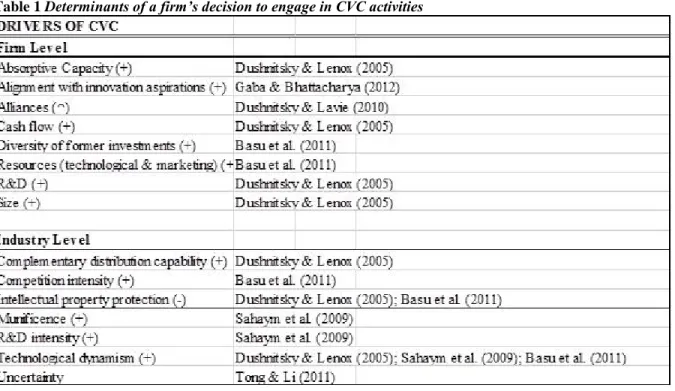
and aspirations are aligned, the foundation of a CVC unit will be considered and once founded, its maintenance will not be threatened. When the innovation performance is above expectations, directors do not see a need for introduction of this high-risk activity. In case of disappointing outputs, directors can be reluctant to take risk and eventually worsen the situation, what concurs with the importance of available cash flow to undertake CVC investments (Dushnitsky & Lenox, 2005). An overview of the drivers of CVC, identified on firm and industry level, can be found in Table 1.
Table 1 Determinants of a firm’s decision to engage in CVC activities
Research on what drives companies to set up a CVC unit to invest in venture entrepreneurs has gained limited attention of researchers. Maula (2007) already wrote that questions on the when and why of corporate venture capital investments remain with unsatisfying answers. And now, 12 years later, we see that some work has been done in the field, but there still are competing explanations and we lack a satisfying understanding on the drivers of CVC activities. Principally the impact of intellectual property protection regimes should be cleared out as well as other factors that influence a firm’s decision to engage in this type of investments. We note, however, that the research on drivers of CVC is also dominated by the organizational learning theory. Authors analyze and seek those drivers linked with the learning objectives that companies are assumed to
21
have when partnering with venture entrepreneurs. As stated in the subsection on outcomes of CVC investments, many other factors can be of interest of the corporate investor. Therefore, a less biased mindset could help the research on corporate venture capital to identify other variables determining a company’s participation in the field of venture investments.
Besides revisiting the theory dominating CVC research, more in-depth case studies will progress our understanding on what motivates firms to place investments in venture entrepreneurs. In general, extant research on this issue tends to formulate hypotheses deviated from theoretical assumptions, to test for the ‘likelihood of CVC to happen’. More substantive qualitative or survey-based research can contribute to the progressive interpretation of drivers, minimizing researcher bias to find pre-intended results.
2.3.2. CORPORATE INVESTORS: SHARKS OR VALUABLE PARTNERS?
Corporate investors represent about 10% of venture capital available and injected more than US$ 7 billion in venture technologies in 2013 (CB Insights). The importance and prominent role CVC investors play in the venture financing scene is undeniable (Dushnitsky & Lenox, 2005; Keil et al., 2010; Maula, 2007). At first sight, corporations seem to be splendid investment partners for a venture entrepreneur as they do not only bring financial resources but can add their expertise, infrastructure and sales channels to the deal. Because ventures often lack those resources it can be very attractive to build partnerships with those corporate investors. Katila et al.’s (2008) article “Swimming with Sharks: Technology Ventures, Defense Mechanisms and Corporate Relationships” demonstrated that tying up with established firms incorporates a potential misappropriation of resources and knowledge developed by the entrepreneur. This, because corporate investors mainly have strategic interests in the venture technology. As we discussed in the former section, in the context of CVC investments strategic interests are interpreted as the integration of the venture’s knowledge in the investor’s knowledge base. Katila et al. (2008) pointed to the fact that entrepreneurs are aware of these dangers and make conscious selection of their partners depending on their needs and market environment. The choice made by the venture is one based on finding the balance in the tension between the resource-based view of the firm (I need this tie to get access to additional resources) and the transaction cost theory (how can I protect myself against opportunistic behavior of my partner). Because the venture has virtually no
22
protection against the big corporation during their partnership, following Katila et al. (2008), a venture shall make the balance between risk and potential benefits before approving the investment of a corporate investor. Therefore, understanding the tension a venture faces when making the choice of partner and what circumstances are beneficial for corporate investors compared to e.g. a financial venture capitalist, are essential to understand market and investment dynamics. As Dushnitsky & Shaver (2009: 1059) state: “An interfirm relationship is formed only when both parties are willing to enter”. Comprehending what incentivizes venture entrepreneurs to engage with corporate investors will help those investors to make attractive offers or to diminish the tension projected.
Interestingly, Katila et al. (2008) show that patent protection has no influence on the choice of investment partner. Even in situations where the market is considered as highly protective towards patented technologies, the possibility of maintaining trade secrets is considered more important. This is explained by the ease of ‘inventing around’ the patent or the inability to fight big corporations by small ventures. Trade secrets through non-disclosure clauses and employee transfer restrictions are seen as more efficient and the possibility to apply these defense mechanisms makes ventures more confident contracting with corporations. Another factor identified as defense mechanism is the use of timing. Letting corporations enter in later funding rounds makes it more difficult for those investors to influence the product and strategy. That CVC investments more likely realize under strong intellectual property regimes3 is confirmed by Dushnitsky & Shaver’s (2009) empirical study of US ventures receiving CVC funding from investors of the same industry between 1990 and 1999. The importance of knowledge protection must be balanced with the financial and complementary resource needs of the entrepreneur. When the entrepreneur has large needs, they tend to prefer corporate partners on financial ones. That this is a correct choice from the venture’s side is empirically confirmed by Park & Steensma (2012) who found that CVC funding is most beneficial for ventures that require specialized complementary assets. Those ventures backed by CVC investors demonstrated significantly higher exit rates than ventures supported by financial investors. Besides needs for complementary assets, CVC funding is also favorable in cases of higher uncertainty.
3 Measure based on the Carnegie Mellon Survey, including several protecting mechanisms besides patents – Cohen
23
Even in situations where CVC is considered most appropriate, the tension between resources and knowledge protection does not disappear after the deal is made. Maula et al. (2009) focus on how ventures manage the trade-off between openness and self-protection. Although their question is on how a venture can manage this relation, ‘complementarity of resources’ is presented as trigger of obstacles or incentives for knowledge sharing. ‘Complementarity of resources’, following Maula and colleagues (2009), is a variable that belongs to ante- and not post-investment management. Lack of complementarity of resources will result in more safeguards and less risk for misappropriation. More complementarity results in closer social interaction and more learning benefits for the venture (Maula et al., 2009), but most likely also for the corporate investor. Therefore, seeking a complementary partner seems to be essential to diminish safeguards and create a fruitful cooperation in the post-investment period. The importance of complementarity fits the finding of Katila et al. (2008) on entrepreneur’s preference for CVC investors in case of resource needs. In case the venture is in little need, the complementarity of resources of venture and corporation can be minimum what can cause restraints to share additional information from the venture’s side beforehand and also during the relation. Knowing this the corporate investor is aware of the risks of safeguards emerging during a partnership where it offers little complementary resources to the venture entrepreneur.
Taken together, we observe that research on CVC perceives that the tension between corporate investor and venture as inherent to their relationship. We must be cognizant however, that this tension is focused on an information asymmetry the CVC investors tries to overcome in the disadvantage of the entrepreneur. To the detriment of the completeness of the debate, two aspects are absent: (1) the risk of misappropriation the CVC investor faces, (2) the fact that strategic benefits of the investor can be others than learning. Understanding in how far the corporation faces and fears risks of misappropriation and how this affects the creation and relation with the portfolio will further the comprehension and predictability of the phenomenon. Secondly, and this goes back to the lack of in-depth understanding of the objectives and drivers of CVC, considering other than learning benefits could nullify the tension assumed to be ever present. Finding common grounds and interests in the relation could shed new light on the relationship between venture entrepreneur and corporate investor.
24
2.3.3. OUTCOMES OF CVC INVESTMENTS
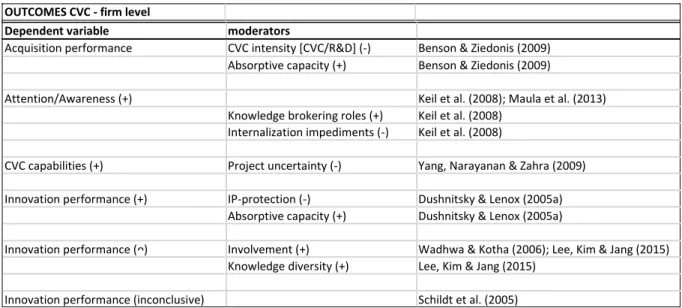
Although Dushnitsky (2006) and Maula (2007) give a clear overview of the numerous potential benefits of CVC for the corporate investor, empirical testing has mainly focused on the correlation between this type of investments and innovation performance of the firm. Financial returns are generally considered of less importance for the corporate investor (a.o. Dushnitsky & Lenox, 2005a; Katila et al., 2008; Siegel et al., 1988). Studies that examined other than learning outcomes are the work of Benson & Ziedonis (2009 & 2010), Keil et al. (2008), and Maula et al. (2013). Benson & Ziedonis (2010) analyzed the stock market’s reaction on acquisitions of 34 major CVC investors. They found a significantly negative reaction of the market towards the acquisition of VC-backed ventures. Comparing acquisitions of CVC-backed ventures, increased CVC intensity (CVC as percentage of internal R&D spending) is negatively correlated to performance, while to stability of the investment program positively affects the performance (which overall is negative; Benson & Ziedonis, 2009). The papers of Keil et al. (2008) and Maula et al. (2013) build on the idea that CVC serves as a radar for new technologies. CVC investments channel information from the innovation frontier to the corporate investor. The connections the corporate investor builds through its CVC activities, create awareness of the gaps in its present internal capability stock (Keil et al., 2008). The awareness of capability gaps is only achieved when the established firm acquires the tacit knowledge hidden in the venture entrepreneur’s network. Because of the difficult transfer of tacit knowledge, established firms must work together with venture entrepreneurs. It is this ‘disembodied experimentation’, occurring outside the borders of the established firm, that generates awareness of capability gaps for the corporate investor. Maula et al. (2013) build further on this same idea of CVC being a radar for technology discontinuities but focus on the connections with independent venture capitalists as trigger for awareness, instead of the ‘disembodied experimentation’ Keil et al. (2008) described. For Maula et al. (2013) the position the firm occupies in the investor’s network will make information about technology developments at the frontier available. The CVC unit transfers this information to the board of directors of the firm, who should take the appropriate steps to create a response towards these changes. Keil et al. (2008) consider the interaction with the venture entrepreneur as provider of information, Maula et al. (2013) point to the importance of co-investors and the position of the established firm in the investor’s network as prime channel for knowledge on upcoming technologies. Both, however, focus on the same outcome of CVC activities: awareness of the corporate investor, respective the
25
board of directors (Maula et al., 2013), of technology discontinuities. Awareness, necessary to be able to take decisions (Kaplan & Tripsas, 2008; Kaplan, 2008). The outcome measured here is the awareness of the corporate investor. What is not analyzed however, is how those firms react once aware of emerging technologies. Both papers seem to assume that the board of directors shall decide to build new capabilities to create a response on emerging technologies. In this context it is worth observing that companies make parallel investments in multiple technologies. Firms, and their board of directors, might become aware of several distinct new technologies, but how do they decide in which capabilities to invest? Many technologies compete to become the next ‘technology paradigm’ (Dosi, 1982). Does CVC help to orient their investments in the ‘right’ direction? Empirical research on these questions is needed to further our understanding on the potential benefits of CVC, as it can be argued now that the awareness of new technologies can create confusion and doubt in the board room. Dushnitsky (2006) also mentions the potential of board composition and structure of CVC programs to affect the investment portfolio and performance. Besides of the acquisition performance and awareness, little other outcomes have been empirically analyzed if not innovation performance of the corporate investor. In this regard, Dushnitsky & Lenox (2005a) did the pioneering work. Relating the amounts invested through venture capital deals with citation-weighted count of patents they conclude that there exists a positive linear relationship between the two variables. Separating the different sectors included in the general model, only two of the five sectors (Devices & Information) demonstrate a statistically significant effect on innovation performance. Those sectors where the effect of CVC on innovation performance was not significant also demonstrated strong IP rights, what explains the crippled learning (Dushnitsky & Lenox, 2005a). A different approach to study the relation between venture investments and corporate investor’s learning has been used by Wadhwa & Kotha (2006). Instead of using the nominal value of investments as independent variable, the number of distinct investments is used. Also, the normal count of annual successful patent applications serves as proxy for innovation performance, compared to Dushnitsky & Lenox’s weighted count. In case of low involvement an inverted U-curve indicates that there exists a limited number of CVC investments where the learning experience is maximized. In case of high involvement with the portfolio firms, this curve is mirrored. When there is a policy of high involvement with the ventures invested in, the initial learning experience will be less due to high efforts put in these new relations. But later on, the learning experience increases because of better management of these investments
26
(Wadhwa & Kotha, 2006). Using the same regression model (negative binomial models with fixed and random effects) Dushnitsky & Lenox (2005a) and Wadwha & Kotha (2006) come to very different outcomes. Different databases and measures can have contributed to these contradictions, but further study on this issue is surely required. Schildt et al. (2005) made an interesting contribution in the discussion of learning outcomes as well. In a comparative study on tools for external knowledge acquisition it is found that CVC is less efficient than acquisitions and joint ventures. What brings more nuance to the debate of organizational learning, however, is that this study counts for the patents of the established firm citing patents of portfolio firms. The first group of studies cited (a.o. Dushnitsky & Lenox, 2005a; Wadhwa & Kotha, 2006) measure for general innovation performance, the latter study (Schildt et al., 2005) sought for direct learning from the venture technology (explorative learning) and cannot find a statistically significant relationship. Technology relatedness of the partners improves the learning experience, claiming a exploitative learning experience. Lee, Kim & Jang (2015) also measured the direct learning experience, using patent citations of the venture by the established firm as dependent variable. Replicating the study of Wadhwa & Kotha (2006) with this different count variable they find similar results. An inverted u-curve represents the relation between CVC investments and innovation performance. The moderators in these studies give dissimilar results, however. Wadhwa & Kotha (2006) find involvement of the established firm as affecting the relation between CVC and innovation output. The ties, or involvement, between the partners, as measured by Lee, Kim & Jang (2015) does not seem to affect the CVC-innovation correlation. Knowledge diversity is considered an insignificant moderator by Wadhwa & Kotha (2006). Lee, Kim & Jang’s (2015) regression results in a less accentuated curve in case of high knowledge diversity, compared to moderated or low diversity. The discrepancies between these research results of the original and replicating study should be investigated and explained.
Using a similar dataset (same industry –telecommunications industry; same time period 1989-1999 (Wadhwa & Kotha, 2006) and 1989-2000 (Wadhwa et al., 2015)), diversity was again introduced to the CVC-innovation performance correlation, but this time as the diversity of the investment portfolio. Because firms make parallel multiple investments it is plausible that interfirm relationships complement or conflict with each other. Portfolio diversity initially has a positive effect on innovation performance, to decrease when the maximum number of diversified