
Freeware authoring tools for the creation of e-contents: current experience
15
0
0
Texto
(2) DIRECTOR. Rui Torres DIRECTORADJUNTO. Pedro Reis CONSELHO DE REDACÇÃO. Jorge Luiz Antonio - Investigador Independente Sérgio Bairon - Universidade de São Paulo, Brasil Pedro Barbosa - Investigador Independente (Professor Aposentado, Escola Superior de Música e Artes do Espectáculo, Portugal) Luis Carlos Petry - Pontifícia Universidade Católica de São Paulo, Brasil Manuel Portela - Universidade de Coimbra, Portugal Pedro Reis - Universidade Fernando Pessoa, Porto Fátima Silva- Universidade Fernando Pessoa, Porto Rui Torres - Universidade Fernando Pessoa, Porto COMISSÃO DE HONRA. Maria Augusta Babo - Universidade Nova de Lisboa, Portugal Jean-Pierre Balpe - Université de Paris VIII, França Jay David Bolter - Georgia Tech, Atlanta, E.U.A. Phillipe Bootz - Université de Paris VIII, França Claus Clüver - Indiana University, Bloomington, E.U.A. José Augusto Mourão (in memoriam) Winfried Nöth - Universität Kassel, Alemanha Lúcia Santaella - PUC-São Paulo, Brasil Alckmar Luiz dos Santos - Universidade Federal de Santa Catarina, Brasil Alain Vuillemin - Université d’Artois, França TÍTULO. Revista Cibertextualidades 04 (anual) - 2011 © Universidade Fernando Pessoa EDIÇÃO. edições UNIVERSIDADE FERNANDO PESSOA Praça 9 de Abril, 349 | 4249-004 Porto [email protected] | www.ufp.pt DESIGN E IMPRESSÃO. Oficina Gráfica da UFP ACABAMENTOS. Gráficos Reunidos DEPÓSITO LEGAL. 241 161/06 ISSN. 1646-4435. Reservados todos os direitos. Toda a reprodução ou transmissão, por qualquer forma, seja esta mecânica, electrónica, fotocópia, gravação ou qualquer outra, sem a prévia autorização escrita do autor e editor é ilícita e passível de procedimento judicial contra o infractor..
(3) CIBERTEXTUALIDADES04 Ensino à Distância: Desafios Pedagógicos Distance Education: Pedagogical Challenges Publicação do CECLICO - Centro de Estudos Culturais, da Linguagem e do Comportamento Universidade Fernando Pessoa http://cibertextualidades.ufp.pt. org. Pedro Reis e Fátima Silva. PORTO UNIVERSIDADE FERNANDO PESSOA 2011.
(4) Reis, P. e Damião, I. (2011). Freeware authoring tools for the creation of e-content – Current experience. In: Cibertextualidades, 4, "Ensino à Distância: Desafios Pedagógicos / Distance Education: Pedagogical Challenges", Reis, P. e Silva, F., eds. pp. 155-166.. Freeware authoring tools for the creation of e-contents – Current experience Pedro Reis1 Isabel Damião2. Abstract: e-contents play an important role in e-learning since the latter relies significantly on the former. Furthermore, e-content and e-learning face a number of challenges in producing viable modules for information enriched society and institutions. Hence, e-learning developers feel the need, for instance, to increase collaboration among learners, to create relevant practical activities for learners to participate in and to create content that today’s learners will find engaging. This represents an essentially intellectual and creative challenge, which is, basically, to produce imaginative, engaging and interactive designs that work with the browsers used by the target audiences, within realistic bandwidth constraints. Most of the professional development studios use their programmers to create custom tools that suit their own working methods and styles. In-house units and individual e-learning developers are much more likely to employ tools which help them to avoid the technical minefields and concentrate on the realisation of their designs. For this purpose, e-learning authoring tools do have their advantages, as they make it easy for e-learning developers to employ a relatively wide range of interactive techniques and to have their content communicate with a Learning Management System (LMS) at moderate costs or even for free. The use of such tools may imply some loss of flexibility since the easier the tool is to use the less one can do with it. However, the real worth of e-learning content is in the design and the writing, so, in our view, one should accept sacrificing a little flexibility if it implies a sensible budget and timetable.. 1 Pedro Reis is Associate Professor at the Faculty of Human and Social Sciences at Fernando Pessoa University (Porto, Portugal), Pedagogic Coordinator of UFP-UV (Virtual University), co-founder and researcher at the Centre for Computerproduced Texts and Cyberliterature Studies, researcher of the project PO-EX ‘70-80 - Digital Archive of Portuguese Experimental Literature, financed by the Portuguese Foundation for Science and Technology. He developed a Post-Doctoral research project on e-Learning with the cooperation of the Instructional Technology and Distance Education (ITDE), Nova Southeastern University (NSU), (Florida, USA). He is currently consultant on e-learning for the United Nations organizations, UNITAR and IAEA. He is sub-director of the magazine Cibertextualidades (Edições UFP). His main research interests are Cyberliterature, Humanities, Computing and e-Learning. He has published several books and articles and lectured in Portugal, Sweden, Ireland, USA, France, Brazil, Spain, Holland, Italy, Senegal, and Germany. Contact: [email protected] 2 Isabel Damião is Cultural Programmer of the Literary Club of Porto. She has a degree in International Journalism from ‘Escola Superior de Jornalismo’ of Porto and is a Master’s student in Culture, Literature e Hypermedia in the specialization area of Education and Hypermedia. Contact: [email protected]. 155.
(5) 156. Pedro Reis & Isabel Damião. Based on our current use of freeware authoring tools (such as eXe-learning, Xerte or CourseLab), they seem to have the right functionalities for the production of engaging Learning Objects (LO) and a way of delivering the end-product that conforms to the hardware and software capabilities of our audiences. In sum, we would like to demonstrate with our current experience as e-learning developers how subject-matter experts may work directly with these tools, to populate the templates with content. For maintenance, this content may be stored in a database, although for delivery it may be converted to standard HTML. Key-words: e-Content, Authoring Tools, Learning Objects, Distance Education. 1. Introduction. Distance Education (DE) is characterized by the establishment of a multi-way. Authoring tools are computer applications. communication. Since its possibilities have. which allow an author of digital learning. been broadened due to technological. resources to integrate different components,. changes, it can now be considered an. creating interactive and multimedia. alternative modality to overcome limits of. educational content. The concept of content. time and space.. creation tools is a generic term which refers to the software used in the production. Its benchmarks are based on the four pillars. of content. On the other hand, the term. of Education for the 21st century, published. “Authoring Tool” is very common, referring to. by UNESCO:. software for content authors. ��. Learning to know,. This terminological duality stresses the. ��. Learning to do,. occurrence of two theses: one that places. ��. Learning to live together,. primacy in the technological side, and another. ��. Learning to be (UNESCO, 2003). that highlights the pedagogical aspects. Regardless of these two approaches, the primary. Thus, Education is no longer regarded as. objective of these tools is to facilitate the. a mere transfer of information and should. production of multimedia materials, providing. be guided by the contextualization of. authors with the autonomy to design their own. knowledge useful to the student. In distance. materials. In fact, these are tools for ordinary. learning, students are challenged to. users, who can rapidly, and wherever they are,. understand the content and to do research in. develop a certain content or programme.. order to participate in the course..
(6) 157. Freeware authoring tools for the creation of e-content – Current experience. Technological support has progressively. ��. Broader vision of learning: it promotes. replaced man in the production work, leading. different methodologies that make. him to act increasingly in the design and. reference to the organizational reality. management of work processes, requiring. and aim at the development of skills and,. new skills and competences. In this sense,. with the use of Internet tools, proposes. training has become ever more necessary to. more interactive approaches to content,. monitor changes in the working world.. which contribute to the improvement of the individual’s performance.. This scenario has led both companies and universities to invest in developing their. Today we face a very different educational arena.. intellectual capital through appropriate. It may be F2F, blended-learning or mostly, or. training (Boog, 2001, pp. 34-35). In this. even totally, distance learning. Every day, we are. area, technological development and the. faced by new features brought by this rapidly. use of resources, like the Internet, have. evolving technology, which affects educational. been pushing such learning processes. The. institutions. Talking about education today, has. Internet offers valuable advantages and. a much broader scope, and it is not possible to. resources such as the updating of content on. speak about education without referring to DE,. the fly, expanding forms of communication. with all the technological advances providing. and support for learning anytime, anywhere.. greater interactivity between people. Due to the use of technological means, DE came to. The junction between learning and. destroy taboos and started a new era in terms of. Information and Communication. education.. Technologies (ICT) has helped to establish this new concept – e-learning, which can. Consequently, we can say that this type of. be defined as a set of solutions to improve. learning is no longer an alternative for those. knowledge and performance using Internet. institutions which do not provide formal. technologies.. education. It has become, instead, a kind of quality education that enables learning to. According to Rosenberg (2002), e-learning is. reach a greater number of people. Before,. based on three basic criteria:. DE did not have much credibility; it was a controversial issue and gave rise to many. ��. ��. Transmission Networking: makes. divergences but, over the years, it has. upgrading, storage, retrieval, distribution. conquered its own space. Nevertheless, it is. and sharing of the information possible;. not the kind of education that determines the. Access via the computer connected to. learning process, whether F2F or distance.. the network: so it implies the use of the. Today, learning is synonymous of effort and. Internet;. dedication of each person involved..
(7) 158. Pedro Reis & Isabel Damião. In this context, authoring tools may have. ��. What is the student’s prior knowledge?. an important role to play, as vehicles that. ��. To what extent will the presentation of. teachers/trainers have to facilitate distance. content take into account different ways. learning, motivating and challenging. of studying?. students/trainees, providing them not only. ��. To what extent does this information. with the information but also guidelines. represent something new in relation to. and motivation so that they may search, by. what the student already knows?. themselves, other data in addition to the. ��. teaching, via the Internet.. To what extent does it include tools in order to facilitate the assimilation of the new learning?. 2. Authoring tools: what they are and what they can be used for. ��. How would it be possible to confer meaning to what is learnt? Will the contents have any use? (Guàrdia et al, 2008, p. 13). Learning is a process by which people change their structure of knowledge in. Any instructor or content author can – without. relation to an issue – either they increase it. the support of a production team – develop. or change it – and eventually change their. his/her own course, his/her own methodology. attitudes and norms of behaviour. Thus,. for DE by means of authoring tools.. the knowledge we already have changes as we learn new things and knowledge is. However, there is a catch. Some more. restructured to make room for new data.. sophisticated software has the disadvantage of needing some learning so that users. A really significant learning process occurs. will be able to interact with the tool and to. whenever a learning object acquires special. exploit its maximum potential. Authoring. significance and meaning, always due to. tools, in turn, although more affordable to. active assimilation. This type of learning. use, imply a lower pedagogical creativity. is able to modify previous ideas, increase. and a less complex content production.. knowledge network and even establish new. So, generally speaking, we have an inverse. relations between data. Therefore, it consists. relationship between the level of software. of modifying and enriching the previous. complexity and the creativity of the content.. schemes by establishing new connections and relationships. This is, in short, a. For example, if we want to develop more. description of the construction of learning.. complex content and give freedom to the pedagogical creativity of content authors,. Thus, when one creates learning material. authoring tools requiring programming skills. and prepares learning activities, some issues. should be used, such as, Adobe Flash.. should be considered, namely:.
(8) 159. Freeware authoring tools for the creation of e-content – Current experience. There is a wide variety of authoring tools. Other reasons justify the use of authoring tools. on the market. Some of the best known. to develop e-learning courses, namely the. applications are Authorware, Director,. reduction of both time and cost of production.. ReadyGo, ToolBook, Dreamweaver and Coursebuilder (e-learning templates as an. 4. Advantages of authoring tools. add-on to Dreamweaver). The use of these tools requires previous training to ensure. The great advantage is the freedom to create. their truly effective usage.. and manage content in terms of the teacher/ trainer so that the new educational paradigm. On the other hand, software such as. lies in the production of content, in the. eXe-learning, Xerte or CourseLab, have. students/trainees, and in the development,. features of production for placing contents. management and construction of. online [automatically converted into HTML],. knowledge. Each teacher/trainer and each. which makes them quite suitable for use on. college/institution is then responsible for the. Web pages.. use of such resources.. Besides, these are free access tools that. It should be noted that these tools facilitate. encourage the creativity of each author and,. the life of the institutions in several ways,. more importantly, the development and. such as reduced costs of the production. creation of LO with some level of interactivity,. team, the management of a large number of. which is unanimously considered a key factor. students, or even the guarantee of return on. to the success of DE.. investment.. 3. The impact of authoring tools on the development of solutions for e-learning. The teacher/trainer, as manager of content, becomes increasingly essential. The technology is merely a resource, a mere working tool. Thus, the teacher/trainer can. The choice of the authoring tool to be used. put together all their resources in one place,. must take into account aspects such as the. in the most convenient, interesting, and. complexity, the pedagogical methodology. engaging way, leading the participants to. and the level of creativity.. develop and build their learning.. The specific features and functionality of an. The Internet has a very important role since. authoring tool does not affect the freedom of. it makes it possible to implement, at low. the teacher/trainer to manage the e-learning. cost, this new type of education: modern. methodology. On the contrary, it stimulates. and more accessible to everyone. This. the development of Instructional Design (ID).. promising project is likely to achieve success,.
(9) 160. Pedro Reis & Isabel Damião. considering the increasing number of users.. in an e-learning course. Hence, one can. It is possible, with some security, to delineate. mention four forms of interaction:. plans that address the changing face of education for this new era of DE.. 1. The student-content interaction, which is the key to the effectiveness. One might even imagine that, soon, with the. of the learning process. Thanks to. dizzying advance of technology and Internet,. this process of intellectual interaction. one can learn whatever subject, comfortably. with the content, changes arise in the. at home, at one’s pace.. understanding of students at the level of their cognitive structures.. 5. Interactivity in online learning. 2. The student-teacher interaction, considering that the latter has to help, assist, guide and even motivate the. From our point of view, interactivity is. student’s learning.. fundamental to successful e-learning, because it not only encourages adherence. 3. The student-student interaction,. to this type of learning/training, but it also. which is central from the constructivist. provides greater student engagement. perspective. According to this theory,. in the learning process. Thus, we believe. learning is a social act that requires a. that interactivity should be designed in a. specific dialogue between students and. thoughtful and intentional manner.. their peers. This interaction will result in. We can speak of different dimensions of. the sharing of experiences.. interactivity, namely: In a constructivist approach, Lauzon (1997, �� ��. Visibility and accessibility (to view and. pp 22-39) introduces another variant of the. access content in different ways);. interaction:. Ability to annotate and manipulate (to build content and create notes);. �� ��. 4. the intrapersonal, which relates to the. Creativity and combination (to create. trainee’s ability to reflect on their own. new content by combining data);. knowledge, on the process or how it is. Experimentation and test (to run a. achieved; this is metacognition.. simulation or build a model). (Aldrich et al, 1998, pp. 321-332). Still on interactivity, Northrup (2002, pp. 219-226) proposed a model, with which we. The interaction with the content, social. agree, that includes five variables to use. interaction and intra-personal interaction are. when designing content for e-learning:. essential for the effectiveness of interactivity ��. Interaction with the content,.
(10) 161. Freeware authoring tools for the creation of e-content – Current experience. ��. Collaboration with working groups,. Nevertheless, we must be cautious about. ��. Asynchronous and synchronous. the extent to which we can divorce ourselves. conversation,. from the code. The more we understand. ��. Intra-personal interaction,. about the underlying HTML and JavaScript,. ��. Support the student’s performance.. the more we are in control. If we do not know any HTML, we are likely to be surprised by. From our point of view, support of the. what appears in the browser since no web. student’s performance can be viewed as a. tool can be fully WYSIWYG.. mixture of student-content interaction and intra-personal interaction. According to. As mentioned before, specialist e-learning. Northrup, its purpose is to assist students in. authoring tools do have their advantages.. performing tasks.. They should protect the developer from the need for specialist programming expertise.. 6. Current experience. They should make it easy for the developer to employ a wide range of interactive techniques. We firmly believe that e-learning needs. and to have their content communicate with. e-learning authoring tools as well as more. a LMS. If there is a price to pay, it is some. collaboration between learners, more. loss of flexibility: the easier the tool is to use,. relevant, practical activities for learners. the less you can do with it. But given that. to participate in and content that today’s. the real worth of e-learning content is in the. learners will find engaging.. design and the writing, many developers will be prepared to sacrifice a little flexibility if it. If designers have the will to make these. means a sensible budget and timetable.. changes, then they will find a way, as this is essentially an intellectual and creative. In sum, we argue that there is no standard. challenge.. way of developing web-based e-learning content and certainly no right way.. There are hundreds of web development. Professional development studios use their. tools, many of which are HTML editors, but. programmers to create custom tools that suit. some providing WYSIWYG (“What You See Is. their own working methods and styles. In-. What You Get”) facilities that keep a distance. house units and teams of one are much more. between the developer and the code. Using. likely to employ an off-the-shelf tool, which. just the basic facilities of HTML and without. helps them to avoid the technical minefields. special coding in scripting languages such. and concentrate on the realisation of their. as JavaScript, it is possible to produce quite. designs. When we choose a tool, we want to. reasonable e-learning materials, with a very. ensure that it has the right functionality for. reasonable range of interactivity.. the job at hand and a way of delivering the.
(11) 162. Pedro Reis & Isabel Damião. end-product that conforms to the hardware. learning content. Consequently, teachers. and software capabilities of the audience, all. and academics have not adopted these. that at a sensible budget and timetable.. technologies for publishing online learning content. eXe aims to provide an. Our current experience as e-learning. intuitive, easy-to-use tool that will enable. deliverers involves the use of freeware. teachers to publish professional looking. authoring tools, such as eXe-learning, Xerte,. web pages for learning;. and CouseLab, namely for the development. ��. of e-contents of Portuguese for Foreigners.. Currently, learning management systems do not offer sophisticated authoring tools for web content (when compared to the. The eLearning XHTML editor (eXe) is an. capabilities of web-authoring software. authoring environment to assist teachers. or the skills of an experienced web. and academics in the design, development. developer). eXe is a tool that provides. and publishing of web-based learning and. professional web-publishing capabilities. teaching materials without the need to. that can be easily referenced or imported. become proficient in HTML or complicated web-publishing applications.. by learning management systems; ��. Most content management and learning management systems utilise a centralised. The Web is a revolutionary educational tool. web server model thus requiring. because it presents teachers and learners with. connectivity for authoring. This is. a technology that simultaneously provides. limiting for authors with low bandwidth. something to talk about (content) and the. connectivity or no connectivity at all.. means to hold the conversation (interaction).. eXe has been developed as an offline. Unfortunately, the power of this hypertext. authoring tool without the requirement. medium is constrained in educational settings because the vast majority of teachers and. for connectivity; ��. Many content management and learning. academics do not have the technical skills. management systems do not provide. to build their own web pages, and must. an intuitive WYSIWYG (“What You See. therefore rely on the availability of web. Is What You Get”) environment where. developers to generate professional looking. authors can see what their content will. online content. According to its promoters,. look like in a browser when published,. eXe has been developed to overcome a. especially when working offline. eXe’s. number of identified limitations:. WYSIWYG functionality enables users to see what the content will look like when. ��. Much web-authoring software entails a fairly steep learning curve, and is not intuitive or designed for publishing. published online..
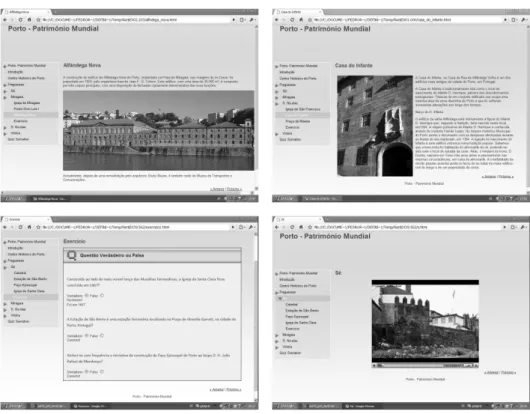
(12) 163. Freeware authoring tools for the creation of e-content – Current experience. Figure 1 – Screenshots of e-content of Portuguese for Foreigners developed with eXe-learning. Another interesting freeware authoring tool. scripting. Functionality that would be time-. that we have been using is Xerte. Xerte is a. consuming to develop from scratch in other. suite of tools for the rapid development of. tools can be created very quickly in Xerte.. interactive learning content. In developing Xerte, the team sought to make it very. It is possible to use Xerte to integrate text,. easy to perform simple, common tasks, yet. graphics, animations, sound and video,. possible to do many things that e-content. create simple interactivity, and deliver it in. developers need since Xerte seeks to. an accessible interface, everything without. provide a focus on the types of problems. writing code. For those who write some. and situations that developers of interactive. code, it is possible to create more complex. learning content frequently encounter.. structures and sophisticated interactivity.. Xerte provides a visual, icon-based authoring. It is also possible to customise the default. environment that allows learning objects. interface and develop our own interfaces and. to be easily created with the minimum of. navigation systems for the learning objects..
(13) 164. Pedro Reis & Isabel Damião. Figure 2 – Screenshots of e-content of Portuguese for Foreigners developed with Xerte. Those who write lots of code will be able to. operating system, including double-byte. develop powerful components and even. character sets;. extend the Xerte authoring interface with. ��. their own tools.. Object-oriented Model allows construction of e-learning content of almost any complexity just as easily as. Finally, we shall mention the key features of CourseLab, another freeware authoring tool:. you put together the building blocks; �� ��. ��. Dynamic HTML based output can be. WYSIWYG environment for creating. played by most browsers – no Java® or. and managing high-quality interactive. other special player software required for. e-learning content – no HTML or other. playing created e-learning content;. programming skills required; ��. Objects are highly customizable;. ��. encoding supported by the Windows®. Embedded Screen Capturing mechanism (without using Adobe Flash® technology);. Unicode support – use any font and ��. Built-in assessment and test creation capabilities;.
(14) 165. Freeware authoring tools for the creation of e-content – Current experience. Figure 3 – Screenshot of e-content of Portuguese for Foreigners developed with CourseLab. ��. Import PowerPoint® presentations into. Input, Hidden Input, Text Area, Checkbox, Radio. the learning material.. Buttons, and Dropdown Menu, but with these tools it is not possible to provide feedback.. In the process of creating LO with these. So, one limitation of the software, in this. tools, some limitations of the software were. particular set of tools, is that the user will not. identified.. know if his/her answers are correct.. For example, in CourseLab, there are two. Another limitation, which is to be found. groups of interactive tools: one is called. both in CourseLab and Xerte, is that text. Questions and the type of facilities included. introduced by the user is not saved. Besides,. are Single Choice, Multiple Select, Ordering,. it is not always possible to provide feedback,. Numeric, Text, and Matching Pairs, and these. such as a model answer.. allow the introduction of feedback to the student. Another group is called Form, which. Other difficulties were encountered, for. includes interactive facilities such as Text. example, when we tried to save a project to.
(15) 166. Pedro Reis & Isabel Damião. CD, using CourseLab, the entire project was. References. disfigured and, generally, the three authoring tools are not entirely WYSIWYG. The promoters. ALDRICH, F., ROGERS, Y. & SCAIFE, M.. of this software assure that authors can see. (1998). Getting to grips with “interactivity”:. what their content will look like in a browser. helping teachers assess the educational value. when published, but our experience shows. of CD-ROMs. In: British Journal of Educational. that these WYSIWYG facilities do not enable. Technology, 29, pp 321-332.. users to see what the content will look exactly. BOOG, GUSTAVO G. (2001). Manual de. like when published online.. treinamento e Desenvolvimento: Um Guia de Operações. São Paulo, Makron Books.. In spite of these limitations and difficulties,. GUÀRDIA, L., MAS, X., GIRONA, C. & SANGRÀ,. overall, one must not ignore the advantages. A. (2008). Os materiais de apredizaxe en contextos. of these tools: they are free access tools, easy. educativos virtuais: pautas para o deseño tecno-. to use, both by teachers and students, they. pedagóxico. Vigo, Universidade. Vicerreitoría de. encourage the creativity of authors and,. Formación e Innovación Educativa, D.L.. more importantly, the development and. LAUZON, A. (1997). Learning New Ways of. creation of LO with some level of interactivity.. Being in the World. In: International Journal of University Adult Education Vol.XXXVI. No.1, 1997.. 7. Conclusion. NORTHRUP, PAM T. (2002). Online Learners’ Preference for Interaction. In: Quarterly Review. We may conclude that the evolution of. of Distance Education, vol 3 no. 2, pp 219-26.. e-learning requires new tools for the. ROSEMBERG, MARC J. (2002). E-learning:. creation of digital educational content that. Estratégias para a Transmissão do Conhecimento. will capture the attention of those who get. na Era Digital. São Paulo, Makron Books.. distance training. It is no longer enough just. SHEPHERD, CLIVE. (2010) Content builders –. to put the information on a particular subject. tools for e-learning authors. [Online]. Available. on a platform and to ask learners to consult. in http://www.fastrak-consulting.co.uk/. it. The material needs to be exposed, but,. tactix/Features/content.htm#Authoring tools. at the same time, it must allow interactivity. compared [Accessed on 12-12-2010].. between teacher and student, and even. UNESCO, “Os Quatro Pilares da Educação:. among students.. O seu Papel no Desenvolvimento Humano”. Unesco (13 June 2003). Hence, authoring tools, such as those that were mentioned throughout this paper, are. Authoring Tools cited. increasingly used tools which are developed. CourseLab, http://www.courselab.com/. to enable a greater flow of knowledge and. eXe-learning, http://exelearning.org/wiki. expertise in order to enrich DE.. Xerte, http://www.nottingham.ac.uk/xerte/.
(16)
Imagem


Documentos relacionados