Universidade Federal de Uberlˆ
andia
Faculdade de Engenharia El´etrica
Programa de P´
os-Gradua¸c˜
ao em Engenharia El´etrica
MAURO JACOB HONORATO
WAM BASED SPACE EFFICIENT PROLOG
IMPLEMENTATION IN LISP
Banca Examinadora:
Luciano Vieira Lima, Dr. UFU. Orientador (UFU) Marcelo Rodrigues Sousa, Dr. (UFU)
Antˆonio Eduardo Costa Pereira, Dr. (UFU) Jos´e Lopes de Siqueira Neto, Dr. (UFMG) Reny Cury Filho, Dr. (PMU)
Uberlˆandia - MG
MAURO JACOB HONORATO
WAM BASED SPACE EFFICIENT PROLOG
IMPLEMENTATION IN LISP
Tese apresentada ao Programa de P´os-Gradua¸c˜ao
em Engenharia El´etrica da Universidade Federal de
Uberlˆandia como requisito parcial para obten¸c˜ao do
t´ıtulo de Doutor em Ciˆencias.
´
Area de concentra¸c˜ao: Processamento da Informa¸c˜ao
Orientador: Prof. Dr. Luciano Vieira Lima
Uberlˆandia - MG
Dados Internacionais de Catalogação na Publicação (CIP) Sistema de Bibliotecas da UFU, MG, Brasil.
H77 2016
Honorato, Mauro Jacob, 1981-
Wam based space efficient Prolog implementation in Lisp / Mauro Jacob Honorato. - 2016.
97 f. : il.
Orientador: Luciano Vieira Lima.
Tese (doutorado) - Universidade Federal de Uberlândia, Programa de Pós-Graduação em Engenharia Elétrica.
Inclui bibliografia.
WAM BASED SPACE EFFICIENT PROLOG
IMPLEMENTATION IN LISP
MAURO JACOB HONORATO
Tese apresentada por Mauro Jacob Honorato `a Universidade Federal de Uberlˆandia (UFU)
como parte dos requisitos para obten¸c˜ao do t´ıtulo de doutorado.
—————————————————– ——————————————
Luciano Vieira Lima, Dr. Darizon Alves de Andrade, Dr
Orientador Coordenador do
Dedico esse trabalho aos meus pais, Maur´ıcio e
Maria, `a minha esposa Leiliane, `as minhas filhas
Contents
1 Agradecimentos 5
2 Abstract 6
2.1 Keywords . . . 6
3 Resumo 7 3.1 Palavras-chave . . . 7
4 Introduction 8 5 Computers and limitations 9 5.1 Operating system . . . 9
5.2 Application software . . . 10
5.2.1 Code evaluation . . . 10
5.2.2 Online documentation . . . 11
5.2.3 Integration of REPL with Emacs . . . 12
5.2.4 The MELPA installation . . . 12
5.3 Common Lisp Implementation . . . 13
5.3.1 A taste of native compiler: . . . 14
5.4 SBCL and CMUCL . . . 15
6 New syntax 16 6.1 DEFMACRO . . . 16
6.2 LOOP . . . 17
7 Space efficiency 19 7.1 Proper Lisp lists usage . . . 28
7.2 Specialized data structure . . . 30
8 The logic system 38 8.1 How a Prolog system works . . . 38
8.2 WAM adaptations . . . 40
8.2.1 Memory vector and registers . . . 40
8.2.2 Prolog syntax into LISP . . . 46
9 Conclusion 51
References 53
List of Figures
1 Stack . . . 23
2 Java program, measure of bytes consumption and memory allocation (RSS) . . . 25
3 Lisp program, measure of bytes consumption and memory al-location (RSS) . . . 27
4 Comparison between Java and Lisp memory usage . . . 28
5 Comparison between Java and Lisp RSS . . . 29
6 Sharing structures . . . 29
7 Comparison between Proper lists and Object lists . . . 31
8 Comparison between Java and Lisp program using proper lists (RSS) . . . 32
9 Comparison between Java and Lisp program using proper lists (Bytes usage) . . . 33
10 Comparison between vectors and proper lists . . . 34
11 Comparison between Java Objects and Lisp vectors . . . 35
12 Comparison between Java Lists and Lisp vectors . . . 36
List of Tables
1 Java program, measure of bytes consumption and memory
allocation (RSS) . . . 24
2 Lisp program, measure of bytes consumption and memory al-location (RSS) . . . 26
3 Comparison between the claimed bytes consumption. . . 26
4 Comparison between the measured RSS . . . 27
5 Comparison between Proper lists and Object lists . . . 30
6 Comparison between Java and Lisp program using proper lists 30 7 Comparison between vectors and proper lists . . . 31
8 Comparison between Java Objects and Lisp vectors . . . 32
9 Comparison between Java Lists and Lisp vectors . . . 34
1
Agradecimentos
Em primeiro lugar agradeço à Deus que me conheceu a substância ainda informe no útero de minha mãe e me amou antes da criação do mundo, não levando em conta todo o meu pecado ofereceu seu único filho na cruz, tornando-se Ele mesmo maldito em meu lugar. Pois eu também sei que o meu Redentor vive!
Agradeço ao meu pai e à minha mãe, Maurício e Maria, que com muita luta e sacrifício me forneceram o necessário para chegar até aqui. Além disso, mesmo com um aperto no coração sempre apoiaram meus projetos para um futuro melhor.
2
Abstract
This thesis proposes the implementation of a space efficient Prolog imple-mentation based on the work of David H. D. Warren and Hassan Aït-Kaci. The Common Lisp is the framework used to the construction of the Prolog system, it was chosen both to provide a space efficient environment and a rich programming language in the sense that it supply the user with abstrac-tions and new ways of thinking. The resulting system is a new syntax to the initial language that runs on top of the SBCL Common Lisp implementation and can abstract away or exploit the underlying system.
2.1 Keywords
3
Resumo
Esse trabalho propõe a implementação de um sistema Prolog eficiente no espaço, o mesmo é baseado nos trabalhos de David H. D. Warren e Hassan Aït-Kaci. A Common Lisp é a estrutura usada para a construção do sistema Prolog, ela foi escolhida tanto por fornecer um ambiente eficiente no espaço quando por ser uma linguagem de programação rica no sentido de que fornece ao usuário abstrações e novas maneiras de pensar. O sistema resultante consiste em uma nova sintaxe aplicada à linguagem inicial que funciona sobre a implementanção Common Lisp chamada SBCL e é capaz de abstrair ou explorar o sistema subjacente.
3.1 Palavras-chave
4
Introduction
The present work is the result of four tofive years of work in the Artificial Intelligence Laboratory of Faculty of Electrical Engineering at Federal Uni-versity of Uberlândia (UFU). In the meantime we studied a bunch of other subjects including Kindle device programming, Financial Calculators design, Android device programming, item response theory, optical recognition sys-tems (Lush), and Stenography, one of the few things these subjects had in common was the use of the Common Lisp language.
During the study of the Common Lisp language it became obvious that write domain-specific languages in it is not an option but the way it works. When the Stenography subject claimed a Prolog system in order to imple-ment chunk grammars and connect it later with Emacs, we take into account the easiness of extending thefirst-order logic in Prolog, the build-in
depth-first search algorithm, and pattern matching. Then the Prolog system on top of Common Lisp became important enough to deserve all this discussion. Although the Prolog audience is broad enough, we had to narrow the objectives, the consequences and its causes are described in the next section Computers and limitations, there we explain the chosen operating system, the Gnu Emacs and how it smoothes the interaction with a so called inferior Lisp implementation though its Slime mode. The inferior word denotes an external Lisp session that run as a subprocess or inferior process of Emacs
and has nothing to do with the power of the implementation.
The implementation of another programming language on top of Com-mon Lisp requires a change in the Lisp syntax and two important facilities from the language to do this are described in the section New syntax. More than defining functions we are changing the way the language works and looks like. Even the Common Lisp language specification provides another syntax called Loop that does not resembles Lisp but an English-like con-struction.
After these sections is time to analyze the space efficiency of the imple-mentation where the Prolog system resides, the section Space efficency treat this. The Java1
language environment (language and virtual machine) was chosen as the analysis parameter. The use of Common Lisp vectors showed to be the right choice and were employed in the Prolog system.
The culmination of the work is explained in the section The logic system. It is described the more important things and how the system was adapted from the Warren’s Abstract Machine (WAM). The main abstractions and structures rest there near a modest Prolog clarification.
1
5
Computers and limitations
At the time of this writing, the computer industry seams to be at least a couple of decades away from reaching hard physical limits, according to Nature[9] and Arstechnica[14]. Reaching that limit would not just stuck but halt the progress in computer processing power.
First we had a mechanical computer with Charles Babbage, which gave Ada Lovelace the title of thefirst programmer, then came the vacuum tubes powered computers, after that transistors, and today the integrated circuits set the pace. But we are always begging for more, the people are already wearing computer devices and that is not enough.
A team of Stanford University is working hard to change the way the computation happens[10], bringing logical circuits in the form of biological cells, with the possible creation of what would be a biological computer, this is one that lays on your hand skin or even in your front head, the important thing is that such a computer is part of your body, living and dying with you.
In the same pace of processing power improvements is the use of data, with deep learning and big data, computers are doing things that go from automatic face recognition in personal photographs to beat human beings at ancient games[5]. The next logical step seams to be to predict whether a couple of visitors in a shopping mall would cause people or money damage. This kind of decision brings logic programming to decision trees.
Given the wide range of computers today, we must show what kind of computer hardware and software support our logic system.
5.1 Operating system
In order to abstract and manage the hardware we need an operating system (OS), today three of the most used are Mac OS2, Windows3and GNU/Linux.
We choose the Ubuntu4 distribution out of the GNU/Linux world given that it is open source, secure and accessible through its translations. Our logic system was written in the Common Lisp language and there are few OS
dependent features and someone willing to portate it to another OS will
have to read the compiler documentation.
Some years ago we could choose a Lisp Machine, but today there are few of them available, besides that you can use Emacs from Gnu5, it resambles a Lisp Machine in the sense that it is an operating system with lots of applications written in Lisp. You can rest assured that if something doesn’t looks like what you wanted you will have a Lisp language at your disposal to
2
Mac OS is a registered trademark of Apple Inc.
3
Windows operating system is a registered trademark of Apple Inc.
4
Ubuntu is a registered trademark of Canonical Ltd.
5
fix that, the language is called Emacs Lisp and every single Emacs Module is written in it.
5.2 Application software
Despite the fact that our proposed logic programming system runs on top of the SBCL implementation of the Common Lisp language, you still need application software, just the one called Emacs, and as an application Emacs has a purpose, let you work without interruptions. As long as you stay within Emacs, you can work with directories,files, source code, version control sys-tems and a special interaction Mode for your Common Lisp implementation called Slime.
Slime is an Emacs Mode specially designed to the development in Com-mon Lisp. There is a list of its best features and we narrow it here:
• Code evaluation
• Online documentation
• Integration of REPL with Emacs
5.2.1 Code evaluation
Using Slime you can run code snippets in a file without the copying/paste sequence. The alternative to this would be to comment all the code but the chosen and use the load function, as an example you could load just the following subtraifunction by commenting the code this way:
#|
(defun soma(x y) (+ x y)) |#
(defun subtrai(x y) (- x y))
#|
(defun multiplica(x y) (* x y))
(defun divide(x y) (/ x y))
|#
And loading the file inside the SBCL with the next LISP expression:
If you were using Slime, with the following buffer opened, what you need to do is just press the sequence C-c C-c after the subtrai’s closing parentheses in the last column of line 5:
1 (defun soma(x y)
2 (+ x y))
3
4 (defun subtrai(x y)
5 (- x y))
6
7 (defun multiplica(x y)
8 (* x y))
9
10 (defun divide(x y)
11 (/ x y))
And the Common Lisp implementation (SBCL) gives a hint of what is going on in the Slime REPL buffer:
CL-USER> ; compiling (DEFUN SUBTRAI ...)
Only subtrai’s definition were given to the read function and no com-ments or copy/paste were needed.
5.2.2 Online documentation
What happens when you forget a Common Lisp keyword in the middle of an algorithm translation? First you would open a browser and point toThe Common Lisp HyperSpec searching for the function name from the full text of the ANSI standard. Iffind nothing or the function was developed by yourself, you could try to deduce from the documentation string with the
documentation function.
(documentation ’subtrai ’function)
NIL
If you were using Slime, nothing of the previous options would be need, as long as you just forget the name of a keyword, Slime gives you a hint as soon as it receives a function name, for instance if you start typing a call to
with-open-filethe hint below would be shown in the mini-buffer:
(with-open-file
(stream filespec &rest options
if-exists if-does-not-exist
(external-format :default) (class ’sb-sys:fd-stream)) &body body)
Even with yoursubtraifunction you would not be totally lost given that typing(subtraiyou would receive the following Slime hint:
(subtrai x y)
The reader must agree that this hint is much better than thenilreceived from the previousdocumentation command.
5.2.3 Integration of REPL with Emacs
There is an endless cycle inside all LISP systems that is called REPL, it is always reading LISP expressions, evaluating them and printing the result. SLIME is an Emacs mode that was developed to integrate the REPL from LISP systems (or implementations) within the Emacs editor, providing also "shortcut" commands.
In order to install Slime, the Emacs user needs to add the following lines to the .emacs initialization file. It resides on the root folder reached with
∼/.
1 (add-to-list ’load-path "~/progs/2016/slime") 2 (require ’slime-autoloads)
3 (setq inferior-lisp-program "/usr/local/bin/sbcl") 4 (setq slime-contribs ’(slime-fancy))
Thefirst and third lines are the most important. Thefirst specifies where you did put the SLIMEfiles. The third one indicates the LISP implementa-tion that is to be integrated into Emacs through the SLIME mode.
5.2.4 The MELPA installation
Today, no Emacs documentation is complete if it does not say anything about MELPA, this is a better way to do installation on Emacs. The reader does not need to extract installation files by hand and interact with the Emacs initializationfile anymore, in the same extent that the Linux users are doing less and less installations like the needed by theLinux from scratch 6
. What one do when it needs to install another software in his Linux distro? He will probably do something that resembles the Ubuntu apt-get install name command. Emacs has evolved and the Milkypostman’s Emacs Lisp Package Archive also known asMELPAlets the install work become easier, like apt-get does in Linux. You still need to open the ∼/.emacs file and add the following lines, but once and for all.
6
(require ’package) ;; You might already have this line (add-to-list ’package-archives
’("melpa" . "https://melpa.org/packages/"))
In the next Emacs initialization, after it reads those lines, the world of MELPA will be at youfingers, and you willfind and install Emacs packages like SLIME with the following Emacs command:
M-x package-install slime-mode
There is the possibility of listing all the packages available with:
M-x package-list-packages
You can search the results with C-s slime-mode, when you find the package, click in its name to initiate the installation buffer. Only your mouse device will be needed, no more tar nor mv commands just button clicks. The SLIME tighten integration of the Emacs with the Common Lisp imple-mentation raises the question of which impleimple-mentation to choose and that is the matter of the next section.
5.3 Common Lisp Implementation
The Common Lisp language is defined by its standard and the language is implemented by many entities. Even the reader could start small with a book like Build Your Own Lisp from Mr Daniel Holden[7] and then read the ANSI Common Lisp standard implementing all the features that define the language producing a conforming Common Lisp implementation.
We have not the time and resources needed to write a conforming imple-mentation so we had to choose between the following list of Common Lisp systems:
• CLISP
• CMUCL
• ECL
• CCL
• SBCL
• ABCL
Our choice was SBCL, given that we are familiar with it, it is open source, and provides native compiler. SBCL is thus complete to our system and is alive in the sense that the developers are still working on it7
. Besides that it does native code compilation very fast.
5.3.1 A taste of native compiler:
Let’s show you that native compiler matters. In SBCL, every single form given to evalis translated into native code by the native code compiler. If someone declare the following function:
(defun soma(x y) (+ x y))
He could even see the generated assembly code with:
(disassemble ’soma)
And would receive something like the following:
; 98: 48894DF8 MOV [RBP-8], RCX
; 9C: 488BD6 MOV RDX, RSI
; 9F: 488BFB MOV RDI, RBX
; A2: 41BBC0010020 MOV R11D, 536871360
; A8: 41FFD3 CALL R11
; AB: 488B5DE8 MOV RBX, [RBP-24]
; AF: 488B75F0 MOV RSI, [RBP-16]
; B3: 488BE5 MOV RSP, RBP
; B6: F8 CLC
; B7: 5D POP RBP
; B8: C3 RET
; B9: CC10 BREAK 16
The third column shows the Assembly code that was generated by SBCL and consists of everything needed by thesoma function.
Even if the reader doesn’t know anything about that encrypted code, understanding that the Assembly language is the programming language closest to the Machine language is enough to know that such a snipet of code would in no doubt execute much more fast than any interpreted counterpart given that there is a strong correspondence between the generated code and the architecture’s machine code instructions.
The ABCL LISP implementation, for example, is a system that generates Java bytecodes not machine code. In order to see those bytecodes running
7
you need another layer in-between, something that translate those bytecodes into machine language, this is the work of the Java Virtual Machine. Some projects can waste running time and memory using the Java environment, our logic system must be fast and ABCL does notfit in.
After the description of why a system that does not work, we will go straight to the chosen system, SBCL.
5.4 SBCL and CMUCL
Actually the SBCL implementation is what would be called a fork of the CMUCL implementation, CMUCL is not outdated but is less actively devel-oped than SBCL. CMUCL, as SBCL, is a implementation of the Common Lisp programming language that conforms to the ANSI Common Lisp stan-dard.
However, as stated in its own FAQ, CMUCL does not have Unicode support nor native threads on Linux/x86 platforms and SBCL is closer to the ANSI Common Lisp specification than CMUCL. Both compiled code runs at a similar speed and CMUCL would be the right one only if one needs a faster compiler.
6
New syntax
It’s remarkable that Lisp provides facilities to add new constructs to the language, the defmacro function allows someone to define new operators, and these operators can circumvent the idiosyncrasies of the so called LISt Processing language.
One of these useful Common Lisp idioms is backquote, very well described by Doug Hoyte in Let Over Lambda[8], it stops the evaluation of a form, except on the unquoting areas where an expression is evaluated and the result inserted where the unquote mark appears. We took advantage of this feature in our logic system to create code templates that arefilled at runtime like the add_clcalls in the following addnotfunction definition.
1 (defun addnot(s)
2 (let* ( (n (length (cdr s))) 3 (args (mknotvars 0 (cdr s)))
4 (pred (car s))
5 (notpred (not-symbol-name pred)) )
6 (when (not (get notpred ’def))
7 (add_cl notpred
8 ‘(,n ( ,notpred ,@args)
9 ( ,pred ,@args) (! ,n) (|fail|)) ’def)
10 (add_cl notpred ‘(,n (,notpred ,@args)) ’def )
11 (format t "notdef: ~a :- ~a~%" notpred (get notpred ’def)))))
The previousaddnotfunction, shows an example of backquote in action, the variablen is the length of the rest of thes list, as its peers, dependent of the value thataddnot receive as argument at the moment of the call. And the lines 8, 9 and 10 are the result of the kind of improvement the former List Processing language acquired, actually a change on its syntax.
Another two important expressions that change the LISP syntax and deserve descriptions aredefmacroand the loopmacro.
6.1 DEFMACRO
In order to talk about defmacro we can go straight to the point, for instance, instead of writing a series of nested IFs, the user can get ride of typing a lot (and lots of typos) with WHEN, UNLESS and COND macros. Writing part of a program to choose the right package from correios, a newbie Lisp programmer could do this:
1 (if (< volume (* 18 13 9)) 2 (print "Tipo 1")
5 (if (< volume (* 36 27 18)) 6 (print "Tipo 3")
7 (print "Tipo 4"))))
But with two more missing types of packages, known for its volume, its clear that the following code would be much more clear and concise.
1 (cond
2 ((< volume (* 18 13 9)) (print "Tipo 1")) 3 ((< volume (* 27 18 9)) (print "Tipo 2")) 4 ((< volume (* 36 27 18)) (print "Tipo 3")) 5 (t (print "Tipo 4")))
Thank God that Lisp is not like Python, as Tim Peters advocates in the Python Developer’s Guide,
There should be one– and preferably only one –obvious way to do it.
Using defmacro the Lisp language user can find himself common con-structions inside his code and give birth to new operators in order to become more efficient by using the new abstraction. He is not even tied to the Lisp syntax or language standard itself, as he is actually adding the abstraction to the language, he just need to be concise. Thus there are lots of ways to do one thing in Lisp.
When reading the source code of our logic system one will understand that a list is a two arg functor with descritors given by (\.) for originals, and (\. . t)for copies, a new predicate was defined with defmacro in the following code from our logic system:
1 (defmacro list? (x)
2 ‘(eq (functor (functorDescription ,x)) ’\.))
Instead of writting the full expression in line 2, the programmer needs just to use the new expression list?.
6.2 LOOP
The most prominent of these other syntax operators is the LOOP macro, by providing a distinct way to express convolution it lets a Lisp hacker to express himself in an English-like language in order to achieve a goal. See this loop example:
The same result could be achieved with a DO macro, starting with a null list, iterating from 1 to 10, PUSHing every step number into the list, and reversing the list to give as the result. It’s as difficult to express as to write and read the following code:
1 (do ((lista nil) (i 1 (1+ i))) 2 ((> i 10) (nreverse lista))
3 (push i lista))
Someone may argue that the LOOP way is not LISP like, but the English-like constructions in the form of LOOP macros allows everyone to guess what is going on even if he does not master the LOOP language yet. Hence it decreases the time needed to someone else trying to understand the original code.
1 (loop for x from 1 to 10 summing x)
Despite the fact that the LOOP syntax is different from Lisp, all the Lisp code inside LOOP is applied in the same way it is in the outside. This shows that there is a connection between the Lisp syntax and new syntaxes provided by DEFMACRO, thus extending the Lisp language not taking it off the play.
1 (loop for i below 10
2 and a = 0 then b
3 and b = 1 then (+ b a)
4 finally (return a))
Here (+ b a)and (return a)are side by side with the english-like ex-pressions, the user acquainted with both LISP and LOOP syntax will apply the obvious one in the right place.
In the following code snippet, it is clear that a list of x is being constructed from the call togetOutputVariables:
(defun getOutputVariables(c) (let* ( (fn (car c)) (mods (cdr (get fn ’mod))) (args (cdr c)))
(loop for x in args for m in mods
when (equal m ’+) collect x)))
A cryptic function would be the outcome of the use of setf and cons
7
Space e
ffi
ciency
In order to analyze space efficiency of a system one needs to establish mem-ory space goals as a system parameter, it is becoming consensus to the contemporary computer users the fact that extra memory use is not a huge concern as important as is the time efficiency. A good example of this is the proliferation of Java applications despite its memory usage.
The following Java program (hello.java) contains the source code nec-essary to the Java compiler produce another file called hello.class. The classfile containsbytecodesthat are executed by the Java Virtual Machine (JVM).
import java.util.Scanner;
public class hello {
public static void main(String[] args) { String nome;
Scanner user_input = new Scanner( System.in ); nome = user_input.next();
} }
The size of the class file is just 580 bytes:
$ ls -lia hello.class
21890030 -rw-rw-r-- 1 mauro mauro 580 Jul 18 09:23 hello.class
At the execution time the class file must be loaded consuming 580B and because there is a wait for input, we can infer that two objects would be alive in memory plus the program class through its static method, but looking for the memory usage with thetop command, we get this:
1 $top u mauro
2 top - 09:25:46 up 4 days, 15:36, 3 users, load average: 0,85, 0,68, 1,58 3 Tarefas: 219 total, 1 executando, 218 dormindo, 0 parado, 0 zumbi
4 %Cpu(s): 11,1 us, 2,3 sy, 0,3 ni, 85,3 id, 1,0 wa, 0,0 hi, 0,0 si, 0,0 st 5 KiB Mem: 3943036 total, 3148888 used, 794148 free, 180336 buffers
6 KiB Swap: 4087804 total, 957356 used, 3130448 free. 924112 cached Mem 7
8 PID USUÁRIO PR NI VIRT RES SHR S %CPU %MEM TIME+ COMMAND
9 12659 mauro 20 0 881868 105872 32988 S 32,8 2,7 1:11.96 chrome
10 2057 mauro 20 0 1543204 64496 14268 S 7,0 1,6 23:59.23 compiz
11 6791 mauro 20 0 1480960 371712 51688 S 6,3 9,4 13:03.02 chrome
13 27953 mauro 20 0 1333332 72080 5484 S 1,7 1,8 2:16.06 mono
14 22679 mauro 20 0 632576 15632 8564 S 1,3 0,4 0:09.24 gnome-term+
15 1927 mauro 20 0 20360 416 416 S 0,3 0,0 0:43.08 syndaemon
16 11061 mauro 20 0 1036112 89616 19548 S 0,3 2,3 4:04.28 chrome
17 12797 mauro 20 0 29220 1804 1248 R 0,3 0,0 0:01.79 top
18 13430 mauro 20 0 3335040 23976 11152 S 0,3 0,6 0:00.26 java
19 29902 mauro 20 0 532516 12584 3304 S 0,3 0,3 0:22.97 chrome
The important thing to note is that the RES column indicates the Res-ident memory used by a process (KiB), with only our hello application running as a Java application (line 18), 23MB are being used. A very simple program is consuming 0.6% of the physical memory and 0.3% of the CPU time. One can think that the Scanner class is very big and this justify the memory usage, but if we create an infinity loop without the Scanner object like the one in the following class:
public class hello {
public static void main(String[] args) { for( ; true ; ) {}
} }
The resulting RES is still high, now near 18MB, this is because of the Java Virtual Machine machinery and this is an intrinsic characteristic of Java applications:
top - 09:51:49 up 4 days, 16:02, 3 users, load average: 0,81, 0,56, 0,73 Tarefas: 220 total, 1 executando, 219 dormindo, 0 parado, 0 zumbi
%Cpu(s): 26,0 us, 0,2 sy, 0,0 ni, 72,8 id, 1,1 wa, 0,0 hi, 0,0 si, 0,0 st KiB Mem: 3943036 total, 3374724 used, 568312 free, 190468 buffers
KiB Swap: 4087804 total, 898592 used, 3189212 free. 989224 cached Mem
PID USUÁRIO PR NI VIRT RES SHR S %CPU %MEM TIME+ COMMAND
13808 mauro 20 0 3334888 17924 10508 S 99,7 0,5 0:27.84 java
Applying Lars Vogel method[15] to obtain the total application used memory, we apply thetotalMemoryandfreeMemorymethods from the Run-time class. According to the Java API Specification[1], the totalMemory
method returns the total amount of memory in the Java Virtual Machine, this is the total amount of memory currently available for current and future objects and is measured in bytes, while thefreeMemory method returns the amount of free memory in the Java Virtual Machine and is an approximation to the total amount of memory currently available.
public class hello {
public static void main(String[] args) { Runtime runtime = Runtime.getRuntime(); String nome;
Scanner user_input = new Scanner( System.in );
runtime.gc();
long memory = runtime.totalMemory() - runtime.freeMemory(); System.out.println("Used memory in bytes: " + memory);
nome = user_input.next(); }
}
The amount of Java Virtual Machine (JVM) memory spent become clear, while the JVM is consuming 23MB only 0.4MB were actually employed inside the hello class:
$ java hello
Used memory in bytes: 445936
The following stripped hello class shows that the Scanner object con-sumes less than 0.2MB of memory:
public class hello {
public static void main(String[] args) { Runtime runtime = Runtime.getRuntime(); runtime.gc();
long memory = runtime.totalMemory() - runtime.freeMemory();
System.out.println("Used memory in bytes: " + memory); for( ; true ; ) {}
} }
The used memory inside the program is near 0.3MB without the Scanner class, while the Java application is consuming near 18MB of the system memory:
$ java hello
Some Java-based systems, like for example Trader Workstation8, being aware of the memory issues inherent to the Java Virtual Machine’s auto-matic storage management system, warns their users and teach them how to increase the memory available to the Java environment as heap space.
Notwithstanding the fact that such modifications are easy like the fol-lowing command, what should be noticed is that values like 3GB of memory for the Java environment only9 are nowadays accepted without questioning:
java -cp j.jar:t.2.jar -Xmx768M -XX:MaxPermSize=256M jc.LoginFrame
The Heap profiling for space-efficient Java[13] article shows that there must be some level of concern about space efficiency even among Java pro-grammers given that this can also positively impact the runtime efficiency of the program. The Java garbage collector (GC) automatically dealocates memory but the time of the GC operation is not controlled. Hereupon the Java programmer must be aware that his control over the application mem-ory usage inside the Java environment is limited.
These Java levels were chosen as benchmark for our system parameters. An easy test can be applied to compare the way that the Java application behaves compared to Lisp, in order to minimize the influence of our expertise into the tests we must keep the programs and problems as small as possible assuming the risk of touching border issues.
It can be claimed that the difference between the Common Lisp language and its peers makes the comparison very hard. However as a programmable programming language[12] LISP has easily adopted new paradigms, one of
this is the object system through the Common Lisp Object System (CLOS) that we will employ to construct a Java equivalent Lisp program, trying to compare oranges and oranges.
Our logic system has to deal with stacks, a stack as stated by the CLRS book on Introduction to Algorithms[3] is a dynamic set that implements a last-in, first-out policy (LIFO) in which the element removed is the one most recently inserted. The backtracking system (the mechanism forfinding multiple solution) will handle the stack.
The Node object in the Java language is defined by the next Node class
file:
public class Node{
private int position;
public int getPosition() { return position; }
public Node next;
public Node(int p, Node n) {
8
Seehttps://ibkb.interactivebrokers.com/article/2170.
9
position = p; next = n;
} }
Note that the result is the following linked list, the nodevariable points to the top of the stack, the pointer to null marks the bottom of the stack:
Figure 1: Stack
The following Lista class is responsible for the creation of the stack and a modest memory measurement in Java, the resulting data of changing the size of the list is organized and showed in table 1 andfigure 2.
import java.util.Scanner;
public class Lista {
public static void main(String[] args) { Scanner next = new Scanner(System.in);
Node no = new Node(0,null);
for(int i = 1; i < 100000000; i++) { no = new Node(i,no);
}
Runtime runtime = Runtime.getRuntime(); runtime.gc();
long memory = runtime.totalMemory() - runtime.freeMemory();
System.out.println("Used memory in bytes: " + memory); next.nextInt();
} }
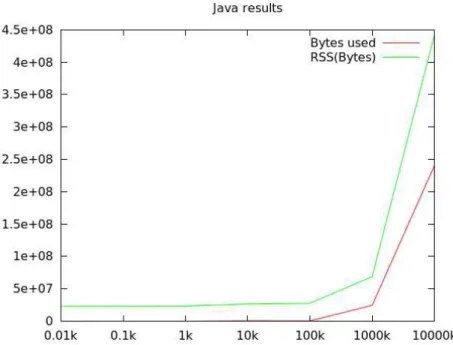
The Java program allocates more memory (RSS) than it is really nec-essary, and the allocation does not increase in the same rate as the bytes consumption function. The slope of RSS line (mrj) is 68% greater than
bytes consumption line (mbj).
mbj=
240425336−24425336
Table 1: Java program, measure of bytes consumption and memory alloca-tion (RSS)
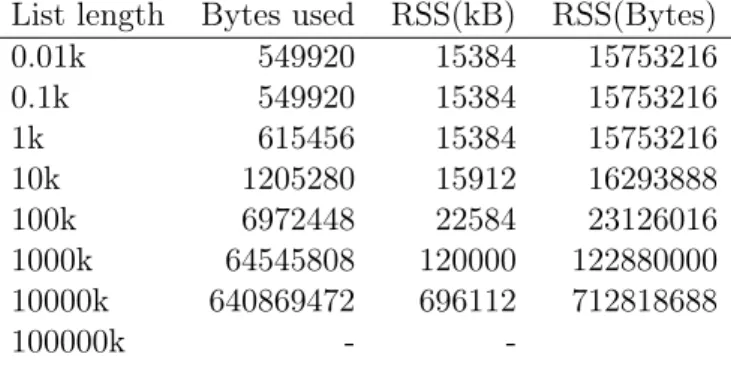
List length Bytes used RSS(kB) RSS(Bytes) 0.01k 446672 22568 23109632 0.1k 448832 22732 23277568 1k 470432 22864 23412736 10k 686432 26080 26705920 100k 446520 26944 27590656 1000k 24425336 67212 68825088 10000k 240425336 432072 442441728
100000k -
-mrj = Δy
Δx =
432072−67212
10000−1000 = 40.54 (2)
Another important thing is that when the length of the stack comes close to one hundred million a Java unchecked exception occurs:
$ java Lista
Exception in thread "main" java.lang.OutOfMemoryError: Java heap space at Lista.main(Lista.java:9)
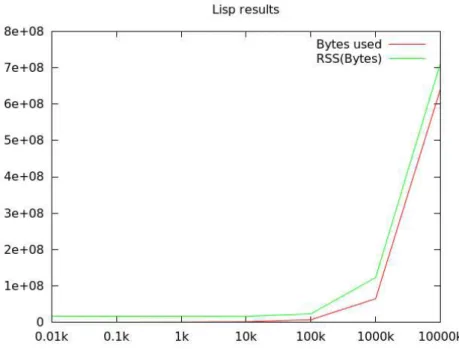
The Lisp code corresponding to the Java Node class is the following one, it has two slotspositionandnext, both of them serve the same purpose as the equivalent written in Java. Themainfunction produces the stack and we vary the length in order to evaluate the memory consumption. The result of the change in the length and execution of the Lisp program are summarized in table 2 and displayed in figure 3.
(defclass Node () ((position
:initarg :position :accessor pos) (next
:initarg :next :accessor nxt)))
(defparameter *node* (make-instance ’Node :position 0 :next nil))
(defun main()
(loop for i from 1 to 1000000 do
(setf *node* (make-instance ’Node :position i :next *node*))) (format t "!")
Figure 2: Java program, measure of bytes consumption and memory alloca-tion (RSS)
(gc :full t) (read-line))
Although the consumption and allocation of memory in Lisp programs increase in a similar rate after 1MB, the slope of RSS line (mrl) is equal to
the slope of bytes consumption line (mbl), despite this behavior it is greater
than the Java equivalent and could not alone justify the Common Lisp usage.
mbl=
640869472−64545808
10000−1000 = 64 (3)
mrl = Δy
Δx =
696112−120000
10000−1000
= 64 (4)
Again the large stack length near one hundred million overflows the heap size which leads to a fatal error:
fatal error encountered in SBCL pid 17056(tid 140737353971520): Heap exhausted, game over.
It is possible, as is the case for Java applications, to adjust the heap size of the SBCL Common Lisp implementation at the time of its execution, the
rlwrap sbcl --dynamic-space-size 2048 --load plist.lisp
We used thesave-lisp-and-diefunction to produce the executablefile, along with the name of the executable file the name of thefirst function to execute by the toplevel is informed. In order to save the configuration the keywordssave-runtime-options tand executable t were added:
(defun tempo() (time (main)))
(save-lisp-and-die "htime" :executable t
:toplevel #’tempo
:save-runtime-options t)
Table 2: Lisp program, measure of bytes consumption and memory allocation (RSS)
List length Bytes used RSS(kB) RSS(Bytes) 0.01k 549920 15384 15753216 0.1k 549920 15384 15753216 1k 615456 15384 15753216 10k 1205280 15912 16293888 100k 6972448 22584 23126016 1000k 64545808 120000 122880000 10000k 640869472 696112 712818688
100000k -
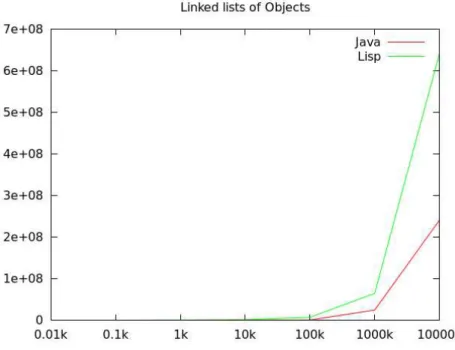
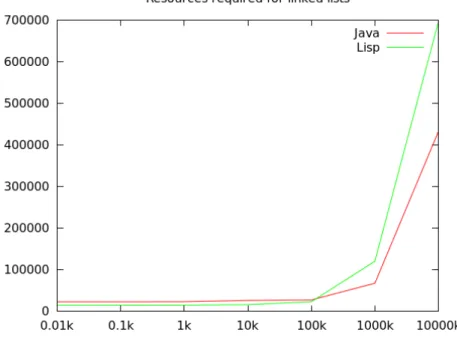
-A humble comparison between bytes consumption in Java and Lisp can be seen in table 3 and displayed infigure 4.
Table 3: Comparison between the claimed bytes consumption. List length Bytes used in Java Bytes used in Lisp
0.01k 446672 549920
0.1k 448832 549920
1k 470432 615456
10k 686432 1205280
100k 446520 6972448
1000k 24425336 64545808 10000k 240425336 640869472
Figure 3: Lisp program, measure of bytes consumption and memory alloca-tion (RSS)
between the performance of the Java application towards the Common Lisp one is smaller as shown in table 4 andfigure 5.
Table 4: Comparison between the measured RSS List length Java RSS Lisp RSS
0.01k 22568 15384 0.1k 22732 15384
1k 22864 15384
10k 26080 15912 100k 26944 22584 1000k 67212 120000 10000k 432072 696112
Figure 4: Comparison between Java and Lisp memory usage
7.1 Proper Lisp lists usage
Given that a proper list is one of the most basic data structure included in Common Lisp, the language provides built-in procedures for access and con-trol of lists components. Besides that two lists can point to the same memory locations which improves the space efficiency of Common Lisp systems. As an example we can see the following code available in Wikipedia10
:
(setf foo (list ’a ’b ’c)) (setf bar (cons ’x (cdr foo)))
The bar list is actually sharing structure with the foo list, as b and c
are in the same memory locations for both lists, see figure 6. Programming with proper lists is another possibility out of the Common Lisp language repertory. Paul Graham in ANSI Common Lisp[6] advocates that the Lisp programmer should use lists in the initial version of a Lisp program replacing them with specialized data structures in later versions.
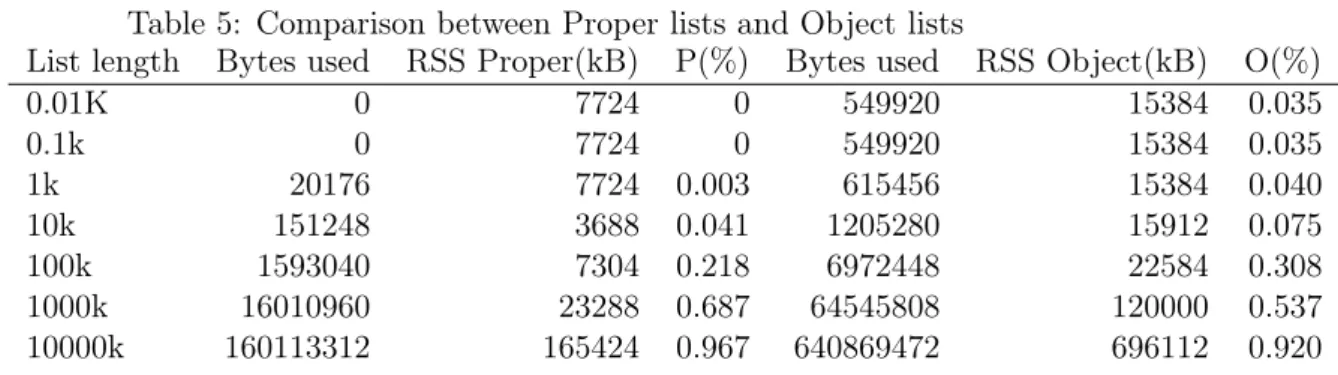
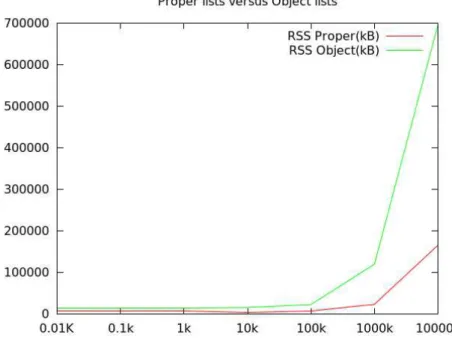
In order to compare which implementation is better, as the table 5 and
figure 7 show, we measured the bytes consumption and allocation first in a program using proper lists then in an implementation with linked lists constructed with the CLOS (Objects) technology. The construction of the list was left to the Loop dialect through collect as shown below:
10
Figure 5: Comparison between Java and Lisp RSS
Figure 6: Sharing structures
(defparameter *no* nil)
(defun main()
(setf *no* (loop for i from 1 to 100000000 collect i)))
We concluded that the best data structure for the first version of our logic system stack is not object lists in Java nor Common Lisp (CLOS) but proper lists. Even when not using specialized data structures Common Lisp beats the Java technology as summarized in table 6 andfigure 8. The bytes usage also corroborates to the conclusion as shown infigure 9.
Despite the fact that it is already clear that Common Lisp should be the
Table 5: Comparison between Proper lists and Object lists
List length Bytes used RSS Proper(kB) P(%) Bytes used RSS Object(kB) O(%)
0.01K 0 7724 0 549920 15384 0.035
0.1k 0 7724 0 549920 15384 0.035
1k 20176 7724 0.003 615456 15384 0.040 10k 151248 3688 0.041 1205280 15912 0.075 100k 1593040 7304 0.218 6972448 22584 0.308 1000k 16010960 23288 0.687 64545808 120000 0.537 10000k 160113312 165424 0.967 640869472 696112 0.920
source code and is proposed by Paul Graham[6].
Table 6: Comparison between Java and Lisp program using proper lists
List length Bytes used (Java) RSS Java(kB) Bytes used (Lisp) RSS Proper(kB)
0.01k 446672 22568 0 7724
0.1k 448832 22732 0 7724
1k 470432 22864 20176 7724
10k 686432 26080 151248 3688
100k 446520 26944 1593040 7304
1000k 24425336 67212 16010960 23288
10000k 240425336 432072 160113312 165424
7.2 Specialized data structure
Following Paul Graham’s advices, we proceed by showing that even though arrays are less versatile as data structure, they take less space than proper lists and can make access faster. The Common Lisp program that makes use of vectors to compare with the proper lists is the following one:
1 (defparameter *node* nil) 2 (defparameter *size* 10) 3
4 (defun main()
5 (setf *node* (make-array *size*))
6 (loop for i from 0 to (- *size* 1) do (setf (aref *node* i) i))) 7
8 (defun tempo() (time (main))) 9
10 (save-lisp-and-die "vtime" :executable t :toplevel #’tempo :save-runtime-options
The parameter*size*, defined on line 2, controls the length of the vector
Figure 7: Comparison between Proper lists and Object lists
usage even more than proper lists, as one can see from table 7 and figure 10. The reduction become prominent after the length of the vector achieves 1000k elements.
Our verification of the advantages of using specialized data structures from Lisp over Object lists from Java can be seen in table 8 andfigure 11. It is clear that if our logic system makes use of Lisp vectors it would be much more space efficient.
Table 7: Comparison between vectors and proper lists
List length Bytes used RSS Vectors(kB) V(%) Bytes used RSS Proper(kB) P(%)
0.01K 0 7728 0 0 7724 0
0.1k 0 7728 0 0 7724 0
1k 0 7728 0 20176 7724 0.003
10k 11536 7728 0.001 151248 3688 0.041 100k 800016 8520 0.093 1593040 7304 0.218 1000k 8000016 15452 0.517 16010960 23288 0.687 10000k 80024400 87452 0.915 160113312 165424 0.967
Figure 8: Comparison between Java and Lisp program using proper lists (RSS)
list is specified when the constructor receives size:
import java.util.*;
public class Slista {
public static void main(String[] args) { Scanner next = new Scanner(System.in);
int size = 10;
List<Integer> lista = new ArrayList<Integer>(size);
Table 8: Comparison between Java Objects and Lisp vectors
List length Bytes used (Java) RSS Java(kB) Bytes used(Lisp) RSS Vectors(kB)
0.01K 446672 22568 0 7728
0.1k 448832 22732 0 7728
1k 470432 22864 0 7728
10k 686432 26080 11536 7728
100k 446520 26944 800016 8520
1000k 24425336 67212 8000016 15452
Figure 9: Comparison between Java and Lisp program using proper lists (Bytes usage)
for(int i = 1; i <= size; i++) { lista.add(i);
}
Runtime runtime = Runtime.getRuntime(); runtime.gc();
long memory = runtime.totalMemory() - runtime.freeMemory();
System.out.println("Used memory in bytes: " + memory); next.nextInt();
} }
Although this program saves memory with respect to the initial Java version, it presents no improvement over the Lisp vectors version as can be seen in table 9 andfigure 12.
One last try employees vectors in Java as stated in the Jvector class below, the results are summarized in table 10 and figure 13. It is now clear that no Java alternative beats Lisp, except when unprepared CLOS objects were used in Lisp.
Figure 10: Comparison between vectors and proper lists
public class Jvector {
public static void main(String[] args) { Scanner next = new Scanner(System.in);
int size = 10000000;
Vector<Integer> v = new Vector<Integer>(size);
for(int i = 1; i <= size; i++) { v.add(i);
}
Table 9: Comparison between Java Lists and Lisp vectors
List length Bytes used (Java) RSS Java(kB) Bytes used(Lisp) RSS Vectors(kB)
0.01K 446536 34536 0 7728
0.1k 446896 35476 0 7728
1k 464448 36240 0 7728
10k 645824 35528 11536 7728
100k 447920 34828 800016 8520
1000k 20424976 77476 8000016 15452
Figure 11: Comparison between Java Objects and Lisp vectors
Runtime runtime = Runtime.getRuntime(); runtime.gc();
long memory = runtime.totalMemory() - runtime.freeMemory();
System.out.println("Used memory in bytes: " + memory); next.nextInt();
} }
Table 10: Comparison between Java Vectors and Lisp vectors
List length Bytes used (Java) RSS Java(kB) Bytes used(Lisp) RSS Vectors(kB)
0.01K 446368 35372 0 7728
0.1k 446728 36148 0 7728
1k 464296 37532 0 7728
10k 645568 34976 11536 7728
100k 447640 37132 800016 8520
1000k 20424720 76768 8000016 15452
10000k 200424720 387492 80024400 87452
Hence, our logical system uses one-dimensional arrays, also calledvectors,
Figure 12: Comparison between Java Lists and Lisp vectors
as stated in the next code snippets:
1 (defvar Memory
2 (make-array +LocalStackOverflow+
3 :initial-element 0 )) 4
5 (defvar trailMem
6 (make-array +TrailOverflow+
7 :initial-element 0 8 :element-type ’fixnum)) 9
10 (defvar xArgs
11 (make-array 50
12 :initial-element 0)) 13
14 (defun exec(str)
15 (setf *keep-going* nil) 16 (in-package :mini)
17 (let ((oldin *standard-input*) 18 (oldout *standard-output*) 19 (fstr (make-array ’(0)
20 :element-type ’base-char
Figure 13: Comparison between Java Vectors and Lisp vectors
22 :adjustable t)))
23 (with-input-from-string (s (format nil "~a " str))
24 (setf *standard-input* s)
25 (with-output-to-string
26 (z fstr)
27 (setf *standard-output* z)
28 (handler-case (lisploop (read_code_tail))
29 (error(e) (format t "toplevel error: ~a~%" e) ))))
30 (setf *standard-input* oldin
31 *standard-output* oldout)
32 (in-package :cl-user)
33 fstr))
The first argument of make-array is called dimensions and it is a list of integers that defines the dimensions of the array, lines 2, 6, and 11 are defining one-dimensional arrays (vectors) since +LocalStackOverflow+,
+TrailOverflow+ and 50 are numbers. Although line 19 provides an one-element list, not a number, as the dimension, it is defining a vector too.
8
The logic system
The Prolog language is a theorem prover for predicate logic, in it the pred-icate’s name and the formal parameters (number and structure) receive a meaning in the same manner as other atomic propositions in the form of internal structures.
A Prolog compiler is a process that receives a collection of Prolog clauses and produces a description of the structure from this clauses in an executable way. Over the validation process, the Prolog interpreter needs to travel through complex data structures.
The representation of the Prolog term is a symbol containing a value and a tag. The tag discriminates the type of the term. The main types are references, structures, lists and constants. A not ajusted variable is represented by a reference to itself.
8.1 How a Prolog system works
The Prolog programming can be summarized as follows:
• A Prolog program is a set of procedures.
• A Prolog procedure is a set of clauses.
Each clause has the following form:
P :- Q1,Q2,...,Qn.
The previousP form is true ifQ1is true, Q2is true and so on untilQnis true. If n is equal to 0 the clause is written as Ponly. In this case P is true. In the following form:
P :- Q1,Q2,Q3.
P is the head.
:- is the neck.
Q1,Q2,Q3 form the body.
. is the foot.
In Prolog, the predicate definition is represented by a process and the declarative semantics goes straight to the point:
Conditions can be defined with predicates in the following manner:
filho(PAI,FILHO) :- genitor(PAI,FILHO), masculino(PAI). avo(AVO,NETO) :- genitor(AVO,PAI), genitor(PAI,NETO).
The terms AVO,PAI,FILHO, NETOare variables. The scope of a variable is the clause where it is used.
A way to visualize the running of Prolog procedures is through a search tree. The search and the pattern matching limits the Prolog performance. In order to execute a process the Prolog system mustfind through the process candidates verifying the matching, doing backtracking when it does notfind a match through the path and passing information through deunification or pattern matching.
The Prolog procedures may contain parameters that works like input and output pipes depending on the call type. Each provided argument by a procedure call is a description.
At the time of the procedure call, the call term arguments are compared with the parameter terms from the procedure called. The pattern matching process (called unification) tests if two terms match.
Prolog procedures may contain parameters on terms. A term may be a constant, a structure or variable. Constants are atomic objects. Structures consist on a functor applied to the terms as arguments,pai(willian,george), the variables denote arbitrary objects, the convention is to use variable names starting with uppercase letters. In the following code:
pai(william,george)
8.2 WAM adaptations
Now we proceed with the description of the idiosyncrasies that makes our logic system based on the WAM virtual machine, the reader should be aware that:
1. We choose a implementation language (Common Lisp).
2. The system makes use of specialized data structures (Lisp vectors).
3. Our logic system can make calls to the host language.
The WAM system consists of a memory architecture and instruction
set tailored to Prolog. It was developed by David H. D. Warren[16] and described in his technical report. This technical report was written for an expert reader and contains only a "bare bones" definition thus the need for the Hassan’s work.
The frameword that supports our system is the Warren’s Abstract Ma-chine (WAM) and Hassan Aït-Kaci in [2] did an excellent work transforming theWAM system into something more palatable to the rest of us. Our work
was to bring the WAM to the LISP world.
8.2.1 Memory vector and registers
The Memory vector implements both the local and heap (copy) stack. A
fixed-size vector was choosen over a resizable one, given that they do not ab-stract the actual storage, and we can use the more general function MAKE-ARRAYdefining the size of the vector.
(defconstant +LocalStackOverflow+ (the fixnum 1500000))
Note the lack of the keyword :adjustable thus this vector will not be resized as needed consuming less memory resources.
(defvar Memory (make-array +LocalStackOverflow+ :initial-element 0 ))
The Memory vector will not expand if one tries to push an element when its length +LocalStackOverflow+ is already filled. Instead, the following throw clause will unwind the stack and cause the matching catch to return immediately.
(defmacro push_Environment (n)
‘(let ((top (+ *LocalPointer* 3 ,n))) (if (>= top +LocalStackOverflow+)
(vset Memory (+ *LocalPointer* 2) Cut_pt)
(dotimes (i ,n top) (vset Memory (decf top) (cons ’V top)))))
(defun readProvePrintLoop (c)
(setq *GPointer* BottomG *LocalPointer* BottomL TR BottomTR CP nil CL 0 BL 0 BG BottomG Duboulot t Cut_pt 0)
(push_continuation)
(push_Environment (nvar c))
(setq CP (cdr c) CL *LocalPointer*) (max_Local (nvar c)) (read-char) (catch ’debord (forward))
(cond ( *keep-going*
(handler-case (readProvePrintLoop (read_prompt))
(error(e) (format t "Error: ~a" e) (readProvePrintLoop (read_prompt))))) (t (format t "Bye!~%")
(setf *keep-going* t))))
As a remainder to the kind of association that exists between a catch and throw in the Common Lisp language one can note that the following catch is tied topush_Environmentor readProvePrintLoopand this will be determined at runtime conforming thelispforwardcall.
(defun lisploop (c)
(setq *GPointer* BottomG *LocalPointer* BottomL TR BottomTR CP nil CL 0 BL 0 BG BottomG Duboulot t Cut_pt 0)
(push_continuation)
(push_Environment (nvar c))
(setq CP (cdr c) CL *LocalPointer*) (max_Local (nvar c)) (read-char) (catch ’debord (lispforward)))
(defun readProvePrintLoop (c)
(setq *GPointer* BottomG *LocalPointer* BottomL TR BottomTR CP nil CL 0 BL 0 BG BottomG Duboulot t Cut_pt 0)
(push_continuation)
(push_Environment (nvar c))
(setq CP (cdr c) CL *LocalPointer*) (max_Local (nvar c)) (read-char) (catch ’debord (forward))
(cond ( *keep-going*
(handler-case (readProvePrintLoop (read_prompt))
(error(e) (format t "Error: ~a" e) (readProvePrintLoop (read_prompt))))) (t (format t "Bye!~%")
Being a Lisp vector, Memory can accept any kind of data, and we retrieve its contents with(svref Memory i), the index imust be non-negative and less than the length of the vector.
(defmacro CL (b) ‘(svref Memory ,b)) (defmacro CP (b) ‘(svref Memory (1+ ,b))) (defmacro Cut (b) ‘(svref Memory (+ ,b 2)))
(defmacro TR (b) ‘(svref Memory (1- ,b))) (defmacro BP (b) ‘(svref Memory (- ,b 2))) (defmacro BL (b) ‘(svref Memory (- ,b 3))) (defmacro BG (b) ‘(svref Memory (- ,b 4))) (defmacro BCL (b) ‘(svref Memory (- ,b 5))) (defmacro BCP (b) ‘(svref Memory (- ,b 6))) (defmacro AChoice (b) ‘(svref Memory (- ,b 7)))
(defun load_A2 ()
(let ((deb (- *LocalPointer* (size_C *LocalPointer*)))) (dotimes (i (AChoice *LocalPointer*) (vset xArgs 0 i))
(declare (fixnum i)) (vset xArgs (+ i 1)
(svref Memory (+ deb i))))))
The command(setf (svref Memory i) Val)should be applied by one trying to store data on Memory, and we created the macroVSETto abstract away the details and reduce typing. Whilesvref returns a place,setf change its value. VSETwas defined on line 1 from the following code and used on lines 4, 5, 11, 12, 16, 18, 24, 29 and 36.
1 (defmacro vset (v i x) ‘(setf (svref ,v ,i) ,x)) 2
3 (defmacro push_continuation ()
4 ‘(progn (vset Memory *LocalPointer* CL) 5 (vset Memory (1+ *LocalPointer*) CP))) 6
7 (defmacro push_Environment (n)
8 ‘(let ((top (+ *LocalPointer* 3 ,n))) 9 (if (>= top +LocalStackOverflow+)
10 (throw ’debord (print "Local Stack Overflow")))
11 (vset Memory (+ *LocalPointer* 2) Cut_pt)
12 (dotimes (i ,n top) (vset Memory (decf top) (cons ’V top))))) 13
14 (defun save_args ()
16 (vset Memory (incf *LocalPointer* i) i))
17 (declare (fixnum i))
18 (vset Memory (+ *LocalPointer* i)
19 (svref xArgs (+ i 1)))))
20
21 (defmacro push_Global (x)
22 ‘(if (>= (incf *GPointer*) BottomL)
23 (throw ’debord (print "Heap Overflow"))
24 (vset Memory *GPointer* ,x)))
25
26 (defmacro poptrail (top) 27 ‘(do () ((= TR ,top))
28 (let ((v (aref trailMem (decf TR)) ))
29 (vset Memory v (cons ’V v)))))
30
31 (defmacro bind (x te)
32 ‘(progn
33 (if (or (and (> ,x BottomL) (< ,x BL))
34 (<= ,x BG))
35 (pushtrail ,x ,te))
36 (vset Memory ,x ,te)))
37
38 (defun ult (m)
39 (declare (fixnum m))
40 (do* ( (n m (cdr te)) (te (svref Memory n) (svref Memory n)))
41 ( (not (and (var? te) (/= (cdr te) n))) te)
42 (declare (fixnum n))))
The Memory vector will work as the global block of storage needed to implement the addressable heap used as a stack for building terms. The top of this global stack receive the term parts as they are incrementally constructed. This vector will store variables and structures.
There is no need to pointer arithmetic in LISP. The concept of places
in Common Lisp defines location in memory, those locations are handled directly when a function applies setf to work with places not values. The
aref built-in (accessor) function can be used to provide the place where setf will work.
In Lisp, a vector containing only fixnums is vastly more efficient than a general vector, as the specialization of the vector restrict the type of elements that may be received. Therefore, one has defined the trail stack trailMem as a vector offixnums. The local stack and the copy stack share an inefficient general vector Memory.
efficiency of thetrailMemvector regulating the memory use.
(defconstant +TrailOverflow+ 1000000) (defvar trailMem
(make-array +TrailOverflow+ :initial-element 0 :element-type ’fixnum))
ThetrailMemreceives values less than the length+TrailOverflow+and starting from 0.
(defconstant BottomTR (the fixnum 0))
The setfoperation on this vector gave birth to another Lisp macro:
(defmacro trailset(v i x) ‘(setf (aref ,v ,i) ,x))
This trailset macro is identical to the vset macro, both abstract the insertion of an element into a vector place through the use of setf, but as they are applied to different vectors, they exist only to improve the reading comprehension.
The global variablesTR(line 1),*LocalPointer*(line 3) and*GPointer*
(line 6) logically mark the top of the corresponding stacks, trail, local, and copy stack.
1 (defvar TR (the fixnum 0)) 2
3 (defvar *LocalPointer*
4 (the fixnum 0))
5
6 (defvar *GPointer*
7 (the fixnum 0))
Letg[i],g[i+1],...,g[n]be a sequence of sibling goals. Letclbe the clause whose head unifies withg[i]. In this case, one has that:
CL mother block of this sequence of goals.
CP current continuation: g[i],g[i+1],...,g[n].
Environment part of the action block allocation in the local stack:
BL field previous choice in the local stack
BP field set of clauses in the remaining choices
BG field top of the copy stack before allocation of the top stack. In the pair (BL, BG), BG designates the top of the copy stack associated with the previous choice BL.
1 (defvar CP (the fixnum 0)) 2 (defvar CL (the fixnum 0)) 3 (defvar Cut_pt (the fixnum 0)) 4 (defvar BL (the fixnum 0)) 5 (defvar BG (the fixnum 0)) 6 (defvar PC (the fixnum 0)) 7 (defvar PCE (the fixnum 0)) 8 (defvar Duboulot)
An originalfp(a,b)functor is stored as((|fp|) a b)a so called proper list. A copy of this functor is stored as((|fp| . t) a b), a proper list that contains a dotted list as its first argument given that the cdr of this list is not another list nor the empty list (nil) but just the atom t.
1 (defmacro functorCopy (des largs) 2 ‘(cons (cons (car ,des) t) ,largs))
Let be the fp(a,b) functor. We had chosen to represent it as
((|fp|) a b)for an original functor, and as((|fp| . t) a b) for a copy. The description of the functor is given by(|fp|)in the case of the original, or (|fp| . t) the case of the copy. Anyway car will return the expected result.
1 (defmacro functorDescription (te) ‘(car ,te))
2 (defmacro functor (description) ‘(car ,description))
Let us have an largs macro for retrieving predicate args, and fargs
for functor args. In the present representation, these macros are defined identically. However, one may choose a different representation for functors. For example, it may be a good idea to represent functors as a CLOS class, but space efficiency must be verified.
1 (defmacro largs (x) ‘(cdr ,x)) 2 (defmacro fargs (x) ‘(cdr ,x))
A var consists of a well formed lists of numbers:
1 (defmacro var? (x)
2 ‘(and (consp ,x)
List is a two arg functor with descritors given by (\.) for originals, and (\. . t) for copies.
1 (defmacro list? (x)
2 ‘(eq (functor (functorDescription ,x)) ’\.))
The next section deals with the coupling of Prolog code and Lisp code.
8.2.2 Prolog syntax into LISP
Our system has to define a non-lisp syntax. The Prolog syntax must be processed by a different reader other than the lisp reader. By controlling the lisp reader behaviour with the read macro we are extending the reader. This is done to turn ourProlog code into lisp code.
1 (set-macro-character
2 #\$
3 #’(lambda (stream char)
4 (declare (ignorable char))
5 (let* ( (*standard-input* stream) (c (read_code_cl)))
6 (add_cl (if (symbolp (car c)) (car c)
7 (pred (head c ))) c ’def)
8 (if (largs (head c))
9 (let ((b (nature (car (largs (head c))))))
10 (if (eq b ’def)
11 (mapc
12 #’ (lambda (x) (add_cl (pred (head c)) c x))
13 ’(atom empty list fonct))
14 (add_cl (pred (head c)) c b)))))
15 (values)))
We somehow have to convert the Prolog predicates’ id into LISP id. For instance, if xs = (|fib| |n| |?f|) is read it needs to be translated to
(FIB N ?F). This is the job of read_clausealong withfix.
1 (defun fix(xs)
2 (mapcar #’mkLispID xs )) 3
4 (defun read_clause (ch &optional (stream *standard-input*)) 5 (let ((tete (read_pred ch stream))
6 (neck (rchnsep stream)))
7 (if (char= neck #\.)
8 (cond ( (modedeclarationp tete)
9 (list ’mdef (fix tete )))
11 (let ((nneck (read-char stream)))
12 (cond ( (and (char= neck #\:) (char= nneck #\-) 13 (get (mkLispId (car tete)) ’mod) )
14 (let ((tail
15 (xread_tail (rchnsep stream) stream)))
16 (cons ’def (cons (fix tete) tail))))
17 (t (cons tete
18 (read_tail (rchnsep stream)
19 stream)))) )) ))
Lisp uses uppercase ids while Prolog uses lowercase. An expression like
(mkLispID ’|fib|)translates|fib| to FIB, where|fib| may be replaced by any Prolog id.
1 (defun mkLispID(n)
2 (intern (string-upcase
3 (symbol-name n))))
8.2.3 The main function
We created a package:mini that can access all the Common Lisp facilities defined in another package,:cl, in order to start the logic system, one must use thewam function.
(defpackage :mini (:use :cl) (:export :wam :exec))
(defun wam ()
(setf *keep-going* t) (banner)
(in-package :mini)
(readProvePrintLoop (read_prompt)) (in-package :cl-user))
The main function is readProvePrintLoop, it works like the Common Lisp REPL adapted to Prolog, after setting up the environment, it loops through reading Prolog code from the standard input stream, processing its tokens, as indicated in the Warren’s work, proving those statements and printing the results.
(defun readProvePrintLoop (c)
(setq *GPointer* BottomG *LocalPointer* BottomL TR BottomTR CP nil CL 0 BL 0 BG BottomG Duboulot t Cut_pt 0)
(push_continuation)
(setq CP (cdr c) CL *LocalPointer*) (max_Local (nvar c)) (read-char) (catch ’debord (forward))
(cond ( *keep-going*
(handler-case (readProvePrintLoop (read_prompt))
(error(e) (format t "Error: ~a" e) (readProvePrintLoop (read_prompt))))) (t (format t "Bye!~%")
(setf *keep-going* t))))
The user can interact with the logic system stopping the process that shows all the matched options or to continue to see the rest of them after backtrack answering theyes/nofunction.
(defun lispforward () (do () ((null Duboulot))
(cond ((null CP) (answer)) ( (load_PC)
(cond
((partial? PC) (funcall (car PC)))
((user? PC) (let ((d (def_of PC)))
(if d (pr2 d) (backtrack)))) ((builtin? PC)
(if (eq (apply (car PC) (cdr PC)) ’fail) (backtrack)
(cont_eval)))
((backtrack)))))))
(defun yes/no() (princ "More : ") (finish-output)
(member (rchnsep) ’(#\o #\y #\s #\d #\j #\;)))
(defun answer () (printvar) (if (zerop BL)
(setq Duboulot nil) (if (yes/no)
(backtrack)
(setq Duboulot nil))))
(setq Duboulot nil)
(progn (setq *LocalPointer* BL *GPointer* BG Cut_pt (BL BL) CP (BCP *LocalPointer*) CL (BCL *LocalPointer*))
(load_A2)
(poptrail (TR BL))
(pr_choice (BP *LocalPointer*)))))
One of the most important things of unification is the specialization of the unification algorithm in order to handle special cases. The non-deterministic Prolog implementation is a good example.
pai(a, b). pai(b, c). pai(c, d).
mae(d, g).
avo(P, X, Y) :- pai(X, Z), call(P, Z, Y).
equ(X,X).
A typical interaction with the Prolog system would be like the following one, the user creates a file called pai, like the previous one, where it defines some relationships between names, make a query and receives the system response:
CL-USER(3): (mini:wam)
mini-Wam
| ?- consult(pai) .
Yes no More
| ?- avo(pai, X, Y).
call=(pai (V . 3) (V . 2)) X = a
Y = c More : ;
call=(pai (V . 3) (V . 2)) X = b
call=(pai (V . 3) (V . 2)) no More
| ?- avo(mae, X, Y).
call=(mae (V . 3) (V . 2)) call=(mae (V . 3) (V . 2)) call=(mae (V . 3) (V . 2)) X = c
Y = g no More
| ?- halt. Yes
no More Bye!
9
Conclusion
The computer became pervasive, part of the life and almost of the body of the human beings. Nowadays, it is used like an extension of the person and not as a mere tool stuck in an office desk, they are smaller and more powerful. In [11] it was reported that nearly half (47%) of respondents couldn’t last more than one day without their phone.
Along with the increase in use, new applications emerged. Banks are op-erating through apps, even check deposit can be made with the smarthphone cameras. Games are being played with the real world as a background. The smart TVs are listening to the users and responding to voice commands. All this and other applications needs processing power, some even needs to solve logic problems.
Our Prolog system is a good option, a space efficient one given it is three or four times more efficient than the chosen parameter. The system is, in short, a domain-specific language written on top of the Common Lisp language, this provides an interface to the Common Lisp implementation and gives the user the option to write Lisp code when the algorithm in it is more evident or maintainable and write Prolog otherwise to express logic. Thus the user would in no doubt implement the Ninety-Nine Lisp Problems11
in Common Lisp, while the eight queens problem12
would be implemented in the Prolog system like the following one:
queen(N,R) :- range(1,N,Ns), queens(Ns,[],R).
range(N,N,[N]) :- !.
range(M,N,[M|Ns]) :- plus(M1, M,1), range(M1,N,Ns).
queens([],R,R).
queens(Unplaced,Safe,R) :- del(Q,Unplaced,U1), \+ att(Q,Safe),
queens(U1,[Q|Safe],R).
att(Q, Safe) :- attack(Q, 1, Safe).
attack(X,N,[Y|_]) :- plus(X, Y,N), !. attack(X,N,[Y|_]) :- plus(Y, X,N), !.
attack(X,N,[_|Ys]) :- plus(N1, N,1), attack(X,N1,Ys).
% ?- cputime(X1), tqueen(8, Q), cputime(X2), minus(Time, X2, X1). tqueen(X, R) :- queen(X, R), fail.
11
See http://www.ic.unicamp.br/~meidanis/courses/mc336/2006s2/funcional/ L-99_Ninety-Nine_Lisp_Problems.html
12
tqueen(X, R) :- queen(X, R), !.
All the found common constructions became new operators thanks to defmacro available in Common Lisp. Even those important only because of the program logic likelargs andfargstook advantage of that macro given that this enriches the code and makes it more readable and maintainable. The reader must be aware that the language used in Lisp macros is Lisp and the way it works has nothing to do with C macros where the language does not works like C.
With the Prolog system available in the appendix A, it is possible to do logic programming with the benefit of the Common Lisp environment, for instance, now the user may adapt a Computer Algebra System like Maxima, written in Common Lisp, to work with its logic problem.