This work is licensed under a Creative Commons Attribution 4.0 International License.
Fonte: http://theglobaljournals.com/ijsr/issues.php?m=March&y=2014&id=23. Acesso em: 27
jul. 2014.
REFERÊNCIA
ARAÚJO, Pollyanna Cardoso
et al
. Physiological demands and changes resulting from effort in low
handicap polo horses.
International
Journal of Scientific Research
, Ahmedabad, v. 3, n. 3,
mar. 2014. Disponível em:
Veterinary Science
Pollyanna Cardoso
Araújo
Programa de Pós-Graduação em Saúde Animal, Faculdade de Agronomia e
Medicina Veterinária, Universidade de Brasília (UnB), ICC Sul, Campus
Univer-sitário Darcy Ribeiro, Cx. Postal 4508, Brasília, DF 70910-970, Brazil.
Camila Alfaro de
Oliveira Bello
Programa de Pós-Graduação em Saúde Animal, Faculdade de Agronomia e
Medicina Veterinária, Universidade de Brasília (UnB), ICC Sul, Campus
Univer-sitário Darcy Ribeiro, Cx. Postal 4508, Brasília, DF 70910-970, Brazil.
Cinthia Beatriz da Silva
Dumont
Programa de Pós-Graduação em Saúde Animal, Faculdade de Agronomia e
Medicina Veterinária, Universidade de Brasília (UnB), ICC Sul, Campus
Univer-sitário Darcy Ribeiro, Cx. Postal 4508, Brasília, DF 70910-970, Brazil.
Renata De Pino
Albuquerque Maranhão
Universidade Federal de Minas Gerais, Departamento Clínica e Cirurgia
Veter-inárias - EV., Av. Antônio Carlos, 6627 Pampulha 30123-970 - Belo Horizonte,
MG - Brasil - Caixa-postal: 567
Fabieni Tiemy Menezes
Okiyama
Programa de Pós-Graduação em Saúde Animal, Faculdade de Agronomia e
Medicina Veterinária, Universidade de Brasília (UnB), ICC Sul, Campus
Univer-sitário Darcy Ribeiro, Cx. Postal 4508, Brasília, DF 70910-970, Brazil.
Kaique Nogueira
Programa de Pós-Graduação em Saúde Animal, Faculdade de Agronomia e
Medicina Veterinária, Universidade de Brasília (UnB), ICC Sul, Campus
Univer-sitário Darcy Ribeiro, Cx. Postal 4508, Brasília, DF 70910-970, Brazil.
Eduardo Maurício
Mendes de Lima
Programa de Pós-Graduação em Saúde Animal, Faculdade de Agronomia e
Medicina Veterinária, Universidade de Brasília (UnB), ICC Sul, Campus
Univer-sitário Darcy Ribeiro, Cx. Postal 4508, Brasília, DF 70910-970, Brazil.
ABSTRACT
In order to understand the physiological demands and possible changes resulting from effort in horses and determine the type and intensity of exercise performed in equestrian polo of low handicap, we analyzed the negative logarithm of the activity of hydrogen ions (pH), carbon dioxide partial pressure (pCO2), oxygen partial pressure (pO2), the concentration of plasma bicarbonate ions (HCO3-) and serum concentrations of Na+, Cl- and K+ of seven healthy horses after a polomatch of low handicap. Variables pCO2, pO2 and HCO3- were the only parameters that were significantly different before and after the match, and there were no significant hydroelectrolytic changes. It was possible to classify the low handicap polo as an exercise of short
duration and varying intensity, considering the lack of change in the hydroelectrolytic balance. The exercise to which the animals were
subjected is compatible with their athletic fitness.
Physiological Demands and Changes
Resulting from Effort in Low Handicap
Polo Horses
KEYWORDS : Venous Blood Gas
Analy-sis, Physiology, Acid-base Balance.
INTRODUCTION
Polo is an equestrian sport with the effort alternating between low and high intensity (Gondim et al., 2013). Besides requir-ing heavy muscular and articular work, it requires moments of galloping with sudden pauses, high speed startups and sudden changes of direction (Ferraz et al., 2010; Bello et al., 2012).
The matches are held outdoors on grass field with two teams of
four players each competing with the objective of scoring goal
on the opponent’s field. The matches last around an hour and
a half, and are divided into 6 time (called chukker) of 7 minu-teseach, with intervals between them. The animals do not play more than one chukker followed and should be changed every interval (Bello et al., 2013). Each equestrian polo player, accord-ing to his ability, has a handicap, rangaccord-ing from -2 (less skilled players) to +10 (most skilled players), the values of the handi-cap of the team members are added together and the total is the total team handicap (Marlin & Allen 1999).
Thermoregulation in horses during exercise is maintained by
sweating, which causes loss of fluids and electrolytes (DiFilippo et al., 2009). The exercise is associated with changes in acid-base balance and hydroelectrolytic alterations in the blood, promoting metabolic acidosis (Aguilera-Teiero et al., 2000) or metabolic al-kalosis due to the reduction of plasma Cl-, lost in sweat, and to the
compensatory increase of plasma bicarbonate (HCO
-3) as a result
of hyperventilation (Kingston et al., 1998; Aguilera-Tejero et al., 2000) . Respiratory alkalosis or acidosis in prolonged
submaxi-mal exercise is usually associated with respiratory alkalosis due to hypocapnia caused by hyperventilation (Kingston et al., 1998), progressive exercises of short duration are directly related to hy-percapnia (Padilla et al., 2004). Interpreting data related to acid-base balance during exercise is a complex task, once it involves the interaction between different systems and variables ( King-ston et al., 1998; Aguilera-Tejero et al., 2000).
Monitoring of changes in pH, blood gases and derivatives (Kow-al et (Kow-al., 2008), in addition to hydroelectrolytic changes that occur as a result of an equestrian polo match, is an important protocol for characterization and assessment of hydroelectro-lytic and acid-base imbalance (Farias et al., 2011). This strategy seeks to better understand the complexity of the effort during this exercise.
Thus, it is necessary to search for data to properly elucidate the alterations relative to the physiological demands and pos-sible changes due to effort in this modality. Therefore the goal of this work was to define, from the analysis of blood gas and electrolyte changes, which were the physiological demands and possible changes resulting from effort in polo horses of low handicap, seeking to determine the type and intensity of exer-cise performed in this type of sport.
MATERIAL AND METHODS Samples
five to 22 years, weighing between 368 and 477 kg and height
b.etween 1.47 and 1.61 m. The studied animals were part of the polo squad of the 1st Guard Cavalry Regiment (1st RCG),
sub-jected to the same nutritional and health management and un-dergoing the same training protocol for at least one year. It was performed clinical and biochemical assessments and complete
blood count to confirm the healthy condition of the animals. The
procedures were approved by the Ethics Committee on Animal Experimentation of the Institute of Biological Sciences, Univer-sity of Brasilia (21359/2010).
Collection and processing of samples
The venous blood samples were taken between the June and July, at two different times, two collections per animal: at rest (M0) and immediately after the polo match (MF). The collec-tions at M0 were conducted where animals were stabled, one month before the match, in days previously set when they had not been exercised. Four ml of venous blood were used for he-mogram (pocH-100ivDiff®). For blood gas analysis it was used a
portable chemistry analyzer (i-STAT CG8+ cartridge), hemato-crit (HCT), hemoglobin (Hb), sodium, ionized calcium, potassi-um, potential of hydrogen (pH), carbon dioxide pressure (pCO2) and bicarbonate (HCO3
-).
Statistical analysis
Data before (M0) and after (MF) exercise were presented as mean±standard deviation (mean±SD). The normality was test-ed by the Kolmogorov-Smirnov test and evaluattest-ed by the pairtest-ed t-test. To clarify the possible interference between the factors pO2, pCO2, pH e HCO3-, at M0 and MF, it was applied a Pearson
correlation test (GraphPad Prism 2.6 for Windows, GraphPad
Software, San Diego, CA, USA). P ≤ 0.05 was considered as sta
-tistically significant.
RESULTS
The values remained within the normal reference range. Signifi -cant change (p <0.05) was found between the two times evalu-ated only for the parameters pCO2, pO2 and HCO3-.The partial
pressure of pCO2 and the bicarbonate ion concentration
de-creased at the end of the match, while pO2 increased at this time. Increased concentrations of Na+ and Cl- and reduced
concentra-tion of K+ were observed, but all with p> 0.05. The mean values
of results obtained for the parameters in the times (M0, MF) and the standard deviation of samples are presented in Table 1.
Table 1: Results (mean±SD) of the analysis of blood gases (pCO2, pO2 and HCO3-), electrolytes (Na+,Cl-,K+), and pH,
be-fore (M0) and after (MF) the polo match.
Asterisk (*) in the same row indicates significant difference
between the times (p <0.05).
Variable M0 MF Normal reference range Blood Gases
pCO2 (mmHg) 48,78 ±3,20 39,64 ±3,91* 38 – 46
pO2 (mmHg) 38,31 ±3,93 47,45 ±3,31* 35 – 40
HCO3
-(mmol/L) 30,41 ±1,38 23,55 ±2,81* 24 – 30
pH 7,41 ±0,01 7,39 ±0,03 7,32 – 7,44
Electrolytes Na+(mmol/L)
135,46 ±5,02 137,18 ±2,45 133 – 144
Cl-(mmol/L)
97,21 ±4,02 98,71 ±3,36 94 – 104
K+ (mmol/L)
3,92 ±0,17 3,68 ±0,34 3,2 – 4,2
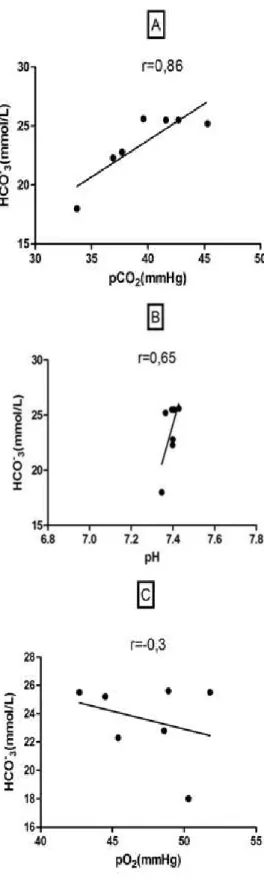
The correlations between bicarbonate and other variables at M0 and MF were shown in Figures 2 and 3. There was no pat-tern in the correlations between parameters.
Figure 2. Pearson correlation between pCO2 and HCO3-(A),
pH and HCO3-(B), pO
2 and HCO3
Figure 3. Pearson correlation between pCO2 and HCO3-(A),
pH and HCO3-(B), pO
2 and HCO3
- (C) after the exercise (MF). r = Pearson correlation coefficient.
DISCUSSION
Equestrian polo is a team sport, the matches are held outdoors and presents moments of sudden increases in speed, with fre-quent and sudden changes of direction, all these characteristics make it a unique sport, whose analyses of physiological de-mands are complex. In this study, mainly the choice of the
meth-ods proved effective, since there was no difficulty in carrying
out collections or samples analysis.
Regarding blood electrolytes Na+,Cl- andK+, there were no
sig-nificant changes between the times. This corroborates the find -ings of other studies performed with low handicap polo horses
(Bello et al., 2012), which detected no significant loss of body
weight after polo match, suggesting that the animals suffered
no significant dehydration, i.e., water loss, and consequent elec -trolyte loss. Physical activity promotes increased production of heat, and sweating is the main route of heat dissipation, and the sweat volume varies according to the duration and intensity of exercise (DiFilippo et al., 2009). In general there are no remark-able changes in electrolyte balance during maximum intensity exercise, due to the short period of this effort (Silva et al., 2009). In this way, the low handicap polo was not characterized as pro-longed or intense, unable to promote sweating that resulted in
significant depletion of ions.
The reduction in pCO2 was similar to that found in jumping
animals (Aguilera-Tejero et al., 2000) and polo animals (Ferraz et al., 2010). When the effort is prolonged the organism seeks ways to maintain homeostasis, with hyperventilation being an important mechanism. Thereby, at the moment immediately af-ter exercise, as there is no metabolic demand, elimination of CO2 through respiration exceeded the buildup that was produced during the exercise, lowering its level to below the resting level
(Aguilera-Tejero et al., 2000).
Despite the significant reduction, HCO3
- values were within the
physiological range considered for the species (20-28 mmol/L)
(Carlson et al., 1997). This reduction, similar to that observed in jumping animals, can be attributed to compensatory mecha-nisms related to hyperventilation due to the exercise (Aguilera-Tejero et al., 2000). For Ferraz et al. (2010), the significant
reduction of this parameter in high handicap animals, with the occurrence of metabolic acidosis, allowed classifying it as a high intensity exercise. The reduction in the concentration of HCO
3-in the low handicap polo could lead to metabolic acidosis, if it was not the compensation caused probably by the reduction of pCO2(Aguilera-Tejero et al., 2000). This situation can be under-stood by the requirement of the animals during the match.
There was no significant change in pH, between the times, evi -dencing the efficiency of compensatory mechanisms, such as the relationship between HCO3
- and pCO
2 in maintaining the pH
within a normal range during exercise. This corroborated the findings of Aguilera-Tejero et al. (2000) in jumping animals. The effort performed in low handicap polo match was not able to in-duce acid-base disturbance until the time of evaluation. Never-theless, with the increase in exercise intensity certainly acidosis would develop (Dumont et al., 2012).
Immediately after the match, the animals showed an increase in pO2 values, as also found by DiFilippo et al. (2009), when evaluated endurance animals, and Silva et al. (2009) in animals subjected to submaximal and maximal exercise on treadmill. Even considering different equestrian sports, it was possible to understand that the most likely cause of this increase was the alveolar hyperventilation in response to a decrease in the con-centration of HCO3-caused by physical activity (DiFilippo et al.,
2009).
The correlation between pCO2 and HCO3
- was positive and
high, and can be explained from the respiratory mechanism of pH control. Among the buffering mechanisms against rapid changes in pH, the one that responds more quickly is the res-piratory, acting as a bicarbonate/carbonic acid buffering system
(Kingston and Beyly, 2004). CO2 is transported in the blood in the form of a volatile acid, carbonic acid, and to turn into this acid, CO2 undergoes hydration. The carbonic acid then dissoci-ates into water (H2O) and bicarbonate (HCO3
-). When there is
excess acid in the blood, the bicarbonate from the dissociation of carbonic acid combines with free H+ ions, again forming the
carbonic acid which, by being in excess at that time, will dis-sociate into CO2 and H2O; the CO2 produced in this reaction is
Beyly, 2004). It was expected a high correlation between these factors, before and at the end of the exercise, indicating the ef-fectiveness of this mechanism to restrain metabolic changes, as demonstrated by the absence of changes in pH. It should be noted that the lack of linear correlation between pH e HCO3
-and
pO2 and HCO3- does not mean that there may be another type
of correlation between them, like the exponential (Figueiredo Filho and Silva Júnior, 2009).
When comparing the results between animals of low and high handicap (Ferraz et al., 2010), which showed metabolic disor-ders, it was possible to suppose that the exercise imposed to low handicap animals was not enough to induce acid-base and hydroelectrolytic imbalance. It should be emphasized that the high handicap animals underwent more intense physical train-ing, ensuring adaptation to the exercise. Thus it would be ex-pected that these animals better adapted to the type of exercise
would not show significant metabolic changes and, conversely,
those low handicap horses - theoretically less suited to the ef-fort practiced – would show such changes, which did not occur. Especially, the handicap is determined in relation to the ability of each horseman, so those less skilled require less from the athletic potential of the animal, i.e., less effort. Consequently, by promoting metabolic changes little striking when compared to animals used by horsemen with high handicap. In other words,
regardless of the animal adaptation to the type of effort
per-formed, it was observed that the human factor influenced on the
intensity of the effort performed by the animal.
Coinciding with Bello et al. (2012), the low handicap polo can be characterized as a sport of mixed intensity. However, Ferraz
et al. (2010), classified this as a high intensity activity, based on the significant reduction of HCO3
-, pCO
2 and pH. For Kingston
and Bayly (2004), only the measurement of pH, HCO3 - and pCO
2
without measuring the maximal oxygen consumption (VO2max),
it would be inaccurate to draw definite conclusions about the
intensity of the exercise. Otherwise, the exact determination of the degree of depletion of metabolic reserves and physical re-quirements of the animals should take as reference other vari-ables, such as the climatic ones.
CONCLUSION
The low handicap polo is classified as an exercise of short du -ration and varying intensity (mild to moderate), since there were no changes in hydroelectrolytic balance. The blood gas variations are related to the type of sport, or according to the variations in the ability of oxygen consumption of each animal. Thus, the type of exercise to which the animals were submitted
is compatible with their athletic fitness.
REFERENCE
Aguilera-Tejero, E., Estepa, J. C., López, I., Bas, S., Mayer-Valor, R., & Rodríguez, M. (2000). Quantitative analysis of acid–base balance in showjumpers before and after exercise. Research in veterinary science, 68(2), 103-108. | Bello, C. A., Dumont, C. B., Souza, T. C., Palma, J. M., Lima, E. M.,
Godoy, R. F., ... & Meryonne, M. (2012). Avaliação eletrocardiográfica de equinos após exercício de polo (baixo handicap). Pesquisa Veterinária Brasileira,32(1), 47-52. | Carlson, G. P.
(1997). Fluid, electrolyte, and acid-base balance. Clinical biochemistry of domestic animals, 5, 485-516. | Di Filippo, P. A., Gomide, L. M. W., Orozco, C. A. G., da Silva, M. A., Martins, C. B., de Lacerda Neto, J. C., & Santana, A. E. (2009). alterações hemogasométricas e eletrolíticas de cavalos da raça árabe durante prova de enduro de 60 km. Ciência Animal Brasileira, 10(3), 840-846. | Kowal, R. J., Cascardo, B., Summa, R. P., Cury, L. J., Neto, J. M., & Almosny, N. R. P. (2008). Avaliação dos valores gasométricos em cavalos (Equus caballus) da raça Puro-Sangue-Inglês (PSI) submetidos a teste de esforço em esteira ergométrica. Revista Brasileira de Ciência Veterinária,15(1). | Dumont, C. B., Leite, C. R., Moraes, J. M., Moreira, M.,
Moscardini, A. R., Godoy, R. F., & Lima, E. M. (2012). Osmolaridade, ânion gap, potencial hidrogênionico e íons plasmáticos mensuráveis de equinos Puro Sangue Árabe finalistas em
provas de enduro de 90 Km. Pesq. Vet. Bras, 32(6), 542-546. | de Farias, S. K., Ribeiro Filho, J. D., Donner, A. C., Dantas, W. D. M. F., & Gomes, C. L. N. (2011). Hemogasometria e ânion gap em equinos tratados com soluções eletrolíticas enterais contendo diferentes fontes de energia.Ciência Rural, 41(9), 1587-1592. | Ferraz, G. C., Soares, O. A. B., Foz, N. S. B., Perei-ra, M. C., & QUEIROZ-NETO, A. (2010). The workload and plasma ion concentration in a training match session of high-goal (elite) polo ponies. Equine Veterinary Journal,42(s38),
191-195. | Figueiredo Filho, D. B., & Silva Junior, J. A. (2010). Desvendando os Mistérios do Coeficiente de Correlação de Pearson (r). Revista Política Hoje,18(1). | Gondin, M. R.,