Extracellular polysaccharide production by a strain of
Pleurotus djamor
isolated
in the south of Brazil and antitumor activity on Sarcoma 180
Gisele Martini Borges
1, Fabiana Figueredo Molin De Barba
1, Ana Paula Schiebelbein
2,
Bruna Parmezzani Pereira
3, Mariane Bonatti Chaves
4, Marcia Luciane Lange Silveira
3,
Mauro Souza Leite Pinho
1, Sandra Aparecida Furlan
1,2,4,5, Elisabeth Wisbeck
2,4,5 1Mestrado em Saúde e Meio Ambiente, Universidade da Região de Joinville, Univille, Joinville, SC, Brazil.
2
Departamento de Engenharia Ambiental, Universidade da Região de Joinville, Univille, Joinville, SC, Brazil.
3
Departamento de Farmácia, Universidade da Região de Joinville, Univille, Joinville, SC, Brazil.
4
Departamento de Engenharia Química, Universidade da Região de Joinville, Univille, Joinville, SC, Brazil.
5
Mestrado em Engenharia de Processos, Universidade da Região de Joinville, Univille, Joinville, SC, Brazil.
Submitted: September 21, 2011; Approved: April 4, 2013.
Abstract
Polysaccharides with medicinal properties can be obtained from fruiting bodies, mycelium and cul-ture broth of several fungus species. This work was carried out in batch culcul-ture using a stirred tank re-actor with two different initial glucose concentrations (40-50 g/L) and pH values (3.0-4.0) to enhance extracellular polysaccharides production by Pleurotus djamorUNIVILLE 001 and evaluate anti-tumor effect of intraperitonial administration ofPleurotus djamorextract on sarcoma 180 animal model. According to factorial design, the low pH value (pH 3.0) led to a gain of 1.6 g/L on the extracellular polysaccharide concentration, while glucose concentration in the tested range had no significant effect on the concentration of polysaccharide. With 40 g/L initial glucose concentration and pH 3.0, it was observed that yield factor of extracellular polysaccharide on substrate (YP/S= 0.072) and maximum extracellular polysaccharide productivity (QPmax= 11.26 mg/L.h) were
about 188% and 321% respectively higher than those obtained in the experiment performed at pH 4.0. Under these conditions, the highest values of the yield factor of biomass on substrate (YX/S= 0.24) and maximal biomass productivity (QXmax= 32.2 mg/L.h) were also reached. In tumor
response study, mean tumor volume on the 21th day was 35.3 cm3in untreated group and 1.6 cm3in treated group (p = 0.05) with a tumor inhibition rate of 94%. These impressive results suggests an in-hibitory effect ofP.djamorextract on cancer cells.
Key words:Pleurotus djamor, extracellular polysaccharides production, antitumor activity.
Introduction
Natural products have been traditionally accepted as solutions to health, due to popular beliefs that they have fewer adverse effects (Mantovaniet al., 2008). Edible fungi have been widely used as functional foods and their extracts have been studied in natural therapy for prevention and
treat-ment of tumors, raising commercial interest (Firenzuoliet al., 2008).Pleurotussp. antitumor activity has been focused by several studies (Zhanget al., 2004; Gu and Sivam, 2006; Laviet al., 2006; Sarangiet al., 2006; Jedinak and Sliva, 2008; Wolffet al., 2008; Dalonsoet al., 2010).
The culture medium and conditions must be related to the nutritional needs of the microorganism and strongly
in-Send correspondence to E. Wisbeck. Master Program in Process Engineering, Department of Chemical Engineering and Department of Environmental Engineering. University of the Region of Joinville, 89.219-710 Joinville, SC, Brazil. E-mail: [email protected].
fluence the metabolite formation, such as the intracellular polysaccharides (Shihet al., 2006), the extracellular poly-saccharides (Hwanget al., 2003; Wisbeck, 2003; Gernet al., 2008; Shihet al., 2008; Furlanet al., 2009), and the bio-mass formation (Hwanget al., 2003; Wisbeck, 2003; Cho
et al., 2006; Shihet al., 2008).
Several research groups have been developing ex-periments in shake flasks or bioreactors using different fungi species in order to optimize the production of poly-saccharides by varying the concentration of nutrient sources and the growing conditions such as pH, tempera-ture and aeration (Hwanget al., 2003; Choet al., 2006; Shihet al., 2006; Furlanet al., 2008; Gern et al., 2008; Shihet al., 2008).
However, informations about nutritional require-ments and environmental conditions for submerged culture ofPleurotus djamorare still limited. In the present study the biomass and extracellular polysaccharide production by
P. djamorwas evaluated in batch culture, using a stirred tank reactor. The influence of initial glucose concentration and pH control on mycelial growth and polysaccharide pro-duction were demonstrated. Inhibitory effect ofP.djamor
extract on cancer cells was proven.
Materials and Methods
Microorganisms and inoculum preparation
P. djamorUNIVILLE 001, isolated in the garden of the University of the Region of Joinville - UNIVILLE, was maintained in Petri dishes at 4 °C on WDA (Wheat Dex-trose Agar) medium (Furlanet al., 1997). The inoculum was prepared in a 2 L Duran flask containing 400 mL of POL medium: (NH4)2SO4 5.0 g; MgSO4.7H2O 0.2 g;
K2HPO41.0 g; yeast extract 2.0 g; peptone 1.0 g; CaCO3
1.0 g; glucose 20 g in 1 L of distilled water (Cavazzoni and Adami, 1992). pH value was 6.5 - 7.0, and the medium was sterilized at 15 psi and 121 °C. The entire content of one Petri dish was used to inoculate each Duran flask. The flasks were incubated at 30 °C on a rotary shaker at 120 rpm, for six days (Wisbeck, 2003).
Extracellular polysaccharides and biomass production
A factorial design 22was used to evaluate the influ-ence of initial glucose concentration (40 and 50 g/L) and pH control (3.0 and 4.0) on biomass (X) and extra-cellular polysaccharide (P) production in batch cultivation. These conditions were selected based on the results ob-tained by Wisbeck (2003) showing thatP. ostreatus accu-mulated higher concentrations of extracellular polysaccha-rides with 40 g/L glucose and initial pH 4.
Culture medium composition was similar to that de-scribed in 2.1, except for glucose concentration (40 and 50 g/L). The medium was sterilized and inoculated with an inoculation ratio equal to 10% (v/v) and cultivated in a 5 L
stirred tank reactor (Biostat B, B. BRAUN, Germany) with 4 L working volume. The cultivation was performed under the following conditions: 30 °C, 0.25 L/min air flow and 300 rpm (initial KLa equal to 15 1/h) and pH 3.0 or 4.0
ac-cording to the experiment.
All experiments were performed in duplicate and the calculation of the kinetic parameters was based on the ki-netic profiles, using the data of both replications.
For the statistic analysis of the factorial design, the Paretos method was used (Barros Netoet al., 1996).
The culture broth was filtered, washed with distilled water and the retained biomass was dried at 60 °C for 48 h for the determination of the biomass dry weight.
The glucose concentration was determinated by the Enzyme-Glucose Test (Wiener Laboratórios, Bra-sil).
After biomass separation, 10 mL of the broth were treated with acetone cooled to 8 °C (3:1, v/v) (Rosadoet al., 2003), and maintained for 24 h under refrigeration (4 °C) for extracellular polysaccharide precipitation. The precipitate was centrifuged at 3373 g for 5 min. The supernatant was separated and the precipitate was washed twice, using an acetone:ethanol:distilled water solution (3:1:1, v/v/v) (Cavazzoni and Adami, 1992). The extra-cellular polysaccharide concentration was estimated in the precipitate by the phenol-sulfuric method (Duboiset al., 1956).
Polysaccharides extracts
Extracellular polysaccharides were produced in
Pleurotus djamorsubmerged culture in POL medium (sec-tion 2.2) with 40 g/L initial glucose and pH 3.0. Extrac(sec-tion (Pokhrel and Ohga, 2007) in which ethanol PA (4:1, v/v) was added to the culture broth and left for 24 hours at 4 °C, with the formed precipitate being separated by centrifu-gation and lyophilized. The obtained material was prepared in concentration of 10 g/L for 30 mg/kg doses in phosphate buffered saline solution (PBS 0.01 M, pH 7.0). These pa-rameters were established from a previous study comparing different methods of extraction, concentration and doses to determine the optimal antitumor effect.
Animal study
These were performed after following the protocol by the Ethics Committee of University of the Region of Join-ville (No. 031/2008) and were carried out in accordance with current guidelines for the Care and Use of Laboratory Animals - Commission on Life Sciences, National Re-search Council, 1996.
Tumor response study
Ten male Swiss albino mice were divided in two groups of five animals each, named Untreated Group mor induction with no treatment) and Treated Group (tu-mor induction with treatment).
Tumor induction and treatment
Sarcoma 180 (S180) tumor culture was obtained by courtesy from the Pharmacology Department from UNIVALI (Itajaí/SC/Brazil), and maintained through weekly intraperitoneal injections in male Swiss albino mice (Pagnoet al., 2006). Tumor induction was performed sub-cutaneously, in the back of each mouse from both Treated and Untreated Groups in a concentration of 25x106cel/mL, in 0.2 mL volume (Mizunoet al., 1999).
Polysaccharide extracts were administered intrape-ritoneally in the Treated Group for ten consecutive days, starting at 24 h after tumor induction (Zhanget al., 2004), in daily doses of 30 mg/kg of body weight. A PBS solution was applied intraperitoneally to Untreated Group at a dose of 10 mg/kg.
Assessment of tumor response
Animals were observed from 11th to 20th post-in-duction days. All mice were sacrificed on the 21thday and tumors were removed. Tumor weight (g) was obtained ac-cording to Misakiet al.(1984) and tumor volume (cm3) was calculated as proposed by Ajith and Janardhanan (2003) and Leeet al.(2003), through the equation (4/3)p(a2b)/2. Inhibition rate was calculated as [(C-T)/C]*100 (Zhanget al., 2004).
Results and Discussion
Extracellular polysaccharides and biomass production
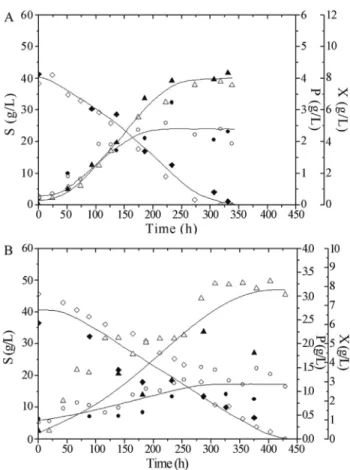
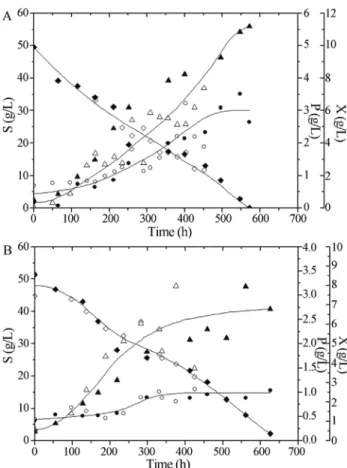
The kinetic profiles of glucose (S) consumption, bio-mass (X) growth and extracellular polysaccharide (P) pro-duction, obtained from experiments performed with 40 g/L initial glucose and pH 3.0, 40 g/L initial glucose and pH 4.0, 50 g/L initial glucose and pH 3.0, 50 g/L initial glucose and pH 4.0, are showed in Figure 1 (A and B) and 2 (A and B), respectively.
The time required for glucose consumption by P. djamorwas lower using 40 g/L initial glucose concentra-tion and pH value 3.0, when compared with the other tested conditions. It can also be observed that independent of the initial glucose concentration, the lower pH value (3.0) fa-vors glucose consumption.
Table 1 shows the kinetic parameters obtained for the tested conditions. With 40 g/L initial glucose concentra-tion, YP/Sand QPmaxobtained in the experiment conducted
at pH 3.0 were about 188% and 321% higher than those ob-tained at pH 4.0. In culture conducted with 50 g/L initial glucose concentration, YP/Sand QPmaxobtained at pH 3.0
were about 190% and 242% higher than those obtained at pH 4.0.
Comparing the kinetic parameters obtained at pH 3.0, it can be observed that 40 g/L initial glucose concentration promoted the highest yield factor and productivities in polysaccharides (YP/S = 0.072, QP = 9.337 mg/L.h and
QPmax =11.260 mg/L.h).
The initial glucose concentration equal to 40 g/L also favored QXand QXmaxindependent of the pH value. Using
this initial glucose concentration and pH 3.0, the highest values of YX/S(0.244), QX(31.4 mg/L.h) and QXmax(32.2
mg/L.h) were obtained.
Gernet al.(2008) investigated the extracellular poly-saccharide production byPleurotus ostreatusin a stirred tank reactor using KLa value equal to 10.2 1/h, pH 4.0 and
40 g/L initial glucose concentration. The kinetic parameters were: YP/S= 0.047 and QP= 7.01 mg/L.h. The values
re-ported by the authors for YP/Sand QPwere about 35% and
25% lower respectively when compared to the best results obtained in this work (for S0= 40 g/L and pH 3.0). The
au-thors did not evaluate the behavior of the microorganism in pH 3.0.
Bonattiet al.(2008) studied the production of extra-cellular polysaccharides by Pleurotus ostreatus in
continuous process with medium replacements of 50 and 75% in a bioreactor with 4 L working volume. 40 g/L initial glucose concentration, pH 4.0 and 50% medium replace-ment favored the production of polysaccharides (YP/S= 0.09 and QPmax= 9 mg/L.h) in the second cycle.
Ac-cording to the authors productivity was increased in nearly 30% compared to batch culture. YP/Sreached by the authors
was higher than that obtained in this study (0.072) using 40 g/L glucose and pH 3.0. However, QPmaxreached in this
study was about 25% higher than the value reported by the authors.
Wisbeck (2003) obtained withP. ostreatuscultivated in 40 g/L initial glucose concentration and pH 4.0:
DP = 1.32 g/L, YP/S= 0.081 and QP= 7.50 mg/L.h.
Com-paring the data obtained for the same culture conditions (40 g/L initial glucose concentration and pH 4.0) the author reached higher values than those obtained in this work. However, comparing the results reported by the author with those obtained in this study for pH 3.0, the last are higher forDP (59%) and QP(24%). The maximal specific growth
rate obtained by the author (0.022 1/h) is lower than that reached in this work (0.041 1/h).
Choet al.(2006) reached maximum biomass concen-tration equal to 10.4 g/L, maximal extracellular polysac-charide concentration of 3.05 g/L and YP/Sequal to 0.13 in 5
days cultivation of Tremella fuciformis in bioreactor. Hwanget al.(2003) obtainedDX = 11 g/L after 15 days cul-tivation and DP = 3.3 g/L after 14 days cultivation of
Phellinus linteusat pH 4.0. Both studies showed superior results than those observed in this study, but using different microorganisms.
In order to better evaluate the influence of initial glu-cose concentration (40 and 50 g/L) and pH value (3.0 and 4.0) onDX andDP a factorial design was done (Table 2).
Table 3 shows the effects of the variables S0and pH
on the mycelial biomass (DX) and the extracellular poly-saccharide (DP) formation. According to the results pre-sented in this Table, S0in the tested range as well as the
in-teraction between S0and pH, did not present any significant
effect on both mycelial biomass and extracellular
Figure 2- Kinetics of glucose consumption (S◆,à), biomass growth (X▲,D) and extracellular polysaccharide production (P●,❍) for the cultivation ofP. djamorusing 50 g/L initial glucose concentration and pH 3.0 (A) and pH 4.0 (B).
Table 1- Kinetic parameters forP. djamorcultivated with 40 and 50 g/L initial glucose concentration, pH 3.0 and 4.0, according to 22factorial design.
Kinetic parameters 40 g/L pH 3.0 40 g/L pH 4.0 50 g/L pH 3.0 50 g/L pH 4.0
DP (g/L) 2.110 0.760 2.530 0.560
DX (g/L) 7.110 6.990 9.880 5.730
DPm(g/L) 1.810 0.650 2.420 0.496
DXm(g/L) 6.470 6.440 10.630 3.800
YP/S 0.072 0.025 0.058 0.020
YX/S 0.240 0.230 0.228 0.206
QP(mg/L.h) 9.340 2.380 5.040 1.320
QX(mg/L.h) 31.400 21.970 19.680 13.540
QPmax(mg/L.h) 11.260 2.670 5.170 1.510
QXmax(mg/L.h) 32.200 22.190 20.020 15.830
t (h) 226 318 502 423
tmp(h) 161 242 467 328
polysaccharide concentration. However, pH has a negative significant effect on the extracellular polysaccharide for-mation. The lower pH value (pH 3.0) led to a gain of approximately 1.6 g/L on extracellular polysaccharide con-centration. The highest values of extracellular polysac-charide concentration (Table 2) were obtained using 40 g/L initial glucose and pH 3.0 (2.31±0.4 g/L) and 50 g/L initial glucose and pH 3.0 (2.15±0.9 g/L).
Wisbeck (2003) evaluated the effect of initial glucose concentration (20 and 40 g/L) and pH (4.0 and 6.0) on extracellular polysaccharide production by Pleurotus ostreatusin submerged culture. The initial glucose concen-tration of 40 g/L and the pH 4.0 maximized the production of extracellular polysaccharides by that microorganism. In this work, usingPleurotus djamorit was observed the same behavior for pH. However, the initial glucose concentration in the tested range had no significant effect on the extra-cellular polysaccharide formation by the speciesPleurotus djamor.
Several kinds of fungi have acidic optima pH during submerged cultures. Yang and Liau (1998) investigated the effects of environmental parameters on the extracellular polysaccharide production byGanoderma lucidumin sub-merged cultures. For the optimal pH (4.0-4.5) the polysa-ccharide concentration reached 1.6 g/L, a value lower than those found in this work at pH 3.0. Shu and Lung (2004) studied the effects of pH (3.0-6.0) on extracellular poly-saccharide concentration of Antrodia camphorata in a stirred tank fermenter. The optimum pH for this process was 5.0, with 0.118 g/L of extracellular polysaccharides, a
very low value when compared to the finds of this study. Shih et al. (2008) cultivated Grifola frondosa in shake flasks, at different initial pH (4.0-6.0). After 9 days cultiva-tion, the maximum extracellular polysaccharide concentra-tion (0.82 g/L) was obtained in culture grown at an initial pH 5.0. This value is also lower than the best ones ob-tained in this investigation.
These results evidence thatP. djamoris a potential microorganism for extracellular polysaccharide production mainly at pH 3.0 and the initial concentration of glucose 40g/L.
Tumor response
On the 21th day, mean tumor weight was 6.64 g in the Untreated Group and 0.37 g in the Treated Group (p = 0.05). Mean tumor volume was 35.3 cm3in the Un-treated Group and 1.6 cm3in the Treated Group (p = 0.05). A tumor inhibition rate of 94% was found (Table 4).
Antitumor activity of mushroom extracts have been reported by several authors as described in the review pub-lished by Mantovaniet al.(2008). Despiteb-glucan poly-saccharide has been regarded as the responsible agent for this effect, most of the related studies have used either crude extracts (Leeet al., 2003; Wonget al., 2007; Harhaji
et al., 2008) or a fraction of extracts (Ohno et al., 2001; Nakamuraet al., 2004; Sarangiet al., 2006; Unursaikhanet al., 2006).
In a detailed biomolecular study, Jedinak and Sliva (2008) analyzed the inhibitory effect of four different mushroom extracts on proliferative activity of breast and colon cancer cell cultures.Pleurotus ostreatusextract was found to present a most potent suppression of both breast and colon cancer cell proliferation, but no effect was ob-served on normal mammary or colonic cells.b-glucans are glucose polymers that differ from each other by a highly variable structure of length and branching. Their immune function is apparently related to the conformational com-plexity and it has been suggested that intensity of anti-cancer effects is associated to a higher degree of structural complexity (Bohn and BeMiller, 1995).
This is the rational to assess the anti-tumoral effect of different species ofb-glucan containing mushrooms. In the present study, we present the first investigation on the po-tential anticancer effects ofPleurotus djamorafter its isola-tion.
Table 2- Factorial design 22to study the effect of initial glucose concen-tration (S0) and pH values on the mycelial biomass (DX) and EPS (DP) concentrations.
Experiments S0(g/L) pH DX±sd* (g/L) DP±sd* (g/L)
1 40 3 6.86±1.5 2.31±0.4
2 40 4 6.28±2.2 0.73±0.3
3 50 3 7.86±2.6 2.15±0.9
4 50 4 5.60±0.3 0.56±0.02
*Standard deviation.
Table 3- Effects of the variables S0and pH on the mycelial biomass for-mation (DX) and maximal extracellular polysaccharide concentration (DP) by the factorial design.
Variables Effects
DX (g/L±SE*) DP (g/L±SE*)
pH (1) -1.42 ±1.33 -1.58 ±0.38**
S0(2) 0.16 ±1.33 -0.16 ±0.38
(1) and (2) -0.83 ±1.33 -0.00 ±0.38
*Standard error, **Statistically significance effect (95% confidence lim-its).
Table 4- Weight, volume tumor and inhibition rate for the treated and un-treated groups with polysaccharides extract ofP.djamor.
Groups Tumor weight (g±sd*)
Tumor volume (cm3±sd*)
Inhibition rate (%)
Treated 0.37±0.07 1.6±0.15 94
Untreated 6.64±1.19 35.37±12.16
The impressive results obtained in this pilot study suggests an inhibitory effect ofP.djamorextract on cancer cells and have encourage us to pursued in further efforts to assess its role in future benefits in the treatment of malig-nant diseases.
Acknowledgments
The group wishes to thank the Research and Support Fund - FAP from UNIVILLE for the financial backing for the project. The authors wish to express their gratitude to Dr. A. A. Steil and Dr. D. Sato, from UNIVALI, for donat-ing the tumor strain.
Nomenclature
a - The short diameter (mm2) b - The long diameter (mm2)
C and T - The tumor weight of the untreated group and the treated group, respectively
KLa - volumetric oxygen transfer rate
QP, QX- global productivities in extracellular
polysaccha-rides and biomass (for t = t)
QPmax, QXmax - maximum productivities in extracellular
polysaccharides (for t = tmp) and biomass (for t = tmx)
P, S, X - Product, substrate and biomass concentrations
DP,DX - extracellular polysaccharides and biomass formed until the stabilization of extracellular polysaccharide con-centration at its maximum value
DPm- extracellular polysaccharide concentration formed by
the time that productivity in extracellular polysaccharides is maximal
DXm- mycelial biomass concentration formed by the time
that productivity in biomass is maximal
t - time process, considered the time of the stabilization of extracellular polysaccharide concentration at its maximum value
tmp- time for QPmax
tmx- time for QXmax
YP/S, YX/S- global yield factors of extracellular
polysaccha-rides on substrate and biomass on substrate (for t = t)
References
Ajith TA, Janardhanan KK (2003) Cytotoxic and antitumor activi-ties of a polypore macrofungus, Phellinus rimosus(Berk) Pilat. J Ethnopharmacol 84:157-162.
Barros Neto B, Scarminio IS, Bruns RE (1996) Planejamento e otimização de experimentos. Editora Unicamp, Campinas, Brazil.
Bonatti M, Libardi Junior N, Borges GM, Wisbeck E, Furlan SA (2008) Produção de polissacarídeos extracelulares prove-nientes dePleurotus ostreatuspor processo semicontínuo. XVII Congresso Brasileiro de Engenharia Química, Recife, PE, p. 1-7.
Bohn JA, BeMiller JN (1995) (1-3)-b-Glucans as biological re-sponse modifiers: a review of structure-functional activity relationships. Carbohydr Polym 28:3-14.
Cavazzoni V, Adami A (1992) Exopolysaccharides produced by mycelial edible mushrooms. Ital J Food Sci 1:9-15. Cho EJ, Oh JY, Chang HY, Yun JW (2006) Production of
exopo-lysaccharides by submerged mycelia culture of a mushroom
Tremella fuciformis. J Biotechnol 127:129-140.
Dalonso N, Souza R, Silveira MLL, Ruzza AA, Wagner TM, Wisbeck E, Furlan, SA (2010) Characterization and antineo-plasic effect of extracts obtained fromPleurotus sajor-caju
fruiting bodies. Appl Biochem Biotechnol 160:2265-2274. Dubois M, Gilles KA, Hamilton JK, Rebers PA, Smith F (1956)
Colorimetric method for determination of sugars and related substances. Anal Chem 28:350-356.
Firenzuoli F, Gori L, Lombardo G (2008) The medicinal mush-roomAgaricus blazeiMurrill: review of literature and phar-maco-toxicological problems. eCAM 5:3-15.
Furlan SA, Gern RMM, Wisbeck E, Bonatti M, Silveira MLL, Silva HH (2008) Possibilities ofPleurotusapplications in food, health and environmental technologies.In: Koutinas, A., Pandey, A., Larroche, C. (eds). Current Topics on Bio-processes in Food Industry. Asiatech Publishers Inc, New Delhi, Indian, 482-495.
Furlan SA, Silveira MLL, Wisbeck E, Wolff ERS, Dalonso N, Ruzza AA, Pinho MSL (2009) Antitumor activity of
Pleurotus spp.In: Pandey, A., Larroche, C., Soccol, C.R., Dussap, C.G. (eds). New Horizons in Biotechnology. Asiatech Publishers Inc, New Delhi, Indian, 429-439. Furlan SA, Virmond LJ, Miers DA, Bonatti M, Gern RM, Jonas R
(1997) Mushrooms strains able to grow at high temperatures and low pH values. WorldJMicrobiol Biotechnol 13:689-692.
Gern RMM, Wisbeck E, Rampinelli JR, Ninow JL, Furlan SA (2008) Alternative medium for production of Pleurotus ostreatusbiomass and potential antitumor polysaccharides. Biores Technol 99:76-82.
Gu YH, Sivam G (2006) Cytotoxic effect of oyster mushroom
Pleurotus ostreatuson human androgen-independent pros-tate cancer PC-3 cells. J Med Food 9:196-204.
Harhaji L, Mijatovic S, Maksimovic-Ivanic D, Stojanovic I, Momcilovic M, Maksimovic V, Tufegdzic S, Marjanovic Z, Mostarica-Stojkovic M, Vucinic Z, Stosic-Grujicic S (2008) Anti-tumor effect of Coriolus versicolormethanol extract against mouse B16 melanoma cells: in vitroand in vivo
study. Food Chem Toxicol 46:1825-1833.
Hwang HJ, Kim SW, Choi JW, Yun JW (2003) Production and characterization of exopolysaccharides from submerged culture of Phellinus linteus KCTC 6190. Enz Microbial Technol 33:309-319.
Jedinak A, Sliva D (2008)Pleurotus ostreatusinhibits prolifera-tion of human breast and colon cancer cells through p53-dependent as well as p53-inp53-dependent pathway. Int J Oncol 33:1307-1313.
Lavi I, Friesem D, Geresh S, Hadar Y, Schwartz B (2006) An aqueous polysaccharide extract from the edible mushroom
Pleurotus ostreatusinduces anti-proliferative and pro-apop-totic on HT-29 colon cancer-cells. Cancer Lett 244:61-70. Lee YL, Kim HJ, Lee MS, Kim JM, Han JS, Hong EK, Kwon MS,
Mantovani MS, Bellini MF, Angeli JPF, Oliveira RJ, Silva AF, Ribeiro LR (2008)b-Glucan in promoting health: preven-tion against mutapreven-tion and cancer. Mutat Res 658:154-161. Misaki A, Kawaguchi K, Miyaji H, Nagae H, Hokkoku S, Kakuta
M, Sasaki T (1984) Structure of pestalotan, a highly branched (1-3)-b-D-glucan elaborated byPestalotiasp. 815, and the enhancement of its antitumor activity by polyol modification of the side chains. Carbohydr Res 129:209-227.
Mizuno M, Minato K, Ito H, Kawade M, Terai H, Tsuchida H (1999) Anti-tumor polysaccharide from the mycelium of liq-uid-cultured Agaricus blazeimill. Biochem Mol Biol Int 47:707-714.
Nakamura T, Matsugo S, Uzuka Y, Matsuo S, Kawagishi H (2004) Fractionation and anti-tumor activity of the mycelia of liquid-cultured Phellinus linteu. Biosci Biotechnol Biochem 68:868-872.
Ohno N, Furukawa M, Miura NN, Adachi Y, Motoi M, Yadomae T (2001) Antitumorb-glucan from the cultured fruit body of
Agaricus blazei. Biol Pharm Bull 24:820-828.
Pagno T, Blind LZ, Biavatti MW, Kreuger MR (2006) Cytotoxic activity of the dichloromethane fraction from Vernonia scorpioides(Lam.) Pers. (Asteraceae) against Ehrlich’s tu-mor cells in mice.Braz J Med Biol Res 39:1483-1491. Pokhrel CP, Ohga S (2007) Submerged culture conditions for
mycelial yield and polysaccharides production by
Lyophyllum decastes. Food Chem 105:641-646.
Rosado FR, Germano S, Carbonero ER, Costa SMG, Iacomini M, Kemmelmeier C (2003) Biomass and exopolysaccharide
production in submerged cultures of Pleurotus
ostreatoroseus SING. and Pleurotus ostreatus “florida” (JACK.: FR.) KUMMER. J Basic Microbiol 43:230-237. Sarangi I, Ghosh D, Bhutia SK, Mallick SK, Maiti TK (2006)
Anti-tumor and immunomodulating effects of Pleurotus ostreatus mycelia-derived proteoglycans. Int Immuno-pharmacol 6:1287-1297.
Shih IL, Chou BW, Chen CC, Wu JY, Hsieh C (2008) Study of mycelial growth and bioactive polysaccharide production in
batch and fed-batch culture of Grifola frondosa. Biores Technol 99:785-793.
Shih IL, Pan K, Hsieh C (2006) Influence of nutritional compo-nents and oxygen supply on the mycelia growth and bioacti-ve metabolites production in submerged culture ofAntrodia cinnamomea. Process Biochem 41:1129-1135.
Shu CH, Lung MY (2004) Effect of pH on the production and mo-lecular weight distribution of exopolysaccharide by
Antrodia camphoratain batch cultures. Process Biochem 39:931-937.
Unursaikhan S, Xu X, Zeng F, Zhang L (2006) Antitumor activi-ties of O-sulfonated derivatives of (1-3)-a-D-glucan from different Lentinus edodes. Biosci Biotechnol Biochem 70:38-46.
Wisbeck E (2003) Estudo do cultivo submerso de Pleurotus ostreatus DSM 1833 para a produção de biomassa e de exopolissacarídeos. Florianópolis, Brasil, 175p. (Dr. Thesis. Universidade Federal de Santa Catarina. UFSC).
Wolff ERS, Wisbeck E, Silveira MLL, Gern RMM, Pinho MSL, Furlan SA (2008) Antimicrobial and Antineoplasic Activity ofPleurotus ostreatus. Appl Biochem Biotechnol 151:402-412.
Wong SM, Wong KK, Chiu LCM, Cheung PCK (2007) Non-starch polysaccharides from different developmental stages of Pleurotus tuber-regiuminhibited the growth of human acute promyelocytic leukemia HL-60 cells by cell-cycle ar-rest and/or apoptotic induction. Carbohydr Polym 68:206-217.
Yang FC, Liau CB (1998) The influence of environmental condi-tions on polysaccharide formation byGanoderma lucidum
in submerged cultures. Process Biochem 33:547-553. Zhang M, Zhang L, Cheung PCK, Ooi VEC (2004) Molecular
weight and anti-tumor activity of the water-soluble polysac-charides isolated by hot water and ultrasonic treatment from the sclerotia and mycelia of Pleurotus tuber-regium. Carbohydr Polym 56:123-128.