FREE THEMES
1 Curso de Enfermagem, Universidade Estadual do Piauí. Av. Nossa Senhora de Fátima S/N, Bairro de Fátima. 64202-220 Parnaíba PI Brasil. thatymaranhao@ hotmail.com
2 Universidade Federal do Piauí. Teresina PI Brasil.
Impact of first sexual intercourse on the sexual and reproductive
life of young people in a capital city of the Brazilian Northeast
Abstract This study aimed to analyze the reper-cussion of first sexual intercourse on the number of pregnancies and partners of teenagers with obste-tric history in Teresina (PI), Brazil. This is a cros-s-sectional study with 464 young women selected by accidental sampling who gave birth at 15-19 years of age in the first four months of 2006 in six maternity hospitals of the municipality. Primary data was collected from May to December 2008 at the participants’ homes after tracking them in the hospital medical records. The univariate and bivariate analysis were performed by descriptive statistics and Pearson’s Correlation Coefficient Test or T-test, respectively. Tukey’s post hoc test was used as post hoc test and significant varia-bles on the bivariate analysis (p < 0.05) were also included in the multifactor analysis of variance model. Schooling (p < 0,001) and menarche’s age (p < 0,001) influenced the age of first sexual in-tercourse and this, in turn, showed significant ne-gative correlation (p < 0.01) with the number of partners and pregnancies of young women. Thus, the earlier the young women start sexual activity, the higher the number of pregnancies and sexual partners until the moment of their reproductive life. Thus, early first sexual intercourse had a
ne-gative repercussion on these variables.
Key words Sexual behavior, Pregnancy in ado-lescence, Sexual and reproductive health
Thatiana Araújo Maranhão 1
Keila Rejane Oliveira Gomes 2
Delvianne Costa de Oliveira 2
M
ar
anhão T Introduction
Adolescence is a life stage characterized by rapid growth, emergence of secondary sexual charac-teristics, personality structure, environmental adaptation and social integration. Adolescents attempt to detach themselves from the infantile phase to assume behaviors that transform them into a socially accepted adult. In this process of transformation, they become more aware of their own sexuality, which has been constructed throughout life through the interpersonal rela-tionships established between the individual and the environment in which they live as an oppor-tunity to develop their sexual interaction capaci-ty1. However, while the development of sexuality
is something natural and expected, young people have increasingly engaged in premature and risky sexual activities2,3.
For many young people who start their sex-ual life in adolescence, this event is perceived as an opportunity to express the exercise of auton-omy and sexual freedom, sensations that evi-dence a more emotional than rational meaning4.
However, many adolescents do not understand that this event also represents their most intense introduction in the group vulnerable to Sexually Transmitted Infections (STIs), unplanned preg-nancy and abortion5. Since they do not perceive
unsafe sexual practice risks, some adolescents experience this moment without worrying about the possible negative consequences that this event may cause6.
Evidence from national and international surveys shows that the onset of sexual life often occurs in adolescence7,8. Factors that influence
this event are related to the complex determinants that involve biopsychosocial issues. Anticipation of the first coitus is often associated with biolog-ical changes, such as early menarche9. In relation
to psychic development, the search for the defini-tion of sexual identity contributes to young peo-ple experiencing new sensations through sexual practices10. From the social point of view, studies
have shown that early engagement in sexual life is related to the economic level, schooling, reli-gion, group influence, gender social models and violence in its various aspects, increasing the vul-nerability of young people to factors that pose a risk to their health11,12.
Assuming risky behaviors that may jeopar-dize the sexual and reproductive health of young people can be evidenced from the onset of sexual
life, since young people have in the first sexual relationship a range of factors that predispose them to the inadvertent exercise of sexuality, such as early first sexual intercourse, inadequate use of contraceptive methods, lack of guidance on sexuality, poor ability to negotiate contracep-tive use, among others13-15.
The consequences of the factors mentioned above have reflected in the country’s fertility rates, which, while declining from 18.8% in the year 2000 to 17.7% in 2010 among adolescents aged 15-19 years, still highlight the participa-tion of this age group16. Data from the Brazilian
Institute of Geography and Statistics17 show that,
in 2006, 21.5% of all deliveries in Brazil were among adolescents aged 10-19 years, which cor-responds to one in five pregnant women. On the other hand, in the state of Piauí, 26% of total deliveries occurred in adolescents, a percentage higher than the national average.
In addition to early pregnancy, another wor-rying issue is the vulnerability of adolescents to STIs. Regarding new cases of people living with HIV who were notified in 2010, the incidence rate among young people of both genders 15-24 years was 9.5/100,000 inhabitants, representing a significant value of the national rate for all age groups, which was 17.9/100,00018.
In view of the above, it is observed that the problem of young people’s exposure to multiple sexual partners, in this study understood as two or more partners, together with the incorrect use or non-use of contraceptives are manifested from the onset of sexual life4,6. These risky
behav-iors can jeopardize the future of young people, with negative repercussions, among them, pre-cocious and unwanted pregnancy for that mo-ment, which, in turn, can cause school dropout and limit the entry of young people in the labor market6,13.
aúd
e C
ole
tiv
a,
22(12):4083-4094,
2017
Methodology
This is a cross-sectional study that underlies the research project entitled Pregnancy in
adoles-cence: relapse predictors [English translation of
Portuguese title], which was developed by the Nursing Department of the Federal University of Piauí. Data were collected from May to December 2008 among young people living in the urban area of Teresina, capital of Piauí, who complet-ed a pregnancy in the first four months of 2006, when they were 15 to 19 years old.
Considering that the study that originated this research aimed at analyzing the relapse of adolescent pregnancy, a retrospective search of young women was conducted in the databases of six maternity hospitals in the city, namely, five public and one private institution, two years after completion of pregnancy in 2006. The justifica-tion for this term arises from the WHO recom-mendation that advocates the ideal interpartal interval of at least two years, when the previous pregnancy resulted in a live fetus19.
According to records from the Department of Information Technology of the SUS (DATASUS), in 2006, there were 2,852 live children born to mothers aged 15-19 years, corresponding to 19.5% of all births of mothers residing in Teresina. Of this total, the proportion calculat-ed for the first four months of that year was 950 young women (36.8%). However, since all forms of pregnancy resolution would be included in the study, and some of them are not known in all their realms due to their underreporting, such as abortion, the calculation of the probabilis-tic sample would not be feasible. However, the probable sample estimate was about 1,000 cases, which allowed the researchers to decide that this number would be viable through the resources available for the implementation of the study. Thus, due to the limitation of being unable to use a probabilistic sample, we opted for the acciden-tal sampling, which consists of elements that can be located in a pre-determined period of time20.
Initially, young women were located through their identification in the maternity hospitals records. Then, a telephone contact was made to invite them to participate in the research. When telephone contact was not possible due to un-availability in the hospital records, but the address was available, two interviewers were sent to their home address. If they accepted to participate in the research, the semi-structured, pre-coded and pre-tested form was applied. In the event of any impediment to the application of the form at that
time, telephone numbers were requested for later contact and a new date and time of the interview-ers’ visit was scheduled.
The young women who were not found were listed so that, later, primary care nurses who worked in the teams corresponding to the area where the young woman was supposed to reside were asked to try to locate them with the Community Health Worker of the respective mi-cro-area. This same procedure was performed when neighbors of the young woman’s home address only reported the neighborhood she had moved to, without the new address. Thus, nurs-es from the PHC facility of the neighborhood where the girl allegedly moved to were asked to try to locate her.
Since search occurred through secondary data from maternity hospitals two years after their registration, it was expected that many cas-es would not be located. Another limitation of the study was the impossible access to curettage cases of the private institution, due to secrecy of this information. Thus, among the population of 632 young women from whom we could to locate information in hospital records, 464 responded to the form and 168 were considered lost cases. Losses occurred due to the non-location of 164 young women (despite all the strategies em-ployed), three refusals to participate in the study and one maternal death.
In order to achieve the objectives proposed for this study, the form contained questions that aimed to characterize the sociodemographic, re-productive and sexual profile of the young wom-en, such as schooling, employment, study, living with companion, number of pregnancies and sexual partners. Other variables that character-ize first sexual intercourse were also considered, among them the sexarche’s age group, which corresponds to the first sexual intercourse4; time
elapsed between the beginning of the relation-ship with the partner and sexarche; if she re-ceived parental and school guidance before first sexual intercourse; if she sought health services for sexual guidance; if contraceptive was used at the first intercourse and method used.
After collection, data were entered into the Epi info 6.04d software (US Centers for Disease Control and Prevention, Atlanta, GA) in two data-bases, by different people, to allow the detection of inconsistencies and corrections. Statistical and in-ferential analysis was done through the Statistical Package for Social Sciences version 18.0.
M
ar
anhão T characteristics, sociodemographic and
reproduc-tive variables. In the bivariate analysis, Pearson’s chi-square test (χ2) or t-test for independent
samples were used, as appropriate, to test pos-sible associations between the age of first sexual intercourse (dependent variable) and sociode-mographic, reproductive and first sexual inter-course characterization variables (independent variables)20.
Variables with a significant association in the bivariate analysis (p<0.05) with age at the time of the first sexual intercourse were includ-ed in the Multifactor Analysis of Variance model. This model is used to identify predictive factors that could influence the age of first sexual inter-course21. When means of the age of first sexual
in-tercourse were different from each other, Tukey’s post hoc test was used to show the significant differences between the tested values for more than two groups20. Below Table 3 are the possible
comparisons between any two combinations of involved categories duly pointed out to compari-sons in which there is significant difference.
Pearson’s correlation coefficient was used to evaluate possible repercussions of the age of first sexual intercourse on the number of partners and pregnancies of young women until the mo-ment of the interview. Thus, values of r = 1 or r = -1 were established as parameters, so the closer the extreme values are, the greater the linear as-sociation between variables22.
In order to comply with all the ethical and legal requirements of research with human beings, according to resolution 196/96 of the National Health Council, the major project that corresponds to this study was submitted and ap-proved by the Research Ethics Committee (CEP) of the Federal University of Piauí under CAAE n ° 0056.0.045.000-08. All participants in this re-search were asked to sign the Informed Consent Form (ICF). The signature of the ICF was made by the legal guardian when the girl was under 18 years of age. In addition, before data collection onset, authorization was requested for access to participants’ data to the managers of the state institution, the Municipal Health Foundation, manager of the Unified Health System in Teresina and the private hospital’s board.
Results
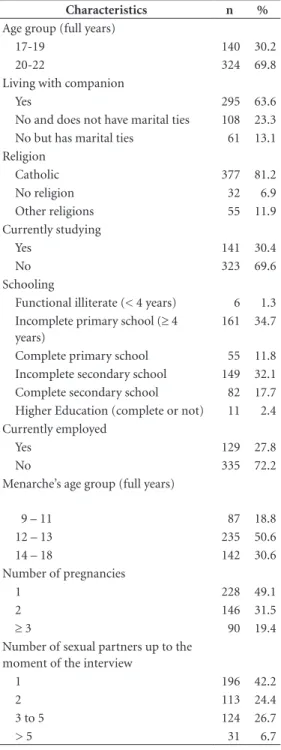
Most of the young women lived with their com-panion (63.6%), declared themselves Catholic (81.2%) and belonged to the age group
20-22 years (69.8%), with a mean age of 20 years (SD = 1.31). At the time of the interview, two out of three young women no longer attended school (69.6%) (Table 1). This was defined as school dropout, and of those who dropped out of school, none enrolled at the university and more than half (56.3%) interrupted their studies while still in elementary school (data not shown in Tables). Regarding employment, 72.2% stated that they did not engage in paid work. Of these, 67.2% did not work or study (data not shown in Tables).
Table 1 shows that 50.6% of the participants reported having menstruated for the first time at 12-13 years of age, and the mean age of menarche was 12.8 years (SD = 1.49). Almost one in five young women had been pregnant at least three times (19.4%) and 49.1% were primigravidas. Regarding the number of sexual partners up to the time of the interview, 42.2% of the respon-dents reported that they had a single sexual part-ner.
The young women’s first sexual intercourse varied from 9 to 19 years, with a mean age of 15.32 years (SD = 1.59). The first coitus occurred in the 16-17 years age range for 38.6% of the young women. Relationship time with the first sexual partner until the beginning of the sexu-al activities was above one year for most of the participants (53.8%). Guidance on how to avoid pregnancy and STIs before the first sexual inter-course was more often given at school (72.2%) than by parents (42.5%). More than half of the young women reported not having sought coun-seling at the health service before having the first sexual intercourse (78.0%) and used some con-traceptive at the first intercourse (55.6%), and the male condom was the most commonly used method (89.1%) (Table 2).
In the bivariate analysis, the variables related to religion (p = 0.162), work (p = 0.573), ado-lescent pregnancy among siblings of the partic-ipant (p = 0.483) and sexual guidance received from the parents (p = 0.937) before the onset of sexual activities did not show a statistically signif-icant association with the age of the first sexual intercourse. However, schooling (p < 0.001), age at menarche (p = 0.0001), dating time with the first sexual partner (p = 0.001), sexual guidance at school (p = 0.001) and at the health service (p = 0.005) were significantly associated with the age of first sexual intercourse (Data not shown).
includ-aúd
e C
ole
tiv
a,
22(12):4083-4094,
2017
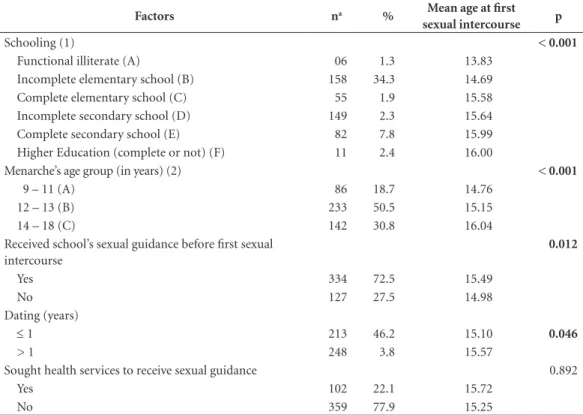
ed in the multifactor analysis of variance model, which identifies the predictive factors that in-terfere in the age of the first sexual intercourse. The following were significant to onset of sexual life: schooling (p < 0.001), age at menarche (p <
0.001), dating time with the first sexual partner (p = 0.046) and sexual guidance at school (p = 0.012). However, sexual guidance of health ser-vices (p = 0.892) was not significantly associated with onset of sexual activities (Table 3).
Tukey’s post hoc test applied to schooling showed that the mean age of the sexarche is sig-nificantly lower for participants who, at the time of data collection, stated that they were func-tionally illiterate (13.83), with the mean age of the first coitus increasing progressively as the schooling of young women also increased, reach-ing 16.00 years when the participant referred to higher education or not. The test also showed that menarche occurring in the two early age groups (9-11/12-13) had a significantly
differ-Table 2. Characterization of the first sexual
intercourse of young women with gestational experience in Teresina (PI), Brazil. 2008.
Characteristics n %
Age group of first sexual intercourse
9-14 136 29.3
15 113 24.4
16-17 179 38.6
18-19 36 7.7
Time elapsed between onset of relationship and first sexual intercourse (years)a
≤ 1 213 46.2
> 1 248 53.8
Received parents’ sexual guidance before first sexual intercourse
Yes 197 42.5
No 267 57.5
Received school’s sexual guidance before first sexual intercourse
Yes 335 72.2
No 129 27.8
Sought health services to receive sexual guidance
Yes 102 22.0
No 362 78.0
Use of CMb in the first sexual intercourse
Yes 258 55.6
No 206 44.4
CM use in the first sexual intercourse
Male condom 230 89.1
Other 28 10.9
a Three young rape victims at the first intercourse were excluded. b CM: Contraceptive Method.
Table 1. Distribution of young women with
gestational history according to sociodemographic, reproductive and sexual aspects in Teresina (PI), Brazil. 2008.
Characteristics n %
Age group (full years)
17-19 140 30.2
20-22 324 69.8
Living with companion
Yes 295 63.6
No and does not have marital ties 108 23.3
No but has marital ties 61 13.1
Religion
Catholic 377 81.2
No religion 32 6.9
Other religions 55 11.9
Currently studying
Yes 141 30.4
No 323 69.6
Schooling
Functional illiterate (< 4 years) 6 1.3 Incomplete primary school (≥ 4
years)
161 34.7
Complete primary school 55 11.8
Incomplete secondary school 149 32.1
Complete secondary school 82 17.7
Higher Education (complete or not) 11 2.4
Currently employed
Yes 129 27.8
No 335 72.2
Menarche’s age group (full years)
9 – 11 87 18.8
12 – 13 235 50.6
14 – 18 142 30.6
Number of pregnancies
1 228 49.1
2 146 31.5
≥ 3 90 19.4
Number of sexual partners up to the moment of the interview
1 196 42.2
2 113 24.4
3 to 5 124 26.7
M
ar
anhão T ent mean of first sexual intercourse from the age
group reporting later menarche (14-18). In ad-dition, the age of onset of sexual life was higher among young women with late menarche, com-pared to those whose first menstruation occurred at earlier ages (Table 3).
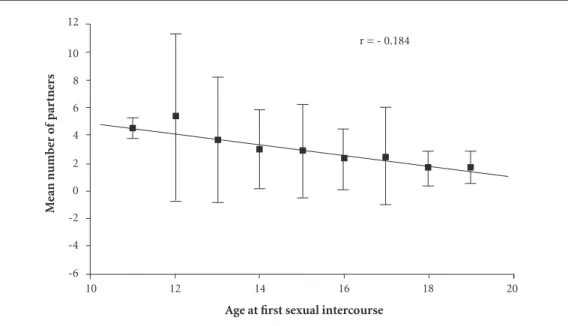
The age of first sexual intercourse showed sig-nificant negative correlation (p < 0.01) with the number of partners (Graphic 1) and pregnancies of young girls until the interview (Graphic 2). This shows that the earlier the young woman’s first sexual intercourse age, the greater the num-ber of pregnancies and sexual partners, and vice versa. The mean number of sexual partners and pregnancies up to the moment of the interview showed a statistically significant correlation (p < 0.0001) (data not shown in Charts). While all correlations were significant, the value of the cor-relation coefficient was distant from the extreme values of the correlation coefficient (r = -1 or r = 1).
Discussion
The results showed that young women with a gestational history began their sexual life at an early age, which resulted in greater exposure to multiple partners and pregnancies in adoles-cence. Anticipation of first sexual intercourse has been pointed out as a relevant factor for a series of negative implications in the life of young peo-ple, such as exposure to STIs23, unplanned
preg-nancies24, alcohol abuse and tobacco use23. These
implications suggest the need to adopt health ed-ucation strategies so that young people are sensi-tized to postpone the onset of sexual life.
As important as the problem of early first sexual intercourse and its harmful repercussions is whether the adolescent uses some contracep-tive method during her first experience. It was observed that a significant portion of young women in this study abstained from using the Contraceptive Method (CM) at their first sexu-al intercourse. This is particularly worrisome, as some people argue that young people’s decisions
Table 3. Multifactor analysis of variance of predicting factors associated with the age of first sexual interaction of
young women with a gestational history. Teresina (PI), Brazil, 2008.
Factors na % Mean age at first
sexual intercourse p
Schooling (1) < 0.001
Functional illiterate (A) 06 1.3 13.83
Incomplete elementary school (B) 158 34.3 14.69
Complete elementary school (C) 55 1.9 15.58
Incomplete secondary school (D) 149 2.3 15.64
Complete secondary school (E) 82 7.8 15.99
Higher Education (complete or not) (F) 11 2.4 16.00
Menarche’s age group (in years) (2) < 0.001
9 – 11 (A) 86 18.7 14.76
12 – 13 (B) 233 50.5 15.15
14 – 18 (C) 142 30.8 16.04
Received school’s sexual guidance before first sexual intercourse
0.012
Yes 334 72.5 15.49
No 127 27.5 14.98
Dating (years)
≤ 1 213 46.2 15.10 0.046
> 1 248 3.8 15.57
Sought health services to receive sexual guidance 0.892
Yes 102 22.1 15.72
No 359 77.9 15.25
aúd
e C
ole
tiv
a,
22(12):4083-4094,
2017
about contraceptive practices are taken at the onset of sexual life, since those who used some method at first intercourse are less likely to have an unwanted pregnancy and therefore more likely to be using CM in the last sexual relationship25. In
addition, research conducted in the United States
with secondary data from the National Survey of Family Growth for the period 1984-2010 showed that girls who had their first sexual intercourse at age 14 or younger are less likely to have used con-traception at first sexual intercourse and tend to take more time to start using it26.
Graphic 1. Pearson correlation coefficient between the age of first sexual intercourse and the mean number of
partners of young women with gestational history. Teresina (PI), Brazil, 2008.
Age at first sexual intercourse
M
ean n
umb
er o
f par
tne
rs
r = - 0.184
10 12 14 16 18 20
-6 -4 -2 0 2 4 6 8 10 12
Graphic 2. Pearson correlation coefficient between the age of first sexual intercourse and the mean number of
pregnancies of young women with gestational history. Teresina (PI), Brazil, 2008.
Age at first sexual intercourse
M
ean n
umb
er o
f pr
eg
nancies
10 12 14 16 18 20
-1 0 1 2 3 4 5 6
M
ar
anhão T The decision to postpone or anticipate
sexu-al life is not sexu-always the result of own will; many young women build on prevailing social norms that advocate sexual initiative as a masculine pre-rogative, and it is up to women to resist for as long as possible and then to give in27. This fact
could justify the reason why a significant portion of young women had the first intercourse with penetration after a year of relationship with the partner. In other situations, the idealization of first sexual intercourse as an inevitable event of the long-lasting relationship contributes to young people giving in early for fear of losing their boy-friend due to their virginity or for fear that he may engage in another relationship28. Therefore,
it is crucial to have a greater debate on issues re-lated to dating to ensure egalitarian relationships within the couple so that they may decide togeth-er the appropriate time to start sexual practices.
Anticipating or postponing the onset of sex-ual practice among young women of this study suffered interference from schooling, the men-arche’s age and access to information related to sexuality at school. Young women with higher ed-ucation postponed their first intercourse at least two years, on average, when compared to those with lower schooling. A study conducted in Rio Grande do Sul showed that the lower the school-ing level, the greater the risk for early sexual ac-tivity, since young people with up to four years of schooling were 41% at greater risk of having started early in comparison to those with 12 years or more of study11. From this perspective, access
to the educational system allows young people a space to obtain information that covers issues es-sential to their well-being, propitiating the adop-tion of healthy sexual behaviors29.
The occurrence of menarche increased the likelihood of sexual initiation among young women. For some societies, menstruation rep-resents physical maturity, the transition to adult-hood and, in some cultures is marked by rituals of sexual initiation9. However, sexual maturity
acquired during this period does not occur con-comitantly with psychological and social maturi-ty4, which is why the first menstruation at an
ear-ly age has been associated with a higher incidence of pregnancy in adolescence30.
Receiving school’s sexual guidance proved to be a favorable factor in postponing the first sexual intercourse. A study showed that adoles-cents who received the first information about pregnancy and contraception were less likely to become pregnant31, and those who received
guid-ance on sexual abstinence and birth control were
significantly more likely to use CM at the first intercourse32. Conversely, adolescents who do
not receive sex education tend to take risky be-haviors, such as early first sexual intercourse and multiple sexual partners33, which demonstrates
the school’s extreme importance in directing beneficial behaviors among young people.
However, school should not be the only insti-tution responsible for encouraging young people to assume responsibility for a healthy sex life, since the involvement of the family and health services is also of paramount importance. Regrettably, this partnership was not evidenced in this study, be-cause in addition to the lack of family participa-tion in the debate on issues related to the STIs and pregnancy prevention, many young women also did not use health services as a source of informa-tion. This fact contradicts research recommenda-tions that health professionals should advise ado-lescents on the correct use of CMs before they be-come sexually active as an effective way of avoid-ing unwanted pregnancies in this age group15,26.
While the importance of approaching sexu-ality issues is acknowledged by parents, their dis-information about the topic or the very lack of knowledge about the sexual life of their children contributes to hindering dialogue between young people and their family34. Lack of openness to
talk about sex with their parents may influence young people to engage in risky behaviors, be-cause when they are unable to clarify their doubts with their parents, they tend to look for friends who often have inaccurate or incomplete infor-mation6. However, when parental monitoring is
appropriate, children are more likely to postpone the onset of sexual practices, as they will be better prepared for this event35.
The difficulty in addressing young people’s sexuality is not only found in the family. Studies show that the fear of judgments and the lack of confidentiality of information by health profes-sionals36, as well as their inability to meet the
needs of young people, results in the distancing of this group from health centers. The delay in seeking health services after the onset of sexual life may represent a period of continued risk, which interferes with the sexual and reproductive health of adolescents15.
aúd
e C
ole
tiv
a,
22(12):4083-4094,
2017
lack of contraceptive use has occurred since the first sexual intercourse, which may have persist-ed in subsequent intercourse, as about half of the participants had had at least one recurrence of pregnancy at the time of the interview. This find-ing suggests that the attitude of the woman in the first sexual experience can jeopardize the sexual behavior in the course of her life25,26.
For each two young participants, one was a repeat offender and one in five had had at least three pregnancies at the time of the interview. Recurrent pregnancies in this stage of life are a worrying situation, given that, for each preg-nancy, young women’s probability of completing their studies, having a job and being economical-ly independent are considerabeconomical-ly reduced. Failure to access essential conditions for personal growth contributes to social exclusion that can be per-petuated throughout life13,15,38,39.
It was evidenced that the anticipation of first sexual intercourse was significantly associated with the greater number of sexual partners, as well as the greater risk for pregnancy among the young women interviewed. This anticipation de-serves attention, given that more than a quarter of the participants in this study had their first sexual intercourse until the age of fourteen. This result was also observed in a study that analyzed the recurrence of adolescent pregnancy in the state of Ceará, where the exchange of partners was associated with a risk condition for subse-quent pregnancy, increasing the probability of a new pregnancy40 by about 40%. Another study
with adolescents from four Nordic countries found that the odds of reporting more than ten lifetime sexual partners were four times higher among women reporting early onset of sexual intercourse compared to those reporting age over 14 years on the occasion of the first intercourse23.
Association between the diversity of partners and exposure to pregnancies may be related to the difficulty of negotiating contraceptive use with each new relationship. It has been shown that women’s lack of power restricts their ability to make decisions about family planning prac-tice, as well as to have an open discussion with their partners about this issue41. Women’s lack of
confidence in their decision-making power con-tributes to having many relationships marked by gender inequalities, which interferes with the negotiation of contraceptive use, increasing the likelihood of unsafe sexual practices14.
Among the young women who reported a sin-gle sexual partner, most lived in a stable relation-ship. This means that the first sexual intercourse
occurred with the father of their child. The estab-lishment of formal ties due to pregnancy is still a reality in our society. Pregnancy is associated with family pressure in order to consummate the couple’s relationship42. By matching family’s
ex-pectations, young women manage to alleviate the embarrassment of unplanned pregnancy39. From
this perspective, we can infer that early marriage may have contributed to a reduced number of sexual partners.
It should be noted that, despite significant association between the number of partners and pregnancies, the correlation coefficient was low. This means that one variable does not explain alone the other variable. Thus, it is necessary to have a better understanding of the socioeco-nomic and cultural context in which these young women are inserted, since this reality has a strong influence on their way of thinking and acting vis-à-vis their own sexuality.
The inclusion of only young women with obstetric history was a limitation to the study because it was not possible to compare them to young women with no gestational history. However, it is important to note the various dif-ferences in the sexual history of young women who have become pregnant, as it was observed that, for some participants, the negative reper-cussions of first sexual intercourse in the first years of their reproductive life were much more significant, translated by the greater number of sexual partners and pregnancies.
Conclusion
We conclude that the earlier the onset of sexual intercourse, the greater the negative impact on the reproductive and sexual life of young wom-en, represented by the higher number of preg-nancies and sexual partners, respectively. Some variables had an important influence on the on-set of young women’s sexual activities. The lower level of schooling was a determinant for the first coitus at earlier ages, since those who reported being functional illiterates started sexually earli-er in comparison to those who reported having completed higher education or not. Similarly, premature menarche, lack of school sexual guid-ance prior to the first intercourse and dating time with the first sexual partner of less than one year also influenced the occurrence of the first sexual intercourse at earlier ages.
M
ar
anhão T sexual activities, pregnancy prevention and STIs.
The achievement of this objective will be possi-ble through the formulation of public policies that consider not only the individual perspective, but also the biopsychosocial context in which these young people are inserted. It is necessary to provide the appropriate conditions for young people to show positive attitudes vis-à-vis sexual practices. Thus, these actions are expected to be inclusive, involving the family and health services so that all young people gain access to quality in-formation and to contraceptive methods to exer-cise their sexuality safely without harming their future.
It is also worth mentioning the crucial role of school in promoting sexual education among young people. However, young women’s school dropout is observed, especially when they be-come pregnant and mothers, which prevents them from continuing to enjoy this important source of information. Thus, it is necessary to ensure that young women with a history of preg-nancy return, as soon as possible, to the school environment so as not to increase their vulnera-bility to risky behaviors marked by unsafe sexual practices, favoring the recurrence of unwanted pregnancies, which could further compromise their future.
Collaborations
aúd
e C
ole
tiv
a,
22(12):4083-4094,
2017
References
1. Ximenes Neto FRG, Dias MAS, Rocha J, Cunha ICKO. Gravidez na adolescência: motivos e percepções de adolescentes. Rev bras enferm 2007; 60(3):279-285. 2. Ryu E, Kim K, Kwon H. Predictors of sexual intercourse
among korean adolescents. J Sch Health 2007; 17:615-622.
3. Melo Neto OC, Cerqueira-Santos E. Comportamento sexual e autoestima em adolescentes. 2012; Contextos Clínic 5(2):100-111.
4. Krauss H, Bogdanski P, Szulinska M, Malewski M, Buraczynska-Andrzejewska B, Sosnowski P, Piatek J, Demont C, Kaczmarek E, Kaczmarek C, Szpakow A, Kleszczewska E, Maciorkowska E, Klimberg AJ, Mikrut K. Sexual initiation of youths in selected European countries compared with their sexual and contracepti-ve knowledge. Ann Agric Environ Med 2012; 19(3):587-592.
5. Stockl H, Kalra N, Jacobi J, Watts C. Is early sexual de-but a risk factor for HIV infection among women in sub-Saharan Africa? A systematic review. Am J Reprod Immunol 2013; 69(Supl. 1):27-40.
6. Moura LNB, Gomes KRO, Rodrigues MTP, Oliveira DC. Informação sobre contracepção e sexualidade en-tre adolescentes que vivenciaram uma gravidez. Acta Paul Enferm 2011; 24(3):320-326.
7. Malta DC, Silva MAL, Mello FCM, Monteiro RA, Porto DL, Sardinha LMV, Freitas PC. Saúde sexual dos ado-lescentes segundo à Pesquisa Nacional de Saúde dos Escolares. Rev Bras Epidemiol 2011; 14(Supl. 1):147-156.
8. Sweeting H, Jackson C, Haw S. Changes in the so-cio-demographic patterning of late adolescent health risk behaviours during the 1990s: analysis of two West of Scotland cohort studies. BMC Public Health 2011; 11:1-15.
9. Glynn JR, Kayuni N, Floyd S, Banda E, Francis-Chizororo M, Tanton C, Molesworth A, Hemmings J, Crampin AC, French N. Age at menarche, schooling, and sexual debut in Northern Malawi. PLoS One 2010; 5(12):1-8.
10. Ma Q, Ono-Kihara M, Cong L, Xu G, Pan X, Zamani S, Ravari SM, Zhang D, Homma T, Kihara M. Early initiation of sexual activity: a risk factor for sexually transmitted diseases, HIV infection, and unwanted pregnancy among university students in China. BMC Public Health 2009; 9(1):1-9.
11. Hugo TDO, Maier VT, Jansen K, Rodrigues CEG, Cruzeiro ALS, Ores LC, Pinheiro RT, Silva R, Souza LDM. Fatores associados à idade da primeira relação sexual em jovens: estudo de base populacional. Cad Saude Publica 2011; 27(11):2207-2214.
12. Berquó E, Garcia S, Lima L. Reprodução na juventu-de: perfis sociodemográficos, comportamentais e re-produtivos na PNDS 2006. Rev Saude Publica 2012; 46(4):685-693.
13. Gomes KRO, Speizer IS, Oliveira DC, Moura LNB, Gomes FM. Contraceptive method use by adolescents in Brazilian state capital. J Pediatr Adolesc Gynecol 2008; 11(4):213-219.
14. Bui TC, Markham CM, Ross MW, Williams ML, Beasley RP, Tran LTH, Nguyen HT, Le TN. Perceived gender inequality, sexual communication selfefficacy, and sexual behaviour among female undergraduate students in the Mekong Delta of Vietnam. Sex Health 2012; 9(4):314-322.
15. Moura LNB, Gomes KRO. Planejamento familiar: uso dos serviços de saúde por jovens com experiência de gravidez. Cien Saude Colet 2014; 19(3):853-863. 16. Instituto Brasileiro de Geografia e Estatística (IBGE).
Censo demográfico-2010. Brasília: IBGE; 2010. 17. Instituto Brasileiro de Geografia e Estatística (IBGE).
Indicadores Sociodemográficos e de Saúde no Brasil 2009. Brasília: IBGE; 2009.
18. Brasil. Ministério da Saúde (MS). Boletim epidemioló-gico–AIDS e DST. Brasília: MS; 2012.
19. World Health Organization (WHO). Report of WHO technical consultation on birth spacing. Geneva: WHO; 2005.
20. Downing D, Clarck J. Estatística aplicada. São Paulo: Editora Saraiva; 2000.
21. Ho R. Handbook of univariate and multivariate data analysis and interpretation with SPSS. London: Chapman & Hall, CRC; 2006.
22. Pestana MH, Gageiro JN. Análise de dados para ciências sociais:a complementaridade do SPSS. 3ª ed. Lisboa: Edições Sílabos; 2003.
23. Olesen TB, Jensen KE, Nygârd M, Tryggvadottir L, Sparén P, Hansen BT, Liaw KL, Kjaer SK. Young age at first intercourse and risk-taking behaviours: a study of nearly 65.000 women in four Nordic countries. Eur J Public Health 2012; 22(2):220-224.
24. Tenkorang Y, Maticka-Tyndale E. Factors influencing the timing of first sexual intercourse among young people in Nyanza, Kenya. Int Fam Plan Perspect 2008; 34(4):177-188.
25. Li J, Li S, Yan H, Xu D, Xiao H, Cao Y, Mao Z. Early sex initiation and subsequent unsafe sexual behaviors and sex-related risks among female undergraduates in Wuhan, China. Asia Pac J Public Health 2015; 27(Supl. 2):21S-29S.
26. Finer LB, Philbin JM. Sexual initiation, contracep-tive use, and pregnancy among young adolescents. Pediatrics 2013; 131(5):1-6.
27. Moreira MRC, Santos JFFQ. Entre a modernidade e a tradição. A iniciação sexual de adolescentes piauienses universitárias. Esc Anna Nery 2011; 15 (3):558-566. 28. Borges ALV, Nakamura E. Normas sociais de iniciação
sexual entre adolescentes e relações de gênero. Rev. Latino-am. Enfermagem 2009; 17(1):58-76.
29. Ishida K, Stupp P, McDonald O. Prevalence and cor-relates of sexual risk behaviors among jamaican adoles-cents. Int Perspect Sex Reprod Health 2011; 37(1):6-15. 30. Viellas EF, Gama SGN, Theme Filha MM, Leal MC.
M
ar
anhão T 32. Lindberg LD, Maddow-Zimet I. Consequences of sex
education on teen and young adult sexual behaviors and outcomes. J Adolesc Health 2012; 51(4):332-338. 33. Esere MO. Effect of sex education programme on
at-risk sexual behaviour of schoolgoing adolescents in Ilorin, Nigéria. Afr Health Sci 2008; 8(2):122-127. 34. Palatni A, Seidman DS. Survey of opinions of mothers
and teenage daughters on sexual behavior and contra-ception: descriptive study and literature review. Int J Womens Health 2012; 4(1):265-270.
35. Manlove, J, Wildsmith E, Ikramullah E, Terry-Humen E, Schelar E. Family environments and the relationship context of first adolescent sex: Correlates of first sex in a casual versus steady relationship. Soc Sci Res 2012; 41(4):861-875.
36. Carvacho IE, Mello MB, Morais SS, Silva JLP. Fatores associados ao acesso anterior à gestação a serviços de saúde por adolescentes gestantes. Rev Saude Publica 2008; 42(5):886-894.
37. Baumgatner JN, Gery CW, Wedderburn M. The influ-ence of early sexual debut and sexual violinflu-ence on ad-olescent pregnancy: a matched case-control study In Jamaica. Int Perspect Sex Reprod Health 2009; 35(1):21-28.
38. Maranhão TA, Gomes KRO, Oliveira DC. Couple and family relationships of adolescents post-pregnancy. Acta Paul Enferm 2012; 25(3):371-377.
39. Gomes KRO, Speizer IS. Longitudinal study on self-es-teem among recently pregnant Brazilian adolescents. J Reprod Infant Psychol 2010; 28(1):1-13.
40. Bruno ZV, Feitosa FEL, Silveira KP, Morais AQ, Bezerra MF. Reincidência de gravidez em adolescentes. Rev Bras Ginecol Obstet 2009; 31(10):480-484.
41. Do M, Kurimoto N. Women’s empowerment and choice of contraceptive methods in selected African countries. Int Perspect Sex Reprod Health 2012; 38(1):23-33. 42. Lopes RCS, Lopes RCS, Menezes C, Santos GP, Piccinini
CA. Ritual de casamento e planejamento do primeiro filho. Psicol estud 2006; 11(1):55-61.
Article submitted 25/08/2015 Approved 15/04/2016