DOI: 10.1590/1518-8345.1683.2844 www.eerp.usp.br/rlae
How to cite this article
Lima TM, Nicolau AIO, Carvalho FHC, Vasconcelos CTM, Aquino PS, Pinheiro AKB. Telephone interventions for
adherence to colpocytological examination. Rev. Latino-Am. Enfermagem. 2017;25:e2844. [Access ___ __ ____];
Available in: ____________________. DOI: http://dx.doi.org/10.1590/1518-8345.1683.2844.
URL
day month year
Telephone interventions for adherence
to colpocytological examination
1Thais Marques Lima
2Ana Izabel Oliveira Nicolau
2Francisco Herlânio Costa Carvalho
3Camila Teixeira Moreira Vasconcelos
4Priscila de Souza Aquino
4Ana Karina Bezerra Pinheiro
41 Paper extracted from Doctoral Dissertation “Intervenções por telefone para adesão ao exame colpocitológico”, presented to Universidade
Federal do Ceará, Fortaleza, CE, Brazil.
2 PhD, Assistant Professor, Centro Universitário Estácio do Ceará, Fortaleza, CE, Brazil.
3 PhD, Adjunct Professor, Departamento de Medicina, Universidade Federal do Ceará, Fortaleza, CE, Brazil. 4 PhD, Adjunct Professor, Departamento de Enfermagem, Universidade Federal do Ceará, Fortaleza, CE, Brazil.
Objective: to test the effects of behavioral and educational intervention by telephone on
adherence of women with inappropriate periodicity to colpocytological examination. Method:
quasi-experimental study with a sample of 524 women, selected with the following inclusion
criteria: be aged between 25 and 64 years, have initiated sexual activity, have inappropriate
periodicity of examination and have mobile or landline phone. The women were divided into
two groups for application of behavioral and educational intervention by telephone. It was
used an intervention script according to the principles of Motivational Interviewing. Results:
on comparing the results before and after the behavioral and educational interventions, it was
found that there was a statistically signiicant change (p = 0.0283) with increase of knowledge
of women who participated in the educational intervention. There was no change in the attitude
of women of any of the groups and there was an increase of adherence to colpocytological
examination in both groups (p < 0.0001), with greater adherence of women participating in the behavioral group (66.8%). Conclusion: the behavioral and educational interventions by
phone were effective in the adherence of women to colpocytological examination, representing
important strategies for permanent health education and promotion of care for the prevention
of cervical cancer.
Introduction
Cervical cancer (CC) is the third malignant
neoplasia with the highest incidence in the world and
the fourth leading cause of death from cancer in women,
which is directly related to the degree of development
of some countries, mainly affecting women with low
socioeconomic status and less access to screening
actions(1).
The incidence of this cancer is higher in the age
group between 30 and 39 years and its control is a
challenge to public health because of the inancial and
social damage associated with the disease, considering
that, when they are sick, women occupy hospital beds, leave the labor market and are deprived of family life(2).
In order to reduce the morbidity and mortality rates
for this cancer, the Brazilian Ministry of Health adopted
as standard the recommendation of the World Health
Organization. It proposes the cytological examination
of the cervix every three years, after two consecutive
negative annual exams in women aged between 25
and 64 years, or who, at that moment, have initiated
sexual activity, in addition to improving the adherence
to screening strategies(3).
It is known that women who are at increased risk
of developing this cancer are not being reached by
screening programs, due to the fact that many of these
women attended the healthcare units to undergo the
examination for reasons unrelated to cancer prevention.
In this way, the lack of adherence to periodicity of the
colpocytological examination is considered the main
limiting factor for detection of CC(4).
Among the most important factors related to
non-adherence to periodicity of the colpocytological
examination are the low socioeconomic status, low
education, lack of a partner, fear of doing it and/or a positive test result for cancer and constraint; smoking; women’s lack of time; dificult access to the health service and lack of knowledge about the colpocytological
examination(5).
In this way, in addition to the existing socioeconomic
inequalities, there is the fact that cervical screening is
mainly opportunistic, serving women who are at that
moment in the healthcare unit, without greater efforts
to reach the population considered to be at higher risk.
Most healthcare services are restricted to younger
women seeking primary healthcare, prenatal care or
family planning, in which the examination is performed
aiming at treating or preventing other health problems(6).
In this context, the nurse, as a health professional,
has a fundamental role in the development and
practice of interventions aimed at changing this reality,
considering that the focus of this profession should be
the healthcare in general. Interventions should take
into account the individuals and subjectivities of each
region, and must be performed differently, considering
the individuality and the way of living of each woman(5).
Therefore, the telephone intervention arises as a
potential tool for the integral health care and means
an expansion of the action in health, representing an
advance in the traditional nursing care, emerging as
potential strategy in the holistic care(7). In telephone
counseling, a standardized protocol must be used to
identify the barriers that prevent the individuals from
having a good attitude in relation to their health,
and provide information to help them to address and
overcome these barriers(8).
Given the above, there is a need to introduce
new behavioral and educational interventions that
increase the adherence to colpocytological examination
and aim at women’s empowerment. Thus, it has been
questioned: What will be the effects of an educational
intervention and a behavioral intervention, by telephone,
on the adherence to colpocytological examination by
women who have inappropriate periodicity? The aim
of this study is to test the effects of the behavioral
and educational interventions by telephone on the
adherence of women with inappropriate periodicity to
colpocytological examination.
Such studies are important because they aim to
propose and assess the use of interventions to minimize
the absenteeism rates to the regular consultations for
colpocytological examination and, thus, improve the
healthcare of women; reduce the unnecessary health
system expenditures and stimulate nurses to undertake
new interventions, which are essential for success in the
control of CC.
Method
This is a quasi-experimental study with pre-test
and post-test design, developed in the city of Fortaleza,
at the Family Development Center (CEDEFAM), from
June to December 2014.
The study population consisted of women who
underwent examination for prevention of cervical cancer
at that healthcare unit, and did not show the periodicity
to examination in accordance with the recommendations
of the Ministry of Health, i.e., they did not undergo the
annual colpocytological examination or any examination
in the last three years, after two consecutive negative
tests(3). The sample selection met the following inclusion
criteria: women aged between 25 and 64 years, who
have initiated sexual activity, with inappropriate
periodicity of examination and who had their mobile
records. To classify them as “inappropriate periodicity”,
the amount of previous examinations was also assessed.
The sample size calculation was performed using
the formula for comparative studies of groups and the
following values were adopted: Zα = 95%, Zβ = 80%,
p = 18.6%, d = 10%. Thus, by substituting the values,
it was found that 239 women would be needed for each
group. However, a 10% safety percentage for possible
telephone losses was added, with 262 women for each
group, totalling 524 women.
The women composing the sample were randomly
allocated into two groups:
- Group 1. educational telephone intervention: an
educational telephone intervention and the scheduling
of the colpocytological examination was offered to
the women. The intervention was guided by the
technology created in a previous study(9) and by the
guidelines for cervical cancer control of the Ministry
of Health(3), in accordance with the principles of Motivational Interviewing (MI)(10). During the phone call, demographic data and information on knowledge,
attitude and practice of women on the prevention of
cervical cancer were also collected through application
of the KAP survey.
- Group 2. behavioral telephone intervention: a
behavioral telephone intervention (telephone reminder)
and the scheduling of the colpocytological examination
was offered to the women. During the phone call,
demographic data and information on knowledge,
attitude and practice of women on the prevention of
cervical cancer were also collected through application
of the KAP survey.
The study design involved the random assignment
of subjects to groups. By means of randomization,
or random selection for groups, all participants had
an equal chance of being included in either group.
It was predicted from the beginning of the study
that the randomly assigned groups were similar, in
general, in relation to the ininite number of biological,
psychological and social features(11). The random
selection was performed by means of a table created
by using a random allocation software. Each number on
the lists of the two groups (educational and behavioral)
was inserted into an opaque envelope, which was
numbered and sealed. Individuals unaware of the study
performed these steps.
In this study, women who were part of the sample
were blinded with respect to the group to which they
belonged. Besides them, two professionals were chosen
– one of them performed the behavioral telephone
interventions and the other performed the educational
telephone interventions. These trained professionals
were also blinded, because they were not aware of the
goals of the study and they did not know the schedule
and the existence of groups.
The educational telephone intervention was
divided into two phases: the irst phase consisted of
the introduction of the professional, research on the
examination performed in other healthcare services
and questions about the intention to participate in the
study; if the answer was afirmative, the second phase
was started.
In the second phase, information on the
sociodemographic characteristics and knowledge
and attitude of women on the prevention of CC were
collected. Subsequently, the intervention started,
which addressed: a brief explanation on CC and its
risks, the purpose of the colpocytological examination,
the importance of the periodicity of examination,
pre-examination care and return to receive the result of the
colpocytological examination(3,9).
The evoke-provide-evoke model was used,
supported by the MI, because it involves a collaborative
mindset, proper for interventions aiming at behavior
changes. This model seeks not only to transfer
information, but also to insert the patients into the
context and enable them to make their own decision
about the change(10).
The two phases were carried out in a single
telephone call, lasting about ifteen minutes, because
this is the recommended time for intervention(12).
Finally, the examination was scheduled according to the
availability of women to attend the healthcare unit.
The behavioral intervention used in this study
aimed to serve as a reminder to the colpocytological
examination. This telephone intervention was divided
into two phases – the irst phase consisted of the
introduction of the professional, research on the
examination performed in other healthcare services
and questions about the intention to participate in the
study; if the answer was afirmative, the second phase
was started.
In the second phase, information on the
sociodemographic characteristics and knowledge and
attitude of women in relation to prevention of CC were
collected. Subsequently, they received a reminder for
the examination without any information about it. In
addition, the examination was scheduled according to
the availability of women to attend the healthcare unit.
These two phases were carried out in a single telephone
call, lasting about ive minutes.
The second phase of data collection was carried
out on the day of consultation, which was scheduled
to perform the colpocytological examination. The KAP
survey was applied again to women who attended the
intervention on their knowledge and attitude in relation
to the examination. Next, colpocytological examination
was performed and another day was scheduled to
receive the results of the examination (from 30 to 40 days after examination).
Data were compiled and analyzed using the
Statistical Package for the Social Sciences software, version 20.0. Continuous variables were expressed as
mean ± Standard Deviation, with a 95% conidence interval (CI), and categorical variables as frequencies and percentages. To assess the knowledge, attitude
and practice of women regarding the colpocytological
examination before and after interventions, it was used
Person’s chi-square test and McNemar’s test. To assess
the existence of factors related to knowledge, attitude
and inappropriate practices on the examination, it was
used Person’s chi-square test and odds ratio (OR), with a 95% conidence interval.
In the assessment of the existence of factors related
to non-performance of the colpocytological examination,
it was also used the Pearson’s chi-square and OR. A
p-value ≤ 0.05 was considered statistically signiicant.
Compliance with standards for research involving
humans was ensured by the Resolution 466/2012 of
the National Health Council of Brazil(13). Initially, it
was requested authorization from the Coordination of
CEDEFAM for conducting this study. Next, the study was
submitted to ethical approval by the Brazil Platform,
which approved it under opinion number 700.006.
Results
It was observed that the average age was 38.4
years, considering the minimum and maximum ages
recommended by the MOH (25-64 years). Women
showed an average of 9.4 years of study, prevailing
complete high school level (32.6%).
Regarding the onset of sexual life (OSL), the
average age was 17.3 years, with 11 years as minimum
age and 32 years as maximum age. Most participants
reported having a partner (53.4%), not work outside the home (52.9%) and reside near to the healthcare unit where the examination was performed (88.7%).
When asked about the date of the last
colpocytological examination, it was observed an average
of 31.7 months, ranging from 13 to 122 months.
The motives that make women not to undergo
the colpocytological examination periodically were also
questioned. Many of the study participants mentioned
the dificulty in scheduling the examination in the
healthcare unit as the major impediment to attend with
the appropriated periodicity (40.8%). It is noteworthy,
however, the presence of factors such as personal
negligence (23.7%), forgetfulness about the period of undergoing the examination (12.0%), lack of time (10.5%) and even the lack of interest (5.3%).
In assessing the knowledge about the
colpocytological examination and attitude in relation
to its performance before the intervention, it was
found that most women had inappropriate knowledge (68.7%) and attitude (61.1%). It is emphasized that all women were classiied as “inappropriate practice of
examination”.
Assessments were performed before and after each
intervention to evaluate the effect of interventions on
the knowledge, attitude and practice on the adherence
to examination, as shown in the tables that follow. It
is emphasized that, of the total of 524 women, 198
(37.7%) did not show up to undergo the colpocytological
examination.
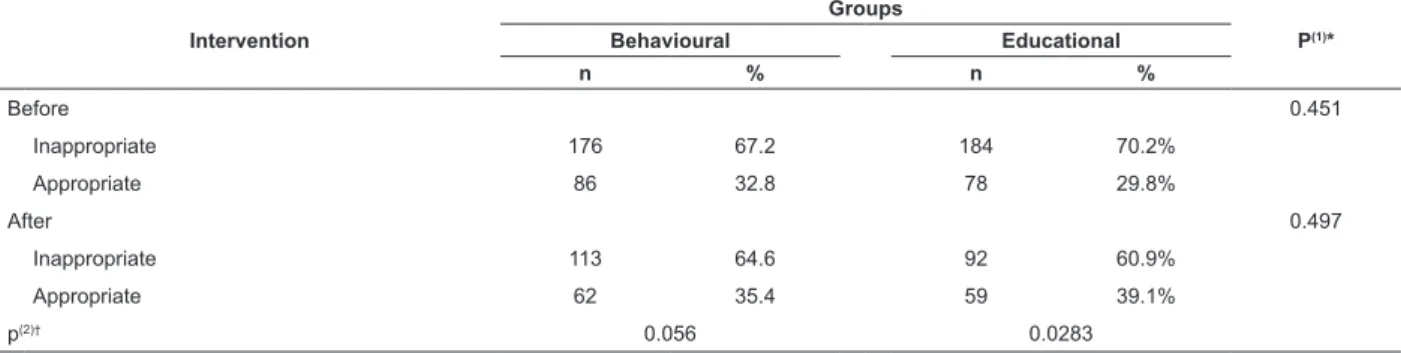
Table 1 shows the assessment of knowledge about
the colpocytological examination between the behavioral
and educational groups assessed with the use of KAP
survey.
Table 1 - Assessment of knowledge before and after application of the interventions. Fortaleza, CE, Brazil, 2014
*P(1) = Chi-square test; †p(2) = McNemar test
Intervention
Groups
P(1)*
Behavioural Educational
n % n %
Before 0.451
Inappropriate 176 67.2 184 70.2%
Appropriate 86 32.8 78 29.8%
After 0.497
Inappropriate 113 64.6 92 60.9%
Appropriate 62 35.4 59 39.1%
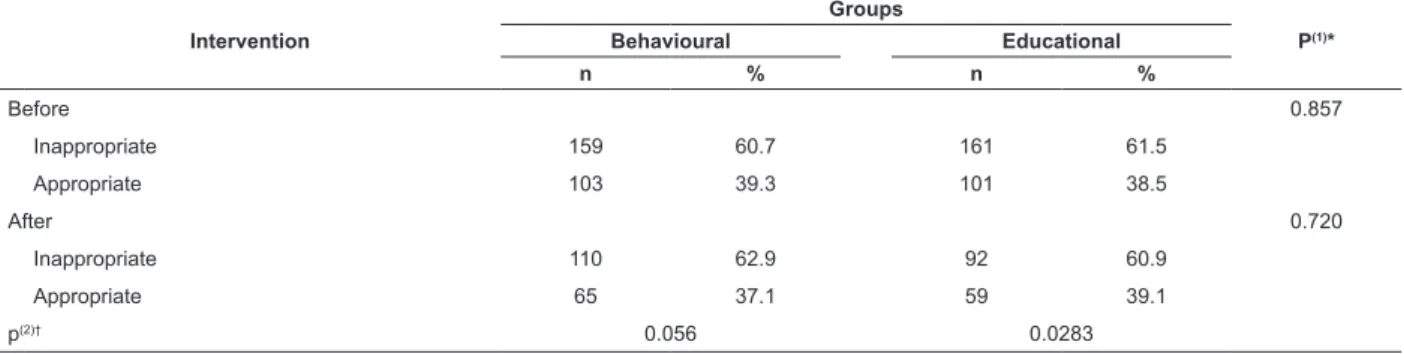
Table 2 - Assessment of attitude before and after application of the interventions. Fortaleza, CE, Brazil, 2014
Table 3 - Assessment of adherence before and after application of the interventions. Fortaleza, CE, Brazil, 2014 *P(1) = Chi-square test; †p(2) = McNemar test
*P(1) = Chi-square test; †p(2) = McNemar test
In both groups there was a prevalence of
inappropriate knowledge before and after intervention, being higher than 60.9%. However, it is observed that there was a statistically signiicant increase of knowledge in the educational group (p² = 0.0283) when this group was analyzed before (29.8%) and after (39.1%) intervention, and almost 10% of women acquired appropriate knowledge about the examination.
Regarding the behavioral group, it was observed a small
change in the adequacy of knowledge in this group before (32.8%) and after (35.4%) intervention. Nevertheless,
this change leads us to believe that when examination
was scheduled through a reminder intervention, women
became interested to know more about the examination, acquiring knowledge by their own means.
Table 2 shows the assessment of women’s
attitude in relation to the examination before and after
interventions.
Intervention
Groups
P(1)*
Behavioural Educational
n % n %
Before 0.857
Inappropriate 159 60.7 161 61.5
Appropriate 103 39.3 101 38.5
After 0.720
Inappropriate 110 62.9 92 60.9
Appropriate 65 37.1 59 39.1
p(2)† 0.056 0.0283
There was a prevalence higher than 60.9% of the
inappropriate attitude before and after intervention in
both groups, but this association was not statistically
signiicant in the behavioral group (p = 0.631) and in the educational group (p = 0.681). In the educational
group, there was a slight reduction in the inadequacy of
attitude before (61.5%) and after (60.9%) intervention.
In the behavioral group, there was a small increase of
inappropriate attitudes, when it was compared before
(60.7%) and after (62.9%) intervention.
Intervention
Groups
P(1)*
Behavioural Educational
n % n %
Before 1.000
Inappropriate 262 100.0 262 100.0
Appropriate
After 0.031
Inappropriate 87 33.2 111 42.3
Appropriate 175 66.8 151 57.5
p(2)† <0.0001 <0.0001
Table 3 shows the assessment of the practice in
relation to the adherence to colpocytological examination
in the groups. Before the interventions, all women in the
study were included in the inappropriate practice group,
but in comparing the groups after the interventions,
it was found a statistically signiicant relationship (p < 0.0001) for the two groups, showing that
interventions were effective in raising the attendance of
women to the healthcare services for examination.
It was also noted that there was a higher
percentage of adherence to examination among women
in the behavioral group (66.8%), in comparison with the educational group (57.7%), showing that most of the
women who participated in the educational intervention
did not show up for examination (42.3%), even after they have increased their knowledge about the importance of
Discussion
The average age found in this study corroborates
a study of 772 women aged over 18 years, carried out
in the city of Rio Branco, Acre, showing an average age
of 36.6 years, with a higher prevalence of undergoing
the colpocytological examination among women aged
between 25 and 35 years (86.4%). According to the
authors of this study, the end of child-bearing age
inluences in reducing the appointments for gynecological
consultations or their demand in the healthcare units,
leading to decrease of prevention practices in the age
period in which the incidence and severity of cancer are
higher(14).
Added to the above, non-adherence to appropriate
periodicity to the colpocytological examination is related
to some social factors such as be part of the younger
age group, be single and have low education or low
socioeconomic status(15).
There was a large time gap since the last
colpocytological examination, with an average of 31.7
months. The periodical examination is essential, since
the late diagnosis of CC can cause not only physical
injury, but also emotional and psychosocial problems(16).
Women undergoing examination at a periodicity
exceeding three years also have higher proportion of no
returning to receive the inal results of examination, and
they do not show the results to a professional, featuring
discontinuity of this health care(17).
When asked about the reason for not undergoing examination, many women mentionated the dificulty in scheduling the examination, carelessness, lack of time,
among other. A study of 12 women diagnosed with CC
found that there are problems related to the women,
healthcare services and professionals, what makes it dificult the examination as recommended. This study
found that factors such as shame, carelessness, fear
of going to the doctor, absence of symptoms and
lack of time are individual components that interfere
with the practice of examination. Moreover, since
they affected the demand for examination in the
healthcare services, these reasons denote lack of knowledge about the importance and necessity of
periodical examination(16).
Undergoing examination at an inappropriate
periodicity can be associated with inappropriate
knowledge and attitude, as observed in this study. A
study of 30 women in the state of Minas Gerais found
that only 40% had appropriate knowledge about the colpocytological examination and 83.3% did not know
what was HPV or reported – erroneously – that it was
the “same as” AIDS, cancer, some kind of bacteria and
so on(18).
In assessing the knowledge before and after
intervention, it was found that in both groups there was
a prevalence of inappropriate knowledge, exceeding 60.9%. Therefore, it is necessary to improve the knowledge and awareness of women about prevention
of cervical cancer, and educate the population so that
the demand for colpocytological examination meets
the screening goals, also reaching the most excluded
women(6).
Regarding the attitude towards the examination,
there was a prevalence higher than 60.9% of inappropriate
attitude before and after intervention in both groups. It
is emphasized that none of the interventions proposed
have improved women’s attitude. This may be related to
the culture of seeking the healthcare services to undergo
the examination only when there are symptoms, or to
check the health status, not associating the prevention
of CC as the main reason for examination.
Promoting the development of personal skills and
attitudes favorable to health at all stages is among the
most import ields of health promotion, considering
that they provide opportunities for the development
of the health potential. To this end, it is essential the
dissemination of information on health education,
which should take place in all collective spaces. Friendly environments, access to information, skills to live better, just as opportunities to make healthier choices, are
among the main empowerment elements(19).
Regarding the adherence to examination, by
comparing the groups after the intervention, it was
found a statistically signiicant relationship (p < 0.0001)
for the two groups, showing that interventions were
effective. It is worth mentioning the greater attendance
by women belonging to the behavioral group. However,
it is known that behavioral interventions appear to
have more elusive effect when compared to cognitive
interventions, leading to the need to use a combination
of interventions to achieve a better eficacy(17). Thus,
the women in this study showed a higher increase in
knowledge and lower adherence rate in the educational
group. Therefore, it is recommended to carry out a
further study to assess the effectiveness of adherence
over time in both groups after one year, conirming the permanent modiication about the practice of
colpocytological examination.
In this way, performing telephone interventions
is a resource associated with the nursing practice,
which can produce signiicant changes in the health
of the population, highlighting the importance of
technical and clinical knowledge for the interventions
by the professional. Moreover, the use of technology for
healthcare development requires trained professionals to
and technological knowledge, aiming at the desired
goals(20).
Investing in prevention practices and awareness of
the population is less costly than the curative treatment
of various types of diseases, especially in the public
health system, by reducing the costs of hospitalization,
surgeries and treatments(19).
In a case study of a chemically dependent patient,
the use of MI by telephone enabled the codependency
to be reduced, and modiied the observed permissive
behavior. Moreover, the authors noticed the expansion of
self-perception of the patient on his personal needs and
limits with regard to chemical dependency. Thus, it is
emphasized that an intervention focused on motivational
approaches and in MI represents a helping strategy(21).
The educational intervention based on principles of
MI was able to arouse the interest of participants to change
their demotivation in relation to self-care and caused
changes that favored the prevention of diseases, in this
case, the undergoing of colpocytological examination. It
is emphasized that no person is completely unmotivated
and the motivation to change is quite malleable and
formed especially within the context of relationships.
Great results are achieved when patients are interested
and show an active role, making the intervention more effective and with a lasting inluence on the patient’s
health(10).
Conclusion
It was found, in the view of the observed changes,
that the different telephone interventions were effective
in promoting the adherence of women to colpocytological
examination. For this reason, it is considered relevant
the permanent healthcare education, with actions
that aim at promoting the prevention of CC and are
comprehensive, prioritizing interventions for the
screening of both the asymptomatic and symptomatic
women, besides ensuring access to methods for proper
diagnosis and treatment.
It is recommended conducting future studies to
assess the long-term effectiveness of the educational
and behavioral interventions on adherence to
colpocytological examination, in order to check, after a year, if women remain seeking the healthcare service
to undergo the examination within the recommended
periodicity.
References
1. Jemal A, Bray F, Center MM, Ferlay J, Ward E,
Forman D. Global Cancer Statistics. CA Cancer J
Clin. [Internet]. 2011 [Access March 10, 2016];
Mar-Apr;61(2):69-90. Available from: http://onlinelibrary.
wiley.com/doi/10.3322/caac.20107/full
2. Rodrigues BC, Carneiro ACMO, Silva TL, Solá ACN,
Manzi NM, Schechtman NP, et al. Educação em saúde
para a prevenção do câncer cérvico-uterino. Rev Bras
Educ Med. [Internet]. 2012 [Acesso 26 mai 2016];
36(1, Supl.1):149-154. Disponível em: http://www.
scielo.br/pdf/rbem/v36n1s1/v36n1s1a20.pdf
3. Ministério da Saúde (BR). Controle dos cânceres do colo do útero e da mama. Brasília: Ministério da
Saúde; 2013.
4. Spayne J, Ackerman I, Milosevic M, Seidenfeld
A, Covens A, Paszat L. Invasive cervical cancer: a
failure of screening. Eur J Public Health. [Internet].
2008 [Acess Jun 20, 2014]; 18: 162-5. Available
from: http://eurpub.oxfordjournals.org/content/18/2/
162.long
5. Silva JMAS, Souza RC, Manzo BF, Souza SR, Pereira MS.
Fatores relacionados a não continuidade da realização
do exame citológico Papanicolau. Percurso Acadêmico.
[Internet]. 2011 [Acesso 26 mai 2016]; 1(2): 227-241. Disponível em: http://periodicos.pucminas.br/index.
php/percursoacademico/article/view/2289/3802
6. Corrêa DAD, Villela WV, Almeida AM. Desaios à
organização de programa de rastreamento do câncer do
colo do útero em Manaus-AM. Texto Contexto-Enferm.
[Internet]. 2012 jun [Acesso 12 jan 2014]; 21(2): 395-400. Disponível em: http://www.scielo.br/scielo. php?script=sci_arttext&pid=S0104-07072012000200018 7. Snooks HA, Williams AM, Grifiths LJ, Peconi J, Rance
J, Snelgrove S, et al. Real nursing? The development of
telenursing. J Adv Nurs. [Internet]. 2008 [Access Jun
12, 2014]; 61(6): 631-40. Available from:
http://onlinelibrary.wiley.com/doi/10.1111/j.1365-2648.2008.04877.x/abstract?userIsAuthenticated=fals e&deniedAccessCustomisedMessage=
8. Militello LK, Kelly SA, Melnyk BM. Systematic review
of text-messaging interventions to promote healthy
behaviors in pediatric and adolescent populations:
implications for clinical practice and research.
Worldviews Evid Based Nurs. [Internet]. 2012
[Access Jan 12, 2014]; 9(2): 66-77. Available from:
http://onlinelibrary.wiley.com/doi/10.1111/j.1741-6787.2011.00239.x/full
9. Vasconcelos CTM. Intervenção comportamental e
educativa: efeitos na adesão das mulheres à consulta
de retorno para receber o resultado do exame
colpocitológico [tese de doutorado]. Fortaleza (CE):
Departamento de Enfermagem da Universidade Federal
do Ceará; 2012. 101 p.
10. Rollnick S, Miller WR, Butler CC. Entrevista motivacional
no cuidado da saúde: ajudando pacientes a mudar
Received: May 16th 2016
Accepted: Sept. 23rd 2016
Copyright © 2017 Revista Latino-Americana de Enfermagem This is an Open Access article distributed under the terms of the Creative Commons (CC BY).
This license lets others distribute, remix, tweak, and build upon your work, even commercially, as long as they credit you for the original creation. This is the most accommodating of licenses offered. Recommended for maximum dissemination and use of licensed materials.
Corresponding Author: Thais Marques Lima
Universidade Federal do Ceará. Departamento de Enfermagem Rua Alexandre Baraúna, 1115
Bairro: Rodolfo Teóilo
CEP: 60430-160, Fortaleza, CE, Brasil E-mail: [email protected]
11. Polit DF, Beck CT, Hungler BP. Fundamentos de
pesquisa em enfermagem. 6th.ed. Porto Alegre:
Artmed; 2011.670 p
12. Bowen DJ, Robbins R, Bush N, Meischke H, Ludwig
A, Wooldridge J. Effects of a web-based intervention on
women’s breast health behaviors. Transl Behav Med.
[Internet]. 2011 [Access Feb 15, 2014] ;1(1):155-64. Available from: http://link.springer.com/article/10.1007 %2Fs13142-011-0028-0
13. Conselho Nacional de Saúde (BR). [Internet]. Resolução nº 466, 12 de dezembro de 2012. Brasília; 2012. Acesso 26 mai 2014. Disponível em:
http://bvsms.saude.gov.br/bvs/saudelegis/cns/2013/
res0466_12_12_2012.html
14. Borges MFSO, Dotto LMG, Cunha MA, Muniz
PT. Prevalência do exame preventivo de câncer
do colo do útero em Rio Branco, Acre, Brasil, e
fatores associados à não-realização do exame. Cad
Saúde Pública. [Internet]. 2012 [Acesso 26 mai
2016];28(6):1156-66. Disponível em: http://www. scielo.br/scielo.php?script=sci_arttext&pid=S0102-311X2012000600014&lng=en. http://dx.doi.
org/10.1590/S0102-311X2012000600014.
15. Gonçalves CV, Sassi RM, Oliveira Netto I, Castro NB,
Bortolomedi AP. Cobertura do citopatológico do colo uterino
em Unidades Básicas de Saúde da Família. Rev Bras Ginecol Obstet. [Internet].2011 [Acesso 12 jan 2014]; 33(9):258-6. Disponível em: http://www.scielo.br/scielo.php?script=sci_ arttext&pid=S0100-72032011000900007&lng=en. http://
dx.doi.org/10.1590/S0100-72032011000900007.
16. Pimentel AV, Ponobianco MS, Almeida AM, Oliveira
ISB. A percepção da vulnerabilidade entre mulheres
com diagnóstico avançado do câncer do colo do útero.
Texto Contexto - Enferm. [Internet].2011[Acesso 26
mai 2016]; 20(2): 255-62. Disponível em:http://www. scielo.br/scielo.php?script=sci_arttext&pid=S0104-07072011000200006&lng=en. http://dx.doi.org/10.1590/
S0104-07072011000200006.
17. Vasconcelos CTM, Damasceno MMC, Lima FET, Pinheiro
AKB. Integrative review of the nursing interventions
used for the early detection of cervical uterine cancer.
Rev. Latino-Am. Enfermagem. [Internet] 2011 [Acess
Jun 15, 2013];19(2):437-44. Available from: http://
www.scielo.br/scielo.php?script=sci_arttext&pid=S0104-11692011000200028&lng=en. http://dx.doi.org/10.1590/
S0104-11692011000200028.
18. Silveira CF, Melo MM, Rodrigues LR, Parreira BDM.
Conhecimento de mulheres de 40 a 60 anos sobre o
papillomavirus humano. Rev Rene. [Internet]. 2011 [Acesso
15 jun 2013]; 12(2):309-15. Disponível em: http://www.
revistarene.ufc.br/vol12n2_html_site/a12v12n2.htm
19. Casarin MR, Piccoli JCE. Educação em Saúde para
Prevenção do Câncer de Colo do Útero em Mulheres do
Município de Santo Ângelo/RS. Ciênc Saúde Coletiva. [Internet]. 2011 [Acesso 26 mai 2016];16(9):3925-32. Disponível em: http://www.scielo.br/scielo.php?script=sci_ arttext&pid=S1413-81232011001000029&lng=en.
http://dx.doi.org/10.1590/S1413-81232011001000029.
20. Becker TAC. O acompanhamento por telefone
como estratégia de intervenção de Enfermagem
no processo de aplicação de insulina no domicílio [dissertação de mestrado]. Ribeirão Preto (SP): Escola
de Enfermagem de Ribeirão Preto da Universidade de
São Paulo; 2010. 159 p.
21. Bortolon CB, Machado CA, Ferigolo M, Barro HMT.
Abordagem motivacional para familiar de usuário de
drogas por telefone: um estudo de caso. Contextos Clín. [Internet]. 2013 [Acesso 26 mai 2016];6(2):157-63. Disponível em: http://revistas.unisinos.br/index.php/