A PATTERN OF HEARING HEALTH EDUCATION
Modelo de educação em saúde auditiva
Wanderléia QuinhoneiroBlasca(1), Jéssica Kuchar(2), Cássia De Souza Pardo-Fanton(3),
Ana Carolina Soares Ascencio(4), Adriana Pessutto Montilha Falsetti(5),
Maria Fernanda Capoani Garcia Mondelli(6)
(1) Speech-Language Therapist and Audiologist; Professor
and Doctor of the Department of Speech-Language and Hearing of Bauru School of Dentistry, University of São Paulo – FOB/USP.
(2) Speech-Language Therapist and Audiologist; Master
Degree Student in Speech-Language and Hearing scien-ces at Bauru School of Dentistry, University of São Paulo – FOB/USP.
(3) Translator; Master Degree Student in Speech-Language
and Hearing Sciences at Bauru School of Dentistry, Univer-sity of São Paulo – FOB/USP.
(4) Speech-Language Therapist and Audiologist; Master
Degree Student in Speech-Language and Hearing Scien-ces at Bauru School of Dentistry, University of São Paulo
INTRODUCTION
In a country with large geographic dimensions as Brazil, where there is a heterogenic distribution of speech therapists and audiologists, the applications of Telehealth in Audiology area are increasing in a fast time, next to the necessity of decentralization of knowledge and specialized care to professional and patients.
Data from the Federal Council of
Speech-Language and Hearing1 showed that are approxi
-mately 35.369 speech therapists and audiologists all over the country, acting in different areas. Although,
ABSTRACT
Purpose: this study intend to show a pattern of education in hearing health with Interactive Teleducation developed by the Speech-Language Pathology and Audiology Department of FOB-USP, emphasizing the importance of creating educational materials at the proposal of professional education and
education to the patient in Audiology area. Method: it was created a pattern of hearing health education
based on the Interactive Teleducation from the union of information about the projects developed and
the chronologic survey of the objects of apprenticeship elaboration. Results: the results showed the
Interactive Tele-education on the creation of an apprenticeship network by the develop of educational materials, capacitating courses, websites and educational projects, involving students of graduation
and post graduation courses and the community. Conclusion: all the developed proposals with
Interactive Teleducation characterized a work that has being improved alongside the years focusing making the knowledge hierarchal, on which the importance must be centered in the multiplication of knowledge, apprenticeship and Hearing Health Education.
connecting professional to patient or professional to professional, promoting any or all the following services: training, counseling, education; evaluation to establish the condition of patient; intervention and remote assistance to professional training.
The Tele-education should be seen as an environment that reunites technologies to improve the educational effectiveness, both traditional
methods and distance courses3. In
Speech-Language and Hearing Sciences, appears as a relevant strategy to help ill in the demand needs to
the education of both professional and population4.
The educational practices at distance associated to interactive resources enabled the Interactive Teleducation advent, as a discerning union of the informatics and telecommunication resources based on educational models, stimulating the inter-activity and maintaining the interest of student using
communication ways eficient and directed5.
In this context, the Department of Speech-Language and Hearing of FOB/USP was innovator in Brazil, the creation and development of educational proposals in Audiology, giving priority to profes-sional education, patient orientation, and mainly, the Health Education. Thus, the Tele-education in Audiology is stimulating the development of research and extension projects in the national and international scope, providing higher knowledge and dynamism in the process of diagnosis and inter-vention in hearing health.
Based on the exposed, this study intent in demonstrate a pattern of hearing health education developed by the Department of Speech-Language and Hearing of FOB/USP, emphasizing the impor-tance of creation the educational materials in a proposal of education to professionals and patients in Audiology area.
METHOD
The developed study was qualitative and with descriptive character.
Research Strategy
The research was developed from the union of several materials produced by professors and
and Hearing, of FOB/USP following the research line of Telehealth in Speech-Language and Hearing Sciences.
It was developed a chronologic research of the creation of these projects which were pioneer in the area in Brazil concerning the Telehealth, Tele-aid and Tele-education.
Selection Criteria
It was selected all educational material produced, from the year of 1990, in the Audiology area by researchers of the Department of Speech-Language and Hearing of the Bauru School of Dentistry (FOB/ USP).
To the survey of the educational materials produced by the Department of Speech-Language and Hearing in the Audiology area, it was considered the following aspects:
1. Year of the material creation: It was selected the produced material from the year 1990; 2. Type of the material produced: It was selected
the material produced in the videotape format, CD-ROM, DVD, website, electronic tutor and Telehealth actions;
3. Areas deinition: public health in audiology, audiological diagnosis, hearing intervention and rehabilitation;
4. Survey of materials: the search of the material produced was directed by means of a survey done in the professional group and professors involved in the Research Line – Telehealth in Speech-Language and Hearing Sciences – Audiology area, Department of the Speech-Language and Hearing of FOB/USP.
RESULTS
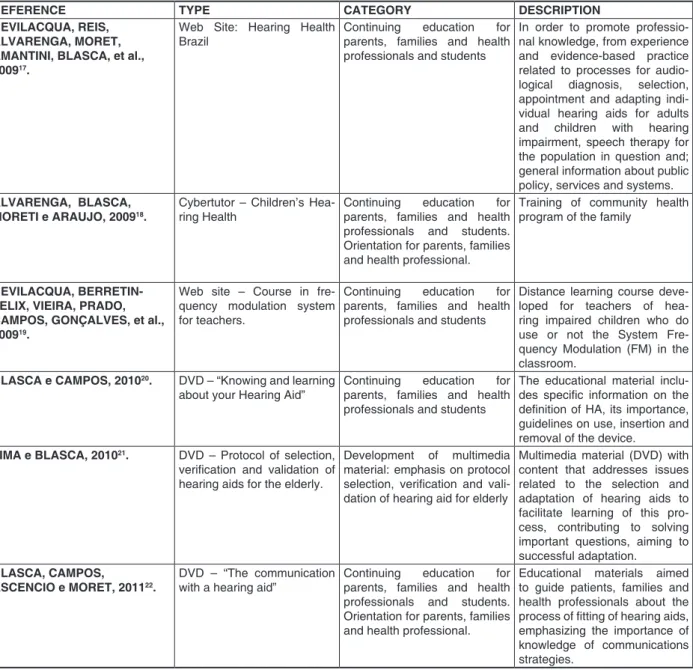
In Figure 1 will be presented the educational material produced by the Department of Speech-Language and Hearing area.
REFERENCE TYPE CATEGORY DESCRIPTION BEVILACQUA, MORET e
BARBOSA, 19926.
Videotape – Educational Stra-tegies in Hearing Impairment
Continued Education of Health Professionals, professors and students; Parents, patients, Family and orientation of health professionals.
Educational material about the rehabilitation process of hearing impaired patients.
FREITAS, BEVILACQUA, COSTA FILHO, FERRARI, MORET e ALVARENGA, 19967.
CD-ROM “The sound and the silence”
Continued Education of Health Professionals, professors and students; Parents, patients, Family and orientation of health professionals.
Educational Material aiming to inform parents, patients, stu-dents and Healthcare profes-sional about the normal process of hearing and the diagnostic of the hearing disabilities. BEVILACQUA, FREITAS e
COSTA FILHO, 19998.
Videotape. Cochlear Implant. Parents, patients, families and Healthcare Professionals orientation.
The video aims to educate all the Healthcare Professionals in addition to the audiologists about the study and improve of this new technology applied to the treatment of deafness. Also, to be available to parents and others interested in the subject. BEVILACQUA e MORET, 20019. Videotape. Course for
parents of deaf children.
Parents, patients, families and Health professionals orientation.
Educational material aimed the guidance of parents and families of deaf children.
BEVILACQUA, GONÇALVES e MORATA, 200210.
CD-ROM “Worker’s health” Continuing education of health professionals, professor and students.
Educational material for the trai-ning and improvement of heal-thcare professionals about the worker’s hearing.
BEVILACQUA e BLASCA, 200211.
CD-ROM “The way of sound” Continuing education of health-care professionals, educators and students.
Educational Material for the training and professional impro-vement in the area of electronic hearing aids devices. Presents a theoretical and practical appro-ach providing clinical reasoning in guiding behavior on patient with hearing impaired
FERNANDEZ, BLASCA, CAMPOS, MORTARI,
ALVARENGA, FERRARI, et al., 200512.
CD ROM “The sound and the psychoacoustics”
Continuing education for parents, families and health professionals
Educational material for trai-ning and professional impro-vement about the sound and psychoacoustics.
FERRARI e MACHADO (Org), 200713.
Web Site “Portal of babies – Speech therapy”
Continuing education for parents, families and health professionals
Site “Portal of Babies – Speech Therapy”: created as a guidance tool for parents and caregivers of children up to 36 months of age. Provides information about types, technologies, operation,
identiication and resolution of
problems with hearing aids, use and care of these devices and ear mold.
BLASCA e FERRARI, 200814. CD ROM – “Virtual man – Individual hearing aids”
Continuing education for parents, families and health professionals and students; Orientation for parents, families and health professional.
Educational material for infor-mation and guidance on the use and care of hearing aids and Individual earmold. For students, professionals and patients.
BEVILACQUA, FERRARI e MARTINEZ, BLASCA, 200915.
“Challenges in the itting of
hearing aids with quality – Measures with the probe
Continuing education for parents, families and health professionals and students;
Presents through the process
REFERENCE TYPE CATEGORY DESCRIPTION BEVILACQUA, REIS,
ALVARENGA, MORET, AMANTINI, BLASCA, et al., 200917.
Web Site: Hearing Health Brazil
Continuing education for parents, families and health professionals and students
In order to promote
professio-nal knowledge, from experience
and evidence-based practice related to processes for audio-logical diagnosis, selection, appointment and adapting indi-vidual hearing aids for adults and children with hearing impairment, speech therapy for the population in question and; general information about public policy, services and systems. ALVARENGA, BLASCA,
MORETI e ARAUJO, 200918.
Cybertutor – Children’s Hea-ring Health
Continuing education for parents, families and health professionals and students. Orientation for parents, families and health professional.
Training of community health program of the family
BEVILACQUA, BERRETIN-FELIX, VIEIRA, PRADO, CAMPOS, GONÇALVES, et al., 200919.
Web site – Course in fre-quency modulation system for teachers.
Continuing education for parents, families and health professionals and students
Distance learning course deve-loped for teachers of hea-ring impaired children who do use or not the System Fre-quency Modulation (FM) in the classroom.
BLASCA e CAMPOS, 201020. DVD – “Knowing and learning about your Hearing Aid”
Continuing education for parents, families and health professionals and students
The educational material
inclu-des speciic information on the deinition of HA, its importance,
guidelines on use, insertion and removal of the device.
LIMA e BLASCA, 201021. DVD – Protocol of selection,
veriication and validation of
hearing aids for the elderly.
Development of multimedia material: emphasis on protocol
selection, veriication and vali -dation of hearing aid for elderly
Multimedia material (DVD) with content that addresses issues related to the selection and adaptation of hearing aids to facilitate learning of this pro-cess, contributing to solving important questions, aiming to successful adaptation.
BLASCA, CAMPOS, ASCENCIO e MORET, 201122.
DVD – “The communication with a hearing aid”
Continuing education for parents, families and health professionals and students. Orientation for parents, families and health professional.
Educational materials aimed to guide patients, families and health professionals about the
process of itting of hearing aids,
emphasizing the importance of knowledge of communications strategies.
REFERENCE TYPE CATEGORY DESCRIPTION FERRARI, BLASCA e
COSTA, 200423.
Telehealth forum in audiology Continuing education for health professional, parents and stu-dents. The forum happens since 2004 at the International Audio-logy Conference.
Discussions about the prospects
in Speech, with afiliation to the
Brazilian Council of Telemedicine and Telehealth, with a restriction to Audiology Department. The forums have been repeating this same event annually in order to improve this practice. From this, videoconferences are held natio-nally and internationatio-nally, facilita-ting access to the knowledge of professionals and students. BLASCA, FERRARI,
CRENITE, BRASOLOTO, MEYER, SHAYEB, et al., 200824.
Exhibition Routes of Com -munication “- interactive lear-ning environment: a traveling museum.
Continuing education for health professional, parents and students;
Activity initially developed in Bauru, with support from the secretariat of the culture of the state of Sao Paulo. His proposal was to provide the learning of elementary students about the whole process of communica-tion, emphasizing prevention and intervention of problems related to communication.
Projeto Jovem Doutor, 200825.
Project Young doctor. Continuing education for health professional, parents and students
Activity developed along with stu-dents from elementary, middle, with the participation of under-graduate and under-graduate – Young Doctor Project – Bauru – conduc-ted since 2008 in partnership with the Department of Telemedicine FMUSP – focuses on contents of Hearing Health and Inclusion of Disabled Persons in school. ALVARENGA, BLASCA,
MAXIMINO, MACHADO, 201026.
Online course – Children’s hearing health
Training on professionals in healthcare
Training of community health workers of the Family Health Program: a proposal for distance education in hearing health. BLASCA, ASCENCIO e
PANELLI, 201127.
Online Course – Individual
Sound Ampliication device
Education and Training of pro-fessionals in healthcare and in Service Center for hearing impaired.
Training of professionals working in the care of deaf people in institutions linked to PROFIS NETWORK – HRAC / USP. Figure 2 – Actions in Telehealth developed by the Department of Speech-Language and Hearing, of FOB/USP in Audiology area
DISCUSSION
Due to the Technology progress and the speed in which the information need to be acquired, every day becomes more eficient the use of technologies of information and communication (TIC) in an approach directed to health.
In this proposal, the campus in Bauru of the
The development of educational materials was started before the advent of materials such as CD-ROM, in videotape format entitle “Educational Strategies in Hearing Loss” which promotes the
creation of computerized educational materials6,
and next the CD-ROM “The Sound and Silence”7.
– USP and the Ministry of Health, the FOB/USP, aims to approach health units, developing technical trainings at distance and even to obtain second opinions and aids to cases that must to be treated by communication in real time, following and distance
therapy41.
The Telehealth applications in Audiology are growing in a fast pace all over the world; however, they still are characterized by the number of small samples and dificultness of multicenter approaches.
Besides, the relation cost-beneit, patient accep
-tance and the refund of these services are aspects widely discussed by professionals, in which the existence of a proper protocol will demand changes to these services may be practicable. Although, recent researches has been enabled a higher explanation and practicability in the application of
Telehealth services to the future41.
The Telehealth in Audiology in Brazil, even if it is recent, already had favorable results in education and assistance area, believing that the usage of technology of information and communication will bring a positive impact in the future of the Brazilian
Audiology4.
The education, not only of professionals, but patients, families and community agents, makes a productive chain of health to the dissemination of knowledge and improvement of health quality of the
population in general42-44.
CONCLUSION
The results showed the Interactive Teleducation in the creation of a learning network from the devel-opment of educational materials, training courses and educational projects involving undergraduation and post-graduation students and the community. All these developed proposals feature a work that has been improved during the years focusing in the hierarchy of knowledge, in which the importance must be centered in the dissemination of it, learning and Hearing Health Education.
experience of the author.
In this area, there are didactic videos, created by companies of hearing aids, in which are available in their internet pages, to individuals users of HA. The content of the videos approaches orientations about the usage and handling the BTE (behind the ear) HA type, intra-canal, micro-canal and BTE in open
itting, besides earmold cares31,32.
In the United States, in 2004, Robert H. Margolis, professor of the Department of Audiology at the University of Minnesota, has started the Project Audiology Incorporated, aiming to create didactic
materials to patients and their relatives33.
The studies cited above are consonant to the developed projects by the Department of Speech-Language and Hearing of FOB/USP, since they have as common objective to help the professional in the itting of patients hearing impaired, as also to provide more information to patients and guide them about the care and usage of the hearing aid.
In Audiology, the mainly themes approached are about public health, hearing diagnosis, inter-vention and rehabilitation, produced in different formats, which each one was adequated to its
target public34-40. Nevertheless, there is dificultness,
mainly inancial in make available these materials to a large number of professionals, what turns the promotion and access restrict.
Spinardi et al. (2009)29 described several
interna-tional applications in Telemedicine in the Audiology area, mostly including the Tele-Audiometry, that is, a real time evaluation system of hearing thresholds by internet and the virtual simulations to instruct the Speech-Language and Audiology students, allowing to develop the hearing evaluation in different virtual patients.
Although others instruments has been developed by the Department of Speech-Language and Hearing, in this study were described only those directed to the Audiology area that aimed to assist
on the education of professionals and provide expla
REFERENCES
1. CFFa: Conselho Federal de Fonoaudiologia. Número de Proissionais por Região. [cited 2011 Nov 11]. Available from: http://www.fonoaudiologia. org.br/.
2. ASHA: American Speech-Language-Hearing Association. Audiologists Providing Clinical Services via Telepractice: Technical Report. [cited 2011 Nov 11]. Available from: http://www.asha.org/docs/html/ TR2005-00152.html.
3. Spinardi ACP, Blasca WQ, De-Vitto LM. Genética e fonoaudiologia: aprendizado baseado na teleducação. Pró-Fono R. Atual. Cient. 2008;20:42-4.
4. Ferrari DV, Blasca WQ, Bernardez G, Wen CL. Telessaúde: acesso a educação e assistência em audiologia. In: Bevilacqua MC, Martinez MAN, Balen S, Pupo A, Reis ACMB, Frota S. Saúde auditiva no Brasil: políticas, serviços e sistemas. São Jose dos Campos (SP): Editora Pulso; 2010. p.189-218. 5. Wen CL. Modelo de ambulatório virtual (cyber ambulatório) e tutor eletrônico (cyber tutor) para aplicação na interconsulta médica e educação à distância mediada por tecnologia [tese de livre docência]. São Paulo (SP): Universidade de São Paulo; 2003.
9. Bevilacqua MC, Moret ALM. Curso para pais de crianças deicientes auditivas [Fita de Vídeo]. Bauru (SP); 2001.
10. Bevilacqua MC, Gonçalves FL, Morata T. Saúde do trabalhador [CD ROM]. Bauru (SP): TBR-Produções Especiais de Imagens e Textos Ltda; 2002.
11. Blasca WQ, Bevilacqua MC. A caminho do som: moldes auriculares [CD ROM]. Bauru (SP): TBR-Produções Especiais de Imagens e Textos Ltda; 2002.
12. Fernandes JC. O Som e a Psicoacústica [CD ROM]. Bauru (SP): TBR Produções Especiais de Imagens e Texto Ltda; 2005.
13. Ferrari DV, Bastos BG, Alvarenga KF, Chaves JN, Souza PJS. Web site – Portal dos Bebês Fonoaudiologia. In Ferrari DV, Machado MAAM (Org). Web site – Portal dos Bebês. Bauru (SP); 2007.
14. Blasca WQ, Ferrari DV. Homem Virtual: Aparelho de Ampliicação Sonora Individual [CD ROM]. Bauru (SP): Telemedicina – Faculdade de Medicina da Universidade de São Paulo; 2008. 15. Bevilacqua MC, Ferrari DV, Martinez MANS, Blasca WQ. Desaios na Adaptação do AASI com Qualidade: medidas com microfone sonda [CD ROM]. Bauru (SP): Unimagem Produções
RESUMO
Objetivo: este estudo pretende apresentar um modelo de educação em saúde auditiva com Teleducação Interativa desenvolvido pelo Departamento de Fonoaudiologia da FOB-USP, enfati-zando a importância da criação de materiais educacionais numa proposta de educação proissional e
ao paciente na área de Audiologia. Método: foi elaborado um modelo de educação em saúde auditiva
baseado na Teleducação Interativa a partir da união de informações acerca dos projetos
desenvolvi-dos e levantamento cronológico da elaboração desenvolvi-dos objetos de aprendizagem. Resultados: os
resul-tados demonstraram a Teleducação Interativa na criação de uma rede de aprendizagem colaborativa
com o desenvolvimento de materiais educacionais, cursos de capacitação, website e projetos
educa-cionais envolvendo proissionais, alunos de graduação, pós graduação e a comunidade. Conclusão:
todas as propostas desenvolvidas com a Teleducação Interativa caracterizam um trabalho que tem sido aprimorado ao longo dos anos com enfoque na hierarquização do conhecimento, no qual a importância deve estar centrada na multiplicação do conhecimento, no aprendizado e na Educação em Saúde Auditiva.
ES. Saúde auditiva infantil [Cybertutor]. Bauru (SP): TBR-Produções Especiais de Imagens e Textos Ltda; 2009.
19. Bevilacqua MC, Berretin-Felix G, Vieira MMRM, Prado LM, Campos K, Gonçalves TS, et al. Web site – Curso de Sistema de frequência modulada para professores; 2009.
20. Blasca WQ, Campos K. Conhecendo e aprendendo sobre seu Aparelho Auditivo [DVD]. Bauru (SP): TBR-Produções Especiais de Imagens e Textos Ltda; 2010.
21. Lima S, Blasca WQ. Elaboração de material em multimídia: ênfase no protocolo de seleção, veriicação e validação do AASI para indivíduo idoso [Monograia de Especialização]. Bauru (SP): Hospital de Reabilitação de Anomalias Craniofaciais; 2010.
22. Blasca WQ, Moret ALM, Campos K, Ascencio ACS, Belai, LSV. A Comunicação com o Aparelho Auditivo [DVD]. Bauru (SP): TBR Produções Especiais de Imagens e Textos Ltda; 2011.
23. Ferrari DV, Blasca WQ, Costa OA. Fórum Telessaúde em Audiologia. In: EIA: Encontro Internacional de Audiologia. Bauru (SP); 2004. 24. Blasca WQ, Ferrari DV, Crenite P, Brasoloto AG, Meyer AS, Shayeb DR, et al. Caminhos da Comunicação – Ambiente interativo de aprendizagem: um museu itinerante [Exposição]. Bauru (SP); 2008.
25. Telemedicina USP. Projeto Jovem Doutor; 2008. 26. Alvarenga KF, Blasca WQ, Maximino LP, Machado MA. Saúde Auditiva Infantil [Curso online]. Bauru (SP); 2010.
27. Blasca WQ, Ascencio ACS, Panelli M. Aparelho de Ampliicação Sonora Individual [Curso online]. Bauru (SP); 2011.
28. Blasca WQ, Bevilacqua MC. A multimídia como uma nova proposta de ensino da audiologia. Salusvita. 2006;25(3):113-25.
29. Spinardi ACP, Blasca WQ, Wen CL, Maximino LP. Telefonoaudiologia: ciência e tecnologia em saúde. Pró-Fono R. Atual. Cient. 2009;21(3):249-54.
30. Smith J. Hearing Aid Orientation DVD [DVD]. Dayton (OH): So others my hear, LLC; 2011. 31. Sarkey do Brasil. Uso e Cuidados: Vídeos Educacionais. Disponível em: http://www.starkey. com.br/videos-educacionais.php.
32. Starkey. Use and Care: Instructional Videos. Disponível em: http://www.starkey.com/use-care/ instructional-videos.
33. Margolis RH. Understanding [Series of Patient Education Materials]. Minnesota; 2004. Disponível em: http://audiologyincorporated.com/ understanding.
34. Campos K, Oliveira JRM, Blasca WQ. Processo de adaptação de aparelho de ampliicação sonora individual: elaboração de um DVD para auxiliar a orientação a indivíduos idosos. Rev. soc. bras. fonoaudiol. 2010;15(1):19-25.
35. Blasca WQ, Maximino LP, Galdino DG, Campos K, Picolini MM. Novas tecnologias educacionais no ensino da Audiologia. Rev. CEFAC. 2010;12(6):1017-24.
36. Augestad KM, Lidsetmo RO. Overcoming distance: video-conferencing as a clinical and educational tool among surgeons. World J Surg. 2009;33(7):1356-65.
37. Fung KM, Hassell LA, Talbert ML, Wiechmann AF, Chaser BE, Ramey J. Whole slide images and digital media in pathology education, testing, and practice: the Oklahoma experience. Anal Cell Pathol. 2012;35(1):37-40.
38. Grady JL. The Virtual Clinical Practicum: an innovative telehealth model for clinical nursing education. Nurs educ perspect. 2011;32(3):189-94. 39. Groom KL, Ramsey MJ, Saunders JE. Telehealth and humanitarian assistance in otolaryngology. Otolaryngol Clin North Am. 2011;44(6):1251-8. 40. Haley C, O’Callaghan E, Hill S, Mannion N, Donnelly B, Kinsella A et al. Telepsychiatry and carer education for schizophrenia. Eur Psychiatry. 2011;26(5):302-4.
41. Krumm M, Ferrari DV. Contemporary telehealth and telemedicine applications in audiology. Audiology Today. 2008;20(5):36-41.
42. Head BA, Keeney C, Studts JL, Khayat M, Bumpous J, Pfeifer M. Feasibility and acceptance of a telehealth intervention to promote symptom management during treatment for head and neck cancer. J Support Oncol. 2011;9(1):1-11.
43. Idriss NZ, Alikhan A, Baba K, Armstrong AW. Online, video-based patient education improves melanoma awareness: a randomized controlled trial. Telemed J E Health. 2011;15(10):992-7.
44. Hopper B, Buckman M, Edwards M. Evaluation of satisfaction of parents with the use of videoconferencing for a pediatric genetic consultation. Twin Res Hum Genet. 2011;14(4):343-6.
Received on: January 18, 2012 Accepted on: June 24, 2012
Mailing address:
Wanderléia Quinhoeiro Blasca
Faculdade de Odontologia de Bauru – Departamento de Fonoaudiologia
Al. Dr. Octávio Pinheiro Brisola, 9-75 – Bauru – SP CEP: 17012-900 – Caixa-Postal: 73