The genesis of the AIDS policy and AIDS
Space in Brazil (1981-1989)
Sandra Garrido de BarrosI, Ligia Maria Vieira-da-SilvaII
I Programa Integrado de Pesquisa em Política, Gestão e Avaliação. Instituto de Saúde Coletiva. Universidade Federal da Bahia. Salvador, BA, Brasil
II Programa de Pós-Graduação em Saúde Coletiva. Instituto de Saúde Coletiva. Universidade Federal da Bahia. Salvador, BA, Brasil
ABSTRACT
OBJECTIVE: To analyze the genesis of the policy for controlling AIDS in Brazil.
METHODS: Socio-historical study (1981-1989), based on Bordieu’s genetic sociology, by document analysis, bibliographical review, and in-depth interviews. It consisted of a connection between the analysis of the paths of 33 agents involved in the creation of a social space focusing on AIDS-related issues and the historical possibility conditions of the drafting of a speciic policy. RESULTS: AIDS Space is a gathering point for the paths of agents from several social ields (medical, scientiic, political, and bureaucratic ields). A speciic space for relationships, which enabled the drafting of a policy for controlling the AIDS epidemic, but also a place where the authority to talk about the meaning of the disease, the methods to prevent and treat it was under dispute. he analysis showed how the various structures (democratic administrations in Sao Paulo and at the national level, with public health oicers taking important positions) and the lack of a speciic therapy contributed to social agents of diferent ranks and backgrounds to initially set prevention as a priority.
CONCLUSIONS: he rise of the sanitary movement, the organization of SUS, and the dominance of the medical ield at the AIDS Space contributed to foster treatment as a part of the measures to control the epidemic. hese conditions allowed drafting a policy based on the integrality of care, by linking prevention and treatment in the following decade, with important participation from state bureaucracy and researchers.
DESCRIPTORS: Acquired Immunodeiciency Syndrome history. Policy Making. Sociology, Medical. Social Determinants of Health. Equity in Health. Bourdieu.
Correspondence: Sandra Garrido de Barros Departamento de Odontologia Social e Pediátrica
Faculdade de Odontologia – UFBA Rua Araújo Pinho, 62 Canela 40110-912 Salvador, BA, Brasil E-mail: [email protected]
Received: 15 Aug 2014 Approved: 22 Aug 2015 How to cite: Barros SG, Vieira-da-Silva LM. The genesis of the AIDS policy and AIDS Space in Brazil (1981-1989). Rev Saude Publica. 2016;50:43.
Copyright: This is an open-access article distributed under the terms of the Creative Commons Attribution License, which permits unrestricted use, distribution, and reproduction in any medium, provided that the original author and source are credited.
INTRODUCTION
To analyze the genesis of a public health care policy is to seek to understand the historical
and social circumstances that enabled the State to intervene to implement speciic measures
for controlling a certain health problem22.
he studies on the origins of Brazil’s AIDS policy, which were reviewed, focused on analyses
of state cases, especially Sao Pauloa,b,c,d or on the relationships between non-government
organizations (NGO) and the State11,e,f,g, whether by highlighting the political focus of
these organizations or by emphasizing the drafting and implementation of the policy for
speciic groups10 at the diferent levels of the health care systemh,i. hose who analyzed
the government response to the epidemic at the national level have not investigated the
participation of medical and scientiic ields, nor have they considered the social and
professional paths of agents13,15,18.
By putting the concept of social space developed by Bourdieu5 into practice, Pinell et al.22
studied the universe of possibilities for the rise of a movement to ight AIDS in France, its
structure, and its dynamics of relationships of AIDS Space agents between 1981 and 1996.
his space was created in that country through a popular mobilization that aimed to replace state institutions in the performance of this public role. he policy against AIDS was drafted by the initiatives of militant associations, the advancements in the medical ield, and the illness social representation as a threat to French society.
he study by Mendonça et al.17, based on Bordieu’s ield concept, connected the position at
the “HIV/AIDS ield” with entrepreneurial action methods. heir analysis focused on the medical ield and on speciic associations, but did not explore the interaction between the paths of agents and conditions of possibility. he development of a space for ighting AIDS is understood to depend on the medical knowledge on the disease, but not to fulill all the requirements of a ield, as proposed by Bordieu. he concept of AIDS Space as suggested
by Pinell et al.22 is more appropriate because it is a space of relationships among the agents
in diferent social ields.
he studies reviewed do not shed light on how the AIDS Space was organized in Brazil (composition, agents, disputes, interests) nor do they explain why a policy was drafted at a time when there was no evidence on its extent and vulnerability. Neither have they
systematically analyzed the liaisons between agents, the points of view or strategies they
chose regarding the policy on AIDS, concerning their ields of origin.
his study on the genesis of Brazil’s AIDS policy provides elements that help ill these gaps, based on Bourdieu’s relexive sociology3-8.
METHODS
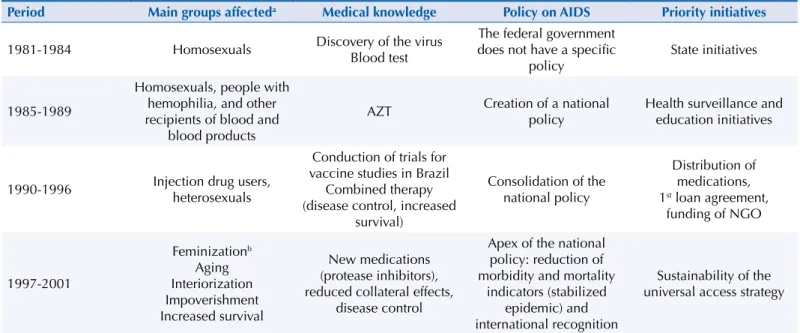
A socio-historical study was conducted between 1981 and 1989, the time when the AIDS
policy had its genesis. his period was deined according to a broader research periodization
comprising the interval between 1981 and 2001j, considering the main groups afected,
times, and priority actions of the government response and its relationship with medical knowledge (Table 1).
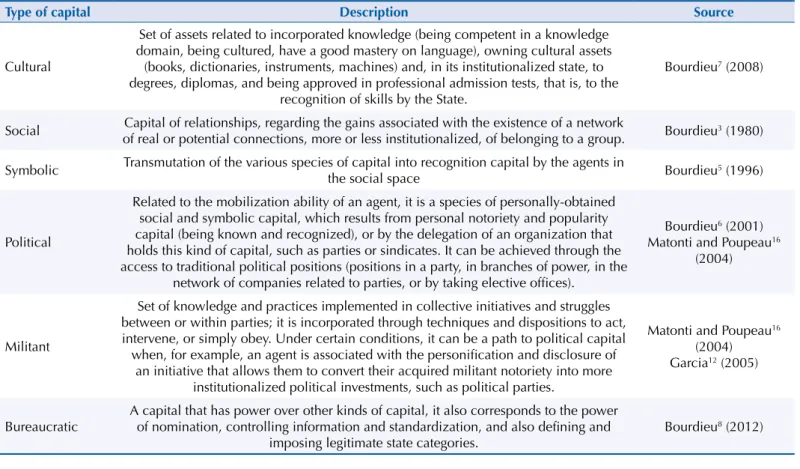
he concept of social space is based on the idea of diference: agents are distributed in it
according to the various kinds of capital5 (Table 2). In turn, the concept of ield corresponds
to a network of relationships, a relatively autonomous microcosm comprising agents and institutions that have habitus, common perception and action schemes, and illusio, a shared interest4,7. he AIDS Space was operationalized as a space of relationships between agents
in several ields, with common interest in a problem: AIDS22. To rebuild the dynamics of
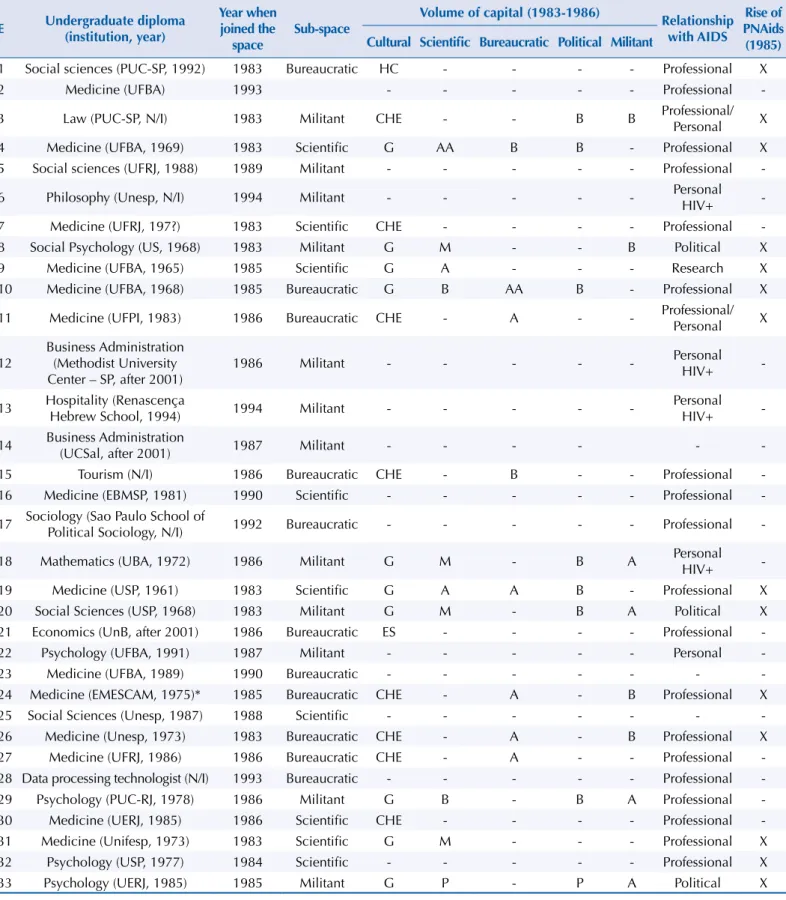
this space and its connections with the medical ield, the Collective Health Space25,k and
the political ield, we analyzed the social and professional trajectories of 33 agents (in-depth
a Guerra MAT. Política de controle da AIDS da Secretaria de Estado da Saúde de São Paulo, no período 1983-1992: a história contada por seus agentes [dissertation]. São Paulo (SP): Faculdade de Medicina da Universidade de São Paulo; 1993. b França MSJ. Ciências em tempos de AIDS: uma análise da resposta pioneira de São Paulo à epidemia [these]. São Paulo (SP): Pontifícia Universidade Católica de São Paulo; 2008.
c Santos VL. Avaliação do grau de implementação do Programa de DST/AIDS no Distrito Sanitário Especial Indígena de Mato Grosso do Sul – Distrito de Dourados [dissertation]. Rio de Janeiro (RJ): Escola Nacional de Saúde Pública da Fundação Oswaldo Cruz; 2009. d Lima SCVS. Avaliação do processo de implementação da política de controle das DST/AIDS no Maranhão [these]. São Luís (MA): Universidade Federal do Maranhão; 2006.
interviews) (Table 3) and the historical conditions for the rise of the policy (document and bibliographical sources).
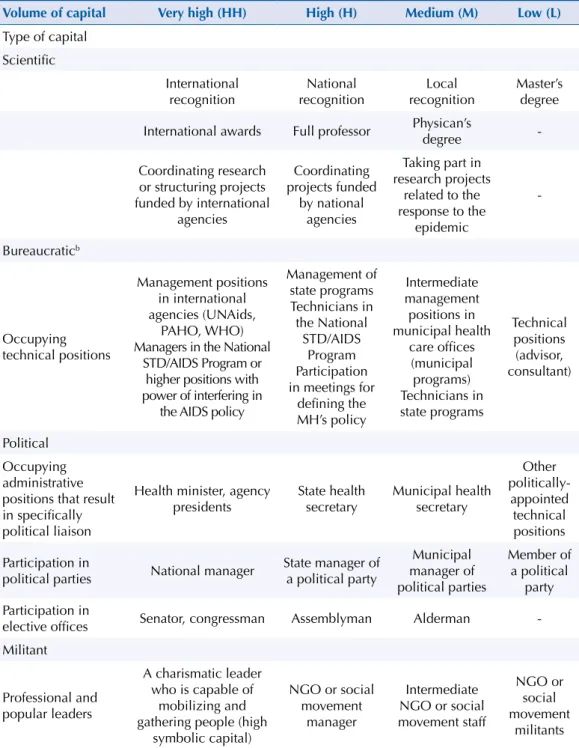
he sample was delimited through the saturation of oral information, which were conirmed and complemented by document analysis. he classiication of the agents according to their social ields was conducted according to volume indicators of scientiic, bureaucratic,
militant, and political capital, as proposed by Vieira-da-Silva and Pinell25 (Table 4).
he project was approved by the Universidade Federal da Bahia’s Collective Health Institute’s Research Ethics Committee. he interviewed subjects signed informed consent forms and
agreed to have their names disclosed.
RESULTS AND DISCUSSION
The Construction of the AIDS Space (1981-1984)
he epidemics arrived in Brazil in the early 1980s, when AIDS was not widely known and no eicient therapeutic response existed. From a political point of view, it was a period marked
by the transition to democracy after the military dictatorship that started in 1964.
he irst news reports about the disease were treated as a foreign problem by the media2 and
contributed to it being seen as a gay disease, the so-called “gay plague”l. he irst cases, which
were concentrated in Sao Paulo, were identiied between 1982 and 1983, by dermatologist Valéria Petri. he patients had Kaposi’s sarcoma, which is very unusual in young people. No blood tests existed; diagnose was clinical and therefore questioned by some physicans, according to the interviewed testimonial, “[...] some colleagues insisted I was lying” (E31, 6/20/2011). Despite the role of the press in giving the irst reports on AIDS, only in 1983 were the irst Brazilian cases reported1,2.
Despite irst denying the disease, the gay movement was fundamental to recognize AIDS as a problem that required speciic measures. he questioning stance on medical ield was a result from the historical relationship of some physicians with homosexuality, who viewed
it as a mental illness.
k Collective Health, in its genesis, according to the findings from an empirical study conducted by Vieira-da-Silva and Pinell25 (2013), analyzing the paths of 26 founders, could be interpreted as a social space that aimed to become a field but still did not have relative autonomy or a common habitus, found in consolidated fields, such as scientific, medical, bureaucratic, and political fields.
l Silva LL. Homossexualidade e aids em São Paulo [dissertation]. São Paulo (SP): Pontifícia Universidade Católica de São Paulo; 1986.
Table 1. Times of the national policy on AIDS control, main groups affected, priority initiatives and their relationship with medical knowledge, 1981-2001.
Period Main groups affecteda Medical knowledge Policy on AIDS Priority initiatives
1981-1984 Homosexuals Discovery of the virusBlood test
The federal government does not have a specific
policy State initiatives
1985-1989
Homosexuals, people with hemophilia, and other recipients of blood and
blood products
AZT Creation of a national policy Health surveillance and education initiatives
1990-1996 Injection drug users, heterosexuals
Conduction of trials for vaccine studies in Brazil
Combined therapy (disease control, increased
survival)
Consolidation of the national policy
Distribution of medications, 1st loan agreement,
funding of NGO
1997-2001
Feminizationb
Aging Interiorization Impoverishment Increased survival
New medications (protease inhibitors), reduced collateral effects,
disease control
Apex of the national policy: reduction of morbidity and mortality
indicators (stabilized epidemic) and international recognition
Sustainability of the universal access strategy
AZT: azithromycin; NGO: non-government organizations
a Source: Epidemiological AIDS Bulletins, Ministry of Health.
“[...] Militants tended to think that it was another lie from physicans [...]. Yet another way to control homosexuality, to get people to quit these behaviors” (E8, 5/16/2011).
Afterwards, this group started reinforcing medical discourse, probably as a result from the
exchange with foreign groups who brought reports of fear and death, and also because of
the threat to the developing gay trade14,21,m.
“[...] I spent a week in New York. [...] I heard about people dying like lies. [...] almost no one believed it” (E8, 5/16/2011).
he epidemic transformed the gay rights movement, by causing its sexual freedom proposals
to lose momentum and reducing the number of groups9.
Besides diagnosing the irst cases, physicians from diferent backgrounds took part in the initiatives that resulted in the irst measures for control of the disease. Ricardo Veronesi (professor at Faculdade de Medicina of the Universidade de Sao Paulo, founder of the Brazilian
Society of Infectious Diseases, and responsible for administering interferon as a treatment for AIDS in Brazil),n,o gathered gay activists in March 1983, warning them about the need for
a response from the government.
“[...] From then on, they started getting organized [...] to try to ensure some achievements, and, at the same time, discuss the AIDS issue and push authorities” (E8, 5/16/2011).
Motivated by the meeting and by the irst AIDS cases in Brazil, Darcy Penteado scheduled
an appointment with Sao Paulo’s Health Care Oicer, João Yunes15,24.
“[...] a demand that had been started by people that had already [...] taken part in the gay
rights movement. [...] and demanded the [State Health] Secretariat [...] take measures, provide guidance, give information regarding the epidemic [...]” (E26, 5/3/2011)
Former members of Grupo Somos and of the “Lampião da Esquina” newspaper, such as
anthropologist Edward MacRae, Belgian ilmmaker Jean Claude Bernadet, writer and journalist
m Silva LL. Homossexualidade e aids em São Paulo [dissertation]. São Paulo (SP): Pontifícia Universidade Católica de São Paulo; 1986.
n Interferon teve seus poderes superestimados. Folha de São
Paulo. 4 jun 1983.
o Congresso termina com crítica de médico ao Inamps. Folha de
São Paulo. 6 jun 1983.
Table 2. Definition of the different kinds of capital.
Type of capital Description Source
Cultural
Set of assets related to incorporated knowledge (being competent in a knowledge domain, being cultured, have a good mastery on language), owning cultural assets
(books, dictionaries, instruments, machines) and, in its institutionalized state, to degrees, diplomas, and being approved in professional admission tests, that is, to the
recognition of skills by the State.
Bourdieu7 (2008)
Social of real or potential connections, more or less institutionalized, of belonging to a group.Capital of relationships, regarding the gains associated with the existence of a network Bourdieu3 (1980)
Symbolic Transmutation of the various species of capital into recognition capital by the agents in the social space Bourdieu5 (1996)
Political
Related to the mobilization ability of an agent, it is a species of personally-obtained social and symbolic capital, which results from personal notoriety and popularity capital (being known and recognized), or by the delegation of an organization that holds this kind of capital, such as parties or sindicates. It can be achieved through the access to traditional political positions (positions in a party, in branches of power, in the
network of companies related to parties, or by taking elective offices).
Bourdieu6 (2001)
Matonti and Poupeau16
(2004)
Militant
Set of knowledge and practices implemented in collective initiatives and struggles between or within parties; it is incorporated through techniques and dispositions to act, intervene, or simply obey. Under certain conditions, it can be a path to political capital when, for example, an agent is associated with the personification and disclosure of
an initiative that allows them to convert their acquired militant notoriety into more institutionalized political investments, such as political parties.
Matonti and Poupeau16
(2004) Garcia12 (2005)
Bureaucratic A capital that has power over other kinds of capital, it also corresponds to the power of nomination, controlling information and standardization, and also defining and
imposing legitimate state categories. Bourdieu
Table 3. Profile of the subjects interviewed, according to college diplomas, year when joined AIDS Space, insertion sub-space, volume of scientific, bureaucratic, political, and militant capital, relationship with AIDS, and presence at AIDS Space during the rise of the national policy for controlling the epidemic, 1985.
E Undergraduate diploma (institution, year)
Year when joined the
space
Sub-space
Volume of capital (1983-1986)
Relationship with AIDS
Rise of PNAids (1985) Cultural Scientific Bureaucratic Political Militant
1 Social sciences (PUC-SP, 1992) 1983 Bureaucratic HC - - - - Professional X
2 Medicine (UFBA) 1993 - - - Professional
-3 Law (PUC-SP, N/I) 1983 Militant CHE - - B B Professional/Personal X
4 Medicine (UFBA, 1969) 1983 Scientific G AA B B - Professional X
5 Social sciences (UFRJ, 1988) 1989 Militant - - - Professional
-6 Philosophy (Unesp, N/I) 1994 Militant - - - Personal
HIV+
-7 Medicine (UFRJ, 197?) 1983 Scientific CHE - - - - Professional
-8 Social Psychology (US, 1968) 1983 Militant G M - - B Political X
9 Medicine (UFBA, 1965) 1985 Scientific G A - - - Research X
10 Medicine (UFBA, 1968) 1985 Bureaucratic G B AA B - Professional X
11 Medicine (UFPI, 1983) 1986 Bureaucratic CHE - A - - Professional/Personal X
12 Business Administration (Methodist University Center – SP, after 2001)
1986 Militant - - - Personal HIV+
-13 Hospitality (Renascença Hebrew School, 1994) 1994 Militant - - - Personal HIV+
-14 Business Administration (UCSal, after 2001) 1987 Militant - - -
-15 Tourism (N/I) 1986 Bureaucratic CHE - B - - Professional
-16 Medicine (EBMSP, 1981) 1990 Scientific - - - Professional
-17 Sociology (Sao Paulo School of Political Sociology, N/I) 1992 Bureaucratic - - - Professional
-18 Mathematics (UBA, 1972) 1986 Militant G M - B A Personal HIV+
-19 Medicine (USP, 1961) 1983 Scientific G A A B - Professional X
20 Social Sciences (USP, 1968) 1983 Militant G M - B A Political X
21 Economics (UnB, after 2001) 1986 Bureaucratic ES - - - - Professional
-22 Psychology (UFBA, 1991) 1987 Militant - - - Personal
-23 Medicine (UFBA, 1989) 1990 Bureaucratic - - -
-24 Medicine (EMESCAM, 1975)* 1985 Bureaucratic CHE - A - B Professional X
25 Social Sciences (Unesp, 1987) 1988 Scientific - - -
-26 Medicine (Unesp, 1973) 1983 Bureaucratic CHE - A - B Professional X
27 Medicine (UFRJ, 1986) 1986 Bureaucratic CHE - A - - Professional
-28 Data processing technologist (N/I) 1993 Bureaucratic - - - Professional
-29 Psychology (PUC-RJ, 1978) 1986 Militant G B - B A Professional
-30 Medicine (UERJ, 1985) 1986 Scientific CHE - - - - Professional
-31 Medicine (Unifesp, 1973) 1983 Scientific G M - - - Professional X
32 Psychology (USP, 1977) 1984 Scientific - - - Professional X
33 Psychology (UERJ, 1985) 1985 Militant G P - P A Political X
E: subject interviewed; PUC-SP: Pontifícia Universidade Católica de São Paulo; UFBA: Universidade Federal da Bahia; N/I: no information; UFRJ: Universidade Federal do Rio de Janeiro; Unesp: Universidade Estadual Paulista “Júlio de Mesquita Filho”; US: University of Sussex; UFPI: Universidade Federal do Piauí; UCSal: Universidade Católica de Salvador; EBMSP: Escola Bahiana de Medicina e Saúde Pública; UBA: Universidad de Buenos Aires; USP: Universidade de São Paulo; UnB: Universidade de Brasília; EMESCAM: Escola Superior de Ciências da Santa Casa de Misericórdia de Vitória; PUC-RJ: Pontifícia Universidade Católica do Rio de Janeiro; UERJ: Universidade do Estado do Rio de Janeiro; UNIFESP: Universidade Federal de São Paulo; HC: high school; CHE: complete higher education; G: graduate; ES: elementary school; AA: very high scientific capital volume; M: medium scientific capital volume; A: high scientific capital volume; B: low scientific capital volume; PNAids: Brazil’s National Policy on AIDS
João Silvério Trevisan, and physician Valéria Petri (E8, E31), followed Darcy Penteado. hey requested that Sao Paulo’s State Heath Secretariat (SES-SP) made a statement about AIDS and future cases treatment. his meeting motivated a movement for creating the AIDS Program at SES-SP, at Hansen’s Disease and Public Health Dermatology Division, which was coordinated
by physician Paulo Roberto Teixeira, a former member of GrupoSomos (E26).
According to other studies15,24, the following contributed to the implementation of the AIDS
Program at SES-SP: the irst cases diagnosed; the demand for a group of militants, with support from a female physican; and the political conditions (democratic government,
Table 4. Criteria for analyzing the composition of different species of capital during the rise of AIDS Space in Brazil, 1981-1986a.
Volume of capital Very high (HH) High (H) Medium (M) Low (L)
Type of capital Scientific
International
recognition recognitionNational recognitionLocal Master’s degree
International awards Full professor Physican’s degree
-Coordinating research or structuring projects funded by international
agencies
Coordinating projects funded
by national agencies
Taking part in research projects
related to the response to the
epidemic -Bureaucraticb Occupying technical positions Management positions in international agencies (UNAids, PAHO, WHO) Managers in the National
STD/AIDS Program or higher positions with power of interfering in
the AIDS policy
Management of state programs Technicians in the National STD/AIDS Program Participation in meetings for
defining the MH’s policy Intermediate management positions in municipal health care offices (municipal programs) Technicians in state programs Technical positions (advisor, consultant) Political Occupying administrative positions that result in specifically political liaison
Health minister, agency
presidents State health secretary Municipal health secretary
Other politically-appointed technical positions Participation in
political parties National manager
State manager of a political party
Municipal manager of political parties Member of a political party Participation in
elective offices Senator, congressman Assemblyman Alderman
-Militant
Professional and popular leaders
A charismatic leader who is capable of
mobilizing and gathering people (high
symbolic capital)
NGO or social movement
manager
Intermediate NGO or social movement staff
NGO or social movement
militants
UNAids: Joint United Nations Program on HIV/AIDS; PAHO: Pan American Health Organization; WHO: World Health Organization; MH: Ministry of Health; NGO: non-government organization
a Adapted from Vieira-da-Silva and Pinell22.
b Measured based on occupied positions, whereas the technical office occupation requires titles
with sanitarians in strategic positions). he fear of the epidemic, the social group afected
(an organized, upper class group of intellectuals with an important social capital), and the
fact Sao Paulo had had a health care system with public health oicer positions as of the
1960s should be addedp, as well as the proile of the system’s director (a sanitarian and former
member of the gay rights movement), a person with technical and political capability of
dealing with stigmatized groups (E26).
Federal education and research institutions engaged by initiative of their professors and researchers. For example, Escola Paulista de Medicina, by physician Valéria Petri (E31), and Fiocruz, by its AIDS Research Laboratory. he latter was created in 1983, in Rio de Janeiro, by Bernardo Galvão, physician, master in Human Pathology, and PhD in Immunology, who became its coordinator, and Cláudio Ribeiro, a PhD in Immunohematology (E4).
he rise of Sao Paulo State AIDS Program conirmed the organization of a space to ight
AIDS (AIDS Space). It was also a space for research and intervention, involving agents in
the gay rights movement (militant space), in the medical ield, teaching professionals, and researchers (scientiic ield), or staf in the state health care oice (bureaucratic ield).
The Response from the Ministry of Health (1985-1989)
In February 1985, federal government initiatives for controlling AIDS were initiated through Professional Training for Controlling Hospital-Acquired Infections Program, which was coordinated by Luiz Carlos Pelizari Romero, from the National Secretariat for Special Health
Care Programs (SNPES)q. Fabíola de Aguiar Nunes, a sanitarian physician, took part in the
program as a representative from the Ministry of Education and Culture (E10).
When Carlos Sant’Anna, a physician, congressman, and one of the liaison agents in Tancredo Neves’ presidential election run, took over the Ministry of Health (MH) in March 1985, Fabíola Nunes took over SNPES, where, in the National Public Health Dermatology Division (DNDS), Brazil’s National Program on Sexually-Transmitted Diseases (STD) and AIDS (PNAids) would be created (E10, E11, E24).
he irst measures taken by the MH were epidemiological surveillance, public health
education and information, voluntary testing, and characterization of an epidemic that
afected the whole population, to reduce stigma and discrimination of the most afected groups (E10, E11, E24).
Several social movements (homosexual, thalassemic, and hemophiliac) demanded a response from the government. he press insisted on the issue (E10, E26). Sao Paulo, Rio de Janeiro, and Rio Grande do Sul had already structured measures (E24), pressing the federal government to make a decision. he social representation of the disease, coupled with terror and fear,
should be added to this.
In March 1985, meetings were held in Sao Paulo and Brasilia, to review and discuss the cases diagnosed. hese meetings respectively resulted in the standardization of AIDS management
procedures and the drafting of an ordinance by a panel of expertsr. Epidemiological, clinical,
and laboratory investigation were proposed, as well as public health education for suspected
and conirmed cases, people in contact, and high-risk groups. he ordinance mentioned using
condoms, disposable or individual syringes and needles, and controlling blood quality as preventive measuress. A training system was organized in Sao Paulo, for the states reporting
their irst cases (E10).
In January 1986, Fabíola Nunes invited dermatologist Maria Leide de Oliveira to DNDS (E10, E24). Miriam Franchini was responsible for STDs and sanitarian Lúcia Amaral, for AIDS,
organizing an initial reporting system19. Lair Guerra de Macedo Rodrigues, a biomedical and
professor at Universidade de Brasilia who had taken a specialization course at the Centers for Disease Control and Prevention (CDC) in the USA, was invited by Maria Leide to take over the AIDS program. he motivations behind this invitation were her experience at the
p Ribeiro ES. Gestão estadual do SUS: alternativas e adequação do sistema de informação para a política hospitalar [dissertation]. São Paulo (SP): Faculdade de Ciências Médicas da Santa Casa de São Paulo; 2008.
q Infecção hospitalar. Folha
de São Paulo. 17 dez 1985;
Cidades:18. Pastoral pede clareza na campanha. Folha de
São Paulo. 26 fev 1987.
r Histórico da aids: documento do Ministério da Saúde, SNEPS/DNS. Dr. Fabíola Nunes’ Personal File.
s Ministério da Saúde. Portaria nº 236 de 2 de maio de 1985. Define critérios diagnósticos e estratégias de ação para o controle da epidemia da aids.
Diario Oficial Uniao. 6 mai
CDC, her good references, and her potential inluence and international support, as Carlyle Guerra de Macedo’s, a representative from the Pan American Health Organization (PAHO)
was her brother (E24). As Maria Leide joined, a committee on risk group 19 was created.
It was the precursor of Brazil’s National Aids Commission (CNAids) (E24) and it played an important technical and political role, by providing guidance to PNAids on the deinition
of adopted strategiest.
he initiatives aimed at structuring the program and preventing AIDS. he implementation of activities started being centrally managed by the MH, in a way to invert the relationship
with the states, which by then created and executed their speciic programs24.
AIDS was included in Brazil’s 8th National Health Conference, within “Epidemiological Surveillance” sub-topic. Later, the MH coordinated debates on “AIDS and Constitutional Convention” topic in the states, and this subsidized the national 1987 campaign, which
discussed how the new health care system could solve the AIDS issueu,v,w.
he analysis of documents and interviews showed that Lair Guerra’s administration was marked by NGO criticism related to the care of patients, to the campaigns, and to the oicial discourse, which was considered normative and medicalizing. Criticism was mainly given
against 1988’s campaign, which held individuals accountable for measures they were not capable of taking, such as controlling their blood quality, in a way to shift responsibility from the state to the people. Nonetheless, there were also people supporting the government campaign (Table 5).
he relationship between the disease, sexuality, and use of injection drugs led its concept to be inluenced by the religious discourse. Catholic tradition especially instilled the impression
the disease was related to sin, moral transgression, and divine punishment, opposite to the
discourse from homosexual groupsx. his issue was mentioned by some subjects interviewed,
and it shows the importance of analyzing the roles of agents in this ield in setting the policy.
When it started being referred to as Acquired Immunodeiciency Syndrome (AIDS) (Síndrome
da Imunodeiciência Adquirida – SIDA, in Portuguese), the foreign term was incorporated
by physicians and the press in Brazil. Was the incorporation of a foreign word submission
from scientiic and cultural ield agents to the USA, or simply a wish for better international communication in the scientiic ield? When asked, one of the interviewed subjects shows that, in the MH, its adoption was rationalized and formalized in a meeting for deining the
term to be used.
“[...] I was present in the main meeting when they decided Brazil was not going to refer to
it as SIDA [...] to keep from stigmatizing all Cidas [short for Aparecida, a common female name in Brazil]. hat is why AIDS was chosen” (E11, 8/4/2011).
he associations that ight AIDS (NGO/AIDS), which rose from 1985, had a determining role
for regulating the control of blood and blood products23 and in the lobby in the constitutional
convention for pushing the blood issue20,y.
he empirical material showed that the main disputes between agents in the PNAids and in
the association movement revolved around the preventive campaigns (target population, technical or popular language, what could be said, which terms to use, among other things). And from the release of zidovudine (AZT), also regarding treatment.
During the whole period analyzed, the technical conception from the bureaucratic ield prevailed in the oicial discourse. However, due to the inluence from militant and religious ields, AIDS was considered to be a threat to society in general rather than restricted to speciic groups.
Lair’s international negotiations with the CDC and PAHO, as well as her management ability, contributed to the initial structuring and extension of PNAids. he Program also
had important support from theSpecial Public Health Care Services Foundation for its
t Ministério da Saúde, Secretaria de Políticas de Saúde, Coordenação Nacional de DST e AIDS. Comissão Nacional de AIDS: 1986-1994. Brasília (DF); 1994. u Médico diz que detentos internados não apresentam sintomas de aids. Folha de São
Paulo. 8 out 1986.
v Ministério da Saúde. AIDS e Constituinte: subtema da VIII Conferência Nacional de Saúde. Brasília (DF); 1986.
w Teixeira PR, Oliveira MLWDR, Pluciennik TI, Rosenthal C, Petri V, Koperstych S, et al. Debate AIDS. Interviewer: Rodolfo Gamberini. São Paulo: TV Cultura; 1987. Transcribed interview given to Roda Viva
TV show on January 19, 1987. Available from: http:// www.rodaviva.fapesp.br/ materia/211/entrevistados/ debate_aids_1987.htm x Pastoral pede clareza na campanha. Folha de São Paulo. 26 fev 1987.
interiorization, through its representative for transmittable diseases, sanitarian physician
Pedro Chequer, who later was part of PNAids team19.
Getting PNAids attached to DNDS was under dispute, and this resulted from disagreements
between agents from the medical ield (Fabíola and Maria Leide) and AIDS Space, which was consolidating itself and seeking autonomy (Lair Guerra) (E10). In 1987, after Fabíola Nunes left
SNPES, Brazil’s National STD/AIDS Division19 was created. It was no longer part of DNDS and had
autonomy regarding public health dermatology, a medical specialty. Its creation and transference
to Brazil’s National Oice of Basic Health Care Initiatives were made oicial in 1988. Lair remained in the management of the division until March 1990, during the early Collor administration.
AIDS Space: Its Agents and Sub-spaces
he following people afected by the epidemic engaged in AIDS Space: HIV positive people, people who were more vulnerable to AIDS (homosexuals, injection drug users, people
Table 5. Some characteristics from the sub-spaces according to interviewed subjects and document analysis.
Sub-space Characteristic
Militant space
Detachment of NGO/AIDS from the gay rights movement
[...] we founded the Bahia Anti-AIDs Center, [...] to give lectures [...] at schools, universities, syndicates, neighborhood associations, the phrase gay group still caused prejudice, [...] it was a way to diversify and
camouflage our actions [...]” (E20 on 3/23/2011, Salvador, BA).
“[...] We just try to make it clear this is an anti-AIDS movement, not a gay movement[...]” (E3, on 6/20/2011, Sao Paulo, SP).
Funding
“At the time the first here was a fund from INPS, Hésio Cordeiro, [...] destined a share of the funds there to ABIA. [...]” (E29, on 6/15/2011, Rio de Janeiro, RJ).
“[...] We set a space aside, as well as rooms and communication equipment: mail, telephone, etc., and this was the first, let us say, support. [...] Gapa was created inside the institution [SES-SP] [...]” (E26, 5/3/2011, Sao Paulo, SP).
Main disputes
“Gapa’s perspective leaned towards advocacy, ABIA had a concentration, a very high expertise to give information and guidance to specific groups” (E29, on 6/15/2011, Rio de Janeiro, RJ).
“[...] the king ONGs were Gapa, Pela Vida, ABIA, and the others were all small” (E26, 5/3/2011, Sao Paulo, SP). “[...] The MSM category does not help anybody, nor does the prevention for bisexual individuals, not even to the
queers and transvestites themselves, who often do not even consider they are men, then we protest against it, and still nowadays there are people defending it, but it is a misguided way as shown by the experience” (E20, on
3/23/2011, Salvador, BA).
Conception regarding government campaigns
[...] there is no real care program to help the sick people. [...] There is no consistent program for education or information. [...] In this campaign, the only information that is really clear is that the government does not know
this country, nor the responsibilities it has to it [...]” ABIA Bulletin, no. 2, April 1988).
“[...] even though it is late, shy, and filled with gaps, the government campaign has achieved tangible results in making different social layers aware [...]” (Luiz Mott, GGB, Letter sent to ABIA, ABIA Bulletin, no. 3, July 1988).
Scientific field
“After the Ministry of Health sent me an official passport, [...] so then I could represent Brazil in the United States, they started contradicting me [...]” (E31, 6/20/2011, Sao Paulo, SP).
“They did not accept that other agency instead of Fiocruz would do it. [...] I managed to get grants in the United States. UFRJ had an agreement signed with Fiocruz. [...] The Ministry of Health did not give statements approving the project. [...] However, as they were not the ones that would do it, they canceled it. Two and a half
million dollars” (E7, 6/15/2011, 12/7/2011, and 12/8/2011, Rio de Janeiro, RJ, Skype).
Medical field “[...] At that time, they thought a dermatologist could disturb their work or that which they intended to do. So they said that on television. Once Veronesi said “A dermatologist only serves to disrupt” [...] (E31, 6/20/2011, Sao Paulo, SP).
Bureaucratic field
“[...] all the programs, at a certain point, were organized in public health dermatology offices in the states. Similar to what had happened in Sao Paulo and because of the relationships we had. [...] at that time, the whole public health dermatology department of the Ministry of Health, in 1983, 1984, specially, had a very indecisive stance, even opposing us. [...] that caused a certain agitation in the ministry concerning the topic
[...]” (E26, 5/3/2011, Sao Paulo, SP).
NGO/AIDS: Specific AIDS-related non-government organization; INPS: National Institute of Social Security; ABIA: Brazilian
with hemophilia, sex workers); their parents and friends; professionals related to the epidemic, especially physicians and researchers. hose who enter this space for personal
reasons, in general, joined the militant sub-space, had diverse educational backgrounds, and important cultural capital, with master’s or PhD’s degrees. In the bureaucratic and
scientiic sub-spaces, physicians predominated; the scientiic ield agents had graduate
diplomas or were attending such courses (Table 3).
Despite the importance of the gay movement in planning the irst responses to the epidemic, the NGO/AIDS were created seeking get detached from this movement (E3, E20) (Table 5). The first NGO/AIDS were funded by the State: Aids Support and Prevention Group (Gapa) by SES-SP (E3, E26), and Brazilian Interdisciplinary AIDS Association (ABIA)
by the National Social Security Institute of Medical Care (E29) and by Finep20, through
public health militants taking over positions in these institutions, such as Hésio Cordeiro and Reinaldo Guimarães.
In this sub-space, the main issues were funding, structure, and liaison with the PNAids,
living with HIV/AIDS, strategies for prevention and use of the technical formulation “men who have sex with men” (MSM). Disputes were also between the NGO/AIDS
and groups in which AIDS was a cross-sectional topic, NGOs with more political
perspectives (ABIA) and NGO focusing on care (Gapa) (E3, E12, E14, E18, E20, E29, E33) (Table 5).
In the scientific field, young researchers and new PhD engaged themselves, seeking
independent and original research lines. he main disputes were between generations or institutions. What was at stake was the recognition of the scientiic authority or the position of state expert (E4, E7, E31) (Table 5).
In the medical ield, the disputes were between dermatologists, infectious disease specialists, tropical medicine, and infectious and parasitic diseases (E4, E31) (Table 5).
In the bureaucratic ield, the disputes were between State Health Secretariats and PNAids (E10, E26) (Table 5). Some agents had priority insertion in this ield, where agents from the remaining sub-spaces circulated through the CNAids or by taking over positions at PNAids
or the remaining management levels.
he meeting of conceptions from the diferent sub-spaces on AIDS contributed to a broad
construction of the problem and actions, based on the dignity of patients and human
rights. CNAids, as the State commission that concentrated scientiic and militant powers, transmuted into bureaucratic power, had an important role in planning the oicial discourse, which enabled negotiations between agents from diferent sub-spaces.
Political and Militant Path
Some of the agents involved in the genesis of the policy had a dominant political
path, by occupying elective oices (Carlos Sant’Anna and Sérgio Arouca). Others had taken part in the sanitary movement (E9, E10, E26, E27), in the gay rights movement (E8, E18, E20, E26, E33), and in the ight against dictatorship, in clandestine parties such
as Brazil’s Communist Party (E4, E12), and Ação Popular (Popular Action) Party (E26) Most
agents who had political capital to some extent stood out in the militant space, taking over dominant positions, such as the management of NGO/AIDS or other associative
organizations (Table 3).
Final Considerations
his socio-historical analysis allowed explaining how the initial demand from militants to SES-SP took place, highlighting the role of the scientiic ield, from the start of the epidemic.
implementation of initiatives already in the last months of the military government. It also showed the importance of the participation of sanitarians who took over government positions at that time.
AIDS Space was historically constituted as a space for ighting for the organization of the response to the epidemic and public health care intervention. he authority to talk about the
meaning of the disease, the methods to prevent, and treat it were under dispute, as well as
strategies for controlling the epidemic. Its structure involved agents from the medical ield, from “Collective Health Space”, from the bureaucratic ield, from the gay rights movement, and from the scientiic ield, inluenced by political, religious, and juridical ields. Later, movements of people with hemophilia, people with thalassemia and sex workers, and NGO/AIDS, composing the militant sub-space.
he government response had the level of government that implemented the irst initiatives as a speciic aspect. Traditionally, the MH had a national policy, which was followed and enforced by the states. he initiatives against AIDS were started in the states, when MH denied the need for intervention. he national policy was implemented since 1985. he conditions that enabled including AIDS in the political agenda were the following: the democratic transition process; sanitarians taking over management positions at the MH; the quick spread of the epidemic; the existence of research groups of infectious and parasitic diseases, involving pathologists who became immunologists; the advancements in the medical ield regarding the disease, and the development stage of the clinical and laboratory research; the organization of AIDS programs by some states; and the pressure from social
movements and the press.
he comprehension of the historical reasons that allowed the initial planning of this policy
and the analysis of the paths of agents and struggles common to AIDS Space and to the
“Collective Health Space” empirically show the relationship between the policy and the
sanitary reform movement and its assumptions. Its origin, during a time when the sanitary
reform movement was rising and when there was no speciic therapy, contributed to the initial prioritization of prevention. he dominance of the medical ield and the constitution
of theBrazilian Uniied Health System (SUS) contributed to a connection between preventive
measures and ensured treatment, a component that is necessary for implementing a policy
that is based on integral care, which is internationally considered as an example.
REFERENCES
1. Abbade ACS, Baião F, organizadores. 100 nomes que fizeram a história da luta contra a AIDS no Brasil. São Paulo (SP): GAPA BR SP; 2010.
2. Barata GF. O Fantástico apresenta a Aids ao público (1983-1992). In: Nascimento DR, Carvalho DM, Marques RC, organizadores. Uma história brasileira das doenças. Rio de Janeiro (RJ): Mauad Editora; 2006. v.2.
3. Bourdieu P. Le capital social: notes provisoires. Actes Rech SciSoc. 1980;31(1):2-3.
4. Bourdieu P. As regras da arte: gênese e estrutura do campo literário. Lisboa: Editorial Presença; 1996. 5. Bourdieu P. Razões práticas: sobre a teoria da ação. Campinas (SP): Papirus; 1996.
6. Bourdieu P. O poder simbólico. Rio de Janeiro (RJ): Bertrand Brasil; 2001.
7. Bourdieu P. A distinção: crítica social do julgamento. Porto Alegre (RS): Zouk; EDUSP; 2008. 8. Bourdieu P. Sur l’État: cours au Collège de France 1989-1992. Paris: Seuil; 2012.
9. Facchini R. Movimento homossexual no Brasil: recompondo um histórico. Cad AEL. 2003;10(18-19):83-123.
10. Fonseca EM, Nunn A, Souza-Júnior PB, Bastos FI, Ribeiro JM. Descentralização, AIDS e redução de danos: a implementação de políticas públicas no Rio de Janeiro, Brasil. Cad Saude Publica. 2007;23(9):2134-44. DOI:10.1590/S0102-311X2007000900021
12. Garcia S. Expertise scientifique et capital militant: le rôle de médecins dans la lutte pour la légalisation de l’avortement. Actes Rech SciSoc. 2005;(158):96-115. DOI:10.3917/arss.158.0096
13. Gómez EJ. How Brazil outpaced the United States when it came to AIDS: the politics of civic infiltration, reputation, and strategic internationalization. J Health Polit Policy Law. 2011;36(2):317-52. DOI:10.1215/03616878-1222739
14. MacRae E. A construção da igualdade: identidade sexual e política no Brasil da abertura. Campinas (SP): Editora Unicamp; 1990.
15. Marques MCC. A história de uma epidemia moderna: a emergência política da Aids/HIV no Brasil. Maringá: Editora da Universidade Estadual de Maringá; 2003.
16. Matonti F, Poupeau F. Le capital militant: essai de définition. Actes Rech Sci Soc. 2004;(155):5-11. DOI:10.3917/arss.155.0004
17. Mendonça PME, Alves MA, Campos LC. Empreendedorismo institucional na emergência do campo de políticas públicas em HIV/Aids no Brasil. RAE-electron [Internet]. 2010
[citado 2012 jun 13];9(1). Disponível em: http://dx.doi.org/10.1590/S1676-56482010000100007 18. Nunn A. The politics and history of AIDS treatment in Brazil. New York: Springer Science; 2009. 19. Oliveira MLW. Participação em quatro décadas da política de controle da hanseníase no Brasil:
acasos e determinações. Hansenol Int. 2008;33(2 Supl 1):45-50.
20. Parker R Terto Jr V, organizadores. Solidariedade: a ABIA na virada do milênio. Rio de Janeiro (RJ): ABIA; 2001.
21. Perlongher N. O que é AIDS? São Paulo (SP): Brasiliense; 1987.
22. Pinell P, Broqua C, Busscher PO, Jauffret M, Thiaudière C. Une épidémie politique: la lutte contre le sida en France (1981-1996). Paris: Presses Universitaires de France; 2002. 23. Santos LAC, Moraes C, Coelho VSP. Os anos 80: a politização do sangue. Physis.
1992;2(1):107-49. DOI:10.1590/S0103-73311992000100005
24. Teixeira PR. Políticas públicas em AIDS. In: Parker R, organizador. Políticas, instituições e AIDS: enfrentando uma epidemia no Brasil. Rio de Janeiro (RJ): Jorge Zahar; 1997. p.43-68.
25. Vieira-da-Silva L, Pinell P. The genesis of collective health in Brazil. Sociol Health Illn. 2014;36(3):432-46. DOI:10.1111/1467-9566.12069
Funding: Fundação de Amparo à Pesquisa do Estado da Bahia (FAPESB – 020/2010 – Research Program for SUS: Shared Health Care Management PPSUS/2010 – MS/CNPq/FAPESB/SESAB).
Authors’ Contribution: Creation and planning of the study: SGB, LMVS. Interviews and document analysis: SGB. Analysis and interpretation of the data: SGB, LMVS. Drafting of the manuscript: SGB. Critical review of the manuscript: LMVS. All authors approved the inal draft of the article.
In the Portuguese version of the article: “he genesis of the AIDS policy and AIDS Space
in Brazil (1981-1989)” published in the “Revista de Saúde Pública”, volume 50 (2016),
number 43, DOI:10.1590/S1518-8787.2016050005801, the following references should be added at the end of section References:
24. Teixeira PR. Políticas públicas em AIDS. In: Parker R, organizador. Políticas, instituições e AIDS: enfrentando uma epidemia no Brasil. Rio de Janeiro (RJ): Jorge Zahar; 1997. p.43-68.
25. Vieira-da-Silva L, Pinell P. The genesis of collective health in Brazil. Sociol Health Illn. 2014;36(3):432-46. DOI:10.1111/1467-9566.12069
http://www.rsp.fsp.usp.br/
In the article: “he genesis of the AIDS policy and AIDS Space in Brazil (1981-1989)” published in the “Revista de Saúde Pública”, 2016;50:43, DOI: http://dx.doi.org/10.1590/ s1518-8787.2016050005801; on page 8, 7th paragraph.
Where it reads:
“azithromycin (AZT)”.
It should read: