Sheila Sherezaide Rocha GondimI
Alcides da Silva DinizI Rafaela Alves de SoutoII Roberta Gouveia da Silva BezerraII
Emídio Cavalcanti de AlbuquerqueIII
Adriana de Azevedo PaivaIV
I Programa de Pós-Graduação em Nutrição. Universidade Federal de Pernambuco. Recife, PE, Brasil
II Núcleo de Estudos e Pesquisas
Epidemiológicas. Universidade Estadual da Paraíba. Campina Grande, PB, Brasil III Instituto de Medicina Integral Professor
Fernando Figueira. Recife, PE, Brasil IV Programa de Pós-Graduação em Alimentos
e Nutrição. Universidade Federal do Piauí. Teresina, PI, Brasil
Correspondence:
Sheila Sherezaide Rocha Gondim R. Auta Leite, 501 – Bela Vista 58428-745 Campina Grande, PB, Brasil E-mail: [email protected] Received: 8/12/2011
Approved: 3/15/2012
Article available from: www.scielo.br/rsp
Magnitude, time trends and factors
associate with anemia in children in
the state of Paraíba, Brazil
ABSTRACT
OBJECTIVE: To estimate the magnitude of the anemia, to analyze the time trends and investigate the factors associated with this disturbance in children in the state of Paraíba, Brazil.
METHODS: A cross-sectional survey, of population-based, with 1108 children, aged 6 to 59 months, both sexes in the state of Paraíba. Hemoglobin (Hb) in venous blood was analyzed with an automatic counter. The social-economic and demographic characteristics of children were obtained by questionnaire. Proportions were compared by Pearson’s chi-squared test, and the association between hemoglobin concentrations and potential risk factors was tested by regression model Poisson. The time trend of anemia was assessed by the increase/decreased in the prevalence of anemia, using as comparison the prevalence observed in the years 1982, 1992 and 2007.
RESULTS: The prevalence of anemia (Hb < 11.0 g/dl) in the state of Paraíba was 36.5% (95%CI 33.7 to 39.3). It was observed that 1.3% (95%CI 0.7 to 1.8) were in severe form (Hb < 7.0 g/dl), 11% (95%CI 9.4 to 13.5) in a moderate form and 87.6% (95%CI 79.1 to 91.2) in the mild form. There was an increase 88.5% in cases of anemia between the years 1982-1992 and stabilization in the prevalence between the years 1992-2007. The analysis adjusted Poisson model showed a greater susceptibility to anemia in children 6 to 24 months of age, those breastfed for six months or more, who co-inhabited with more than four people in the same household and lived in houses with less than fi ve rooms.
CONCLUSIONS: The results revealed that anemia remains an important public health problem in the state of Paraíba and despite having been shown an stabilization in the prevalence of anemia between 1992-2007, differently the prevalence observed between 1982-1992, this defi ciency presents in high level, witch requires more effective measures of prevention and control.
DESCRIPTORS: Child. Anemia, epidemiology. Socioeconomic Factors. Risk Factors. Cross-Sectional Studies.
INTRODUCTION
Micronutrient defi ciencies affect approximately one third of the world’s popula-tion, damaging the health of individuals and the development of nations. The most common and widely distributed nutritional defi ciency in the world is iron defi ciency, the main cause of anemia in childhood. Despite the high prevalence and although its etiology is well known, it is a problem that persists even in developed countries.14
defi ciency (ID), the reserves in the form of ferritin and hemosiderin are adequate to maintain the iron serum levels at normal values, and only a reduction in the mineral in the organic deposits occurs. In the second phase, a reduction occurs in the plasma iron concentration, together with an increase in the total iron fi xation capacity and the consequent decrease in the transferrin saturation percentage, as well as an increase in the concentration of free erythrocyte protoporphyrin, without signifi cant modifi cations in the hemoglobin levels. In the third and last stage, iron defi ciency anemia is produced, which is characterized by a sharp decrease in the concentration of hemoglobin, hematocrit and plasma iron.7
This nutritional disorder can cause important harmful effects in the individual. Even in the form of moderate iron defi ciency, it has been associated with reduction in the productive capacity, cognitive development disorders and psychomotor development.5 ID has been generally associated with risk of low birth weight19 and reduction in the immunologic capacity, leading to greater susceptibility and to the occurrence of infections and high morbidity and mortality.a In a more compre-hensive way, there are the economic consequences, which are directly related to the costs of the treatment of prevailing cases: approximately 5% of the gross domestic product of developing countries is wasted on heath expenses deriving from ID anemia.21
It is estimated that more than two billion people in the world are affected by ID. Infants, preschoolers, preg-nant women and non-pregpreg-nant women of childbearing age are the main risk groups.b Studies have shown a correlation between iron nutritional status and a series of determinants, such as: age,2,12,19,24 gender,6 maternal age, housing conditions and birth weight,20 number of co-inhabitants in the household,14 mother’s level of schooling and per capita income,13 father’s level of schooling,18 breastfeeding,15 among others.
In spite of all knowledge about the etiology and treat-ment of iron defi ciency anemia, its high prevalence and spatial distribution in Brazil are well known. In the last ten years, the magnitude of the defi ciency in infants ranged between 51.9% and 65.4%,2,6,9,18,20 and in preschoolers, it varied between 31.6% and 62.5%.1,12,19,24 Secular trends in anemia data in the State of São Paulo between 1984 and 1996 show a signifi cant increase in the prevalence of the disease (from 35.6% to 46,5%).13
a United Nations Children’s Fund. Preventing iron defi ciency in women and children technical consensus on key issues. New York: International Nutrition Foundation; 1999 [cited 2007 Aug 25]. Available from: http://www.inffoundation.org/pdf/prevent_iron_def.pdf b Pan American Health Organization. Gender, health and development in the America 2003. Washington (DC); 2003 [cited 2007 Jul 25]. Available from: http://www.paho.org/english/ad/ge/GenderBrochure.pdf
c Dricot D`ans C, Dricot JME, Santos LMP, Asciutti LS. Estudo epidemiológico preliminar da desnutrição no Estado da Paraíba [relatório técnico]. João Pessoa; 1985. Apud: Arruda BKG. editor. A política alimentar e nutricional brasileira. In: Anais do 7° Congresso Latinoamericano de Nutrición; 1984; Brasília (DF). Jaboticabal: Fundaçäo de Estudos e Pesquisas em Agronomia Medicina Veterinária e Zootecnia; 1984. p.7-56.
The Northeast region of Brazil, which is potentially vulnerable to nutritional defi ciencies, presents high prevalence of anemia.2,12,20,24 In the State of Paraíba two important population-based epidemiological studies were carried out with preschoolers. The fi rst one was conducted between 1981 and 1982 by Dricot D’Ans et alc and revealed a prevalence of 19.3% of anemia; the second, carried out in 1992 by Oliveira et al,17 revealed a prevalence of 36.4%.
Knowing the evolution of anemia after the implementa-tion of intervenimplementa-tion acimplementa-tions – especially the iron supple-mentation program and the program of wheat fl our and corn fl our fortifi cation with iron and folic acid – is fundamental to control this nutritional disorder in child-hood in the primary care services. Understanding the risk factors of each population enables to take effi cient measures to prevent and control anemia.
This paper aimed to estimate the prevalence of anemia in children, its temporal trend, and to identify associ-ated factors.
METHODS
A cross-sectional, cohort, population-based household survey was carried out between January and April 2007, with children aged six to fi fty-nine months, of both sexes, living in the urban area of the State of Paraíba (Northeastern Brazil). The eligible subjects were children with these characteristics who did not present diarrhea, neurological problems or infectious diseases at the moment of the screening.
The sample was calculated by estimating a preva-lence (p) of anemia of 36%.20 The basis for sample defi nition was the equation described in the formula
N = [E2. p (1-p). c] /A2, in which E is the confi dence
limit (E = 1.96) for a margin of error of 5%; c is the cluster sample correction coeffi cient (c = 2.1); and A, the accepted precision for the estimated prevalence (A = 4.5%). The minimum sample size that was obtained (N) was of 919 children. Sample size was corrected by a proportional factor of 1.25 (100/100-80) to correct possible losses and allow for a better disag-gregation of the independent variables, resulting in a fi nal sample of 1,149 children.
d Instituto Brasileiro de Geografi a e Estatística. Censo Demográfi co 2000 [cited 2006 Sep 20]. Available from: http://www.sidra.ibge.gov.br/cd/ defaultcd2000.asp?o=11&i=P
e World Health Organization. Iron defi ciency anemia assessment, prevention, and control: a guide for programme managers. Geneva; 2001. estimated for the year of 2006 according to the data of
Instituto Brasileiro de Geografi a e Estatística (IBGE – Brazilian Institute of Geography and Statistics),d and the number of children aged six to 59 months that lived in the urban zone was surveyed (15% of the population), with the respective accumulated populations.
After the calculation of the sample interval, the randomization of the municipalities was performed. The municipalities of João Pessoa and Campina Grande, located respectively in the mid-regions of Zona da Mata and Agreste, were intentionally selected because they are the municipalities that have the largest populations of the State. The municipalities of Patos, Belém do Brejo do Cruz, Boa Ventura, Conceição, Malta, Pedra Branca and São José de Espinharas, located in the mid-region of Sertão, were selected in a random, systematic way.
Then, the census tracts were drawn, followed by the number of households per tract, with maximum limit of 40 units, and fi nally, the sample unit. It was decided to assess all children residing in the household that met the eligibility criteria.
In the household the interviewer explained about the research and asked for the guardian’s authorization for the child to participate in the research through the signature of a consent document. After the participation was authorized, the collection of the child’s blood was scheduled at the Primary Family Health Units. After this, a socioeconomic and demographic questionnaire was administered.
The sample of 4 ml of blood was collected by means of the peripheral venipuncture technique. Of this amount, 2 ml were deposited in tubes without anticoagulant (serum obtention) to determine C-reactive protein (CRP) and 2 ml were deposited in tubes with the anticoagulant K3EDTA to analyze the hemoglobin concentrations.
The blood and serum samples that were obtained were adequately packaged and transported to the analysis laboratories, maintaining an unbroken cold chain.
The analyzes were performed at the Clinical Analyses Laboratory of Hospital Universitário Lauro Wanderley, Universidade Federal da Paraíba, in the city of João Pessoa. The hemoglobin (Hb) concentrations were determined by an automatic counter (Sysmex SF – 3000, Roche Diagnóstica). The children who presented Hb levels below 11.0 g/dL were considered anemic, taking into account the study’s age group, according to the World Health Organization (WHO).e To defi ne the degrees of anemia, the following categories were considered: mild anemia (Hb ≥ 9.0 to < 11.0 g/dL);
moderate anemia (Hb ≥ 7.0 to < 9.0 g/dL); and severe anemia (Hb < 7.0 g/dL).
CRP concentrations were analyzed through the latex agglutination technique (SYMSMEX SF-3000, Roche Diagnóstica). CRP concentrations ≥ 6 mg/L were considered signifi cant subclinical infection.22
A semi-structured questionnaire was used, with vari-ables related to the mother (level of schooling, age), to the child (gender, age, breastfeeding duration, per capita income), and to the household (type of house, number of co-inhabitants, number of rooms, garbage collection, type of sewage, water availability).
The database was constructed through the program EpiInfo version 6.04 (WHO/CDC, Atlanta, GE, EUA), in double entry; then, the validate module was used to check for possible inconsistencies. The statistical analyzes were performed in the statistical programs SPSS version for Windows 13.0 and Stata version 9.0.
The variables presented normal distribution according to the Kolmogorov-Smirnov test. In the description of the proportions, the binomial distribution was approxi-mated to the normal distribution by the 95% confi dence interval. The proportions were compared by Pearson’s chi-square test, and the strength of the association among proportions, by the prevalence ratio with the respective confi dence interval.
The association between hemoglobin concentrations and potential risk factors was tested by Poisson’s regression model.
The temporal trend of anemia was evaluated by the increase/decrease in the prevalence of anemia, and the following formula was employed: [prevalence A x Prevalence B / Prevalence A x 100]. The prevalences observed in the years of 1982,c 199217 and 2007 were used for the comparison.
The investigation project was approved by the Ethics Committee of Universidade Estadual da Paraíba
(protocol nº 11280133000-05/2006). The diagnosed cases of anemia were referred to the Primary Care Units for specifi c treatment.
RESULTS
mothers who had four or more years of schooling; 47.1% were children of mothers aged between 20 and 28 years; 80.2% of the children came from families with per capita income below 0.5 minimum salary; 86.3% lived in brick houses and 66.2% lived in houses with five or more rooms. The mean hemoglobin concentration was 11.2 g/dL (SD 1.2), with minimum concentration of 6.1 g/dL and maximum concentration of 15.6 g/dL.
The prevalence of anemia (Hb < 11g/dL) was 36.5 % (95%CI 33.7;39.3); 87.6% (95%CI 79.1;91.2) was of the mild form, 11.1% (95%CI 9.4;13.5) moderate and 1.3% (95%CI 0.7;1.8) severe.
There was a sharp increase in the number of cases of anemia (88.5%) in the period between 1982 and 1992, and stabilization in the period from 1992 to 2007, but in a high level (Figure).
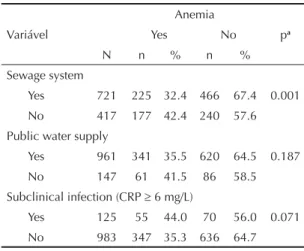
In the univariate analysis, the following children presented greater vulnerability to anemia: children aged six to 24 months, children who were breastfed for six months or more, children of mothers younger than 20 years and belonging to families with per capita income below 0.5 minimum salary. Concerning housing condi-tions, the following children were more susceptible to anemia: those who lived in unfi nished brick houses, in houses which had more than eight co-inhabitants, less than fi ve rooms and no sewage system (Table 1).
The variables that represented potential confounding factors with association at the level of p < 0.20 in relation to anemia and that participated in Poisson’s regression model were: child’s age, breastfeeding dura-tion, mother’s age, per capita income, mother’s level of schooling, type of construction of the house, number of co-inhabitants in the household, number of rooms of the house, public garbage collection, sewage system and public water supply. After the analysis of the adjusted model, the following variables remained associated with anemia: child’s age, breastfeeding period, number
Table 1. Prevalence of anemia in children aged six to 59 months, according to demographic, biological and socioeconomic characteristics. State of Paraíba, 2007.
Variable
Anemia
Yes No pa
N n % n %
Age (months)
6 ├ 12 115 73 63.5 42 36.5 < 0.001
12 ├ 24 249 150 60.2 99 39.8
24 ├ 36 219 66 30.1 153 69.9
36 ├ 48 265 69 26.0 196 74.0
48 260 46 17.7 214 82.3 Sex
Male 571 206 36.0 365 64.0 0.933
Female 537 196 36.5 341 63.5
Duration of breastfeeding (Months)
< 3 52 14 26.9 38 73.1 0.012
3 - 6 414 135 32.6 279 67.4
6 569 231 40.6 338 59.4 Mother’s age (years)
< 20 101 52 51.5 49 48.5 < 0.001
20 ├ 28 514 198 38.5 316 61.5
28 anos 478 145 30.3 333 69.7 Per capita income (Minimum salary)b
0,25 482 203 42.1 279 57.9 0.001 > 0,25 e
0,50 407 135 43.6 272 56.4 > 0,50 219 64 29.2 155 70.8
Mother’s level of schooling (years of schooling)
< 4 103 46 44.7 57 55.3 0.085
4 949 337 35.5 612 64.5 Type of construction of the house
Brick
house 955 333 34.9 622 65.1 0.016
Unfi nished
brick house 152 69 45.4 83 54.6
Number of co-inhabitants in the household
1-4 471 147 31.2 324 68.8 0.001
5-8 486 183 37.7 303 62.3
> 8 151 72 47.7 79 52.3
Number of rooms in the house
1-4 374 160 42.8 214 57.2 0.002
5 731 241 33.0 490 67.0 Public garbage collection
Yes 1052 375 35.6 677 64.4 0.109
No 55 26 47.3 29 52.7
Continue Figure. Temporal trend of anemia in children aged six to 59
months. State of Paraíba, 1982-2007.
40
36.5 36.4
39.1
33.7 33.7
39.3
19.3 17.3
1992 Years
1982 2007
21.5 30
20
%
10
of co-inhabitants in the house and number of rooms in the house (Table 2).
DISCUSSION
The results found in the present study indicate that iron defi ciency anemia is a nutritional defi ciency of great magnitude which continues to represent a public health problem of the moderate type (10% to 40%) in the State of Paraíba. The prevalence of anemia observed in the State of Paraíba (36.5%) was similar to the prevalences described in studies conducted in States of the Northeast region of Brazil.10,16
Analyzing the temporal trend of anemia in the studied ecological context, the stabilization in the prevalence of anemia in the period from 1992 to 2007 shows a trend profi le that is signifi cantly different from that of the period between 1982 and 1992, when there was a sharp increase in the problem, which has also been reported by Oliveira et al.17 This trend was somewhat unexpected, as its prevalence was expected to decrease, in consonance with what has been observed in temporal trend studies of other nutritional defi ciencies, like protein-energy malnutrition. A possible explanation for this unexpected behavior would be the fact that, although suffi ciently adequate in quantitative and ener-getic terms, these children’s nutrition is defi cient in iron, mainly that of high bioavailability, to meet their physi-ological needs. This high prevalence, although the mild form of anemia prevails, suggests that the measures to combat iron defi ciency and anemia in children, like food fortifi cation, oral iron supplementation and promotion of nutritional education, recommended by the WHO,e need to be implemented, monitored, and evaluated, so that the real impact of this interventions on the combat of nutritional anemia can be known.
The genesis of anemia seems to be associated with conjunctural and structural elements. Although iron defi ciency is characteristically an organic problem, its occurrence is not reduced to this dimension, that is, to the processes generated by defi ciencies in the consumption and absorption of foods and/or spolia-tion of this mineral. In order to know the totality of the causes of this disorder, it is necessary to consider the reality outside the human organism, like specifi c social processes which also determine iron defi ciency.
The greater susceptibility to anemia in children younger than 24 months strengthens the hypothesis that the disease is signifi cantly more prevalent among younger children, which has been ratifi ed by other studies.3,9,10,19,24 This greater vulnerability might be attributed, mainly, to the accelerated growth and consequent increase in the iron needs in the fi rst years of life.9 After the sixth month of age, with the end of the iron reserves that were acquired in the uterus, nutrition becomes fundamental to supply the mineral. Therefore, children younger than two years constitute a group of higher risk for anemia, as they present factors such as: early abandonment of exclusive breastfeeding, inadequate transition diet, as well as greater exposure to the contagion of infectious and parasitic diseases, due to greater contact with the external environment.
The greater vulnerability to anemia in the children who were breastfed during a larger period might be explained by the short duration of exclusive breastfeeding and the complementation with an iron-defi cient nutrition. This process occurs simultaneously with the organism’s greater requirement of an increased consumption of Table 1. continuation
Variável
Anemia
Yes No pa
N n % n %
Sewage system
Yes 721 225 32.4 466 67.4 0.001 No 417 177 42.4 240 57.6
Public water supply
Yes 961 341 35.5 620 64.5 0.187 No 147 61 41.5 86 58.5 Subclinical infection (CRP 6 mg/L)
Yes 125 55 44.0 70 56.0 0.071
No 983 347 35.3 636 64.7
a Chi-square test b R$ 350.00
CRP: C-Reactive Protein
Table 2. Poisson’s regression model adjusted for prevalence of anemia in children aged six to 59 months. State of Paraíba, 2007.
Variable RP 95%CI p-value
Child’s age (months)
6 ├ 12 3.84 2.79;5.29 0.000 12 ├ 24 3.56 2.62;4.83 0.000 24 ├ 36 1.89 1.34;2.67 0.000 36 ├ 48 1.58 1.11;2.25 0.012
48 1 -
-Duration of breastfeeding (months)
< 3 0.74 0,48;1.13 0.165 3 ├ 6 0.81 0,69;0.95 0.011
6 1 -
-Number of co-inhabitants in the household
1-4 1 -
-5-8 1.28 1.09;1.51 0,003 > 8 1.55 1.28;1.89 0.000
Number of rooms in the house
1-4 1.29 1.11;1.49 0,001
-this mineral for an adequate erythropoiesis, due to the accelerated growth. Low iron reserves at birth can also represent an important factor in the triggering of anemia, since iron storage during intrauterine life and exclusive breastfeeding meet the needs of the infant in the fi rst six months of life.15 In this sense, it should be emphasized that the duration of exclusive breastfeeding in Paraíba has been of only 22.4% of children younger than four months of age and 16.6% of children younger than six months,23 a prevalence that is well below what is recommended by the WHO.f Kitoko et al,8 in a study carried out in the municipality of João Pessoa, found a prevalence of exclu-sive breastfeeding of 23.9% in children younger than four months, and revealed that only 24.8% of children aged six to nine months received what the WHOg considers to be timely complementary feeding. Furthermore, of this total, 40.5% did not include in the diet beans and meat, two important sources of iron.
Studies have verifi ed the benefi cial effect of exclusive breastfeeding in the fi rst six months of life, as it increases the hemoglobin levels.11,15,16 In addition, the association of breastfeeding with the use of cow’s milk has caused a decline in children’s hemoglobin levels due to occur-rences of intestinal microhemorrhages.11,15,16 As a preven-tive measure, combined with other interventions, it is necessary to implement actions to promote exclusive breastfeeding up to the sixth month of life and nutritional guidance about adequate complementation to breast milk up to two years, aiming to reduce the consumption of cow’s milk and to stimulate the ingestion of foods with high density of heme iron.16
The greater risk of anemia in children with unfavor-able housing conditions (number of co-inhabitants and number of rooms in the house) might be explained by the reduction in these families’ economic accessibility, which leads to a per capita reduction in foods and to the consequent reduction in iron intake.10 The fact that anemia is more prevalent in households with lower number of rooms might be associated with factors that contribute to a greater dissemination of infectious diseases and intestinal parasitosis.13 This is a conse-quence of confi nement and overpopulation, which, in turn, contribute to the increase in insalubrity. It is known that this process of iron spoliation occurs due to the microhemorrhages that are caused by the parasitosis,
and by the reduction in iron absorption and the decrease in hemoglobin production as a result of infections.9
The non-association of anemia in the adjusted model with other variables that translate the socioeconomic status might be explained by the fact that it was represented in the adjusted model by other proxy variables, like housing condition. However, the distribution of anemia in the majority of the studied geographical spaces shows that iron defi ciency exceeds the socioeconomic limits, since it occurs in countries that are considered developed. Many studies3,13 haveshown that, the larger the child’s family income, the more he/she is protected from anemia, due to the infl uence in the very quality of nutrition. To these authors, although individuals from any stratum are not immune to anemia, families of lower socioeconomic level are subject to a higher risk of developing the disease, and its prevalence tends to be lower in the strata of better socioeconomic level. The relevance of income level in the determination of anemia seems to derive from its effect on the quantity and quality of food, on the consumption of foods that are sources of heme iron, on the access to healthcare services and on the quality of housing and sanitation.4
Although the variable maternal age lost its strength of association in the regression analysis, children whose mothers were younger than 20 years were more susceptible to anemia. Similar fi ndings from other studies10,13,20 lead us to suppose that these mothers’ lack of maturity and knowledge infl uence the inad-equate choice of complementary foods. Furthermore, adolescent mothers have higher probability of having preterm children, with low birth weight and, conse-quently, lower hemoglobin reserves.6
The results that were found in this study reiterate that anemia in the State of Paraíba continues to be an impor-tant public health problem and that little advance has been obtained regarding the reduction in this nutritional disorder, probably due to the fact that this defi ciency is the fi nal result of a series of biological, social, economic and cultural factors in which the child is included. As a measure to prevent and control this nutritional defi ciency, it is necessary that the public health polices implement effective and urgent actions, mainly in the risk population; otherwise, irreversible damages may affect the population.
f World Health Organization. World Health Assembly Resolution 47.5. Geneva; 1994. g World Health Organization. Indicators for assessing breastfeeding practices. Geneva; 1991. 1. Almeida CAN, Ricco RG, Del Ciampo LA, Souza AM,
Pinho AP, Oliveira JED. Fatores associados à anemia por defi ciência de ferro em crianças pré-escolares brasileiras. J Pediatr (Rio J). 2004;80(3):229-34. DOI:10.2223/1188
2. Assis AMO, Gaudenzi EM, Gomes G, Ribeiro RC, Szarfarc SC, Souza SB. Níveis de hemoglobina, aleitamento materno e regime alimentar no primeiro ano de vida. Rev Saude Publica. 2004;38(4):543-51.
DOI:10.1590/S0034-89102004000400010
3. Assunção MCF, Santos IS, Barros AJD, Gigante DP, Victora CG. Anemia em menores de seis anos: estudo de base populacional em Pelotas, RS. Rev Saude Publica. 2007;41(3): 328-35. DOI:10.1590/S0034-89102007000300002
4. Borges CQ, Silva RCR, Assis AMO, Pinto EJ, Fiaccone RL, Pinheiro SMC. Fatores associados à anemia em crianças e adolescentes de escolas públicas de Salvador, Bahia, Brasil. Cad Saude Publica. 2009;25(4):877-88. DOI:10.1590/S0102-311X2009000400019
5. Brunken GS, Guimarães LV, Fisberg M. Anemia em crianças menores de 3 anos que frequentam creches públicas em período integral. J Pediatr (Rio J). 2002;78(1):50-6. DOI:10.1590/S0021-75572002000100011
6. Compri PC, Cury MCFS, Novo NF, Juliano Y, Sigulem DM. Variáveis maternas e infantis associadas à ocorrência de anemia em crianças nos serviços de atenção básica em São Paulo. Rev Paul Pediatr. 2007;25(4):349-54. DOI:10.1590/S0103-05822007000400009
7. Gibson RS. Principles of nutritional assessment. New York: Oxford University Press; 1990.
8. Kitoko PM, Rea MF, Venancio SI, Vasconcelos ACCP, Santos EKA, Monteiro CA. Situação do aleitamento materno em duas capitais brasileiras: uma análise comparada. Cad Saude Publica. 2000;16(4):1111-9. DOI:10.1590/S0102-311X2000000400029
9. Konstantyner T, Taddei JAAC, Palma D. Fatores de risco de anemia em lactentes matriculados em creches públicas ou fi lantrópicas de São Paulo. Rev Nutr. 2007;20(4):349-59. DOI:10.1590/S1415-52732007000400002
10. Leal LP, Batista Filho M, Lira PIC, Figueiroa JN, Osório MM. Prevalência da anemia e fatores associados em crianças de seis a 59 meses de Pernambuco. Rev Saude Publica.2011;45(3):457-66. DOI:10.1590/S0034-89102011000300003
11. Levy-Costa RB, Monteiro CA. Consumo de leite de vaca e anemia na infância no município de São Paulo. Rev Saude Publica. 2004;38(6):797-803. DOI:10.1590/S0034-89102004000600007
12. Miranda AS, Franceschini SCC, Priore SE, Euclides MP, Araújo RMA, Ribeiro SMR, et al. Anemia ferropriva e estado nutricional de crianças com idade de 12 a 60 meses do município de Viçosa, MG. Rev Nutr. 2003;16(2):163-9. DOI:10.1590/S1415-52732003000200003
13. Monteiro CA, Szarfarc SC, Mondini L. Tendência secular da anemia na infância na cidade de São Paulo (1984-1996). Rev Saude Publica.2000;34(6 Supl):62-72. DOI:10.1590/S0034-89102000000700009
14. Neuman NA, Tanaka OY, Szarfarc SC, Guimarães PRV, Victora CG. Prevalência e fatores de risco para anemia no sul do Brasil. Rev Saude Publica. 2000;34(1):57-63. DOI:10.1590/S0034-89102000000100011
15. Oliveira AS, Silva RCR, Fiaccone RL, Pinto EJ, Assis AMO. Efeito da duração da amamentação exclusiva e mista sobre os níveis de hemoglobina nos primeiros seis meses de vida: um estudo de seguimento. Cad Saude Publica.2010;26(2):409-17. DOI:10.1590/S0102-311X2010000200020
16. Oliveira MAA, Osório MM, Raposo MCF. Fatores socioeconômicos e dietéticos de risco para a anemia em crianças de 6 a 59 meses de idade. J Pediatr (Rio J). 2007;83(1):39-46. DOI:10.2223/JPED.1579
17. Oliveira RS, Diniz AS, Benigna MJC, Miranda-Silva SM, Lola MM, Gonçalves MC, et al. Magnitude, distribuição espacial e tendência da anemia em pré-escolares da Paraíba. Rev Saude Publica. 2002;36(1):26-32. DOI:10.1590/S0034-89102002000100005
18. Silva DG, Franceschini SCC, Priore SE, Ribeiro SMR, Szarfarc SC, Souza SB, et al. Anemia ferropriva em crianças de 6 a 12 meses atendidas na rede pública de saúde do município de Viçosa, Minas Gerais. Rev Nutr. 2002;15(3):301-8. DOI:10.1590/S1415-52732002000300006
19. Souto TE, Oliveira MN, Casoy F, Machado EHS, Juliano Y, Gouvêa LC, et al. Anemia e renda per capita familiar de crianças frequentadoras da creche do Centro Educacional Unifi cado Cidade Dutra, no Município de São Paulo. Rev Paul Pediatr. 2007;25(2):161- 6. DOI:10.1590/S0103-05822007000200011
20. Spinelli MGN, Marchioni DML, Souza JMP, Souza SB, Szarfarc SC. Fatores de risco para anemia em crianças de 6 a 12 meses no Brasil. RevPanam Salud Publica.2005;17(2):84-91. DOI:10.1590/S1020-49892005000200004
21. Szarfarc SC. Políticas públicas para o controle da anemia ferropriva. Rev Bras Hematol Hemoter. 2010;32(Supl 2)2-8. DOI:10.1590/S1516-84842010005000065
22. Thurnham DI, McCabe GP, Northrop-Clewes CA, Nestel P. Effects of subclinical infection on plasma retinol concentrations and assessment of prevalence of vitamin A defi ciency: meta-analysis. Lancet. 2003;362(9401):2052-8. DOI:10.1016/S0140-6736(03)15099-4
23. Viana RPT, Rea MF, Venancio SI, Escuder MM. A prática de amamentar entre mulheres que exercem trabalho remunerado na Paraíba, Brasil: um estudo transversal. Cad Saude Publica. 2007;23(10):2403-9. DOI:10.1590/S0102-311X2007001000015
24. Vieira ACF, Diniz AS, Cabral PC, Oliveira RS, Lóla MMF, Silva SMM, et al. Avaliação do estado nutricional de ferro e anemia em crianças de 5 anos de creches públicas. J Pediatr (Rio J).2007;83(4):370-6. DOI:10.1590/S0021-75572007000500014
Research fi nanced by Conselho Nacional de Desenvolvimento Científi co e Tecnológico (CNPq). Process nº 402157/2005-2. Paper based on the doctoral dissertation authored by Gondim SSR, submitted to the Postgraduate Program in Nutrition of Universidade Federal de Pernambuco in 2011.