Accuracy of spirometry for detection of asthma: a
cross-sectional study
Andréa Cristina Meneghini
I, Ana Carolina Botto Paulino
II, Luciano Penha Pereira
III, Elcio Oliveira Vianna
IVUniversity Hospital, Universidade de São Paulo (USP), Ribeirão Preto (SP), Brazil
ABSTRACT
BACKGROUND: Asthma is a chronic inlammatory disease with airway hyperresponsiveness. Spirometry is the most commonly used test among asthmatic patients. Another functional test used for diagnosing asthma is the bronchial challenge test. The aim of this study was to analyze the accuracy of spirometry for detecting asthma in the general population.
DESIGN AND SETTING: Cross-sectional study with data analysis to evaluate the accuracy of spirometry through calculating sensitivity, speciicity and predictive values and through the kappa agreement test.
METHODS: Subjects who constituted a birth cohort were enrolled at the age of 23 to 25 years. Spirometric abnormality was deined as reduced forced expiratory volume in one second, i.e. lower than 80% of the predicted value. Measurement of bronchial responsiveness was performed by means of the bronchial challenge test with methacholine. The gold-standard diagnosis of asthma was deined as the presence of bronchial hyperresponsiveness in association with respiratory symptoms.
RESULTS: Asthma was detected in 200 subjects (10.4%) out of the sample of 1922 individuals. Spiro-metric abnormality was detected in 208 subjects (10.9%) of the sample. The speciicity of spiroSpiro-metric abnormality for detecting asthma was 90%, sensitivity was 23%, positive predictive value was 22%, and negative predictive value was 91%. The kappa test revealed weak agreement of 0.13 (95% conidence interval, CI: 0.07-0.19) between spirometry and the diagnosis of asthma.
CONCLUSION: Spirometry, as a single test, has limitations for detecting asthma in the general population.
IMSc. Doctoral Student, Department of Social
Medicine, Faculdade de Medicina de Ribeirão Preto (FMRP), Universidade de São Paulo (USP), Ribeirão Preto (SP), Brazil.
IIMSc. Nurse, Department of Social Medicine,
Faculdade de Medicina de Ribeirão Preto (FMRP), Universidade de São Paulo (USP), Ribeirão Preto (SP), Brazil.
IIIMD, MSc. Preceptor of Internship, Pneumology
Service, Hospital Santa Casa de Ribeirão Preto, Ribeirão Preto (SP), Brazil.
IVMD, PhD. Associate Professor, Department of
Medicine, Faculdade de Medicina de Ribeirão Preto (FMRP), Universidade de São Paulo (USP), Ribeirão Preto (SP), Brazil.
KEY WORDS:
Asthma. Spirometry.
Methacholine chloride.
Dimensional measurement accuracy. Diagnosis.
Bronchial hyperreactivity.
INTRODUCTION
Asthma is a chronic inlammatory disease of the airways in which many cells and mediators have a role. Chronic inlammation is associated with airway hyperresponsiveness that leads to recurrent episodes of wheezing, breathlessness, chest tightness and coughing, particularly at night or early in the morning.1 he medical history and a physical examination are frequently
suicient for diagnosing asthma. In epidemiological studies and for screening for asthma in large groups (for example, employees at risk, students and the military), a diagnosis of asthma may be made based on questionnaires, with or without a physiological test.2
Spirometry is the most commonly used test for asthmatic patients. It is useful for making the diagnosis, classifying the severity and monitoring therapeutic drug administration.3 Use of
spirometry is valued in most guidelines on approaches to and treatment of asthma.3,4
Another functional test that is used for diagnosing asthma is measurement of airway respon-siveness, i.e. the bronchial challenge test.5 his test uses bronchoconstriction stimuli, such as
methacholine, and it is considered to be the best choice for diagnosing asthma in patients with normal spirometry tests.5,6
Bronchial challenge corroborates the diagnosis of asthma through conirming the presence of bronchial hyperresponsiveness. More importantly, it may rule out this diagnosis when bron-chial hyperresponsiveness is not detected, because its negative predictive value is high.2 For this
reason, it is considered to be a gold standard test for asthma diagnosis.
Untreated asthma results in signiicant morbidity. It carries high costs, due not only to health expenditure but also to loss of productivity, absence from school or work and impairment of family life.1 One example of the importance of early asthma diagnosis is the case of work-related
OBJECTIVE
he aim of this study was to analyze the accuracy of spirome-try for detecting asthma in the general population, by means of calculating sensitivity and speciicity and using the kappa agree-ment test. A positive methacholine challenge test in combina-tion with respiratory symptoms was used as the gold-standard method for diagnosing asthma.
METHODS
his was a cross-sectional study with data analysis to evaluate the accuracy of spirometry for detecting asthma. Spirometric abnor-mality was deined here as reduced forced expiratory volume in one second (FEV1), i.e. lower than 80% of the predicted value. Measurements of bronchial responsiveness were made and a gold-standard diagnosis of asthma was deined as the presence of bronchial hyperresponsiveness and respiratory symptoms.7
Sample
Subjects who constituted a birth cohort were enrolled in this study at the age of 23 to 25 years. We randomly selected 2,063 subjects and 1,922 of them underwent all the procedures neces-sary for this study.
his birth cohort comprised subjects born in the municipality of Ribeirão Preto during the period from June 1, 1978, to May 31, 1979, and this data collection was the fourth study on this cohort.7
he recruitment of the sample was based on the charts of the liveborns of the original cohort, which contained the name and address of the mother and the data of birth of the child. he potential participants in this evaluation were identiied by the contact and ield teams, which were set up and trained over a six-month period. A period of 24 months was reserved for sub-ject identiication and for data collection, with a capacity of 4-7 daily evaluations by the service.7
he inclusion criteria were that the subjects needed to belong to this cohort and to be able to perform all the procedures neces-sary. Previous articles have reported on the history of this cohort, sample size calculations, subject selection and recruitment.7
his sample was assessed in the fourth phase of following up this cohort.7 he aim of this fourth phase was to ascertain the
importance of events that occurred between the prenatal period and early adulthood and to analyze the impact of these events on the growth and development of chronic non-transmissible adult diseases, such as asthma. At this phase, anthropometric measure-ments were taken, blood samples were collected and spirometry, skin allergy tests and the bronchial challenge test with metha-choline were performed. Asthma was one of the diseases studied. he methacholine challenge was performed on the whole sample to evaluate asthma for the several analyses on this cohort. Some of these analyses have already been published.7-10
he tests and measurements were carried out in a healthcare setting with easy access to medical facilities. he examinations were performed at the university hospital in the city of Ribeirão Preto, in the northwestern region of the state of São Paulo, Brazil. he participants signed a consent form ater reading and listening to the aims and procedures included in the study. his study was approved by the institutional ethics committee.
Procedures
Respiratory and occupational questionnaires
Respiratory symptoms were assessed using the European Community Respiratory Health Survey (ECRHS) questionnaire, as translated into Portuguese and adapted to the Brazilian lexi-con.8 he ECRHS questionnaire was developed for use among
young adults aged 20 to 44 years, to explore asthma symptoms in young adults. We used questions of the ECRHS questionnaire to explore asthma symptoms. Subjects could answer yes or no to the following questions:
• “Have you had wheezing or whistling in your chest at any time in the last 12 months?”
• “Have you woken up with a feeling of tightness in your chest at any time in the last 12 months?”
• “Have you had an attack of shortness of breath that came on during the day when you were at rest at any time in the last 12 months?”
• “Have you been woken by an attack of shortness of breath at any time in the last 12 months?”
Presence of any of these symptoms in association with bronchial hyperresponsiveness deined asthma. hus, symptoms reported by non-hyperresponsive individuals were not enough to classify them as asthmatic.
Spirometry and bronchial responsiveness measurements he bronchial responsiveness to methacholine was measured using the two-minute tidal breathing method. Increasing con-centrations of methacholine (0.06, 0.125, 0.25, 0.5, 1, 2, 4, 8 and 16 mg/ml) were aerosolized using a DeVilbiss 646 nebu-lizer (Sunrise Medical HHG Inc, Somerset, PA, USA) driven by a computer-activated dosimeter (Koko Digidoser System, PDS Instrumentation, Inc., Louisville, CO, USA) with an output of 9 ml per 0.6 second (total delivery of 0.045 ml).
challenge test were all conditions that might compromise the qual-ity of the test or that might subject the patient to increased risk or discomfort, and these included FEV1 < 50% of predicted value, pregnancy, nursing mothers and inability to perform spirometry of acceptable quality. Other contraindications were heart attack or stroke in the last three months; uncontrolled hypertension; systolic blood pressure (BP) > 200 mmHg or diastolic BP > 100 mmHg; known aortic aneurysm; and current use of cholinesterase inhibitor medi-cation (for myasthenia gravis). During preparation, patients were questioned about factors that could increase or decrease bronchial responsiveness, such as current respiratory infection.2
he hypothesis of the study was formulated ater data collec-tion. To avoid bias, the same investigator performed all tests on every volunteer. he main measurements, as described above, were symptom evaluation, FEV1 and bronchial responsiveness measure-ments. Based on these data, the variables were deined as follows.
Variables
Current wheezing was deined as a positive answer to the
ques-tion: “Have you had wheezing or whistling in your chest any time in the last 12 months?” Possible answers: yes or no.
Chest tightness was deined as a positive answer to the
ques-tion: “Have you woken up with a feeling of tightness in your chest at any time in the last 12 months?” Possible answers: yes or no.
Breathlessness was deined as a positive answer to the
ques-tion: “Have you had an attack of shortness of breath that came on during the day when you were at rest at any time in the last 12 months?” Possible answers: yes or no.
Nocturnal breathlessness was deined as a positive answer to
the question: “Have you been woken by an attack of shortness of breath at any time in the last 12 months?” Possible answers: yes or no.
Reduced FEV1 was deined as any value less than 80% of the
predicted FEV1. Reference values were adopted as described by Crapo et al.11 hus, this quantitative variable was handled as a
binary variable (FEV1 reduction: yes or no).
Presence of asthma, as conirmed through the bronchial
hyper-responsiveness test, was deined by two main components of the disease, i.e. presence of bronchial hyperresponsiveness and at least one of the symptoms.2,5 hus, bronchial hyperresponsiveness was
handled as a binary variable (positive or negative) to deine asthma.
Sample size
he sample size was deined from previous prevalence studies in which the data gathered formed the database that allowed us to conduct the present analysis.
Statistical analysis
Simple exploratory analyses were used to describe the study population and to calculate the prevalence of reduced FEV1,
hyperresponsiveness, respiratory symptoms and asthma, expressed as percentages.
We irst tested the association between reduced FEV1 (under test here) and asthma as conirmed through the methacholine chal-lenge test (gold standard). If there was no association, we would not pursue this to test its accuracy.
he simple and multiple log-binomial regression method was used to estimate the prevalence ratio, since the response was binary (presence of disease = yes or no). In assessing the association between reduced FEV1 and asthma, the confounding variables were schooling, type of work, smoking, physical activity, blood pressure, allergy and anthropometry.
he presence of bronchial hyperresponsiveness (i.e. a positive result from the methacholine challenge) in subjects with symptoms was the deinition used for asthma (gold standard). he accuracy of FEV1 reduction for detecting asthma was tested through cal-culation of positive and negative likelihood ratios and sensitivity and speciicity. he kappa test was applied to check for agreement between reduced FEV1 and asthma. he analyses were carried out using STATA version 9.1 (Copyright 1984-2005; Stata Corp., 4905 Lakeway Drive, College Station, Texas 77845, USA).
RESULTS
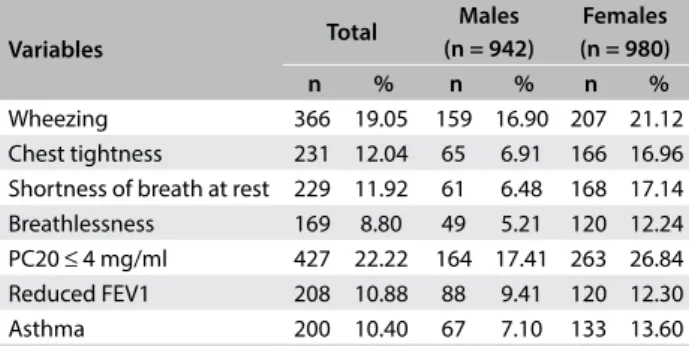
he age of the sample of 1922 individuals (980 women) who completed the protocol (mean ± standard deviation, SD) was 23.9 ± 0.7 years. he prevalence of asthma was 10.4% and 119 subjects (6.1%) were using asthma medications. he prevalences of the major variables are shown in Table 1. Bronchial hyperre-sponsiveness was detected in 22.2% of the sample, i.e. 427 sub-jects: 263 women (61.6%) and 164 men (38.4%) (P < 0.0001). Current smoking was reported by 17.4% of the individuals, i.e. by 14.2% of the women and 20.7% of the men (P < 0.0001). he prevalence of current plus former smoking was 26.3%, i.e. 21.9% of the women and 30.8% of the men (P < 0.0001). Slightly
Table 1. Prevalence of reduced FEV1, hyperresponsiveness, respiratory symptoms and asthma
Variables Total
Males (n = 942)
Females (n = 980)
n % n % n %
Wheezing 366 19.05 159 16.90 207 21.12
Chest tightness 231 12.04 65 6.91 166 16.96 Shortness of breath at rest 229 11.92 61 6.48 168 17.14 Breathlessness 169 8.80 49 5.21 120 12.24 PC20 ≤ 4 mg/ml 427 22.22 164 17.41 263 26.84
Reduced FEV1 208 10.88 88 9.41 120 12.30
Asthma 200 10.40 67 7.10 133 13.60
more than one third of the individuals belonged to the catego-ries of qualiied and semi-qualiied manual workers; 21.5% to the unqualiied manual category; 21.1% to the non-manual category; and 22.7% did not belong to the economically active population. Regarding educational background, 14.7% had had 1-8 years of schooling, 50.9% had had 9-11 years and 34.4% had had more than 11 years.
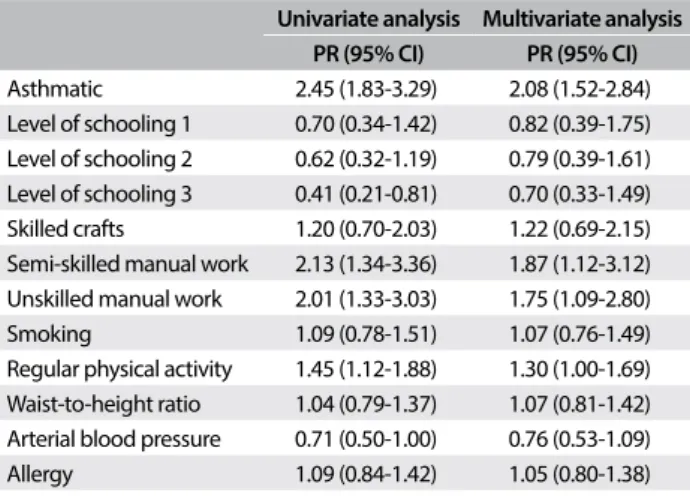
In the 208 cases with FEV1 reduction, the FEV1/FVC ratio (% of predicted value) was 82 ± 6% (mean ± SD). Since 90% of the predicted value is considered to be the cutof value for this variable, these indings indicate that there was a reduction in FEV1/FVC in the group with FEV1 reduction. he prevalence of FEV1/FVC reduction in this group was 70%. FEV1 (% of predicted value) for the group with reduced FEV1 (n = 208) was 73 ± 0.06%. he association between asthma and reduced FEV1 is shown
in Table 2. he kappa index calculated to assess the agreement
between reduced FEV1 and asthma was 0.13 (range, 0.07 - 0.19), thus indicating weak agreement. he sensitivity, speciicity, predic-tive values, posipredic-tive likelihood ratio and negapredic-tive likelihood ratio for reduced FEV1 to detect asthma were 23%, 90%, 22%, 91%, 2.30 and 0.86, respectively (Table 3). he prevalences of reduced FEV1 in cases of conirmed asthma and in cases of non-asthma are shown in Table 4.
DISCUSSION
he aim of this study was to analyze the accuracy of spirometry for detection of asthma in general or speciic populations. Accuracy was evaluated by means of calculation of sensitivity and speciic-ity and use of the kappa agreement test. A positive methacholine challenge test in combination with asthma symptoms was used
as the gold-standard reference method for diagnosing asthma. A preliminary statistical analysis was conducted to investigate the association between abnormal spirometry and asthma in this sample. his irst step conirmed that there was an association between reduced FEV1 and asthma. However, subsequent analy-ses indicated that spirometry underdiagnosed asthma. he sensi-tivity of spirometry was 23%, speciicity was 90%, negative pre-dictive value was 91% and positive prepre-dictive value was 22%. he accuracy calculated using the Youden index was low (0.33). he agreement between asthma and reduced FEV1 was also low according to the kappa coeicient (0.13). Figure 1 shows the data relating to this lack of agreement.
Table 2. Univariate and multivariate binomial analysis on reduced FEV1
Univariate analysis Multivariate analysis PR (95% CI) PR (95% CI)
Asthmatic 2.45 (1.83-3.29) 2.08 (1.52-2.84) Level of schooling 1 0.70 (0.34-1.42) 0.82 (0.39-1.75) Level of schooling 2 0.62 (0.32-1.19) 0.79 (0.39-1.61) Level of schooling 3 0.41 (0.21-0.81) 0.70 (0.33-1.49) Skilled crafts 1.20 (0.70-2.03) 1.22 (0.69-2.15) Semi-skilled manual work 2.13 (1.34-3.36) 1.87 (1.12-3.12) Unskilled manual work 2.01 (1.33-3.03) 1.75 (1.09-2.80) Smoking 1.09 (0.78-1.51) 1.07 (0.76-1.49) Regular physical activity 1.45 (1.12-1.88) 1.30 (1.00-1.69) Waist-to-height ratio 1.04 (0.79-1.37) 1.07 (0.81-1.42) Arterial blood pressure 0.71 (0.50-1.00) 0.76 (0.53-1.09) Allergy 1.09 (0.84-1.42) 1.05 (0.80-1.38)
FEV1 = forced expiratory volume in one second; PR = prevalence ratio; CI = conidence interval; level of schooling 1 = 9-11 years of schooling; level 2 = 5-8 years of schooling; level 3 = 4 years of schooling or less. FEV1 reduction means values below 80% of predicted value.
Table 3. Sensitivity, speciicity, predictive values and likelihood ratio values for reduced FEV1 to detect asthma
Parameter Value
Sensitivity 23%
Speciicity 90%
Positive predictive value 22%
Negative predictive value 91%
Positive likelihood ratio 2.30
Negative likelihood ratio 0.86
FEV1 = forced expiratory volume in one second; reduced FEV1 means values < 80% of predicted value. Asthma was deined as positive methacholine bronchial challenge test in association with any compatible symptom.
Table 4. Reduced FEV1 in cases of conirmed asthma and in cases of non-asthma
Conirmed asthma Non-asthma Total n = 200 n = 1,722 1,922
Reduced FEV1 46 162 208
Normal FEV1 154 1,560 1,714
FEV1 = forced expiratory volume in one second; Reduced FEV1 means values below 80% of predicted value; Asthma was deined as positive methacholine bronchial challenge test in association with any compatible symptom.
Figure 1. Number of subjects with asthma and with reduced forced expiratory volume in one second (FEV1).
Note: Asthma diagnosis was conirmed through the bronchial challenge test and any compatible symptom in the last year.
Asthma with normal FEV1 n = 154
Asthma with reduced
FEV1 n = 46
his high negative predictive value for spirometry (91%) means that a negative test (normal spirometry) probably indicates absence of asthma. It is worthy bearing in mind that predictive value cal-culations are inluenced by prevalence, i.e. the low probability of asthma in this case of a negative test was also a consequence of the low prevalence of asthma (10.4%). he low sensitivity of this test indicates that it is not suitable for disease screening. Although spirometry is a cheap, common and simple health screening test that, for example, can be used for workers exposed to high-risk pollutants, it is insuicient for detecting most cases of asthma.12
In the irst study evaluating the diagnostic accuracy of spirom-etry for diagnosing airlow obstruction in patients with asthma or chronic obstructive pulmonary disease (COPD) in primary care, it was found that the presence or absence of COPD could be estimated with comparatively high diagnostic accuracy. It was also possible to accept the presence of asthma. However, it was impossible to rule out asthma because the sensitivity was too low. he sensitivity for diagnosing airway obstruction in asthma cases was 29% (95% conidence interval, CI: 21-39) and the speciicity was 90% (95% CI: 81-95).13 hese igures were similar to our indings.
Four commonly used tests for diagnosing asthma were assessed in a population-based sample of 495 schoolchildren (the Odense Schoolchild Study). he test panel consisted of FEV1, challenge with treadmill exercise, challenge with inhaled methacholine and monitoring of peak expiratory low (PEF), twice daily for two weeks. he agreement between the four tests was weak. he sensitivity for diagnosed asthma was highest for the methacholine challenge followed by PEF monitoring, whereas the speciicity for asthma or asthma-like symptoms was margin-ally higher with the other two tests (spirometry and challenge with exercise).14 Finally, Bonini et al. reported that spirometry
appeared to be poorly sensitive for detecting mild persistent or intermittent asthma in athletes, possibly because exercise necessi-ties are associated with spirometry values of approximately 100% of predicted values in most athletes.15
Most deinitions of asthma highlight variable airlow obstruc-tion and inlammaobstruc-tion as essential elements of this condiobstruc-tion. hese characteristics do not translate into an unambiguous deini-tion to separate asthma and non-asthma in surveys and in screen-ing approaches. In previous studies from our group, we showed that non-dichotomous deinitions of asthma may lead to diferent results regarding the prevalence of and risk factors for asthma.16
Nevertheless, asthma deinitions depend on the purposes of the diagnosis and deinitions based on spirometry are scarcely found in epidemiological studies.16,17
Conversely, for medical practice, use of spirometry is certainly more important because patients have asthma of greater severity and present with bronchial obstruction. Measurement of FEV1 is necessary for classifying its severity and for follow-up. In cases
with normal spirometry and unconirmed asthma, bronchial chal-lenge with methacholine is the test of choice.2
Work-related asthma is the most prevalent occupational respira-tory disease. It is deined as asthma that is causally and speciically related to exposure to airborne dust, gases, vapors or fumes in the workplace. Work-related asthma encompasses aggravated asthma (meaning preexisting asthma) and occupational asthma (without preexisting asthma).2 Patients’ prognoses depend on the duration
of exposure, duration of symptoms and severity of asthma at the time of diagnosis. Patients with asthma of greater severity tend to continue to present asthma symptoms ater exposure ceases, but those with mild asthma may subsequently achieve complete remis-sion.2 herefore, early diagnosing of asthma and exposure
cessa-tion are the most important approaches for work-related asthma.1
Brazilian regulation NR-7 requires annual spirometry for work-ers dealing with non-ibrogenic aerosols. Our inding that spirome-try has low sensitivity for detecting asthma in the general population does not support this policy. Instead, regulations should encourage use of the bronchial challenge test and symptom questionnaires to detect asthma cases with normal spirometry. Other manifesta-tions that precede asthma could also improve patients’ odds of early detection and cure for occupational asthma. hese may include occurrences of rhinitis, skin symptoms and allergic sensitization. herefore, NR-7 may lead to detection of asthma at a later stage than would be recommendable.12
However, the purpose of the present analysis was not to exam-ine the eicacy of the regulation NR-7. We mention it simply as an example of the value that is placed on spirometry, which deserves attention. If NR-7 were to be changed such that it would then rec-ommend use of the bronchial challenge test or use of a symptom questionnaire, this would lead to earlier diagnosis of asthma in workers with high-risk exposure.
he positive features of the present study protocol were its large sample size, its excellent reference test for asthma and the young age of the participants, which practically excluded the bias of patients with COPD. One limitation of the study was its lack of diagnosis for all subjects with reduced FEV1. Asthmatics could be identiied through the methacholine challenge, but other diseases with normal bronchial responsiveness were not evaluated. However, detection of reduced FEV1 was not common. Subjects without asthma but with reduced FEV1 may have obesity, chest wall disease, neuromuscular impairment, bronchiectasis or other respiratory diseases.
CONCLUSION
he low sensitivity of spirometry for detecting asthma in clinical settings allows us to assume that this test conducted alone is not a good screening tool.
REFERENCES
1. Global Initiative for Asthma. Global strategy for asthma management
and prevention. Global Initiative for Asthma; 2016. Available from:
http://ginasthma.org/wp-content/uploads/2016/04/GINA-Appendix-2016-inal.pdf. Accessed in 2017 (Jul 28).
2. Crapo RO, Casaburi R, Coates AL, et al. Guidelines for methacoline and
exercise challenge testing-1999. This oicial statement of the American
Thoracic Society was adopet by the ATS Board of Directors, July 1999.
Am J Respir Crit Care Med. 2000;161(1):309-29.
3. British Thoracic Society. British guideline on the management of asthma.
A national clinical guideline. Edinburgh: British Thoracic Society; 2014.
Available from: https://www.brit-thoracic.org.uk/document-library/
clinical-information/asthma/btssign-asthma-guideline-2014/. Accessed
in 2017 (Jul 28).
4. Lougheed MD, Lemiere C, Ducharme FM, et al. Canadian Thoracic
Society 2012 guideline update: diagnosis and management of asthma
in preschoolers, children and adults. Can Respir J. 2012;19(2):127-64.
5. Borges Mde C, Ferraz E, Vianna EO. Bronchial provocation tests in clinical
practice. Sao Paulo Med J. 2011;129(4):243-9.
6. Cockcroft DW, Killian DW, Mellon JJ, Hargreave FE. Bronchial reactivity
to inhaled histamine: a method and clinical survey. Clin Allergy.
1977;7(3):235-43.
7. Barbieri MA, Bettiol H, Silva AA, et al. Health in early adulthood: the
contribution of the 1978/79 Ribeirão Preto birth cohort. Braz J Med
Biol Res. 2006;39(8):1041-55.
8. Caldeira RD, Bettiol H, Barbieri MA, et al. Prevalence and risk factors
for work related asthma in young adults. Occup Environ Med.
2006;63(10):694-9.
9. Cardoso VC, Simões VM, Barbieri MA, et al. Proile of three Brazilian birth
cohort studies in Ribeirão Preto, SP and São Luís, MA. Braz J Med Biol
Res. 2007;40(9):1165-76.
10. Vianna EO, Gutierrez MR, Barbieri MA, et al. Respiratory efects of tobacco
smoking among young adults. Am J Med Sci. 2008;336(1):44-9.
11. Crapo RO, Morris AH, Gardner RM. Reference spirometric values using
techniques and equipment that meet the ATS recommendations. Am
Rev Respir Dis. 1981;123(6):659-64.
12. Ministério do Trabalho. NR 7 – Programa de controle médico de saúde
ocupacional. Available from: https://www.pncq.org.br/uploads/2016/
NR_MTE/NR%207%20-%20PCMSO.pdf. Accessed in 2017 (Jul 28).
13. Schneider A, Gindner L, Tilemann L, et al. Diagnostic accuracy of
spirometry in primary care. BMC Pulm Med. 2009;9:31.
14. Siersted HC, Mostgaard G, Hyldebrandt N, et al. Interrelationships
between diagnosed asthma, asthma-like symptoms, and abnormal
airway behaviour in adolescence: the Odense Schoolchild Study.
Thorax. 1996;51(5):503-509.
15. Bonini M, Lapucci G, Petrelli G, et al. Predictive value of allergy and
pulmonary function tests for the diagnosis of asthma in elite athletes.
Allergy. 2007;62(10):1166-70.
16. Vianna EO, García CA, Bettiol MA, et al. Asthma deinitions, relative
validity and impact on known risk factors in young Brazilians. Allergy.
2007;62(10):1146-51.
17. Pekkanen J, Sunyer J, Anto JM, et al. Operational deinitions of asthma
in studies on its aetiology. Eur Respir J. 2005;26(1):28-35.
18. Birnbaum S, Barreiro TJ. Methacoline challenge testing: identifying
its diagnostic role, testing, coding, and reimbursement. Chest.
2007;131(6):1932-5.
Conlict of interest: None
Sources of funding: Fundação de Amparo à Pesquisa do Estado de São
Paulo (FAPESP), protocol number 1998/10382-6 and 2001/12416-0
Date of irst submission: February 8, 2017
Last received: May 12, 2017
Accepted: May 25, 2017
Address for correspondence:
Elcio Oliveira Vianna
Departamento de Clínica Médica, Hospital das Clínicas de Ribeirão Preto,
Universidade de São Paulo (USP)
Av. Bandeirantes, 3.900
Ribeirão Preto (SP) — Brasil
CEP 14048-900
Tel. (+55 16) 3602-2706
Fax. (+55 16) 3602-0229