www.jped.com.br
ORIGINAL
ARTICLE
A
short
form
of
the
neonatal
intensive
care
unit
family
needs
inventory
夽
,
夽夽
Elisabete
Alves
a,∗,
Milton
Severo
a,b,
Mariana
Amorim
a,c,
Catarina
Grande
d,
Susana
Silva
aaEpiUnit-InstituteofPublicHealth,UniversidadedoPorto,Porto,Portugal
bDepartmentofClinicalEpidemiology,PredictiveMedicineandPublicHealth,MedicalSchool,UniversidadedoPorto,Porto,
Portugal
cGlobalPublicHealthDoctoralProgramme,InstituteofPublicHealth,UniversidadedoPorto,Portugal dFacultyofPsychologyandEducationSciences,UniversidadedoPorto,Porto,Portugal
Received7December2014;accepted15April2015 Availableonline9October2015
KEYWORDS
Neonatalintensive careunits; Needsassessment; Parents;
Validationstudiesas topic
Abstract
Objective: TheidentificationofparentalneedsinNeonatalIntensiveCareUnitsisessentialto designandimplementfamily-centeredcare.ThisarticleaimstovalidatetheNeonatalIntensive CareUnitsFamilyNeedsInventoryforthePortuguesepopulation,andtoproposeaShortForm.
Methods: A linguistic adaptation ofthe Neonatal Intensive Care Units FamilyNeeds Inven-tory, aself-reportscalewith56-items,wasperformed.Theinstrumentwasadministered to 211parentsofinfantshospitalizedinalllevelIIINeonatalIntensiveCareUnitsintheNorthof Portugal,15---22daysafteradmission(Julyof2013---Juneof2014).Thenumberofitemsneeded toachievereliabilitycloseto0.8wascalculatedusingbytheSpearman---Brownformula.The global goodnessoffitofthescalewas evaluatedusingthecomparativefitindex.Construct validitywasassessedthroughassociationofeachdimensionscorewithsocio-demographicand obstetriccharacteristics.
Results: Exploratoryfactoranalysisrevealedtwodimensions,onefocusedonparents’needs andanotherontheinfant’sneeds.TocomposetheShortFormInventory,itemswithceiling effectwereeliminatedand22itemsweresubmittedtoconfirmatoryanalysis,whichsupported theexistenceoftwodimensions(CFI=0.925).TheShortFormshowedahighdegreeofreliability (alpha≥0.76).Lesseducatedandolderparentsmorefrequentlyattributedasignificantlyhigher
importancetoparent-centeredneeds,whileparentsofmultiplesrevealedatendencytovalue infant-centeredneeds.
夽 Pleasecitethisarticleas:AlvesE,SeveroM,AmorimM,GrandeC,SilvaS.Ashortformoftheneonatalintensivecareunitfamilyneeds inventory.JPediatr(RioJ).2016;92:73---80.
夽夽
StudyconductedatInstitutodeSaúdePública,UniversidadedoPorto(ISPUP),Porto,Portugal. ∗Correspondingauthor.
E-mail:[email protected](E.Alves).
http://dx.doi.org/10.1016/j.jped.2015.04.010
Conclusions: TheShortFormoftheNeonatalIntensiveCareUnitsFamilyNeedsInventoryisa brief,simple,andvalidinstrumentwithahighdegreeofreliability.Furtherstudiesareneeded toexploreassociationswithpracticesoffamily-centeredcare.
©2015SociedadeBrasileiradePediatria.PublishedbyElsevierEditoraLtda.Allrightsreserved.
PALAVRAS-CHAVE
UnidadedeCuidados IntensivosNeonatais; Avaliac¸ãode
necessidades; Pais;
Estudosdevalidac¸ão comoassunto
Versãocurtadoinventáriodenecessidadesdafamílianaunidadedecuidados intensivosneonatais
Resumo
Objetivo: A identificac¸ão de necessidades parentais em Unidades de Cuidados Intensivos Neonatais (UCINs) é essencial para planejar e implementar cuidadoscentrados na família. EsteartigopretendevalidaroInventáriodeNecessidadesdaFamíliaem UCINnapopulac¸ão portuguesaeproporumaVersãoCurtadomesmo.
Metodologia: Foirealizadaumaadaptac¸ãolinguísticadoInventáriodeNecessidadesdaFamília naUCIN,umaescaladeautorrelatocom56itens.Oinstrumentofoiaplicadoa211paisdebebês internadosemtodasasUCINsdenívelIIInoNortedePortugal15a22diasapósainternac¸ão (julhode2013-junhode2014).Onúmerodeitensnecessáriosparaatingirumaconfiabilidade próximaa0,8foicalculadopelafórmuladeSpearman-Brown.Aadequac¸ãoglobaldaescalafoi avaliadapeloíndicedeajustecomparativo(CFI).Avalidadedeconstrutofoiavaliadaatravés daassociac¸ãodoescoredecadadimensãocomcaracterísticassociodemográficaseobstétricas.
Resultados: Aanálisefatorialexploratóriarevelouduasdimensões,umafocadanas necessi-dadesdospaiseoutra,nasnecessidadesdobebê.ParacomporaVersãoCurtadoInventário,os itenscomefeitotetoforameliminados,e22itensforamsubmetidosaanáliseconfirmatória, quesustentouaexistênciadeduasdimensões(CFI=0,925).AVersãoCurtaapresentoualtograu deconfiabilidade(alfa≥0,76).Paismaisvelhosecommenorescolaridadeatribuíram,mais
frequentemente,maiorimportânciaàsubescaladenecessidadescentradasnospaisenquanto os pais de gêmeos revelaram uma tendência de valorizar as necessidades centradas nos bebês.
Conclusões: AVersãoCurtadoInventáriodeNecessidadesdaFamíliaemUCINéuminstrumento breve,simpleseválidocomaltograudeconfiabilidade.Sãonecessáriosestudosadicionaispara explorarasassociac¸õescompráticasdecuidadoscentradosnafamília.
©2015SociedadeBrasileiradePediatria.PublicadoporElsevierEditoraLtda.Todososdireitos reservados.
Introduction
Theimprovementinthequalityofantenatalandneonatal careled toadecrease inperinatalmortality and morbid-ityinthe lastthreedecades,1 butprematurity isstillthe
worldwideleadingdirectcauseofneonataldeathand
short-andlong-termmorbidity.2Thehospitalizationofanewborn
ina neonatalintensive careunit (NICU)constitutesa
dis-ruptivelife event withimpacton familyhealth.3,4 During
the hospitalization period, parents need to assume new
rolesunderadverseconditions,5suchasphysicalseparation
fromthe child,structuredandcontrolledopportunities of
interaction,difficultiesinfeelingpartoftheinfant’scare,
andfearforhis/hersurvivalandfuturedevelopment,while
alsoexperiencingfeelingsofhope,love,andhappiness.3,6,7
Parentshavereportedtheimportanceofobtaining
informa-tionandguidance,8 trustinginthe healthcareteam,9and
experiencingsupportfromstaffmembersandfromhis/her
partner.9,10
Family-centered care, defined as provision of care
that is respectful of and responsive to parents
prefer-ences, needs, and values, is essential for a successful
design and implementation of evidence-based practices
in NICU.11 Therefore,the identification of parental needs
may contribute for diminishing the risk for the
develop-ment of parental stress and several psychopathological
symptoms.9,12
TheNICUFamilyNeedsInventoryisareliableself-report
instrumenttoassesstheparents’ needsduringaninfant’s
hospitalization in NICU.13 To listen to parents is
particu-larlyimportantinacontextwherehealthcareprofessionals
and parents tend to identify different parental needs.14
To the best of the authors’ knowledge, the NICU Family
NeedsInventoryistheonlyscalespecificallydesignedand
validated for the NICU setting, but its utility for health
research,aswellasforcounselingandclinicalpractice,is
limited by itslength (56-items). A shorter version of the
Inventory, brief and easy to administrate, but also valid
and witha high degree of reliability,would actively
con-tribute tothe identification ofthe specific needs ofeach
family, and for their inclusion in health care, while
less-ening the intrusion and ensuringthe ethical principles of
respect for autonomy, non-maleficence, beneficence, and
Thus,thisstudyaimedtovalidatetheNeonatalIntensive
CareUnit(NICU)FamilyNeedsInventoryforthePortuguese
population,andtoproposeaShortForm.
Methods
Originalinstrument
TheNICUFamilyNeedsInventory13wastheinstrumentused
for datacollection.It isaself-reported scale dividedinto
five subscales: support, information, comfort, assurance,
andproximity. Itconsists of56 need statements designed
tomeasure theimportance attributedto familyneedsby
mothersandfathersintheNICUsetting,rangingfrom1to
4 (not important,slightly important, important, and very
important,respectively).Eachitemcouldalsobeclassified
asnotapplicable,iftheparticipantshadneverexperienced
thespecificneed.Permissiontouseormodifytheinventory
wasgrantedbytheoriginalauthor.
Linguisticadaptation
Two native Portuguese speakers proficient in English translatedNICUFamilyNeedsInventoryandanexpert com-mittee,withbackgroundsinPublicHealth,Psychology,and Sociology, ensured conceptual and item equivalence. The discrepanciesbetweenthetwotranslationsweresolvedby consensusandmergedintoasinglePortugueseversion.After completing the Inventory, parents were invited to report eventualdoubtsandsuggestions.
Sampleandrecruitment
TheadaptedversionoftheInventorywasadministeredtoa cohortofparentsofverypreterminfants,whichhasbeen previouslydescribed.16 Briefly,allparents ofverypreterm
infantsborn betweenJuly 1,2013andJune 30,2014who
werehospitalizedinalllevelIIINICUthatprovided
subspe-cialtycareforcriticallyillnewborninfants17intheNorthern
HealthRegionofPortugal(n=7),wereconsecutivelyinvited
toparticipateinthe study.Parentswereapproached
dur-ing their hospital stay by a NICU healthcare professional
(neonatologistor nurse),whowasresponsiblefor the
pre-sentationofthestudyandinvitationtoparticipate,15---22
daysafterbirth.Only parentswithinfantsborn before32
weeksofgestationandstillhospitalizedinNICUatthetime
oftheinterviewwereconsideredeligibletoparticipatein
thestudy.Parentswithseriousillness thatprecluded NICU
visitation (e.g. severe chronic conditions), families who
were absent fromNICU during the hospitalizationperiod,
andparents whose infantswere dischargedor transferred
to another hospital were excluded. Among the 126
eligi-ble couples, 122 (98.6%) agreed to participate. The final
sample included 120mothers and91 fathers(in89 cases,
bothparentsparticipatedinthestudy).Refusalswere
justi-fiedbylackoftimetoparticipate(n=3)andpsychological
unavailability (n=1). Duringdata collection, two mothers
were absent due to medical complications and 31
fathers wereabsent dueto professionalcommitmentsor
emigration.
Trained interviewers were responsible for interviewing
mothersandfathers,separately.Dataonsocio-demographic
characteristics were collectedthrough face-to-face
inter-views, using a structured questionnaire. Afterwards, the
parentswereaskedtofilltheNICUFamilyNeedsInventory.13
Clinicalrecordswerereviewedtoretrievedataonmultiple
pregnancy, gravidity, and pregnancy complications (which
includedinfectious,placental,hemorrhagic,and
cardiovas-cular complications). Data on neonatal birth weight and
gestationalagewerealsocollected.AccordingtotheWorld
HealthOrganizationdefinitions,extremelylowbirthweight
and extremely premature infants were defined as those
withbirthweight below1000gandgestational ageunder
28weeks,respectively.18
The present investigation was approved by the Ethics
CommitteeofthesevenHospitalswithNICUwheredatawas
collectedandbytheNationalCommitteefor Data
Protec-tion.Eachparticipantsignedaninformedconsent.
Statisticalanalysis
Due to the low variability in the response scale, items were dichotomized as very important (scoring 4) or not veryimportant (scoring 3 or less, combining the answers notimportant,slightlyimportant,andimportant)for anal-ysis.Exploratory factor analysisfor dichotomousvariables wasperformed toassess the dimensionalityof the scale, whethertheconstructstudyisasingleconceptormultiple concepts.When items areusedtoformscale theyshould allbe correlated withoneanother, and theyshould have internalconsistency.Cronbach’salphawasusedtomeasure internalconsistency andaCronbach alphavalue of0.8 or higherwasconsideredasgoodinternalconsistency.
Consideringthatthe aimofthe studywastoconstruct a short-form, the Spearman---Brownformula19 allowed for
theestimationoftheminimumnumberofitemsneededto
achievereliabilitycloseto0.8. Itemswiththe best
item-fit statistics for the one-parameter logistic model (Rasch
model) were included in the Short Version. This ensured
thatitemswithsimilarpsychometricqualitywereselected.
Theglobal goodness offit oftheShortVersion was
evalu-atedusingthecomparativefitindex(CFI),theTucker---Lewis
Index(TLI),andtherootmeansquarederrorapproximation
(RMSEA), obtained from the confirmatory factor analysis.
Cutoff valuesabove 0.9for CFIand TLI, andbelow 0.10
forRMSEAindicatedagoodfitofthemodel.20
To assess the construct validity of the Short Version,
the authors measured the association of each dimension
scorewithsocio-demographicandobstetriccharacteristics
of the participants, and a multilevel model with a
ran-domeffectbycouplewasusedtoestimatethedifferences
betweengroups, correctingfor thecouple dependency.It
wasassumedthatthosewithmoreadversesocial
environ-mentswouldbemorelikelytoattributehigherimportance
to parents-centered needs. The subscales scores of the
Short Version were calculated as the sum of all items
afterdichotomization.Whenitems wereclassifiedas
non-applicable,thescorewascalculatedasthemeanofallitems
answeredmultipliedbythetotalnumberofitems ineach
subscale(n=10fortheparents-centeredneedssubscaleand
Statistical analyses wereperformed usingthe software
STATA 11.0 (StataCorp. 2009. Stata Statistical Software:
Release11.CollegeStation,TX,USA),R2.12.1(R
Statisti-calProgrammingLanguage2.12.1),andMPlus(MPlusversion
5.2.).
Results
Themajorityoftheparticipantshadlessthan35yearsofage (70.1%),63.0%hadmorethannineyearsofeducation,and 65.4%reportedahouseholdmonthlyincomeaboveD 1000.
This wasthefirst pregnancyfor 55.5% of theparticipants
and 42.7% had a pregnancy complication. In this sample, 29.9%oftheparticipantshadanextremelylowbirthweight delivery,21.3%anextremelypretermdelivery,and23.7%of thepregnanciesweremultiple(Table1).
ExploratoryfactoranalysisoftheNICUFamily NeedsInventory
Overall, 60.7% of the need statements were identifiedas veryimportantneeds(meanscore>3.5)bytheparticipants and none of the statements were ranked as not impor-tant. Only one item(1.8%), ‘‘to have a pastor, clergy,or
Table1 AssociationsbetweenthescoreofeachsubscaleoftheShortVersionwithsocio-demographicandobstetric charac-teristicsoftheparticipants(n=211).
Total
n(%)
Parents-centeredneeds Mean(SD)
p Infant-centeredneeds Mean(SD)
p
Overall 3.5(2.6) 8.6(2.7)
Sex
Female 120(56.9) 3.7(2.6) 8.8(2.7)
Male 91(43.1) 3.3(2.4) 0.239 8.3(2.7) 0.230
Age(years)
<35 148(70.1) 3.3(2.3) 8.5(2.6)
≥35 63(29.9) 4.1(3.0) 0.037 8.8(2.9) 0.516
Education(years)
<9 78(37.0) 4.3(2.5) 8.7(2.9)
≥9 133(63.0) 3.1(2.5) <0.001 8.5(2.6) 0.600
Householdmonthlyincome(D)
≤1000 72(34.6) 3.9(2.6) 8.4(3.0)
>1000 136(65.4) 3.4(2.6) 0.149 8.7(2.6) 0.518
Gravidity
0 117(55.5) 3.7(2.6) 8.8(2.6)
≥1 94(44.5) 3.4(2.5) 0.446 8.2(2.9) 0.111
Pregnancycomplicationsa
Yes 90(42.7) 3.4(2.7) 8.3(2.6)
No 121(57.4) 3.6(2.5) 0.530 8.8(2.9) 0.256
Multiplepregnancy
Yes 50(23.7) 4.0(2.6) 9.4(2.8)
No 161(76.3) 3.4(2.5) 0.117 8.3(2.7) 0.024
Extremelyprematuredeliveryb
Yes 45(21.3) 3.5(2.8) 8.4(3.0)
No 166(78.7) 3.6(2.5) 0.943 8.6(2.7) 0.692
Extremelylowbirthweightdeliveryc
Yes 63(29.9) 3.3(2.5) 8.4(2.6)
No 148(70.1) 3.6(2.6) 0.375 8.6(2.8) 0.547
SD,standarddeviation.
Note: Thesubscalesscoreswerecalculatedas thesumofallitems afterdichotomization asveryimportant ornotveryimportant (combiningtheanswersnotimportant,slightly important andimportant). Inthecaseofhavingitems classifiedasnon-applicable, thescore wascalculatedas themean ofall items answeredmultiplied bythetotalnumberof itemsin each subscale(n=10for parents-centeredneedssubscaleandn=12forinfant-centeredneedssubscale).
aIncludesthe followingcomplications: gestational hypertension;preeclampsia;eclampsia;HELLPsyndrome; gestationaldiabetes
mellitus;acutepyelonephritis;metrorragia;placentaprevia;placentalabruption;fetalmalformations;pulmonaryinfection;urinary tractinfections;threatofmiscarriage;andcholestasisofpregnancy.
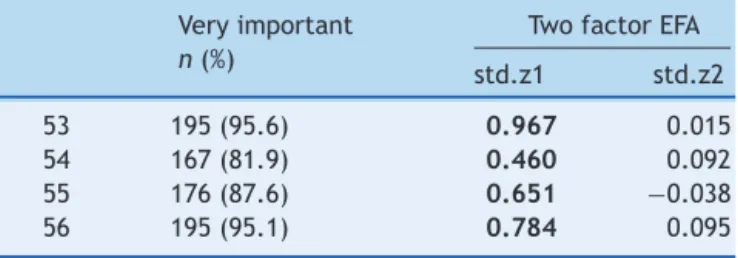
Table2 Proportion ofparticipants who answered ‘‘very important’’ineachitem,standardizedfactor loadingsfor twofactorsinexploratoryfactoranalysis(EFA).
Veryimportant
n(%)
TwofactorEFA
std.z1 std.z2
Item
1 191(91.4) 0.673 −0.173
2 147(72.1) 0.365 0.196
3 157(75.5) 0.652 −0.173
4 178(84.8) 0.658 0.137
5 200(95.7) 0.773 −0.099
6 186(91.6) 0.723 −0.022
7 139(66.2) 0.644 −0.065
8 96(45.7) 0.389 0.402
9 96(49.5) 0.319 0.460
10 189(90.0) 0.848 −0.094
11 181(86.6) 0.754 −0.116
12 104(50.0) 0.454 0.288
13 167(80.7) 0.450 0.255
14 197(94.7) 0.994 0.651
15 63(31.3) 0.440 0.358
16 131(63.6) 0.636 −0.039
17 152(73.8) 0.493 0.094
18 139(67.5) 0.701 0.006
19 101(49.3) 0.262 0.328
20 186(89.0) 0.902 −0.424
21 56(27.3) 0.404 0.455
22 22(11.7) −0.112 0.941
23 120(57.7) 0.643 0.081
24 35(17.7) −0.009 0.884
25 142(68.3) 0.614 0.265
26 114(54.6) 0.546 0.315
27 101(45.6) 0.557 0.407
28 96(45.9) 0.482 0.422
29 100(48.1) 0.312 0.272
30 90(43.3) 0.221 0.694
31 106(56.1) 0.274 0.290
32 110(53.1) 0.411 0.407
33 98(47.3) 0.317 0.528
34 169(82.0) 0.595 0.272
35 196(94.2) 0.824 0.021
36 173(83.6) 0.650 0.104
37 158(79.0) 0.612 0.266
38 191(91.8) 0.893 0.000
39 201(96.6) 1.008 −0.023
40 192(92.3) 0.948 −0.348
41 92(44.4) 0.028 0.835
42 160(78.8) 0.747 0.094
43 59(52.2) 0.621 0.358
44 93(46.0) 0.494 0.445
45 71(60.2) 0.619 0.341
46 131(64.5) 0.637 0.208
47 91(46.4) 0.415 0.507
48 174(84.1) 0.698 0.268
49 183(89.7) 0.632 0.153
50 157(76.6) 0.569 0.081
51 44(22.1) 0.306 0.467
52 195(96.1) 0.806 −0.037
Table2 (Continued) Veryimportant
n(%)
TwofactorEFA
std.z1 std.z2
53 195(95.6) 0.967 0.015
54 167(81.9) 0.460 0.092
55 176(87.6) 0.651 −0.038
56 195(95.1) 0.784 0.095
Note:Totalofparticipantsmaynotadd211ineachitemdueto thenon-applicableresponseoption.Theitemsincludedinthe dimensionfocusingoninfant-centeredneedsarepresentedat bold.
otherpersonfrommychurchvisit’’,wasregardedasslightly important(meanscorebetween1.5and2.5).
Exploratory factor analysis for dichotomous variables revealedtwodimensions,withalmostalloftheitems associ-atedtoneedscenteredontheparentsinthefirstdimension, andallthoseassociatedwithinfant-centeredneedsinthe second(Table2).
ShortFormoftheNICUFamilyNeedsInventory
To compose the Short Form Inventory, all the items with ceiling effect (more than 90% of participants answered ‘‘very important’’) were eliminated, which corresponded toitems 1, 5, 14, 35, 38, 39, 40, 52, 53, and 56 of the originalscale (Table3).AccordingtotheSpearman---Brown
predictionformula,10 and12 itemswere included inthe
dimensionsfocusingonparents-centeredneedsand
infant-centered needs,respectively. The items with a better fit
withindimension1wereselected,takingintoaccountthe
item-fitstatisticsfortheRaschmodel(AppendixA).
Confirmatoryfactoranalysissupportedthatboth
dimen-sions were reflected in the Short Form version of the
Inventory (Fig. 1). Overall, the Short Form NICU Family
Needs Inventoryshowed a high degree of reliability, with
aCronbach’salphaof0.77for theparents-centeredneeds
dimensionand 0.76 for the infant-centeredneeds
dimen-sion.Asignificantcorrelationwasobservedbetweenthetwo
dimensions,indicatingaconsiderabledependencebetween
thesubscales.TheCFI,TLI,andRMSEAvaluesobtainedfrom
confirmatory factor analysis indicated an adequate
good-nessoffitinthisstudysample(X2(50)=643.690;CFI=0.925;
TLI=0.950;RMSEA=0.053).
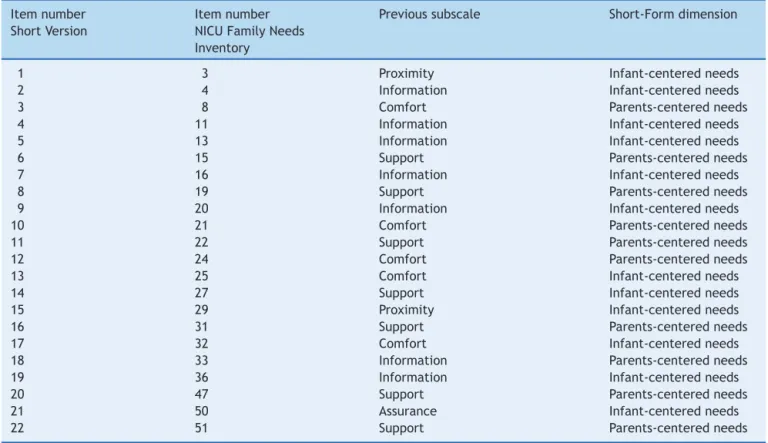
The fivesubscalesof theoriginalInventory(assurance,
proximity, information, comfort, and support) were
reor-ganized within the two new dimensions obtained in the
ShortFormversion.Supportandcomfortneedsweremainly
included in the parents-centered needs subscale, while
information,assurance,andproximitywerepredominantly
includedintheinfant-centeredneedssubscale(Table3).
AssociationsbetweeneachsubscaleoftheShortVersion
score with socio-demographic and obstetric
characteris-tics of the participants arepresented in Table 1. Parents
ofinfants hospitalized in NICUclassified, onaverage, the
infant-centered needs subscale as more important than
theparents-centeredneedssubscale(mean(SD):8.6(2.4)
[range:0---12];3.5(2.6)[range:0---10],respectively).
Table3 PresentationoftheitemscomposingthePortugueseShortVersionoftheNeonatalIntensiveCareUnit(NICU)Family NeedsInventory.
Itemnumber ShortVersion
Itemnumber NICUFamilyNeeds Inventory
Previoussubscale Short-Formdimension
1 3 Proximity Infant-centeredneeds
2 4 Information Infant-centeredneeds
3 8 Comfort Parents-centeredneeds
4 11 Information Infant-centeredneeds
5 13 Information Infant-centeredneeds
6 15 Support Parents-centeredneeds
7 16 Information Infant-centeredneeds
8 19 Support Parents-centeredneeds
9 20 Information Infant-centeredneeds
10 21 Comfort Parents-centeredneeds
11 22 Support Parents-centeredneeds
12 24 Comfort Parents-centeredneeds
13 25 Comfort Infant-centeredneeds
14 27 Support Infant-centeredneeds
15 29 Proximity Infant-centeredneeds
16 31 Support Parents-centeredneeds
17 32 Comfort Infant-centeredneeds
18 33 Information Parents-centeredneeds
19 36 Information Infant-centeredneeds
20 47 Support Parents-centeredneeds
21 50 Assurance Infant-centeredneeds
22 51 Support Parents-centeredneeds
of needs between couples for the infant-centered needs subscale (35.0%), while the concordance regarding the parents-centeredneedssubscalewasmuchlower(14.3%).
Parents withmore than 34 years of age and with less thantenyearsof educationweresignificantlymore likely toattribute a higherimportanceto thesubscale focusing onthe parents’needs than thoseyounger andmore edu-cated(mean(SD):3.3 (2.3)vs. 4.1(3.0), p=0.037;mean (SD): 4.3 (2.5) vs. 3.1 (2.5), p<0.001). Also, parents of multiplesrevealed a significant tendency tovalue infant-centeredneeds,incomparisonwiththosewithoutamultiple pregnancy(mean(SD):9.4(2.8)vs.8.3(2.7),p=0.024).
Discussion
Inthepresent study,theauthorspropose aShortFormof theNICUFamilyNeeds Inventory,abriefand valid instru-ment for the Portuguese population. It is composed by 22itemsdividedintotwosubscales,onefocusingon parents-centeredneedsandanotheroninfant-centeredneeds.The ShortFormInventory presented a high degree of reliabil-ity to assess the parental needs of parents during their child’shospitalizationinNICU,andhadahighinternal con-sistencyinbothdimensions.Also,anadequategoodnessof fitensuredthatthemodelfitthedataanalyzedwell.
Overall,allitemsoftheShortFormoftheInventorywere highlyvaluedbytheparents,underliningtherelevanceof thoseissuesforthedesignofparent-friendlyNICUsettings and highlighting the importance of family-centered care in such a context.11 In fact, previous studies concluded
that, during the hospitalization period, parents face
particular infant-centered needs, such as need of
information,6,8assurance,9,10andproximity6thatintertwine
with their own needs of comfort10 and social support.9,10
Access to accurate and consistent information, the need
to trust in the healthcare team, as well as, assuming
responsibility for the infant, by comforting, visiting,
breastfeeding,bathing, diapering,andtouchingthe child,
increase parents’ sense of control and empowerment,
contributing to their involvement in infant’s health and
care by focusing on their child.21,22 At the same time,
establishing genuine relationships with the staff, relying
ontheir partner for physical help andemotional support,
makingtheenvironmentmorehomelike,andthepossibility
ofaccommodationatbedsideimproveparents’satisfaction
withthe healthcare23 andcontribute for their health and
well-beingbyfocusingontheirownneeds.24,25
The four categories of response of the original
instru-ment(notimportant,slightlyimportant,importantandvery
important) must be included in the Short Form
admin-istration sheet, in order to allow a higher variability of
responsesandabetterdiscriminationoftheparental
per-ception ofneedsin NICU.However,thisproposal suggests
thedichotomization of thescoresinto notveryimportant
and very important for purposes of data analysis, which
facilitatestheinterpretationoftheresults.
Thisis,tothebestoftheauthors’knowledge,theonly
reliableandvalidinstrumentavailabletoevaluateparental
needsduringinfants’hospitalizationinNICUandthereisno
goldstandardforthisconstruct.Therefore,criterion
valid-itywasnotassessedin thepresentstudy,sinceitwasnot
X2(50)=643.690; CFI=0.925; TLI=0.950; RMSEA=0.053 Item 3 0.67
0.67 0.71
0.51
0.69
0.73
0.45
0.68
0.74 0.76
0.54
0.59
0.57 0.75
0.61
0.56
0.50
0.72
0.81
0.48
0.66 0.60
Item 6
Item 8
Item 10
Item 11
Item 12
Item 16
Item 18
Item 20
Item 22 Parents-centered
needs
Item 1
Item 2
Item 4
Item 5
Item 7
Item 9
Item 13
Item 14
Item 15
Item 17
Item 19
Item 21 Infant-centered
needs Cronbach’s alpha: 0.77
Cronbach’s alpha: 0.76 0.879
Figure1 ConfirmatoryfactoranalysisofthePortugueseShort VersionoftheNeonatalIntensiveCareUnit(NICU)FamilyNeeds Inventory.
or an external and objective measure of the construct.26
The strategy implemented for assessing constructvalidity
consisted in measuring the association of each dimension
score with socio-demographic and obstetric
characteris-tics oftheparticipants. The authorsconcludedthatolder
and less educated parents were significantly more likely
toattributehigherimportancetoparents-centeredneeds,
suggestingthere-entrenchmentofsocialinequalitiesinside
NICU.Ithighlightshowsocialfactors,namelysocioeconomic
position,impactonvaluingparentalneedsduring
hospital-izationoftheirinfants.
Also,mothersattributedhigherimportancetoboth
par-ents and infant needs, although not reaching statistical
significance. These results were expected since
moth-ers frequently take over the care of the child during
hospitalization.9Infact,theideaofintensivemotherhood,
inwhichmotheringisexclusive,whollychildcentered,
emo-tionally involving, and time consuming,27 is reinforced in
NICU. The assumption that mothers, more than fathers,
shouldbedevotedtochildcareandself-sacrifice,28through
thenaturalizationanddevaluationofthepainandsuffering
during hospitalization, might have justified the
predom-inance of infant-centered needs over parents-centered
needs. These results emphasize the previously described
focusoninfants’health andprognosis overthefulfillment
ofparents’needs.29
Amajorstrengthofthisstudyistheproposalofabrief
andeasy toadministrate instrument, simple toscoreand
to interpret. Although most of parents have time
avail-able toanswer to the full inventory, this does not mean
thattheyhavethe emotionalavailabilitytodoso.Avery
preterm delivery and hospitalization in NICU leads to an
emotional chaos in which parents frequently report
feel-ingsoffear,sadness,guilt,orfailure.5Consideringparents’
emotionalavailability isparticularlyrelevant in acontext
where healthcare professionals and researchers must act
accordingtofundamental ethicalprinciples,includingthe
minimizationoftheburdenandthedecreaseofthe
intru-sionintotheprivatelivesofparentsofchildrenhospitalized
in NICU. Therefore, the ShortForm of the Inventory can
contributetoincrease parentalparticipation andto
mini-mizetheburden, whileallowingfor theidentificationand
inclusionoffamilyneedsinhealthcare,takingintoaccount
essentialethicalprinciples.15
Somelimitationsofthepresentstudyshouldbe
acknowl-edged and discussed. Although the sample size was
relativelysmallforafactoranalysis,ithasbeenarguedthat
theincreaseinprecisiongainedfromsample sizesover50
israrelyworththeeffort.30Also,datawerecollectedfrom
alllevelIIINICUlocatedintheNorthofPortugal,andthe
proportionofrefusalswasverylow,ensuringthe
represen-tativenessofthesample.
The Short Form Inventory demonstrated good
psycho-metricproperties.However,furtherstudiescomparingthe
performance of the instrument with the original one,
according to the parents’ socio-demographic
characteris-tics and reproductive and obstetric history, as well as to
infants’characteristicsatbirthandprognosis,areneeded.
Furthermore, it is important to determine its robustness
andreliabilityindifferentcultural,economic,andpolitical
contexts.
Inconclusion,theShortFormoftheNICUFamilyNeeds
Inventory is a valid and reliable instrument to measure
parents-centeredandinfant-centeredneeds,bycombining
thefivesubscalesoftheoriginalInventory.Thisshorter
ver-sionoftheInventory,validforthePortuguesepopulation,is
briefandeasytoadministrate.
Funding
fromthe Operational Programme Factors of Competitive-ness (COMPETE) within the project ‘‘Parenting roles and knowledge in neonatal intensive care units’’ (FCOMP-01-0124-FEDER-019902), and by national funding from the Foundation for Science and Technology (Portuguese Ministry of Education and Science) and by the grants IF/00956/2013(toSS),SFRH/BPD/103562/2014(toEA),and PD/BD/105830/2014(toMA).
Conflicts
of
interest
Theauthorsdeclarenoconflictsofinterest.
Acknowledgements
The authors thank all participants and health profession-alsof thesevenNeonatalCareUnitswherethestudy was conducted,fortheircollaborationandassistanceduring par-ticipants’recruitment.
Appendix
A.
Supplementary
data
Supplementary data associated with this article can be found, in the online version, at doi:10.1016/j.jped. 2015.04.010.
References
1.Saigal S, Doyle LW. An overview of mortality and seque-lae of preterm birth from infancy to adulthood. Lancet. 2008;371:261---9.
2.HowsonCP,KinneyMV,LawnJE.Borntoosoon:theglobalaction reportonpretermbirth.Geneva:WorldHealthOrganization; 2012(MarchofDimes,PMNCH,SavetheChildren,WorldHealth Organization).
3.Lasiuk GC, Comeau T, Newburn-Cook C. Unexpected: an interpretivedescriptionofparentaltraumas’associatedwith pretermbirth.BMCPregnancyChildbirth.2013;13:S13. 4.Rich-EdwardsJW, Fraser A,Lawlor DA,Catov JM.Pregnancy
characteristicsandwomen’sfuture cardiovascularhealth:an underusedopportunitytoimprovewomen’shealth?Epidemiol Rev.2013;36:57---70.
5.FlackingR,EwaldU,NyqvistKH,StarrinB.Trustfulbonds:akey tobecomingamotherandtoreciprocalbreastfeeding.Stories ofmothersofverypreterminfantsataneonatalunit.SocSci Med.2006;62:70---80.
6.Padden TGS. Maternal experiences of preterm birth and neonatal intensive care. J Reprod Infant Psychol. 1997;15: 121---39.
7.deCarvalhoJB,AraujoAC,CostaIdoC,deBritoRS,deSouza NL.Socialrepresentationoffathersregardingtheirpremature child in theNeonatal Intensive CareUnit. RevBrasEnferm. 2009;62:734---8.
8.ArockiasamyV,HolstiL,AlbersheimS.Fathers’experiencesin theneonatal intensivecare unit:a searchfor control. Pedi-atrics.2008;121:e215---22.
9.Bernaix LW, Schmidt CA, Jamerson PA, Seiter L, Smith J. The NICU experience of lactation and its relationship to family management style. MCN Am J Matern Child Nurs. 2006;31:95---100.
10.PepperD,RempelG,AustinW,CeciC,HendsonL.Morethan information: a qualitative studyof parents’ perspectives on neonatalintensive careat theextremesofprematurity.Adv NeonatalCare.2012;12:303---9.
11.StaniszewskaS,BrettJ,RedshawM,HamiltonK,NewburnM, JonesN,etal.ThePOPPYstudy:developingamodelof family-centredcareforneonatalunits.WorldviewsEvidBasedNurs. 2012;9:243---55.
12.JubinvilleJ,Newburn-CookC,HegadorenK,Lacaze-Masmonteil T.Symptomsofacutestressdisorderinmothersofpremature infants.AdvNeonatalCare.2012;12:246---53.
13.Ward K. Perceived needs of parents of critically ill infants in a neonatal intensive care unit (NICU). Paediatr Nurs. 2001;27:281---6.
14.JaconoJ,HicksG,AntonioniC,O’BrienK,RasiM.Comparisonof perceivedneedsoffamilymembersbetweenregisterednurses andfamilymembersofcriticallyillpatientsinintensivecare andneonatalintensivecareunits.HeartLung.1990;19:72---8. 15.Dickson-Swift V,James EL,Liamputtong P.Undertaking
sen-sitive research in the health and social sciences: managing boundaries,emotionsandrisks.UnitedKingdom,Cambridge: CambridgeUniversityPress;2008.
16.AlvesE,AmorimM,FragaS,BarrosH,SilvaS.Parentingroles andknowledgeinneonatalintensivecareunits:protocolofa mixedmethodsstudy.BMJOpen.2014;4:e005941.
17.AmericanAcademyofPediatricsCommitteeonFetusAnd New-born.Levelsofneonatalcare.Pediatrics.2012;130:587---97. 18.WorldHealth Organization.Internationalstatistical
classifica-tionof diseases and relatedhealth problems,10th revision. Geneva:WorldHealthOrganization;1992.
19.CortinaJM.Whatiscoefficientalpha?Anexaminationoftheory andapplications.JApplPsychol.1993;78:98---104.
20.Hu L, Bentler P. Cutoff criteria for fit indexes in covari-ance structure analysis: conventional criteria versus new alternatives.StructEquModel.1999;6:1---55.
21.HeermannJA, WilsonME, Wilhelm PA. Mothers inthe NICU: outsidertopartner.PaediatrNurs.2005;31:176---81,200. 22.ReevesE,TimmonsS,DampierS.Parents’experiencesof
nego-tiatingcarefortheirtechnology-dependentchild.JChildHealth Care.2006;10:228---39.
23.SawyerA,Rabe H,AbbottJ,GyteG,DuleyL,AyersS,etal. Parents’ experiences and satisfaction with care during the birthoftheir verypretermbaby: aqualitative study.BJOG. 2013;120:637---43.
24.GreisenG,MiranteN,HaumontD,PierratV,Pallas-AlonsoCR, WarrenI,etal.Parents,siblingsandgrandparentsinthe neona-talintensivecareunit.AsurveyofpoliciesineightEuropean countries.ActaPaediatr.2009;98:1744---50.
25.SkeneC,FranckL, CurtisP, GerrishK. Parentalinvolvement in neonatal comfort care. J ObstetGynecol Neonatal Nurs. 2012;41:786---97.
26.FrostMH,ReeveBB,LiepaAM,StaufferJW,HaysRD,Mayo/FDA Patient-ReportedOutcomesConsensusMeetingGroup.Whatis sufficientevidenceforthereliabilityand validityof patient-reportedoutcomemeasures?ValueHealth.2007;10:S94---105. 27.BellS.Intensiveperformancesofmothering:asociological
per-spective.QualRes.2004;4:45---75.
28.Arendell T. Conceiving and investigating motherhood: the decade’sscholarship.JMarriageFam.2000;62:1192---207. 29.BialoskurskiMM,CoxCL,WigginsRD.Therelationshipbetween
maternalneedsandprioritiesinaneonatalintensivecare envi-ronment.JAdvNurs.2002;37:62---9.