FROM CONCEPTS
TO PROGRAMS:
THREE DECADES OF
PROGRESS FOR VETERINARY
PUBLIC
HEALTH
AND ANIMAL
HEALTH
IN LATIN
AMERICA
AND THE CARIBBEAN
Pedro N. Achal
Veterinary public health activities play a key role in promoting animal health, human health, and economic development. This article reviews the basic ra- tionale behind veterinary public health activities in Latin America and th Caribbean. It aLso describes the major role PAHO has played in developing that rationale and helping to improve the quality of those activities.
Introduction
Veterinary public health has traveled a long road in Latin America and the Caribbean, having been transformed from a subject on the periphery of veterinary medicine to a key discipline critically and intimately linked to both animal and human health and socioeco- nomic development. The key to this progress has been not merely development of appropri- ate concepts but incorporation of those con- cepts into national programs and an interna- tional infrastructure capable of promoting them throughout the Hemisphere.
The purpose of this article is twofold: to re- view the concepts of animal health and veteri- nary public health, as well as their interrela- tionships; and to trace the development of na- tional prevention and control programs-and of a correlated international infrastruc- ture-that have made and will continue to make important contributions to closing the existing socioeconomic gap in the Americas.
Concepts
The development of a veterinary public health action program depended upon accep- tance of three major concepts. These concepts were:
‘Special Adviser to the Director-General, Inter-Amer- ican Institute of Agricultural Sciences, Washington, D.C.
1) Animal health is a key factor in socioeco- nomic development.
2) There is a crucial interrelationship be- tween human and animal health that becomes evident in veterinary public health programs.
3) Veterinary public health plays an impor- tant role in focusing the attention of health and livestock authorities on communicable disease problems and in pioneering new pro- grams in the fields of animal health and veteri- nary education.
Animal Health and Socioeconomic Development
To fully understand the support that devel- opment of veterinary public health programs has received in Latin America and the Carib- bean, we must first appreciate the unique role that the livestock industry plays in this region. The area is blessed with favorable climates; but of the approximately 500 million hectares of agricultural land, 80 per cent are suitable only for pastures and livestock raising. Thus
Latin America and the Caribbean, with
roughly the same amount of agricultural land as the United States (55 per cent of which is used for pasture), have more than twice the head of livestock (448 million food animals versus 192 million). In 1978 the nations of the Americas, excepting Canada and the United States, had 247 million cattle, 109 million sheep, 63 million pigs, and 29 million goats (1). Even considering differences in prices and
Acha l ANIMAL HEALTH AND VETERINARY PUBLIC HEALTH 357
slaughter cycles, this represents about US$45 billion in cattle alone.
However, the herd is constantly at risk from diseases-both those endemic to the Hemi- sphere and exotic diseases. The livestock in- dustry’s productivity is only 67 per cent of what it is in Australia and 32 per cent of what it is in the United States (2). It follows that the United States, with only half the livestock, produces almost twice the supply of meat and meat products. Moreover, animals in devel- oping countries generally grow more slowly, mature later, and produce less than animals in developed areas. Nevertheless, notwithstand- ing the risks and reduced potential, such animals still represent an economically impor- tant agricultural product and a major source of income-in both local and international trade.
Animal Diseases
The economic losses and waste of energy caused by animal pests and diseases are so enormous that intensive control efforts must be made. Obviously, for purposes of socioeco- nomic development, it is imperative to reduce the risks, reverse the disease trends, and max- imize the area’s livestock potential.
Besides posing a major obstacle to increased productivity, animal diseases also create a ma- jor barrier to international trade in livestock
products. They thus constitute a key negative factor in the socioeconomic development of Latin America.
Meanwhile, the productivity of US agricul- ture and livestock products depends partly on heavy expenditures of energy resources. That is, the US consumes lo-15 petroleum calories to produce a calorie of food (3). From the point of view of energy requirements, this is the least efficient of all systems of production. Consequently, in a world suffering critical and ever-accelerating shortages of energy as well as food, increased productivity in devel-
oping countries-where fewer energy re-
sources are used in meat production-will
prove both economically sound and essential for world trade.
In this vein, it should be kept in mind that ruminants and other food-producing animals can convert the bioenergy of crop-harvest waste directly into food and fiber for the wel- fare of humanity. And if Latin America’s live- stock output could be raised merely to the level of Australia’s, while the number of head increased only 5 per cent each year, total pro- duction would double within 5 years (2).
In the 19609, animal diseases accounted for approximately one-third of the livestock pro- ductivity losses in Latin America. For exam- ple, foot-and-mouth disease, hog cholera, ba- besiosis, and Newcastle disease together caused an estimated 11,701 metric tons of meat, eggs, and milk to be lost per year from 1962 to 1964. The control of these diseases alone could have a significant effect on animal productivity in the region. When foot-and- mouth disease is eradicated from Latin Amer- ica, it is expected that 350,000 more tons of meat and 500,000 more tons of milk will be obtainable from the same number of cattle in today’s herd (4).
Intertzational Trade and Economics
Latin America today provides one-fourth of the world trade in meat products, but its share has been declining due to animal dis- eases that could be spread by international movements of animals and animal products (5). For example, before World War II Ar- gentina accounted for 14 per cent of the mut- ton and lamb in the world market and 53 per cent of the beef exports; today the correspond- ing rates are 4 and 19 per cent (6). The leader- ship role has been assumed by Australia with 32 per cent of the export trade (6). Although the United States has emerged as the world’s leading meat importer since World War II, Latin America has not been able to capture this neighboring market because of the bar- riers raised to thwart animal diseases.
Despite these circumstances, however,
358 PAHO BULLETIN l vol. 14, no. 4, 1980
critical role in development. Besides providing a source of employment and food for local populations, it still yields important amounts of the foreign currency needed for economic development. In recognition of this fact, the Inter-American Development Bank (IDB) has mobilized large sums for animal disease con- trol projects. To date 13 countries have re- ceived 15 IDB loans for animal health totaling US$llO million, of which US$SO million, or 54 per cent, has been disbursed. The total cost of these projects (including counterpart fi-
nancing by the countries themselves) is
estimated at about US$400 million (7). The various projects have involved the following activities:
1) Providing an infrastructure for diagnosing animal diseases and conducting disease control ac- tivities in the field;
2) Training skilled manpower;
3) Implementing long-term control efforts; 4) Integrating and coordinating national and in- ternational efforts.
In addition, the World Bank, the IDB, and the United States Agency for International Development have lent the Latin American countries approximately US$1,300 million to promote and improve livestock production, as part of projects costing a total of US$2,300 million.
The justification for these international agencies’ capital outlays is based on recogni- tion of the livestock industry’s importance for Latin America and the need for its future de- velopment. Seen in this light, the proper role of veterinary medicine in the area is to simul- taneously protect these investments and make a major contribution to Latin America’s so- cioeconomic development.
The magnitude of the task at hand can be seen from the following figures: In 1976 the total world trade in fresh, chilled, and frozen beef amounted to USg3.9 billion, in live cattle amounted to US$2 billion, and in canned meat amounted to another USJ61.5 billion. In terms of exports, developing countries had 35-40 per cent of this trade in the early 197Os,
but by 1976 that share was down to 22 per cent (8).
In a world beset by critical energy and pro- tein shortages, a crucial element of survival strategy is to shift animal production to the de- veloping world by increasing productivity and removing the animal disease barrier to inter- national trade. In the interest of achieving this in the Western Hemisphere, national animal health programs have been implemented and an international animal health infrastructure has been established.
Animal Health and Veterinary Public Health
Protein deficiency is perhaps the most wide- spread public health problem of our time. Malnutrition has been a major contributor, directly or indirectly, to infant mortality. The Inter-American Investigation of Mortality in Childhood found it to be an associated cause of 60.9 per cent of the deaths from infections and 32.7 per cent of the deaths from all other causes (9). It has been estimated that 19 per cent of all children O-4 years of age in Latin America experience moderate or severe forms of protein-calorie malnutrition. If mild forms of malnutrition are included, an estimated 50 per cent of the children under 5 are affected. Overall, malnutrition appears to be a direct or indirect cause of half of all deaths among chil- dren in Latin America (9).
Acha l ANIMAL HEALTH AND VETERINARY PUBLIC HEALTH 359
products for animal food is the best way of converting those products into high-quality protein and eliminating nutritional diseases such as kwashiorkor.
At the same time, however, some animal diseases-the zoonoses-can be transmitted to people. Some of these, in addition to their eco- nomic consequences, have important public
health implications. Zoonoses considered
among the most important are rabies, brucel- losis, bovine tuberculosis, hydatidosis, the equine encephalitides, leptospirosis, and an- thrax.
Vampire bat-transmitted bovine rabies af- flicts some 500,000 cattle per year in Latin
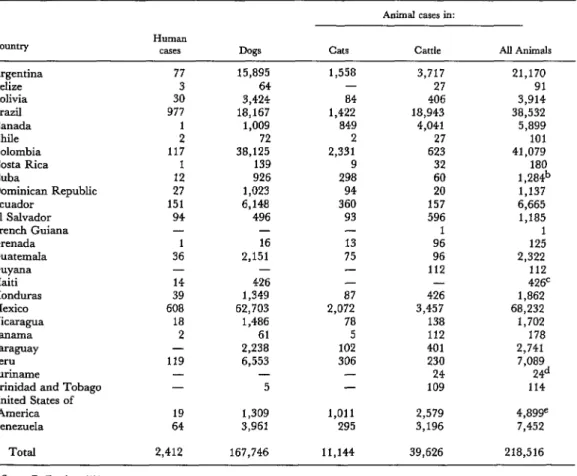
America and causes losses of up to US$JO mil- lion annually. Canine rabies also poses serious problems. Though progress has been made in controlling the latter, it continues to be wide- spread in the Americas. During the period 1970-1979 there were 2,412 registered human rabies cases (Table 1).
Brucellosis continues to be one of the world’s most prevalent zoonoses. In Latin America, estimated economic losses caused by brucellosis run as high as US$SOO million per year (11). To date, relatively few developing countries have been able to control the infec- tion, and fewer still have managed to eradi- cate it.
Table 1. Reported cases of rabies in man and animals in the Americas, 1970-1979.a Animal cases in:
COUltry Human cases Dogs cats Cattle All Animals
Argentina Belize Bolivia BtaZiI Canada Chile Colombia Costa Rica Cuba
Dominican Republic Ecuador
El Salvador French Guiana Grenada Guatemala Guyana Haiti Honduras Mexico Nicaragua Panama Paraguay Peru Suriname
Trinidad and Tobago United States of
America Venezuela
77 15,895 1,558
3 64 -
30 3,424 84
977 18,167 1,422
1 1,009 a49
2 72 2
117 38,125 2,331
1 139 9
12 926 298
27 1,023 94
151 6,148 360
94 496 93
- 1 36 - 14 39 608 18 2 - 119 - - 16 2,151 - 426 1,349 62,703 1,486 61 2,238 6,553 - 5 - 13 75 - - 87 2,072 78 5 102 306 - - -
19 1,309 1,011 2,579 4,89ge
64 3,961 295 3,196 7,452
3,717 27 406 18,943 4,041 27 623 32 60 20 157 596 1 96 96 112 - 426 3,457 138 112 401 230 24 109 21,170 91 3,914 38,532 5,899 101 41,079 180 1 ,284b 1,137 6,665 1,185 1 125 2,322 112 426’ 1,862 68,232 1,702 178 2,741 7,089 24d 114
Total 2,412 167,746 11,144 39,626 218,516
Source: E. Escobar (17).
aThe cumulative figures for 1979 are pmvisional.
360 PAHO BULLETIN l vol. 14. no. 4. 1980
Available information indicates there were 3,049 human brucellosis cases in 1977 in se- lected countries of the Americas (Table 2). Goat brucellosis has been the main source of human infection in Argentina, Mexico, and Peru, where the goat infection rate in some areas is very high. Porcine brucellosis also constitutes a serious human health problem.
Bovine tuberculosis, endemic and wide- spread in most of the countries, has been known to afflict as many as 4.7 per cent of the 4 million animals slaughtered by one country in a single year. The highest prevalence rates occur in South American dairy sheds, where positive reactions to the tuberculin test have been as high as 30 per cent in some herds
(Table 3). Annual Hemisphere-wide losses
from this disease are estimated at over US$lOO million.
Hydatid disease, a zoonotic infection of man caused by the cystic stage of the tape- worm Echinococcus granulosus, is a major public health and economic problem in Argentina, Brazil (Rio Grande do Sul), Chile, Peru (the central Sierra), and Uruguay, where the dog- sheep cycle is predominant. A total of 1,008 human’cases were reported in 1977. Hydatid
disease also seems to be endemic in the high plateau region of Bolivia, where at least 6 human cases with hydatid cysts are treated every year. The disease has also been reported in Ecuador, Guatemala, and Mexico.
Besides its implications for human health, hydatidosis has a major economic impact be- cause of the large number of condemned vis- cera involved (6). Large dog and sheep popu- lations-together with unsanitary free dispos- al of parasite-infected wastes, uncontrolled
home slaughter, uninspected commercial
slaughterhouses, and inadequate dog con- trol-have contributed to the maintenance of the disease cycle.
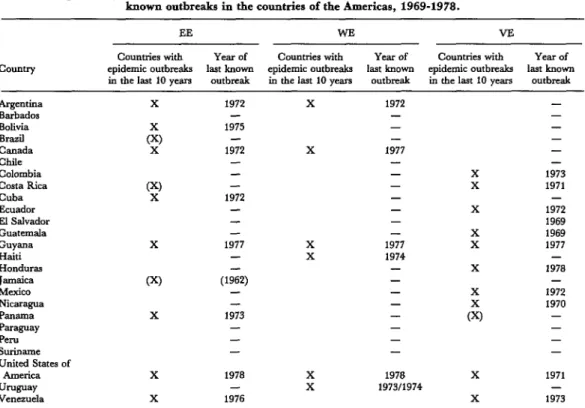
Three types of equine encephalitides are present in the Americas in epizoodemic and cyclical forms; these are eastern equine en- cephalitis, western equine encephalitis, and Venezuelan equine encephalitis. The diseases pose major problems for human health and livestock raising in the affected countries (Table 4).
With regard to leptospirosis, more than 50 leptospira serovars from 15 serotypes have been isolated in Latin America and the Carib- bean. Several of these serovars are autoch-
Table 2. Human cases of brucellosis in selected countries of the Americas, 1973-1977,
Country 1973 1974 1975 1976 1977
Argentina
Canada Chide
Colombia Costa Rica Cuba
Dominican Republic Guatemala Honduras Mexico Panama Peru
United States of America Uww Venezuela
986 1,123
8 27
4 3
25 69
6 5
18 10
- -
- -
3 4
735 557
1 4
607 554
1,293
30 1 -
7 34
10 1
4 550 - 592
1,569 1,727
38 39
2 -
- 8 14a 12
3 1 565 5 610
202 240 310 296
2 6 7 4
72 13 18 15
Total 2,669 2,615 2,857 3,142
- 2 14 13 -
1
382 7 630
214
1 19 3,049 Source: Animal health questionnaire, with supplemental data from Report of the Dirccfor, Quadrmnial 1974-1977, Annual 1977. Washington, D.C., Pan American Health Organization, 1978.
Acha l ANIMAL HEALTH AND VETERINARY PUBLIC HEALTH 361
Table 3. Numbers of animals tested with tuberculin and the percentages of positive reactors, suspects, and positive herds in 15 countries of the Americas, 1977.
Countly
No. of animals tested Positive herds @I Barbados Brazil Canada Colombia Costa Rica Dominican Republic Honduras Jamaica Mexico Nicaragua PWu Suriname United States of
America uwwv Venezuela
2,225 1.3
101,261 2.5
532,200 0.2
350 10.6
9,176 0.2
100,645 1.0
144,011 0.7
17,292 0.1
485,643 0.3
725 0.5
81,691 0.9
400 8.0
2,358,604 0.1
109,376 0.03
319,779 0.4
0.3 0.8 - - 0.3 0.2 0.7 - 0.1 - 5.7 11.5 0.6 66.7 0.6 6.5 20.8 - 3.3 50.0 2.7 100.0 0.1 - 9.7 0.2 0.1 0.1
Source: E. Escobar (17) and country reports to the Pan American Zoonoses Center, 1977.
Table 4. Geographic distribution of eastern equine encephalitis (EE), western equine encephalitis (WE), and Veneauelan equine encephalitis (VIZ) and the dates of the most recent
known outbreaks in the countries of the Americas, 1969-1978.
Country
EE WE VE
Counties with Year of Countries with Year of Countries with Year of epidemic outbreaks last known epidemic outbreaks last known epidemic outbreaks last known in the last 10 years outbreak in the last 10 years outbreak in the last 10 yeam outbreak
Argentina Barbados Bolivia Brazil Canada Chile Colombia Costa Rica Cuba Ecuador EI Salvador Guatemala Guyana Haiti Honduras Jamaica Mexico Nicaragua P.%lma Paraguay PerU Suriname
United States of America umP=Y Venezuela
X 1972
- -
- -
-
X 1977
- - - - 1973 1971 - 1972 1969 1969 1977 - 1978 - 1972 1970 - - X X X X X X X c% - - - - - - 1977 1974 - X X
w -
- - - - X - - - - X X 1978 1976
X 1978
X 197311974
X 1971
-
X 1973
Source: E. Escobar (17) and Pan American Zwnoses Center, Encepkalih Epidnniologic Sun~cif~nce. Annual Reports l-6, 1973, 1974, 1975, 1976, 1977, and 1978.
362 PAHO BULLETIN l vol. 14. no. 4. 1980
thonous and have not been described in other geographic areas (12). Little is known about the distribution and importance of these sero- vars-owing to shortages of data, diagnostic facilities, and personnel trained to diagnose the disease.
Anthrax continues to be endemic in Haiti, where human outbreaks affecting several per- sons have periodically occurred in association with animal cases. In 1977 about 150 cases of
human anthrax were reported from Les
Cayes, Haiti, and 162 were reported from other parts of Latin America.
Hemispheric Control Efforts and Veterinary Public Health
Once the key importance of the interrela- tionships between animal and human health had been established, it became essential to have action programs that would bring togeth- er agricultural and public health interests and would direct the resources of the veterinary and scientific communities at problem areas.
This pioneering task was undertaken by
PAHO’s Veterinary Public Health Program. Establishment of that program became possi- ble because medical leaders understood the public health importance of the nutritional diseases and zoonoses. Its ultimate success in attracting large-scale funding and interna- tional support was due to recognition by the Hemisphere’s agriculture ministries that con- trol of the zoonoses and vesicular diseases had great socioeconomic importance.
Agriculture ministries have traditionally been among the strongest of Latin American government ministries, and governmental cooperation and support throughout Latin America has always been a key factor in the program’s development. At the same time, PAHO’s Veterinary Public Health Program has itself proved instrumental in promoting, establishing, and giving technical support to all phases of national animal health programs.
However, animal disease control measures are costly, and the results are sometimes un- predictable. In this vein, national animal
health programs are an expensive proposition because they require long-range planning, highly-trained veterinarians, qualified animal scientists, and an array of assistants. Expen- sive technology is often needed to make bio- logical and chemical products for disease diag- nosis, prevention, and treatment. And sophis- ticated diagnostic facilities are required for ac- curate monitoring of specific diseases. Clear- ly, such programs must be founded upon a po- litical commitment to provide appropriate ti- trancing and resources.
The United Nations Food and Agriculture Organization has estimated that over the dec- ade of the 1960s animal diseases caused the loss of over 30 million tons of milk per year-enough to provide almost 200 million children with two glasses of milk a day. How tragic that the technology of disease preven- tion has not kept pace, through either devel- opment or adaptation, with the technology of production.
In our own Latin American and Caribbean area, until major diseases can be controlled there will be little incentive for livestock breeders to introduce large-scale improve- ments; for the expense in time, labor, and feed can be negated quickly by disease outbreaks. Moreover, the prevalence of established dis- eases often effectively blocks importation of new and improved breeding stock that has not been exposed to diseases indigenous to the areas involved (4).
Promotion and Implementation of Control Programs
AC/K2 l ANIMAL HEALTH AND VETERINARY PUBLIC HEALTH 363
There are presently 54 country projects re- lated to animal health and veterinary public health (see Figure 1) in Latin America and the Caribbean area. Through its Special Program of Animal Health, PAHO provides technical assistance for these projects-assistance sup- ported by financing from the regular PAHO budget or by grants from various national or- ganizations, countries, and international or- ganizations. The approved budget for this program in the 1980-81 period is over US$18 million.
The established goals of the Special Pro- gram of Animal Health are to reduce the prev-
alence of foot-and-mouth disease and the most important zoonoses in the Americas; to ex- pand the areas declared free of them; to pro- mote and strengthen animal health and veteri- nary public health services; to strengthen sur- veillance systems; to improve diagnostic methods; to establish new laboratories; to in- crease vaccine production and supply; to de- velop new and effective immunizing agents; and to raise the number and technical capabil- ities of veterinary medical service personnel.
By using consultants with world reputations and expert scientific committees, the Veteri- nary Public Health Program has been able to
Figure 1. PAHO animal health and veterinary public health projects and activities in Latin America and the Caribbean, 19651979.
MEXICO. US BORDER&
l O*O**Oa-v
EL SALVADOR
l **oAXv*
‘TRINIDAD-TOBAGO
l e*o*O~-O
l ***uOAwXvs
l e+Tt*ooAXvco l oe*O*Elu@A~-v=@
l e*O*OAmXvs
l *O*OAXv- l *O*uAm Xv-
ARGFNTINA
extend the range of its activities and keep up with scientific knowledge while dealing with practical problems of the developing world. It has also enabled PAHO to initiate unique pro- grams for Latin America-including ones in the fields of veterinary education and man- power development, epidemiology and dis- ease control, vaccine production methodolo- gies, food protection, and laboratory animal medicine.
Veterinary Education and Manpower Development
A major obstacle to improvement of veteri- nary public health services in Latin America has been the scarcity of trained manpower at all levels. This problem is only compounded by the existing manpower’s prevailing geo- graphic distribution within each country. Overall, 65 per cent of the veterinarians are still located in capitals and large cities. The main community services rendered by veteri- narians are food hygiene inspection, research, prevention and control of animal diseases (in- cluding zoonoses), and environmental sanita- tion. However, the service of inspecting meat and milk does not extend into rural communi- ties. In addition, since rural areas are the most exposed to zoonoses and food-borne diseases, veterinary services capable of solving these problems are needed in order to provide ap- propriate health assistance to rural dwellers.
Overall, there was a significant improve- ment in the manpower situation between 1972 and 1979. To begin with, there were only
18,347 veterinarians in Latin America and the Caribbean in 1972 as compared to 26,775 in 1979 (Figure 2). In 1972 only 37.4 per cent of these veterinarians were in government ser- vices (doing administrative work or employed by government agencies concerned with ani- mal or human health). As a result of substan- tial growth of animal disease control pro- grams, this percentage had risen to 47 per cent as of 1979. Elsewhere, of the total veterina- rians, 30 per cent were in private practice in 1979, as compared to 44 per cent in 1972; 17
Figure 2. Growth in the number of veterinarians in Latin America and the Caribbean from 1972 to 1979.
30,000
r
26,7751972 1979
YEAR
Source Pm Ameman Health Orgmzat~on Ill, H Malogo and
P Ache KG. and P Ache 119)
engaged in education or research, and the re- maining 5 per cent (2.6 per cent in 1972) were employed in industry (Figure 3).
Of the veterinarians in government service in 1979, 66.5 per cent were working for agri- culture ministries or similar agencies, approx- imately 12.7 per cent had entered the public health services, and 20.8 per cent were work- ing for other government services (Figure 4).
The number of individuals wishing to enter the veterinary profession has increased nota- bly over the past 7 years, and consequently the number of those who have completed the de- gree program has likewise risen (Figure 5). There has also been a substantial increase in the number of veterinary schools in Latin America and the Caribbean-the total in- creasing from 53 in 1972 to 90 in 1979.
Despite the increased numbers, however, there is still a tremendous need to train veteri- narians in the various areas of animal health and veterinary public health-including the areas of program planning and administra- tion. Most Latin American and Caribbean countries do not have the infrastructure needed for effective development of veterinary public health and animal health programs.
364 PAHO BULLETIN l vol. 14, no. 4, 1980
A&a l ANIMAL HEALTH AND VETERINARY PUBLIC HEALTH 365
Figure 3. The percentages of Latin American and Caribbean area veterinarians engaged in different
types of activities in 1972 and 1979.
PER CENT
20 40 60 (10 100
Sources Pan Amencon Health Orgonzatmn (I), H. Mologo and
P Ache (13). and P Acha 09)
Figure 4. A chart of government agencies employing veterinarians in Latin America and the Caribbean that shows the percentages employed by ministries of
agriculture, ministries of health, and other government services in 1979.
MlNlSTRY OF AGRICULTURE
665%
TOTAL 12.P.52
Public Health Program in entering the field of education and training were to help upgrade the quality of the existing schools of veterinary medicine, to train teachers, to promote intro- duction of newer curricula and courses, and to provide specific short courses for technicians and practitioners already in the field. One of the most serious problems in most of the coun- tries was the limited number of veterinarians with adequate preparation and experience in health-related disciplines-specifically epide- miology, biostatistics, and administration.
Considerable progress has been made since the First Seminar on the Teaching of Public Health and Preventive Medicine in Schools of
Veterinary Medicine in the Americas was
held under PAHO auspices in Kansas City (U.S.A.) in 1959. Since then, regional semi- nars in veterinary education have been held in
Mexico City, Mexico (1963); Lima, Peru
(1967); Minnesota, U.S.A. (1968); Belo Ho- rizonte, Brazil (1972); and Valdivia, Chile (1979).
The curricula of most veterinary medical schools in Latin America today provide a ba- sic knowledge of subjects such as epidemiol- ogy, biostatistics, food protection, and public health administration. In addition, over the past few years some schools have made serious efforts to adapt their curricula to the needs of national programs in animal health and veter- inary public health.
Nevertheless, there is still a great need for specialized education in veterinary medicine in Latin America. In order to prepare veteri- narians responsible for activities related to planning and executing animal disease control programs, the teaching of disciplines such as epidemiology and biostatistics, surveillance
and information systems, diagnosis of animal diseases, laboratory animal medicine, and food protection will have to be strengthened. Moreover, the universities will need to estab- lish special educational programs with a sizable continuing education component.
366 PAHO BULLETlN . vol. 14, no. 4. 1980
Figure 5. Charts showing the numbers of ntidents enrolled in Latin American and Caribbean veterinary medical schools and the numbers graduated in 1972 and 1979.
26,979
17.546
1972 1979
YEAR
Students of Veterinary Medicine in Latm America and the Caribbean
1972.1979.
2,127
1972 1979 YEAR
Students who completed the degree program in Schools of Veterinary Medicine
in Latin America and the Caribbean 19724979
Sources: P. Acha and H. Malaga (18) and P. Acha (1%
prove curricula by developing specific instruc- tional areas and by providing support to indi- vidual veterinary schools to advance their academic programs. Specific PAHO activities include participating in curriculum reform, selecting and providing textbooks, designing interdisciplinary studies, coordinating cur- ricula among schools, and lending direct teaching assistance through consultants and staff members.
Also, at the request of the countries, PAHO has developed an infrastructure within the
Pan American Foot-and-Mouth Disease and
Zoonoses Centers which has trained almost 2,000 veterinarians in the forementioned specialized disciplines over the last 20 years. The demand for this type of education has in- creased so much recently that the Centers’ re- sources-in terms of space and staff-are now
being overwhelmed. Continued efforts to
strengthen’ this type of training are essential for improvement of the veterinary contribu- tion being made to human and animal health programs in Latin America.
With the establishment of national disease control programs, a special need arose to train veterinarians in project planning, evaluation, and administration. Since 1971, PAHO has been conducting a yearly seven-month course in animal health planning at the Pan Ameri-
can Zoonoses Center (CEPANZO). Staff
members from CEPANZO and the Pan
American Foot-and-Mouth Disease Center,
as well as outside consultants, provide the in- struction to between 15 and 20 veterinarians from different national animal health agencies who are admitted annually.
Acha l ANIMAL HEALTH AND VETERINARY PUBLIC HEALTH 367
master’s or doctoral level has developed only recently in Latin America and is still limited to five schools. Latin American veterinarians usually pursue this type of advanced training in the United States, Canada, or Europe.
PAHO also helps with the training of assis- tants in animal health and veterinary public health. In 1976 the Regional Training Center
for Animal Health Assistants (REPAHA)
opened in Georgetown, Guyana. This center was established through the collaborative ef- forts of PAHO, the World Bank, the United Nations Development Program, and the Gov- ernment of Guyana for the purpose of training auxiliary veterinary personnel for the English- speaking Caribbean countries and territories. Since then the center has trained and gradu- ated over 100 animal health and veterinary public health assistants.
Animal Disease Control, Epidemiology, and Vaccine Production
Over the last 15 years, PAHO’s animal health and veterinary public health work in Latin America and the Caribbean has been aimed mainly at assisting Member Govern- ments in planning, developing, and executing programs to control the Hemisphere’s more important zoonoses.
Rabies. Projects or activities directed against urban rabies have been conducted in prac- tically every country of the region. Studies of wildlife rabies have been performed in the Mexico-U.S. border area, Guatemala, Nic- aragua, Cuba, Grenada, and Brazil. Pro- grams to combat paralytic rabies in cattle have been organized successfully in Mexico, Cen- tral America, Peru, Venezuela, and Brazil.
Beyond that, owing to CEPANZO’s in-
fluence and work, every Latin American country has been able to improve diagnostic procedures and to organize a system for pro- ducing and distributing good-quality rabies vaccine. In turn, this has resulted in success- ful anti-rabies campaigns (undertaken jointly by agriculture and public health agencies) throughout the Continent.
Also, special projects have been organized against paralytic cattle rabies caused by vam- pire bats. These projects have entailed vacci- nation of cattle and use of anticoagulants to reduce vampire bat populations. Finally, a special project to control canine and wildlife rabies at the Mexican-American border was instituted in 1966; and although eradication has not yet been achieved, the situation has been brought under control.
Encephalitis. Another example of a joint bi- national effort was the campaign against Ven- ezuelan encephalitis that included vaccina- tion of 12 million horses in Mexico and the United States. Systematic vaccination in sev- eral countries of Central and South America has kept this disease quiescent, and has also served as a model of how health and agricul- ture ministries can control an important zoon- osis by sharing responsibilities for diagnosis, field work, and vaccine production. At pres- ent Venezuelan equine encephalitis vaccina- tion programs are being conducted in Colom- bia, El Salvador, Guatemala, Mexico, Peru, and Venezuela. Regarding western and east- ern equine encephalitis, control activities are only being performed in countries where the diseases are enzootic-such as Argentina, Brazil, Cuba, and Guyana.
Hydatidosis. Effective hydatidosis control programs are underway in Peru, Argentina, Chile, and Uruguay. PAHO projects in the three latter countries are concentrating on ad- ministering drugs to affected dogs. In addi- tion, a number of national projects have suc- ceeded in using standardized diagnostic re- agents to identify the geographic areas in- volved and to plan control efforts.
Bovine tuberculosis and leptospirosis. Regarding national efforts, it should be noted that Costa Rica, Cuba, Honduras, Mexico, and Panama now have programs for eradication of bovine tuberculosis, and that leptospirosis studies have been performed in Argentina, Brazil, Peru, Venezuela, Trinidad and Tobago, Cu- ba, Barbados, Grenada, and Jamaica.
368 PAHO BULLETIN l vol. 14. 110. 4. 1980
diagnose human and animal brucellosis cases and to control the quality of Bmcella abortus strain 19 vaccines. A few decades ago, com- plete chaos reigned with respect to diagnostic procedures and the quality of antigens used in different countries. Brucellosis vaccines were produced and used without any official quality control.
of PAHO country projects have been con- cerned with foot-and-mouth disease. Every South American country has now built an in- frastructure to control and eradicate this ani- mal scourge, and the Hemispheric effort against it probably constitutes one of the larg- est animal health campaigns in the world.
This situation has changed, partly because PAHO (through CEPANZO) has come to dis- tribute Brucella strains used for vaccine and antigen production, standard reference anti- gens, and technical guidelines. PAHO is also performing reference quality control of these biologicals at the governments’ request.
Most countries now have regional or na- tional control programs against bovine brucel- losis, and some have programs against goat and swine brucellosis. PAHO’s Veterinary Public Health Program, which was instru- mental in promoting these efforts, acted as a preinvestment technical agency to obtain in- ternational credits for national control pro-
gXWllS.
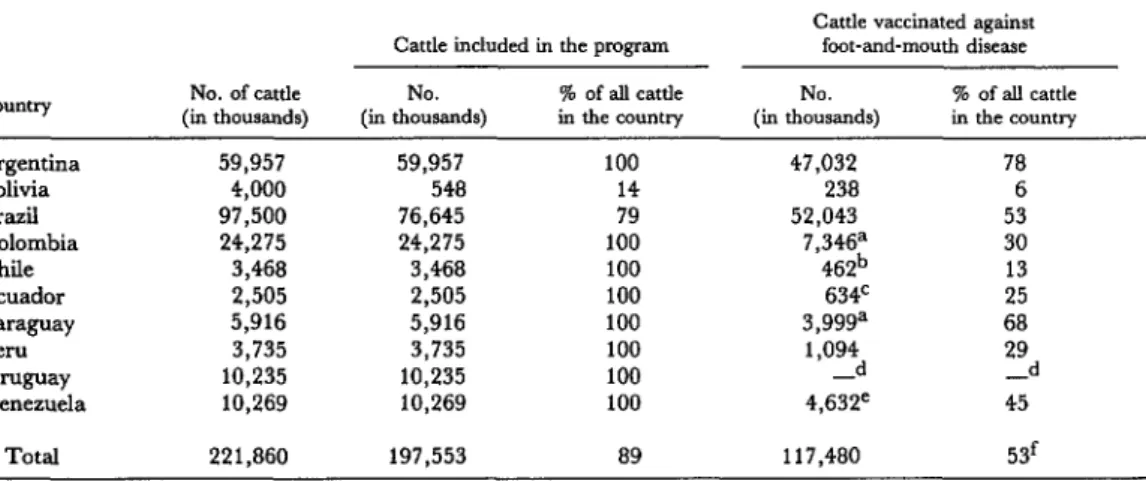
The South American program covers a cat- tle population of 198 million head-including 89 per cent of the total cattle population in the affected countries. Overall, 63 per cent of the South American herd (117 million animals) was vaccinated in 1979 (Table 5). Average an- nual vaccine production by the South Ameri- can countries currently exceeds 500 million doses. Argentina has instituted a national vac- cine quality-control project that has resulted in a substantial decrease in foot-and-mouth disease cases. Meanwhile, the countries of
Central America and the Caribbean are
maintaining an active program to prevent foot-and-mouth and other exotic diseases-a program that includes continual surveillance of vesicular stomatitis.
Foot-and-mouth disease. The greatest number In addition, some South American coun-
Table 5. Percentages of cattle included in South American foot-and-mouth disease control programs and vaccinated against the disease, by country, 1979.
Cattle included in the program
Cattle vaccinated against foot-and-mouth disease
Country
Argentina Bolivia Brazil Colombia Chile Ecuador Paraguay Peru Uww Venezuela
No. of cattle NO. % of all cattle NO. % of all cattle (in thousands) (in thousands) in the ccluntty (in thousands) in the country
59,957 59,957 100 47,032 78
4,000 548 14 238 6
97,500 76,645 79 52,043 53
24,275 24,275 100 7,346a 30
3,468 3,468 100 462b 13
2,505 2,505 100 634’ 25
5,916 5,916 100 3,999= 68
3,735 3,735 100 1,094 29
10,235 10,235 100 -d -d
10,269 10,269 100 4,632e 45
Total 221,860 197,553 89 117,480 53f
Source; Report on the Epidemiological Surveillance on Foot-and-Mouth Disease and other Vesicular Diseases in the Americas, 1980 (20).
‘First vaccination round in 1979.
bDoses applied during the first round in 1979, within a vaccination mne containing 674,494 cattle. CDoses applied in 1979 divided by 3.
dData not available.
Ada l ANIMAL HEALTH AND VETERINARY PUBLIC HEALTH 369
tries have started to use their foot-
and-mouth disease infrastructure against
other problems- such as brucellosis, tubercu- losis, and rabies in Bolivia, Brazil, Paraguay, and Peru. Chile, which is about to be declared free of foot-and-mouth disease after a cam- paign that began in 1969, is now shifting its eradication infrastructure to control hog chol- era, brucellosis, and hydatidosis.
Other activities and considerations. The United Nations Development Program, the Canadian
International Development Agency, and
other international agencies have provided re- sources to several Caribbean countries to im- prove their animal health infrastructures, to control brucellosis and bovine tuberculosis, and to prevent the introduction of new diseas- es through construction of quarantine facili- ties.
One important effect of all these national programs, with or without international sup- port, has been to demonstrate that the Gov- ernments of Latin America and the Caribbe- an, as well as international agencies, trust the veterinary profession and are willing to invest capital in veterinary programs. Millions of dollars of the countries’ budgets have now been invested in disease prevention or control activities at the national and local levels. It is important that this confidence in the profes- sion be maintained.
Animal Disease Diagnostic Laboratories
In assisting countries with animal health planning, a primary aim of PAHO’s Veteri- nary Public Health Program has been to pro- vide national programs with an adequate in- frastructure for field and laboratory activities.
Most of the Latin American and Caribbean countries lack an integrated system of labora- tories and instead operate through a central laboratory. The major exceptions are Argenti- na, CoIombia, and Mexico (each of which has a laboratory network) and Brazil, Honduras, and Venezuela (each of which is developing such a network with PAHO project assis- tance). Nevertheless, over the past decade the,
countries’ veterinary service infrastructure- including diagnostic laboratories-has im- proved considerably.
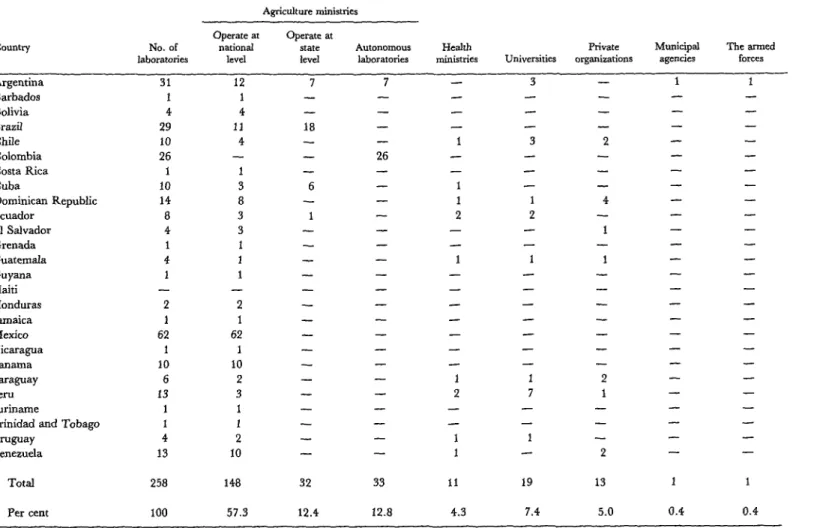
In 1976-1978 the animal disease diagnostic laboratory services in the Americas were in- ventoried. Overall, information was obtained from 26 Latin American and Caribbean coun- tries (1,14). According to this information, there were a total of 258 animal disease diag- nostic laboratories in those countries (see Table 6) in 1978. Most of these (82.5 per cent) were under the Ministry of Agriculture. The ratio between head of livestock and the num- ber of diagnostic laboratories is shown in Table 7. Overall, Latin America and the Car- ibbean appeared to have about one laboratory for every 1,937,844 head of livestock (includ- ing horses, cattle, sheep, goats, and pigs).
The inventory also showed that the animal disease diagnostic laboratories were providing important public health services in addition to their specific veterinary functions. Data from
17 countries indicated that 91 laboratories were making water quality-control examina- tions and 89 were performing food quality- control examinations. In 1977 some 10,000 specimens from human patients were exam- ined by 139 animal health laboratories in 13 of the 17 countries. This diagnostic work was all the more significant because it was performed in rural areas without public health laborato- ries. Hence it is clear that many animal health laboratories are providing services that are in- dispensable to the primary health care of rural populations (15).
At present PAHO’s Special Program of
Animal Health is providing the countries with reference and advisory services, biological re- agents, laboratory animals, small amounts of equipment, and training in diagnosis and vac- cine production for the control of vesicular and zoonotic diseases. Most of this work is
performed by CEPANZO and PANAF-
TOSA.
Table 6. The distribution of animal disease diagnostic laboratories in Latin America and the Caribbean area and the types of agencies responsible for their administration, 1978.
No. of laboratories under different types of aaencies
Countly No. of
laboratories
operate at national
kVel
operate at state
level
Autonomous Health
laboratories ministries
Private Municipal The armed
Universities organizations agencies forces
Argentina 31 12 7 7 - 3 - 1 1
Barbados 1 1 - - - - -
Bolivia 4 4 - - - -
Brazil 29 11 18 - - - -
Chile 10 4 - - 1 3 2 - -
Colombia 26 - - 26 - - - -
Costa Rica 1 1 - - - -
Cuba 10 3 6 - 1 - - - -
Dominican Republic 14 8 - - 1 1 4 - -
Ecuador 8 3 1 - 2 2 - - -
El Salvador 4 3 - - - - 1 - -
Grenada 1 1 - - - -
Guatemala 4 1 - 1 1 1 -
Guyana 1 1 - - - -
Haiti - - - -
Honduras 2 2 - - - - -
Jamaica 1 1 - - - -
Mexico 62 62 - - - -
Nicaragua 1 1 - - - -
Panama 10 10 - - - - -
Paraguay 6 2 - - 1 1 2 - -
Peru 13 3 - - 2 7 1 - -
Suriname 1 1 - - - -
Trinidad and Tobago 1 1 - - - -
Uwwy 4 2 - - 1 1 - - -
Venezuela 13 10 - - 1 2 - -
Total 258 148 32 33 11 19 13 1 1
Per cent 100 57.3 12.4 12.8 4.3 7.4 5.0 0.4 0.4
Table 7. The ratios between head of livestock and number8 of animal disease diagnostic laboratories in countries of Latin America and the Caribbean, 1978.
Country No. of
cattle
No. of various kids of livestock -
Total No. of No. of
No. of No. of No. of No. of national diagnostic head per
sheep goats swine horses herd laboratories laboratory
Argentina 55,354,669
Barbados 7,082
Bolivia 2,406,941
Brazil 92,495,364
Chile 3,417,003
Colombia 23,858,508
Costa Rica 1,346,222
Dominican Republic 1,471,967
Ecuador 2,446,055
El Salvador 960,774
Grenada 6,000
Guatemala 1,712,851
Guyana 200,000
Honduras 1,685,487
Jamaica 278,710
Mexico 25,123,756
Nicaragua 2,864,198
Panama 1,358,360
Paraguay 5,537,200
Peru 4,251,800
Suriname 26,000
UwwY 10,383,773
Venezuela 9,409,443
Totala 246,602,163
34,691,426 4,580,263
27,054 5,436
8,112,932 3,680,848 19,760,643 6,416,964 6,690,280 933,007 1,920,770 626,071
- -
25,565 259,758 1,096,640 221,354
112 -
9,000 5,500
667,766 53,576
62,000 20,000
2,863 16,938
9,000 263,000 5,320,070 8,487,822
- -
- -
370,400 108,300 14,117,600 2,276,154
- -
15,647,170 -
90,035 1,262,300 108,621,326 29,217,291
4,126,742 3,005,240
27,515 952
1,188,OOO 1,334,665 34,192,028 8,539,784 1,021,594 536,051 1,897,374 2,526,052 246,802 106,576 730,218 412,145 1,127,745 556,404
11,160 104,674
10,000 -
659,03 1 165,174
80,000 22,500
511,124 264,753
66,013 -
11,720,843 10,720,699 207,059 149,446 179,000 130,019 1,102,000 325,400 2,141,600 1,326,350
- -
226,265 507,948 1,117,215 882,699 62,589,328 31,617,531
101,758,340 31 3,282,527
68,039 1 68,039
16,723,386 4 4,180,846
161,404,783 29 5,565,682
12,597,935 10 1,259,793
30,828,775 26 1,185,722
1,699,600 1 1,699,600
2,899,653 10 289,965
5,448,198 8 681,025
1,076,720 4 269,180
30,500 1 30,500
3,258,398 4 814,599
384,500 1 384,500
2,481,165 2 1,240,582
616,723 1 616,723
61,373,190 62 989,890
3,220,703 1 3,220,703
1,667,379 10 166,738
7,443,300 6 1,240,550
24,113,504 13 1,854,885
26,000 1 26,000
26,765,156 8 3,345,645
12,761,692 13 981,669
478,647,639 247 1,937,844
‘Not including Cuba cw Trinidad and Tobago.
372 PAHO BULLETIN l vol. 14. no. 4. 1980
ognized international standing. These in- clude the U.S. Agriculture Department’s Plum Island Animal Disease Center, which provides invaluable assistance in diagnosing and controlling exotic disease outbreaks- such as the recent outbreaks of African swine fever in some countries of the Americas. The U.S. Agriculture Department’s Animal Dis- ease Center in Ames, Iowa, is also used by many Latin American and Caribbean labora- tories. Other centers employed include the U.S. Public Health Service’s Center for Dis- ease Control in Atlanta, Georgia; PAHO/
WHO’s Caribbean Epidemiology Center
(CAREC) in Port-of-Spain, Trinidad; the
Animal Virus Research Institute in Pirbright, Great Britain; the Central Veterinary Labora- tory in Weybridge, Great Britain; the Nation- a.l Livestock Research Institute in Palo Alto, Mexico; and the Laboratory Animal Diseases Research Institute in Ottawa, Canada.
Food Protection
Most veterinary public health and animal health services in Latin America and the Car- ibbean are directly responsible for the quality control of foods of animal origin. In some
countries-such as Colombia, Costa Rica,
Guatemala, Trinidad and Tobago, and Vene- zuela-the veterinary public health units are in charge of all food protection activities with- in the purview of the health sector.
Since its creation, PAHO’s Veterinary Public Health Program has provided Member Countries with active cooperation in this field. These activities have always been closely coor- dinated with related PAHO Veterinary Pro- gram activities in such areas as food-borne disease epidemiology, laboratory diagnosis, veterinary education, and the training of aux- iliary personnel. Among other things, this PAHO effort has included direct technical as- sistance in planning and organizing food pro- tection programs in the ministries of health and agriculture. This assistance has been de- signed to help develop or improve local and national food nrotection nrograms and ser-
vices through enactment of up-to-date legisla- tion, preparation of qualified personnel, and provision of adequate support for food analy- sis laboratories.
As Figure 1 indicates, several PAHO food protection projects or activities were under- way in the 1970s. During that period a region- al training center for food inspectors was es- tablished in Caracas, Venezuela, in coopera- tion with the School of Public Health of the Ministry of Health and Social Welfare of that country. This project, which was later trans- ferred to Medellin, Colombia, has trained over 150 food inspectors from practically all the Latin American countries. The Central American countries, Colombia, Venezuela, Barbados, and Jamaica have also received as- sistance in training personnel in meat hygiene and meat technology. In addition, with the co- operation of the Adolf0 Lutz Institute in Sgo Paulo, Brazil, PAHO has prepared and pub- lished over 350 food health standards. These have been adopted by the Central American countries and are also being used by several South American countries. Finally, with the
cooperation of Guatemala’s Ministry of
Health and the United Nations Development Program, a National Food Analysis Laborato- ry has been established in Guatemala City. This fully-equipped laboratory, operated by PAHO personnel and well-qualified Guate- malan staff members, uses the most sophisti- cated available technology to analyze chemical and pesticide residues in meats and other foods of both plant and animal origin. Besides serving an important public health function, it has provided the Central American countries with analytical certificates for all the meats and other agricultural products exported to the United States and Europe.
A large part of PAHO’s assistance to food protection programs has been provided by
CEPANZO’s Food Microbiology Depart-
Acha 0 ANIMAL HEALTH AND VETERINARY PUBLIC HEALTH 373
search on the contamination of animal and food products. In this same vein, CEPANZO has published several training and laboratory manuals on food protection.
Laboratory Animal Medicine
Since the development of this discipline,
PAHO’s Veterinary Public Health Program
has provided assistance to Member Govern- ments for training veterinarians in animal care and management and in laboratory ani- mal pathology. Several Latin American veter- inarians have received U.S. and European training in this field at the master’s and doc-
toral levels. PANAFTOSA and CEPANZO
have provided assistance at both the profes- sional and technical levels for training people from several animal health and public health laboratories in how to develop, maintain, and manage laboratory animal colonies. The two centers have also published and distributed a series of manuals on diseases of laboratory an- imals, appropriate breeding methodologies for several species, and proper design and opera- tion of animal colonies.
Through its Special Program of Animal Health, PAHO is also collaborating with the
Government of Peru in development of a
breeding center for subhuman primates used
in biomedical research. Agreements have
been signed for development of similar centers in Brazil and Colombia. These projects are being financed through a contract between PAHO and the United States National Insti- tutes of Health.
Conclusion
The establishment and subsequent success of PAHO’s Veterinary Public Health Pro-
gram throughout Latin America has de-
pended on a number of factors. These in- clude:
1) Development of sound concepts relating to the program’s importance and to the socioeconomic gains (as well as the health gains) involved.
2) Establishment of procedures for bringing to-
gether top scientific experts and leading agriculture and health authorities to determine the most appro- priate control procedures.
3) Establishment of a sound infrastructure of services and functions well-suited to meeting the needs of PAHO Member Countries.
4) Generation of constructive pressure capable of promoting program development and justifying program costs by estimating concrete benefits to be produced.
These were the methods by which veteri- nary medicine was brought into the forefront of current interest and concern with socioeco- nomic development. In this same vein, the Veterinary Public Health Program has pro- vided supportive assistance in procuring
Inter-American Development Bank funds-
funds needed by Member Countries to im- prove disease control and diagnostic laborato- ry services. All in all, the program’s impact on veterinary medicine in the Americas has been out of proportion to its limited staff and bud- get, for it has proved a decisive stimulus to growth and development over the past three decades.
At the present juncture, society has shown confidence in the veterinary profession and has invested heavily in animal disease pre- vention and control. But it is also true that new kinds of veterinarians are needed in Latin
America-veterinarians with new skills in
management, economics, computer sciences, epidemiology, and so forth-who can carry these programs to a successful conclusion. Not enough present veterinarians have these skills, so it is important that appropriate numbers with such skills be prepared quickly. Other- wise, it may take generations before veteri- nary medicine will get the social support needed for its work.
374 PAHO BULLETIN l vol. 14, no. 4, 1980
SUMMARY The purpose of this article is twofold: to review the basic rationale behind veterinary medical activi- ties in Latin America and the Caribbean and to de- scribe the role PAHO has played over the last three decades in promoting and helping to improve the quality of these activities.
In essence, development of a strong veterinary public health program in the region has depended upon acceptance of three major precepts. These are:
1) Animal health is a key factor in socioeconomic development.
2) There is a critical interrelationship between human and animal health that becomes evident in veterinary public health programs.
3) Veterinary public health plays an important role in focusing attention on communicable disease problems and in pioneering new programs in ani- mal health and veterinary education.
Clearly, animal health in Latin America and the Caribbean is inextricably linked to socioeconomic development. Livestock represents an important agricultural product and a major source of revenue. It is therefore essential to reduce economic losses wrought by animal diseases such as the zoonoses, foot-and-mouth disease, hog cholera, piroplasmo- sis, and Newcastle disease. The resulting increased productivity and freer international trade would help alleviate the critical shortages of energy and protein that beset the world today.
A key interrelationship between human and ani- mal health relates to man’s need of protein. Malnu- trition, which continuea to plague the populations of developing countries, was recently shown to be
the indirect or direct cause of half of the deaths among children under 5 years of age in Latin America. The livestock industry is a principal tool for alleviating this problem by providing essential protein. In addition, some of the more prevalent human diseases-rabies, brucellosis, tuberculosis, hydatidosis, the equine encephalitides, leptospiro- sis, and anthrax-are acquired directly or indirectly from animals.
Given these important linkages between animal and human health, it is appropriate that national and international programs should have been insti- tuted to promote well-being and prevent disease, capitalizing on the resources of veterinary and sci- entific communities. In the Americas, PAHO’s Special Program of Animal Health has spear- headed these pioneering efforts. That program has proved instrumental in promoting, establishing, and providing technical support for all phases of na- tional and regional animal health activities. Nu- merous PAHO-supported country projects have been successfully completed, and many others are still underway, in such crucial areas as: veterinary education and development of human resources; animal disease control, epidemiology, and vaccine production; animal disease diagnostic laboratories; food protection; and laboratory animal medicine. All in all, it is now evident that this Program’s past and present endeavors have made a major con- tribution to human and animal health. But it is also true that solution of the problems confronted partly through that Program will require a continuing po- litical commitment to provide appropriate financial and human resources-and that failure to employ sufficient resources of this kind could have a serious adverse impact on animal health and human well- being in the Americas.
BIBLIOGRAPHIC REFERENCES (I) Pan American Health Organization. Znter-
American Study on the Animal Health Situation, 1978 (~01s. l-4). Publication of the Special Program of Animal Health. Washington, D.C., 1980.
(2) Ckeres, F. Statement by the Observer for the Inter-American Development Bank. In Pan American Health Organization, Animal Disease Con- trol in the Americns, 1977. Scientific Publication 358. Washington, D.C., 1978, pp. xiii-xvi.
(3) Bergland, R. Address by the Secretary of Agriculture of the United States of America. In Pan American Health Organization, Animal Dtkea.se Con-
trol in the Americas, 1977. Scientific Publication 358. Washington, D.C., 1978, p. viii.
(4) Poppensiek, G. C., and K. T. Marash. Bio- logical Energy and the Plant Animal Trade-off, I Inter-American Meeting at the Ministerial Level on Animal Health. PAHO Document RIMSA l/10. Washington, D.C., Pan American Health Organization, 1980.
Acha l ANIMAL HEALTH AND VETERINARY PUBLIC HEALTH 375
tion, and Development. Scientific Publication 380. Washington, D.C., 1979, pp. 36-41.
(6) de las Carreras, A. Foot-and-Mouth Disease and the World Meat Trade. In Pan American Health Organization, Marketing of Animals and Their Products and Animal Health. Scientific Publication 374. Washington, D.C., 1979, pp. 59-72.
(7) Herman, M. Statement by Observer of the Inter-American Development Bank, I Inter-Ameri- can Meeting at the Ministerial Level on Animal Health. PAHO Document RIMSA l/18. Washing- ton, D.C., Pan American Health Organization, 1980.
(8) Rivero, N. Barriers to the World Beef Trade. In Pan American Health Organization, Marketing of Animals and Their Products and Animal Health. Scientific Publication 374. Washington, D.C., 1979, pp.149-155.
(9) Horwitz, A. Worldwide Perspective on Ani- mal Disease Losses and Their Impact on Nutrition, Health and Development. In Pan American Health Organization, Animal Disease Prevention in Developing Countries. Scientific Publication 380. Washington, D.C., 1979, pp. l-8.
(10) Pritchard, W. R. The Role of Animals in Providing for Man’s Nutritional Needs. In Pan American Health Organization, Animal Disease Pre- vention in Developing Countries. Scientific Publication 380. Washington, D.C., 1979, pp. 28-35.
(11) Acha, P. N., and B. Szyfres. Zoonoses and Communicable Diseases Common to Man and Animals. Scientific Publication 354. Washington, D.C., Pan American Health Organization, 1980.
(12) Szyfres, B. Leptospirosis as an Animal and Public Health Problem in Latin America and the Caribbean Area. In Pan American Health Organi- zation, VZZZ Inter-American Meeting, at the Ministerial Level, on Foot-and-Mouth Disease and Zoonoses Control. Scientific Publication 316. Washington, D.C.,
1976, pp. 115-130.
(13) M&laga, H., and P. Acha. The Function of the Veterinarian in Community Health in Latin America. In Pan American Zoonoses Center, ZZ Seminar on Education in Veterinary Medicine in Latin America, Belo Horizonte, Brazil, 21-31 August 1972.
Series on Education in Veterinary Medicine, 1. Ramos Mejia, Argentina, 1973, pp. 59-72.
(14) Szyfres, B. Animal Disease Diagnostic Lab- oratories in the Americas. In Pan American Health Organization, Animal Health in the Ameri>as, 1979. Scientific Publication 391. Washington, D.C., 1980, pp. 75-88.
(15) Orozco, R. The Animal Health Laboratory of San Rafael, Veracruz, Mexico, and Its Support for Medical Care Programs in Rural Areas. In Pan American Health Organization, Animal Health in the Americas, 1979. Scientific Publication 391. Wash- ington, D.C., 1980, pp. 89-96.
(IS) Pinto Cohen, G. Address by the Minister of Agriculture and Livestock Breeding of Venezuela. In Pan American Health Organization, Marketing of Animals and Thkr Products and Animal Health. Scien- tific Publication 374. Washington, D.C., 1979, pp. xii-xiii.
(17) Escobar, E. Animals and Zoonoses, Gener- al Bases for Zoonoses Control, I Inter-American Meeting at the Ministerial Level on Animal Health. PAHO Document RIMSA l/7. Washing- ton, D.C., Pan American Health Organization, 1980.
(18) Acha, P., and H. Maaga. Some Aspects of Teaching Veterinary Medicine in Latin America. In Pan American Zoonoses Center, ZZ Seminar on Education in Veterinary Medicine in Latin America, Belo Horizonte, Brazil, 21-31 August 1972. Series on Edu- cation in Veterinary Medicine, 1. Ramos Mejfa, Argentina, 1973, pp. 19-58.
(19) Acha, P. Algunos hechos y conceptos sobre la enseiianza de la medicina veterinaria en Amtrica Latina. Informe V, Jornadas Medico Veterinarios, 8-10 de noviembre de 1979. Valdivia, Chile, Uni- versidad Austrai de Chile, 1979, pp. 62-100.