PERSPECTIVES ON ACUTE ENTERIC DISEASE
EPIDEMIOLOGY
AND CONTROL1 ’ 2
William H. Barker, M.D.3
Annual mortality from enteric disease ranges from IO per 100,000 in highly developed countries to as much as 500 per 100,000 in developing countries. This article reviews the major epidemiologic features of acute enteric diseases and outlines a general strategy for their prevention and control in developing
countries.
Introduction
The acute enteric diseases may be defined as a group of gastrointestinal disorders caused by ingesting one of a wide variety of infectious or toxic agents. While clinical manifestations may be specific for a few well-known enteric dis- eases (e-g, rice-water diarrhea is specific for severe cholera, bloody diarrhea and tenesmus for severe Shiga dysentery, and sustained fever with headache for typhoid) clinical features in the majority of enteric illnesses are quite nonspecific. Some form of diarrhea is generally present, and incubation periods are generally short, ranging from a few hours to a few days. Basic epidemiologic attributes of the various enteric disease agents are also quite similar. The reservoir of most agents is the intestinal tract of either humans or animals. The mode of spread is either by direct person-to-person contact (via the fecal-oral route) or through ingestion of contaminated food or water.
Morbidity and Mortality Patterns
Mortality statistics testify to the significant impact of acute enteric diseases in many parts
IAlso appearing in Spanish in the Boletin de la
Ojkina Sanitaria Panamericana, 1975.
2Paoer Dresented at the Conference on Caribbean Epidemioldgical Surveillance held at Kingston, Ja- maica, on 20-22 April 1974.
3Chief, Enteric Diseases Branch, Bacterial Diseases Division, Bureau of Epidemiology, United States Center for Disease Control, Atlanta, Georgia, U.S.A.
of the world. A recent World Health Organiza- tion report shows yearly death rates of 200 to 500 per 100,000 attributed to diarrhea1 disease in certain developing countries. Overall, diar- rhea1 disease accounted for between 20 and 35 per cent of total mortality in those countries. These rates contrast strikingly with rates in the more developed countries, which reported few- er than 10 deaths from diarrhea per 100,000 people-indicating that these diseases accounted for less than 1 per cent of total mortality. In all countries, however, the well-known specific types of enteric disease-typhoid, dysentery, and cholera-accounted for less than 5 per cent of the reported diarrhea mortality (I).
Estimates of enteric disease morbidity in terms of incidence, prevalence, and relative frequency of various etiologic agents have been reported in numerous surveys from different parts of the world (2, 3). As in the case of mortality statistics, there are great differences in the rates reported for different countries, and the rates tend to vary inversely with levels of socioeconomic and industrial development.
The agents most often incriminated by laboratory-based studies of endemic enteric disease have been enteropathogenic Escherichia coli and shigellae; but in the past such investiga- tions have failed to identify the etiologic agents responsible for most of the cases studied (4-S). A number of agents whose enteropathogenicity has only recently been recognized may account for some of these cases. This group of agents would include the non-cholera vibrios (9),
Barker . ENTERIC DISEASE EPIDEMIOLOGY AND CONTROL 149
toxin-producing strains of E. coli that may not agglutinate in standard enteropathogenic E. coli diagnostic antisera (IO), and viruses (II). In tropical countries, infestation with one or more intestinal parasites is also common; but the high background prevalence of these parasites often makes it difficult to ascertain their etiologic significance in cases of acute enteric disease.
High-Risk GTOUPS
Certain definable subgroups of people run a particularly high risk of acquiring enteric dis- eases. Age is the prime consideration. In all societies, children under ten years of age (especially those between one and four) have the highest rates of morbidity and mortality from enteric disease. “Wearding diarrhea,” the well-known high incidence enteric illness which occurs in children of developing countries when they are weaned from the breast, is a particular- ly serious component of this problem, and one which has been the subject of extensive study (12). Residents of institutions for the mentally retarded also have a disproportionately great chance of experiencing acute enteric diseases, especially shigellosis (13). And visitors to for- eign countries, particularly developing tropical countries, run a relatively high risk of acquiring “traveler’s diarrhea,” a febrile gastroenteritis syndrome usually lasting only a few days, which may be caused by one of a variety of agents (14).
Epidemics
Besides endemic patterns of morbidity and mortality, one must consider the well-known potential for enteric disease to occur in epi- demic form. These epidemics range in size from the small community outbreak of staphylo- coccal foodborne disease following a common meal, or the propagated outbreak of shigellosis in a custodial institution, to nationwide out- breaks-such as that due to Salmonella @phi which occurred in Mexico in 1972-1973 (15); to region-wide outbreak-such as that due to Shiga’s bacillus, which spread through several
Central American countries in 1969-1972 (16); and ultimately to pandemics-such as that due to El Tor cholera, which spread from East Asia to the Middle East, Africa, and parts of Southern Europe over the past decade (I 7, 18).
Epidemiologic Determinants
Three basic epidemiologic determinants-the agent, the host, and the environment-each contribute in some way to every case of disease; the agent through its ability to persist in the environment and to cause pathophysiologic changes in the host; the host through behavioral and biological characteristics which may serve to increase or decrease the risk of disease; and the environment by providing a means for transmitting the agent to the host.
Agent Factors
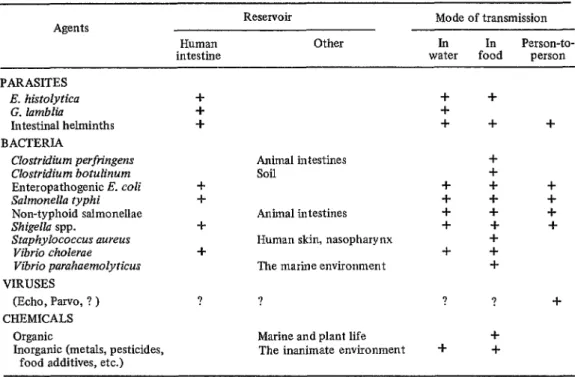
Table 1 lists a selection of known enteric disease agents and their basic epidemiologic attributes. The list includes various bacteria, viruses, parasites, and chemicals. The most common reservoir of infection is the human body, although some agents reside in domestic animals or the inanimate environment. Inges- tion of contaminated food and water is the most general mode of transmission, but person- to-person spread through fecal-oral contact is also very important.
150 PAHO BULLETlN . Vol. IX, No. 2, 197.5
TABLE 1 -Epidemiologic profiles for selected agents of acute enteric disease.
Reservoir Mode of transmission
Agents
Human Other In In Person-to-
intestine water food person
PARASITES
E. histcdytica + + +
G. lamblia + +
Intestinal helminths + + + -I-
BACTERIA
Clostridium perfringens Animal intestines +
Clostridium botulinurn soil +
Enteropathogenic E. coli c + + +
Salmonella typhi -I- + + +
Non-typhoid salmonellae Animal intestines + + +
Shigella spp. + + + +
Staphylococcus aureus Human skin, nasopharynx +
Vibrio cholerae + + -t
Vibrio parahaemolyticus The marine environment + VIRUSES
(Echo, Parve, ? ) ? ? ? ? +
CHEMICALS
Organic Marine and plant life +
Inorganic (metals, pesticides, The inanimate environment + + food additives, etc.)
of 104 to 105, are spread primarily by food and water but undergo some definite person-to- person spread as well (23, 24).
Pathogenic mechanisms, which for many agents are poorly understood, may be broadly categorized as either toxic or invasive. Well- studied models of toxic and invasive mecha- nisms include the watery diarrhea1 syndrome of cholera, which is attributed almost entirely to the effects of enterotoxin released by the growing organism on the mucosa of the small intestine (2.5), and the bloody mucoid diarrhea1 syndrome of Shiga dysentery, which results primarily from invasion of the mucosa of the large intestine and proliferation by the Shiga bacillus (Shigella dysenteriae, type 1) (20).
Besides pathogenic mechanisms, the other major factors that account for an agent’s capacity to cause illness are its ability to survive in nature and to withstand host defenses and therapeutic interventions. These abilities are illustrated by two recent enteric disease experi- ences. First, the relative hardiness of the El Tor biotype of Vibrio cholerae, relative to the
classical biotype of V. cholerae, is thought to have contributed to the rapid and wide dissemi- nation of the former organism through Asia, Africa, and Southern Europe over the past several years (17, 18). Second, the appearance and rapid spread of the Shiga bacillus in Central America and the attendant severe clinical dis- ease which it caused in the early 1970’s is attributed, in part, to the resistance of the epidemic strain to various commonly employed antibiotics (26, 27).
Host Factors
Host factors that contribute to enteric dis- ease include behavior patterns promoting host exposure to pathogenic agents and biological conditions rendering the host susceptible to them.
Barker . ENTERIC DISEASE EPIDEMIOLOGY AND CONTROL 151
For example, one classic case described by John Snow involved a lady who contracted cholera because she had the unusual habit of drinking water brought many blocks across London each day from the contaminated Broad Street Pump cm.
Several contemporary examples of the rela- tionship between host behavior and exposure to enteric disease agents can also be cited. For instance, several studies of enteric disease inci- dence among infants suggest that the mother’s choice to breast-feed affords protection against such illness (3, 29). Whether this is the result of some transferred immunity, or (more likely) reduced ingestion of contaminated foodstuffs, or both, is subject to speculation. In addition, various observations suggest that an individual increases his risk of acquiring traveller’s diar- rhea by choosing to eat fresh vegetables or fruit, or by drinking water from unreliable sources (30). Also, holding food at tempera- tures conducive to bacterial growth prior to eating has been documented as the commonest factor contributing to the occurrence of food- borne diseases in the United States (31); this is probably a factor, to varying degrees, in all societies. Finally, with regard to personal hy- giene, studies from several parts of the world suggest that hand-washing reduces the incidence of enteric diseases, particularly shigellosis (32, 33).
Biological conditions. Among the biological factors that determine host susceptibility, both specific and nonspecific protective mechanisms should be considered.
Field trials of orally administered attenuated shigella vaccines and parenterally administered killed cholera vaccines have demonstrated mod- erate but generally short-lived protective effects (34, 35). Typhoid vaccines have provided mod- erate levels of protection that have been sus- tained for several years (23). The possible protective role of secretory antibody, whether passively acquired by an infant from the mother’s colostrum or actively secreted by the gastrointestinal mucosa, is a debated but un- resolved subject.
There is considerable experimental evidence that gastric acid provides a major nonspecific barrier against a wide variety of enteric patho- gens; therefore, situations which compromise an individual’s capacity to produce gastric acid might be expected to increase his susceptibility to enteric disease (36).
Existence of a correlation between nutri- tional status and the occurrence of acute enteric disease has frequently been reported.4 When exposed to an enteric pathogen, a mal- nourished host is likely to experience a longer, more severe, and more dangerous illness than his well-nourished counterpart. Furthermore, an episode of diarrhea will often aggravate borderline malnutrition, leading to kwashiorkor (3).
Environmental Factors
Food, water, and human waste are the principal environmental ingredients involved in spreading human enteric disease.
Inadequate facilities for hand-washing and for disposal of fecal waste have both been linked to increased risk of enteric disease (32, 37). Deficiencies in such facilities can contrib- ute both to person-to-person spread of enteric disease agents and to their spread through contaminated food and water. If removal of fecal wastes is inadequate, flies may serve as intermediaries by transferring pathogens from sewage to food or water (38).
The role of contaminated drinking water in enteric disease transmission, first documented on sound epidemiologic grounds by Snow’s investigations of cholera in mid-nineteenth cen- tury London (28), has been well-established for a variety of parasitic, bacterial, viral, and chemical agents (39). In most instances the introduction of these agents into water supplies is attributable to contamination with human fecal waste. Studies from both North and South
4See M. Bkhar, The role of feeding and nutrition in the pathogeny and prevention of diarrheic processes,
Bulletin of the Pan American Health Organization,
152 PAHO BULLETIN . Vol. IX, No. 2, 1975
America indicate an inverse relationship be- tween the quality of drinking water and the morbidity and mortality rates for typhoid fever and general diarrhea1 disease (3, 40).
Food, like water, can serve as the vehicle for transmitting a wide variety of disease agents. This role of food has been documented by epidemiologic investigations of food-borne dis- ease outbreaks in many parts of the world. Less direct evidence comes from observing the inci- dence of “weanling diarrhea,” which occurs shortly after breast-fed babies are put on a diet of cow’s milk and food. Primary causes of food contamination include improper processing or packaging, practice of poor personal hygiene by food handlers, lack of adequate cooking, and failure to keep cooked or fresh food properly preserved before eating. These errors can either introduce pathogenic agents into food or allow microbial agents to proliferate until they reach potentially harmful levels.
Prevention and Control
Preventive health programs can employ any of three types of measures: first, those directed at reducing the agent’s presence or its ability to cause disease; second, those directed at increas- ing the host’s resistance to disease agents; and third, those directed at countering environ- mental factors which contribute to disease transmission. Successful use of each type of measure can be cited, such as 1) prophylactic use of antibiotics to eliminate infectious agents from persons exposed to tuberculosis and syphilis; 2) administration of specific vaccines to immunize the host against smallpox, measles, polio, etc.; and 3) application of insecticides to remove malaria and yellow fever vectors from the environment.
In the case of enteric diseases, caused as they are by such a wide variety of known and unknown agents, agent-specific preventive pro- grams are likely to have only limited effect. Instead, one must think primarily in terms of measures aimed at host and environmental factors common to many enteric disease agents.
Primary Prevention
Specifically, preventive programs should focus on improving nutrition, improving per- sonal hygiene and food handling habits, and providing safe water supplies and sewage dis- posal systems. Long before antibiotics or vac- cines were available, these measures accounted for a major drop in the incidence of enteric disease among the world’s industrialized coun- tries. The continuing strength of such barriers against enteric disease has been confirmed by recent experiences in which epidemic strains of Vibrio cholerae from Asia, Shigella dysenteriae 1 from Central America, and Salmonella typhi from Mexico were accidentally introduced into the United States or countries of Western Europe; for in each case the existence of these barriers prevented the agent from establishing endemic foci of infection (41-43).
Where there is an unusually high risk of exposure to a specific enteric pathogen, vac- cination may be an important primary preven- tive measure. For example, a shigella vaccine could be very useful for protecting residents of custodial institutions where shigellosis is a serious endemic problem.
Clinical Treatment
While primary prevention of enteric disease is the ultimate object, reducing current mortali- ty by effectively treating cases and by recog- nizing and controlling epidemics is a more immediate practical goal.
The vast majority of enteric disease deaths result from diarrhea1 fluid loss with attendant dehydration, serum electrolyte imbalance, and acidosis. A simple regimen of oral glucose- electrolyte fluid replacement has been shown highly effective in ameliorating these life-threat- ening complications (44, 45). Because of its simplicity, relatively low cost, and wide applica- bility, this form of treatment should have the highest priority in an enteric disease control program.
Barker . ENTERIC DISEASE EPIDEMIOLOGY AND CONTROL 153
titoxic treatments may play a major role in reducing morbidity and mortality from certain enteric diseases involving invasion and systemic spread of the agent. Examples of such treat- ments include use of antibiotics against typhoid fever, shigellosis, and amebiasis; employment of chemotherapeutic agents to treat intestinal hehninthic infections; and use of type-specific antitoxin to treat botulism.
Epidemic Control
The coming of an epidemic, superimposed upon the usual background incidence of dis- ease, always signals some significant shift in the existing balance between host, agent, and envi- ronment. A prompt and thorough investigation of the cases that arise should shed light on the responsible factor or factors and should serve as a guide in selecting control measures to prevent further spread. Several recent examples from Western Hemisphere countries illustrate this principal of epidemic investigation and control.
In April 1971 widespread increases in the incidence of typhoid fever cases were noted in Trinidad. The cases occurred primarily in school-age children, and careful epidemiologic analysis of the children’s eating habits impli- cated the products of an ice cream company. As a result, a number of hazardous practices in the processing plant were uncovered and cor- rected (46).
In June 1973 an explosive outbreak of shigellosis involving over 500 passengers oc- curred on board a Caribbean cruise ship. An investigation implicated the ship’s potable water system (47). This investigation resulted not only in correction of the water system on that specific craft, but also in an extensive survey to assess the risk of diarrhea1 illness on cruise vessels (48).
Local investigations of Central America’s Shiga dysentery epidemic of the early 1970’s and Mexico’s typhoid epidemic of 1972-1973 implicated both contaminated water and per- son-to-person spread (15, 16). In these in- stances, the widespread lack of proper hygienic practices and the prevalence of unsafe water systems made it impossible to take dramatic corrective measures, and both epidemics persist- ed for one or more years. However, the investigations did provide important informa-
tion about resistance of the epidemic strains of Shiga bacillus and S. typhi to commonly employed antibiotics, thus contributing to a decrease in mortality by improving the choice of antibiotics.
Administrative Considerations
Effective administration of a program for acute enteric disease prevention and control requires both allocation of appropriate re- sources to deal with the problem and ongoing evaluation of the program’s results. The prob- lem in developing countries, as already noted, requires a public health program directed at improving treatment methods, nutritional sta- tus, personal hygiene, food handling practices, and water and sewerage facilities. To implement such a’ program, one must consider the relative worth of contributions made by physicians, nurses, sanitarians, health aides, and other personnel, and of hospitals, laboratories, com- munity health centers, and other facilities.
High priority should be given to early and practical ways of reducing the poor prognosis for common diarrhea1 diseases of young chil- dren. Such a reduction may be most effectively achieved by providing nutritional services and simple glucose-electrolyte fluid therapy by community health centers. This task, one of direct service combined with health education, will be most appropriately carried out by trained community health workers and nurses. The same community health facilities and personnel should also serve to educate families about personal hygiene and food handling practices, with a view to primary prevention of disease.
154 PAHO BULLETIN . Vol. IX, No. 2. 1975
munity health workers who have received basic training in environmental sanitation.
Finally, consideration must be given to combatting the relatively less-reported but po- tentially life-threatening enteric pathogens (Salmonella typhi, Vibrio cholerae, Shigella dysenteriae 1, and Clostridium botulinurn) as they occur in either sporadic or epidemic form. Effective management of such outbreaks re- quires specific diagnosis and therapy. This component of the enteric disease program will generally require the services of physicians, microbiological laboratories, and hospitals.
Epidemiologic Surveillance
Surveillance-the ongoing collection, analy- sis, and dissemination of data on the occurrence of disease-should be viewed as a public.health activity serving three basic purposes. First, it provides the basis for administrative guidance and evaluation of ongoing disease control pro- grams. Second, it assists in obtaining new knowledge about disease agents and their trans- mission. And third, it facilitates recognition of epidemics and provides guidance for their inves- tigation. With any surveillance system, one must determine the geographic area to be covered, the diagnostic criteria for reporting cases of disease, and the persons and institu- tions responsible for collection, analysis, and use of the data being obtained.
Surveillance should play a major role in guiding and evaluating control efforts in areas of high enteric disease endemicity. Cases and deaths should be diagnosed on the basis of simple clinical criteria for diarrhea. There should be little if any need for laboratory diagnosis at this level of surveillance, and the surveillance unit might appropriately be limited to the area served by a community health center. The case-finding and reporting could then be the task of community health workers. Ongoing analysis and preparation of reports could be performed at the community or regional level. Either an ongoing count of all cases or a simple periodic prevalence survey could be employed. The effectiveness of exist-
ing control meas-ues and the need for modifica- tions could then be assessed on the basis of disease trends over time.
The role of surveillance in recognizing and investigating enteric disease epidemics has been illustrated by the recent experiences already cited. Recognition of an epidemic requires several things, the first being a reliable reporting system that points up unusual disease increases or disease types. In addition, people with epidemiologic field training are needed at the health ministry level to analyze the pattern of an epidemic. Also, as a guide to both case diagnosis and determination of the disease source, laboratory facilities for diagnostic mi- crobiology and other activities would generally be required.
Conclusions
Morbidity and mortality from acute enteric diseases generally vary inversely with levels of socioeconomic and industrial development. In some countries, diarrhea1 disease is the leading reported cause of death; those at greatest risk are infants and young children, who account for most of the diarrhea fatalities. In these age groups, malnutrition markedly decreases the enteric disease patients’ chances for survival.
Despite the many different agents of acute enteric disease, the major clinical manifesta- tions (diarrhea, dehydration) and epidemiologic determinants (malnutrition, inadequate per- sonal hygiene, contaminated food and water) are quite similar. Programs for prevention and control should focus on these common factors rather than on traditional agent-specific mea- sures such as antibiotics or vaccines. Several recent cost-benefit studies support this argu- ment (49, 50).
Barker . ENTERIC DISEASE EPIDEMIOLOGY AND CONTROL 155
ACKNOWLEDGMENTS
I would like to express special gratitude to with a great deal of useful insight into the field Dr. Eugene J. Gangarosa for his interest in of enteric diseases.
reviewing this manuscript and for providing me
SUMMARY This paper reviews the major epidemiologic features of the acute enteric diseases and outlines a plan for their prevention and control in developing countries. Annual mortality from enteric diseases ranges from 10 per 100,000 in highly developed countries to as much as 500 per 100,000 in developing countries.
Most agents of enteric disease are spread by one of two routes: direct person-to-person contact or ingestion of contaminated vehicles (food or water). An effective control program
should therefore focus on common epidemio- logic factors, rather than on agent-specific remedies such as vaccines or antibiotics. The major operational components of such a pro- gram should include oral fluid replacement therapy, improvements in environmental sanita- tion, health education to promote personal hygiene and proper food handling, and epide- miologic surveillance to monitor public health needs and evaluate the impact of health measures.
REFERENCES (I) World Health Organization. Mortality due to
diarrhoeal diseases in the world. Weekly Epi- demiological Record 48 (43): 409-412, 1973. (2) van Zijl, W.J. Studies on diarrhoeal diseases in seven countries by the WHO diarrhoeal dis- eases advisory team. Bull WHO 35: 249-261, 1966.
(3) Verhoestraete, L.J., and R.R. Puffer. Diarrhoeal disease with special reference to the Americas.
Bull WHO 19: 23-51,1958.
(4) Gordon, J.E., M. Behar, and N.S. Scrimshaw. Acute diarrhoeal disease in less developed countries: 1. An epidemiological basis for control. Bull WHO 31: l-7, 1964.
(5) Guardiola-Rotger, A., E. Figueroa de Gonzalez, E. Kauder, et al. Studies on diarrhea1 diseases.
JPediatr 65 (1): 81-91, 1964.
(6) Back, E.H., and S.E.H. Brooks. The pattern of infantile gastroenteritis in Jamaica. West In- dziznMedJl1: 179-187, 1962.
(7) Goodwin, Jr., M.H., D.C. Mackel, R.S. Ganelin,
et al. Observation on etiology of diarrheal diseases in Arizona. Am J Trop Med Hyg 9
(3): 336-342, 1960.
(8) Hodges, R.G., L.P. McCorkle, G.F. Badger, et al.
A study of illness in a group of Cleveland families: XI. The occurrence of gastrointesti- nal symptoms. Am J Hyg 64: 349-356,1956.
(9) McIntyre, O.R., W.B. Greenough III, A. S. Benenson, ef al. Diarrhea caused by non- cholera vibrios. Am J Trap Med 14: 412, 1965.
(10) Gorbach, S.L., and C.M. Khurana. Toxigenic
Escherichia coli: A cause of infantile diarrhea in Chicago. N EngZ JMed 287 (16): 791-795, 1972.
(II) Kapikian, A.Z., R.G. Wyatt, R. Dolin, et al.
Visualization by immune electron microscopy of a 27-run particle associated with acute infectious nonbacterial gastroenteritis. J ViroZ
10 (5): 1075-1081, 1972.
(12) Gordon, J.E., I.D. Chitkara, and J.B. Wyon. Wear&g diarrhea. Am J Med Sci 245:
345-377, 1963.
(13) DuPont, H.L., E.J. Gangarosa, L.B. Reller, et al.
Shigellosis in custodial institutions. Am J EpidemioZ 92 (3): 172-179, 1970.
(14) Loewenstein, MS., A. Balows, and E.J. Gangaro- sa. Twista at an international congress in Mexico. Lancet 1: 529-531,1973.
(15) U.S. Center for Disease Control. Morbidity and MortaZity Weekly Report 22 (42): 350, 1973. (16) Gangarosa, E.J., L.J. Mata, DR. Perera, et al.
Shiga bacillus dysentery in Central America.
In: Proceedings of 6th International Science Meeting, Primosten, Yugoslavia, January
1973; pp. 259-267.
(I 7) Gangarosa, E.J. The epidemiology of cholera: Past and present. BUZZ NY Acad Med 47 (10):
1140-1151,197l.
(18) Gangarosa, E.J. The epidemiologic basis of chol- era control. BUZZ Pan Am Health Org 8:
189-197, 1974.
156 PAHO BULLETIN . Vol. IX, No. 2, 19 7.5
Immunity in shigellosis: II. Protection induced by oral live vaccine or primary infection. J infect Dis 125 (1): 12-16, 1972.
(20) Levine, M.M., H.L. DuPont, S.B. Formal, et al.
Pathogenesis of Shigella dysenteriae 1 (Shiga) dysentery. J Infect Dis 127 (3): 261-270, 1973.
(21) Hornick, R.B., S.I. Music, R. Wenzel, et al.
Response of volunteers to ingested cholera vibrios. Bull NY Acad Med 47 (10):
1181-1191, 1971.
(22) Barker, Jr., W.H., and E.J. Gangarosa. Food poisoning due to Vibrio parahaemolyticus. Annu Rev Med 25: 75-81, 1974.
(23) Hornick, R.B., T.E. Woodward, F.R. McCrumb,
et al. Typhoid fever vaccine-Yes or no? Med Clin North Am 51 (3): 617-623, 1967. (24) Armstrong, R.W., T. Fodor, G.T. Curlin, et al.
Epidemic salmonella gastroenteritis due to contaminated imitation ice cream. Am J Epi- demiol91 (3): 300-307,197O.
(25) Carpenter, C.C.J. Cholera and other entero- toxin-related diarrheal diseases. J Znfect Dis
126 (5): 551-564,1972.
(26) Gangarosa, E.J., J.V. Bennett, C. Wyatt, et al. An
epidemic associated episome? J Infect Dis
126 (2): 215-218, 1972.
(27) Faith, G.A., E. Navarro Rivas, and E.J. Ganga- rosa. The rise and fall of Shiga dysentery in El Salvador, 1969-1973. Bull Pan Am Health Org
7 (4): 20-24, 1973.
(28) Snow, J. On the mode of communication of cholera. In: Snow on Cholera (Second edi- tion). New York, Hafner Publishing Co., Inc., 1965, pp. 1-139.
(29) Behar, M. The role of feeding and nutrition in the pathogeny and prevention of diarrheic processes. Bull Pan Am Health Org 9 (1): l-9, 1975.
(30) Kendrick, M.A., and J.W. Mosley. European travelers study. (Submitted for publication.) (31) Bryan, F.L. Emerging foodborne diseases: II.
Factors that contribute to outbreaks and their control. J MiZk Food Tech 35 (11): 632-638, 1972.
(32) Hollister, Jr., A.C., M.D. Beck, A.M. Gittelsohn,
et al. Influence of water availability of shigella prevalence in children of farm labor families.
Am J Public Health 45: 354-362, 1955. (33) Stewart, W.H., L.J. McCabe, Jr., E.C. HemphilI,
et al. Symposium on diarrhea1 diseases other than amebiasis: Diarrheal disease control stud- ies; relationship of certain environmental fac- tors to prevalence of Shigella infection. Am J 7?opMed Hyg4: 718-724,1955.
(34) Mel, D., E.J. Gangarosa, M.L. Radovanovic, et al.
Studies on vaccination against baclllary dysen- tery: 6. Protection of children by oral lm-
munization with streptomycin-dependent Shigella strains. Bull WHO 45: 457-464, 1971. (35) Anon. Attack on cholera. Brit Med J 1: 15.55,
1969.
(36) Giannella, R.A., S.A. Broitman, and N. Zam- check. Influence of gastric acidity on bacterial and parasitic enteric infections. Ann Intern Med 78: 271-276, 1973.
(37) McCabe, L.J., and T.W. Haines. Diarrheal disease control by improved human excreta disposal.
Pub Health Rep 72 (10): 921-927, 1957. (38) Ordway, N.K. Diarrhoeal disease and its control.
Bull WHO 23: 73-101, 1960.
(39) Taylor, A., L.J. McCabe, E.J. Gangarosa, et al. Infectious disease from water. In: Environ- mental Problems in Medicine. Springfield, Illinois, C. Thomas and Co., 1975. (In press.) (40) Pan American Health Organization. Facts on
Health Progress 1971. Also available in Span- ish under the title Hechos que revelan progre-
so en s&d 1971. Washington, D.C., 1971. (PAHO Scientific Publication 227.)
(41) Weissman, J.B., K.I. Marton, J.N. Lewis, et al.
Impact in the United States of the Shiga dysentery pandemic of Central America and Mexico: A review of surveillance data through 1972. JZnfect Dis 129 (2): 218-223, 1974. (42) U.S. Center for Disease Control. Morbidity and
Mortality Weekly Report 22: 159,1973.
(43) World Health Organization. Cholera. Weekly EpidemiologicalRecord48 (43):413, 1973.
(44) Sack, R.B., J. Cassels, R. Mitra, et al. The use of oral replacement solutions in treatment of cholera and other severe diarrhoeal disorders.
Bull WHO 43: 351, 1970.
(45) Hirschhorn, N., B.J. McCarthy, B. Ranney, er al.
Ad libitum oral glucose-electrolyte therapy for acute diarrhea in Apache children. J Pediatr
83 (4): 562-571, 1973.
(46) Taylor, A., A. Santiago, A. Gonzalez Cortez, et al. Outbreak of typhoid fever in Trinidad in 1971 traced to a commercial ice cream prod- uct. Am J Epidemiol 100 (2): 150-157, 1974. (47) U.S. Center for Disease Control. Morbidity and
Mortality Weekly Report 22 (26): 217-218, 1973.
(48) U.S. Center for Disease Control. Morbidity and Mortality Weekly Report 23 (7): 65-66, 1974.
(49) Cvjetanovic, B., B. Grab, and K. Uemura. Epi- demiological model of typhoid fever and its use in the planning and evaluation of anti- typhoid immunization and sanitation pro- grammes. Bull WHO 45: 53-75, 1971. (50) Cvjetanovic, B. Economic considerations in chol-