Effectiveness of Implantation of
Cardioverter-Defibrillators Therapy in Patients with Non-Ischemic
Heart Failure: an Updated Systematic Review and
Meta-Analysis
Zhenhua Xing
1, MD; Liang Tang
1, MD; Chenyang Chen
1, MD; Jiabing Huang
1, MD; Zhaowei Zhu
1, MD, PhD;
Xinqun Hu
1, MD, PhD
Abstract
Objective: Implantable cardioverter-defibrillator has become the first-line therapy for prevention of sudden cardiac death. Controversial results still exist regarding the effectiveness of implantable cardioverter-defibrillator (ICD) in non-ischemic heart failure.
Methods: The PubMed, Embase, and Cochrane Central databases were searched for randomized trials comparing implantable cardioverter-defibrillator in combination with medical treatment
versus medical treatment for non-ischemic heart failure. The primary
endpoint was incidence of all-cause death. We derived pooled risk ratios with fixed-effects models.
Results: Five studies enrolling 2573 patients were included. Compared with medical treatment, implantable cardioverter-defibrillator with medical treatment was associated with a significantly lower risk for all-cause mortality (Risk ratio: 0.83; 95% confidence interval 0.71 to 0.97).
Conclusion: Compared with medical treatment only, implantable cardioverter-defibrillator in combination with medical treatment reduces all-cause mortality.
Keywords: Defibrillators, Implantable. Heart Failure. Cardiomyopathies/*Therapy. Meta-Analysis.
DOI: 10.21470/1678-9741-2017-0003
1Second Xiangya Hospital of Central South University, Department of Cardiology, Huan Province, P.R. China.
This study was carried out at the The Second Xiangya Hospital, Central South University, Huan Province, P.R. China.
No financial support. No conflict of interest.
Correspondence Address: Xinqun Hu
Department of Cardiovascular Medicine
The Second Xiangya Hospital, Central South University
Middle Ren-Min road, No.139 – Changsha – Huan Province, P.R. China Zip code: 410011
E-mail: [email protected]
Article received on January 5th, 2017. Article accepted on June 8th, 2017.
INTRODUCTION
Sudden cardiac death (SCD) has become the leading cause of death in patients with left ventricular dysfunction[1]. A large
number of randomized clinical trials (RCTs) have proved that implantable cardioverter-defibrillator (ICD) can terminate
life-Abbreviations, acronyms & symbols
AMIOVIRT
CAT CI
COMPANION
CRT CRTD
CT
= Amiodarone versus Implantable Defibrillator Randomized Trial
= Cardiomyopathy trial = Confidence interval
= Comparison of Medical Therapy, Pacing, and Defibrillation in Heart Failure
= Cardiac resynchronization therapy
= Cardiac resynchronization therapy-cardioverter– defibrillator
= Computed tomographic
DEFINITE
ICD LVEF NYHA RCTs RRs SCD SCD-HeFT
= Defibrillators in Non-Ischemic Cardiomyopathy Treatment Evaluation
= Implantable cardioverter-defibrillator = Left ventricular ejection fraction = New York Heart Association = Randomized clinical trials = Risk ratios
= Sudden cardiac death
= Sudden Cardiac Death in Heart Failure Trial
threatening ventricular arrhythmias effectively and reduce mortality significantly[2,3]. Therefore, ICD has become the first-line
the evidence in favor of ICD is much stronger for patients with ischemic heart disease than it is for patients with heart failure from other causes[6]. Over the past two decades, several RCTs
concerning non-ischemic heart failure were carried out with controversial results[6-9]. The cardiomyopathy trial (CAT), which
randomly assigned 104 patients with recent onset of dilated cardiomyopathy and an ejection fraction (≤30%) to receive ICD in combination with medical treatment or medical treatment only did not show lower mortality with ICD[7]. Desai et al.[10]
performed a meta-analysis of 7 RCTs as regards ICD in patients with non-ischemic heart failure and showed a significant 31% overall reduction in mortality with ICD therapy. More confusingly, the recent Danish Study to Assess the Efficacy of ICDs in Patients with non-ischemic Systolic Heart Failure on Mortality (DANISH), which randomized 1,112 patients with symptomatic systolic heart failure [ejection fraction (EF) 35%] to ICD in combination with optimal medical treatment or optimal medical treatment only, did not provided evidence in favor of ICD implantation[6].
Given the confusing situation of ICD application in non-ischemic heart failure, we performed an updated system review and meta-analysis.
METHODS
Search Strategy and Selection Criteria
We systematically reviewed relevant studies between January 1, 1966, and August 31, 2016, by searching Embase, PubMed, and the Cochrane Central Register of Controlled Trials. We used the terms implantable cardioverter-defibrillator, implantable defibrillator, randomized controlled trial, and clinical trial to identify RCTs. We considered all potentially eligible studies for review, regardless of the primary outcome or language. We also performed a manual search, by searching the reference lists of key studies.
Inclusion Criterion and Data Abstraction
We regarded studies as eligible for inclusion if they met the following criteria: the study design was a prospective RCTs; the study population was non-ischemic heart failure with high risk of SCD including symptomatic or asymptomatic ventricular tachyarrhythmia or those with depressed left ventricular ejection fraction (LVEF), patients were randomly assigned to ICD in combination with medical therapy or medical therapy only; and the main endpoints included all-cause mortality. If the study included patients with cardiac resynchronization therapy (CRT) or cardiac resynchronization therapy- cardioverter –defibrillator (CRTD), the proportion of patients with CRT or CRTD should be matched between groups to eliminate the bias caused by CRT. Trials are excluded if they contained survivors of SCD or unstable ventricular arrhythmias. Trials which studied heart failure because of coronary artery disease are also excluded.
Two investigators (L Tang and Zw Zhu) independently reviewed the articles following the inclusion and exclusion criteria and assessed relevance of the articles. Disagreements were resolved by discussion or consultation with a third investigator (Xq Hu). The following data were abstracted from the selected articles: total number of participants, inclusion
criterion, study design, age, sex, LVEF, New York Heart Association (NYHA) class, ICD type, duration of follow-up, all-cause mortality and cardiac mortality.
Data Analysis
Meta-analysis was performed to calculate the risk ratio (RR) and 95% confidence interval (CI) of all-cause mortality. Statistical heterogeneity among the trial-specific RRs was checked and quantified by the I2 statistic, and a P-value ≤0.05 was
considered statistically significant. When no significant statistical heterogeneity was identified, the fixed effect was preferentially used; otherwise, a random-effects model was used as an alternative. Data analysis will be performed on an intention-to-treat basis. All analyses were performed using Review Manger Software, RevMan 5.3.
RESULTS Search Results
The combined search strategy identified 1,208 potential relevant manuscripts. On the basis of the abstract evaluation, 13 of these studies were considered potentially eligible for inclusion and their full-texts were analyzed (Figure 1). We excluded seven, four of them studied the effectiveness of ICD in patients with ischemic heart failure, and three were on the secondary prevention of ICD in patients with SCD. Cochrane Collaboration’s tool was used to assess risk of bias[11]. After quality assessment,
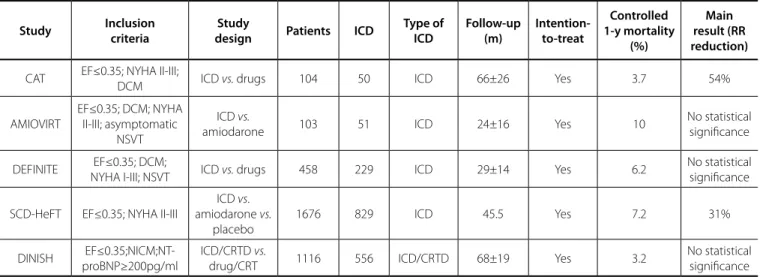
five high-quality trials were eligible for further pooling analysis (Figure 2). The main features of the five included studies have been presented in Table 1.
1.208 initial references from all database
948 potentially relevant articles
13 Prospective clinical studies for eligibility
260 duplicates removed
Paper excluded for: Non-related diseases Non-related treatment
Unoriginal Others
Paper excluded for: 4 articles for Ischemic heart failure 3 articles for secondary prevention 1 article on CRTD vs. medical therapy
5 randomized clinical trials
Characteristics of Studies
The five primary prevention of non-ischemic heart clinical trials are the Cardiomyopathy Trial (CAT), the Amiodarone
versus Implantable Defibrillator Randomized Trial (AMIOVIRT), the Defibrillators in Non-Ischemic Cardiomyopathy Treatment Evaluation (DEFINITE), the Sudden Cardiac Death in Heart Failure Trial (SCD-HeFT), and the Danish Study (DANISH). Substantial heterogeneity among studies was inevitable. The CAT, AMIOVIRT, and DEFINITE are all patients with non-ischemic cardiomyopathy[7,8,12]. However, the SCD-HeFT study
also included ischemic cardiomyopathy[9]. Only patients with non-ischemic cardiomyopathy were included in the study. The DANISH trial randomized patients with non-ischemic cardiomyopathy to ICD/CRTD in combination with optimal medical treatment, or optimal drugs treatment/CRT[6]. Given
the matching ratio of CRT or CRTD between ICD group and control group, this trial was included. One other thing to note was that the Comparison of Medical Therapy, Pacing, and Defibrillation in Heart Failure (COMPANION) was excluded, which randomly assigned patients with advanced heart failure to optimal pharmacologic therapy alone or in combination with CRTD[12]. The COMPANION trial might overstate the benefits of
ICD in combination with function of resynchronized pacing, as CRT alone already has a benefit on survival[13,14]. Furthermore,
patients with ischemic cardiomyopathy was also included, which made data extract impossible. Last but not least, any comparison of defibrillator with antiarrhythmic drugs reveals only the relative effect of these two therapies, not the difference between treatment and no treatment. The AMIOVIRT, SCD-HeFT both compared amiodarone with ICD which might lead to bias inevitably. Given no beneficial effect of amiodarone on survival, those studies were included[1]. Finally, our meta-analysis included
2,573 patients with non-ischemic heart failure randomized to ICD group or optimal pharmacologic therapy group (Table 2).
Table 1. Main features of included articles.
Study Inclusion criteria
Study
design Patients ICD
Type of ICD
Follow-up (m)
Intention-to-treat
Controlled 1-y mortality
(%)
Main result (RR reduction)
CAT EF≤0.35; NYHA II-III;
DCM ICD vs. drugs 104 50 ICD 66±26 Yes 3.7 54%
AMIOVIRT
EF≤0.35; DCM; NYHA II-III; asymptomatic
NSVT
ICD vs.
amiodarone 103 51 ICD 24±16 Yes 10
No statistical significance
DEFINITE EF≤0.35; DCM;
NYHA I-III; NSVT ICD vs. drugs 458 229 ICD 29±14 Yes 6.2
No statistical significance
SCD-HeFT EF≤0.35; NYHA II-III
ICD vs. amiodarone vs.
placebo
1676 829 ICD 45.5 Yes 7.2 31%
DINISH EF≤0.35;NICM;NT-proBNP≥200pg/ml
ICD/CRTD vs.
drug/CRT 1116 556 ICD/CRTD 68±19 Yes 3.2
No statistical significance
AMIOVIRT=Amiodarone vs. Implantable Defibrillator Randomized Trial; CAT=cardiomyopathy trial; CRTD=cardiac resynchronization therapy-cardioverter-defibrillator; DANISH=Danish Study; DCM=dilated cardiomyopathy; DEFINITE=Defibrillators in Non-Ischemic Cardiomyopathy Treatment Evaluation; LVEF=left ventricular ejection fraction; NICM=non-ischemic systolic heart failure; NYHA=New York Heart Association; NSVT=non-sustained ventricular tachycardia; SCD-HeFT=Sudden Cardiac Death in Heart Failure Trial
Table 2. Baseline clinical characteristics of patients.
Study Age (y) Male (%) EF (%) No-ischemic (%)
NYHA (%) Pharmacological therapy (%)
II III ACEI/ARB β-blocker Amiodarone Digoxin
CAT 52±11 83 24 100 67 33 94 4 NR 86
AMIOVIRT 59±11 72 23 100 35 25 85 52 50 71
DEFINITE 58 71 21 100 54 21 97 86 4 42
SCD-HeFT 60 77 25 47.3 71 29 NR 69 NR 67
DNISH 64±8 72 25 100 54 45 97 92 6 NR
ACE/ARB=angiotensin-converting enzyme inhibitor/angiotensin receptor blocker; AMIOVIRT=Amiodarone vs. Implantable Defibrillator Randomized Trial; CAT=cardiomyopathy Trial; DANISH=Danish Study; DEFINITE=Defibrillators in non-Ischemic cardiomyopathy treatment evaluation; LVEF=left ventricular ejection fraction; NYHA=New York Heart Association; SCD-HeFT=Sudden Cardiac Death in Heart Failure Trial
All-Cause Mortality
The CAT, SCD-HeFT trials showed significant reduction in all-cause mortality with RR reduction ranging from 31%-54%[7,9].
However, the AMIOVIRT, DEFINITE, DANISH trials have not shown a statistical reduction in all caused mortality[6,8,12]. When the
results of five randomized clinical trials were pooled, no statistical evidence was found on the pooled evidence of heterogeneity (I2=0, P=0.77). Pooled analysis using a fixed-effects model
showed the summary RR for all-cause mortality was 0.83 (95%CI: 0.65-0.96, P=0.02) (Figure 3).
SCD
The CAT and AMIOVIRT trails have not shown significant reduction in SCD. However, a tendency towards a reduction in SCD by ICD therapy was found in the DEFINITE and DANISH trials (RR: 0.2, CI: 0.06-0.71; RR: 0.50, CI: 0.31-0.82, respectively). Only a substudy of the SCD-HeFT trial was included and we could not extract the exact number of SCD in patients with non-ischemic heart failure. This study was included when we calculated the pooled effects of SCD. Moderate heterogeneity was found (I2=57%, P=0.1). Pooled
analysis using a random-effects model have not shown reduction in SCD (RR: 0.54, CI: 0.21-1.37) (Figure 4).
DISCUSSION
Our updated meta-analysis showed that, compared with optimized medical treatment, ICD in combination with medical treatment can yield improved outcome in patients with non-ischemic heart failure. In order not to overstate the benefits of ICD, the COMPANION study was excluded which randomized patients to optimal medical treatment in combination with CRTD or optimal medical treatment only. This analysis was robust in sensitivity. Finally, it is important to notice that the benefit of ICD is less compared with previous meta-analysis because of inclusion of the recent DANISH study[9,10].
Over the past two decades, ICD implantation in patients with ischemic heart failure has been associated with improved outcome. Theuns et al.[15] performed a meta-analysis as regards
ICD in patients with ischemic heart disease. Pooled analysis showed a 29% RR reduction in all-cause mortality. However, the effectiveness of ICD in patients with non-ischemic heart failure is controversial. Meta-analysis of ICD secondary prevention trials have not shown more benefits compared with medical treatment only[10]. When new evidence occurs, we performed an updated
meta-analysis, and showed that ICD therapy in combination with medical treatment improved outcome of patients with non-ischemic heart failure.
Our meta-analysis must be viewed in the context of its limitation. The treatment of heart failure has improved greatly with the implication of CRT, beta-blocker, and mineralocorticoid-receptor antagonist. Among this five RCTs, only CAT and SCD-HeFT were in favor of ICD implantation. The CAT study was not important in the pooling analysis because of its small sample size. The SCD-HeFT enrolled patients between 1997 and 2001, beta-blocker and mineralocorticoid-receptor antagonist were not well managed among patients at that time. Furthermore, the differentiation between ischemic heart and non-ischemic heart failure was mainly based on patient history, which was quite inaccurate compared with coronary angiography or computed tomographic (CT) angiogram used by the DANISH study. As we known, the evidence for a benefit of ICD is much stronger for patients with ischemic heart failure. The SCD-HeFT might overstate the benefits of ICD in patients with no-ischemic heart failure. The DANISH study of which more patients accepted ACEI/ ARB, beta-blocker, mineralocorticoid-receptor antagonist, and CRT showed lowest mortality rate.
With optimized medical treatment in combined with CRT, ICD implantation in patients with non-ischemic heart failure has not brought further benefits.
Fig. 4 - SCD among patients with non-ischemic heart disease randomized to ICD vs. medical treatment only in primary prevention.
Authors’ roles & responsibilities
ZX
LT
CC
JH
ZZ
XH
Conception, acquisition, analysis, interpretation of data, work review; final approval of the version to be published Conception, acquisition, analysis, interpretation of data, work review; final approval of the version to be published Conception, acquisition, analysis, interpretation of data, work review; final approval of the version to be published Conception, acquisition, analysis, interpretation of data, work review; final approval of the version to be published Conception, acquisition, analysis, interpretation of data, work review; final approval of the version to be published Conception, acquisition, analysis, interpretation of data, work review; final approval of the version to be published
REFERENCES
1. Bardy GH, Lee KL, Mark DB, Poole JE, Packer DL, Boineau R, et al. Amiodarone or an implantable cardioverter-defibrillator for congestive heart failure. N Engl J Med. 2005;352(3):225-37.
2. Moss AJ, Hall WJ, Cannom DS, Daubert JP, Higgins SL, Klein H, et al. Improved survival with an implanted defibrillator in patients with coronary disease at high risk for ventricular arrhythmia. Multicenter Automatic Defibrillator Implantation Trial Investigators. N Engl J Med. 1996;335(26):1933-40.
3. Buxton AE, Lee KL, Fisher JD, Josephson ME, Prystowsky EN, Hafley G. A randomized study of the prevention of sudden death in patients with coronary artery disease. Multicenter Unsustained Tachycardia Trial Investigators. N Engl J Med. 1999;341(25):1882-90.
4. Yancy CW, Jessup M, Bozkurt B, Butler J, Casey DE Jr, Drazner MH, et al. 2013 ACCF/AHA guideline for the management of heart failure: a report of the American College of Cardiology Foundation/American Heart Association Task Force on practice guidelines. Circulation. 2013;128(16):e240-327.
5. Ponikowski P, Voors AA, Anker SD, Bueno H, Cleland JG, Coats AJ, et al. 2016 ESC Guidelines for the diagnosis and treatment of acute and chronic heart failure: The Task Force for the diagnosis and treatment of acute and chronic heart failure of the European Society of Cardiology (ESC). Developed with the special contribution of the Heart Failure Association (HFA) of the ESC. Eur J Heart Fail. 2016;18(8):891-975. 6. Køber L, Thune JJ, Nielsen JC, Haarbo J, Videbæk L, Korup E, et al.
Defibrillator implantation in patients with nonischemic systolic heart failure. N Engl J Med. 2016;375(13):1221-30.
7. Bänsch D, Antz M, Boczor S, Volkmer M, Tebbenjohanns J, Seidl K,
Second, given the small number of studies included, publication bias in favor of ICD therapy cannot be inevitable. Although an extensive search strategy was performed, some studies might not be included in this meta-analysis.
CONCLUSION
et al. Primary prevention of sudden cardiac death in idiopathic dilated cardiomyopathy: the Cardiomyopathy Trial (CAT). Circulation. 2002;105(12):1453-8.
8. Strickberger SA, Hummel JD, Bartlett TG, Frumin HI, Schuger CD, Beau SL, et al. Amiodarone versus implantable cardioverter-defibrillator:randomized trial in patients with nonischemic dilated cardiomyopathy and asymptomatic nonsustained ventricular tachycardia: AMIOVIRT. J Am Coll Cardiol. 2003;41(10):1707-12. 9. Al-Khatib SM, Hellkamp AS, Lee KL, Anderson J, Poole JE, Mark DB, et
al. Implantable cardioverter defibrillator therapy in patients with prior coronary revascularization in the Sudden Cardiac Death in Heart Failure Trial (SCD-HeFT). J Cardiovasc Electrophysiol. 2008;19(10):1059-65. 10. Desai AS, Fang JC, Maisel WH, Baughman KL. Implantable defibrillators
for the prevention of mortality in patients with nonischemic cardiomyopathy: a meta-analysis of randomized controlled trials. JAMA. 2004;292(23):2874-9.
11. Higgins JP, Altman DG, Gøtzsche PC, Jüni P, Moher D, Oxman AD,
et al. The Cochrane Collaboration's tool for assessing risk of bias in randomised trials. BMJ. 2011;343:d5928.
12. Kadish A, Dyer A, Daubert JP, Quigg R, Estes NA, Anderson KP, et al. Prophylactic defibrillator implantation in patients with nonischemic dilated cardiomyopathy. N Engl J Med. 2004;350(21):2151-8. 13. Cleland JG, Daubert JC, Erdmann E, Freemantle N, Gras D, Kappenberger
L, et al. The effect of cardiac resynchronization on morbidity and mortality in heart failure. N Engl J Med. 2005;352(15):1539-49. 14. Rivero-Ayerza M, Theuns DA, Garcia-Garcia HM, Boersma E, Simoons
M, Jordaens LJ. Effects of cardiac resynchronization therapy on overall mortality and mode of death: a meta-analysis of randomized controlled trials. Eur Heart J. 2006;27(22):2682-8.